Opens in a new tab
Join Anantam IAS Channel on Telegram

Daily Digest · Saturday

25 July 2026 Current Affairs for UPSC

6 current affairs published on Saturday, 25 July 2026

25 July 2026 Current Affairs for UPSC — every Why-in-News article AnantamIAS published on Saturday, 25 July 2026, broken down with Why in News?, the exact GS paper it feeds, sub-topic mapping, MCQ-ready facts and a UPSC-style practice question. 6 articles in total, covering Polity, Economy, Environment, S&T, IR, Geography, History, Society and Internal Security — the same Why-in-News + GS-paper-mapping + practice-question format the Compass uses across every daily digest on the site.

Daily current affairs for UPSC is where new material enters your prep stream. Read this 25 July 2026 digest end-to-end in 25–35 minutes, attempt the practice question at the foot of each article (it's MCQ for some, 10/15-marker for others), then bookmark the entries that fall inside your active revision window. Everything stays cross-linked: tap any subject pill to jump to that subject's hub, or use the table of contents above to skip straight to a specific story.

Use this page three ways. Read sequentially for a one-sitting scan of everything that mattered on 25 July 2026. Download the 25 July 2026 PDF below for offline study or print revision. Or use the July 2026 Current Affairs compilation to see this day in the month's full context. For the previous day's reading, see 24 July 2026 Current Affairs; the next day's is 26 July 2026 Current Affairs.

Why we publish daily current affairs separately from the monthly compilation: daily is learning, monthly is revision. Use the daily page to add fresh material to your notes the day it breaks; come back to the July 2026 compilation 60 days before Prelims when the noise has settled and only the lasting takeaway is worth re-reading.

Jagannath Dham Trademark: Protecting Puri Temple’s Sacred Identity

Open article →Download PDF

Why in News?

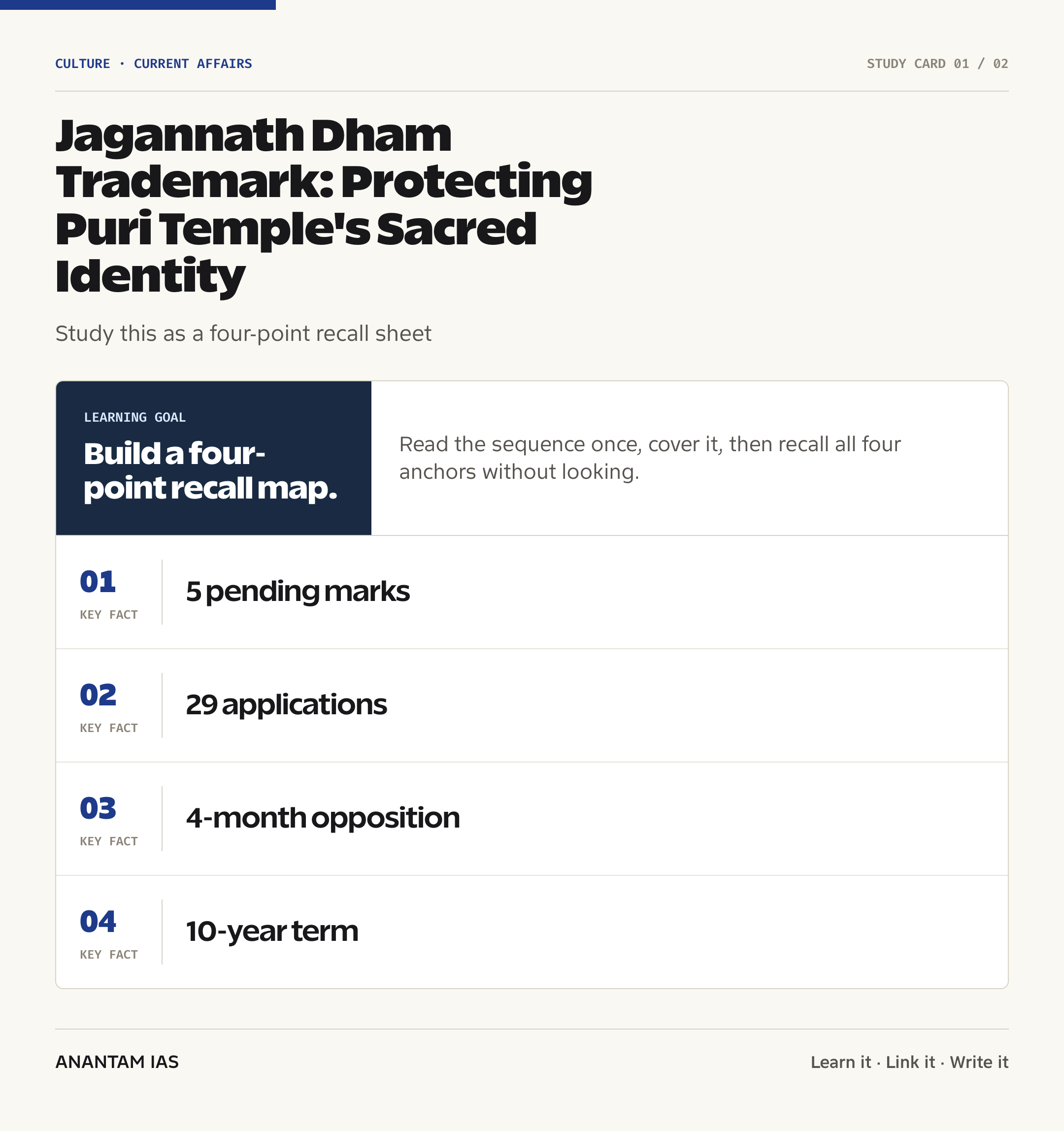
The Indian Express reported on 25 July 2026 that five applications filed by the Shree Jagannath Temple Administration had cleared a second round of examination by the Trade Marks Registry. The marks are Jagannath Dham, Shree Kshetra, Mahaprasad, Nilachakra and Koili Vaikuntha.

The present status is acceptance for publication in the forthcoming Trade Marks Journal, not final registration. Publication opens the statutory opposition stage under the Trade Marks Act, 1999; only after that stage is completed can an eligible application proceed to a registration certificate.

  • Five applications have cleared examination for Journal publication.
  • SJTA has filed 29 applications covering names, expressions and symbols linked to the Puri temple tradition.
  • Three earlier identifiers, Patitapabana, Ananda Bajara and the SJTA Nilachakra logo, were reported as registered in June 2026.
  • The latest applications seek protection against unauthorised commercial exploitation, not ownership over worship, belief or ordinary cultural discussion.
  • The initiative gained urgency after the 2025 dispute over the use of Jagannath Dham for the temple complex at Digha in West Bengal.

The development matters in the context of:

  • The development tests how ordinary intellectual-property law can support the custodianship of a living religious tradition.
  • It also shows why an application, Journal advertisement, opposition proceeding and registration are separate legal stages.
  • The case raises a governance question: how can a statutory temple body prevent deceptive commerce without claiming a blanket monopoly over shared religious vocabulary?
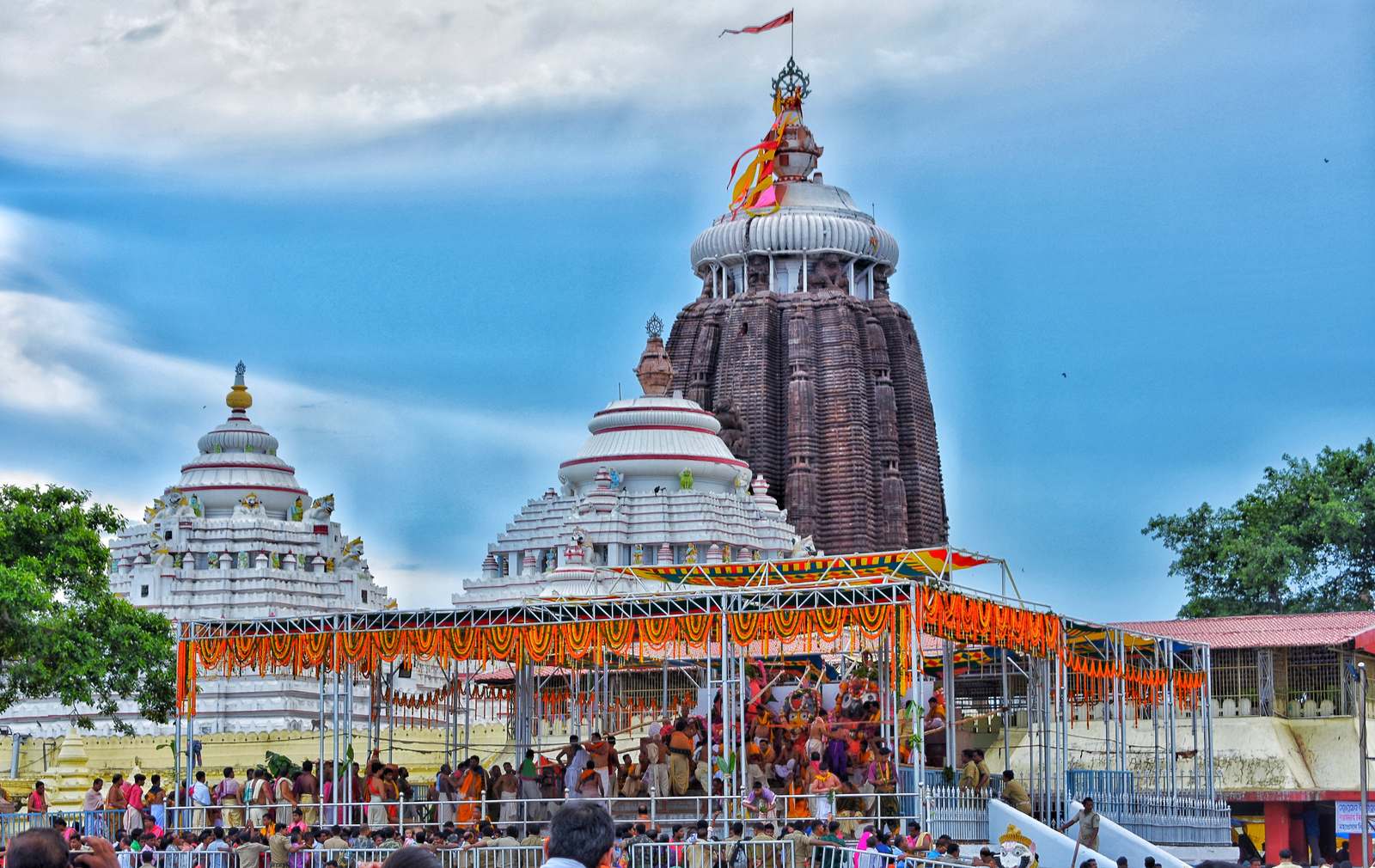
Shree Jagannath Temple complex in Puri, Odisha
The 12th-century Shree Jagannath Temple at Puri is the centre of the Jagannath tradition. Photo: Prachites, CC BY-SA 3.0 (Wikimedia Commons)
Jagannath Dham Trademark: Protecting Puri Temple's Sacred Identity — quick facts

UPSC Relevance

Prelims Relevance

  • The Trade Marks Act, 1999 governs registration and protection of trade marks in India; the Trade Marks Rules, 2017 prescribe procedure.
  • A trade mark identifies a commercial connection between particular goods or services and a proprietor; protection is tied to the specification and class in which the mark is registered.
  • The Trade Marks Registry functions under the Controller General of Patents, Designs and Trade Marks in the Department for Promotion of Industry and Internal Trade.
  • Acceptance and publication in the Trade Marks Journal do not by themselves create a registered trade mark.
  • Under Section 21, any person may oppose an advertised application within four months from its advertisement or re-advertisement.
  • Section 9 contains absolute grounds for refusal, including lack of distinctiveness and marks customary in current language or established trade practice.
  • Section 11 contains relative grounds, including conflict with an earlier mark and likelihood of confusion.
  • Section 28 gives a registered proprietor exclusive rights subject to the Act, conditions and the goods or services covered by the registration.
  • A geographical indication identifies goods whose quality, reputation or characteristic is essentially attributable to geographical origin; it isn’t the same as a trade mark.
  • The Puri temple is administered under a separate state legal framework built around the Shri Jagannath Temple Act, 1955.

Mains Relevance

GS Paper 1

  • Living religious heritage, the Jagannath tradition, Kalinga temple architecture and the cultural geography of Puri.
  • The relationship between sacred vocabulary, ritual practice and the regional identity of Odisha.

GS Paper 2

  • Role of a statutory temple administration, state oversight and institution-based custodianship of cultural assets.
  • Balancing regulatory protection, inter-state sensitivities, freedom of expression and legitimate religious use.

GS Paper 3

  • Operation of trademark law, opposition, infringement, passing off and the limits of exclusive rights.
  • Choosing between trade marks, geographical indications and other tools for protecting cultural and commercial value.

Essay

  • Heritage survives through communities, but institutions can protect it from deceptive commercial appropriation.
  • Legal ownership and cultural belonging aren’t identical; good governance must respect both.

Background and Context

What has been approved, and what has not

The news concerns a procedural milestone, so the legal status must be stated with precision.

  • The Registry has reportedly accepted five applications for publication after a second examination stage; this means the marks are moving into public notice and possible opposition.
  • The five marks are Jagannath Dham, Shree Kshetra, Mahaprasad, Nilachakra and Koili Vaikuntha, each associated with Puri’s temple, rituals or sacred landscape.
  • An application is a request for statutory protection. It doesn’t carry the same enforceable rights as an entry that is actually on the Register and remains in force.
  • After acceptance, the mark is advertised in the Trade Marks Journal. IP India’s official procedure says an unopposed published mark becomes eligible for registration only after the four-month opposition period.
  • If a third party files an opposition, the Registrar must decide the contested proceeding after pleadings, evidence and an opportunity of hearing. The certificate isn’t automatic merely because examination has been cleared.
  • The news reports an SJTA portfolio of 29 applications. But every application has its own mark, specification, class, evidence and prosecution history; portfolio size doesn’t turn pending claims into registered rights.
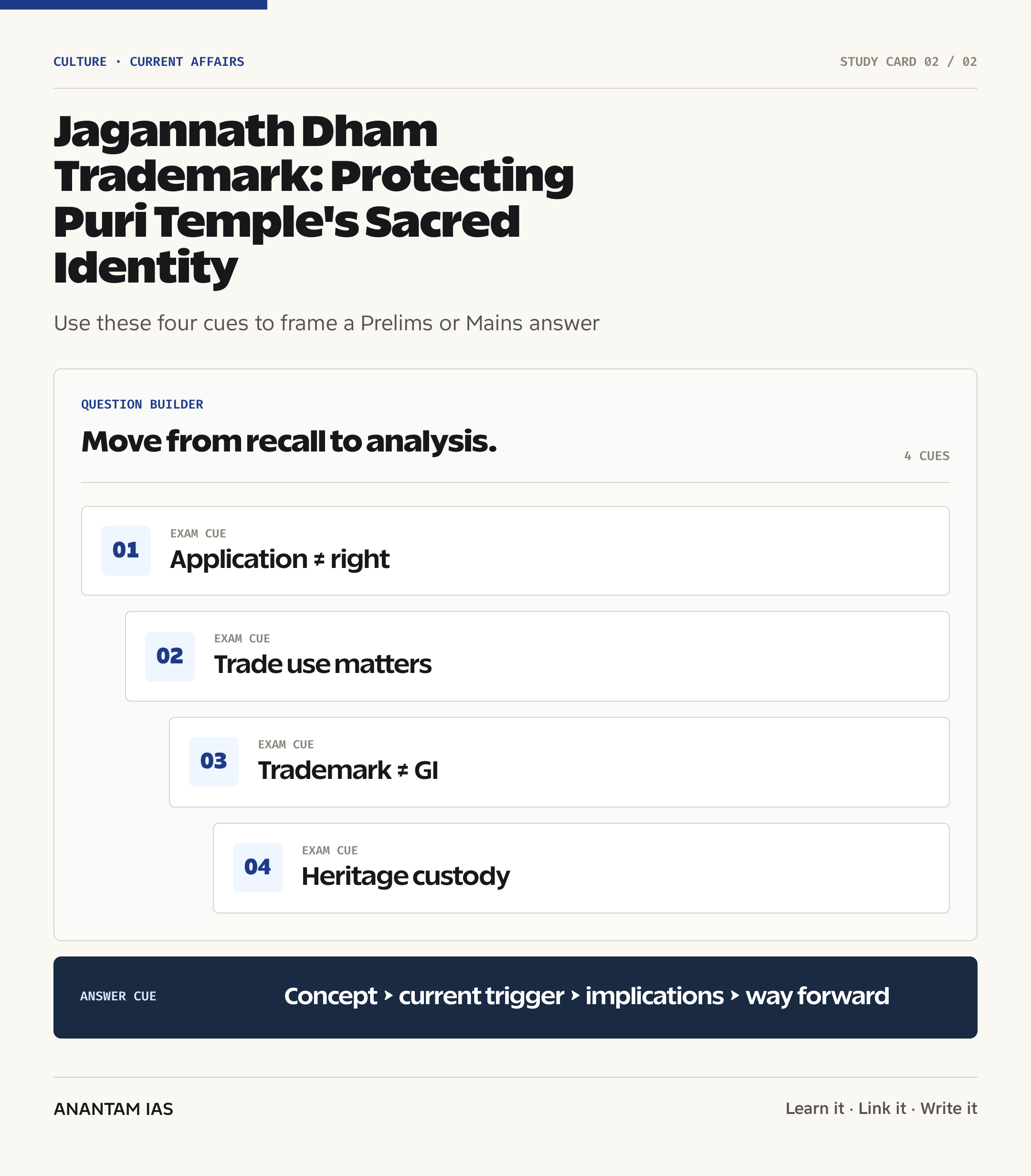
Jagannath Dham Trademark: Protecting Puri Temple's Sacred Identity — exam lens

How the trademark system works

Trademark law protects source-identifying signs in trade rather than ideas, faiths or historical narratives.

  • Under Section 2(1)(zb), a trade mark must be capable of graphical representation and distinguishing one person’s goods or services from those of others.
  • A mark may include a word, name, device, label, logo, shape, packaging or combination of colours. A sacred term can enter the system only through the same legal tests applied to other marks.
  • The applicant files for identified goods or services. Any eventual exclusive right is bounded by the specification, relevant class, statutory limitations and conditions recorded by the Registrar.
  • The Registry first conducts formal and substantive examination. An office objection can require evidence, submissions or a hearing before the mark is accepted for advertisement.
  • Journal advertisement serves a public-law function: it lets prior users, proprietors and other persons challenge a mark before registration through Section 21 opposition.
  • If registered, the mark is ordinarily valid for 10 years and may be renewed for further ten-year periods. Registration can still face rectification, invalidity or non-use proceedings.

Distinctiveness, opposition and limits

The central legal question is not whether a term is revered, but whether the claimed mark can lawfully distinguish the applicant’s covered goods or services.

  • Section 9 can bar a mark that lacks distinctive character, directly describes characteristics of the goods or services, or has become customary in bona fide trade practice.
  • Section 11 addresses conflicts with earlier marks and the likelihood that consumers may be confused about commercial origin or association.
  • Long historical use can support an acquired-distinctiveness claim, but evidence must connect the sign with the applicant as a source identifier for the relevant specification.
  • A registered word mark doesn’t automatically prohibit every spoken, devotional, historical, academic or journalistic use of the words. Infringement analysis focuses on use in the course of trade, similarity, covered goods or services, confusion and reputation.
  • Section 30 preserves important limits on a proprietor’s rights, including certain honest and descriptive uses. The precise defence depends on the facts rather than the sacred character of the vocabulary.
  • Section 27(2) preserves the common-law action of passing off even for an unregistered mark, but the claimant must prove goodwill, misrepresentation and likely damage.
  • For UPSC answers, the safe formulation is that registration can restrain specified deceptive or unauthorised commercial uses; it doesn’t confer ownership of Lord Jagannath, the religion, the city of Puri or the words in every context.

Who is seeking protection

The applicant’s institutional character matters because Puri’s temple administration is rooted in a special statutory arrangement.

  • The Shri Jagannath Temple Act, 1955 reorganised the management of the temple and its properties while recognising the importance of established customs, usages, nitis and rituals.
  • The Act provides for the Shree Jagannath Temple Managing Committee. Odisha’s Law Department lists the Office of the Shree Jagannath Temple Administration as a subordinate office under its administrative control.
  • The management framework includes hereditary, administrative, legal, district and temple-linked representation, reflecting the shrine’s character as both a religious institution and a major public institution.
  • The Chief Administrator exercises executive and day-to-day administrative responsibilities under the statutory scheme; the trademark initiative is presented as an act of institutional custodianship.
  • This authority still operates within general central law. The SJTA must satisfy the Trade Marks Act before the national Registry like any other applicant.
  • A defensible protection strategy should connect enforcement to the temple body’s statutory purpose: authenticity, accountability and prevention of misleading commerce, not control over all cultural participation.

Why the five expressions carry heritage value

Each expression belongs to a wider system of sacred geography, architecture, food and ritual centred on the Puri temple.

  • Jagannath Dham and Shree Kshetra are names associated with Puri as a sacred abode. The Puri district administration identifies the city as one of India’s four dhams.
  • The present 12th-century temple, associated with the Eastern Ganga ruler Anantavarman Chodaganga Deva, is a major example of Kalinga architecture and the centre of the Jagannath tradition.
  • Mahaprasad is the food offered to the deities and distributed through Ananda Bazaar; it carries ritual meaning as well as a substantial everyday economy of preparation and sharing.
  • Nilachakra is the sacred wheel crowning the temple’s spire. The current word-mark application must not be confused with the separately reported registration of SJTA’s Nilachakra logo.
  • Koili Vaikuntha is the sacred area linked with Nabakalebara, when the wooden forms of the deities are renewed and the old forms are ritually interred.
  • The annual Rath Yatra takes the deities into the public realm, making the tradition simultaneously temple-centred and socially expansive.
  • The issue can be read alongside India’s efforts to document and protect living artisanal heritage and to interpret major sites through projects such as the Lothal heritage complex.

The Digha dispute as the immediate trigger

A political and cultural disagreement over temple naming pushed a longer-term heritage concern into an intellectual-property strategy.

  • The West Bengal government opened a Jagannath temple complex at Digha in April 2025 and used the expression Jagannath Dham, prompting objections from Odisha’s government, temple administration, servitors and devotees.
  • Odisha argued that the word Dham in this setting diluted Puri’s distinct sacred identity. The objection combined scriptural tradition, historical association and public sentiment.
  • In June 2026, West Bengal’s new government announced that Dham would be removed from the Digha temple’s name, easing the inter-state political dispute.
  • That resolution doesn’t itself decide a trademark claim. A political naming decision and the Registry’s assessment under the Trade Marks Act are legally distinct processes.
  • The episode shows how cultural symbols can become points of competitive place-branding, tourism promotion and commercial merchandising even when the primary dispute is expressed in religious terms.
  • Governments should avoid treating culture as a zero-sum territorial asset. The policy task is to prevent misrepresentation while allowing legitimate worship, scholarship and cultural exchange.
  • Comparable heritage disputes, such as the legal and archaeological contest around Bhojshala-Kamal Maula, show why evidence, statutory process and institutional restraint matter.

Trademark protection is not GI protection

Both systems protect reputation, but they answer different questions and create different kinds of rights.

  • A trade mark distinguishes the goods or services of one enterprise or proprietor from those of others. It can cover names, logos and other signs used to indicate commercial origin.
  • A geographical indication identifies agricultural, natural or manufactured goods whose quality, reputation or other characteristic is essentially attributable to a defined territory, region or locality.
  • A GI is a community-linked right: the registered proprietor represents producers, and qualifying producers may seek authorised-user status. It isn’t normally assigned or licensed like private commercial property.
  • GI law applies to goods, not a shrine’s identity or religious services in the abstract. A term such as Mahaprasad could raise origin-related questions only through a properly framed goods claim and evidence satisfying the GI Act.
  • Trademark registration for temple-linked terms would instead protect the SJTA’s sign within the approved classes and specification. It wouldn’t silently convert the words into a GI for every food, craft or service from Puri.
  • The distinction is visible in cases such as Jharkhand’s GI-tagged crafts, where protection turns on identifiable goods, producers, territory and attributable reputation.
  • A layered strategy may use trade marks for institutional authentication, GI protection for qualifying products, copyright for original artistic works and consumer law against misleading claims. The legal tool should fit the protected subject.

Way Forward

Complete transparent prosecution

  • Publish non-confidential details of each application, class, specification and status so the public can distinguish pending marks from registered ones.
  • Respond to Registry objections with archival, statutory and use evidence while respecting the four-month opposition window after Journal advertisement.
  • Avoid announcements that describe an accepted application as a completed registration.

Adopt proportionate enforcement

  • Prioritise misleading merchandise, fake endorsements, deceptive fundraising and unauthorised commercial licensing that creates a false SJTA connection.
  • Issue public brand-use guidelines separating prohibited commercial impersonation from good-faith devotional, descriptive, educational, media and artistic use.
  • Use notice, correction and licensing mechanisms before litigation where consumer confusion can be removed without suppressing legitimate cultural expression.

Build a broader heritage protocol

  • Create an authenticated digital register of temple-linked names, logos, ritual objects and approved merchandise with records of provenance and authorised use.
  • Consult servitors, scholars, local producers, consumer bodies and intellectual-property experts before converting living traditions into licensing categories.
  • Assess separately whether particular origin-linked foods or crafts meet the stricter requirements of the GI Act.

Keep federal dialogue open

  • Use inter-state consultation for naming disputes involving shared religious traditions instead of allowing tourism promotion to harden into cultural rivalry.
  • Frame Puri’s distinctiveness through evidence, public education and authentic institutional marks while respecting the spread of Jagannath worship beyond Odisha.
  • Make consumer clarity and heritage integrity the tests for intervention, not political ownership of faith.

Conclusion

The five applications represent a meaningful but incomplete step. Their passage to Journal publication shows that the Trade Marks Registry is willing to expose the claims to public scrutiny; it doesn’t establish that Jagannath Dham and the other expressions are already registered.

A strong heritage policy will use trademark law with precision: authenticate the Puri temple administration, stop deceptive commercial exploitation and preserve evidence of living tradition. It should also leave room for worship, scholarship, fair description and the wider cultural life through which Jagannath heritage endures.

UPSC Practice Questions

Prelims MCQ 1

With reference to trademark registration in India, consider the following statements:

  1. Publication of an application in the Trade Marks Journal is the same as final registration.
  2. Any person may oppose an advertised application within four months of its advertisement or re-advertisement.
  3. A registered trademark’s exclusive right is linked to the goods or services for which it is registered.

How many of the above statements are correct?

(a) Only one (b) Only two (c) All three (d) None

Answer: (b) Only two

Explanation:

Statements 2 and 3 are correct. Journal publication opens the opposition stage; it doesn’t equal registration. Section 21 provides a four-month opposition period, and Section 28 ties the right to the registered mark and covered goods or services.

Prelims MCQ 2

Which option best distinguishes a geographical indication from a trademark?

(a) A GI identifies services of one enterprise, while a trademark protects only agricultural goods. (b) A GI protects every famous place name, while a trademark protects only logos. (c) A GI identifies qualifying goods linked to a geographical origin, while a trademark distinguishes the goods or services of one source from others. (d) A GI and a trademark create identical assignable private rights.

Answer: (c) A GI identifies qualifying goods linked to a geographical origin, while a trademark distinguishes the goods or services of one source from others.

Explanation:

A GI connects qualifying goods and reputation or characteristics to a defined origin and operates as a community-linked right. A trademark identifies commercial source for specified goods or services.

UPSC Mains Questions

  1. Trademark protection can support heritage custodianship, but it cannot substitute for cultural policy. Examine this statement with reference to the Shree Jagannath Temple Administration’s applications for sacred names and symbols.
  2. Distinguish trademark protection from geographical-indication protection. Explain how choosing the wrong intellectual-property tool can either leave cultural assets exposed or create overbroad claims over shared heritage.
  3. How should statutory religious bodies balance authenticity, prevention of commercial misuse and legitimate public use of sacred vocabulary? Suggest a proportionate governance framework.

Sources: IP India, Trade Marks Registry and The Indian Express.

Frequently Asked Questions

Is Jagannath Dham now a registered trademark?

No. The reported status is acceptance for publication in the Trade Marks Journal after examination. Publication gives the public an opportunity to oppose the application. Registration can follow only after the statutory process is completed and any opposition is resolved.

Which five applications cleared examination?

The five reported marks are Jagannath Dham, Shree Kshetra, Mahaprasad, Nilachakra and Koili Vaikuntha. They are linked to Puri’s sacred geography, food tradition, temple symbol and Nabakalebara ritual landscape.

How long is the trademark opposition period?

Under Section 21 of the Trade Marks Act, any person may file opposition within four months from the advertisement or re-advertisement of an application. A shorter news estimate for certificate issuance shouldn’t replace the statutory four-month rule.

Can SJTA stop every use of these words?

No blanket ban follows from an application or registration. Rights depend on the final specification, classes, conditions and facts of use. Trademark infringement generally concerns unauthorised use in the course of trade, while honest descriptive, devotional, educational or referential use may fall outside infringement or within statutory limits.

How is a trademark different from a GI?

A trademark distinguishes one source’s goods or services. A geographical indication identifies qualifying goods whose reputation, quality or characteristic is linked to a defined place. GI protection is community-linked and producer-oriented; it isn’t a general title over a temple name.

Why is Puri temple culturally significant?

The 12th-century Shree Jagannath Temple is a major Kalinga-style shrine and one of India’s Char Dham pilgrimage centres. Its Rath Yatra, wooden deities, Mahaprasad tradition, Nilachakra and Nabakalebara rituals make it a living institution rather than only an archaeological monument.

Buxa Tiger Reintroduction: Habitat Readiness Before Release

Open article →Download PDF

Why in News?

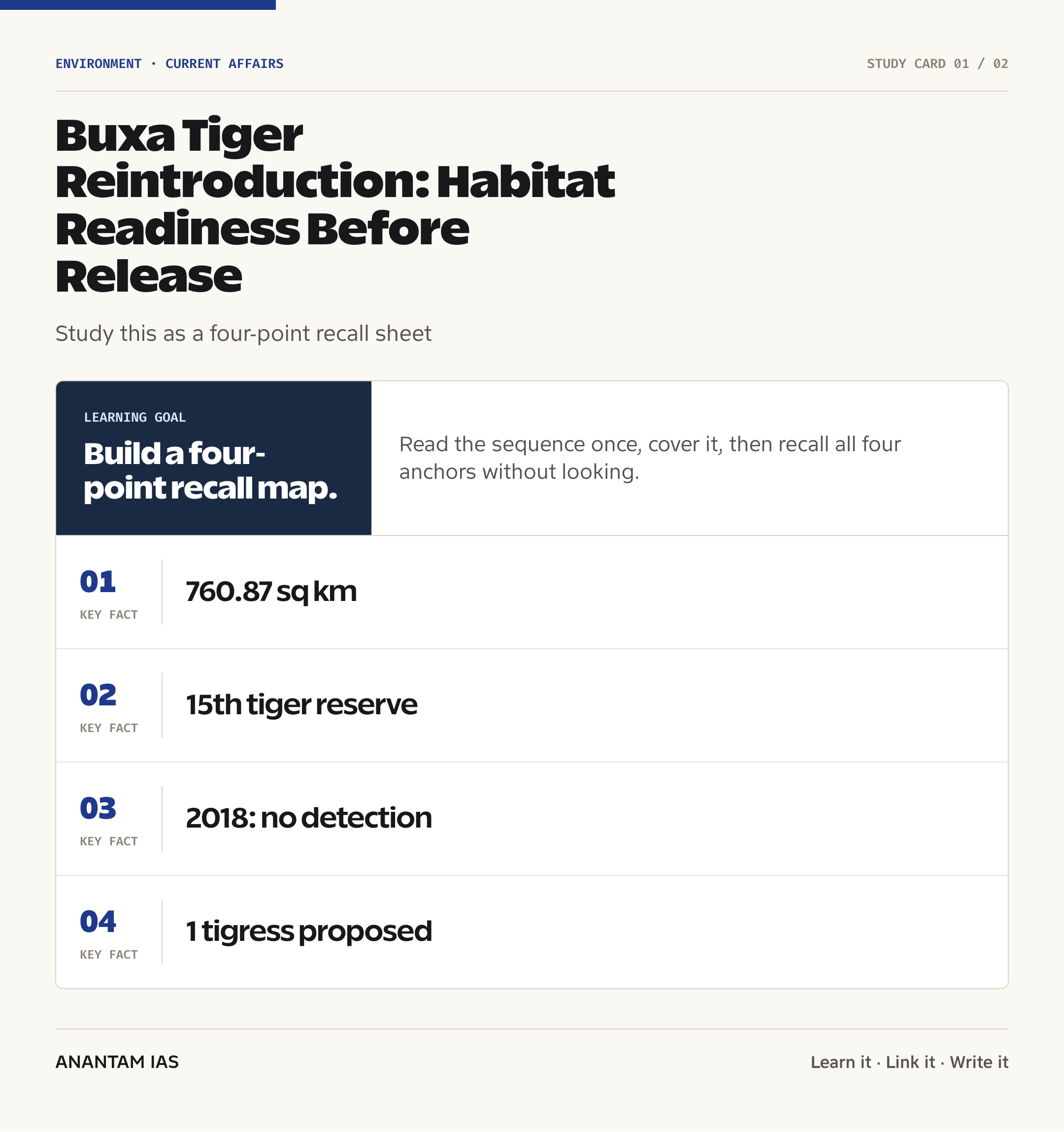
West Bengal has announced a plan to introduce a tigress into Buxa Tiger Reserve in north Bengal on October 2, according to The Hindu. The date is a proposed operational target, not proof that donor selection, statutory clearances and field-readiness checks have all been completed.

The proposal brings attention to a difficult conservation question: moving a tiger can begin a recovery programme, but it can’t substitute for adequate prey biomass, secure habitat, compatible genetics, low conflict risk and sustained monitoring.

  • The announcement was made by West Bengal Environment and Forest Minister Manoj Oraon on July 24, 2026.
  • The Hindu reported that officials were considering a tigress from Valmiki Tiger Reserve in Bihar and were also examining options in Assam.
  • The reported donor options remain proposals; the final animal and source population must pass NTCA, ecological, veterinary and genetic scrutiny.
  • Officials ruled the Sundarban out as an obvious donor because its mangrove-adapted tigers belong to a distinctive ecological setting.
  • Buxa had no tiger detection in the 2018 All India Tiger Estimation, though an adult male was camera-trapped in the reserve in December 2021.

The development matters in the context of:

  • The proposal matters in the context of recovering a tiger population in a reserve where abundance is far below the habitat’s assessed carrying capacity.
  • It tests the difference between animal translocation and full species reintroduction, which seeks a viable, free-ranging population in former range.
  • It connects Project Tiger with prey restoration, corridor security, community rights, human-wildlife conflict management and conservation genetics.
  • It also shows why a launch date should remain conditional on measurable readiness rather than becoming the main measure of success.
Forest landscape in Buxa Tiger Reserve, West Bengal
Buxa Tiger Reserve's forest landscape in the Dooars of northern West Bengal. Photo: Swaroop Singha Roy, CC BY-SA 4.0 (Wikimedia Commons)
Buxa Tiger Reintroduction: Habitat Readiness Before Release — quick facts

UPSC Relevance

Prelims Relevance

  • Buxa Tiger Reserve is in the Dooars region of northern West Bengal, near the international boundary with Bhutan.
  • Buxa became India’s 15th tiger reserve under Project Tiger in 1983.
  • The WII Management Effectiveness Evaluation portal records a total area of 760.87 sq km, including a 390.58 sq km core or Critical Tiger Habitat.
  • The reserve lies where the Lower Gangetic Plains, Central Himalaya and Brahmaputra Valley biogeographic zones meet.
  • Important forest formations include Eastern Bhabar and Terai Sal, moist mixed deciduous, sub-montane semi-evergreen and wet hill forests.
  • Buxa’s identified linkages include the Buxa-Titi, Buxa-Chilapata and Buxa-Ripu at Sankosh corridors.
  • Section 38V of the Wild Life (Protection) Act, 1972 requires a Tiger Conservation Plan for a tiger reserve.
  • The NTCA is a statutory body under the Wild Life (Protection) Act and guides tiger-reserve management, reintroduction and monitoring.
  • Soft release keeps a translocated animal temporarily in an in-situ enclosure before release; it is preferred in the NTCA active-management SOP.
  • Phase IV monitoring uses camera traps for annual tiger monitoring in source areas, while M-STrIPES supports patrolling and ecological records.

Mains Relevance

GS Paper 3

  • Biodiversity conservation through Project Tiger, habitat restoration, prey-base assessment and landscape connectivity.
  • Scientific and ethical requirements for reintroduction, including genetic compatibility, veterinary screening and post-release telemetry.
  • Managing human-wildlife conflict, linear infrastructure, poaching risks and pressures on forest resources.

GS Paper 2

  • Centre-State coordination among the NTCA, State Forest Department, source state and reserve authorities.
  • Balancing conservation with due process, community participation and rights under the Forest Rights Act, 2006.

GS Paper 1

  • Dooars geography, Terai-Bhabar ecology and the role of transboundary linkages between India and Bhutan.

Essay

  • Conservation succeeds when an ecosystem is repaired, not when an animal is merely relocated.
  • Large carnivores turn administrative borders into ecological questions of cooperation.

Background and Context

What Reintroduction Actually Means

A successful reintroduction is a population-recovery project, not a one-day release event.

  • The NTCA defines tiger reintroduction as establishing a population in an area within the species’ historical range where it has become locally extinct.
  • Its principal aim is a viable, free-ranging population capable of performing its ecological and evolutionary role with minimal long-term management.
  • A translocation is the physical movement of an animal; reintroduction is the wider ecological programme covering feasibility, release stock, social conditions, release and long-term follow-up.
  • A single tigress may function as a cautious first phase, but one animal can’t by itself create a breeding population; later decisions must be based on survival, settlement, prey use and risk data.
  • Reintroduction differs from population reinforcement, where animals are added to an existing resident population. Buxa’s uncertain and very low baseline makes that distinction dependent on fresh field evidence, not labels used in a public announcement.
  • India’s experience includes recovery at Sariska and Panna, while problems at Satkosia show that biological, administrative and social preparedness can decide outcomes.
Buxa Tiger Reintroduction: Habitat Readiness Before Release — exam lens

Buxa's Geography and Ecological Position

Buxa occupies a biologically rich transition zone at the Himalayan foothills and the eastern edge of the Dooars.

  • The reserve is in Alipurduar in northern West Bengal and extends towards the Bhutan border across hill, foothill, riverine and alluvial habitats.
  • The WII portal places it at the meeting point of three biogeographic zones: Lower Gangetic Plains, Central Himalaya and Brahmaputra Valley.
  • Its mosaic of Terai Sal, semi-evergreen, moist deciduous, savannah woodland and wet hill forest can support diverse prey and co-predators if disturbance is controlled.
  • Recorded fauna include tiger, leopard, clouded leopard, elephant and gaur, showing that Buxa is more than a single-species conservation unit.
  • Rivers, foothills and forest transitions can create productive habitat, but they also make patrol access, flood-season monitoring and animal movement uneven. A site-level release range must be assessed more precisely than the reserve-wide habitat label.
  • The reserve’s 760.87 sq km area must be read as core plus buffer; ecological viability also depends on connected habitat beyond the legal boundary.

Tiger History and the Readiness Gap

Past tiger records show historical use, but they don’t remove the need for a current, transparent baseline.

  • The WII assessment records minimum estimates of 12 tigers in 2007, 15 through DNA analysis in 2010 and 20 through a 2011 DNA analysis with a strongly male-skewed result.
  • No tiger was recorded in Buxa during the 2018 AITE; an adult male later appeared on a camera trap in East Damanpur Range in December 2021.
  • An occasional camera-trap record can show presence or dispersal, but it isn’t equivalent to evidence of a resident breeding population.
  • WII links Buxa’s low tiger density to anthropogenic pressure and a reduced prey population, and records grassland work and the release of chital as prey-restoration measures.
  • Before release, managers need current estimates of prey density, competing carnivores, livestock use, water, disturbance, disease exposure, poaching risk and carrying capacity.
  • Prey augmentation isn’t just the number of animals released. Managers must measure survival, breeding and distribution of wild prey and avoid disease transfer, over-browsing or dependence on repeated stocking.
  • The case should be studied alongside the wider logic of Project Tiger, where habitat and protection are the foundation and animal movement is only one tool.

Choosing a Donor Population

The source tiger must fit the receiving landscape genetically, ecologically and behaviourally.

  • The Hindu reported that Valmiki Tiger Reserve was under consideration and that Assam was another possible source; neither report should be treated as a final donor decision.
  • The NTCA’s active-management SOP places Buxa in its Northeast Hills and Brahmaputra Floodplains Cluster I with Kaziranga, Manas, Orang, Nameri, Jaldapara and other landscapes.
  • That SOP identifies Kaziranga and Orang as source populations in the cluster and lists Buxa among possible low-density recipient areas, subject to protection readiness.
  • The same SOP places Valmiki in the Shivalik Hills and Gangetic Plains landscape, so a Valmiki proposal calls for explicit, updated genetic and ecological justification rather than an assumption based on state proximity.
  • The SOP treats Sundarban tigers as phenotypically distinctive and adapted to mangrove habitat; it says they shouldn’t be introduced into other clusters.
  • A donor reserve also needs a defensible demographic surplus. Removing a breeding-age female from a small or vulnerable population can shift risk from the recipient landscape back to the source.
  • Final selection should consider relatedness, sex, age, health, behaviour, conflict history and the donor population’s own demographic needs.

Release Protocol and Monitoring

Field protocol converts a transport operation into a controlled conservation intervention.

  • The NTCA SOP requires the receiving site’s field protection and prey base to be ascertained before translocation.
  • It prefers soft release, which uses an in-situ enclosure with natural prey to let the tiger acclimatise before entering the open landscape.
  • A translocated tiger should be radio-collared for close monitoring of movement, settlement, kills, proximity to settlements and possible attempts to return towards the source.
  • Veterinary work should cover capture fitness, injuries, pathogens, parasites, transport stress and emergency-response arrangements without turning routine intervention into excessive handling.
  • Camera traps, telemetry and M-STrIPES patrol data should be combined under clear thresholds for intervention, recapture or conflict response.
  • Monitoring data should be reviewed by a named technical group and released in periodic summaries. This separates a genuine adaptive-management programme from a sequence of unverified claims about sightings or settlement.
  • Success should be assessed over years through survival, reproduction, prey response, conflict trends and habitat use, not through the release ceremony.

Corridors, Communities and Conflict

A tiger will use a lived landscape, so ecological connectivity and human safety must be planned together.

  • WII identifies the Buxa-Titi, Buxa-Chilapata and Buxa-Ripu at Sankosh corridors as important wildlife linkages.
  • These connections link Buxa with landscapes towards Manas, Jaldapara and Phipsoo Wildlife Sanctuary in Bhutan, giving the reserve transboundary importance.
  • The same assessment records villages, tea gardens, grazing and forest-resource dependence in and around Buxa, along with gaps in prey and staffing.
  • Any relocation from critical habitat must be voluntary, rights-compliant, adequately compensated and livelihood-secure; coercion would be legally and socially damaging.
  • Corridor governance reaches beyond forest departments because roads, rail lines, tea estates and settlements affect permeability. District administration and infrastructure agencies must keep risky bottlenecks from becoming ecological traps.
  • Conflict preparation needs rapid compensation, livestock-protection support, local warning systems, trained response teams and trusted communication before a tiger is released.
  • The broader framework is explained in human-wildlife conflict management, where prevention and community confidence matter as much as emergency capture.

Law, Institutions and Accountability

Tiger recovery is governed through a statutory framework rather than an isolated state-level announcement.

  • The Wild Life (Protection) Act, 1972 gives the NTCA statutory functions and requires tiger-reserve notification and planning under Chapter IVB.
  • Under Section 38V, a Tiger Conservation Plan must address core protection, prey and co-predators, buffer management, compatible land use and corridors.
  • The Chief Wildlife Warden, Buxa field management, West Bengal Forest Department, donor-state authorities, veterinarians, scientists and NTCA each carry distinct responsibilities.
  • The legal setting, including protected-area categories and wildlife schedules, can be revised through Wild Life (Protection) Act provisions and amendments.
  • Inter-state movement requires a documented chain of custody, veterinary certification and coordination between the source and recipient authorities. Those records protect animal welfare and allow later evaluation of what worked or failed.
  • Public accountability needs a dated readiness note covering prey, protection, source selection, community consultation, animal health, release method and contingency arrangements.
  • If the readiness evidence isn’t complete by October 2, postponement would be a conservation safeguard rather than a policy failure.

Way Forward

Make the Date Conditional

  • Treat October 2 as a target subject to written readiness gates, not an irreversible deadline.
  • Publish a concise pre-release assessment and record the NTCA approvals, donor-state consent and reasons for source selection.

Prove Habitat and Prey Readiness

  • Complete seasonal prey-density, water, livestock, carnivore, disease and human-disturbance baselines in the proposed release range.
  • Link prey augmentation to native habitat restoration and scientific monitoring; avoid manipulating habitat only to meet a release calendar.

Use Genetics to Select the Source

  • Compare candidate tigers and populations through genetic affinity, demographic surplus and ecological suitability.
  • Explain any departure from the NTCA’s published landscape-cluster guidance with updated evidence and expert review.

Build a Long Monitoring Window

  • Use soft release, a radio collar, camera traps and round-the-clock field capacity during the high-risk settling period.
  • Predefine triggers for veterinary intervention, conflict response, recapture and independent review.

Put Communities Inside the Plan

  • Complete rights recognition, voluntary relocation processes and livelihood safeguards before creating new restrictions.
  • Fund rapid compensation, livestock security, local response teams and corridor-compatible land use so nearby residents share both safety and conservation benefits.

Conclusion

The proposed Buxa tiger reintroduction is ecologically significant because it could restore a top predator to a landscape where tiger abundance has collapsed. But the quality of the programme will be measured by habitat, prey, genetics, protection and public trust, not by whether a release occurs on a symbolic date.

A phased, evidence-led approach can turn Buxa into a test of modern landscape conservation. The sound policy is simple: release only when the receiving ecosystem and surrounding institutions are ready to keep both the tiger and people safe.

UPSC Practice Questions

Prelims MCQ 1

With reference to Buxa Tiger Reserve, consider the following statements:

  1. It is located in northern West Bengal near the Bhutan border.
  2. It lies at the meeting point of the Lower Gangetic Plains, Central Himalaya and Brahmaputra Valley biogeographic zones.
  3. No tiger was recorded there during the 2018 All India Tiger Estimation.

How many of the above statements are correct?

(a) Only one (b) Only two (c) All three (d) None

Answer: (c) All three

Explanation:

All three statements are correct. Buxa is in the Dooars of northern West Bengal, occupies a three-zone biogeographic junction, and had no tiger detection in the 2018 AITE. An adult male was camera-trapped later, in December 2021.

Prelims MCQ 2

Which source populations did the NTCA active-management SOP identify for the Northeast cluster containing Buxa?

(a) Corbett and Dudhwa (b) Kaziranga and Orang (c) Ranthambore and Sariska (d) Kanha and Bandhavgarh

Answer: (b) Kaziranga and Orang

Explanation:

The SOP lists Kaziranga and Orang as source populations producing dispersing tigers in Northeast Cluster I. It includes Buxa among possible recipient areas, subject to adequate protection.

UPSC Mains Questions

  1. Tiger reintroduction is an ecosystem-restoration programme, not merely the translocation of an individual animal. Discuss with reference to habitat readiness, prey density, conservation genetics and post-release monitoring in Buxa Tiger Reserve.
  2. Examine how corridors, community rights and human-wildlife conflict preparedness shape the prospects of recovering a viable tiger population in the transboundary landscape around Buxa Tiger Reserve.
  3. Symbolic deadlines can weaken evidence-led wildlife management. Suggest an accountable decision framework for selecting a donor population and deciding when a tiger should be released into a low-density reserve.

Sources: National Tiger Conservation Authority and Wildlife Institute of India and The Hindu.

Frequently Asked Questions

Where is Buxa Tiger Reserve?

Buxa Tiger Reserve lies in the Dooars of northern West Bengal, in Alipurduar, close to Bhutan. It occupies a transition among the Lower Gangetic Plains, Central Himalaya and Brahmaputra Valley biogeographic zones and is linked with other protected landscapes through wildlife corridors.

When is the Buxa tiger release planned?

West Bengal announced October 2 as the target for introducing a tigress. The date should be read as a proposal because final release depends on donor selection, NTCA and inter-state processes, habitat and prey readiness, veterinary screening, community safeguards and operational preparedness.

Why not move a Sundarban tiger?

The NTCA SOP treats Sundarban tigers as phenotypically distinctive and specially adapted to the mangrove landscape. It advises that they remain within the Sundarban cluster and that tigers from other clusters not be introduced there, protecting ecological adaptation and genetic integrity.

Which source population suits Buxa?

The reported options include Valmiki and reserves in Assam, but no final donor was confirmed. The NTCA’s published cluster guidance places Buxa with Northeast landscapes and identifies Kaziranga and Orang as source populations. Any choice needs updated genetic, ecological, demographic and veterinary evidence.

What makes reintroduction successful?

Success needs adequate wild prey, secure and connected habitat, a suitable donor animal, soft-release capacity, radio-collar and camera-trap monitoring, trained protection and conflict teams, rapid compensation, community trust and enough follow-up to show survival, settlement and reproduction.

What is soft release?

Soft release means holding a translocated tiger temporarily in a secure in-situ enclosure with natural conditions and prey before releasing it into the wider reserve. The NTCA SOP prefers this method because it allows acclimatisation and reduces some risks associated with immediate hard release.

Airport-Airline Cross-Ownership: Competition and Conflict-of-Interest Test

Open article →Download PDF

Why in News?

The Ministry of Civil Aviation has reportedly begun preliminary internal discussions on whether airport operators should be allowed to own and control scheduled airlines. The issue concerns cross-ownership between a bottleneck infrastructure provider and a business that depends on that infrastructure.

The Indian Express reported that the discussion is at an early stage, legal opinion is being sought and no final policy change has been notified. It also reported that Adani Enterprises denied that it was evaluating an airline launch, so a possible regulatory relaxation must not be presented as an approved entry by any company.

  • Contemporary reporting describes a 10% ownership restraint in the concession framework governing the operators of Delhi and Mumbai airports.
  • The public Delhi OMDA of 2006 separately records the cross-ownership concern by capping the aggregate shareholding of scheduled airlines and their group entities in the airport joint venture at 10%, subject to a narrow legacy exception.
  • A change affecting the concession arrangements would require a formal legal and policy process; reports indicate that Union Cabinet approval may be required.
  • The policy objective cited in the reporting is to attract a credible new carrier into a market where IndiGo and the Air India group together account for about 90% of domestic traffic.
  • The central risk is not ownership by itself but the ability of an integrated group to influence slots, stands, counters, gates, charges, ground services and commercial information in favour of its airline.

The development matters in the context of:

  • The debate pits entry-promoting competition in airlines against competition neutrality at airports, which often have local monopoly characteristics.
  • India must distinguish an announced consultation from a rule change: the existing concession terms, airline licensing requirements and competition law remain applicable unless formally amended.
  • The issue is a useful case study in vertical integration, where one corporate group operates at different levels of the same supply chain.
Airport-Airline Cross-Ownership: Competition and Conflict-of-Interest Test — quick facts

UPSC Relevance

Prelims Relevance

  • Operation, Management and Development Agreement (OMDA) is the concession contract through which AAI transferred specified functions at Delhi and Mumbai airports to joint-venture companies.
  • The public Delhi OMDA caps the aggregate holding of scheduled airlines and their group entities in the airport joint venture at 10%; it is a contractual restriction, not a general statutory ban applying identically to every Indian airport.
  • A slot is permission to use the airport infrastructure needed for arrival or departure at a coordinated airport at a specified date and time.
  • The Ministry of Civil Aviation’s Slot Allocation Guidelines, 2013 require a Level 3 airport coordinator to allocate slots neutrally under declared coordination parameters.
  • DGCA grants the Air Operator Certificate under Rule 134 of the Aircraft Rules, 1937 and approves scheduled flight programmes; it is primarily the safety and operational regulator.
  • AERA determines tariffs for aeronautical services and monitors prescribed performance standards at major airports under the AERA Act, 2008.
  • CCI examines anti-competitive agreements, abuse of dominance and combinations under the Competition Act, 2002; dominance itself is not prohibited, but its abuse is.
  • AAI is the public airport and air-navigation entity and the concession counterparty for Delhi and Mumbai airports; it holds 26% equity in both airport joint ventures.
  • Under the current DGCA Civil Aviation Requirement, a scheduled-airline applicant needs a MoCA No Objection Certificate, security clearances and an Air Operator Certificate before operations.
  • A change of 10% or more in an airline’s shareholding pattern separately attracts security-clearance and prior-permission requirements under the current DGCA CAR; this licensing threshold should not be confused with the concession-based cross-ownership cap.

Mains Relevance

GS Paper 3

  • Infrastructure regulation, public-private partnerships and the treatment of airports as essential facilities with local monopoly power.
  • Vertical integration, market entry, economies of scope and the risk of foreclosure in a concentrated aviation market.
  • Balancing investment by deep-pocketed firms with fair access for existing and future airlines.

GS Paper 2

  • Regulatory design across MoCA, DGCA, AERA, AAI, BCAS and CCI, with clear mandates and accountability.
  • Need for transparent consultation and reasoned amendment of long-term public concession contracts.

Essay

  • Competition is not only about adding firms; it also requires neutral access to the infrastructure on which those firms depend.
  • Good regulation separates commercial ambition from control over the rules of access.

Background and Context

What the present debate does and does not change

The first analytical task is to separate a reported policy discussion from the law and contracts currently in force.

  • No notified relaxation had been identified when the issue entered public debate; the Ministry was reported to be holding preliminary discussions and seeking legal advice.
  • The reported proposal focuses on the concession framework associated with Delhi and Mumbai airports, not on a blanket repeal of every aviation ownership rule.
  • The public Delhi OMDA contains a related but reverse-direction restriction: scheduled airlines and their group entities ordinarily cannot hold more than 10% of the airport joint venture, while foreign airlines cannot hold equity in it.
  • News reports describe a restriction on the airport operator holding more than 10% of a scheduled carrier. The exact clause, amendment route and scope must be tested against the full concession and shareholder documents before any decision.
  • Even after a concession amendment, a new carrier would still need the MoCA NOC, MHA security clearance, DGCA Air Operator Certificate, approved schedules, aircraft, crew and safety systems required of every scheduled airline.
  • For a wider overview, see Anantam IAS’s civil aviation in India study note.
Airport-Airline Cross-Ownership: Competition and Conflict-of-Interest Test — exam lens

Why airports are treated as essential facilities

An airport is not an ordinary supplier because an airline often has no close substitute for access to a city’s runway and terminal at commercially useful times.

  • Runway capacity, terminal gates, aircraft stands and night parking are scarce, location-specific inputs; congestion is most valuable during peak hours.
  • A large airport can display natural-monopoly characteristics: duplicating runways and terminals is costly, land-intensive and constrained by safety, environment and urban planning.
  • An airline denied a viable morning slot or a connecting bank may technically receive access but still be unable to build a competitive network.
  • Non-price conditions matter alongside tariffs: check-in counters, boarding gates, baggage systems, lounges, advertising space, ground handling and maintenance access affect costs and passenger experience.
  • The airport operator can also see sensitive commercial information such as proposed schedules, capacity plans and infrastructure requests. A related airline must not receive that information.
  • This is why the issue belongs to competition policy as much as aviation policy. The concepts of market power and denial of access are explained in the Competition Commission of India guide.

How airport slots are allocated

A slot combines a time with access to the runway, stand and terminal capacity needed to operate a flight at a coordinated airport.

  • The MoCA Slot Allocation Guidelines, revised in May 2013, classify the most constrained airports as Level 3 and place allocation with a coordinator.
  • The coordinator must act neutrally, transparently and without discrimination, using declared capacity and coordination parameters.
  • Historic precedence, often called grandfather rights, rewards a carrier that operated an allocated series sufficiently during the previous equivalent season; this promotes schedule stability but can entrench incumbents.
  • The slot pool creates an entry channel. Under the guidelines, 50% of pool slots at initial allocation should go to qualifying new entrants when demand exists, with other stated priorities also applied.
  • DGCA approves summer and winter flight schedules under Rule 140A of the Aircraft Rules, 1937, while slot coordination involves the airport operator, AAI, DGCA and airlines.
  • Cross-ownership raises a principal-agent problem if the infrastructure controller participates in the allocation process while its affiliate competes for the same peak slots.
  • A defensible relaxation would need an independent coordinator, published reasons, auditable timestamps and an appeal mechanism, not a general promise of fair treatment.

Regulatory map and division of responsibility

No single aviation regulator can address the entire conflict because safety, tariffs, concessions, security and market conduct fall under different institutions.

  • MoCA sets policy, issues the airline NOC and represents the Union government in major policy or concession decisions.
  • DGCA certifies airline operational capability, safety systems, personnel, aircraft and schedules; it does not replace a competition investigation.
  • AERA determines aeronautical tariffs and development or passenger fees where its statute applies, and monitors service-performance standards. It can improve cost transparency but does not allocate corporate ownership rights.
  • AAI manages many airports, provides air-navigation services and is the public partner and concession counterparty in the Delhi and Mumbai joint ventures.
  • BCAS and MHA handle aviation security programmes and security clearances for the company, directors and specified changes in control.
  • CCI can review combinations and investigate exclusionary conduct. Sections 3 and 4 of the Competition Act address anti-competitive arrangements and abuse of dominance, including denial of market access or leveraging power from one market into another.
  • The sectoral map is summarised in the internal note on air transport, airports and regulators.

Benefits claimed for a relaxation

Supporters see cross-ownership as a possible route to new capacity in a market where starting and scaling an airline is financially difficult.

  • A well-capitalised airport group may bring patient capital, project execution, traffic data and aviation-service experience to a new carrier.
  • A new airline could weaken the reported near-duopoly, expand consumer choice and give the system redundancy when a large carrier suffers operational disruption.
  • Coordinated investment may reduce transaction costs across terminals, maintenance, cargo, training and ground operations.
  • An integrated group may be willing to develop routes from a new or underused airport where network-building needs simultaneous demand creation and infrastructure investment.
  • But these are potential efficiencies, not automatic public benefits. They must be verifiable, merger-specific and passed through as lower costs, better connectivity or service quality.
  • Entry by one vertically integrated conglomerate can increase the number of airlines while reducing neutrality at the infrastructure layer. A simple carrier count is an incomplete competition test.

Competition risks and the CCI precedent

The strongest Indian precedent treats vertical integration as manageable only with enforceable safeguards against foreclosure and preferential treatment.

  • In its 2019 GMR Airports combination order, CCI examined a link between the Tata group, then active in airlines, and GMR’s airport business.
  • CCI identified incentives to foreclose competing airlines and accepted commitments designed to protect competition neutrality, a level playing field and fairness.
  • The safeguards included restrictions on board and key-managerial appointments, recusal, non-disclosure of sensitive information related to slot allocation and monitoring mechanisms.
  • AAI told CCI that restrictions protect against preferential treatment in slots, terminal and check-in counters, office space, fuel, ground handling, maintenance, cargo and other airport services.
  • Potential abuse can be subtle: a related airline may receive a better slot, faster operational clearance, lower effective charge, superior counter location or advance knowledge of rivals’ plans.
  • Cross-subsidy is another risk if profits from a regulated or monopoly airport activity support aggressive airline pricing, while unrelated carriers bear higher common costs.
  • The policy test should cover ability, incentive and effect: can the airport discriminate, would the group gain from doing so, and can the conduct materially harm rivals or passengers?

Safeguards needed if policy is relaxed

A credible framework would need structural, behavioural and transparency protections that can be audited before harm becomes irreversible.

  • Require separate legal entities, independent boards and distinct key managerial personnel for the airport and airline, backed by fit-and-proper requirements.
  • Create enforceable information firewalls: airline schedules, bids, passenger data and commercial requests received by the airport must not move to the affiliate.
  • Shift slot coordination at affected Level 3 airports to a demonstrably independent coordinator; publish capacity declarations, priority rules, allocations, reasons and changes in machine-readable form.
  • Mandate arm’s-length, non-discriminatory access to gates, stands, counters, parking, ground handling, fuel, MRO, lounges and advertising, with comparable service-level agreements.
  • Use accounting separation and related-party disclosure to prevent hidden cross-subsidy between regulated airport activity, non-aeronautical services and airline operations.
  • Provide a time-bound grievance route, interim relief and penalties for retaliation, because a slot dispute decided after the season may offer no effective remedy.
  • Require periodic independent audits and a joint MoCA-AERA-CCI compliance protocol, while keeping each institution within its statutory mandate.
  • Add a review or sunset clause so the relaxation can be reassessed against entry, fares, slot concentration, service quality and complaints rather than assumed to work permanently.

Way Forward

Consult before amending

  • Publish a competition-impact assessment and the precise concession clauses proposed for amendment.
  • Consult airlines, consumer groups, airport users, state governments, lessors and independent competition experts, and release a reasoned response.

Make neutrality operational

  • Separate slot coordination and commercial access decisions from the integrated group’s management chain.
  • Publish allocation data and use non-discrimination benchmarks for every scarce airport input.

Use a conditional, reversible route

  • If relaxation is adopted, begin with tightly specified licences or a pilot subject to CCI review, audit and measurable public-interest conditions.
  • Retain powers to impose structural separation, divestment or suspension when behavioural safeguards fail.

Conclusion

India needs more resilient airline competition, but the solution can’t give one competitor privileged control over the gateway used by all. The right benchmark is not whether cross-ownership is inherently good or bad; it is whether access remains demonstrably neutral.

Any change should move only after the contractual rule, institutional mandate and safeguards are published. Independent slot allocation, information firewalls, accounting separation and effective competition enforcement can turn a policy experiment into a contestable market rather than a vertically integrated bottleneck.

UPSC Practice Questions

Prelims MCQ 1

With reference to civil aviation regulation in India, consider the following statements:

  1. DGCA grants the Air Operator Certificate for scheduled passenger services.
  2. AERA determines tariffs for aeronautical services at major airports within its statutory remit.
  3. CCI is the authority that approves the technical airworthiness of an airline’s aircraft.

How many of the above statements are correct?

(a) Only one (b) Only two (c) All three (d) None

Answer: (b) Only two

Explanation:

Statements 1 and 2 are correct. DGCA handles operational certification and airworthiness oversight, while AERA performs economic-regulation functions. CCI enforces competition law; it does not certify aircraft.

Prelims MCQ 2

In airport economics, a slot is best described as:

(a) Ownership of a parking bay for an indefinite period (b) Permission to use required airport infrastructure for an arrival or departure at a specified date and time (c) A route right granted under a bilateral air-services agreement (d) A security clearance issued to airline directors

Answer: (b) Permission to use required airport infrastructure for an arrival or departure at a specified date and time

Explanation:

A slot is time-specific access to the airport infrastructure required for an arrival or departure. It is distinct from route rights, ownership of infrastructure and security clearance.

UPSC Mains Questions

  1. Airport-airline cross-ownership may bring new capital and airline entry, but it can also weaken neutral access to essential infrastructure. Examine this trade-off and propose safeguards for slot allocation, airport services and commercial information.
  2. India’s civil aviation sector is governed through overlapping roles of MoCA, DGCA, AERA, AAI, BCAS and CCI. Explain their distinct mandates and assess why coordinated regulation is necessary when an airport operator owns an airline.
  3. The number of competitors is an incomplete measure of competition when one firm controls a bottleneck facility. Discuss with reference to vertical integration and competition neutrality in civil aviation.

Sources: The Indian Express and Airports Authority of India.

Frequently Asked Questions

What is airport-airline cross-ownership?

It means the same corporate group holds meaningful ownership or control in an airport operator and a scheduled airline. Because airlines depend on airports for slots, gates, stands and services, the arrangement can create efficiencies but also incentives to favour the affiliated carrier over rivals.

Has India approved the proposed relaxation?

No final relaxation had been notified when the debate arose. The Indian Express described preliminary Ministry discussions and legal examination, while Adani Enterprises denied evaluating an airline launch. Existing concession terms, airline licensing rules, security clearances and competition law continue unless changed through a formal process.

Does the 10% cap cover every airport?

No. The publicly verifiable OMDA restriction concerns the Delhi and Mumbai airport joint-venture framework and expressly caps scheduled airlines’ aggregate holding in the airport venture. Current reports describe a related constraint on airport operators owning airlines. It should not be treated as one identical statutory ban across all Indian airports.

Why are airport slots competition-sensitive?

At a congested airport, peak-time slots are scarce and directly shape an airline’s network, connections and revenue. An inferior time can make a route unviable. If an airport-linked airline influences allocation, formally equal access may still produce a commercially unequal result.

Which regulator handles the conflict?

The response is shared across institutions. MoCA and AAI deal with policy and concessions, DGCA with safety certification and schedules, AERA with specified airport tariffs and performance standards, and CCI with foreclosure, discriminatory conduct, abuse of dominance and combinations.

What is the strongest safeguard?

No single safeguard is sufficient. The minimum package is an independent slot coordinator, separate boards and management, information firewalls, arm’s-length access terms, accounting separation, public allocation data, external audits and rapid remedies. Structural separation should remain available if repeated discrimination shows behavioural rules are failing.

Vande Mataram Amendment Bill: Proposed Protection for the National Song

Open article →Download PDF

Why in News?

The Prevention of Insults to National Honour (Amendment) Bill, 2026 was introduced in the Rajya Sabha on July 24, 2026. It is a government Bill that seeks to extend the criminal-law protection now given to the National Anthem under Section 3 of the 1971 Act to the National Song, Vande Mataram.

The precise text matters: the Bill does not create a general offence called “insulting Vande Mataram”. It proposes punishment for intentionally preventing its singing or causing disturbance to an assembly engaged in singing it. As of July 25, it is only an introduced Bill, not enacted law.

  • The measure is Bill No. LIX of 2026, introduced in the Council of States.
  • It substitutes Section 3 of the Prevention of Insults to National Honour Act, 1971.
  • The proposed maximum punishment is three years’ imprisonment, a fine, or both.
  • The amendment adds the words “National Song” beside the National Anthem in the two prohibited acts.
  • The Bill’s statement of objects cites Dr. Rajendra Prasad’s statement of January 24, 1950 on the equal honour and status of Vande Mataram.

The development matters in the context of:

  • The proposal tests how the state can protect a shared national symbol without converting patriotic respect into compelled speech.
  • The key legal distinction is between active obstruction and a person’s peaceful decision not to sing.
  • Any restriction on expression must fit the grounds in Article 19(2) and satisfy constitutional standards of clarity, necessity and proportionality.
Vande Mataram Amendment Bill: Proposed Protection for the National Song — quick facts

UPSC Relevance

Prelims Relevance

  • The Prevention of Insults to National Honour Act, 1971 is Act 69 of 1971 and is administered by the Ministry of Home Affairs.
  • Existing Section 2 protects the Indian National Flag and the Constitution of India against specified forms of public insult or contempt.
  • Existing Section 3 penalises intentionally preventing the singing of the National Anthem or disturbing an assembly engaged in such singing.
  • Proposed Section 3 would cover both the National Anthem and the National Song.
  • The maximum punishment under Section 3 is three years, a fine, or both.
  • Under Section 3A, a second or later conviction under Section 2 or Section 3 attracts imprisonment of at least one year.
  • Article 51A(a) asks every citizen to respect the Constitution, its ideals and institutions, the National Flag and the National Anthem; it does not expressly name the National Song.
  • Article 19(1)(a) protects speech and expression, while Article 19(2) permits only specified reasonable restrictions.
  • Article 25(1) protects freedom of conscience and the right freely to profess, practise and propagate religion, subject to constitutional limits.
  • In Bijoe Emmanuel v. State of Kerala (1986), the Supreme Court protected students who stood respectfully but did not sing the National Anthem because of a genuine religious belief.

Mains Relevance

GS Paper 2

  • Relationship between fundamental rights, fundamental duties and laws protecting national symbols.
  • Legislative design questions involving mens rea, legal certainty, proportionality and safeguards against selective enforcement.
  • Role of Parliament and judicial review when an ordinary criminal statute affects speech and conscience.

GS Paper 1

  • Historical role of Vande Mataram in the freedom struggle and the Swadeshi movement.
  • National symbols as carriers of collective memory in a culturally and religiously plural society.

GS Paper 4

  • Difference between sincere civic respect and coerced conformity.
  • Public authority’s duty to combine constitutional patriotism with tolerance of peaceful dissent.

Essay

  • A democracy is strengthened when national unity rests on constitutional consent, not fear of punishment.
  • Respect for national symbols and protection of individual conscience can reinforce each other when law targets harm with precision.

Background and Context

What the Bill Actually Proposes

The as-introduced text is narrow in wording, even though public discussion often describes it broadly as an anti-insult law.

  • Clause 2 substitutes Section 3 with a provision covering the National Anthem or National Song.
  • The first prohibited act is intentionally preventing the singing of either national composition.
  • The second is causing disturbance to an assembly engaged in such singing; the word “intentionally” precedes the two clauses and supplies the mental element.
  • The Bill does not define “insult”, “prevent”, “disturbance” or “assembly”. Its operative clause does not criminalise criticism, parody, silence or refusal to sing in express terms.
  • It also does not impose a general statutory duty on every person to sing Vande Mataram. That distinction must guide enforcement and judicial interpretation.
  • Because the Bill was only introduced, it must still be passed by both Houses of Parliament and receive presidential assent before it can become an Act.
Vande Mataram Amendment Bill: Proposed Protection for the National Song — exam lens

Architecture of the 1971 National Honour Act

The parent law protects different national symbols through conduct-specific offences rather than one open-ended offence of disrespect.

  • Section 2 lists acts such as burning, mutilating, defacing, defiling, destroying or trampling upon the National Flag or the Constitution in public view.
  • Section 2 also covers bringing those symbols into contempt by words or acts, but its first explanation protects lawful criticism aimed at constitutional amendment or alteration of the flag.
  • Existing Section 3 focuses only on intentionally preventing the National Anthem’s singing or disturbing an assembly during it.
  • Both Sections 2 and 3 permit imprisonment up to three years, a fine, or both.
  • Section 3A, inserted in 2003, prescribes imprisonment of at least one year after a second or every subsequent conviction under Section 2 or Section 3.
  • The proposed substitution leaves Section 3A untouched. If enacted, repeat convictions involving the National Song would fall within its enhanced-penalty structure because they would be convictions under amended Section 3.

Constitutional and Historical Status of Vande Mataram

The National Song’s authority comes from constitutional history and executive recognition, not from an article that names it.

  • Bankim Chandra Chattopadhyay composed Vande Mataram, and it became closely associated with India’s anti-colonial movement.
  • Rabindranath Tagore sang it at the 1896 Calcutta session of the Indian National Congress; it later became a prominent rallying cry during the Swadeshi movement.
  • On January 24, 1950, Constituent Assembly President Dr. Rajendra Prasad stated that Vande Mataram would be honoured equally with Jana Gana Mana and have equal status with it.
  • The Assembly did not take that decision through a formal resolution. The President expressly said a statement was preferred, a nuance relevant to the legal source of the song’s status.
  • Article 51A(a) expressly names the Constitution, National Flag and National Anthem among objects of civic respect, but not the National Song.
  • The Bill’s objects and reasons seek to close this statutory gap by placing the singing of Vande Mataram within Section 3.

The July 2026 Home Ministry Orders

An official executive order issued before the Bill standardised the version, occasions and decorum connected with the National Song.

  • The Ministry of Home Affairs order dated July 9, 2026 identifies the official lyrics and gives an approximate playing time of 3 minutes 10 seconds.
  • It lists formal occasions for playing the song, including certain civil investitures, presidential and gubernatorial functions, and when the National Flag is brought on parade.
  • For mass singing, it covers the unfurling of the National Flag at cultural or ceremonial functions and specified public functions involving the President.
  • The order says school work may begin with community singing. The use of “may” is different from a universal legal command to sing.
  • It directs an audience to stand to attention when the official version is sung or played, with an exception where the song forms part of a newsreel or documentary and standing could disrupt the screening.
  • When the National Song and National Anthem are both used, the order places the National Song first. Executive instructions and a criminal statute still perform different legal functions.

Freedom of Expression and Conscience

Constitutional protection depends on separating conduct that blocks others from peaceful non-participation.

  • Article 19(1)(a) protects speech, expression and the freedom not to be compelled to express a belief; restrictions must be justified under Article 19(2).
  • A criminal restriction aimed at disruption may draw support from public order, but its application must retain a real connection with that constitutionally permitted ground.
  • Article 25(1) protects freedom of conscience, subject to public order, morality, health and the other provisions of Part III.
  • In Bijoe Emmanuel, three Jehovah’s Witness students stood respectfully during the National Anthem but did not sing. The Supreme Court found no offence under Section 3 and held their expulsion unconstitutional.
  • The judgment’s durable rule is that respectful silence is not disruption. The state may address active interference without treating every refusal to vocalise as disloyalty.
  • The wider relationship between rights and duties is explained in Anantam IAS’s Fundamental Rights and Duties guide; duties inform civic conduct but do not erase enforceable rights.

Ambiguity, Proportionality and Enforcement Risks

The amendment’s constitutional durability will depend less on symbolism and more on precise, even-handed application.

  • The term “disturbance” is undefined. Police and courts must distinguish audible obstruction, threats or deliberate interruption from silence, departure, criticism or non-participation.
  • The requirement of intent is a vital safeguard: accidental noise, lack of knowledge or conduct unrelated to stopping the singing should not satisfy the offence.
  • A maximum of three years and the repeat-offence minimum invite scrutiny under the principle that punishment should be proportionate to the harm.
  • Prior judicial treatment of Section 3 indicates that loud or contemptuous conduct that actually obstructs an assembly may warrant investigation, while mere non-singing does not.
  • Loose use of the word “insult” could encourage complaints against lawful speech even when the statutory elements are absent. Police guidance should reproduce the two exact prohibited acts.
  • The debate parallels broader questions discussed in Artistic Freedom vs Obscenity: criminal law needs clear boundaries when expression is at stake.

Legislative Scrutiny and the Democratic Balance

Parliament can protect national symbols, but the quality of the law turns on deliberation, definitions and safeguards.

  • As an ordinary government Bill, the proposal can be debated, amended, referred to a committee, passed, rejected or allowed to lapse under the applicable constitutional rules.
  • A committee could examine whether “prevents” and “disturbance” need statutory definitions, illustrative exclusions or a threshold of material interference.
  • Legislators should assess whether arrest, investigation and sentencing rules create adequate filters against vexatious complaints.
  • The state can affirm the song’s historical importance through education and voluntary civic practice alongside carefully limited penal protection.
  • Parliament’s deliberative and oversight functions are covered in the Anantam IAS guide to the Parliament of India.
  • The sound constitutional balance protects an assembly’s freedom to sing while preserving another citizen’s right to respectful non-participation.

What a Prosecution Would Need to Prove

If enacted, the provision should be applied as a conventional criminal offence with every statutory element proved, not as a presumption against unpopular conduct.

  • The prosecution would first need evidence that an assembly was engaged in, or a person was undertaking, the singing of the National Song covered by amended Section 3.
  • It would need to identify a concrete act that actually prevented the singing or caused a disturbance, rather than relying only on a complainant’s feeling of offence.
  • The placement of “intentionally” at the opening of proposed Section 3 requires proof of a deliberate mental state connected with the prohibited result.
  • A close temporal and causal link should connect the accused person’s conduct with interruption of the rendition; remote criticism or later commentary does not supply that link.
  • Video, audio, neutral witnesses and surrounding circumstances may show both guilt and innocence. Investigators should preserve exculpatory evidence, including proof that a person stood quietly or left without interfering.
  • Courts should prefer a rights-consistent interpretation that gives effect to the law’s protective purpose while avoiding any reading that compels belief, speech or participation.

Way Forward

Define the Offence Narrowly

  • Clarify that liability requires deliberate and material interference with an ongoing or imminent rendition.
  • Expressly exclude peaceful silence, refusal to sing, lawful criticism and accidental disturbance from the offence.

Build Procedural Safeguards

  • Issue binding investigation guidance on intent, evidence and actual obstruction before coercive action.
  • Require reasoned supervisory review for registration or prosecution to reduce symbolic or politically motivated complaints.

Apply the Proportionality Principle

  • Review whether the penalty range and the one-year repeat minimum are calibrated to varying levels of harm.
  • Reserve imprisonment for serious, deliberate obstruction and consider graded responses for minor conduct.

Prefer Constitutional Civic Education

  • Teach the song’s history, authorised rendition and freedom-struggle role through accurate public material rather than compelled performance.
  • Train public authorities to protect both national dignity and the pluralism embodied in the Constitution.

Conclusion

The Bill seeks to give the singing of Vande Mataram the same Section 3 protection now attached to the National Anthem. But it remains a proposal, and its text targets intentional prevention or disturbance rather than creating an unlimited offence of hurt patriotic sentiment.

A defensible law must preserve that narrow focus. Protecting people who wish to sing and protecting those who remain respectfully silent are not rival constitutional goals; together they express constitutional patriotism rooted in dignity, tolerance and the rule of law.

UPSC Practice Questions

Prelims MCQ 1

With reference to the Prevention of Insults to National Honour (Amendment) Bill, 2026, consider the following statements:

  1. It was introduced in the Rajya Sabha.
  2. It proposes to add the National Song to Section 3 of the 1971 Act.
  3. It has already made refusal to sing Vande Mataram a criminal offence.

How many of the above statements are correct?

(a) Only one (b) Only two (c) All three (d) None

Answer: (b) Only two

Explanation:

Statements 1 and 2 are correct. The Bill was introduced in the Rajya Sabha and would extend Section 3 to the National Song. Statement 3 is incorrect: it is not yet law, and the operative text addresses intentional prevention or disturbance, not mere refusal to sing.

Prelims MCQ 2

Which constitutional provision expressly lists respect for the National Anthem as a Fundamental Duty?

(a) Article 19(2) (b) Article 25(1) (c) Article 51A(a) (d) Article 368

Answer: (c) Article 51A(a)

Explanation:

Article 51A(a) requires citizens to abide by the Constitution and respect its ideals and institutions, the National Flag and the National Anthem. The clause does not expressly name the National Song.

UPSC Mains Questions

  1. The Prevention of Insults to National Honour (Amendment) Bill, 2026 seeks to protect Vande Mataram through criminal law. Examine how Parliament can distinguish intentional obstruction from peaceful non-participation while respecting Articles 19(1)(a), 19(2) and 25 of the Constitution.
  2. National symbols derive authority from shared history, but democratic respect cannot rest on vague offences. Discuss the need for legal certainty, proportionality and procedural safeguards in enforcing laws relating to the National Anthem and National Song.
  3. Fundamental Duties can guide citizenship without extinguishing Fundamental Rights. Analyse this proposition with reference to Article 51A(a), the proposed National Honour amendment and the Supreme Court’s reasoning in Bijoe Emmanuel v. State of Kerala.

Sources: Rajya Sabha Bill text and PRS Legislative Research and The Indian Express.

Frequently Asked Questions

What is the Vande Mataram amendment Bill?

It is the Prevention of Insults to National Honour (Amendment) Bill, 2026. Introduced in the Rajya Sabha on July 24, it proposes to substitute Section 3 of the 1971 Act so intentional prevention or disturbance of the singing of the National Song is treated like similar conduct involving the National Anthem.

Is the Vande Mataram Bill already law?

No. As of July 25, 2026, it has only been introduced in the Rajya Sabha. It must complete the parliamentary process, be passed by both Houses and receive the President’s assent before becoming law. Existing Section 3 still refers only to the Indian National Anthem.

Does the Bill punish refusal to sing?

The operative text does not expressly punish silence or refusal to sing. It covers intentionally preventing the singing or disturbing an assembly engaged in singing. Bijoe Emmanuel protects respectful non-singing in the National Anthem context, so enforcement must distinguish non-participation from active obstruction.

What punishment does the proposal provide?

Proposed Section 3 retains the existing punishment: imprisonment for up to three years, a fine, or both. Section 3A separately prescribes at least one year’s imprisonment for a second or every later conviction under Section 2 or Section 3, a feature relevant if the amendment is enacted.

What is Vande Mataram’s constitutional status?

On January 24, 1950, Constituent Assembly President Dr. Rajendra Prasad stated that Vande Mataram would be honoured equally with Jana Gana Mana and have equal status with it. The Constitution’s Article 51A(a), however, expressly names the National Flag and National Anthem, not the National Song.

Why is Bijoe Emmanuel relevant?

In Bijoe Emmanuel v. State of Kerala, students stood respectfully during the National Anthem but declined to sing because of a genuine religious belief. The Supreme Court protected their freedoms under Articles 19(1)(a) and 25 and found no Section 3 offence, establishing an important distinction between respectful silence and disruption.

Bangladesh President Resigns: Constitutional Succession and India’s Stakes

Open article →Download PDF

Why in News?

Bangladesh President Mohammed Shahabuddin resigned on 24 July 2026, submitting a signed letter to Jatiya Sangsad Speaker Hafiz Uddin Ahmad and citing serious health complications that required long-term treatment.

Bangladesh Sangbad Sangstha reported that the Speaker accepted the resignation at 5:01 p.m. and then assumed the President’s functions under Article 54. The development tests constitutional continuity during Bangladesh’s post-2024 political transition and matters directly to India’s neighbourhood policy.

  • The resignation letter invoked Article 50(3), which allows the President to resign through a signed writing addressed to the Speaker.
  • Speaker Hafiz Uddin Ahmad became Acting President after accepting the letter; Bangladesh does not leave the head-of-state functions unattended during a vacancy.
  • Article 123(2) requires an election to fill a vacancy caused by death, resignation or removal within 90 days of the vacancy.
  • Shahabuddin entered office as Bangladesh’s 22nd President on 24 April 2023, so the resignation ended his five-year term early.
  • The Associated Press reported political speculation surrounding the exit but said it couldn’t independently confirm an alleged telephone contact with former Prime Minister Sheikh Hasina; the formal and verified ground remains ill health.

The development matters in the context of:

  • The episode matters in the context of constitutional legitimacy: a rules-based handover can reduce uncertainty even when the political background is contested.
  • It matters for India-Bangladesh relations because political stability affects border management, connectivity, trade, energy links and cooperation in the Bay of Bengal.
  • It also tests whether Bangladesh’s institutions can separate a constitutional succession process from partisan disputes arising from the 2024 uprising and the subsequent transfer of power.
Jatiya Sangsad Bhaban, the Parliament building of Bangladesh, in Dhaka
Bangladesh's Parliament building in Dhaka, where the Speaker announced the constitutional succession. Photo: Saiful Aopu & Nahid Sultan, CC BY-SA 3.0 (Wikimedia Commons)
Bangladesh President Resigns: Constitutional Succession and India's Stakes — quick facts

UPSC Relevance

Prelims Relevance

  • Bangladesh is a parliamentary republic in which members of the Jatiya Sangsad elect the President.
  • Article 48 establishes the presidency, identifies the President as head of state and provides for election by members of Parliament.
  • Article 50(1) provides a five-year presidential term, while Article 50(2) limits a person to two terms, consecutive or otherwise.
  • Article 50(3) says the President may resign by a signed writing addressed to the Speaker.
  • Article 54 authorizes the Speaker to discharge presidential functions when the office is vacant or the President is unable to act.
  • Article 123(2) mandates a presidential election within 90 days after a vacancy caused by death, resignation or removal.
  • Article 48(3) generally binds the President to the Prime Minister’s advice, except when appointing the Prime Minister and the Chief Justice.
  • Article 55 places executive power with the Prime Minister-led Cabinet, which is collectively responsible to Parliament.
  • Article 49 grants the President the prerogative of mercy, while Article 61 vests the supreme command of the defence services in the President subject to law.
  • BIMSTEC, whose permanent secretariat is in Dhaka, links Bangladesh and India with five other Bay of Bengal countries.

Mains Relevance

GS Paper 2

  • Compare parliamentary head-of-state succession with executive succession in presidential systems.
  • Examine how constitutional offices provide continuity during a disputed political transition.
  • Assess the role of stable institutions in India’s Neighbourhood First policy and bilateral diplomacy.

GS Paper 3

  • Connect political stability in Bangladesh with border management, transnational crime and security in India’s eastern and northeastern states.
  • Assess implications for connectivity corridors, power trade, ports and Bay of Bengal economic integration.

Essay

  • Constitutions matter most when political consensus is weakest.
  • Neighbourhood diplomacy works better through institutions than through dependence on individual leaders.
  • A ceremonial office can become a stabilizing office during moments of political uncertainty.

Background and Context

What the resignation changed immediately

The resignation created a vacancy in the presidency, but the Constitution supplied an immediate bridge rather than a power vacuum.

  • Mohammed Shahabuddin addressed his signed resignation to the Speaker, matching the procedure set out in Article 50(3).
  • Bangladesh Sangbad Sangstha said the letter cited heart disease, hypertension, diabetes, kidney complications and autonomic neuropathy; detailed medical claims came from the resignation statement.
  • Once the Speaker accepted the letter, Article 54 became the operative continuity clause and Hafiz Uddin Ahmad began discharging presidential functions.
  • The Acting President is a constitutional caretaker of the office, not a separately elected President with a fresh five-year mandate.
  • The Speaker continues only until a new President is elected and assumes office; the vacancy election must fit the 90-day window in Article 123(2).
  • When the Speaker acts as President, the Deputy Speaker performs the Speaker’s parliamentary functions under the constitutional arrangement for continuity in the legislature.
Bangladesh President Resigns: Constitutional Succession and India's Stakes — exam lens

How Bangladesh elects and constrains its President

Bangladesh uses an indirectly elected head of state within a Prime Minister-led parliamentary executive.

  • Under Article 48(1), members of Parliament elect the President; the public does not vote directly for the office.
  • A candidate must be at least 35 years old, be qualified for election as an MP and must not have been removed previously through presidential impeachment.
  • The President’s normal term is five years, with no more than two terms for one person, whether consecutive or not.
  • Under Article 48(3), the President generally acts on the Prime Minister’s advice, making the office largely ceremonial in routine administration.
  • The two express exceptions are appointing the Prime Minister who appears to command a parliamentary majority and appointing the Chief Justice.
  • The office still carries constitutional weight through formal appointments, the prerogative of mercy, state representation and functions that become sensitive during government formation or political crisis.

Political transition since the 2024 uprising

Shahabuddin’s exit can’t be understood apart from Bangladesh’s prolonged transition after Sheikh Hasina left power.

  • Shahabuddin was elected during the Awami League government and took office on 24 April 2023.
  • After the student-led uprising and Sheikh Hasina’s departure in August 2024, he remained President while Parliament was dissolved and an interim administration took office.
  • The Muhammad Yunus-led interim administration governed for about 18 months before the February 2026 election returned an elected government.
  • The new government led by Prime Minister Tarique Rahman inherited unresolved debates over accountability, institutional reform and the political legacy of the uprising.
  • Student-origin political groups had previously demanded Shahabuddin’s removal, arguing that his association with the old order weakened the legitimacy of the transition.
  • News reports also described pressure linked to an alleged contact with Hasina during a medical visit, but that claim remains unverified; exam answers should distinguish reported allegations from the constitutional record.

Why the office is more than ceremonial in a crisis

The presidency has limited day-to-day discretion, yet continuity at the apex of the state can become important when institutions are under stress.

  • All executive actions are formally expressed in the name of the President, even though Article 55 places effective executive authority with the Prime Minister and Cabinet.
  • The President appoints the person who appears to command a parliamentary majority as Prime Minister, a function that matters if election results or coalitions are unclear.
  • The President appoints the Chief Justice without the specific advice requirement that applies to most other presidential functions.
  • The President possesses the prerogative of mercy, while constitutional immunity protects official acts and bars criminal proceedings during the term.
  • The supreme command of the defence services is vested in the President under Article 61, but its exercise is regulated by law.
  • An orderly succession signals that political actors accept constitutional procedure even when they disagree over the former office-holder’s political alignment.

India's strategic stakes

For India, the immediate issue is institutional stability in a country central to its eastern neighbourhood and Bay of Bengal strategy.

  • India’s Ministry of External Affairs records a 4,096.7-km land boundary with Bangladesh, India’s longest with any neighbour, making stable coordination relevant to border policing and local livelihoods.
  • Cooperation between the BSF and Border Guard Bangladesh supports action against trafficking, smuggling, fake currency and other cross-border crimes.
  • Bangladesh provides geography vital to road, rail, inland-waterway and port access linking mainland India with the Northeast.
  • Power trade, transmission links and transport projects need predictable decisions across administrations; readers can connect this with the recent Bangladesh foreign minister’s Delhi visit.
  • Dhaka hosts the BIMSTEC Secretariat, and Bangladesh is central to Bay of Bengal cooperation on connectivity, disaster response and security. See the BIMSTEC security cooperation note.
  • The treatment of Sheikh Hasina’s presence in India and Bangladesh’s requests concerning her remain politically sensitive, so New Delhi must separate legal processes from day-to-day state relations.

The deeper lesson for neighbourhood policy

Leadership changes are a reminder that durable diplomacy rests on broad institutions and public legitimacy.

  • India should work with Bangladesh’s elected government, Acting President, Parliament, bureaucracy and security institutions without appearing to choose sides in domestic politics.
  • Respect for sovereignty and non-interference should shape public messaging, while private diplomacy keeps border and economic mechanisms functioning.
  • A relationship built around one party or leader is exposed when power changes; the trust deficit in India-Bangladesh ties shows why outreach must be wider.
  • Subnational governments in West Bengal, Assam, Meghalaya, Tripura and Mizoram also matter because water, border and connectivity questions affect them directly.
  • India’s best hedge is reliable delivery on mutually agreed projects, predictable visa and trade administration, and open channels across Bangladesh’s political spectrum.
  • The constitutional handover should be judged by whether the 90-day election requirement is met and whether state institutions operate without partisan coercion.

Bangladesh and India: a constitutional comparison

The two parliamentary republics use different mechanisms to keep the head-of-state office functioning after an unexpected vacancy.

  • In Bangladesh, members of Parliament elect the President; in India, an electoral college of elected MPs and elected state and eligible Union Territory legislators elects the President.
  • Bangladesh has no constitutional office of Vice-President. Its Speaker discharges presidential functions under Article 54 when the presidency falls vacant.
  • In India, Article 65 provides that the Vice-President acts as President during a vacancy, while other arrangements apply if both offices are unavailable.
  • Bangladesh’s Article 123(2) gives 90 days to fill a vacancy caused by death, resignation or removal; India’s Article 62 requires the election within six months.
  • Both systems separate the formal head of state from the real executive, which is the Prime Minister and Council or Cabinet responsible to the elected lower house.
  • The comparison shows a common parliamentary principle: the Constitution identifies an immediate acting authority and a deadline for restoring the regularly elected office-holder.
  • A key exam trap is to assume identical succession. The Bangladeshi Speaker, not a Vice-President or Chief Justice, is the first constitutional substitute under Article 54.

What to monitor over the next 90 days

The success of the transition will depend on implementation, not only on the text of the resignation and succession provisions.

  • The first test is whether the Election Commission announces a timetable early enough for nomination, scrutiny, withdrawal and voting to finish within the constitutional deadline.
  • Because Parliament elects the President, the governing majority will have decisive influence; political legitimacy will depend on a process that remains procedurally credible to opposition parties and the public.
  • The Acting President should avoid actions that could be seen as creating an independent long-term mandate, especially on appointments, mercy petitions or matters carrying major partisan consequences.
  • The Deputy Speaker’s handling of parliamentary business must prevent institutional congestion while the Speaker performs presidential functions, preserving both legislative scrutiny and executive continuity.
  • Public authorities should communicate the verified medical basis and constitutional timetable clearly, reducing space for rumours without suppressing legitimate questions about political pressure.
  • For India, the practical indicators are uninterrupted border coordination, progress on connectivity and energy mechanisms, and continued diplomatic access to the elected government and constitutional authorities.
  • A timely election would reinforce the message that the post-uprising order is moving through constitutional institutions; delay or coercion would revive questions about the durability of democratic normalization.

Way Forward

For Bangladesh's institutions

  • Publish a clear constitutional timetable for the presidential election and complete the process within Article 123(2)’s 90-day limit.
  • Keep the Acting President’s decisions transparent and distinguish temporary stewardship from a new political mandate.
  • Let Parliament and the Election Commission perform their defined roles without converting the succession into a partisan contest over the 2024 transition.
  • Address allegations through lawful investigation and evidence, not through retrospective claims that blur the formally recorded basis of resignation.

For India-Bangladesh relations

  • Maintain institutional contact with the Prime Minister’s Office, Foreign Ministry, Parliament and security agencies during the transition.
  • Ring-fence practical cooperation on border management, trade, energy and connectivity from political rhetoric surrounding individual leaders.
  • Use BIMSTEC and bilateral mechanisms to sustain working-level cooperation while respecting Bangladesh’s constitutional process.
  • Expand engagement with civil society, business, youth and provincial stakeholders so the relationship gains support beyond governing elites.

For UPSC answer writing

  • Start with the constitutional chain: Article 50(3) → Article 54 → Article 123(2).
  • Then distinguish the President’s formal status from the Prime Minister-led executive under Articles 48 and 55.
  • End by linking domestic continuity to India’s interests in border stability, Northeast connectivity and Bay of Bengal regionalism.

Conclusion

Mohammed Shahabuddin’s resignation is important less for the departure of one office-holder than for the constitutional sequence it activates. Article 54 prevents a vacuum, while Article 123(2) creates a time-bound route back to an elected President.

For India, a calm and institution-first response is the soundest approach. Stable relations with Bangladesh require respect for its political choices, continuity in practical cooperation and engagement that survives changes of party and personality.

UPSC Practice Questions

Prelims MCQ 1

With reference to the President of Bangladesh, consider the following statements:

  1. The President is elected directly by the people.
  2. The President may resign through a signed writing addressed to the Speaker.
  3. The Speaker discharges presidential functions when the office falls vacant.

How many of the above statements are correct?

(a) Only one (b) Only two (c) All three (d) None

Answer: (b) Only two

Explanation:

Statements 2 and 3 are correct under Articles 50(3) and 54. Statement 1 is incorrect because members of the Jatiya Sangsad, not the public directly, elect the President.

Prelims MCQ 2

A vacancy caused by a Bangladeshi President’s resignation must be filled within:

(a) 30 days (b) 60 days (c) 90 days (d) Six months

Answer: (c) 90 days

Explanation:

Article 123(2) requires an election within 90 days when the presidential office becomes vacant because of death, resignation or removal.

UPSC Mains Questions

  1. Bangladesh’s presidential succession shows how a largely ceremonial head of state can still support constitutional continuity during political stress. Explain the relevant constitutional sequence and assess its importance for democratic legitimacy. (250 words)
  2. Political transitions in Bangladesh have consequences beyond its borders. Examine the implications of stable constitutional governance in Bangladesh for India’s border security, northeastern connectivity and Bay of Bengal strategy. (250 words)
  3. India’s neighbourhood policy should be institution-centric rather than leader-centric. Discuss with reference to recent political changes in Bangladesh and the requirements of a durable bilateral partnership. (250 words)

Sources: Constitution of Bangladesh, Bangladesh Laws and The Hindu.

Frequently Asked Questions

Why did Mohammed Shahabuddin resign?

His signed letter cited serious health complications and the need for long-term treatment. Bangladesh Sangbad Sangstha reported that he invoked Article 50(3). News outlets also described political pressure and an alleged contact with Sheikh Hasina, but the Associated Press said it couldn’t independently verify that allegation.

Who is Bangladesh’s Acting President?

Hafiz Uddin Ahmad, the Speaker of the Jatiya Sangsad, began discharging the President’s functions after accepting Shahabuddin’s resignation. He acts under Article 54 until a newly elected President assumes office. This is temporary constitutional succession, not a fresh presidential term obtained through election.

How is Bangladesh’s President elected?

Under Article 48(1), members of the Jatiya Sangsad elect the President in accordance with law. It is an indirect election, unlike a directly elected presidential system. The office normally carries a five-year term, and one person may serve no more than two terms.

When must Bangladesh elect a new President?

Article 123(2) requires an election within 90 days after a vacancy caused by death, resignation or removal. Article 54 keeps presidential functions operating during that interval by placing them with the Speaker until the elected successor enters office, limiting prolonged reliance on an acting arrangement.

Is Bangladesh’s President only ceremonial?

The office is largely ceremonial because Article 48(3) generally requires the President to act on the Prime Minister’s advice. But it retains important constitutional functions, including appointing the Prime Minister who commands a parliamentary majority, appointing the Chief Justice, exercising mercy powers and ensuring formal continuity during crises.

Why does the resignation matter to India?

A stable Bangladesh matters to India because the countries share a 4,096.7-km border and cooperate on security, trade, power and connectivity to the Northeast. India also needs predictable coordination in BIMSTEC and the Bay of Bengal, so an orderly constitutional transition supports practical bilateral interests.

U.S. Tariff Tiers: India’s Export Position Against Asian Competitors

Open article →Download PDF

Why in News?

The Office of the United States Trade Representative announced final action on 23 July 2026 under Section 301 of the Trade Act, 1974, imposing additional duties on goods from 60 economies over their forced-labour import controls.

India was placed in a 10% additional-duty tier, while many competing exporters, including China and Vietnam, entered a 12.5% tier. The Indian Express examined whether this relative tariff gap can improve India’s position in the U.S. market.

  • The additional duties apply to covered goods entered for U.S. consumption from 24 July 2026, subject to a limited in-transit exception and product-specific exemptions.
  • India shares the 10% flat additional tariff with 16 other economies, including Bangladesh, Cambodia, Indonesia, Malaysia, Mexico, Pakistan, Sri Lanka and the United Kingdom.
  • The European Union and Taiwan receive a net-of-MFN treatment that caps the combined MFN and new Section 301 duty at 10% for covered tariff lines.
  • Japan, South Korea and Switzerland receive a similar 12.5% combined-duty cap, while the remaining investigated economies generally face a flat 12.5% Section 301 addition.
  • USTR linked the lower Indian tier to India’s newly adopted framework for restricting imports made wholly or partly with forced labour.

The development matters in the context of:

  • A lower tariff than some competitors can cause trade diversion, where U.S. buyers shift sourcing toward India even if total American import demand does not rise.
  • The gain is relative, not absolute: India’s covered exports still bear a new 10% cost wedge in addition to the ordinary MFN duty.
  • The tariff schedule is only one layer of U.S. trade policy; product exclusions and separate duties under other legal provisions can change the effective burden at the HS-code level.
U.S. Tariff Tiers: India's Export Position Against Asian Competitors — quick facts

UPSC Relevance

Prelims Relevance

  • Section 301 of the U.S. Trade Act, 1974 authorises action against foreign acts, policies or practices considered unreasonable, discriminatory or burdensome to U.S. commerce.
  • MFN tariff means the normal non-discriminatory import duty applied to WTO members, excluding preferences under free-trade agreements and special schemes.
  • A flat additional duty is added to the existing MFN rate; a net-of-MFN design instead tops up the duty only until a specified combined ceiling is reached.
  • Trade diversion occurs when a tariff changes the source of imports rather than the total quantity demanded.
  • Tariff escalation refers to higher duties on more processed products, which can discourage value addition in exporting countries.
  • India’s Foreign Trade Policy 2023 now contains a route to prohibit imports of goods produced wholly or partly using forced labour.
  • The Harmonized System classifies traded products through standard tariff codes; actual exposure must be checked at the relevant line, not inferred from a country headline.
  • The new U.S. action covers 60 investigated economies, but USTR has provided exemptions for specified products and special treatment for some economies.
  • Under GATT Article I, MFN is the baseline principle of non-discrimination, while WTO rules also recognise limited exceptions and trade-remedy actions.

Mains Relevance

GS Paper 3

  • External-sector management: tariffs affect export demand, the trade balance, foreign-exchange earnings and employment in trade-exposed industries.
  • Manufacturing competitiveness: the policy shock tests whether Indian firms can combine a tariff advantage with quality, scale, logistics and reliable delivery.
  • Inclusive growth: labour-intensive sectors such as textiles, apparel, leather and marine products may gain orders, but smaller exporters face high compliance and working-capital costs.

GS Paper 2

  • India-U.S. relations: trade negotiations increasingly connect market access, energy purchases, labour standards and strategic alignment.
  • WTO and rules-based trade: country-specific Section 301 actions raise questions about unilateralism, non-discrimination and the weakening of multilateral dispute settlement.

Essay

  • Ethics in globalisation: human-rights objectives are more credible when trade enforcement is transparent, evidence-based and consistently applied.
  • Resilience versus efficiency: diversified markets and supply chains may cost more in the short run but reduce exposure to one country’s policy shocks.

Background and Context

What Section 301 does

Section 301 is a domestic U.S. enforcement instrument, not a WTO tariff category.

  • It empowers the U.S. Trade Representative to investigate foreign practices and recommend duties or other restrictions when those practices burden U.S. commerce.
  • USTR initiated the present investigations on 12 March 2026, covering failures to impose and effectively enforce prohibitions on imports made with forced labour.
  • After consultations, hearings and public comments, USTR found the practices of all 60 economies actionable and announced final tariff action on 23 July.
  • The notice records two rounds of hearings and more than 2,100 public comments across the investigation and action stages, showing that Section 301 follows an administrative process even though its legal basis is unilateral.
  • The legal sequence matters: an investigation identifies the challenged practice, a determination finds it actionable, and the responsive action then modifies the Harmonized Tariff Schedule of the United States for customs collection.
  • Unlike a negotiated concession, a Section 301 duty can be revised after monitoring or further executive action, so exporters must track the operative Federal Register notice rather than rely on a political headline.
  • Students should distinguish this action from anti-dumping duty, which addresses unfair export pricing, and countervailing duty, which offsets a foreign subsidy.
U.S. Tariff Tiers: India's Export Position Against Asian Competitors — exam lens

How the four tariff treatments work

The headline rates look close, but the method of applying them creates sharply different effective protection.

  • For India and 16 peers, the U.S. generally adds a flat 10 percentage points to the normal MFN duty on a covered product.
  • For the European Union and Taiwan, the new Section 301 component fills only the gap between the MFN rate and 10%; if the MFN rate is already at least 10%, the new component is zero.
  • For Japan, South Korea and Switzerland, the corresponding combined ceiling is 12.5%, again making the new duty a top-up rather than a flat addition.
  • For the remaining investigated economies, including China and Vietnam, the general treatment is a flat 12.5% Section 301 duty, unless a product is exempt.
  • A product carrying a 4% ordinary MFN duty illustrates the difference: the Indian route would generally reach 14% after the flat addition, while an EU-origin product under the cap would reach 10%. This is only an illustration, not a universal tariff line.
  • Bangladesh, Cambodia, Indonesia and Malaysia may later receive tariff-rate quotas for specified textiles and apparel linked to their use of U.S. cotton or textile inputs; until established, the applicable Section 301 rate continues.
  • So India’s advantage over China or Vietnam is ordinarily 2.5 percentage points under this action, but India can still face a higher total duty than an EU supplier whose ordinary MFN rate is folded into the ceiling.

Why India received the 10% tier

The tariff classification links trade access to the design and enforcement of forced-labour import controls.

  • USTR said a 10% rate applies where an economy has a forced-labour import prohibition, has committed to one through a reciprocal trade agreement, or has an effective partial regime.
  • India amended Foreign Trade Policy 2023 in July 2026 to empower the government to prohibit goods produced wholly or partly with forced labour and to prescribe an inquiry procedure.
  • The Indian change is not only diplomatic signalling: credible implementation needs supply-chain traceability, evidence standards, importer due diligence and a fair review process.
  • The policy authorises prohibition after inquiry; it shouldn’t be read as an automatic ban on all goods from a named country. A defensible regime connects the decision to specific evidence about production conditions.
  • India must coordinate the Directorate General of Foreign Trade, customs, labour authorities and overseas missions because forced-labour risk may sit several tiers upstream from the direct exporter shown on shipping documents.
  • This episode shows how labour standards, once treated mainly as a social-policy issue, are becoming a market-access condition within strategic trade policy.
  • The policy link also creates a governance test: enforcement should target verifiable forced-labour risk rather than become a disguised instrument of protectionism.

India's relative competitiveness window

A 2.5-point gap can matter in thin-margin sectors, but it doesn’t automatically move factories or long-term contracts.

  • U.S. importers may reassess sourcing from China and Vietnam when otherwise comparable Indian goods carry a lower new duty.
  • Potential beneficiaries include selected textiles, garments, footwear, engineering goods and consumer manufactures, provided the relevant tariff lines aren’t exempt or governed by another duty.
  • The tariff gap can improve India’s landed-price position, but buyers also compare lead time, quality consistency, scale, compliance and exchange-rate risk.
  • The largest near-term gains are likely where Indian firms already possess approved vendors, available capacity and recognised certifications. Building these capabilities from scratch can take longer than the tariff window itself.
  • Sectors dependent on imported intermediate goods may gain less because a weaker rupee, high input duties or costly finance can offset the nominal advantage before the product reaches a U.S. buyer.
  • Competitors can absorb part of the duty through lower margins, reroute production, negotiate prices or use product-specific exemptions, reducing the durability of India’s apparent edge.
  • India should treat the gap as a time-bound sourcing opportunity, not as a substitute for productivity and export capability.

What the export data actually shows

Aggregate export growth masks a split between exempt and tariff-exposed products.

  • An ICRIER policy brief, using Ministry of Commerce data, reported that India’s merchandise exports to the U.S. rose 0.9%, from $86.5 billion in 2024-25 to $87.3 billion in 2025-26.
  • Exports on the earlier exclusion list rose 24.5%, from $29.4 billion to $36.6 billion, led by product groups such as pharmaceuticals and electronics.
  • Exports outside that exclusion list fell 11.2%, from $57.1 billion to $50.7 billion, revealing stress hidden by the headline total.
  • The composition effect is crucial: a fast-growing high-value category can lift the national total even while employment-intensive industries lose orders. Policymakers should track jobs, volumes and firm exits alongside export value.
  • Dollar values also combine changes in quantities, unit prices and the product mix. A sound evaluation should compare tariff-exposed lines with similar excluded lines over time rather than attribute every movement to one policy.
  • The evidence warns against reading one aggregate number as proof of resilience: the effect varies by product, tariff coverage and market substitutability.
  • For continuity, compare the negotiations in India-U.S. Interim Trade Deal with the durable concepts in India’s External Trade Policy.

Limits of market diversification

Free-trade agreements widen options, but markets aren’t interchangeable at the product level.

  • The U.S. combines high purchasing power, deep retail networks and demand for large volumes; many exporters cannot replace it quickly with a collection of smaller markets.
  • A destination may accept Indian goods yet lack comparable demand, distribution channels or prices, creating only partial absorption of lost U.S. sales.
  • Market diversification also differs from product diversification. Selling the same narrow basket to more countries reduces destination risk, while developing new products reduces exposure to a sector-specific shock; India needs both.
  • Services exports offer another buffer, but they cannot immediately replace manufacturing jobs concentrated in apparel, leather or gems. Adjustment policy must reflect the regional and skill profile of affected workers.
  • Diversification works best when firms adapt products, certifications, packaging and after-sales support to each destination instead of merely redirecting the same shipment.
  • Recent trade agreements can reduce tariff barriers, but firms must meet rules of origin and standards before preferences translate into sales.
  • The larger lesson is explained in WTO and India’s trade framework: bilateral deals can supplement, but not fully replace, predictable multilateral rules.

Broader policy and WTO concerns

The stated labour-rights objective sits beside a wider contest over industrial capacity, China-linked supply chains and unilateral trade power.

  • USTR describes forced-labour imports as an unfair cost advantage that exposes American workers and firms to distorted competition.
  • Supporters see tariffs as leverage for ethical supply chains; critics may question whether a broad country tariff is sufficiently connected to the specific goods or firms posing the risk.
  • The U.S. notice exempts selected raw materials, goods whose shortage could disrupt the wider economy, and products unlikely to advance the remedy. These exceptions reveal the tension between enforcement goals and domestic economic costs.
  • For India, the diplomatic task is to defend legitimate market access without appearing indifferent to labour abuse. A credible position combines worker protection with objections to arbitrary, country-wide or weakly evidenced restrictions.
  • Country-specific additional duties sit uneasily with the MFN principle, though WTO law recognises exceptions and trade remedies subject to legal conditions.
  • The distinction between a legitimate labour-rights measure and disguised restriction depends on evidence, proportionality, due process and non-arbitrary application.
  • Ongoing U.S. investigations into other trade concerns mean the present rates shouldn’t be treated as a complete or permanent map of India’s market access.

Way Forward

Convert the tariff gap into orders

  • Create an HS-code dashboard that combines MFN duties, Section 301 additions, exemptions and other U.S. measures so exporters can identify genuine opportunities.
  • Support rapid buyer matching in sectors where India has spare capacity, while avoiding subsidies or local-content conditions that breach WTO disciplines.
  • Expand trade finance, export credit insurance and working-capital support for MSMEs facing longer payment cycles.

Build verifiable clean supply chains

  • Operationalise India’s forced-labour provisions through risk-based inquiries, transparent evidence rules and an appeal mechanism.
  • Help firms map suppliers beyond the first tier and maintain chain-of-custody records for high-risk inputs.
  • Align customs, labour and corporate-disclosure systems so compliance protects workers without creating arbitrary delays for legitimate trade.

Raise structural competitiveness

  • Reduce logistics time through ports, multimodal corridors and predictable customs, because a 2.5-point tariff edge can vanish in freight or delay costs.
  • Invest in testing laboratories, standards certification, design, automation and worker skills to improve non-price competitiveness.
  • Use FTAs to diversify markets while tracking preference utilisation and product-level outcomes, not merely the number of agreements signed.

Protect policy space through diplomacy

  • Seek stable, published tariff treatment in India-U.S. negotiations and preserve consultation channels for product exemptions.
  • Work with affected WTO members on rules that address forced labour through traceable, product-focused measures rather than sweeping discrimination.
  • Prepare legal and economic assessments of unilateral measures while keeping retaliation proportionate and sensitive to Indian consumers and input users.

Conclusion

India’s lower Section 301 tier creates a real but narrow relative advantage over several Asian competitors. Its value will be decided product by product, after ordinary duties, exemptions, compliance costs and separate trade measures are counted.

The strategic response is to use this opening to win durable buyer relationships while strengthening productivity, clean supply chains and market diversification. Tariff luck is temporary; export capability is cumulative.

UPSC Practice Questions

Prelims MCQ 1

With reference to the new U.S. Section 301 tariff action, consider the following statements:

  1. India is generally subject to a flat 10% additional Section 301 duty on covered goods.
  2. For products of the European Union and Taiwan, the Section 301 component can be adjusted so that the combined MFN and Section 301 duty reaches 10%.
  3. All products from every investigated economy are covered without exemption.

How many of the above statements are correct?

(a) Only one (b) Only two (c) All three (d) None

Answer: (b) Only two

Explanation:

Statements 1 and 2 are correct. USTR provided product-specific exemptions, so statement 3 is incorrect.

Prelims MCQ 2

In international trade, trade diversion is best described as:

(a) A fall in total imports after a uniform tariff increase (b) A shift of imports from one supplying country to another because relative trade costs change (c) The conversion of merchandise exports into services exports (d) A country’s decision to replace exports with domestic consumption

Answer: (b) A shift of imports from one supplying country to another because relative trade costs change

Explanation:

Trade diversion changes the source of imports when tariffs or preferences alter relative landed prices; it need not increase total trade.

UPSC Mains Questions

  1. The new U.S. tariff tiers give India a relative advantage over some Asian exporters, but tariff differentials alone cannot create sustained competitiveness. Analyse the likely trade-diversion gains and the domestic reforms needed to convert them into durable exports.
  2. Trade measures justified by labour rights can promote ethical supply chains, but they can also become instruments of unilateral protectionism. Discuss the principles that should guide their design, enforcement and review in a rules-based trading system.
  3. India’s aggregate exports to the United States remained resilient even as several tariff-exposed product groups contracted. What does this divergence reveal about export concentration, product exclusions and the limits of market diversification?

Sources: Office of the United States Trade Representative and The Indian Express.

Frequently Asked Questions

What tariff rate does India face?

Covered Indian goods generally face an additional 10% Section 301 duty under the July 2026 action. This is not necessarily the total border charge: the ordinary MFN tariff and any other applicable trade measure may also matter, while listed product exemptions can remove the new duty.

Why is India’s tier relatively favourable?

USTR assigned the 10% tier to economies that adopted, committed to or partly implemented a forced-labour import prohibition. India’s July 2026 amendment to Foreign Trade Policy 2023 created a mechanism to prohibit goods produced wholly or partly using forced labour.

Do China and Vietnam face 12.5% total tariffs?

Not under the simple meaning of a total tariff. The action generally adds a 12.5% Section 301 duty to covered goods from these economies. Their ordinary MFN tariff and other product-specific duties may also apply, so the effective burden must be checked at the tariff-line level.

How can India gain from tariff tiers?

If comparable Chinese or Vietnamese goods bear a higher additional duty, U.S. buyers may shift some sourcing to India. The opportunity is strongest where Indian suppliers can match price, scale, quality, certification and delivery. A tariff gap by itself doesn’t guarantee orders.

What is a net-of-MFN tariff?

It is a top-up mechanism. For an EU or Taiwan product with an MFN rate below 10%, the new Section 301 duty fills the gap up to a combined 10%. If the MFN rate is already at least 10%, the new component is zero.

Why can aggregate export growth mislead?

India’s exports to the U.S. rose slightly in 2025-26, but ICRIER found strong growth in excluded products alongside contraction in non-excluded products. The total can hide sectoral distress, so analysts should separate products by tariff exposure, exemptions and destination dependence.