Opens in a new tab
Join Anantam IAS Channel on Telegram

Daily Digest · Thursday

27 August 2026 Current Affairs for UPSC

13 current affairs published on Thursday, 27 August 2026

27 August 2026 Current Affairs for UPSC — every Why-in-News article AnantamIAS published on Thursday, 27 August 2026, broken down with Why in News?, the exact GS paper it feeds, sub-topic mapping, MCQ-ready facts and a UPSC-style practice question. 13 articles in total, covering Polity, Economy, Environment, S&T, IR, Geography, History, Society and Internal Security — the same Why-in-News + GS-paper-mapping + practice-question format the Compass uses across every daily digest on the site.

Daily current affairs for UPSC is where new material enters your prep stream. Read this 27 August 2026 digest end-to-end in 25–35 minutes, attempt the practice question at the foot of each article (it's MCQ for some, 10/15-marker for others), then bookmark the entries that fall inside your active revision window. Everything stays cross-linked: tap any subject pill to jump to that subject's hub, or use the table of contents above to skip straight to a specific story.

Use this page three ways. Read sequentially for a one-sitting scan of everything that mattered on 27 August 2026. Download the 27 August 2026 PDF below for offline study or print revision. Or use the August 2026 Current Affairs compilation to see this day in the month's full context. For the previous day's reading, see 26 August 2026 Current Affairs; the next day's is 28 August 2026 Current Affairs.

Why we publish daily current affairs separately from the monthly compilation: daily is learning, monthly is revision. Use the daily page to add fresh material to your notes the day it breaks; come back to the August 2026 compilation 60 days before Prelims when the noise has settled and only the lasting takeaway is worth re-reading.

Daraxonrasib Approval: Why RAS-Targeted Therapy Matters for Pancreatic Cancer

Open article →Download PDF

Why in News?

On August 26, the US FDA approved daraxonrasib for specified adults with metastatic pancreatic adenocarcinoma, marking a major advance in targeting the RAS pathway.

  • The indication covers adults who received at least one prior systemic therapy or cannot receive multiagent systemic therapy; it is not a general pancreatic cancer cure.
  • In the 500-patient RASolute 302 trial, daraxonrasib was compared with physician-selected standard chemotherapy after one previous treatment line.
  • Median overall survival was 13.2 months with daraxonrasib and 6.7 months with standard chemotherapy in the overall trial population.
  • Median progression-free survival was 7.2 months with daraxonrasib and 3.6 months with standard chemotherapy; these are trial outcomes, not guaranteed individual results.
  • The result makes a historically difficult cancer pathway a practical example of precision oncology, where tumour biology guides treatment design and evidence interpretation.
  • For India, regulatory approval, price, availability, molecular-testing capacity and equitable access remain unresolved; a US approval does not create automatic Indian access.
  • The case also shows why innovation policy must connect drug discovery with diagnostics, pharmacovigilance, health-technology assessment and affordable delivery.

UPSC Relevance

Prelims Relevance

  • RAS is a family of small GTPase proteins involved in cellular growth signalling.
  • KRAS, NRAS and HRAS are related genes, while G12 identifies a mutation at a specific codon.
  • Pancreatic adenocarcinoma arises from gland-forming epithelial tissue and differs from pancreatic neuroendocrine tumours.
  • Overall survival measures time until death; progression-free survival measures time before disease progression or death.
  • The US FDA approval has no automatic legal effect on marketing authorisation in India.

Mains Relevance

GS Paper 3

  • Biotechnology and precision medicine: converting molecular mechanisms into targeted therapies.
  • Innovation ecosystem: companion diagnostics, clinical trials, manufacturing and post-market safety surveillance.

GS Paper 2

  • Public health equity: affordability and biomarker-testing access can determine who benefits from advanced cancer therapy.
  • Regulatory governance: foreign approval is evidence for review, not a substitute for Indian authorisation and assessment.

Essay

  • Scientific breakthroughs become public-health gains only when accurate diagnosis, regulation and affordable access move with them.
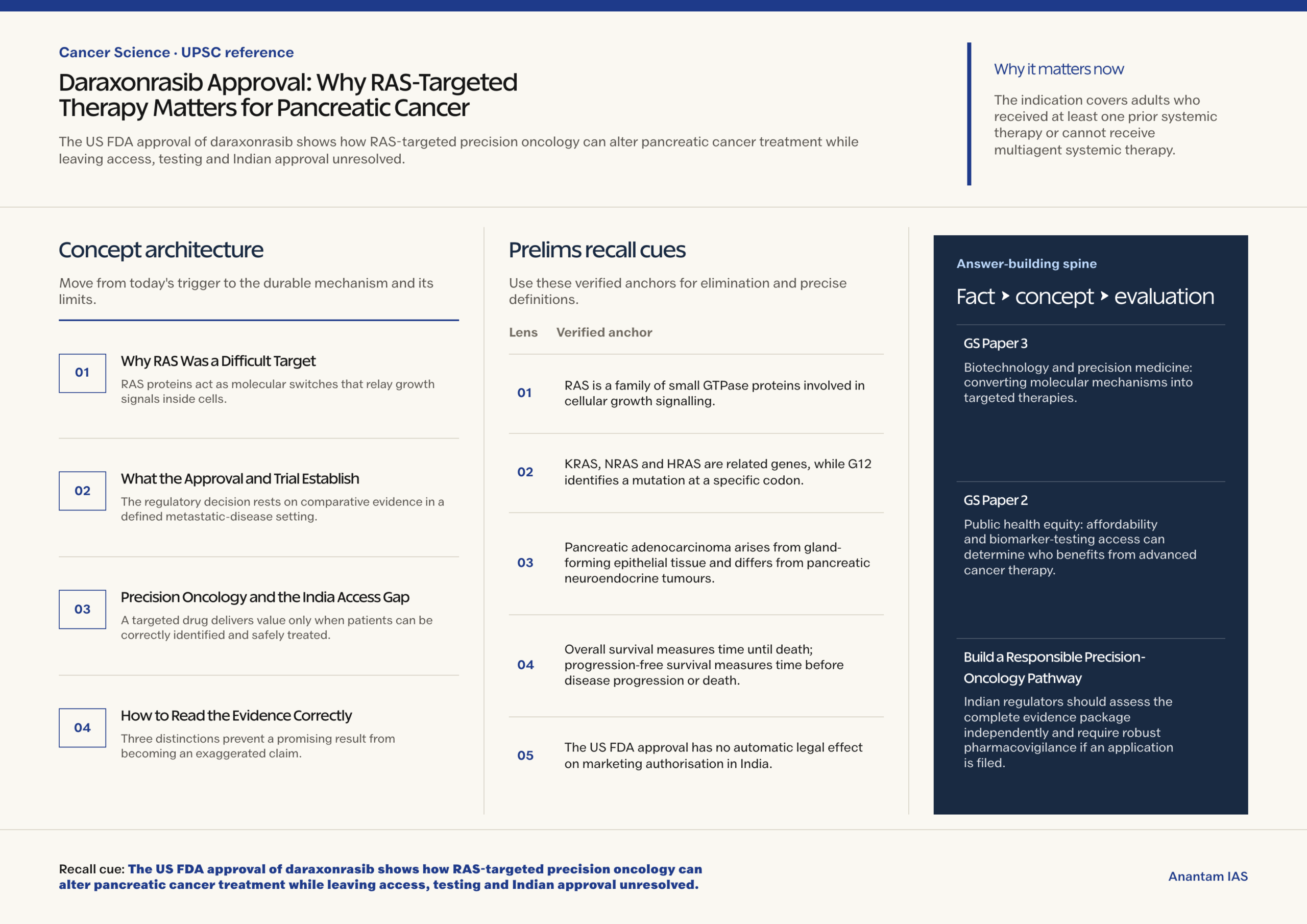
Mindmap explaining Daraxonrasib Approval: Why RAS-Targeted Therapy Matters for Pancreatic Cancer for UPSC revision
Revision mindmap: Daraxonrasib Approval: Why RAS-Targeted Therapy Matters for Pancreatic Cancer. Open the full-size image for details.

Background and Context

Why RAS Was a Difficult Target

RAS proteins act as molecular switches that relay growth signals inside cells.

  • When a RAS gene is mutated, the switch can remain active, continuously promoting cell division and tumour survival without normal growth controls.
  • KRAS mutations are especially important in pancreatic ductal adenocarcinoma, making the pathway biologically attractive but historically difficult to inhibit with medicines.
  • Earlier targeted drugs often focused on one mutation, such as KRAS G12C, which limited their usefulness where several RAS variants drive disease.
  • Daraxonrasib inhibits active, or RAS(ON), signalling across multiple RAS forms, widening the scientific strategy beyond a single narrow mutation subtype.
  • Targeting a pathway is still not equivalent to curing a cancer; tumour heterogeneity, resistance mechanisms and toxicity can limit the duration or suitability of benefit.

What the Approval and Trial Establish

The regulatory decision rests on comparative evidence in a defined metastatic-disease setting.

  • RASolute 302 was a randomized, open-label, multicentre Phase 3 trial involving adults whose metastatic pancreatic adenocarcinoma progressed after one prior systemic therapy.
  • Patients received daraxonrasib or the physician’s choice of standard chemotherapy, allowing direct comparison of survival and disease-control outcomes.
  • The major endpoints were overall survival and progression-free survival, assessed in the RAS G12 subgroup and the full study population.
  • The FDA reported statistically significant improvements in survival, progression-free survival and response for daraxonrasib in both analysed populations.
  • The approval applies to the FDA-defined clinical group; the evidence does not justify describing daraxonrasib as a universal treatment for every stage or type of pancreatic cancer.

Precision Oncology and the India Access Gap

A targeted drug delivers value only when patients can be correctly identified and safely treated.

  • Molecular profiling detects mutations and helps clinicians interpret whether pathway-directed evidence is relevant, but testing access and quality vary across health systems.
  • India would require its own regulatory pathway, with evidence review, authorised supply and safety monitoring before routine marketing or prescribing.
  • Neither US approval nor trial efficacy resolves the medicine’s Indian price, reimbursement status, procurement route or availability outside specialised cancer centres.
  • The FDA label warns about skin and soft-tissue toxicity, oral disorders, diarrhoea, gastrointestinal perforation and lung inflammation, reinforcing the need for clinical monitoring.
  • Equity depends on combining targeted treatment with affordable diagnostics, trained oncology teams, referral networks and financial protection rather than viewing the pill in isolation.

How to Read the Evidence Correctly

Three distinctions prevent a promising result from becoming an exaggerated claim.

  • A median survival is the middle observed outcome in a trial population; it does not predict exactly how long any individual patient will live.
  • A statistically significant difference supports a treatment effect under the trial design, but clinical decisions must also weigh toxicity, health status, prior therapy and patient preference.
  • Subgroup findings, including the RAS G12 analysis, help interpret biological relevance, while the legal indication must be read from the regulator’s approved wording.
  • Post-market use can reveal uncommon harms, resistance patterns and effectiveness in broader populations, making pharmacovigilance part of the evidence cycle rather than an afterthought.

Way Forward

Build a Responsible Precision-Oncology Pathway

  • Indian regulators should assess the complete evidence package independently and require robust pharmacovigilance if an application is filed.
  • Expand quality-assured molecular diagnostics through regional cancer centres, with clear referral standards and external quality control.
  • Use transparent health-technology assessment and price negotiation to judge benefit, budget impact and appropriate patient selection.
  • Support genomic research and representative clinical trials so treatment guidance reflects Indian patients, care pathways and resource constraints.

Conclusion

  • Daraxonrasib shows that a once-resistant biological pathway can become clinically actionable, but its benefit belongs to a defined disease and treatment setting.
  • In a UPSC answer, connect precision medicine with diagnostics, regulation, affordability and equity; discovery alone does not guarantee population-level health impact.

UPSC Practice Questions

Prelims MCQ 1

With reference to daraxonrasib and the RAS pathway, consider the following statements:

  1. RAS proteins function as molecular switches in cellular growth signalling.
  2. KRAS, NRAS and HRAS belong to the RAS gene family.
  3. A US FDA approval automatically authorises the same medicine for sale in India.

How many of the above statements are correct?

(a) Only one (b) Only two (c) All three (d) None

Answer: (b) Only two

Explanation:

Statements 1 and 2 are correct. India has a separate drug-regulatory system, so a US FDA decision does not automatically create Indian marketing authorisation.

Prelims MCQ 2

Which one of the following best describes progression-free survival in a cancer trial?

(a) Time until every symptom disappears (b) Time until a medicine receives regulatory approval (c) Time during and after treatment before disease progression or death (d) Percentage of participants who complete every treatment cycle

Answer: (c) Time during and after treatment before disease progression or death

Explanation:

Progression-free survival measures how long participants remain alive without the disease worsening; it is distinct from overall survival and cure.

UPSC Mains Questions

  1. How does daraxonrasib illustrate both the potential and the limits of precision oncology? Discuss with reference to molecular targeting, clinical evidence and patient selection.
  2. A biomedical breakthrough becomes a public-health achievement only through diagnostics, regulation and equitable access. Examine this statement in the Indian context.

Sources: US Food and Drug Administration and The Indian Express.

Frequently Asked Questions

What is daraxonrasib?

Daraxonrasib is an oral inhibitor of active RAS signalling. The US FDA approved it for specified adults with metastatic pancreatic adenocarcinoma after prior therapy or when multiagent therapy is unsuitable.

Does daraxonrasib cure pancreatic cancer?

No. The approval concerns treatment in a defined metastatic setting. Trial-level survival improvements do not mean every patient responds, and resistance, toxicity and disease progression remain possible.

Why is KRAS important in pancreatic cancer?

KRAS is a member of the RAS gene family and commonly drives abnormal growth signalling in pancreatic adenocarcinoma, making the pathway central to targeted-treatment research.

Is daraxonrasib approved and available in India?

The reported decision is by the US FDA. Indian approval, commercial availability, price, reimbursement and the practical reach of molecular testing remain unresolved.

What did RASolute 302 show?

The randomized Phase 3 trial reported longer median overall and progression-free survival with daraxonrasib than physician-selected chemotherapy in previously treated metastatic pancreatic adenocarcinoma.
H-1B Fee Proposal: Why the New Legal Route Matters for Indian Workers

Open article →Download PDF

Why in News?

On August 26, the US Department of Homeland Security proposed an additional $103,265 fee for cap-subject H-1B petitions, but the proposal is open for comment and is not yet law.

  • The proposed charge would be paid by the petitioning employer when filing and would sit on top of other applicable H-1B fees.
  • It would cover cap-subject petitions, including the advanced-degree exemption, while cap-exempt petitions would remain outside this particular proposal.
  • DHS has opened a 30-day public-comment process; it must consider relevant submissions before deciding whether and how to issue a final rule.
  • The proposal follows the judicial vacatur of a separate $100,000 proclamation-based payment; the government’s appeal in that case remains pending.
  • Indian professionals are the largest national-origin group among approved H-1B beneficiaries, making changes to employer filing costs especially important for India-US labour mobility.
  • The dispute connects migration policy with separation of powers, delegated fee-setting authority, administrative procedure and the economic choices of sponsoring employers.

UPSC Relevance

Prelims Relevance

  • H-1B is a US non-immigrant classification for specialty-occupation workers sponsored through employer petitions.
  • The annual regular cap is 65,000, with a separate exemption for up to 20,000 beneficiaries holding qualifying advanced US degrees.
  • Universities and certain affiliated nonprofit or government research organisations may file cap-exempt petitions.
  • A notice of proposed rulemaking invites public comment; it is not the same as a final, effective regulation.
  • Section 286 of the US Immigration and Nationality Act concerns immigration fees and the Immigration Examinations Fee Account.

Mains Relevance

GS Paper 2

  • Assess skilled-worker mobility as a component of India-US relations and the Indian diaspora’s economic linkages.
  • Use the episode to explain delegated legislation, judicial review and procedural limits on executive power.

GS Paper 3

  • Evaluate how sharply higher employer costs could reshape outsourcing, local hiring and the movement of Indian technology professionals, without treating projected effects as accomplished facts.

Essay

  • Rules governing skilled migration show how domestic administrative choices can redistribute opportunity across borders.
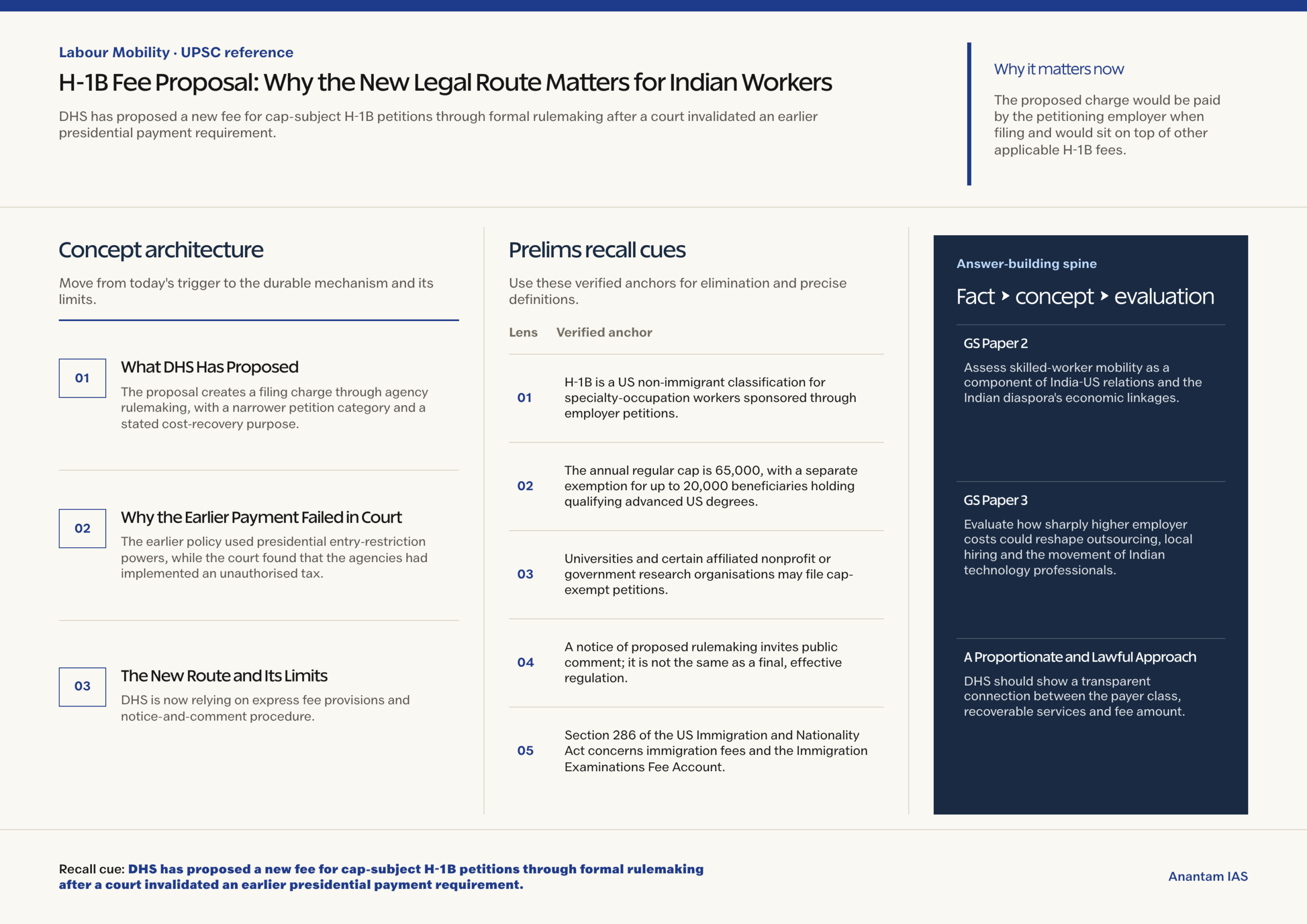
Mindmap explaining H-1B Fee Proposal: Why the New Legal Route Matters for Indian Workers for UPSC revision
Revision mindmap: H-1B Fee Proposal: Why the New Legal Route Matters for Indian Workers. Open the full-size image for details.

Background and Context

What DHS Has Proposed

The proposal creates a filing charge through agency rulemaking, with a narrower petition category and a stated cost-recovery purpose.

  • Under the DHS notice, the additional $103,265 fee would apply to every H-1B petition counted against the annual statutory cap.
  • The covered set includes petitions under the advanced-degree exemption; it does not convert every H-1B filing, extension or cap-exempt university petition into a fee-paying case.
  • DHS proposes depositing the receipts in the Immigration Examinations Fee Account to recover a portion of immigration-system costs incurred across several federal departments.
  • The agency also presents the charge as a labour-market signal that could make employers reassess whether a foreign hire’s specialised skills justify the added filing cost.
  • These are proposed effects, not present obligations: publication, public comments, agency consideration and a final rule must precede any announced effective date.

Why the Earlier Payment Failed in Court

The earlier policy used presidential entry-restriction powers, while the court found that the agencies had implemented an unauthorised tax.

  • A September 2025 presidential proclamation relied on INA Sections 212(f) and 215(a), which concern restrictions on entry, to require a $100,000 payment with certain new petitions.
  • In California v. Mullin, the District of Massachusetts treated the payment as a tax because it raised revenue and burdened otherwise lawful conduct.
  • The court held that Congress had not clearly delegated to the President the power to impose that tax, making the policy inconsistent with separation of powers.
  • It also found the implementing agency actions unlawful under the Administrative Procedure Act and vacated them; the First Circuit later declined to stay that judgment.
  • The government’s appeal remains pending, so the litigation is unfinished even though the earlier agency payment policy presently lacks legal force.

The New Route and Its Limits

DHS is now relying on express fee provisions and notice-and-comment procedure, but that choice does not guarantee judicial approval.

  • The new notice invokes INA Section 286, including provisions authorising fees for immigration adjudication and naturalisation services, rather than resting primarily on presidential exclusion power.
  • Formal notice-and-comment rulemaking creates a public record: affected employers, workers and institutions can submit data, legal objections and alternative designs for agency consideration.
  • A final rule must respond to significant comments and remain within statutory authority; courts may still review whether the fee’s amount, payer class and spending purposes fit that authority.
  • For Indian workers, the immediate fact is regulatory uncertainty, not an implemented six-figure charge; employers’ future hiring responses cannot yet be stated as measured outcomes.
  • For India, the policy is a bilateral mobility issue rather than a visa entitlement dispute: US domestic law controls the programme, while its effects spill into talent and services ties.

Way Forward

A Proportionate and Lawful Approach

  • DHS should show a transparent connection between the payer class, recoverable services and fee amount, and answer substantial objections in the final-rule record.
  • Indian firms should model multiple scenarios while avoiding irreversible decisions based only on an unfinalised proposal.
  • India-US dialogue should separate legitimate programme-integrity concerns from measures that unnecessarily disrupt high-skill mobility and innovation partnerships.
  • Aspirants should track the final rule and appellate outcome separately; they arise from different legal authorities and procedural records.

Conclusion

  • The key change is not only the proposed amount but the legal route: DHS is attempting delegated fee-setting through public rulemaking after a court rejected proclamation-based implementation.
  • In an answer, distinguish proposal from law, presidential entry power from statutory agency fee power, and likely economic incentives from effects that have actually been observed.

UPSC Practice Questions

Prelims MCQ 1

With reference to the proposed additional H-1B fee, consider the following statements:

  1. It would apply to cap-subject petitions, including those under the advanced-degree exemption.
  2. It automatically applies to every cap-exempt university petition.
  3. Publication of the proposal itself makes the fee immediately payable.

How many of the above statements are correct?

(a) Only one (b) Only two (c) All three (d) None

Answer: (a) Only one

Explanation:

Only statement 1 is correct. The proposal targets cap-subject petitions, not every cap-exempt filing, and a proposed rule is not an immediately effective final rule.

Prelims MCQ 2

What best distinguishes the new DHS proposal from the earlier $100,000 H-1B payment policy?

(a) It grants an automatic visa to every fee-paying applicant (b) It relies on INA fee provisions and notice-and-comment rulemaking (c) It is an Indian government levy on overseas employment (d) It has already been upheld by the US Supreme Court

Answer: (b) It relies on INA fee provisions and notice-and-comment rulemaking

Explanation:

DHS invokes Section 286 fee authority and formal rulemaking. The earlier policy was implemented under a presidential proclamation relying on entry-restriction provisions.

UPSC Mains Questions

  1. The H-1B fee controversy is as much about administrative law as labour mobility. Discuss with reference to delegated authority, rulemaking and judicial review.
  2. Assess how major changes in US skilled-worker visa costs could affect India-US economic relations and Indian technology professionals.

Sources: US Department of Homeland Security, Federal Register public inspection and US District Court for the District of Massachusetts, California v. Mullin.

Frequently Asked Questions

Is the proposed $103,265 H-1B fee already in force?

No. DHS has issued a notice of proposed rulemaking and invited public comments. A final rule and effective date would be required before the proposed fee becomes operative.

Which H-1B petitions would the proposal cover?

It would cover petitions subject to the annual H-1B cap, including the advanced-degree exemption. Cap-exempt petitions are outside this specific proposed charge.

Why was the earlier $100,000 payment struck down?

A federal district court treated it as an unauthorised tax, found no clear congressional delegation for the presidential action, and invalidated the agencies’ implementation under the APA.

What is different about the new legal route?

DHS invokes statutory fee authority under INA Section 286 and uses notice-and-comment rulemaking, creating a procedural record before any final regulation is issued.

Why does the proposal matter for India?

Indian professionals form the largest group among approved H-1B beneficiaries, so employer cost changes could disproportionately affect Indian talent mobility and technology-services ties.

Financial Cyber Resilience: RBI and SEBI’s Measurable Safeguards

Open article →Download PDF

Why in News?

SEBI introduced an IT Resilience Index and FIRE-aligned incident reporting, while RBI’s 2026 directions strengthened measurable, board-supervised cyber resilience for commercial banks.

  • SEBI’s IT Resilience Index applies to critical systems of stock exchanges, clearing corporations and depositories, collectively called Market Infrastructure Institutions.
  • The index uses nine weighted parameters, led by availability and security at 20% each, to produce comparable evidence of operational health.
  • MIIs must operationalise the index, early-warning system and real-time service-delivery monitoring by February 28, 2027.
  • SEBI also aligned its incident portal with the FIRE format, allowing initial, intermediate and closure-stage reporting as facts emerge.
  • RBI’s directions require commercial banks to report cyber incidents through DAKSH within six hours of detection and assign clear board-level responsibility.
  • AI can accelerate personalised phishing, voice cloning, synthetic identities and automated vulnerability discovery, increasing both the speed and scale of financial attacks.
  • The regulatory shift is from periodic compliance documents towards continuous visibility, comparable metrics, rapid incident disclosure and accountable recovery.
  • The adopted instruments are operational-resilience rules; separate responsible-AI guidelines and kill-switch ideas remain proposed or under consideration.

UPSC Relevance

Prelims Relevance

  • SEBI regulates securities markets; RBI regulates banks and payment-system segments under separate statutory powers.
  • Market Infrastructure Institutions include stock exchanges, clearing corporations and depositories.
  • FIRE means Format for Incident Reporting Exchange, developed by the Financial Stability Board.
  • SEBI’s ITRI must be system-driven and computed half-yearly within 60 days after each half-year.
  • RBI’s 2026 commercial-bank directions took effect immediately and exclude Small Finance Banks, Payments Banks and Local Area Banks from that specific instrument.
  • Cyber resilience means maintaining mission-critical functions by anticipating, withstanding, containing and recovering from cyber incidents.

Mains Relevance

GS Paper 3

  • Cybersecurity of critical financial infrastructure, operational continuity and technology-enabled financial fraud.
  • Use of measurable resilience indicators, continuous monitoring, incident reporting and recovery testing.

GS Paper 2

  • Regulatory governance through board accountability, independent security leadership and standardised disclosure.
  • Proportionate regulation of emerging technology while distinguishing enforceable duties from policy proposals.

Essay

  • Digital trust rests less on promises of perfect prevention than on measurable preparedness, transparent accountability and rapid recovery after failure.
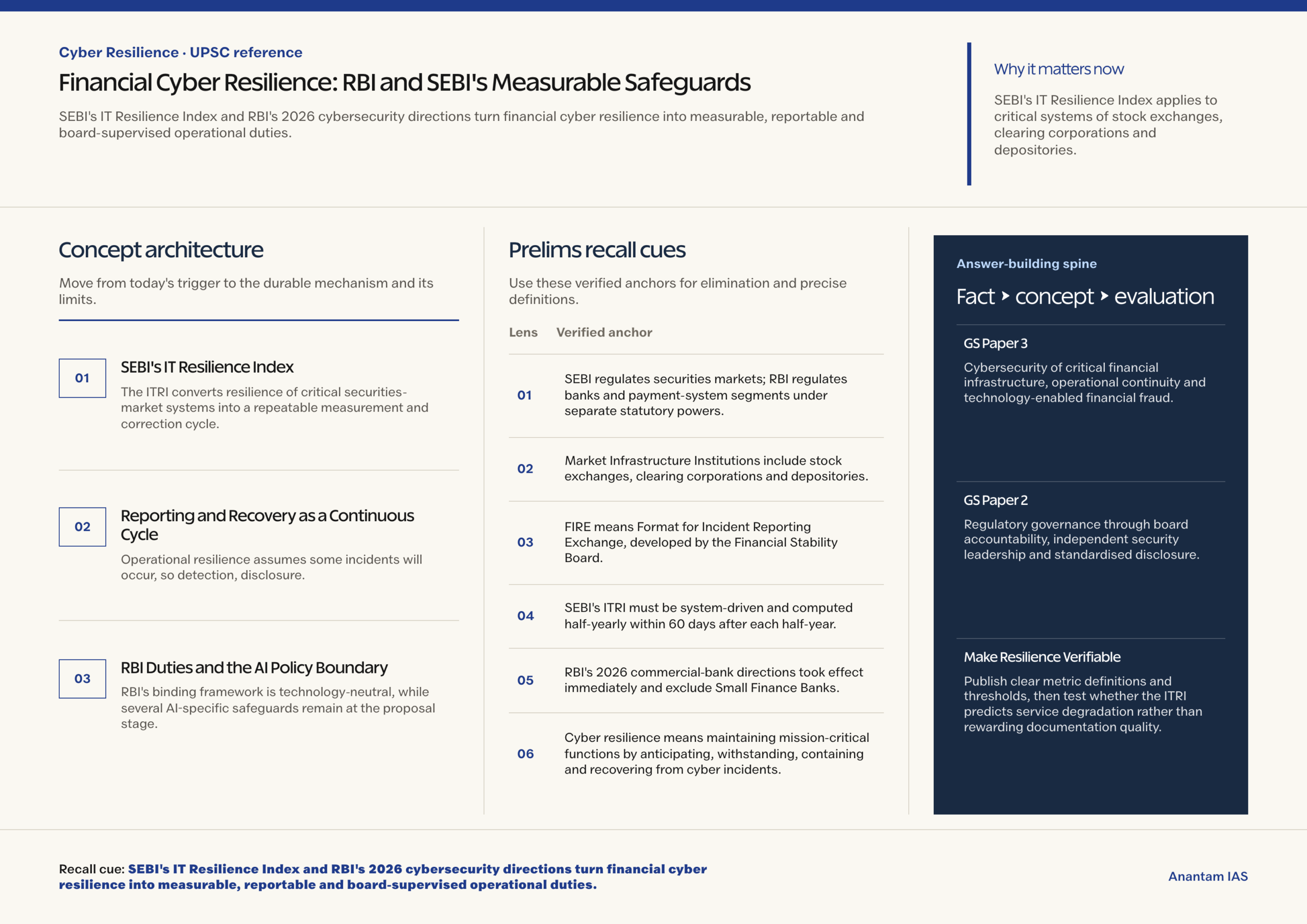
Mindmap explaining Financial Cyber Resilience: RBI and SEBI's Measurable Safeguards for UPSC revision
Revision mindmap: Financial Cyber Resilience: RBI and SEBI's Measurable Safeguards. Open the full-size image for details.

Background and Context

SEBI's IT Resilience Index

The ITRI converts resilience of critical securities-market systems into a repeatable measurement and correction cycle.

  • Its scope covers critical systems and connected systems that feed them, recognising that an exchange or depository can fail through dependencies outside the core application.
  • Availability and security each carry 20% weight; integrity, governance, reliability and monitoring, business continuity, and modularity and flexibility each carry 10%.
  • Scalability and an ‘others’ category, including incident handling, carry 5% each; detailed sub-parameters and thresholds are to be finalised through the Industry Standards Forum.
  • Computation must be automatic and non-discretionary from system data; any manual retrieval requires prior discussion with the Standing Committee on Technology.
  • Every half-year, MIIs must compare two consecutive periods and place corrective actions before their technology committee and Governing Board, linking metrics to accountability.

Reporting and Recovery as a Continuous Cycle

Operational resilience assumes some incidents will occur, so detection, disclosure, containment and learning must connect quickly.

  • SEBI’s existing CSCRF requires regulated entities to report cyber incidents by email within six hours and through its incident portal within 24 hours.
  • The FIRE-aligned portal standardises fields, definitions and classification, making reports easier to compare across incident types, firms and jurisdictions.
  • Staged reporting accepts that the initial alert may be incomplete; entities can add intermediate findings and close the record after containment, investigation and remediation.
  • The ITRI adds early warning and consolidated dashboards for system performance and service delivery, aiming to detect deterioration before it becomes a market-wide disruption.
  • A good resilience metric must trigger action: thresholds, ownership, time-bound repair and retesting matter more than a high score presented without evidence.

RBI Duties and the AI Policy Boundary

RBI’s binding framework is technology-neutral, while several AI-specific safeguards remain at the proposal stage.

  • The 2026 directions require commercial-bank boards to approve IT, business-continuity, information-security and cyber incident-response policies and review them at least annually.
  • Banks need a Board-level IT Strategy Committee and an Information Security Committee; the Chief Information Security Officer must not report directly to the Head of IT.
  • The framework requires inventories, access controls, continuous surveillance, security testing, business continuity, forensic readiness and six-hour RBI reporting through DAKSH.
  • These are adopted duties, but proposed responsible-AI guidelines would separately address model governance, data integrity, human accountability and AI-enabled surveillance risks.
  • A customer ‘kill switch’ to halt transactions during suspected fraud has been discussed, not established here as a universal enforceable right; answers should label it under consideration.

Way Forward

Make Resilience Verifiable

  • Publish clear metric definitions and thresholds, then test whether the ITRI predicts service degradation rather than rewarding documentation quality.
  • Run red-team and recovery exercises against AI-enabled phishing, synthetic identity, supply-chain compromise, cloud outages and corrupted model or transaction data.
  • Connect staged incident reports with root-cause analysis, customer protection, cross-regulator threat intelligence and time-bound corrective action.
  • Adopt AI-specific rules only after defining model ownership, independent validation, human override, audit trails and liability for automated financial decisions.

Conclusion

  • SEBI and RBI are making resilience observable through metrics, monitoring, reporting and governance, while preserving the essential goal of uninterrupted and trustworthy financial services.
  • In an answer, separate what is already binding from what is proposed, then judge each safeguard by whether it improves detection, containment, recovery and accountable learning.
  • AI changes the pace and sophistication of attacks, but the durable regulatory test remains whether institutions can identify responsibility, preserve evidence, protect customers and restore critical services under stress.

UPSC Practice Questions

Prelims MCQ 1

With reference to SEBI’s IT Resilience Index for Market Infrastructure Institutions, consider the following statements:

  1. It covers stock exchanges, clearing corporations and depositories specified by the circular.
  2. Its computation is intended to be system-driven without manual intervention.
  3. It is to be computed every month and submitted directly to the Financial Stability Board.

How many of the above statements are correct?

(a) Only one (b) Only two (c) All three (d) None

Answer: (b) Only two

Explanation:

Statements 1 and 2 are correct. Statement 3 is incorrect: MIIs compute ITRI half-yearly, with comparative analysis and corrective action placed before their technology committee and Governing Board.

Prelims MCQ 2

What is the principal purpose of the FIRE format used in SEBI’s cyber incident reporting portal?

(a) To rank financial institutions by profitability (b) To standardise incident fields, definitions and life-cycle reporting (c) To replace all reporting to CERT-In (d) To authorise automatic suspension of customer accounts

Answer: (b) To standardise incident fields, definitions and life-cycle reporting

Explanation:

FIRE supports harmonised, staged reporting from the initial alert through intermediate updates and final closure. It does not rank profitability or create an automatic account-suspension power.

UPSC Mains Questions

  1. How do SEBI’s IT Resilience Index and FIRE-aligned reporting move financial-sector cybersecurity from periodic compliance towards measurable operational resilience? Explain.
  2. AI-enabled fraud can operate at machine speed, while regulation often changes slowly. Suggest a technology-neutral accountability framework with targeted AI safeguards for India’s financial sector.

Sources: SEBI, IT Resilience Index Circular and RBI, Commercial Banks Cybersecurity Directions.

Frequently Asked Questions

What is SEBI’s IT Resilience Index?

It is a system-driven index for measuring the robustness of critical systems used by specified market infrastructure institutions across availability, security, continuity, governance and related operational parameters.

Which institutions are covered by the ITRI circular?

The circular covers stock exchanges, clearing corporations and depositories, except AMC Repo Clearing Ltd., and includes systems that feed or are related to their defined critical systems.

What does the FIRE reporting format change?

It gives SEBI-regulated entities common fields, definitions and classifications, while supporting initial reports, intermediate updates and final closure as the facts and response develop.

Does RBI’s 2026 framework create AI-specific rules?

Its binding cybersecurity directions are technology-neutral and cover governance, monitoring, testing, response and recovery. Separate responsible-AI safeguards discussed by regulators should not be presented as already adopted.

Is a financial fraud kill switch already a universal right?

No. Regulators have discussed mechanisms that could let users halt transactions during suspected fraud, but the idea should be described as under consideration unless a binding instrument is issued.

Free Coaching Scheme: What Low Enrolment Reveals About Delivery Gaps

Open article →Download PDF

Why in News?

A parliamentary committee reported that only 2,790 students enrolled against 10,500 planned slots under the Union government’s Free Coaching Scheme over three years.

  • The reported enrolment equals about 26% of planned slots, making the gap a question of implementation rather than merely budgetary intent.
  • The committee found that limited university participation and delayed proposals continued despite earlier changes in the scheme’s administrative design.
  • The Ministry said only 14 Central universities were actively providing coaching, restricting geographic access and use of available slots.
  • Proposed changes include participation by State universities and a student-centric mode, but their design and operational roadmap require scrutiny.
  • A welfare scheme cannot create substantive equality if eligible students cannot discover it, complete its procedures or reach a participating institution.
  • The correct performance chain is eligible population → application → selection → attendance → examination outcome; enrolment measures only one link.
  • For UPSC answers, separate allocation, capacity, access, delivery quality and outcomes instead of treating expenditure or announced slots as proof of success.

UPSC Relevance

Prelims Relevance

  • The scheme is administered by the Department of Social Justice and Empowerment through the Dr. Ambedkar Foundation and empanelled Central universities.
  • It covers economically disadvantaged SC and OBC students and beneficiaries of the PM CARES Children Scheme.
  • The scheme supports coaching for specified recruitment, professional entrance and eligibility examinations.
  • SC and OBC applicants face an annual family-income ceiling; PM CARES Children beneficiaries do not face income or caste restrictions.
  • Central universities screen eligible SC and OBC applicants, while eligible PM CARES Children beneficiaries are exempt from that selection procedure.
  • The official design uses DBT, biometric attendance, periodic reporting and performance appraisal of participating universities.

Mains Relevance

GS Paper 2

  • Welfare-scheme design, substantive equality, targeted support and last-mile delivery for disadvantaged groups.
  • Institutional capacity, digital access, regional reach, accountability and outcome-based monitoring.

GS Paper 4

  • Public accountability when announced entitlements do not translate into accessible services.
  • Fairness in eligibility and selection rules, transparency of results and responsibility for implementation failure.

Essay

  • Equality of opportunity depends not only on opening a programme but on making its access pathway usable for those it is intended to serve.
Mindmap explaining Free Coaching Scheme: What Low Enrolment Reveals About Delivery Gaps for UPSC revision
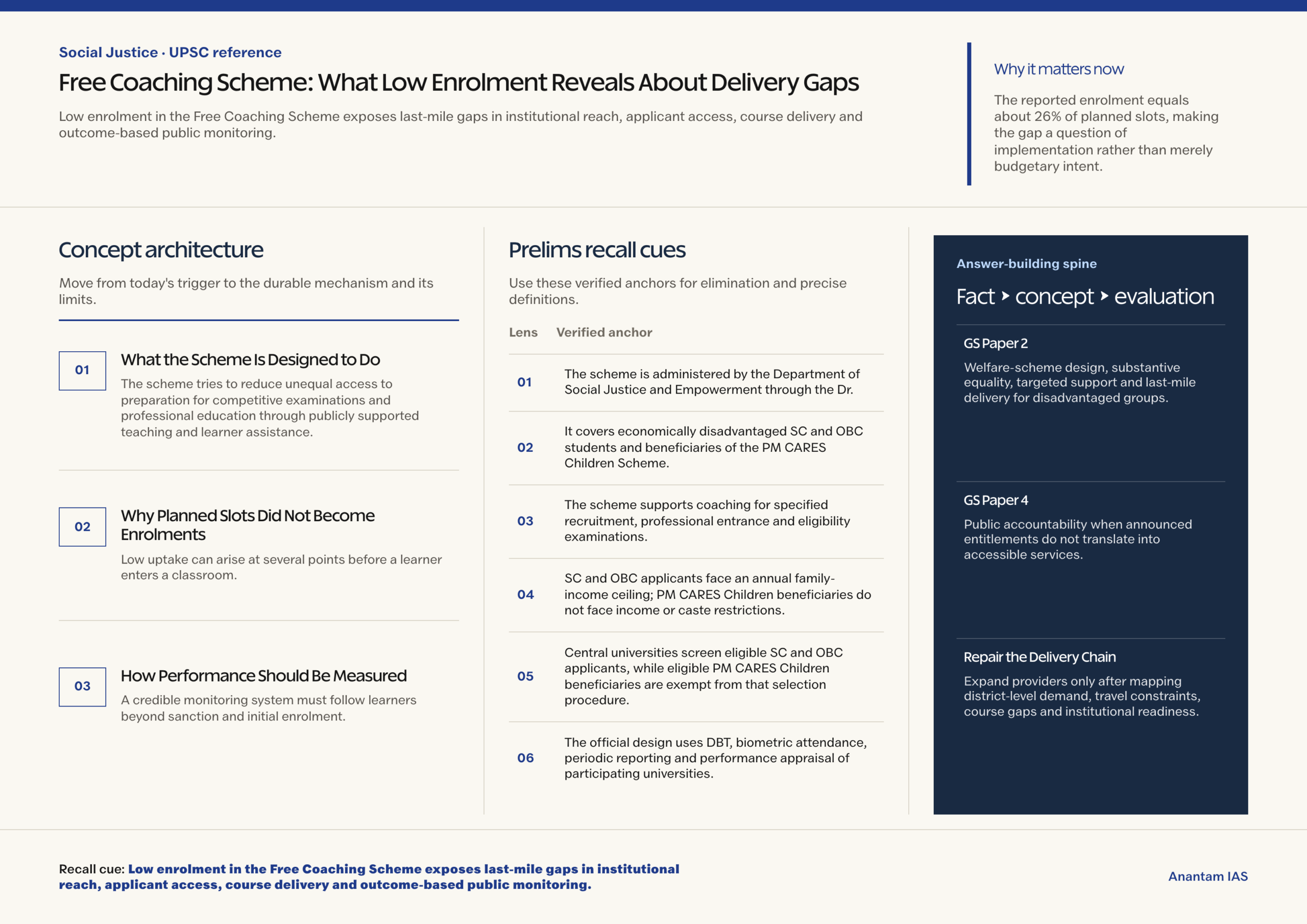
Revision mindmap: Free Coaching Scheme: What Low Enrolment Reveals About Delivery Gaps. Open the full-size image for details.

Background and Context

What the Scheme Is Designed to Do

The scheme tries to reduce unequal access to preparation for competitive examinations and professional education through publicly supported teaching and learner assistance.

  • Its objective is to provide quality coaching to economically disadvantaged SC and OBC students and eligible PM CARES Children beneficiaries who might otherwise be priced out of preparation.
  • Covered examinations include major public recruitment tests, professional entrance examinations and selected eligibility tests, so course availability must match varied qualification stages and career pathways.
  • The Dr. Ambedkar Foundation implements the programme through empanelled Central universities, whose coaching centres operate as Dr. Ambedkar Centres of Excellence within a centrally coordinated delivery chain.
  • Participating universities advertise courses, receive online applications, verify eligibility and select SC and OBC candidates through their own pre-declared screening procedures.
  • Payments move through Direct Benefit Transfer, while biometric attendance and staged releases connect public support with participation, course continuity and verified attendance over time.

Why Planned Slots Did Not Become Enrolments

Low uptake can arise at several points before a learner enters a classroom, so each stage needs a distinct diagnosis and remedy.

  • A narrow network of active institutions creates a geographic access gap; nominally available coaching may remain impractical for students far from campuses or unable to relocate affordably.
  • An online-only application, documentary verification, Aadhaar-linked banking and academic conditions create an administrative access chain that can exclude otherwise eligible applicants without assisted support.
  • University-specific screening can match students to limited seats, but inconsistent calendars, course offerings and selection methods may create unequal access across locations.
  • Delayed institutional proposals reveal a supply-side capacity problem: the scheme depends on universities having faculty, infrastructure, timely approvals, predictable funding and incentives to run viable batches.
  • The income ceiling is a design choice, but changing it alone cannot fix weak outreach, missing local institutions, procedural friction, unsuitable course availability or poor information about demand.

How Performance Should Be Measured

A credible monitoring system must follow learners beyond sanction and initial enrolment.

  • Start with a public delivery funnel: eligible applicants, completed applications, verified candidates, selected students, actual attendance, course completion, examination attempts, outcomes and time taken between stages.
  • Disaggregate results by social category, gender, geography, disability and examination type to identify whether apparently neutral processes reproduce barriers or concentrate benefits among easier-to-reach groups.
  • Track reasons for rejection, withdrawal and non-attendance; these failure-point data reveal whether the constraint is awareness, documentation, travel, course timing, digital access or teaching quality.
  • The official guidelines already provide for attendance records, periodic reports, physical verification and outcome-linked appraisal; data quality and public reporting determine whether these become accountability tools.
  • Measure learning and examination outcomes alongside enrolment, but avoid punishing institutions for serving harder-to-reach students through simplistic success-rate comparisons.

Way Forward

Repair the Delivery Chain

  • Expand providers only after mapping district-level demand, travel constraints, course gaps and institutional readiness; wider coverage should not dilute teaching standards.
  • Create assisted application channels, publish a unified calendar and send time-bound status updates so procedural friction does not silently eliminate eligible students.
  • Use common minimum standards for faculty, contact hours, study material and grievance handling while preserving local course flexibility based on student demand.
  • Publish institution-level funnel and outcome data, commission independent evaluation and use corrective support before renewal or expansion decisions.

Conclusion

  • The enrolment shortfall shows that announced capacity is not delivered opportunity; access depends on reachable institutions, usable procedures, relevant courses and accountable execution.
  • In a Mains answer, organise reform around the delivery funnel: outreach, access, institutional capacity, teaching quality, completion and independently verified outcomes.

UPSC Practice Questions

Prelims MCQ 1

With reference to the Scheme of Free Coaching for SCs, OBCs and beneficiaries of the PM CARES Children Scheme, consider the following statements:

  1. It is implemented by the Dr. Ambedkar Foundation through empanelled Central universities.
  2. Beneficiaries of the PM CARES Children Scheme face the same family-income ceiling as SC and OBC applicants.
  3. Eligible PM CARES Children beneficiaries are exempt from the university selection procedure.

How many of the above statements are correct?

(a) Only one (b) Only two (c) All three (d) None

Answer: (b) Only two

Explanation:

Statements 1 and 3 are correct. Statement 2 is incorrect because eligible PM CARES Children beneficiaries face neither income nor caste restrictions under the scheme.

Prelims MCQ 2

Which indicator would best reveal where eligible candidates are being lost before coaching begins?

(a) Total scheme expenditure alone (b) Number of examinations listed in the guidelines (c) Stage-wise data from application to verification, selection and attendance (d) Number of press releases about the scheme

Answer: (c) Stage-wise data from application to verification, selection and attendance

Explanation:

A stage-wise delivery funnel identifies the point of exclusion. Aggregate spending or announcements cannot show whether outreach, documentation, selection or attendance caused the shortfall.

UPSC Mains Questions

  1. Low enrolment in a welfare scheme may reflect a delivery-chain failure rather than weak demand. Examine this proposition with reference to the Free Coaching Scheme for disadvantaged students.
  2. Design an outcome-monitoring framework for publicly funded coaching that balances measurable examination results with equity, regional access and institutional accountability.

Sources: The Hindu and Department of Social Justice and Empowerment, Scheme Guidelines applicable from 2024-25.

Frequently Asked Questions

Who is covered by the Free Coaching Scheme?

It covers eligible Scheduled Caste and Other Backward Class students and beneficiaries of the PM CARES Children Scheme preparing for specified recruitment, entrance and eligibility examinations.

Why does low enrolment indicate more than low demand?

Students can be lost through weak outreach, distant institutions, online-only applications, document checks, screening, unsuitable courses or delayed university participation before a class begins.

What role do Central universities play?

Empanelled Central universities advertise courses, accept applications, verify eligibility, select eligible SC and OBC students, deliver coaching, record attendance and report performance through the scheme framework.

How should the scheme’s success be measured?

Monitoring should cover the full delivery funnel, learning quality, completion, examination attempts and outcomes, disaggregated by category, gender, geography, disability and examination type.

Would raising the income ceiling solve the enrolment gap?

It may widen eligibility, but cannot by itself repair limited institutional reach, procedural friction, delayed proposals, course mismatches or weak outreach and monitoring.

OBC Creamy Layer: Income Tests, Service Status and CSE 2025

Open article →Download PDF

Why in News?

On August 25, the Supreme Court agreed to constitute a Special Bench to hear the Centre’s clarification plea on applying its March 11 OBC creamy-layer judgment to CSE 2025.

  • The March judgment came five days after the CSE 2025 final result, while service allocation and training arrangements were still progressing.
  • The Centre says applying the ruling to this cycle could reopen category-wise merit, service allocation, cadre allocation, seniority and training arrangements.
  • The Court has not yet decided that temporal question. Agreeing to form a Special Bench is a listing step, not a final ruling on the plea.
  • The March holding itself remains clear: salary income alone cannot exclude children of PSU or private-sector employees from OBC reservation benefits.
  • The dispute joins substantive equality in reservation law with certainty and fairness in an examination process nearing completion.
  • For UPSC answers, separate the Court’s interpretation of creamy-layer criteria from the unresolved question of temporal relief for CSE 2025.

UPSC Relevance

Prelims Relevance

  • Indra Sawhney established exclusion of the creamy layer from OBC reservation as part of the equality framework.
  • The 1993 Office Memorandum contains category-based exclusions and an income/wealth test for identifying socially advanced OBC sections.
  • Under that framework, income from salary and agricultural land is not clubbed with other income for the income/wealth test.
  • A parent’s service status and post category remain material; creamy-layer determination is not a single income-threshold exercise.
  • The rules of the game doctrine generally restrains authorities from changing selection criteria after a recruitment process begins.

Mains Relevance

GS Paper 2

  • Creamy-layer exclusion as an instrument of substantive equality under Articles 14 and 16.
  • Judicial interpretation of executive instructions governing reservation and public recruitment.

GS Paper 2

  • Balancing lawful OBC claims with recruitment finality and the settled expectations of other candidates.
  • Designing transparent equivalence rules for government, PSU and private-sector employment.

Essay

  • Equality requires both accurate identification of disadvantage and fair administration of rules once a public selection process has begun.
Mindmap explaining OBC Creamy Layer: Income Tests, Service Status and CSE 2025 for UPSC revision
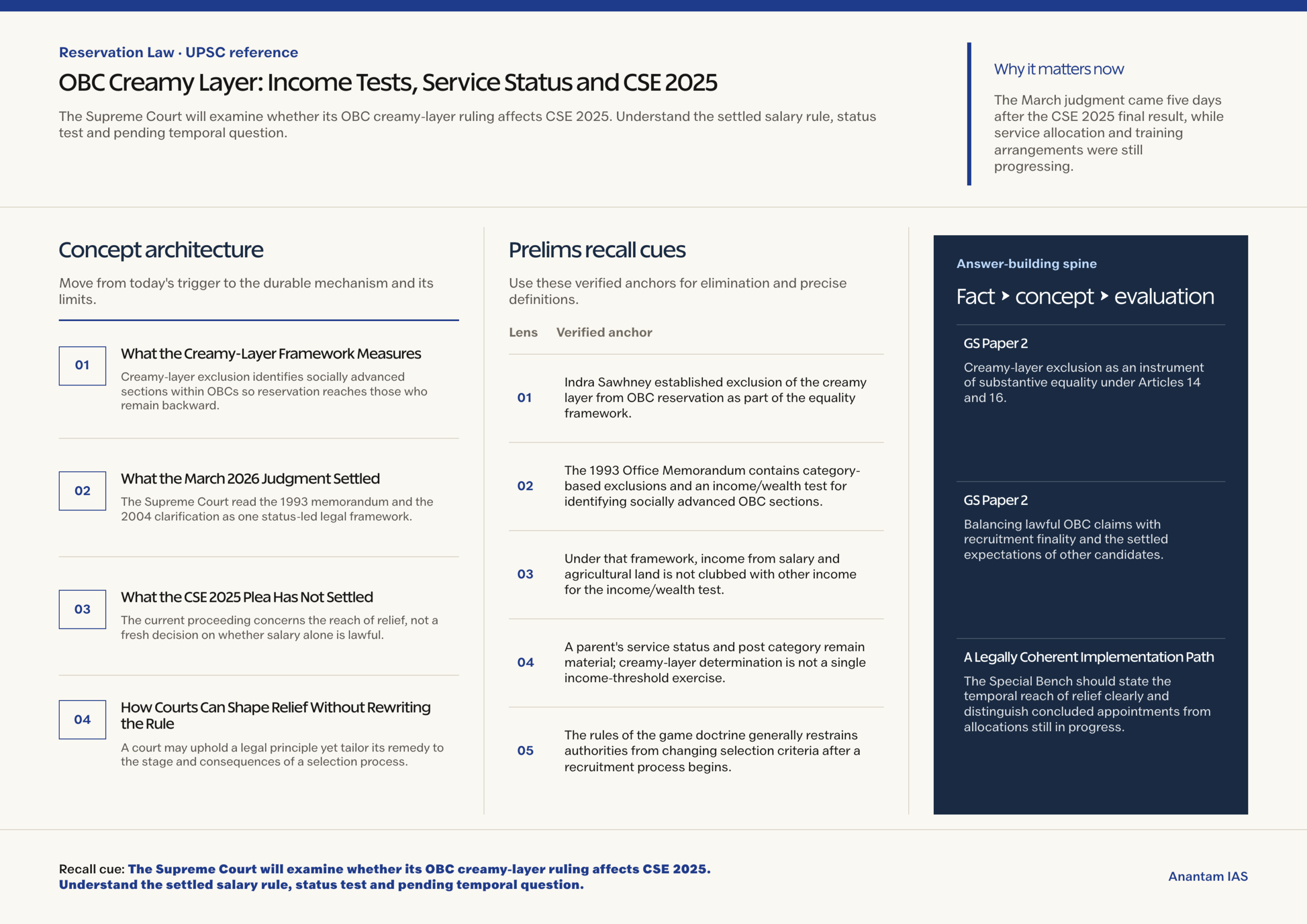
Revision mindmap: OBC Creamy Layer: Income Tests, Service Status and CSE 2025. Open the full-size image for details.

Background and Context

What the Creamy-Layer Framework Measures

Creamy-layer exclusion identifies socially advanced sections within OBCs so reservation reaches those who remain backward.

  • The doctrine emerged from Indra Sawhney, which treated exclusion of advanced OBC sections as necessary to preserve substantive equality.
  • The 1993 Office Memorandum created several exclusion categories, including constitutional posts, service classes, property holdings and an income/wealth test.
  • For service-linked categories, a parent’s rank, mode of entry and age of promotion may matter because occupational status can indicate social advancement.
  • The separate income/wealth category addresses income from relevant non-salary sources; it does not convert the framework into a family-income-only test.
  • The candidate’s own income or a spouse’s income does not replace the inquiry into the parents’ status under the applicable criteria.

What the March 2026 Judgment Settled

The Supreme Court read the 1993 memorandum and the 2004 clarification as one status-led legal framework.

  • In Union of India v. Rohith Nathan, the Court dismissed Union appeals arising from OBC claims linked to PSU and private employment.
  • It held that salary, agricultural income and other income cannot be mechanically clubbed when applying the income/wealth test.
  • A parent’s salary cannot be the sole criterion; the parent’s service status and the category of post are essential to the decision.
  • Using salary alone for PSU or private employees, while similarly placed government employees receive status-based assessment, creates hostile discrimination.
  • The Court linked this unequal treatment to Articles 14, 15 and 16 and directed consideration of affected claims within six months.

What the CSE 2025 Plea Has Not Settled

The current proceeding concerns the reach of relief, not a fresh decision on whether salary alone is lawful.

  • CSE 2025 results were declared before the March judgment, but important administrative steps such as service allocation were still underway.
  • The Centre seeks protection for the existing cycle, citing effects on merit lists, training, cadre allocation, seniority and candidates not before the Court.
  • The rules of the game doctrine protects predictable selection criteria, but courts may also interpret what the governing rule legally meant from the start.
  • That tension makes prospective application, retrospective application and moulded relief distinct possibilities for the Special Bench to examine.
  • Until the Bench decides the application, neither automatic reopening nor automatic insulation of CSE 2025 should be presented as settled law.

How Courts Can Shape Relief Without Rewriting the Rule

A court may uphold a legal principle yet tailor its remedy to the stage and consequences of a selection process.

  • A declaration explains the correct legal standard; the separate question of relief decides which candidates and completed steps it should affect.
  • The Court can distinguish candidates already appointed, candidates awaiting allocation and claimants whose cases remain pending before DoPT or courts.
  • It can also protect candidates who relied on the existing list while preventing an unlawful criterion from governing future recruitment cycles.
  • The March judgment already contemplated supernumerary posts for qualifying respondents and intervenors, showing one method of reducing displacement while enforcing rights.

Way Forward

A Legally Coherent Implementation Path

  • The Special Bench should state the temporal reach of relief clearly and distinguish concluded appointments from allocations still in progress.
  • DoPT should publish a uniform method for assessing post equivalence and parental status across government, PSU and private employment.
  • Individual claims should receive reasoned decisions, while relief should protect eligible OBC candidates without unnecessarily unsettling third-party rights.
  • Where the judgment permits, supernumerary posts can reduce zero-sum disruption while preserving lawful claims and administrative continuity.

Conclusion

  • The durable rule is that OBC creamy-layer exclusion is status-led and equality-based; parental salary by itself cannot decide the claim.
  • In a Mains answer, treat CSE 2025 as a pending relief-design question involving legality, recruitment finality and the rights of candidates inside and outside the case.

UPSC Practice Questions

Prelims MCQ 1

With reference to the OBC creamy-layer framework, consider the following statements:

  1. Creamy-layer status under the 1993 Office Memorandum is determined solely by total parental income.
  2. Salary and agricultural income are excluded from the income/wealth test under the framework examined by the Supreme Court.
  3. Parental service status and the category of post may be relevant to creamy-layer determination.

How many of the above statements are correct?

(a) Only one (b) Only two (c) All three (d) None

Answer: (b) Only two

Explanation:

Statements 2 and 3 are correct. The Supreme Court held that salary alone cannot be determinative and that the status and category of the parents’ posts are essential.

Prelims MCQ 2

What did the Supreme Court do in August 2026 regarding the application of its OBC creamy-layer judgment to CSE 2025?

(a) It automatically reopened the CSE 2025 merit list (b) It stayed the March 2026 judgment in full (c) It agreed to constitute a Special Bench to hear the Centre’s clarification plea (d) It cancelled service allocation for all selected candidates

Answer: (c) It agreed to constitute a Special Bench to hear the Centre's clarification plea

Explanation:

The Court took a listing-related step. It did not finally decide the plea’s merits or the temporal application of the March ruling to CSE 2025.

UPSC Mains Questions

  1. The OBC creamy-layer test is a status-based equality mechanism, not merely an income ceiling. Examine with reference to the Supreme Court’s 2026 judgment.
  2. How should courts balance correction of an unlawful recruitment criterion with finality, administrative continuity and third-party rights in a selection process?

Sources: The Indian Express Explained Law and Supreme Court of India, Union of India v. Rohith Nathan, 2026 INSC 230.

Frequently Asked Questions

What is the OBC creamy layer?

It refers to socially advanced sections within OBCs that are excluded from reservation benefits so affirmative action reaches groups that continue to experience social and educational backwardness.

Did the Supreme Court abolish the creamy-layer test?

No. It reaffirmed creamy-layer exclusion but held that parental salary cannot be the sole test. Service status, post category and the 1993 framework remain central.

Does salary above the income threshold automatically make an OBC candidate creamy layer?

Not under the March 2026 holding. Salary alone is not determinative; authorities must apply the relevant status categories and income/wealth rules to the candidate’s parental circumstances.

Has the March judgment been applied to CSE 2025?

That question remains unresolved. The Supreme Court agreed to constitute a Special Bench to hear the Centre’s clarification plea, but no final decision on temporal application was reported.

What is the rules of the game doctrine?

It generally bars authorities from changing selection criteria after recruitment begins, protecting predictability and equal treatment. Courts may still need to determine what the governing rule legally meant.

Heatwaves and Disaster Finance: What Notified Calamity Status Changes

Open article →Download PDF

Why in News?

The Ministry of Home Affairs confirmed that heatwaves and lightning are now notified natural calamities under the SDRF and NDRF operational guidelines for 2026–31.

  • The change implements a recommendation of the Sixteenth Finance Commission and raises the national list of notified calamities to 14.
  • The operational guidelines were issued on June 30, 2026, creating a policy framework for relief assistance through SDRF and NDRF.
  • Heatwave projects were already eligible for financing through disaster mitigation funds after the mitigation guidelines were amended in 2024.
  • National notification removes the earlier dependence on the limited State-specific disaster window for immediate heatwave relief.
  • The change improves financial eligibility; it does not prove that heat exposure, illness or mortality has fallen.
  • Effective protection still depends on local risk assessment, health surveillance, workable Heat Action Plans and the capacity to prepare fundable projects.
  • UPSC answers should separate response finance for immediate relief from mitigation finance that reduces future heat risk.

UPSC Relevance

Prelims Relevance

  • The SDRF is constituted under Section 48(1)(a) of the Disaster Management Act, 2005.
  • The SDRF is the primary State-level fund for immediate relief after notified disasters.
  • The NDRF supplements State resources when a disaster is sufficiently severe and State capacity is inadequate.
  • The SDMF and NDMF finance risk-reduction and mitigation, not routine immediate relief.
  • Heatwave and lightning were added through the 2026–31 operational guidelines, not through an amendment naming them in the Disaster Management Act.
  • States may still use up to 10% of SDRF funds for properly notified local disasters outside the national list.

Mains Relevance

GS Paper 3

  • Disaster-risk financing, the response-mitigation distinction and climate adaptation for extreme heat.
  • Heat Action Plans, early warning, public-health surveillance and measurable risk reduction.

GS Paper 2

  • Fiscal federalism and the division of responsibility among the Union, States and local bodies.
  • State and municipal capacity to convert national finance rules into equitable last-mile protection.

Essay

  • Recognising a hazard in public finance matters only when institutions can convert eligibility into protection for vulnerable people.
Mindmap explaining Heatwaves and Disaster Finance: What Notified Calamity Status Changes for UPSC revision
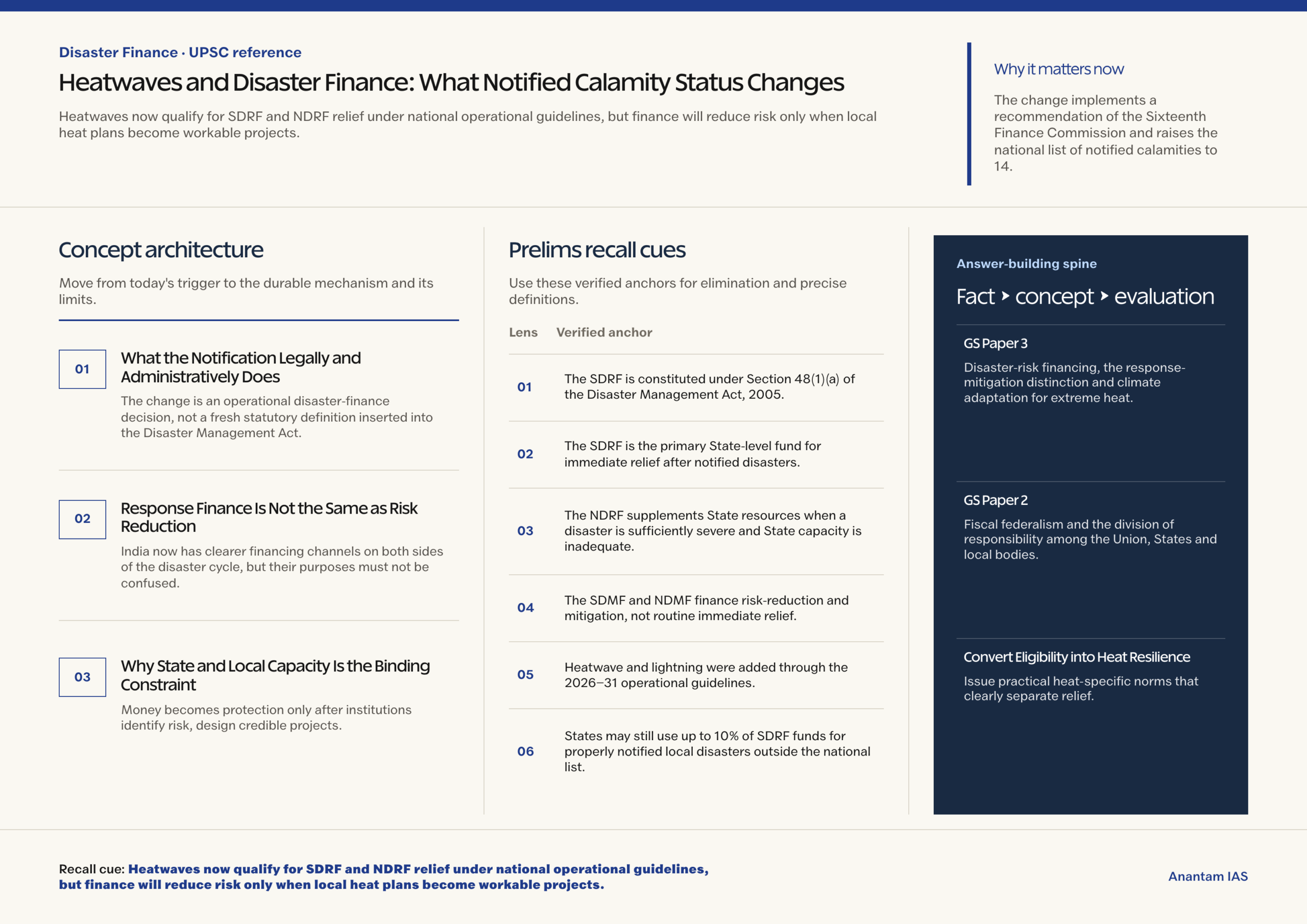
Revision mindmap: Heatwaves and Disaster Finance: What Notified Calamity Status Changes. Open the full-size image for details.

Background and Context

What the Notification Legally and Administratively Does

The change is an operational disaster-finance decision, not a fresh statutory definition inserted into the Disaster Management Act.

  • MHA has placed heatwaves and lightning on the nationally notified calamity list used by the SDRF and NDRF operational guidelines for the Finance Commission award period 2026–31.
  • This gives States a common national basis to claim eligible immediate-relief expenditure for heatwave impacts, subject to approved assistance norms, documentation and fund-administration rules.
  • Earlier, a State could treat heatwave as a local disaster, notify transparent norms and draw from the SDRF’s local-disaster window, capped at 10% of available funds.
  • National inclusion removes that particular 10% local-window constraint for heatwaves; it does not turn the SDRF into an unlimited compensation account or guarantee additional money automatically.
  • The NDRF is a supplementary national response fund; access for a severe event follows assessment and approval processes rather than arising automatically from a heat alert.

Response Finance Is Not the Same as Risk Reduction

India now has clearer financing channels on both sides of the disaster cycle, but their purposes must not be confused.

  • The SDRF and NDRF support immediate relief after eligible losses, including assistance governed by notified norms; they do not by themselves redesign hot settlements or prevent exposure.
  • The SDMF and NDMF finance mitigation measures intended to reduce future disaster risk, and heatwave mitigation projects have been eligible under these funds since the 2024 guideline amendment.
  • A Heat Action Plan should connect hazard forecasts, exposure and vulnerability to specific actions such as cooling access, health preparedness, worker protection and heat-resilient urban design.
  • A city can have a written plan yet remain unsafe if responsibilities are unfunded, warnings miss informal workers, health facilities lack readiness or agencies cannot act before temperatures peak.
  • Success should be measured through reduced illness, mortality and exposure, faster response and equitable protection, not merely by fund release, expenditure totals or the number of plans adopted.

Why State and Local Capacity Is the Binding Constraint

Money becomes protection only after institutions identify risk, design credible projects, coordinate departments and document outcomes.

  • State disaster authorities must set clear assistance norms, coordinate health and revenue departments, maintain loss records and ensure that vulnerable households can access relief without excessive procedural burdens.
  • Districts and urban local bodies need staff able to conduct heat-risk assessments, translate plans into costed proposals and manage procurement, implementation, maintenance and evaluation.
  • Heat risk varies between dry inland and humid coastal settings; copying a standard package can misallocate funds because temperature, humidity, housing, work and health vulnerability interact differently.
  • Health surveillance must capture timely, credible heat-related illness and death data while recognising that extreme heat can worsen cardiovascular, respiratory and kidney conditions beyond narrowly certified heatstroke.
  • Public accountability requires publishing risk maps, approved projects, spending and outcomes, with independent evaluation showing whether interventions reached outdoor workers, older people, low-income settlements and other high-risk groups.

Way Forward

Convert Eligibility into Heat Resilience

  • Issue practical heat-specific norms that clearly separate relief, preparedness and mitigation expenses while keeping approval and reporting requirements usable for districts and municipalities.
  • Create model project templates for cool roofs, cooling centres, heat-health systems and worker protection, but require adaptation to local climate and vulnerability evidence.
  • Fund technical support for local bodies to prepare proposals, procure responsibly and track health and exposure outcomes rather than only financial utilisation.
  • Link IMD warnings, health surveillance and social-protection delivery through pre-agreed triggers, with special protocols for outdoor workers, informal settlements and people living alone.

Conclusion

  • Notified status corrects a financing asymmetry: heatwave relief can now use the national SDRF and NDRF framework instead of relying on the restricted local-disaster window.
  • In a Mains answer, add the essential qualification: fund access is an input; reduced deaths and exposure require capable local institutions, credible data, prevention projects and public accountability.

UPSC Practice Questions

Prelims MCQ 1

With reference to disaster-management funds in India, consider the following statements:

  1. The State Disaster Response Fund is constituted under Section 48(1)(a) of the Disaster Management Act, 2005.
  2. The State Disaster Mitigation Fund is intended exclusively for immediate relief after a notified disaster.
  3. Heatwaves are included in the notified calamity list under the SDRF and NDRF operational guidelines for 2026–31.

How many of the above statements are correct?

(a) Only one (b) Only two (c) All three (d) None

Answer: (b) Only two

Explanation:

Statements 1 and 3 are correct. Statement 2 is incorrect because mitigation funds finance risk reduction; immediate relief is the function of response funds.

Prelims MCQ 2

What is the most accurate effect of adding heatwaves to the national list of notified calamities?

(a) Every heat warning automatically releases money from the NDRF (b) States may use SDRF relief finance for heatwaves without relying on the 10% local-disaster window (c) Heatwaves have been inserted as a separately named disaster through a new amendment to the Disaster Management Act (d) All Heat Action Plan expenditure must now come only from the SDRF

Answer: (b) States may use SDRF relief finance for heatwaves without relying on the 10% local-disaster window

Explanation:

National notification removes dependence on the restricted local-disaster route. It neither makes NDRF release automatic nor converts all heat planning into response expenditure.

UPSC Mains Questions

  1. Explain how national notification of heatwaves changes India’s disaster-finance framework. Why does access to response funds not necessarily mean that heat risk has been reduced?
  2. State and local implementation capacity is the bridge between Heat Action Plans and measurable protection. Discuss the institutional reforms needed to make heatwave finance effective and equitable.

Sources: Ministry of Home Affairs, Lok Sabha Unstarred Question 2541 and The Hindu.

Frequently Asked Questions

Are heatwaves now nationally notified calamities in India?

Yes. MHA has included heatwaves and lightning in the notified list under the SDRF and NDRF operational guidelines for the 2026–31 Finance Commission award period.

Was the Disaster Management Act amended to name heatwaves?

The confirmed change is administrative: heatwaves were included through operational fund guidelines. It should not be described as a statutory amendment separately naming heatwaves in the Act.

What changed from the earlier local-disaster arrangement?

Previously, States could notify heatwaves locally and use a window capped at 10% of available SDRF funds. National inclusion removes reliance on that restricted route.

What is the difference between response and mitigation finance?

Response funds support immediate relief after eligible losses. Mitigation funds support measures that reduce future risk, such as heat-health systems, cooling access and heat-resilient infrastructure.

Why may heat risk remain high despite more funding access?

Finance cannot substitute for local risk data, trained staff, workable projects, coordinated health systems and accountable delivery. Outcomes must be judged by reduced exposure, illness and mortality.

Nepal Flash Flood: How a Glacial Collapse Became a Transboundary Himalayan Disaster

Open article →Download PDF

Why in News?

The USGS reclassified an August 26 seismic signal near the Nepal–Tibet border as a glacial collapse and debris flow, not an earthquake, after reviewing seismic and satellite evidence.

  • The signal occurred near the border at 8:37 a.m. local time and was initially reported as a magnitude 4.4 earthquake.
  • USGS analysis used nearby seismic stations, long-period waves and satellite imagery to revise the event interpretation.
  • The moving ice and debris produced seismic energy and severe downstream impacts across a connected mountain river system.
  • The evidence supports a glacial-collapse and debris-flow cascade; it does not by itself confirm that a glacial lake breached.
  • Himalayan valleys can convert a high-altitude slope failure into a fast, sediment-rich flood with little warning time.
  • Because headwaters and downstream assets cross borders, hazard monitoring must link cryosphere observations, river gauges and emergency communication across jurisdictions.
  • The episode demonstrates why disaster labels should follow verified mechanisms, not preliminary interpretations issued during rescue operations.

UPSC Relevance

Prelims Relevance

  • A glacial collapse is the sudden failure and downslope movement of glacier ice, often mixed with rock and sediment.
  • A debris flow is a gravity-driven mixture of water, sediment and larger material that can travel rapidly through steep channels.
  • A GLOF requires the sudden release of water stored in or near a glacier, commonly after failure or overtopping of a natural dam.
  • Seismic instruments record ground motion from non-earthquake sources, including landslides, avalanches, explosions and large mass movements.
  • The Sendai Framework for Disaster Risk Reduction 2015–2030 promotes understanding risk, preparedness, resilient investment and stronger disaster governance.

Mains Relevance

GS Paper 3

  • Multi-hazard monitoring for glacier, slope, debris-flow and flash-flood cascades in the Himalayas
  • Risk-sensitive planning for hydropower, roads, bridges and settlements in narrow mountain valleys

GS Paper 2

  • Cross-border data sharing and last-mile warning protocols for transboundary Himalayan river basins

Essay

  • Disasters often emerge from interacting natural processes and human exposure, not from a single isolated hazard.
Mindmap explaining Nepal Flash Flood: How a Glacial Collapse Became a Transboundary Himalayan Disaster for UPSC revision
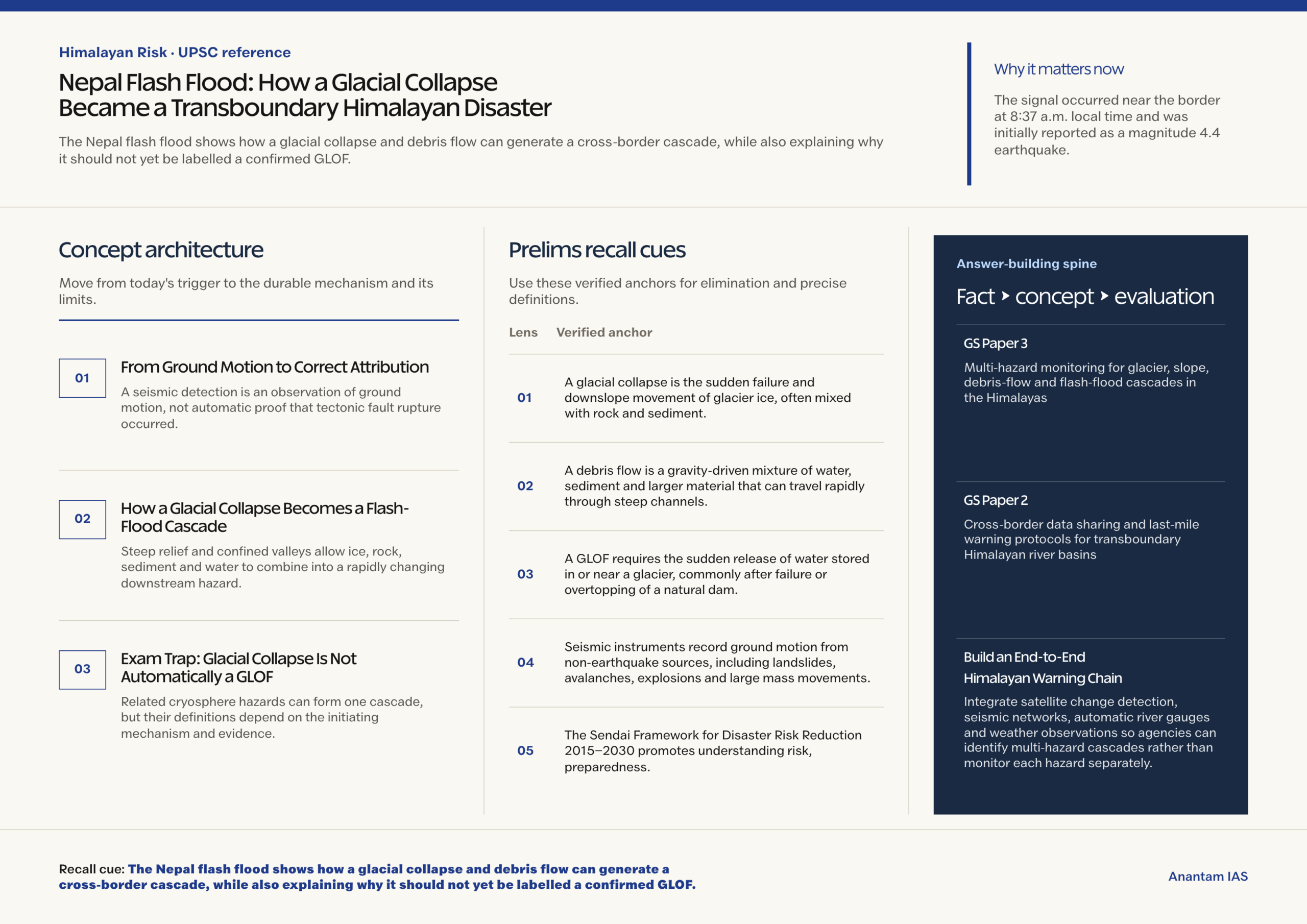
Revision mindmap: Nepal Flash Flood: How a Glacial Collapse Became a Transboundary Himalayan Disaster. Open the full-size image for details.

Background and Context

From Ground Motion to Correct Attribution

A seismic detection is an observation of ground motion, not automatic proof that tectonic fault rupture occurred.

  • Earthquakes usually generate identifiable seismic phases from fault rupture; large landslides or ice collapses produce signals shaped by sustained surface mass movement over uneven terrain.
  • An automatic earthquake catalogue can provide a useful first alert, but analysts must compare waveforms, station records and event location before assigning a final physical cause.
  • Long-period seismic waves can reveal the slower force history of a moving mass that differs from the abrupt rupture pattern expected in many tectonic earthquakes.
  • Satellite imagery supplies missing spatial evidence by showing collapse scars, displaced ice, altered channels or deposits that ground instruments cannot directly identify or map.
  • The USGS revision illustrates scientific correction: an early classification was updated when independent observations supported a non-tectonic explanation of the recorded ground motion.

How a Glacial Collapse Becomes a Flash-Flood Cascade

Steep relief and confined valleys allow ice, rock, sediment and water to combine into a rapidly changing downstream hazard.

  • A collapsing ice mass can entrain loose rock and sediment, increasing its volume and converting the initial failure into a dense debris flow with greater impact force.
  • When debris enters a channel, it may displace water, temporarily block flow or add sediment until the moving surge behaves differently from an ordinary rainfall-fed river flood.
  • A temporary blockage can impound water and later fail, creating a second pulse whose timing, sediment load and magnitude remain difficult to forecast during an unfolding emergency.
  • Narrow gorges concentrate flow, while steep gradients increase velocity and erosive power; downstream bends, tributaries and confluences can redistribute water and debris unpredictably.
  • Roads, bridges, hydropower works and communications often occupy valley floors, so one upstream failure can disable evacuation routes, electricity and essential services together.

Exam Trap: Glacial Collapse Is Not Automatically a GLOF

Related cryosphere hazards can form one cascade, but their definitions depend on the initiating mechanism and evidence.

  • A glacial lake outburst flood begins with sudden drainage of water stored in a glacier-related lake after a moraine dam, ice barrier or natural blockage fails.
  • A glacial collapse can generate a debris flow without any lake breach, so the presence of ice, floodwater and sediment downstream does not prove a GLOF mechanism.
  • A mass movement may also strike a lake, produce a displacement wave and trigger a breach; only verified lake involvement and drainage would support that combined interpretation.
  • Preliminary earthquake, avalanche and GLOF explanations should remain hypotheses until field evidence, remote sensing, seismic analysis and channel deposits establish the event sequence.
  • For Mains answers, separate hazard, exposure and vulnerability: the collapse initiates danger, while valley development, infrastructure siting and weak warning coverage shape losses.

Way Forward

Build an End-to-End Himalayan Warning Chain

  • Integrate satellite change detection, seismic networks, automatic river gauges and weather observations so agencies can identify multi-hazard cascades rather than monitor each hazard separately.
  • Adopt impact-based thresholds that convert upstream detections into clear downstream evacuation actions, including redundant sirens, mobile alerts, radio and community volunteers.
  • Share upstream observations across borders through pre-agreed formats, named contact points and joint exercises for rivers whose warning time depends on another jurisdiction.
  • Apply risk-sensitive siting, protective design and emergency shutdown plans to hydropower, roads, bridges and settlements exposed along confined valleys.

Conclusion

  • The durable lesson is not to attach every Himalayan flood to an earthquake or GLOF, but to reconstruct the complete hazard cascade from evidence.
  • A strong UPSC answer should combine scientific attribution, transboundary monitoring, resilient infrastructure and last-mile warning as parts of one mountain-risk strategy.

UPSC Practice Questions

Prelims MCQ 1

With reference to cryosphere-linked hazards, consider the following statements:

  1. A glacial lake outburst flood necessarily involves the sudden release of water stored in or near a glacier.
  2. A seismic station can record ground motion caused by a large landslide or glacial collapse.
  3. Every glacial collapse that enters a river is classified as a glacial lake outburst flood.

How many of the above statements are correct?

(a) Only one (b) Only two (c) All three (d) None

Answer: (b) Only two

Explanation:

Statements 1 and 2 are correct. A GLOF requires sudden lake-water release, while seismic instruments can detect non-tectonic mass movements. A collapse without a lake breach is not automatically a GLOF.

Prelims MCQ 2

Which combination is most appropriate for identifying a glacial-collapse and debris-flow cascade in a remote mountain basin?

(a) Electoral records and census maps alone (b) Seismic waveforms, satellite imagery and river observations (c) Surface temperature at one downstream city only (d) A single early social-media report

Answer: (b) Seismic waveforms, satellite imagery and river observations

Explanation:

Seismic records help identify mass movement, satellite imagery locates landscape changes, and river observations track downstream effects. Their combination supports attribution and operational warning.

UPSC Mains Questions

  1. Explain how a glacial collapse can evolve into a debris-flow and flash-flood cascade in the Himalayas. Why is precise hazard attribution important for disaster management?
  2. Transboundary Himalayan disasters require an end-to-end warning system rather than isolated monitoring networks. Discuss with reference to cryosphere-linked hazards and infrastructure exposure.

Sources: The Hindu, citing the United States Geological Survey and United Nations Office for Disaster Risk Reduction.

Frequently Asked Questions

Did an earthquake cause the Nepal flash flood?

The USGS revised the initial interpretation after analysing seismic stations, long-period waves and satellite imagery. It classified the signal as a glacial collapse and debris flow, stating that no earthquake occurred.

Was the event a confirmed glacial lake outburst flood?

No confirmed lake breach was established in the cited USGS revision. A GLOF requires sudden release of glacier-related lake water; glacial collapse and debris flow alone do not satisfy that definition.

Why can a glacial collapse look like an earthquake on instruments?

A large mass of ice, rock and sediment transfers force to the ground while moving. Seismic stations record that motion, although detailed waveforms can distinguish it from tectonic fault rupture.

Why are Himalayan flash floods difficult to warn against?

Steep slopes, small headwater basins and confined gorges can produce rapid surges with little lead time. Sparse monitoring, damaged communications and cross-border headwaters can shorten the response window further.

What should a transboundary early-warning system include?

It should combine upstream seismic, satellite, weather and river observations with agreed data-sharing, impact thresholds, named emergency contacts, redundant public alerts, community drills and pre-planned evacuation routes.

Smart Border Command Centres: Architecture, Risks and Safeguards

Open article →Download PDF

Why in News?

The Ministry of Home Affairs is developing a proposed smart-border system linking local command centres, field headquarters and Delhi through integrated surveillance feeds.

  • The proposed system would combine cameras, sensors, drones and image-processing tools into a shared operational picture for deployed agencies.
  • A pilot is expected to begin along the Pakistan border, where drone-enabled smuggling and reconnaissance are prominent concerns.
  • The architecture is intended to improve monitoring where physical fencing is difficult, including mountains, rivers, forests and flood-prone stretches.
  • Technology would be terrain-specific, rather than a uniform package applied identically across every land frontier.
  • The policy challenge is not merely collecting more video; it is converting heterogeneous feeds into timely, attributable decisions without overwhelming operators.
  • Its legitimacy will depend on cybersecurity, privacy safeguards and clear responsibility when an automated alert is wrong, missed or misused.
  • For UPSC answers, treat smart borders as a socio-technical system: sensors, networks, human judgment, law, maintenance and local terrain must work together.

UPSC Relevance

Prelims Relevance

  • The proposed architecture concerns the Ministry of Home Affairs and India’s land-border management.
  • A common operational picture is a fused, shared view built from multiple surveillance and field inputs.
  • AI may assist detection and prioritisation; the reported proposal does not establish autonomous coercive action.
  • Border technologies must account for desert, mountain, riverine, forest and densely populated terrain.
  • The planned chain links local centres, field headquarters and the headquarters in Delhi.

Mains Relevance

GS Paper 3

  • Technology in border management, drone threats, cyber resilience and critical surveillance infrastructure.
  • Limits of AI-assisted threat detection, including false positives, blind spots and degraded communications.

GS Paper 2

  • Accountable data governance, privacy safeguards, procurement oversight and auditable decision-making.
  • Institutional design for sharing operational data while preserving lawful access controls and responsibility.

Essay

  • Technology strengthens security only when institutional capacity and constitutional safeguards develop alongside it.
Mindmap explaining Smart Border Command Centres: Architecture, Risks and Safeguards for UPSC revision
Revision mindmap: Smart Border Command Centres: Architecture, Risks and Safeguards. Open the full-size image for details.

Background and Context

How the Proposed Architecture Would Work

The design resembles a layered information pipeline, not a single control room or one surveillance device.

  • At the edge layer, cameras, ground sensors, anti-drone equipment and patrol reports would detect movement, objects or anomalous activity in terrain that fixed fencing cannot reliably cover.
  • A communications layer would carry time-stamped feeds to nearby command centres; resilient links, local buffering and offline procedures are essential when connectivity is weak, jammed or contested.
  • The fusion layer would correlate inputs from different devices, remove duplicate alerts and present operators with one shared picture rather than several disconnected screens and incompatible timelines.
  • An analytics layer could flag patterns or prioritise alerts, but confidence scores, source quality and uncertainty must remain visible to trained human operators.
  • The command layer would escalate validated alerts from local centres to field headquarters and Delhi, while recording who viewed, changed, shared or acted upon each item.

Interoperability and Operational Reliability

Integration succeeds only when equipment and data from different vendors can be interpreted consistently under field conditions.

  • Common data standards should define timestamps, coordinates, alert categories, device health and confidence levels so one system’s output remains intelligible and comparable to another.
  • Open interfaces and tested vendor portability can reduce lock-in, prevent isolated technology silos and allow failed or obsolete components to be replaced without rebuilding the whole network.
  • A shared picture needs role-based access: each authorised user should see the minimum data required for a defined operational task, location and period.
  • Systems require redundancy and graceful degradation; loss of a sensor, server, power supply or communications link should narrow capability rather than disable the entire decision chain.
  • Independent field trials must measure detection accuracy, false alarms, response time and performance across weather, terrain, day-night conditions and deliberate electronic interference before scale-up.

Privacy, Accountability and Implementation Risks

A powerful surveillance network can generate security value and governance risk at the same time.

  • Continuous monitoring near settlements may capture lawful civilian activity, homes and livelihoods; collection should be necessary, proportionate, geographically bounded and limited to defined security purposes.
  • Data rules should specify retention, deletion and sharing, with stronger controls for biometric or personally identifiable information, documented exceptions and a ban on unrelated reuse.
  • Every query, export and alert change needs an immutable audit trail, enabling later review of misuse, selective enforcement, unauthorised access and responsibility after an incident.
  • AI errors can produce false positives against harmless activity or false negatives that conceal threats; neither model output should be treated as unquestionable evidence for coercive action.
  • Cyber compromise, sensor spoofing and manipulated feeds could corrupt the common operational picture, making zero-trust access, security testing and authenticated data provenance core operational requirements.

Way Forward

Build Safeguards into the Pilot

  • Publish a functional architecture that separates detection, analysis, authorisation and field response, with a named official accountable at each stage.
  • Test the pilot against realistic spoofing, jamming, outage and false-alarm scenarios, not only ideal demonstrations prepared by vendors.
  • Mandate human confirmation for consequential action, document override rules and preserve evidence showing how each alert reached a decision.
  • Use periodic security audits, privacy reviews and outcome-based procurement tied to verified field performance, repairability and interoperability.

Conclusion

  • A smart border is not defined by the number of sensors; it is defined by whether trusted information produces timely, lawful and reviewable action.
  • In a Mains answer, connect capability with safeguards: interoperability, human oversight, cyber resilience, proportional collection and auditability must advance together.

UPSC Practice Questions

Prelims MCQ 1

With reference to the proposed smart-border command architecture, consider the following statements:

  1. It seeks to combine inputs from cameras, sensors, drones and image-processing tools.
  2. It is designed as a completely autonomous system that excludes human operators from consequential decisions.
  3. It proposes a chain linking local command centres with field headquarters and Delhi.

How many of the above statements are correct?

(a) Only one (b) Only two (c) All three (d) None

Answer: (b) Only two

Explanation:

Statements 1 and 3 reflect the reported proposal. Statement 2 is incorrect: the proposal describes AI-enabled integration, not an autonomous system excluding human judgment.

Prelims MCQ 2

In a sensor-rich border command system, the term ‘common operational picture’ most appropriately refers to:

(a) A single nationwide terrain map generated without field inputs (b) A fused and shared view of relevant information from multiple systems (c) An autonomous weapon-selection interface (d) A database accessible without role-based restrictions

Answer: (b) A fused and shared view of relevant information from multiple systems

Explanation:

A common operational picture integrates relevant, time-sensitive inputs into a shared view for authorised decision-makers; it is neither an autonomous weapon system nor unrestricted data access.

UPSC Mains Questions

  1. Explain how integrated command centres can improve technology-enabled land-border management. What interoperability and operational-resilience conditions are necessary for their effectiveness?
  2. Security surveillance can create both public value and constitutional risk. Suggest privacy, accountability and human-oversight safeguards for India’s proposed smart-border architecture.

Source: The Hindu.

Frequently Asked Questions

What is a smart-border command centre?

It is a proposed operational hub that would receive and fuse feeds from sensors, cameras, drones and field units, helping authorised personnel assess alerts and coordinate a response.

What does a common operational picture mean?

It means a shared, time-sensitive view created by correlating relevant inputs from multiple systems, with common labels, timestamps and confidence information for authorised decision-makers.

Why is interoperability important for border surveillance?

Different vendors and agencies may produce incompatible data. Common standards and open interfaces allow feeds to be combined, components replaced and alerts interpreted consistently without isolated technology silos.

Can AI independently decide how to respond to a border alert?

The reported proposal describes AI-assisted surveillance integration, not autonomous coercive decisions. Consequential action should remain under trained human authority with documented reasons, review and accountability.

What privacy safeguards should a smart-border system include?

It should limit collection to defined purposes, minimise civilian data, control access, set retention and deletion rules, record every use and provide independent security and privacy audits.

Making India’s Food System Climate-Proof 

Open article →Download PDF

Context: 

India’s journey from dependence on food aid in the 1960s to becoming a major agricultural producer is a remarkable achievement. Public investment in improved seeds, irrigation, procurement, storage, price support and the Public Distribution System (PDS) has enabled the country to maintain buffer stocks and provide subsidised foodgrains to around 81 crore people under the National Food Security Act (NFSA), 2013.

However, the challenge is no longer limited to producing sufficient food. India must ensure an affordable, nutritious and reliable food supply for 1.4 billion people amid rising temperatures, erratic rainfall, water scarcity and extreme weather. 

UPSC Relevance: GS-3 Economy: Agriculture; Food Security; GS-3 Environment & Disaster Management: Disaster Resilience; Climate Smart Agriculture  

Mains: Food Security and Climate Change 

India’s Existing Strengths: 

India already possesses a strong foundation for climate-proofing its food system:

  • Foodgrain production exceeded 350 million tonnes in 2024-25, with record rice and wheat output.
  • The Public Distribution System (PDS) provides an extensive food-security safety net.
  • Digitisation and the One Nation One Ration Card (ONORC) have improved portability and access to entitlements.
  • Institutional mechanisms for procurement, buffer stocking and price support provide the administrative capacity required for transition.

Emerging Climate Risks: 

Climate change affects the entire food value chain:

  • Heat stress reduces wheat and other crop yields.
  • Erratic monsoons may produce droughts and floods within the same season.
  • Groundwater depletion weakens irrigation security.
  • Extreme weather damages warehouses, roads and transport networks.
  • Disrupted production and logistics create food-price volatility and reduce access to nutritious food.

Thus, food security must be viewed not merely as grain availability but as the resilience of production, storage, transport, markets and consumption.

Diversifying Procurement and the PDS: 

  • Limited Procurement: The rice-wheat system served India well, but procurement remains concentrated in a few crops and States, many of which face severe groundwater stress. India should progressively diversify procurement across both commodities and regions, while aligning price support with local climate and water conditions. 
  • Crop Diversification: Millets, pulses, oilseeds and other nutri-cereals can:
    • reduce dependence on water-intensive crops
    • distribute production risks across regions
    • improve soil and water sustainability; and
    • strengthen dietary diversity and nutrition.

Rice and wheat will remain essential, but a broader procurement base can create a more resilient national food portfolio. The PDS can similarly include locally appropriate millets and pulses, connecting food security with nutrition and climate adaptation.

Building a Climate-Resilient Food System: 

  • Climate-informed planning: India Meteorological Department forecasts should be integrated with procurement, buffer stock and contingency decisions. NFSA monitoring may include indicators relating to heat, water stress, storage vulnerability and supply chain resilience, alongside conventional measures such as coverage and foodgrain offtake.
  • Farmer-level resilience: Farmers require access to climate-resilient seed varieties, micro-irrigation and watershed development, precision farming and digital weather advisories, diversified cropping systems, and effective weather-indexed crop insurance.
  • Public-private collaboration can accelerate research, seed certification and last-mile delivery, while public support must protect smallholders and highly climate-exposed regions.
  • Resilient infrastructure: Adaptation must extend beyond farms to include flood-resilient warehouses, heat- and moisture-controlled storage, expanded cold-chain networks, and reliable, climate-resilient transport links. Such infrastructure becomes especially important as the food basket expands to include pulses, fruits, vegetables and other perishables.
  • Financing the Transition: Climate-resilient food systems require green bonds, adaptation finance, agricultural insurance and investment in sustainable value chains. Food systems should also be integrated into India’s net-zero pathway, with measurable targets for emission reduction, carbon sequestration and climate resilience. 

Towards a Climate Buffer:

India could develop a broader “climate buffer” combining diversified crops and procurement regions, resilient infrastructure, climate information, insurance and improved water management. This would complement conventional grain buffer stocks by addressing systemic risks rather than merely harvest shortfalls.

Thus, India must shift from the narrow objective of “food security” to “sustainable food security”, embedding climate risk management into NFSA planning, procurement and monitoring. Timely action can ensure that India’s food system remains productive, nutritious, affordable and sustainable in the decades ahead. 

Practice Question: 

Q. The increasing frequency and intensity of disasters are emerging as a major threat to food security in India. Examine the impact of disasters on food security and suggest measures for building a disaster-resilient food system. (10 M) 

Restoring Lakes by going beyond Quick Fixes

Open article →Download PDF

Context: 

Wetlands, including urban lakes, cover nearly 6% of the Earth’s surface and rank among its most productive ecosystems. They store carbon, support biodiversity, regulate local climates, recharge groundwater and reduce floods. 

Yet many urban lakes in India are disappearing, heavily polluted or biologically dead. Their loss is weakening cities’ natural defences against climate change and threatening public health, water security and urban liveability. 

UPSC Relevance: GS-3 Environment: Pollution, Environmental Governance

Mains: Wetland Conservation, Ramsar Convention, Urban wetlands

Scale of the Crisis: 

  • CAG reports have highlighted the disappearance of more than 500 lakes in Jammu and Kashmir since 1967. 
  • Hyderabad reportedly lost around 61% of its lake area since 1979, while 268 water bodies disappeared between 2002 and 2012.

Such degradation intensifies urban heat islands, flooding and water scarcity. Lakes must therefore be treated as “urban climate buffers” and “sponge systems”, rather than liabilities.

Why are Urban Lakes disappearing?

  • Unplanned urbanisation:
    • Rapid urban expansion has increased pressure on land. Developers and public agencies frequently treat lakes and their catchments as vacant land rather than essential ecological infrastructure. Consequently, wetlands are filled, fragmented or converted for housing, roads and commercial projects. 
    • The sharp rise in urban land prices has further transformed lakes into a perceived opportunity cost. Former agricultural fields, lakebeds and drainage channels in cities such as Hyderabad, Bengaluru and Mumbai have become prime real estate.
  • Pollution and institutional apathy: Urban lakes have become dumping grounds for untreated sewage, industrial effluents, construction debris, and municipal solid waste.

Thus, lakes are dying not only because of encroachment but also because they are routinely taken for granted.

Policy Recognition, Weak Implementation: 

  • India’s expanding network of Ramsar sites demonstrates formal recognition of wetland conservation. However, international designation alone does not guarantee ecological recovery. At the local level, the wetlands continue to face:
    • ambiguous boundaries
    • encroachment of lakebeds and catchments
    • disruption of feeder channels
    • fragmented institutional responsibility; and
    • weak enforcement of the Wetlands (Conservation and Management) Rules, 2017.
  • Programmes such as AMRUT, Jal Shakti Abhiyan and Mission Amrit Sarovar provide useful policy frameworks, but their impact is often weakened by poor inter-departmental coordination and the preference for beautification over restoration. Municipal bodies frequently construct promenades, fences and lighting around lakes while ignoring sewage inflows, catchment protection, feeder channels and water quality. Such cosmetic interventions cannot restore a lake’s ecological functioning.

Examples of Effective Restoration: 

  • The Hyderabad Disaster Response and Asset Protection Agency (HYDRAA) illustrates the importance of institutional action. It has reclaimed encroached lakebeds, removed illegal structures from Full Tank Level zones and undertaken restoration across several water bodies. By clearing silted feeder channels and restoring natural hydrological flows, the agency reportedly increased the water spread of Nalla Cheruvu from 16 acres to nearly 30 acres.
  • Citizen-led movements have also revived lakes such as Puttenahalli and Jakkur in Bengaluru and Kudikunta in Hyderabad. These lake champions demonstrate how community monitoring, local knowledge and sustained participation can complement State action.

However, without statutory backing, stable financing and consistent enforcement, such successes will remain isolated.

Way Forward: Going Beyond Quick Fixes

Urban lake restoration requires structural reforms:

  • Integrate lakes into urban planning: Water bodies, floodplains, feeder channels and catchments must be incorporated into city master plans as ecological infrastructure.
  • Secure legal boundaries: Lakes and Full Tank Level zones should be scientifically mapped, geo-tagged and legally protected, with strict penalties for encroachment.
  • Restore entire hydrological systems: Rejuvenation must cover catchments, drainage channels, sewage treatment and natural water flows and not merely the visible lake area.
  • Create unified authorities: Fragmented responsibilities among municipal, irrigation, revenue and pollution-control agencies should be consolidated under accountable urban-wetland institutions.
  • Control pollution at source: Sewage and industrial effluents must be intercepted and treated before entering lakes, while solid waste dumping should attract effective penalties.
  • Institutionalise citizen participation: Residents, researchers and “lake champions” should be included in lake-management committees and monitoring systems.
  • Ensure ecological financing: Dedicated restoration funds and long-term maintenance budgets are needed instead of one-time beautification projects.

India’s urban lake crisis is fundamentally a crisis of land, law and governance. Cities that reduce lakes to landscaped backdrops will pay through greater floods, heat stress and water scarcity. Those that restore lakes as living ecological systems will strengthen their resilience in an increasingly warm and water-stressed future. 

Practice Question: 

Q. Degradation of urban and peri-urban wetlands poses a dual threat to flood resilience and urban ecological security. In the context of initiatives such as Amrit Dharohar, examine the major drivers of wetland loss in India and suggest measures for their restoration. (10 M)

How Can States Use Disaster Funds for Heatwaves?

Open article →Download PDF

Why in News?

Recently, the Ministry of Home Affairs informed the Lok Sabha that heatwaves and lightning had been added to India’s list of notified natural calamities, taking the total to 14.

The decision follows the recommendation of the Sixteenth Finance Commission (FC-XVI). Combined with the 2024 amendment to Disaster Mitigation Fund guidelines, it makes heatwaves eligible for financing from the full State Disaster Risk Management Fund pool.

UPSC Relevance: GS-3 Disaster Management: Disaster Resilience, Climate Change

Prelims: Finance Commission, SDRF, SDMF, Notified disasters
Mains: Financing heatwave preparedness and climate adaptation

Disaster Finance Architecture in India: 

  • Under Article 280, the Finance Commission recommends arrangements for financing disaster management.
  • The FC-XVI recommended ₹2.04 lakh crore for State disaster funds during 2026-27 to 2030-31, which is around 28% more than the previous Finance Commission’s allocation. It includes:
    • ₹1.6 lakh crore for the State Disaster Response Fund (SDRF): For immediate response, relief and assistance following disasters.
    • Remaining allocation for the State Disaster Mitigation Fund (SDMF): For long-term interventions that reduce disaster risks.
  • Distribution among States is based on a disaster-risk index incorporating the frequency and intensity of hazards, population exposure, vulnerability and expenditure incurred during the previous Finance Commission’s tenure.
  • The FC-XVI also recommended ₹79,406 crore for National Disaster Funds. States may seek additional national assistance when a severe disaster exceeds their financial capacity, as Kerala did after the 2024 Wayanad landslides. 

Why was the Change Necessary?

  • Previously, a State could declare a heatwave a local disaster and use its SDRF, but expenditure was limited to 10% of the annual allocation. The State also had to formulate separate relief norms, including compensation for deaths and crop losses. 

However, no comparable ceiling applied to nationally notified disasters such as floods and cyclones. The new notification removes this asymmetry at a time when India’s heat exposure is rising:

  • An assessment based on 35 indicators estimated that over 57% of Indian districts, containing nearly three-fourths of the population, face high to very-high heat risk.
  • The number of hot days, very warm nights and levels of relative humidity have increased.
  • Warm nights and high humidity prevent the human body from recovering after daytime heat exposure. 

What can States Fund?

The National Disaster Management Authority has advised heatwave-prone States, districts and cities to prepare Heat Action Plans (HAPs) that map vulnerability and specify short-, medium- and long-term interventions. The notification provides two clear financing routes:

  • Through the SDRF: States can finance immediate relief measures, such as:
    • compensation for heat-related deaths and eligible losses
    • emergency drinking-water arrangements
    • temporary cooling and relief centres
    • medical assistance and emergency response; and
    • support for affected livelihoods and crops under prescribed norms.
  • Through the SDMF: States can finance long-term risk-reduction measures, including:
    • cooling shelters and cool-roof programmes
    • heat early-warning and public-alert systems
    • urban greening and shaded public spaces
    • heat-resilient health facilities
    • drinking-water infrastructure; and
    • vulnerability mapping and community preparedness.

State Disaster Management Authorities and State Emergency Operations Centres will serve as key nodal institutions for administering these funds.

Implementation Challenges: 

Although around 300 cities and districts across 23 heatwave-prone States have HAPs, implementation remains weak. A 2023 assessment found that 79% of HAPs asked departments to arrange funds from their existing budgets. 

Major constraints include:

  • Absence of HAPs across nearly 4,800 urban local bodies and several hundred districts
  • Limited technical capacity to prepare fundable mitigation projects
  • Fragmented responsibility among health, labour, urban and disaster-management departments
  • Inadequate heat-related health and mortality data; and
  • Weak monitoring of plan implementation.

The notification of heatwaves as a national disaster category removes a major financial barrier. However, access to funds alone will not protect vulnerable populations. 

States must develop credible Heat Action Plans, strengthen health surveillance and translate plans into locally appropriate projects. Effective use of the SDRF and SDMF can shift India’s approach from temporary heat relief towards sustained climate resilience.

Western Disturbance linked to Nepal Flash Flood

Open article →Download PDF

Why in News?

A western disturbance (WD) that brought rainfall to northern India and subsequently moved eastwards towards the Himalayas may have contributed to the weather conditions preceding the devastating flash flood along the Trishuli River in Nepal’s Nuwakot district.

However, the India Meteorological Department (IMD) has cautioned that the WD should be treated only as a possible contributor to the broader rainfall environment, not as the established direct cause of the disaster. 

Nepal and China are investigating whether an earthquake, landslide or ice avalanche triggered the sudden release of water.

UPSC Relevance: GS-1 Physical Geography: Western Disturbances and Himalayan Climate; GS-3 Disaster Management 

Prelims: Western disturbances, subtropical westerly jet, flash floods
Mains: Weather-system interaction and cascading disaster risks in the Himalayas

What may have caused the Flood?

The precise sequence of events remains under investigation. Several interacting factors may have produced a cascading disaster:

  • Persistent rainfall: The World Meteorological Centre, Beijing, reported nearly 10 days of continuous rainfall along Nepal’s southern Himalayan foothills.
  • Upstream rainfall: Southern Tibet, located upstream of northern Nepal, received moderate to heavy rainfall with localised intense downpours.
  • Western disturbance: The eastward-moving WD enhanced rainfall over the Himalayan and northeastern regions.
  • Monsoon depression: A depression over northern India supplied additional moisture and was expected to sustain rainfall over Nepal.
  • Earthquake or slope failure: Preliminary reports suggested that an earthquake may have triggered a landslide or ice avalanche.
  • Temporary river blockage: An avalanche may have dammed the river, causing water to accumulate before the natural barrier suddenly breached, producing a flash flood and debris flow downstream.

The region’s steep slopes, narrow valleys and unstable geology could have amplified the impact. There is presently insufficient evidence to classify the event as a cloudburst.

What is a Western Disturbance?

Western disturbances are eastward-moving extra-tropical weather systems that originate largely over the Mediterranean-West Asian region and travel towards the Indian subcontinent.

  • They generally appear as upper-air troughs or cyclonic circulations.
  • They form through interactions between cold polar and relatively warm tropical air masses.
  • They are steered eastwards by the subtropical westerly jet stream.
  • They collect moisture from the Mediterranean, Black and Caspian seas and, occasionally, the Arabian Sea.
  • They are most frequent and influential over India between December and March, though they can occur in other seasons as well.

They are called western disturbances because they approach India from the west and disturb the prevailing weather conditions.

image 33

Interaction with other weather systems & Importance: 

  • A Western Disturbance may interact with Arabian Sea moisture, easterly winds, monsoon depressions, local convection, and Himalayan topography. Such interactions may produce rainfall far more intense than that generated by either system independently.
  • Importance for India: WD provide-
    • Essential winter rainfall to Punjab, Haryana, Rajasthan, western Uttar Pradesh and adjoining areas which benefits rabi crops. 
    • Principal source of winter snow over the western Himalayas which supports glaciers, seasonal snowpack, spring and summer river flows.
    • Temperature regulation: Cloud cover and rainfall may reduce daytime temperatures, while the passage of a WD is often followed by cold north-westerly winds, cold waves and fog.

Western Disturbances as Disaster Triggers: 

  • Although agriculturally beneficial, strong or interacting WDs can generate serious hazards:
    • intense rainfall and flash floods
    • landslides and debris flows
    • heavy snowfall and avalanches
    • hailstorms and crop damage
    • cloudbursts under favourable local conditions
    • urban flooding; and
    • disruption of roads, power and communication networks.
  • The risks become particularly acute when a WD interacts with a monsoon system. Moisture convergence, unstable slopes and saturated catchments can transform prolonged rainfall into a compound or cascading disaster.

Western Disturbances & Climate-Change Dimension: 

  • The relationship between climate change and the frequency of WDs remains scientifically complex. However, a warmer atmosphere can hold more moisture, increasing the potential for intense precipitation when favourable weather systems interact.
  • Even where a WD is not the immediate cause, it can contribute to the environmental conditions that make floods, landslides or avalanches more likely. 

The Nepal flood demonstrates how western disturbances, monsoon systems, upstream rainfall and unstable Himalayan terrain may interact to produce cascading disasters. 

It also underlines the need to avoid simplistic attribution: the WD may have created favourable rainfall conditions, while the immediate trigger could have been an earthquake, avalanche, landslide or temporary river blockage. 

Hence, Climate-resilient Himalayan development requires stronger scientific monitoring, transboundary cooperation and multi-hazard early-warning systems.

Practice Question: 

Q. Western disturbances are both climatic lifelines and potential triggers of cascading disasters in the Himalayan region. Explain their origin and movement, and examine how their interaction with monsoon systems and mountain topography can intensify disaster risks. (10 Marks)

UN panel flags violations against SC, ST and Rohingya

Open article →Download PDF

Why in News?

The UN Committee on the Elimination of Racial Discrimination (UNCERD) expressed concern over alleged human-rights violations affecting Scheduled Castes, Scheduled Tribes, Dalits, Rohingya refugees and other non-citizens. 

India rejected the committee’s observations as containing politically motivated and malicious references, sweeping generalisations and unsubstantiated allegations.  

UPSC Relevance: GS-2 Polity and Governance: Fundamental Rights; GS-2 International Relations: Reports and Indices, Human Rights, Refugee Policy

Prelims: ICERD, CERD, Constitutional safeguards for SCs and STs

What are ICERD and CERD?

  • The International Convention on the Elimination of All Forms of Racial Discrimination (ICERD), adopted in 1965, prohibits discrimination based on race, colour, descent, or national or ethnic origin. 
  • India signed the Convention in 1967 and ratified it in 1968.
  • The Convention is monitored by the UN Committee on the Elimination of Racial Discrimination (CERD), consisting of 18 independent experts serving in their personal capacities. It examines periodic reports submitted by States and issues concluding observations containing concerns and recommendations.
  • CERD’s concluding observations are not directly enforceable judgments. Nevertheless, they carry persuasive and interpretative authority and create an expectation that States will respond and improve treaty compliance.  

Key concerns raised by UNCERD: 

  • Reported violence, excessive force, arbitrary detention and ill-treatment of SCs, STs, particularly Dalits, and non-citizens.
  • Alleged profiling and arbitrary detention of Rohingya, Bengali-speaking Muslims, migrants and asylum-seekers. 
  • The committee called upon India for impartial investigations, accountability, action against hate crimes and adherence to non-refoulement.

India’s Response: 

  • India rejected what it termed politically motivated and highly malicious references in the observations.
  • India highlighted:
    • constitutional guarantees of equality and non-discrimination
    • affirmative-action policies for disadvantaged communities
    • an independent judiciary and democratic accountability
    • statutory commissions and human-rights institutions
    • targeted welfare measures; and
    • India’s plural, multi-religious and multi-ethnic character.

India’s Constitutional and Legal Safeguards: 

(i) Constitutional Provisions: 

  • Article 14: Equality before law and equal protection of laws, available to every person.
  • Article 15: Prohibits discrimination against citizens on grounds including religion, race and caste.
  • Article 16: Ensures equality of opportunity in public employment and permits reservations.
  • Article 17: Abolishes untouchability.
  • Article 21: Protects the life and personal liberty of every person, including non-citizens, subject to procedure established by law.
  • Article 46: Directs the State to promote the educational and economic interests of SCs and STs and protect them from exploitation.
  • Articles 338 and 338A: Establish the National Commissions for Scheduled Castes and Scheduled Tribes.
  • Fifth and Sixth Schedules: Provide special governance protections for tribal areas.
  • Articles 330 and 332: Reserve seats for SCs and STs in Parliament and State Assemblies.

(ii) Statutory Protections: 

  • Protection of Civil Rights Act, 1955: Penalises the practice of untouchability.
  • SC/ST (Prevention of Atrocities) Act, 1989: Criminalises specified atrocities and provides Special Courts, victim relief and witness protection. 
  • Bharatiya Nyaya Sanhita, 2023: Section 196 penalises promotion of enmity on grounds including religion, race, language, caste and community.
  • Protection of Human Rights Act, 1993: Provides for the NHRC and State Human Rights Commissions.