Opens in a new tab
Join Anantam IAS Channel on Telegram

Daily Digest · Friday

28 August 2026 Current Affairs for UPSC

7 current affairs published on Friday, 28 August 2026

28 August 2026 Current Affairs for UPSC — every Why-in-News article AnantamIAS published on Friday, 28 August 2026, broken down with Why in News?, the exact GS paper it feeds, sub-topic mapping, MCQ-ready facts and a UPSC-style practice question. 7 articles in total, covering Polity, Economy, Environment, S&T, IR, Geography, History, Society and Internal Security — the same Why-in-News + GS-paper-mapping + practice-question format the Compass uses across every daily digest on the site.

Daily current affairs for UPSC is where new material enters your prep stream. Read this 28 August 2026 digest end-to-end in 25–35 minutes, attempt the practice question at the foot of each article (it's MCQ for some, 10/15-marker for others), then bookmark the entries that fall inside your active revision window. Everything stays cross-linked: tap any subject pill to jump to that subject's hub, or use the table of contents above to skip straight to a specific story.

Use this page three ways. Read sequentially for a one-sitting scan of everything that mattered on 28 August 2026. Download the 28 August 2026 PDF below for offline study or print revision. Or use the August 2026 Current Affairs compilation to see this day in the month's full context. For the previous day's reading, see 27 August 2026 Current Affairs; the next day's is 29 August 2026 Current Affairs.

Why we publish daily current affairs separately from the monthly compilation: daily is learning, monthly is revision. Use the daily page to add fresh material to your notes the day it breaks; come back to the August 2026 compilation 60 days before Prelims when the noise has settled and only the lasting takeaway is worth re-reading.

Youth Mental-Health Support: The Design and Safeguards of Let’s Talk Life

Open article →Download PDF

Why in News?

The Hindu reported on August 28 that NIMHANS and IIIT-B’s Let’s Talk Life platform offers young people anonymous, moderated peer support for mental-wellbeing concerns.

  • The service was developed by NIMHANS mental-health professionals with technologists from the E-Health Research Centre at IIIT-Bengaluru.
  • Users can post concerns anonymously and receive responses from trained young peer volunteers whose replies are reviewed by mental-health professionals.
  • A reported study of 137 platform posts examined why users sought support; it did not establish clinical effectiveness or population-level outcomes.
  • The service describes itself as low-intensity peer support, not crisis care, counselling or a substitute for professional treatment.
  • Anonymous first contact can lower stigma and fear of judgement, helping a young person put distress into words before deciding whether to seek formal care.
  • Public value depends on a safe bridge to care: moderation, escalation pathways, privacy safeguards and honest limits matter as much as digital access.

UPSC Relevance

Prelims Relevance

  • NIMHANS is an Institute of National Importance under the Union Ministry of Health and Family Welfare.
  • Let’s Talk Life is a moderated peer-support forum, not a telemedicine replacement or emergency-response service.
  • Anonymity in public conversation does not necessarily mean that a digital service collects no registration or technical data.
  • The platform combines trained peer responses with review by mental-health professionals.
  • Digital mental-health governance joins public health, data protection, platform safety and equitable access.

Mains Relevance

GS Paper 2

  • Mental-health service delivery for young people and the role of low-intensity, community-linked support.
  • Stigma, access barriers, referral continuity and accountability in public-health innovation.

GS Paper 3

  • Responsible digital-health design, privacy protection and human oversight of online support systems.

Essay

  • Technology can open the first door to care, but trust is built through human judgement, privacy and dependable institutions.
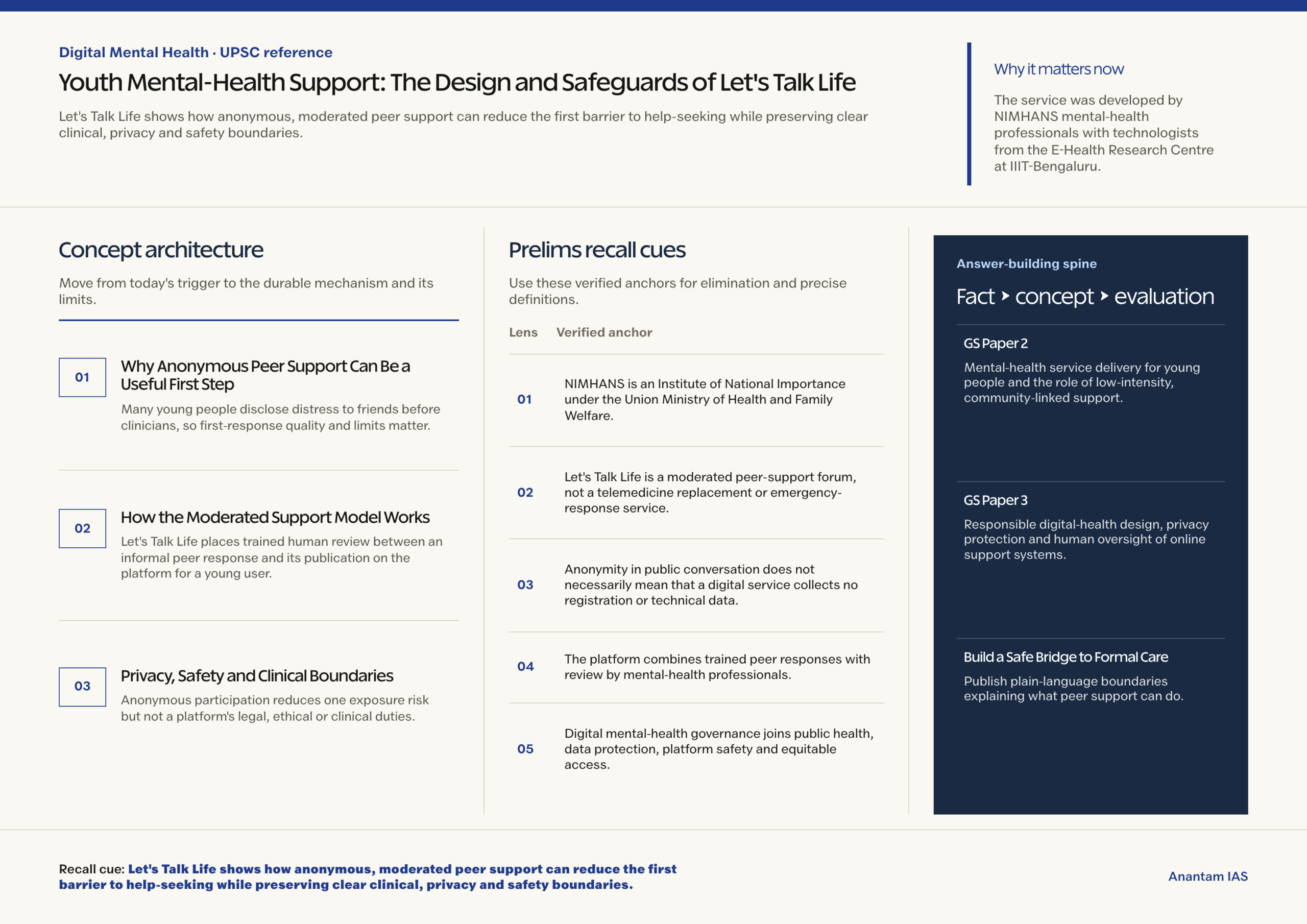
Mindmap explaining Youth Mental-Health Support: The Design and Safeguards of Let's Talk Life for UPSC revision
Revision mindmap: Youth Mental-Health Support: The Design and Safeguards of Let's Talk Life. Open the full-size image for details.

Background and Context

Why Anonymous Peer Support Can Be a Useful First Step

Many young people disclose distress to friends before approaching a clinician, making the quality, safety and limits of that first response especially important.

  • Stigma, fear of misunderstanding and doubt about whether a problem is serious enough can delay formal help-seeking until distress becomes harder to manage.
  • Anonymous posting can reduce the social cost of disclosure and let users discuss stress, loneliness, relationships, family pressure or uncertainty without public identification or immediate face-to-face exposure.
  • A trained peer can offer empathetic listening, validation and practical perspective in language that feels less institutional than a clinical intake, especially at first disclosure.
  • This is best understood as early, low-intensity support: it may make distress speakable and encourage help-seeking, but it neither diagnoses illness nor proves improvement.
  • Digital access can widen the entry point, yet language, disability access, connectivity and digital literacy still shape who can use it safely.

How the Moderated Support Model Works

Let’s Talk Life places trained human review between an informal peer response and its publication on the platform for a young user.

  • Young peer volunteers receive structured training in empathetic, respectful and solution-oriented responses, with role boundaries that prevent them from acting as unqualified counsellors.
  • Mental-health professionals review responses for safety and appropriateness, adding supervision and a second judgement layer that an open, unmoderated discussion board would lack.
  • Responders are trained to notice signs of significant distress and encourage professional intervention when a user’s needs, risk or symptoms exceed the peer-support role.
  • The model creates a referral bridge: listen without judgement, clarify the concern, support the next step, recognise limits and avoid promising treatment outcomes.
  • Its public-health contribution should be assessed through safe referrals, user trust and access quality, not engagement time or the volume of posts.

Privacy, Safety and Clinical Boundaries

Anonymous participation reduces one exposure risk, but it does not remove a platform’s legal, ethical and clinical duties toward users in distress.

  • The official privacy policy says posts and questions may be used for research in aggregated and anonymised form; meaningful consent and purpose limitation remain essential.
  • Anonymous public posting is different from collecting no data: registration or service operation may involve personal or technical information requiring data minimisation, security and limited retention.
  • A clear crisis disclaimer must be matched by visible helplines, risk-recognition protocols and a workable escalation pathway for serious, persistent or rapidly worsening concerns.
  • Moderators need defined roles, supervision and protection from emotional overload; users need accessible reporting, deletion and grievance mechanisms that work predictably in practice.
  • The study of platform posts describes user needs and behaviour. It cannot by itself prove reduced illness, prevented self-harm or improved clinical outcomes.

Way Forward

Build a Safe Bridge to Formal Care

  • Publish plain-language boundaries explaining what peer support can do, what it cannot do and when a user should seek urgent or professional help.
  • Create audited referral and crisis pathways linked to qualified services, with response protocols tested for high-risk disclosures.
  • Collect only necessary data, explain research use clearly and provide practical access, correction, deletion and grievance options.
  • Evaluate safety, referral completion, accessibility and user-reported trust through independent review, without turning vulnerable disclosures into engagement targets.

Conclusion

  • Let’s Talk Life illustrates a useful stepped-care entry point: moderated peer support can reduce silence and help a young person recognise when more specialised care is needed.
  • In a Mains answer, pair digital reach with four safeguards: professional oversight, clinical escalation, privacy by design and measurable accountability for safety and access.

UPSC Practice Questions

Prelims MCQ 1

With reference to the Let’s Talk Life platform, consider the following statements:

  1. It was developed through collaboration between NIMHANS mental-health professionals and IIIT-Bengaluru technologists.
  2. It is designed to replace professional counselling for young people with persistent mental-health concerns.
  3. Responses from trained peer volunteers are reviewed by mental-health professionals before publication.

How many of the above statements are correct?

(a) Only one (b) Only two (c) All three (d) None

Answer: (b) Only two

Explanation:

Statements 1 and 3 are correct. The platform is a low-intensity, moderated peer-support service and explicitly does not replace professional care.

Prelims MCQ 2

Which safeguard most directly distinguishes a moderated digital peer-support service from an unmoderated online discussion forum?

(a) Maximising the number of daily posts (b) Requiring public disclosure of users’ identities (c) Professional review and escalation protocols for significant distress (d) Replacing all referrals with automated replies

Answer: (c) Professional review and escalation protocols for significant distress

Explanation:

Professional oversight and escalation create safety boundaries around peer responses. Popularity or anonymity alone cannot provide clinical risk management.

UPSC Mains Questions

  1. Anonymous digital peer-support platforms can reduce barriers to mental-health help-seeking, but they cannot substitute for clinical care. Discuss with reference to service design and safeguards.
  2. Examine how privacy by design, human moderation and referral pathways can make digital mental-health services safer and more accountable for young users.

Sources: The Hindu and Let's Talk Life official privacy policy.

Frequently Asked Questions

What is Let’s Talk Life?

It is an anonymous online peer-support forum for young people, developed by NIMHANS mental-health professionals with IIIT-Bengaluru technologists and moderated by mental-health experts.

Does the platform provide counselling or crisis care?

No. It is designed as low-intensity peer support, not a substitute for counselling, treatment or emergency assistance. Serious or persistent concerns require qualified professional care.

How are responses kept safe?

Trained young peer volunteers draft empathetic responses, and mental-health professionals review them for safety and appropriateness before they are posted.

Does anonymous posting mean that no personal data is collected?

Not necessarily. Public anonymity and backend data collection are different. The service must still minimise data, explain its purposes, secure records and provide meaningful user rights.

What is the main governance lesson?

Digital access works best as a bridge to care when professional oversight, crisis escalation, privacy safeguards and independent evaluation are built into the service.
India-US Javelin Agreement: Procurement, Capability and Defence Cooperation

Open article →Download PDF

Why in News?

India signed a Letter of Offer and Acceptance with the United States for procuring the Javelin anti-tank guided missile system through the Foreign Military Sales route.

  • The signed Letter of Offer and Acceptance converts an earlier proposed sale into a concrete government-to-government acquisition step.
  • The report describes Javelin as a medium-range, fire-and-forget anti-tank guided missile for armoured vehicles and fortified positions.
  • The agreement makes India a customer of the system, which is already operated by United States forces and several international customers.
  • The signing may facilitate later co-production discussions, but the report does not establish that co-production or technology transfer forms part of this procurement contract.
  • The acquisition can strengthen portable infantry anti-armour options, but capability depends on training, doctrine, logistics, target identification and integration with other battlefield systems.
  • Using the FMS route embeds the purchase in an established inter-governmental process and adds another practical link in the India-US Major Defence Partnership.
  • Industrial cooperation should be assessed through negotiated work share, intellectual-property access, maintenance capacity and supply resilience, not through diplomatic language alone.

UPSC Relevance

Prelims Relevance

  • The Javelin is an anti-tank guided missile system, not a surface-to-air missile or an artillery gun.
  • It is described as fire-and-forget, meaning the operator need not continuously guide the missile after launch.
  • The acquisition uses the United States’ Foreign Military Sales route, a government-to-government mechanism.
  • A signed Letter of Offer and Acceptance is distinct from an earlier proposed or notified sale.
  • The system is produced by the Javelin Joint Venture comprising RTX and Lockheed Martin.

Mains Relevance

GS Paper 2

  • Defence procurement as an operational pillar of the India-US Major Defence Partnership.
  • Interoperability benefits and the strategic risks of long-term dependence on foreign supply and support chains.

GS Paper 3

  • Infantry anti-armour capability, training, maintenance and integration within combined-arms operations.
  • Conditions under which acquisition can support credible co-production, domestic maintenance and defence-industrial learning.

Essay

  • Strategic partnership becomes durable when political alignment is translated into usable capability, reliable institutions and mutually beneficial production relationships.
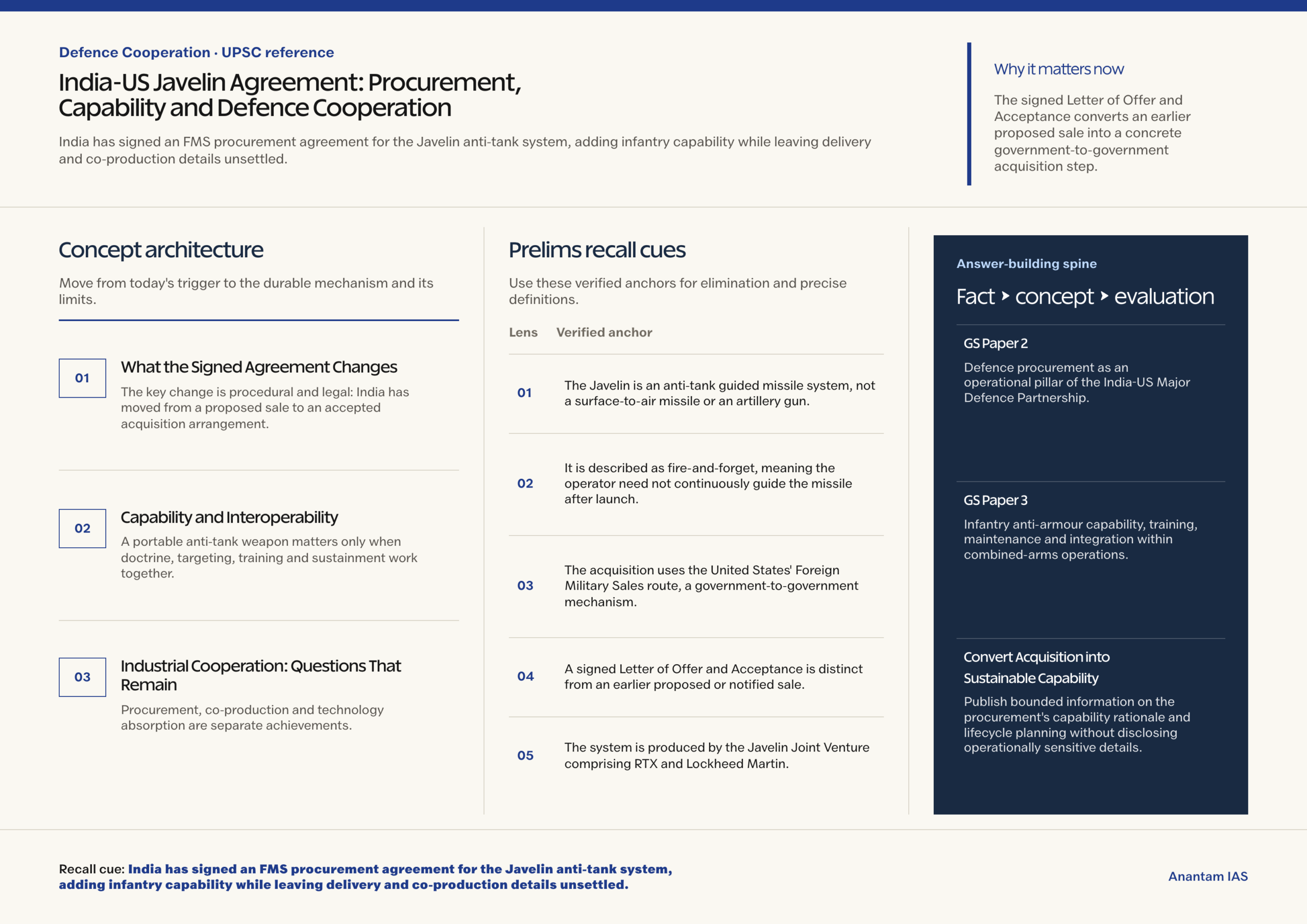
Mindmap explaining India-US Javelin Agreement: Procurement, Capability and Defence Cooperation for UPSC revision
Revision mindmap: India-US Javelin Agreement: Procurement, Capability and Defence Cooperation. Open the full-size image for details.

Background and Context

What the Signed Agreement Changes

The key change is procedural and legal: India has moved from a proposed sale to an accepted acquisition arrangement.

  • Under the Foreign Military Sales route, the purchasing government deals with the United States government, which manages the case rather than treating it as an ordinary private commercial purchase.
  • The Letter of Offer and Acceptance records acceptance of the offered procurement case and is stronger evidence of acquisition than an earlier request, approval proposal or sale notification.
  • This distinction prevents a common exam error: a proposed FMS case shows authorization to proceed, while a signed LOA shows that the customer has accepted the acquisition terms.
  • The report does not provide a verified delivery schedule, induction date or operational deployment. Signing should not be equated with systems already reaching Indian Army units.
  • Nor does the report establish contracted technology transfer. It says the signing can facilitate discussions on mutually beneficial co-production, which remains a prospective industrial track.

Capability and Interoperability

A portable anti-tank weapon matters when it fits doctrine, targeting, training and sustainment rather than operating as an isolated platform.

  • The Javelin is described as a medium-range, fire-and-forget guided system capable of engaging armoured vehicles and fortified positions, giving infantry a precision anti-armour option.
  • Fire-and-forget capability can allow an operator to relocate after launch instead of remaining exposed while continuously guiding the weapon, but battlefield effectiveness still depends on correct target acquisition.
  • Its value lies in combined-arms use: infantry anti-armour teams must coordinate with surveillance, manoeuvre, artillery, air defence and logistics rather than substitute for those capabilities.
  • Interoperability may improve when partners use compatible training concepts, support procedures and communications during exercises, yet common equipment alone does not guarantee seamless joint operations.
  • A new system also creates obligations for training rounds, simulators, spares, storage, inspection and maintenance. Readiness depends on this support chain across the equipment’s service life.

Industrial Cooperation: Questions That Remain

The agreement opens an industrial conversation, but procurement, co-production and technology absorption are separate achievements.

  • The United States Embassy said the signing would facilitate discussions on mutually beneficial co-production; this wording signals an opportunity for negotiation, not a completed production arrangement.
  • A credible industrial package would specify work share, production scale, quality control, intellectual-property boundaries, export permissions and the Indian entities responsible for manufacturing or support.
  • Domestic maintenance and repair can improve availability and turnaround time, but meaningful learning requires access to processes, tooling, testing and skilled personnel rather than final assembly alone.
  • Supply resilience requires planning for spares, components and replenishment during disruptions. Dependence is reduced by diversified stocks and local capability, not merely by changing the procurement channel.
  • For policy evaluation, separate three tests: whether the weapon meets a defined operational gap, whether lifecycle costs are sustainable, and whether promised industrial cooperation becomes contractually measurable.

Way Forward

Convert Acquisition into Sustainable Capability

  • Publish bounded information on the procurement’s capability rationale and lifecycle planning without disclosing operationally sensitive details.
  • Build training, simulation, maintenance, storage and replenishment plans before induction so hardware availability translates into usable readiness.
  • Negotiate industrial cooperation through measurable work share, quality standards, maintenance access and realistic technology-absorption milestones.
  • Integrate the system into Indian doctrine and exercises while preserving diversified supply options and indigenous anti-tank development.

Conclusion

  • The Javelin LOA is significant because it records a signed FMS acquisition, strengthens a specific infantry capability and deepens the operational content of India-US defence cooperation.
  • In a Mains answer, distinguish procurement from delivery and industrial opportunity from contracted technology transfer, then assess capability through interoperability, lifecycle support and domestic absorption.

UPSC Practice Questions

Prelims MCQ 1

With reference to the Javelin procurement agreement, consider the following statements:

  1. The procurement is being undertaken through the United States Foreign Military Sales route.
  2. The Javelin is described as a fire-and-forget anti-tank guided missile system.
  3. The signed agreement itself establishes a completed technology-transfer and co-production arrangement in India.

How many of the above statements are correct?

(a) Only one (b) Only two (c) All three (d) None

Answer: (b) Only two

Explanation:

Statements 1 and 2 are correct. The report says the signing may facilitate co-production discussions; it does not establish completed co-production or technology transfer.

Prelims MCQ 2

In the context of the United States Foreign Military Sales route, the Letter of Offer and Acceptance is best understood as:

(a) a request by a buyer for preliminary information (b) a notification that automatically delivers the equipment (c) the customer’s acceptance of the offered government-to-government procurement case (d) a licence granting unrestricted domestic production rights

Answer: (c) the customer's acceptance of the offered government-to-government procurement case

Explanation:

The signed LOA marks acceptance of the FMS acquisition terms. It is distinct from a preliminary request, delivery, or an automatic grant of production rights.

UPSC Mains Questions

  1. How can a foreign defence acquisition strengthen military capability without creating unsustainable lifecycle dependence? Discuss with reference to the India-US Javelin agreement.
  2. A defence procurement agreement and a defence-industrial partnership are related but distinct. Examine the conditions needed to convert acquisition into meaningful industrial cooperation.

Source: The Hindu.

Frequently Asked Questions

What has India signed for the Javelin system?

India has signed a Letter of Offer and Acceptance with the United States to procure the Javelin anti-tank guided missile system through the Foreign Military Sales route.

What does fire-and-forget mean?

It means the missile does not require continuous operator guidance after launch, allowing the operator to relocate while the weapon proceeds toward its acquired target.

Does the agreement mean Javelin systems have already been delivered?

No. The report confirms the signed procurement agreement but does not provide a verified delivery schedule, induction date or evidence that systems have reached operational units.

Does the agreement include co-production or technology transfer?

The report says the signing can facilitate co-production discussions. It does not establish a contracted co-production package or technology-transfer arrangement, so those outcomes remain prospective.

Why is the agreement relevant to India-US relations?

It adds a concrete capability transaction to the Major Defence Partnership and may support interoperability and industrial discussions, subject to implementation and lifecycle support.

Tank Fleet Readiness: Why the New T-72 and T-90 Overhaul Facility Matters

Open article →Download PDF

Why in News?

On August 27, 2026, the foundation ceremony was held for a new T-72 and T-90 tank overhaul facility at Vehicle Factory Jabalpur, an Armoured Vehicles Nigam Limited unit.

  • The planned Rs 472 crore project is designed to overhaul 80 tanks annually; it is a facility under creation, not an operational plant yet.
  • The Ministry of Defence states that the Army needs 230 tank overhauls each year, while Heavy Vehicles Factory, Avadi, can currently handle 150.
  • The new capacity is intended to improve the timely return of serviced tanks to the Army and strengthen operational readiness.
  • Officially identified supply needs span mechanical, electrical, electronic and hydraulic components, assemblies and subsystems.
  • Fleet strength on paper differs from available combat strength: a tank undergoing maintenance cannot be fielded until restoration and acceptance are complete.
  • Domestic overhaul capacity links maintenance, spares, testing and skills, making sustainment a core part of defence self-reliance rather than an after-sales activity.
  • The Jabalpur project expands capacity beyond Avadi and may create a wider MSME supplier base for recurring overhaul requirements.

UPSC Relevance

Prelims Relevance

  • T-72 is known in Indian service as Ajeya, while T-90 is known as Bhishma.
  • Vehicle Factory Jabalpur is a unit of Armoured Vehicles Nigam Limited, a defence public sector undertaking.
  • Tank overhaul is deeper than routine servicing: it covers disassembly, inspection, restoration, replacement, reassembly and testing.
  • Heavy Vehicles Factory at Avadi is an existing centre for manufacture and overhaul of armoured vehicles.
  • Overhaul belongs to the equipment sustainment lifecycle; it is distinct from purchasing a new platform.

Mains Relevance

GS Paper 3

  • Defence preparedness through equipment availability, resilient maintenance chains and lifecycle management
  • Indigenous capability in spares, quality assurance, skilled labour and industrial support for legacy platforms

GS Paper 2

  • Public-sector capacity, supplier coordination and institutional accountability in strategic manufacturing

Essay

  • Strategic autonomy depends as much on sustaining existing capabilities as on acquiring new technology.
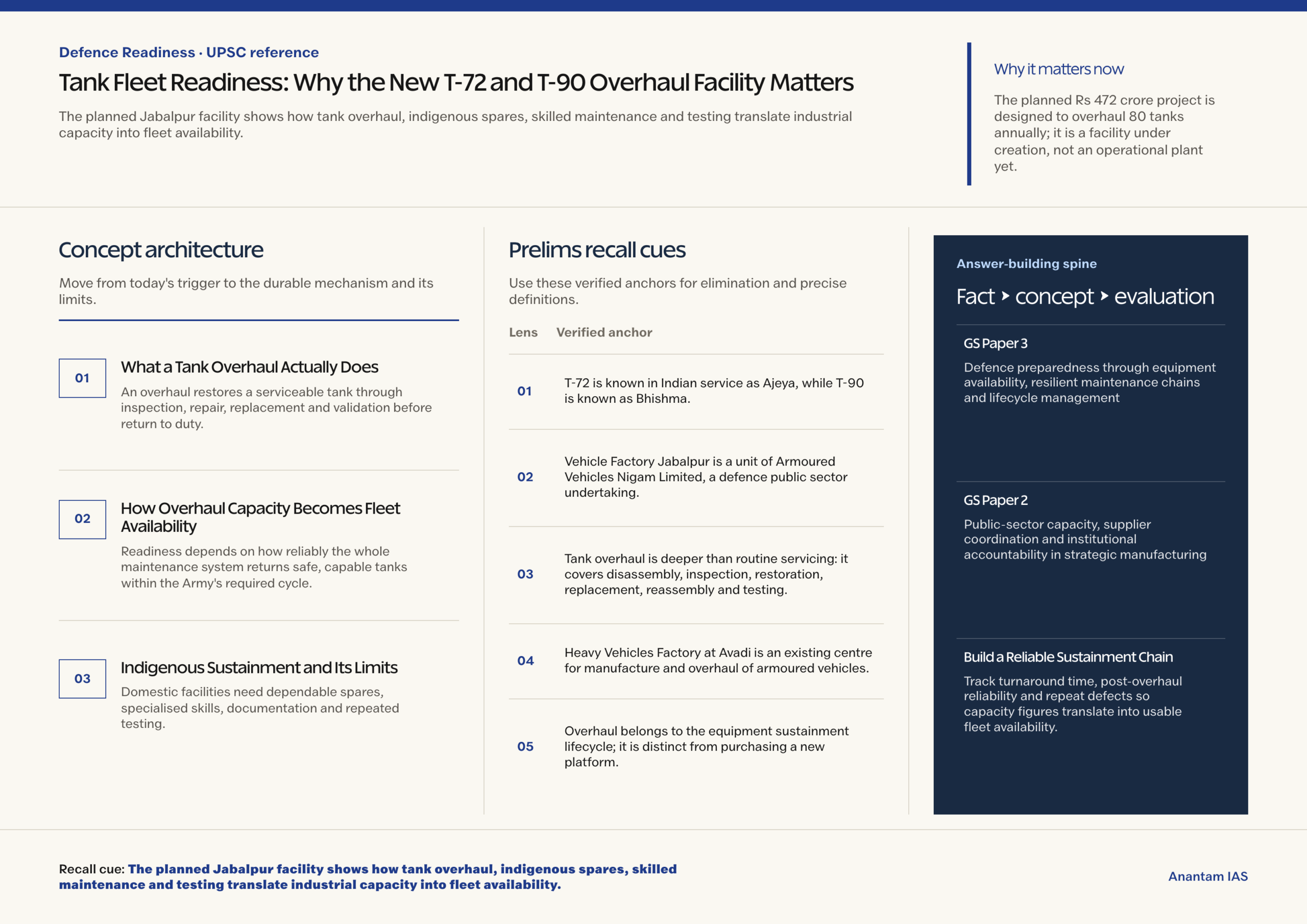
Mindmap explaining Tank Fleet Readiness: Why the New T-72 and T-90 Overhaul Facility Matters for UPSC revision
Revision mindmap: Tank Fleet Readiness: Why the New T-72 and T-90 Overhaul Facility Matters. Open the full-size image for details.

Background and Context

What a Tank Overhaul Actually Does

An overhaul restores a heavily used but serviceable platform through controlled inspection, repair, replacement and validation before its return to operational duty.

  • The tank is stripped into major assemblies so technicians can inspect wear, damage and defects that routine servicing cannot adequately assess.
  • Repairable assemblies are dismantled and checked component by component; items that cannot meet safe and economical repair criteria are replaced.
  • Time-limited parts such as seals, gaskets, rings, bearings, fasteners and washers receive planned attention before hidden deterioration becomes an operational failure during service.
  • The hull and systems for cooling, fuel, lubrication, air induction, exhaust and transmission are examined, repaired or revalidated according to their condition.
  • Major assemblies are tested before reintegration, followed by quality checks that confirm whether the restored tank can safely return to service.

How Overhaul Capacity Becomes Fleet Availability

Readiness depends on how reliably the whole maintenance system returns safe, capable tanks within the Army’s required cycle, not on nominal workshop capacity alone.

  • A tank in a workshop remains part of the inventory but not the available fleet; turnaround time directly affects formations that can be equipped for operations.
  • Planned Jabalpur capacity complements Avadi rather than replacing it, creating a second industrial node for the Army’s stated annual workload and maintenance schedule.
  • Additional capacity can reduce maintenance backlogs only when components, trained workers, test equipment and quality assurance remain available in the same production rhythm without bottlenecks.
  • Overhaul preserves the value of platforms already acquired, extending useful service while avoiding premature replacement of fundamentally usable equipment and conserving scarce industrial effort.
  • Availability is the correct exam lens: the strategic output is not a repaired machine alone, but a verified combat asset returned on schedule to its unit.

Indigenous Sustainment and Its Limits

Domestic facilities matter only when dependable spares, specialised skills, documentation and rigorous testing support every repeated overhaul cycle.

  • T-72 and T-90 fleets require recurring access to specialised parts; external supply disruption can lengthen downtime even when a workshop has adequate physical capacity and labour.
  • Local sourcing must cover repeatable design, manufacture, inspection and delivery, not merely the one-time substitution of an imported component without assured quality.
  • The project can provide sustained demand for Indian MSMEs across mechanical, electrical, electronic and hydraulic systems, widening the maintenance ecosystem beyond a single factory.
  • Skills are a strategic asset: technicians need platform knowledge, fault diagnosis, assembly discipline and familiarity with acceptance standards to produce consistent outcomes across repeated overhaul cycles.
  • Mechanical restoration does not automatically equal battlefield modernisation; any new sensors or communications need separate technical integration, testing and configuration control to prevent incompatibility.

Way Forward

Build a Reliable Sustainment Chain

The facility’s value will depend on measurable readiness outcomes after construction and commissioning.

  • Track turnaround time, post-overhaul reliability and repeat defects so capacity figures translate into usable fleet availability.
  • Develop multiple qualified suppliers for critical spares while preserving traceability, testing standards and configuration consistency.
  • Create structured training and knowledge-retention systems for technicians, inspectors and Army maintenance personnel across the platform lifecycle.
  • Plan upgrades separately from restoration, with clear requirements and trials for any sensor, communication or protection change.

Conclusion

  • The Jabalpur project highlights a durable defence lesson: maintenance capacity is combat capacity only when spares, skills, testing and turnaround work as one accountable, repeatable system.
  • In a Mains answer, connect indigenous overhaul to fleet availability and supply-chain resilience, distinguish lifecycle extension from procurement or automatic modernisation, and judge capacity by actual turnaround.

UPSC Practice Questions

Prelims MCQ 1

With reference to the planned T-Series Tanks Overhaul Project at Vehicle Factory Jabalpur, consider the following statements:

  1. It is intended to handle both T-72 and T-90 tanks.
  2. Vehicle Factory Jabalpur is a unit of Armoured Vehicles Nigam Limited.
  3. The foundation ceremony means the planned facility has already begun full annual operations.

How many of the above statements are correct?

(a) Only one (b) Only two (c) All three (d) None

Answer: (b) Only two

Explanation:

Statements 1 and 2 are correct. The August 2026 event marked the foundation ceremony for facilities under creation; it did not establish that full annual operations had begun.

Prelims MCQ 2

Which one of the following best distinguishes a comprehensive tank overhaul from routine servicing?

(a) It only replenishes fuel and lubricants (b) It changes the tank’s national designation (c) It restores major assemblies through disassembly, inspection, repair or replacement, reassembly and testing (d) It necessarily replaces the tank with a newly manufactured platform

Answer: (c) It restores major assemblies through disassembly, inspection, repair or replacement, reassembly and testing

Explanation:

A comprehensive overhaul is a lifecycle-restoration process. It reaches major assemblies and concludes with validation; it is deeper than routine servicing and does not itself mean purchasing a new tank.

UPSC Mains Questions

  1. Defence preparedness depends on lifecycle sustainment as much as on new acquisition. Discuss with reference to indigenous overhaul capacity for armoured fleets.
  2. Explain how domestic spares, technical skills and quality assurance convert an overhaul facility into improved fleet availability. What implementation risks must be addressed?

Sources: Press Information Bureau, Ministry of Defence and The Hindu Explained.

Frequently Asked Questions

What is a tank overhaul?

It is a comprehensive restoration process involving disassembly, inspection, repair or replacement of parts, reassembly, testing and quality assurance before a serviceable tank returns to duty.

Why does the Jabalpur facility matter for readiness?

It is planned to add annual overhaul capacity, complement Avadi and help return maintained T-72 and T-90 tanks to operational units within required timelines.

Is the new facility already operational?

No. The August 27, 2026 event was the foundation ceremony for the project. The announced annual capacity describes the planned facility, not completed output.

How can overhaul support defence self-reliance?

Domestic repair, spares, testing and skilled labour reduce dependence on external sustainment chains and build the industrial capability needed to keep existing platforms available.

Does overhaul automatically modernise a tank?

No. Overhaul restores serviceability and life. New sensors, communications or protection systems require separately defined integration, testing and configuration-control work.

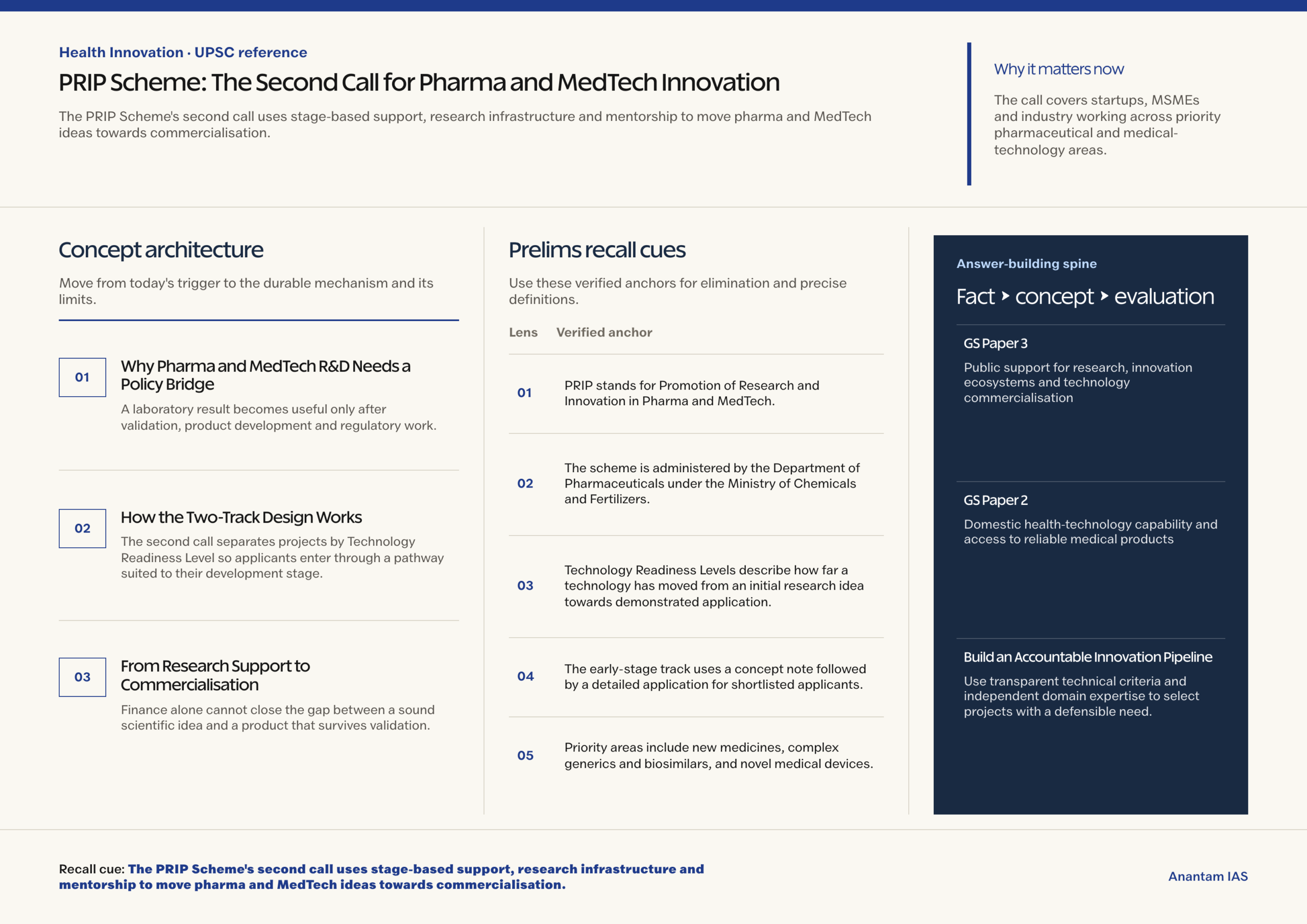
PRIP Scheme: The Second Call for Pharma and MedTech Innovation

Open article →Download PDF

Why in News?

The Department of Pharmaceuticals announced the second PRIP application call on 28 August 2026, with the submission window scheduled to open by mid-September.

  • The call covers startups, MSMEs and industry working across priority pharmaceutical and medical-technology areas.
  • Early-stage projects begin at TRL 1, 2 or 3 and may receive support to progress no further than TRL 5.
  • Later-stage projects begin at TRL 4, 5 or 6 and seek support to advance towards higher readiness levels.
  • The announcement opens a new selection round; it does not mean that applications are open already or that any project has received funding.
  • India’s challenge is not only producing medicines and devices, but converting research into validated, scalable and commercially viable technologies.
  • PRIP links project finance with research infrastructure, mentorship and collaboration, addressing several gaps along the innovation pathway.
  • Stage-based selection can direct different forms of support to proof-of-concept work and technologies that are closer to deployment.

UPSC Relevance

Prelims Relevance

  • PRIP stands for Promotion of Research and Innovation in Pharma and MedTech.
  • The scheme is administered by the Department of Pharmaceuticals under the Ministry of Chemicals and Fertilizers.
  • Technology Readiness Levels describe how far a technology has moved from an initial research idea towards demonstrated application.
  • The early-stage track uses a concept note followed by a detailed application for shortlisted applicants.
  • Priority areas include new medicines, complex generics and biosimilars, and novel medical devices.

Mains Relevance

GS Paper 3

  • Public support for research, innovation ecosystems and technology commercialisation
  • The role of startups and MSMEs in pharmaceutical and medical-device innovation

GS Paper 2

  • Domestic health-technology capability and access to reliable medical products
  • Institutional design for collaboration among government, academia and industry

Essay

  • Innovation policy succeeds when it connects scientific discovery with institutions capable of testing, scaling and delivering public value.
Mindmap explaining PRIP Scheme: The Second Call for Pharma and MedTech Innovation for UPSC revision
Revision mindmap: PRIP Scheme: The Second Call for Pharma and MedTech Innovation. Open the full-size image for details.

Background and Context

Why Pharma and MedTech R&D Needs a Policy Bridge

A laboratory result becomes useful only after validation, product development, regulatory work, manufacturing preparation and market adoption.

  • Pharma and MedTech innovation is capital-intensive and failure-prone; long development cycles can discourage private investment before technical or commercial viability is clear.
  • Startups may generate promising intellectual property but lack specialised laboratories, testing facilities, regulatory expertise or partners capable of manufacturing at scale, leaving viable ideas stranded before validation.
  • MSMEs often understand manufacturing and supply chains, yet may struggle to finance uncertain research or absorb the cost of moving a prototype through validation.
  • Public support can reduce early risk, while competitive selection and milestone review should keep assistance tied to credible scientific progress, validated evidence and a realistic development plan.
  • The policy objective is innovation capacity, not merely import substitution: stronger research institutions, skilled talent, viable enterprises and technologies that can reach users.

How the Two-Track Design Works

The second call separates projects by Technology Readiness Level so applicants enter through a pathway suited to their development stage.

  • Under the early-stage track, eligible startups and MSMEs may move projects from TRL 1–3 towards higher readiness, but not beyond TRL 5.
  • Early-stage applicants first submit a concise concept note; only shortlisted applicants proceed to a detailed application, reducing the initial documentation burden.
  • Ecosystem enablers may submit concept notes on behalf of promising projects in their networks, helping discover research teams outside established corporate channels and connect them with application support.
  • The later-stage track accepts projects at TRL 4–6 from industry, startups and MSMEs, using a direct detailed application for advancement to higher levels.
  • Later-stage assistance is capped at 35% of approved project cost, with the applicant co-funding the remainder; this shares risk while demanding commitment from the developer.

From Research Support to Commercialisation

Finance alone cannot close the gap between a sound scientific idea and a product that survives validation, regulation and adoption.

  • PRIP, launched in 2023, also seeks stronger research infrastructure and a deeper pool of trained students for pharmaceutical and medical-technology R&D.
  • Mentorship can help teams plan development milestones, protect intellectual property, understand regulatory requirements and identify manufacturing or clinical-validation partners before preventable design errors consume scarce capital.
  • Initiatives including MedTech Mitra and Patent Mitra are intended to facilitate technical-regulatory guidance, patent support, collaboration and partnership across the ecosystem.
  • The priority areas extend beyond conventional drugs to complex generics, biosimilars and novel devices, including software-based, diagnostic, robotic, telemedicine and precision-medicine applications.
  • Commercialisation should not be confused with immediate market entry: projects still require evidence, appropriate approvals, quality assurance, responsible procurement and a viable route to manufacturing and adoption.

Way Forward

Build an Accountable Innovation Pipeline

  • Use transparent technical criteria and independent domain expertise to select projects with a defensible need, credible team and realistic development pathway.
  • Link disbursement to verifiable milestones without imposing reporting burdens that crowd out research time for small firms.
  • Give applicants coordinated access to shared facilities, regulatory advice, patent strategy, clinical partners and manufacturing mentors rather than isolated financial support.
  • Track outcomes beyond grants, including validated prototypes, intellectual property quality, regulatory progress, industry partnerships and technologies that reach patients or health systems.

Conclusion

  • The second PRIP call illustrates a stage-gated innovation policy: public support is matched to technological maturity, while infrastructure, mentorship and partnerships address non-financial barriers.
  • In a Mains answer, connect the scheme to India’s need for stronger research capacity, accountable risk-sharing and a reliable bridge from scientific discovery to affordable health technology.

UPSC Practice Questions

Prelims MCQ 1

With reference to the second call under the PRIP Scheme, consider the following statements:

  1. Early-stage projects may begin at Technology Readiness Level 1, 2 or 3.
  2. Early-stage applicants must first submit a concept note before shortlisted applicants submit a detailed application.
  3. The submission window was already open when the call was announced on 28 August 2026.

How many of the above statements are correct?

(a) Only one (b) Only two (c) All three (d) None

Answer: (b) Only two

Explanation:

Statements 1 and 2 are correct. The Department announced that the submission window would open by mid-September, so Statement 3 is incorrect.

Prelims MCQ 2

The Promotion of Research and Innovation in Pharma and MedTech Scheme is administered by which department?

(a) Department of Biotechnology (b) Department of Health Research (c) Department of Pharmaceuticals (d) Department of Science and Technology

Answer: (c) Department of Pharmaceuticals

Explanation:

PRIP is administered by the Department of Pharmaceuticals under the Ministry of Chemicals and Fertilizers.

UPSC Mains Questions

  1. How can stage-based public support help India move pharmaceutical and medical-technology research from laboratories to commercially viable products? Discuss with reference to the PRIP Scheme.
  2. Financial assistance alone cannot create a health-innovation ecosystem. Examine the role of research infrastructure, mentorship and institutional collaboration in strengthening India’s Pharma and MedTech capacity.

Source: PIB, Department of Pharmaceuticals.

Frequently Asked Questions

What is the PRIP Scheme?

PRIP is the Promotion of Research and Innovation in Pharma and MedTech Scheme, administered by the Department of Pharmaceuticals to strengthen research capacity and support technology development and commercialisation.

Is the second-call submission window open?

No. The 28 August announcement said the PRIP portal’s submission window would open by mid-September; the announcement itself did not open submissions or award support.

How do the early-stage and later-stage tracks differ?

The early-stage track covers TRL 1–3 projects and begins with a concept note, while the later-stage track covers TRL 4–6 projects through a detailed application.

Who can apply under the second PRIP call?

Startups and MSMEs are eligible in the early-stage track; industry, startups and MSMEs may apply under the later-stage track, subject to the announced requirements.

Why does PRIP include mentorship and research infrastructure?

Innovators need laboratories, talent, regulatory guidance, patent strategy and industry partners alongside finance to validate technologies and build a credible route towards commercialisation.

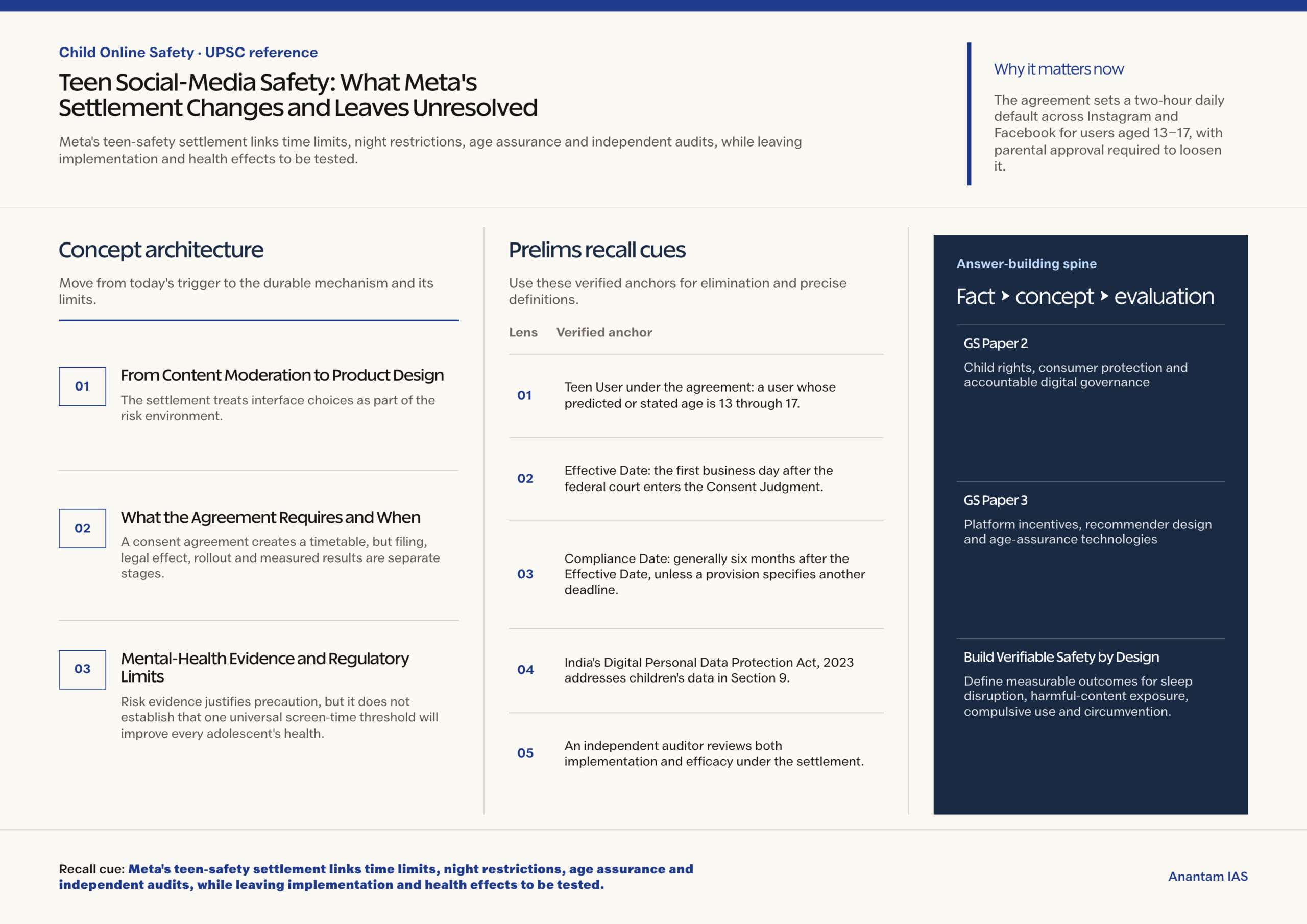
Teen Social-Media Safety: What Meta’s Settlement Changes and Leaves Unresolved

Open article →Download PDF

Why in News?

On August 26, Meta and a multistate US coalition filed a settlement requiring product-design safeguards for teen accounts, subject to court entry and phased implementation.

  • The filed agreement sets a combined two-hour daily default limit across Instagram and Facebook for users aged 13–17, changeable to a less restrictive setting only with parental approval.
  • Its first-phase night access mode blocks most platform use from midnight to 6 a.m.; messaging and settings remain available with anti-circumvention limits.
  • It also requires pauses after prolonged use, restricted notifications, stronger age assurance, safer content controls, parental tools and limits on selected social-comparison features.
  • These are settlement obligations, not proof that the features are already live or that they will produce particular mental-health outcomes.
  • The case shifts attention from harmful posts alone to product architecture: defaults, recommendations, notifications and feedback signals can shape attention and continued use.
  • The settlement illustrates regulation through enforceable design duties, monitoring and independent audit rather than relying only on user choice or parental awareness.

UPSC Relevance

Prelims Relevance

  • Teen User under the agreement: a user whose predicted or stated age is 13 through 17.
  • Effective Date: the first business day after the federal court enters the Consent Judgment.
  • Compliance Date: generally six months after the Effective Date, unless a provision specifies another deadline.
  • India’s Digital Personal Data Protection Act, 2023 addresses children’s data in Section 9.
  • An independent auditor reviews both implementation and efficacy under the settlement.

Mains Relevance

GS Paper 2

  • Child rights, consumer protection and accountable digital governance
  • Design-based regulation, enforceable defaults and independent oversight

GS Paper 3

  • Platform incentives, recommender design and age-assurance technologies
  • Innovation-safety trade-offs in regulating large digital intermediaries

Essay

  • When a platform profits from attention, safety cannot depend entirely on a child’s self-control.
Mindmap explaining Teen Social-Media Safety: What Meta's Settlement Changes and Leaves Unresolved for UPSC revision
Revision mindmap: Teen Social-Media Safety: What Meta's Settlement Changes and Leaves Unresolved. Open the full-size image for details.

Background and Context

From Content Moderation to Product Design

The settlement treats interface choices as part of the risk environment, not as neutral containers for user-generated content.

  • Infinite feeds, repeated recommendations, visible popularity signals and timed notifications can reward continued engagement; changing defaults can alter exposure without banning lawful speech or individual expression.
  • A default rule matters because many users keep preselected settings, while parental approval adds friction before protections are weakened for a young account.
  • Time limits address duration, but the agreement also targets how attention is captured through pauses, notification controls and selected social-comparison features.
  • Age assurance is the entry gate: safeguards cannot work reliably if children are classified as adults or maintain easily undetected secondary accounts across the same service.
  • The agreement covers Meta’s US teen users in participating jurisdictions; it does not automatically create an international standard, legal precedent or duty in India.

What the Agreement Requires and When

A filed consent agreement creates a timetable, but filing, legal effect, product rollout and measured results are separate stages.

  • The agreement was fully executed and filed, yet its Effective Date begins only after the federal court enters the Consent Judgment in the pending litigation.
  • Most operational duties take effect on the Compliance Date, generally six months later; productive pauses have a specified four-month deadline after the Effective Date.
  • The two-hour cap applies cumulatively across covered Meta platforms and excludes some messaging, settings and long-form viewing, so it is neither a total device-use limit nor a complete lockout.
  • Night mode restricts access from midnight to 6 a.m., while notifications are generally disabled from 10 p.m. to 7 a.m.; parental approval is needed to relax defaults.
  • Independent review can test whether Meta implemented the controls and examine their efficacy, converting a public promise into an auditable compliance process.

Mental-Health Evidence and Regulatory Limits

Risk evidence justifies precaution, but it does not establish that one universal screen-time threshold will improve every adolescent’s health.

  • The US Surgeon General’s advisory says social media can provide benefits and risks, while evidence gaps prevent a conclusion that it is sufficiently safe for children.
  • Observed associations between heavy use and poor mental health do not, by themselves, prove a single causal pathway; content, vulnerability, context and type of use differ.
  • Usage controls may reduce exposure or interrupt compulsive patterns, but health effects require independent longitudinal evaluation across different adolescents, not inference from feature deployment alone.
  • Rigid controls can also invite age misstatement, secondary accounts or migration to other platforms, making industry coverage and circumvention testing important.
  • For India, Section 9 of the DPDP Act supplies a child-data framework; platform-design accountability requires wider safety, audit, transparency and independent research tools.

Way Forward

Build Verifiable Safety by Design

  • Define measurable outcomes for sleep disruption, harmful-content exposure, compulsive use and circumvention, while separating these from broad claims about overall mental health.
  • Require privacy-preserving age assurance, data minimisation and clear deletion rules so child protection does not become a justification for excessive identity collection.
  • Give independent researchers access to sufficiently detailed, privacy-protected platform data and publish comparable audit findings across services.
  • Combine enforceable platform duties with digital literacy, parental tools, grievance systems and accessible professional support for children who experience harm.

Conclusion

  • The settlement’s durable lesson is that platform accountability can regulate defaults and engagement mechanisms, not merely remove unlawful content after harm occurs.
  • In a UPSC answer, distinguish the legal promise, implementation timetable and independently measured outcome; treating them as one event would overstate both enforcement and evidence.
  • A credible child-safety regime must protect attention and privacy together, because intrusive age checks can create a new risk while addressing an existing one.

UPSC Practice Questions

Prelims MCQ 1

With reference to the Meta teen-safety settlement, consider the following statements:

  1. Its Effective Date begins after the court enters the Consent Judgment.
  2. The two-hour daily limit became operational merely upon filing the agreement.
  3. The agreement provides for independent assessment of implementation and efficacy.

How many of the above statements are correct?

(a) Only one (b) Only two (c) All three (d) None

Answer: (b) Only two

Explanation:

Statements 1 and 3 are correct. Filing did not itself activate the product controls; court entry starts the Effective Date, followed by specified implementation deadlines.

Prelims MCQ 2

Which regulatory approach is best illustrated by mandatory teen defaults combined with independent auditing?

(a) Complete prohibition of social media (b) Exclusive reliance on parental awareness (c) Safety-by-design with accountable implementation (d) Removal of all intermediary protections

Answer: (c) Safety-by-design with accountable implementation

Explanation:

The approach changes product defaults and subjects compliance to outside assessment; it neither bans platforms nor relies solely on parents.

UPSC Mains Questions

  1. Platform design can create public risks even when individual pieces of content are lawful. Discuss the case for safety-by-design regulation of social media used by children.
  2. How can India combine child-data protection, age assurance and independent platform audits without creating excessive surveillance?

Sources: Pennsylvania Office of Attorney General and Indian Express Explained Health.

Frequently Asked Questions

Are Meta’s new teen protections already active?

Not merely because the agreement was filed. Court entry triggers the Effective Date, and most obligations follow on the Compliance Date or another specified deadline.

What is the daily limit in the first phase?

The default is two hours of covered use cumulatively across Instagram and Facebook, with some messaging, settings and long-form viewing excluded from the calculation.

Does the settlement prove that time limits improve mental health?

No. It creates risk-reduction measures and an evaluation mechanism, but particular mental-health outcomes must be established through independent evidence over time.

Why is age assurance central to child online safety?

Age-based protections fail when children are classified as adults. The challenge is improving classification without collecting more identity data than is necessary.

What is the main lesson for India?

Child-data duties should be complemented by enforceable product-design standards, transparent audits, researcher access and privacy safeguards for age-assurance systems.

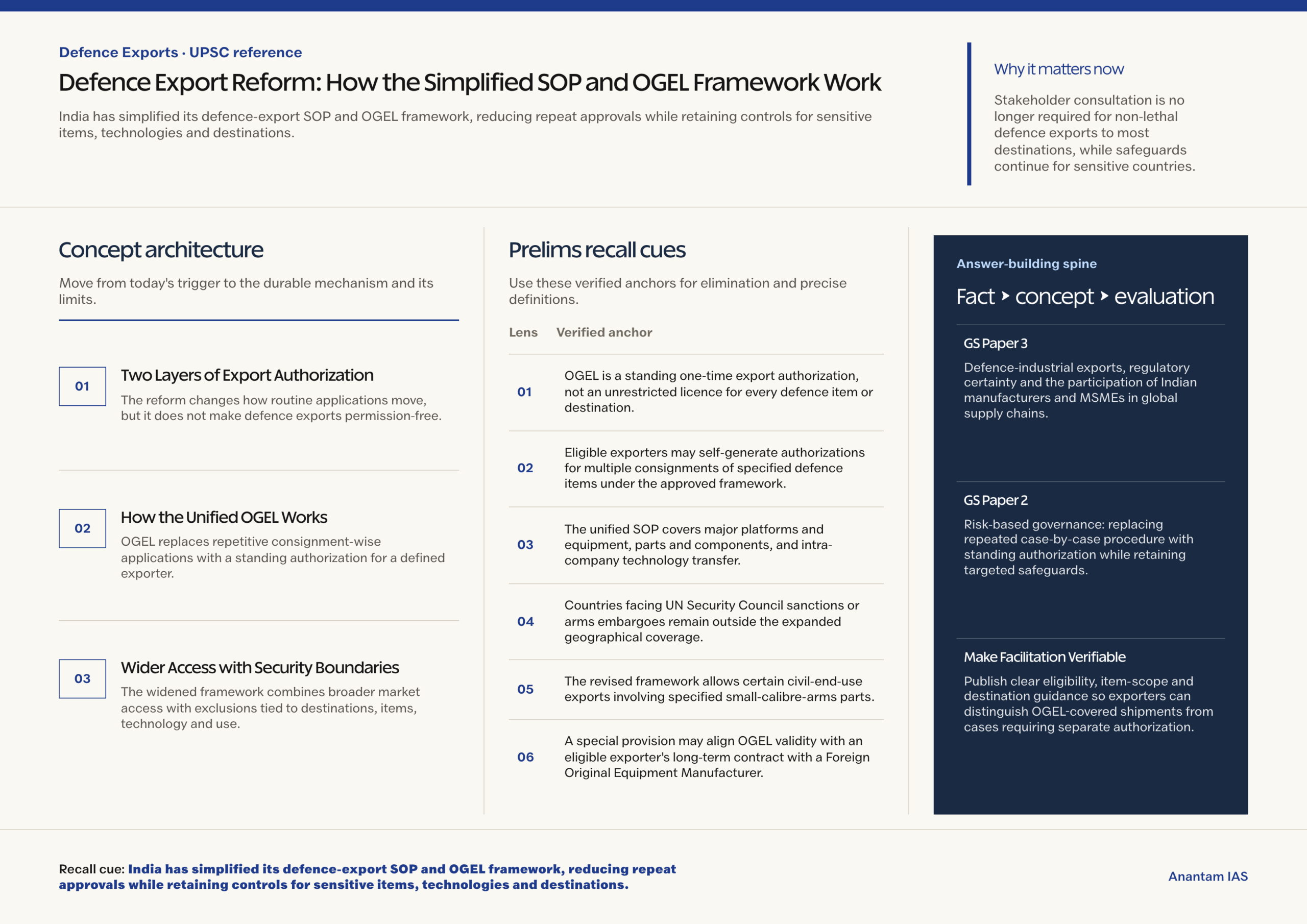
Defence Export Reform: How the Simplified SOP and OGEL Framework Work

Open article →Download PDF

Why in News?

On 28 August 2026, the Ministry of Defence announced a simplified defence-export SOP and a unified, expanded Open General Export Licence framework.

  • Stakeholder consultation is no longer required for non-lethal defence exports to most destinations, while safeguards continue for sensitive countries.
  • Consultation has also been removed for exports of all items meant for international tenders and exhibitions.
  • Three separate OGEL procedures have been merged into one unified SOP covering platforms, components and intra-company technology transfer.
  • The normal OGEL validity has increased from two years to three years, reducing renewal frequency.
  • Geographical coverage now extends beyond the earlier 41-country list, excluding negative or sensitive countries and countries under UN Security Council sanctions or arms embargoes.
  • The reform separates low-risk, repeat transactions from cases needing closer scrutiny, illustrating risk-based regulation rather than blanket deregulation.
  • Faster authorization can help exporters respond to tenders, exhibitions and recurring orders without seeking an identical approval for every eligible consignment.
  • The continuing restrictions show that export promotion must remain compatible with national security, end-use concerns and international obligations.

UPSC Relevance

Prelims Relevance

  • OGEL is a standing one-time export authorization, not an unrestricted licence for every defence item or destination.
  • Eligible exporters may self-generate authorizations for multiple consignments of specified defence items under the approved framework.
  • The unified SOP covers major platforms and equipment, parts and components, and intra-company technology transfer.
  • Countries facing UN Security Council sanctions or arms embargoes remain outside the expanded geographical coverage.
  • The revised framework allows certain civil-end-use exports involving specified small-calibre-arms parts, components and protective equipment.
  • A special provision may align OGEL validity with an eligible exporter’s long-term contract with a Foreign Original Equipment Manufacturer, subject to conditions.

Mains Relevance

GS Paper 3

  • Defence-industrial exports, regulatory certainty and the participation of Indian manufacturers and MSMEs in global supply chains.
  • Balancing faster trade facilitation with controls over sensitive items, technologies, destinations and end use.

GS Paper 2

  • Risk-based governance: replacing repeated case-by-case procedure with standing authorization while retaining targeted safeguards.

Essay

  • Good regulation does not remove every gate; it places closer scrutiny where the public risk is highest.
Mindmap explaining Defence Export Reform: How the Simplified SOP and OGEL Framework Work for UPSC revision
Revision mindmap: Defence Export Reform: How the Simplified SOP and OGEL Framework Work. Open the full-size image for details.

Background and Context

Two Layers of Export Authorization

The reform changes how routine applications move, but it does not make defence exports permission-free.

  • The Defence Export SOP governs procedural handling, including when authorities seek views from relevant stakeholders before permitting an export and when that consultation may be dispensed with.
  • Removing consultation for non-lethal items to most destinations reduces a recurring procedural stage where the proposed item-destination combination carries lower stated sensitivity.
  • The exception for sensitive countries preserves differentiated scrutiny; the relaxation is based on destination risk rather than an identical rule for every market.
  • For international tenders and exhibitions, consultation is removed across item categories so companies can pursue or display opportunities without that preliminary procedural wait.
  • These relaxations concern the consultation step. They should not be read as an official statement that every exporter, item, destination or end use is automatically approved.

How the Unified OGEL Works

OGEL replaces repetitive consignment-wise applications with a standing authorization for a defined exporter, scope and period.

  • An eligible exporter receives a one-time standing authorization and can self-generate export authorizations for multiple consignments of specified defence items under the approved licence and prescribed conditions.
  • The benefit is procedural continuity: repeat eligible shipments need not begin a separate authorization process each time, provided the exporter, items, destinations and transactions remain within the approved scope.
  • A single unified SOP now replaces three procedures for platforms and equipment, parts and components, and intra-company transfers of technology.
  • The standard licence lasts three years instead of two, reducing renewal frequency without converting the authorization into a permanent or open-ended permission.
  • For eligible long-term arrangements with a Foreign Original Equipment Manufacturer, validity may match the underlying contract, subject to prescribed conditions and approved items.

Wider Access with Security Boundaries

The widened framework combines broader market access with exclusions tied to destinations, items, technology and use.

  • Country coverage expands from 41 countries to a wider default, but negative and sensitive nations remain excluded from this facilitative route.
  • Countries subject to UN Security Council sanctions or arms embargoes are also excluded, linking domestic facilitation to international security restrictions.
  • Item coverage is broader, yet the PIB formulation still refers to eligible or specified items; OGEL is not a general permission for the entire defence catalogue.
  • Specified parts and components of small-calibre arms and protective equipment may use the framework for civil end use, illustrating how end use can shape regulatory treatment.
  • The design combines speed for repeat, lower-risk transactions with retained controls over sensitive items, technologies and destinations where diversion, unauthorized transfer or misuse demands greater scrutiny.

Way Forward

Make Facilitation Verifiable

  • Publish clear eligibility, item-scope and destination guidance so exporters can distinguish OGEL-covered shipments from cases requiring separate authorization.
  • Use proportionate end-use documentation and post-export records to preserve traceability without rebuilding the same approval file for every consignment.
  • Review negative and sensitive-country controls regularly against security assessments and applicable UN Security Council measures.
  • Track processing time, renewal burden and compliance failures to test whether simplification improves legitimate exports without weakening safeguards.

Conclusion

  • The reform is best understood as risk-based authorization: a standing route for eligible repeat exports, with targeted scrutiny retained for sensitive destinations, technologies, items and uses.
  • In a Mains answer, connect administrative simplification to export competitiveness, then evaluate it against traceability, end-use assurance and India’s international security obligations.
  • Do not confuse export licensing with defence indigenisation; one regulates outward transfers, while the other concerns domestic production and import dependence.

UPSC Practice Questions

Prelims MCQ 1

With reference to India’s revised Open General Export Licence framework for defence items, consider the following statements:

  1. It enables eligible exporters to self-generate authorizations for multiple consignments of specified defence items.
  2. Its normal validity has been increased from two years to three years.
  3. It covers countries facing United Nations Security Council arms embargoes.

How many of the above statements are correct?

(a) Only one (b) Only two (c) All three (d) None

Answer: (b) Only two

Explanation:

Statements 1 and 2 are correct. Countries under UN Security Council sanctions or arms embargoes are excluded from the expanded geographical coverage.

Prelims MCQ 2

What is the principal procedural feature of an Open General Export Licence in the revised defence-export framework?

(a) It abolishes controls over all defence exports (b) It permits exports only for international exhibitions (c) It provides a standing authorization for multiple eligible consignments (d) It transfers licensing authority to foreign manufacturers

Answer: (c) It provides a standing authorization for multiple eligible consignments

Explanation:

OGEL is a one-time standing authorization under which eligible exporters can self-generate authorizations for multiple consignments of specified defence items.

UPSC Mains Questions

  1. Explain how the simplified defence-export SOP and OGEL framework applies risk-based regulation to balance export facilitation with national security safeguards.
  2. Faster defence-export authorization must be matched by strong destination and end-use controls. Discuss in the context of India’s revised OGEL framework.

Source: PIB, Ministry of Defence.

Frequently Asked Questions

What is an Open General Export Licence in defence exports?

It is a standing one-time authorization allowing eligible exporters to self-generate authorizations for multiple consignments of specified defence items within an approved scope.

Does the revised OGEL permit exports to every country?

No. Its wider coverage excludes negative or sensitive nations and countries facing UN Security Council sanctions or arms embargoes.

What changed in the OGEL procedure?

Three separate procedures were unified, normal validity rose from two to three years, country and item coverage widened, and a long-term FOEM-contract provision was added.

What changed in the Defence Export SOP?

Stakeholder consultation was removed for non-lethal items to most destinations and for all items entering international tenders or exhibitions, while sensitive-country safeguards remain.

Why is the reform relevant for UPSC preparation?

It illustrates risk-based governance: lower repetitive compliance for eligible exports alongside continuing controls over sensitive destinations, items, technologies and end use.

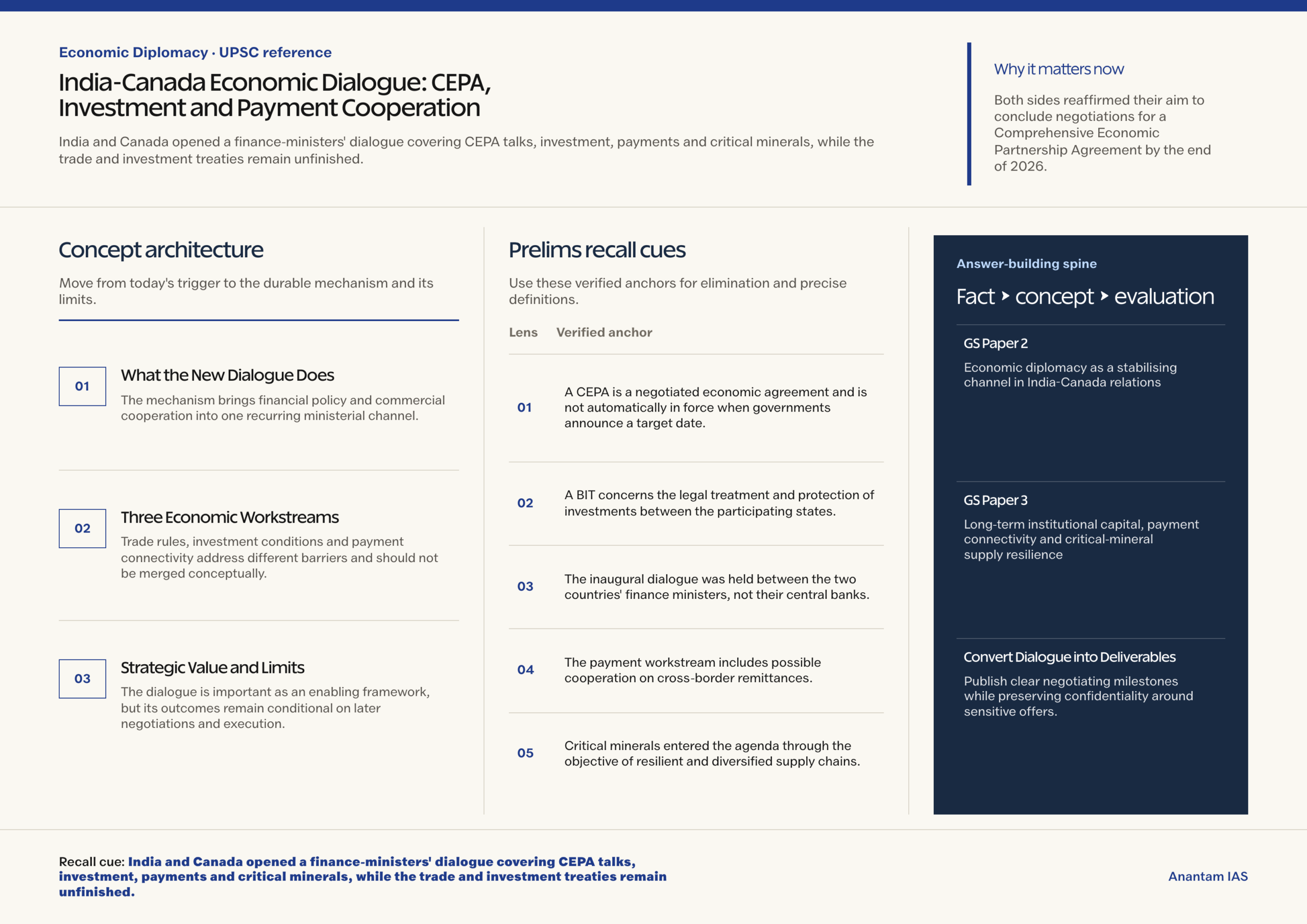
India-Canada Economic Dialogue: CEPA, Investment and Payment Cooperation

Open article →Download PDF

Why in News?

India and Canada concluded their inaugural Finance Ministers’ Economic and Financial Dialogue in Toronto and identified trade, investment, payments and critical minerals as priority areas.

  • Both sides reaffirmed their aim to conclude negotiations for a Comprehensive Economic Partnership Agreement by the end of 2026.
  • India expressed readiness to initiate negotiations on a Bilateral Investment Treaty at the earliest; no such treaty was concluded at the dialogue.
  • The leaders’ shared aspiration is to expand bilateral trade to CAD 70 billion, or about ₹4.65 lakh crore, by 2030.
  • The agenda included institutional capital, payments modernisation, financial stability, FinTech, capital markets, financial crime and critical-mineral supply chains.
  • The dialogue creates a recurring finance-ministry channel that can connect trade negotiations with financial regulation, investment facilitation and payment infrastructure.
  • Its significance lies in converting a renewed political relationship into specific economic workstreams without treating negotiating intentions as completed agreements.
  • For India, Canadian pension capital, remittance links and critical minerals offer opportunities, but each requires predictable rules and commercially viable projects.

UPSC Relevance

Prelims Relevance

  • A CEPA is a negotiated economic agreement and is not automatically in force when governments announce a target date.
  • A BIT concerns the legal treatment and protection of investments between the participating states.
  • The inaugural dialogue was held between the two countries’ finance ministers, not their central banks.
  • The payment workstream includes possible cooperation on cross-border remittances, merchant payments and UPI through service-provider partnerships.
  • Critical minerals entered the agenda through the objective of resilient and diversified supply chains.

Mains Relevance

GS Paper 2

  • Economic diplomacy as a stabilising channel in India-Canada relations
  • Difference between political commitments, negotiations and legally operative agreements

GS Paper 3

  • Long-term institutional capital, payment connectivity and critical-mineral supply resilience
  • Regulatory certainty and financial-crime safeguards in deeper cross-border finance

Essay

  • Economic interdependence can create practical space for cooperation even when a wider bilateral relationship remains politically sensitive.
Mindmap explaining India-Canada Economic Dialogue: CEPA, Investment and Payment Cooperation for UPSC revision
Revision mindmap: India-Canada Economic Dialogue: CEPA, Investment and Payment Cooperation. Open the full-size image for details.

Background and Context

What the New Dialogue Does

The mechanism brings financial policy and commercial cooperation into one recurring ministerial channel.

  • It allows both governments to review macroeconomic developments and domestic policy priorities while identifying bilateral projects that require coordination across finance, trade and regulatory authorities.
  • The agenda joins trade expansion with investment facilitation, recognising that market access alone cannot mobilise capital without credible projects, tax certainty and stable financial rules.
  • Officials can use the channel to connect financial institutions, institutional investors and public investment platforms with commercially viable opportunities rather than relying only on diplomatic declarations.
  • The 2030 trade aspiration supplies direction, but it is not a binding guarantee; actual gains depend on negotiated market access, business demand and implementation.
  • The next dialogue is planned for 2027, giving the mechanism a follow-up cycle through which announced workstreams can be reviewed against concrete outcomes.

Three Economic Workstreams

Trade rules, investment conditions and payment connectivity address different barriers and should not be merged conceptually.

  • The proposed CEPA would be the trade-policy track. Its final coverage, commitments and legal obligations depend on the text negotiated and adopted by both countries.
  • A possible BIT would be a separate investment-law track. India’s statement of readiness begins a process; it does not establish protections or dispute rules by itself.
  • Canadian pension funds illustrate the role of patient institutional capital, which can support infrastructure and other long-horizon assets when projects, taxation and regulation provide sufficient predictability.
  • Payment cooperation may examine faster and less costly remittances and merchant payments, including wider UPI use through partnerships with payment service providers in Canada.
  • Cooperation on financial stability, FinTech, capital markets and financial crime acknowledges that connectivity must be accompanied by supervision, consumer protection and enforcement capacity.

Strategic Value and Limits

The dialogue is important as an enabling framework, but its outcomes remain conditional on later negotiations and execution.

  • Critical-mineral cooperation links bilateral finance to economic security: diversified supply chains can reduce concentration risk, while investment can help develop extraction, processing and recycling capacity.
  • The bilateral format can match complementary strengths more closely than a broad forum, yet it must remain consistent with each country’s domestic law and wider international obligations.
  • Students should distinguish a political aspiration, such as the 2030 trade figure, from a negotiated treaty obligation with defined commitments and implementation procedures.
  • They should also separate a dialogue’s agreed areas of exploration from operational outcomes: discussing UPI partnerships does not mean a universal payment link has already been launched.
  • Durable progress requires institutions to manage political shocks, regulatory differences and project risks without allowing every disagreement to halt functional economic cooperation.

Way Forward

Convert Dialogue into Deliverables

  • Publish clear negotiating milestones while preserving confidentiality around sensitive offers, so businesses can distinguish agreed rules from provisional objectives.
  • Create regulator-to-regulator work on payments, consumer safeguards, cybersecurity, anti-money-laundering controls and interoperable technical standards.
  • Develop investible project pipelines with transparent risk allocation, tax treatment and dispute-management arrangements for long-term institutional investors.
  • Define critical-mineral projects by supply-chain need, environmental safeguards, community interests and processing capability rather than by diplomatic signalling alone.

Conclusion

  • The inaugural dialogue gives India and Canada a structured economic channel spanning trade, investment, finance and supply chains, but the test will be measurable implementation.
  • In a Mains answer, present CEPA and BIT as unfinished negotiating tracks, then assess how payments, institutional capital and critical minerals can deepen cooperation with safeguards.

UPSC Practice Questions

Prelims MCQ 1

With reference to the 2026 India-Canada Economic and Financial Dialogue, consider the following statements:

  1. It was the inaugural finance-ministers’ economic and financial dialogue between the two countries.
  2. A Bilateral Investment Treaty entered into force at the conclusion of the dialogue.
  3. The agenda included payments modernisation and critical-mineral supply chains.

How many of the above statements are correct?

(a) Only one (b) Only two (c) All three (d) None

Answer: (b) Only two

Explanation:

Statements 1 and 3 are correct. India expressed readiness to initiate BIT negotiations, but no treaty was concluded or brought into force at the dialogue.

Prelims MCQ 2

Which one of the following best describes the status of the India-Canada CEPA after the dialogue?

(a) It entered into force immediately (b) It was replaced by a currency union (c) Negotiations remained underway with an end-2026 completion aim (d) It became a multilateral treaty

Answer: (c) Negotiations remained underway with an end-2026 completion aim

Explanation:

Both sides reaffirmed an aim to conclude CEPA talks by the end of 2026. The announcement did not make the agreement operative.

UPSC Mains Questions

  1. How can an institutional economic dialogue help stabilise India-Canada relations? Discuss with reference to trade, investment and payment cooperation.
  2. Differentiate political commitments, treaty negotiations and implementation. Apply this distinction to the proposed India-Canada CEPA and Bilateral Investment Treaty.

Sources: Department of Finance Canada and The Hindu.

Frequently Asked Questions

What is the India-Canada Economic and Financial Dialogue?

It is a finance-ministers’ mechanism for coordinating economic and financial cooperation. Its inaugural meeting covered trade, investment, payments, financial-sector issues and resilient critical-mineral supply chains.

Was the India-Canada CEPA concluded at the dialogue?

No. Both governments reaffirmed their shared aim to conclude CEPA negotiations by the end of 2026, but the agreement remained under negotiation after the meeting.

Is an India-Canada Bilateral Investment Treaty now in force?

No. India expressed readiness to initiate BIT negotiations at the earliest. Starting negotiations, concluding a treaty and bringing it into force are separate stages.

Why were UPI and remittances discussed?

The ministers supported exploration of cross-border remittance and merchant-payment opportunities, including wider UPI use through provider partnerships, to improve payment efficiency for trade and people-to-people links.

Why do critical minerals matter in this dialogue?

They connect bilateral cooperation with economic security. Diversified mineral supply chains can support strategic industries, provided projects meet commercial, environmental, regulatory and community safeguards.