Opens in a new tab
Join Anantam IAS Channel on Telegram

Daily Digest · Tuesday

27 October 2026 Current Affairs for UPSC

8 current affairs published on Tuesday, 27 October 2026

27 October 2026 Current Affairs for UPSC — every Why-in-News article AnantamIAS published on Tuesday, 27 October 2026, broken down with Why in News?, the exact GS paper it feeds, sub-topic mapping, MCQ-ready facts and a UPSC-style practice question. 8 articles in total, covering Polity, Economy, Environment, S&T, IR, Geography, History, Society and Internal Security — the same Why-in-News + GS-paper-mapping + practice-question format the Compass uses across every daily digest on the site.

Daily current affairs for UPSC is where new material enters your prep stream. Read this 27 October 2026 digest end-to-end in 25–35 minutes, attempt the practice question at the foot of each article (it's MCQ for some, 10/15-marker for others), then bookmark the entries that fall inside your active revision window. Everything stays cross-linked: tap any subject pill to jump to that subject's hub, or use the table of contents above to skip straight to a specific story.

Use this page three ways. Read sequentially for a one-sitting scan of everything that mattered on 27 October 2026. Download the 27 October 2026 PDF below for offline study or print revision. Or use the October 2026 Current Affairs compilation to see this day in the month's full context. For the previous day's reading, see 26 October 2026 Current Affairs; the next day's is 28 October 2026 Current Affairs.

Why we publish daily current affairs separately from the monthly compilation: daily is learning, monthly is revision. Use the daily page to add fresh material to your notes the day it breaks; come back to the October 2026 compilation 60 days before Prelims when the noise has settled and only the lasting takeaway is worth re-reading.

Addiction Care: Building Skills for Assessment and Continuing Treatment

Open article →Download PDF

Why in News?

On 26 October 2026, the Health Ministry launched a capacity-building programme for addiction-care professionals and released a revised physician manual on managing addictive disorders.

  • The programme combines live online sessions, self-paced learning and in-person training for medical and allied healthcare personnel.
  • NDDTC, AIIMS will coordinate implementation through six institutions under the Drug De-Addiction Programme.
  • Training covers identification, assessment, treatment and management, including the needs of women and adolescents.
  • The announcement establishes a training launch; it does not demonstrate completed workforce training or improved patient outcomes.
  • Health-service capacity includes skills, referral arrangements and follow-up, alongside the availability of treatment facilities.
  • Drug-control policy needs a care pathway for people with substance use disorders, complementing action against illicit supply networks.

UPSC Relevance

Prelims Relevance

  • DDAP: Drug De-Addiction Programme.
  • NDDTC: National Drug Dependence Treatment Centre, AIIMS, the coordinating centre for this initiative.
  • Blended learning: a combination of online and in-person training methods.
  • Screening and assessment: related stages with different roles in identifying needs and planning care.
  • Continuity of care: coordinated support across treatment stages and service settings.

Mains Relevance

GS Paper 2

  • Strengthening healthcare workforce capacity and access to appropriate treatment.
  • Connecting health and social services while protecting dignity and confidentiality.

GS Paper 3

  • Distinguishing drug-supply enforcement from the health response to substance use disorders.

Background and Context

What the Training Programme Adds

The initiative connects specialist teaching resources with the wider workforce that encounters people needing addiction care.

  • Blended delivery combines live teaching, self-paced modules and in-person learning. These formats can reach personnel in different settings while reserving practical interaction for skills that benefit from case discussion, feedback and supervised learning.
  • The programme includes medical and allied professionals, extending beyond doctors to nurses, counsellors and other personnel. Care involves several workers, so shared understanding of roles can reduce gaps between first contact and subsequent services.
  • NDDTC, AIIMS coordinates the participating DDAP institutions. This arrangement brings existing clinical and teaching resources into a common initiative, while implementation still depends on institutions delivering training and participants applying learning in their workplaces.
  • State nominations through the National Health Mission connect the programme with service delivery. Personnel from Central Government services and addiction facilities supported by the Social Justice Ministry are also included, broadening the institutional routes into training.
  • The revised physician manual provides practical guidance for recognition, assessment and management in specialised and general healthcare settings. Its release supplies a teaching resource; availability of a manual alone cannot establish consistent clinical practice across facilities.

From First Contact to Continuing Care

WHO–UNODC standards describe a range of services matched to individual needs, with continuity across treatment settings.

  • Screening helps identify people who may benefit from further attention, brief intervention or referral. It should connect to an assessment pathway rather than become a stand-alone exercise that records risk without arranging appropriate next steps.
  • Individual assessment informs the type and intensity of care required. A common training curriculum does not mean every person should receive an identical intervention, because clinical needs and circumstances can differ substantially between individuals.
  • Referral links a person to services suited to those needs. Staff must know where additional expertise is available and how to coordinate the transition, rather than treating the act of issuing a referral as completed care.
  • Continuing treatment and recovery support extend beyond an initial contact or short episode of care. The standards support coordinated services over time, with changes in treatment based on the person’s needs and progress.
  • Dignity, informed consent and confidentiality are core care standards. Training should equip staff to communicate respectfully and protect patient information, helping people seek support without being subjected to humiliating practices or discriminatory treatment.

Why Training Must Connect With Service Capacity

The policy test is whether learning improves the functioning of care services, rather than whether a training event occurred.

  • Knowledge must become usable competence. Case discussions and practical training can support that transition, but workplaces also need supervision and opportunities to apply learning. Course participation alone is an incomplete measure of readiness to deliver care.
  • Available referral services matter when frontline personnel identify needs beyond their role. Expanding recognition without adequate receiving services can leave people waiting, so workforce planning should consider the capacity of connected facilities and support teams.
  • Access depends on more than staff numbers. Service availability, appropriate treatment resources and coordinated follow-up determine whether trained personnel can offer useful care. These operational conditions should be assessed alongside the expansion of training opportunities.
  • Health care and enforcement have different immediate functions. The Trident operation addressed trafficking networks and assets; this initiative addresses treatment skills, so its progress needs measures relevant to service quality and continuity.
  • Programme evaluation should distinguish training delivery from changes in care. Assessing competence, referral completion and follow-up can reveal implementation gaps, while claims about better patient outcomes require separate evidence rather than assumptions based on launch announcements.

Way Forward

Connect Training With a Working Referral Network

  • Map receiving services and referral responsibilities so each participating facility can connect patients with the appropriate level of support.
  • Use supervision and case review to identify where staff need additional help applying the curriculum in their actual service setting.
  • Monitor referral completion and follow-up alongside training participation, with safeguards for patient confidentiality.

Conclusion

  • Addiction-care training can strengthen the workforce available to recognise needs and coordinate treatment. Its practical value depends on connecting those skills with accessible services, appropriate referral arrangements and support that continues beyond the first clinical encounter.
  • Implementation should be judged through care quality. The launch and revised manual are inputs; competent practice and continuing access require further work, while improved patient outcomes must be established through evidence rather than inferred from programme participation.

UPSC Practice Questions

Prelims MCQ 1

With reference to the new addiction-care capacity-building programme, consider the following statements:

  1. NDDTC, AIIMS will coordinate the participating DDAP institutions.
  2. The programme is restricted to specialist doctors.
  3. Its learning approach includes online and in-person training.

How many of the above statements are correct?

(a) Only one (b) Only two (c) All three (d) None

Answer: (b) Only two

Explanation:

Statements 1 and 3 are correct. The programme also includes nurses, counsellors and other medical and allied personnel, making statement 2 incorrect.

Prelims MCQ 2

Which measure best examines whether workforce training is improving the organisation of addiction-care services?

(a) Assessing competence, completed referrals and continuity of follow-up. (b) Recording only the number of people invited to training. (c) Treating every course enrolment as evidence of recovery. (d) Replacing patient follow-up with a one-time attendance certificate.

Answer: (a) Assessing competence, completed referrals and continuity of follow-up.

Explanation:

These measures examine the connection between training and service delivery. Attendance is an input measure and cannot establish clinical competence or patient recovery on its own.

UPSC Mains Questions

  1. Explain how workforce training can improve addiction-care delivery. What supporting service arrangements are needed to translate training into continuing care?
  2. Discuss the complementary roles of public health services and law enforcement in addressing substance use disorders and illicit drug supply.

Sources: PIB, Ministry of Health and Family Welfare and WHO and UNODC, International Standards for Treatment.

Frequently Asked Questions

What is new in the addiction-care initiative?

The Health Ministry launched blended training for medical and allied professionals and released a revised physician manual. NDDTC, AIIMS coordinates participating DDAP institutions to strengthen recognition, assessment and management skills.

Does the programme train only doctors?

No. It includes medical and allied personnel such as nurses, counsellors and other healthcare workers. The programme uses different learning formats to support the roles involved in addiction-care delivery.

Why is continuing care important?

The WHO–UNODC standards support coordinated services matched to individual needs over time. An initial contact or brief treatment episode may need to connect with further treatment, follow-up and recovery support.

Does completing training prove that patient outcomes have improved?

No. Training participation is an input. Assessment of competence and service delivery can show implementation progress, while claims about improved patient outcomes require additional evidence rather than assumptions based on attendance.

What ethical safeguards should guide addiction care?

Respect for dignity, informed consent and confidentiality are central to the WHO–UNODC standards. Staff should communicate without stigma, protect patient information and avoid humiliating or discriminatory practices during treatment.


ALTD Proposal: Regulating Scheduled Television Delivered Through Apps

Open article →Download PDF

Why in News?

On 26 October 2026, TRAI released recommendations for an Application-based Linear Television Distribution (ALTD) authorisation framework covering scheduled television channels delivered through internet applications.

  • The recommendations propose a distinct television distribution category, with the application provider responsible for authorisation and compliance.
  • Device manufacturers and operating-system providers would make only authorised ALTD applications available through their devices and application stores.
  • The application provider would be the primary contact for consumer complaints, while ALTD viewing would enter the television audience-measurement framework.
  • These are TRAI recommendations. The release does not establish that the proposed authorisation rules have already been notified or enforced.
  • Connected televisions can deliver a conventional scheduled channel experience through software, making the distribution function more important than the device carrying it.
  • A clear accountability chain can help consumers identify the responsible provider when the television, operating system, application and content belong to different businesses.

UPSC Relevance

Prelims Relevance

  • ALTD: aggregation and distribution of linear television channels through internet or other IP-based networks.
  • Linear television: programmes follow a channel schedule; viewers join the stream at its current point.
  • FAST: Free Ad-Supported Streaming Television, included within the broader proposed ALTD scope.
  • TRAI: the recommending authority; the proposed framework requires government action.
  • Application provider: the proposed primary authorisation holder and consumer grievance contact.

Mains Relevance

GS Paper 2

  • Assigning regulatory responsibility across digital distribution chains.
  • Balancing consumer protection, content accountability and proportionate compliance.

GS Paper 3

  • Adapting broadcasting regulation to internet-based delivery without confusing distinct digital services.

Background and Context

What Makes a Service Linear Television?

The proposal follows the viewing and distribution function, rather than treating every internet video application as the same service.

  • Linear television follows a programme schedule chosen by the channel. A viewer joins the ongoing stream rather than selecting the start time of every programme, even when the signal arrives through an internet connection.
  • On-demand viewing lets the user choose content and when to start it. An ALTD application may also offer such content, but that additional feature does not erase its scheduled-channel distribution function or define every service.
  • FAST services offer free, advertising-supported streaming television. TRAI uses the broader ALTD category because the relevant activity is aggregating and distributing scheduled channels through applications, websites or similar interfaces across internet-enabled devices.
  • Access routes include pre-installed television applications, downloadable mobile or smart-TV applications, and browser-based services. The same distribution activity can reach different screens, so hardware form alone does not determine the proposed regulatory category.
  • The proposed scope excludes broadcaster-owned platforms carrying only their own channels or those of holding or subsidiary companies, and social-media live streams. These exclusions prevent treating every live internet video as ALTD.

Who Would Carry Which Responsibility?

TRAI distributes obligations across the supply chain while keeping the application provider as the main accountable entity.

  • The application provider would obtain authorisation and comply with its conditions. This places primary responsibility on the entity organising the channel-distribution service, rather than assuming the television manufacturer controls every service available on the screen.
  • Manufacturers and operating-system providers would ensure that only authorised ALTD applications are available through their devices and application stores. Annual compliance reporting to the Ministry of Information and Broadcasting would support this proposed access check.
  • The proposed channel-permission check would require authorised distributors to carry channels with valid government permission, authorisation or registration. A simpler registration route is recommended for internet-native linear channels, alongside the existing permitted television channels.
  • The consumer grievance route would lead first to the application provider. Identifying this contact matters when a consumer experiences the service through hardware and software supplied by different firms, each controlling a different part.
  • A proposed government app repository would help identify authorised services, while audience measurement would include ALTD viewing. Permission to publish anonymised periodic viewing data concerns audience measurement, not an unrestricted right to expose identifiable viewing histories.

How Should the Proposal Be Assessed?

The policy question is whether comparable distribution functions can receive clear, proportionate obligations as technology changes.

  • Recommendations are not notified rules. TRAI proposes an authorisation category and governing conditions; government decisions and notification remain necessary. A recommendation describes a policy option and cannot by itself prove that providers face the proposed obligations.
  • The proposed category sits within television channel distribution, rather than becoming a general classification for all online audiovisual material. This distinction matters when evaluating scope, exclusions and which business would need to seek authorisation.
  • A light-touch framework seeks regulatory certainty without imposing infrastructure-heavy requirements on software-based distribution. Whether compliance remains proportionate depends on how final rules define obligations, reporting and enforcement for businesses of differing scale and operating models.
  • Accountability at several layers can reduce gaps: the provider handles service compliance, device and operating-system firms check app availability, and channel permissions address content eligibility. These duties complement each other rather than making all actors interchangeable.
  • Audience measurement can better reflect television viewing as it moves across delivery technologies. Its usefulness depends on consistent definitions and trustworthy measurement; including app-based viewing does not automatically establish comparability with every existing audience dataset.

Way Forward

Make Responsibility Visible to the Viewer

  • Final rules should state scope and exclusions clearly enough for providers and consumers to distinguish scheduled-channel aggregation from unrelated video services.
  • Require a visible grievance contact within authorised applications so consumers can find the responsible provider without navigating several unrelated companies.
  • Keep compliance reporting focused on verifiable authorisation and channel-permission checks, with audience-data safeguards that preserve privacy.

Conclusion

  • ALTD addresses a familiar television function delivered through newer software channels. The central issue is allocating responsibility across the application, device and content chain while preserving an understandable consumer remedy.
  • The proposal should be evaluated through scope, accountability and implementation status. Scheduled viewing does not make all internet video identical, and a published recommendation does not establish that its authorisation conditions are already legally operational.

UPSC Practice Questions

Prelims MCQ 1

With reference to TRAI’s ALTD recommendations, consider the following statements:

  1. ALTD includes aggregation and distribution of scheduled television channels over internet or other IP-based networks.
  2. Every video-on-demand service is automatically an ALTD service under the proposed definition.
  3. The application provider is proposed as the primary entity responsible for obtaining authorisation.

How many of the above statements are correct?

(a) Only one (b) Only two (c) All three (d) None

Answer: (b) Only two

Explanation:

Statements 1 and 3 are correct. ALTD concerns linear-channel aggregation and distribution. On-demand content may accompany the service, but the proposal does not classify every video-on-demand service as ALTD.

Prelims MCQ 2

Under the recommendations, which entity would be the primary contact for a consumer complaint relating to an ALTD service?

(a) Every television manufacturer, regardless of the service (b) The consumer’s electricity distributor (c) Only the producer of the programme being watched (d) The application provider

Answer: (d) The application provider

Explanation:

TRAI recommends the application provider as the primary consumer grievance contact. Device manufacturers and operating-system providers have separate proposed obligations concerning the availability of authorised applications.

UPSC Mains Questions

  1. How does application-based television distribution complicate the allocation of regulatory responsibility? Assess the approach proposed by TRAI.
  2. Discuss how a proportionate authorisation framework can balance consumer protection and innovation in internet-based linear television services.

Source: PIB, Ministry of Communications.

Frequently Asked Questions

What is ALTD?

Application-based Linear Television Distribution means aggregating and distributing scheduled television channels over internet or other IP-based networks through applications, websites or similar interfaces. TRAI proposes regulating this activity as a television-distribution category.

Is ALTD the same as all OTT video?

No. ALTD centres on scheduled linear television channels. On-demand audiovisual content may accompany an ALTD service, but the proposal does not classify every internet video or video-on-demand service as ALTD.

Are the recommended authorisation conditions already in force?

The 26 October release announces TRAI recommendations. Government action and notification are needed for the proposed framework. The release should not be treated as proof that the new authorisation conditions are already enforceable.

Who would handle consumer complaints?

The application provider would be the primary grievance contact under the recommendations. Television manufacturers and operating-system providers would have separate responsibilities for making only authorised ALTD applications available through their devices and application stores.

ASUSE Redesign: Linking Survey Timing With Enterprise Constraints

Open article →Download PDF

Why in News?

On 26 October 2026, MoSPI proposed changes to the Annual Survey of Unincorporated Sector Enterprises, including financial-year alignment and new questions on enterprise constraints.

  • The proposed ASUSE 2027–28 cycle runs from April 2027 to March 2028, replacing the calendar-year survey cycle.
  • A January–March 2027 bridge quarter will use the existing ASUSE 2026 questionnaire to preserve continuity in quarterly estimates.
  • New questions cover women entrepreneurs’ constraints, electricity sources, longer-period fixed-asset investment and identification of handloom, powerloom and handicraft establishments.
  • The questionnaire remains a proposal open to feedback; these announcements are not findings about changes in enterprise performance.
  • Unincorporated enterprises contribute to employment and economic output, but their diverse operating conditions require more than a headline count.
  • Comparable statistics depend on consistent definitions, timing and coverage, even when a redesigned questionnaire asks more useful questions.

UPSC Relevance

Prelims Relevance

  • ASUSE: an establishment survey of the unincorporated non-agricultural sector.
  • National Statistics Office: conducts ASUSE under MoSPI.
  • Survey period: the calendar over which the survey is conducted.
  • Reference period: the period to which a particular reported activity or value relates.
  • CAPI: Computer-Assisted Personal Interviewing for data collection.

Mains Relevance

GS Paper 3

  • Economic measurement: maintaining comparability while improving enterprise statistics.
  • Inclusive growth: identifying constraints on women-led enterprises and investment.

GS Paper 2

  • Evidence-based administration: matching survey questions to the information needs of ministries and States.

Background and Context

What the Enterprise Survey Measures

ASUSE examines establishments and their economic operations, giving policymakers a different unit of analysis from household employment surveys.

  • Unincorporated non-agricultural establishments are the survey’s focus. Its results should not be treated as a complete count of every informal worker or farm, because enterprise activity and individual employment are different statistical units.
  • The proposed gender-specific questions ask about constraints faced by female entrepreneurs in operating and managing establishments. They can reveal reported obstacles, but a questionnaire announcement does not establish their prevalence or prove their causes.
  • Questions on electricity sources seek a clearer picture of enterprises’ energy arrangements. Knowing how establishments obtain power can improve analysis of operating conditions, although the source category alone cannot establish reliability or production losses.
  • A longer fixed-asset investment reference period is intended to show investment beyond the existing question’s window. The announcement does not specify its duration, so readers should not assume an invented multi-year measurement period.
  • Identification of handloom, powerloom and handicraft establishments responds to sector-specific information needs. Recognising these activities within the survey can support closer analysis without turning ASUSE into an exhaustive census of every artisan or producer.

How the Calendar Transition Preserves Continuity

The proposed transition joins an existing questionnaire quarter to a new financial-year cycle, rather than leaving an unmeasured interval.

  • The April–March cycle is intended to align ASUSE with financial-year economic statistics and other enterprise surveys. This can make combined analysis more useful, but shared dates alone do not make different surveys directly interchangeable.
  • For January–March 2027, survey collection will continue using the existing ASUSE 2026 schedule. This bridge preserves quarterly estimates before the proposed new cycle begins, avoiding a deliberate gap during the calendar change.
  • The survey period and a question’s reference period are related but distinct. An interview conducted during a particular quarter may ask about activity over another interval, depending on the variable and questionnaire instructions.
  • The proposed longer investment window illustrates this distinction: changing when fieldwork occurs does not automatically define how far back every question looks. The final questionnaire and metadata must clarify the period for each measure.
  • A continuous quarterly series still requires comparability checks when questions change. Analysts should examine definitions, reference windows and coverage before attributing a movement entirely to actual economic expansion or deterioration in business conditions.

What Better Questions Can and Cannot Establish

The redesign can improve diagnosis when users distinguish new information from conclusions that the data cannot independently support.

  • District-level estimation by participating States is an existing sampling-design provision that will continue. It should not be presented as a newly guaranteed estimate for every district, regardless of State participation or statistical requirements.
  • CAPI collection, internationally accepted classifications and questions on e-commerce and digital payments also continue. Their retention supports a consistent statistical framework, while the proposed additions address information gaps identified through consultations with data users.
  • An enterprise reporting a constraint supplies descriptive evidence, not a causal experiment. Policy design should investigate how that obstacle operates before assuming that one intervention will produce the same business response across different establishments.
  • ASUSE’s establishment perspective complements the PLFS household perspective. One examines enterprise operations; the other studies people’s labour-market circumstances, so their employment-related figures need careful interpretation rather than automatic substitution.
  • The announced changes remain proposed survey improvements. They do not show that women’s business constraints have fallen, investment has risen or electricity supply has improved; such conclusions require collected evidence and appropriately qualified analysis.

Way Forward

Publish a Clear Comparability Guide

  • Provide variable-level metadata identifying changed questions, reference periods and coverage so users can distinguish measurement changes from economic developments.
  • Explain how the bridge quarter connects to subsequent releases, including any limits on comparisons across the questionnaire transition.
  • Combine questionnaire guidance with statistical staff capability so definitions are applied consistently and users can interpret the results accurately.

Conclusion

  • ASUSE’s proposed redesign joins a more useful enterprise questionnaire with a planned calendar transition. Its value will depend on whether new information improves diagnosis while the statistical series remains interpretable across changing survey arrangements.
  • Financial-year alignment can strengthen the use of enterprise data in economic analysis. It should be assessed alongside consistent concepts, transparent reference periods and careful interpretation, rather than treated as evidence that the underlying economy has changed.

UPSC Practice Questions

Prelims MCQ 1

With reference to the proposed ASUSE 2027–28 redesign, consider the following statements:

  1. The proposed survey cycle runs from April 2027 to March 2028.
  2. January–March 2027 is planned as a bridge quarter using the existing ASUSE 2026 schedule.
  3. District-level estimation by participating States is being introduced for the first time.

How many of the above statements are correct?

(a) Only one (b) Only two (c) All three (d) None

Answer: (b) Only two

Explanation:

Statements 1 and 2 are correct. District-level estimation by participating States is an existing sampling-design provision that will continue, making statement 3 incorrect.

Prelims MCQ 2

Which interpretation best distinguishes a survey period from a reference period?

(a) A survey period concerns conduct of the survey, while a reference period concerns the activity or value being reported. (b) Both necessarily cover the same dates for every variable. (c) A reference period is always the financial year. (d) Changing the survey period proves that economic activity has increased.

Answer: (a) A survey period concerns conduct of the survey, while a reference period concerns the activity or value being reported.

Explanation:

The timing of survey collection does not automatically determine the reporting window of every question. The proposed longer fixed-asset investment reference period illustrates why variable-specific instructions matter.

UPSC Mains Questions

  1. Explain how a change in the survey calendar can improve the policy usefulness of enterprise statistics while creating challenges for comparability.
  2. How can questions on women entrepreneurs’ constraints and enterprise investment improve economic policymaking? Discuss the limits of descriptive survey evidence.

Source: PIB, Ministry of Statistics and Programme Implementation.

Frequently Asked Questions

What is ASUSE?

ASUSE is the Annual Survey of Unincorporated Sector Enterprises, conducted by the National Statistics Office under MoSPI. It collects information about the characteristics and economic operations of unincorporated non-agricultural establishments.

Why is ASUSE moving to an April–March cycle?

The proposed alignment is intended to improve the use of ASUSE alongside financial-year economic statistics, other enterprise surveys and National Accounts. Consistent dates help analysis but do not remove differences in coverage or definitions.

What happens during January–March 2027?

The survey is planned to continue during this bridge quarter using the existing ASUSE 2026 schedule. The arrangement is intended to preserve quarterly estimates before the proposed April 2027 start of the new cycle.

Does the redesign prove that enterprise conditions have improved?

No. The announcement concerns proposed measurement changes, including new questions and timing. Conclusions about investment, energy arrangements or women’s business constraints require collected data, suitable comparisons and careful interpretation.

Are district-level estimates a new feature?

No. The sample-design provision for district-level estimates by participating States already exists and will continue. It should not be described as a newly guaranteed estimate for every district without regard to participation or statistical requirements.

Election Commission: Removal Safeguards and Collective Decisions

Open article →Download PDF

Why in News?

The Hindu reported that a joint Election Commission affidavit filed on 26 October 2026 invoked removal safeguards and collective decision rules while contesting allegations concerning the Chief Election Commissioner’s functioning.

  • The affidavit invokes the CEC’s removal protection, which follows the manner and grounds applicable to a Supreme Court judge.
  • It states that differences of opinion within the Commission would be resolved through the statutory majority rule.
  • The Commission claims that decisions receive member approval, including electronic approval during exigencies, subsequently recorded in official files.
  • These are submissions by parties to litigation. The report does not establish a final judicial finding on the disputed conduct or maintainability.
  • Institutional independence requires protection against arbitrary removal and a reliable process for exercising collective authority.
  • Accountability also requires distinguishing the law governing an office from evidence about how a particular decision was actually taken.

UPSC Relevance

Prelims Relevance

  • Chief Election Commissioner: has removal protection corresponding to a Supreme Court judge’s manner and grounds of removal.
  • Other Election Commissioners: cannot be removed except on the CEC’s recommendation.
  • Section 18(1): unanimous decision governs regulation of the Commission’s business procedure and allocation.
  • Section 18(2): business should be unanimous as far as possible; differences are decided by majority.
  • Affidavit: a formal statement presented in proceedings, whose assertions must be distinguished from the court’s findings.

Mains Relevance

GS Paper 2

  • Constitutional bodies: reconciling security of tenure with institutional accountability.
  • Collective administration: recording concurrence, disagreement and the authority behind decisions.

Background and Context

What Removal Protection Does

The law protects officeholders through different removal conditions, while the Commission exercises its functions as a collective institution.

  • Section 11(2) of the enacted law protects the CEC against removal except through the manner and grounds applicable to a Supreme Court judge. This restricts the removal route rather than declaring every official decision correct.
  • Other Election Commissioners have a different safeguard: removal requires the CEC’s recommendation. The requirement should not be confused with identical removal procedures for every member or a general power to disregard the other members’ opinions.
  • Security of tenure reduces the risk that disagreement with powerful actors can be answered through an ordinary removal decision. Its institutional purpose is to support independent functioning, while legally prescribed conditions continue to govern official action.
  • Removal and decision validity ask different questions. One concerns whether an officeholder may lose office; the other concerns whether a particular action followed the applicable authority and procedure, requiring attention to the specific legal issue raised.
  • The separate debate over protection from proceedings concerns another provision. A claim based on removal safeguards should not be converted automatically into a conclusion about immunity or the outcome of pending litigation.

How Collective Decisions Are Governed

The enacted law separates the setting of business procedures from the resolution of differences arising during the Commission’s work.

  • Section 18(1) allows the Commission, by unanimous decision, to regulate its procedure for transacting business and allocating work among members. This provision makes collective agreement relevant to the institutional rules through which business is organised.
  • Section 18(2) directs that business should be transacted unanimously as far as possible. Where members differ on a matter, the majority opinion decides it; disagreement does not necessarily prevent the Commission from reaching a decision.
  • The distinction between procedure-setting and particular decisions matters. A general reference to majority voting should not obscure the express unanimity requirement attached to regulating business procedure and allocation under the preceding subsection of the law.
  • Allocation of work and final institutional authority are related but different. Assigning responsibility for processing a matter does not, by itself, answer whether the required collective approval was obtained for the resulting decision or order.
  • Recorded concurrence and disagreement help establish who considered a matter and how a conclusion emerged. Clear records support scrutiny of the process without treating every difference between members as proof that the institution cannot function.

Reading the Affidavit Without Prejudging the Case

The reported submissions describe the Commission’s position; evaluating disputed conduct requires evidence and the court’s assessment of the issues before it.

  • The affidavit describes sequential approval by members and signatures on official files before implementation. This account should be attributed to the Commission, rather than presented as an independently established finding about every disputed administrative action.
  • For urgent situations, the Commission says electronic approval is obtained when members cannot be present, with approval recorded later. The description raises a documentation question: whether records reliably establish agreement, timing and the decision’s authorised scope.
  • The affidavit also states that a disputed internal allocation order was never implemented. That assertion concerns the particular order’s treatment; it does not settle every allegation about its preparation, authority or the surrounding institutional process.
  • The Commission challenges the evidentiary basis and maintainability of petitions relying on media reports. These remain litigation arguments unless accepted by the court, so reporting the submission does not establish that the petitions have been dismissed.
  • Legal analysis should identify the act challenged, the governing provision and the evidence of compliance. General appeals to institutional independence cannot replace that inquiry, just as allegations alone cannot establish that misconduct or unlawful decision-making occurred.

Way Forward

Make the Decision Record Traceable

  • Maintain a clear approval record showing the matter considered, member concurrence or disagreement and the basis on which the institutional decision was reached.
  • Ensure urgent electronic approvals can be linked reliably to the final official file, preserving timing and the scope of the decision approved.
  • Distinguish procedure and allocation decisions from individual matters so the applicable statutory approval requirement can be identified and checked.

Conclusion

  • Removal safeguards and collective decision rules protect different aspects of institutional independence. Their value depends on respecting the prescribed removal conditions while ensuring that Commission business follows the relevant procedure and approval requirements.
  • The affidavit brings these distinctions into focus, but party submissions remain claims for judicial consideration. A sound assessment separates tenure protection, institutional procedure and evidence about the particular conduct being challenged.

UPSC Practice Questions

Prelims MCQ 1

With reference to removal safeguards for Election Commissioners, consider the following statements:

  1. The CEC can be removed only in like manner and on like grounds as a Supreme Court judge.
  2. Other Election Commissioners cannot be removed except on the CEC’s recommendation.
  3. These safeguards establish that every decision made by the Commission is legally valid.

How many of the above statements are correct?

(a) Only one (b) Only two (c) All three (d) None

Answer: (b) Only two

Explanation:

Statements 1 and 2 reflect Section 11 of the enacted law. Removal protection concerns the officeholder’s tenure; it does not itself establish the validity of every institutional decision.

Prelims MCQ 2

Which statement correctly describes Section 18 of the enacted law governing Commission business?

(a) The CEC may always override the other members unilaterally. (b) Any disagreement permanently prevents a decision. (c) Every matter must be decided by a court before implementation. (d) Procedure and allocation may be regulated unanimously, while differences on business matters are resolved by majority.

Answer: (d) Procedure and allocation may be regulated unanimously, while differences on business matters are resolved by majority.

Explanation:

Section 18(1) specifies unanimous regulation of procedure and allocation. Section 18(2) seeks unanimity as far as possible and provides majority decision when members differ.

UPSC Mains Questions

  1. Explain how security of tenure and collective decision procedures support the independence of the Election Commission.
  2. Why should removal safeguards, decision validity and litigation assertions be distinguished when assessing the accountability of constitutional bodies?

Sources: The Hindu and Gazette of India, enacted CEC and Other ECs Act 2023.

Frequently Asked Questions

What protects the CEC against removal?

The enacted law provides that the CEC cannot be removed except in like manner and on like grounds as a Supreme Court judge. This is a safeguard governing removal from office.

Do other Election Commissioners have identical removal conditions?

Their stated safeguard is different: they cannot be removed except on the CEC’s recommendation. This requirement should not be confused with the removal route specified for the Chief Election Commissioner.

How does the Commission resolve differences of opinion?

Section 18 says business should be unanimous as far as possible; differences are decided by majority. The separate provision for regulating business procedure and allocation expressly requires a unanimous decision.

Did the affidavit establish that all challenged actions were lawful?

No. The report describes the Commission’s submissions, including its account of approvals and objections to the petitions. These assertions must be distinguished from findings made by the court after considering the dispute.

DPDP Challenge: Balancing Personal Data With Public-Interest Journalism

Open article →Download PDF

Why in News?

The Hindu reported that the Digital News Publishers Association has challenged provisions of the DPDP Act and Rules, with its petition listed before the Supreme Court on 27 October 2026.

  • The association argues that the absence of a general journalism-specific exemption threatens reporting and freedom of expression.
  • It also challenges information-requisition powers that it says could expose confidential journalistic sources.
  • The dispute includes the amendment of the RTI Act’s personal-information exemption; the separate public-interest override remains relevant.
  • These are petitioners’ arguments. The cited report does not establish a stay, invalidation or final decision on the challenge.
  • Journalism can require examining personal information to expose matters of public importance, while individuals retain legitimate privacy interests.
  • Legal effect depends on the applicable provision, its scope and commencement date, rather than the fact that an Act has been enacted.

UPSC Relevance

Prelims Relevance

  • Data Principal: the individual to whom personal data relates.
  • Data Fiduciary: a person determining the purpose and means of processing personal data.
  • DPDP framework: regulates digital personal data within its defined scope and exceptions.
  • RTI public-interest override: permits disclosure when public interest outweighs harm to protected interests.
  • Phased commencement: different provisions begin operating at different notified times.

Mains Relevance

GS Paper 2

  • Balancing privacy and freedom of expression in public-interest reporting.
  • Protecting confidential sources while defining accountable information-gathering powers.
  • Interpreting transparency laws alongside exemptions, overrides and commencement provisions.

Background and Context

Why Journalism Raises a Distinct Data Question

The dispute concerns how a general personal-data framework applies to reporting that serves public scrutiny and accountability.

  • Personal data can appear in interviews, records and investigations. Its use may contribute to public scrutiny, but that purpose does not erase the privacy interests of individuals whose information is collected or disclosed.
  • A Data Principal is the individual concerned, while a Data Fiduciary determines the purpose and means of processing. These roles help identify whose interests require protection and who carries responsibility under the statutory framework.
  • The Act contains no general journalism-specific exemption. Its scope and other exceptions still matter, so this absence should not be interpreted as proof that every piece of information used in journalism is necessarily covered.
  • The association argues that notice, consent and erasure requirements could constrain reporting. That is a challenge to the framework’s design and constitutional implications; it should not be presented as a finding that those concerns are established.
  • Public interest requires examining why disclosure matters, rather than assuming every published detail deserves protection as journalism. The policy problem is distinguishing accountable investigation from unnecessary exposure of private information while preserving effective reporting.

Source Protection and Access to Information

Confidential sources and public records raise related but different questions about information moving between individuals, journalists and the State.

  • The petition challenges government information demands because they could, in its view, identify confidential sources. Protecting a source concerns the conditions under which information is obtained, not only what eventually appears in a published report.
  • The Act authorises the Central Government to call for information for its purposes. The petition disputes the safeguards around this power; its allegation of inadequate protection must remain distinct from a ruling on constitutional validity.
  • The RTI amendment replaces the earlier personal-information clause with a broader personal-information exemption. This affects requests to public authorities and should be analysed separately from obligations governing a publisher’s own processing of personal data.
  • Section 8(2) of the RTI Act remains a public-interest override. As MeitY has explained, a public authority may disclose information when the public interest in disclosure outweighs harm to protected interests.
  • An exemption with an override is different from an unconditional disclosure ban. The dispute concerns the balance and its practical operation; neither automatic secrecy nor automatic release accurately describes every request involving personal information.

Why Commencement Changes the Analysis

The official notification brings different parts of the framework into force in stages, which matters when describing present obligations.

  • The commencement notification places the RTI amendment in the immediate tranche. It must be distinguished from provisions deferred to later dates, rather than treating the entire framework as beginning on one common day.
  • The general provisions on processing, consent and individual rights fall in the eighteen-month tranche. On the publication date of this note, that period has not elapsed, so their enactment cannot be equated with current operation.
  • The information-requisition provision also belongs to the later tranche, with its related rule deferred. A legal challenge can address the design of future obligations without establishing that every challenged power is already being exercised.
  • The petition’s listing for a hearing establishes a procedural development, not its eventual result. Whether the Court grants relief, interprets a provision narrowly or rejects an argument requires a subsequent verified judicial decision or order.
  • This dispute differs from privacy concerns around recording devices: it examines statutory treatment of journalism, sources and public records. The shared privacy theme does not make the legal questions or available safeguards identical.

Way Forward

Make the Safeguards Operationally Clear

  • Clarify how public-interest journalism is treated within the framework, including the interaction of scope, exceptions and applicable obligations.
  • Provide clear safeguards for information demands affecting confidential sources, with defined purposes and accountable procedures.
  • Ensure RTI decisions address the public-interest override where relevant and explain the reasoning for disclosure or refusal.

Conclusion

  • The DPDP challenge concerns the boundaries between personal privacy, journalistic inquiry and access to public records. A useful assessment keeps each legal route distinct and examines the safeguards that govern the information at issue.
  • Scope, commencement and public-interest balancing are essential to interpreting the dispute. Petition claims do not establish judicial conclusions, and the personal-information exemption must be read alongside the RTI Act’s continuing public-interest override.

UPSC Practice Questions

Prelims MCQ 1

With reference to the DPDP framework and the RTI amendment, consider the following statements:

  1. All substantive processing and consent obligations were brought into force immediately by the commencement notification.
  2. The RTI amendment belongs to the immediate commencement tranche.
  3. RTI Section 8(2) permits public-interest disclosure despite exemptions under Section 8(1).

How many of the above statements are correct?

(a) Only one (b) Only two (c) All three (d) None

Answer: (b) Only two

Explanation:

Statements 2 and 3 are correct. General processing and consent provisions are deferred to the eighteen-month tranche. The RTI amendment commenced earlier, while Section 8(2) continues to permit disclosure when public interest outweighs protected harm.

Prelims MCQ 2

Which statement most accurately describes the current-affairs development reported on the publishers’ petition?

(a) The Supreme Court has invalidated the DPDP Act. (b) The petition raises constitutional objections, while its listing does not establish a final judicial outcome. (c) Every journalistic use of information is automatically exempt under the Act. (d) The RTI public-interest override has been removed.

Answer: (b) The petition raises constitutional objections, while its listing does not establish a final judicial outcome.

Explanation:

The report concerns a challenge and a scheduled hearing. It does not establish invalidation or a final ruling. The Act lacks a general journalism-specific exemption, while scope, exceptions and the RTI public-interest override still require consideration.

UPSC Mains Questions

  1. Examine the challenges of reconciling personal-data protection with public-interest journalism and protection of confidential sources.
  2. Why must the interpretation of a transparency dispute consider statutory exemptions, public-interest overrides and phased commencement together?

Sources: The Hindu and MeitY, Digital Personal Data Protection Act 2023.

Frequently Asked Questions

What has the publishers association challenged?

It has challenged specified DPDP Act and Rules provisions over their implications for journalism, source confidentiality and access to information. These are constitutional objections raised by the petitioner, not established judicial findings.

Does the DPDP Act contain a general journalism exemption?

It does not contain a general journalism-specific exemption. However, the Act’s defined scope and other exceptions still require examination; the absence of that exemption does not establish that every journalistic use of information is covered.

Does personal information become absolutely inaccessible under RTI?

The personal-information exemption must be read with Section 8(2). A public authority may allow disclosure when the public interest outweighs harm to protected interests. Neither automatic disclosure nor an unconditional ban describes every case.

Are all DPDP obligations already operating?

No. Commencement is phased. The RTI amendment is in the immediate tranche, while general processing, consent, rights and information-requisition provisions are in the eighteen-month tranche, which has not elapsed on this note’s publication date.

Has the Supreme Court decided the challenge?

The cited report records a petition listed for hearing on 27 October 2026. It does not establish a final judgment, stay or invalidation; any later outcome requires a verified order or subsequent reporting.

Flex-Fuel Rules: Matching Ethanol Blends to Certified Vehicles

Open article →Download PDF

Why in News?

On 26 October 2026, the Ministry of Road Transport and Highways announced notified amendments expressly including E100 alongside E85 in vehicle emission certification provisions.

  • The changes amend the Central Motor Vehicles Rules, 1989; certified vehicles must meet the emission and safety requirements applicable to their category.
  • E85 contains up to 85% ethanol by volume, while the ministry describes E100 as consisting predominantly of ethanol.
  • Existing vehicle owners are not required to switch to E85 or modify their vehicles under this notification, either presently or in the future.
  • The rules take effect upon publication in the Official Gazette; the ministry release does not supply the Gazette identifier or publication date.
  • Fuel substitution involves vehicle design, certification and fuel availability; changing the permitted certification framework does not upgrade an existing vehicle.
  • Environmental assessment must distinguish exhaust effects from emissions across fuel production and use.

UPSC Relevance

Prelims Relevance

  • Flex-fuel vehicle: designed to operate on an approved range of ethanol and petrol blends using a single tank.
  • Fuel compatibility: the manufacturer-declared and certified range governs fuel choice.
  • E10/E20 approval: does not establish suitability for E85.
  • Emission certification: vehicles must satisfy requirements applicable to their category.
  • Lifecycle emissions: include fuel production and use, rather than exhaust alone.

Mains Relevance

GS Paper 3

  • Energy security: opportunities and limits of substituting domestically produced ethanol for imported petroleum.
  • Environmental policy: evaluating transport fuels through compatibility, production pathways and lifecycle emissions.

GS Paper 2

  • Consumer protection: clear technical communication when regulations introduce additional fuel options.

Background and Context

What the Rule Changes for Vehicles and Owners

The amendment expands the certification framework while preserving the distinction between a newly certified vehicle and the existing vehicle fleet.

  • The ministry reports notified amendments that expressly add E100 alongside E85 in emission certification provisions. This is a regulatory change for the relevant vehicles; it does not establish that every available model supports these fuels.
  • Category-specific requirements continue to apply to emissions and safety. Inclusion of an additional fuel in the rules does not remove compliance obligations or make fuel compatibility independent of the vehicle design submitted for certification.
  • The ministry explicitly states that existing owners need not switch or modify vehicles under this notification. A policy supporting additional vehicle options should not be interpreted as a compulsory conversion instruction for current users.
  • Gazette publication determines when the rules take effect. The date of a ministry explanation and the legal commencement date should be distinguished unless the relevant notification establishes that both dates are the same.
  • The practical decision rests on the manufacturer-declared fuel range. Motorists should consult the compatibility sticker and owner’s manual, because a general description of flex-fuel technology cannot establish what their particular vehicle is approved to use.

How Flex-Fuel Compatibility Works

A flex-fuel vehicle combines suitable components with engine control that accommodates an approved range of fuel compositions.

  • Flex-fuel technology permits operation on different ethanol and petrol blends using one tank. The usable range depends on the vehicle’s design and certification, so the label describes a capability with defined limits rather than unrestricted choice.
  • Fuel-system components and materials are selected for the approved blends. Compatibility involves the vehicle system as a whole; adding a higher-ethanol fuel to the tank cannot substitute for the required design and certification.
  • Engine controls automatically adjust operation to the fuel composition within the vehicle’s approved range. This adjustment is part of the flex-fuel system and should not be assumed to exist in every conventional petrol vehicle.
  • E10 or E20 compatibility alone does not establish E85 suitability. Approval for a lower ethanol blend and approval for a high-ethanol blend are separate claims, even though both fuels contain ethanol and petrol components.
  • The ministry defines E85 as a blend containing up to 85% ethanol by volume and describes E100 as predominantly ethanol. The latter wording should be preserved without converting the name into an unsupported absolute-purity claim.

Assessing Energy and Environmental Benefits

The policy case depends on how the fuel is produced and used, as well as whether vehicles are suited to it.

  • Greater use of domestically produced ethanol can reduce dependence on imported crude oil. The release presents this as a potential contribution to energy security, rather than a quantified guarantee of savings from each vehicle purchase.
  • The ministry states that ethanol use in suitably designed vehicles can reduce certain exhaust pollutants. The qualification matters: a claim about selected pollutants should not become a claim that combustion produces no emissions at all.
  • Lifecycle greenhouse-gas performance depends on feedstock and production processes as well as vehicle use. Fuel assessment must examine these stages together before drawing a general conclusion about the climate benefit of a particular pathway.
  • Tailpipe and lifecycle assessments answer different questions. One concerns pollutants emitted during operation; the other includes production and use, so a change at the exhaust cannot by itself establish the complete environmental result.
  • The announcement provides no universal mileage, running-cost or emissions-reduction figure for every certified vehicle. Policy analysis should retain this evidence limit instead of treating a new fuel option as an identical benefit across all models.

Way Forward

Make the Approved Fuel Range Clear

  • Use consistent compatibility information across the vehicle sticker, owner’s manual and manufacturer guidance so consumers can identify the approved fuel range.
  • Explain that certification changes expand permitted vehicle options while existing owners retain the notification’s explicit protection against a compulsory switch or modification.
  • Assess environmental claims using evidence about the relevant fuel-production pathway and vehicle, keeping exhaust findings separate from lifecycle conclusions.

Conclusion

  • Flex-fuel adoption requires alignment between the fuel offered and the vehicle approved to use it. The amendment creates a certification pathway for relevant vehicles while leaving existing owners free from a compulsory conversion requirement.
  • Energy-security and climate benefits should be assessed alongside vehicle suitability and fuel-production conditions. The useful distinction is between enabling an additional option and proving that every vehicle or production pathway will deliver the same outcome.

UPSC Practice Questions

Prelims MCQ 1

With reference to the notified flex-fuel amendments described by MoRTH, consider the following statements:

  1. Compatibility with E20 alone establishes suitability for E85.
  2. Existing vehicle owners must modify their vehicles to use E85.
  3. Certified vehicles must meet the emission and safety requirements applicable to their category.

How many of the above statements are correct?

(a) Only one (b) Only two (c) All three (d) None

Answer: (a) Only one

Explanation:

Only statement 3 is correct. E10/E20 compatibility does not establish E85 suitability, and the notification does not require existing owners to switch to E85 or modify their vehicles.

Prelims MCQ 2

Which approach best evaluates the greenhouse-gas implications of an ethanol fuel pathway?

(a) Treat all fuels containing ethanol as having zero emissions. (b) Consider feedstock, production processes and vehicle use together. (c) Infer the full climate impact from the fuel name alone. (d) Assume certification guarantees an identical emissions reduction for every model.

Answer: (b) Consider feedstock, production processes and vehicle use together.

Explanation:

Lifecycle greenhouse-gas performance depends on fuel production and use. The ministry specifically qualifies potential benefits by feedstock and production process; certification alone does not establish a universal reduction.

UPSC Mains Questions

  1. Explain why expanding the certification framework for high-ethanol fuels does not automatically establish compatibility across the existing vehicle fleet.
  2. Discuss the potential energy-security benefits of ethanol adoption and the importance of distinguishing tailpipe effects from lifecycle environmental outcomes.

Source: PIB, Ministry of Road Transport and Highways.

Frequently Asked Questions

What is a flex-fuel vehicle?

A flex-fuel vehicle is designed to operate on an approved range of ethanol and petrol blends using a single fuel tank. Suitable components and engine controls accommodate the fuel composition within its certified range.

Does E20 compatibility mean a vehicle can use E85?

No. MoRTH states that E10 or E20 compatibility alone does not establish E85 suitability. The approved range must be checked through the vehicle compatibility sticker, owner’s manual and manufacturer guidance.

Must existing owners convert their vehicles?

No. The notification does not require existing owners to switch to E85 or modify their vehicles, either at present or in the future. High-ethanol fuel is intended for vehicles specifically designed and certified for it.

Does E100 mean the ministry has specified absolutely pure ethanol?

The ministry describes E100 as a fuel consisting predominantly of ethanol. That wording should be retained rather than assuming that the label establishes absolute chemical purity or an identical composition in every context.

Are the environmental benefits automatic?

The ministry describes potential reductions in certain exhaust pollutants and lifecycle greenhouse-gas emissions in suitably designed vehicles. Lifecycle outcomes depend on feedstock and production processes, so the release does not establish a universal benefit for every pathway.

Green Propulsion: Moving From a Demonstration to a Reliable System

Open article →Download PDF

Why in News?

On 26 October 2026, TDB-DST announced an agreement supporting Manastu Space’s green propulsion programme, including further engineering, integration, testing and validation of an indigenous system.

  • The programme seeks to advance from Technology Readiness Level 6 to Level 9; the target has not been reported as achieved.
  • The technology uses a hydrogen-peroxide-based propellant with additives, supported by an integrated engine, catalyst and propellant feed system.
  • The project includes an ultra-high-temperature ceramic catalyst intended for reliable operation under demanding conditions.
  • PIB reports an existing space demonstration, followed by further development for wider deployment in satellite and launch-vehicle applications.
  • Propulsion reliability depends on the complete chain from stored propellant to controlled thrust, including materials and operating conditions.
  • Green propellant describes an intended improvement over conventional options; it does not establish that a chemical is harmless or that the system is already operational.

UPSC Relevance

Prelims Relevance

  • TDB: Technology Development Board under the Department of Science and Technology.
  • Catalyst: a material that accelerates a chemical reaction without being consumed overall by that reaction.
  • Exothermic decomposition: breakdown of a substance that releases heat.
  • Chemical propulsion: produces thrust by accelerating gases generated through reaction or decomposition.
  • Technology readiness: evidence of maturity under increasingly representative operating conditions.

Mains Relevance

GS Paper 3

  • Indigenous space capability: developing critical subsystems alongside spacecraft and launch vehicles.
  • Technology assessment: separating demonstrated feasibility, system reliability and deployment readiness.
  • Safety and sustainability: evaluating propellant choices across handling, materials and mission operations.

Background and Context

What the Integrated System Must Do

A useful propulsion system combines a suitable propellant with hardware that can deliver and control its energy reliably.

  • The announced propellant formulation is based on hydrogen peroxide with additives. The release does not disclose their identities or proportions, so the formulation should not be described as pure peroxide or reconstructed from assumptions.
  • The feed system supplies propellant to the engine. Its compatibility with the liquid and its ability to deliver controlled flow matter because a promising chemical cannot compensate for unreliable delivery to the reaction region.
  • The project combines an engine and catalyst system, including a ceramic catalyst intended for demanding temperatures. Catalyst development belongs within the larger engineering task, rather than serving as independent proof that every propulsion function works.
  • Scalability means adapting a technology across different propulsion requirements. It does not mean that one unchanged device can serve every spacecraft: flow, thermal loads, structural requirements and mission demands still need appropriate engineering and verification.
  • PIB reports that the technology has been demonstrated in space. This establishes an important development milestone, while the announced programme still involves integration, testing and validation before the intended wider deployment can be assessed.

How Peroxide Can Contribute to Thrust

The general chemical mechanism explains the role of the catalyst without revealing the proprietary design of the announced system.

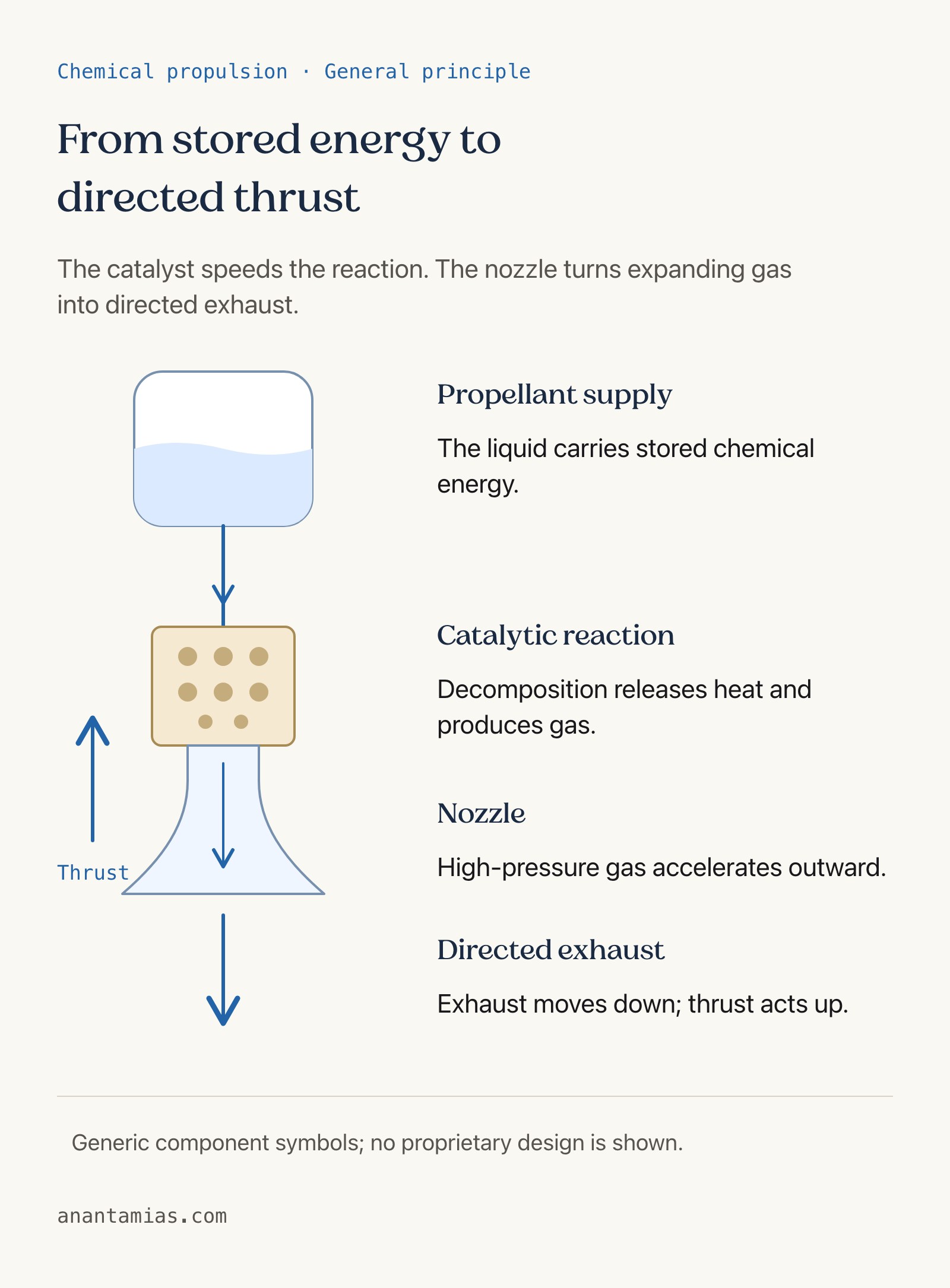
  • Hydrogen peroxide can undergo catalytic, exothermic decomposition, as NASA explains. A catalyst accelerates the reaction; the chemical stores the energy released during decomposition, so the catalyst should not be described as the fuel itself.
  • In chemical propulsion, combustion or decomposition produces high-pressure gas that accelerates through a nozzle. Expelling that gas generates thrust, linking chemical energy release to the mechanical task of changing a spacecraft’s motion or orientation.
  • This general mechanism helps explain why propellant delivery, reaction control and nozzle operation must work together. It does not establish the detailed reaction pathway, geometry or performance of Manastu’s undisclosed additive-containing formulation and hardware.
  • Thermal and materials compatibility must be considered together with the reaction. Components exposed to the propellant and hot reaction products need suitable materials; selecting a greener chemical does not automatically qualify an existing propulsion assembly.
  • Peroxide handling still requires care. NASA notes that concentrated peroxide can react rapidly with impurities and decompose dangerously if improperly stored or handled, making cleanliness and compatible storage materials part of the safety assessment.
Generic process diagram linking liquid propellant supply, catalytic reaction and nozzle acceleration to downward exhaust and opposite thrust
General chemical-propulsion principle: a catalyst accelerates energy release and gas accelerates through a nozzle. This schematic does not depict Manastu’s proprietary design.

What Counts as Evidence of Readiness

Readiness claims become useful when they identify which system was tested, under what conditions and with what remaining limitations.

  • The announced TRL 6 to TRL 9 objective describes intended progression in technology maturity. It must not be converted into a statement that the final level has already been reached or operational deployment completed.
  • A component result answers a narrower question than a complete-system test. Successful catalyst behaviour alone cannot establish how feed hardware, engine operation and spacecraft interfaces will perform together during the mission’s required sequence of operations.
  • A space demonstration provides evidence under a particular set of conditions. Wider deployment requires examining how representative that experience is of future uses, rather than treating one successful demonstration as an unrestricted guarantee of reliability.
  • The term green should be evaluated through the hazards and operational demands actually reduced. Lower toxicity or easier handling relative to conventional alternatives does not remove oxidising behaviour, materials constraints or the need for safety procedures.
  • Performance, safety and cost are separate assessment dimensions. An improvement in one does not prove equal progress in the others; transparent test evidence is needed before broad claims about mission suitability or economic advantage are accepted.

Way Forward

Tie Progress Claims to Test Evidence

  • Report system-level milestones with the operating conditions, interfaces and remaining limitations needed to interpret the achieved readiness.
  • Keep materials compatibility and handling controls within the qualification programme, including the risks associated with concentrated peroxide and contamination.
  • Distinguish demonstrated results from deployment targets so procurement and mission planning use verified capabilities rather than the ambitions of a development agreement.

Conclusion

  • Green propulsion combines chemistry with demanding systems engineering. The announced programme’s significance lies in developing an integrated indigenous capability and testing whether its components can operate reliably together across the intended applications.
  • Readiness is an evidence question. A space demonstration supports further development, while wider deployment requires qualified system performance and credible safety controls. The programme’s target should remain distinct from what has already been verified.

UPSC Practice Questions

Prelims MCQ 1

With reference to the announced green-propulsion programme, consider the following statements:

  1. The propellant is described as hydrogen-peroxide-based with additives.
  2. The programme’s TRL-9 objective establishes that operational readiness has already been achieved.
  3. The project includes an integrated engine, catalyst and propellant feed system.

How many of the above statements are correct?

(a) Only one (b) Only two (c) All three (d) None

Answer: (b) Only two

Explanation:

Statements 1 and 3 follow the official release. TRL 9 is an intended development target, so statement 2 is incorrect; further integration, testing and validation remain part of the programme.

Prelims MCQ 2

Which statement best explains the role of a catalyst in peroxide-based chemical propulsion?

(a) It removes the need for compatible storage materials. (b) It guarantees that the complete propulsion system is flight-qualified. (c) It accelerates a chemical reaction through which the propellant releases energy. (d) It supplies all the energy by being consumed as the fuel.

Answer: (c) It accelerates a chemical reaction through which the propellant releases energy.

Explanation:

A catalyst accelerates the reaction without being consumed overall. Peroxide can decompose exothermically, but catalyst performance alone does not establish storage safety or qualify the complete propulsion system.

UPSC Mains Questions

  1. Explain why a space demonstration of a propulsion technology does not by itself establish readiness for wider deployment.
  2. Assess the opportunities and engineering constraints associated with greener propellants in India’s space sector.

Sources: PIB, Department of Science and Technology and NASA, In-Space Propulsion.

Frequently Asked Questions

What is new in the Manastu Space announcement?

TDB-DST announced support for further development, integration, testing and validation of an indigenous green-propulsion system. The programme seeks progression from TRL 6 to TRL 9, building on an existing space demonstration.

Does green propulsion mean hazard-free propulsion?

No. Green alternatives may reduce particular hazards or handling burdens compared with conventional propellants. Concentrated peroxide still requires compatible materials, cleanliness and careful storage because impurities or improper handling can trigger rapid decomposition.

What role does the catalyst play?

A catalyst accelerates the reaction through which the propellant releases energy. The announcement includes an ultra-high-temperature ceramic catalyst, but does not disclose its detailed composition or the proprietary chemistry of the additive-containing propellant.

Has the programme achieved TRL 9?

The official release presents TRL 9 as the programme’s objective. It reports an earlier space demonstration while describing further engineering, integration, testing and validation as work needed to advance readiness for wider deployment.

Jojari River Case: Linking Restoration Costs With Regulatory Accountability

Open article →Download PDF

Why in News?

The Hindu reported that, at the 26 October 2026 hearing, the Supreme Court questioned Rajasthan’s regulatory conduct and sought a workable financial proposal to restore the Jojari-Luni-Bandi river system.

  • The court questioned the regularisation of mining leases after violations had been detected, according to the hearing report.
  • The Bench warned of a possible CBI investigation if remedial action failed; the report does not say that such a probe was ordered.
  • The reported proposal concerns common effluent treatment plants, zero-liquid-discharge technology and recirculation of treated water to industrial units.
  • The Bench indicated contributions from the State and industries. The report establishes neither a sanctioned budget nor completed restoration.
  • Regulatory accountability becomes central when authorities permit activities despite detected environmental violations.
  • Restoration planning must connect responsibility, finance and measurable ecological improvement, rather than end with a promise to build infrastructure.

UPSC Relevance

Prelims Relevance

  • Polluter pays: connects environmental harm with the costs of prevention and restoration.
  • CETP: a common effluent treatment plant serving multiple industrial units.
  • ZLD: zero-liquid-discharge systems recover and reuse water while requiring management of remaining residues.
  • Oral observations: remarks during a hearing must be distinguished from a final written order.
  • Jojari-Luni-Bandi: the river system addressed in the reported Rajasthan proceedings.

Mains Relevance

GS Paper 3

  • Financing industrial pollution control and river restoration.
  • Testing environmental projects through compliance and ecological outcomes.

GS Paper 2

  • Accountability for regulatory failure and the role of judicial oversight.

Background and Context

Why the Hearing Focuses on Regulatory Conduct

The reported concern extends beyond individual discharges to how public authorities exercised their responsibilities after violations came to light.

  • The Bench questioned lease regularisation after detected violations, according to The Hindu. This focuses attention on the sequence of regulatory decisions and whether later permissions addressed the environmental problems that authorities had already identified.
  • The State submitted that cases had been registered and preventive steps were being taken. These are reported submissions about action initiated; they do not independently establish that unlawful activity ended or river conditions improved.
  • The reported CBI warning signals the court’s concern about official conduct. A warning about a possible investigation must remain distinct from an order directing one, and neither should be treated as a finding of criminal guilt.
  • The court’s concern about State responsibility challenges the idea that restoration can be left entirely to industries and municipal bodies. The report attributes this position to the Bench while a workable financial proposal remains pending.
  • Later permission and earlier harm require separate examination. The hearing raises questions about this case’s regulatory sequence; it should not be converted into a universal legal rule that every subsequent permission has the same effect.

What a Workable Restoration Proposal Must Connect

The proposed response combines treatment capacity, water recovery and financing, with responsibilities that must remain clear throughout operation.

  • A common effluent treatment plant receives wastewater from multiple industrial units for shared treatment. Collective infrastructure can address a cluster’s needs, but participating units still need clear obligations concerning the waste entering the system.
  • Zero-liquid-discharge technology aims to recover water and avoid routine liquid effluent discharge. It does not mean that pollution simply disappears: concentrated streams and solid residues remain management responsibilities within the overall treatment arrangement.
  • The reported recirculation proposal would return treated water to industrial units through pipelines. Treatment and reuse must be planned together, because producing treated water alone does not establish that users can receive or suitably reuse it.
  • State and industry contributions were indicated during the hearing, according to the report. The exact allocation, sanctioned expenditure and implementation arrangements are not established, so a proposal should not be described as an approved funding package.
  • Polluter pays connects responsibility for environmental damage with restoration costs. Applying that principle requires identifying obligations and evidence in the relevant proceedings; a financial remedy and a determination of criminal liability answer different legal questions.

How to Judge Progress Beyond Announcements

A credible remedy needs evidence that the proposed arrangements reduce harm and that responsible institutions continue to perform their assigned roles.

  • Construction and operation are separate stages of delivery. Even an installed treatment facility needs reliable operation, appropriate inputs and residue management; announcing equipment or completing civil works cannot alone establish effective pollution control over time.
  • Monitoring should examine water quality and the functioning of treatment and reuse arrangements. The Mandovi water-quality discussion illustrates why a narrow indicator or isolated compliant result cannot substitute for a properly designed assessment.
  • Institutional responsibility must be traceable when several bodies contribute finance, permissions and oversight. A shared project can leave gaps if each participant assumes another institution will verify performance, address failures or provide continuing operational support.
  • The earlier Yamuna sewage note focused on municipal collection and treatment delivery. This case’s distinct lesson concerns industrial restoration finance and regulatory conduct, including how public authorities respond after violations have been detected.
  • Judicial scrutiny can demand a clearer proposal and expose weak explanations, but ecological recovery still requires sustained implementation. Progress should be assessed through fulfilled obligations and measured conditions rather than the strength of courtroom language alone.

Way Forward

Link Funding to Verifiable Responsibilities

  • Publish a costed implementation plan identifying the institutions responsible for treatment, reuse, residue management and continuing operation.
  • Connect each funding commitment with measurable milestones and transparent reporting on whether the proposed facilities and regulatory measures are functioning.
  • Use independent performance checks to distinguish expenditure and construction from sustained compliance and improvement in river conditions.

Conclusion

  • The Jojari hearing places restoration finance alongside the conduct of regulators. Its durable lesson is that public responsibility, industrial obligations and environmental performance must be examined together when designing a remedy for continuing harm.
  • A workable proposal is the beginning of implementation. Its eventual value depends on clear responsibilities, sustained operation and evidence of improvement; the reported warning and proposed measures should retain their correct legal and administrative status.

UPSC Practice Questions

Prelims MCQ 1

With reference to the reported Jojari river hearing, consider the following statements:

  1. The report describes a warning of a possible CBI investigation, rather than an ordered probe.
  2. The report establishes that a final restoration budget has been sanctioned.
  3. The proposed measures include treatment and recirculation of water to industrial units.

How many of the above statements are correct?

(a) Only one (b) Only two (c) All three (d) None

Answer: (b) Only two

Explanation:

Statements 1 and 3 follow the hearing report. A financial proposal was sought; the report does not establish a sanctioned budget, making statement 2 incorrect.

Prelims MCQ 2

Which statement best describes zero-liquid-discharge treatment?

(a) It removes every form of waste from an industrial process. (b) It makes monitoring and residue management unnecessary. (c) It aims to recover water and avoid routine liquid discharge while remaining residues require management. (d) It guarantees river restoration as soon as a plant is announced.

Answer: (c) It aims to recover water and avoid routine liquid discharge while remaining residues require management.

Explanation:

ZLD concerns liquid discharge and water recovery. It does not eliminate concentrated or solid residues, nor does a proposed facility establish successful operation or ecological recovery.

UPSC Mains Questions

  1. How can regulatory failure complicate the application of the polluter pays principle? Discuss with reference to the reported Jojari river proceedings.
  2. What should a financial proposal for industrial river-pollution control include to connect treatment infrastructure with sustained environmental improvement?

Source: The Hindu.

Frequently Asked Questions

What is the central issue in the Jojari hearing?

The reported hearing concerns regulatory conduct after detected violations and a workable financial proposal for river restoration. The focus includes the responsibilities of the State and industries, alongside treatment and water-reuse measures.

Has the Supreme Court ordered a CBI probe?

The Hindu reports an oral warning of a possible CBI investigation if remedial action failed. It does not establish that a probe was ordered. The warning should retain that status when explaining the case.

Has a restoration budget been approved?

The report says the court sought a concrete financial proposal and indicated contributions from the State and industries. It does not establish a sanctioned budget, final cost allocation or completed treatment infrastructure.

Does zero liquid discharge mean no waste remains?

No. ZLD aims to recover water and avoid routine liquid effluent discharge. Concentrated streams and solid residues still need appropriate management, and successful operation must be checked rather than assumed from the technology label.