Join Anantam IAS Channel on Telegram

Daily Digest · Wednesday

3 June 2026 Current Affairs for UPSC

5 current affairs published on Wednesday, 3 June 2026

3 June 2026 Current Affairs for UPSC — every Why-in-News article AnantamIAS published on Wednesday, 3 June 2026, broken down with Why in News?, the exact GS paper it feeds, sub-topic mapping, MCQ-ready facts and a UPSC-style practice question. 5 articles in total, covering Polity, Economy, Environment, S&T, IR, Geography, History, Society and Internal Security — the same Why-in-News + GS-paper-mapping + practice-question format the Compass uses across every daily digest on the site.

Daily current affairs for UPSC is where new material enters your prep stream. Read this 3 June 2026 digest end-to-end in 25–35 minutes, attempt the practice question at the foot of each article (it's MCQ for some, 10/15-marker for others), then bookmark the entries that fall inside your active revision window. Everything stays cross-linked: tap any subject pill to jump to that subject's hub, or use the table of contents above to skip straight to a specific story.

Use this page three ways. Read sequentially for a one-sitting scan of everything that mattered on 3 June 2026. Download the 3 June 2026 PDF below for offline study or print revision. Or use the June 2026 Current Affairs compilation to see this day in the month's full context. For the previous day's reading, see 2 June 2026 Current Affairs; the next day's is 4 June 2026 Current Affairs.

Why we publish daily current affairs separately from the monthly compilation: daily is learning, monthly is revision. Use the daily page to add fresh material to your notes the day it breaks; come back to the June 2026 compilation 60 days before Prelims when the noise has settled and only the lasting takeaway is worth re-reading.

1.5 Crore Artificial Groundwater Recharge and Storage Structures under JSJB Initiative

Open article →Download PDF

Why in News?

Over 1.5 crore artificial groundwater recharge and water storage structures have been created across India under the Jal Sanchay Jan Bhagidari (JSJB) initiative. These assets were primarily developed through community participation, corporate contributions, and government convergence. 

UPSC Relevance: GS-1 Geography: Changes in critical geographical features; GS-3 Environment and Biodiversity: Conservation 

Prelims: Jal Sanchay Jan Bhagidari (JSJB) Initiative
Mains: Groundwater Depletion and Management: Challenges & Policies 

Groundwater comprises nearly 99% of Earth’s liquid freshwater. In India, groundwater is the primary source of agricultural activity and drinking water, meeting nearly 62% of irrigation needs, 85% of rural consumption, and 50% of urban demand. 

Why is Groundwater Management critical for India?

India is the world’s largest user of groundwater, extracting more groundwater annually than China and the United States combined.

1. Over-Exploitation of Groundwater:

  • Increasing agricultural demand has resulted in excessive pumping.
  • Free or subsidised electricity has encouraged indiscriminate extraction.
  • Falling water tables are reported in several regions of Punjab, Haryana, Rajasthan, Gujarat, Karnataka, and parts of Uttar Pradesh.

2. Groundwater Quality Degradation:

  • Anthropogenic Sources: Industrial effluents, Mining activities, Agricultural chemicals & Urban wastewater. 
  • Natural Contaminants: Arsenic (Gangetic Plains), Fluoride (Rajasthan, Telangana, Andhra Pradesh), Iron and salinity in several regions.
  • Consequences include Fluorosis, Arsenicosis, reduced agricultural productivity and Public health burden. 

3. Climate Change and Water Security:

  • Climate change is altering Rainfall intensity, Monsoon patterns, Recharge cycles and Drought frequency. Groundwater serves as India’s most reliable climate adaptation resource.

4. Urbanisation-Induced Stress:

Rapid urban expansion has:

  • Reduced natural recharge zones.
  • Increased concretisation.
  • Enhanced groundwater extraction.
  • Caused urban flooding alongside groundwater depletion.

The sharp increase in groundwater extraction has been driven by the availability of affordable drilling techniques and pumping technologies, enabling even small farmers and low-income households to construct and operate private tube wells.

As per the United Nations Educational, Scientific and Cultural Organisation (UNESCO), effective groundwater management needs 4 key priorities to ensure sustainable and balanced use of groundwater resources:

  1. Maintaining a dynamic water cycle to support natural recharge
  2. Balancing ecological and human needs to ensure environmental protection
  3. Preserving reserve supplies to safeguard against droughts
  4. Aligning use with quality requirements so that groundwater quality matches its purpose

What is Artificial Recharge, and why is it required? 

  • Natural recharge is the process by which water from rainfall seeps downward from the ground and is stored in aquifers. The amount of water that can be naturally recharged depends on land slope, water retention time, geographic location, and the availability of recharge areas. 
  • In many cases, adequate recharge does not occur due to unfavourable natural conditions. Human activities, urbanisation, and concretisation result in a reduction in rechargeable area. 
  • Further, natural recharge may not be sufficient to compensate for the increasing abstraction of groundwater. It is possible to increase recharge by constructing suitable structures. This process of increasing recharge is called artificial recharge. 
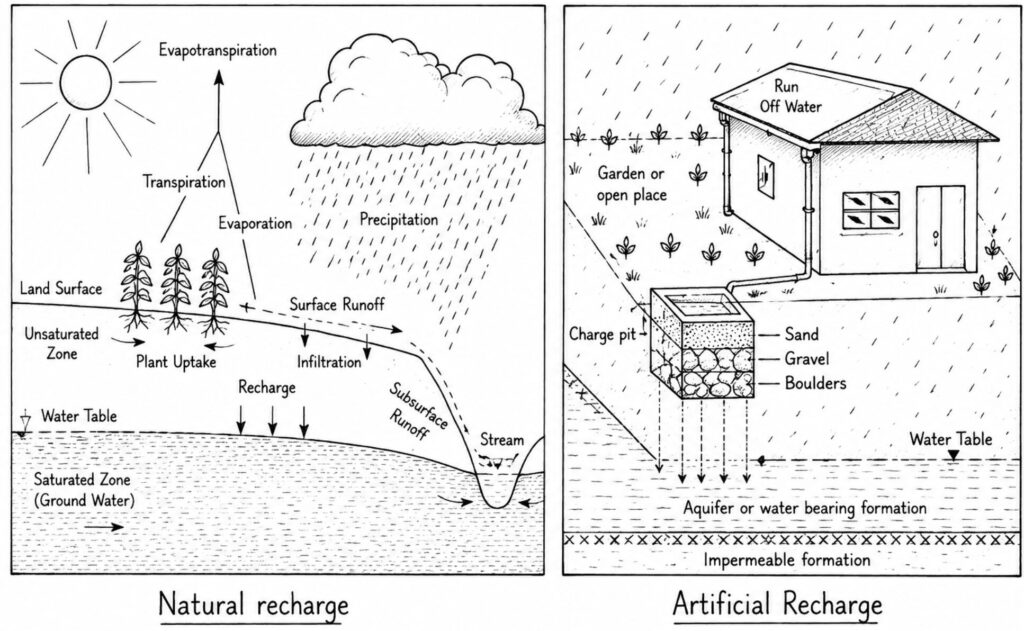
Artificial Recharge has the following Advantages: 

  • Arrest the decline in groundwater levels
  • Enhance the availability of groundwater
  • Sustain drinking water sources
  • Improve the yields of irrigation wells
  • Increase recharge in urban areas, which has decreased drastically due to paving
  • Prevent urban flooding
  • Improve groundwater quality by dilution
  • Restrict sea-water ingress. 

Various Techniques or Methods of Artificial Recharge:

Artificial recharge techniques can be broadly categorised into three categories: surface, subsurface and combination techniques.

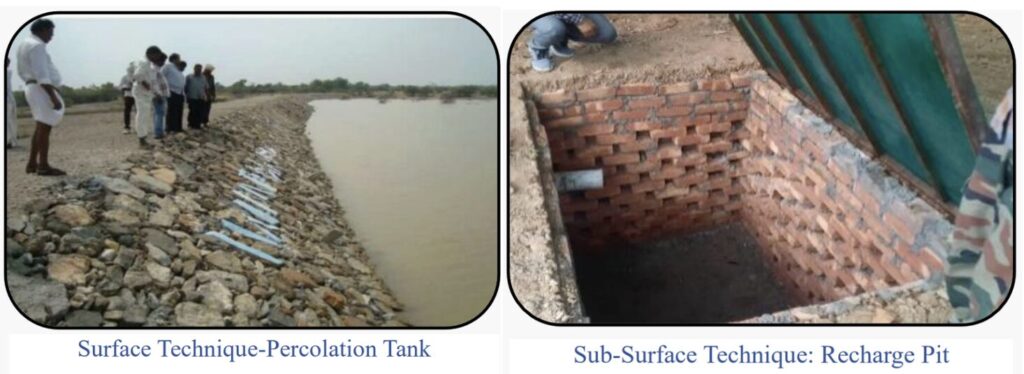
i. Surface Techniques: This is done by restricting the surface flow, impounding water on the surface or by spreading (also called flooding). Major variants are Percolation Tanks, Check Dams, Ditch and furrow system, Flooding and over Irrigation.

ii. Subsurface Techniques: This is done by putting water directly into the aquifers, and the variants include Recharge pits, Recharge shafts, recharge wells or Injection wells, etc.

iii. Combination of Surface-Subsurface Techniques: The surface and subsurface techniques can also be combined to get more out of the recharge interventions. One such example is a recharge well within a percolation tank. 
Jal Sanchay Jan Bhagidari (JSJB) Initiative: 

  • The Jal Sanchay Jan Bhagidari (JSJB) initiative was launched under the Jal Shakti Abhiyan: Catch the Rain campaign in 2024.
  • Launched by the Ministry of Jal Shakti to transform water conservation into a mass movement by strengthening community and private sector participation in water conservation.  
  • Objective: To tackle declining groundwater levels at the local level by combining scientific technology with traditional storage methods.
  • It focuses on the construction of low-cost artificial recharge structures, including rooftop rainwater harvesting, recharge pits/shafts, and the revival of defunct borewells.
  • The initiative functions on the 3Cs mantra (Community, Corporate Social Responsibility, and Cost). The 3Cs Framework:
    • Community: Emphasises Jan Bhagidari (public participation) to drive voluntary labour and community-led water conservation.
    • Corporate Social Responsibility (CSR): Engages private industries and businesses to fund water security projects.
    • Cost: Focuses on low-cost, decentralised, and scalable infrastructure models.
  • It works through the convergence of government schemes like MGNREGA and the District Mineral Fund, and philanthropic resources. 
  • The program integrates community action with official JSJB portals and monitoring systems to measure the impact of groundwater replenishment and ensure sustainable water use.

The growing groundwater crisis has strengthened the Government’s commitment to effective management, reaffirmed by India’s COP 21 commitment to climate resilience and long-term growth. Effective groundwater management is vital for achieving the Sustainable Development Goals, especially SDG 6, SDG 11, and SDG 12.
Successful flight tests of the indigenous RudraM-II Missile

Open article →Download PDF

Why in News?

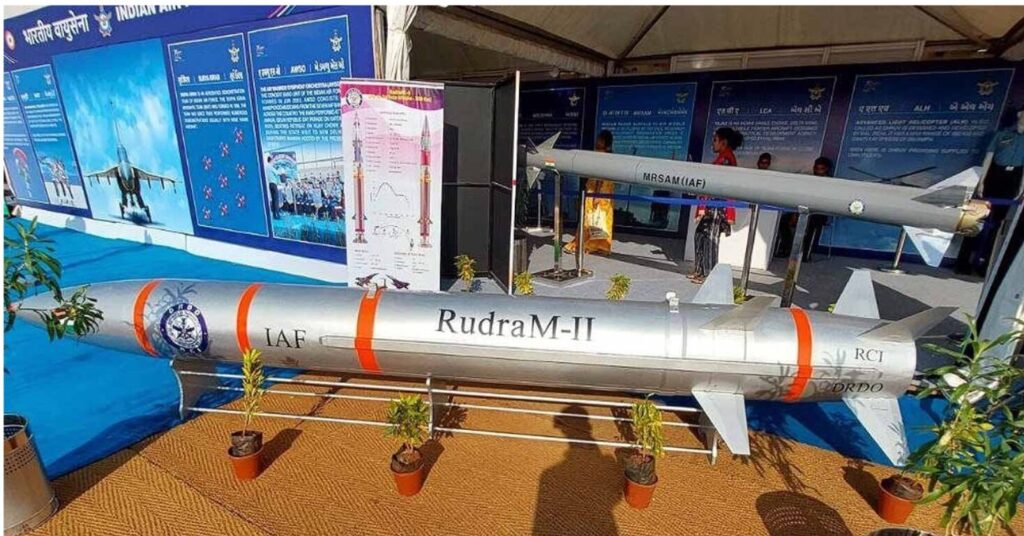
Defence Research and Development Organisation (DRDO) and Indian Air Force (IAF) successfully flight-tested the RudraM-II air-to-surface missile from a Su-30 MKI fighter under extreme release conditions. The missile struck its designated target with pinpoint accuracy and met all trial objectives. 

UPSC Relevance: GS-3 Science and Technology: Defence Technology

Prelims: RudraM-II Missile: Specifications, Significance; Anti-Radiation Missile

About RudraM-II Missile:

  • RudraM-II is an indigenous next-generation anti-radiation missile (ARM). Designed to locate, track, and destroy enemy radar systems, surface-to-air missile (SAM) batteries, and command-and-control centres.
  • Developed by DRDO’s Research Centre Imarat (RCI), Hyderabad.
  • Key Specifications:
    • Type: Air-to-Surface Anti-Radiation Missile
    • Range: Up to 300 km
    • Speed: Around Mach 5.5
    • Warhead: Approximately 200 kg
    • Launch Platform: Su-30 MKI (future integration with Tejas Mk-1A planned)
    • Guidance: INS + GPS + Passive Radar Homing + Imaging Infrared Seeker
    • Intended to replace the Russian-origin Kh-31 missile in IAF service.
  • SEAD and DEAD Operations: RudraM-II is specifically designed to undertake both SEAD and DEAD roles.
    • Suppression of Enemy Air Defences: Temporarily neutralise enemy air-defence networks so that friendly aircraft can operate safely.
    • Destruction of Enemy Air Defences: Permanent destruction of enemy radar and missile systems.

What makes RudraM-II Special?

  • Long Stand-Off Range: The missile can strike targets up to 300 km away, allowing aircraft to engage enemy air-defence systems without entering hostile airspace.
  • High-Speed Precision Strike: Travelling at approximately Mach 5.5, RudraM-II leaves very little reaction time for enemy air-defence systems.
  • Neutralises Modern Air Defence Networks: Modern warfare relies heavily on integrated air-defence systems. By destroying surveillance and fire-control radars, RudraM-II can effectively “blind” enemy air-defence networks, reducing their ability to detect and intercept incoming aircraft and missiles.
  • Multi-Seeker Capability: Unlike conventional anti-radiation missiles that depend solely on radar emissions, RudraM-II employs Passive Radar Homing and Imaging Infrared (IIR) Seeker. This enables the missile to continue tracking and destroying the target even if enemy operators switch off their radars after detecting the incoming missile.
  • Strengthens Electronic Warfare Capability: The missile complements India’s growing electronic warfare and precision-strike ecosystem, allowing coordinated operations against sophisticated air-defence environments.

Anti-Radiation Missile: 

  • Anti-Radiation Missile (ARM) is an air-to-surface weapon designed to detect and destroy enemy radar and electromagnetic-emitting systems, such as jammers or communication radios. 
  • Working:
    • Homing: Instead of reflecting radar waves off a target, the missile uses a passive radar seeker to lock onto the radio-frequency (RF) signals emitted by the target.
    • GPS/Inertial Backup: Modern ARMs feature built-in memory tracking and GPS navigation. If an enemy operator turns off their radar in an attempt to spoof the missile, the ARM remembers the last known location and destroys it anyway.
  • Applications:
    • SEAD (Suppression of Enemy Air Defences): Primary role of ARMs. They are deployed to blind enemy air defences and destroy surface-to-air missile (SAM) sites in the initial stages of conflict, allowing subsequent waves of strike aircraft to operate safely.
    • Disrupting Communications: Beyond radars, they can home in on jamming pods and command-centre radios to sever an adversary’s communication networks.

Strategic Significance for India:

  • Strengthening Air Dominance: The missile enhances the IAF’s ability to neutralise sophisticated air-defence systems before launching major air operations.
  • Force Multiplier: Modern conflicts increasingly rely on integrated air-defence systems and network-centric warfare. RudraM-II enables India to: Degrade enemy sensor networks. Disrupt command-and-control structures. Facilitate deep penetration strikes.
  • Reducing dependence on Imports: The missile is expected to progressively replace the Russian-origin Kh-31 missiles currently used by the IAF. This reduces strategic dependence on foreign suppliers and strengthens defence self-reliance.

The successful flight testing of RudraM-II marks a major advance in India’s indigenous missile development programme. 

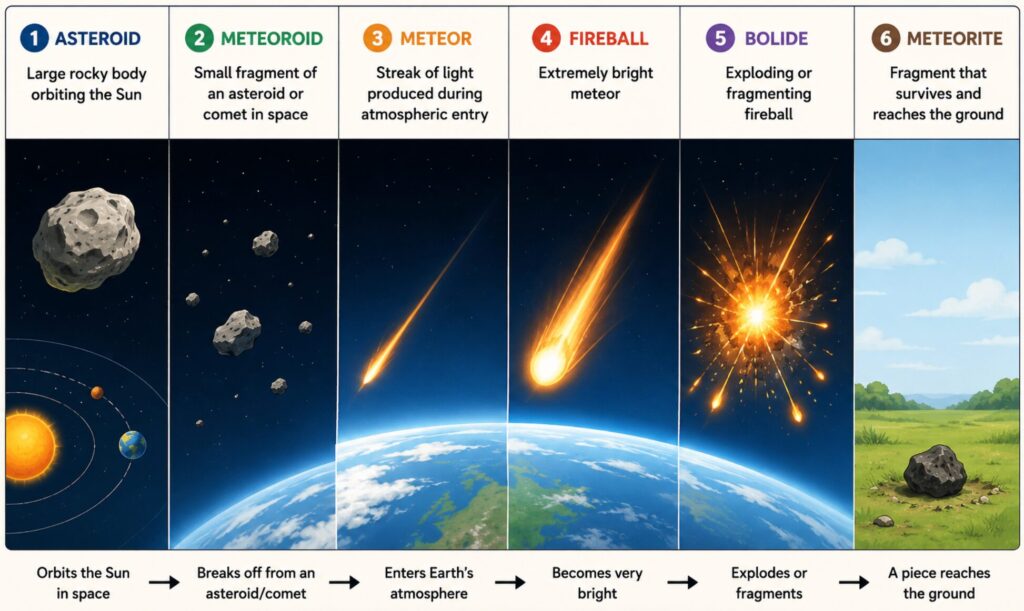
Bolides: Fireballs Going Boom

Open article →Download PDF

Why in News?

Recently, a meteor exploded over the northeastern United States, producing a bright fireball and loud sonic booms heard across several states. NASA estimated that the object fragmented at an altitude of about 64 km while travelling at more than 120,000 km/h, releasing energy equivalent to nearly 300 tonnes of TNT.

UPSC Relevance: GS-3 Science and Technology: Astronomy and Space Technology

Prelims: Asteroid, Meteoroid, Meteor, Fireball, Bolide

What is a Bolide?

  • A bolide is an exceptionally bright meteor that explodes or fragments violently in Earth’s atmosphere, producing a powerful flash of light and often a shockwave.
  • In simple terms:
    • Meteoroid: A small rocky or metallic object travelling through space.
    • Meteor: The streak of light produced when a meteoroid enters Earth’s atmosphere.
    • Fireball: An unusually bright meteor, brighter than the planet Venus.
    • Bolide: A fireball that explodes or breaks apart dramatically in the atmosphere.

All bolides are fireballs, but not all fireballs are bolides. 

NASA’s fireball classification:

A meteor brighter than magnitude -4 (brighter than Venus) is generally classified as a fireball. A bolide is a fireball that undergoes a significant atmospheric explosion or fragmentation.

How does a Bolide form?

  • Origin in Space: Most bolides originate from fragments of asteroids. Some may also originate from cometary debris. These objects orbit the Sun until their paths intersect with Earth’s orbit.
  • Atmospheric Entry: When the object enters Earth’s atmosphere:
    • It travels at extremely high speeds (typically 11–72 km/s).
    • Air in front of it is compressed rapidly.
    • Compression generates intense heat, causing the object to glow.
    • A bright streak of light becomes visible across the sky.
  • Explosion: As atmospheric pressure increases, internal stresses build up. The object may fragment violently. The sudden release of kinetic energy creates an airburst, producing shockwaves and loud booms.

Why are the Booms so Loud?

  • The sound is not caused by burning. Instead, the meteor travels faster than the speed of sound. It generates a shockwave, similar to a supersonic aircraft.
  • When the shockwave reaches the ground, people hear a loud boom and may feel vibrations. This phenomenon is called a sonic boom.
  • A famous example is the Chelyabinsk bolide, which exploded over Russia in 2013, generating a powerful shockwave that damaged buildings and injured more than a thousand people.

Difference between Asteroid, Meteoroid, Meteor, Fireball and Bolide:

Significance: 

Bolides help scientists:

  • Understand the composition of asteroids and meteoroids.
  • Estimate the frequency of near-Earth impacts.
  • Improve planetary defence systems.
  • Assess risks posed by larger Near-Earth Objects (NEOs).
  • Study atmospheric shockwave physics.

UPSC PYQ 2023

Q. Consider the following pairs:

 Objects in space     Description

  1. Cepheids: Giant clouds of dust and gas in space
  2. Nebulae: Stars which brighten and dim periodically
  3. Pulsars: Neutron stars that are formed when massive stars run out of fuel and collapse

How many of the above pairs are correctly matched?

(a) Only one

(b) Only two

(c) All three

(d) None

Answer: (a) 

Govt to replace Wholesale Price Index with Producer Price Index 

Open article →Download PDF

Why in News?

The Government of India has approved the revision of the Wholesale Price Index (WPI) base year from 2011-12 to 2022-23. Introduction of a comprehensive Producer Price Index (PPI) framework. Gradual replacement of WPI by PPI over the next five years.

The revised WPI and the new PPI series are scheduled for release by the Office of the Economic Adviser (OEA), Department for Promotion of Industry and Internal Trade (DPIIT). WPI will continue to be published alongside PPI for five years before being phased out.

UPSC Relevance: GS-3 Economy: Economic Development, National Income Accounting

Prelims: WPI, PPI, CPI, Purchaser’s Price, DPIIT

What is the Wholesale Price Index (WPI)?

  • WPI is a key economic indicator that tracks the average change in price of goods and commodities at the bulk/producer level before they reach the retail or consumer market. 
  • It reflects price movements of a basket of goods, including primary articles (food, oilseeds, minerals), fuel and power (petrol, diesel, LPG, electricity), and manufactured products (chemicals, textiles, metals and machinery). 
  • Published monthly by: Office of the Economic Adviser (DPIIT) 
  • Current base year: 2011-12 (being revised to 2022-23).
  • WPI does not include services. WPI is used to monitor supply-side inflation and is a critical input for industry pricing, taxation and policy-making. 

Current WPI Basket:

The revised WPI series expands coverage from:

  • 2011-12 Series: 697 items 
  • 2022-23 Series: 957 items

This provides a broader representation of India’s evolving economy.

What is the Producer Price Index (PPI)?

  • The Producer Price Index measures changes in prices received and paid by producers during the production process.
  • Unlike WPI, PPI tracks inflation across the entire production chain, including:
    • Output PPI: prices received by producers for goods and services sold.
    • Input PPI: prices paid by producers for raw materials, fuel, services and other inputs.

Thus, PPI captures inflationary pressures before they reach consumers.

Plan for Release of Services PPI:

  • It will be released on a quarterly basis. The release schedule is being finalised in consultation with the Ministry of Statistics and Programme Implementation.
  • Initial services PPI will include seven services: Banking, Securities Transaction, Insurance, Management of Pension Funds, Railways, Air (Passenger) and Telecom.

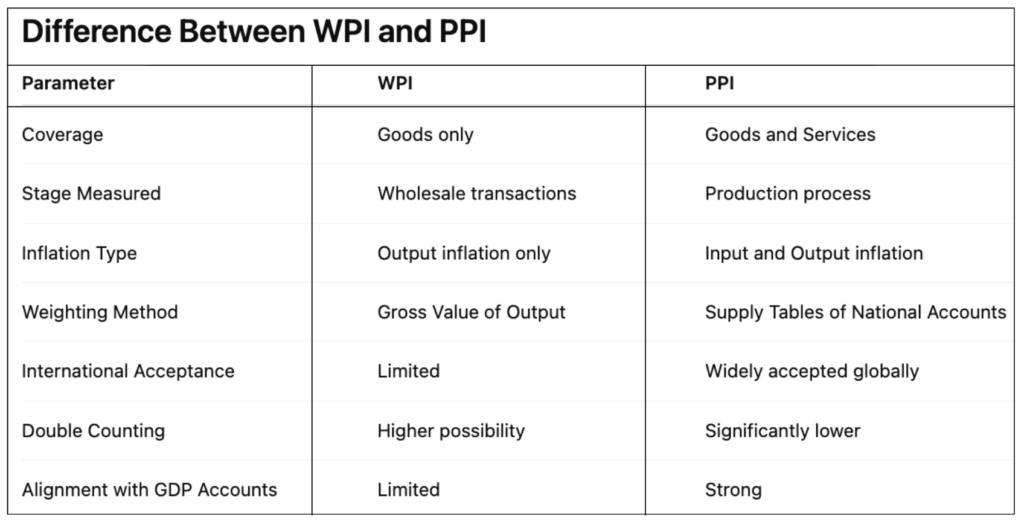
Difference between WPI and PPI: 

Why is India moving from WPI to PPI?

  • Better reflection of the economy: India’s economy has become increasingly service-oriented. Services contribute nearly 55% of India’s Gross Value Added (GVA). WPI excludes services entirely. PPI incorporates both goods and services. Therefore, PPI provides a more comprehensive picture of producer-level inflation.
  • Alignment with International Best Practices: Most advanced economies use PPI rather than WPI. Countries such as the United States, the United Kingdom, Canada, and Australia have long adopted PPI frameworks. The transition also aligns with recommendations of the International Monetary Fund (IMF) and international statistical standards.
  • Consistency with National Accounts: PPI is closely linked with the Supply and Use Tables (SUTs) and the National Accounts framework. This improves GDP estimation, Sectoral price analysis, Productivity measurement, and input-output modelling. Thus, policymakers obtain more reliable macroeconomic information.
  • Captures Cost-Push Inflation Better: One major limitation of WPI is that it mainly records output prices. PPI captures both Input Inflation (Raw materials, Energy, Transport costs, Intermediate goods) & Output Inflation (prices received by producers). This helps identify whether rising production costs are being passed on to consumers.
  • Eliminates Double Counting: Under WPI, the same product may appear multiple times at different stages of production. For example: Iron Ore → Steel → Automobile. Inflation may be counted repeatedly at each stage. PPI’s supply-chain-based methodology significantly reduces such double-counting, leading to more accurate inflation estimates.
  • Better Policy Formulation: PPI provides early warning signals about inflationary pressures. It helps:
    • RBI monitor cost-push inflation
    • Government assess industrial competitiveness
    • Businesses forecast pricing trends
    • Policymakers understand sector-specific stress.

By aligning India’s statistical framework with global standards and modern economic realities, the PPI is expected to provide a more accurate, comprehensive, and policy-relevant measure of inflationary trends. 

The Future of India’s Chip Industry

Open article →Download PDF

Why in News?

NITI Aayog’s Frontier Tech Hub released India’s first comprehensive 10-year roadmap titled “Future of India’s Semiconductor Industry.”  The report complements ISM 2.0, announced in the Union Budget 2026-27.

UPSC Relevance: GS-3 Economy: Manufacturing, Industrial Policy; Science and Technology: Frontier Technology

Prelims: India Semiconductor Mission, ISM 2.0  
Mains: Semiconductors: Role in economic growth & challenges associated

What is a Semiconductor?

  • A semiconductor is a material (typically silicon) whose electrical conductivity lies between that of a conductor and an insulator, making it the fundamental building block of all modern electronic devices.
  • Semiconductors are the foundation of technologies such as computing, mobile communications, telecommunications, automobiles, defence systems, and artificial intelligence. 
  • The chip value chain runs from design → wafer fabrication (fab) → assembly, testing, marking & packaging (ATMP/OSAT) → end products.

India’s Current Position: 

  • India currently imports 90-95% of its total domestic semiconductor consumption, exposing the economy to supply-chain disruptions, foreign-exchange outflows, and geopolitical shocks. 
  • India’s semiconductor market has grown to $45-50 billion in 2024-25, and is projected to reach $100-110 billion by 2030. 
  • The global semiconductor market is expected to exceed $1.5 trillion by 2035, while India’s semiconductor demand could reach around $200 billion by the same year. 
  • India does not yet have a single operational fabrication unit; the first is expected to begin production at Dholera, Gujarat, in 2028.
  • Tata Electronics fab at Dholera, set up in partnership with Taiwan’s Powerchip Semiconductor Manufacturing Corp, will have the capacity to produce 50,000 wafers per month and involves an investment of ₹91,000 crore, with the Centre contributing 50% of capex on a pari passu basis. 

India Semiconductor Mission (ISM) 1.0: 

  • ISM 1.0 was launched with a financial outlay of ₹76,000 crore ($10 billion) to reduce India’s reliance on imported semiconductor chips and establish a robust, self-reliant electronics manufacturing ecosystem. The
  • Indian government has approved 12 major semiconductor manufacturing projects (encompassing silicon fabs, compound semiconductors, and packaging units) alongside 24 chip design projects.
  • The Mission offers fiscal support of up to 50% for silicon fabs, compound semiconductor facilities, assembly and testing units, and chip design. 

ISM 2.0 (Announced in Union Budget 2026-27):

  • A provision of ₹1,000 crore has been made for ISM 2.0 in FY 2026-27. 
  • ISM 2.0 focuses on designing and manufacturing semiconductor equipment in India, manufacturing of materials used in semiconductor production, and the creation of a large design ecosystem. 
  • It focuses on developing full-stack Indian intellectual property in chip design and manufacturing and fortifying semiconductor supply chains to reduce import dependence. 
  • ISM 2.0 coincides with the expansion of the Electronics Components Manufacturing Scheme (ECMS), which was launched in 2025 and has already received investment commitments double its original target.

NITI Aayog Roadmap Vision 2035:  

  • Strategic Vision: The roadmap lays out a clear, actionable vision for India to build a $120-150 billion semiconductor value chain by 2035. 
    • India is targeting 70-75% self-sufficiency in domestic chip demand by 2029.
    • To become a leading semiconductor nation with 3 nm and 2 nm manufacturing capabilities by 2035. 
    • To create more than 100 breakthrough advanced semiconductor design IPs by 2035. 
  • Five Strategic Pillars: India’s strategy is built around five mutually reinforcing pillars:
    1. Pioneering: frontier R&D and design IP, including over 100 advanced semiconductor design IPs.
    2. Policy & Investment: mobilising long-horizon capital.
    3. Production: focus on advanced packaging, OSAT, compound semiconductors, and wide-bandgap materials.
    4. People: building a full semiconductor talent pyramid from design to fab.
    5. Partnerships with trusted nations and the global industry. 
  • Production Strategy: India should- 
    • Become a top-three global destination for outsourced semiconductor assembly and test (OSAT) and advanced packaging. 
    • Build leadership in wide-bandgap materials such as silicon carbide (SiC) and gallium nitride (GaN). 
    • Shift away from costly frontier chips (3-7 nm nodes) and towards mature nodes, compound semiconductors, and advanced packaging, which offer better bankability and strategic returns.
  • Capital Investment: The roadmap estimates that India will need cumulative semiconductor investments of nearly $135-180 billion over the next decade and recommends that the government commit at least one-third of this amount to de-risk projects and attract large-scale private capital.  

The report calls for industry-led research and training centres to develop technology and a skilled workforce. 

Also Read:  https://anantamias.com/current-affairs/indias-semiconductor-mission-policy-push-challenges/