Join Anantam IAS Channel on Telegram

Daily Digest · Tuesday

2 June 2026 Current Affairs for UPSC

8 current affairs published on Tuesday, 2 June 2026

2 June 2026 Current Affairs for UPSC — every Why-in-News article AnantamIAS published on Tuesday, 2 June 2026, broken down with Why in News?, the exact GS paper it feeds, sub-topic mapping, MCQ-ready facts and a UPSC-style practice question. 8 articles in total, covering Polity, Economy, Environment, S&T, IR, Geography, History, Society and Internal Security — the same Why-in-News + GS-paper-mapping + practice-question format the Compass uses across every daily digest on the site.

Daily current affairs for UPSC is where new material enters your prep stream. Read this 2 June 2026 digest end-to-end in 25–35 minutes, attempt the practice question at the foot of each article (it's MCQ for some, 10/15-marker for others), then bookmark the entries that fall inside your active revision window. Everything stays cross-linked: tap any subject pill to jump to that subject's hub, or use the table of contents above to skip straight to a specific story.

Use this page three ways. Read sequentially for a one-sitting scan of everything that mattered on 2 June 2026. Download the 2 June 2026 PDF below for offline study or print revision. Or use the June 2026 Current Affairs compilation to see this day in the month's full context. For the previous day's reading, see 1 June 2026 Current Affairs; the next day's is 3 June 2026 Current Affairs.

Why we publish daily current affairs separately from the monthly compilation: daily is learning, monthly is revision. Use the daily page to add fresh material to your notes the day it breaks; come back to the June 2026 compilation 60 days before Prelims when the noise has settled and only the lasting takeaway is worth re-reading.

IMEC is caught between Commerce and Geopolitics

Open article →Download PDF

Why in News?

The ongoing Iran conflict has severely disrupted West Asian trade routes and placed IMEC’s implementation under acute stress. 

During PM Modi’s recent visit to Italy, India and Italy elevated ties to a Special Strategic Partnership and agreed to convene the first-ever IMEC Ministerial Meeting in 2026

IMEC is now under pressure to redesign its route alignment to bypass conflict-prone chokepoints while managing growing divergence between Saudi Arabia and the UAE, two of its most critical partner states.

UPSC Relevance: GS-2 International Relations: Effect of policies and politics of developed and developing countries on India’s interests, Connectivity Projects  

Prelims: Location of IMEC. Mains: IMEC: Significance and Challenges 

What is IMEC? 

  • The India-Middle East-Europe Economic Corridor (IMEC) is a transcontinental connectivity initiative announced through a Memorandum of Understanding (MoU) during the G20 New Delhi Summit (2023).
  • Seven countries and the European Union signed the MoU: India, the USA, Saudi Arabia, UAE, France, Germany, Italy, and the EU. 
  • The framework was envisioned as a direct strategic counter to China’s Belt and Road Initiative (BRI). 
Three-Segment Structure of IMEC:

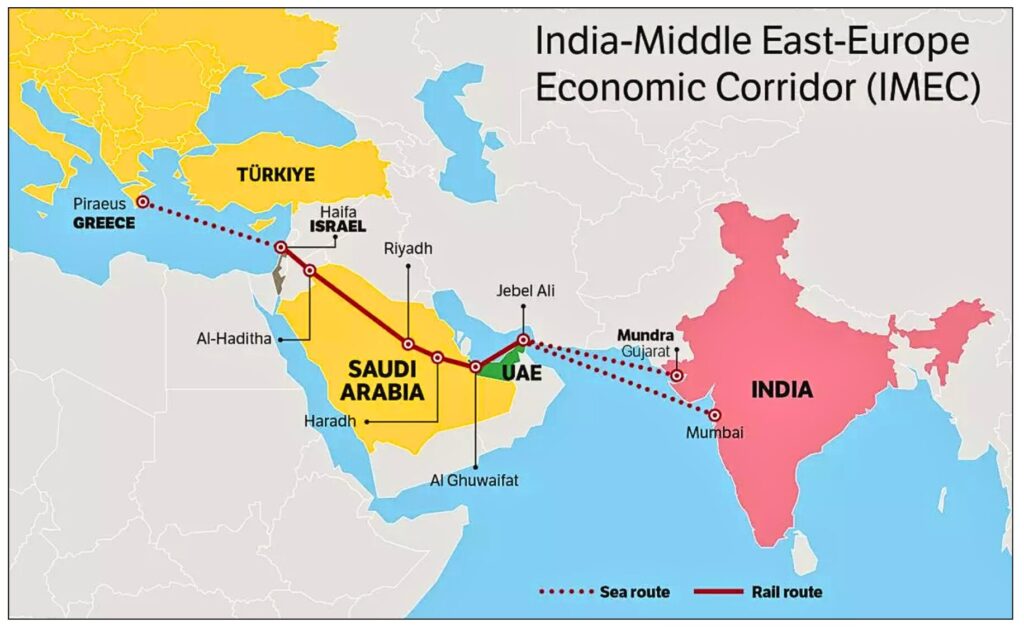
  • Eastern Leg (Sea): India connected to the UAE via sea routes, entering through ports such as Mundra and JNPT on the Indian side and Jebel Ali or Fujairah on the UAE side.
  • Central Leg (Overland): An overland multimodal corridor crossing the UAE → Saudi Arabia → Jordan → Israel, terminating at the port of Haifa on Israel’s Mediterranean coast.
  • Western Leg (Sea): From Haifa across the Mediterranean to European ports, feeding into the EU’s existing transportation network. 

Beyond a Transport Corridor

  • Unlike conventional trade routes, IMEC was conceived as a holistic infrastructure ecosystem integrating: railways, sea routes, road networks, green hydrogen pipelines, undersea high-speed data cables, electricity transmission grids, and gas pipelines. 
  • The corridor aims to reduce the transit time for cargo from Mumbai to Piraeus (Greece) by approximately 3 days compared with the Suez Canal route. 

Political Prerequisites:

  • IMEC’s original alignment (specifically the Israel segment through the central corridor) was premised on the Abraham Accords framework, which normalised Israel’s relations with the UAE and Bahrain in 2020 and anticipated eventual Saudi-Israeli normalisation. 
  • The corridor was, in effect, an economic incentive structure designed to accelerate Saudi-Israeli normalisation as a geopolitical goal of the United States.

Significance of IMEC for India:

  • Alternative to Suez Canal dependence: India’s trade heavily depends on the Suez Canal-Bab-el-Mandab corridor, which is controlled by geopolitically volatile chokepoints. IMEC would reduce India’s exposure to disruptions at these choke points and potentially cut transit times from Mumbai to European ports by approximately three days, reducing shipping costs.
  • Act West Policy: IMEC aligns with India’s “Act West” policy aimed at deepening economic and strategic integration with West Asia and Europe. The corridor positions India as a connectivity hub rather than a peripheral player, consistent with its aspirations for permanent UNSC membership and leadership of the Global South.
  • Energy diversification: The electricity grid interconnection and green hydrogen pipeline components of IMEC directly advance India’s renewable energy transition. The corridor provides a potential framework for importing green hydrogen from the Gulf and exporting it to Europe, connecting India to the emerging global clean energy trade system.
  • Trade diversification: Faster, cheaper access to European markets benefits India’s manufacturing sector, particularly in pharmaceuticals, textiles, engineering goods, and electronics. IMEC could serve as the physical infrastructure backbone of India-EU trade growth, especially as the India-EU Free Trade Agreement negotiations gain momentum in 2025-26.
  • India as a trusted diplomatic broker: India’s unique position, maintaining close relations with both Saudi Arabia and the UAE, as well as with both the US and Iran historically, gives it the diplomatic leverage to act as a bridge between diverging regional partners. This is a distinctive and time-sensitive opportunity that India must exercise proactively.
  • Counter-BRI strategic value: IMEC offers India, the US, and Europe a credible, values-aligned alternative to China’s BRI, which has drawn 140+ countries into debt-funded infrastructure dependence on Beijing. As BRI’s structural problems become more visible, IMEC’s model of non-predatory connectivity gains strategic salience.

Challenges to IMEC: 

  • Geopolitical instability: IMEC’s central corridor passes through one of the most conflict-prone regions in the world. The Gaza war froze Israeli normalisation; the Iran conflict has now struck the UAE’s ports and created Saudi-UAE divergence. Neither the Haifa hub nor the UAE entry ports can currently function as stable multimodal nodes. The corridor needs a “wartime redesign” to remain viable.
  • No dedicated financing mechanism: As of mid-2026, neither a dedicated corpus nor a multilateral financing institution has been finalised for IMEC. Unlike the BRI (which has the China Development Bank and Silk Road Fund behind it), IMEC relies on decentralised commitments from partner governments and private investors who have yet to formalise investment frameworks. This leaves the corridor vulnerable to delays and competing priorities.
  • Regulatory harmonisation: Seamless trade across IMEC requires convergence of customs procedures, safety standards, phytosanitary regulations, port logistics technology, data exchange protocols, and taxation regimes across India, the UAE, Saudi Arabia, Jordan, Israel, and EU member states. Without harmonisation, the corridor risks becoming a collection of disconnected nodes rather than an integrated system.
  • China and Turkey as structural adversaries: China views IMEC as a direct strategic challenge to BRI, particularly in the Gulf and Mediterranean. Turkey (excluded from IMEC) objects to being bypassed as a natural Eurasian transit corridor and has leverage through its control of the Turkish Straits, NATO membership, and influence in the Caucasus and Central Asia.
  • India’s own track record: India’s previous transnational connectivity projects, the International North-South Trade Corridor (INSTC, involving India, Iran, and Russia) and the Asia-Africa Growth Corridor (with Japan), have not advanced from paper to operational status due to financial, political, and diplomatic reasons. This pattern, if repeated with IMEC, would damage India’s credibility as a connectivity leader.

Way Forward: 

  • Develop Oman as the eastern entry point: Oman’s main export terminals (Salalah, Duqm, Muscat, and Sohar) lie well outside the Hormuz zone and are perceived as geopolitically neutral, as Iran views Oman as a non-hostile state. Routing IMEC’s eastern leg through Oman instead of (or in addition to) Jebel Ali and Fujairah (the UAE) would substantially reduce the corridor’s exposure to any future Hormuz closure.
  • Develop a western Egypt spur as a contingency for Haifa: Until Israel’s port of Haifa becomes a secure and politically acceptable transit hub, a western spur through Egypt, connecting overland to one of Egypt’s Mediterranean ports, offers a viable alternative. Egypt possesses the Suez Canal Economic Zone, six operational ports, and four industrial zones (in green hydrogen, LNG, shipbuilding, and future-facing sectors).
  • India as a diplomatic broker: India must leverage its unique position, trusted by Saudi Arabia, UAE, Egypt, and Iran, to prevent IMEC partner fragmentation. India should convene back-channel dialogues between Saudi Arabia and the UAE. 
  • Establish a formal IMEC coordinating and financing structure: A dedicated corpus, potentially modelled on the World Bank’s Multilateral Investment Guarantee Agency (MIGA) or the US Development Finance Corporation (DFC), would reduce private sector risk perception and attract the institutional capital needed for corridor infrastructure.
  • Broaden stakeholder inclusion: Including Turkey, Oman, and Egypt formally within the IMEC framework, moving them from bystanders to participants, would reduce regional opposition, increase route flexibility, and distribute political risk more evenly.  

The IMEC represents one of the most ambitious connectivity projects of the 21st century, with the potential to reshape trade flows between Asia, the Middle East, and Europe. If successfully implemented, IMEC could emerge as a cornerstone of resilient supply chains, energy security, and India’s rise as a leading connectivity power.
Remittances Anchor the Rupee and India’s External Balances

Open article →Download PDF

Why in News?

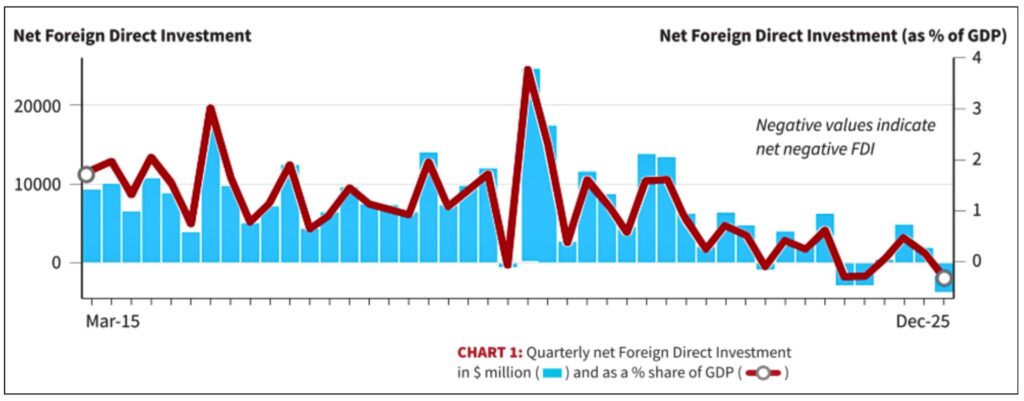
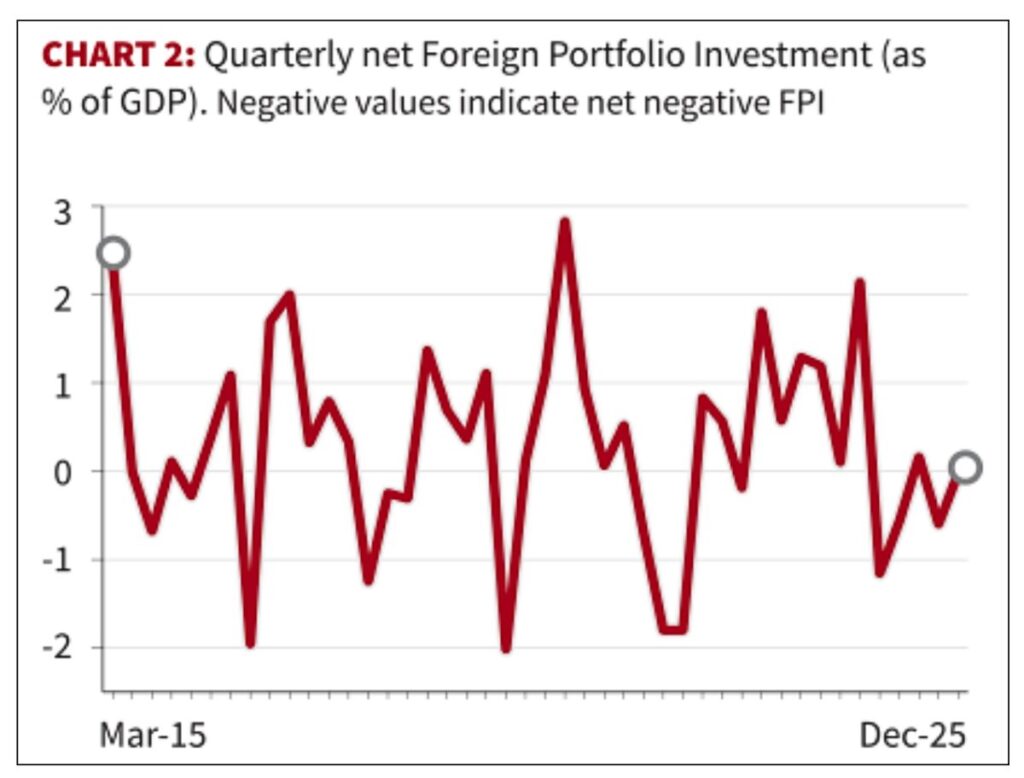
The Indian rupee has depreciated significantly against the U.S. dollar since 2025, amid declining net Foreign Direct Investment (FDI) and Foreign Portfolio Investment (FPI) inflows. Simultaneously, remittances have played a crucial role in financing India’s external deficit and supporting the rupee.

UPSC Relevance: GS-3 Economy: Balance of Payments, External Sector 

Prelims: Current Account Deficit (CAD), Balance of Payments (BoP), FDI, FPI, Remittances, Net Primary Income (NPI), Net Secondary Income (NSI) 

India’s Balance of Payments (BoP):

The Balance of Payments (BoP) is a comprehensive record of all economic transactions between the residents of a country and the rest of the world in a given period of time.    

Structure of India’s Balance of Payments (BoP)
Current AccountCapital Account
Exports/Imports 
Net Primary Income (interest, dividends, profits, compensation)
Net Secondary Income (remittances, gifts, grants)
Foreign Direct Investment (FDI)
Foreign Portfolio Investment (FPI)
External Commercial Borrowings (ECBs)
Non-Resident Indian (NRI) deposits
Foreign aid, loans and other capital flows

India typically experiences a Current Account Deficit (CAD) because its imports of goods and services consistently exceed its exports. This consistent shortfall is primarily driven by a heavy reliance on importing essential commodities like crude oil, natural gas, gold, and electronics.

If the capital account surplus does not cover the current account deficit, it can lead to a negative Balance of Payments (BoP), resulting in a depletion of forex reserves. 

In FY 2025, India maintained its position as the world’s largest recipient of remittances with inflows reaching USD 135.4 billion.  These massive remittance inflows, combined with record services exports, helped to stabilise the current account, despite the merchandise trade deficit. 

What are Remittances?

  • Remittances are cross-border transfers of money or goods sent by foreign workers to individuals in their home countries. 
  • Remittance forms a part of the transfer payment category in the Current Account of the Balance of Payments (BoP).
    • Transfer payments are the receipts which the residents of the country get for free, without having to provide any goods and services in return.

Importance of Remittances for an Economy: 

Remittances are the silent stabiliser of India’s Balance of Payments and the rupee.

  • Reduces Current Account Deficit (CAD): Remittances generate a large surplus under Net Secondary Income, and help offset India’s persistent trade deficit. Along with services exports, they significantly reduce the Current Account Deficit, thereby lowering dependence on volatile foreign capital inflows.
  • Provides Stable Foreign Exchange Inflows: Remittances are a major source of foreign exchange earnings. Unlike portfolio investments, they are driven by family and household needs and therefore remain relatively stable even during periods of global economic uncertainty.
  • More Reliable than Capital Flows: Remittance inflows are generally less volatile than FDI and especially FPI flows. They are often counter-cyclical, increasing during economic hardships, natural disasters, or crises when households require additional support.
  • Supports Balance of Payments Stability: By bringing in foreign exchange without creating repayment obligations, remittances help finance imports, reduce external sector vulnerabilities, and strengthen the Balance of Payments position.
  • Supports Exchange Rate Stability: By increasing the supply of foreign currency in the domestic market, remittances help moderate depreciation pressures on the national currency and contribute to exchange rate stability.
  • Non-debt-creating source of External Finance: Unlike external borrowings, remittances do not create future repayment obligations, interest liabilities, or profit repatriation requirements, making them one of the most sustainable sources of foreign exchange.
  • Boosts Domestic Consumption and Demand: Remittances increase household spending on food, housing, healthcare, education, and consumer goods, thereby stimulating domestic demand and supporting economic growth.

Policy Measures to Sustain Remittance Flows:

  • Enhance Engagement with the Indian Diaspora: Strengthen overseas welfare mechanisms. Expand diaspora investment channels & promote Skilled Migration. Higher-skilled migrants generally send larger remittances.
  • Reduce transaction costs by encouraging Digital payment platforms, UPI-linked cross-border transfers and Fintech innovations, which can improve remittance efficiency.
  • Deepen NRI Investment Instrument: NRI deposits, Diaspora bonds, and Infrastructure investment vehicles can channel overseas savings into productive sectors.

UPSC PYQ 2019: 

Q. In the context of India, which of the following factors is/are contributor/contributors to reducing the risk of a currency crisis?

1. The foreign currency earnings of India’s IT sector

2. Increasing the government expenditure

3. Remittances from Indians abroad

Select the correct answer using the code given below:

(a) 1 only

(b) 1 and 3 only

(c) 2 only

(d) 1, 2 and 3

Answer: (b) 

Myanmar not to allow use of its territory by anti-India elements: President Min Aung Hlaing

Open article →Download PDF

Why in News?

Myanmar President Min Aung Hlaing, during his visit to India, assured Prime Minister Narendra Modi that Myanmar would not allow its territory to be used by anti-India insurgent groups. The discussions also covered border security, connectivity projects, defence cooperation, critical minerals, cybercrime networks, and the ongoing political crisis in Myanmar following the 2021 military coup.

UPSC Relevance

Prelims:
India-Myanmar border, Kaladan Multimodal Transit Transport Project, India-Myanmar-Thailand Trilateral Highway, Act East Policy, BIMSTEC, insurgency in Northeast India.

Mains:
GS-II: India and its Neighbourhood Relations, International Relations,
GS-III: Internal Security, Border Management, Infrastructure Connectivity, Security Challenges and Cross-Border Terrorism.

Background

India and Myanmar share a long land boundary of approximately 1,643 km, connecting India’s northeastern states with Southeast Asia. Myanmar occupies a pivotal position in India’s Act East Policy, serving as the geographical bridge between South Asia and ASEAN.

However, since the military coup of February 2021 that overthrew the elected government led by Aung San Suu Kyi, Myanmar has witnessed prolonged civil conflict involving the military junta and various ethnic armed organisations and pro-democracy groups.

Despite international criticism of the military regime, India has maintained engagement with Myanmar, driven by strategic, security, and economic considerations.

Why Myanmar Matters for India

Strategic Gateway to Southeast Asia

Myanmar is India’s only ASEAN neighbour connected through both land and maritime routes.

Its location makes it indispensable for:

  • Enhancing connectivity between Northeast India and Southeast Asia.
  • Expanding trade under the Act East Policy.
  • Strengthening India’s presence in the Bay of Bengal region.

Security Concerns Along the Border

Several insurgent groups operating in India’s Northeast have historically maintained camps and logistical networks inside Myanmar’s border regions.

India’s primary concerns include:

  • Safe havens for insurgent groups.
  • Illegal movement of arms and narcotics.
  • Human trafficking and cross-border crime.
  • Cybercrime syndicates operating from Myanmar’s border areas.

The assurance from Myanmar that its territory will not be used against India’s security interests directly addresses these longstanding concerns.

The Security Dimension of India-Myanmar Relations

Counter-Insurgency Cooperation

India and Myanmar have increasingly coordinated military operations against insurgent groups operating along the border.

Myanmar’s commitment assumes significance because:

  • Stability in Northeast India depends partly on cooperation from Myanmar.
  • Insurgent groups often exploit difficult terrain and porous borders.
  • Joint intelligence sharing helps disrupt militant networks.

Border Management

The India-Myanmar border passes through:

  • Arunachal Pradesh, Nagaland, Manipur, Mizoram

The region faces challenges from illegal migration, smuggling, insurgency, and narcotics trafficking.

Enhanced border coordination is therefore critical for both countries.

Connectivity Projects: Strategic but Delayed

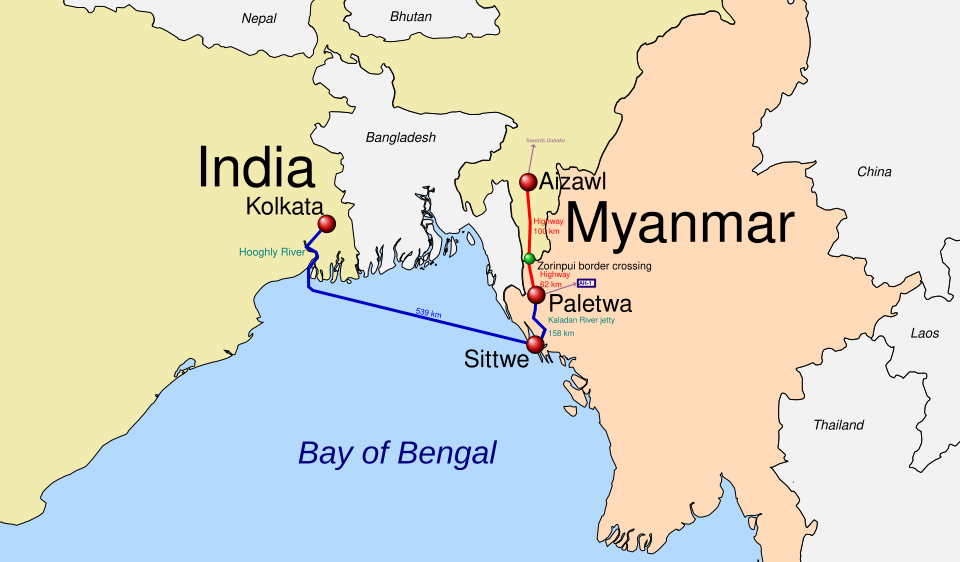
Kaladan Multimodal Transit Transport Project

The project seeks to connect India’s eastern coast with Myanmar through a combination of sea, river, and road transport.

Its importance lies in:

  • Providing alternative access to Northeast India.
  • Reducing dependence on the Siliguri Corridor.
  • Improving regional trade and connectivity.

However, active conflict in Myanmar’s Rakhine State has delayed implementation.

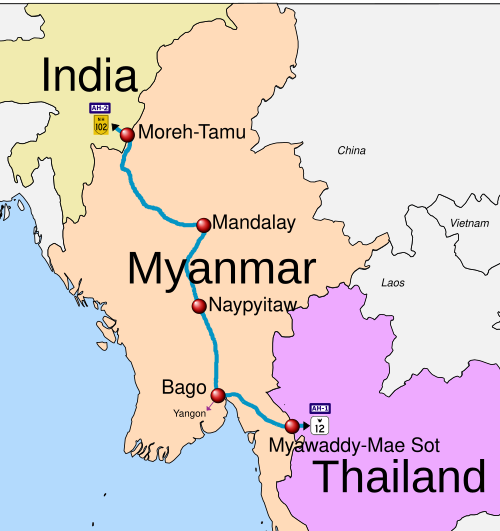
India-Myanmar-Thailand Trilateral Highway

This ambitious project aims to connect:

Moreh → Myanmar → Mae Sot

The highway is expected to:

  • Facilitate regional trade.
  • Improve supply chains.
  • Integrate India’s Northeast with ASEAN economies.

Yet security challenges inside Myanmar remain a major obstacle.

Defence Cooperation Between India and Myanmar

India’s defence engagement with Myanmar primarily focuses on:

  • Training military personnel.
  • Capacity building.
  • Institutional development.
  • United Nations peacekeeping training.

Unlike some major powers, India’s military cooperation has largely emphasized professional training and confidence-building rather than direct military intervention.

This approach aligns with India’s broader neighbourhood policy of maintaining engagement while encouraging stability.

Critical Minerals and Strategic Competition

Myanmar possesses substantial reserves of:

  • Rare earth elements.
  • Critical minerals essential for electronics.
  • Strategic minerals required for clean energy technologies.

Many of these resources are located in Kachin State, which borders both India and China.

For India, access to diversified critical mineral supply chains is increasingly important because these minerals are essential for:

  • Electric vehicles.
  • Renewable energy infrastructure.
  • Semiconductor manufacturing.
  • Defence production.

The issue has acquired added significance amid growing global competition over critical mineral resources.

The Challenge of Cyber Scam Networks

Southeastern Myanmar has emerged as a hub for large-scale cyber fraud operations.

These scam centres have been linked to:

  • Human trafficking, Online financial fraud, Forced labour, Digital extortion networks.

India has already repatriated more than 2,400 citizens trapped in such compounds and continues efforts to rescue others.

The issue demonstrates how traditional security concerns are increasingly intertwined with emerging cyber threats.

India’s Delicate Balancing Act

Engagement Without Endorsement

India faces a diplomatic dilemma in Myanmar.

On one hand:

  • Security cooperation is necessary.
  • Connectivity projects require engagement.
  • Strategic competition with China demands continued presence.

On the other hand:

  • India supports democratic values.
  • It has expressed concerns regarding the continued detention of Aung San Suu Kyi.
  • It advocates dialogue among all stakeholders for restoring peace and democratic governance.

India’s approach can therefore be described as pragmatic engagement rather than political endorsement.

Contrast with Western Approaches

Many Western countries have imposed sanctions and reduced engagement with Myanmar’s military government.

India has instead chosen:

  • Continuous dialogue.
  • Development cooperation.
  • Security coordination.
  • Humanitarian engagement.

This reflects India’s belief that disengagement would reduce its influence while creating opportunities for rival powers.

Challenges in India-Myanmar Relations

Security Instability

The ongoing civil war continues to affect infrastructure projects, border management, and economic cooperation.

Chinese Influence

China remains Myanmar’s largest strategic partner and investor, limiting India’s room for manoeuvre.

Refugee and Migration Issues

Instability in Myanmar has generated refugee flows into India’s northeastern states, particularly Manipur and Mizoram.

Delayed Connectivity Projects

Repeated delays reduce the economic benefits expected from India’s Act East Policy.

Way Forward

Strengthen Border Security Cooperation

India and Myanmar should institutionalise intelligence-sharing mechanisms and enhance coordinated action against insurgent and criminal networks.

Accelerate Connectivity Projects

Special security arrangements may be required to ensure completion of critical infrastructure projects despite ongoing conflict.

Expand Economic Engagement

Greater investments in trade, energy, healthcare, and digital infrastructure can strengthen mutual dependence and stability.

Promote Inclusive Political Dialogue

India should continue supporting peaceful dialogue among all stakeholders in Myanmar to facilitate a durable political settlement.

Enhance Cybersecurity Cooperation

Joint mechanisms to tackle cyber scam networks and human trafficking syndicates must become a priority area of bilateral cooperation.

Conclusion

The visit of President Min Aung Hlaing underscores the strategic importance of Myanmar in India’s neighbourhood and Indo-Pacific policies. While political instability continues to pose serious challenges, India has chosen a pragmatic path that combines security cooperation, infrastructure development, economic engagement, and support for dialogue. As regional geopolitics becomes increasingly competitive, the future of India-Myanmar relations will play a significant role in shaping connectivity, security, and stability across South and Southeast Asia.

Practice Questions

Prelims Question 1 (Inference-Based)

Consider the following statements:

  1. Successful implementation of the Kaladan Multimodal Transit Transport Project would reduce India’s dependence on the Siliguri Corridor for connectivity with the Northeast.
  2. Political instability in Myanmar can directly affect the effectiveness of India’s Act East Policy.

Which of the following can be correctly inferred from the statements above?

(a) Myanmar’s internal developments have limited relevance to India’s strategic interests.
(b) Connectivity projects with Myanmar are important for India’s regional integration objectives.
(c) India’s Act East Policy depends entirely on maritime routes.
(d) The Siliguri Corridor will become irrelevant after completion of the Kaladan Project.

Answer: (b)

Explanation: The two statements indicate that Myanmar is central to India’s connectivity and regional integration plans. Political instability and project delays directly affect India’s strategic objectives under the Act East Policy.

Prelims Question 2

Consider the following statements regarding India-Myanmar relations:

  1. Myanmar is India’s only ASEAN neighbour sharing a land boundary with India.
  2. The Kaladan Multimodal Transit Transport Project involves sea, river, and road connectivity.
  3. The India-Myanmar-Thailand Trilateral Highway is intended to connect Northeast India with Southeast Asia.

Which of the statements given above are correct?

(a) 1 and 2 only
(b) 2 and 3 only
(c) 1 and 3 only
(d) 1, 2 and 3

Answer: (d)

Explanation: All three statements are correct. Myanmar is India’s only ASEAN neighbour connected by land, the Kaladan Project uses multiple transport modes, and the Trilateral Highway is designed to link Northeast India with Southeast Asia.

Mains Questions

  1. Discuss the strategic significance of Myanmar in India’s Act East Policy and internal security framework. Examine the challenges posed by Myanmar’s political instability.
  2. India’s engagement with Myanmar reflects a balance between strategic interests and democratic values. Critically analyse.

Delhi High Court recognises the Right to be Forgotten

Open article →Download PDF

Why in News?

The Delhi High Court, in a landmark judgment, recognised the “Right to be Forgotten” (RTBF) as an integral part of the fundamental right to privacy under Article 21 of the Constitution. 

The Court directed search engines and legal databases such as Google and Indian Kanoon to de-index certain judicial records from name-based searches, thereby protecting individuals from disproportionate reputational harm arising from permanent digital accessibility of past legal proceedings. 

UPSC Relevance: GS-2 Polity and Governance: Fundamental Rights, Digital Governance

Prelims & Mains: Right to be Forgotten: Significance & Framework 

What is the Right to be Forgotten (RTBF)?

  • The Right to be Forgotten refers to an individual’s right to seek the removal, restriction, or reduced accessibility of personal information available online when such information:
    • Has become irrelevant or outdated.
    • No longer serves a legitimate public interest.
    • Causes disproportionate harm to an individual’s dignity, reputation, or privacy.
  • It is based on the principle of informational self-determination, allowing individuals greater control over their personal data in the digital age.

Constitutional Basis of RTBF in India: 

The Delhi High Court held that:

  • RTBF flows from the Right to Privacy under Article 21.
  • The absence of specific legislation does not prevent constitutional courts from protecting this right.
  • Privacy protections must evolve to address the permanence of digital records and internet searchability.

Judicial Evolution: 

  • Justice K.S. Puttaswamy v. Union of India (2017): The Supreme Court declared privacy a fundamental right under Article 21. Recognised informational privacy as an essential component of human dignity.
  • Delhi High Court Judgment (2026): The Court explicitly recognised RTBF and established an operational framework for its enforcement in India.

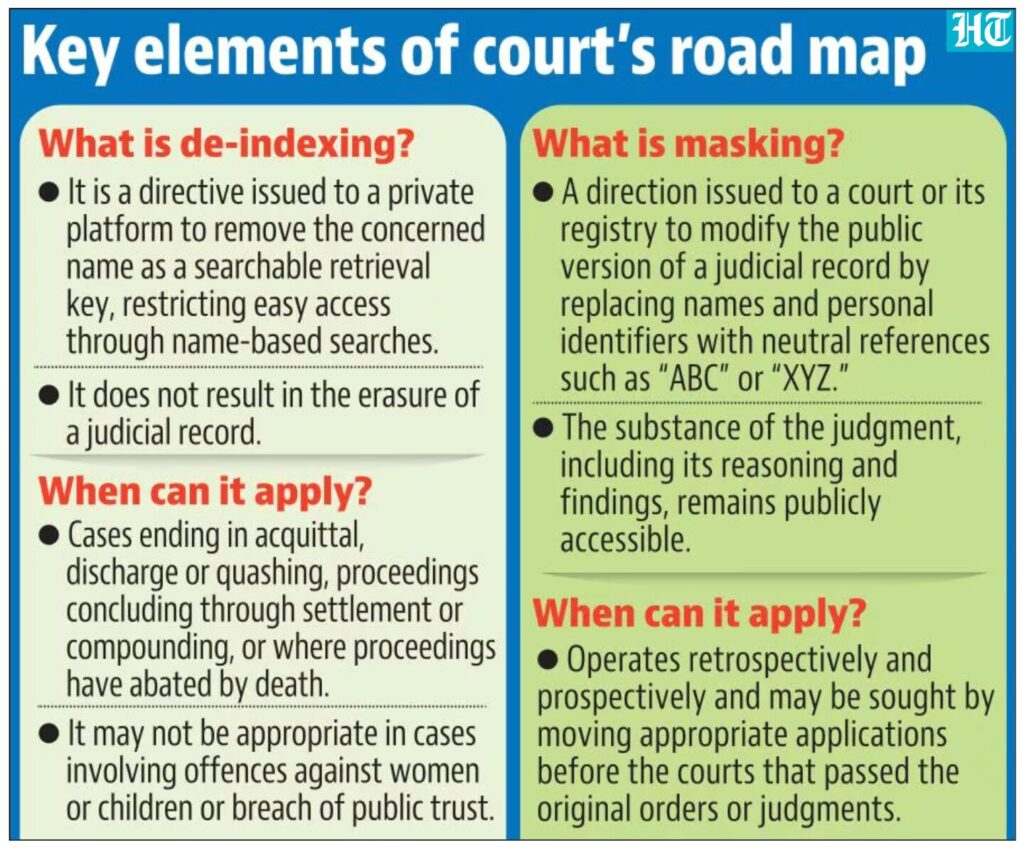
What is De-indexing?

  • De-indexing means removing a person’s name as a searchable keyword from search engines or legal databases.
  • De-indexing does not delete or erase judicial records. The judgment, order, or legal document remains available through case number, citation, Court details, and date of judgment. Only name-based searches cease to retrieve the record.

Example: If an acquitted person’s name is searched on Google, the old criminal case should no longer automatically appear in search results. However, legal researchers can still access the judgment through citations or case references.

Masking: Under masking, names may be replaced with identifiers such as “ABC”, “XYZ”, etc.

Why did the Court recognise RTBF?

  • The petitioners argued that the continued online accessibility of judicial records:
    • Damaged their reputation.
    • Reduced employment opportunities.
    • Affected marriage prospects.
    • Caused social stigma despite legal exoneration.
  • The Court agreed that permanent digital searchability can create a disconnect between legal outcomes and public perception.

Categories of Individuals who sought Relief:

The petitions included:

  • Persons acquitted in criminal cases.
  • Individuals whose proceedings had been quashed.
  • Parties involved in matrimonial disputes.
  • Persons involved in settled civil disputes.
  • Individuals whose names appeared incidentally in judicial records.

Framework laid down by the Delhi High Court: 

The Court directed that while considering RTBF claims, authorities should assess:

1. Nature of Information: Whether the information is personal or public in character.

2. Outcome of Proceedings: Acquittal, Discharge, Quashing of proceedings, Settlement or compounding.

3. Public Role of the Individual: Whether the person is a public official, elected representative, or public figure.

4. Continuing Relevance: Whether the information still serves a legitimate public interest.

5. Proportionality Test: Whether privacy harm outweighs public interest in accessibility.

Cases where De-indexing may be Appropriate: 

  • Criminal Cases Ending in: Acquittal, Discharge, Quashing of proceedings. The Court observed that continued searchability undermines the presumption of innocence.
  • Settled or Compounded Cases: Where parties have amicably resolved disputes.
  • Civil and Matrimonial Matters: The Court held that family disputes and personal relationships are protected by privacy rights and often have little continuing public relevance.
  • Demonstrably False Information: The Court stated that false information has no claim to protection under public interest principles.

Cases where De-indexing may not be Appropriate: 

The Court suggested caution in granting relief in cases involving:

  • Convictions for offences against women.
  • Convictions involving children.
  • Corruption and abuse of public office.
  • Breach of public trust by public servants.
  • Cases involving elected representatives and fiduciary responsibilities.

These cases involve strong public interest considerations.

Regarding the framework governing masking, the court clarified that such relief would be limited to concealing names and personal identifiers, while the substance of the judgment, including its reasoning, findings, legal conclusions and court details, would remain publicly accessible to preserve its institutional and precedential value.

The bench further held that masking directions would operate both retrospectively and prospectively, covering existing digital records as well as future uploads. 

Significance of the Judgment: 

  • Strengthens Privacy Rights: Expands the practical scope of the Right to Privacy in the digital era.
  • Balances Open Justice and Privacy: The judgment seeks to reconcile: Judicial transparency, Public access to records, Individual dignity and rehabilitation.
  • Addresses Digital Permanence: Recognises that internet search engines can perpetuate reputational harm long after legal disputes have ended.
  • Provides Judicial Framework: Offers India’s first detailed judicial roadmap for RTBF implementation.

Challenges and Concerns: 

  • Transparency Concerns: Critics argue that de-indexing could limit public access to judicial information.
  • Absence of Statutory Framework: India still lacks a dedicated Right to be Forgotten (RTBF) law.
  • Potential for Abuse: Public figures may seek privacy protections to suppress information that remains relevant to public accountability.
  • Compliance Challenges: Implementation requires coordination among Search engines, Legal databases, Courts, and data intermediaries.

Data Protection Law and RTBF

  • The Digital Personal Data Protection Act 2023 provides rights relating to correction and erasure of personal data, but does not explicitly establish a comprehensive Right to be Forgotten.
  • The Delhi High Court judgment, therefore, fills an important jurisprudential gap until Parliament enacts a detailed legal framework.

The Delhi High Court’s 2026 judgment marks a significant milestone in India’s evolving privacy jurisprudence. By recognising the Right to be Forgotten as a facet of Article 21 and establishing a framework for de-indexing judicial records, the Court has sought to protect individuals from perpetual digital stigma while preserving the principles of open justice.  

India, Australia discuss maritime security, defence cooperation

Open article →Download PDF

Why in News?

India and Australia held the second India–Australia Defence Ministers’ Dialogue in New Delhi on June 1, 2026. Defence Minister Rajnath Singh and Australian Deputy Prime Minister and Defence Minister Richard Marles reviewed bilateral defence ties and reaffirmed their commitment to strengthening maritime security, defence industry cooperation, interoperability, and emerging technology collaboration across the Indo-Pacific.

UPSC Relevance

Prelims:
Quad, UNCLOS, Indo-Pacific, maritime security initiatives, defence exercises, military logistics agreements.

Mains:
GS-II: India and its bilateral relations, international groupings,
GS-III: Internal security, defence technology, maritime security, strategic affairs.

Background

India and Australia have transformed their relationship from a primarily economic partnership into a comprehensive strategic partnership over the last decade. Shared concerns regarding maritime security, freedom of navigation, resilient supply chains, and regional stability have brought the two countries closer.

The relationship gained momentum through:

  • Comprehensive Strategic Partnership (2020)
  • Mutual Logistics Support Arrangement (MLSA)
  • Growing cooperation within the Quad framework
  • Regular bilateral and multilateral military exercises
  • Expanding defence industrial engagement

The latest Defence Ministers’ Dialogue reflects the increasing strategic convergence between the two countries in the Indo-Pacific region.

Evolution of India–Australia Defence Relations

From Strategic Dialogue to Operational Cooperation

India and Australia have gradually expanded defence engagement from policy consultations to practical military cooperation. The relationship now includes:

  • Joint military exercises across all three services.
  • Intelligence and information-sharing mechanisms.
  • Logistics cooperation.
  • Maritime surveillance collaboration.
  • Defence technology engagement.

The two countries increasingly view each other as important security partners in maintaining stability across the Indian Ocean and Pacific regions.

Shared Strategic Outlook

Both nations support:

  • A free, open, inclusive and rules-based Indo-Pacific.
  • Respect for international law.
  • Freedom of navigation and overflight.
  • Peaceful resolution of disputes.
  • Opposition to unilateral attempts to alter the status quo.

These principles align closely with India’s Indo-Pacific Oceans Initiative (IPOI) and Australia’s Indo-Pacific Strategy.

Maritime Security: The Core Pillar of Cooperation

Growing Importance of the Maritime Domain

The Indian Ocean Region has become central to global trade, energy transportation, and strategic competition. A significant portion of global commerce passes through critical sea lanes in the region.

Both countries recognise that maritime security is no longer limited to naval operations but now includes:

  • Maritime domain awareness.
  • Undersea infrastructure protection.
  • Submarine monitoring.
  • Cybersecurity of maritime assets.
  • Protection of critical sea lanes.

Joint Maritime Security Collaboration Roadmap

A major outcome of the dialogue was progress towards finalising a Joint Maritime Security Collaboration Roadmap.

The proposed framework seeks to enhance cooperation in:

  • Maritime surveillance.
  • Information sharing.
  • Undersea monitoring.
  • Coast Guard coordination.
  • Operational interoperability.

This roadmap is expected to become a cornerstone of future India–Australia security cooperation.

Underwater Security and Emerging Challenges

An important focus area discussed during the meeting was underwater security.

Growing concerns include:

  • Vulnerability of submarine communication cables.
  • Increased submarine activities.
  • Grey-zone operations in maritime spaces.
  • Protection of offshore energy infrastructure.

India and Australia are exploring advanced technologies and sensor systems to improve underwater situational awareness and maritime domain awareness.

Defence Industrial Cooperation

Expanding Defence Manufacturing Partnership

A significant development was the decision to work towards a Memorandum of Understanding on the Provision of Defence Articles and Defence Services.

The proposed arrangement could facilitate:

  • Defence exports and imports.
  • Joint development projects.
  • Technology sharing.
  • Defence supply chain integration.
  • Industrial partnerships.

This aligns with India’s objective of becoming a major defence manufacturing hub under the “Atmanirbhar Bharat” initiative.

Emerging Technologies Cooperation

The dialogue also highlighted collaboration in future-oriented technologies such as:

  • Advanced sensor systems.
  • Maritime surveillance technologies.
  • Artificial Intelligence applications.
  • Defence innovation.
  • Research and development partnerships.

Australia also invited India to participate in the 2026 Australian Defence Science, Technology and Research Summit.

Military-to-Military Cooperation

Joint Exercises

The two countries welcomed growing participation in major military exercises, including:

ExerciseNature
MilanNaval Exercise
KakaduMaritime Exercise
Talisman SabreJoint Military Exercise
Pitch BlackAir Force Exercise
AustrahindArmy Exercise

These exercises improve interoperability and operational familiarity between the armed forces.

Logistics Cooperation

The Mutual Logistics Support Arrangement enables:

  • Access to military bases.
  • Refuelling and replenishment.
  • Maintenance support.
  • Greater operational reach.

The dialogue also endorsed continued aircraft deployments from each other’s territories to strengthen practical cooperation.

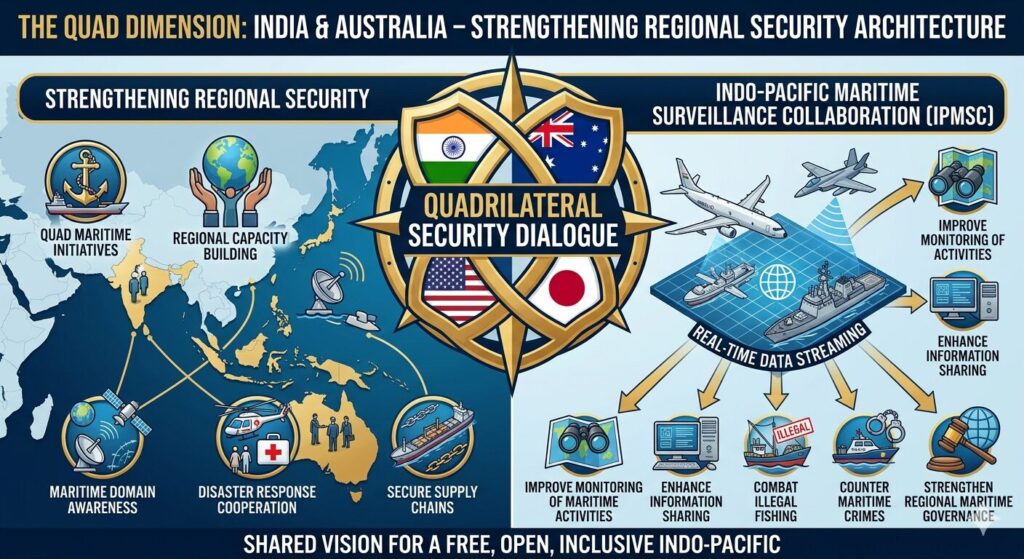
The Quad Dimension

Strengthening Regional Security Architecture

India and Australia are key members of the Quadrilateral Security Dialogue alongside the United States and Japan.

The ministers reiterated support for:

  • Quad maritime initiatives.
  • Regional capacity building.
  • Maritime domain awareness.
  • Disaster response cooperation.
  • Secure supply chains.

Indo-Pacific Maritime Surveillance Collaboration (IPMSC)

Both sides expressed support for the Quad’s Indo-Pacific Maritime Surveillance Collaboration (IPMSC) initiative.

The initiative seeks to:

  • Improve monitoring of maritime activities.
  • Enhance information sharing.
  • Combat illegal fishing.
  • Counter maritime crimes.
  • Strengthen regional maritime governance.

What is the Significance for India?

Securing the Indian Ocean Region

Australia’s strategic location and maritime capabilities complement India’s position as a major Indian Ocean power.

Enhanced cooperation can help:

  • Protect sea lanes of communication.
  • Monitor maritime threats.
  • Improve regional stability.
  • Strengthen maritime deterrence.

Defence Modernisation

Collaboration with Australia provides opportunities for: Technology acquisition, Joint research, Defence innovation, Industrial partnerships.

    Balancing Strategic Competition

    The growing partnership contributes to maintaining a stable balance of power in the Indo-Pacific while supporting a rules-based international order.

    Challenges

    Divergent Strategic Priorities

    Despite convergence, India and Australia may occasionally differ on:

    • Regional crises, China-related policies Trade and economic considerations.

    Resource Constraints

    Implementing ambitious maritime and technological initiatives requires: Sustained investments, Infrastructure development, Human resource capacity.

      Evolving Security Environment

      Rapid technological changes and emerging threats such as cyber warfare, autonomous systems, and grey-zone tactics require continuous adaptation.

      Way Forward

      Enhance Maritime Domain Awareness

      India and Australia should accelerate cooperation in surveillance systems, information-sharing networks, and undersea monitoring technologies.

      Expand Defence Industrial Collaboration

      Joint production, co-development projects, and defence innovation partnerships should be encouraged to deepen strategic interdependence.

      Institutionalise Strategic Dialogue

      Regular defence, foreign policy, and security consultations can ensure long-term alignment on regional issues.

      Strengthen Quad Cooperation

      Greater synergy between bilateral and Quad initiatives can contribute to a more secure and resilient Indo-Pacific.

      Conclusion

      India–Australia defence ties have evolved into one of the most significant strategic partnerships in the Indo-Pacific. With growing cooperation in maritime security, defence technology, industrial collaboration, and regional governance, both countries are positioning themselves as important stakeholders in shaping a stable and rules-based regional order. The latest Defence Ministers’ Dialogue demonstrates that the partnership is moving beyond symbolism towards substantive and operational cooperation.

      Practice Questions

      Prelims Question 1 (Inference-Based)

      Consider the following statements:

      1. Enhanced maritime domain awareness contributes to both national security and protection of global trade routes.
      2. Undersea infrastructure such as communication cables has emerged as a critical component of maritime security.

      Which one of the following is the most appropriate inference from the above statements?

      (a) Maritime security is no longer confined to traditional naval warfare alone.
      (b) Maritime security is relevant only for countries possessing large navies.
      (c) Maritime security concerns arise only during wartime.
      (d) Maritime surveillance has replaced naval forces in the Indo-Pacific.

      Answer: (a)

      Explanation: The statements indicate that maritime security today encompasses economic, technological, and infrastructure dimensions beyond conventional naval operations. Hence, maritime security has become a broader strategic concept.

      Prelims Question 2

      Consider the following pairs:

      ExerciseParticipating Countries
      1. AustrahindIndia and Australia
      2. Pitch BlackAustralia-led Air Force Exercise
      3. KakaduMultinational Naval Exercise hosted by Australia

      How many pairs given above are correctly matched?

      (a) Only one
      (b) Only two
      (c) All three
      (d) None

      Answer: (c)

      Explanation:

      • Pair 1: Correct. Austrahind is a bilateral Army exercise between India and Australia.
      • Pair 2: Correct. Pitch Black is a major multinational air combat exercise hosted by Australia.
      • Pair 3: Correct. Kakadu is Australia’s premier multinational maritime exercise involving several regional navies.

      Therefore, all three pairs are correctly matched.

      Mains Questions

      1. India–Australia defence cooperation has emerged as a critical pillar of Indo-Pacific security architecture. Examine its significance for India’s strategic interests.
      2. Discuss the growing importance of maritime domain awareness and undersea security in the evolving geopolitics of the Indo-Pacific region.

      Fearsome dinosaur-era marine reptile was T. rex of the sea

      Open article →Download PDF

      Why in News?

      Scientists have identified Tylosaurus rex as a distinct species of giant marine reptile after a detailed re-examination of previously discovered fossils. The newly classified species, which lived about 80 million years ago, rivalled the famous Tyrannosaurus rex in size and predatory dominance, earning the nickname “T. rex of the sea.”

      UPSC Relevance

      Prelims: Evolution, fossils, geological time scale, extinct reptiles, biodiversity and palaeontology.

      Mains:
      GS III: Science and Technology, scientific discoveries, evolution of life on Earth, importance of palaeontological research.

      Background

      The age of dinosaurs was not dominated only by giant land predators. While Tyrannosaurus rex ruled terrestrial ecosystems during the Late Cretaceous Period, the oceans were inhabited by equally formidable marine predators.

      Among them were the mosasaurs, a group of giant marine reptiles that evolved from land-dwelling lizards and became apex predators in prehistoric seas. Recent research has identified Tylosaurus rex as a separate species within this group, highlighting the diversity and complexity of marine ecosystems during the Cretaceous era.

      Understanding Tylosaurus rex

      What is Tylosaurus rex?

      Tylosaurus rex was a giant marine reptile belonging to the mosasaur family. It inhabited the vast inland sea that once divided North America into eastern and western landmasses during the Late Cretaceous Period.

      Researchers identified it as a separate species based on several distinctive features, including:

      • Extremely large body size.
      • Fine serrations along its teeth that enhanced flesh-cutting efficiency.
      • Strong jaw and neck musculature suited for capturing large prey.
      • Unique anatomical characteristics that distinguished it from other Tylosaurus species.

      Physical Characteristics

      Tylosaurus rex possessed several adaptations that made it a highly effective marine hunter. It had a streamlined body for rapid swimming, a long snout equipped with powerful teeth, four paddle-like flippers for manoeuvrability, and a muscular tail that generated strong propulsion through water.

      The species was among the largest marine predators of its time and occupied the highest level of the marine food chain.

      How Large Was It?

      Comparison with Tyrannosaurus rex

      The largest known specimen of Tyrannosaurus rex, known as “Sue,” measures approximately 12.2 metres in length.

      The largest known Tylosaurus rex specimen, nicknamed “Bunker,” measures about 13.2 metres, making it slightly longer than T. rex.

      Researchers noted that the skull of Tylosaurus rex alone was approximately 1.7 metres long, illustrating the enormous size of the animal.

      Comparison with Modern Marine Predators

      According to palaeontologists, Tylosaurus rex would have been nearly twice the length of the largest modern great white sharks.

      Its immense size, combined with powerful jaws and specialised teeth, allowed it to dominate ancient marine ecosystems.

      Mosasaurs: The Apex Predators of Ancient Oceans

      Evolutionary Origins

      Mosasaurs evolved from terrestrial lizards and gradually adapted to marine environments. Over millions of years, they developed specialised features such as flippers, streamlined bodies, and powerful tails, enabling them to thrive in oceans across the globe.

      They became dominant marine predators during the final 30 million years of the dinosaur era.

      Relationship with Modern Reptiles

      Although mosasaurs became extinct approximately 66 million years ago, their closest living relatives are believed to be monitor lizards.

      Among modern species, the Komodo dragon is considered one of the nearest evolutionary relatives of these giant marine reptiles.

      Geological Significance

      The Cretaceous Period

      The Cretaceous Period lasted from about 145 million to 66 million years ago and represented the final chapter of the age of dinosaurs.

      During this period:

      • Dinosaurs dominated terrestrial ecosystems.
      • Giant marine reptiles controlled oceanic food chains.
      • Flowering plants expanded rapidly.
      • Continents gradually moved toward their modern positions.

      The Western Interior Seaway

      Approximately 80 million years ago, a massive inland sea known as the Western Interior Seaway divided North America into two landmasses.

      This shallow sea created ideal conditions for diverse marine life, including mosasaurs such as Tylosaurus rex.

      Scientific Importance of the Discovery

      The identification of Tylosaurus rex as a separate species demonstrates the continuing value of fossil re-examination. Modern analytical techniques allow scientists to identify subtle anatomical differences that may have been overlooked in earlier studies.

      The discovery contributes to:

      • Better understanding of marine reptile evolution.
      • Reconstruction of ancient marine ecosystems.
      • Insights into predator-prey relationships during the Cretaceous Period.
      • Improved knowledge of biodiversity before the mass extinction event that ended the age of dinosaurs.

      Significance for Evolutionary Studies

      The discovery highlights how evolution can produce apex predators in different environments.

      While Tyrannosaurus rex dominated land ecosystems, Tylosaurus rex evolved independently to occupy a similar ecological role in marine habitats. This illustrates the concept of ecological convergence, where unrelated species develop similar characteristics due to comparable environmental pressures.

      Conclusion

      The recognition of Tylosaurus rex as a distinct species enriches our understanding of prehistoric marine life and the extraordinary diversity that existed during the age of dinosaurs. As one of the largest and most formidable marine predators ever discovered, it demonstrates that the oceans of the Cretaceous Period were as fiercely contested as the lands ruled by Tyrannosaurus rex. Continued fossil research is likely to reveal even more about the complex ecosystems that existed before one of Earth’s greatest mass extinction events.

      Practice Questions

      Prelims Question 1 (Inference-Based)

      Consider the following statements regarding apex predators during the Cretaceous Period:

      1. Both terrestrial and marine ecosystems supported highly specialised apex predators.
      2. The existence of Tylosaurus rex suggests that giant predators evolved only in marine environments.
      3. Similar ecological roles can evolve independently in different habitats.

      Which of the above statements can be inferred from the passage?

      (a) 1 and 3 only
      (b) 2 only
      (c) 1 only
      (d) 1, 2 and 3

      Answer: (a)

      Explanation:

      Statement 1 is correct. The passage shows that Tyrannosaurus rex dominated land ecosystems while Tylosaurus rex dominated marine ecosystems.

      Statement 2 is incorrect. Giant predators existed in both terrestrial and marine environments.

      Statement 3 is correct. The article highlights how T. rex and Tylosaurus rex independently evolved to become apex predators in different ecological settings.

      Prelims Question 2

      Consider the following statements about mosasaurs:

      1. They evolved from land-dwelling reptiles.
      2. They were among the dominant marine predators during the Late Cretaceous.
      3. They survived the mass extinction event that ended the age of dinosaurs.

      Which of the statements given above is/are correct?

      (a) 1 and 2 only
      (b) 2 and 3 only
      (c) 1 and 3 only
      (d) 1, 2 and 3

      Answer: (a)

      Explanation:

      Statement 1 is correct. Mosasaurs evolved from terrestrial lizards and adapted to marine environments.

      Statement 2 is correct. They occupied the top levels of marine food chains during the Late Cretaceous.

      Statement 3 is incorrect. Mosasaurs became extinct during the mass extinction event approximately 66 million years ago.

      Mains Questions

      1. Discuss the evolutionary significance of apex marine reptiles such as Tylosaurus rex in understanding prehistoric ecosystems and biodiversity.
      2. How does palaeontological research contribute to our understanding of evolution, extinction events, and environmental change on Earth? Examine with suitable examples.

      Why do Indian cities get polluted in summer? 

      Open article →Download PDF

      Why in News?

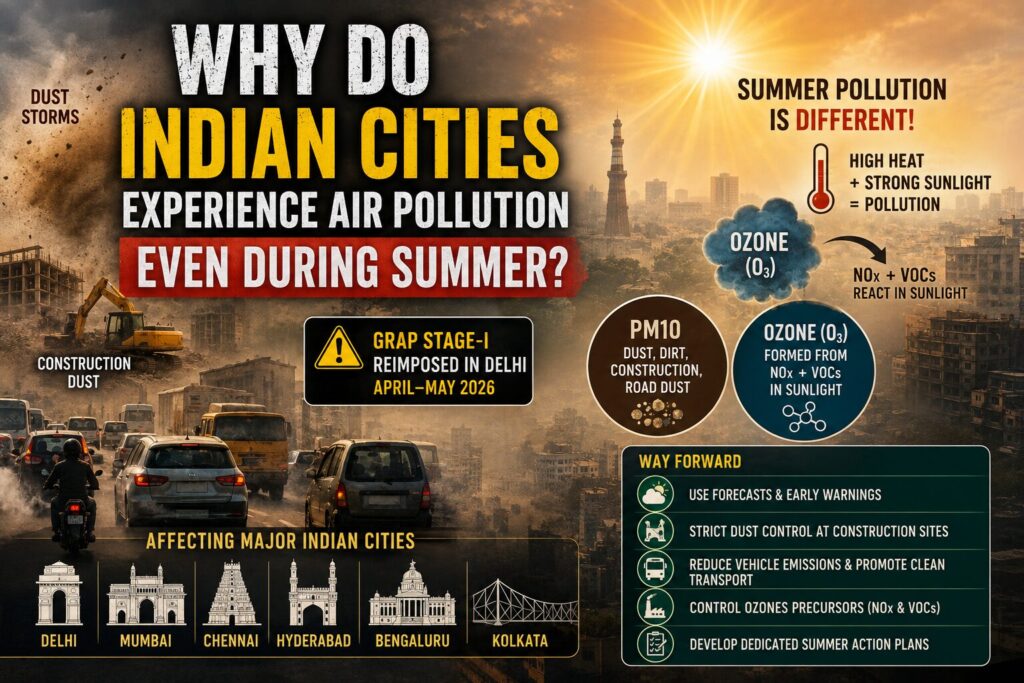
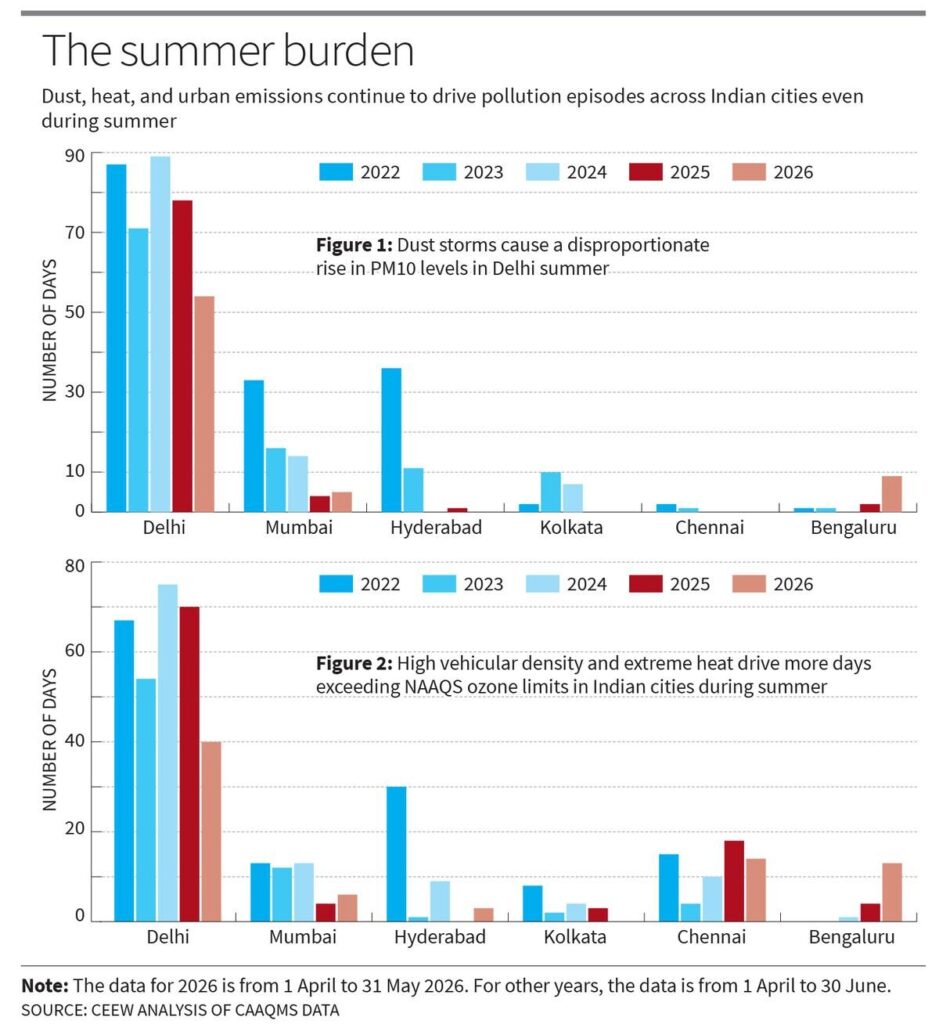
      Despite the onset of summer conditions that usually help disperse pollutants, several Indian cities, including Delhi, Mumbai, Chennai, Hyderabad, Bengaluru, and Kolkata, witnessed significant air pollution episodes during April–May 2026. The Commission for Air Quality Management (CAQM) had to reimpose Stage-I restrictions under the Graded Response Action Plan (GRAP) in Delhi due to rising particulate matter and ozone levels.

      UPSC Relevance

      Prelims:
      Air pollutants, PM2.5, PM10, ozone, dust storms, AQI, GRAP, AQEWS.

      Mains:
      GS III: Environmental Pollution and Degradation, Urban Environmental Challenges, Climate and Air Quality Management, Public Health.

      Background

      Air pollution in India is often associated with winter smog, particularly in the Indo-Gangetic Plain. During winter, low temperatures, weak winds, and temperature inversions trap pollutants close to the ground, leading to severe air quality deterioration.

      However, recent pollution episodes demonstrate that summer is not necessarily a clean-air season. Although stronger winds, higher temperatures, and occasional thunderstorms improve atmospheric mixing, other factors such as dust storms, construction activity, vehicular emissions, and ozone formation continue to degrade air quality.

      This highlights the need for year-round air pollution management rather than a seasonal focus limited to winter.

      Understanding Summer Air Pollution

      How is Summer Pollution Different from Winter Pollution?

      The dominant pollutants vary across seasons.

      Winter pollution is primarily driven by PM2.5, which consists of fine particulate matter capable of penetrating deep into the lungs and bloodstream. Crop residue burning, biomass burning for heating, vehicular emissions, and industrial pollution contribute significantly to winter smog.

      Summer pollution, in contrast, is largely dominated by PM10 and ground-level ozone. Dust storms, road dust, construction activities, and atmospheric chemistry associated with high temperatures become more influential during this period.

      Major Pollutants During Summer

      PM10 (Coarse Particulate Matter)

      PM10 consists of larger airborne particles with diameters less than 10 micrometres. These particles mainly originate from dust storms, construction sites, road dust, mining activities, and industrial operations.

      While larger than PM2.5, they can still cause respiratory illnesses, irritation of airways, and aggravate asthma and other lung diseases.

      Ground-Level Ozone

      Ground-level ozone differs from the protective ozone layer found in the stratosphere.

      It is a secondary pollutant formed when nitrogen oxides (NOx) and volatile organic compounds (VOCs) react in the presence of strong sunlight. High ozone levels can reduce lung function, worsen respiratory diseases, and damage vegetation.

      Why Does Ozone Increase During Summer?

      Role of Sunlight and Heat

      Unlike particulate matter, ozone is not emitted directly from any source.

      It forms through photochemical reactions involving:

      • Nitrogen oxides (NOx) emitted primarily from vehicles and industries.
      • Volatile Organic Compounds (VOCs) emitted from fuel combustion, industrial activities, paints, solvents, and petrochemical processes.

      Strong sunlight and high temperatures accelerate these reactions, making summer conditions ideal for ozone formation.

      Urban Heat and Traffic

      Cities with dense traffic and industrial activity often experience elevated ozone concentrations during hot summer afternoons. Even when particulate matter levels decline, ozone pollution can remain severe and pose significant public health risks.

      Why Does PM10 Rise During Summer?

      Dust Storms and Regional Winds

      During summer, intense heating of the Indian subcontinent creates low-pressure conditions over northern India.

      The interaction between these low-pressure systems and surrounding high-pressure zones generates strong winds capable of transporting dust over long distances. Dust from:

      • The Thar Desert,
      • Arid regions of western India,
      • West Asian deserts,

      can travel across northern and central India, significantly increasing PM10 levels.

      Loo and Andhi Events

      The hot, dry winds known as loo frequently affect North India during summer. These winds often carry large quantities of dust, causing sustained deterioration in air quality.

      Short-duration local dust storms known as andhi also occur, especially before thunderstorms. These storms rapidly lift dust from dry surfaces and can temporarily raise particulate concentrations to hazardous levels.

      Human Contributions

      Natural dust events are often intensified by human activities.

      Construction and demolition work typically increase after winter restrictions are relaxed. Poor dust management at construction sites allows large quantities of particulate matter to enter the atmosphere.

      Similarly, traffic moving over damaged or dusty roads continuously resuspends loose dust, contributing to elevated PM10 concentrations.

      Air Pollution Across Indian Cities

      Delhi and the Indo-Gangetic Plain

      Delhi recorded multiple PM10 exceedances during April and May 2026. Ozone concentrations also crossed prescribed national standards at several monitoring stations.

      Although winter smog remains a major concern, summer pollution episodes have become increasingly frequent.

      Mumbai

      Mumbai has witnessed recurring PM10 and ozone spikes over recent years. Rapid construction activity, vehicular congestion, and urban dust have emerged as major contributors.

      Chennai

      While PM10 exceedances are relatively less frequent, Chennai’s combination of high temperatures and dense traffic makes it particularly vulnerable to ozone pollution.

      Hyderabad, Bengaluru, and Kolkata

      These cities also experience periodic pollution spikes linked to local emission sources, construction activities, traffic density, and meteorological conditions.

      Institutional Mechanisms for Air Quality Management

      Graded Response Action Plan (GRAP)

      GRAP is a framework for implementing emergency pollution-control measures in the National Capital Region based on air quality levels.

      It prescribes escalating restrictions on activities such as construction, industrial operations, and vehicular movement depending on pollution severity.

      Air Quality Early Warning System (AQEWS)

      The AQEWS was developed following major dust storms and severe pollution episodes in North India.

      It provides:

      • Air quality forecasts,
      • Dust storm warnings,
      • Meteorological information,
      • Multi-day AQI predictions.

      The system has gradually expanded beyond Delhi to cities such as Jaipur and Mumbai.

      Role of the IMD

      The India Meteorological Department regularly issues weather forecasts and can support local authorities in issuing timely alerts regarding dust storms, heatwaves, and pollution episodes.

      Challenges in Tackling Summer Pollution

      Difficulty in Controlling Natural Dust

      Large-scale dust transport from deserts and arid regions cannot be prevented. Authorities can only forecast and prepare for such events.

      Weak Enforcement of Dust Control Measures

      Construction activities often continue without adequate dust suppression mechanisms such as water spraying, enclosure systems, and debris management.

      Rising Vehicular Emissions

      Rapid urbanisation and increasing vehicle ownership continue to contribute significantly to NOx and VOC emissions that drive ozone formation.

      Limited Focus on Ozone

      Air quality management in India has traditionally concentrated on particulate matter. Ozone monitoring, forecasting, and mitigation strategies remain relatively underdeveloped.

      Way Forward

      Strengthen Forecast-Based Action

      Authorities should fully utilise AQEWS and IMD forecasts to issue advance warnings regarding dust storms, ozone spikes, and deteriorating air quality.

      Improve Construction Dust Management

      Strict enforcement of dust-control measures at construction and demolition sites should continue throughout the year rather than only during winter.

      Reduce Vehicular Emissions

      Promotion of public transport, electric mobility, cleaner fuels, and anti-idling campaigns can significantly reduce NOx emissions.

      Address Ozone Precursors

      Targeted policies should focus on reducing VOC emissions from industries, fuel combustion, paints, solvents, and petrochemical activities.

      Develop Summer Action Plans

      Major Indian cities should formulate dedicated summer air quality action plans that address dust management, ozone control, public advisories, and emergency responses.

      Conclusion

      The perception that air pollution is primarily a winter phenomenon is increasingly outdated. While meteorological conditions during summer may help disperse some pollutants, high temperatures, intense sunlight, dust storms, and continued human emissions create a different but equally important pollution challenge. Effective air quality management in India requires a year-round approach that addresses both winter smog and summer pollution with equal urgency.

      Practice Questions

      Prelims Question 1 (Inference-Based)

      Consider the following statements:

      1. Improvements in atmospheric mixing during summer automatically ensure good air quality in Indian cities.
      2. Different meteorological conditions can alter the dominant type of air pollutant in a season.
      3. Effective air pollution management requires interventions throughout the year.

      Which of the above statements can be inferred from the passage?

      (a) 2 and 3 only
      (b) 1 and 2 only
      (c) 1 and 3 only
      (d) 1, 2 and 3

      Answer: (a)

      Explanation:

      Statement 1 is incorrect. Despite better atmospheric mixing, many cities still experienced pollution episodes due to dust storms, ozone formation, and anthropogenic emissions.

      Statement 2 is correct. Winter is dominated by PM2.5 pollution, whereas summer sees higher contributions from PM10 and ozone.

      Statement 3 is correct. The article emphasises the need for year-round air quality management instead of focusing solely on winter pollution.

      Prelims Question 2

      Consider the following regarding ground-level ozone:

      1. It is a secondary pollutant.
      2. It is formed through reactions involving nitrogen oxides and volatile organic compounds.
      3. Its formation is enhanced by strong sunlight and high temperatures.

      Which of the statements given above are correct?

      (a) 1 and 2 only
      (b) 2 and 3 only
      (c) 1 and 3 only
      (d) 1, 2 and 3

      Answer: (d)

      Explanation:

      Statement 1 is correct. Ground-level ozone is not emitted directly and is therefore a secondary pollutant.

      Statement 2 is correct. Ozone forms through photochemical reactions involving NOx and VOCs.

      Statement 3 is correct. High temperatures and strong sunlight accelerate these reactions, making ozone pollution particularly severe during summer.

      Mains Questions

      1. Why has summer air pollution emerged as a major environmental challenge in Indian cities? Examine the role of PM10 and ozone in shaping urban air quality.
      2. Discuss the meteorological and anthropogenic factors responsible for seasonal variations in air pollution in India. Suggest measures for year-round air quality management.

      Orbital Rivalry: The Challenge of China’s Space Power

      Open article →Download PDF

      Why in News?

      China’s rapid expansion of military and civilian space capabilities, including anti-satellite (ASAT) weapons, co-orbital systems, and large satellite constellations, has intensified concerns regarding the weaponisation of outer space. 

      These developments have significant implications for India’s national security, strategic autonomy, and space-based infrastructure.

      UPSC Relevance: GS-3 Science and Technology: Space Technology

      Mains: Advancement in Space technologies and National Security 

      Outer Space has become a critical domain for communication, navigation, intelligence gathering, weather forecasting, financial transactions, and military operations.

      Modern warfare increasingly depends on space-based assets for:

      • Intelligence, Surveillance and Reconnaissance (ISR)
      • Positioning, Navigation and Timing (PNT)
      • Secure military communications
      • Precision-guided weapons

      Although no war has been fought in space, the growing militarisation of outer space raises concerns about future conflicts extending beyond Earth.

      China’s Expanding Space Ambitions:

      1. Building Comprehensive Space Power: 
      • China has developed capabilities across the entire space ecosystem, including satellite manufacturing, launch vehicles, navigation systems, space stations, lunar exploration, deep-space missions and counter-space technologies. 
      • Major achievements include:
        • Operational BeiDou Navigation Satellite System
        • Permanent presence through the Tiangong Space Station
        • Sample-return missions from the Moon
        • Ambitious plans for lunar bases and deep-space exploration

      2. Space Race Leadership: 

      • China seeks to reduce the gap with the United States in the number of satellites, launch capacity, space-based services and Military space capabilities. 
      • Its competition increasingly extends to Low Earth Orbit (LEO) satellite constellations, lunar exploration, space resource utilisation and commercial launch services. 
      • Chinese private firms such as LandSpace, iSpace, and OneSpace are emerging as competitors to American firms like SpaceX and Blue Origin.

      3. Long-Term Strategic Goals: 

      China has articulated ambitious timelines:

      • Human lunar landing before the late 2030s
      • Development of advanced reusable launch systems
      • Space-based solar power projects
      • Expansion of lunar infrastructure
      • Exploration of asteroid resources

      These objectives reflect China’s intent to become a leading space power by mid-century.

      China’s Counter-Space Capabilities: 

      A key concern is that China’s development of systems can threaten satellites and space infrastructure.

      • Kinetic Anti-Satellite (ASAT) Weapons:
        • 2007 ASAT Test: China destroyed one of its own weather satellites using a ground-launched missile. The test generated thousands of debris fragments and demonstrated China’s ability to destroy satellites in orbit.
        • Analysts associate China with capabilities such as: SC-19 interceptor & DN-series missile systems. These are designed to target satellites in different orbital regimes.
      • Co-Orbital Systems: Co-orbital satellites can approach another satellite, inspect it, interfere with its functioning and potentially move or disable it. E.g., China’s Shijian (SJ) and Shiyan satellite series. China’s Shijian-21 spacecraft has demonstrated the ability to dock with and move another satellite to a graveyard orbit.
      • Orbital Dogfighting: In 2024, several Chinese satellites reportedly conducted coordinated proximity manoeuvres, resembling “dogfighting” in space. Such operations demonstrate sophisticated orbital manoeuvring capabilities that could have military applications.
      • Directed-Energy Weapons: China is believed to be developing Laser dazzling systems and High-energy laser technologies. Potential effects include temporary blinding of sensors, degradation of imaging capabilities and disruption of communications. These systems can create reversible effects without generating orbital debris.
      • Electronic and Cyber Warfare: China possesses capabilities for GPS jamming, communication interference, cyberattacks on space infrastructure and spoofing navigation signals. 

      Implications for India: 

      • Limited Satellite Redundancy: India operates a relatively modest satellite fleet compared to major powers. Critical Indian systems include:
        • CARTOSAT series 
        • RISAT series
        • GSAT communication satellites
        • NavIC navigation satellites

      Loss of even a few satellites could significantly affect military and civilian operations.

      • Threat to ISR (Intelligence, Surveillance, and Reconnaissance) Capabilities: Chinese counter-space actions could reduce surveillance along the Line of Actual Control (LAC), affect tactical imagery, and create intelligence gaps during crises. This would hinder military planning and response.
      • Vulnerability of NavIC: India’s indigenous navigation system, NavIC, supports Military navigation, Disaster management, transportation, and Timing services. Electronic warfare measures could degrade its effectiveness during conflict.
      • Escalation Risks: A major concern is the Kessler Syndrome (cascading chain reaction of collisions in orbit), as destroyed satellites would generate debris. Debris causes further collisions. Entire orbital regions may become unusable. This creates a strong deterrent against large-scale, destructive ASAT attacks.
      • Growing Strategic Asymmetry: China enjoys advantages in launch frequency, satellite manufacturing, counter-space capabilities and commercial space ecosystem. This asymmetry poses long-term challenges for India.
      • Lack of advanced co-orbital capabilities: India’s counter-space strategy is heavily focused on deterrence and resilience rather than immediate co-orbital weaponisation. While the country successfully tested a direct-ascent kinetic ASAT (Mission Shakti), it currently lacks deployed co-orbital interceptors, space-based lasers, and offensive space robotics. 

      Strengthening India’s Defence Capabilities through Space:

      • Space-Based Surveillance Expansion: India has approved the Space-Based Surveillance-III (SBS-III) programme, involving 52 surveillance satellites at an estimated cost of around 27,000 crore. The objective is to improve persistent monitoring of borders, the Indian Ocean Region and adversarial military movements.
      • Shift towards Distributed Satellite Constellations: Recognising the vulnerability of operating a few large satellites, India is shifting towards distributed constellations in LEO and GEO, smaller satellites, shorter revisit times and greater redundancy. This would make India’s satellite architecture harder to disable and easier to replace.
      • Closing the ISR Gap with China: India’s SBS-III programme seeks to reduce this gap by providing round-the-clock monitoring, including through synthetic aperture radar capabilities that can work at night and through cloud cover.
      • Civil-Military Convergence: India’s civilian space ecosystem, led by ISRO, is increasingly being aligned with national security needs. The creation of the Defence Space Agency, the release of a Joint Military Space Doctrine, and the use of dual-use space assets indicate a gradual convergence between civilian, commercial and military space capabilities. 
      • Private Sector Participation: The Indian Space Policy 2023 promotes private participation across the space value chain, including satellite manufacturing, launch services, ground infrastructure and data services. IN-SPACe has been empowered to authorise and promote non-government entities, while NSIL commercialises ISRO technologies. 
      • Strategic Role of Space Start-ups: Indian start-ups such as Pixxel, Digantara, Agnikul and Skyroot are strengthening India’s commercial space ecosystem. E.g., Pixxel’s hyperspectral imaging constellation has applications in agriculture, mining, environment and defence.

      India’s defence-space strategy must move from satellite possession to satellite resilience through distributed constellations, private-sector capacity, civil-military integration, secure ground infrastructure and a clear military space doctrine.