Opens in a new tab
Join Anantam IAS Channel on Telegram

Daily Digest · Wednesday

30 September 2026 Current Affairs for UPSC

14 current affairs published on Wednesday, 30 September 2026

30 September 2026 Current Affairs for UPSC — every Why-in-News article AnantamIAS published on Wednesday, 30 September 2026, broken down with Why in News?, the exact GS paper it feeds, sub-topic mapping, MCQ-ready facts and a UPSC-style practice question. 14 articles in total, covering Polity, Economy, Environment, S&T, IR, Geography, History, Society and Internal Security — the same Why-in-News + GS-paper-mapping + practice-question format the Compass uses across every daily digest on the site.

Daily current affairs for UPSC is where new material enters your prep stream. Read this 30 September 2026 digest end-to-end in 25–35 minutes, attempt the practice question at the foot of each article (it's MCQ for some, 10/15-marker for others), then bookmark the entries that fall inside your active revision window. Everything stays cross-linked: tap any subject pill to jump to that subject's hub, or use the table of contents above to skip straight to a specific story.

Use this page three ways. Read sequentially for a one-sitting scan of everything that mattered on 30 September 2026. Download the 30 September 2026 PDF below for offline study or print revision. Or use the September 2026 Current Affairs compilation to see this day in the month's full context. For the previous day's reading, see 29 September 2026 Current Affairs; the next day's is 1 October 2026 Current Affairs.

Why we publish daily current affairs separately from the monthly compilation: daily is learning, monthly is revision. Use the daily page to add fresh material to your notes the day it breaks; come back to the September 2026 compilation 60 days before Prelims when the noise has settled and only the lasting takeaway is worth re-reading.

Revised GRAP: Earlier Controls and Wider Dust Oversight

Open article →Download PDF

Why in News?

The revised GRAP schedule approved by CAQM on 28 September 2026 brings selected controls into an earlier stage and extends construction-dust monitoring beyond municipal boundaries.

  • Actions concerning diesel generator sets and entry of buses meeting BS-IV or lower standards move from Stage II to Stage I.
  • Sonipat joins the listed districts covered by specified petrol and diesel four-wheeler restrictions; this is not a restriction on every vehicle across Haryana.
  • Eligible construction and demolition projects beyond municipal limits enter the dust-monitoring framework; the 500-square-metre plot-area threshold remains unchanged.
  • Approval changes the schedule; it does not establish that every GRAP stage or listed restriction is currently in force.
  • Regional coordination matters because the revised measures cover vehicle entry, specified neighbouring districts and construction activity outside municipal boundaries.
  • Targeted enforcement depends on reading vehicle category, emission standard, registration location and stage together, rather than treating GRAP as one blanket ban.

UPSC Relevance

Prelims Relevance

  • GRAP: Graded Response Action Plan.
  • CAQM: Commission for Air Quality Management in National Capital Region and Adjoining Areas.
  • Stage reassignment versus actual invocation of a stage.
  • Vehicle emission class versus vehicle category.
  • Construction-dust registration threshold and territorial coverage.

Mains Relevance

GS Paper 3

  • Emergency pollution response and sustained source control.
  • Regulating transport emissions and construction dust across an urban region.

GS Paper 2

  • Coordination across municipal, state and regional authorities.

Essay

  • Environmental governance requires clear boundaries of responsibility even when pollution crosses administrative borders.

Background and Context

An earlier stage changes the response schedule

GRAP organises pollution-response measures into stages; selected actions now sit earlier in the framework.

  • Stage reassignment matters because an action previously located in a later stage can be required earlier when the relevant stage applies. The change concerns timing within the response framework, not merely wording.
  • Actions involving diesel generator sets and entry of BS-IV and lower-standard buses from NCR and adjoining states shift into Stage I. The release does not describe an unconditional ban on all buses.
  • Repeated actions concerning dust, municipal solid waste and transport are merged in Stage I. Consolidating the schedule can clarify instructions, but administrative simplification alone does not demonstrate reduced emissions on the ground.
  • The Citizens Charter for each stage receives additional dos and don’ts. Distinguish these public-facing instructions from the separate responsibilities of enforcement authorities, construction operators and vehicle owners under the applicable measures.
  • Schedule approval and stage invocation answer different questions: what measures the framework contains, and which measures apply at a particular time. This announcement provides no basis for claiming today’s AQI or active bans.

Vehicle restrictions depend on several conditions

Read emission standard, vehicle class, territorial reach and stage together before applying a restriction.

  • The specified four-wheeler restrictions extend to Sonipat alongside Gurugram, Faridabad, Ghaziabad and Gautam Budh Nagar. The listed coverage must not be rewritten as a restriction covering every district of Haryana.
  • The relevant classes are BS-III petrol and BS-IV diesel or lower-standard light motor vehicles. An emission-standard label describes the category named in the rule; it does not make all private cars identical.
  • For Stage III, the schedule explicitly mentions entry into Delhi by diesel BS-IV or lower-standard light and medium goods vehicles registered outside Delhi. Registration location is part of this particular entry restriction.
  • The essential-commodities exemption is removed for specified BS-IV and lower-standard goods vehicles: light and medium goods vehicles in Stage III, and trucks or heavy goods vehicles in Stage IV. Class and stage remain important.
  • For a case-based question, identify fuel, emission standard, vehicle category and route before applying the restriction. Carrying an essential commodity cannot automatically settle eligibility when the relevant exemption has been removed.
Dust oversight follows development beyond municipal limits

A separate amendment extends dust monitoring to eligible construction sites beyond municipal boundaries.

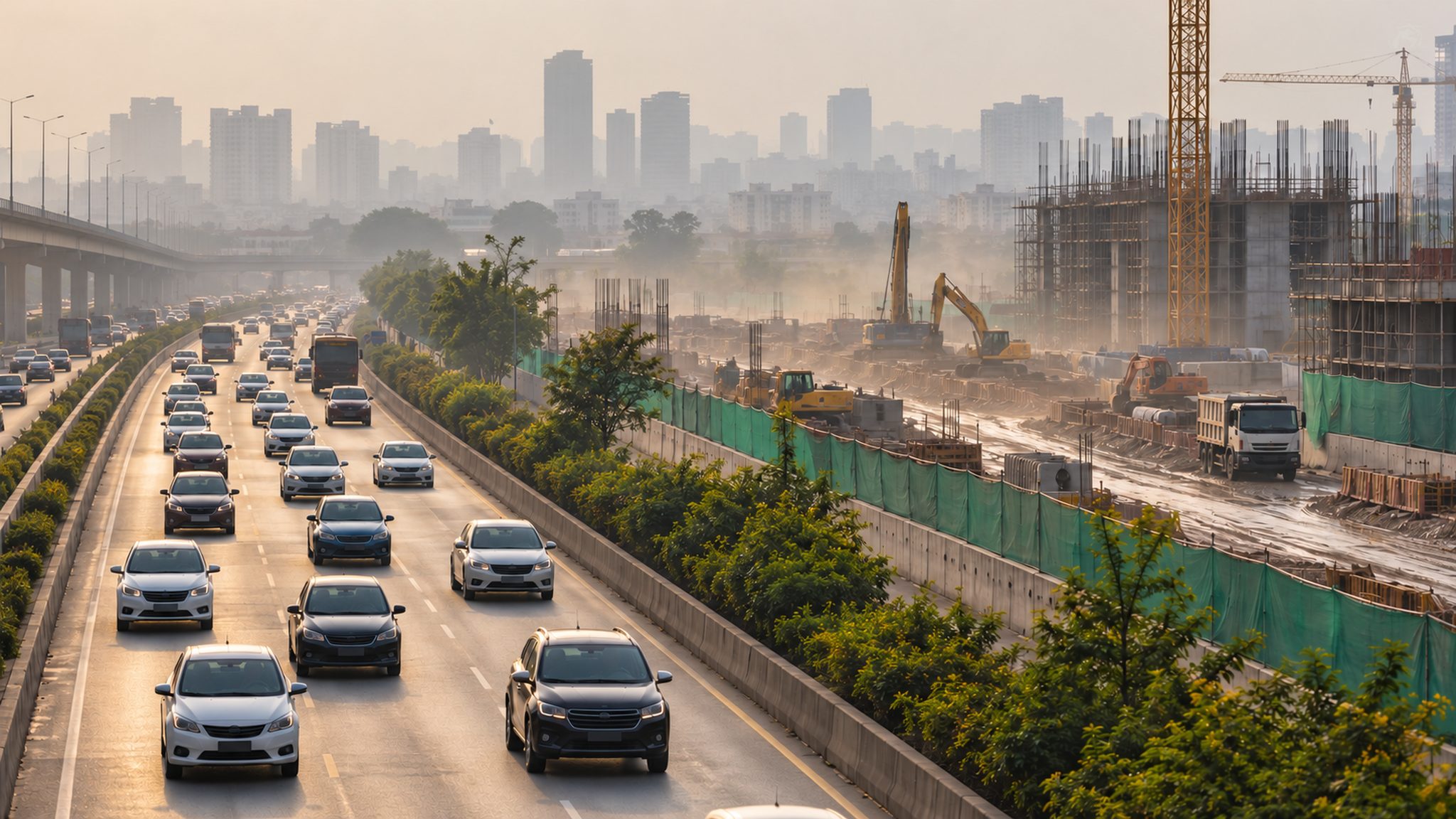
  • Municipal boundaries do not necessarily contain the whole developed region. The amendment reaches eligible projects in urban, controlled and development areas beyond those limits, subject to the relevant statutory or planning framework.
  • Industrial development areas, industrial zones and highway corridor zones are also included where applicable. This is a defined extension of coverage, not a claim that every rural construction site falls under identical requirements.
  • The existing plot-area threshold of at least 500 square metres stays unchanged. The policy changes where eligible projects are monitored; it does not announce a newly lowered size threshold for registration.
  • The mechanism uses web-portal registration and monitoring of construction-dust control measures. Registration makes projects visible to the system, but checking whether dust controls operate requires follow-through beyond the existence of an online entry.
  • The governance distinction is between coverage and compliance. Bringing a qualifying site into the monitored universe addresses an oversight gap; it does not by itself establish that the site has controlled its emissions.

Emergency measures need proportionality and follow-through

The revision distinguishes essential maintenance, public exposure and enforcement.

  • A minor relaxation under Stage III includes pothole repair. A specified maintenance exception should be read narrowly; the announcement does not support describing it as permission to restart all construction activity.
  • Physical sports competitions scheduled in NCR during November and December should be appropriately rescheduled with local air-quality trends in view, according to the advisory noted by CAQM; student health is the stated concern.
  • Emergency response can restrain selected activities during pollution episodes. In a Mains answer, pair that function with sustained source control; recurring restrictions alone are not evidence that underlying emissions have been durably reduced.

Way Forward

Make applicability and compliance visible

  • Publish stage-specific notices that state vehicle classes, territorial coverage, exemptions and the applicable date clearly.
  • Map newly covered construction sites against planning boundaries, then verify registration and functioning dust controls through inspections.
  • Track compliance outcomes, not merely portal entries; explain corrective requirements clearly to operators and affected residents.

Conclusion

  • Revised GRAP combines earlier placement of selected controls with more precise vehicle coverage and a wider construction-dust monitoring area. Read the schedule as a conditional framework, not proof of restrictions currently operating everywhere.
  • For answers, distinguish timing, coverage and enforcement. Each addresses a different weakness in pollution governance; credible assessment requires checking both the applicable order and whether the affected source actually complies.

UPSC Practice Questions

Prelims MCQ 1

With reference to the revised GRAP schedule approved in September 2026, consider the following statements:

  1. Selected diesel-generator and bus-entry actions move from Stage II to Stage I.
  2. The construction-dust monitoring amendment lowers the existing plot-area threshold.
  3. Approval of the revised schedule means all stages are automatically operating.

How many of the above statements are correct?

(a) Only one (b) Only two (c) All three (d) None

Answer: (a) Only one

Explanation:

Only the first statement is correct. The threshold remains at least 500 square metres, and schedule approval must not be confused with invocation of every stage.

Prelims MCQ 2

Which distinction best explains the construction-dust monitoring amendment?

(a) It replaces site monitoring with voluntary reporting. (b) It expands eligible territorial coverage while retaining the size threshold. (c) It exempts all sites beyond municipal boundaries. (d) It applies the same restrictions to every rural building.

Answer: (b) It expands eligible territorial coverage while retaining the size threshold.

Explanation:

The amendment extends the existing monitoring mechanism to eligible projects beyond municipal limits in specified statutory or planning areas; the existing threshold remains unchanged.

UPSC Mains Questions

  1. Emergency air-pollution controls require both precision and regional coordination. Discuss with reference to the revised GRAP schedule.
  2. Explain why extending construction-dust monitoring beyond municipal boundaries can improve environmental governance. What implementation gaps may remain?

Source: PIB, Ministry of Environment, Forest and Climate Change.

Frequently Asked Questions

What is the main change in the revised GRAP schedule?

Selected controls concerning diesel generator sets and bus entry move to an earlier stage. The revision also adjusts specified vehicle restrictions and expands the reach of construction-dust monitoring beyond municipal boundaries.

Does approval mean every GRAP restriction is active?

No. Approval defines the revised schedule. Whether a particular restriction applies at a particular time depends on the applicable stage and order; the announcement does not establish that every stage is operating.

Did CAQM reduce the construction-dust registration threshold?

No. The existing threshold of plot area equal to or greater than 500 square metres remains unchanged. The amendment expands eligible territorial coverage under the relevant statutory and planning frameworks.

Are all vehicles in Haryana covered by the Sonipat change?

No. Sonipat is added to specified district coverage for named petrol and diesel four-wheeler categories. The announcement does not impose an all-vehicle restriction across every district of Haryana.

Gyroplane Training Rules: Separating Rotor Lift From Propeller Thrust

Open article →Download PDF

Why in News?

On September 29, 2026, the Ministry of Civil Aviation announced that DGCA had prescribed ground and flying training for candidates seeking a gyroplane pilot licence.

  • The new Civil Aviation Requirement covers the syllabus for the gyroplane category.
  • A freely rotating rotor produces lift; a separate propeller provides forward thrust.
  • The ministry calls this an initial step towards introducing and operationalising gyroplanes in India.
  • Further development includes training organisations and manufacturing or assembly capabilities.
  • The policy question is how to connect aircraft-specific skills with safe entry into a new aviation segment.
  • A machine’s potential usefulness does not establish permission or readiness to offer every proposed service.

UPSC Relevance

Prelims Relevance

  • Gyroplane: rotorcraft using autorotation for rotor lift.
  • Propeller thrust is distinct from rotor lift.
  • DGCA and Civil Aviation Requirements.
  • Difference between a training syllabus, a pilot licence and operational readiness.

Mains Relevance

GS Paper 3

  • Science underlying new aviation applications and aircraft-specific safety.

GS Paper 2

  • Sequencing regulation, training capacity and supervision when introducing new technology.

Background and Context

How a gyroplane stays airborne

The aircraft separates two jobs: supporting its weight and moving forward.

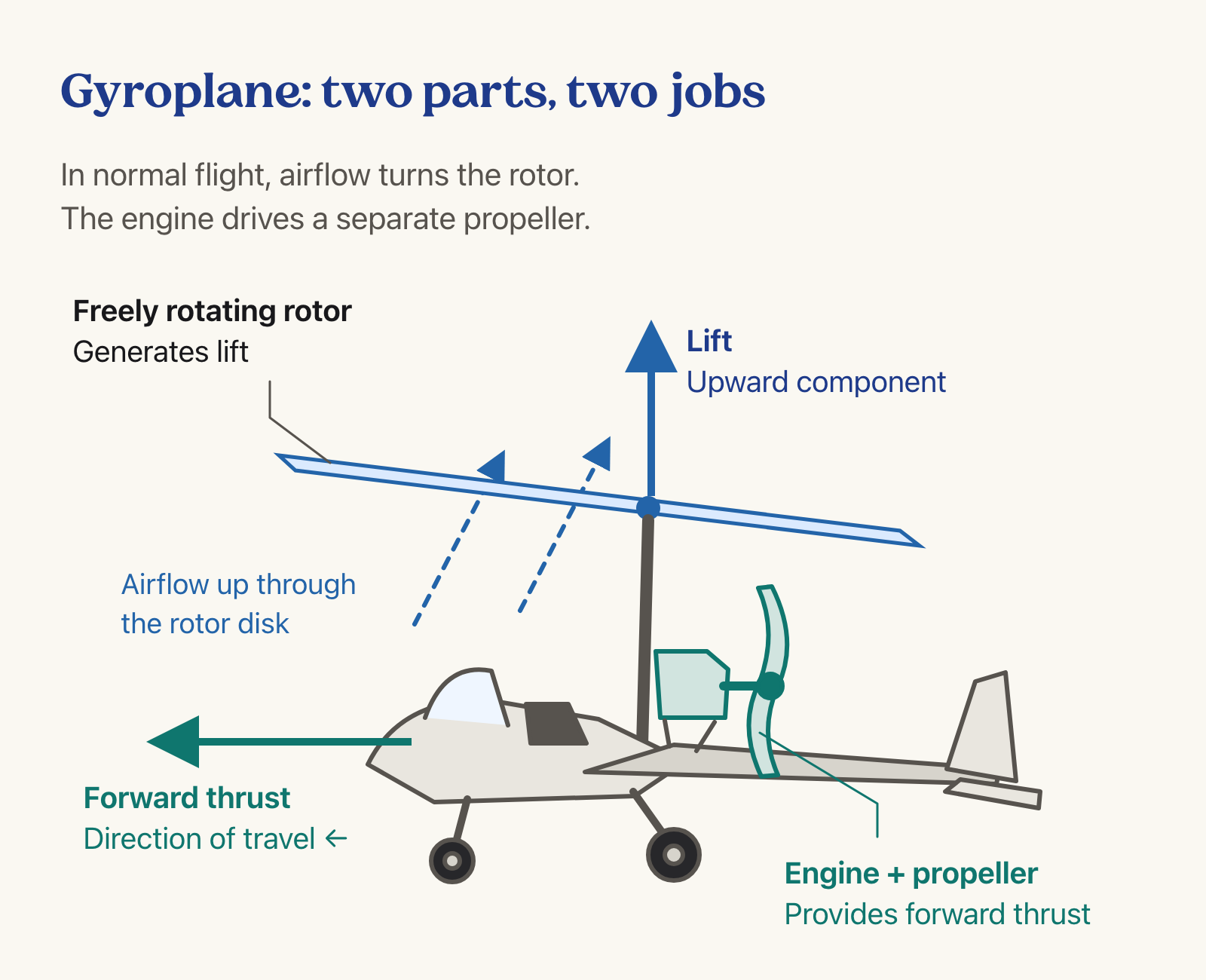
  • The main rotor blades are rotating airfoils. Their movement through air creates aerodynamic forces, including the upward component that supports the aircraft against its weight during flight.
  • In normal flight, the rotor turns through autorotation: air flowing through the rotor sustains its rotation. The engine does not continuously drive this rotor as in powered helicopter flight.
  • A separate, engine-driven propeller supplies forward thrust. Treat the rotor and propeller as different systems even when both are visible as spinning blades on the same aircraft.
  • The important relationship is airflow to rotor rotation to lift, alongside engine power to propeller thrust. Calling the main rotor an engine-powered lifting fan would misdescribe the mechanism.
  • The FAA handbook explains that a gyroplane’s rotor normally operates in autorotation. This is an operating principle, not a claim that every flight condition or handling error is safe.
Side-view gyroplane diagram: airflow passes upward through the freely rotating main rotor to generate lift, while an engine drives a separate rear propeller for forward thrust.
In normal gyroplane flight, airflow sustains rotor rotation and lift, while the engine-driven propeller supplies forward thrust. Schematic, not to scale.

What the training announcement establishes

A prescribed learning framework is a defined regulatory step, with a limited scope.

  • The announced CAR is titled Ground and Flying Training Syllabus for Issue of Pilot Licence for Gyroplanes. Its stated purpose is training candidates seeking the relevant DGCA licence.
  • Ground training and flying training appear together in the announced syllabus. This distinction matters: understanding an aircraft on paper and demonstrating competence while operating it are different learning tasks.
  • The announcement establishes a syllabus; it does not report that all prospective pilots have completed training or received licences. A new framework should not be mistaken for completed qualification.
  • The ministry describes this as an initial step. That wording limits the inference: it announces progress towards operationalisation, rather than certifying that the entire supporting aviation system is ready.
  • The short release does not reproduce detailed training hours, medical criteria or examination requirements. Avoid importing figures from another aircraft category or a foreign licensing system into the Indian syllabus.

Why aircraft-specific safety matters

The policy lesson is to match training to the actual machine and its operating environment.

  • Rotorcraft is a broad category, not a promise of identical controls or performance. A gyroplane and a helicopter should not be treated as interchangeable merely because each has a rotor.
  • The contrast concerns normal powered flight: helicopter rotors receive engine power, while the gyroplane rotor autorotates. Helicopters can also use autorotation, so the term is not exclusive to gyroplanes.
  • An engine problem does not become harmless because a rotor can autorotate. Flight conditions and pilot handling still matter; the news release provides no guarantee of automatic safety after power loss.
  • A useful training-policy question is whether instruction connects mechanism with judgment: what produces lift, what supplies thrust, and how operating limits constrain a particular aircraft and planned flight.
  • For policy answers, distinguish a technology description from a safety finding. Knowing how an aircraft flies does not establish its accident record, suitability for every location or readiness for passenger service.

From a syllabus to usable aviation services

Pilots, organisations and aircraft capability must come together before proposed applications become dependable services.

  • The ministry identifies joyrides, air experience flights and aerial work as potential uses. Examples include agricultural spraying, banner towing, surveillance and surveys; these describe applications, not blanket operational permission.
  • It also identifies training organisations as a further development need. Publishing a syllabus is not evidence that enough instructors, suitable aircraft and institutions are already available to train candidates.
  • Manufacturing and assembly capabilities form another part of the stated development pathway. The announcement does not quantify domestic production, name a completed fleet or prove that servicing capacity is sufficient.
  • A survey mission and an agricultural application involve different operating tasks. As a policy recommendation, assess the intended task and local risks rather than assuming one aircraft description establishes universal suitability.
  • The durable governance distinction is between pilot competence and service readiness. A licensing pathway addresses the human operator; safe deployment also requires attention to the aircraft, supporting organisations and intended operation.

Way Forward

Build readiness around the actual operation

  • Develop training capacity alongside the syllabus, with aircraft-specific instruction and clear assessment of practical competence.
  • Communicate the difference between potential uses and permitted operations so promotional claims do not outrun the regulatory position.
  • Assess maintenance support and task-specific risks before scaling services; treat these as implementation priorities, not achievements established by the announcement.

Conclusion

  • The gyroplane news connects a clear scientific distinction, rotor lift versus propeller thrust, with an equally important regulatory distinction: prescribing training is one stage in developing a safe aviation segment.
  • Use the development to argue for sequenced regulation: establish learning requirements, develop competent operators and supporting capacity, and assess the intended service before claiming operational readiness.

UPSC Practice Questions

Prelims MCQ 1

With reference to gyroplanes, consider the following statements:

  1. In normal flight, the main rotor operates in autorotation.
  2. Forward thrust is supplied by a propeller.
  3. The main rotor must be continuously driven by the engine in normal flight.

How many of the above statements are correct?

(a) Only one (b) Only two (c) All three (d) None

Answer: (b) Only two

Explanation:

Statements 1 and 2 are correct. The freely rotating rotor generates lift, while the engine-driven propeller supplies thrust; statement 3 describes the mechanism incorrectly.

Prelims MCQ 2

What does the September 2026 DGCA announcement specifically establish?

(a) Blanket approval for all gyroplane aerial work (b) A completed nationwide network of training organisations (c) A ground and flying training syllabus for the gyroplane pilot licence (d) Automatic recognition of every foreign gyroplane licence

Answer: (c) A ground and flying training syllabus for the gyroplane pilot licence

Explanation:

The ministry describes the CAR prescribing the syllabus as an initial step. It identifies training organisations and manufacturing or assembly capabilities as further development needs.

UPSC Mains Questions

  1. Explain the distinction between rotor lift and propeller thrust in a gyroplane. Why should training reflect the specific aircraft mechanism?
  2. A training framework is necessary but insufficient for operationalising a new aviation segment. Discuss with reference to gyroplanes.

Sources: PIB, Ministry of Civil Aviation and Federal Aviation Administration, Rotorcraft Flying Handbook.

Frequently Asked Questions

What is a gyroplane?

A gyroplane is a rotorcraft whose freely rotating main rotor produces lift while a separate propeller provides forward thrust. This separates its normal flight mechanism from that of a powered helicopter rotor.

What did DGCA announce?

The Ministry of Civil Aviation announced a Civil Aviation Requirement prescribing ground and flying training for candidates seeking a gyroplane pilot licence. It described this as an initial step towards operationalisation in India.

Does autorotation make engine failure automatically safe?

No. Autorotation describes how airflow sustains rotor rotation; it is not an automatic safety guarantee. Flight conditions, aircraft limitations and pilot handling remain relevant when engine power is lost.

Are all proposed gyroplane activities now approved?

The announcement does not establish blanket approval for every application. It lists potential activities and prescribes a training syllabus, while identifying further needs such as training organisations and manufacturing or assembly capabilities.

PRAMAAN Certification: Independent Audits and Traceable Forest Products

Open article →Download PDF

Why in News?

India issued its first PRAMAAN certificates under the Indian Forest and Wood Certification Scheme on 29 September 2026.

  • The Andhra Pradesh Forest Development Corporation received certification for plantations covering 33,000 hectares.
  • An Odisha bamboo farmer also received a certificate, extending the announcement beyond state-managed plantations to tree-based farming.
  • The plantations underwent field and management audits; the announcement concerns first certificates, not a new scheme launch.
  • A sustainability claim becomes useful to buyers when independent evidence supports it and the claim remains traceable through processing and sale.
  • Certification connects forest governance with market information, but cannot by itself guarantee higher farmer incomes or acceptance under every importing jurisdiction.

UPSC Relevance

Prelims Relevance

  • IFWCS: Indian Forest and Wood Certification Scheme.
  • Forest Management and Trees Outside Forests Management assess management against their respective standards.
  • Chain of Custody: continuity of a product claim along the supply chain.
  • IIFM, Bhopal: scheme operating agency.
  • NABCB: accredits certification bodies under the Quality Council of India.

Mains Relevance

GS Paper 3

  • Sustainable forestry: combining ecological stewardship, traceability and producer livelihoods.
  • Trade: distinguishing credible sustainability evidence from guaranteed market access.

GS Paper 2

  • Regulatory institutions: separating standard setting, accreditation and independent assessment.

Essay

  • Trust in markets depends on evidence that can survive independent scrutiny.

Background and Context

What does PRAMAAN certify?

The scheme separates how trees are managed from how a claim follows their products to buyers.

  • The Indian Forest and Wood Certification Scheme, launched in December 2023, offers voluntary third-party certification. The latest certificates demonstrate field implementation of that framework rather than the creation of another forestry programme.
  • Forest Management certification assesses management against the Indian Forest Management Standard within the National Working Plan Code 2023. Its subject is management quality; a forest product label serves a different evidentiary purpose.
  • Trees Outside Forests Management extends the certification architecture beyond forests to relevant tree-growing systems. This matters for farmers whose production enters wood and bamboo value chains without originating in a conventional forest plantation.
  • Chain of Custody certification concerns the continuity of a claim through sourcing, processing, trading and distribution. A certified source and a traceable finished product answer related but separate questions for a buyer.
  • The scope includes wood and non-timber forest products. Certification should be read against the relevant certificate and standard; these first awards do not establish that every Indian forest, farm or timber consignment is certified.

Who checks the claim, and who checks the checker?

Independent assessment is the central safeguard against treating a producer’s declaration as sufficient proof.

  • The Indian Institute of Forest Management, Bhopal, operates the scheme. Administrative coordination is distinct from conducting an independent assessment of whether a particular applicant meets the standard relevant to its proposed certification.
  • The National Accreditation Board for Certification Bodies, under the Quality Council of India, accredits certification bodies. Accreditation concerns the bodies performing assessments; it does not itself certify every forest enterprise or product they encounter.
  • Accredited certification bodies perform independent audits against prescribed standards. The announcement records field and management audits before the first plantation certificates, giving the claim a basis beyond the applicant’s own description of its practices.
  • For chain of custody, ownership changes along the value chain matter. The official standard requires effective custody management systems and independent verification where an organisation wants to make an IFWCS claim about its products.
  • Consider a furniture maker purchasing wood from a certified source: the source certificate addresses management upstream. Evidence connecting the purchased material with the finished product is still needed to support a downstream certification claim.

What certification can and cannot deliver

A credible certificate can reduce uncertainty, but its commercial and legal effects must be established separately.

  • Information asymmetry arises when a seller knows more about sourcing than a buyer. Independent assessment can help buyers distinguish supported sustainability claims from unsupported assertions, provided the certificate actually covers the activity being represented.
  • Traceability links a claim to material as it moves between organisations. It complements management assessment: good practices at the growing site cannot establish, by themselves, the origin of every product later offered for sale.
  • The government presents PRAMAAN as supporting responsible sourcing and market linkages. That stated objective is not proof that a particular certificate automatically satisfies every foreign regulation, buyer specification or importing-country due-diligence requirement.
  • Livelihood benefits depend on buyers valuing the claim and producers bearing workable costs. The first awards do not establish a realised price premium, higher net income or universal access for smallholders and forest-dependent communities.
  • Certification and legal due diligence should remain distinct in an answer. A certificate is evidence within its scope; checking applicable sourcing rules, documents and market obligations remains necessary rather than becoming redundant after an audit.

Way Forward

Make claims verifiable and participation workable

  • For implementation: make certificate scope and validity easy for buyers to check, reducing the risk of broad claims based on narrowly certified activities.
  • For small producers: support recordkeeping and collective participation where appropriate; assess costs before promising livelihood gains.
  • For evaluation: track buyer acceptance, producer costs and net returns separately from the number of certificates issued.

Conclusion

  • PRAMAAN links sustainable management with independent assessment and product traceability. Its first certificates are an implementation milestone whose value depends on the credibility of the underlying evidence.
  • In a Mains answer, connect environmental governance with market trust, then examine certificate scope, custody continuity and producer costs before claiming commercial success.

UPSC Practice Questions

Prelims MCQ 1

With reference to PRAMAAN certification, consider the following statements:

  1. Forest Management certification and Chain of Custody certification address different aspects of a sustainability claim.
  2. NABCB accredits the certification bodies that perform independent assessments.
  3. The first certificates establish that all Indian timber exports automatically meet every importing-country requirement.

How many of the above statements are correct?

(a) Only one (b) Only two (c) All three (d) None

Answer: (b) Only two

Explanation:

The first two statements are correct. Certification has a defined scope and does not establish automatic compliance with every foreign market requirement.

Prelims MCQ 2

A furniture maker needs to substantiate that a finished product carries a valid claim linked to certified source material. Which mechanism is most directly relevant?

(a) A general increase in national forest cover (b) A producer self-declaration without supporting records (c) Chain of Custody certification (d) An accreditation certificate issued to an unrelated auditor

Answer: (c) Chain of Custody certification

Explanation:

Chain of Custody concerns the continuity of the product claim through the supply chain; management certification alone addresses the upstream management standard.

UPSC Mains Questions

  1. Explain the distinction between forest management certification and chain of custody. How can both contribute to credible sustainability claims?
  2. Assess the opportunities and limits of voluntary forest certification for small producers and forest-dependent communities.

Sources: PIB, Ministry of Environment, Forest and Climate Change and Indian Institute of Forest Management, certification standards.

Frequently Asked Questions

Is PRAMAAN a newly launched scheme?

No. IFWCS was launched in December 2023. The September 2026 announcement concerns its first PRAMAAN certificates, marking field implementation after assessment rather than a fresh scheme launch.

How does chain of custody differ from forest management certification?

Forest management certification assesses management against its standard. Chain of custody addresses the continuity of a product claim through sourcing, processing, trading and distribution, connecting material with its claimed origin.

Who audits applicants under the scheme?

Independent certification bodies conduct assessments against applicable standards. NABCB, under the Quality Council of India, accredits these bodies, while IIFM Bhopal acts as the scheme operating agency.

Does certification guarantee higher prices or foreign market access?

No automatic guarantee follows. Commercial benefits depend on buyer acceptance and producer costs; applicable importing-market requirements must still be checked. The first awards are not evidence of realised price premiums.

Statistical Business Register: Using Udyam Data to Build Survey Frames

Open article →Download PDF

Why in News?

On 29 September 2026, the MSME ministry announced an MoU with MoSPI to share Udyam Registration data for developing and strengthening the Statistical Business Register.

  • The agreement provides for unit-wise data sharing through APIs, including a two-way API for preparing the National Statistical Business Register.
  • It establishes a structured sharing framework between the MSME ministry and the Ministry of Statistics and Programme Implementation.
  • The stated objective is better coverage, consistency and reliability of business information used for statistics.
  • This is a register-building arrangement; the release does not establish that a complete national register is already operational.
  • A survey can miss economic activity before fieldwork begins if its business list omits the units it needs to study.
  • Knowing which units exist, how they relate and whether they remain active helps interpret enterprise counts and economic survey results.

UPSC Relevance

Prelims Relevance

  • Statistical Business Register and its statistical purpose
  • Enterprise, establishment and relationships between units
  • Survey frame versus selected sample
  • Undercoverage, duplication and inactive units
  • Business demography and regular register updating

Mains Relevance

GS Paper 3

  • Quality of economic statistics and representation of small businesses
  • Administrative records as inputs to economic surveys

GS Paper 2

  • Interministerial statistical coordination and controlled data access

Essay

  • What governments can measure depends partly on whom their records can see.

Background and Context

A register records units and their relationships

The Statistical Business Register is an organised, regularly updated record of economic units, rather than a registration count.

  • The official description includes businesses, enterprises and establishments, their characteristics and relationships within a territory. Keeping these categories distinct matters because different surveys ask different economic questions.
  • An enterprise represents an economic decision-making unit; an establishment is associated with production at a location. A business operating across locations can require more than one statistical view.
  • Consider an illustrative firm operating workshops in different towns. Counting the firm answers a business-organisation question; counting its workshops helps locate production. Adding both counts would mix unlike units.
  • The register must preserve links between units so statistics about an organisation can be related to its operating locations without treating every record as an unrelated new business.
  • Udyam records are an administrative input under this agreement. Their contribution must be organised for statistical purposes; the existence of a registration does not settle every survey classification question.

From a business register to a survey sample

A survey frame turns the register into an operational list for a particular statistical inquiry.

  • The target population is the set of units a survey intends to describe. A study of establishments asks a different question from one examining whole enterprises and their finances.
  • The survey frame is the list from which eligible units can be selected. The sample contains the units actually chosen for investigation; neither term means all registered businesses automatically respond.
  • Unit characteristics help identify eligible businesses and organise selection. Survey designers need definitions matching their question, rather than selecting records solely because an administrative database contains them.
  • Sample results support estimates for a wider population through statistical methods. A larger sample cannot automatically repair the exclusion of a whole category of businesses from the starting list.
  • A dated frame provides a reference point for a survey while the underlying register keeps changing. This distinction helps explain why a live administrative total may differ from survey coverage.

Coverage errors begin before questionnaires

The quality of the starting list affects whose economic activity becomes visible in the results.

  • Undercoverage arises when eligible units are missing. The agreement does not prove that businesses outside the Udyam data being exchanged, including informal activity, are comprehensively represented in the register.
  • Overcoverage includes records outside the intended population, such as units no longer operating. Keeping an old entry does not demonstrate that production or employment continues at that business today.
  • Duplicate records can distort selection if the same unit appears more than once. Conversely, separate establishments should not be merged merely because they belong to the same enterprise.
  • Misclassification can place a business in an unsuitable activity or location category. Analysts should distinguish an actual economic shift from a change caused by corrections to the underlying records.
  • Coverage quality should be assessed alongside record counts. A growing database may improve statistical reach, but growth in registrations alone cannot demonstrate proportionate growth in active businesses or output.

Updating supports business demography

Another mechanism is tracking change, rather than treating the register as a finished list.

  • Regular updating helps the register reflect changes in activity, location and organisational relationships. Its value depends on maintaining reliable records after construction, not merely transferring an initial data file.
  • Business demography concerns changes in the business population, including births, deaths and survival. Register information can support this analysis, as the official release identifies among its intended statistical functions.
  • A new administrative entry should not automatically be interpreted as newly created economic activity. An existing business may become visible to a registration system after it has already begun operating.
  • API-based exchange describes how authorised systems share information. It does not mean unit-level records are publicly available, and the announcement does not specify a public release of individual business data.
  • Access controls and correction procedures are practical safeguards to recommend. Their exact design cannot be inferred from the short announcement, which describes the agreement without publishing its complete operational provisions.

Way Forward

Make coverage and maintenance measurable

  • Publish coverage and revision notes alongside statistical outputs so users can understand omissions, changes in definitions and breaks in comparability.
  • Create correction channels for inactive, duplicated or wrongly classified units, with responsibility assigned for resolving conflicting records.
  • Use complementary statistical sources to assess units missing from administrative inputs, and protect business information through purpose-limited access.

Conclusion

  • A Statistical Business Register improves the foundation for surveys when it identifies the right units and maintains their relationships over time; a data-sharing agreement begins that work rather than completing it.
  • For policy analysis, connect coverage, unit definition and updating to the reliability of economic estimates. Avoid equating registration growth with new production, or administrative data exchange with public disclosure.

UPSC Practice Questions

Prelims MCQ 1

With reference to a Statistical Business Register, consider the following statements:

  1. It can record relationships between different economic units.
  2. A survey sample is identical to the complete register.
  3. A register can support business demography statistics.

How many of the above statements are correct?

(a) Only one (b) Only two (c) All three (d) None

Answer: (b) Only two

Explanation:

Statements 1 and 3 are correct. A sample consists of selected units for investigation; it is not identical to the register.

Prelims MCQ 2

A survey draws a large sample from a business list that excludes an entire eligible category. Which problem remains?

(a) Undercoverage of the target population (b) Automatic duplication of every respondent (c) Public disclosure of all business records (d) Complete elimination of sampling error

Answer: (a) Undercoverage of the target population

Explanation:

Increasing sample size within an incomplete list does not automatically include units absent from that list.

UPSC Mains Questions

  1. Explain how a Statistical Business Register can strengthen economic surveys. Why do unit definitions and coverage matter as much as the volume of administrative records?
  2. Administrative registration growth need not equal business creation. Discuss with reference to register maintenance and business demography.

Sources: PIB, Ministry of Micro, Small and Medium Enterprises and United Nations Statistics Division.

Frequently Asked Questions

What is a Statistical Business Register?

It is a regularly updated statistical database of economic units, their characteristics and relationships. It supports survey frames, sample selection and analysis of changes in the business population.

What does the Udyam data-sharing MoU do?

It establishes a framework for sharing unit-wise Udyam Registration data between the MSME ministry and MoSPI through APIs for developing and strengthening the Statistical Business Register.

How does a survey frame differ from a sample?

The frame is the operational list used to select eligible survey units. The sample is the subset chosen for investigation. Missing units in the frame can create coverage problems.

Does the agreement make individual business data public?

The announcement describes data exchange between the ministries through APIs. It does not announce public disclosure of unit-level business records or establish that the national register already covers every business.

Rural Roads Study: Measuring Access Before and After Construction

Open article →Download PDF

Why in News?

On 29 September 2026, the Ministry of Rural Development announced an NRIDA-IIM Kolkata agreement for a four-year rural roads impact assessment covering PMGSY-IV and PM-JANMAN.

  • The longitudinal study will collect baseline information before road construction and endline information after construction.
  • Its proposed outcomes include travel time, transport costs, livelihoods and access to essential services.
  • The assessment will examine differences across regions and vulnerable groups, alongside the sustainability of benefits.
  • The announcement commissions research; it does not report measured improvements or completed evaluation findings.
  • A completed road is an infrastructure output; dependable access to a clinic or market is an outcome requiring further evidence.
  • Repeated observation can reveal changes over time, but isolating the road’s contribution requires attention to other simultaneous changes.

UPSC Relevance

Prelims Relevance

  • NRIDA: National Rural Infrastructure Development Agency, under the Ministry of Rural Development.
  • Baseline: measurement before the intervention being assessed.
  • Endline: follow-up measurement after the intervention.
  • Longitudinal assessment: observation across time rather than a single snapshot.
  • Output versus outcome: completed infrastructure versus changes experienced by people.

Mains Relevance

GS Paper 3

  • Rural connectivity, market access and complementary services.
  • Infrastructure outcomes and sustained benefits.

GS Paper 2

  • Evidence-based policy evaluation and unequal access across vulnerable groups.

Essay

  • Development should be judged by usable opportunities, not only by completed assets.

Background and Context

How roads can change access

A rural road matters through the journeys it enables, so the study must connect construction with changes in everyday access.

  • Physical connectivity can reduce the difficulty of reaching markets, schools and health facilities. The relevant question is whether households can make these journeys reliably.
  • Travel time and transport costs are useful intermediate outcomes: they show whether connecting a settlement makes movement easier before assuming that household incomes or welfare have improved.
  • For farm households, easier movement may widen choices of buyers and input suppliers. Whether this raises earnings also depends on prices, production conditions and the availability of affordable transport services.
  • For healthcare and education, a shorter route is only part of effective access. A usable facility, suitable opening hours and transport must also be available at the destination when needed.
  • The announced study includes employment, migration and income diversification. These are outcomes to investigate, rather than benefits already established by the signing of the agreement or the completion of roads.

What baseline and endline surveys establish

The proposed design starts before construction, giving later observations a reference point rather than relying entirely on memories of earlier conditions.

  • A baseline survey records conditions before the road intervention. Later measurements can then examine how mobility, access and household circumstances changed from that starting point.
  • An endline survey records conditions after construction. Its value depends on measuring comparable concepts, such as the journey to a health facility, consistently across the observations used in the analysis.
  • Longitudinal evidence places observations in sequence. This helps distinguish an initial change after construction from a benefit that persists, although the release does not provide the complete survey instrument.
  • Seasonal comparability matters when interpreting rural access: a dry-season journey and a monsoon journey may differ even without construction. Evaluators should account for survey timing before attributing the difference to roads.
  • Household follow-up also needs care if people move or become difficult to contact. Losing some respondents can change the apparent results if those missing differ systematically from those still observed.

Why change does not automatically establish causation

A before-and-after difference describes change; identifying how much the road caused requires a stronger account of what else changed.

  • Other influences, including harvest conditions, employment opportunities and new public services, can affect household outcomes during construction. An income increase afterwards cannot automatically be assigned entirely to the new road.
  • The counterfactual is what would have happened without the intervention. It cannot be observed directly for the same household at the same time, which creates the central challenge of impact evaluation.
  • Comparable areas with different construction timing could help assess broader trends, if chosen carefully. This is a methodological recommendation; the announcement does not establish that such comparison groups are included.
  • Selection differences need attention because connected and unconnected settlements may differ before construction. Simply comparing their later incomes can confuse the road’s contribution with advantages or disadvantages already present beforehand.
  • Transparent limitations make findings more useful. As with local labour estimates, readers need to know which population the evidence represents before extending conclusions beyond the people and places actually studied.

Who benefits, and whether benefits last

The study also proposes examining vulnerable groups and sustainability, which adds an inclusion question beyond average improvements in access.

  • Average outcomes can conceal unequal gains. A useful assessment should ask whether women and disadvantaged households experience improved access, rather than assuming a settlement-level connection changes everybody’s opportunities equally.
  • Affordability and safety can constrain use even when a route exists. Evaluators should distinguish being physically connected from being able to make a necessary journey under realistic household conditions.
  • Service continuity matters after construction: disruptions can reverse an initial improvement in access. Follow-up evidence should examine whether useful journeys remain possible instead of treating opening-day connectivity as a lasting result.
  • Outcome evaluation complements independent checks on programme assets. Verifying that infrastructure exists and examining how people’s lives change answer related questions, but neither task fully substitutes for the other.

Way Forward

Design evidence for decisions

  • Publish measurement definitions, survey timing and analytical limitations so programme managers can judge what observed changes establish.
  • Use credible comparison strategies where feasible, explaining how selection differences and wider economic changes are addressed.
  • Report distributional results alongside averages, and investigate the transport or service constraints that prevent households from using improved connectivity.

Conclusion

  • Rural road evaluation should follow the chain from a completed route to usable journeys and sustained household opportunities. Each step requires evidence rather than an assumption of automatic benefits.
  • The proposed study creates an opportunity for better outcome evidence; it has not yet demonstrated impact. In a Mains answer, distinguish measured change from a defensible estimate of causation.

UPSC Practice Questions

Prelims MCQ 1

With reference to the announced rural roads impact assessment, consider the following statements:

  1. Baseline information is to be collected before road construction.
  2. Endline information is to be collected after road construction.
  3. The agreement announcement establishes that household incomes have already increased because of the roads.

How many of the above statements are correct?

(a) Only one (b) Only two (c) All three (d) None

Answer: (b) Only two

Explanation:

The proposed study includes pre-construction baseline and post-construction endline surveys. The announcement describes a commissioned assessment, not completed impact findings.

Prelims MCQ 2

Why does a rise in household income after road construction not, by itself, establish the road’s causal impact?

(a) Income cannot be studied through household surveys (b) Roads cannot influence market access (c) Other changes may also have affected income during the same period (d) Baseline measurements are always unnecessary

Answer: (c) Other changes may also have affected income during the same period

Explanation:

Before-and-after change can reflect the road, wider economic conditions or other interventions. Causal assessment must consider what would likely have happened without the road.

UPSC Mains Questions

  1. Distinguish infrastructure outputs from development outcomes. How can a longitudinal assessment improve the evaluation of rural road connectivity?
  2. Why is a before-and-after comparison insufficient to establish causal impact? Discuss the methodological and inclusion safeguards required when evaluating rural infrastructure.

Source: PIB, Ministry of Rural Development.

Frequently Asked Questions

What has been announced for rural road evaluation?

NRIDA and IIM Kolkata have signed an agreement for a four-year longitudinal assessment of roads under PMGSY-IV and PM-JANMAN. It proposes examining changes in access, mobility and household conditions.

What is the difference between baseline and endline surveys?

A baseline records conditions before the intervention. An endline records conditions afterwards. Comparable measurements help identify changes, but that difference alone does not establish how much the intervention caused.

What outcomes will the study examine?

The announced scope includes travel time, transport costs, livelihoods, employment, education, healthcare and access to public and financial services. It also proposes examining vulnerable groups and the sustainability of benefits.

Does the announcement confirm that comparison groups will be used?

No. The release describes baseline and endline surveys without specifying a comparison-group design. Suitable comparisons are a recommended evaluation safeguard, not a confirmed feature of the announced study.

Multi-Gas Sensors: From a Sensing Element to a Reliable Signal

Open article →Download PDF

Why in News?

The Technology Development Board announced support on 29 September 2026 for an indigenous multi-gas sensor platform combining a MEMS sensing element with a custom front-end chip.

  • Multi Nano Sense Technologies is developing the platform for applications including leak detection, process control and health and safety monitoring.
  • The programme aims to advance from TRL-4 to TRL-9; the announcement does not establish that the final readiness level has been achieved.
  • Proposed features include auto-calibration, environmental compensation and software-based gas-library processing.
  • Integration, testing, validation and scale-up remain part of the supported development programme.
  • Sensor reliability depends on the complete measurement chain: a small sensing element is useful only when its response can be acquired and interpreted consistently.
  • Indigenous capability involves sensor fabrication, electronics, software and testing together; a funding agreement is an enabling step rather than proof of field performance.

UPSC Relevance

Prelims Relevance

  • MEMS: microelectromechanical systems.
  • AFE: analogue front end; SoC: system-on-chip.
  • Sensing element versus signal acquisition and processing.
  • Calibration against reference standards.
  • Technology readiness target versus achieved deployment.

Mains Relevance

GS Paper 3

  • Domestic capabilities in sensors and semiconductor systems.
  • Validation, calibration and industrial adoption of emerging technologies.

Essay

  • Trust in technology depends on reliable measurement, not merely smaller devices.

Background and Context

The sensing element and electronics perform different jobs

The proposed platform joins a miniature sensing element to dedicated electronics.

  • MEMS stands for microelectromechanical systems, a class of miniature devices combining small physical structures with electronics. The announcement describes a MEMS-based gas-sensing element, rather than an already deployed universal detector.
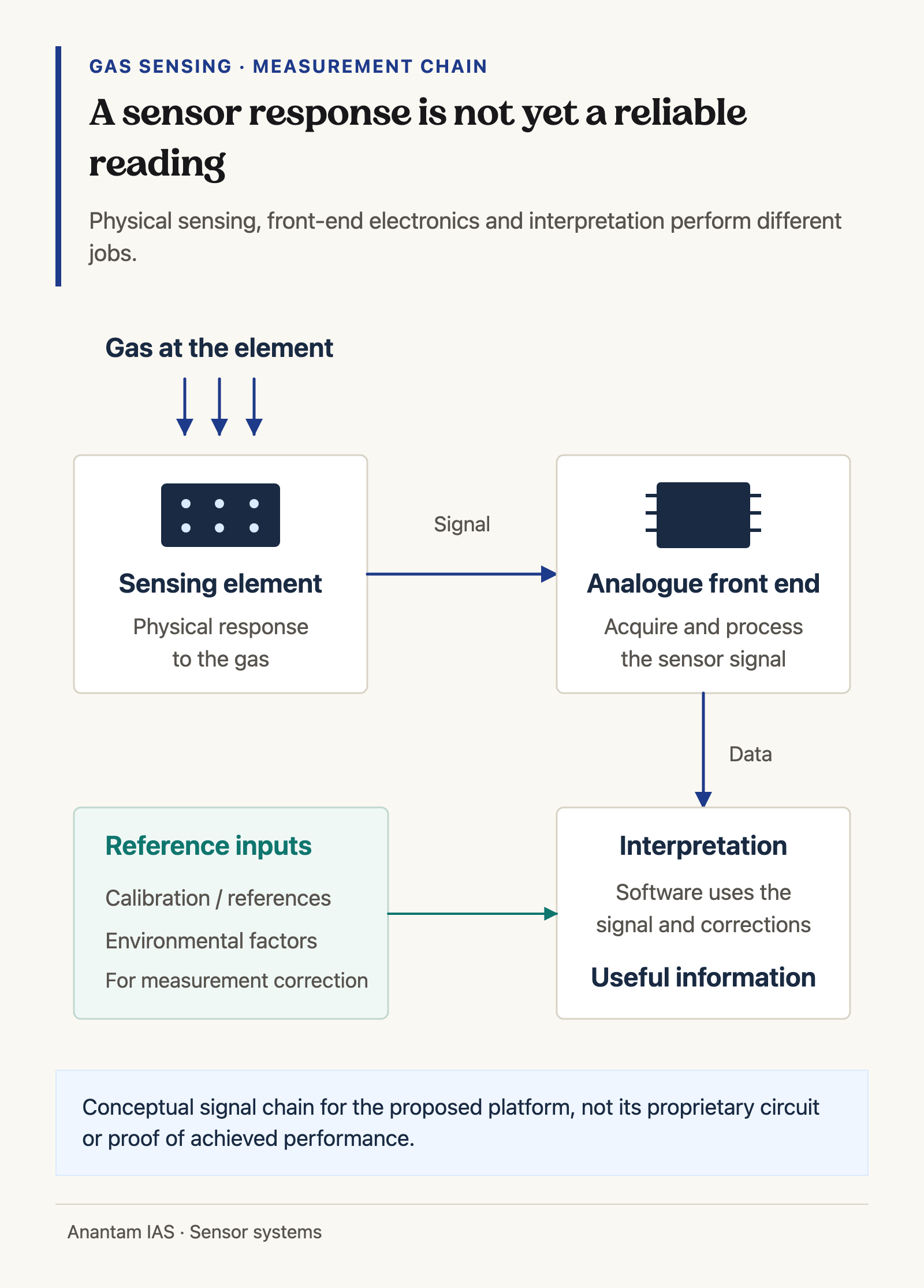
  • The sensing element responds to the gas-related quantity being measured. That response must enter a measurement chain before it can support a useful reading, alarm or process-control decision.
  • The analogue front end handles the signal close to the sensor. Here, a custom system-on-chip is being developed for acquisition and processing, connecting the sensing element to subsequent interpretation.
  • Integration means designing the element and its electronics to work together. A compact package alone cannot show that the resulting readings are accurate across the intended gases and operating environments.
  • The release names a particular sensor architecture but does not explain its detailed physical detection mechanism. Avoid assigning an optical, thermal or quantum operating principle without additional technical documentation.

Calibration connects a response to a meaningful measurement

A signal becomes useful when its relationship to the measured quantity is established and relevant environmental effects are addressed.

  • Calibration relates an instrument response to reference standards or a designated measurement process. NIST describes this relationship as the basis for assigning values, rather than treating an unexplained signal as a trustworthy measurement.
  • Auto-calibration is a planned feature of this platform. Automation can support the calibration process, but the announcement does not provide a validated protocol or establish that reference checks will never be needed.
  • Environmental compensation is also proposed because the platform is intended for demanding industrial conditions. Correction for environmental parameters must be tested; naming the feature does not establish accuracy under every condition.
  • Gas-library processing uses software in interpreting the sensor response. The release identifies this feature without publishing a complete validated gas list, concentration range or interference performance for each intended application.
  • Multi-gas does not mean every gas. A buyer needs evidence for the gases and conditions relevant to the installation, rather than assuming that a platform label guarantees universal detection capability.
Conceptual gas measurement chain separating sensing element, analogue front end, software interpretation and reference inputs.
A sensing response needs signal acquisition and calibrated interpretation. This conceptual chain is not the announced platform's proprietary circuit.

Industrial use makes the whole measurement chain important

Leak detection and process monitoring require evidence tied to their operating conditions.

  • For leak detection, a reading must help identify an abnormal release in the intended setting. The announcement identifies this use case; it does not certify the platform for a particular safety installation.
  • For process control, measurements inform how an industrial process is operated. Consistent interpretation matters because an output can influence an action, rather than merely appear as a number on a display.
  • Low power consumption and a compact architecture are development aims relevant to battery-operated or embedded applications. Their usefulness must be assessed alongside the sensing function, operating conditions and maintenance requirements.
  • The targeted rapid response is an engineering objective, not an independently demonstrated result in the announcement. Avoid presenting proposed response time or package dimensions as specifications of a proven commercial product.
  • Hydrogen infrastructure, refineries and energy systems appear among potential applications. This indicates the intended market breadth, not completed deployment, procurement, approval or proven performance in every listed industry.

Readiness advances through evidence, not announcements

The supported programme includes further development, integration, testing, validation and scale-up before its stated final readiness objective.

  • Technology readiness levels describe maturity. The stated movement from TRL-4 to TRL-9 is the programme objective; it must not be reported as a journey already completed when the agreement is announced.
  • Validation should address the intended application and operating conditions. For public assessment, distinguish a proposed feature, a laboratory finding and demonstrated use; each supports a different strength of claim.
  • Scale-up concerns making the integrated platform reproducibly, beyond an individual working device. This makes manufacturing consistency and testability relevant to industrial capability alongside the originality of the sensing design.
  • The release places the project in a funding Quantum Technology sub-sector, but describes MEMS and semiconductor electronics. An administrative classification alone does not establish that the gas sensor uses a quantum-sensing mechanism.

Way Forward

Specify the evidence required for adoption

  • Publish the validated gas list, measurement ranges and operating conditions so users can assess suitability for a particular application.
  • Report calibration and interference testing alongside response performance; separate design targets from measured outcomes.
  • Require application-specific validation before safety-critical deployment, with documented maintenance and verification procedures.

Conclusion

  • A multi-gas sensor platform combines sensing, electronics and interpretation. Its value depends on whether that chain produces reliable information for a defined application, not only on miniaturisation or the funding announcement.
  • Use this example to connect semiconductor capability with measurement science: calibration and validation turn an engineering design into evidence that industry can assess. The announced readiness goal remains a goal.

UPSC Practice Questions

Prelims MCQ 1

With reference to the proposed MEMS multi-gas sensing platform, consider the following statements:

  1. The sensing element is combined with a custom front-end chip for signal acquisition and processing.
  2. The agreement establishes that TRL-9 has already been achieved.
  3. The expression multi-gas establishes detection of every gas.

How many of the above statements are correct?

(a) Only one (b) Only two (c) All three (d) None

Answer: (a) Only one

Explanation:

Only the first statement is correct. TRL-9 is an objective, and the release does not establish universal gas detection.

Prelims MCQ 2

Which statement best describes calibration in a measurement system?

(a) Reducing a device to the smallest possible package. (b) Relating instrument response to reference standards or a designated measurement process. (c) Removing the need for future performance assessment. (d) Establishing that every gas produces the same response.

Answer: (b) Relating instrument response to reference standards or a designated measurement process.

Explanation:

Calibration establishes the relationship used to assign measurement values. It is distinct from miniaturisation and does not by itself prove performance under every operating condition.

UPSC Mains Questions

  1. Explain how sensing elements, front-end electronics and calibration together determine the usefulness of industrial gas sensors.
  2. Why should support for indigenous sensor technologies be assessed through validation and scale-up evidence as well as design capability?

Sources: PIB, Ministry of Science and Technology and NIST: Calibration.

Frequently Asked Questions

What does MEMS mean in this sensor project?

MEMS means microelectromechanical systems. The proposed platform combines a miniature gas-sensing element with dedicated semiconductor electronics for acquisition and processing; the announcement does not establish completed commercial deployment.

What does the analogue front end do?

The analogue front end handles signals close to the sensing element. In this project, a custom front-end system-on-chip is being developed for signal acquisition and processing within the integrated gas-sensing platform.

Has the platform already reached TRL-9?

No such achievement is established by the announcement. Advancing from TRL-4 to TRL-9 is the programme objective, with further development, integration, testing, validation and scale-up included in the supported work.

Does multi-gas mean the sensor detects every gas?

No. The term indicates an intended capability involving multiple gases. The release does not provide a complete validated gas list or establish detection performance for every gas, concentration or industrial environment.

Tribal Heritage Archives: Preserving Living Knowledge With Communities

Open article →Download PDF

Why in News?

On 29 September 2026, the government announced a MoTA-IGNCA partnership, signed a day earlier, to document and preserve tribal cultural heritage.

  • The Ministry of Tribal Affairs and Indira Gandhi National Centre for the Arts signed the MoU on 28 September 2026.
  • The collaboration connects Tribal Research Institutes with IGNCA’s archival, research and curatorial expertise.
  • Planned work includes digital archives and museum galleries, alongside support for endangered languages, oral traditions, arts and customary knowledge.
  • Living heritage survives through people practising and teaching it. A recording can support continuity but cannot substitute for speakers, performers or craft practitioners.
  • Public visibility and community control can pull in different directions; documentation needs decisions about what may be recorded, accessed and reused.

UPSC Relevance

Prelims Relevance

  • MoTA: Ministry of Tribal Affairs.
  • IGNCA: an autonomous trust under the Ministry of Culture.
  • TRIs: Tribal Research Institutes within the ministry’s research ecosystem.
  • Tangible heritage: material objects and artefacts.
  • Intangible heritage: living practices, expressions, knowledge and skills transmitted by communities.

Mains Relevance

GS Paper 1

  • Cultural diversity: preserving tribal languages, oral traditions and craft knowledge.
  • Living heritage: distinguishing documentation from continued practice and transmission.

GS Paper 2

  • Participatory governance: community authority over access, representation and reuse of cultural knowledge.

Essay

  • Cultural preservation requires space for communities to shape continuity and change.

Background and Context

Why a preserved object is only part of the story

Tangible and intangible heritage are connected, but conserving one does not automatically safeguard the other.

  • Tangible heritage includes material objects such as a musical instrument or woven basket. Their physical form can be conserved and displayed, but an exhibit alone does not explain how people make or use them.
  • Intangible heritage includes skills, expressions and knowledge sustained through practice. For a basket, the associated knowledge may concern material preparation and weaving; the object and the skill require different forms of preservation.
  • Oral traditions and languages carry meanings through speech and performance. UNESCO notes that language loss threatens transmission of living heritage; a translated summary can preserve information while leaving pronunciation and performance context inadequately represented.
  • Traditional ecological knowledge is among the subjects identified in the announcement. Recording it requires attention to the people and settings in which it is used, rather than treating each statement as a context-free fact.
  • Living heritage changes as communities practise and transmit it. Safeguarding should enable that continuity, not require every future performance or craft object to reproduce an archived version selected by an outside researcher.

What the institutional partnership proposes

The announcement establishes a framework for collaboration; it does not report completed archives or measured preservation outcomes.

  • The Ministry of Tribal Affairs contributes its research ecosystem and Tribal Research Institute network. IGNCA contributes academic, archival and curatorial expertise, linking knowledge of communities with specialist capacity to document and present cultural material.
  • The proposed work covers identification, documentation, digitisation, research and dissemination. These are related activities: collecting a recording, preserving its digital file and making it accessible to an audience are separate implementation tasks.
  • Digital archives and interactive galleries are envisaged, including displays about tribal contributions to the freedom struggle. Their mention is a plan for future cooperation, not evidence that every proposed facility is already functioning.
  • Endangered languages, oral traditions and folklore receive explicit attention. The partnership also envisages youth camps, offering a possible connection between documenting traditions and helping learners engage with knowledge holders and cultural practices.
  • Exhibitions, publications, festivals and digital platforms are proposed dissemination channels. Wider visibility is an intended benefit; whether it strengthens transmission or livelihoods must be assessed through implementation, rather than inferred from signing the agreement.

How to document without taking control away

The following are recommended safeguards, supported by UNESCO principles, rather than verified clauses of the MoU.

  • Community participation should begin when deciding what to record and how to describe it. UNESCO gives communities a central role in safeguarding; consultation after a catalogue has been completed leaves important interpretive decisions elsewhere.
  • Consent should be informed and sustained, consistent with UNESCO ethical principles. Practitioners should understand the intended audience and uses; willingness to be recorded should not be presumed to authorise every future form of reuse.
  • Access controls should distinguish public material from knowledge whose circulation communities wish to limit. A digital archive can support preservation without making every recording freely downloadable or detaching it from community-defined conditions.
  • Attribution and benefit arrangements should be agreed before publication or commercial reuse. These are implementation recommendations here: the announcement does not establish specific intellectual-property licences, payment obligations or benefit-sharing clauses for every contributor.
  • Success measures should include opportunities to learn and practise, alongside the quantity of digitised files. An archive with many entries may still fail its wider purpose if younger community members cannot access or use it.

Way Forward

Pair archival preservation with community use

  • Co-design collections: involve knowledge holders in selection, naming, descriptions and decisions about sensitive material.
  • Return usable copies: provide locally accessible recordings and learning resources in formats and languages chosen with communities.
  • Support transmission: connect documentation with practitioner-led teaching, then evaluate continued use rather than counting uploads alone.

Conclusion

  • The MoTA-IGNCA partnership can connect institutional expertise with community knowledge. Its educational value will depend on preserving context and supporting people who continue to practise and transmit that heritage.
  • In a Mains answer, distinguish objects, records and living practice, then assess whose choices govern documentation, access and reuse. More digital material alone is not proof of successful safeguarding.

UPSC Practice Questions

Prelims MCQ 1

With reference to the MoTA-IGNCA partnership, consider the following statements:

  1. IGNCA is an autonomous trust under the Ministry of Culture.
  2. The collaboration concerns both tangible and intangible tribal cultural heritage.
  3. The announcement confirms that all proposed digital archives and museum galleries have been completed.

How many of the above statements are correct?

(a) Only one (b) Only two (c) All three (d) None

Answer: (b) Only two

Explanation:

The first two statements match the announcement. Archives and galleries are proposed areas of cooperation; their completion was not reported.

Prelims MCQ 2

Which approach best safeguards the living heritage associated with a traditional craft?

(a) Conserving one object while preventing changes to the practice (b) Replacing practitioner instruction entirely with catalogue photographs (c) Supporting community-led teaching alongside appropriate documentation (d) Making every recording public irrespective of community preferences

Answer: (c) Supporting community-led teaching alongside appropriate documentation

Explanation:

Living heritage depends on continued practice and transmission. Documentation can assist, while communities remain central to decisions about representation and access.

UPSC Mains Questions

  1. Distinguish preservation of tangible heritage from safeguarding living heritage. Illustrate why digital archives need to be linked with intergenerational transmission.
  2. Discuss the safeguards required when public institutions document tribal cultural knowledge for museums and digital platforms.

Sources: PIB, Ministry of Tribal Affairs and UNESCO, Ethics and Intangible Cultural Heritage.

Frequently Asked Questions

When was the MoTA-IGNCA MoU signed?

The MoU was signed on 28 September 2026 and announced by PIB on 29 September. It establishes a collaboration framework for documenting, preserving, researching and promoting tribal cultural heritage.

What is the difference between tangible and intangible heritage?

Tangible heritage concerns material objects such as instruments or craft artefacts. Intangible heritage includes the skills, practices, expressions and knowledge associated with community life, which survive through practice and transmission.

Have the proposed digital archives already been completed?

The announcement identifies archives, galleries and other activities as areas of cooperation. It does not demonstrate that all facilities are completed or that the intended cultural and livelihood benefits have already occurred.

Are consent and access safeguards confirmed MoU clauses?

They are recommendations in this article, informed by UNESCO ethical principles. The public announcement does not establish specific consent procedures, access restrictions or intellectual-property arrangements as clauses of the signed agreement.

PRAGATI-50: Tracking Sanitation Services Across the Whole City

Open article →Download PDF

Why in News?

On 29 September 2026, the Ministry of Housing and Urban Affairs launched PRAGATI-50 to improve sanitation through targeted action and outcome-based monitoring in selected cities.

  • The initiative covers 50 cities across 24 states within the framework of Swachh Bharat Mission–Urban 2.0.
  • Its whole-city approach covers cleanliness, solid waste, used water, sanitation and citizen participation.
  • Ministry officers will receive specific city assignments for supervision and support, backed by a digital review mechanism.
  • The ministry also released source-segregation guidelines and an SOP for secondary collection centres for construction and demolition waste.
  • A clean street can coexist with failures in collection, processing or used-water management. City performance requires examining connected services.
  • The central governance question is whether monitoring identifies and resolves service failures, rather than simply increasing the number of reports submitted.

UPSC Relevance

Prelims Relevance

  • PRAGATI-50 and the Ministry of Housing and Urban Affairs
  • Swachh Bharat Mission–Urban 2.0
  • Source segregation of municipal solid waste
  • Construction and demolition waste collection centres
  • Outputs versus outcomes in public-service monitoring

Mains Relevance

GS Paper 2

  • Accountability and coordination in urban service delivery
  • Citizen feedback and outcome-based programme review

GS Paper 3

  • Urban waste management and sustainable municipal services

Essay

  • A city is clean only when its everyday systems work.

Background and Context

What the whole-city approach changes

PRAGATI-50 frames cleanliness as a connected service-delivery task across the city, rather than isolated cleaning.

  • The announced scope joins urban cleanliness, solid waste and used-water management with sanitation and citizen participation. A city assessment must consider how these services interact daily.
  • Urban local bodies, stakeholders and partners are included in planning and implementation. This matters because a visible failure may involve several service providers rather than a single municipal team.
  • The selected cities are intended to become demonstration cities. Their selection is a programme decision, not evidence that they have already achieved sustained cleanliness or resolved their waste-management problems.
  • Micro-level action plans were urged at the launch. Such plans can connect city ambitions to local service gaps, but their preparation and effective execution still need to be established.
  • A useful analytical test is coverage across neighbourhoods: improvements in prominent public spaces should not conceal unreliable services elsewhere. This is a review recommendation, not a published programme threshold.

Follow the solid-waste service chain

For waste services, the practical relationship runs from separation where waste arises through collection to appropriate downstream handling.

  • Source segregation separates waste before collection. Its teaching value lies in the connection with later handling: material separation loses much of its purpose if the collection system mixes it again.
  • Collection reliability determines whether separated material reaches the next stage. A city can distribute containers and run campaigns while residents still face missed pickups or recurring waste accumulation.
  • Sorting and processing must match what the collection system delivers. A sorting facility is one part of this chain; its existence alone cannot establish that the city receives reliable service.
  • Construction and demolition waste needs an organised collection pathway. The newly released SOP concerns secondary collection centres, but the announcement does not supply detailed design specifications for those centres.
  • The ministry released implementation guidance alongside the initiative. The launch announcement alone should not be used to infer exact segregation categories, new penalties or commencement dates for legal obligations.

Connect supervision to service outcomes

The initiative introduces assigned oversight and technology-enabled reviews, while the real test remains better services on the ground.

  • Assigned ministry officers will supervise and support specific cities. Naming responsibility can make follow-up more organised, but responsibilities across local implementation teams must be clear to resolve problems.
  • Outcome-based assessments are part of the announced design. Analysts should distinguish completed activities, such as inspections or equipment procurement, from improvements actually experienced by residents using municipal services.
  • Digital review can bring information together for discussion. Its usefulness depends on accurate reporting and action on identified gaps; a dashboard by itself cannot establish cleanliness or effective processing.
  • Citizen complaints can identify recurring failures that aggregate city figures miss. The launch included an additional complaint channel, but receiving a complaint and resolving its underlying cause are different administrative steps.
  • The release describes KPI-based action without supplying the detailed indicator framework. Specific numerical thresholds, penalties, funding entitlements or performance rankings should not be invented from this broad description.

Distinguish demonstrated improvement from reported progress

Verification is a separate mechanism: it tests whether reported progress corresponds to sustained service changes.

  • A proposed baseline should identify the service gap before corrective action. Without a starting point, a report of improvement is difficult to assess, where local conditions differ.
  • Field checks should examine the same service beyond a ceremonial visit. Repeated observation can reveal whether collection, sorting or complaint resolution remains dependable after initial attention.
  • Resident experience offers a check on administrative completion claims. A complaint marked closed should be assessed against whether the problem has stopped recurring, beyond closure status.
  • Local operating conditions shape replication. A practice that works in one city may require changes elsewhere; copying equipment without examining staffing, collection arrangements and maintenance can leave service gaps unresolved.
  • These are evaluation recommendations, not claims about results already achieved or provisions confirmed in the programme. The current news establishes a launch and oversight design, not a completed impact assessment.

Way Forward

Close the loop from reporting to correction

  • Publish clear indicator definitions and baselines so reported progress can be interpreted consistently without confusing activities with outcomes.
  • Link identified service failures to responsible teams and follow-up checks, including whether problems recur after being recorded as resolved.
  • Assess whole-city coverage through field observations and resident feedback alongside administrative reporting, with attention to areas receiving unreliable services.

Conclusion

  • PRAGATI-50 creates a framework for selected cities to improve sanitation through targeted action and review. Success must be demonstrated through dependable services across the city, rather than inferred from the launch.
  • In a governance answer, connect planning, service-chain coordination and verification. Technology supports this sequence when it helps officials identify a failure, assign corrective work and check whether the correction lasts.

UPSC Practice Questions

Prelims MCQ 1

With reference to PRAGATI-50, consider the following statements:

  1. It is situated within the framework of Swachh Bharat Mission–Urban 2.0.
  2. Its scope includes used-water management as well as solid waste.
  3. Selection confirms that each city has already achieved the intended sanitation outcomes.

How many of the above statements are correct?

(a) Only one (b) Only two (c) All three (d) None

Answer: (b) Only two

Explanation:

Statements 1 and 2 match the announcement. Selection and launch do not establish that intended results have already been achieved.

Prelims MCQ 2

Which finding most directly indicates a continuing gap between complaint closure and service outcomes?

(a) A complaint dashboard has been created (b) More inspection reports have been uploaded (c) Waste repeatedly accumulates at a location after its complaint is marked resolved (d) An officer has been assigned a city

Answer: (c) Waste repeatedly accumulates at a location after its complaint is marked resolved

Explanation:

Repeated accumulation tests the underlying service outcome. Administrative closure, reporting and officer assignment are not sufficient evidence of a lasting correction.

UPSC Mains Questions

  1. Explain why urban cleanliness requires a whole-city service-delivery approach. Illustrate how failures at one stage of waste management can undermine improvements elsewhere.
  2. Discuss the opportunities and limits of technology-enabled, outcome-based monitoring in urban sanitation. Suggest ways to verify whether reported progress improves resident experience.

Source: PIB, Ministry of Housing and Urban Affairs.

Frequently Asked Questions

What is PRAGATI-50?

It is a Ministry of Housing and Urban Affairs initiative for selected cities to demonstrate improved sanitation through targeted action, technology-enabled monitoring and outcome-based review within Swachh Bharat Mission–Urban 2.0.

What does the whole-city approach include?

The announced scope covers urban cleanliness, solid waste, used-water management, sanitation and citizen participation. It includes urban local bodies, partners and stakeholders in planning and implementation across the city.

Does the launch prove that the cities are clean?

No. The launch establishes an initiative and its intended oversight arrangements. Sustained improvements in service coverage and quality need subsequent evidence; selection itself is not proof of achieving those outcomes.

Why must source segregation connect with collection?

Separating waste where it arises is useful only if later handling preserves and uses that separation. Mixing it again during collection can undermine downstream sorting and appropriate processing.

Cybercrimes in India: Vulnerability and Access to Justice

Open article →Download PDF

Why in News?

The Status of Policing in India Report (SPIR), 2026, prepared by Common Cause and Lokniti-CSDS, examines cybercrime through a survey of 8306 respondents across 16 States. It highlights both growing exposure to online fraud and unequal access to redress. 

Meanwhile, NCRB data show that registered cybercrime cases increased from 86,420 in 2023 to 1,01,928 in 2024, a rise of 17.9%. These represent registered cases, rather than the entire extent of cybercrime. 

UPSC Relevance: GS-2: Polity and Governance: Governance; GS-3 Internal Security; GS-3 Science and Technology: Cybersecurity

Prelims: IT Act, I4C, CERT-In, NCRP, Sanchar Saathi etc. 
Mains: Cybercrimes and Cybersecurity

Understanding Cybercrime and Cyber Fraud:

  • Cybercrime refers broadly to criminal activities in which computers, communication devices or networks are the target or the means of committing an offence.
  • Cyber fraud is a subset involving digital deception to obtain money, credentials or other benefits.

Major forms of cybercrime include:

  • Financial fraud: Fake investment platforms, fraudulent loan apps, payment scams and bank impersonation.
  • Identity and data theft: Stealing passwords, personal information or account credentials.
  • Attacks on computer systems: Hacking, malware and ransomware that locks data and demands payment.
  • Online abuse and exploitation: Cyberstalking, bullying, sextortion and non-consensual sharing of intimate images.
  • Attacks on essential services: Disruption of digital systems supporting hospitals, banks, electricity and other infrastructure.

A crucial feature of many frauds is social engineering: manipulating people into trusting a fraudulent identity or request. Criminals exploit fear of authority, financial aspirations, urgency and trust in familiar relationships.

What does the Survey reveal?

Four findings capture its significance:

  • Exposure grows with digital participation: Frequent internet and digital-payment users encounter more fraudulent communications. Younger and less-educated respondents faced greater overall victimisation.
  • Financial fraud is prominent: Around 13% of respondents reported experiencing cybercrime in the preceding two to three years; financial fraud accounted for more than half of reported victim experiences. Financial fraud is more prominent among better-educated and affluent respondents. 
  • Reporting remains difficult: Around half of victims of cybercrime approached the police, while 42% of complainants found complaint registration difficult.
  • Justice can depend on informal influence: 27% of those who registered police complaints reported paying a bribe, with poorer complainants disproportionately affected. Personal contacts were also used to secure police attention. 

Who is more Vulnerable and Why?

Vulnerability has three dimensions: exposure to crime, severity of harm and ability to obtain justice.

  • Highly connected and financially active users: Frequent online shopping, investing and digital payments create more opportunities for fraudulent contact. Publicly available or leaked information can make impersonation more convincing. 
  • New digital users and people with limited digital literacy: Difficulty distinguishing genuine applications, customer-care numbers and payment requests can expose users to deception. Language barriers and dependence on intermediaries can compound the problem. Formal education does not necessarily provide the skills to recognise a sophisticated scam.
  • Elderly people and socially isolated individuals: Impersonation of relatives, banks or officials can exploit trust, fear and limited access to immediate assistance. Loss of retirement savings can be particularly damaging.
  • Women, children and adolescents: Cyberstalking, sexual harassment, grooming and image-based abuse create risks beyond financial loss. Fear of stigma or restrictions on internet access can discourage reporting.
  • Poor and rural households: Even a modest loss can disrupt essential expenditure. Travel costs, repeated police visits, lost wages, and limited legal assistance may make pursuing a complaint unaffordable.

Why is tackling Cybercrime difficult?

  • Rapid movement of money: Funds can move through several mule accounts (accounts used to receive and transfer criminal proceeds) before withdrawal or further concealment. Delayed reporting reduces opportunities to intercept them.
  • Interstate and international networks: Victims, offenders, bank accounts and servers may be located in different jurisdictions. Investigations require coordinated access to evidence across police forces, financial institutions and countries.
  • Evolving methods of deception: AI-generated voices, deepfake videos, fake websites and impersonation make fraudulent requests more persuasive. Technical safeguards alone cannot prevent a victim from being manipulated into making a payment.
  • Under-reporting and victim-blaming: Embarrassment, fear of reputational damage and low expectations of recovery discourage complaints. Treating victims as merely careless can deepen distrust.
  • Uneven investigative capacity: Effective investigation requires digital forensics, financial tracing, timely preservation of electronic evidence and trained prosecutors. Capacity varies across jurisdictions.
  • Fragmented responsibility and unequal treatment: Victims may have to approach banks, payment platforms, police and helplines separately. Demands for bribes or dependence on personal influence undermine equal access to justice.
  • Blocking money does not ensure its return: Complaint registration, FIR registration, freezing funds, refund and conviction are different stages. A successful intervention to block funds must be followed by lawful and timely restoration to the victim.

Why Cybersecurity Matters for India?

  • Critical Infrastructure Protection: India’s power grids, nuclear plants, telecom networks, airports, hospitals and banks are increasingly digitised. A cyberattack can disrupt essential services. E.g., Kudankulam Nuclear Powerplant attack, Mumbai blackout 
  • Financial Security: With UPI, digital banking and fintech growth, cyber fraud threatens trust in the financial system. E.g., UPI fraud, fake investment apps, mule accounts, loan-app scams and digital arrest frauds.
  • Data Protection and Privacy: India’s digital ecosystem stores large volumes of personal, health, financial and biometric data. Breaches in hospitals, insurers, banks or fintech firms can compromise privacy and institutional credibility. E.g., the AIIMS Delhi cyberattack.
  • National Security: Cyber espionage against military, diplomatic and strategic institutions can weaken India’s security. Cyberattacks are now part of hybrid warfare, along with disinformation, infrastructure disruption and psychological operations. 
  • Trust in Digital Governance: Digital India, DBT, Aadhaar-linked services, CoWIN, DigiLocker and other DPIs depend on public trust. If citizens fear data theft, identity fraud or service disruption, adoption of e-governance may suffer. 
  • Protection of Vulnerable Groups: Women, children, elderly citizens and digitally inexperienced users face higher risks of cyberstalking, sextortion, online grooming, doxxing, financial fraud and digital arrest scams. 

Government Laws, Institutions and Initiatives:

(i) Legal and procedural framework:

  • Information Technology Act, 2000: Section 66C addresses identity theft, while Section 66D addresses cheating by personation using computer resources. Other provisions deal with computer-related offences and unlawful electronic content. 
  • National Cyber Security Policy 2013: India’s first cybersecurity policy aims to build a secure and resilient cyberspace.
  • BNSS, 2023- Section 173: Information about a cognizable offence may be given irrespective of where it occurred, supporting Zero FIR. Information communicated electronically must be signed within three days to be taken on record. 
  • RBI’s customer-protection framework: Provides zero or limited customer liability for specified unauthorised electronic transactions, depending on responsibility and reporting time. It does not guarantee reimbursement for every scam-induced payment.

(ii) Reporting and coordinated action:

Indian Cyber Crime Coordination Centre (I4C): An attached office of the Ministry of Home Affairs, supporting coordinated action against cybercrime.

Its principal mechanisms include:

  • National Cyber Crime Reporting Portal (NCRP): Enables reporting of cybercrimes, with special attention to offences against women and children.
  • 1930 helpline and Citizen Financial Cyber Fraud Reporting and Management System (CFCFRMS): Facilitate immediate reporting of financial fraud and coordination to stop further movement of stolen funds.
  • Cyber Fraud Mitigation Centre: Brings banks, payment intermediaries, telecom providers, technology intermediaries and law-enforcement agencies together.
  • Samanvaya platform: Supports interstate information sharing and analysis of linked crimes.
  • Suspect Registry: Shares suspect identifiers with participating financial institutions to help prevent fraudulent transactions. 

(iii) Telecom-based fraud prevention:

  • Sanchar Saathi- Chakshu: Allows citizens to report suspected fraudulent communications. Actual financial fraud should be reported through 1930/NCRP.
  • Financial Fraud Risk Indicator (FRI): A Department of Telecommunications tool that classifies mobile numbers by financial-fraud risk and shares intelligence with banks and payment providers for preventive checks.

(iv) Capacity building and awareness:

  • Cybercrime Prevention against Women and Children (CCPWC) Scheme: Supports forensic-cum-training laboratories and investigative capacity.
  • CyTrain: Provides online training in cybercrime investigation, forensics and prosecution.
  • CyberDost: Spreads awareness about scams and safe digital practices.

(v) Wider cybersecurity institutions:

  • CERT-In, under MeitY, is the national agency for responding to cybersecurity incidents under Section 70B of the IT Act.
  • NCIIPC, designated under Section 70A, focuses on protecting critical information infrastructure.

These roles complement police investigation of individual cybercrimes. 

Key Challenges:

  • Shortage of trained cyber police, prosecutors and judges
  • Low FIR conversion and conviction rates
  • Cross-border nature of cybercrime
  • Use of mule accounts, fake SIM cards and crypto channels
  • Weak cyber hygiene among citizens
  • Inadequate cybersecurity budgets among MSMEs and local bodies
  • Fragmented institutional coordination
  • Shortage of digital forensic capacity
  • Outdated National Cyber Security Policy of 2013
  • Risks from AI, deepfakes and quantum computing
  • Poor security in Internet of Things and operational technology systems.

Way Forward: 

  • Update the National Cyber Security Policy and release a comprehensive National Cyber Security Strategy.
  • Strengthen CERT-In, I4C, NCIIPC and state cyber cells through manpower and technology.
  • Create specialised cyber courts and trained cyber prosecutors.
  • Expand cyber forensic labs at district and state levels.
  • Enforce secure-by-design standards for digital public infrastructure.
  • Make reporting accessible: Provide multilingual assistance, acknowledgement numbers, case tracking and effective implementation of Zero FIR.
  • Improve cyber hygiene through school curricula, workplace training and citizen campaigns.
  • Protect vulnerable groups through faster takedown, victim support and gender-sensitive policing.
  • Regulate mule accounts, fake SIMs and illegal loan apps more strictly.

As cybercrime becomes more organised, AI-driven and transnational, India must move from a reactive policing model to a proactive cyber-resilience model. 

Practice Prelims MCQ: 

Q. Consider the following statements:

  1. I4C functions under the Ministry of Home Affairs.
  2. CERT-In is the national agency for responding to cybersecurity incidents.
  3. Reporting a financial loss through Chakshu automatically initiates reimbursement.

Which statements are correct?

(a) 1 and 2 only
(b) 2 and 3 only
(c) 1 and 3 only
(d) 1, 2 and 3

Answer: (a) Chakshu concerns suspected fraudulent communications; it does not automatically reimburse losses.

UPSC PYQ 2018

Q. The terms ‘WannaCry, Petya and EternalBlue’ sometimes mentioned in the news are related to:

(a)    Exoplanets

(b)    Cryptocurrency

(c)    Cyber attacks

(d)    Mini satellites

Answer: (c)

UPSC PYQ 2017

Q. In India, it is legally mandatory for which of the following to report on cyber security incidents?

1. Service providers

2. Data centres

3. Body corporate

Select the correct answer using the code given below:

(a) 1 only

(b) 1 and 2 only

(c) 3 only

(d) 1, 2 and 3

Answer: (d)

Mains Practice Question: 

Q. In the context of the increasing frequency of cybercrimes, explain the importance of cybersecurity for India. Discuss the steps taken by the government to strengthen prevention and victim redress.

Indian Academia’s drift from Reason to Ritual

Open article →Download PDF

Why in News?

The 2026 convocation of IIT Delhi has triggered a debate over the role of ritual, religious symbolism and protocols of deference in publicly funded academic institutions. IIT Delhi’s 57th convocation was held in August 2026, with the Indian Prime Minister as chief guest.

Media reports claimed that students were instructed on how much to bow while receiving medals and were asked to stand during the recitation of Vedic chants. These claims were publicly questioned by the AIMIM leader, who invoked Articles 28 and 51A(h) of the Constitution. 

The controversy concerns whether participation in religious observances and prescribed gestures of deference were voluntary or institutionally expected. It raises questions about scientific temper, freedom of conscience and institutional autonomy. 

UPSC Relevance: GS-2 Social Justice: Education; GS-IV Ethics: Scientific temper, ethics in public institutions, integrity and dissent; Essay: Education, reason, freedom of thought and democracy.

Mains: Higher Education: Academic Freedom, Scientific Temper and Institutional Autonomy

The University as a Space for Reason:

The fundamental purpose of a modern university is not merely to transmit inherited knowledge but to question, test and expand it. Scientific inquiry rests on:

  • Observation and evidence rather than authority or revelation.
  • Falsifiability, whereby claims remain open to being disproved.
  • Peer review and reproducibility as mechanisms of verification.
  • Questioning and dissent, which allow established theories to be challenged.
  • Intellectual autonomy, allowing researchers to pursue questions without political or ideological coercion.

Scientific progress itself demonstrates the importance of challenging established assumptions.

Constitutional Foundations of Academic Freedom:

  • Article 51A(h)  makes developing scientific temper, humanism and the spirit of inquiry and reform a Fundamental Duty of every citizen. It supports an educational culture that encourages examination of claims, acceptance of evidence and willingness to revise conclusions. 
  • Article 28: Religious Instruction and Worship: Article 28 makes three important distinctions:
    • Article 28(1): Religious instruction is prohibited in educational institutions wholly maintained from State funds.
    • Article 28(2): This prohibition does not apply to institutions administered by the State but established under an endowment or trust requiring religious instruction.
    • Article 28(3): A person attending a State-recognised or State-aided institution cannot be compelled to participate in religious instruction or worship without consent. For a minor, the guardian’s consent is required.

Therefore, constitutional assessment depends on the institution’s status, the character of the activity and whether participation is compulsory. However, a cultural or ceremonial activity should not automatically be equated with “religious instruction”.

  • Article 25: Freedom of Conscience: It protects freedom of conscience, subject to constitutional limitations. This makes respect for individual religious choice relevant to institutional practices, including the freedom to abstain from religious observances.
  • Article 19(1)(a): Freedom of Speech and Expression: Academic freedom is closely linked to freedom of expression. Students and academics must be able to question government policies, criticise prevailing theories, challenge institutional decisions, publish research that produces uncomfortable conclusions and engage in peaceful intellectual disagreement.
  • Article 14 and Equality: Public educational institutions are expected to function within the framework of equality and non-arbitrariness. Institutional protocols should therefore be based on legitimate academic or administrative purposes rather than arbitrary distinctions based on status or political authority.

Dimensions and Significance of Academic Freedom: 

Academic freedom enables innovation, correction of errors, independent evaluation of public policy and the development of critical democratic citizens.

The Academic Freedom Index (AFI) assesses five dimensions:

  1. Freedom to research and teach: Pursuing legitimate academic questions and communicating findings.
  2. Freedom of academic exchange and dissemination: Sharing knowledge and collaborating with other scholars.
  3. Institutional autonomy: Meaningful control over academic and administrative decisions.
  4. Campus integrity: Protection from intimidation, surveillance and security infringements.
  5. Freedom of academic and cultural expression: Discussing and expressing ideas without undue interference.

The Academic Freedom Index (AFI), developed by researchers associated with the V-Dem Institute and Friedrich-Alexander-Universität Erlangen-Nürnberg, measures these dimensions. 

Concerns over Academic Freedom in India:

  • The Scholars at Risk (SAR) Free to Think 2026 report examined attacks on higher education communities globally between July 1, 2025 and June 30, 2026. 
  • It assessed academic freedom in India as “severely restricted” and reported an AFI score of 0.14 in its 2026 assessment, down from 0.16 in 2024. 
  • The report attributes the decline to restrictions affecting research and teaching, institutional autonomy and academic expression. 

SAR also raises concerns regarding:

  • increasing governmental influence over university governance
  • restrictions affecting campus discourse
  • actions against faculty members and academic events
  • constraints on student expression 
  • greater dependence of academic institutions on executive and regulatory structures.

Wider Challenges facing Indian Higher Education: 

Beyond constraints on academic freedom, India’s higher education system struggles with deeply entrenched structural inefficiencies:

  • Regulatory Overhead & Limited Autonomy: Overlapping jurisdictions and multi-layered administrative approvals choke curriculum reform, faculty recruitment, and international research collaborations. Balancing institutional flexibility with strict quality and financial accountability remains an ongoing challenge.
  • Underfunded and Imbalanced Research: While Gross Expenditure on R&D (GERD) climbed to 0.84% of GDP in 2023-24, Higher Education Institutions manage only 12.6% of that total. A recent NITI Aayog study reveals a severe funding concentration, where top-tier institutes like the IIT system command the vast majority of research grants, starving weaker institutions.
  • Severe Faculty Vacancies & Insecure Tenure: Around 29% of teaching posts in Central Universities stood vacant by late 2024. This structural shortage leads to heavy teaching workload; over-reliance on temporary or ad-hoc faculty disrupts academic continuity and long-term research pipelines.
  • Access vs. Affordability Paradox: The AISHE 2023-24 report highlights record growth, with 4.50 crore students driving the Gross Enrolment Ratio (GER) to 30%. However, hidden costs like accommodation, transport, hardware devices, and forgone income continue to lock out first-generation and marginalised learners.
  • Support Deficits & Retention Gaps: Socio-economic hardships, language barriers, and inadequate student mentorship lead to silent dropouts. Currently, India lacks a synchronised national tracking framework to measure higher education attrition rates.
  • Employability Deficits & Academic Integrity: Outdated, exam-focused curricula often fail to build core analytical skills, widening the industry-readiness gap. Concurrently, hyper-fixing on institutional rankings pushes faculty toward predatory publishing and superficial outputs over high-impact teaching. 

Way Forward:

  • Enact Autonomy with Agile Governance: Simplify multi-layered regulatory approvals and empower internal academic boards to dynamically update curricula. Replace rigid bureaucratic oversight with data-driven financial audits, robust anti-discrimination protocols, and independent grievance cells.
  • Democratise & Stabilise Research Funding: Balance steady base institutional grants with competitive, peer-reviewed project funding. To bridge the institutional divide, rapidly scale initiatives like the Anusandhan National Research Foundation’s (ANRF) PAIR programme, which pairs under-resourced state universities with elite institutions for shared infrastructure and capacity building.
  • Institutionalise Time-Bound Faculty Recruitment: Eliminate the talent gap by executing strict, time-bound hiring windows for vacant posts. Transition away from unstable ad-hoc contracts toward transparent tenure tracks and fair baseline working conditions.
  • Turn Retention into a Core Performance Metric: Move beyond basic enrollment data by launching an integrated National Student Cohort Tracking Framework. Support vulnerable and first-generation learners by combining need-based stipends, subsidised accommodation, and structured language bridge courses, ensuring the National Education Policy’s (NEP) multiple exit options include seamless pathways to return.
  • Institutionalise Academic Freedom & Conscience: Create legally backed safeguards to protect faculty and students from administrative or political retaliation for good-faith scholarship. Mandate inclusive, secular public ceremonies and ensure voluntary participation in cultural activities in line with constitutional rights.
  • Pivot to Competency-Based Learning & Holism: Modernise classrooms by prioritising case study discussions, active undergraduate research, and credit-backed industry internships. Shift faculty review boards from a “publish-or-perish” numbers game to a balanced rubric measuring teaching quality, student mentoring, and real-world public contributions.
  • Build Ethical, Conflict-Free Partnerships: Accelerate strategic alliances between universities, corporate houses, and local bodies to address regional challenges. Protect research integrity by introducing mandatory conflict-of-interest disclosures and guaranteeing the independent right to publish findings. 

Rabindranath Tagore’s vision of a society “where the mind is without fear” remains relevant to contemporary higher education. 

India’s universities must be places where authority can be respected without becoming unquestionable, culture can be celebrated without becoming compulsory, and scientific inquiry can flourish without ideological boundaries. 

Supreme Court Flags Steep Mark-ups on Essential Drugs

Open article →Download PDF

Why in news?

The Supreme Court asked why the DPCO’s 16% retailer margin is not applied uniformly, citing ten-fold cancer-drug mark-ups.

UPSC Relevance

Prelims: NPPA, Drugs (Prices Control) Order 2013, NLEM, Essential Commodities Act, Pradhan Mantri Bhartiya Janaushadhi Pariyojana, trade margin rationalisation.

Mains GS-II: Issues relating to development and management of health; government policies and interventions; role of the judiciary; welfare of vulnerable sections.

Mains GS-III: Inclusive growth; pharmaceutical industry; public spending and its efficiency.

GS-IV : Ethics in healthcare and business; profit versus public good.

What the Supreme Court observed

  • A Bench of Justices Vikram Nath and Sandeep Mehta expressed concern over the sharp gap between the price at which essential medicines are supplied to retailers and the price charged to consumers, especially for cancer drugs.
  • The Bench said such steep mark-ups place an enormous burden on taxpayers and described the situation as “carnage” or slaughter.
  • It asked the Centre why the 16% retailer margin provided under the Drugs (Prices Control) Order (DPCO), 2013 should not be applied uniformly to all essential medicines, so as to curb steep mark-ups over the Price to Retailer (PTR). In its words, the loser ultimately is the taxpayer.
  • The observations came while hearing petitions filed by advocate Kishan Chand Jain and paediatric surgeon Sanjay Kulshrestha, seeking the Court’s intervention to regulate the prices of drugs, medical equipment and generic medicines and make them more affordable.
  • Example – Cancer drug: Justice Mehta pointed to a nearly ten-fold mark-up on an essential cancer drug that was supplied to retailers for about ₹3,000 but sold to consumers for ₹27,000. He asked who ultimately benefited from the difference of nearly ₹24,000.

Constitutional and legal dimensions

  • Right to health: The Supreme Court has read the right to health and emergency medical care into Article 21 (Parmanand Katara case, 1989; Paschim Banga Khet Mazdoor Samity case, 1996). Unaffordable essential drugs weaken this right in practice.
  • Directive Principles: Article 47 makes it the duty of the State to raise the level of nutrition and the standard of living and to improve public health. Article 39(e) and Article 41 also point to State responsibility for the health of workers and public assistance in sickness.
  • Division of powers: Public health and hospitals are a State subject (Entry 6, List II), while drugs and poisons (Entry 19) and trade and commerce in products (Entry 33) are in the Concurrent List. This is why drug pricing is regulated by the Centre, but hospitals are regulated largely by States.
  • Regulating hospitals: The Clinical Establishments (Registration and Regulation) Act, 2010 allows standardisation of rates, but it has been adopted by only some States. The NHRC’s Charter of Patients’ Rights (endorsed by the Health Ministry) recognises a patient’s right to buy medicines from any registered pharmacy of choice.
  • Earlier, in (Siddharth Dalmia v. Union of India, 2025), the Supreme Court had asked States to frame policies to stop private hospitals from forcing patients to buy medicines and consumables from in-house pharmacies at inflated prices.

Understanding the drug price control framework

  • Legal basis: The Drug Prices Control Order is issued by the Centre under Section 3 of the Essential Commodities Act, 1955, which allows it to control the production, supply and price of essential commodities. Drugs are an essential commodity under this Act.
  • Evolution: India has had DPCOs in 1970, 1979, 1987, 1995 and 2013. The National Pharmaceutical Pricing Policy, 2012 shifted the method of price fixation from a cost-based approach to a market-based approach, which the DPCO 2013 put into effect.
  • Coverage: Only medicines listed in the National List of Essential Medicines (NLEM), placed in Schedule I of the DPCO, are directly price-controlled. These are called scheduled formulations.
  • How the ceiling price is fixed: The NPPA takes the simple average of the Price to Retailer (PTR) of all brands of a medicine having at least 1% market share, and then adds a 16% margin to the retailer. The consumer price is this ceiling price plus GST.
  • Annual revision: Ceiling prices of scheduled medicines are revised every year in line with the Wholesale Price Index (WPI).
  • Non-scheduled medicines: Their prices are not fixed, but manufacturers cannot raise the MRP by more than 10% in 12 months.
  • Special powers (Paragraph 19): In extraordinary circumstances and in public interest, the government can fix or cap the price of any drug, including non-scheduled ones. This was used to cap the prices of coronary stents (2017) and knee implants (2017), and for trade margin rationalisation of anti-cancer drugs (2019).

Why steep mark-ups persist

  • Limited coverage of price control: Only NLEM medicines are directly controlled. A large share of the market consists of non-scheduled drugs, where trade margins are not capped.
  • Loopholes in the scheduled list: Price control applies to a specific formulation, strength and combination. Companies can shift to non-scheduled strengths or fixed-dose combinations to escape control. The Rosuvas example shows the opposite distortion, where a single drug costs more than its controlled combination.
  • Margins on PTR, not on MRP: Because many companies print a high MRP and give a low PTR, a large hidden margin is created. Hospitals and retailers compete for stock by demanding higher margins, not lower prices for patients.
  • Captive patients in private hospitals: In-house pharmacies sell at MRP, and patients, especially in emergencies or cancer treatment, have little bargaining power. An NPPA analysis in 2018 of private hospitals in Delhi-NCR found margins on drugs and consumables ranging from about 344% to over 1,700%.
  • Information asymmetry and inelastic demand: Patients cannot judge prices or alternatives, and demand for life-saving drugs does not fall when prices rise. This is a classic case of market failure.
  • Branded generics and prescribing practices: Doctors often prescribe brand names, and unethical marketing ties between companies and prescribers push costlier brands. The Uniform Code for Pharmaceutical Marketing Practices (UCPMP), 2024 is voluntary and lacks strong penalties.

Why this matters

  • High out-of-pocket expenditure (OOPE): Although OOPE has fallen, it still forms close to two-fifths of total health expenditure as per recent National Health Accounts estimates. Medicines are the single largest component of OOPE, pushing many families into poverty.
  • Rising cancer burden: ICMR estimates show India’s cancer cases rising to over 15 lakh a year. Cancer treatment runs for months, so mark-ups on anti-cancer drugs cause catastrophic spending.
  • Burden on the public exchequer: Government health schemes such as CGHS, ECHS, Ayushman Bharat–PM-JAY and State insurance schemes often reimburse medicines at or near MRP. Inflated prices therefore become a direct cost to taxpayers, which is the point stressed by the Bench.
  • Credibility of ‘Pharmacy of the World’: India is the third-largest producer of medicines by volume and a leading supplier of low-cost generics globally. It is a paradox that Indian patients themselves face unaffordable drug prices at home.
  • Universal Health Coverage: Affordable medicines are essential to achieving SDG 3.8 (Universal Health Coverage) and the goals of the National Health Policy, 2017, which stressed free drugs in public facilities.

Way Ahead

  • Rationalise trade margins: Extend trade margin caps, in a phased manner, to all essential and high-value medicines, including non-scheduled drugs and combinations, and consider fixing margins in relation to MRP rather than only the PTR.
  • Close loopholes: Price control should cover all strengths and combinations of an essential molecule, so that companies cannot escape by changing the formulation.
  • Regulate private hospitals: Enforce the patient’s right to buy medicines from any pharmacy, bring hospital drug and consumable prices under transparent disclosure, and push wider adoption of the Clinical Establishments Act.
  • Strengthen the NPPA: Give it statutory backing, more staff and data systems for real-time price monitoring through PMRUs in every State.
  • Promote quality generics: Encourage prescription by generic name, supported by strong quality testing so that doctors and patients trust generics.
  • Make UCPMP binding: Give the marketing code legal force with penalties to break the nexus between companies and prescribers.
  • Raise public spending on health: Move towards the National Health Policy target of 2.5% of GDP, with free essential medicines in public facilities to reduce dependence on private pharmacies.

The Supreme Court’s remarks highlight a simple truth: controlling the price of a drug at the factory gate is of little use if the gains are captured along the supply chain. A fair system must balance the viability of industry and trade with the patient’s right to affordable treatment. 

National Pharmaceutical Pricing Authority (NPPA)

FeatureDetails
Established1997, through a Government of India resolution. It is an independent body of experts, not a statutory body.
MinistryAttached office of the Department of Pharmaceuticals, Ministry of Chemicals and Fertilizers.
FunctionsFixes and revises ceiling prices of scheduled formulations; enforces the DPCO; monitors prices of non-scheduled drugs; recovers amounts overcharged by companies; monitors availability and shortages of medicines.
Enforcement toolOvercharged amounts are recovered as arrears of land revenue, with interest.
Support networkPrice Monitoring and Resource Units (PMRUs) in states help monitor prices at the local level.

National List of Essential Medicines (NLEM)

FeatureDetails
Prepared byMinistry of Health and Family Welfare, on the recommendation of the Standing National Committee on Medicines (SNCM).
ConceptBased on the WHO’s idea of essential medicines, which satisfy the priority healthcare needs of the population. The WHO’s first Model List of Essential Medicines came in 1977.
NLEM 2022384 medicines across 27 therapeutic categories; 34 medicines added and 26 deleted. Several anti-cancer drugs were included.
Link to price controlOnce a medicine is placed in the NLEM, it is added to Schedule I of the DPCO and becomes price-controlled.

Pradhan Mantri Bhartiya Janaushadhi Pariyojana (PMBJP)

FeatureDetails
LaunchStarted as Jan Aushadhi Scheme in 2008; revamped and renamed in 2015–16.
Ministry and agencyDepartment of Pharmaceuticals; implemented by the Pharmaceuticals and Medical Devices Bureau of India (PMBI).
AimProvide quality generic medicines at affordable prices through Janaushadhi Kendras.
Price advantageMedicines are generally 50% to 90% cheaper than branded equivalents in the open market.
QualityMedicines are procured from WHO-GMP certified manufacturers and tested at NABL-accredited laboratories.
Special day7 March is observed as Jan Aushadhi Diwas.

Practice Questions

Q1. Consider the following statements regarding drug price regulation in India:

1. The Drugs (Prices Control) Order, 2013 is issued under the Essential Commodities Act, 1955.

2. The National Pharmaceutical Pricing Authority prepares the National List of Essential Medicines.

3. Manufacturers of non-scheduled formulations can increase the maximum retail price by up to 10% in twelve months.

How many of the statements given above are correct?

(a) Only one     

(b) Only two     

(c) All three     

(d) None

Answer: (b). Statements 1 and 3 are correct. Statement 2 is incorrect, as the NLEM is prepared by the Ministry of Health and Family Welfare through the Standing National Committee on Medicines; the NPPA only fixes prices.

Q2. Consider the following statements:

Statement-I: A fixed-dose combination of two drugs may be sold at a lower price than one of its constituent drugs sold alone in India.

Statement-II: Price control under the Drugs (Prices Control) Order, 2013 applies to specific formulations listed in its Schedule, and not to every medicine containing the same molecule.

Which one of the following is correct in respect of the above statements?

(a) Both Statement-I and Statement-II are correct and Statement-II explains Statement-I

(b) Both Statement-I and Statement-II are correct but Statement-II does not explain Statement-I

(c) Statement-I is correct but Statement-II is incorrect

(d) Statement-I is incorrect but Statement-II is correct

Answer: (a). A scheduled combination (such as rosuvastatin with aspirin) is price-controlled, while the single drug may be non-scheduled and priced freely, so the combination can be cheaper.

Surveillance Is Not the Only Privacy Issue

Open article →Download PDF

Why in news?

Facial recognition at protests, doxxing and deepfakes, and the SIR of electoral rolls reveal gaps in India’s privacy law.

UPSC Relevance

Prelims: Right to privacy (K.S. Puttaswamy case), Digital Personal Data Protection Act 2023, 326, history of fingerprinting.

Mains GS-II: Fundamental rights and their evolving scope; judiciary; Election Commission; e-governance and accountability; government policies.

Mains GS-III: Role of media and social networking sites in internal security challenges; cyber security; awareness in IT and AI.

GS-IV : Ethics of surveillance, dignity and autonomy.

Three kinds of watching

Kind of watchingWhat happensExamples from the news
1. State surveillance in publicThe state watches people in public spaces and uses technology to establish who they are.Rahim’s petition alleges that police used facial recognition, AI-enabled smart glasses, drones and a mobile command vehicle at Jantar Mantar, and that the data was hosted by two private firms.
2. Online identification by networks (doxxing)Private individuals and anonymous accounts identify people and publish their personal details to shame or threaten them.Women who took part in the CJP protests were targeted online; their personal details were published along with rape and death threats. Earlier, in March 2020, the UP administration put up hoardings in Lucknow with photographs and addresses of anti-CAA protesters; the Allahabad High Court ordered their removal, calling it an “unwarranted interference in privacy”.
3. Bureaucratic identity checksIdentity checks decide who stays on the electoral roll and therefore who can vote.The SIR: the Court held that the EC may examine citizenship for this limited purpose but cannot decide citizenship itself. Bihar’s SIR began with about 7.89 crore electors and ended with a final roll of 7.42 crore.
  • The author argues that these are not three unrelated stories. Read together, they form a pattern connecting the state, private firms, online networks and the citizens caught among them.
  • Surveillance must be treated not as a discrete act by one identifiable actor against one identifiable person, but as a diffuse act spread across states, companies and foreign vendors at once.
  • Legal gaps: India has no clear legal answers to who is responsible when a protester is identified by a camera, doxxed by anonymous accounts and then threatened at home.

Why the new pattern is a concern

  • Chilling effect on free speech: If protesters know they can be identified, doxxed and threatened, many will stay away. This weakens Article 19(1)(a) and 19(1)(b) (speech and peaceful assembly).
  • Gendered harm: Women protesters faced rape and death threats after their details were published. Online abuse pushes women out of public and political life.
  • Blurred accountability: Police data hosted by private firms, spread by anonymous accounts and processed by foreign software leaves no single actor answerable.
  • Accuracy and bias: Facial recognition systems have higher error rates for women and darker-skinned people, which can lead to wrongful identification.
  • Function creep: Data collected for one purpose (such as crowd control or voter verification) may be used for other purposes without consent.
  • Exclusion from democracy: In the SIR, an identity-verification exercise decides whether a person can vote. Errors can remove genuine voters, especially the poor, migrants and women whose documents are weaker.
  • The Pegasus episode : shows how difficult it is to fix accountability when surveillance involves foreign vendors and secret state action.
    • In Manohar Lal Sharma v. Union of India (2021), the Supreme Court refused to let the state get a “free pass” by merely invoking national security and appointed an independent expert committee.
    • In 2022, the Justice R.V. Raveendran committee reported malware in some of the phones it examined, but could not say for sure whether it was Pegasus. It also noted that the Union government had not cooperated.
    • Later, in 2025, the Supreme Court indicated that parts of the report would not be made public.  

India’s privacy jurisprudence

  • Early phase: In M.P. Sharma (1954) and Kharak Singh (1962), the Supreme Court held that privacy was not a fundamental right, though Kharak Singh struck down domiciliary night visits by police. Gobind (1975) and R. Rajagopal (1994) later recognised privacy in a limited form.
  • Telephone tapping: In PUCL v. Union of India (1997), the Court held tapping to be a serious invasion of privacy and laid down procedural safeguards, including review committees.
  • K.S. Puttaswamy v. Union of India (2017): A nine-judge Bench unanimously held privacy to be a constitutionally protected right, intrinsic to Article 21 and to the freedoms in Part III. It overruled M.P. Sharma and Kharak Singh to that extent. It recognised informational privacy, bodily autonomy and decisional autonomy.
  • Aadhaar judgment (Puttaswamy II, 2018): A five-judge Bench upheld Aadhaar for welfare delivery but struck down Section 57, which allowed private companies to use Aadhaar for authentication.
  • Limitation noted by the author: Puttaswamy was decided in a case against the state, and its test is framed around state action. It does not easily address harm done by private firms or anonymous online actors.

The Puttaswamy test for restricting privacy

RequirementMeaning
LegalityThere must be a law authorising the restriction.
Legitimate aimThe law must pursue a legitimate state aim, such as national security or prevention of crime.
ProportionalityThe means used must be suitable, necessary and the least restrictive option, and must balance the right against the aim.
Procedural safeguardsThere must be safeguards against abuse of power (added by Justice S.K. Kaul and applied in the Aadhaar case).

The legal gaps

  • The Digital Personal Data Protection Act, 2023 – The Union government can exempt any state instrumentality by notification on grounds including the security of the state, sovereignty, and public order.
  • Interception and monitoring: Section 69 of the IT Act, 2000 and Section 20 of the Telecommunications Act, 2023 (which replaced the Indian Telegraph Act, 1885) allow lawful interception on grounds such as sovereignty, security and public order.
  • Biometric data of suspects: The Criminal Procedure (Identification) Act, 2022 allows police to take measurements, including biometrics, of convicts, arrested persons and others. Records can be kept by the NCRB for 75 years.
  • Facial recognition: Police in several states use facial recognition systems, and the NCRB has been developing a National Automated Facial Recognition System. There is no specific law governing their use, accuracy or data retention.
  • Doxxing and deepfakes: India has no specific offence of doxxing. Victims rely on general provisions such as Section 66E of the IT Act (violation of privacy), the BNS provisions on stalking, criminal intimidation and defamation, and the IT Rules, 2021, which require platforms to remove non-consensual intimate or morphed images within 24 hours of a complaint. Amendments have been made to require labelling of synthetically generated (AI) content.
  • Electoral rolls: The EC’s power flows from Article 324 (superintendence, direction and control of elections). Article 326 provides adult suffrage for citizens aged 18 and above. Under the Representation of the People Act, 1950, a non-citizen cannot be registered, and Section 21(3) allows a special revision. In Lal Babu Hussein (1995), the Court held that names cannot be deleted without due process.
  • RTI amendment – Amends Section 8(1)(j) of the RTI Act, 2005, widening the exemption for personal information.

The author’s concern is that the broad exemption for state agencies means the law that is meant to protect citizens’ data may not apply to the very bodies that collect the most sensitive data.

Security vs Privacy: the balance

BasisCase for surveillance toolsCase for strong privacy safeguards
Public orderHelps manage large crowds, identify violent offenders and prevent terror attacks.Mass surveillance of peaceful protesters goes beyond what is necessary and fails the proportionality test.
EfficiencyTechnology speeds up investigation and finding missing children (for example, Delhi Police’s use of facial recognition to trace missing children).Speed without rules multiplies harm, as data spreads within hours.
Clean electoral rollsRemoving dead, duplicate and ineligible names protects the integrity of elections.The burden of proof on citizens may exclude genuine voters; a vote once lost in an election cannot be restored.
AccountabilityThe state is answerable through courts and Parliament.Secrecy, national security exemptions and private contractors weaken real accountability, as the Pegasus case showed.

Way Ahead

  • A law on surveillance: Enact a clear law governing facial recognition and other surveillance tools, with rules on purpose, accuracy, retention, independent authorisation and oversight, in line with the Puttaswamy test.
  • Narrow the DPDP exemptions: State exemptions under Section 17 should be specific, time-bound and subject to review, and the Data Protection Board should be made more independent.
  • Cover the whole data chain: Private companies that host police data should carry clear duties, audit obligations and liability.
  • Address doxxing and deepfakes: Create a specific offence of doxxing, enforce quick takedowns, and require platforms to label AI-generated content and trace malicious accounts.
  • Safeguards in electoral revisions: Ensure notice, a fair hearing, easy documentation and a presumption in favour of those already on the rolls.
  • Learn from global practice: The EU’s GDPR covers both public and private actors, and the EU AI Act largely bans real-time remote biometric identification in public spaces, with narrow exceptions.
  • Digital literacy and support: Help citizens, especially women, protect their data and seek remedies quickly.

Privacy in India today is not threatened by one watcher but by many working together. Puttaswamy gave India a strong foundation, but a framework focused only on state action cannot protect citizens in this web. Privacy law must follow the data wherever it travels, so that dignity and liberty are protected at every point in the chain.

Practice Questions

Q1. Consider the following statements regarding the right to privacy in India:

1. In the K.S. Puttaswamy case (2017), a nine-judge Bench held the right to privacy to be intrinsic to Article 21 and the freedoms in Part III.

2. The Digital Personal Data Protection Act, 2023 allows the Union government to exempt any instrumentality of the state from its provisions on the ground of public order.

3. The Supreme Court has held that the fundamental rights under Articles 19 and 21 can never be enforced against private persons.

How many of the statements given above are correct?

(a) Only one    

(b) Only two     

(c) All three     

(d) None

Answer: (b). Statements 1 and 2 are correct. Statement 3 is incorrect, as in Kaushal Kishor v. State of UP (2023) the majority held that Articles 19 and 21 can be enforced even against non-state actors.

Q2. Consider the following statements:

Statement-I: The world’s first Fingerprint Bureau was set up in Calcutta in 1897.

Statement-II: A fingerprint classification system was developed in Bengal with contributions from Indian police officers Azizul Haque and Hem Chandra Bose.

Which one of the following is correct in respect of the above statements?

(a) Both Statement-I and Statement-II are correct and Statement-II explains Statement-I

(b) Both Statement-I and Statement-II are correct but Statement-II does not explain Statement-I

(c) Statement-I is correct but Statement-II is incorrect

(d) Statement-I is incorrect but Statement-II is correct

Answer: (a). The classification system developed in Bengal made it possible to organise fingerprint records, which led to the setting up of the Calcutta Fingerprint Bureau in 1897.

Mains Practice Question 

“The Puttaswamy judgment gave India a strong foundation for privacy, but threats to privacy today come as much from private and online actors as from the state.” Discuss the gaps in India’s privacy framework and suggest measures to address them. (250 words, 15 marks)

What are the provisions of AFSPA?

Open article →Download PDF

Why in news?

Union Home Ministry extended AFSPA for six more months in parts of Manipur, Nagaland and Arunachal Pradesh.

UPSC Relevance

Prelims: AFSPA 1958 provisions (Sections 3, 4, 6), “disturbed area” declaration, Seventh Schedule entries on public order and armed forces.

Mains:

GS II: salient features of Indian Constitution (Articles 21, 355, 356), Centre–State relations. 

GS III: Security challenges in border areas, internal security, various security forces and their mandate, linkages between development and insurgency.

Latest developments 

  • The Union Home Ministry has extended the Armed Forces (Special Powers) Act (AFSPA) in parts of Manipur, Arunachal Pradesh and Nagaland for another six months.
  • Manipur: AFSPA covers the whole State except 13 police stations in five valley districts.
    • AFSPA has been applied in Manipur since 1981. Manipur, a former Union Territory, became a State in 1972.
  • Nagaland: extended for six months in nine districts and 21 police stations in five other districts.
  • Arunachal Pradesh: three districts and three police stations in another district bordering Assam declared “disturbed areas” for six more months.
  • Rollback trend: AFSPA was fully withdrawn from Tripura (2015) and Meghalaya (2018), and disturbed areas in Assam, Nagaland and Manipur were significantly reduced from April 2022, after the Oting incident (Mon district, Nagaland, December 2021) in which civilians were killed in a botched operation.
  • Why the valley–hills split matters ?
    • Manipur’s valley districts (largely Meitei-inhabited) saw AFSPA withdrawn in 2022–23, while the hill districts (largely Naga and Kuki-Zo) remained under it. After the 2023 ethnic conflict, the Centre reimposed it in six valley police stations in 2024. The pattern of exemptions has itself become politically sensitive, as each community perceives security deployment differently.

What is AFSPA?

  • The Armed Forces (Special Powers) Act, 1958 grants special powers to the armed forces to maintain public order in areas declared “disturbed”. 
  • It grew out of a 1942 colonial ordinance against the Quit India Movement and was enacted to deal with the Naga insurgency. 
  • A separate AFSPA (Jammu & Kashmir), 1990 applies in J&K; the Punjab and Chandigarh version (1983) lapsed in 1997.

Key provisions

  • Section 3, disturbed area: the Governor of the State, the Administrator of a UT, or the Central Government can declare an area “disturbed” when use of armed forces in aid of civil power is necessary. The Centre’s power was added by a 1972 amendment, which critics see as diluting federalism.
  • Section 4, special powers: an officer (even a non-commissioned officer) may, after due warning, fire upon or use force, even causing death, against persons acting in contravention of law or orders prohibiting assembly of five or more persons or carrying weapons; destroy arms dumps and hideouts; arrest without warrant on reasonable suspicion; and enter and search premises without warrant.
  • Section 5: arrested persons must be handed over to the nearest police station with the least possible delay.
  • Section 6, legal immunity: no prosecution, suit or legal proceeding against any person acting under the Act without prior sanction of the Central Government.

Constitutional basis

  • Entry 2A, List I (added by 42nd Amendment, 1976): deployment of armed forces of the Union in aid of civil power in any State.
  • Entry 1, List II: public order is a State subject, which is why State consent and Centre’s unilateral declaration power are contested.
  • Article 355: duty of the Union to protect every State against external aggression and internal disturbance, often cited to justify AFSPA.
  • Article 21: critics argue powers to kill and immunity from prosecution clash with the right to life and due process.

Judicial pronouncements

  • Naga People’s Movement of Human Rights v. Union of India (1998): Constitution Bench upheld the validity of AFSPA, but held that the declaration must be reviewed before six months expire, that Centre can declare without State consent (though State should be consulted), that force must be minimal, and that the Army’s do’s and don’ts are binding.
  • Extra-Judicial Execution Victim Families Association (EEVFAM) v. Union of India (2016): there is no absolute immunity; excessive or retaliatory force even in a disturbed area must be investigated. The SC ordered a CBI probe into alleged fake encounters in Manipur.
  • The Santosh Hegde Commission (2013), appointed by the SC, found that the six Manipur encounters it examined were not genuine.

The core debate

Arguments for continuationArguments against
Insurgent groups and ethnic militias remain active; Manipur violence since 2023Human rights violations: fake encounters, Oting (2021), Manorama Devi (2004)
Protects soldiers from frivolous litigation in hostile terrainSection 6 immunity breeds impunity; sanction rarely granted
Porous Indo-Myanmar border, arms and drug smugglingDecades of use without ending insurgency; alienates local population
Armed forces need legal cover to operate beyond peacetime powersUndermines federalism and civilian authority; normalises emergency rule

Way Ahead

  • The Justice B.P. Jeevan Reddy Committee (2005) recommended repeal of AFSPA and insertion of suitable provisions in the Unlawful Activities (Prevention) Act. 
  • The Second ARC (5th Report, Public Order) endorsed repeal. 
  • The Justice Verma Committee (2013) recommended that sexual offences by armed forces personnel be tried under ordinary criminal law.
  • The UN Special Rapporteur on extrajudicial executions (2012) also called for repeal.

Security must be pursued with accountability. Thus, AFSPA should be a temporary instrument, not a permanent governance tool.

Practice MCQs 

Q1. With reference to the Armed Forces (Special Powers) Act, 1958, consider the following statements:

  1. Both the Central Government and the Governor of a State can declare an area as “disturbed” under the Act.
  2. Prosecution of armed forces personnel for acts done under the Act requires prior sanction of the concerned State Government.
  3. The Supreme Court has upheld the constitutional validity of the Act.

How many of the statements given above are correct?

(a) Only one

(b) Only two

(c) All three

(d) None

Answer: (b). Statement 2 is incorrect: Section 6 requires sanction of the Central Government. Validity upheld in Naga People’s Movement of Human Rights (1998).

Q2. Consider the following statements:

Statement I: A declaration of “disturbed area” under AFSPA is ordinarily notified for a period of six months at a time.

Statement II: The Supreme Court has held that the declaration of an area as “disturbed” must be reviewed before the expiry of six months.

Which one of the following is correct in respect of the above statements?

(a) Both Statement I and Statement II are correct and Statement II explains Statement I

(b) Both Statement I and Statement II are correct but Statement II does not explain Statement I

(c) Statement I is correct but Statement II is incorrect

(d) Statement I is incorrect but Statement II is correct

Answer: (a)

Mains Practice Question 

“Despite claims of improved security, AFSPA continues to be extended in parts of the North-East.” Critically examine the continued relevance of AFSPA in the light of judicial pronouncements and committee recommendations. Suggest a way forward. (15 marks, 250 words)

Why did the Centre Reduce Import Duty on Edible Oils?

Open article →Download PDF

Why in news?

The Centre cut Basic Customs Duty on crude and refined edible oils from September 24, ahead of the festival season.

UPSC Relevance

Prelims: Indian economy (customs duty, cess and surcharge, landed cost, inflation); agriculture (oilseeds, edible oil missions); international institutions (FAO Food Price Index); world geography (palm oil producers, El Niño).

Mains GS-III: Agricultural pricing and MSP; import and export of farm produce; food security and inflation; cropping pattern and self-sufficiency in edible oils.

Mains GS-II: Bilateral trade agreements and their effect on India’s interests (proposed India–US trade deal).

What has the Government decided?

  • On September 24, the Department of Consumer Affairs announced through a press release that the BCD on major imported crude edible oils, including palm oil, would be reduced. The new rates took effect the same day.
  • The move comes ahead of the festival season, when household and commercial demand for edible oil usually rises. The Government says the decision will help moderate domestic edible oil prices.
  • The Government has also reduced the BCD on the respective refined edible oils, while maintaining an import duty differential of 19.25% between crude and refined edible oils.
  • This differential is kept so that India imports raw (crude) oil and refines it at home. It protects the domestic refining industry, supports jobs and value addition within India, and prevents cheap refined oil from flooding the market.

Why now? The international situation

  • According to the Food and Agriculture Organization (FAO) Food Price Index published on September 4, the vegetable oil price index averaged 196.9 points in August, up 1.1 points (0.6%) from July.
  • The FAO said the rise reflected higher world palm oil and soy oil prices, which more than offset lower quotations for sunflower and rapeseed oils.
  • International palm oil prices kept rising because of robust global import demand and concerns over the possible impact of El Niño-related weather on production in Southeast Asia. El Niño usually brings drier conditions to Indonesia and Malaysia, which lowers palm oil yields, often with a time lag.

Why increasing prices of palm oil

  • Slower acreage expansion: the area under oil palm is growing more slowly in the main producing countries, Indonesia and Malaysia.
  • Indonesia’s B50 biofuel mandate: Indonesia, one of the largest palm oil producers, plans to blend 50% palm-based biodiesel with diesel. More palm oil will be used for fuel at home, leaving less for export.

The core debate: consumer relief or farmer protection?

Case for the duty cut Case against the duty cut 
Lowers the landed cost of imports and eases retail prices during the festival season.Cheaper imports depress domestic oilseed prices and hurt farm incomes.
Helps contain food inflation at a time when global vegetable oil prices are at a three-year high.Contradicts the goal of self-sufficiency and the missions that urge farmers to grow oilseeds.
The crude–refined differential is kept, so domestic refiners remain protected.Seen as a signal ahead of the India–US trade deal, opening the door to US soybean oil.
  • Policy oscillation: in September 2024 the Centre raised duties on crude and refined edible oils to support farmers ahead of the kharif oilseed harvest; in 2025 it cut the duty on crude oils; and it has now cut them again. Such swings show the difficulty of balancing consumer prices against farm incomes, and they send mixed signals to growers.

India’s edible oil economy: the bigger picture

  • India is the world’s largest importer of vegetable oils and meets roughly 55–60% of its edible oil requirement through imports. Domestic production has not kept pace with rising consumption driven by population, incomes and processed-food demand.
  • Main import sources: palm oil from Indonesia and Malaysia (the largest share of imports); soybean oil from Argentina and Brazil; sunflower oil from Russia and Ukraine. The 2022 Russia–Ukraine conflict showed how concentrated sources expose India to supply shocks.
  • Why domestic oilseed output lags:
    • Most oilseed area is rainfed, so yields swing with the monsoon, and average yields remain well below global levels.
    • Low seed replacement and limited access to high-yielding and hybrid seeds.
    • Cereal bias in procurement: assured MSP procurement of rice and wheat makes these crops less risky than oilseeds, whose procurement is limited.
    • Price volatility and import-policy swings reduce the incentive to invest in oilseeds.
    • Oilseeds are often grown on marginal land by small farmers with poor irrigation and post-harvest infrastructure.

Major oilseeds in India

OilseedMain seasonLeading State(s)
SoybeanKharifMadhya Pradesh, Maharashtra
GroundnutMainly kharifGujarat
Rapeseed-mustardRabiRajasthan
SunflowerGrown in all seasons, mainly rabiKarnataka
Oil palm (perennial tree crop)PerennialAndhra Pradesh, Telangana

India officially counts nine major oilseeds: groundnut, rapeseed-mustard, soybean, sunflower, sesamum, safflower, niger, linseed and castor. Castor is non-edible and India is its leading global producer.

Palm oil: key facts

FeatureKey facts
OriginThe oil palm is native to West Africa, not Southeast Asia.
Major producersIndonesia (largest) and Malaysia together produce the bulk of the world’s palm oil.
Climatic needsHot, humid tropical climate with high and well-distributed rainfall; it is a water-intensive crop.
YieldGives the highest oil yield per hectare among oil crops.
UsesCooking oil, processed foods, soaps, detergents, cosmetics such as lipsticks, and biodiesel.
ConcernsLinked to tropical deforestation and loss of habitat (for example, of orangutans) in Southeast Asia; plantations in India’s North-East raise biodiversity concerns.
Indonesia’s biodiesel mandateB40 (40% blending) was implemented in 2025; B50 would divert still more palm oil to fuel, tightening export supply.

Government schemes for edible oil self-sufficiency

SchemeKey facts
National Mission on Edible Oils – Oil Palm (NMEO-OP), 2021Centrally Sponsored Scheme with an outlay of ₹11,040 crore; special focus on the North-East and the Andaman and Nicobar Islands; aims to expand oil palm area and crude palm oil output; assures farmers a ‘viability price’ for fresh fruit bunches, linked to international crude palm oil prices.
National Mission on Edible Oils – Oilseeds (NMEO-Oilseeds), 2024Runs from 2024-25 to 2030-31 with an outlay of about ₹10,103 crore; aims to raise primary oilseed production from about 39 million tonnes to about 69.7 million tonnes by 2030-31; covers rapeseed-mustard, groundnut, soybean, sunflower and sesamum, and secondary sources such as rice bran and cottonseed; promotes quality seed (SATHI portal for seed traceability) and value-chain clusters.
PM-AASHAUmbrella scheme for remunerative prices; its Price Support Scheme (physical procurement) and Price Deficiency Payment (paying the gap between MSP and market price) cover oilseeds.
Technology Mission on Oilseeds (1986)Launched to raise oilseed output; led to the ‘Yellow Revolution’, which briefly made India nearly self-sufficient in edible oils in the early 1990s.

Way ahead

  • Stable and predictable tariff policy: a rule-based tariff band linked to international prices would protect consumers when prices spike and protect farmers at harvest time, instead of ad hoc changes.
  • Protect farmer prices: strengthen procurement and Price Deficiency Payment for oilseeds so that duty cuts do not push market prices below MSP.
  • Raise productivity: better seeds, irrigation support, seed replacement and a science-based approach to new technologies can close the yield gap.
  • Crop diversification: use incentives to shift some area from water-intensive rice and wheat to oilseeds, especially in rainfed regions.
  • Diversify imports and build buffers: reduce dependence on a few countries and use long-term contracts to manage shocks such as El Niño or biofuel mandates abroad.
  • Safeguard farmers in trade talks: any trade agreement with the United States should keep sensitive agricultural products and farmer livelihoods protected.
  • Demand side: promote balanced consumption of edible oils for better public health.

The duty cut is a short-term tool to cool prices during the festival season. But lasting food security in edible oils needs a steady policy that raises domestic output, so that consumer relief and farmer welfare do not keep pulling in opposite directions.

Practice MCQ 

Q1. Consider the following statements:

I. A reduction in Basic Customs Duty on crude edible oils lowers their landed cost in India.

II. Import duties form an important component of the landed cost of imported edible oils.

III. Keeping a higher duty on refined edible oils than on crude edible oils encourages refining within India.

Which one of the following is correct in respect of the above statements?

(a) Statement II explains Statement I, and Statement III is also correct but does not explain Statement I

(b) Statement II explains Statement I, and Statement III contradicts Statement I

(c) Statement III explains Statement I, and Statement II is incorrect

(d) Only Statement I is correct

Answer: (a). A lower duty reduces landed cost precisely because duty is a large part of that cost. Statement III is correct: the crude–refined differential supports domestic refining, but it is not the reason why a duty cut lowers landed cost.

Q2. With reference to palm oil, consider the following statements:

1. The oil palm tree is native to Southeast Asia.

2. The National Mission on Edible Oils – Oil Palm gives special focus to the North-Eastern States and the Andaman and Nicobar Islands.

3. Palm oil is used in the production of biodiesel.

How many of the statements given above are correct?

(a) Only one        

(b) Only two      

 (c) All three        

(d) None

Answer: (b). Statement 1 is incorrect because the oil palm is native to West Africa. Statements 2 and 3 are correct; Indonesia’s biodiesel mandates rely on palm oil.

Mains Practice Question 

India’s edible oil import policy often swings between protecting consumers and protecting oilseed farmers. Examine the reasons for India’s high dependence on edible oil imports and suggest measures to achieve self-reliance without hurting consumers. (250 words, 15 marks)