Opens in a new tab
Join Anantam IAS Channel on Telegram

Daily Digest · Saturday

31 October 2026 Current Affairs for UPSC

8 current affairs published on Saturday, 31 October 2026

31 October 2026 Current Affairs for UPSC — every Why-in-News article AnantamIAS published on Saturday, 31 October 2026, broken down with Why in News?, the exact GS paper it feeds, sub-topic mapping, MCQ-ready facts and a UPSC-style practice question. 8 articles in total, covering Polity, Economy, Environment, S&T, IR, Geography, History, Society and Internal Security — the same Why-in-News + GS-paper-mapping + practice-question format the Compass uses across every daily digest on the site.

Daily current affairs for UPSC is where new material enters your prep stream. Read this 31 October 2026 digest end-to-end in 25–35 minutes, attempt the practice question at the foot of each article (it's MCQ for some, 10/15-marker for others), then bookmark the entries that fall inside your active revision window. Everything stays cross-linked: tap any subject pill to jump to that subject's hub, or use the table of contents above to skip straight to a specific story.

Use this page three ways. Read sequentially for a one-sitting scan of everything that mattered on 31 October 2026. Download the 31 October 2026 PDF below for offline study or print revision. Or use the October 2026 Current Affairs compilation to see this day in the month's full context. For the previous day's reading, see 30 October 2026 Current Affairs; the next day's is 1 November 2026 Current Affairs.

Why we publish daily current affairs separately from the monthly compilation: daily is learning, monthly is revision. Use the daily page to add fresh material to your notes the day it breaks; come back to the October 2026 compilation 60 days before Prelims when the noise has settled and only the lasting takeaway is worth re-reading.

NCLT Staffing: Separating Administration From Adjudication

Open article →Download PDF

Why in News?

On 30 October 2026, the Ministry of Corporate Affairs clarified its administrative role in NCLT member appointments and the tribunal’s responsibility for appointing and managing its staff.

  • MCA issued the clarification following news reports concerning Supreme Court observations on NCLT personnel matters.
  • The ministry described its role in the appointment process for Judicial and Technical Members as administrative.
  • According to the release, NCLT independently handles appointment and management of its officers and staff under responsibility delegated in October 2019.
  • Institutional independence depends partly on who controls the people and processes supporting adjudication.
  • A clarification of responsibilities does not itself demonstrate that vacancies, staffing delays or operational constraints have been resolved.

UPSC Relevance

Prelims Relevance

  • NCLT: National Company Law Tribunal, a statutory judicial body.
  • Members: Judicial and Technical Members exercise the tribunal’s adjudicatory functions.
  • Officers and employees: personnel supporting institutional administration and case handling.
  • Section 418: the Companies Act provision addressing tribunal staff and their supervision.

Mains Relevance

GS Paper 2

  • Administrative autonomy and judicial independence in statutory tribunals.
  • Accountability for recruitment, staffing capacity and timely access to justice.

GS Paper 3

  • Dependable corporate adjudication as an institutional requirement for economic activity.

Essay

  • An institution’s independence must work through its daily administration.

Background and Context

What the Ministry Clarified

The immediate development concerns an existing allocation of personnel responsibilities, with different arrangements for tribunal members and the staff who support them.

  • The official clarification says MCA performs an administrative role in conducting the member appointment process. This describes its assigned function; it does not establish that ministry officials may direct a bench’s reasoning or conclusions.
  • Judicial and Technical Members belong to the adjudicatory institution. Their appointment process must be distinguished from recruitment of personnel who maintain records, support hearings and perform other administrative work within the tribunal’s daily operations.
  • The release assigns staff appointment and management to NCLT itself. It identifies registrarial, court-support and office personnel as examples, showing that the clarification concerns an operational workforce rather than only those deciding cases.
  • The ministry traces this responsibility to a 2019 delegation, intended to support effective and independent functioning. The October clarification restates that arrangement; it should not be described as a newly introduced transfer of authority.
  • The release responds to reports about Supreme Court observations, but does not reproduce a judicial order. Its account establishes the ministry’s stated position, not a fresh court holding resolving every concern about tribunal administration.

How Staffing Powers Fit the Statutory Framework

The Companies Act distinguishes the provision of staff from their supervision, allowing institutional support and internal administrative control to be examined separately.

  • Section 418 provides for the Central Government, in consultation with the tribunals, to supply necessary officers and employees. Government support for staffing forms part of the statutory framework rather than disappearing through autonomy.
  • The same provision places staff functions under general superintendence and control of the President, Chairperson or a member receiving that delegated authority. For NCLT, this directs attention to internal supervision by its leadership.
  • Recruitment responsibility and day-to-day supervision answer related but separate questions: who organizes entry into the workforce, and who directs its institutional work. A clear analysis identifies both instead of using “control” as an undefined label.
  • The MCA clarification and the statutory text must be read together. The former describes the delegated administrative arrangement; the latter supplies the broader legal framework. Neither should be replaced by assumptions drawn from a headline.
  • Member selection requires its own applicable legal process, distinct from staff management. The release’s description of MCA’s administrative role cannot, by itself, settle every question about selection safeguards, eligibility or judicial scrutiny of appointments.

Why Administrative Capacity Matters for Independence

Independence concerns decisions, but dependable adjudication also requires records, personnel and working procedures that enable a bench to hear and resolve disputes.

  • Registry capacity supports the movement of filings and records through an institution. If supporting work stalls, adding adjudicators alone may leave procedural bottlenecks intact; staffing adequacy must be assessed across the case-handling chain.
  • Administrative accountability means identifying which authority must address a staffing problem. Clear responsibilities make a vacancy or processing delay traceable, while vague institutional blame makes it harder to establish where corrective action belongs.
  • Judicial independence requires space for deciding cases according to law. As the discussion of institutional independence illustrates, practical conditions can affect functioning even where formal adjudicatory authority remains legally separate.
  • Appointment safeguards and decision-making safeguards perform different tasks. The distinction also appears in the debate on institutional protections: one rule about personnel cannot be treated as a complete guarantee of independence.
  • Performance assessment should examine staff availability, processing delays and continuity of support alongside adjudicatory work. The clarification supplies no evidence that these outcomes have improved, so any claim of successful institutional repair would be premature.

Way Forward

Make Personnel Responsibilities Traceable

  • Publish a clear responsibility matrix for recruitment stages, staff supervision and vacancy escalation, consistent with the governing law.
  • Track support-staff vacancies and processing delays separately from member vacancies so remedial action addresses the actual bottleneck.
  • Preserve judicial decision-making autonomy while making administrative performance answerable through transparent records and review.

Conclusion

  • NCLT staffing requires three distinctions: the administrative conduct of member appointments, the management of supporting personnel and adjudication. The ministry’s clarification concerns the first two; it does not authorize executive direction of judicial outcomes.
  • For an answer on tribunal reform, connect independence with usable administrative capacity. Explain who holds each responsibility, then assess whether staffing arrangements actually enable timely and legally independent decisions.

UPSC Practice Questions

Prelims MCQ 1

With reference to the MCA clarification on NCLT personnel, consider the following statements:

  1. The clarification describes MCA’s role in conducting member appointments as administrative.
  2. The clarification announces a new delegation of staff management powers made in October 2026.
  3. NCLT independently undertakes appointment and management of its officers and staff, according to the release.

How many of the above statements are correct?

(a) Only one (b) Only two (c) All three (d) None

Answer: (b) Only two

Explanation:

Statements 1 and 3 reflect the release. Statement 2 is incorrect: the ministry refers to responsibility delegated in October 2019, not a new October 2026 delegation.

Prelims MCQ 2

Which distinction is most useful when evaluating the staffing framework under section 418 of the Companies Act?

(a) Provision of staff and supervision of their functions are separate aspects of the framework. (b) Staff recruitment automatically determines the outcome of individual cases. (c) Tribunal autonomy removes every government responsibility for providing staff. (d) Supporting employees exercise the same adjudicatory powers as tribunal members.

Answer: (a) Provision of staff and supervision of their functions are separate aspects of the framework.

Explanation:

Section 418 addresses government provision of staff in consultation with the tribunals and places staff functions under specified internal superintendence and control.

UPSC Mains Questions

  1. Explain how administrative capacity and personnel autonomy can influence the effective independence of statutory tribunals.
  2. Distinguish member appointments, staff management and adjudication in assessing accountability for NCLT functioning.

Sources: PIB, Ministry of Corporate Affairs and India Code, Companies Act 2013.

Frequently Asked Questions

What did MCA clarify about NCLT appointments?

MCA said its role in conducting the appointment process for Judicial and Technical Members is administrative. It separately stated that NCLT handles appointment and management of its own officers and staff.

Was staff management newly delegated in October 2026?

No. The release refers to responsibility delegated in October 2019. The current development is a clarification of institutional roles, rather than an announcement of a new delegation of staff-management powers.

What does section 418 address?

It addresses necessary tribunal officers and employees, their provision by the Central Government in consultation with the tribunals, and their functioning under specified tribunal leadership. It also provides for prescribed service conditions.

Does an administrative appointment role permit control over judgments?

The release does not confer such authority. Conducting an appointment process, managing support personnel and deciding cases are different functions; an administrative role cannot simply be read as authority to determine judicial outcomes.


Sanctuary Tourism: Why Land Ownership Does Not Replace Wildlife Approval

Open article →Download PDF

Why in News?

The Indian Express reported on 31 October that Bihar had tendered tourism facilities inside Bhimbandh Wildlife Sanctuary, raising questions about prior wildlife approval and responsibility for obtaining clearances.

  • The 16 October tender reportedly proposes cottages, tree houses, hospitality facilities and a helipad within the sanctuary.
  • Officials cited government land ownership and said permissions would be obtained where required.
  • The report identifies differing tender clauses on whether the public agency or developer must secure statutory clearances.
  • These are proposed facilities; the report does not establish completed construction or a final judicial determination of the project’s legality.
  • A sanctuary boundary determines the protected-area setting; the identity of the landowner does not settle which activities are permitted.
  • A development contract can allocate application costs and responsibilities, but cannot remove statutory approval requirements.

UPSC Relevance

Prelims Relevance

  • Bhimbandh Wildlife Sanctuary is in Bihar’s Kharagpur Hills.
  • The Wild Life (Protection) Act governs sanctuary protection and specified activities within it.
  • Section 33(a) requires prior NBWL approval for specified commercial tourist facilities inside sanctuaries.
  • The Standing Committee of NBWL considers proposals under delegated powers.
  • State wildlife scrutiny and national consideration are distinct parts of the approval process.

Mains Relevance

GS Paper 3

  • Protected-area governance and appraisal of commercial tourism proposals.
  • Matching project design with wildlife safeguards before construction.

GS Paper 2

  • Accountability when government agencies promote projects and administer permissions.

Essay

  • Public ownership carries a duty to respect ecological limits.

Background and Context

The Boundary and the Activity Determine the Question

Bhimbandh illustrates why an ownership record and a sanctuary notification answer different questions about the same proposed project site.

  • Land ownership identifies the holder of a parcel, while sanctuary status establishes a protective legal setting. Government ownership alone cannot demonstrate that commercial accommodation is exempt from requirements applying within the notified area.
  • The reported proposal combines visitor accommodation with facilities for hospitality and events. Each component needs scrutiny on its actual function and location; describing the package as ecotourism does not establish compliance by itself.
  • A tender invites development bids and defines commercial responsibilities. It is not evidence that wildlife authorities have approved the proposed facilities, nor does selecting a developer establish permission to begin every listed activity.
  • Existing rights and a proposed new use must be examined separately. An agency should identify the parcel, its legal status and the intended construction before deciding which permissions are needed for that particular component.
  • This issue differs from conservation outside protected areas: Bhimbandh concerns activity inside a sanctuary. The starting question is the applicable statutory approval, before assessing claims about tourism benefits or proposed local employment.

Prior Wildlife Approval Has a Specific Role

The ministry’s guidelines explain both the statutory requirement for listed tourist facilities and the institutions that examine protected-area proposals.

  • Section 33(a), as explained in the MoEFCC guidelines, requires prior NBWL approval for commercial tourist lodges, including government lodges, and specified facilities inside sanctuaries. Public sponsorship does not create an exception for government accommodation.
  • The Standing Committee of NBWL exercises delegated powers when considering development proposals in wildlife habitats. Its role should not be confused with a tourism agency’s decision to finance, tender or promote a project.
  • Local wildlife scrutiny includes examination of the proposal and site inspection before recommendations move through the state process. These steps connect the submitted design with actual habitat conditions, rather than relying only on paperwork.
  • The guidelines then provide for state wildlife consultation and a state recommendation to the Union ministry. National consideration follows its own process; a favourable view at one stage should not be presented as final permission.
  • Prior approval matters because appraisal must be capable of changing or refusing a proposal before the relevant construction proceeds. Treating permission as later documentation would undermine the practical purpose of examining its wildlife implications.

Contractual Responsibility Cannot Substitute for Permission

The reported disagreement over clearance duties exposes an accountability problem that must be resolved before work starts on components requiring approval.

  • A contract may require the developer to prepare applications or bear their cost. That allocation does not grant the developer authority to approve its own project, or excuse compliance with the statutory decision-making process.
  • If the public agency promises land with permissions, the supporting approval documents should identify the covered parcels and activities. Permission for one component should not be assumed to cover a different building or commercial use.
  • Environmental, forest and wildlife permissions address their applicable legal requirements. The reported tender refers to all three; obtaining one document cannot automatically be described as completing every clearance that the actual project might require.
  • Appraisal also needs a defined project footprint: access, buildings, utilities and waste arrangements can interact. Evaluating isolated plots without the full proposal may obscure pressures relevant to the wildlife authority’s assessment of the site.
  • Tourism carrying capacity informs ecological planning, while statutory approval determines legal permission. A project needs both sound assessment and applicable authorisation; a promise of limited visitors does not settle the prior-approval requirement.

Way Forward

Make Clearance Responsibilities Traceable

  • Publish a parcel-and-component schedule showing the proposed use, applicable permission, responsible applicant and present decision status.
  • Require documented approval conditions before permitting work on components that need prior wildlife approval.
  • Resolve conflicting tender clauses so the public agency and developer have clear duties without shifting statutory accountability.
  • Assess the whole project footprint and consider lower-impact alternatives before committing to a final construction design.

Conclusion

  • The Bhimbandh proposal makes location, activity and prior permission the decisive questions. A government title deed or tourism tender cannot by itself establish that commercial construction inside a sanctuary is authorised.
  • For an answer, distinguish project promotion from regulatory approval, then examine who must apply, who decides and whether work can begin. Keep proposed facilities separate from verified construction or a final finding of illegality.

UPSC Practice Questions

Prelims MCQ 1

With reference to commercial tourism facilities inside wildlife sanctuaries, consider the following statements:

  1. Government ownership of a proposed site automatically exempts commercial tourist lodges from prior NBWL approval.
  2. The MoEFCC guidelines identify prior NBWL approval as a requirement for commercial tourist lodges, including government lodges, inside sanctuaries.
  3. A tender can itself replace statutory wildlife approval if it assigns clearance costs to the developer.

How many of the above statements are correct?

(a) Only one (b) Only two (c) All three (d) None

Answer: (a) Only one

Explanation:

Only statement 2 is correct. Public ownership and contractual allocation of clearance costs do not replace the specified statutory approval requirement.

Prelims MCQ 2

Which document would best establish that a proposed component has received the relevant wildlife authorisation?

(a) A tender notice listing the component (b) A land ownership certificate alone (c) The competent authority’s applicable approval identifying the activity and its conditions (d) A developer’s estimate of visitor demand

Answer: (c) The competent authority’s applicable approval identifying the activity and its conditions

Explanation:

The approval must be checked against the particular activity and applicable conditions. A tender, ownership record or demand estimate addresses a different question.

UPSC Mains Questions

  1. Explain why government ownership of land does not by itself settle the permissibility of commercial tourism facilities inside a wildlife sanctuary.
  2. How can public agencies allocate contractual clearance responsibilities while preserving effective statutory scrutiny of tourism projects in protected areas?

Sources: Indian Express and MoEFCC wildlife-clearance guidelines.

Frequently Asked Questions

What is the Bhimbandh tourism controversy?

The Indian Express reported proposed tourism facilities inside Bhimbandh Wildlife Sanctuary and questions about required permissions. The central issue is whether the particular facilities have the necessary prior wildlife approval, irrespective of land ownership.

Do government tourist lodges require wildlife approval?

The MoEFCC guidelines explain that commercial tourist lodges, including government lodges, inside sanctuaries require prior NBWL approval under Section 33(a). Government ownership does not itself create an exemption from that requirement.

Can a tender replace wildlife clearance?

No. A tender can allocate commercial responsibilities and application costs, but it does not constitute the statutory authority’s approval. The actual permission must be checked for the relevant activity, location and conditions.

Has the Bhimbandh project been judicially declared illegal?

The source reviewed describes a tender and competing positions about permissions. It does not establish a final judicial determination of this project’s legality, and proposed facilities should not be described as completed construction.

Consent and Criminal Law: Why Evidence Must Be Act-Specific

Open article →Download PDF

Why in News?

The Hindu reported on 30 October 2026 that the Supreme Court distinguished later regret after a relationship ends from sexual acts involving deception, coercion or absence of consent.

  • The reported case arose from Kerala; the complainant alleged repeated rape and concealment of an existing marriage during a relationship that subsequently ended.
  • The Court reportedly held that relationship breakdown alone cannot retrospectively make consensual sexual acts criminal; the circumstances in which consent was obtained remain decisive.
  • The report also records the Court’s concern about under-reporting of rape and its insistence that genuine sexual-assault cases must be pursued vigorously.
  • Bodily autonomy requires attention to a person’s willingness for the relevant act, without assuming that a relationship supplies continuing permission.
  • Fair criminal process requires examining the alleged offence and supporting material, while avoiding stereotypes about either complainants or accused persons.

UPSC Relevance

Prelims Relevance

  • Consent: voluntary agreement communicated for the specific sexual act.
  • Misconception of fact: a legally relevant error that may undermine consent.
  • False promise: deceptive intention must be distinguished from later failure to fulfil a genuine promise.
  • Evidence: allegations, legal ingredients and findings are separate stages of analysis.

Mains Relevance

GS Paper 2

  • Bodily autonomy, access to justice and fair investigation.
  • Balancing effective protection against sexual violence with evidence-based criminal adjudication.

GS Paper 4

  • Avoiding stereotypes and moral judgments when evaluating sensitive allegations.

Essay

  • Individual dignity and the responsibilities of a fair justice system.

Background and Context

What the Reported Ruling Establishes

The reported decision concerns how an allegation is assessed after a relationship ends; its reasoning must be read alongside the protection of autonomy.

  • The news report identifies a distinction between consent affected by deception and later regret about an earlier voluntary choice. It does not establish that every allegation following a breakup is unfounded.
  • A relationship’s duration describes its history, but does not answer every question about individual encounters. The relevant inquiry concerns willingness, pressure and representations surrounding the conduct alleged in the particular case.
  • The complainant’s allegation about concealed marital status is part of the reported dispute. A summary should distinguish that allegation from what a court ultimately finds proved, rather than assuming either conclusion.
  • The Court’s reported warning about under-reporting matters equally to its concern about misuse. A balanced reading must preserve access to investigation for genuine complaints instead of using the headline to discourage reporting.
  • The immediate exam distinction is between the end of a personal relationship and the ingredients of a criminal offence. Emotional harm can be serious without, by itself, establishing every ingredient of rape.

How Consent and Deception Are Examined

Consent is assessed through the applicable law and the circumstances of the relevant act, rather than a general description of the relationship.

  • Section 375 of the IPC defines consent through voluntary agreement communicated for a specific sexual act. Its proviso makes clear that absence of physical resistance alone cannot be treated as consent.
  • A false promise and a promise later broken are different evidentiary questions. The former concerns deception when the assurance was made; the latter may involve changed circumstances despite an initially genuine intention.
  • In its earlier November 2025 judgment, the Supreme Court discussed whether a deceptive promise actually induced the sexual relationship. This is background authority, separate from the newly reported Kerala case.
  • The connection between a representation and the decision matters: merely identifying an unfulfilled assurance does not complete the inquiry. Courts must examine whether the alleged deception affected the consent relevant to the charge.
  • A prior voluntary encounter supplies no blanket permission for later acts. Someone may decline further intimacy, and an ongoing relationship cannot replace examination of whether the particular act involved willing participation.

Why Evidence Must Remain Specific

Careful reasoning separates the alleged conduct, the legal test and the procedural stage before drawing any conclusion about criminal responsibility or innocence.

  • An allegation initiates an inquiry; it is not automatically a proved fact. Equally, a denial is not conclusive. Decision-makers must examine the available material without substituting assumptions about character for evidence.
  • A chronology helps identify what was represented, when it was communicated and which acts are alleged. Contemporaneous messages may provide context, but selective excerpts should not stand in for the complete available record.
  • An individual judgment’s factual assessment should not become a universal rule about complainants. Education, relationship length or later separation cannot sensibly replace careful attention to the alleged coercion, deception or absence of willingness.
  • Procedural stages also matter: examining whether allegations disclose an offence differs from deciding guilt after evidence is tested. An exam answer should identify the stage before treating an observation as a final factual finding.
  • The law applicable to the alleged conduct must be identified separately from the date of the news report. A current headline does not justify automatically applying newer criminal provisions to earlier events.

Way Forward

Make Investigation Sensitive and Precise

  • Investigators should preserve relevant communications and record the alleged acts carefully, while protecting privacy and avoiding judgmental questions about a complainant’s personal choices.
  • Justice institutions should combine accessible reporting with accountable follow-up, consistent with the broader concern in the women’s safety advisory.
  • Public explanations should retain both autonomy and due process; the broader principle of respecting women’s choices also informs equal occupational choice.

Conclusion

  • Consent must be assessed for the relevant act, with deception and coercion examined through evidence. A relationship label cannot supply permanent permission, and its later breakdown alone cannot establish an earlier crime.
  • A balanced answer protects dignity and fair process together. Distinguish allegations from findings, identify the applicable law and avoid turning a case-specific judicial conclusion into a stereotype about sexual-assault complaints.

UPSC Practice Questions

Prelims MCQ 1

With reference to consent and criminal-law reasoning, consider the following statements:

  1. Absence of physical resistance alone establishes consent under the IPC definition.
  2. A later broken promise and a promise made deceptively from the outset require distinct examination.
  3. A relationship’s later breakdown alone establishes that every earlier sexual act was non-consensual.

How many of the above statements are correct?

(a) Only one (b) Only two (c) All three (d) None

Answer: (a) Only one

Explanation:

Only statement 2 is correct. The IPC definition rejects treating absence of physical resistance alone as consent. Later relationship breakdown alone does not establish an earlier offence.

Prelims MCQ 2

Which approach best reflects careful analysis of an allegation of consent obtained through deception?

(a) Infer consent solely from the length of the relationship. (b) Examine the alleged deception, its connection to the relevant decision and the available evidence. (c) Treat every unfulfilled promise as conclusive proof of rape. (d) Apply the newest criminal provision solely because the report is current.

Answer: (b) Examine the alleged deception, its connection to the relevant decision and the available evidence.

Explanation:

The inquiry concerns the relevant conduct, the applicable legal ingredients and supporting evidence. Relationship labels, broken promises alone and the publication date cannot replace that assessment.

UPSC Mains Questions

  1. Explain why consent must be examined in relation to the relevant act and circumstances. How can investigation protect bodily autonomy while ensuring fair criminal process?
  2. Discuss the risks of converting case-specific judicial observations into general assumptions about sexual-assault complaints. Suggest safeguards for accurate public communication.

Sources: The Hindu and Supreme Court, earlier judgment of 24 November 2025.

Frequently Asked Questions

Does a relationship mean continuing consent?

No. Willingness must relate to the relevant act. An earlier voluntary encounter or an ongoing relationship does not create blanket permission for later intimacy; a person may decline further participation.

Does a breakup alone establish an earlier offence?

The reported ruling distinguishes later relationship breakdown from the ingredients of a criminal offence. Whether conduct involved deception, coercion or absence of consent requires examination of the relevant circumstances and evidence.

How is a false promise different from a broken promise?

A false promise concerns deception when the assurance was made. A genuine promise may later remain unfulfilled because circumstances change. The evidence must establish the relevant intention and its connection to consent.

Is the November 2025 judgment the current news case?

No. It is an earlier Supreme Court judgment used to explain the background distinction between deception and subsequent relationship failure. The current Kerala development is attributed separately to The Hindu’s October report.

BharatNet Utilisation: Connecting Fibre Networks to Rural Homes

Open article →Download PDF

Why in News?

On 30 October 2026, Digital Bharat Nidhi, Tamil Nadu and TANFINET signed a BharatNet utilisation agreement to support rural household fibre connections under the State-led Amended BharatNet Program.

  • PIB reports subsidy support expected to facilitate more than five lakh rural home fibre connections; this is an expected expansion, not a count of installed connections.
  • The announcement also provides for on-demand connectivity to 4,767 villages in Tamil Nadu.
  • The agreement concerns utilisation of the existing BharatNet framework, rather than the launch of a new national broadband programme.
  • A network asset produces public value when people can obtain a working, affordable service and get faults repaired.
  • The agreement connects Centre-funded support with State-level delivery, making implementation responsibilities as important as physical coverage.

UPSC Relevance

Prelims Relevance

  • Digital Bharat Nidhi: universal-service support administered under the Department of Telecommunications.
  • FTTH: fibre-to-the-home, connecting the access network to a subscriber’s premises.
  • Middle mile: shared network connectivity between upstream capacity and local access points.
  • Last mile: the final connection serving a household, institution or enterprise.
  • Utilisation: active service and network use, distinct from the length of fibre installed.

Mains Relevance

GS Paper 3

  • Infrastructure investment versus service delivery in rural broadband.
  • Public support, local maintenance and commercial sustainability.

GS Paper 2

  • Centre-State coordination and accountability for digital public-service access.

Essay

  • Public infrastructure succeeds when people can depend on it.

Background and Context

What the Utilisation Agreement Changes

The new development is an arrangement for putting broadband infrastructure to use, with Tamil Nadu’s delivery institutions participating in implementation.

  • Digital Bharat Nidhi supports access to telecommunications in underserved areas. In this agreement, national financial support is linked to rural household connectivity, while the State government and TANFINET participate in delivery.
  • TANFINET is Tamil Nadu FibreNet Corporation. Its presence in the agreement gives the State network institution a direct role; the announcement should not be read as a transfer of every retail connection to one operator.
  • The Amended BharatNet Program seeks to upgrade, consolidate and expand the existing network. An agreement within that framework addresses implementation in a particular State; it does not establish a separate national programme or entitlement.
  • Expected connections describe the reach envisaged from subsidy support. Installation, activation and continued use are later stages, so a signed agreement cannot establish that homes already receive broadband or that projected service benefits have occurred.
  • On-demand provision links network expansion to requests for service. It should not be treated as evidence that every listed village already has an active connection, or that all households automatically receive an individual subscription.

How Backbone Capacity Reaches a Household

The service chain has distinct network and customer-facing tasks; capacity at a village access point does not complete the connection inside a home.

  • Middle-mile infrastructure carries shared connectivity towards Gram Panchayats and local access points. BBNL’s service description distinguishes this network from the last mile that a service provider extends to end customers in the served area.
  • A last-mile connection carries service from that local network to the subscriber’s premises. In FTTH, the final access uses optical fibre; the household still needs installation, activation and appropriate terminal equipment to receive service.
  • Network availability and household service answer different questions. A nearby fibre route can make provision possible, while the customer still awaits a feasible connection and an activated plan from the selected service provider.
  • Public subsidy can lower the cost of extending service where commercial returns are weak. It does not by itself remove recurring service charges; the official BharatNet service information distinguishes installation support from monthly subscription payments.
  • Digital access depends on usable service throughout this chain. A school’s application or a home’s subscription can remain ineffective if the local connection fails, even when the wider backbone has spare carrying capacity available.

Judge Service Delivery Beyond Fibre Coverage

For public policy, the useful comparison is between completed physical assets and services that remain active and dependable for their intended users.

  • Coverage indicators show where infrastructure exists, while active subscriptions and sustained use reveal whether it serves people. Neither a cable-length total nor an agreement’s projected reach can establish household adoption without separate evidence of use.
  • Maintenance responsibility should follow each network segment. Fault reporting, local repair capability and coordination with the upstream provider determine restoration; an unresolved break in the last mile can isolate customers from a functioning backbone.
  • Service quality needs assessment over time. A successful installation test cannot show that a connection stays reliable during ordinary use; monitoring should track interruptions and repair performance alongside activation and continued subscription, with clear ownership.
  • Affordability concerns the household’s ability to keep using service, not only the initial connection. Useful public-service applications and accessible support can encourage uptake, but the announcement does not demonstrate improved learning, health or income outcomes.
  • Accountability requires distinguishing funding, infrastructure and retail-service responsibilities. The same asset-to-service concern appears in rural water maintenance, while payment-system resilience illustrates why continued operation matters after digital infrastructure has been established.

Way Forward

Link Support to Dependable Service

  • Publish separate figures for feasible requests, activated connections and continued use, so announced reach is not confused with delivery.
  • Assign repair responsibilities across backbone and access providers, with a clear customer complaint route.
  • Assess recurring affordability and service reliability before treating installation numbers as evidence of digital inclusion.

Conclusion

  • The Tamil Nadu agreement advances BharatNet utilisation: converting shared network capacity into household access. Its educational value lies in separating a funding arrangement, a completed connection and a service people continue to use.
  • For a Mains answer, connect infrastructure finance to last-mile responsibility and maintenance. Evaluate the initiative through verified activation and dependable service, while retaining the distinction between announced expectations and demonstrated outcomes.

UPSC Practice Questions

Prelims MCQ 1

With reference to BharatNet and rural broadband, consider the following statements:

  1. Availability of a middle-mile network necessarily means that every nearby household has an activated broadband subscription.
  2. Last-mile connectivity connects the local access network to end users.
  3. An expected connection figure in a utilisation agreement is proof of completed household installations.

How many of the above statements are correct?

(a) Only one (b) Only two (c) All three (d) None

Answer: (a) Only one

Explanation:

Only statement 2 is correct. Shared network availability, a household’s activation and projected programme reach are distinct. A utilisation agreement does not establish that all expected connections are installed.

Prelims MCQ 2

Which indicator most directly helps assess whether a rural broadband network is delivering an ongoing service?

(a) The date on which the funding agreement was signed (b) The total planned length of fibre cable (c) The number of officials present at the signing (d) Active subscriptions considered alongside service uptime and repair performance

Answer: (d) Active subscriptions considered alongside service uptime and repair performance

Explanation:

Active subscriptions and service performance assess actual delivery. An agreement or planned cable length records an input or intention, not dependable customer service.

UPSC Mains Questions

  1. Explain why building broadband backbone infrastructure may not ensure meaningful rural digital inclusion. Discuss the role of last-mile connectivity and maintenance.
  2. How can Centre-State utilisation agreements improve accountability for rural broadband delivery? Suggest indicators that distinguish infrastructure creation from sustained service.

Sources: PIB, Ministry of Communications and Department of Telecommunications, BharatNet.

Frequently Asked Questions

What was signed in Tamil Nadu on 30 October 2026?

Digital Bharat Nidhi, the Tamil Nadu government and TANFINET signed a BharatNet utilisation agreement under the State-led Amended BharatNet Program. It supports the expansion of rural household fibre connections.

Does the agreement mean the expected home connections are already installed?

No. The release describes connections expected from financial support. Installation, activation and continued use require separate evidence; signing the agreement does not establish that the projected households already receive service.

What is the difference between the middle mile and last mile?

The middle mile provides shared connectivity towards local access points. The last mile connects that local network to a household or other end user, allowing backbone capacity to become an individual service.

Does subsidy support mean free internet forever?

No. Support for establishing connections does not automatically eliminate recurring charges. Official BharatNet service information distinguishes installation assistance from monthly subscription payments; the Tamil Nadu announcement does not promise universally free ongoing service.

How should BharatNet utilisation be evaluated?

Assess activated connections, continued subscriptions and actual service performance alongside physical coverage. Repair times and clear responsibility for network faults help show whether households can depend on the connection after installation.

Court Live Streams: Protecting Access and Authenticity

Open article →Download PDF

Why in News?

The Hindu reported that on 30 October 2026, the Supreme Court asked MeitY to formulate measures against commercial exploitation of live-streamed judicial proceedings in violation of earlier orders.

  • The Solicitor General said stakeholder suggestions from High Courts and others had reached the Ministry of Electronics and Information Technology, which would consider them and respond.
  • The report describes concerns about unauthorised extraction, modification and circulation of hearing clips, including misleading captions and commercial use.
  • A lawyer proposed verifiable digital signatures or watermarks for official clips; the report does not establish that the Court adopted this as a mandatory technical standard.
  • The proposed policy response remained pending. The news should not be read as confirmation that every court has deployed an authenticated video archive.
  • Open justice lets people observe judicial work, but a short viral extract can hide the question, qualification or response that gave an exchange its meaning.
  • Source authenticity and lawful reuse require separate checks: footage can be genuine while its redistribution breaches applicable restrictions or its caption misrepresents the hearing.

UPSC Relevance

Prelims Relevance

  • MeitY: the ministry considering measures against misuse of court feeds.
  • e-Committee: develops the judiciary’s technology framework, including model live-streaming rules.
  • Open justice: public access to judicial proceedings and scrutiny of court processes.
  • Digital signature: cryptographic authentication tied to the signed electronic content.
  • Model rules: a framework whose publication alone does not establish identical binding rules in every court.

Mains Relevance

GS Paper 2

  • Balance judicial transparency with privacy, fair proceedings and responsible reporting.
  • Design proportionate remedies for manipulated or commercially misused court footage.

GS Paper 3

  • Assess authentication tools and their limits in preserving trustworthy digital public records.

Essay

  • Public access becomes meaningful when information remains verifiable and understandable.

Background and Context

Why Public Access Needs a Reliable Record

A live feed extends observation beyond the courtroom; its public value depends on viewers understanding what the hearing actually establishes.

  • Geographical access is the first benefit: citizens, journalists and students can follow proceedings without travelling to the court, reducing the practical barriers created by distance, limited seating and the cost of attendance.
  • Institutional scrutiny becomes possible when viewers can follow arguments and judicial questioning. The e-Committee describes live streaming as a means of improving transparency and access, while recognising that sensitive proceedings require safeguards.
  • Context matters because a question from the Bench may test an argument rather than announce a conclusion. A clip should not be treated as proof of the final ruling merely because a judge speaks.
  • Privacy and confidentiality remain relevant to public proceedings. The e-Committee identifies litigant and witness privacy, business confidentiality and statutory restrictions as concerns that a streaming framework must accommodate when deciding what becomes publicly accessible.
  • The e-Committee model-rules consultation supplies background, not evidence of a newly uniform national prohibition. For a particular recording, the applicable court rules and orders must be checked before conclusions about permitted use.

Viewing a Hearing and Reusing Its Footage

Public availability answers who can watch; permission, accuracy and purpose determine how a recording can responsibly be used afterward.

  • Viewing access does not itself settle every question about downloading, editing, commercial distribution or republication. The current dispute concerns misuse of live-streamed material, so the specific restriction and conduct must be identified together.
  • Reporting informs the public about proceedings; republishing an extracted video is a separate action. An accurate account and an uploaded clip can raise different issues even when both concern the same hearing.
  • Misleading editing can remove a qualification or the answer to a judicial question. The remaining footage may be authentic, yet the inference encouraged by its shortened presentation can differ from the full exchange.
  • Commercial exploitation is central to the reported hearing. The Hindu says the Court sought measures against use violating earlier orders; this should not be expanded into an unsupported claim banning all discussion of cases.
  • Proportionate enforcement should identify the offending material and the relevant restriction. This is a policy design consideration: broad removal without clear reasons can affect useful public reporting along with genuinely misleading or prohibited reuse.

Authentication Helps but Does Not Supply Context

A technical authenticity check can identify the source of a file; it cannot decide whether a caption fairly explains a hearing.

  • A visible watermark can help viewers recognise an official source, but a displayed mark alone is not cryptographic proof. The reported suggestion for authentication needs a specified verification method before its reliability can be assessed.
  • A digital signature binds authentication to electronic content. The Controller of Certifying Authorities explains that signatures change with message content and can be independently verified using software, unlike simply recognising an on-screen graphic.
  • Verification still needs a trusted reference. The principles behind digital certificates and trust help explain why a platform must validate the claimed signer instead of accepting an uploader’s unsupported statement that a clip is official.
  • Authenticity cannot certify interpretation: a genuine recording may carry a misleading caption or omit the surrounding exchange. Readers should compare disputed extracts with the official recording and the written order where one is available.
  • Privacy-aware access needs editorial and legal safeguards alongside technology. The wider privacy and public-interest journalism debate illustrates this tension, without determining the separate court-specific rules governing a hearing recording or its reuse.

Way Forward

Make Verification Practical

  • Courts should provide stable official recording links and clear notices about applicable reuse conditions, making the authoritative source easier to find.
  • Platforms should distinguish verified source footage from claims about its meaning, linking disputed extracts to available official context and providing reasons for enforcement.
  • Policy makers should specify the verification method, responsible authority and review process before presenting a watermark or signature as a complete solution.

Conclusion

  • Open justice requires accessible proceedings and dependable context. The reported intervention concerns protecting that public value against misuse; it does not establish a completed nationwide authentication system.
  • For an answer, separate access, authenticity and lawful reuse. Each solves a different problem, and technological verification should support proportionate rules and accurate reporting rather than substitute for them.

UPSC Practice Questions

Prelims MCQ 1

With reference to live-streamed court proceedings, consider the following statements:

  1. Public viewing access automatically establishes unrestricted permission for commercial redistribution.
  2. A genuine video can still be presented with a misleading caption.
  3. The publication of model rules alone establishes identical binding rules in every court.

How many of the above statements are correct?

(a) Only one (b) Only two (c) All three (d) None

Answer: (a) Only one

Explanation:

Only statement 2 is correct. Viewing access does not by itself resolve reuse permissions, and model rules must not be mistaken for identical rules binding every court.

Prelims MCQ 2

Which is the strongest reason to distinguish authentication of court footage from interpretation of a hearing?

(a) Authentication makes written court orders unnecessary (b) Every authentic clip may be commercially redistributed (c) Genuine footage may still omit context or carry a misleading caption (d) Only edited footage can ever mislead viewers

Answer: (c) Genuine footage may still omit context or carry a misleading caption

Explanation:

Authentication concerns the source and integrity of content. It does not establish that a caption, selection or inference accurately represents the full hearing.

UPSC Mains Questions

  1. How can courts preserve the benefits of live-streamed proceedings while addressing misleading and unauthorised reuse? Discuss.
  2. Explain the distinction between source authentication and contextual accuracy in digital public records. Assess its relevance to open justice.

Sources: The Hindu and Supreme Court e-Committee.

Frequently Asked Questions

What was the latest development on court live streams?

The Hindu reported that the Supreme Court asked MeitY on 30 October to formulate measures against commercial exploitation of live-streamed proceedings in violation of earlier orders. The policy response remained pending.

Did the Court mandate watermarks for every recording?

The report attributes the digital-signature or watermark proposal to a lawyer. It does not establish an adopted mandatory technical standard or confirm that every court has implemented an authenticated archive.

Why can an authentic hearing clip still be misleading?

An extract may omit the response, qualification or surrounding argument. Its caption may also present a judicial question as a conclusion. Checking the official recording and available written order helps restore context.

Do model live-streaming rules apply identically everywhere?

The e-Committee published model rules for consultation. That publication alone does not establish identical binding rules across every court; the applicable court rules and orders must be checked for a particular recording.

What does a digital signature contribute?

A digital signature ties authentication to electronic content and can be verified with software. It can support checks on source and integrity, but cannot establish that an accompanying caption or interpretation is accurate.

NVS-03 Launch: From Transfer Orbit to Navigation Service

Open article →Download PDF

Why in News?

ISRO launched NVS-03 aboard GSLV-F18 on 30 October 2026, placing the navigation satellite in its intended geosynchronous transfer orbit, a significant milestone toward strengthening NavIC services.

  • The launch date is recorded in ISRO’s launch inventory; The Hindu reported the successful injection on 31 October.
  • ISRO’s mission brief confirms transfer-orbit injection and identifies NVS-03 as the third satellite in the next-generation navigation series.
  • The satellite adds an L1 signal alongside the existing L5 and S signals, with service continuity as its stated purpose.
  • The Hindu reported expectations of restored navigation capability; completed commissioning is not independently established by the available mission brief.
  • A successful launch vehicle delivers a satellite to its specified injection orbit; the spacecraft must then perform the tasks required for its service role.
  • Navigation infrastructure includes satellites, ground control and users’ receivers. Improving one segment does not automatically establish end-to-end service performance.

UPSC Relevance

Prelims Relevance

  • GTO: an elliptical transfer orbit used on the way to a geosynchronous operational orbit.
  • Orbit raising: controlled spacecraft manoeuvres that change its orbit after launch-vehicle separation.
  • Commissioning: checking and accepting spacecraft and payload performance before routine service.
  • L1, L5 and S: signal bands supported by the NVS navigation payload.
  • NavIC: India’s regional positioning, navigation and timing system.

Mains Relevance

GS Paper 3

  • Assess space capability through verified service delivery, not launch totals alone.
  • Connect satellite replenishment with ground monitoring, receiver adoption and resilient public infrastructure.

Essay

  • The difference between building infrastructure and making it dependable.

Background and Context

What the Launch Establishes

The launch confirms a specific delivery milestone; later service claims require evidence from the spacecraft and its ground systems.

  • GSLV-F18 carried NVS-03 from Sriharikota and injected it into the intended transfer orbit. ISRO’s mission page describes this result; it does not provide a completed commissioning record or user-service acceptance report.
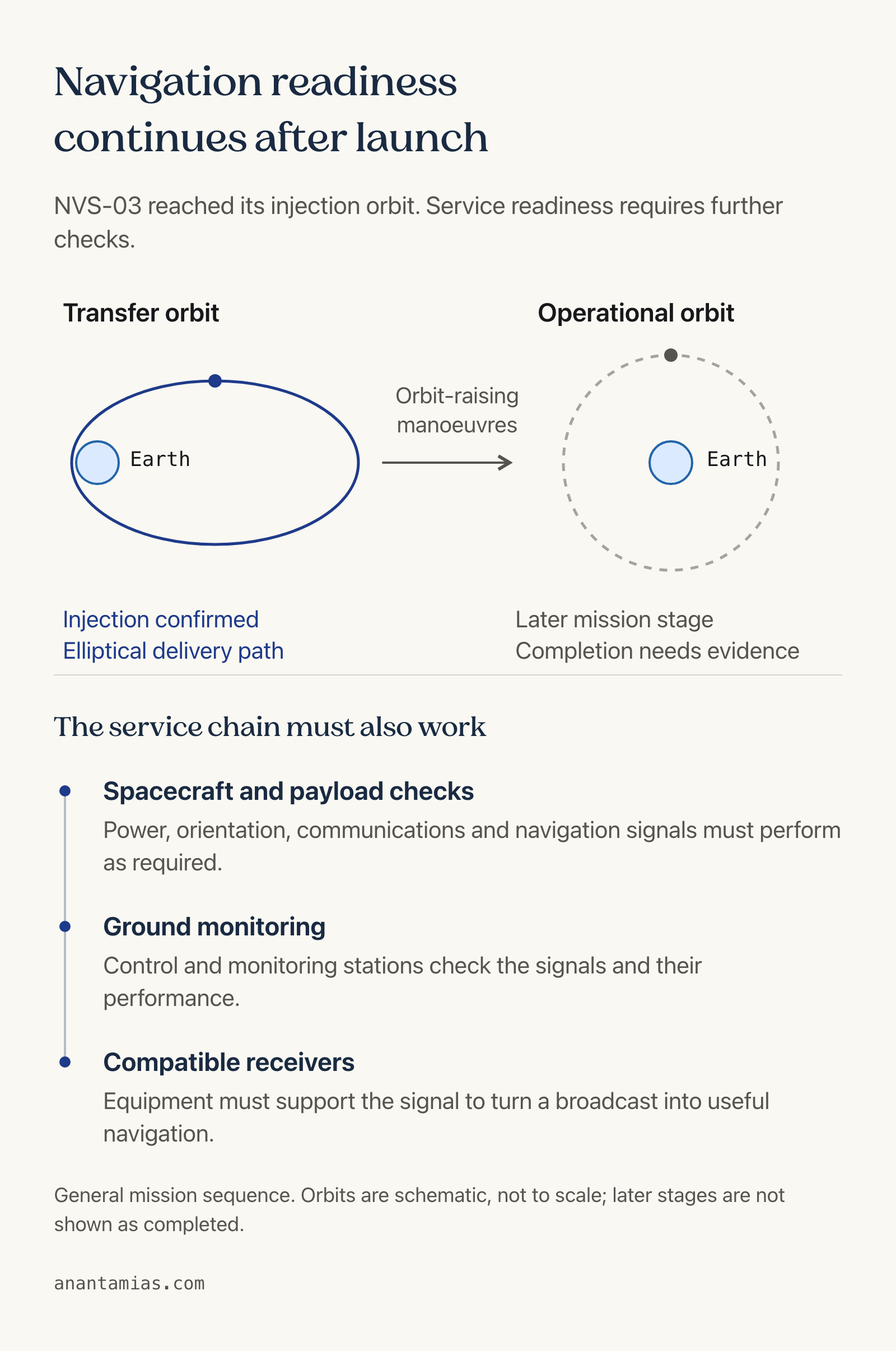
  • Transfer orbit describes a route toward the operational orbit. Its elliptical path has unequal distances from Earth, so being successfully placed there does not mean the satellite already occupies its intended final service orbit.
  • Launch success and spacecraft readiness answer different questions. The first concerns delivery to the injection conditions; the second concerns whether the satellite can complete its own operations and sustain the functions expected of it.
  • Service continuity is the stated purpose of the NVS series. A replacement mission strengthens the programme only when its spacecraft, navigation payload and supporting systems become available for dependable use across the intended service area.
  • The earlier NavIC note explains clock reliability. This launch adds a separate operational question: what evidence shows that newly delivered hardware has progressed from deployment toward usable navigation service?

How a Satellite Moves Toward Service

Orbit raising and in-orbit checks turn a delivered spacecraft into a candidate for operational use; these are distinct engineering tasks.

  • Orbit raising uses controlled propulsion manoeuvres to change the spacecraft’s path. ISRO’s NVS-01 mission description explicitly separated transfer-orbit deployment from subsequent manoeuvres to reach the intended orbit, illustrating the general mission sequence.
  • Spacecraft health must support those operations: power generation, stable orientation and communication with controllers matter after separation. A payload cannot provide a reliable service if the platform carrying it cannot maintain the required operating conditions.
  • Payload verification asks whether navigation signals behave as required in operation. Ground control, precise timing and monitoring stations form part of NavIC’s architecture, linking the satellite’s transmitted signals with the system that checks their performance.
  • Ground monitoring then connects spacecraft performance with service quality. ISRO states that calibrated receivers continuously monitor NavIC signals; the relevant question is what users can reliably receive, rather than whether a satellite merely transmits.
  • Readiness evidence should identify the completed stage and its limits. The distinction resembles propulsion validation: a demonstrated component or mission milestone supports further assessment, without proving every later operating condition.
Schematic comparing an elliptical transfer orbit with an operational orbit, followed by spacecraft checks, ground monitoring and compatible receivers
Transfer-orbit injection precedes later spacecraft operations and navigation-service checks. Orbits are schematic, not to scale; the later stages are not shown as completed.

Why L1 Still Needs Compatible Receivers

A new signal broadens the technical opportunity for civilian use, while practical adoption depends on equipment that can process it.

  • L1 capability is additional to L5 and S in ISRO’s NVS-03 brief. The extra signal gives receiver designers another supported navigation input; it does not mean that every existing device automatically acquires NavIC functionality.
  • Receiver compatibility involves implementing the relevant signal interface. ISRO published the civilian L1 signal-in-space interface document to facilitate user-segment implementation, linking satellite design with the engineering decisions made by equipment and chipset developers.
  • System performance depends on the entire chain: the spacecraft must operate, ground systems must monitor it, and the receiver must process supported signals. Failure at any one stage can limit the usefulness of otherwise successful infrastructure.
  • Regional navigation remains NavIC’s role. Adding a signal band does not by itself convert the constellation into a global service; signal format and geographical service coverage are different design questions with different evidence requirements.
  • Public assessment should follow confirmed milestones: orbit delivery, spacecraft operations, payload verification and service availability. Avoid assigning an unverified completion date or treating reported expectations as a measured restoration of performance for all users.

Way Forward

Report Readiness in Verifiable Stages

  • ISRO should communicate orbit and commissioning milestones with their operational meaning, so launch announcements and user-service availability remain distinguishable.
  • Service agencies should assess receiver compatibility before procurement and verify performance in the environments where navigation will actually be used.
  • Track signal monitoring and service notices alongside spacecraft additions when evaluating the reliability of national navigation infrastructure.

Conclusion

  • NVS-03’s successful launch is a verified advance toward stronger NavIC capability. Transfer-orbit injection establishes delivery; dependable navigation requires the spacecraft, ground systems and compatible receivers to work together through subsequent operational stages.
  • For a Mains answer, assess space infrastructure by service readiness: explain the mission sequence, identify the verified milestone and state what further evidence is needed before claiming full operational restoration.

UPSC Practice Questions

Prelims MCQ 1

With reference to navigation-satellite missions, consider the following statements:

  1. Successful injection into a transfer orbit necessarily establishes completion of operational commissioning.
  2. Orbit-raising manoeuvres can change a spacecraft’s orbit after its separation from the launch vehicle.
  3. An added navigation signal requires compatible receiver implementation to be useful to a user.

How many of the above statements are correct?

(a) Only one (b) Only two (c) All three (d) None

Answer: (b) Only two

Explanation:

Statements 2 and 3 are correct. Transfer-orbit injection is a launch milestone; subsequent spacecraft operations and payload verification are separate from it.

Prelims MCQ 2

Which statement best explains the significance of adding L1 to an NVS navigation payload?

(a) It eliminates the need for ground monitoring. (b) It makes the regional constellation a global system. (c) It guarantees support in every existing mobile receiver. (d) It provides an additional signal that compatible receivers can implement.

Answer: (d) It provides an additional signal that compatible receivers can implement.

Explanation:

L1 adds a supported signal. Receiver implementation, ground monitoring and geographical coverage remain distinct requirements.

UPSC Mains Questions

  1. Explain why a successful navigation-satellite launch should be distinguished from operational service readiness.
  2. How can satellite replenishment, ground monitoring and receiver adoption jointly strengthen the reliability of India’s navigation infrastructure?

Sources: ISRO mission brief and launch inventory and The Hindu.

Frequently Asked Questions

What did the NVS-03 launch achieve?

ISRO confirmed that GSLV-F18 placed NVS-03 into the intended geosynchronous transfer orbit on 30 October. This establishes successful injection, while completed operational commissioning requires separate evidence from later mission stages.

Why is transfer orbit different from the final operational orbit?

A transfer orbit is an intermediate elliptical path. Spacecraft manoeuvres change that path toward the intended operational orbit, after which health and payload checks help establish readiness for routine service.

Does an L1 signal make every phone NavIC-compatible?

No. The receiver must implement the relevant signal interface. Adding L1 expands the supported signal options, while practical compatibility depends on the hardware and software of the receiving equipment.

Has full NavIC service restoration been confirmed here?

The available sources confirm successful launch and report expectations of stronger navigation capability. They do not independently establish completed commissioning and measured restoration for all users, so that outcome remains conditional in this note.

Banking Review: Balancing Credit Expansion With Financial Resilience

Open article →Download PDF

Why in News?

On 30 October 2026, the Union government constituted the High Level Committee on Banking for Viksit Bharat to recommend banking reforms, according to the Ministry of Finance.

  • The committee has a six-month tenure and will recommend structural, institutional, regulatory and legislative changes for the banking sector.
  • Its mandate includes prudential norms, long-term capital needs and differences in the cost of capital faced by businesses.
  • The review covers Priority Sector Lending and the Lead Bank Scheme, alongside institutional frameworks, digital innovation and workforce capacity.
  • The official announcement establishes a review process; it does not announce revised capital ratios, compulsory mergers or new lending targets.
  • Expanding credit access requires institutions that can assess borrowers and withstand losses; a larger loan book alone does not establish a healthier banking system.
  • The review connects financial resilience with inclusion: lending must reach viable underserved borrowers while preserving the institutions entrusted with deposits.

UPSC Relevance

Prelims Relevance

  • Bank capital: resources that absorb losses.
  • Liquidity: capacity to meet payment obligations when due.
  • Priority Sector Lending: a framework directing eligible credit towards specified priority activities and borrowers.
  • Lead Bank Scheme: coordination among banks and development agencies for local credit delivery.
  • Committee recommendations: proposals requiring subsequent action by the competent authorities.

Mains Relevance

GS Paper 3

  • Explain the relationship between bank capital, credit growth and financial stability.
  • Assess how credit allocation and local coordination affect financial inclusion.

GS Paper 2

  • Distinguish expert recommendations from regulatory decisions and legislative change.

Essay

  • Financial inclusion depends on the quality and continuity of access, alongside the availability of credit.

Background and Context

What the Banking Review Can Change

The committee brings several connected banking questions into one review, while leaving the authority to implement each recommendation with the relevant institution.

  • The terms of reference cover banking practices and prudential norms, asking which international approaches suit Indian conditions. Copying another system without considering domestic borrowers, institutions and risks would miss that adaptation requirement.
  • The legal and regulatory review expressly includes Regional Rural Banks and Cooperative Banks. This broad scope matters because improving credit delivery requires attention to different institutional structures, rather than assuming every lender operates identically.
  • The committee will assess long-term capital requirements, including those of Development Financial Institutions and Non-Banking Financial Companies. Its financing question extends beyond commercial bank balance sheets to institutions supporting different kinds of credit demand.
  • The announcement also seeks a roadmap for globally competitive banks. It does not specify that competition must be achieved through mergers, privatization or any particular ownership change; those outcomes cannot be treated as decided.
  • A recommendation identifies a possible course of action. Depending on its subject, implementation may require a regulatory decision, administrative action or legislation; constituting the committee does not itself complete any of these steps.

Why Capital and Credit Growth Must Be Considered Together

A bank needs resources to fund its business and capacity to bear losses; confusing those functions can produce misleading claims about lending capacity.

  • Capital absorbs losses when borrowers fail to repay or assets lose value. The Federal Reserve explains this function as a cushion supporting continued operations and protecting creditors, rather than a stock of unused lending cash.
  • Deposits and capital have different roles: deposits are obligations owed to customers, while capital bears losses. Attracting more deposits does not automatically provide an equivalent increase in the cushion protecting the bank against losses.
  • Liquidity concerns meeting payments when due, whereas capital concerns absorbing losses. A policy assessment should examine both functions because the ability to obtain cash immediately and the ability to withstand losses are separate questions.
  • Prudential standards link expansion to risk-bearing capacity. Easier lending cannot be assessed only through the amount disbursed; loan quality and the capacity to absorb adverse outcomes also affect whether that expansion can be sustained.
  • The review of business funding costs asks a different question: why financing conditions differ across businesses. Reducing an avoidable barrier is useful, but the announcement neither fixes lending rates nor promises identical prices for every borrower.

How Inclusion Depends on Allocation and Coordination

Reaching underserved borrowers involves deciding where credit should flow and resolving practical obstacles between lenders, applicants and local institutions before disbursement can translate into productive use.

  • Priority Sector Lending addresses the allocation of eligible credit to specified activities and borrowers. Reviewing its relevance and effectiveness does not mean existing obligations have been suspended, reduced or replaced by the committee announcement.
  • The Lead Bank Scheme concerns coordination for credit delivery. It brings a local implementation question into the review: whether institutions can identify financing needs and address obstacles that an aggregate lending figure can conceal.
  • The proposed storage-backed credit pilots illustrate why delivery arrangements matter alongside funding. A lending opportunity still needs workable links between borrowers, the underlying activity and institutions responsible for assessing and servicing credit.
  • The AT-1 loss-absorption dispute offers a related caution about institutional authority. Banking policy must distinguish an instrument’s financial purpose from the lawful process governing a particular decision, rather than merging both questions.
  • For an inclusion assessment, ask whether viable underserved borrowers can obtain suitable credit and maintain repayment. Bank size or aggregate lending alone cannot answer that question; the committee explicitly includes effectiveness and coordination in its review.

Way Forward

Evaluate Recommendations Against Identified Barriers

  • Specify the problem and responsible authority for each proposed reform, so that legislative, regulatory and administrative changes have a clear route to implementation.
  • Test credit expansion against loan quality, loss-bearing capacity and borrower needs, rather than treating higher disbursement as sufficient evidence of success.
  • Use the inclusion review to identify local delivery obstacles and assign responsibility for resolving them before changing targets or institutional structures.

Conclusion

  • The banking review links credit expansion, resilience and inclusion. Its significance lies in examining their interaction across institutions; the announcement establishes a process for recommendations rather than a completed package of banking reforms.
  • A useful assessment separates funding, loss absorption and credit delivery. Proposed changes should be judged by which constraint they address, who can implement them and whether borrowers receive sustainable access without weakening institutional safeguards.

UPSC Practice Questions

Prelims MCQ 1

With reference to the banking review committee constituted in October 2026, consider the following statements:

  1. Its mandate includes reviewing Priority Sector Lending and the Lead Bank Scheme.
  2. Its constitution automatically changes prudential capital requirements for banks.
  3. Its capital assessment includes Development Financial Institutions and Non-Banking Financial Companies.

How many of the above statements are correct?

(a) Only one (b) Only two (c) All three (d) None

Answer: (b) Only two

Explanation:

Statements 1 and 3 are expressly covered by the terms of reference. Statement 2 is incorrect: the committee recommends reforms; its constitution does not change capital requirements.

Prelims MCQ 2

Which statement best describes the distinction between bank capital and liquidity?

(a) Capital absorbs losses, while liquidity concerns meeting payment obligations when due. (b) Capital consists entirely of deposits repayable to customers. (c) Liquidity determines which sectors qualify for priority credit. (d) Both refer exclusively to cash held in bank branches.

Answer: (a) Capital absorbs losses, while liquidity concerns meeting payment obligations when due.

Explanation:

Capital and liquidity serve different functions. A loss-absorbing cushion is distinct from the resources needed to meet immediate payment obligations.

UPSC Mains Questions

  1. Why should a banking reform agenda consider credit growth and prudential resilience together? Discuss.
  2. Explain how reviewing Priority Sector Lending and the Lead Bank Scheme can improve the assessment of financial inclusion beyond aggregate credit growth.

Sources: PIB, Ministry of Finance and US Federal Reserve, capital adequacy background.

Frequently Asked Questions

What is the new banking committee expected to do?

It will review the banking sector and recommend structural, institutional, regulatory and legislative reforms. Its mandate includes prudential practices, capital requirements, business financing costs and inclusive credit delivery.

Has the government changed banking capital rules through this announcement?

The announcement constitutes a review committee. It does not itself change capital ratios or lending rules. Any recommendation must subsequently be considered and implemented through the applicable regulatory, administrative or legislative process.

Why is bank capital different from deposits?

Deposits are amounts the bank owes customers. Capital provides a cushion against losses. Raising more deposits can support funding, but it does not automatically create the same amount of additional loss-absorbing capital.

Why review Priority Sector Lending and the Lead Bank Scheme together?

They address connected questions of credit allocation and local delivery. The committee is asked to examine their relevance, effectiveness and coordination in supporting inclusive and balanced access to credit.

Form 7 Objections: Verifying Claims Before Removing Voters

Open article →Download PDF

Why in News?

The Hindu reported that on 30 October 2026, the Supreme Court asked the Election Commission to examine alleged misuse of Form 7 objections during Uttar Pradesh electoral revision and file a compliance report.

  • The petitioner alleged false objector details and forged signatures in applications seeking voter deletions. These remain allegations requiring scrutiny.
  • The Election Commission said officials rejected forms that violated norms and took corrective measures after detecting false submissions.
  • The Court sought further details and a compliance report; the reported hearing does not establish that every challenged objection produced a wrongful deletion.
  • An objection mechanism helps correct inaccurate rolls, but its credibility depends on identifying who made a claim and checking the evidence behind it.
  • Wrongful deletion can exclude an eligible elector. Individual scrutiny protects participation while allowing genuine errors to be corrected.

UPSC Relevance

Prelims Relevance

  • Form 7: objection to proposed inclusion or deletion from an existing electoral roll.
  • Electoral Registration Officer: authority to whom Form 7 is addressed.
  • Objector identification: applicant name, EPIC details and signature or thumb impression.
  • Section 31: liability for knowingly false declarations under the Representation of the People Act, 1950.

Mains Relevance

GS Paper 2

  • Electoral integrity: reconciling accurate rolls with protection against wrongful exclusion.
  • Administrative accountability: evidence, traceability and scrutiny of delegated field work.

Essay

  • Democratic participation depends on fair administrative procedures as well as formal rights.

Background and Context

What a Form 7 Objection Actually Asks For

The application begins a request concerning an electoral entry. Its contents identify a claim that officials must examine before deciding what happens to that entry.

  • The official Form 7 distinguishes objection to proposed inclusion, deletion of an existing entry and removal of the applicant’s own name. Each option concerns a specified elector, rather than an unnamed group.
  • The form lists grounds such as death, under-age registration, shifting, duplicate enrolment and non-citizenship. Selecting a ground records the applicant’s assertion; the tick alone does not establish that assertion as true.
  • The applicant supplies a name, EPIC number and signature or thumb impression. These details matter because an apparently complete form can still be disputed by the person said to have submitted it.
  • The challenged elector is separately identified by name and address, with an EPIC number where available. Keeping applicant and elector details distinct helps officials avoid confusing who objects with whose entry is challenged.
  • The acknowledgement number allows application-status tracking. A receipt proves that an application was received; it cannot by itself prove approval, establish the alleged ground or show that the electoral entry has changed.

Why Identity and Evidence Must Be Checked Separately

The reported dispute concerns the reliability of objections before deletion. Two different questions arise: who submitted the request, and whether its stated ground is supported.

  • The Hindu reported allegations that some named objectors denied filing applications. If established, that would undermine the authenticity of those submissions even before officials examine the eligibility of the voters being challenged.
  • The ECI told the Court that false applications were rejected. That response must be distinguished from the petitioner’s allegations: a court-requested report is a way to examine the competing accounts, not a final factual verdict.
  • The reported ECI affidavit described directions against accepting bulk Form 7 submissions and digitising forms without proper checking. Moving an unchecked paper claim into a database does not improve the reliability of its contents.
  • Objector authenticity and electoral eligibility are separate inquiries. A genuine signature does not establish that a voter has died or permanently shifted; an eligible voter does not make every document bearing their name genuine.
  • An individual case record should connect the application, verification material and eventual decision. This is a practical accountability standard: a count of rejected forms alone cannot explain how a particular challenged entry was handled.

Accountability Should Follow the Individual Decision

A useful response must make the objection traceable and the decision contestable. Roll accuracy and protection against exclusion depend on the same disciplined handling of evidence.

  • The form warns that a knowingly false statement or declaration can attract liability under Section 31. An unsuccessful objection is not automatically a knowingly false declaration; the required state of knowledge must be established.
  • The Electoral Registration Officer is the authority addressed in the application. A field official’s receipt, collection or checking of a form should not be confused with an independent legal power to decide electoral eligibility.
  • As an administrative safeguard, notice and a meaningful opportunity to respond help test disputed claims about residence or eligibility. Officials should document the evidence considered, rather than treating another person’s allegation as the answer.
  • Reinstatement procedures address a later problem. Here, the focus is preventing an unsupported deletion through scrutiny of the objection itself, so that correction does not depend entirely on the affected elector discovering an error.
  • The broader electoral-roll revision process needs both corrections and safeguards. Transparent reasons allow disputed decisions to be examined individually without assuming that all objections are fraudulent or all deletions are justified.

Way Forward

Make Every Objection Traceable

  • Authenticate the submission: check identifying details and investigate a denial by the named objector before relying on the application.
  • Record individual verification: connect the claimed ground with evidence and preserve a clear record of the decision.
  • Explain the outcome: communicate reasons and the applicable remedy so that affected electors can challenge an error promptly.

Conclusion

  • Form 7 is an objection mechanism whose usefulness depends on authentic submissions and verified grounds. Administrative receipt must remain distinct from a decision affecting an electoral entry.
  • For a Mains answer, connect electoral integrity with procedural fairness: scrutiny of the objector, scrutiny of the evidence and accountability for the final decision protect both accurate rolls and eligible voters.

UPSC Practice Questions

Prelims MCQ 1

With reference to Form 7, consider the following statements:

  1. It can be used to object to the proposed inclusion of a name in an electoral roll.
  2. The form is addressed to the Electoral Registration Officer.
  3. An acknowledgement receipt itself establishes that the requested deletion has been approved.

How many of the above statements are correct?

(a) Only one (b) Only two (c) All three (d) None

Answer: (b) Only two

Explanation:

The first two statements are correct. The acknowledgement records receipt and enables status tracking; it does not establish approval of deletion.

Prelims MCQ 2

Which distinction is most relevant when a person denies filing a Form 7 attributed to them?

(a) Authenticity of the objection and eligibility of the challenged elector (b) Election expenditure and parliamentary privilege (c) Counting votes and allocating reserved constituencies (d) Campaign silence and electoral bonds

Answer: (a) Authenticity of the objection and eligibility of the challenged elector

Explanation:

Whether the named objector filed the application is different from whether the challenged voter meets registration requirements. Both questions require appropriate scrutiny.

UPSC Mains Questions

  1. Explain how scrutiny of electoral-roll objections can reconcile roll accuracy with protection against wrongful exclusion.
  2. Why should administrative systems distinguish receipt of an application from verification and adjudication? Discuss with reference to Form 7.

Sources: The Hindu and Election Commission of India.

Frequently Asked Questions

What is Form 7 used for?

Form 7 allows an objection to proposed inclusion, a request to delete an existing electoral entry, or a request to remove the applicant’s own name on the grounds specified in the form.

Did the Supreme Court establish that all alleged wrongful deletions occurred?

The reported hearing involved competing submissions. The Court asked the ECI to examine the issues and file a compliance report; that direction does not establish every allegation as a proven fact.

Does an acknowledgement mean a deletion is approved?

No. The receipt records the application and supplies a number for checking its status. Verification and a decision on the request are distinct from acknowledging that the application was received.

Why check the objector as well as the voter?

A forged application can misrepresent who made the objection. Separately, even an authentic application may contain an unsupported eligibility claim. Checking both helps prevent an unreliable submission from driving an electoral decision.