Opens in a new tab
Join Anantam IAS Channel on Telegram

Daily Digest · Friday

30 October 2026 Current Affairs for UPSC

18 current affairs published on Friday, 30 October 2026

30 October 2026 Current Affairs for UPSC — every Why-in-News article AnantamIAS published on Friday, 30 October 2026, broken down with Why in News?, the exact GS paper it feeds, sub-topic mapping, MCQ-ready facts and a UPSC-style practice question. 18 articles in total, covering Polity, Economy, Environment, S&T, IR, Geography, History, Society and Internal Security — the same Why-in-News + GS-paper-mapping + practice-question format the Compass uses across every daily digest on the site.

Daily current affairs for UPSC is where new material enters your prep stream. Read this 30 October 2026 digest end-to-end in 25–35 minutes, attempt the practice question at the foot of each article (it's MCQ for some, 10/15-marker for others), then bookmark the entries that fall inside your active revision window. Everything stays cross-linked: tap any subject pill to jump to that subject's hub, or use the table of contents above to skip straight to a specific story.

Use this page three ways. Read sequentially for a one-sitting scan of everything that mattered on 30 October 2026. Download the 30 October 2026 PDF below for offline study or print revision. Or use the October 2026 Current Affairs compilation to see this day in the month's full context. For the previous day's reading, see 29 October 2026 Current Affairs; the next day's is 31 October 2026 Current Affairs.

Why we publish daily current affairs separately from the monthly compilation: daily is learning, monthly is revision. Use the daily page to add fresh material to your notes the day it breaks; come back to the October 2026 compilation 60 days before Prelims when the noise has settled and only the lasting takeaway is worth re-reading.

KG Basin Gas Dispute: Subsurface Flow and Legal Entitlement

Open article →Download PDF

Why in News?

The Hindu reported on 30 October 2026 that the Supreme Court appointed former judge Justice Ranjana Prakash Desai as sole mediator in the KG Basin gas migration dispute involving the RIL consortium and Union government.

  • The appointment followed the parties being unable to arrive at a viable solution, according to the report.
  • The Court requested the mediator to take assistance from two domain experts suggested by the parties, reflecting the technical complexity of the dispute.
  • The dispute involves allegations about gas moving from neighbouring ONGC blocks into the consortium’s block; the allegations and their legal consequences remain contested.
  • Mediation is the current procedural development. The appointment does not establish ownership, wrongdoing, compensation or an already completed settlement.
  • Exploration risk, covered in the Samudra Manthan note, concerns financing uncertain discoveries. This dispute concerns the evidence and rights associated with production from neighbouring blocks.
  • Contractual claims require evidence and interpretation, as the highway arbitration note explains. Mediation offers a different route toward resolving disagreement.

UPSC Relevance

Prelims Relevance

  • Reservoir rock: a subsurface formation whose pore spaces can hold fluids, including natural gas.
  • Porosity: the proportion of pore space in a rock; some pores may be isolated.
  • Permeability: the capacity of connected pathways in rock to permit fluid movement.
  • Pressure difference: a driving condition for gas movement through a connected reservoir system.
  • Mediation: assistance toward a negotiated resolution, distinct from adjudication of the merits.

Mains Relevance

GS Paper 3

  • Energy governance: connecting geological uncertainty with responsible administration of hydrocarbon resources.
  • Infrastructure: interpreting technical evidence in disputes involving complex production systems.

GS Paper 2

  • Dispute resolution: distinguishing expert assistance, negotiated agreement and judicial determination.

Essay

  • Scientific explanation and legal entitlement answer different questions about the use of shared natural resources.

Background and Context

Blocks, Reservoirs and Resource Rights

A production block defines an administrative or contractual area, while the shape and connections of rock formations follow geological processes.

  • Block boundaries identify the area covered by an operating arrangement. A line used to allocate rights does not itself create a physical barrier within the rock or determine the extent of a reservoir beneath it.
  • Reservoir rock contains spaces between grains or other openings that can hold gas and liquids. Thinking of a reservoir as a single empty underground chamber obscures why rock properties matter for storage and movement.
  • Connected pore space permits fluids to move through part of a formation. Isolated pores may store fluid without providing an effective flow path, so the existence of gas alone cannot establish communication between two locations.
  • Neighbouring blocks can raise a cross-boundary question where formations may communicate. Whether that occurred in a particular case requires geological and production evidence; proximity on a block map cannot establish the answer by itself.
  • Legal entitlement requires examination of the applicable contractual and regulatory arrangements. A physical explanation of gas movement cannot, on its own, establish permission to produce it or determine whether an operator breached an obligation.

How Pressure and Evidence Affect the Analysis

Gas movement depends on pressure conditions and available pathways, while a dispute requires evidence connecting that general mechanism to the actual field.

  • Pressure differences can drive gas through connected pore spaces toward a producing well. The size of that difference and resistance along the flow path influence how easily the gas moves.
  • Production changes pressure in a reservoir. The US Environmental Protection Agency explains how declining reservoir pressure affects gas flow, illustrating why production conditions must be considered when examining how a field behaves.
  • Rock properties influence the ease of movement. A formation with poorly connected openings behaves differently from one with effective pathways, so a shared geological label does not establish identical flow behaviour throughout the subsurface.
  • Field evidence can include pressure observations, production histories and geological interpretations. Their combined significance matters: a model should explain the observations and its assumptions, rather than simply provide a persuasive picture of an unseen reservoir.
  • Uncertainty remains when observations support more than one interpretation. Experts should identify what the evidence establishes, what it leaves unresolved and how those limits affect estimates of movement, without presenting an allegation as a measured fact.

What Mediation Can Resolve

A mediator helps parties work toward an agreed outcome, while technical experts can clarify the evidence and the points on which disagreement remains.

  • The reported appointment creates a route for renewed engagement after the parties failed to reach a viable solution. It signals an effort to resolve the dispute and does not itself decide the contested claims.
  • Domain expertise can help the parties understand reservoir behaviour, production records and competing interpretations. An expert explanation informs the discussion, but it cannot substitute for examining the contractual basis on which each party asserts rights.
  • Negotiation allows parties to consider how an acceptable resolution could address their competing positions. The mediator facilitates that process; the appointment should not be described as an adjudicated award granting ownership or fixing damages.
  • Adjudication asks a court or arbitral tribunal to determine disputed issues within the applicable legal framework. Mediation instead seeks agreement, so the distinction matters when reporting what a new procedural step has actually accomplished.
  • A settlement, if reached, needs clear terms about the matters resolved and obligations accepted. Until that outcome is established, claims of final closure or a particular compensation entitlement go beyond the reported development.

Way Forward

Build a Common Evidentiary Record

  • Separate the questions: identify the physical movement alleged, the evidence supporting it and the contractual rule relevant to the claimed entitlement.
  • Expose assumptions: present technical interpretations with their limits and explain which observations would distinguish competing accounts.
  • Define the outcome: if agreement emerges, state the liabilities and obligations it resolves without implying that unrelated questions have also been settled.

Conclusion

  • The KG Basin gas dispute shows why resource governance must connect scientific evidence with contractual interpretation. Pressure-driven movement can explain a physical possibility, while entitlement and liability require examination of the governing arrangements and established facts.
  • The mediator appointment advances a process for seeking agreement. Its value lies in clarifying the evidence and competing positions; the reported step should be distinguished from a judgment on wrongdoing or proof that settlement has occurred.

UPSC Practice Questions

Prelims MCQ 1

With reference to gas reservoirs and dispute resolution, consider the following statements:

  1. An administrative block boundary does not automatically form a physical barrier within reservoir rock.
  2. Connected pore spaces can support the movement of gas through a formation.
  3. Appointment of a mediator by a court automatically establishes which party owns the disputed gas.

How many of the above statements are correct?

(a) Only one (b) Only two (c) All three (d) None

Answer: (b) Only two

Explanation:

Statements 1 and 2 are correct. A mediator appointment creates a dispute-resolution process; it does not itself establish ownership or decide the merits.

Prelims MCQ 2

Which approach best assesses a contested claim of gas movement between neighbouring production blocks?

(a) Examine pressure and production evidence alongside the applicable contractual arrangements (b) Assume that proximity alone proves a connected reservoir and wrongful extraction (c) Treat every geological explanation as proof of legal entitlement (d) Regard a mediator appointment as an award of compensation

Answer: (a) Examine pressure and production evidence alongside the applicable contractual arrangements

Explanation:

Technical evidence helps establish what may have occurred. Contractual and regulatory interpretation separately addresses rights and obligations; neither proximity nor a procedural appointment settles both questions.

UPSC Mains Questions

  1. Explain why an administrative boundary may not correspond to a physical boundary within a hydrocarbon reservoir. How should technical uncertainty be handled in resource-governance disputes? (150 words)
  2. Distinguish mediation from adjudication in complex commercial disputes. Discuss how domain experts can assist resolution without determining legal entitlement on their own. (250 words)

Sources: The Hindu and US Energy Information Administration, Natural Gas Glossary.

Frequently Asked Questions

What is the latest development in the KG Basin dispute?

The Hindu reported that the Supreme Court appointed Justice Ranjana Prakash Desai as sole mediator and requested assistance from domain experts. The development concerns the dispute-resolution process, rather than a final determination of liability.

Does a block boundary prevent gas from moving underground?

An administrative boundary does not itself form a barrier within rock. Actual movement depends on geological connections and pressure conditions, which require field evidence rather than an inference from a surface boundary alone.

Why are porosity and permeability different?

Porosity concerns the amount of pore space in rock. Permeability concerns the ability of connected pathways to permit fluid movement. Rock can contain pore space without all of it contributing effectively to flow.

Does a physical explanation establish a right to produce the gas?

No. A geological explanation addresses possible movement. Entitlement and responsibility require separate examination of the governing contracts, regulatory arrangements and established facts relevant to the particular dispute.

Has the mediator appointment settled the allegations?

No. The appointment facilitates a process toward an agreed resolution. It should not be treated as proof of wrongdoing, an ownership decision, an award of compensation or confirmation that a settlement has already been reached.

Child-Safe Chatbots: Regulating Design and Age Assurance

Open article →Download PDF

Why in News?

New York signed legislation on 28 October 2026 restricting unsafe AI chatbot features for minors, with the main provisions taking effect on 1 January 2027 and implementation rulemaking authorised immediately.

  • The law addresses unsafe interaction features, including simulated human emotions, claimed personal relationships and encouragement of secrecy or isolation.
  • Its protection concerns users under 18, while access to the restricted features also depends on establishing adult status through permitted age-assurance methods.
  • Enactment and commencement differ: signing has occurred, but the main obligations are scheduled to operate from January 2027.
  • This is a New York law, not an Indian requirement or a blanket prohibition on every use of artificial intelligence by children.
  • Interaction design raises a different issue from the detection and removal mechanisms discussed in the online child-safety note.
  • AI literacy, addressed in the NCERT classroom module, helps users question outputs; provider responsibilities address how the system itself behaves.

UPSC Relevance

Prelims Relevance

  • Generative AI: systems that produce synthetic content from patterns learned through training.
  • Covered AI companion: the law’s definition includes generative systems offering ongoing, adaptive responses through a natural-language interface.
  • Age assurance: methods for determining whether a user falls within an age category.
  • Purpose limitation: restricting collected information to the purpose for which its use is allowed.
  • Data minimisation: limiting collection and retention to what the relevant task requires.

Mains Relevance

GS Paper 2

  • Child protection: allocating responsibilities between users, families, service providers and enforcement institutions.
  • Governance: combining safety obligations with privacy safeguards and enforceable implementation.

GS Paper 3

  • AI regulation: addressing adaptive interactions and product design rather than treating every AI application as the same risk.

Essay

  • Digital protection requires attention to both what a system says and how it establishes trust.

Background and Context

What Makes an Interaction Unsafe

The law examines features that can shape a user’s relationship with a chatbot, including how the system presents itself and responds over time.

  • Coverage follows function: the definition includes generative systems with natural-language interfaces and ongoing, adaptive responses. It extends beyond products marketed as companions, making the actual interaction more important than the product’s commercial label.
  • Human-like claims include outputs suggesting that the system is human, alive or capable of human emotions. Such claims can affect how a young user understands the speaker and the reliability of its responses.
  • Relationship claims include presenting the system as having a personal, professional or authority relationship with a user. The regulatory concern involves the trust and influence created by that presentation, beyond the accuracy of individual answers.
  • Secrecy and isolation are among the targeted behaviours, including encouragement to avoid appropriate adults or licensed professionals. These restrictions address interaction patterns that can separate a child from available sources of real-world support.
  • Scope has boundaries: specified exceptions cover tightly limited customer-service and technical-assistance uses that cannot respond outside their designated purpose. A rule against unsafe features should not be described as prohibiting all AI services for children.

How Age Assurance Changes Access

The restricted features cannot be offered merely because an operator has avoided asking whether a user is a child.

  • The access condition requires that the user is not a covered minor and that the operator has used permitted methods to establish this status. Unknown age does not independently provide a route around the restriction.
  • Age assurance answers an eligibility question, while identity verification establishes who a person is. Those tasks can overlap, but collecting an extensive identity record is not automatically necessary to determine an appropriate age category.
  • Interim statutory rules apply where the relevant regulations are not yet in effect. They require reasonable methods that guard against circumvention and minimise information retention, setting a baseline while further regulatory arrangements are developed.
  • More than one method must be available under those interim rules. At least one must either avoid reliance on government-issued identification or allow anonymity towards the operator, preserving alternatives for users with different privacy needs.
  • Self-declaration can be relied upon under the interim rules when the user declares minor status. A simple claim of adulthood does not satisfy that exception, preventing an adult-status checkbox from becoming the sole access control.

Privacy and Enforcement Must Work Together

A safety check can create a separate privacy problem if the information collected for it becomes a lasting record of the user.

  • Purpose limitation restricts age-determination information to that task. The check does not provide a general permission to reuse the information for marketing, personalisation or unrelated profiling merely because the operator obtained it during access verification.
  • Deletion is required immediately after an age-determination attempt, except where retention is necessary for applicable legal compliance. The exception should be read with its stated purpose, rather than as permission for routine indefinite storage.
  • Implementation quality involves both reliable checks and restrained data handling. A practical assessment should ask whether users can bypass the control and whether the chosen method exposes more personal information than the eligibility decision requires.
  • The Attorney General can seek court remedies including injunctions, restitution, damages and civil penalties for violations. These are enforcement powers; enactment alone does not establish a violation, an awarded payment or successful compliance by any provider.
  • Commencement governs timing: the main law begins in January 2027, while preparatory rulemaking is authorised immediately. Administrators and providers must distinguish arrangements being prepared from obligations already operating and results subsequently demonstrated through enforcement.

Way Forward

Test Safety and Privacy in the Same Review

  • Examine real interactions: test whether repeated conversations generate restricted relationship claims or encourage secrecy, including after users change how they phrase requests.
  • Check age controls: assess circumvention, available alternatives and the treatment of users whose adult status has not been established.
  • Audit information handling: verify purpose limits, deletion and any claimed legal-retention exception, while keeping complaints and remedial responsibility identifiable.

Conclusion

  • Child-safe chatbot regulation concerns interaction design, access conditions and enforcement. New York’s approach connects restrictions on unsafe features with age assurance, while limiting what operators may do with the information collected for that check.
  • Judge implementation separately from enactment: the main provisions begin in January 2027. The useful policy question is whether providers can protect young users through reliable controls without turning age verification into an unnecessary source of personal-data exposure.

UPSC Practice Questions

Prelims MCQ 1

With reference to New York’s enacted AI-companion legislation, consider the following statements:

  1. Its main provisions take effect on 1 January 2027.
  2. It prohibits every possible use of AI by persons under 18.
  3. Under the interim rules, a user’s self-declaration of adulthood alone is sufficient for access to restricted features.

How many of the above statements are correct?

(a) Only one (b) Only two (c) All three (d) None

Answer: (a) Only one

Explanation:

Only statement 1 is correct. The law targets specified unsafe features, with defined scope and exceptions. The interim self-declaration exception concerns declaring minor status, not establishing adulthood.

Prelims MCQ 2

Which arrangement best combines an age-assurance check with purpose limitation?

(a) Retaining all identification information indefinitely for future advertising (b) Reusing age-check information to build a detailed personal-interest profile (c) Allowing only a self-declared adult-status checkbox to access restricted features (d) Using information for the age determination and deleting it after the attempt, subject to necessary legal compliance

Answer: (d) Using information for the age determination and deleting it after the attempt, subject to necessary legal compliance

Explanation:

The law limits age-determination information to that purpose and requires immediate deletion after the attempt, with an exception where applicable legal compliance makes retention necessary.

UPSC Mains Questions

  1. Explain how regulating the design of AI interactions differs from removing harmful online content. What implementation challenges arise when services provide adaptive responses? (150 words)
  2. Discuss how child-protection rules for digital services can combine age assurance with privacy safeguards. Use New York’s approach as a comparative example. (250 words)

Sources: Governor of New York, 28 October 2026 and New York Senate, enacted S9051B text.

Frequently Asked Questions

When do the main New York chatbot provisions take effect?

The legislation was signed on 28 October 2026, but its main provisions take effect on 1 January 2027. Necessary implementation rulemaking is authorised immediately, so enactment and operational commencement must be distinguished.

Does the law ban all AI use by children?

No. It restricts specified unsafe interaction features within its defined scope and includes exceptions for certain limited-purpose systems. It should not be described as a general prohibition on every AI application used by minors.

Is government-issued identification the only possible age-assurance method?

No. The interim rules require multiple methods, including at least one that avoids government-issued identification or permits anonymity towards the operator. A self-declaration of adulthood alone does not satisfy the interim self-declaration exception.

Can information from an age check be reused for advertising?

Age-determination information is restricted to that purpose and must be deleted immediately after the attempt, except where retention is necessary for applicable legal compliance. Collection for safety does not authorise unrelated commercial reuse.

Does this create a new legal obligation for Indian chatbot users?

This is a New York law with its own territorial scope. It provides a comparative example for Indian discussions about child safety, age assurance and privacy; it does not itself establish an Indian legal requirement.

Women at Work: Safety Duties and Equal Occupational Choice

Open article →Download PDF

Why in News?

The Hindu reported on 30 October 2026 that the Kerala High Court had struck down a rule excluding women from toddy-shop employment, rejecting blanket exclusion as a way to ensure workplace safety.

  • The challenge concerned a provision of the Kerala Abkari Shops Disposal Rules that prohibited employing women in any capacity in a toddy shop.
  • The petitioner had been denied employment because of the sex-based restriction, according to the report.
  • The State defended the restriction on safety grounds, referring to remote locations and the risk of exploitation.
  • The reported ruling connects the State’s protective responsibility with women’s freedom to choose work; it does not dispense with lawful licensing and safety conditions.
  • Access to employment involves more than a vacancy: legal eligibility and practical mobility both matter, as the note on women’s mobility explains.
  • Safety administration, discussed in the women’s safety advisory, remains necessary when an exclusionary employment rule is removed.

UPSC Relevance

Prelims Relevance

  • Article 14: equality before law and equal protection of laws.
  • Article 15: restrictions on State discrimination against citizens on specified grounds, including sex.
  • Article 19(1)(g): citizens’ occupational freedom, subject to the Constitution’s permitted restrictions.
  • Article 21: protection of life and personal liberty.
  • Judicial review: examination of a legal restriction against constitutional requirements.

Mains Relevance

GS Paper 2

  • Fundamental rights: evaluating protective restrictions that exclude women from economic opportunities.
  • Governance: designing enforceable workplace safeguards while preserving meaningful access to employment.

GS Paper 1

  • Society: occupational stereotypes, women’s agency and barriers to paid work.

Essay

  • Protection should expand the choices people can exercise safely.

Background and Context

What the Reported Ruling Changes

The immediate issue was a legal barrier to employment, rather than a finding that every workplace condition had become safe.

  • The challenged prohibition excluded women from every capacity in a toddy shop. It operated before an employer could assess an applicant’s suitability for a particular task, making sex itself the obstacle to consideration.
  • The State’s protective explanation concerned exploitation and remote workplaces. Those concerns require attention, but excluding the people exposed to risk can leave the underlying workplace problem unresolved while removing their opportunity to earn.
  • The reported judicial response places responsibility on the State to secure a safe working environment. That responsibility cannot be treated as fulfilled simply because women have been prevented from entering the industry concerned.
  • Removing a particular exclusion does not automatically appoint the petitioner, guarantee every applicant a job or invalidate every employment condition. The immediate constitutional question concerns the barrier created by the challenged rule itself.
  • The distinction also preserves regulatory scope: equal access to employment is separate from an unrestricted claim to operate a liquor business. The reported ruling does not abolish Abkari licensing or other lawful operational requirements.

Equality and Occupational Choice

Constitutional scrutiny asks whether the restriction respects rights and whether its justification addresses the actual problem without relying on stereotypes.

  • Articles 14 and 15 provide the equality and non-discrimination framework for examining State action. A rule that classifies applicants by sex requires constitutional justification; describing its purpose as benevolent does not settle that question.
  • Article 19(1)(g) protects citizens’ occupational freedom within the constitutional framework. Reasonable restrictions in the public interest and relevant qualifications remain possible, so occupational choice should not be described as an unlimited exemption from regulation.
  • Life and personal liberty are protected by Article 21. In this dispute, the reported concern for women’s safety must be considered alongside their ability to make decisions about work, rather than assuming protection requires exclusion.
  • Substantive equality considers how a rule operates in practice. Identical treatment is not always sufficient, but a restriction that closes an occupation to women can reinforce the disadvantage it claims to address through protection.
  • Evidence matters when assessing occupational restrictions. The relevant inquiry concerns actual duties and risks, the effectiveness of safeguards and the burden on access; broad assumptions about what women should do cannot replace that assessment.

Make Work Safer While Preserving Access

The administrative task is to address workplace risks through identifiable duties and remedies that allow eligible workers to exercise their choices.

  • Employers should prevent harassment and provide a credible route for complaints. A worker needs to know who will receive a complaint and how it will be addressed without the process becoming another employment barrier.
  • Regulators should specify conditions that address the risks found in the establishment. Clear responsibilities make compliance assessable and help distinguish a genuine safety requirement from an unsupported assumption about a whole category of workers.
  • Task-based assessment should examine what the job actually requires. Relevant qualifications and working conditions can be evaluated directly, allowing decisions to reflect the role rather than treating every woman as unsuitable for every task.
  • Worker agency requires meaningful choices as well as protection. Consulting workers about barriers and safeguards can reveal whether a proposed condition improves access or makes employment impractical while appearing neutral on its face.
  • Implementation review should examine continuing refusals and the reasons given for them. Replacing a formal ban with informal exclusion would preserve the same barrier, even after the legal rule has ceased to justify it.

Way Forward

Review Exclusionary Conditions

  • Identify the risk: state the specific workplace problem and assess whether the proposed condition addresses it.
  • Assign responsibility: make employers and regulators answerable for enforceable safeguards and effective complaint handling.
  • Examine access: review recruitment and implementation to ensure that removal of a legal barrier produces a real opportunity to seek work.

Conclusion

  • The reported Kerala ruling shows why protective intent cannot alone justify occupational exclusion. A State responsible for women’s safety must examine how its rules affect their ability to seek work and make economic choices.
  • Equal occupational choice and workplace safeguards need to operate together. The practical test is whether the legal and administrative response addresses actual risks while preserving access under lawful qualifications, licensing and safety requirements.

UPSC Practice Questions

Prelims MCQ 1

With reference to occupational equality, consider the following statements:

  1. Article 15 addresses State discrimination against citizens on specified grounds, including sex.
  2. A protective purpose automatically makes every sex-based employment restriction constitutionally valid.
  3. Citizens’ occupational freedom is subject to constitutionally permitted restrictions.

How many of the above statements are correct?

(a) Only one (b) Only two (c) All three (d) None

Answer: (b) Only two

Explanation:

Statements 1 and 3 are correct. Protective intent does not by itself establish that an exclusionary rule satisfies constitutional requirements.

Prelims MCQ 2

Which policy approach best reflects the central distinction raised by the reported Kerala High Court ruling?

(a) Removing all licensing conditions from toddy shops (b) Treating the removal of a ban as a guarantee of employment (c) Addressing workplace risks through enforceable safeguards while assessing applicants under lawful job requirements (d) Retaining every blanket exclusion whenever the State describes it as protective

Answer: (c) Addressing workplace risks through enforceable safeguards while assessing applicants under lawful job requirements

Explanation:

The issue is how to secure safety without using a categorical employment exclusion as the substitute. Licensing, valid qualifications and safety duties can remain.

UPSC Mains Questions

  1. Explain how protective employment restrictions can conflict with substantive equality. Discuss the role of evidence and worker agency in evaluating such restrictions. (150 words)
  2. How can the State secure workplace safety while preserving women’s access to employment? Discuss the respective responsibilities of regulators and employers. (250 words)

Sources: The Hindu and Legislative Department, Constitution of India.

Frequently Asked Questions

What did the Kerala High Court rule, according to the report?

The Hindu reported that the Court struck down a provision excluding women from toddy-shop employment. The report connects the decision with equality, occupational choice and the State’s duty to ensure workplace safety.

Does the ruling remove all Abkari licensing requirements?

No. The reported decision concerns a sex-based employment restriction. It should not be read as abolishing licensing, valid qualifications or safety conditions, or as creating an unrestricted entitlement to operate a liquor business.

Why can a protective rule undermine equality?

A rule can respond to risk by excluding the people it claims to protect. That may remove economic opportunities while leaving the underlying workplace problem unresolved. Protective intent must be examined alongside the restriction’s effects.

Does equality require identical conditions in every occupation?

No. Relevant duties, qualifications and working conditions can justify different requirements. The question is whether the distinction rests on a constitutionally defensible assessment rather than a stereotype or a blanket assumption about women.

Does striking down the restriction guarantee a job?

No. Removing a legal barrier permits access to consideration under applicable requirements. It does not automatically appoint an applicant, prove that an establishment is safe or eliminate the need for enforcement against continuing exclusion.

Narmada Settlement: Making Inter-State Cost Sharing Work

Open article →Download PDF

Why in News?

PIB reported on 29 October 2026 that a 27 October meeting of the Review Committee for Narmada Control Authority approved payment arrangements under the Narmada cost-sharing settlement.

  • The committee adopted the Attorney General’s opinion and the Memorandum of Agreement signed on 7 July 2026 by Gujarat, Madhya Pradesh, Maharashtra and Rajasthan.
  • The arrangement addresses pending inter-State dues, claims and financial liabilities connected with construction cost sharing for the Sardar Sarovar Project.
  • Payment modalities were approved for outstanding dues of Narmada Water Disputes Tribunal award projects within the financial year 2026-27.
  • The release confirms adoption and payment arrangements. It does not provide evidence that all outstanding amounts have already been transferred.
  • Water finance includes different obligations: the rural water maintenance note concerns local upkeep, while this development addresses inter-State construction liabilities.
  • Restoration costs, discussed in the Jojari river case, arise from a different accountability problem. A financial settlement must be assessed against the liabilities it actually covers.

UPSC Relevance

Prelims Relevance

  • NWDT: Narmada Water Disputes Tribunal, whose award provides the underlying adjudicatory framework.
  • NCA: Narmada Control Authority, associated with implementation of the Narmada arrangements.
  • RCNCA: Review Committee for Narmada Control Authority, the forum that adopted the agreement and approved payment modalities.
  • Memorandum of Agreement: a negotiated instrument recording the participating parties’ agreed arrangements.
  • Cost sharing: division of financial responsibility for infrastructure serving more than one jurisdiction.

Mains Relevance

GS Paper 2

  • Federalism: translating inter-State commitments into sustained administrative cooperation.
  • Governance: distinguishing adjudication, negotiated settlement and implementation accountability.

GS Paper 3

  • Infrastructure finance: managing shared project liabilities through reconciled accounts and executable payment arrangements.

Essay

  • Cooperation becomes credible when public institutions can carry an agreement through to implementation.

Background and Context

Why Shared Projects Need Cost Rules

A river project can serve several jurisdictions even when its physical works are concentrated in one place, creating financial responsibilities that cross State boundaries.

  • Shared infrastructure separates the location of construction from the reach of its benefits. When several States participate in a project, administrative arrangements must explain how their financial obligations relate to the agreed undertaking.
  • Construction expenditure and the amount owed by another participant are different accounting questions. The project authority must identify the relevant cost and the basis on which a share becomes payable by a particular State.
  • Outstanding dues arise when an obligation remains unpaid or its amount is contested. Resolving such differences requires agreement about the claims being covered, rather than merely repeating that the project benefits several States.
  • Sardar Sarovar is the project identified in the current release. The adopted arrangement addresses construction cost-sharing disputes through a one-time settlement of pending dues, claims and financial liabilities among the participating States.
  • Scope matters when interpreting the announcement. A settlement of financial liabilities does not, by itself, establish revised water allocations or resolve every environmental, rehabilitation and operational question associated with a large river project.

From an Award to an Agreement

Adjudication supplies a framework, while implementation institutions and negotiated arrangements help the participating governments carry its obligations into practical administration.

  • A tribunal award provides an adjudicatory basis for the arrangements it determines. Execution still requires administrative work, including records, coordination and decisions about obligations arising during the life of the project.
  • Implementation institutions connect that framework with continuing project administration. Their role makes the quality of inter-State records and coordination important even after an underlying dispute has received an adjudicatory answer.
  • The Review Committee adopted the Attorney General’s opinion and the July agreement at its October meeting. The reported development concerns acceptance of the financial settlement and payment modalities within the existing institutional arrangement.
  • A negotiated settlement can narrow disagreement by recording what participating governments accept as the basis for resolving pending claims. Its usefulness depends on clear scope and implementation, rather than the existence of signatures alone.
  • Adoption and execution remain separate stages. The October decision advances the July agreement toward payment, but the public release does not supply transaction records demonstrating that every outstanding liability has been discharged.

What Makes Payment Arrangements Work

A financial settlement becomes operational when each party can identify its obligation, authorize payment and reconcile the resulting entries with the other parties.

  • Reconciled accounts should establish which claims are included, the amount accepted and the records supporting that amount. Differences between the payer’s and recipient’s books need resolution before either treats a liability as closed.
  • A payment schedule connects the accepted liability with administrative deadlines. The announcement places payment within the financial year, while evidence of completion must come from subsequent execution and confirmation by the parties concerned.
  • Treasury follow-through requires the competent authorities to carry out the approved arrangement through applicable financial procedures. Approval in a joint forum alone cannot demonstrate that money has moved between the relevant accounts.
  • Confirmation of receipt closes an important accounting loop. A payment instruction, an actual transfer and recognition of that transfer against the correct liability are distinct records that should agree before settlement is considered complete.
  • Cooperative federalism requires a route for handling residual differences without reopening every settled question. Defined responsibility, shared records and regular review can help participating governments identify delays and correct implementation errors.

Way Forward

Track Settlement Through to Closure

  • Reconcile the obligation: maintain a common record of accepted claims, responsible parties and supporting accounts.
  • Verify execution: review actual transfers and acknowledgements against the approved payment arrangement, with responsibility assigned for unresolved entries.
  • Report within scope: distinguish completed payments from pending obligations and keep unrelated water, environmental or rehabilitation issues separately identifiable.

Conclusion

  • The Narmada cost-sharing settlement illustrates the administrative work needed after an inter-State agreement. An award, an accepted settlement and completed payments each answer a different question about how shared infrastructure obligations are carried out.
  • Judge implementation through records: clear liabilities, authorized transfers and reconciled receipt provide evidence that cooperation has produced a financial result. The current announcement confirms the approved arrangement; subsequent execution remains the relevant measure of completion.

UPSC Practice Questions

Prelims MCQ 1

With reference to the recently reported Narmada cost-sharing settlement, consider the following statements:

  1. The October Review Committee meeting adopted an agreement that had been signed in July 2026.
  2. The public announcement confirms that all outstanding payments have already been completed.
  3. The financial settlement itself establishes revised allocations of Narmada water among the States.

How many of the above statements are correct?

(a) Only one (b) Only two (c) All three (d) None

Answer: (a) Only one

Explanation:

Only statement 1 is supported. The release reports adoption of the agreement and approval of payment modalities; it does not establish completed payments or revised water allocations.

Prelims MCQ 2

Which evidence most directly demonstrates completion of an agreed inter-State project payment?

(a) A statement that the project benefits several States (b) A meeting approving the general payment arrangement (c) A signed agreement without subsequent financial records (d) Matching transfer, receipt and liability-reconciliation records

Answer: (d) Matching transfer, receipt and liability-reconciliation records

Explanation:

Execution is established through financial records showing that the payment occurred, was received and was credited against the correct obligation. Approval and agreement are earlier stages.

UPSC Mains Questions

  1. Why can inter-State infrastructure disputes continue after an adjudicatory framework has been established? Explain the administrative role of cost-sharing agreements. (150 words)
  2. Using the Narmada cost-sharing settlement as context, discuss how financial accountability can strengthen cooperative federalism. (250 words)

Source: PIB, Ministry of Jal Shakti.

Frequently Asked Questions

What did the October Narmada meeting approve?

The Review Committee adopted the Attorney General’s opinion and the July agreement, and approved payment modalities for outstanding dues associated with Narmada Water Disputes Tribunal award projects.

Was a new agreement signed in October?

The reported October decision adopted the Memorandum of Agreement signed on 7 July 2026. It advanced that earlier agreement through approval of payment arrangements, rather than announcing a new October signing.

Does approval mean that all outstanding dues have been paid?

No. The release confirms the arrangement and the financial-year payment objective. Actual completion requires subsequent evidence of transfers, receipt and reconciliation against the liabilities covered by the settlement.

Did the settlement change Narmada water allocations?

The release addresses pending financial dues, claims and construction cost-sharing liabilities. It does not establish revised water allocations or the closure of every environmental, rehabilitation or operational dispute.

Why is this relevant to cooperative federalism?

Shared infrastructure creates obligations that governments must implement together. Agreed liabilities, reliable records and verified payments allow cooperation to continue beyond meetings and signed documents, while making delays and unresolved differences identifiable.

Electricity Distribution: Competition, Network Costs and Cross-Subsidies

Open article →Download PDF

Why in News?

The Indian Express reported on 29 October 2026 that Haryana’s regulator had halted further action on a parallel electricity distribution licence after State government directions, reopening debate over competition and utility finances.

  • The report describes the Haryana Electricity Regulatory Commission deciding on 28 October not to proceed further with the licensing process for Eleven Power after its earlier approval.
  • The proposed entry concerned Gurugram and Nuh. Existing State distribution companies raised concerns about revenue, continuing costs and the financing of subsidised supply.
  • The Centre’s shared-network approach remains a proposal; draft policy and legislative changes must not be treated as an already operational national framework.
  • Consumer choice can encourage better service, but its effects depend on network access, cost recovery and the treatment of consumers who remain with the incumbent.
  • Network capacity matters alongside electricity procurement, as the data-centre planning note explains through the link between demand, grid infrastructure and reliable connections.
  • Generation choices, including the agrivoltaics debate, address electricity production. Distribution reform concerns the separate task of delivering and selling that electricity to consumers.

UPSC Relevance

Prelims Relevance

  • Distribution licensee: an entity authorised to distribute electricity in a specified area.
  • Parallel licensing: more than one distribution licensee operating in the same area under the applicable conditions.
  • Wheeling charge: a regulated charge associated with using another entity’s electricity network.
  • Cross-subsidy: tariff revenue from one consumer category helping support another category.
  • Fixed costs: obligations that do not disappear immediately when sales or customer numbers decline.

Mains Relevance

GS Paper 3

  • Infrastructure: balancing electricity competition with efficient network investment and financial sustainability.
  • Inclusive growth: protecting affordable access while changing the distribution sector’s revenue model.

GS Paper 2

  • Regulation: coordinating State policy, regulatory decisions and clearly assigned service responsibilities.

Essay

  • Competition in essential services works through the institutions that allocate costs and protect access.

Background and Context

Who Supplies Power and Who Owns the Network

Electricity distribution combines physical infrastructure with a commercial relationship, and a reform can change one without transferring the other.

  • The distribution network includes local lines, transformers and associated equipment that carry electricity towards consumers. These assets require investment and maintenance even when a customer changes the company responsible for the electricity bill.
  • A distribution licence authorises an entity to operate within its specified area and conditions. It is different from ownership of every asset used to deliver electricity, which must be established through the applicable arrangements.
  • Parallel licensing allows more than one licensee in an area. The Electricity Act’s existing framework discussed in the report includes distribution through each licensee’s own system, making infrastructure duplication an important concern for regulators.
  • State policy directions formed the immediate context in Haryana. Section 108 concerns written directions on policy involving public interest; it should not be read as an unrestricted power to control every individual regulatory determination.
  • The current procedural stage matters: the report describes a halt after an earlier approval. It does not establish that the entrant has begun supplying consumers or that the proposed national shared-network framework is already law.

How Shared-Network Competition Would Work

The proposed approach seeks to introduce additional suppliers while allowing them to use existing distribution infrastructure through regulated access arrangements.

  • Network ownership would remain with the existing licensee under the approach described in the report. An incoming licensee could use that network against regulated charges, with the option of permitted investment in its own infrastructure.
  • Wheeling charges would pay for network use. Their design matters because a charge set too low can weaken maintenance funding, while an excessive charge can obstruct entry and leave consumers with little effective choice.
  • Avoiding duplicate assets can reduce unnecessary expenditure on additional poles, lines and substations. Savings are possible where existing capacity can serve demand, but new connections and congestion may still require additional investment in the system.
  • Equal access conditions are necessary for meaningful competition when one business controls infrastructure used by another. Connection procedures, capacity information and treatment of network constraints should be clear enough to prevent discriminatory delays or unexplained refusals.
  • Service responsibility needs an identifiable owner. Consumers must know who handles billing disputes, meter problems and outages, while suppliers and network operators need enforceable arrangements for maintenance and restoration when their respective responsibilities intersect.

Why Cross-Subsidies and Fixed Costs Matter

A supplier losing customers may retain costs and obligations, especially when the departing consumers contributed disproportionately to its revenue.

  • Cross-subsidy allows revenue from some consumer categories to support others. In the Haryana dispute, existing utilities argued that losing higher-paying commercial or industrial consumers could weaken the revenue supporting household and agricultural supply.
  • Cream-skimming describes the risk of an entrant concentrating on more profitable customers. Whether it occurs depends on licence conditions and market design; it is a regulatory concern to assess, not an inevitable result of private entry.
  • Continuing fixed costs may include contracted capacity payments, staff and network maintenance. These obligations cannot always shrink as quickly as electricity sales, so migration can leave the incumbent recovering them from a smaller revenue base.
  • Affordability pressures can then move elsewhere: remaining consumers may face higher charges, or government may need to provide greater budget support. Neither outcome is automatic; efficiency gains, financing rules and transition arrangements affect the result.
  • The useful test is whether reform improves service and efficiency while sustaining access for less profitable consumers. Counting suppliers alone cannot establish success; tariff design, investment, complaint handling and reliable supply also need examination.

Way Forward

Set the Cost and Service Rules Before Entry

  • Identify continuing costs: assess existing obligations and explain how an entrant, the network owner and remaining consumers would share the transition burden.
  • Specify access and accountability: publish network-use conditions and assign responsibility for connection, metering, billing and outage restoration.
  • Protect affordable service: make cross-subsidy and budget-support arrangements explicit, then assess performance through service quality and access across consumer groups.

Conclusion

  • Electricity competition depends on more than permission for a second supplier. The network still needs maintenance, existing obligations need financing and consumers need an accountable route for reliable supply and correction of service failures.
  • Haryana’s licensing halt highlights the transition problem. A workable reform must connect entry rules with network charges, continuing costs and affordable access, while preserving the distinction between proposals, regulatory decisions and actual supply.

UPSC Practice Questions

Prelims MCQ 1

With reference to electricity distribution, consider the following statements:

  1. Parallel licensing necessarily means that all competing suppliers jointly own the same distribution assets.
  2. A wheeling charge is associated with the use of an electricity network.
  3. Entry of another supplier automatically eliminates the need to address cross-subsidies.

How many of the above statements are correct?

(a) Only one (b) Only two (c) All three (d) None

Answer: (a) Only one

Explanation:

Only the second statement is correct. Licensing and asset ownership are distinct. Entry does not automatically resolve how cross-subsidies and continuing costs will be financed.

Prelims MCQ 2

Why can the departure of higher-paying consumers create financial pressure on an incumbent electricity distributor?

(a) Every network asset immediately becomes unusable (b) Revenue may fall while fixed obligations and support for other consumer categories remain (c) The regulator automatically cancels all existing supply contracts (d) Electricity generation must cease throughout the State

Answer: (b) Revenue may fall while fixed obligations and support for other consumer categories remain

Explanation:

Customer migration can reduce revenue faster than fixed costs decline. It can also reduce the revenue supporting cross-subsidised consumer categories, depending on the tariff and transition arrangements.

UPSC Mains Questions

  1. Explain the distinction between competition in electricity supply and ownership of distribution infrastructure. What regulatory conditions can make shared-network access effective? (150 words)
  2. Discuss the challenge of reconciling parallel electricity distribution licensing with cross-subsidies, continuing fixed costs and affordable access. (250 words)

Source: Indian Express Explained.

Frequently Asked Questions

What is parallel electricity distribution licensing?

It permits more than one distribution licensee in the same area under applicable conditions. The commercial permission to distribute electricity must be distinguished from the arrangements governing ownership and use of physical infrastructure.

Has the proposed national shared-network framework already taken effect?

The shared-network approach remains part of draft policy and legislative changes. It should not be treated as a uniform new framework already operational across India.

What would an incoming supplier pay for using an existing network?

The proposed approach uses regulated wheeling charges for network access. Such charges need to support efficient operation and maintenance while allowing fair entry and avoiding unjustified costs for consumers.

Why do existing distributors worry about cross-subsidies?

Higher-paying consumer categories can help finance supply to categories paying lower tariffs. If those customers leave while costs remain, the incumbent may face a funding gap unless the transition arrangements address it.

Does more competition necessarily lower electricity tariffs?

No. Outcomes depend on procurement, network charges, investment, efficiency gains and the allocation of existing obligations. Poorly designed entry or duplicated infrastructure can create additional costs instead of delivering lower bills.

Glacial Lake Outbursts: Connecting Lake Monitoring With Downstream Warnings

Open article →Download PDF

Why in News?

Indian Express reported on 30 October 2026 that a glacial lake outburst flood at Shintaphu Lake in Bhutan had prompted alerts for possible downstream effects along the Sankosh river in India.

  • The reported event involved Shintaphu Lake in Bhutan’s Gasa district; alerts concerned possible downstream impacts rather than confirmed flooding throughout the alerted areas.
  • A Kokrajhar district official told Indian Express that water was receding and inundation was not expected there at that point.
  • The report did not establish the lake’s specific breach trigger. General explanations of moraine failure should not be treated as findings about this event.
  • The development highlights cross-border warning needs: a disturbance upstream can require decisions by authorities and communities farther down the river.
  • A flood alert communicates a potential threat; it does not establish the extent of actual inundation or damage.
  • Lake monitoring becomes useful to exposed communities when observations lead to timely, understandable warnings and practical action.

UPSC Relevance

Prelims Relevance

  • GLOF: a sudden release of water from a naturally dammed glacial lake.
  • Moraine: debris deposited by a glacier, which can sometimes form a barrier retaining lake water.
  • Piping: internal erosion caused when seepage removes fine material from a natural barrier.
  • Flood routing: assessment of how a flood moves through downstream channels and potentially inundated areas.
  • Early warning: a connected process involving observation, assessment, communication and action.

Mains Relevance

GS Paper 3

  • Link hazard monitoring with preparedness, evacuation and resilient local communications.
  • Distinguish the background effects of warming from evidence needed to attribute an individual disaster.

GS Paper 2

  • Examine cross-border information sharing and coordination between technical agencies, district authorities and communities.

Essay

  • Scientific observation protects people when institutions can convert knowledge into timely action.

Background and Context

How a Lake Stores Water

A glacial lake becomes a downstream hazard when the conditions holding its water change enough to permit a sudden release.

  • A glacial lake can occur in front of, beside, on or beneath a glacier. Its setting matters because the barrier and the route available for drainage differ between these locations.
  • A moraine contains material left by moving ice, including finer sediment and larger rock fragments. When this debris forms a barrier across a depression, water can accumulate behind it as a lake.
  • Glacier retreat can expose depressions where water collects, while warming changes the wider mountain environment. These background changes explain why monitoring is necessary, but cannot establish what triggered a particular lake outburst.
  • Moraine-dammed and ice-dammed lakes have different retaining structures. A barrier made of loose debris behaves differently from glacier ice, so assessment must identify the actual dam rather than infer it from appearance.
  • A larger lake is not automatically the most dangerous one. Dam condition, surrounding slopes and possible drainage routes matter alongside stored water; lake-area change alone cannot determine the likelihood or consequences of failure.

How a Breach Becomes a Flood

The central process is rapid drainage through or over a weakened natural barrier, followed by movement of water and debris into downstream channels.

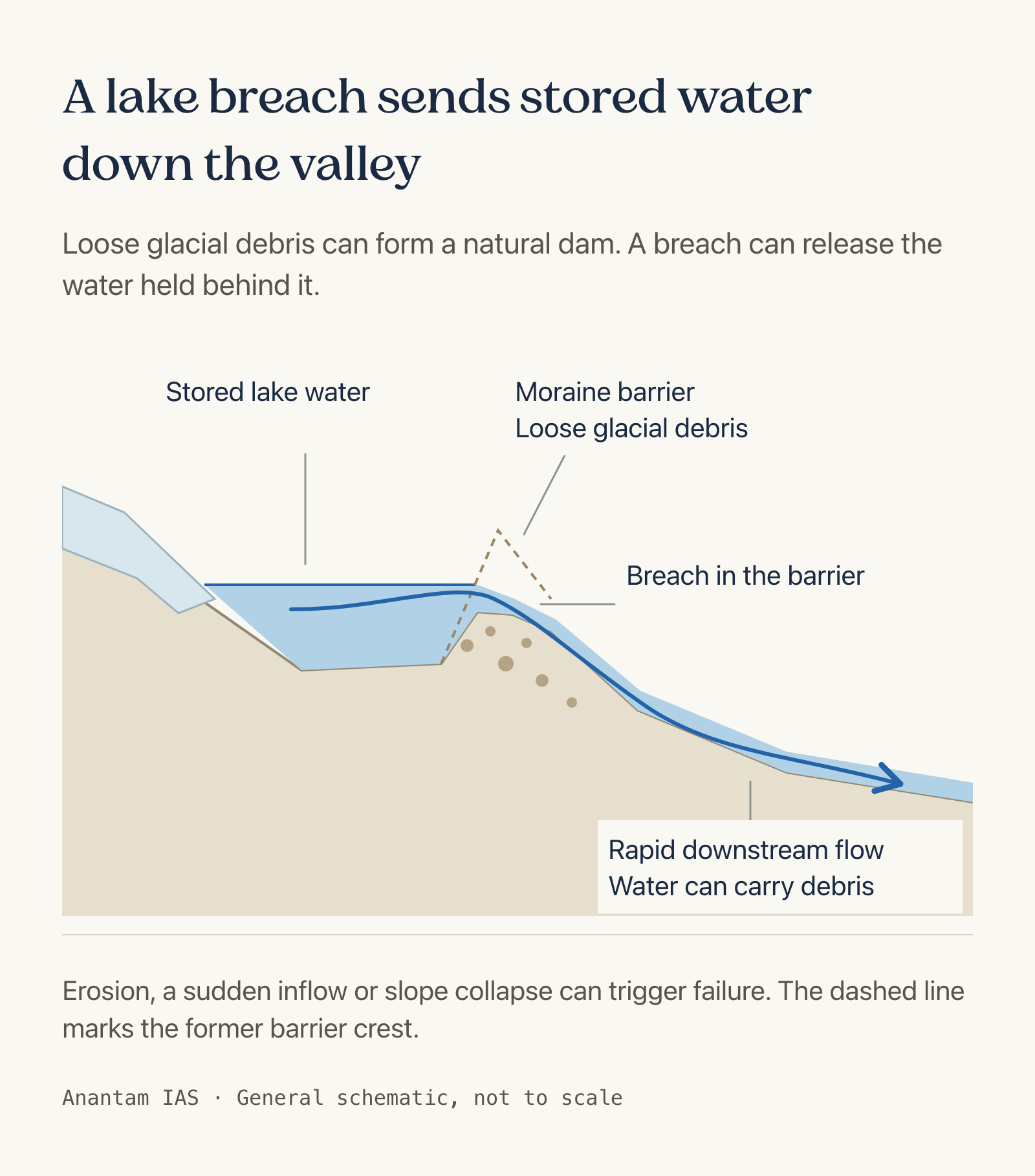
  • Internal erosion can weaken a moraine as water moving through it carries away fine particles. This process, called piping, can enlarge flow paths within the barrier and reduce its ability to retain water.
  • An ice or rock avalanche entering a lake can disturb its water, while heavy rainfall or drainage from another lake can increase inflow. Such disturbances are possible triggers, requiring evidence at each site.
  • Buried ice can form part of a moraine barrier. Melting can alter its structure and stability; this is one possible failure pathway, rather than a universal explanation for every moraine-dammed lake breach.
  • After a breach, rapid release sends water into the valley below. The flow can also move sediment and debris, so downstream assessment must consider the moving material as well as the water itself.
  • Release speed changes the hazard: C-DAC notes that a small lake draining suddenly may produce a more dangerous peak than a larger lake draining gradually. Stored volume alone cannot describe the flood threat.
General cross-section of stored glacial lake water escaping through a breach in a moraine barrier and flowing down a valley
General schematic of a moraine-dammed lake breach, not a reconstruction of the reported Shintaphu event. The dashed line marks the former barrier crest.

From Detection to Evacuation

An early-warning system must connect what happens at the lake with decisions that people downstream can understand and act upon.

  • Water-level sensors provide observations at a monitored lake. Their readings need interpretation alongside knowledge of the barrier and surrounding terrain; an instrument cannot, by itself, determine every possible breach mechanism or downstream outcome.
  • C-DAC describes a Sikkim installation that transmits lake-sensor data through INSAT to a control centre in Gangtok. This illustrates a monitoring link; it does not establish that the same installation covers Bhutan or the Sankosh.
  • Flood models examine possible outburst scenarios, inundation and arrival times. Their outputs depend on the scenario and underlying information, so operational decisions should recognize uncertainty rather than treat one simulated boundary as certain.
  • Warning communication needs designated authorities, understandable messages and a route to exposed settlements. Resilient telecommunications matter because a technically sound forecast cannot support evacuation if its message fails to reach people.
  • For a cross-border river, upstream information must reach downstream authorities with enough context to assess local exposure. Prepared routes, local drills and assistance for people needing support determine whether that information becomes protective action.

Way Forward

Test the Complete Warning Chain

  • Link lake observations, technical assessment and district decisions through named contacts, clear escalation thresholds and routinely tested communication arrangements.
  • Use scenario exercises to check whether an upstream alert reaches exposed communities and whether evacuation routes remain usable under disrupted transport or communications.
  • Connect flood-path assessment with Himalayan carrying-capacity planning so new infrastructure does not increase exposure in vulnerable valley locations.
  • Keep public updates specific about location, expected action and uncertainty, and revise them as observations change instead of leaving an initial alert unqualified.

Conclusion

  • A glacial lake outburst links stored water, barrier failure and downstream exposure. The reported Bhutan event illustrates the need to monitor that chain without assuming that its precise trigger or every downstream impact is already known.
  • Effective early warning requires more than sensors: reliable assessment, communication and prepared local action must work together. For shared river basins, the practical test is whether upstream information reaches the people who may need to move.

UPSC Practice Questions

Prelims MCQ 1

With reference to glacial lake outburst floods, consider the following statements:

  1. A moraine barrier can contain loose material deposited by a glacier.
  2. Piping involves the removal of fine material by water moving through a barrier.
  3. Lake surface area alone is sufficient to determine the downstream flood hazard.

How many of the above statements are correct?

(a) Only one (b) Only two (c) All three (d) None

Answer: (b) Only two

Explanation:

Statements 1 and 2 are correct. Barrier condition, release speed, surrounding terrain and downstream exposure also influence hazard; lake area alone is insufficient.

Prelims MCQ 2

Which approach best completes the chain between monitoring a glacial lake and protecting downstream communities?

(a) Publishing sensor readings without an identified warning authority (b) Treating every simulated inundation boundary as certain (c) Linking observations to assessed warnings, reliable communication and practiced local action (d) Assuming that a larger lake always produces the most dangerous flood

Answer: (c) Linking observations to assessed warnings, reliable communication and practiced local action

Explanation:

Monitoring must support assessment, warning delivery and action. Instruments and models provide inputs, while communication and preparedness determine whether communities can respond in time.

UPSC Mains Questions

  1. Explain how failure of a naturally dammed glacial lake can create downstream flood risk. Why is lake-area monitoring alone insufficient for assessing that risk?
  2. Discuss the institutional and communication requirements for a glacial-lake early-warning system in a river basin shared across national borders.

Sources: Indian Express Explained and C-DAC, Glacier Lake Management and GLOF Early Warning System.

Frequently Asked Questions

What is a glacial lake outburst flood?

A GLOF is a sudden release of water from a naturally dammed glacial lake. Failure or rapid drainage can send water and debris downstream, with impacts shaped by the barrier, terrain and exposed settlements.

Does climate change establish the cause of every GLOF?

Warming and glacier retreat alter the conditions in which lakes and mountain hazards develop. The cause of an individual outburst still needs site-specific evidence about the barrier, inflows, slopes and sequence of failure.

Why can a small glacial lake still be dangerous?

The rate of release matters alongside the volume stored. A small lake draining suddenly can produce a severe flood peak, while downstream terrain and exposure affect the resulting danger to people and infrastructure.

What does an early-warning system need beyond lake sensors?

It needs interpretation of observations, assessment of possible downstream impacts, responsible authorities, reliable communication and prepared local action. Warnings must reach exposed people in a form they can understand and act on.

What was established about the reported Bhutan event?

Indian Express reported an outburst at Shintaphu Lake and downstream alerts along the Sankosh. The reporting did not establish its precise physical trigger, and alerts should not be read as confirmation of inundation everywhere downstream.

Social Security Board: Turning Representation Into Worker Protection

Open article →Download PDF

Why in News?

On 30 October 2026, PIB reported that the Labour Ministry had notified National Social Security Board arrangements for unorganised workers and gig and platform workers under the Code on Social Security.

  • The Union labour minister chairs the arrangements, with representation from governments, workers, employers, aggregators and civil society.
  • The notified responsibilities include scheme recommendations, monitoring, review of State records and scrutiny of expenditure.
  • The Board must meet at least thrice a year; regular meetings create opportunities to review implementation and unresolved administrative problems.
  • The announcement establishes welfare governance. It does not establish that every eligible worker has received insurance, pension or another benefit.
  • Measuring platform work, as discussed in the PLFS redesign proposal, helps describe the workforce; scheme eligibility and benefit delivery require additional administrative decisions.
  • Existing contribution disputes, covered in the ESIC amnesty note, concern a different problem from designing protection for workers outside traditional employment arrangements.

UPSC Relevance

Prelims Relevance

  • Gig work: earning through work outside a traditional employer-employee relationship.
  • Platform work: paid work mediated through an online platform outside a traditional employer-employee relationship.
  • National Social Security Board: a statutory institution for recommending and monitoring relevant welfare schemes.
  • Code on Social Security: separates institutional arrangements from the schemes through which benefits are provided.
  • State records: an administrative input reviewed by the national Board.

Mains Relevance

GS Paper 2

  • Social justice: designing accessible protection for workers with fragmented employment and earnings.
  • Governance: connecting stakeholder representation with funding, records, monitoring and grievance resolution.

GS Paper 3

  • Employment: adapting welfare administration to platform-mediated and other non-traditional work arrangements.

Essay

  • Economic flexibility needs institutions that can carry social protection across changing work arrangements.

Background and Context

Why Worker Categories Matter

The Code recognises different work arrangements because the route through which people earn affects how social protection can reach them.

  • A gig worker earns outside a traditional employer-employee relationship. The category draws attention to work that may not fit a welfare system organised around a stable payroll and a single identifiable employer.
  • Platform work involves an online platform connecting people or organisations for paid tasks or services. The platform mediates the arrangement; using a phone during an ordinary salaried job does not alone establish this category.
  • Unorganised work also extends beyond digital platforms. Welfare design must account for workers whose occupations, payment records and access to formal administration differ substantially from those of app-based delivery or transport workers.
  • Irregular earnings can make fixed, predictable contributions difficult. A scheme designer must consider when workers can pay, how eligibility is maintained and what happens when a person temporarily stops receiving assignments.
  • Legal recognition provides a basis for welfare policy, but does not by itself decide every employment-status dispute. The notification cannot be read as automatically granting every gig worker employee status or provident-fund coverage.

What the Board Can Do

The Board connects worker experience with government decisions through recommendations, advice and oversight, each with a different administrative purpose.

  • Recommendations identify suitable schemes for different sections of workers. They help the government choose what protection to provide, but a recommendation still requires action through the relevant scheme-making and administrative processes before benefits can follow.
  • Representation brings workers, employers, aggregators and governments into the same forum. Their interests may differ over financing and eligibility, making the quality of deliberation and the reasons for decisions important to workable policy.
  • Monitoring concerns Central welfare schemes for the covered groups. A useful review asks whether the intended workers can access protection and where implementation is failing, rather than treating the existence of a scheme as success.
  • State record review links national oversight with the information maintained closer to workers. Incomplete or inconsistent records can obstruct administration; examining their quality helps identify problems that a meeting at the Centre cannot otherwise reveal.
  • Expenditure review examines the use of funds and accounts. It supports financial accountability, while assessment of service delivery must separately establish whether spending produced timely and accessible protection for the workers whom the scheme targets.

How a Scheme Reaches a Worker

Protection becomes meaningful when a worker can establish eligibility, access the promised service and obtain a remedy when administration fails.

  • Scheme design must specify the benefit and its eligibility conditions. A broad statutory commitment to social security leaves practical questions about coverage, exclusions and application procedures to the applicable scheme and implementation arrangements.
  • Financing determines whether the promised protection can be sustained. Administrators need clarity about who contributes, how resources are collected and how payments continue during periods when workers have low or interrupted earnings.
  • Registration creates an administrative record, but enrolment alone cannot prove that a benefit has reached its intended recipient. Applications, approval, access to services and rejected claims need separate attention when assessing the scheme.
  • Portability is a design concern when workers change locations or platforms. Records and procedures should help an eligible person retain access across those changes; the Board notification alone does not establish that such arrangements already function.
  • Grievance handling should make errors visible and correctable. Workers need understandable reasons for denial and a practical route to challenge mistakes, while the Board can use recurring complaints to identify weaknesses requiring government action.

Way Forward

Review Delivery Alongside Enrolment

  • Track access: examine applications, approved benefits, unresolved claims and reasons for exclusion across worker groups.
  • Improve records: give workers a simple route to correct administrative errors and maintain continuity when work arrangements change.
  • Close the review loop: assign responsibility for problems identified in Board meetings and examine subsequent action, with worker representatives able to raise unresolved cases.

Conclusion

  • The Social Security Board gives worker welfare a statutory forum for representation and oversight. Its practical value depends on whether recommendations lead to schemes with clear eligibility, reliable financing and usable delivery arrangements.
  • Assess protection through access: an institution constituted, a worker registered and a benefit received are separate stages. Good administration connects them and makes failures visible enough for workers and public authorities to secure correction.

UPSC Practice Questions

Prelims MCQ 1

With reference to the Code on Social Security and gig workers, consider the following statements:

  1. Gig work is defined in relation to earning outside a traditional employer-employee relationship.
  2. The National Social Security Board can recommend suitable welfare schemes for gig and platform workers.
  3. Constitution of the Board automatically grants provident-fund coverage to every gig worker.

How many of the above statements are correct?

(a) Only one (b) Only two (c) All three (d) None

Answer: (b) Only two

Explanation:

The first two statements reflect the Code’s worker definition and the Board’s recommending function. Constitution of the Board does not automatically confer provident-fund coverage on every gig worker.

Prelims MCQ 2

Which assessment best establishes whether a worker welfare scheme is delivering its intended protection?

(a) Counting only the number of Board meetings held (b) Treating every registered worker as a beneficiary who has received support (c) Assuming that a budget allocation proves successful implementation (d) Examining eligible workers’ access to benefits and the resolution of administrative failures

Answer: (d) Examining eligible workers' access to benefits and the resolution of administrative failures

Explanation:

Meetings, registration and funding are inputs or intermediate steps. Access to benefits and correction of failures provide stronger evidence of delivery.

UPSC Mains Questions

  1. Explain why recognition of gig and platform workers requires changes in the administration of social security. How can representative institutions improve delivery? (150 words)
  2. Discuss the distinction between constituting a welfare institution and ensuring effective social protection. Suggest indicators for assessing implementation. (250 words)

Sources: PIB, Ministry of Labour and Employment and India Code, Code on Social Security 2020.

Frequently Asked Questions

What is the National Social Security Board expected to do?

It recommends suitable welfare schemes, advises the Central Government, monitors relevant Central schemes and reviews State records and expenditure. These responsibilities connect policy formulation with administrative oversight.

Does the notification automatically give every gig worker a pension or insurance?

No. The notification establishes institutional arrangements. Actual access depends on the relevant scheme, its eligibility and financing conditions, registration and functioning delivery procedures. Board constitution alone does not prove that benefits have been received.

How is platform work different from the wider gig-work category?

Gig work involves earning outside a traditional employer-employee relationship. Platform work specifically uses an online platform to connect people or organisations for paid work or services outside such a relationship.

Why does worker representation matter?

Worker representatives can identify practical barriers involving records, eligibility, interrupted earnings and access to services. Their participation makes the forum better informed, but recommendations still require government and administrative follow-through.

What should be measured beyond registrations?

Administrators should examine eligible workers’ access to benefits, processing delays, rejected claims and unresolved grievances. Registration creates a record; it does not independently establish that the promised protection has reached a worker.

Kufri Jamunia: Can new fortified potato variety help with India’s hidden hunger problem?

Open article →Download PDF

Why in News?

Kufri Jamunia is a biofortified, purple-skinned and purple-fleshed potato variety developed by the ICAR-Central Potato Research Institute (CPRI). 

Approved & Officially notified in 2024, it is being promoted by the government to tackle hidden hunger: a form of malnutrition where individuals consume adequate calories but lack vital micronutrients. 

UPSC Relevance: GS-2 Social Justice: Health, Hunger, GS-3 Science and Technology: Biotechnology 

Prelims & Mains: Food Fortification; Kufri Jamunia
image 46

Nutritional Profile of Kufri Jamunia:

Developed by crossing two potato lines MS/8-1148 (high vitamin C) and CP4242 (purple skin and flesh), Kufri Jamunia accumulates higher levels of specific compounds compared to regular white or yellow potato varieties:

  • Vitamin C: ~42.75 mg per 100g (vs. ~23.15 mg in regular potatoes)
  • Anthocyanins: ~42.05 mg per 100g (potent antioxidants responsible for the purple pigment, also found in jamun and blueberries)
  • Iron: ~3.22 mg per 100g (vs. ~0.57 mg in regular potatoes)
  • Zinc: ~2.28 mg per 100g (vs. ~0.28 mg in regular potatoes)
  • Carotenoids: Varies widely by region, ranging from 15.6 µg (Kanpur) to 298.4 µg (Raipur) per 100g in multi-location trials.

Comparison with other CPRI varieties: It contains slightly less zinc than Kufri Neelkanth and slightly less iron than Kufri Manik. 

Potential to Combat Hidden Hunger:

  • High Nutrient Density: Provides significant quantities of iron, zinc, vitamin C, and antioxidants directly through an affordable vegetable base. 
  • Culinary Versatility: CPRI researchers note that its mealy texture makes it adaptable for everyday Indian dishes like curries, parathas, soups, baked goods, and dehydrated flours. 
  • Short Maturity Cycle: Plants mature in roughly 90 days and yield 10-12 tubers per plant, fitting well into existing crop rotations. 
  • Initial Consumer Acceptability: In small-scale sensory panels, the variety scored high on general acceptability (95% rated it good to excellent).

Why Claiming it a “Proven Solution” is Premature?

  • Inconsistent Dietary Consumption: Traditional biofortification targets universal staples consumed daily throughout the year (e.g., rice, wheat, iodised salt). Potatoes are consumed less consistently and vary sharply across regional and seasonal diets. 
  • Cooking and Processing Losses: Micronutrients and anthocyanins degrade depending on preparation methods. Studies on purple potatoes show that steaming or microwaving preserves nutrients better than stir-frying, yet specific data for Kufri Jamunia under diverse Indian cooking styles is lacking.
  • Yield and Economic Viability:
    • Multi-location trials recorded an overall mean yield of 31.96 tonnes per hectare (lower than varieties like Kufri Neelkanth at 36.61 t/ha).
    • Marketable yield sits around 29.19 t/ha versus 33.48 t/ha for Kufri Neelkanth, meaning farmers may require a ~15% price premium over standard wholesale potatoes (~₹17/kg) to maintain equal revenue. 
  • Disease Susceptibility: While showing moderate resistance to late blight in labs, it has proven susceptible in field conditions, requiring higher fungicide input costs.
  • Colour and Market Friction: Purple skin and flesh deviate from traditional consumer expectations, and small trial cohorts (e.g., 64 people) are insufficient to generalise nationwide market adoption. 

Way Forward:

To make biofortified crops like Kufri Jamunia effective policy tools, a multi-pronged strategy is required:

  • Targeted Distribution: Instead of open-market reliance, integrate Kufri Jamunia into public welfare schemes like the Mid-Day Meal Scheme or Anganwadi feeding programs where nutritional intake can be tracked.
  • Seed Subsidies: Since seed potato costs account for 40-50% of cultivation expenses (₹60,000-75,000/hectare), government seed-multiplication programs must subsidise quality planting material for smallholders.
  • Cooking & Bioavailability Research: Conduct localised studies on how traditional Indian cooking (pressure-cooking, deep-frying, prolonged boiling) impacts iron and zinc bioavailability.
  • Awareness Campaigns: Use Farmer Producer Organisations (FPOs) and Krishi Vigyan Kendras (KVKs) to educate consumers on the health benefits of colored functional foods.

Practice Prelims MCQ:

Q. Consider the following statements regarding ‘Kufri Jamunia’, recently in the news:

  1. It is a biofortified potato variety developed by the ICAR-Central Potato Research Institute.
  2. Its purple colour and high antioxidant properties are attributed to the presence of carotenoids exclusively.
  3. It contains significantly higher levels of iron and zinc compared to regular commercial potato varieties.

Which of the statements given above is/are correct?

(a) 1 and 2 only

(b) 1 and 3 only

(c) 2 and 3 only

(d) 1, 2, and 3

Answer: (b)

Explanation: Statement 2 is incorrect because the purple colour and antioxidant properties of Kufri Jamunia come primarily from anthocyanins, not carotenoids exclusively (though it contains carotenoids as well).

Mains Practice Question: 

Q. “Biofortification of staple and regional crops offers a promising decentralised route to combat hidden hunger.” Examine this statement in the context of the newly notified Kufri Jamunia potato variety.

A security deal, but not the end of the Arctic contest

Open article →Download PDF

Why in News?

On September 22, 2026, the U.S., Denmark and Greenland signed a security agreement expanding American military access to Greenland while retaining its existing territorial status. 

  • It follows President Donald Trump’s repeated demands to acquire the island, including threats of force. The agreement provides Trump a diplomatic exit from his acquisition demand while securing an expanded American strategic presence. 
  • For Denmark and Greenland, it reduces immediate pressure over sovereignty, although concerns about long-term autonomy remain.
UPSC Relevance: GS-2 International Relations: International Agreements, Arctic Region 

Prelims: Greenland’s geography, Arctic region, GIUK Gap, NATO, US-Greenland-Denmark Security Agreement

About Greenland:

Geographical features:

  • Location: Geographically part of North America, lying between the Arctic and North Atlantic Oceans.
  • Size: The world’s largest island, excluding continental landmasses such as Australia.
  • Population and capital: Approximately 57,000 people; Nuuk is the capital.
  • Ice cover: Around 80% of its surface is covered by the ice sheet and glaciers. 
  • Map locations:
    • Baffin Bay and Davis Strait lie towards Canada
    • Greenland Sea lies to the east
    • Denmark Strait separates Greenland from Iceland
image 47
image 48

Political status:

  • Greenland is a self-governing territory within the Kingdom of Denmark.
  • It obtained Home Rule in 1979, followed by expanded autonomy under the 2009 Self-Government Act.
  • Its elected Parliament and government administer transferred domestic responsibilities.
  • Denmark retains responsibility for areas including defence, security, monetary policy and overarching foreign policy, while Greenland has specified external-affairs powers.
  • Greenland assumed responsibility for mineral resources in 2010. The Self-Government Act recognises its people’s right to self-determination.

EU distinction: Greenland is outside the EU, but Greenlanders holding Danish nationality are EU citizens. 

Key Provisions of the US-Greenland-Denmark Security Agreement:

The agreement supplements the 1951 U.S.-Denmark Defence Agreement and subsequent arrangements.

(i) Military Expansion:

  • New and Expanded Bases: Allows the U.S. to expand the Pituffik Space Base and build two new military defence facilities at Narsarsuaq (southern Greenland) and Mestersvig (eastern coast). 
  • Operational Sovereignty: Grants broad flyover, landing, and undersea transit rights to U.S. military aircraft and vessels throughout Greenlandic territory and territorial waters.
  • Missile Defence: Integrates Greenland into Western airspace shielding through explicit frameworks for cooperation on advanced defence systems, specifically the proposed “Golden Dome” missile defence system.

(ii) Security & Third-Party Restrictions:

  • Non-NATO Ban: Formally prohibits non-NATO or non-allied nations from establishing a permanent military presence or establishing bases on the island.
  • Defence Continuity: Specifies that if Greenland ever achieves independence, both Denmark and Greenland must ensure the new nation remains inside the NATO alliance, carrying forward these U.S. security obligations.

(iii) Investment & Economic Safeguards:

  • Sensitive Sectors: Bars investors from outside NATO, NATO partners, or the European Union from gaining major influence or control over critical infrastructure and resource extraction/mining.
  • Local Enforcement: Greenland retains the authority to screen and regulate these sensitive investments directly. 

(iv) Governance & Status:

  • Sovereignty: Reaffirms Greenland’s status as a self-governing territory within the Kingdom of Denmark and requires that U.S. actions respect local society and traditions. 
  • Ratification: The pact features no fixed end date, but it requires formal approval from the parliaments of both Denmark and Greenland to enter into force officially. 

Significance of the Agreement: 

  • Diplomatic de-escalation: Provides a negotiated route away from the threat of territorial acquisition. Expands military access and strengthens the U.S.’s influence over Arctic security without acquiring the territory.
  • Protection of territorial status: Enables Denmark and Greenland to preserve the existing constitutional arrangement.
  • Reduced intra-NATO friction: Helps contain a dispute between the U.S. and Denmark, both founding NATO members.
  • Greater Greenlandic participation: Greenland’s inclusion as a signatory acknowledges that its future cannot be negotiated solely between larger powers.

Why is Greenland Strategically Important?

  • Defence of North America: Greenland’s Arctic position makes it valuable for detecting threats approaching North America across polar routes. The U.S. Pituffik Space Base (formerly Thule Air Base) supports missile warning, missile defence, space surveillance and satellite operations.
  • Monitoring the North Atlantic: The Greenland-Iceland-United Kingdom (GIUK) Gap comprises maritime passages connecting Arctic and northern European waters to the broader North Atlantic. Monitoring these passages is important for tracking submarine movements and safeguarding transatlantic lines of communication.
  • Critical mineral resources: The European Commission reported in 2023 that 25 of its 34 identified critical raw materials occur in Greenland. These resources could support clean-energy technologies, electronics and diversification of mineral supply chains. 
  • Emerging shipping opportunities: Accelerating Arctic sea ice melting could increase seasonal access to northern shipping routes, creating interest in ports, logistics and search-and-rescue infrastructure. However, difficult weather, variable ice conditions and limited infrastructure constrain commercial viability. 

The US has concerns about Russian military activity and expanding Chinese engagement in the Arctic. Greenland offers the U.S. a platform for surveillance, logistics and deterrence as the region’s strategic importance increases. 

Major Concerns and Necessary Legal Dimensions:

  • Sovereignty and the threat of force: Article 2(4) of the UN Charter prohibits threats or use of force against a state’s territorial integrity or political independence. While negotiated treaties are structurally valid, public acquisition demands backed by underlying coercion strain the tenets of international jurisprudence.
  • NATO solidarity: Article 1 of the North Atlantic Treaty demands that members settle disputes peacefully. Escalating territorial disputes against Denmark (a founding member of NATO) undermines the foundational solidarity of the alliance. Greenland currently falls within NATO through Denmark. 
  • Dangers of Hyper-Militarisation of the Arctic: Elevating the High North into a heavily fortified missile-defence zone threatens to permanently shut down windows for collaborative polar governance, indigenous welfare protection, and joint climate mitigation.
  • Indigenous rights and environmental costs:  Scaling up radar installations, military airfields, and defensive deep-water assets threatens the delicate ecosystems of the High North and challenges the traditional lifestyles of the native Inuit communities. Striking a balance between the global scramble for minerals and local protections remains delicate. Notably, Greenland does not hold a blanket ban on mining & extraction; its mineral authority actively supports sustainable mining while enforcing a strict prohibition on uranium activities via local legislation passed in 2021.
  • UNCLOS and the Maritime Commons: Under the United Nations Convention on the Law of the Sea (UNCLOS), Arctic waters are strictly partitioned into sovereign territorial seas, Exclusive Economic Zones (EEZs), and the high seas. No individual coastal state or external military power can assert blanket ownership over the Arctic Ocean basin.

The Greenland agreement offers a diplomatic retreat from acquisition threats while expanding American strategic access. Its durability will depend on reconciling Arctic security with sovereignty, Greenlandic self-determination and environmental protection.

Practice Prelims MCQ:

Q. Consider the following statements:

  1. Greenland is geographically part of North America and politically part of the Kingdom of Denmark.
  2. Greenland is a member of the European Union.
  3. The GIUK Gap connects Arctic and northern European waters with the North Atlantic.

Which of the statements given above are correct?

(a) 1 and 2 only
(b) 1 and 3 only
(c) 2 and 3 only
(d) 1, 2 and 3 

Answer: (b) Greenland is outside the EU, although Greenlanders holding Danish nationality are EU citizens.

Mains Practice Question:

Q. With reference to recent security arrangements, evaluate how Greenland reflects the friction between strategic competition, resource exploitation and ecological protection in the Arctic.

SC seeks compensation for Digital Arrest Scam Victims

Open article →Download PDF

Why in News?

The Supreme Court of India ruled during suo motu proceedings that the Reserve Bank of India’s (RBI)  proposed regulatory framework must indemnify cyberfraud victims to the full extent of their losses if an investigation establishes that the crime resulted from a failure of institutional due diligence.

The Court also mandated all State governments to submit exhaustive information on First Information Reports (FIRs), current investigation timelines, and prosecution metrics related to digital-arrest cases.

UPSC Relevance: GS-2 Polity and Governance: Statutory, regulatory, and quasi-judicial bodies (RBI role); Citizen-centric protection mechanisms; GS-3 Internal Security: Cybersecurity 

Prelims: Digital Arrest, Section 43A of the IT Act 2000 

What is Digital Arrest?

A digital arrest is a highly coercive, impersonation-based cyber-psychological crime where syndicates manipulate victims through real-time communication channels.

  • State-Sanctioned Persona: Fraudsters pose as federal or state law enforcement authorities (E.g., CBI, ED, Narcotics Control Bureau, or Police officials).
  • Fabricated Legal Liability: Victims are falsely informed that their national identifiers (Aadhaar, passport) or financial accounts have been implicated in severe transnational crimes like drug trafficking or money laundering.
  • Psychological Confinement: Using authority bias and fear, criminals enforce strict isolation, ordering victims to remain on an uninterrupted video or audio loop under pseudo “digital custody”.
  • Financial Extraction: Under the guise of official asset verification, security deposits, or legal clearance, victims are pressured to transfer their life savings into designated bank accounts.

Indian criminal jurisprudence recognises no statutory or procedural concept known as a “digital arrest.” Law enforcement agencies are legally barred from executing custodial detentions, summonses, or formal interrogations over virtual communication portals or telephone lines.

Key Legal & Regulatory Directives Issued by the Supreme Court:

  • Hard-Coding Institutional Liability: The SC emphasised that general security advisories issued by banks are legally insufficient. The court ordered that the RBI’s regulatory codes must carry explicit, enforceable penal consequences for banks failing to prevent fraudulent fund exfiltration due to relaxed internal safeguards.
  • Mandatory Financial Circuit Breakers: The SC mandated that banking networks deploy advanced technological solutions (including Artificial Intelligence) to establish automated transaction shields:
    • Anomaly Detection: Systems must automatically detect and temporarily freeze transfers that sharply deviate from an individual account holder’s historical profile.
    • Systemic Interdiction: Banks must immediately relay automated security alerts to the nearest law enforcement authority when high-value, uncharacteristic transactions occur.
    • Physical Verification: Banks are expected to institute protocols to confirm the absolute genuineness of a transaction before releasing high-risk held funds.
  • Vetting of the RBI KYC Amendment Directions, 2026: The SC announced it will independently vet and examine the proposed RBI (Know Your Customer) Amendment Directions, 2026 before they are finalised, ensuring they contain strong consumer protection mechanisms.  The Attorney-General stated that these specific directions are scheduled to be notified by November 30, 2026, and fully operationalised across banking institutions by December 31, 2026.

Existing RBI Protection and the Remaining Gap: 

The RBI’s 2017 framework for unauthorised electronic banking transactions provides:

  • Zero customer liability where contributory fraud, negligence or deficiency lies with the bank.
  • Zero liability for specified third-party breaches when reported within three working days of receiving the bank’s communication.
  • Where customer negligence causes the loss, the customer generally bears losses until reporting; subsequent losses fall on the bank.

The gap: The fundamental issue is that the 2017 framework was built for unauthorised transactions (e.g., SIM swapping, database hacks, card cloning). Digital-arrest victims may themselves authenticate transfers under deception or coercion. Such cases cannot automatically be treated as identical to unauthorised account debits. 

This makes clear rules on institutional diligence, causation and compensation especially important. 

Digital Arrest Scam: Associated Laws and Remedies 

India does not have a specific, standalone law explicitly named for “digital arrest” scams. Criminals orchestrating digital arrest scams are prosecuted under the following specific legal provisions:

Statutory ActSection & ProvisionSpecific Action PunishedMaximum Penalty
Information Technology (IT) Act, 2000Section 66D: Cheating by impersonation using computer resourcesUsing smartphones, laptops, or video apps to pretend to be a public official to cheat a citizen.Up to 3 years’ imprisonment and/or a ₹1 lakh fine.
Information Technology (IT) Act, 2000Section 66C: Identity theftUsing stolen signatures, digital credentials, or fake official profiles of real police/CBI officers.Up to 3 years’ imprisonment and/or a ₹1 lakh fine.
Bharatiya Nyaya Sanhita (BNS), 2023Section 319: Cheating by personationPretending to be a specific law enforcement authority (CBI, ED, Narcotics Control Bureau) to deceive a victim.Up to 5 years’ imprisonment and/or a fine.
Bharatiya Nyaya Sanhita (BNS), 2023Section 318: Cheating and inducing delivery of propertyDeceptively forcing the victim to transfer money or assets into fraudulent bank accounts.Up to 7 years’ imprisonment and a fine.
Bharatiya Nyaya Sanhita (BNS), 2023Section 308: ExtortionWeaponising fear of immediate arrest or public shame to force a person to give up their money.Up to 3 years’ imprisonment, a fine, or both.
Bharatiya Nyaya Sanhita (BNS), 2023Section 127: Wrongful confinementUsing psychological terror on a video call to block a person from leaving their room or contacting family.Up to 1 year imprisonment, a ₹5,000 fine, or both.
Bharatiya Nyaya Sanhita (BNS), 2023Section 61: Criminal conspiracyOrganising a cybercrime syndicate composed of international callers, tech experts, and bank insiders.Same punishment as the primary offence committed.
Prevention of Money Laundering Act (PMLA), 2002Section 3 & 4: Money launderingLayering, splitting, and moving the stolen crores through a network of dummy “mule accounts.”Up to 7 years’ rigorous imprisonment and asset seizure.

The proposed KYC amendments, 2026 must move financial institutions beyond procedural compliance towards proactive fraud detection and timely intervention. Linking compensation to proven failures of due diligence, alongside AI-assisted monitoring, swift police coordination and victim-sensitive redress, can make citizen protection central to India’s digital financial architecture. 

Prelims Practice MCQ: 

Q. Consider the following statements:

1. Indian criminal procedure under the Bharatiya Nagarik Suraksha Sanhita (BNSS), 2023 provides statutory recognition to virtual detentions or digital arrests conducted by federal investigative agencies during preliminary inquiries.

2. Under the existing Reserve Bank of India (RBI) liability framework, a customer is entitled to absolute zero liability for transactions self-authenticated under psychological coercion.

Which of the statements given above is/are correct?

(a) 1 only

(b) 2 only

(c) Both 1 and 2

(d) Neither 1 nor 2 

Answer: (d)

Explanation:

  • Statement 1 is incorrect: Indian criminal jurisprudence does not recognise any concept called a “digital arrest.” Law enforcement agencies are legally barred from executing custodial detentions, summonses, or formal interrogations over virtual communication portals or telephone lines.
  • Statement 2 is incorrect: The existing 2017 RBI framework applies strictly to unauthorised electronic transactions (where the attacker breaches a network without the user’s involvement). In a digital arrest scam, the victim is coerced into self-authenticating the transfer. Under current rules, this does not grant automatic zero liability, which is why the Supreme Court is intervening to push for new rules.

Order on Fireworks breached ‘left and right’: SC  

Open article →Download PDF

Why in News?

The Supreme Court of India expressed serious concern over the widespread violation of its directives aimed at curbing air pollution caused by firecrackers during the festive season. The SC emphasised that judicial orders are being breached “left and right,” warning that systemic non-enforcement reduces regulatory directives to a “mockery”.

The Court reiterated that while it seeks a balanced approach rather than a complete blanket ban, the right to religious freedom is structurally subordinate to public health and the protection of fundamental rights.

UPSC Relevance: GS-2 Polity and Governance: Judicial Intervention, Environmental Jurisprudence

Prelims: Judicial Review, Fundamental Rights (Articles 19, 21, and 25), Green Crackers

Core Constitutional and Legal Dimensions:

1. Harmonising Article 21 and Article 25: The legal debate around firecrackers hinges on the intersection of the right to health and the right to practice religion:

  • Article 21 (Right to Life and Personal Liberty): The Supreme Court has repeatedly expanded Article 21 to include the right to a clean, healthy, and pollution-free environment (Subhash Kumar v. State of Bihar, 1991). The hazardous Particulate Matter (PM2.5 and PM10) from crackers directly threatens public health.
  • Article 25 (Freedom of Conscience and Free Profession, Practice, and Propagation of Religion): Freedom of religion is explicitly subject to public order, morality, and health. The court affirmed that religious sentiments cannot override the collective right to health under Article 21.

2. The Doctrine of Proportionality vs. Absolute Ban: The SC noted that it is not inclined toward a complete, absolute ban on firecrackers due to potential spiralling effects (economic distress to manufacturers, illegal black markets, and severe public backlash). Instead, the Court adheres to the doctrine of proportionality, seeking a middle path via:

  • Permitting only verified green firecrackers.
  • Restricting the hours of bursting.
  • Banning highly toxic chemical formulations (e.g., Barium-based salts).

3. Article 19(1)(g) Occupational Freedom: Manufacturers and traders possess a right to carry on business, subject to reasonable restrictions under Article 19(6)

4. Environmental Responsibilities: 

  • Article 48A directs the State to protect the environment
  • Article 51A(g) makes environmental protection and compassion for living creatures a fundamental duty.

Key Judicial Precedent:

  • Arjun Gopal v. Union of India (2018): The landmark ruling where the Supreme Court banned the sale and use of traditional, toxic firecrackers in Delhi-NCR, allowing only “green crackers” with reduced emissions and decibel levels.

Institutional and Enforcement Gaps:

  • Absence of Ground-Level Verification: There is currently no robust, real-time mechanism for field officers to distinguish between spurious, toxic crackers and legitimate green crackers at retail points.
  • Executive Hesitation: Enforcement agencies often show reluctance to book criminal cases against ordinary citizens driven by seasonal and celebratory enthusiasm.
  • Supply-Driven Violations: Seasonal traders exploit high demand to push unauthorised, highly polluting products into markets to maximise short-term profits.

Way Forward:

  • Data-Driven Accountability: As directed by the SC, the state governments and the Commission for Air Quality Management (CAQM) must maintain transparent, quantifiable enforcement data on seizures and retail checks.
  • Empowering Statutory Bodies: The Central Pollution Control Board (CPCB) and State Pollution Control Boards (SPCBs) must rapidly deploy portable chemical testing kits to field personnel to identify unauthorised barium compounds.
  • Standardised Green Certification: Streamline the CSIR-NEERI certification mechanism for green crackers, embedding secure, tamper-proof QR codes on packaging to prevent counterfeit sales.
  • Staggered Public Management: Implement state-regulated community firecracker zones and strict time-window adherence to minimise peak PM concentration spikes.
  • Mass Awareness Campaigns: Utilise public icons, sportspersons, and digital influencers to shift the cultural perception of Deepawali back to its traditional roots as a “festival of lights”.

Protecting the right to breathe cannot rely solely on judicial mandates or police crackdowns. It demands statutory transparency, technological verification, and an internal behavioural shift within society to balance cultural expressions with the constitutional right to health.

What are Green Crackers?

Green crackers are low-emission firecrackers developed to reduce air and noise pollution during festivals.

  • Conceptualised and developed by the Council of Scientific and Industrial Research (CSIR), primarily led by the National Environmental Engineering Research Institute (NEERI).
  • Key Characteristics: They do not contain banned toxic chemicals like Barium Nitrate (which gives a green colour but is highly toxic), lithium, arsenic, lead, or mercury.

Core Differences: Green vs. Traditional Crackers

ParametersTraditional CrackersGreen Crackers
Particulate Matter (PM)High emissions of PM2.5 and PM10.Reduced particulate emissions by 30% to 35%.
Sound LevelsOften exceed 120–160 decibels (dB).Capped at 110 to 125 dB (approx. 10% quieter).
Chemical AdditivesUse Barium Nitrate, Potassium Nitrate, Sulfur.Avoid Barium; use eco-friendly binders and dust suppressants.
Size & ComponentsStandard shell sizes; no water-vapour mechanism.Slightly smaller raw material composition; releases water vapour.

Practice Prelims MCQ:

Q. Consider the following statements:

  1. Freedom of religion under Article 25 is subject to public health.
  2. Green crackers eliminate particulate-matter emissions.
  3. Article 51A(g) places a duty on citizens to protect and improve the natural environment.

Which of the statements given above are correct?

(a) 1 and 2 only
(b) 1 and 3 only
(c) 2 and 3 only
(d) 1, 2 and 3

Answer: (b)

Explanation: Statement 2 is incorrect: Green crackers reduce emissions; they do not eliminate them.

Fouled Waters: River Pollution and the Jojari Case

Open article →Download PDF

Why in news?

The Supreme Court pulled up Rajasthan over industrial effluents in the Jojari River, banning construction and hazardous industries near its banks.

UPSC Relevance

Prelims – Luni river system. 

Mains GS3 – Conservation, environmental pollution and degradation.

The Jojari case 

  • Rivers involved – Jojari, Luni and Bandi are seasonal rivers of arid western Rajasthan flowing through Jodhpur, Balotra and Pali districts. Jojari and Bandi are tributaries of the Luni, which drains into the Rann of Kutch.
  • Source of pollution – The region is a textile-dyeing and steelworking hub. Untreated or partly treated effluents flow straight into the rivers and soil. Illegal sand mining in riverbeds adds to the damage.
  • State failure – The problem was flagged by a PIL in the Rajasthan High Court as early as 2011. Officials regularised leases in areas of known illegal mining, and now the Supreme Court indicated the State itself could be held liable under the polluter pays principle.
  • Court action – The  Court took up a suo motu petition in 2025 and set up a High-level Ecosystem Oversight Committee under Justice Sangeet Lodha. Based on its reports, the Court banned construction within 100 m of river edges and hazardous industries within 500 m.

River pollution 

River pollution means the entry of sewage, chemicals, solid waste or other substances into a river in a way that changes its physical, chemical or biological quality and makes it unsafe for people, animals and aquatic life.

  • Key indicators – Biochemical Oxygen Demand (BOD), Dissolved Oxygen (DO), faecal coliform and pH. CPCB treats a river stretch as polluted when BOD exceeds 3 mg/l (bathing water criteria).
  • Scale – CPCB’s 2022 assessment identified 311 polluted river stretches on 279 rivers across 30 States/UTs. Maharashtra had the highest number.
  • Sewage gap – As per CPCB (2021), urban India generates about 72,368 MLD of sewage, but installed treatment capacity covers only around 44% and actual treatment is close to 28%.
  • Disproportionate stretches – The 22 km Delhi stretch of the Yamuna is less than 2% of its length but carries roughly three-fourths of its pollution load.

Causes of river pollution in India

  • Untreated domestic sewage – The single largest source. Most towns lack full sewer networks, and open drains such as the Najafgarh drain (Delhi) empty directly into rivers.
  • Industrial effluents – Textile dyeing, tanneries, distilleries, sugar, pulp and paper, pharma and steel units release dyes, chromium and other heavy metals. Small units often bypass CETPs (Common Effluent Treatment Plants)to save costs.
  • Agricultural runoff – Excess fertilisers and pesticides cause nutrient loading and eutrophication, especially in Punjab, Haryana and the Gangetic plains.
  • Low flow and dilution – Dams, diversions and groundwater extraction reduce flow. Seasonal rivers like the Jojari carry almost pure effluent in the dry months.
  • Floodplain encroachment and sand mining – These destroy riverbeds and wetlands that naturally clean water (e.g., Mithi in Mumbai, Yamuna floodplains).
  • Cultural practices – Plastic dumping, idol immersion and half-burnt bodies add to the load in many cities.
  • Weak regulation – State Pollution Control Boards (SPCBs) face staff shortages, poor monitoring and political pressure. Consents are renewed without proper checks and penalties are rarely recovered.

Polluted rivers across India – some examples

RiverState / CityMain source of pollution
YamunaDelhiUntreated sewage through urban drains
GangaKanpur (UP)Tannery waste from Jajmau cluster, city sewage
SabarmatiAhmedabad (Gujarat)Industrial effluents and sewage; Gujarat HC took suo motu note in 2021
MusiHyderabad (Telangana)Pharma and bulk drug units, city sewage
DamodarJharkhand / West BengalCoal washeries, thermal power plants, fly ash

Impacts

  • Health – Waterborne diseases like diarrhoea, typhoid and hepatitis; heavy metals in groundwater and food chain linked to skin disease and cancer risk.
  • Agriculture and livelihoods – Polluted water used for irrigation damages soil fertility. Fishing communities and farmers downstream lose income.
  • Biodiversity – Low DO kills fish and threatens species like the Gangetic river dolphin and gharial.
  • Social justice – The poorest, who depend directly on rivers and shallow wells, bear the heaviest cost.

Legal and institutional framework

ProvisionWhat it does
Article 21Right to life includes right to clean water and pollution-free environment (Subhash Kumar v. State of Bihar, 1991)
Article 48A and 51A(g)Duty of State and citizens to protect and improve the environment, including rivers
Water (Prevention and Control of Pollution) Act, 1974Created CPCB and SPCBs; industries need SPCB consent to establish and operate
Water (Amendment) Act, 2024Replaced imprisonment with penalties for many offences; Centre can exempt some industry categories from consent. Applied first to HP, Rajasthan and UTs; other States adopt by resolution (Art. 252)
Environment (Protection) Act, 1986Centre sets effluent discharge standards and can order closure of polluting units

Important judgments

  • Vellore Citizens’ Welfare Forum v. Union of India (1996) – Palar river tanneries; polluter pays and precautionary principle declared part of the law of the land.
  • M.C. Mehta v. Kamal Nath (1997) – Public trust doctrine; rivers and natural resources are held by the State in trust for the public.

Government initiatives

  • Namami Gange (2014-15) – Integrated Ganga conservation; uses Hybrid Annuity Model for STPs so that private operators are paid on performance.
  • National River Conservation Plan (NRCP) – Central assistance for pollution abatement in rivers other than the Ganga basin.
  • AMRUT 2.0 – Sewerage and septage management and reuse of treated water in cities.
  • CETPs (Common Effluent Treatment Plants), Zero Liquid Discharge (ZLD) and OCEMS (Online Continuous Emission / Effluent Monitoring Systems) – Shared treatment for small units; ZLD norms for grossly polluting industries; OCEMS linked to CPCB servers.
  • River Cities Alliance (2021) – Platform for river cities to prepare Urban River Management Plans.

Challenges

  • Infrastructure without use – STPs and CETPs are built but run below capacity due to poor sewer connections, power costs and lack of O&M funds.
  • Weak and captured regulators – SPCBs lack staff and technical members; the Jojari case shows possible collusion between officials and industry.
  • Poor enforcement of compensation – NGT orders are often stayed or not recovered, as with the 2022 NGT compensation on RIICO and local bodies.
  • Fragmented responsibility – Urban bodies, industry departments, SPCBs and water departments work in silos.
  • Small and informal units – Dyeing and electroplating units in clusters cannot afford ZLD and often operate unregistered.
  • Courts replacing regulators – Repeated judicial committees and directions fill the gap temporarily but do not fix the regulatory system itself.

Strategies needed 

  • Treat and reuse sewage – Make treated water a resource. Surat supplies tertiary treated sewage to industries, and Nagpur sells treated water to the Koradi thermal plant. The National Framework on Safe Reuse of Treated Water (2022) should be adopted by all States.
  • Make CETPs actually work – Mandatory pipeline connection for every unit in a cluster, real-time OCEMS data in the public domain, and third-party audits. Tiruppur moved to Zero Liquid Discharge after the Madras High Court ordered closure of dyeing units in 2011.
  • Strengthen SPCBs – Fill vacancies, appoint technical experts, give financial autonomy and fix personal accountability of officials for negligence.
  • Enforce polluter pays strictly – Quick recovery of environmental compensation and use of that money for river restoration, not general budgets.
  • Protect floodplains and flows – Notify river zones, ban hazardous units near banks (as in Jojari), maintain e-flows and enforce the Sand Mining Enforcement and Monitoring Guidelines, 2020.
  • Nature-based solutions – Constructed wetlands, bioremediation of drains and riparian buffers, as tried at the Yamuna Biodiversity Park in Delhi.
  • River basin approach – One authority for the whole basin instead of city-wise projects, with Urban River Management Plans.
  • People’s participation – Ganga Praharis and local river committees can act as watchdogs; citizen water-quality reporting through apps.
  • Learn from global practice – The Rhine Action Programme (1987) and Singapore River clean-up (1977-87) show that coordinated planning, strict industrial control and long-term funding can revive dead rivers.

Conclusion

India does not lack laws or schemes for clean rivers. The real gap lies in enforcement and accountability. The Jojari case shows that unless regulators are made to do their job, courts will keep stepping in and rivers will keep dying. Clean rivers need working treatment plants, honest regulators and active citizens together.

Practice MCQ

Q1. Consider the following statements regarding the Water (Prevention and Control of Pollution) Amendment Act, 2024:

  1. It replaced imprisonment with monetary penalties for several offences under the Act.
  2. It applies automatically to all States from the date of its commencement.
  3. It empowers the Central Government to exempt certain categories of industrial plants from obtaining consent of the State Board.

How many of the above statements are correct?

(a) Only one

(b) Only two

(c) All three

(d) None

Answer: (b)

Explanation: Statement 2 is incorrect. Since water is a State subject, the Act applied first to Himachal Pradesh, Rajasthan and the Union Territories. Other States can adopt it by passing a resolution under Article 252.

Q2. Consider the following pairs:

RiverIndustrial pollution hotspot
1. JojariJodhpur
2. NoyyalTiruppur
3. BandiPali
4. VrishabhavathiPune

How many of the pairs given above are correctly matched?

(a) Only one

(b) Only two

(c) Only three

(d) All four

Answer: (c)

Explanation: Pair 4 is incorrect. The Vrishabhavathi flows through Bengaluru and is polluted by sewage and industrial waste. Pune lies on the Mula-Mutha rivers.

Mains Practice Question

“River pollution in India is less a problem of missing laws and more a problem of failed enforcement.” In light of the recent Supreme Court intervention on the Jojari river, discuss the major causes of river pollution in India and suggest measures to strengthen the regulatory framework. (15 marks, 250 words)

How neoliberalism turned the world against its young

Open article →Download PDF

Why in news?

Youth-led protests from France to South Asia have revived debate on whether neoliberal economic policies have failed young people. According to experts, the problem is not too many young workers but too little demand for labour, caused by neoliberal cuts in public spending and falling wages.

UPSC Relevance

Mains GS1 – Political philosophies like capitalism and socialism.

Mains GS2 – Welfare schemes for vulnerable sections; role of the State.

Mains GS3 – Growth, development and employment; inclusive growth; effects of liberalisation on the economy.

PSIR – Neoliberalism, globalisation, State vs market debate (PSIR Paper 1 and 2).

What is neoliberalism?

Neoliberalism is a set of ideas and policies that gives the free market the central role in economic and social life and limits the role of the State to protecting property, enforcing contracts and maintaining stable money. It is called “neo” (new) liberalism because it revives the 19th-century classical liberal faith in free markets, after the Keynesian welfare-state era.

Origins and spread

  • Trigger – The stagflation of the 1970s (high inflation with high unemployment, worsened by oil shocks) discredited Keynesian policies.
  • First adopters – Chile under Pinochet (the “Chicago Boys”, 1970s), Margaret Thatcher in the UK (1979) and Ronald Reagan in the US (1981).
  • Global spread – Through the Washington Consensus (term by John Williamson, 1989) and IMF-World Bank Structural Adjustment Programmes in developing countries.
  • Peak confidence – After the fall of the Soviet Union, Francis Fukuyama called it the “End of History” (1992). Thatcher’s slogan “There Is No Alternative” (TINA) captured the mood.

Economic connotations

  • Privatisation – Selling or reducing State ownership in public enterprises.
  • Liberalisation and deregulation – Free trade, open capital flows, fewer licences and controls.
  • Fiscal discipline – Low deficits, cuts in public and welfare spending, lower taxes on business and the rich.
  • Monetarism – Priority to controlling inflation over full employment; independent central banks and inflation targeting.
  • Flexible labour markets – Easier hiring and firing, contract work, weaker unions.
  • Trickle-down belief – Growth at the top will eventually benefit everyone.

Political connotations

  • Market over State – The citizen is seen more as a consumer and the State as a facilitator, not a provider.
  • Individual over collective – Thatcher’s famous line “there is no such thing as society” reflects stress on individual responsibility over collective rights.
  • Weakening of organised labour – Breaking of strikes (UK miners 1984-85, US air traffic controllers 1981) shifted class power towards capital.
  • Depoliticisation – Key economic decisions moved to technocrats, independent central banks and global bodies like the WTO and IMF, away from elected governments.
  • Strong State, small welfare – Critics like David Harvey argue neoliberalism needs a strong State to enforce markets and property rights, while shrinking welfare.
  • Cross-party consensus – Centre-left parties also adopted it through the “Third Way” (Bill Clinton, Tony Blair), narrowing political choice.

Keynesian welfare State vs Neoliberal State

BasisWelfare State (1945-1973)Neoliberal (1980 onwards)
Main goalFull employmentLow inflation
Role of StateActive; spends to fill demand gapLimited; leaves it to markets
WelfareUniversal welfare, public servicesTargeted welfare, user charges
LabourStrong unions, job securityFlexible, contract-based work
Cause of unemploymentLack of demandRigid wages and labour laws

Neoliberalism in India

  • 1991 crisis – Foreign exchange reserves fell to barely a few weeks of imports, forcing an IMF loan and the LPG reforms (Liberalisation, Privatisation, Globalisation).
  • Key reforms – End of licence raj, rupee devaluation, FDI opening, disinvestment, financial sector reforms; later FRBM Act (2003), GST (2017), IBC (2016), inflation targeting (2016) and the four Labour Codes.
  • Indian difference – India never adopted a pure model. Large welfare programmes continued or expanded, such as MGNREGA, the National Food Security Act, PM-KISAN and DBT-based schemes. Scholars call it “reform by stealth” or a mixed path.

Achievements of neoliberalism

  • Global poverty reduction – Extreme poverty fell sharply after 1990, mostly because of rapid growth in China and India.
  • Control of inflation – The high inflation of the 1970s was brought under control in most economies.
  • Trade and technology – Global supply chains spread technology, cut prices of goods and created jobs in export economies of East Asia.
  • India’s gains – Faster GDP growth after 1991, rise of IT and services, telecom revolution, a large startup ecosystem and strong forex reserves. As per the World Bank, extreme poverty in India fell from 27.1% (2011-12) to 5.3% (2022-23).
  • Efficiency and choice – Competition improved the quality of services such as airlines, telecom and banking; consumers got more choice.

Failures 

  • Jobless or job-poor growth – Growth has not created enough decent jobs. Labour-saving technology and now AI add to the pressure.
  • Rising inequality – Gains went mainly to the top. In India, the top 1% held about 22.6% of national income in 2022-23 (World Inequality Lab), among the highest in the world.
  • Falling wage share – Wages grew slower than productivity, reducing demand and making jobs scarcer.
  • Weak safety nets – Cuts in welfare and austerity after the 2008 financial crisis hit young people hardest.
  • Unaffordable housing – Young people in many countries cannot afford homes, delaying marriage and family.
  • Costly education – Fee hikes, student loans (US student debt is over $1.6 trillion) and in India, high costs of private colleges and coaching.
  • Precarious work – Contract, gig and platform jobs lack security, pensions and health cover.
  • Political fallout – Youth anger has fed protests and populism: Arab Spring (2011), Sri Lanka’s Aragalaya (2022), Bangladesh quota protests (2024) and Nepal’s Gen Z protests (2025).

The other side of the debate

  • Supporters of neoliberalism argue that problems come from incomplete reforms, rigid labour laws and poor education quality rather than markets themselves.
  • Developing countries like India, China and Vietnam gained enormously from open trade and investment.
  • Excessive State spending can cause inflation and debt crises, as seen in the 1970s and in Sri Lanka in 2022.
  • Skill mismatch is real: India Skills Report and industry surveys repeatedly find only about half of graduates are employable.

Way forward 

  • Employment-led growth – Push labour-intensive sectors like textiles, food processing, leather, toys, tourism and electronics assembly. Link incentives to jobs, as in the Employment Linked Incentive scheme (PM Viksit Bharat Rozgar Yojana, 2025).
  • Public investment as job creator – Spending on health, education, care economy, housing and green infrastructure creates jobs and builds human capital at the same time.
  • Affordable, quality public education – Strengthen government universities and ITIs so that a degree does not mean debt.
  • Better school-to-work transition – Apprenticeships and internships (PM Internship Scheme), drawing from Germany’s dual vocational system.
  • Social security for new workers – Implement the Code on Social Security, 2020 for gig and platform workers; State models like Rajasthan’s Platform-Based Gig Workers Act, 2023.
  • Support MSMEs – Easy credit, cluster development and timely payments, since MSMEs are the largest non-farm employers.
  • Women’s participation – Childcare, safe transport and flexible work to raise female labour force participation.
  • Fair wages and demand – Enforce floor wages under the Code on Wages; a healthy wage share supports consumption and investment.
  • Managing AI and automation – Large-scale reskilling and a social dialogue on technology adoption.
  • Learning from others – Denmark’s “flexicurity” (flexible hiring with strong safety nets) and South Korea’s developmental State show that markets and an active State can work together.
  • Middle path – The answer lies not in rejecting markets but in an enabling and caring State: markets for efficiency, State for equity, in line with Amartya Sen’s capability approach and the Directive Principles (Articles 38, 39 and 41).

Conclusion

Neoliberalism lifted growth and reduced poverty in many countries, but it also widened inequality and left many young people with costly degrees and few secure jobs. For India, with one of the world’s largest young populations, the demographic dividend can turn into a burden if growth does not create decent work. The task is to combine market efficiency with public investment in people.

Mains Practice Question

“Neoliberal reforms delivered growth but failed to deliver decent jobs for the young.” Critically examine this statement in the Indian context and suggest measures for employment-led growth. (15 marks, 250 words)

Japan-northeast India link to be strengthened: Centre

Open article →Download PDF

Why in news?

MEA said Japan-Northeast India projects will be strengthened after Japan-Bangladesh agreements on Matarbari deep sea port connectivity.

UPSC Relevance

Prelims – Matarbari port, BIG-B, Kaladan project, Trilateral Highway, Maitri Setu, Siliguri corridor.

Mains – GS2: India and its neighbourhood, bilateral and regional groupings, effect of policies of other countries on India’s interests.

Act East Policy 

  • Look East Policy (1991) – Started under PM P.V. Narasimha Rao after the end of the Cold War and the economic crisis. Focus was mainly economic – trade and investment with ASEAN countries.
  • Act East Policy (2014) – Announced by PM Narendra Modi at the East Asia Summit in Naypyidaw, Myanmar in November 2014. It widened the focus to security, strategy and connectivity, and from ASEAN to the wider Indo-Pacific including Japan, South Korea and Australia.
  • The 4 Cs – Culture, Commerce, Connectivity and Capacity building.
  • Northeast as the gateway – Under Act East, the Northeast is no longer seen as a remote frontier but as India’s bridge to Southeast Asia.

Why does the Northeast need outside connectivity?

  • Landlocked region – The eight Northeastern States share about 98% of their borders with other countries – China, Bhutan, Myanmar, Bangladesh and Nepal.
  • Siliguri corridor – The region is linked to the rest of India only through the narrow ‘Chicken’s Neck’, about 20-22 km wide at its narrowest. This makes it vulnerable in both economic and security terms.
  • High transport cost – Goods from Agartala to Kolkata through Indian territory travel over 1,600 km. Through Bangladesh, the distance to the sea is much shorter – Chittagong port is about 75-80 km from Sabroom in Tripura.
  • Development gap – Poor industrial base, low private investment and limited jobs have long held the region back.
  • Strategic angle – China’s growing presence in Myanmar and Bangladesh and its claims in Arunachal Pradesh make a strong Northeast important for national security.

Japan’s role in the Northeast

  • Unique position – Japan is the only country India has formally allowed to work on development projects in the Northeast on a large scale, given the region’s sensitivity.
  • India-Japan Act East Forum (2017) – Set up to coordinate Japanese projects in the Northeast. It is co-chaired by India’s Foreign Secretary and the Japanese Ambassador to India.
  • Historical link – The Battles of Imphal and Kohima (1944) during World War II connect Japan with the region. Japan has supported peace memorials in Manipur.
  • Bay of Bengal value chain – In March 2023, then Japanese PM Fumio Kishida proposed an industrial value chain linking the Bay of Bengal, Northeast India and Bangladesh as one economic zone.
  • Skills and people – Japanese language is being taught to the working population in the Northeast, to prepare them for jobs with Japanese firms and in Japan.

Major Japanese-assisted projects in the Northeast

ProjectStatePurpose
North East Road Network Connectivity Improvement ProjectMeghalaya, MizoramUpgrading national highways, e.g. Shillong-Dawki (towards Bangladesh border)
Dhubri-Phulbari bridge over BrahmaputraAssam-MeghalayaIndia’s longest river bridge under construction; cuts long road detours
Guwahati Water Supply and Sewerage ProjectsAssamUrban water supply and sanitation
Umiam-Umtru hydropower renovationMeghalayaModernising old hydropower stations
Forest and biodiversity management projectsTripura, Sikkim, NagalandLivelihood and forest conservation

The Bangladesh link – Matarbari and BIG-B

  • BIG-B – The Bay of Bengal Industrial Growth Belt was launched by Japan and Bangladesh in 2014. It aims to develop an industrial belt along the Dhaka-Chittagong-Cox’s Bazar corridor.
  • Matarbari – Located in Cox’s Bazar district, it is being built by Japan with JICA funding along with a coal power plant. As a deep sea port it can handle large ships that Chittagong cannot.
  • Benefit for India – Cargo from Tripura, Mizoram, Meghalaya and Assam can reach world markets faster through Bangladeshi ports instead of going around via Kolkata.
  • Existing India-Bangladesh links – Agreement on use of Chittagong and Mongla ports (2018), Maitri Setu over the Feni river (2021) linking Sabroom with Ramgarh, and the Agartala-Akhaura rail link (2023).
  • Recent concerns – In 2025, remarks by Bangladesh’s interim leadership describing the Northeast as ‘landlocked’ and Bangladesh as the region’s access to the ocean caused unease in India. India later withdrew the transshipment facility for Bangladeshi export cargo. A new government in Dhaka opens space for a reset.

Other connectivity projects for the Northeast

ProjectCountriesRoute / Status
Kaladan Multimodal Transit Transport ProjectIndia-MyanmarKolkata to Sittwe port by sea, then river and road to Zorinpui (Mizoram); road section delayed due to conflict in Myanmar
India-Myanmar-Thailand Trilateral HighwayIndia-Myanmar-ThailandMoreh (Manipur) to Mae Sot (Thailand); delayed
BBIN Motor Vehicles Agreement (2015)Bangladesh, Bhutan, India, NepalFree movement of vehicles; Bhutan has not ratified
Indo-Bangladesh Protocol RouteIndia-BangladeshInland waterway route on rivers linking Kolkata with Assam

Challenges

  • Internal security – Ethnic violence in Manipur since May 2023 and pockets of insurgency discourage investors and slow projects.
  • Myanmar crisis – The civil war after the 2021 military coup has stalled the Kaladan project and the Trilateral Highway.
  • Political shifts in Bangladesh – Change of governments affects transit and port access. Connectivity depends on the goodwill of Dhaka.
  • China factor – China’s projects and loans in Bangladesh and Myanmar compete with India-Japan plans.
  • Ground-level hurdles – Difficult terrain, floods, land acquisition issues involving community land, and slow approvals.
  • Low industrial base – Without factories and value chains, ports and roads may carry little cargo.

Way forward

  • Trilateral framework – An India-Japan-Bangladesh mechanism to plan the Matarbari-Northeast corridor together, with clear timelines.
  • Industry before infrastructure ends – Use schemes like UNNATI and PM-DevINE to build industrial clusters – agro-processing, bamboo, tea, pharma, electronics – that can use the new routes.
  • Peace dividend – Faster resolution of conflicts in Manipur and the region is a must for investor confidence.
  • Diversify routes – Do not depend on one country – develop Bangladesh, Myanmar and inland waterway routes together.
  • People-to-people ties – Expand Japanese language training, skill programmes and the Specified Skilled Worker route for youth from the Northeast.
  • Local voices – Involve State governments, autonomous councils and local communities in planning so that benefits reach the people.

Japan brings money, technology and trust, while Bangladesh holds the key to the sea. If India can bring these together, the Northeast can change from a frontier at the edge of the map into the front door of Act East.

Practice MCQ

Q1. Consider the following pairs:

Project / PortLocation
1. Matarbari deep sea portCox’s Bazar, Bangladesh
2. Sittwe portChittagong, Bangladesh
3. Maitri SetuFeni river
4. Dhubri-Phulbari bridgeBrahmaputra river

How many of the above pairs are correctly matched?

(a) Only one

(b) Only two

(c) Only three

(d) All four

Answer: (c)

Explanation: Pair 2 is incorrect. Sittwe port is in Rakhine State of Myanmar and is part of the Kaladan project.

Q2. Consider the following statements:

1. India’s Act East Policy was announced at the East Asia Summit held in Myanmar in 2014.

2. The India-Japan Act East Forum is co-chaired by India’s Foreign Secretary and the Japanese Ambassador to India.

3. The Bay of Bengal Industrial Growth Belt (BIG-B) is an initiative launched by India and Bangladesh.

How many of the above statements are correct?

(a) Only one

(b) Only two

(c) All three

(d) None

Answer: (b)

Explanation: Statement 3 is incorrect. BIG-B is a Japan-Bangladesh initiative launched in 2014.

Mains Practice Question

Q. “The success of India’s Act East Policy depends as much on its neighbours as on the Northeast itself.” In this context, examine the role of Japan in the development of Northeast India and discuss the challenges in linking the region with the Bay of Bengal. (15 marks, 250 words)

SC agrees to hear AITUC challenge to definition of ‘industry’ in new law

Open article →Download PDF

Why in news?

Supreme Court agreed to hear AITUC Tamil Nadu’s plea challenging definition and exclusions of ‘industry’ under Industrial Relations Code, 2020. The IRC protects workers only if they work in an ‘industry’. AITUC argues that the IRC definition is vague and its long list of exclusions can deprive lakhs of workers of protection. 

UPSC Relevance

Prelims – Labour Codes, Section 2(p) of IRC, Bangalore Water Supply case, triple test, Concurrent List entries on labour, AITUC.

Mains 

GS3: Indian economy, labour reforms and employment.

Meaning of ‘industry’ 

  • Industrial Disputes Act, 1947 – Section 2(j) – Defined industry broadly as any business, trade, undertaking, manufacture or calling of employers, including any calling, service, employment or industrial occupation of workmen.
  • Bangalore Water Supply and Sewerage Board vs A. Rajappa (1978) – A seven-judge Constitution Bench, through Justice V.R. Krishna Iyer, overruled the narrow view and gave the famous triple test.
    • Any activity is an ‘industry’ if it is:
      • Systematic or organised,
      • Carried on with co-operation between employer and employee, and
      • For production or distribution of goods and services to satisfy human wants (not spiritual or religious wants).
  • Result – Hospitals, educational institutions, clubs, research bodies and municipalities came under ‘industry’.
  • 1982 amendment that never came – Parliament amended Section 2(j) in 1982 to exclude hospitals, educational and charitable institutions, but the amendment was never notified. So Rajappa remained the law.

Definition under the Industrial Relations Code, 2020

  • Section 2(p) – Industry means any systematic activity carried on by co-operation between employer and worker for production, supply or distribution of goods or services to satisfy human wants or wishes – whether or not there is capital investment or profit motive.
  • Exclusions – The Code keeps out:
    • Institutions owned or managed by organisations wholly or substantially engaged in charitable, social or philanthropic service;
    • Activities of the appropriate government relatable to sovereign functions, including defence, research, atomic energy and space;
    • Domestic service; and
    • Any other activity notified by the Central Government.

Old definition vs new definition

AspectID Act, 1947 – Section 2(j) (as read in Rajappa)IRC, 2020 – Section 2(p)
BasisBroad wording, expanded by judicial interpretationTriple test written into the law itself
Charitable / social bodiesCovered if they employ paid staffExcluded if wholly or substantially charitable
Sovereign functionsOnly strictly sovereign functions excludedWider list – includes research, atomic energy, space
Domestic serviceNot specifically dealt withExpressly excluded
Executive powerNo power to exclude by notificationCentre can exclude ‘any other activity’ by notification
Hospitals, schoolsCovered under ‘industry’Covered unless they fall under an exclusion

Practice MCQ

Q1. With reference to the ‘triple test’ laid down in the Bangalore Water Supply and Sewerage Board vs A. Rajappa case, consider the following statements:

1. The activity must be systematic or organised.

2. The activity must be carried on with a profit motive.

3. The activity must involve co-operation between employer and employees.

4. Activities meant to satisfy spiritual or religious wants are also covered.

How many of the above statements are correct?

(a) Only one

(b) Only two

(c) Only three

(d) All four

Answer: (b)

Explanation: Statements 1 and 3 are correct. Profit motive is irrelevant, and activities for spiritual or religious wants are not covered.

Q2. Consider the following statements regarding the Industrial Relations Code, 2020:

Statement-I: Workers employed in an institution owned by an organisation wholly engaged in charitable service may not be covered under ‘industry’ in the Code.

Statement-II: The Code allows the Central Government to exclude any other activity from the definition of ‘industry’ by notification.

Which one of the following is correct in respect of the above statements?

(a) Both Statement-I and Statement-II are correct and Statement-II explains Statement-I

(b) Both Statement-I and Statement-II are correct but Statement-II does not explain Statement-I

(c) Statement-I is correct but Statement-II is incorrect

(d) Statement-I is incorrect but Statement-II is correct

Answer: (b)

Explanation: Both are correct. But charitable institutions are excluded by a separate, express exclusion in Section 2(p), not through the Centre’s notification power.

Mains Practice Question

“The definition of ‘industry’ under the Industrial Relations Code, 2020 trades judicial expansion for legislative clarity, but at the cost of worker protection.” Discuss in the light of the Bangalore Water Supply judgment and the exclusions under the Code. (15 marks, 250 words)

Open to Probe: DPDP Act, Press Freedom and the Right to Information

Open article →Download PDF

Why in news?

Supreme Court issued notice on Digital News Publishers Association (DNPA)’s plea against DPDP Act and Rules over missing journalism exemption and RTI dilution.

UPSC Relevance

Prelims – DPDP Act 2023, DPDP Rules 2025, Data Protection Board, RTI Act Section 8(1)(j). 

Mains GS2 – Fundamental rights; transparency and accountability; role of media; statutory bodies; government policies and their design.

DPDP Act, 2023 

  • Background – Privacy declared a fundamental right in K.S. Puttaswamy v. Union of India (2017). This led to the Justice B.N. Srikrishna Committee (2018), the PDP Bill 2019, the JPC report (2021), withdrawal in 2022 and finally the DPDP Act passed in August 2023.
  • Scope – Applies to digital personal data processed in India, and to processing outside India if it involves offering goods or services to people in India.
  • Not covered – Data processed for personal or domestic purposes, and data made publicly available by the person himself or under a legal obligation.
  • Consent-based model – Data can be processed only with consent that is free, specific, informed, unconditional and unambiguous, after giving a clear notice. Consent can be withdrawn anytime.
  • Legitimate uses (Section 7) – Processing without consent is allowed for certain purposes such as State subsidies and services, medical emergencies, disasters, employment and compliance with law.
  • Children – Anyone below 18 is a child. Verifiable parental consent is needed; tracking, behavioural monitoring and targeted ads aimed at children are barred.
  • Cross-border transfer – Negative list approach: transfer is allowed except to countries the Centre restricts.
  • Exemptions (Section 17) – Centre can exempt government agencies for sovereignty, security, public order etc. Research, archiving and statistical purposes get a conditional exemption. There is no exemption for journalism.
  • Data Protection Board of India (Sections 18-19) – Adjudicates breaches and imposes penalties. Members are appointed by the Central Government for two years (eligible for reappointment). Appeals go to TDSAT (Section 29).
  • Penalties – Up to ₹250 crore per instance (for failure to take reasonable security safeguards). Data Principals can be fined up to ₹10,000 for false complaints.
  • Centre’s powers – Section 36 lets the Centre call for information from fiduciaries; Section 37 lets it block access to a platform on the Board’s advice in certain cases.

DPDP Rules, 2025 and phased rollout

MeitY notified the DPDP Rules on 13 November 2025, after draft rules in January 2025. The law is being brought into force in three phases over 18 months.

PhaseWhat came into force
Immediately (November 2025)Definitions, Data Protection Board provisions, and Section 44(3) amendment to the RTI Act
After 12 months (November 2026)Registration and obligations of Consent Managers
After 18 months (May 2027)Core duties: notice and consent, security safeguards, breach reporting, children’s data, rights of Data Principals

Important features of the Rules

  • Breach reporting – Fiduciaries must inform affected persons without delay and send a detailed report to the Board within 72 hours.
  • Data deletion – Large e-commerce, social media and online gaming platforms must erase data of inactive users after a fixed period (generally three years), with prior notice.
  • Consent Managers – Must be Indian companies meeting minimum net-worth and technical standards.
  • Significant Data Fiduciaries – Annual impact assessment and audit; checks on algorithms; some data may be required to stay in India.
  • Rule 16 – Sets standards for the research and statistical exemption.
  • Rule 23 and Seventh Schedule – Specify when the government can call for information from fiduciaries.
  • Board set-up – In May 2026, MeitY invited applications for the Chairperson and Members of the Board.
  • Possible faster timeline – Reports have suggested the 18-month compliance window may be shortened, but this has not been formally notified.

The RTI amendment – Section 44(3)

BasisOld Section 8(1)(j)New Section 8(1)(j)
ExemptionPersonal information with no link to public activity or interest, or causing unwarranted invasion of privacySimply “information which relates to personal information”
Public interest testPIO could disclose if larger public interest justified itRemoved
ProvisoInformation that cannot be denied to Parliament or State Legislature cannot be denied to any personRemoved
EffectCase-by-case balancingNear-blanket bar on personal information
  • Why it matters – Asset declarations, tender documents, beneficiary lists, attendance and service records of officials all contain personal data. RTI activists and journalists rely on these to expose corruption.
  • Government’s view – The change aligns RTI with the right to privacy and prevents misuse of RTI to harass individuals. Section 8(2) of the RTI Act still allows disclosure if public interest outweighs harm.

Concerns raised

1. No exemption for journalism

  • Reporters could be treated as Data Fiduciaries, needing to notify and seek consent from the very people they are investigating, and to erase data on request.
  • Earlier drafts of 2018, 2019 and 2021 carried a journalistic exemption, which was dropped in 2023.
  • Research and statistics get an exemption, making the denial to journalism hard to justify.
  • Global practice: the EU’s GDPR (Article 85) requires member states to reconcile data protection with journalism; the UK’s Data Protection Act, 2018 has a “special purposes” exemption.
  • Penalties up to ₹250 crore could wipe out small and independent newsrooms, creating a chilling effect.

2. Dilution of the Right to Information

  • Removing the public interest test shifts the balance away from transparency. The right to information is part of Article 19(1)(a).
  • Social audits, MGNREGA muster rolls and ration beneficiary lists may be harder to access.

3. Wide powers of the State

  • Section 17(2)(a) allows the Centre to exempt its own agencies, raising surveillance concerns and questions under the proportionality test of Puttaswamy.
  • Section 36 (calling for information) and Section 37 (blocking) lack clear safeguards such as judicial oversight or notice to affected persons.

4. Independence of the Data Protection Board

  • Members are chosen and appointed by the Centre with a short two-year term, even though the government itself is the largest data fiduciary.

5. Other gaps

  • Delayed protection – Main citizen rights apply only from May 2027.
  • No compensation – Penalties go to the government; affected persons get no compensation, unlike under GDPR.
  • Age of consent at 18 – Higher than many countries; may restrict teenagers’ access to online services.
  • Who is a journalist? – The rise of independent creators makes the category hard to define. A 2026 Reuters Institute report shows 18-24-year-olds using social media as their main news source rose from 21% (2015) to 39% (2025).

The balancing debate

Case for the current lawCase for changes
Privacy is a fundamental right (Puttaswamy); journalists too must respect itPress freedom and RTI are also fundamental rights under Article 19(1)(a)
A broad journalism exemption may be misused by anyone claiming to be a journalistA narrow, public-interest-based exemption can prevent misuse
RTI was sometimes misused to target private individualsPublic servants and those handling public money must remain open to scrutiny

Way forward

  • Narrow journalistic exemption – Tied to public interest and ethical codes (such as the Press Council norms), as recommended by the Srikrishna Committee.
  • Restore the public interest override – Public functionaries and those handling public funds should not be shielded under the guise of privacy.
  • Independent regulator – A selection committee with judicial members and a longer, fixed tenure for the Board.
  • Safeguards on State exemptions – Written reasons, time limits and independent oversight.
  • Graded penalties – Lower penalties and simpler compliance for small newsrooms and startups.
  • Consultation – A stakeholder dialogue among government, editors, digital creators and civil society, as signalled by the minister’s outreach.

Conclusion

India needs a strong data protection law, but privacy cannot become a shield against accountability. A balanced framework should protect ordinary citizens’ data while keeping public power open to scrutiny by the press and the people.

Practice MCQ

Q1. Consider the following statements regarding the Digital Personal Data Protection Act, 2023:

  1. It applies to processing of digital personal data outside India if it is connected with offering goods or services to Data Principals in India.
  2. Appeals against the orders of the Data Protection Board of India lie with the concerned High Court.
  3. Cross-border transfer of personal data follows a negative list approach.

How many of the above statements are correct?

(a) Only one

(b) Only two

(c) All three

(d) None

Answer: (b)

Explanation: Statement 2 is incorrect. Appeals against the Board’s orders go to the Telecom Disputes Settlement and Appellate Tribunal (TDSAT).

Q2. Consider the following statements:

Statement I: After Section 44(3) of the DPDP Act, 2023, Section 8(1)(j) of the RTI Act no longer contains a “larger public interest” ground for disclosing personal information.

Statement II: The DPDP Act, 2023 provides a specific exemption for processing of personal data for journalistic purposes.

Which one of the following is correct in respect of the above statements?

(a) Both Statement I and Statement II are correct and Statement II explains Statement I

(b) Both Statement I and Statement II are correct and Statement II does not explain Statement I

(c) Statement I is correct but Statement II is incorrect

(d) Statement I is incorrect but Statement II is correct

Answer: (c)

Explanation: The journalistic exemption found in the 2018, 2019 and 2021 drafts was dropped from the 2023 Act. Only research, archiving and statistical purposes get a conditional exemption.

Mains Practice Question

“The Digital Personal Data Protection Act, 2023 protects informational privacy but risks weakening transparency and press freedom.” Critically examine this statement in the light of recent challenges to the Act and suggest a balanced framework. (15 marks, 250 words)

Concerns over the collegium system

Open article →Download PDF

Why in news?

Retired SC judge Sanjay Kaul said former CJI Chandrachud may have discussed judicial appointments with the Centre before collegium meetings. Justice Kaul described the alleged practice as seeking the government’s ‘pre-approval’ of names, which he said erodes the judiciary’s autonomy.

UPSC Relevance

Prelims – Articles 124, 217, 222, 224A; Judges cases; 99th Constitutional Amendment; NJAC; Memorandum of Procedure; basic structure.

Mains – GS2: Structure, organisation and functioning of the Judiciary.

Constitutional provisions

  • Article 124(2) – Judges of the Supreme Court are appointed by the President after consultation with the CJI (and other judges as the President thinks necessary).
  • Article 217(1) – High Court judges are appointed by the President after consulting the CJI, the Governor of the State and the Chief Justice of that High Court.
  • Article 224A – Retired judges can be requested to sit as ad hoc judges in High Courts.
  • Key point – The word used in the Constitution is ‘consultation’, not ‘concurrence’. The word ‘collegium’ does not appear anywhere in the Constitution.

How the collegium evolved – the Judges cases

CaseWhat the Court held
First Judges case – S.P. Gupta vs Union of India (1981)‘Consultation’ does not mean ‘concurrence’. The executive had primacy, as it is accountable to the people.
Second Judges case – SC Advocates-on-Record Association vs Union of India (1993)Overruled S.P. Gupta. Gave primacy to the CJI’s opinion, formed together with two senior-most judges. This created the collegium.
Third Judges case – Presidential Reference under Article 143 (1998)Expanded the collegium to the CJI and four senior-most judges for SC appointments, and CJI with two senior-most judges for HC appointments.
Fourth Judges case – SC Advocates-on-Record Association vs Union of India (2015)Struck down the 99th Constitutional Amendment and the NJAC Act, 2014 by a 4:1 majority as violating judicial independence, a part of the basic structure. 
Fifth Judges case (December 2015)Asked the government to revise the Memorandum of Procedure to improve the collegium in consultation with the judiciary.

How the collegium works

  • Composition – For the Supreme Court: CJI and four senior-most judges. For High Courts: CJI and two senior-most judges. The High Court collegium (Chief Justice and two senior-most judges) starts the proposal for HC judges.
  • Memorandum of Procedure (MoP) – Prepared by the Union Law Ministry in line with the Judges cases. It lays down the steps of the appointment process.
  • Process – The collegium recommends names, the Centre gets an Intelligence Bureau (IB) report and can return the names once with objections. If the collegium reiterates them, the appointment must be made.
  • Role of government – Limited to raising objections and seeking reconsideration. In practice, it also delays by sitting on files, since there is no fixed deadline in the MoP.

Merits of the collegium system

  • Judicial independence – Keeps appointments away from political pressure. Judges who decide cases against the government should not owe their posts to it.
  • Expertise – Judges are best placed to judge the legal ability and conduct of lawyers and lower court judges they have seen at work.
  • Check on executive – The government is the biggest litigant in India. Giving it control over appointments would be a conflict of interest.
  • Separation of powers – Protects the judiciary as a separate and equal organ of the State.
  • Stability – The system has worked for over three decades and has produced many respected judges.

Demerits of the collegium system

  • Lack of transparency – No published criteria for selection, no record of discussions and little explanation of why one person is chosen over another.
  • No accountability – Judges appoint judges, and no outside body checks the decisions. It is often called ‘judges choosing judges’.
  • Nepotism – ‘Uncle judge syndrome’ – Relatives of sitting or retired judges are seen to be favoured. Law Commission’s 230th Report (2009) flagged this problem.
  • Lack of diversity – Women, SC/ST/OBC and minorities remain poorly represented. Data given by the Law Ministry to a parliamentary panel in 2023 showed nearly 79% of HC judges appointed from 2018 to 2023 were from the general category.
  • Delays and vacancies – Disagreements between the collegium and the government, and slow processing, leave many High Court posts vacant and add to pendency.
  • Informal executive influence – As the current episode shows, the government can still shape outcomes through back-channel talks or by sitting on files, without any public record.
  • No constitutional basis – The system was created by judicial interpretation, not by the Constitution or a law passed by Parliament.

Committee recommendations on appointment of judges

Committee / ReportKey recommendation
NCRWC – Justice M.N. Venkatachaliah (2002)National Judicial Commission of the CJI, two senior-most SC judges, Union Law Minister and one eminent person nominated by the President after consulting the CJI.
Second ARC – 4th Report on Ethics in Governance (2007)National Judicial Council chaired by the Vice-President, with the PM, Lok Sabha Speaker, CJI, Law Minister and Leaders of Opposition of both Houses.
214th Law Commission Report (2008)Suggested reconsideration of the Second and Third Judges cases to restore a balanced role for the executive.
230th Law Commission Report (2009)Judges whose relatives practise in a High Court should not be posted to the same High Court.
Parliamentary Standing Committee on Law and Justice (2023)More social diversity in the higher judiciary, finalising the MoP and quicker filling of vacancies.

Recent reforms and developments

  • Publishing resolutions (2017) – The collegium started uploading its recommendations on the Supreme Court website. In 2023, it published detailed reasons for rejecting the government’s objections to some names.
  • Timelines (2021) – In the PLR Projects case, the Court said the IB report should be sent within 4 to 6 weeks and the Centre should act within 8 to 12 weeks. Reiterated names should be appointed within 3 to 4 weeks.
  • Interaction with candidates (2024) – The collegium began meeting High Court candidates in person before recommending them, instead of relying only on files and reports.
  • Relatives of judges – In 2025, the collegium reportedly discussed not recommending close relatives of sitting or retired judges.
  • Public disclosure (2025) – The Supreme Court decided to put judges’ asset declarations on its website. It also published the appointment process and details of recent HC appointments, including whether the appointee was related to a judge.
  • Ad hoc judges (2025) – The Court relaxed conditions under Article 224A so that High Courts with heavy pendency can appoint retired judges as ad hoc judges for criminal appeals.
  • Pending gap – The revised MoP has still not been finalised more than ten years after the NJAC judgment.

International practices

CountrySystem
USAFederal Supreme Court judges are nominated by the President and confirmed by the Senate.
UKAn independent Judicial Appointments Commission of 15 members from the judiciary, legal profession and the public selects judges. For the UK Supreme Court, an ad hoc selection commission is used.
South AfricaA 23-member Judicial Service Commission with the Chief Justice and members from the judiciary, legislature, executive, lawyers and academia recommends names to the President.

Way forward

  • Finalise the MoP – Fix clear criteria for merit, seniority and diversity, and set binding timelines for both the collegium and the government.
  • Formal channel, not back-channel – Any consultation with the executive should be on record and part of the process, not informal pre-clearance.
  • Permanent secretariat – A body to maintain a database of eligible candidates, collect inputs and assess candidates in a structured way.
  • Diversity – Consciously widen the pool to include women, SC/ST/OBC, minorities and lawyers from smaller towns.
  • Revisit NJAC in a new form – A broad-based commission with representatives from the judiciary, legislature, Bar Council and academia, as in South Africa and the UK, while giving the judiciary a veto to protect independence.
  • Cooling-off and disclosure – Clear rules on recusal when relatives are being considered, and regular public reporting of appointments data.

Judicial independence is meant to protect citizens, not judges. A system that is independent but opaque loses public trust, so the real task is to keep the executive out while letting sunlight in.

Practice MCQ 

Q1. Consider the following statements:

Statement-I: The Union Government is bound to appoint a person whose name has been reiterated by the collegium.

Statement-II: The word ‘collegium’ is mentioned in Article 124 of the Constitution.

Which one of the following is correct in respect of the above statements?

(a) Both Statement-I and Statement-II are correct and Statement-II explains Statement-I

(b) Both Statement-I and Statement-II are correct but Statement-II does not explain Statement-I

(c) Statement-I is correct but Statement-II is incorrect

(d) Statement-I is incorrect but Statement-II is correct

Answer: (c)

Explanation: Statement-I is correct. Under the Judges cases and the Memorandum of Procedure, the government can return a name once, but a name the collegium reiterates must be appointed. Statement-II is incorrect, because the word ‘collegium’ does not appear anywhere in the Constitution. The system was created through judicial interpretation.

Mains Practice Question

“The collegium system has protected the independence of the judiciary but at the cost of transparency and accountability.” Critically examine. Suggest reforms in the light of recommendations of various committees and recent steps taken by the Supreme Court. (15 marks, 250 words)

Assessing the outcome of MLC elections

Open article →Download PDF

Why in news?

Results of recent MLC elections in UP, Bihar, Maharashtra and Karnataka sparked debate on what council polls really indicate.

UPSC Relevance 

Prelims: Articles 168-171, composition and powers of Legislative Councils, States with Councils. 

Mains: GS2 – Parliament and State legislatures – structure, functioning, conduct of business, powers and privileges. 

Legislative Council 

  • Bicameralism in States – A State legislature may have one House (Legislative Assembly or Vidhan Sabha) or two Houses (Assembly plus Legislative Council or Vidhan Parishad). The Council is the Upper House, broadly like the Rajya Sabha at the Union level.
  • History – The Government of India Act, 1935 provided bicameral legislatures in six provinces. The Constituent Assembly was divided on the need for second chambers in States, so the Constitution left it optional for each State.
  • Present position – Councils exist in six States: Uttar Pradesh (100), Maharashtra (78), Bihar (75), Karnataka (75), Andhra Pradesh (58) and Telangana (40).
  • Abolished Councils – West Bengal and Punjab (1969), Tamil Nadu (1986). Andhra Pradesh abolished its Council in 1985 and revived it in 2007. The Jammu and Kashmir Council ended with the J&K Reorganisation Act, 2019.
  • Pending or stalled proposals – Bills for Councils in Rajasthan and Assam (2013) are pending in Parliament. The Tamil Nadu Legislative Council Act, 2010 was passed but the Council was never formed after a change of government. Odisha (2018) and West Bengal (2021) Assemblies have passed resolutions for Councils. Andhra Pradesh passed a resolution to abolish its Council in 2020 but withdrew it in 2021.

Constitutional provisions

  • Article 168 – Lists the States that have two Houses. A State is added or removed from this list through the Article 169 process.
  • Article 169 – Creation and abolition – The Legislative Assembly passes a resolution by a majority of its total membership and two-thirds of members present and voting. Parliament then may pass a law by simple majority. Such a law is not treated as an amendment of the Constitution for Article 368, even though it changes Article 168. Parliament is not bound to act on the resolution.
  • Article 171 – Composition – Total strength not more than one-third of the Assembly’s strength and not less than 40. Parliament may change the composition by law; until then it is as given below.
  • Article 172(2) – Permanent House – The Council is not subject to dissolution. Members serve six-year terms (fixed by the Representation of the People Act, 1951) and one-third retire every second year.
  • Article 173 – Qualifications – A citizen of India, at least 30 years of age, who takes the prescribed oath. Under the RP Act, 1951, an elected member must be an elector for an Assembly constituency in that State; a nominated member must be ordinarily resident in the State.
  • Article 182 – The Council elects its own Chairman and Deputy Chairman from among its members.
  • Articles 197 and 198 – Deal with the Council’s limited powers over ordinary and Money Bills (see below).
CategoryShareWho elects / how
Local bodies1/3Elected by members of municipalities, district boards and other local authorities notified by Parliament
Graduates1/12Elected by graduates of at least three years’ standing residing in the State
Teachers1/12Elected by persons who have taught for at least three years in institutions not lower than secondary school
MLAs1/3Elected by members of the Legislative Assembly from among persons who are not MLAs
Nominated1/6Nominated by the Governor from persons with special knowledge or practical experience in literature, science, art, co-operative movement and social service
  • Mode of election – Proportional representation by means of the single transferable vote, through secret ballot. Graduate and teacher constituencies are territorial and polls are conducted by the Election Commission.
  • Separate electoral rolls – Graduates and teachers are not enrolled automatically; they must apply to be placed on a separate roll. This is why these electorates are small and why party machinery matters more than a ‘wave’.

Powers and position of the Council

  • Ordinary Bills (Article 197) – If the Council rejects a Bill passed by the Assembly, or does not act on it for three months, or proposes amendments the Assembly does not accept, the Assembly can pass it again. The Council can then hold it for only one more month. So it can delay a Bill by four months at most, after which the Assembly’s version prevails.
  • No joint sitting – Unlike Parliament (Article 108), there is no provision for a joint sitting to resolve deadlock between the two Houses of a State.
  • Bills starting in the Council – If the Assembly rejects a Bill that originated in the Council, the Bill ends there.
  • Money Bills (Article 198) – Can be introduced only in the Assembly. The Council must return it within 14 days with or without recommendations, which the Assembly may ignore.
  • Budget – The Council can discuss the budget but cannot vote on demands for grants.
  • Executive accountability – The Council of Ministers is collectively responsible only to the Assembly (Article 164(2)). The Council can ask questions and hold debates but cannot pass a no-confidence motion.
  • Elections it does not take part in – MLCs do not vote in the election of the President (Article 54) or Rajya Sabha members (Article 80(4)), which are only for elected MLAs.
  • Ministers from the Council – A Chief Minister or Minister can be an MLC. Recent examples include Nitish Kumar (Bihar), Yogi Adityanath (UP) and Uddhav Thackeray (Maharashtra, 2020).
PointRajya SabhaLegislative Council
ExistenceCompulsoryOptional; created or abolished under Article 169
Ordinary Bill deadlockJoint sitting (Article 108)No joint sitting; Assembly prevails after max 4 months
Constitutional amendment BillsEqual power with Lok SabhaNo special role in Article 368 process like Rajya Sabha
Special powersArticles 249 and 312 (State List law, All India Services)None
Role in President’s electionElected members voteMembers do not vote
Nominated members12, by the PresidentOne-sixth, by the Governor

Arguments in favour of Legislative Councils

  • Revising chamber – Acts as a check on hasty or poorly drafted laws passed by the Assembly in a hurry or under majority pressure.
  • Space for experience and expertise – Teachers, graduates and nominated members from literature, science, art and social service can bring knowledge that electoral politics may not.
  • Reduces load on Assembly – Councils can debate Bills and policy in more detail when the Assembly is busy with budgets and constituency matters.
  • Representation of local bodies – One-third of members come from local bodies, giving a voice to the third tier in the State legislature.
  • Continuity – As a permanent House, it keeps legislative experience alive even when the Assembly is dissolved.
  • Accommodating leaders – Allows people like technocrats or senior leaders who may not contest direct elections to serve in government.

Arguments against Legislative Councils

  • Backdoor entry – Often used to bring in leaders who lost Assembly polls or to reward party workers, rather than experts.
  • Weak powers – It can only delay, not block. Many see it as a dilatory chamber that adds little.
  • Cost burden – Salaries, staff and buildings put strain on State finances for limited gain.
  • Outdated electorate – Graduate and teacher constituencies were designed in a time of low literacy. Today they create an elite electorate and leave out other groups like farmers and workers.
  • Politicised nominations – Governor nominates on the advice of the State government, so nominated seats usually go to party loyalists, defeating the purpose.
  • Local bodies already empowered – After the 73rd and 74th Amendments (1992), panchayats and municipalities have their own constitutional status.
  • Instability of the institution – Councils are created and abolished with changes in government (Andhra Pradesh, Tamil Nadu), showing that decisions are often political rather than based on need.

Expert views and way forward

  • Parliamentary Standing Committee on Law and Justice (2013) – While examining the Rajasthan and Assam Council Bills, it recommended a national policy on creation and abolition of Councils so that the decision is not left to the whims of a ruling party. It also questioned the continued need for graduate and teacher constituencies.
  • Uniform policy – Clear criteria (size of the State, population, legislative workload) for having a Council, instead of case-by-case political decisions.
  • Review the electorate – Parliament can use its power under Article 171(2) to update the composition, for example by including other professional or social groups.
  • Meaningful nominations – Transparent criteria for Governor’s nominations so that the seats go to genuine experts.
  • Stronger committee work – Councils can focus on detailed scrutiny of Bills, subordinate legislation and policy through committees, like the Rajya Sabha does.
  • Panchayat Councils – Councils can be turned into a house of deliberation for local bodies of self-governance. 

Practice MCQ 

Q1. Consider the following statements regarding the Legislative Council of a State:

1. A law of Parliament creating a Legislative Council is not deemed to be an amendment of the Constitution for the purposes of Article 368.

2. Members of the Legislative Council take part in the election of the President of India.

3. The Council can delay an ordinary Bill passed by the Legislative Assembly for a maximum period of four months.

How many of the statements given above are correct?

(a) Only one

(b) Only two

(c) All three

(d) None

Answer: (b)

Explanation: Statement 2 is incorrect. Only elected members of the Legislative Assemblies of States (and Delhi and Puducherry) are part of the Electoral College under Article 54. Statement 3 is correct: three months the first time and one month the second time.

Q2. Consider the following statements:

Statement-I: The Legislative Council of a State cannot remove the State Council of Ministers by passing a no-confidence motion.

Statement-II: Under Article 164(2), the Council of Ministers is collectively responsible to the Legislative Assembly of the State.

Which one of the following is correct in respect of the above statements?

(a) Both Statement-I and Statement-II are correct and Statement-II explains Statement-I

(b) Both Statement-I and Statement-II are correct, but Statement-II does not explain Statement-I

(c) Statement-I is correct, but Statement-II is incorrect

(d) Statement-I is incorrect, but Statement-II is correct

Answer: (a)

Explanation: Since collective responsibility is only to the Assembly, the Council has no power to bring down the government, though Ministers may be its members.

Mains Practice Question 

 “Legislative Councils in States are seen by some as a forum for experience and expertise, and by others as a costly backdoor for politicians.” Discuss the constitutional provisions related to Legislative Councils and examine whether India needs a uniform policy on their creation and abolition. (15 marks, 250 words)