Disclosure: this guide contains Amazon affiliate links. As an Amazon Associate, Anantam IAS earns from qualifying purchases — at no extra cost to you.
India’s struggle for independence from British colonial rule spanned nearly a century, from the Revolt of 1857 to 15 August 1947. It produced an extraordinary gallery of leaders — from constitutional moderates and mass mobilisers to armed revolutionaries and tribal rebels. For UPSC aspirants, a structured understanding of freedom fighters across different phases is essential for both Prelims and the Modern Indian History section of GS Paper I.
The Revolt of 1857
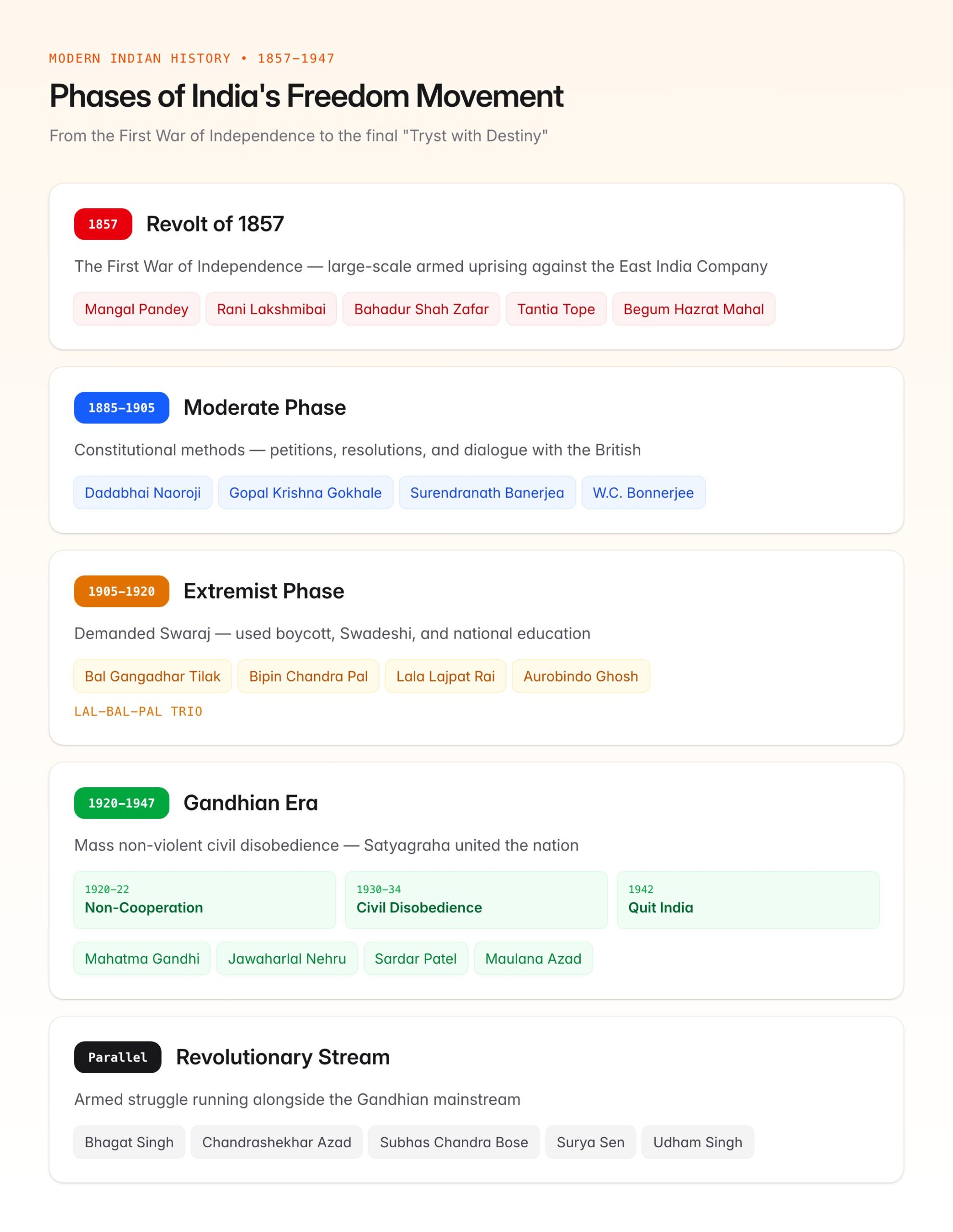
The First War of Independence (also called the Sepoy Mutiny by the British) was the earliest large-scale armed uprising against the East India Company. Though it ultimately failed, it shook the foundations of Company rule and led to the transfer of power to the British Crown.
| Leader | Region | Role |
|---|---|---|
| Mangal Pandey | Barrackpore, Bengal | Sepoy who fired the first shot; hanged on 8 April 1857 |
| Bahadur Shah Zafar | Delhi | Last Mughal emperor; declared symbolic leader of the revolt |
| Rani Lakshmibai | Jhansi | Led forces in battle; died fighting at Gwalior |
| Tantia Tope | Kanpur/Central India | Military commander; executed in 1859 |
| Nana Sahib | Kanpur | Adopted son of Peshwa Baji Rao II; led the Kanpur uprising |
| Begum Hazrat Mahal | Lucknow/Awadh | Led the revolt in Awadh after her son was declared king |
| Kunwar Singh | Bihar | 80-year-old zamindar who led guerrilla warfare |
Moderate Phase (1885-1905)
The early Indian National Congress leaders believed in constitutional methods — petitions, resolutions, and dialogue with the British. They laid the institutional foundation of the national movement.
| Leader | Contribution |
|---|---|
| Dadabhai Naoroji | "Grand Old Man of India"; formulated the Drain Theory exposing British economic exploitation |
| Gopal Krishna Gokhale | Mentor of Gandhi; championed education and social reform |
| Surendranath Banerjea | Founded Indian National Association (1876); called the "Indian Burke" |
| Pherozeshah Mehta | "Lion of Bombay"; key organiser of early Congress sessions |
| W.C. Bonnerjee | First president of the Indian National Congress (1885) |
Extremist Phase (1905-1920)
Disillusioned with the slow pace of reform, a more assertive group demanded Swaraj (self-rule) and used tools like boycott, national education, and swadeshi.
| Leader | Contribution |
|---|---|
| Bal Gangadhar Tilak | "Swaraj is my birthright"; launched Kesari and Maratha newspapers; organised Ganesh and Shivaji festivals |
| Bipin Chandra Pal | Powerful orator; advocated passive resistance and Swadeshi |
| Lala Lajpat Rai | "Punjab Kesari" (Lion of Punjab); died from injuries sustained in a lathi charge (1928) |
| Aurobindo Ghosh | Revolutionary-turned-spiritual leader; editor of Bande Mataram |
Tilak, Pal, and Lajpat Rai are collectively known as Lal-Bal-Pal, the trio that energised the extremist wing.
Gandhian Era (1920-1947)
Mahatma Gandhi transformed the freedom movement into a mass phenomenon through non-violent civil disobedience (satyagraha). His leadership unified peasants, workers, women, and the educated middle class under one banner.
Major Gandhian Movements
| Movement | Year | Key Feature |
|---|---|---|
| Non-Cooperation Movement | 1920-22 | Boycott of British institutions, courts, schools; suspended after Chauri Chaura violence |
| Civil Disobedience Movement | 1930-34 | Dandi March (salt satyagraha); defiance of unjust laws |
| Quit India Movement | 1942 | "Do or Die" call; largest mass movement; leaders arrested, underground resistance |
Key Leaders of the Gandhian Phase
| Leader | Role |
|---|---|
| Mahatma Gandhi | Architect of non-violent resistance; led salt march, negotiations, and mass movements |
| Jawaharlal Nehru | Congress president multiple times; first Prime Minister; advocated socialism and secularism |
| Sardar Vallabhbhai Patel | "Iron Man of India"; led Bardoli Satyagraha (1928); unified princely states post-independence |
| Maulana Abul Kalam Azad | Congress president; advocate of Hindu-Muslim unity; scholar and educationist |
| Rajendra Prasad | Congress president; first President of India; active in Champaran and Quit India |
| Khan Abdul Ghaffar Khan | "Frontier Gandhi"; led Khudai Khidmatgar (Servants of God) movement among Pathans |
| C. Rajagopalachari | Last Governor-General of India; key Gandhi associate; founded Swatantra Party later |
Revolutionary Freedom Fighters
Running parallel to the Gandhian mainstream, a stream of revolutionary nationalists believed armed struggle was necessary to dislodge British rule.
| Leader | Key Actions |
|---|---|
| Bhagat Singh | Lahore Conspiracy Case; threw bomb in Central Assembly (1929); hanged on 23 March 1931 |
| Chandrashekhar Azad | Led Hindustan Socialist Republican Association (HSRA); died in encounter at Alfred Park, Allahabad (1931) |
| Surya Sen (Masterda) | Led the Chittagong Armoury Raid (1930) |
| Khudiram Bose | One of the youngest martyrs; attempted to assassinate Magistrate Kingsford (1908) |
| Udham Singh | Assassinated Michael O'Dwyer in London (1940) to avenge the Jallianwala Bagh massacre |
| Rash Behari Bose | Organised the Delhi-Lahore Conspiracy (1912); later helped establish the INA in Japan |
Indian National Army (INA) and Subhas Chandra Bose
Subhas Chandra Bose (Netaji) took the most dramatic alternative path. He escaped British surveillance in 1941, reached Germany, and eventually Japan, where he revived the Indian National Army (INA) with Japanese support.
- The INA comprised Indian prisoners of war captured by Japan in Southeast Asia.
- Bose established the Azad Hind Government (Provisional Government of Free India) in 1943.
- The INA's motto was "Jai Hind" and its slogan "Delhi Chalo" (March to Delhi).
- The INA fought alongside Japan in the Imphal and Kohima campaigns (1944) but was defeated.
- The INA Trials (Red Fort Trials, 1945-46) galvanised public opinion and contributed to the end of British rule.
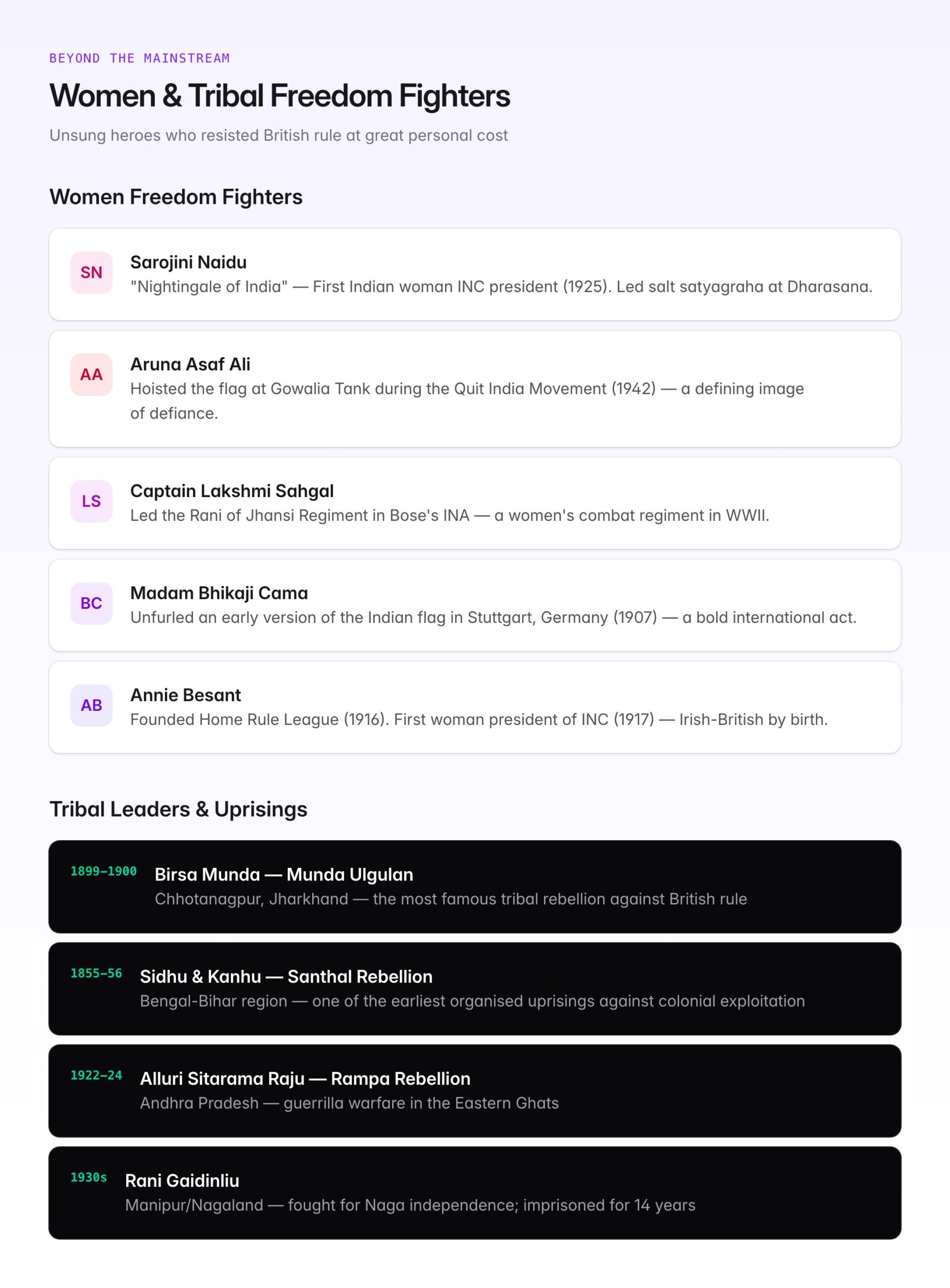
Women Freedom Fighters
Women played crucial roles across all phases of the movement, often at great personal cost.
| Leader | Contribution |
|---|---|
| Sarojini Naidu | "Nightingale of India"; first woman president of INC (1925); led salt satyagraha in Dharasana |
| Kasturba Gandhi | Led movements independently; imprisoned during Quit India; died in Aga Khan Palace (1944) |
| Aruna Asaf Ali | Hoisted the flag at Gowalia Tank during Quit India Movement (1942) |
| Usha Mehta | Ran an underground Congress Radio during Quit India |
| Captain Lakshmi Sahgal | Led the Rani of Jhansi Regiment in the INA |
| Annie Besant | Founded Home Rule League (1916); first woman president of INC (1917) |
| Madam Bhikaji Cama | Unfurled an early version of the Indian flag in Stuttgart, Germany (1907) |
Tribal Leaders in the Freedom Struggle
Tribal communities resisted British exploitation through numerous uprisings, often preceding the mainstream national movement.
| Leader/Movement | Region | Period |
|---|---|---|
| Birsa Munda (Munda Ulgulan) | Chhotanagpur, Jharkhand | 1899-1900 |
| Sidhu and Kanhu (Santhal Rebellion) | Bengal-Bihar | 1855-56 |
| Alluri Sitarama Raju (Rampa Rebellion) | Andhra Pradesh | 1922-24 |
| Rani Gaidinliu | Manipur/Nagaland | 1930s; fought for Naga independence |
| Tana Bhagats | Jharkhand | Early 20th century; non-violent tribal resistance |
UPSC Relevance
GS Paper I: Modern Indian History — phases of the national movement, role of various leaders, tribal and peasant movements. Prelims: Matching leaders to events, dates, slogans, and organisations.
Key Prelims facts:
- The Revolt of 1857 began at Meerut on 10 May 1857; Mangal Pandey's incident was at Barrackpore.
- Lal-Bal-Pal represented the extremist phase of the Congress.
- Gandhi's three major movements: Non-Cooperation (1920), Civil Disobedience (1930), Quit India (1942).
- Bhagat Singh was hanged on 23 March 1931 (Shaheed Diwas).
- Subhas Chandra Bose established the Azad Hind Government in 1943 and led the INA.
- Sarojini Naidu was the first Indian woman president of INC (1925); Annie Besant was the first woman president (1917, but she was Irish-British).
- Birsa Munda‘s uprising (1899-1900) in Chhotanagpur is the most famous tribal rebellion.
- The INA Trials at Red Fort (1945-46) fuelled mass anti-British sentiment.
Tell Google you want more of this.
Add Anantam IAS as a preferred sourceOne tap, and this site shows up more often in your own Top Stories, AI Overviews and AI Mode. Remove it any time.