Gram Nyayalayas are the lowest formal courts of the Indian legal system, designed to deliver speedy and inexpensive justice at the doorstep of rural citizens. Established under the Gram Nyayalayas Act, 2008, they were a direct response to the Law Commission's 114th Report (1986) which had highlighted that two-thirds of India's population lives in rural areas, yet courts are concentrated in district headquarters — making access to justice geographically prohibitive.
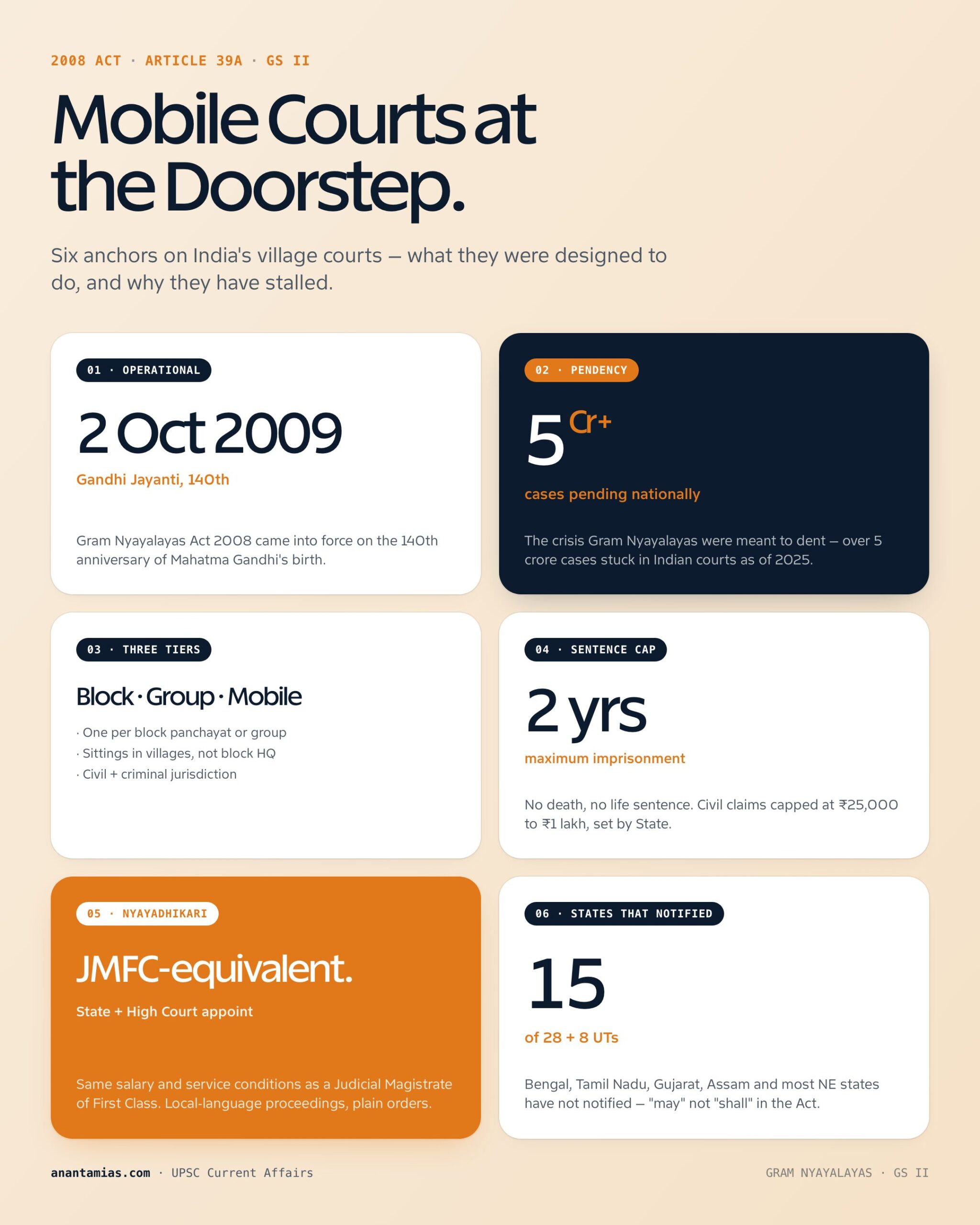
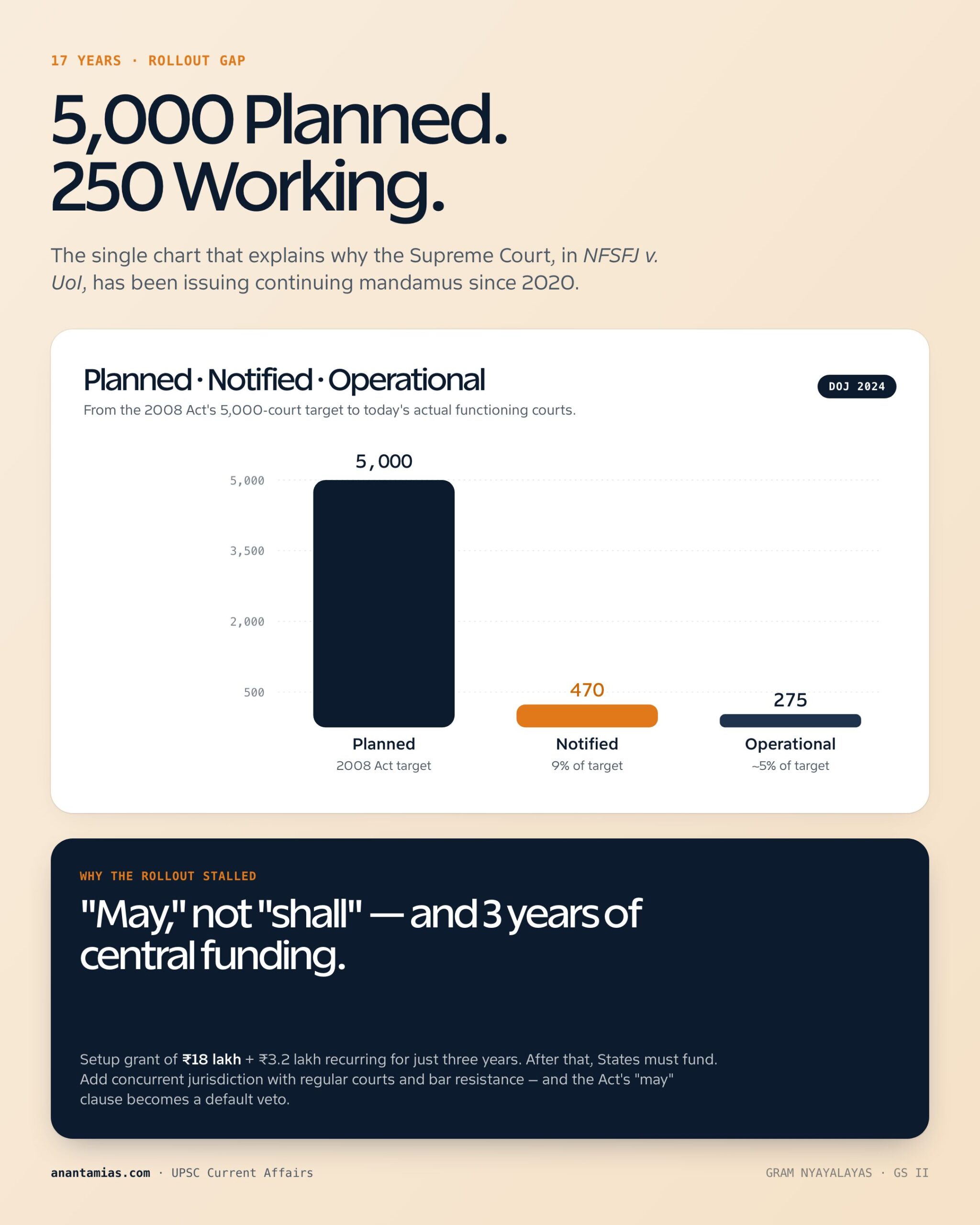
The Act was passed with great expectation. 5,000 Gram Nyayalayas were planned. Over 17 years later, only ~470 have been notified, and far fewer are operational. Of the country's 28 states and 8 UTs, only 15 have notified Gram Nyayalayas. The Supreme Court in National Federation of Societies for Fast Justice v. UoI (2020) expressed dismay at the slow rollout and directed states to operationalise. The 2024-26 status report shows continued state apathy.
For UPSC, Gram Nyayalayas intersect with judicial reforms, access to justice, federalism (state apathy), and the larger pendency crisis (over 5 crore cases pending in Indian courts as of 2025). This guide covers the constitutional rationale, statutory framework, structure, powers, issues, and reform agenda.
Constitutional and statutory basis
- Article 39A — Directive Principle: equal justice and free legal aid.
- Article 40 — Directive Principle: Panchayats as units of self-government.
- 42nd Amendment, 1976 — added Article 39A.
- Gram Nyayalayas Act, 2008 — operational from 2 October 2009, the 140th birth anniversary of Mahatma Gandhi.
The 2008 Act was inspired by:
- Law Commission 114th Report (1986) — proposed Gram Nyayalayas.
- Justice S.K. Khanna Committee recommendations.
- 224th Law Commission Report — judicial reforms.
Why Gram Nyayalayas were needed
- Geographic inaccessibility — district courts are far; rural litigants spend on travel, lodging, lost wages.
- Cost — even nominal court fees, lawyer fees, transport make justice unaffordable.
- Pendency — over 5 crore cases pending nationally; rural cases often abandoned mid-way.
- Cultural distance — formal courts feel alien to rural litigants.
- Article 39A mandate — equal justice for all, free legal aid where needed.
- Speedy trial read into Article 21 (Hussainara Khatoon, 1979).
Structure of Gram Nyayalayas
Establishment
- For every Panchayat at intermediate level (Block Panchayat), OR for a group of contiguous Panchayats.
- The State Government, in consultation with the High Court, notifies the establishment.
Mobile court concept
- Gram Nyayalayas are designed to be mobile — they hold sittings at villages, not just in a fixed building.
- The intent: justice goes to the litigant, not the other way round.
The Nyayadhikari (Presiding Officer)
- Appointed by the State Government in consultation with the High Court.
- Must have qualifications equivalent to a Judicial Magistrate of First Class.
- Same salary, allowances, and service conditions as a JMFC.
- Must reflect the social diversity of the area — preference for SC/ST/women candidates.
Jurisdiction
Gram Nyayalayas have both civil and criminal jurisdiction.
Criminal jurisdiction
Specified offences under:
- Indian Penal Code, 1860 (now Bharatiya Nyaya Sanhita, 2023) — petty offences, simple hurt, simple theft.
- First Schedule of the 2008 Act.
- Cattle Trespass Act, Payment of Wages Act, Minimum Wages Act, Protection of Civil Rights Act, Bonded Labour System (Abolition) Act, Child Labour Act, Equal Remuneration Act.
Limit: No sentence greater than 2 years' imprisonment (no death sentence, no life imprisonment).
Civil jurisdiction
Specified disputes under:
- Second Schedule — claims relating to property, inheritance, water rights, irrigation channels, land rights, partition.
- Pecuniary jurisdiction — civil claims of value not exceeding the limit fixed by the State (typically Rs. 25,000 to Rs. 1 lakh).
Special features
- Both summary and adversarial procedures available.
- Must rely on conciliation and mediation before adjudication (Section 24).
- Plea bargaining allowed.
- Decision must be a reasoned order but in plain language.
Procedural innovations
| Feature | Detail |
|---|---|
| No CrPC/CPC strict application | Procedural laws made flexible (Sections 32-33) |
| Conciliation mandatory | Court must attempt conciliation first |
| Local language | Proceedings can be in any local language |
| Inexpensive | No or nominal court fees |
| Time-bound | Targets 6 months for criminal cases |
| Mobile sittings | Must hold sittings in villages periodically |
| Conciliators | Appointed by State Government from local bar/social workers |
Appeal and revision
- Civil cases — Appeal to District Court within 30 days.
- Criminal cases — Appeal to Court of Session within 30 days.
- Revision lies to the High Court.
Issues — why Gram Nyayalayas have not taken off
The data are stark:
- Originally planned: 5,000 Gram Nyayalayas.
- Notified: ~470.
- Operational: ~250-300.
- States with notified Gram Nyayalayas: 15 (Madhya Pradesh, Rajasthan, Maharashtra, Odisha, Punjab, Haryana, Goa, Jharkhand, Andhra Pradesh, Telangana, Karnataka, Kerala, Uttar Pradesh, Bihar, Uttarakhand).
- States with zero notified Gram Nyayalayas: West Bengal, Tamil Nadu, Gujarat, Assam, NE states (mostly), J&K, etc.
Reasons for state apathy
| Issue | Detail |
|---|---|
| Setting up not mandatory | The 2008 Act says "may," not "shall." States have discretion |
| Concurrent jurisdiction | Existing Magistrate courts and Munsif courts handle the same cases |
| Limited funding | Central assistance for only 3 years (Rs. 18 lakh setup + Rs. 3.2 lakh recurring); afterwards state must fund |
| Negligible reduction in pendency | Concurrent jurisdiction means cases continue to flow to regular courts |
| Functions part-time | Many sit only 1-2 days/week |
| Shortage of HR | Nyayadhikari posts vacant; conciliators not appointed |
| Lawyers' resistance | Bar associations have resisted in many areas |
| Lack of awareness | Litigants do not know about Gram Nyayalayas |
| Infrastructure | Many lack basic infrastructure — buildings, vehicles, computers |
| Mobile court absent | Most Gram Nyayalayas function as fixed courts at block HQ — defeating the original idea |
| State Government apathy | Many state governments view it as a Centre's project |
Supreme Court interventions
National Federation of Societies for Fast Justice v. UoI (2020)
- Supreme Court issued notice to all states; expressed concern at the slow rollout.
- Directed states to take steps to operationalise.
- Subsequent compliance hearings held.
National Federation of Societies for Fast Justice v. UoI (2023-24)
- Continuing mandamus proceedings.
- Tracking of operationalisation across states.
- Court asked the Department of Justice to file consolidated affidavits.
Hussainara Khatoon legacy
- Speedy trial as fundamental right under Article 21 — Gram Nyayalayas the rural extension of this principle.
Way forward — reform agenda
| Reform | Detail |
|---|---|
| Make establishment mandatory | Amend the Act to read "shall" instead of "may" |
| Continued central funding | Beyond 3 years — at least 5 years; matching grants thereafter |
| Exclusive jurisdiction | Make Gram Nyayalayas the sole forum for specified offences |
| Operationalise mobile courts | Funds for vehicles, equipment; mandatory village sittings |
| Statutory minimum sittings | At least 4 days/week |
| Coordination with Lok Adalats and Nyaya Panchayats | Avoid duplication |
| Public awareness campaigns | Funded by Department of Justice |
| Mainstreaming with NALSA | Para-legal volunteers feed cases |
| Tech-enabled court | E-Court, video-conferencing, e-filing |
| Independent monitoring | Justice Department dashboard with state-wise compliance |
Comparison with related institutions
| Forum | Established under | Role |
|---|---|---|
| Gram Nyayalaya | Gram Nyayalayas Act, 2008 | Formal court with civil + criminal jurisdiction |
| Lok Adalat | Legal Services Authorities Act, 1987 | Compromise-based, no formal court status |
| Nyaya Panchayat | State Panchayati Raj Acts | Customary; no statutory backing in most states |
| Mediation Centres | Mediation Act, 2023 | Pre-litigation mediation |
Recent developments (2024-26)
- Department of Justice consolidated dashboard (2024) — state-wise data on operationalisation.
- Mediation Act, 2023 — operational since October 2023; raises question of overlap with Gram Nyayalayas.
- NALSA's Lok Adalat statistics — dispose of 1.5+ crore cases annually; Gram Nyayalayas dispose of <1 lakh.
- Bharatiya Nyaya Sanhita (2023) — replacement of IPC; Gram Nyayalaya jurisdiction now mapped to BNS.
- Bharatiya Nagarik Suraksha Sanhita (2023) — replacement of CrPC; flexible procedure provisions retained.
- Andhra Pradesh and Telangana revival (2024) — both states have committed to operationalising remaining Gram Nyayalayas.
- Kerala expansion (2024-25) — pilot in 3 districts.
Mains-style answer hook
"Gram Nyayalayas are the constitutional answer to the unmet promise of Article 39A — equal justice and free legal aid. The 2008 Act was the right design: mobile courts, Nyayadhikaris with judicial training, conciliation-first procedure, decisions in local languages. But its implementation has been undermined by the optional language of the Act, time-limited central funding, concurrent jurisdiction, and state apathy. The Supreme Court's continuing mandamus in National Federation of Societies for Fast Justice (2020 onwards) and the 2024 Department of Justice dashboard are the new accountability levers. Without making establishment mandatory and providing sustained central funding, Gram Nyayalayas will remain an idea more honoured in the breach than in the observance."
Prelims pointers
- Gram Nyayalayas Act, 2008 — operational from 2 October 2009.
- Nyayadhikari — qualifications equivalent to JMFC.
- No sentence greater than 2 years; no death or life imprisonment.
- Jurisdiction — both civil and criminal, concurrent with regular courts.
- State Government in consultation with the High Court — appointment of Nyayadhikari.
- Article 39A — Directive Principle, equal justice and free legal aid (added by 42nd Amendment, 1976).
- Originally targeted 5,000; only ~470 notified, ~250-300 operational.
- 15 states have notified Gram Nyayalayas.
- Appeal: civil → District Court; criminal → Sessions Court.
FAQ
Are Gram Nyayalayas mandatory for all states?
No — the Act uses "may." This is the central reason for the slow rollout.
Can a Gram Nyayalaya award life imprisonment?
No. Maximum sentence is 2 years' imprisonment.
How is a Gram Nyayalaya different from a Lok Adalat?
Gram Nyayalaya is a regular court with judicial powers, civil and criminal jurisdiction, and reasoned orders. Lok Adalat is a conciliation forum that requires consent and gives compromise awards.
Where can one appeal a Gram Nyayalaya decision?
Civil cases go to District Court; criminal cases go to Sessions Court — both within 30 days.
Are Gram Nyayalayas the same as Nyaya Panchayats?
No. Nyaya Panchayats are customary village dispute-resolution bodies under State Panchayati Raj Acts (where they exist), with no statutory adjudicatory power in most states. Gram Nyayalayas are formal courts of law with civil and criminal jurisdiction under the 2008 Act, headed by a Nyayadhikari with judicial qualifications equal to a Judicial Magistrate of First Class.
What pendency reduction have Gram Nyayalayas actually delivered?
Limited. National pendency stands at over 5 crore cases; Gram Nyayalayas dispose of fewer than 1 lakh cases annually because of low operationalisation, concurrent jurisdiction with regular courts, and part-time functioning. Lok Adalats, by contrast, dispose of over 1.5 crore cases annually under NALSA's National Lok Adalat scheme — though through compromise rather than adjudication.
How does the BNS regime affect Gram Nyayalaya jurisdiction?
The Bharatiya Nyaya Sanhita (BNS), Bharatiya Nagarik Suraksha Sanhita (BNSS), and Bharatiya Sakshya Adhiniyam (BSA) replaced IPC, CrPC, and Indian Evidence Act respectively from 1 July 2024. The First Schedule to the Gram Nyayalayas Act, 2008 — which lists offences within its criminal jurisdiction — has been mapped to corresponding BNS sections. Procedural flexibility under Sections 32-33 of the 2008 Act continues unchanged.
Related: Lok Adalat, Alternate Dispute Resolution, Gram Sabha, Mediation Act 2023.
Tell Google you want more of this.
Add Anantam IAS as a preferred sourceOne tap, and this site shows up more often in your own Top Stories, AI Overviews and AI Mode. Remove it any time.