Disclosure: this guide contains Amazon affiliate links. As an Amazon Associate, Anantam IAS earns from qualifying purchases — at no extra cost to you.
UPSC Mains GS 1 Strategy: Art, Culture, History & Geography
GS Paper 1 covers Indian heritage and culture, history, geography, and Indian society — a vast canvas spanning thousands of years and an entire subcontinent. The paper carries 250 marks with 20 questions (mix of 10-mark and 15-mark questions). Success requires connecting static knowledge with contemporary relevance and presenting answers with analytical depth rather than factual listing.
This paper rewards candidates who can draw linkages — between historical events and present-day governance, between geographical features and economic development, between social structures and policy challenges.
GS 1 Syllabus Breakdown
The Four Pillars
| Section | Topics | Approximate Weightage |
|---|---|---|
| Indian Heritage & Culture | Art forms, literature, architecture, salient features | 10–15% |
| History | Modern India, world history post-18th century, freedom struggle | 25–30% |
| Geography | Physical, human, economic geography; world and India | 30–35% |
| Indian Society | Social issues, communalism, regionalism, globalization effects | 20–25% |
Detailed Syllabus Coverage
Indian Heritage & Culture:
- Salient aspects of art forms, literature, and architecture from ancient to modern
- Modern Indian history — significant events, personalities, issues
- Freedom struggle — various stages and contributions from different parts of the country
- Post-independence consolidation and reorganization
History (Modern India + World History):
- British rule impact and Indian response
- Industrial Revolution, World Wars, colonialism, decolonization
- Political philosophies: communism, capitalism, socialism
- Unification of nations (Italy, Germany)
- Redrawing of national boundaries
Geography:
- Salient features of world physical geography
- Distribution of key natural resources
- Factors responsible for location of primary, secondary, and tertiary industries
- Important geophysical phenomena (earthquakes, tsunamis, volcanoes, cyclones)
- Geographical features and their location
Indian Society:
- Salient features of Indian society, diversity of India
- Role of women, women’s organizations
- Population and associated issues
- Poverty, developmental issues, urbanization
- Effects of globalization on Indian society
- Communalism, regionalism, secularism
UPSC Syllabus 2026: Complete Prelims & Mains Guide
Subject-Wise Preparation Strategy
Indian Heritage, Art, and Culture
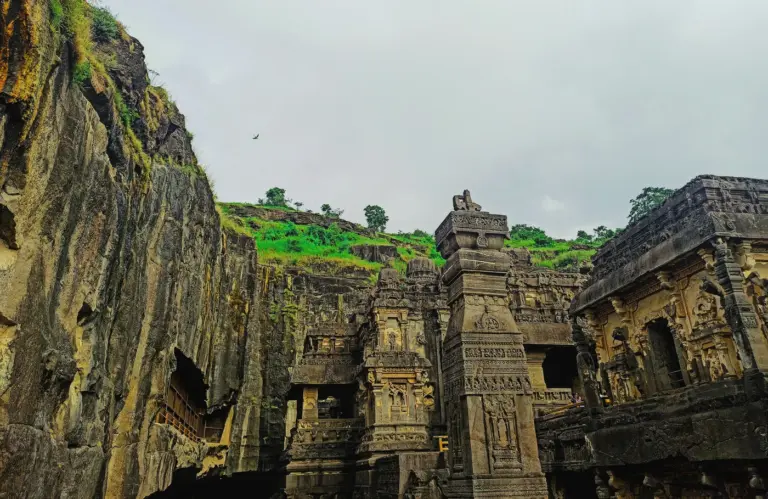
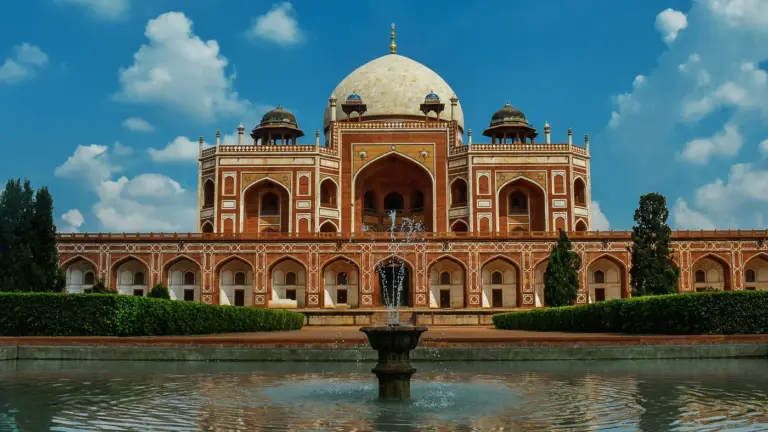
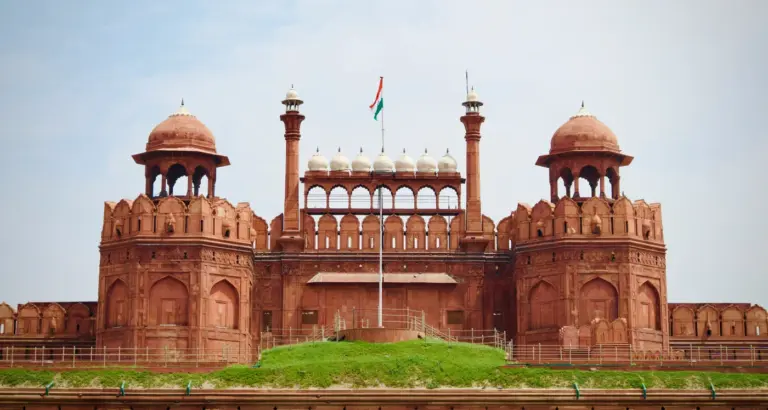
This section appears deceptively simple but questions can be highly specific. UPSC has asked about specific temple architecture styles, dance forms and their regional variations, and literary movements.
Preparation Approach:
- Primary Source: Nitin Singhania — “Indian Art and Culture”
- NCERT: Class 11 “An Introduction to Indian Art” and Class 11 “Living Craft Traditions of India”
- CCRT Website: Government resource with detailed information on art forms
- Current Affairs: UNESCO heritage sites, GI tags, cultural festivals in news
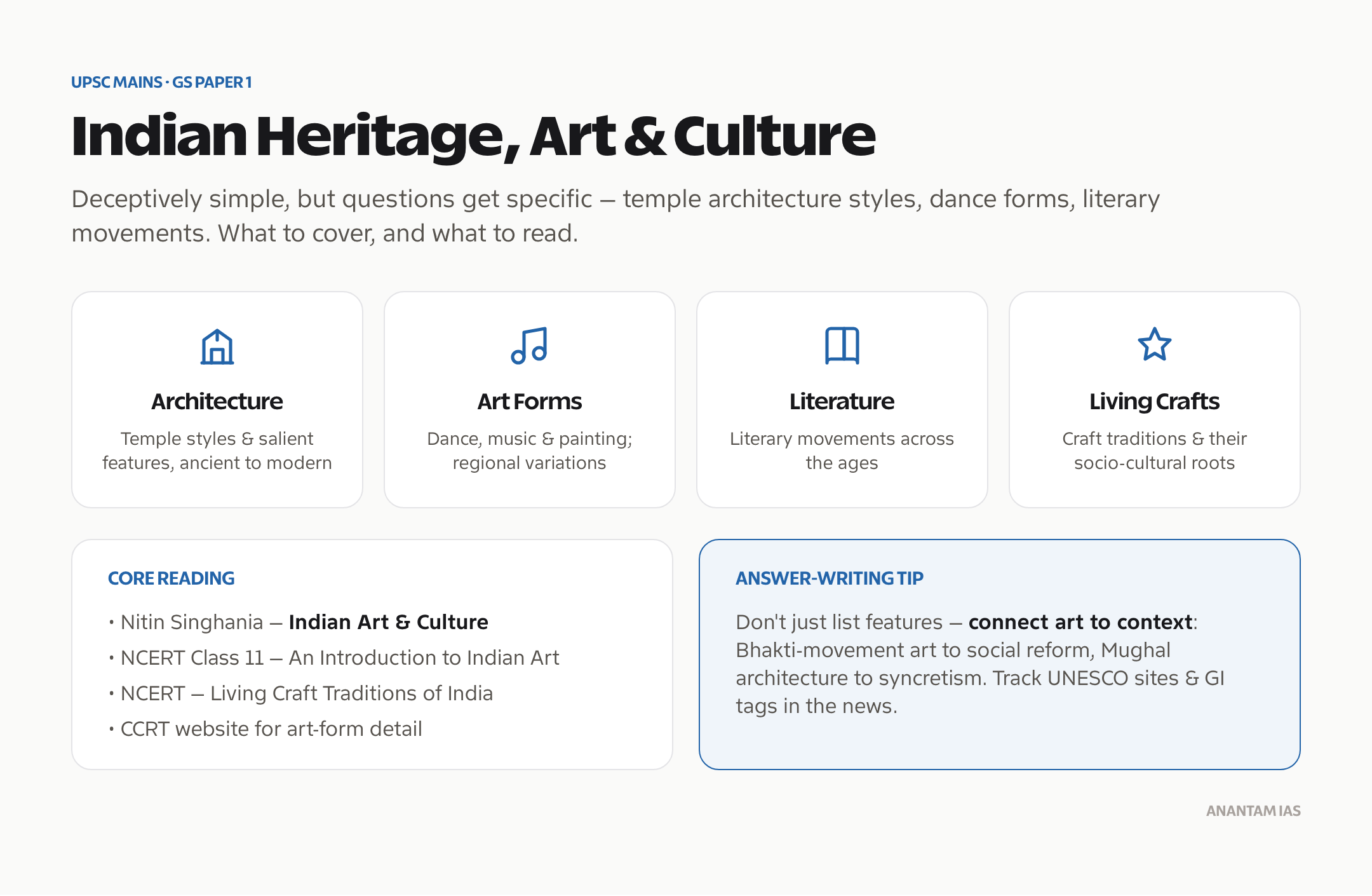
Answer Writing Tip: Don’t just list features. Connect art forms to their socio-political context. For example, link Bhakti movement art to social reform, or Mughal architecture to syncretism.
Modern Indian History and Freedom Struggle
UPSC rarely asks straightforward chronological questions. Instead, expect analytical questions like “Assess the role of peasant movements in the freedom struggle” or “How did the economic critique of colonialism shape nationalist thought?”
Preparation Approach:
- Foundation: Spectrum — “A Brief History of Modern India“
- Depth: Bipan Chandra — “India’s Struggle for Independence“
- Post-Independence: Bipan Chandra — “India Since Independence“
- PYQ Analysis: Map every question to a syllabus sub-topic
Key Focus Areas:
- Social reform movements (Ram Mohan Roy, Dayanand Saraswati, Jyotiba Phule)
- Different phases of the freedom movement (Moderate, Extremist, Gandhian)
- Tribal and peasant movements
- Role of women in the freedom struggle
- Post-independence challenges (integration, language reorganization, refugee crisis)
World History
World History is often neglected but consistently features 2–3 questions worth 20–30 marks.
| Period/Theme | Key Topics |
|---|---|
| Industrial Revolution | Social and economic impact, labor movements |
| French Revolution | Democratic ideals, impact on colonies |
| World Wars | Causes, aftermath, League of Nations, UN |
| Colonialism/Decolonization | Impact on Asia, Africa; neo-colonialism |
| Cold War | Proxy wars, NAM, superpower rivalry |
| Unification | Italy (Mazzini, Garibaldi), Germany (Bismarck) |
Resource: Norman Lowe — “Mastering Modern World History” (selective reading of relevant chapters)
Indian Independence Movement: Timeline & Key Events
Geography
Geography questions in GS 1 focus on physical geography, resource distribution, and geophysical phenomena. Human and economic geography overlap with GS 3 (economy).
Preparation Approach:
- Physical Geography: GC Leong — “Certificate Physical and Human Geography“
- Indian Geography: Majid Husain + NCERT Class 6–12
- Atlas: Oxford Student Atlas or Orient Blackswan Atlas (daily practice)
- Current: Earthquakes, cyclones, climate events, new geographical discoveries
Critical Skills:
- Map-based answers score higher — always draw diagrams for geographical questions
- Use flowcharts for processes (monsoon mechanism, rock cycle, soil formation)
- Connect physical geography to human impact (river systems to agriculture, tectonics to disaster vulnerability)
Indian Society
This section bridges sociology, current affairs, and governance. Questions are analytical and often require balanced perspectives.
Key Topics:
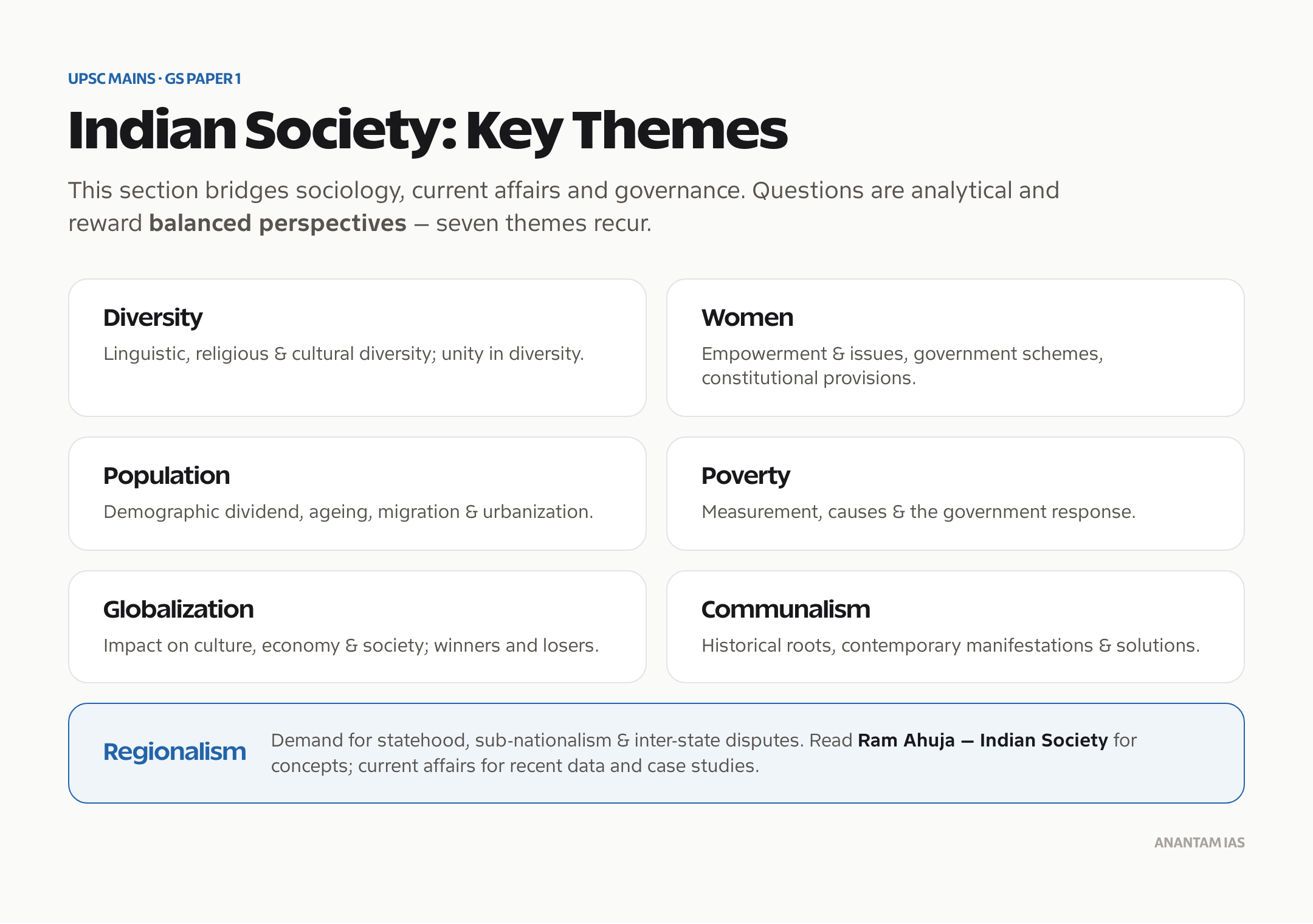
| Topic | Focus Areas |
|---|---|
| Diversity | Linguistic, religious, cultural diversity; unity in diversity |
| Women | Women’s empowerment, issues, government schemes, constitutional provisions |
| Population | Demographic dividend, aging, migration, urbanization |
| Poverty | Measurement, causes, government response |
| Globalization | Impact on culture, economy, society; winners and losers |
| Communalism | Historical roots, contemporary manifestations, solutions |
| Regionalism | Demand for statehood, sub-nationalism, inter-state disputes |
Resource: Ram Ahuja — “Indian Society” (for sociological concepts); current affairs for recent data and case studies.
UPSC Mains GS 2 Strategy: Governance & Polity
Answer Writing Strategy for GS 1
The GS 1 Answer Template
GS 1 answers benefit from a specific structure:
For 10-mark questions (150 words):
- Brief introduction (1–2 sentences)
- Main body with 3–4 points (with examples)
- Conclusion linking to contemporary relevance
For 15-mark questions (250 words):
- Contextual introduction
- Body with 5–6 substantive points
- Counter-arguments or limitations
- Forward-looking conclusion
What Scores High in GS 1
| Element | Why It Matters |
|---|---|
| Analytical depth | UPSC wants “why” and “how,” not just “what” |
| Multiple perspectives | Social, economic, political, cultural angles |
| Data and examples | Specific dates, names, statistics strengthen arguments |
| Diagrams/maps | Especially for geography; adds visual clarity |
| Contemporary relevance | Linking historical/geographical topics to present |
| Balanced view | Acknowledging different scholarly positions |
Common GS 1 Answer Writing Mistakes
- Turning every answer into a list — UPSC wants analysis, not bullet-point dumps
- Ignoring the directive word — “Critically examine” demands a different answer than “Discuss”
- Skipping diagrams for geography — A well-drawn map or flowchart can earn extra marks
- Writing history as narrative — Don’t tell the story; analyze causes, impacts, and significance
- Neglecting the conclusion — A strong conclusion shows complete understanding
PYQ Analysis: Trends in GS 1 (2019–2025)
| Trend | Observation |
|---|---|
| History | Shift from event-based to theme-based questions (social movements, economic impact) |
| Geography | Increasing emphasis on climate, disasters, and resource management |
| Culture | More specific questions (architecture styles, regional art forms) |
| Society | Growing focus on urbanization, migration, and technology’s social impact |
| World History | Consistent 2–3 questions; Cold War and decolonization remain favorites |
Revision Strategy
Three-Pass Revision Method
| Pass | Timing | Focus |
|---|---|---|
| First | 3 months before Mains | Full syllabus; make short notes |
| Second | 6 weeks before Mains | Short notes; focus on weak areas |
| Third | Last 2 weeks | Quick revision of key facts, dates, maps |
Quick-Reference Material
Prepare one-page summaries for:
- Timeline of modern Indian history (1757–1947)
- Key art and architecture facts (dynasty-wise)
- Major geographical features (rivers, mountain passes, climate zones)
- Important social indicators (HDI, gender ratio, urbanization rate)
- World history key dates and events
Frequently Asked Questions
How much time should GS 1 preparation take relative to other GS papers?
GS 1 typically requires 25–30% of total Mains preparation time. History and geography demand extensive reading, and culture requires memorization of specific details. However, much of GS 1 preparation overlaps with Prelims, so the incremental effort for Mains is adding analytical depth rather than new content.
Is it necessary to read Bipan Chandra for modern history?
Spectrum’s u0022Brief History of Modern Indiau0022 covers most of what UPSC asks. Bipan Chandra adds depth, especially for understanding the economic critique of colonialism and the post-independence period. Reading both is ideal, but if time is limited, Spectrum plus PYQ analysis is sufficient.
How important are diagrams in GS 1 geography answers?
Diagrams significantly improve geography answers. A well-labeled map of monsoon patterns, a cross-section of the Himalayas, or a flowchart of the rock cycle can convey understanding that text alone cannot. Examiners appreciate visual clarity, and diagrams often serve as implicit evidence of deeper knowledge.
Should world history be given equal attention as Indian history?
No. Indian history carries substantially more weight — expect 4–6 questions versus 2–3 for world history. However, completely ignoring world history means leaving 20–30 easy marks on the table. A focused reading of key themes (revolutions, world wars, decolonization) takes only 2–3 weeks.
How to handle Indian society questions with no clear right answer?
Indian society questions are inherently subjective. The approach should be: present multiple perspectives (sociological, economic, political), use specific data or case studies to support each view, and conclude with a balanced synthesis. Avoid taking extreme positions — UPSC values nuanced analysis.
Tell Google you want more of this.
Add Anantam IAS as a preferred sourceOne tap, and this site shows up more often in your own Top Stories, AI Overviews and AI Mode. Remove it any time.