IAS Salary 2026: Pay Scale, Perks & Career Growth
An IAS officer’s starting basic pay is ₹56,100 per month at Level 10 of the 7th Central Pay Commission matrix. With DA (Dearness Allowance), HRA (House Rent Allowance), and other allowances, the gross pay for a new IAS officer in a metro city comes to about ₹1.23 lakh per month before deductions.
But the salary figure alone misses most of the compensation picture. Official housing, vehicle, security detail, medical coverage, and post-retirement pension make the total package significantly higher than what the payslip shows.
IAS Salary Structure: 7th Pay Commission
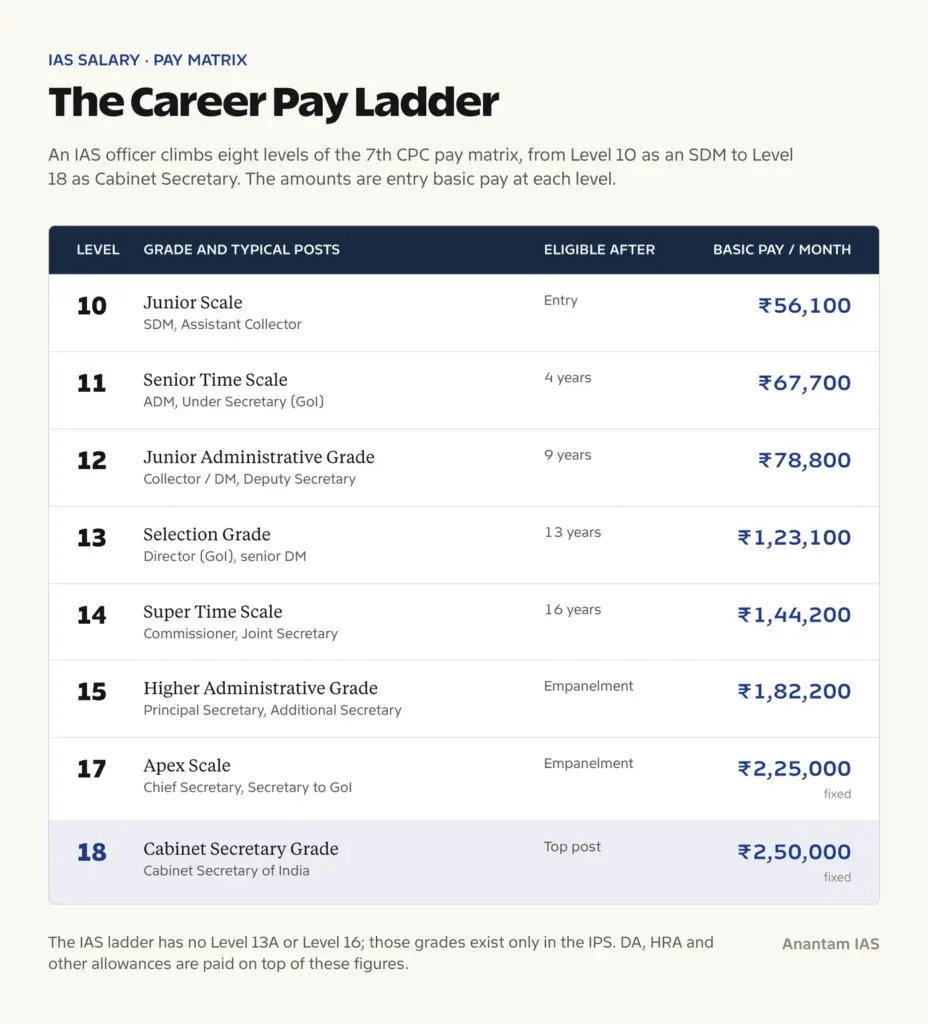
The 7th Central Pay Commission (7th CPC), implemented from January 1, 2016, replaced the grade pay system with a pay matrix of 18 levels. IAS officers start at Level 10 and can progress to Level 18 (Cabinet Secretary).
Basic Pay by Level (Pay Matrix)
| Pay Level | Position | Basic Pay (₹/month) | Years of Service (approx.) |
|---|---|---|---|
| Level 10 | Junior Scale (SDM/Asst. Secretary) | 56,100 | 0–4 years |
| Level 11 | Senior Time Scale (Collector/DM) | 67,700 | 4–8 years |
| Level 12 | Junior Administrative Grade | 78,800 | 9–12 years |
| Level 13 | Selection Grade (Director) | 1,23,100 | 13–15 years |
| Level 14 | Super Time Scale (Jt. Secretary) | 1,44,200 | 16–24 years |
| Level 15 | HAG (Principal Secretary / Addl. Secretary) | 1,82,200 | 25–30 years |
| Level 17 | Apex Scale (Chief Secretary / Secretary to GoI) | 2,25,000 (fixed) | 30+ years |
| Level 18 | Cabinet Secretary | 2,50,000 (fixed) | Top post |
Note: the IAS ladder has no Level 13A or Level 16. Those levels belong to the IPS, where a DIG draws Level 13A (₹1,31,100) and a HAG+ officer draws Level 16 (₹2,05,400). DA is calculated on basic pay and changes every 6 months based on AICPI (All India Consumer Price Index). From 1 January 2026, DA is 60% of basic pay.
Dearness Allowance (DA)
DA is revised twice a year — January 1 and July 1. With DA at 60% from 1 January 2026:
- Level 10: Basic ₹56,100 + DA ₹33,660 = ₹89,760
- Level 11: Basic ₹67,700 + DA ₹40,620 = ₹1,08,320
- Secretary (Level 17): Basic ₹2,25,000 + DA ₹1,35,000 = ₹3,60,000
DA tracks inflation and stays a separate element of pay. It is folded into basic pay only when a new pay commission revises the matrix. The 8th Pay Commission was constituted on 3 November 2025 and hasn’t reported yet, so 7th CPC rates still apply.
How to Become an IAS Officer: Step-by-Step Guide
Allowances: The Real Compensation Boost
Basic + DA is just the start. Allowances significantly increase total take-home.
House Rent Allowance (HRA)
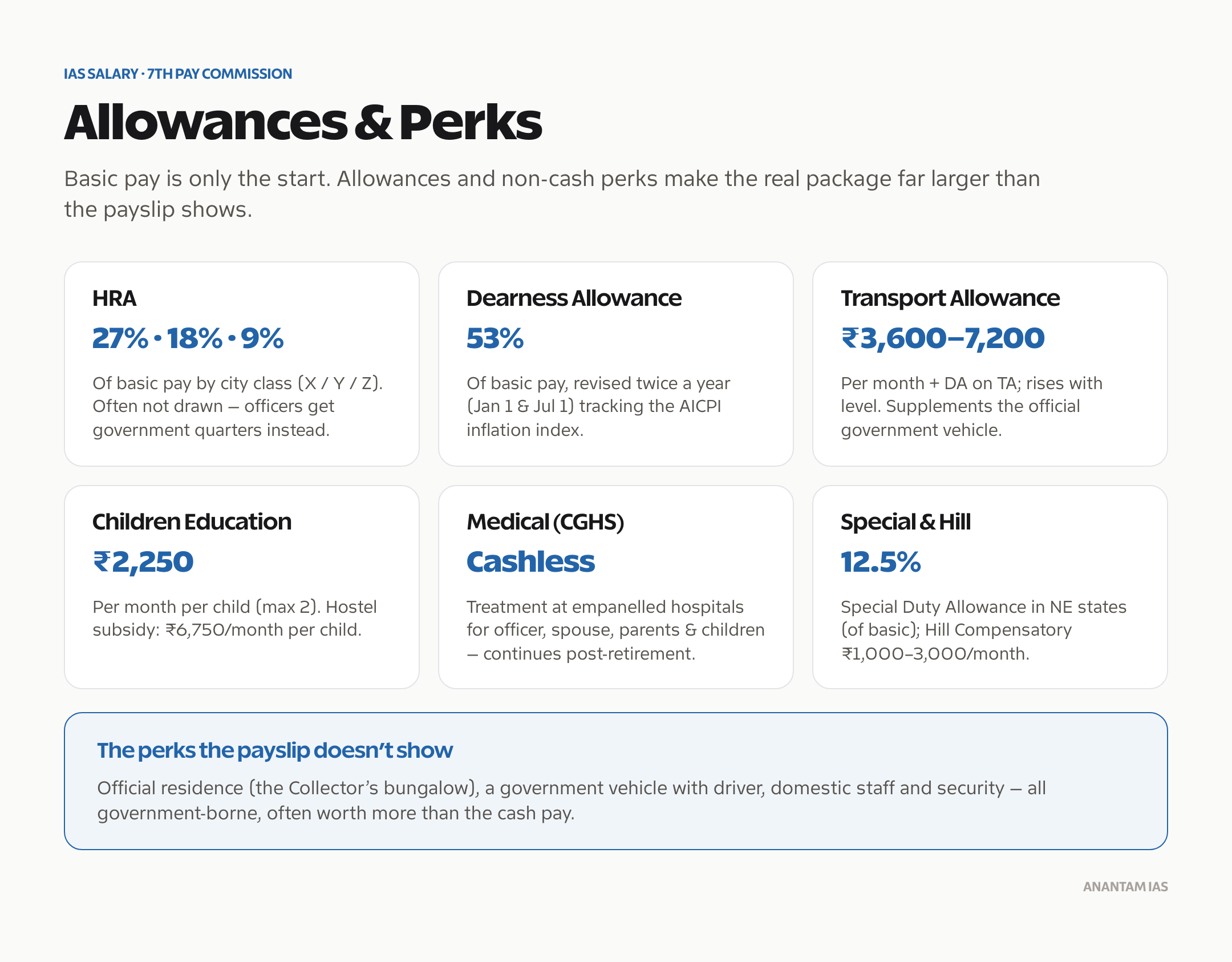
HRA depends on the city classification. The rates rose to 30%, 20% and 10% once DA crossed 50% on 1 January 2024:
- X Cities (Population 50 lakh+: Delhi, Mumbai, Kolkata, Chennai, Bangalore, Hyderabad, Ahmedabad, Pune): 30% of basic pay
- Y Cities (Population 5–50 lakh): 20% of basic pay
- Z Cities (Other): 10% of basic pay
But here’s the practical reality: most IAS officers at district and state levels get government accommodation (a bungalow or official residence), which means they don’t draw HRA at all. Housing as a perk is far more valuable than HRA in cash.
An IAS officer posted as DM/Collector gets the official Collector’s bungalow — a large government residence with attached staff quarters, maintained by the district administration.
Transport Allowance (TA)
- Level 9 and above in the notified higher-TPTA cities: ₹7,200/month + DA on TA (₹11,520 with DA at 60%)
- Level 9 and above at other places: ₹3,600/month + DA on TA (₹5,760)
- Level 14 and above, if entitled to an official car: the car, or ₹15,750/month + DA on TA (₹25,200)
Again, this is partly theoretical — many IAS officers have access to a government vehicle for official duties, making the cash transport allowance a supplement rather than primary transport funding.
Other Allowances
| Allowance | Amount / Rate |
|---|---|
| Medical Allowance (CGHS) | Covered under CGHS scheme; cashless treatment at empanelled hospitals |
| Children Education Allowance | ₹2,812.50/month per child (max 2 children) |
| Hostel Subsidy | Up to ₹8,437.50/month per child in hostel |
| Sumptuary Allowance (Cabinet Secretary) | ₹4,000/month |
| Special Duty Allowance (NE states) | 12.5% of basic pay |
| Hill Compensatory Allowance | ₹1,000–3,000/month depending on altitude |
The Perks: What the Salary Slip Doesn’t Show
The non-cash perks of an IAS posting are substantial and often undervalued in salary comparisons.
Official Residence
At virtually every posting above SDM level, an IAS officer gets an official residence — government-maintained. In district postings, this is the Collector’s bungalow, typically a large colonial-era structure with garden, electricity, and domestic help paid for by the state government. At the secretariat level in state capitals, officers get Type 5 or Type 6 government quarters.
At the central government level in New Delhi, senior IAS officers on central deputation get government bungalows in Civil Lines, Chanakyapuri, or other prime areas — real estate worth ₹5–50 crore in market value.
Government Vehicle
Above SDM level, IAS officers are entitled to a government vehicle with a driver for official use. In practice, the line between official and personal use is blurry. The fuel, maintenance, and driver’s salary are all borne by the government.
Domestic Staff
Official residences come with peons, orderlies, chowkidars, sweepers, and domestic help provided by the government. A Collector’s bungalow might have 4–8 staff members, effectively providing significant household support at no personal cost.
Security
At senior levels (Secretary rank, politically sensitive postings), IAS officers get security detail from state police or central paramilitary forces. Former IAS officers in sensitive positions may retain security for months after retirement.
Medical Coverage
The Central Government Health Scheme (CGHS) covers the officer, spouse, dependent parents, and dependent children. This includes cashless hospitalisation at CGHS empanelled hospitals (which include most major private hospitals in state capitals and Delhi), specialist consultations, and medicines at CGHS dispensaries.
Post-retirement, CGHS coverage continues for the pensioner and spouse.
Total Compensation Estimate: Entry vs. Senior Level
| Component | Entry IAS (Level 10) | Secretary-Level (Level 17) |
|---|---|---|
| Basic Pay | ₹56,100 | ₹2,25,000 |
| DA (60%) | ₹33,660 | ₹1,35,000 |
| HRA (if applicable) | ₹16,830 (X city, 30%) | Not drawn (govt quarters) |
| Transport Allowance | ₹11,520 | Official car (no cash TA) |
| Other Allowances | ~₹5,000 | ~₹10,000 |
| Gross Pay | ~₹1,23,110 | ~₹3,70,000 |
| Government Housing | ₹50,000–1,00,000/month (imputed) | ₹3–5 lakh/month (imputed) |
| Vehicle + Staff | ₹15,000–30,000/month (imputed) | ₹50,000–1,00,000/month (imputed) |
| Total Package (approx.) | ₹1.9–2.5 lakh/month | ₹7–10 lakh/month |
The “imputed value” of government housing and perks at senior levels rivals or exceeds cash compensation in private sector equivalents.
Pension: The Post-Retirement Security
IAS officers are covered under the National Pension System (NPS) — implemented for central government employees joining after January 1, 2004. IAS officers who joined before this date get the Old Pension Scheme (defined benefit).
NPS for IAS (Post-2004 joiners)
Under NPS:
- Government contributes 14% of (Basic + DA)
- Employee contributes 10% of (Basic + DA)
- Total NPS contribution at Level 10: (14%+10%) × ₹89,760 = ₹21,542/month into the NPS corpus
At retirement with 35 years of service, the NPS corpus can reach ₹3–5 crore depending on market returns, providing a monthly pension of ₹80,000–1,50,000.
Post-retirement benefits also include:
- Gratuity up to ₹25 lakh (raised from ₹20 lakh on 1 January 2024, when DA reached 50%)
- Leave encashment on retirement (up to 300 days)
- CGHS coverage for self and spouse for life
- Some former officers retain a modified vehicle facility and residence for a period post-retirement
IAS Salary vs Private Sector: An Honest Comparison
| Component | IAS Officer (15 years) | IIM Graduate / Senior Manager (15 years) |
|---|---|---|
| Cash salary | ₹1.8–2.5 lakh/month | ₹4–10 lakh/month |
| Housing | Government-provided | Self-arranged (₹30,000–1 lakh rent in metro) |
| Vehicle | Government-provided | Self-arranged or company car (limited) |
| Job security | Permanent, near-absolute | Market-dependent |
| Pension (retirement) | NPS corpus + gratuity | Employer PF + gratuity |
| Lateral career options | Limited in first 5 years | High |
| Influence/authority | Very high (DM commands district) | Sector-specific |
The cash salary gap is real and significant — a 15-year IAS officer earns less in cash than a mid-level manager at a large private company. But the perks, job security, and societal influence are genuinely not comparable to most private sector roles.
8th Pay Commission: What to Expect
The 8th Pay Commission was announced in January 2025 and constituted by a Department of Expenditure resolution dated 3 November 2025, chaired by Justice Ranjana Prakash Desai. It has 18 months from constitution to report, and as of October 2026 it hasn’t submitted its recommendations. Based on historical patterns:
- The fitment factor (multiplier applied to current basic pay) is expected to be 1.92–2.86 based on previous commissions
- At those factors, a Level 10 basic of ₹56,100 would become roughly ₹1.08–1.60 lakh (unofficial estimates)
- DA will be reset to 0% upon implementation and start accruing again
Until the Government of India accepts the report, current 7th CPC rates apply. The 7th CPC took effect from 1 January 2016, so 1 January 2026 is the widely expected effective date. If the Government adopts it, the revision would be paid with arrears.
UPSC Age Limit 2026: Complete Eligibility Guide
Frequently Asked Questions
What is the in-hand salary of an IAS officer per month in 2026?
A new IAS officer at Level 10 draws gross pay of about ₹1.23 lakh per month in an X-class city (basic ₹56,100 + DA at 60% + HRA + TA). After NPS and income tax, take-home is roughly ₹95,000–1.05 lakh. With government housing imputed, the effective compensation is ₹1.9–2.5 lakh/month. At the Secretary level, basic plus DA alone is ₹3.6 lakh/month, with a far larger non-cash package.
What is the IAS salary after the 7th Pay Commission?
Under the 7th Pay Commission (implemented 2016), IAS entry-level basic pay is ₹56,100/month at Level 10. With DA at 60% (from 1 January 2026), the total basic + DA is ₹89,760. Gross pay including HRA and TA in a metro city is about ₹1.23 lakh/month before tax.
Does IAS get a free house and car?
Yes. At virtually every substantive posting above SDM level, an IAS officer gets government-provided housing (official residence) and a vehicle with driver for official duties. These are maintained by the government at no personal cost and represent a significant addition to the cash salary — especially at senior levels.
What is the pension for an IAS officer?
IAS officers who joined after January 1, 2004 are under NPS (National Pension System). The government contributes 14% and the employee contributes 10% of (Basic + DA) monthly into the NPS corpus. At retirement with 35 years of service, this can build a corpus of ₹3–5 crore. Pre-2004 entrants get the Old Pension Scheme with a defined benefit of 50% of last drawn pay.
How does IAS salary compare to IPS or IFS salary?
IAS, IPS, and IFS (Indian Foreign Service) all follow the same pay matrix and are in the same pay levels. There’s no difference in basic pay between services at equivalent levels. The perks differ: IPS gets security-related allowances, IFS gets foreign service allowances while posted abroad (which can be 3–5× the domestic pay), and IAS gets district-level administrative perks.
Tell Google you want more of this.
Add Anantam IAS as a preferred sourceOne tap, and this site shows up more often in your own Top Stories, AI Overviews and AI Mode. Remove it any time.