India at the Olympics: History, Medals & Records
India’s Olympic journey spans over 120 years — from Norman Pritchard’s solo appearance at the 1900 Paris Olympics to the record-breaking medal hauls at Tokyo 2020 and Paris 2024. While India’s total medal count remains modest compared to sporting powerhouses, the story includes extraordinary chapters: six consecutive hockey golds, Abhinav Bindra’s historic individual gold, Neeraj Chopra’s javelin triumph, and the steady rise of Indian athletes across multiple disciplines. This guide covers India’s complete Olympic history.
India’s Olympic Timeline
Early Years (1900–1936)
| Year | Host City | India’s Participation | Medals |
|---|---|---|---|
| 1900 | Paris | Norman Pritchard (individual, not official team) | 2 Silver |
| 1920 | Antwerp | First official Indian contingent | 0 |
| 1924 | Paris | 6 athletes | 0 |
| 1928 | Amsterdam | Hockey team debut | 1 Gold (Hockey) |
| 1932 | Los Angeles | Hockey team | 1 Gold (Hockey) |
| 1936 | Berlin | Hockey team + athletes | 1 Gold (Hockey) |
Norman Pritchard’s medals at the 1900 Paris Olympics are debated — some records list him under Great Britain. The International Olympic Committee recognizes him as India’s first Olympic medallist.
The 1928 Amsterdam Olympics marked the beginning of India’s golden era in hockey. Led by Dhyan Chand, the Indian hockey team scored 29 goals without conceding any in the tournament.
The Golden Era of Hockey (1928–1980)
India’s hockey dominance is unmatched in Olympic history. Eight gold medals in twelve Olympic appearances (1928–1980) represent one of the greatest sustained achievements in any sport.
| Year | Host City | Result | Final Score (Gold Medal Match) |
|---|---|---|---|
| 1928 | Amsterdam | Gold | India 3–0 Netherlands |
| 1932 | Los Angeles | Gold | India 24–1 Japan |
| 1936 | Berlin | Gold | India 8–1 Germany |
| 1948 | London | Gold | India 4–0 Great Britain |
| 1952 | Helsinki | Gold | India 6–1 Netherlands |
| 1956 | Melbourne | Gold | India 1–0 Pakistan |
| 1960 | Rome | Silver | Pakistan 1–0 India |
| 1964 | Tokyo | Gold | India 1–0 Pakistan |
| 1968 | Mexico City | Bronze | India 2–1 West Germany |
| 1972 | Munich | Bronze | India 2–1 Netherlands |
| 1976 | Montreal | 7th Place | — |
| 1980 | Moscow | Gold | India 4–3 Spain |
Dhyan Chand remains India’s greatest Olympic athlete. In three consecutive Olympics (1928, 1932, 1936), he scored 37 goals in 12 matches, by Olympics.com’s count. The Berlin Olympics legend says Adolf Hitler offered him German citizenship — a story that, whether true or not, reflects his extraordinary impact.
Post-Hockey Decline and Individual Rise (1984–2008)
After the 1980 hockey gold, India went through a medal drought at the Olympics. Field hockey declined with the shift from natural grass to artificial turf, and India struggled to compete in other sports at the Olympic level.
| Year | Host City | Medal(s) | Medallist(s) |
|---|---|---|---|
| 1996 | Atlanta | 1 Bronze | Leander Paes (Tennis) |
| 2000 | Sydney | 1 Bronze | Karnam Malleswari (Weightlifting) |
| 2004 | Athens | 1 Silver | Rajyavardhan Singh Rathore (Shooting) |
| 2008 | Beijing | 1 Gold | Abhinav Bindra (Shooting) |
Karnam Malleswari became the first Indian woman to win an Olympic medal — a bronze in the 69 kg weightlifting category at Sydney 2000.
Abhinav Bindra’s gold in the 10m Air Rifle at Beijing 2008 was India’s first individual Olympic gold medal. This watershed moment inspired a generation of Indian athletes and triggered increased government and corporate investment in Olympic sports.
The Modern Medal Era (2012–2024)
| Year | Host City | Gold | Silver | Bronze | Total |
|---|---|---|---|---|---|
| 2012 | London | 0 | 2 | 4 | 6 |
| 2016 | Rio | 0 | 1 | 1 | 2 |
| 2020 | Tokyo | 1 | 2 | 4 | 7 |
| 2024 | Paris | 0 | 1 | 5 | 6 |
Tokyo 2020 was India’s best-ever Olympic performance with 7 medals:
| Medallist | Sport | Medal |
|---|---|---|
| Neeraj Chopra | Javelin Throw | Gold |
| Mirabai Chanu | Weightlifting (49 kg) | Silver |
| Ravi Kumar Dahiya | Wrestling (57 kg) | Silver |
| PV Sindhu | Badminton | Bronze |
| Lovlina Borgohain | Boxing (69 kg) | Bronze |
| Bajrang Punia | Wrestling (65 kg) | Bronze |
| Indian Hockey Team | Men’s Hockey | Bronze |
Neeraj Chopra became the second Indian individual gold medallist and the first in athletics. His 87.58m throw in the javelin final made him an instant national icon.
Paris 2024 continued the upward trend with 6 medals, including strong performances in shooting, wrestling, and hockey.
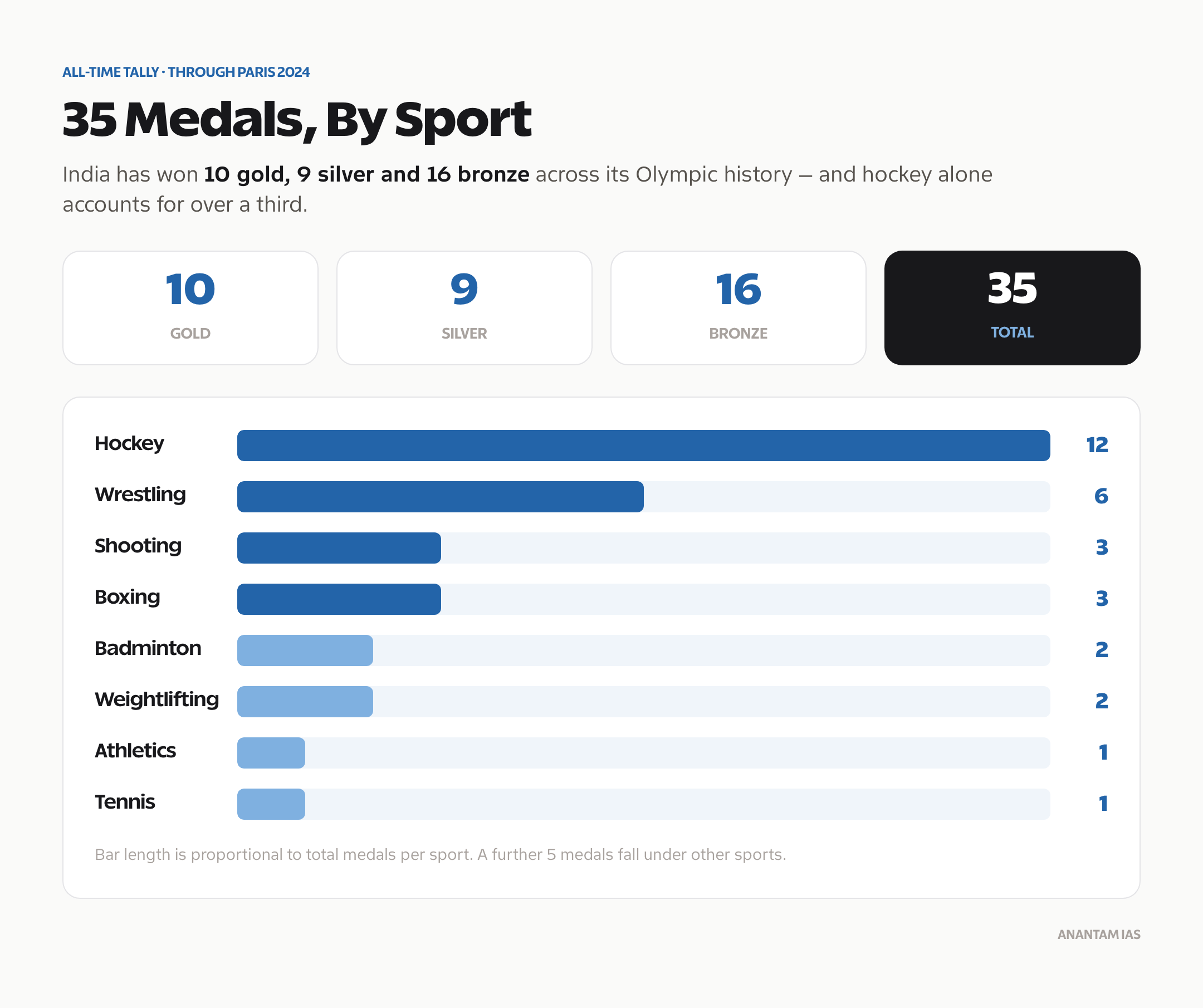
India’s All-Time Olympic Medal Tally
By Medal Type
| Medal | Count |
|---|---|
| Gold | 10 |
| Silver | 9 |
| Bronze | 16 |
| Total | 35 |
Note: Counts include medals through Paris 2024. Numbers may vary slightly based on source methodology.
By Sport
| Sport | Gold | Silver | Bronze | Total |
|---|---|---|---|---|
| Hockey | 8 | 1 | 3 | 12 |
| Shooting | 1 | 1 | 1 | 3 |
| Wrestling | 0 | 2 | 4 | 6 |
| Badminton | 0 | 1 | 1 | 2 |
| Boxing | 0 | 0 | 3 | 3 |
| Weightlifting | 0 | 1 | 1 | 2 |
| Athletics | 1 | 0 | 0 | 1 |
| Tennis | 0 | 0 | 1 | 1 |
| Other | 0 | 3 | 2 | 5 |
Hockey dominates India’s Olympic history — accounting for over one-third of all medals. But the trend is shifting. Since 2008, individual sports have contributed the majority of India’s medals.
Notable Indian Olympic Athletes
Legends
| Athlete | Sport | Olympics | Medals |
|---|---|---|---|
| Major Dhyan Chand | Hockey | 1928, 1932, 1936 | 3 Gold |
| Neeraj Chopra | Javelin Throw | 2020, 2024 | 1 Gold, 1 Silver |
| PV Sindhu | Badminton | 2016, 2020 | 1 Silver, 1 Bronze |
| Abhinav Bindra | Shooting | 2008 | 1 Gold |
| Sushil Kumar | Wrestling | 2008, 2012 | 1 Bronze, 1 Silver |
| Mary Kom | Boxing | 2012 | 1 Bronze |
| Sakshi Malik | Wrestling | 2016 | 1 Bronze |
| Mirabai Chanu | Weightlifting | 2020 | 1 Silver |
PV Sindhu is the only Indian to win Olympic medals in two consecutive editions in an individual sport (Silver 2016, Bronze 2020).
Sushil Kumar is the only Indian to win two individual Olympic medals (Bronze 2008, Silver 2012 — both in wrestling).
India’s Olympic Infrastructure and Governance
Sports Authority of India (SAI)
SAI is the primary body overseeing training centres, coaching, and athlete development for Olympic sports. The Target Olympic Podium Scheme (TOPS) provides customized support — training, coaching, equipment, and financial assistance — to medal-potential athletes.
Key Government Initiatives
| Initiative | Focus |
|---|---|
| Target Olympic Podium Scheme (TOPS) | Direct support to medal-potential athletes |
| Khelo India Programme | Grassroots sports development |
| National Sports Development Fund | Financial support for sports infrastructure |
| Fit India Movement | Mass participation in sports and fitness |
Indian Olympic Association (IOA)
The Indian Olympic Association, founded in 1927, is the National Olympic Committee. It selects and sends the Indian contingent to Olympic Games and manages India’s participation in the Olympic movement.
India’s Bid for Hosting Olympics
India has never hosted the Olympic Games, though discussions about bidding for a future edition surface periodically. The 2023 IOC session in Mumbai highlighted India’s growing sporting ambitions. Key challenges include infrastructure requirements, financial commitment, and competition from other bidding nations.
India successfully hosted the Commonwealth Games in 2010 (Delhi) and has hosted multiple Cricket World Cups, demonstrating capacity for large-scale sporting events.
Olympic Trivia: India Edition
| Record/Fact | Detail |
|---|---|
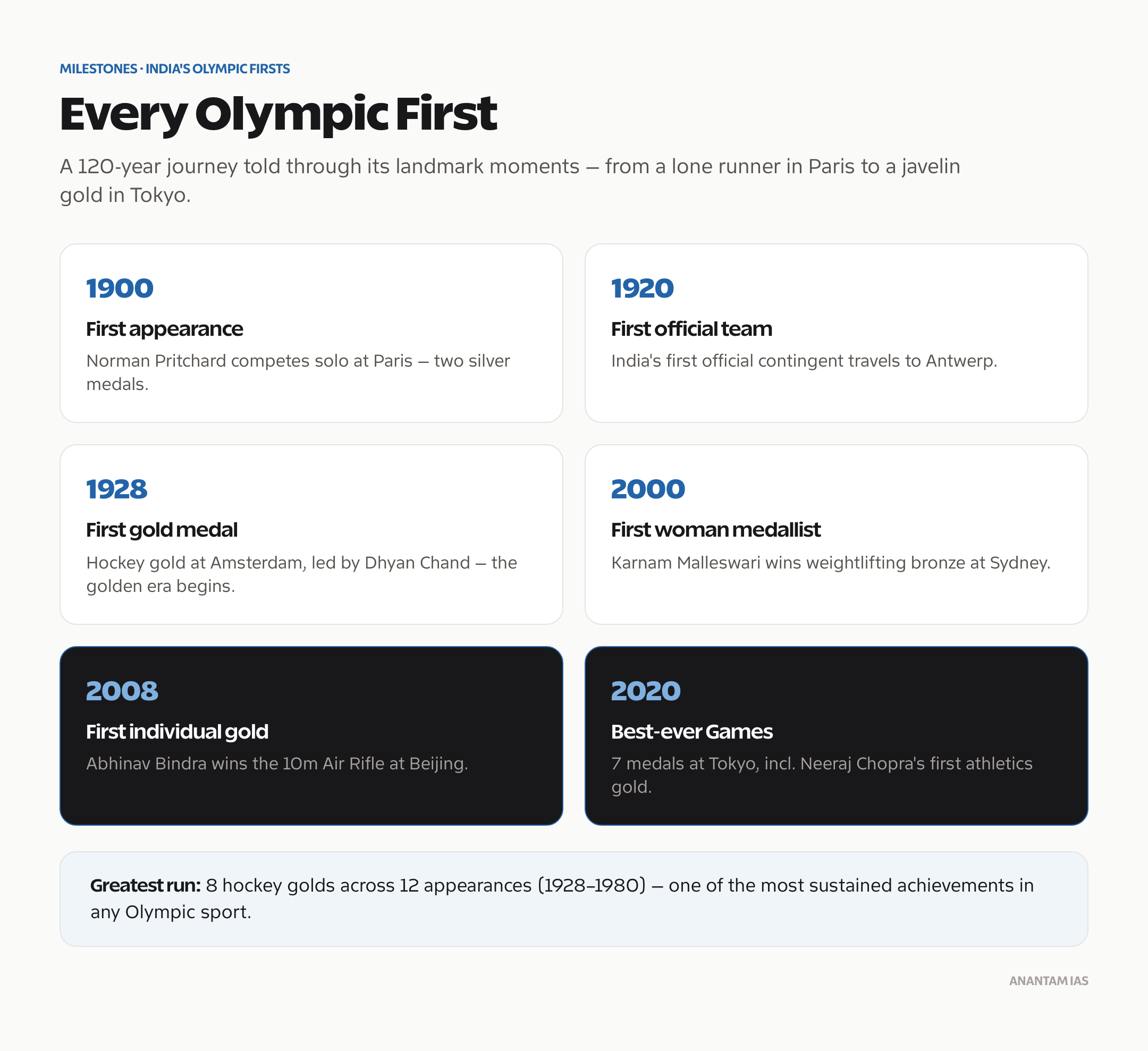
| First Olympic appearance | 1900 Paris (Norman Pritchard) |
| First official team | 1920 Antwerp |
| First gold medal | 1928 Amsterdam (Hockey) |
| First individual gold | 2008 Beijing (Abhinav Bindra) |
| First woman medallist | 2000 Sydney (Karnam Malleswari) |
| Most medals in single Games | 7 (Tokyo 2020) |
| Most hockey golds | 8 (1928–1980) |
| Youngest medallist | PV Sindhu (21, Rio 2016) |
| Flag bearer traditions | Usually a senior athlete from a medal-potential sport |
Upcoming: India at the Olympics
India’s Olympic trajectory is clearly upward. Investment in sports infrastructure, grassroots programmes (Khelo India), and targeted athlete support (TOPS) are producing results. Sports like shooting, wrestling, boxing, badminton, weightlifting, and athletics now regularly produce Olympic contenders.
The 2028 Los Angeles Olympics will feature cricket as an Olympic sport — potentially India’s best opportunity for a significant medal haul, given India’s dominance in the sport globally.
Frequently Asked Questions
How many Olympic gold medals has India won?
India has won 10 Olympic gold medals in total. Eight of these came in field hockey (1928, 1932, 1936, 1948, 1952, 1956, 1964, 1980), one in shooting by Abhinav Bindra (2008), and one in athletics by Neeraj Chopra (2020). Hockey gold medals span from Amsterdam 1928 to Moscow 1980.
Who was the first Indian to win an individual Olympic gold medal?
Abhinav Bindra won India’s first individual Olympic gold medal in the 10m Air Rifle event at the 2008 Beijing Olympics. Before Bindra, all of India’s gold medals had come through the hockey team. His achievement marked a turning point in India’s Olympic sporting culture.
Why did India dominate hockey at the Olympics?
India dominated Olympic hockey from 1928 to 1956 due to extraordinary individual talent (Dhyan Chand, Balbir Singh Sr.), superior stick-work on natural grass pitches, strong domestic hockey culture, and limited international competition. The shift to artificial turf in the 1970s neutralized India’s natural grass advantage.
What is the Target Olympic Podium Scheme?
TOPS (Target Olympic Podium Scheme) is a government initiative under the Ministry of Youth Affairs and Sports that provides customized training, international coaching, equipment, and financial support to athletes identified as potential Olympic medallists. The scheme has been credited with contributing to India’s improved Olympic performances since 2016.
Will cricket be in the 2028 Olympics?
Yes. Cricket (T20 format) has been included in the 2028 Los Angeles Olympics. This represents a major opportunity for India, given the country’s cricketing strength. However, Olympic cricket will feature only T20 format with limited squad sizes, and the competition dynamics may differ from ICC events.
Tell Google you want more of this.
Add Anantam IAS as a preferred sourceOne tap, and this site shows up more often in your own Top Stories, AI Overviews and AI Mode. Remove it any time.