Awards & Honours in India: Complete List for UPSC
India’s awards system recognizes excellence across public service, arts, science, sports, literature, and military valour. For UPSC, awards-related questions appear in Prelims general knowledge, current affairs (annual award announcements), and sometimes in Mains when discussing governance or cultural heritage. This comprehensive reference covers all major categories — civilian, military, sports, literary, and scientific awards.
Civilian Awards: The Padma Awards System
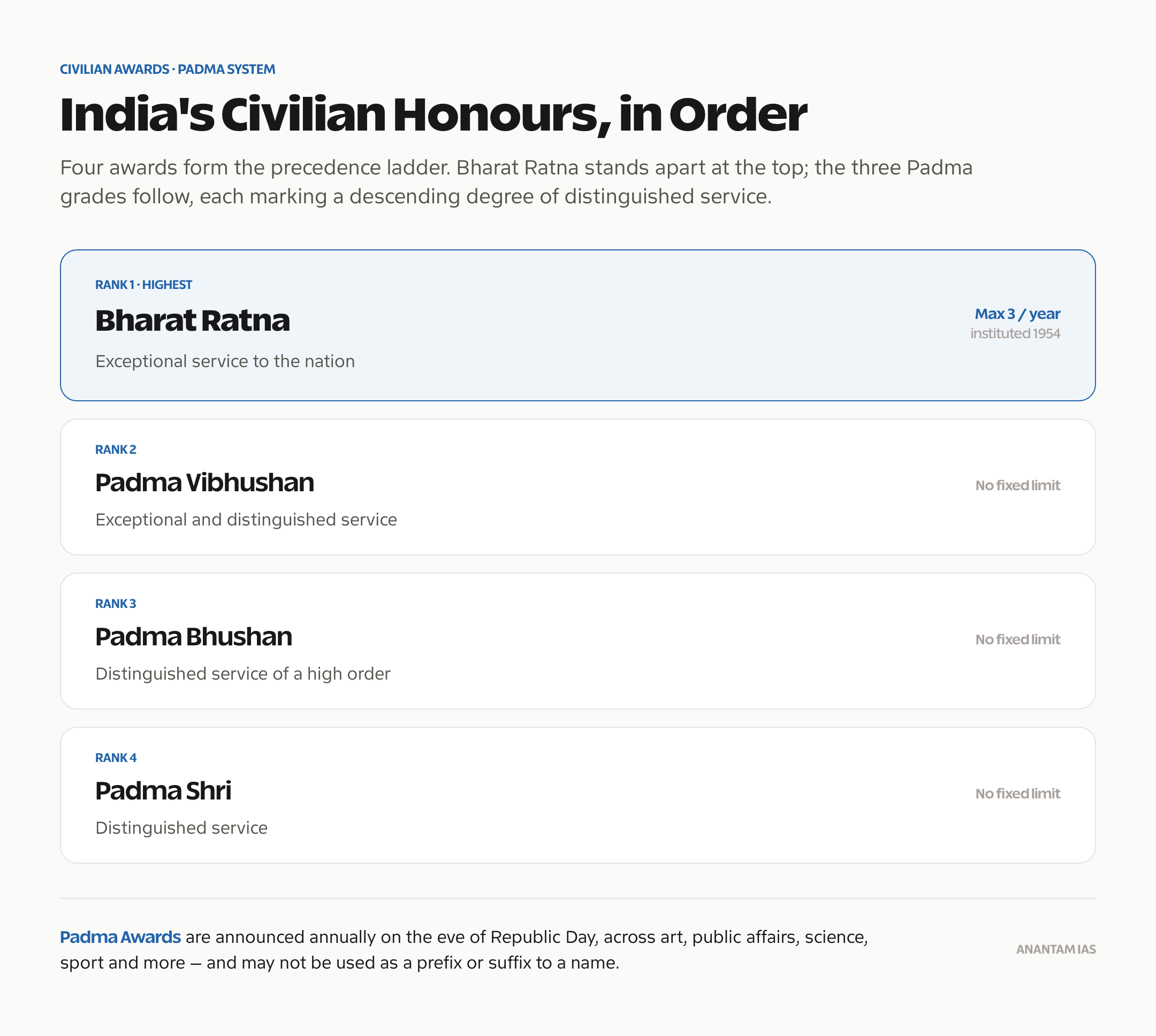
India’s civilian awards are the highest recognitions the government bestows on citizens for distinguished service in various fields.
Hierarchy of Civilian Awards
| Award | Rank | Number Limit | Field |
|---|---|---|---|
| Bharat Ratna | Highest civilian award | Max 3 per year (no strict rule) | Exceptional service to the nation |
| Padma Vibhushan | Second highest | No fixed limit | Exceptional and distinguished service |
| Padma Bhushan | Third highest | No fixed limit | Distinguished service of a high order |
| Padma Shri | Fourth highest | No fixed limit | Distinguished service |
Bharat Ratna
The Bharat Ratna was instituted in 1954. Key facts:
| Feature | Detail |
|---|---|
| Instituted | 1954 |
| First Recipients | C. Rajagopalachari, S. Radhakrishnan, C.V. Raman (all in 1954) |
| Total Recipients | 50+ (as of 2026) |
| Posthumous Awards | Allowed (since 1966) |
| Non-Indian Recipients | Nelson Mandela (1990), Khan Abdul Ghaffar Khan (1987) |
| Constitutional Status | Not mentioned in the Constitution; instituted by Presidential notification |
Notable Bharat Ratna Recipients:
| Year | Recipient | Field |
|---|---|---|
| 1954 | C.V. Raman | Science |
| 1954 | C. Rajagopalachari | Public affairs |
| 1971 | Indira Gandhi | Public affairs |
| 1991 | Rajiv Gandhi (posthumous) | Public affairs |
| 1997 | A.P.J. Abdul Kalam | Science/public service |
| 2001 | Lata Mangeshkar | Music |
| 2014 | Sachin Tendulkar | Sports |
| 2015 | Atal Bihari Vajpayee | Public affairs |
| 2019 | Pranab Mukherjee | Public affairs |
| 2024 | L.K. Advani | Public affairs |
Padma Awards
Padma Awards are announced annually on the eve of Republic Day (January 25). They’re awarded in all disciplines including art, social work, public affairs, science, trade, industry, medicine, literature, education, sports, and civil service.
Selection Process:
- Nominations are open to the public
- Padma Awards Committee evaluates nominations
- Committee chaired by the Cabinet Secretary
- Final approval by the Prime Minister, President
Key Rules:
- Not awarded posthumously (except in rare cases)
- Not used as prefix or suffix to recipient’s name
- Awarded irrespective of race, occupation, position, or sex
- Government servants are also eligible
Gallantry Awards (Military)
Wartime Gallantry Awards
| Award | Rank | Instituted | For |
|---|---|---|---|
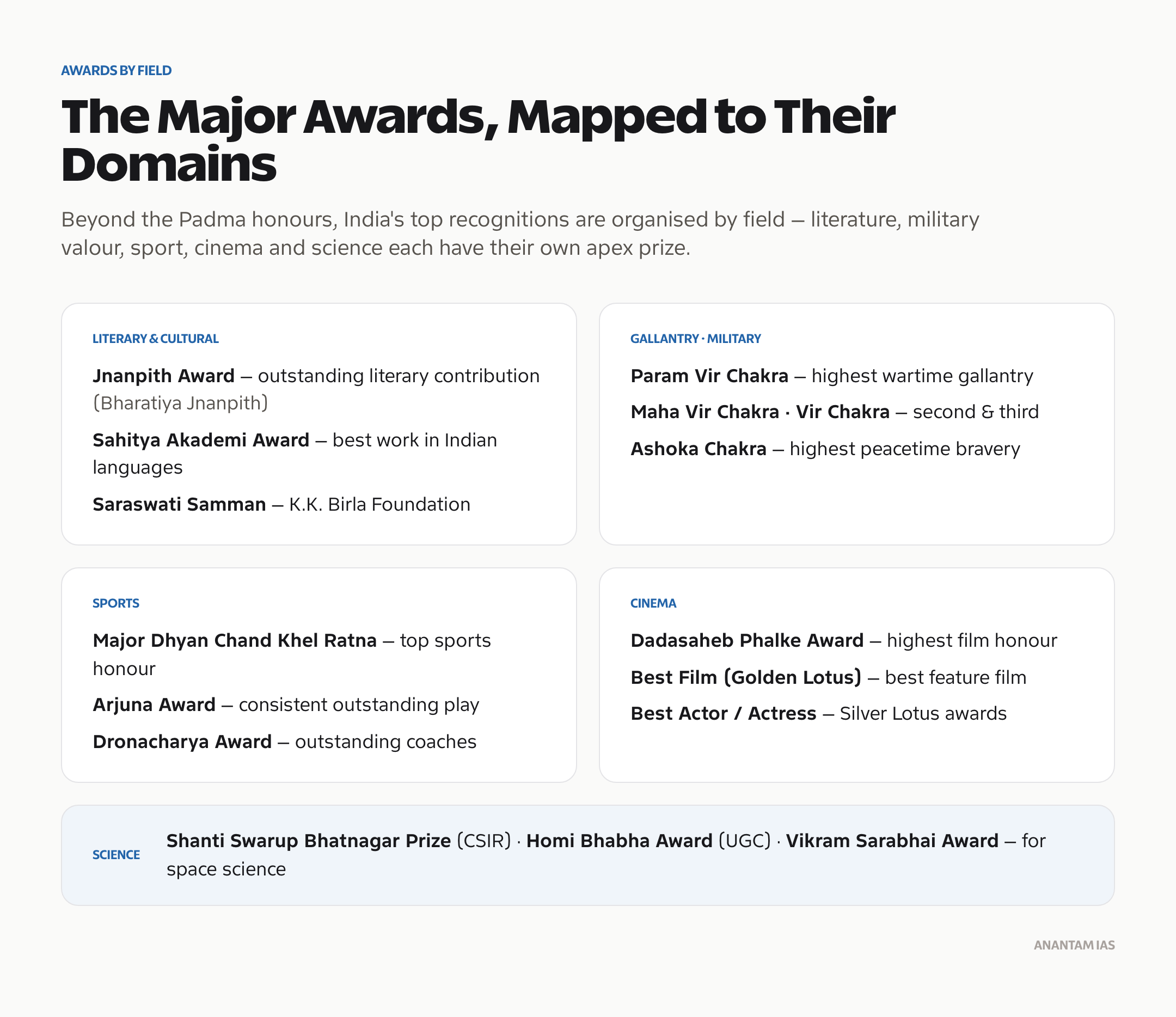
| Param Vir Chakra (PVC) | Highest wartime gallantry | 1950 | Most conspicuous bravery in the presence of the enemy |
| Maha Vir Chakra (MVC) | Second highest | 1950 | Acts of conspicuous gallantry |
| Vir Chakra (VrC) | Third highest | 1950 | Acts of gallantry |
Param Vir Chakra Recipients: The PVC is India’s equivalent of the Victoria Cross (UK) or Medal of Honor (US). Total recipients number 21, with 14 awarded posthumously. Notable recipients include:
| Recipient | War/Operation | Year |
|---|---|---|
| Major Somnath Sharma | Indo-Pak War 1947 (posthumous) | 1947 |
| Company Havildar Major Piru Singh | Indo-Pak War 1947 (posthumous) | 1948 |
| Captain Vikram Batra | Kargil War (posthumous) | 1999 |
| Subedar Major Sanjay Kumar | Kargil War | 1999 |
Peacetime Gallantry Awards
| Award | For |
|---|---|
| Ashoka Chakra | Most conspicuous bravery (not in the face of enemy) |
| Kirti Chakra | Conspicuous gallantry (not in the face of enemy) |
| Shaurya Chakra | Gallantry (not in the face of enemy) |
Distinguished Service Awards
| Award | For |
|---|---|
| Param Vishisht Seva Medal | Most exceptional distinguished service |
| Ati Vishisht Seva Medal | Distinguished service of an exceptional order |
| Vishisht Seva Medal | Distinguished service |
Sports Awards
National Sports Awards
| Award | For | Prize Money |
|---|---|---|
| Major Dhyan Chand Khel Ratna | Spectacular performance in sports over 4 years | Rs 25 lakh |
| Arjuna Award | Consistent outstanding performance over 4 years | Rs 15 lakh |
| Dronacharya Award | Outstanding coaches | Rs 15 lakh (lifetime) / Rs 10 lakh (regular) |
| Dhyan Chand Award | Lifetime contribution to sports development | Rs 10 lakh |
| Maulana Abul Kalam Azad Trophy | Top sports university of the year | Trophy |
| Rashtriya Khel Protsahan Puraskar | Organizations promoting sports | Trophy and citation |
| Tenzing Norgay National Adventure Award | Outstanding adventure feats | Rs 15 lakh |
Note: The Rajiv Gandhi Khel Ratna Award was renamed Major Dhyan Chand Khel Ratna Award in 2021.
India at the Olympics: History, Medals & Records
Literary and Cultural Awards
National Literary Awards
| Award | Instituted By | For | Prize |
|---|---|---|---|
| Jnanpith Award | Bharatiya Jnanpith | Outstanding literary contribution | Rs 11 lakh + statue |
| Sahitya Akademi Award | Sahitya Akademi | Outstanding literary work in Indian languages | Rs 1 lakh + plaque |
| Sahitya Akademi Fellowship | Sahitya Akademi | Lifetime literary achievement | — |
| Saraswati Samman | K.K. Birla Foundation | Outstanding literary work | Rs 15 lakh |
Jnanpith Award Facts:
- Instituted in 1961
- First recipient: G. Sankara Kurup (1965) for Malayalam
- Awarded for contributions to Indian literature in any language in the Eighth Schedule
- Only Indian citizens are eligible
National Film Awards
| Category | Significance |
|---|---|
| Dadasaheb Phalke Award | Highest film honour, lifetime contribution |
| Best Film (Golden Lotus) | National Film Award for Best Feature Film |
| Best Director | National Film Award for Best Direction |
| Best Actor/Actress | Silver Lotus awards |
The Dadasaheb Phalke Award, named after the father of Indian cinema, has been awarded since 1969. Recipients include Devika Rani (first, 1969), Satyajit Ray, Lata Mangeshkar, and Amitabh Bachchan.
Scientific Awards
| Award | Given By | For |
|---|---|---|
| Shanti Swarup Bhatnagar Prize | CSIR | Outstanding research in science |
| INSA Medal for Young Scientists | Indian National Science Academy | Young researchers |
| Homi Bhabha Award | UGC | Applied science research |
| Vikram Sarabhai Award | Indian Science Congress | Contributions to space science |
The Shanti Swarup Bhatnagar Prize is often called India’s “Nobel equivalent” in science, though the comparison is informal.
Bravery Awards for Children
| Award | For | Given By |
|---|---|---|
| National Bravery Awards | Acts of bravery by children (under 18) | Indian Council for Child Welfare |
| Bharat Award | Supreme courage among child bravery awardees | Indian Council for Child Welfare |
Announced annually on January 26 (Republic Day), these awards recognize exceptional courage shown by children in saving lives, fighting crime, or displaying extraordinary bravery.
Important International Awards and Indian Recipients
| Award | Notable Indian Recipients |
|---|---|
| Nobel Prize | Rabindranath Tagore (Literature, 1913), C.V. Raman (Physics, 1930), Amartya Sen (Economics, 1998), Kailash Satyarthi (Peace, 2014), Abhijit Banerjee (Economics, 2019) |
| Ramon Magsaysay Award | Vinoba Bhave (1958), Mother Teresa (1962), Kiran Bedi (1994), Arvind Kejriwal (2006) |
| Pulitzer Prize | Vijay Seshadri (Poetry, 2014), Siddhartha Mukherjee (General Non-Fiction, 2011) |
| Man Booker Prize | Arundhati Roy (1997), Kiran Desai (2006) |
Award Comparison Table
| Parameter | Bharat Ratna | Padma Awards | Param Vir Chakra | Khel Ratna |
|---|---|---|---|---|
| Field | Any | Any | Military | Sports |
| Instituted | 1954 | 1954 | 1950 | 1991 |
| Frequency | No fixed schedule | Annual (Republic Day eve) | As warranted | Annual |
| Cash Prize | None | None | Varies by state | Rs 25 lakh |
| Posthumous | Yes | Rare | Yes | No |
| Foreign Citizens | Yes | Yes | No | No |
Frequently Asked Questions
How many Bharat Ratnas can be given in a year?
There’s no constitutional or statutory limit on the number of Bharat Ratnas per year, though tradition limits it to a maximum of three. In some years, none are awarded. The award was suspended between 1977 and 1980 by the Janata Party government and briefly in 1992 following a Supreme Court observation.
What is the difference between Padma Vibhushan and Padma Bhushan?
Padma Vibhushan is awarded for exceptional and distinguished service, while Padma Bhushan recognizes distinguished service of a high order. Padma Vibhushan is the higher award. The distinction lies in the degree and impact of the service rendered — Vibhushan recipients typically have a transformative national or international impact.
Can foreigners receive Indian civilian awards?
Yes. The Padma Awards and Bharat Ratna can be conferred on foreign nationals. Notable foreign recipients include Nelson Mandela (Bharat Ratna, 1990) and Khan Abdul Ghaffar Khan (Bharat Ratna, 1987). The award recognizes the individual’s contribution to India or humanity irrespective of nationality.
Who selects Padma Award recipients?
A Padma Awards Committee constituted by the Prime Minister evaluates nominations received from the public, state governments, union ministries, and other stakeholders. The committee is headed by the Cabinet Secretary and includes senior government officials. The final list is approved by the Prime Minister and the President of India.
How many Param Vir Chakras have been awarded?
Twenty-one Param Vir Chakras have been awarded since 1950. Of these, 14 were posthumous awards. The most recent PVC was awarded to Captain Vikram Batra and Subedar Major (later Honorary Captain) Yogendra Singh Yadav during the Kargil War (1999).
Tell Google you want more of this.
Add Anantam IAS as a preferred sourceOne tap, and this site shows up more often in your own Top Stories, AI Overviews and AI Mode. Remove it any time.