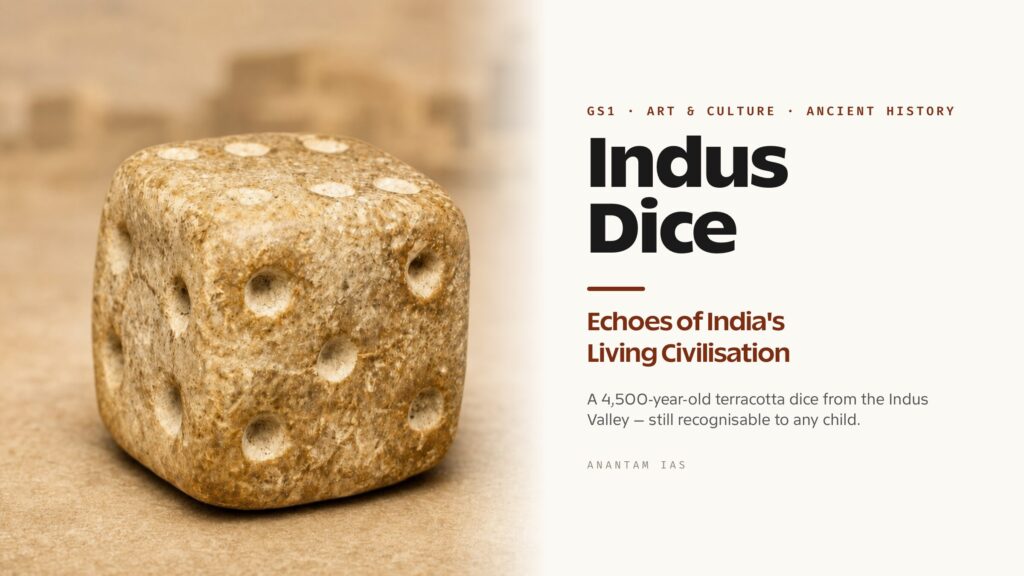
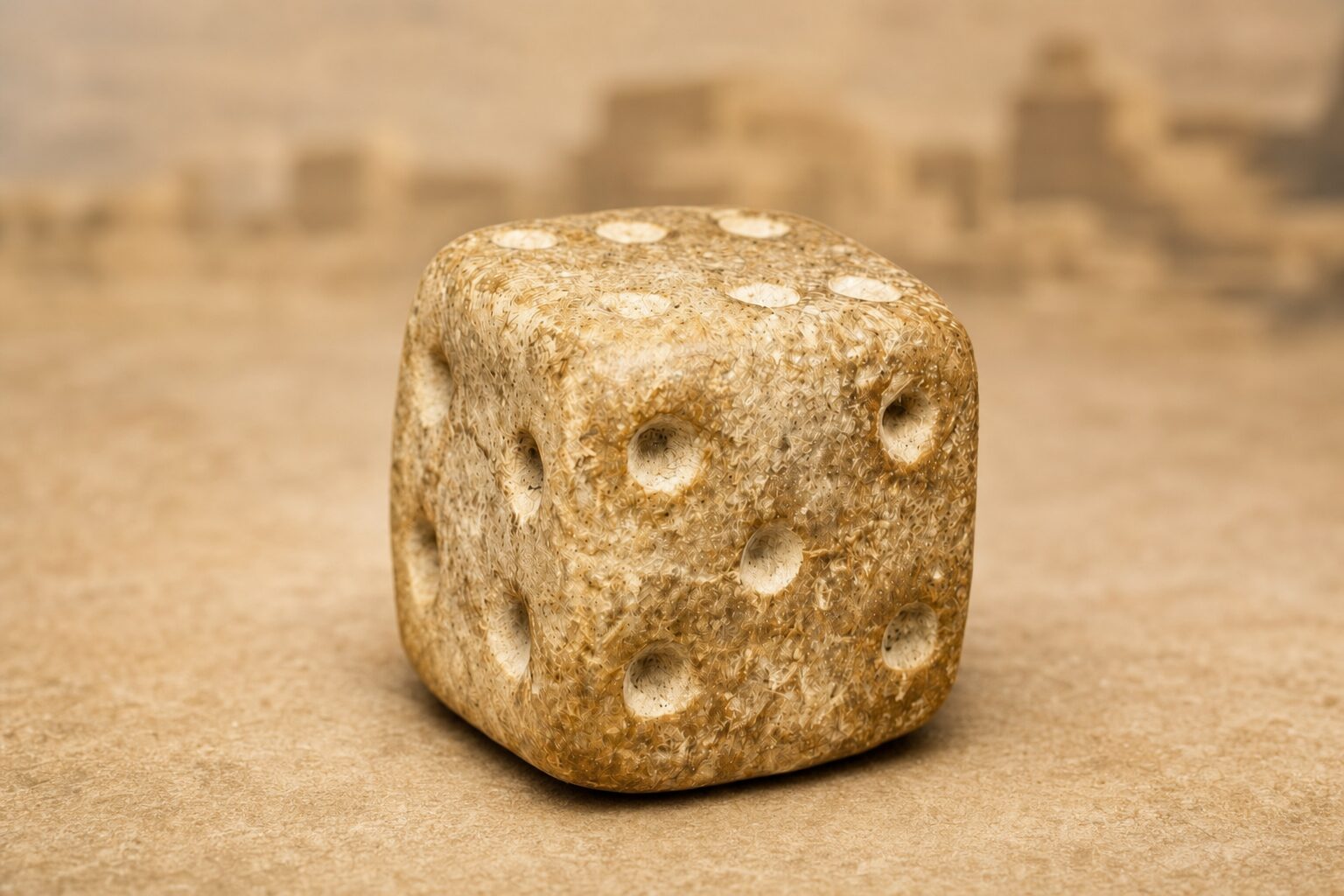
Pick up a 4,500-year-old object and you expect it to feel foreign. This one doesn’t. It’s a small cube of fired clay, its corners worn soft by time, each face pocked with shallow drilled dots — one, two, three, four, five, six. A child in almost any Indian home would recognise it on sight and ask for a turn. That is the quiet astonishment of the Indus dice: an everyday thing from a city that thrived before a single verse of the Vedas was written down, and we still know exactly what it is for.
The Ministry of Culture recently put this terracotta die in front of the public as a 4,500-year-old artefact from the Indus Valley Civilisation, and it travelled far online — not because it is grand, but because it is familiar. A seal asks to be decoded. A sculpture asks to be admired. A die asks to be rolled. And in that small gap between the museum case and the memory of a game you played last week sits one of the largest ideas in Indian history: that this civilisation is less a ruin to be excavated than a habit that simply never stopped being practised.
What the Object Actually Is
Let’s be precise before we get poetic, because the object earns the awe on its own terms. What the Ministry showed is a cubical die of terracotta — fired clay — with the numbers one to six marked as small drilled hollows on its faces. Dice exactly like it have been pulled from the rubble of Harappa, including pieces recovered during excavations between 1995 and 2001, and many more were found at Mohenjo-daro, the two great cities of a civilisation that flourished roughly between 2600 and 1800 BCE. So “4,500 years old” is not a flourish. It is arithmetic.
The archaeologist John Marshall, who led the early Mohenjo-daro digs, was blunt about how ordinary the game must have been. Dicing, he wrote, was clearly a common pastime, “proved by the number of pieces that have been found” — usually cubical, made of pottery, and ranging from about 1.2 to 1.5 inches on a side, with shallow holes for pips and crisp, well-cut edges. People were not making one ceremonial die. They were making lots of them, the way we stamp out plastic ones today.
There’s one detail worth slowing down on, because it is the difference that proves the kinship. On a modern die, the opposite faces always add up to seven — one faces six, two faces five, three faces four. The Indus dice don’t follow that rule; on many of them one sits opposite two, three opposite four, five opposite six. So this is not the same die we use. It is an independent invention of the same idea — a fair, six-sided randomiser for a game of chance — arrived at on the banks of the Indus a thousand years before the Buddha. The form drifted. The instinct held.
Dice in the Vedic Imagination
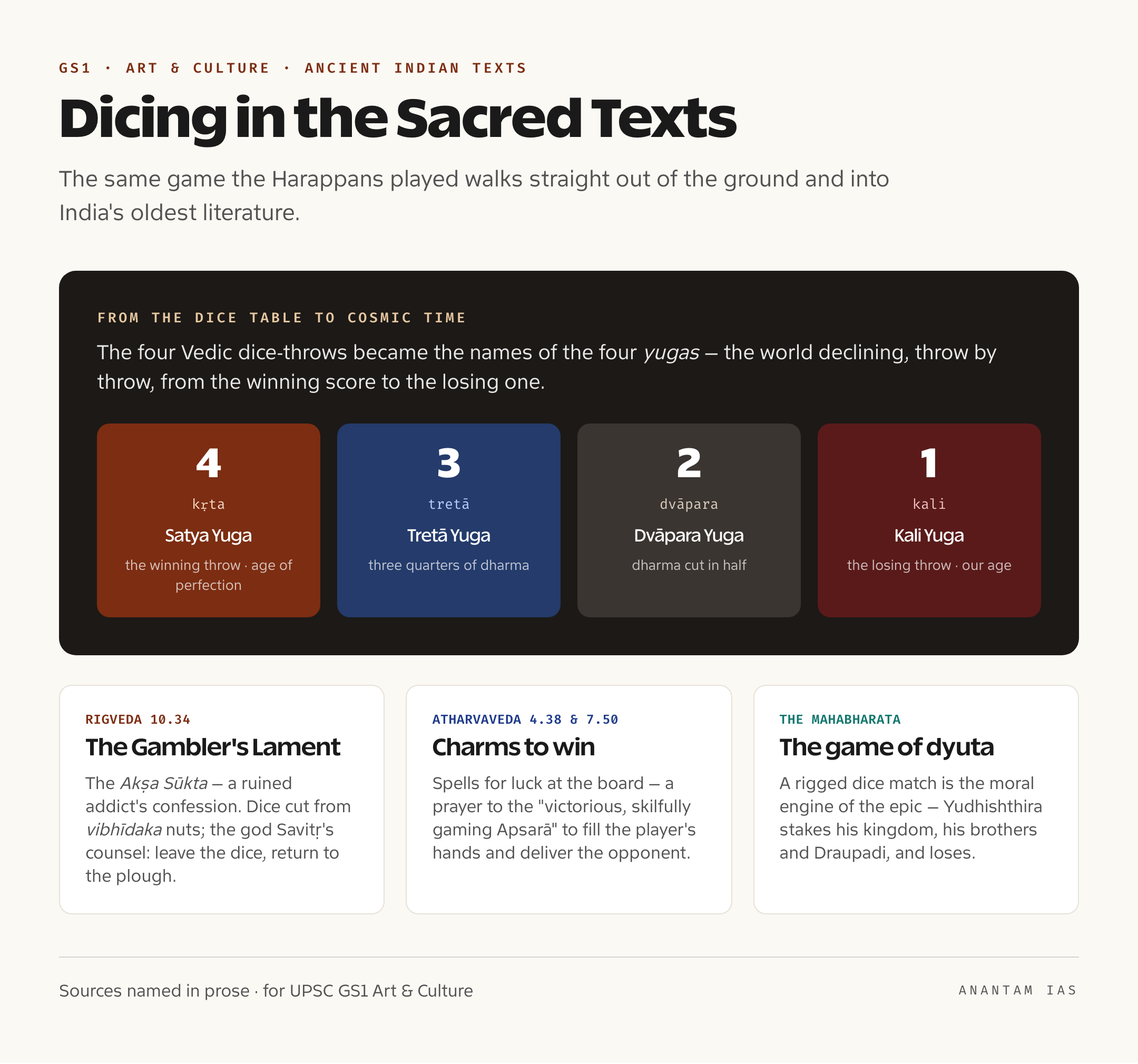
If the dice were only an archaeological curiosity, the story would end at the museum case. It doesn’t, because the same game walks straight out of the ground and into the oldest literature we possess. The Rigveda — the senior-most of the four Vedas — contains a hymn in its tenth book, the Akṣa Sūkta, that everyone now calls the “Gambler’s Lament.” Akṣa simply means dice. And the poem is not a hymn of praise at all; it is the confession of an addict.
In about fourteen verses, a ruined gambler watches the dice — in his day made from the hard brown nuts of the vibhīdaka tree, not yet clay cubes — and cannot stop. “They tempt me, they torment me,” he says in effect; his wife has turned away, his mother-in-law despises him, and still the dice call. The hymn ends with the god Savitṛ’s plain advice, as relevant to a 2026 fantasy-app user as to a Bronze Age punter: stop playing, go back to the plough, and be content with the cattle and the wife you still have. Scholars have long ranked it among the finest secular poems of the ancient world — Moriz Winternitz called it the most beautiful of the Rigveda’s non-religious poems — precisely because the voice is so recognisably human.
Now here is the line that should give you a small shiver. The Vedic dice game scored by four throws, and those throws had names: kṛta, the winning throw of four; tretā, three; dvāpara, two; and kali, the losing throw of one. Read those four words again, because you already know them. They are the names of the four yugas — the cosmic ages — that Indian thought still uses today, declining in order from Kṛta or Satya Yuga, the age of perfection, down to our own fallen Kali Yuga. The civilisation took the language of a dice table and used it to imagine the structure of time itself: a great cosmic game in which the world slips, throw by throw, from the perfect score to the losing one. That is not a coincidence anyone invented later. It is a single thread running from a clay cube to a theory of the universe.
The dice were sacred enough to pray to, as well as to curse. The Atharvaveda — the fourth Veda, full of charms for everyday life — preserves outright spells for winning at the board. One of them calls on a victorious, skilfully gaming Apsara, a celestial dancer, to “fill my hands with butter” and deliver the opponent into the gambler’s grip; another is simply a gambler’s prayer for a lucky run. People bargained with the gods over dice the way some still touch a coin before a toss.
Threads That Were Never Cut
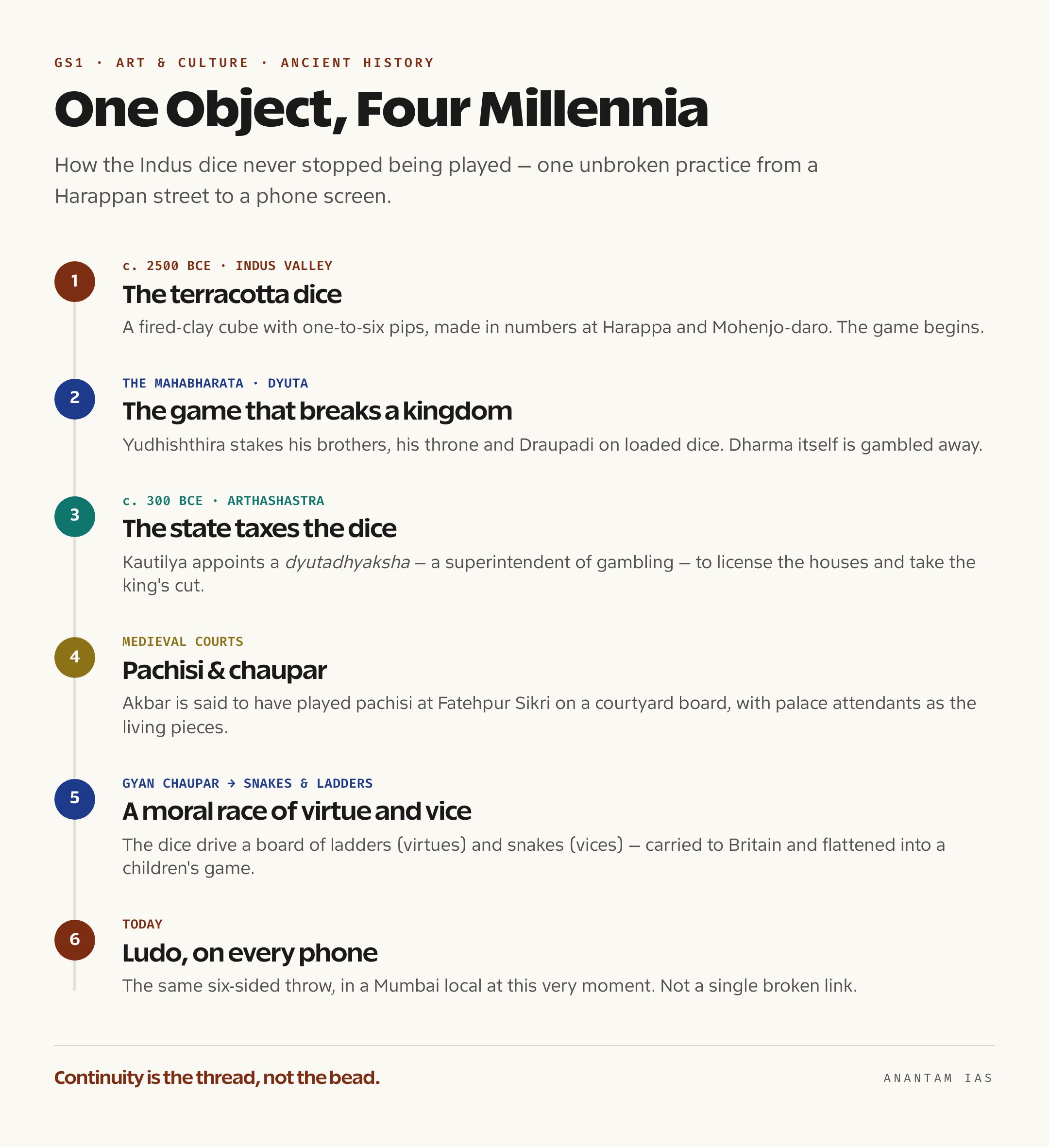
So follow the single thread of the dice forward, and watch how little it frays. From the Indus board it rolls into the Mahabharata, where the entire epic pivots on a rigged game of dyuta — Yudhishthira, the most righteous of kings, gambling away his brothers, his kingdom and finally Draupadi to the loaded dice of Shakuni. Dicing here is not a footnote; it is the moral engine of the story, the moment dharma itself is staked and lost. A few centuries on, Kautilya‘s Arthashastra treats gambling as serious enough to regulate, appointing a dyutādhyakṣa — a state superintendent of gambling — to license the houses, supply the dice and take the king’s cut. The state was taxing the game two thousand years before a GST council existed.
And it keeps rolling. The Indus cube becomes the four-armed cloth board of chaupar and pachisi — the game Akbar is said to have played at Fatehpur Sikri on a courtyard so large that slave girls in coloured dress served as the living pieces. It becomes gyan chaupar, the “game of knowledge,” a moral race up ladders of virtue and down snakes of vice that the British carried home and flattened into Snakes and Ladders. And it ends, for now, as the ludo app open on a phone in a Mumbai local at this very moment. One object. Four millennia. Not a single broken link.
The dice is simply the easiest thread to see, because we still hold its end. But pull on the others and they hold too. The rectangular brick fire-altars unearthed at Kalibangan and Lothal sit uncannily close to the Vedic yajna and the havan lit at a wedding this weekend. The famous Pashupati seal from Mohenjo-daro — a horned figure seated among animals — is read by many as a proto-Shiva. The swastika and the wheel are stamped on Harappan seals and still chalked on doorsteps and carved into temple thresholds. Seated figures on the seals fold into postures a yoga teacher would name without hesitation. The Harappans were obsessive about standardised weights; the Indian instinct for exact measure in ritual and trade never left. None of these is the dice. All of them are the same point.
What “Living Civilisation” Really Means
This is where the object earns its real weight, and where I want to be careful, because the phrase “living civilisation” gets thrown around until it means nothing. So let me give it a hard edge. A civilisation is not its geography, and it is not its ruins. Borders move; cities are buried; languages are lost. What actually carries a civilisation forward is the unglamorous stuff — the customs, symbols, rituals and shared consciousness that pass from hand to hand without anyone ever deciding to preserve them.
By that test, the walls of Mohenjo-daro are a ruin. They need archaeologists, grant money and a roof. The dice game is something else entirely — a living inheritance, which needs nothing but a child willing to learn it from a grandparent. The first kind of heritage is studied. The second kind is practised. And it is the second kind that makes the claim defensible: India is the enduring continuity of the Indus-Saraswati Civilisation — the cluster of cities along the Indus and the now-dry Ghaggar-Hakra that many Indian scholars identify with the Vedic Saraswati — not because the buildings survived, but because the practices did. A ruin tells you a people existed. A living custom tells you they never fully left.
The Honest Caveats
A strong case is only strengthened by stating its limits, so here they are without flinching. The Indus script remains undeciphered — we genuinely cannot read what these people called their dice game, their gods or themselves, and anyone who tells you otherwise is selling something. The name “Indus-Saraswati” is itself a scholarly choice: it is widely used in India to credit the Ghaggar-Hakra sites, while many international archaeologists still prefer “Indus” alone, and that debate is real, not settled. The proto-Shiva reading of the Pashupati seal is an interpretation, not a proof. And the Harappan religious world was not simply an early photocopy of the later Vedic pantheon; there are real discontinuities alongside the continuities.
Hold all of that, and the dice still stands. Because continuity has never meant sameness. A river is continuous even though no drop of water stays in it. The honest claim is not that nothing changed — almost everything did — but that the thread was never cut. Saying so out loud, with the caveats attached, makes the continuity more believable, not less. Overclaiming is how you lose an argument you were already winning.
Why It Matters Beyond Nostalgia
None of this is mere sentiment, and it carries real consequences for how India treats its past. It argues for protecting the everyday and not just the spectacular — for funding the excavation and conservation of sites like Rakhigarhi and Dholavira, the latter now a UNESCO World Heritage Site, with the same seriousness we reserve for royal monuments. It argues for museums that display the dice, the toy cart and the cooking pot beside the gold and the seals, because ordinary objects are where continuity actually lives. You can read more about the cities behind these objects in our explainer on the Harappan Civilisation, and about the deeper timeline in our Ancient History notes.
It also sets a standard for how we talk about the past in public. A civilisation confident of its roots does not need to inflate them; it can afford accuracy. Teaching children that India is a living civilisation is worth doing — and it is worth doing the honest way, with the evidence on the table and the gaps admitted, so that pride rests on something a sceptic cannot knock over. The dice is perfect for exactly that: humble, undeniable, and still in play.
For Your Mains Answer
This single object is a gift for GS Paper 1, which asks about “salient aspects of Art Forms, Literature and Architecture from ancient to modern times” and the broad story of Indian culture and society. It is equally usable in the Essay paper, on themes of heritage, continuity, identity and tradition-versus-modernity. The trick is to treat the dice as a case study that lets you make a large argument about civilisational continuity through one concrete, memorable thing — examiners reward specificity over slogans.
How to Build the Answer
Open with the object, not the thesis. Describe the terracotta die — its age, its sites, the fact that we still recognise it — and only then pivot to the idea it illustrates: that Indian civilisation survives as living practice, not just as ruins. Move outward in widening circles: the dice in the Rigveda and Atharvaveda, the game in the Mahabharata and the Arthashastra, the survival into pachisi and ludo, and finally the broader threads of fire-altars, seals and symbols. Close by defining continuity honestly. That arc — object, text, survival, meaning, caveat — works for almost any “continuity of Indian culture” question.
Common Mistakes to Avoid
Don’t overclaim. Asserting that the Harappans “were Vedic Hindus” or that the script “has been read” will cost you with an informed examiner. Don’t drown the answer in dates; one or two anchors (2600-1800 BCE; the Rigveda’s tenth book) are plenty. Don’t reduce continuity to a list of bullet points with no argument tying them together. And don’t ignore the discontinuities — acknowledging them is what signals maturity.
A Compact Answer Spine
Civilisation as living practice, not ruins → the dice as proof (Harappan sites, Marshall) → the same game in the Vedas (Gambler’s Lament, the kṛta-tretā-dvāpara-kali throws becoming the four yugas) → survival through dyuta, Arthashastra, pachisi, ludo → other threads (fire-altars, Pashupati, swastika, yoga, weights) → honest caveats (undeciphered script, the naming debate) → continuity means an unbroken thread, not sameness.
Diagram or Flowchart Idea
Draw a single horizontal timeline arrow with the dice at the far left (c. 2500 BCE) and a phone showing ludo at the far right (today). Mark four nodes along it — Rigveda, Mahabharata, Arthashastra, pachisi — and label the arrow itself “one unbroken practice.” A clean continuity timeline like this earns marks fast and is quick to draw.
The Continuity-and-Change Angle
The sophisticated point, worth a line in the conclusion, is that continuity and change are not opposites in Indian culture; they run together. The dice changed shape, material and name across four thousand years and yet remained the same act. Civilisation is the thread, not the bead. Make that distinction and you have said something most candidates miss.
How to Use Evidence Without Overclaiming
Attribute confidently and hedge honestly in the same breath: “The Pashupati seal is widely interpreted as a proto-Shiva figure” reads as scholarship; “The Pashupati seal is Shiva” reads as propaganda. Name your evidence — Marshall on the dice, the Akṣa Sūkta, the Dholavira World Heritage listing — and you sound like someone who has read, not just heard.
FAQ
How old is the Indus dice, and where was it found? The terracotta dice highlighted by the Ministry of Culture is about 4,500 years old, from the Indus Valley Civilisation that flourished roughly between 2600 and 1800 BCE. Cubical dice like it have been found at Harappa — including in excavations between 1995 and 2001 — and in large numbers at Mohenjo-daro.
Did the Indus dice work like a modern dice? Almost, but not quite. They were six-sided cubes of fired clay with one-to-six pips, used for games of chance. But unlike modern dice, where opposite faces always add up to seven, many Indus dice place one opposite two and three opposite four — an independent version of the same idea rather than an exact ancestor.
Where is dicing mentioned in the Vedas? The Rigveda’s tenth book contains the Akṣa Sūkta or “Gambler’s Lament,” a famous poem in the voice of a ruined dice addict. The Atharvaveda preserves charms for winning at dice, including a prayer to a victorious Apsara. The four Vedic dice-throw names — kṛta, tretā, dvāpara and kali — even became the names of the four cosmic ages, the yugas.
What does it mean to call India a “living civilisation”? It means India’s continuity rests less on surviving buildings and more on surviving practices — the games, rituals, symbols and customs that have been passed down without interruption. A ruin needs an archaeologist; a living custom needs only the next generation. The Indus dice, still recognisable to any child, is one small proof of that unbroken thread.
Tell Google you want more of this.
Add Anantam IAS as a preferred sourceOne tap, and this site shows up more often in your own Top Stories, AI Overviews and AI Mode. Remove it any time.