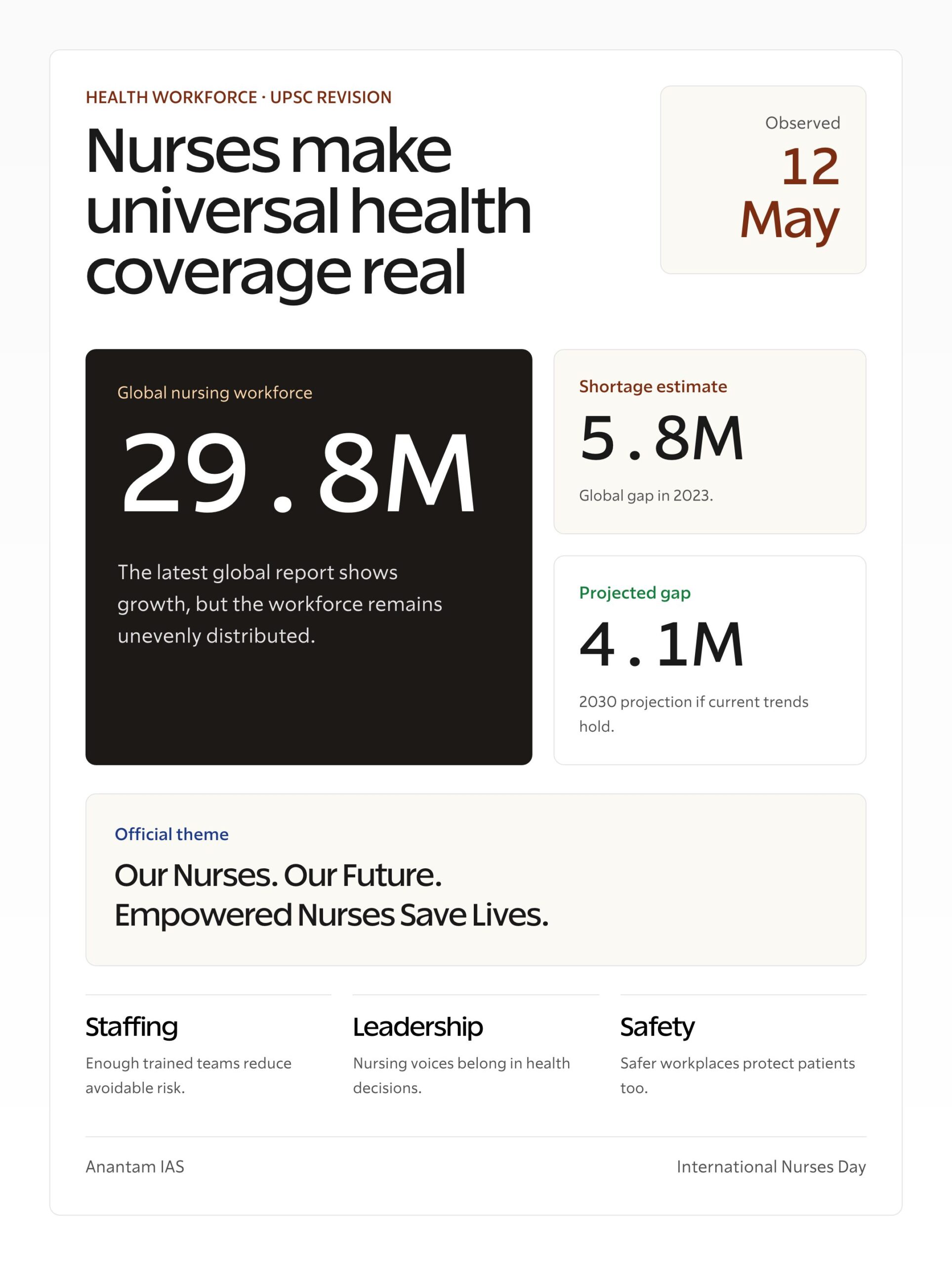
International Nurses Day 2026 will be observed on 12 May 2026, the birth anniversary of Florence Nightingale. The official 2026 theme announced by the International Council of Nurses is "Our Nurses. Our Future. Empowered Nurses Save Lives." The message is simple but very important: nurses do not merely assist doctors. They keep health systems functioning, hold communities together in crises, and convert public-health policy into actual care at the bedside, in primary health centres, in schools, in disaster shelters and in homes.
For students, International Nurses Day is a useful topic because it connects static knowledge with current affairs. It links Florence Nightingale and the professionalisation of nursing, the International Council of Nurses, the World Health Organization, universal health coverage, gender and care work, health workforce shortages, migration of health professionals, and India's own health-system challenges. If you are preparing for UPSC, state PCS, nursing entrance exams, school speeches or essay competitions, the day gives you a compact way to understand how health care depends on people as much as it depends on hospitals, insurance and technology.
The 2026 theme has an educator's lesson hidden inside it. The words "empowered nurses" matter. A health system can build hospitals, buy equipment and announce schemes, but if nurses are underpaid, overworked, excluded from decision-making or denied safe working conditions, the system becomes fragile. Nurses save lives when they have enough colleagues, proper training, leadership roles, fair pay, safe workplaces, digital support and respect. That is why International Nurses Day 2026 should not be reduced to a greeting-card occasion. It is a reminder to invest in the nursing workforce as a national development priority.
Quick facts about International Nurses Day 2026
| Point | Details |
|---|---|
| Date | 12 May 2026 |
| Day type | Global health observance |
| 2026 theme | Our Nurses. Our Future. Empowered Nurses Save Lives |
| Announced by | International Council of Nurses |
| Why 12 May? | Birth anniversary of Florence Nightingale |
| First organized by ICN | 1965 |
| Main idea | Recognising nurses and strengthening the nursing workforce |
| Latest major data source | State of the World's Nursing 2025 |
| UPSC relevance | Health workforce, universal health coverage, gendered care work, primary health care, public health governance |
What is International Nurses Day?
International Nurses Day is a global observance dedicated to recognising the contribution of nurses to health care, public health and society. It is celebrated every year on 12 May. The International Council of Nurses, a global federation of national nursing associations, leads the campaign and releases annual resources around a theme.
The day is not only about appreciation. It is also about policy. Every year, the theme highlights a major issue affecting the nursing profession: investment, leadership, wellbeing, rights, workforce shortages, health-system resilience or the economic value of care. In 2026, the focus is on empowerment because the world is still trying to recover from years of pandemic pressure, health worker burnout, climate-related disasters, conflict, ageing populations and rising demand for long-term care.
In a classroom, I would explain International Nurses Day through one small example. A patient may see a doctor for a few minutes during a hospital round, but nurses monitor the patient hour after hour. They observe small changes in temperature, breathing, pain, consciousness, infection risk and emotional distress. They communicate with families, administer medicines, maintain records, prevent complications and often become the first person to notice that something is going wrong. This is why nursing is not a secondary profession. It is one of the core pillars of patient safety.
Why is International Nurses Day celebrated on 12 May?
The date honours Florence Nightingale, born on 12 May 1820. Nightingale is widely remembered as the founder of modern nursing. During the Crimean War, she and her team improved sanitation, nutrition, ventilation and basic hospital management for wounded soldiers. Mortality declined sharply when care became organised, hygienic and evidence-based.
But reducing Nightingale to the phrase "Lady with the Lamp" makes the story too sentimental. Her larger contribution was scientific and administrative. She used data, hospital statistics and persuasive reports to argue that better nursing, sanitation and public-health planning could save lives. In modern terms, she connected compassion with evidence.
That lesson remains current. Good nursing is not only kindness. It is trained observation, infection control, triage, medication safety, patient education, documentation, teamwork, ethics and public-health awareness. International Nurses Day keeps that legacy alive by reminding governments that nursing needs education, investment and institutional voice.
International Nurses Day 2026 theme
The theme for International Nurses Day 2026 is "Our Nurses. Our Future. Empowered Nurses Save Lives."
This theme has three parts:
Our Nurses means nurses are not invisible workers. They are central to public trust in health systems. People often meet the health system first through a nurse, an ANM, a midwife, a community health worker or a primary-care team.
Our Future means health systems cannot achieve universal health coverage, pandemic preparedness, maternal and child health, elderly care or mental-health access without a strong nursing workforce.
Empowered Nurses Save Lives means nurses need authority, protection and resources. Empowerment is not a motivational slogan. It includes adequate staffing, safe workplaces, fair remuneration, career pathways, leadership roles, digital tools, continuing education, and participation in policy decisions.
The 2026 theme builds on the recent ICN campaign line "Our Nurses. Our Future." The emphasis has now moved from recognising nurses to empowering them. This is a sensible progression. Appreciation without policy change is thin. If governments praise nurses on 12 May but ignore staffing ratios, workplace violence, occupational safety, skill development and migration ethics, the celebration becomes performative.
Latest global nursing data: what the 2025 report shows
The latest global reference point is the State of the World's Nursing 2025 report, prepared by WHO, ICN and partners. The report gives a more current picture than older nursing shortage numbers that are still often repeated online.
The global nursing workforce grew from 27.9 million in 2018 to 29.8 million in 2023. This is progress, but it is uneven. The estimated global nursing shortage reduced from 6.2 million in 2020 to 5.8 million in 2023, with a projection of 4.1 million by 2030 if current trends continue. The numbers are improving, but not fast enough for every region.
The more important point is distribution. A large share of nurses is concentrated in countries that represent a smaller share of the world's population. Low and middle income countries face difficulties in training enough nurses, employing graduates, retaining staff and financing decent working conditions. High income countries, on the other hand, often rely on foreign-trained nurses while facing retirement pressure in their own workforce.
The gender dimension is also important. Women make up the overwhelming majority of the global nursing workforce. This means nursing policy is also gender policy. When nurses face low pay, unsafe workplaces or limited leadership opportunities, the burden falls heavily on women. Strengthening nursing, therefore, advances both health-system resilience and gender equality.
Why nurses are essential for universal health coverage
Universal health coverage means that people should receive needed health services without financial hardship. This goal is impossible without nurses. Doctors, hospitals and insurance schemes receive more public attention, but everyday health delivery depends on nursing.
Nurses support UHC in at least six ways:
- They provide continuous patient care in hospitals, community clinics and homes.
- They deliver maternal and child health services, immunisation support and health education.
- They manage chronic diseases such as diabetes, hypertension and respiratory illness.
- They help prevent hospital-acquired infections and medication errors.
- They support emergency care, disaster response and public-health surveillance.
- They build trust because patients often spend more time with nurses than with any other health professional.
This is why health workforce planning cannot be reduced to counting doctors. India, for example, is trying to expand access through Ayushman Bharat, health and wellness centres, digital health infrastructure and insurance coverage. But these schemes need trained human resources at the last mile. A health card alone does not examine a patient. A hospital building alone does not monitor a mother in labour. A digital record alone does not counsel a family. Nurses make the system human and functional.
International Nurses Day and India
In India, Nurses Day should be understood through three connected realities: public health demand is rising, the nursing workforce is essential to primary care, and care work remains undervalued.
India's health system is moving from a narrow disease-treatment model toward broader primary health care, preventive care, non-communicable disease screening, maternal and child health, elderly care and digital health records. This shift increases the role of nurses. Nurses are needed not only in hospitals, but also in community settings, telehealth workflows, school health, palliative care, mental health and health education.
The Indian Nursing Council regulates nursing education standards, while nursing institutions across states train ANMs, GNMs, B.Sc. Nursing graduates, post-basic nursing graduates and postgraduate nurses. India also has a large pool of nurses who work abroad. This creates both opportunity and responsibility. International migration can improve incomes and global mobility for nurses, but domestic health systems must not be left understaffed.
The policy question is not simply "How many nurses does India have?" The better question is: how many are actively employed in health services, where are they located, what is their skill mix, what are their working conditions, and are they empowered to lead?
For UPSC answers, connect this topic with health status of India, grassroots health workers, universal health coverage, women and health and mental health in India. This gives your answer depth instead of turning it into a one-day celebration note.
Nursing, gender and the care economy
Nursing is part of the larger care economy. Care work includes paid and unpaid labour that maintains human wellbeing: child care, elderly care, illness support, disability care, emotional support and community health. Much of this work is performed by women, either unpaid within households or undervalued in the labour market.
This matters because health systems often depend on women's labour while giving women limited authority. Nurses may be trusted by patients but excluded from senior management. They may carry the emotional burden of care but lack mental-health support. They may be praised during a crisis but denied long-term investments in staffing and safety.
International Nurses Day 2026 pushes us to move beyond symbolic gratitude. Empowerment means recognising nurses as professionals, leaders and knowledge workers. It also means improving hostels, transport safety, night-duty conditions, violence-prevention systems, grievance redressal and career progression.
In an essay, you can use this line: a society that undervalues nursing undervalues the very labour that keeps people alive.
Nurses in disasters and emergencies
Nurses are critical during disasters, epidemics, accidents and conflict situations. During COVID-19, the public saw this clearly. But the same logic applies during floods, heatwaves, earthquakes, industrial accidents, mass-casualty events and disease outbreaks.
In disaster management, nurses help with triage, wound care, infection control, vaccination, psychological first aid, maternal care, child protection, medicine management and continuity of treatment for chronic patients. If a flood disrupts a district hospital, nurses often become the bridge between emergency relief and routine health services.
This is why International Nurses Day also connects with India's disaster-management framework. Strong nursing capacity reduces mortality during emergencies. It also improves recovery because people with diabetes, hypertension, pregnancy complications, dialysis needs or mental-health conditions cannot wait until the disaster is over.
Challenges facing nurses
The nursing profession faces several structural challenges:
Staff shortages: Many health facilities operate with fewer nurses than required. This increases workload and reduces patient safety.
Burnout: Long shifts, emotional stress, night duty and exposure to suffering can cause exhaustion.
Workplace violence: Nurses are often the first visible representative of the hospital system and may face anger from attendants.
Limited leadership roles: Nurses are underrepresented in health policy and hospital management despite their practical knowledge.
Migration pressure: High income countries recruit nurses from lower income countries, which can create shortages in source countries if unmanaged.
Skill mismatch: Health systems need specialised nurses for critical care, oncology, geriatrics, mental health, emergency medicine, community health and digital health.
Gendered undervaluation: Because nursing is feminised, its economic and professional value is often underestimated.
These challenges are not solved by slogans. They need budgets, regulation, data, better education, working-condition standards and social respect.
What should governments do?
The 2026 theme points toward a practical policy agenda.
First, governments should improve nursing education capacity without diluting quality. Expanding seats is useful only when faculty, clinical training, labs and supervision are strong.
Second, health systems should create jobs for trained nurses. Producing graduates without employing them creates frustration and does not improve patient care.
Third, working conditions must be improved. Staffing norms, rest periods, violence-prevention protocols, counselling support and safe accommodation are part of health-system quality.
Fourth, nurses should be included in leadership. A hospital board or health department that ignores nursing voices is missing the perspective of the people closest to patient care.
Fifth, countries should manage international recruitment ethically. Migration should not weaken already fragile health systems.
Sixth, nursing should be integrated with digital health. Nurses need training and tools for electronic health records, telemedicine, remote monitoring and data-driven primary care.
UPSC relevance of International Nurses Day
For Prelims, remember these facts:
- International Nurses Day is observed on 12 May.
- It marks the birth anniversary of Florence Nightingale.
- The International Council of Nurses leads the annual campaign.
- The 2026 theme is "Our Nurses. Our Future. Empowered Nurses Save Lives."
- Nurses are central to universal health coverage and primary health care.
For Mains, the topic can be used in GS Paper II, GS Paper III and Essay.
GS Paper II: Health governance, human resources for health, implementation of health schemes, women workers.
GS Paper III: Disaster management, technology in health care, public health infrastructure.
Essay: Care economy, dignity of labour, gender equality, trust in institutions, the future of work in health care.
A strong Mains answer should not merely say "nurses are important." It should explain why they are a governance issue. Health outcomes depend on staffing, training, working conditions, regulation and leadership. Nurses are the operational backbone of health delivery.
Common mistakes students make
The first mistake is writing that International Nurses Day is celebrated by WHO. WHO supports global nursing work, but the annual campaign is led by ICN.
The second mistake is confusing International Nurses Day with National Nurses Week in some countries. International Nurses Day is globally observed on 12 May.
The third mistake is using outdated workforce numbers. Use the 2025 global report figures: 29.8 million nurses in 2023 and an estimated shortage of 5.8 million in 2023.
The fourth mistake is treating the day as a sentimental tribute only. Appreciation matters, but the policy focus is workforce empowerment.
The fifth mistake is ignoring India. For Indian exams, connect the day with Ayushman Bharat, primary health care, ANMs, nursing education, universal health coverage and gendered care work.
Suggested Mains questions
- "Nurses are the operational backbone of universal health coverage." Discuss with reference to India's health-system priorities.
- Explain how empowering nurses can improve patient safety, public trust and health-system resilience.
- Discuss the gender dimension of nursing and its relationship with the care economy.
- Health workforce planning should go beyond doctor-population ratios. Examine.
- Explain the role of nurses in disaster management and public-health emergencies.
FAQs on International Nurses Day 2026
When is International Nurses Day 2026?
International Nurses Day 2026 will be observed on 12 May 2026.
What is the theme of International Nurses Day 2026?
The official 2026 theme is u0022Our Nurses. Our Future. Empowered Nurses Save Lives.u0022
Why is International Nurses Day celebrated on 12 May?
It is celebrated on 12 May because Florence Nightingale, widely regarded as the founder of modern nursing, was born on this date in 1820.
Who announces the theme of International Nurses Day?
The International Council of Nurses announces the annual International Nurses Day theme and campaign resources.
What is the latest global nursing workforce data?
The State of the World’s Nursing 2025 report says the global nursing workforce grew to 29.8 million in 2023, while the estimated shortage stood at 5.8 million in 2023.
Why are nurses important for universal health coverage?
Nurses provide continuous care, primary health services, health education, chronic disease support, maternal and child care, infection control and emergency response. Without them, universal health coverage remains only a policy promise.
How is International Nurses Day relevant for UPSC?
It connects with health governance, human resources for health, gender and care work, universal health coverage, disaster management and public health.
What is the difference between appreciation and empowerment of nurses?
Appreciation recognises nurses verbally or symbolically. Empowerment gives them staffing support, training, fair pay, safe workplaces, leadership roles and participation in health policy.
Conclusion
International Nurses Day 2026 reminds us that health systems are built not only with hospitals and budgets, but with people. Nurses are present where policy meets pain, where technology meets trust, and where public health becomes personal care. The 2026 theme, "Our Nurses. Our Future. Empowered Nurses Save Lives," asks governments and societies to move from gratitude to investment.
For students, the core lesson is this: a resilient health system is a human-resource system first. If nurses are empowered, patients are safer, communities are stronger and universal health coverage becomes more realistic. If nurses are ignored, even the best-designed health schemes will struggle at the point of care.
Tell Google you want more of this.
Add Anantam IAS as a preferred sourceOne tap, and this site shows up more often in your own Top Stories, AI Overviews and AI Mode. Remove it any time.