The short answer that prelims aspirants memorise is yes. Offering a bribe is a punishable offence in India even when the public servant refuses to accept it. The longer answer, which mains essays must explain, is that the law arrived at this position only in 2018, after three decades of doctrinal confusion, and that the rule itself comes with a narrow but constitutionally important exception for citizens who are coerced into paying.
Section 8 of the Prevention of Corruption Act, 1988, as substituted by the 2018 amendment, makes the giver of an undue advantage a primary offender in his own right. The crime is the offer made with the intent to induce improper performance of a public duty. The transaction does not have to complete. The official does not have to take the money. The promise itself, once made with the requisite mental state, is the offence. The maximum sentence is seven years of imprisonment, a fine, or both.
This guide walks through the constitutional and statutory architecture of bribe-giving in India, the journey from abetment to substantive offence, the seven-day reporting safe harbour for compelled givers, the way the law interacts with corruption more broadly and with the Lokpal and Lokayukta institutions, and the prelims and mains pointers that an aspirant should carry into the exam hall.
Quick Facts on Bribe Giving Under Indian Law
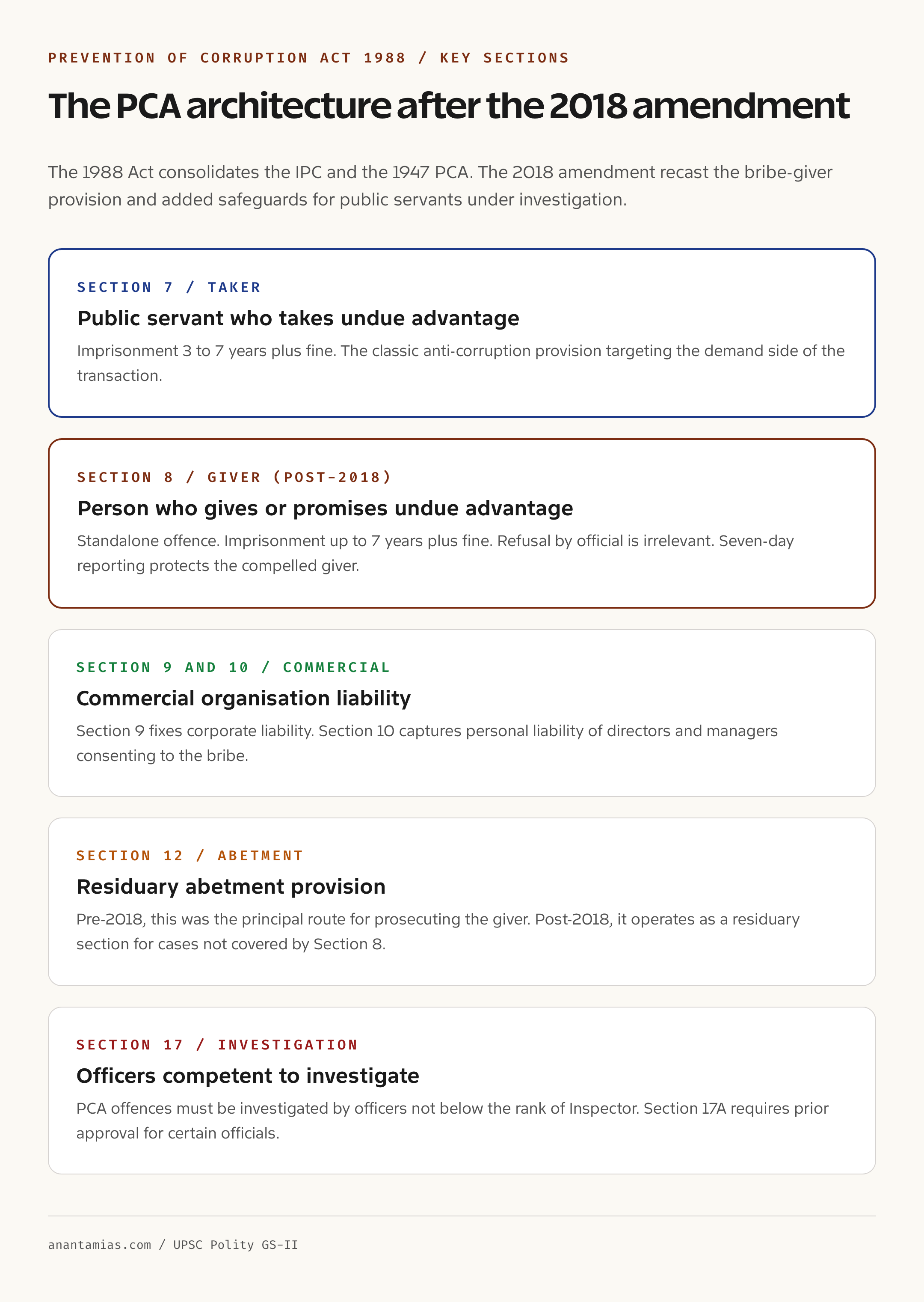
Offering a bribe to a public servant is a substantive offence under Section 8 of the Prevention of Corruption Act, 1988, as amended in 2018. The maximum punishment is imprisonment of up to seven years, a fine, or both. Refusal by the public servant does not defeat the prosecution because the crime is complete on the offer or promise. Before the 2018 amendment, the giver was punished as an abettor under Section 12. After the amendment, the giver is a principal offender under Section 8, and Section 12 is a residuary abetment provision. A person compelled to give a bribe is protected from prosecution if he reports the matter to a law enforcement agency within seven days. The Supreme Court Constitution Bench in Neeraj Dutta v. State (NCT of Delhi), 2022, modernised the law of evidence in trap cases and survived the legislative shift.
Why the Question Matters in Constitutional Theory
A democracy rests on the assumption that public servants act on public reasons. Bribery substitutes a private payment for that public reason and quietly converts the office into private property. Indian constitutional theory therefore treats anti-corruption law as a structural necessity, not just a criminal-law topic. The Preamble’s commitment to justice and the Directive Principle in Article 51A(j) calling for excellence in collective endeavour both presuppose an administration that cannot be bought.
The earlier Indian framework, which only punished the public servant as the principal offender and the giver as a secondary abettor, sent the wrong moral signal. It implied that the citizen who pays is the smaller wrongdoer. That implication missed the demand-side reality of Indian corruption, where pre-emptive offers are made before the public servant has even framed a demand. The 2018 amendment corrects the asymmetry by making both sides of the transaction equally answerable, while protecting the genuinely coerced citizen.
Statutory Framework: The PCA, 1988 Architecture
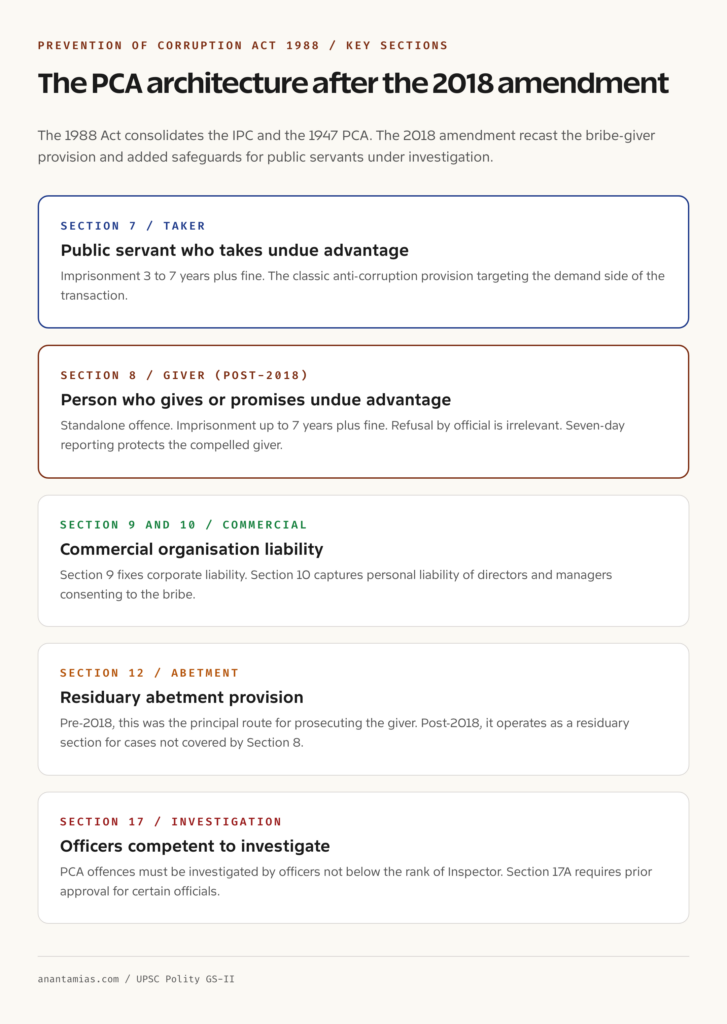
The Prevention of Corruption Act, 1988, consolidates the older Indian Penal Code provisions on public servant corruption with the Prevention of Corruption Act, 1947. Its scheme is straightforward. Section 7 criminalises the public servant who takes or accepts an undue advantage. Section 8, after 2018, criminalises the person who gives or promises an undue advantage with the requisite intent. Section 9 deals with commercial organisations whose officers bribe public servants. Section 10 covers the personal liability of directors and managers of such organisations. Section 11 captures the public servant who obtains valuable thing without consideration. Sections 13 and 13(1)(b) cover criminal misconduct.
The Act applies to all “public servants” as defined in Section 2(c), a definition wider than the IPC list. It includes elected representatives, judges (with sanction safeguards), employees of public sector undertakings, members of Service Commissions, and certain office-holders in cooperative societies and educational bodies receiving government aid. The reach is therefore broad and the offer made to any of these persons engages Section 8.
Section 8 Before 2018: Bribe Giving as Abetment
Until the Prevention of Corruption (Amendment) Act, 2018, Indian law treated the bribe giver primarily through Section 12 of the original 1988 Act, which punished abetment of offences under Sections 7 or 11. Reading Section 12 with the IPC’s definitional sections on abetment, the prosecution had to prove instigation, conspiracy, or intentional aid in addition to the offer itself. Courts asked whether the public servant had taken the money. If the trap failed and the official refused, prosecutions of the giver under abetment did succeed in principle, but the doctrinal architecture was awkward.
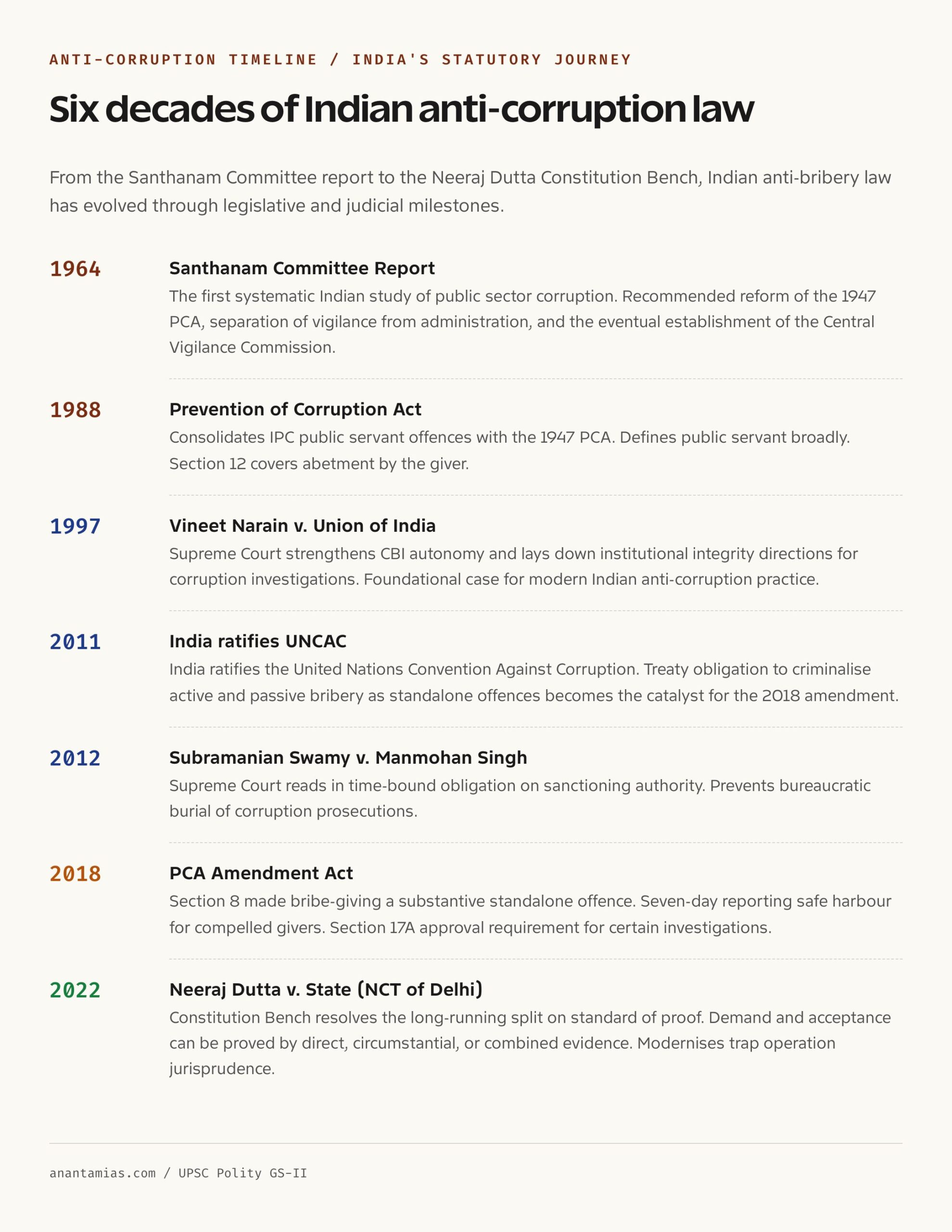
The Santhanam Committee of 1964 and successive Law Commission reports flagged the asymmetry. In international fora, the United Nations Convention Against Corruption, which India ratified in 2011, requires both active and passive bribery to be made offences as a matter of treaty law. India’s pre-2018 framework was technically compliant only by reading Section 12 broadly, and the doctrinal mismatch invited reform.
Section 8 After 2018: Bribe Giving as Standalone Offence
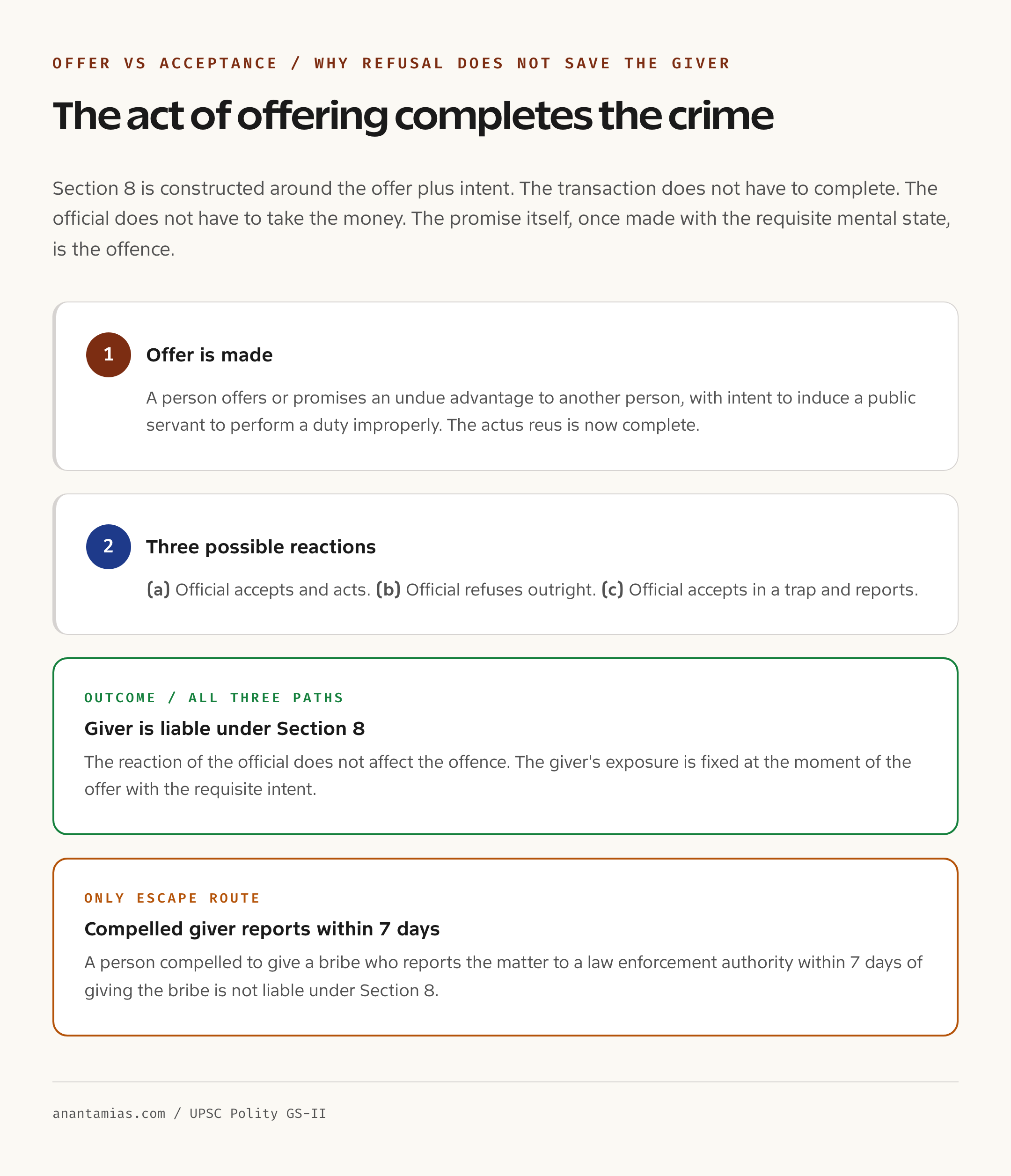
The Prevention of Corruption (Amendment) Act, 2018, substituted a fresh Section 8 that creates a substantive offence for the giver, without recourse to abetment doctrine. The text punishes any person who gives or promises to give an undue advantage to another person, with the intention of either inducing a public servant to perform a public duty improperly or dishonestly, or rewarding such public servant for the improper performance of a public duty. The maximum punishment is imprisonment of up to seven years, fine, or both. The offence does not require the public servant to have accepted, demanded, or even known about the offer being communicated through an intermediary.
The shift from abetment to standalone crime carries three doctrinal consequences. First, the prosecution does not have to plead and prove instigation as a separate element. Second, the offer itself, once intent is shown, completes the actus reus. Third, the conviction of the public servant is not a precondition. The giver can be convicted even if the official is acquitted or never prosecuted.
Why Refusal by the Public Servant Is Irrelevant
The public servant’s refusal does not affect the giver’s liability because the offence is constructed around the offer and the intent, not around the completion of the transfer. Indian criminal law has long recognised inchoate offences such as attempt, conspiracy, and abetment, where the harm is the deviation from law-abiding conduct rather than the consummation of the prohibited transaction. Section 8 sits in this family. The legislature deliberately chose to punish the act of offering with intent.
The practical effect is that an honest official who is offered a bribe and refuses it cannot be made the unwitting cause of the giver’s acquittal. The official’s report to an Anti-Corruption Bureau or the Central Bureau of Investigation activates Section 17 investigation. The prosecution’s burden is to prove the offer and the corrupt intent. The refusal becomes a piece of evidence rather than a defence. The same logic applies if the official accepts the money in a trap operation while pretending to comply: the giver’s offer was complete the moment it was made.
The Seven-Day Reporting Exception for Compelled Givers
Section 8 contains a proviso that protects the citizen who is compelled to give a bribe. If a person is compelled to give an undue advantage and reports the matter to the law enforcement authority or the investigating agency within seven days from the date of giving such undue advantage, that person shall not be liable under Section 8.
The exception is narrow but constitutionally significant. It accepts the empirical reality that Indian citizens often face demand-side extortion at the point of contact with low-level officialdom. A driver who pays a traffic constable to release a vehicle, a contractor who pays to clear a file, or a parent who pays to secure a school admission may be victims rather than culprits. The proviso converts them from co-accused to potential prosecution witnesses, provided they report within the time limit.
Three procedural conditions matter. First, the report must be made to a law enforcement authority. The CBI, the State Anti-Corruption Bureau, and the Vigilance Commission qualify. Second, the seven-day clock runs from the giving of the bribe, not from the demand. Third, the report should be capable of being acted upon, with sufficient particulars about the official, the date, and the circumstance.
Sanction, Investigation, and Prosecution
A prosecution under Section 8 follows the general PCA procedure. Investigation is conducted by an officer not below the rank of Inspector under Section 17. For a company or commercial organisation, Section 9 imposes corporate liability and Section 10 captures directors and managers. The amended Section 17A requires prior approval from a competent authority before investigation against a public servant for any offence relatable to a recommendation or decision in discharge of official functions, but this safeguard applies to the receiving side. The giver does not enjoy the Section 17A shield.
Sanction to prosecute, governed by Section 19, is required for the public servant. The bribe giver does not require sanction. This procedural difference reinforces the point that the giver is not a derivative defendant whose case rises and falls with the official’s prosecution. The giver is a self-standing accused whose trial proceeds on its own merits.
Landmark Cases on Bribe Giving and Trap Operations
Indian case law on bribery built up under the pre-2018 framework but most rulings continue to govern the post-2018 architecture because the underlying evidentiary issues are the same. In Vineet Narain v. Union of India, 1997, the Supreme Court strengthened CBI autonomy and laid down directions for institutional integrity in corruption investigations. In Subramanian Swamy v. Manmohan Singh, 2012, the Court read in a time-bound obligation on sanctioning authorities to decide on prosecution requests, preventing bureaucratic burial of corruption cases.
The most consequential modern decision is Neeraj Dutta v. State (NCT of Delhi), 2022, where a Constitution Bench resolved a long-running split on the standard of proof in bribery cases. The Court held that demand and acceptance can be proved by direct evidence, by circumstantial evidence, or by a combination, and that the absence of the complainant from the witness box does not automatically destroy the prosecution case. The ruling modernised the law of trap operations and survived the 2018 statutory shift because it speaks to evidence rather than offence definition.
Comparison with International Anti-Corruption Frameworks
The 2018 amendment brought Indian law closer to the United Kingdom Bribery Act, 2010, the United States Foreign Corrupt Practices Act, 1977, and the United Nations Convention Against Corruption framework. The UK Act is structurally cleaner: it has a single offence of bribing another person, a single offence of being bribed, and corporate failure to prevent bribery. The Indian Act remains more sectoral, with separate sections for taking, giving, criminal misconduct, commercial-organisation liability, and abetment.
The US FCPA is narrower in some respects because it focuses on payments to foreign public officials. India’s Section 8 covers all public servants as defined under Indian law. The convergence on the principle that the giver is a primary offender is now nearly universal across major jurisdictions, with the seven-day reporting safe harbour being a distinctive Indian feature aimed at the country’s specific extortion pattern.
Prelims and Mains Pointers for UPSC
For prelims, three questions are likely. The first is the section itself: Section 8 of the PCA covers the bribe giver after the 2018 amendment. The second is the seven-day rule: a compelled giver who reports within seven days is not liable. The third is the maximum punishment: seven years of imprisonment. Aspirants should also remember that Section 7 covers the taker, that Section 12 is now a residuary abetment provision, and that the offence requires intent to induce improper performance of a public duty.
For mains, the GS Paper II ethics dimension is the asymmetry between the demand side and the supply side of corruption, and how the 2018 amendment recalibrated the moral message of Indian anti-corruption law. The GS Paper IV ethics paper can use the seven-day rule as a hook for discussing coercion, complicity, and the moral psychology of citizens facing extortion. Connecting the discussion to the Indian judiciary and the 42nd Amendment framework on rights and duties produces a fuller answer.
Conclusion: From Asymmetric to Symmetric Anti-Bribery Law
The 2018 amendment to the Prevention of Corruption Act resolved a structural anomaly in Indian criminal law. Before the amendment, the giver of a bribe was a derivative wrongdoer whose conviction depended on the doctrine of abetment. After the amendment, the giver is a principal offender whose offence is complete on the making of the offer with the requisite intent. The refusal of the public servant is doctrinally irrelevant. The seven-day reporting exception protects the genuinely coerced citizen and converts him into a potential ally of the prosecution.
The reform aligns Indian law with international anti-corruption standards while preserving an Indian-specific defence for victims of extortion. For UPSC aspirants, the takeaway is that anti-bribery law in India is now symmetric. Both sides of the transaction face equal exposure to prosecution, and the only escape route for the giver runs through prompt, candid disclosure to a law enforcement agency.
Frequently Asked Questions
Is offering a bribe a crime in India even if the public servant refuses?
Yes. Under Section 8 of the Prevention of Corruption Act, 1988, as amended in 2018, the act of giving or promising an undue advantage with the intent to induce improper performance of a public duty is a substantive offence. The public servant’s refusal does not defeat the prosecution because the crime is complete on the offer.
What is the maximum punishment for bribe giving under Section 8?
The maximum punishment is imprisonment of up to seven years, a fine, or both.
What is the seven-day rule for compelled bribe givers?
A person who is compelled to give a bribe is not liable under Section 8 if he reports the matter to a law enforcement authority within seven days from the date of giving the bribe. The exception is narrow and the report must be candid and capable of being acted upon.
How did the 2018 amendment change the law on bribe giving?
Before 2018, the bribe giver was punished as an abettor under Section 12. After the amendment, the giver is a principal offender under Section 8 with a self-standing offence, and Section 12 has become a residuary abetment provision.
Does the giver need sanction to prosecute under Section 19?
No. Section 19 sanction applies to the public servant. The bribe giver does not require sanction and can be prosecuted on its own merits.
What is the Neeraj Dutta v. State ruling about?
The 2022 Constitution Bench ruling in Neeraj Dutta v. State (NCT of Delhi) held that demand and acceptance of a bribe can be proved by direct evidence, by circumstantial evidence, or by a combination. The absence of the complainant from the witness box does not automatically destroy the prosecution case.
Is the 2018 amendment compatible with the United Nations Convention Against Corruption?
Yes. The amendment brings Indian law into clearer compliance with UNCAC by criminalising both active and passive bribery as standalone offences and by tightening the framework for commercial organisation liability.
Tell Google you want more of this.
Add Anantam IAS as a preferred sourceOne tap, and this site shows up more often in your own Top Stories, AI Overviews and AI Mode. Remove it any time.