
Introduction
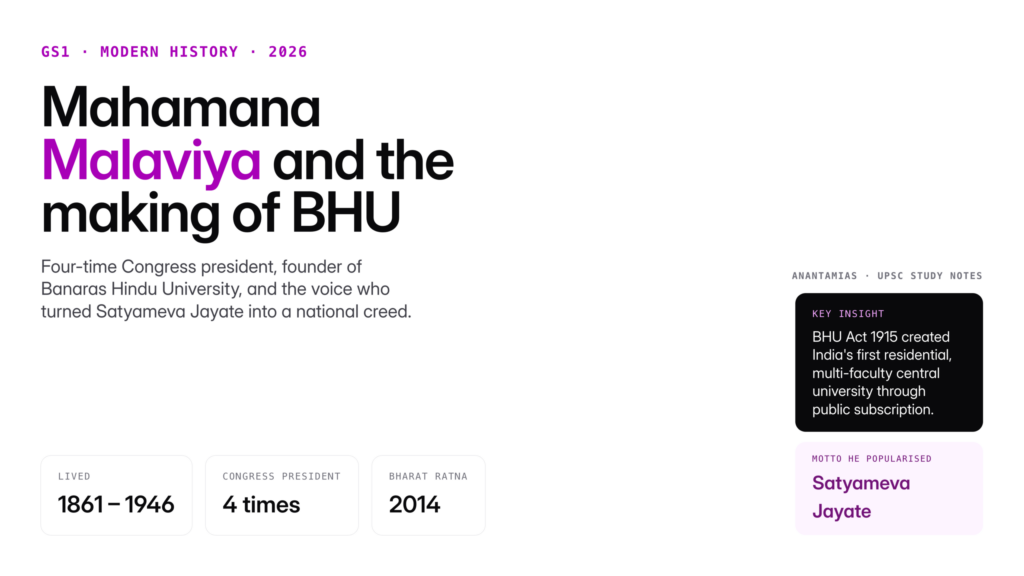
Madan Mohan Malaviya stood at the confluence of education, journalism, law and nationalist politics in late-colonial India. Born on 25 December 1861 in Allahabad and passing on 12 November 1946, he shaped institutions that still anchor Indian public life, most visibly Banaras Hindu University (BHU), founded in 1916. For the UPSC aspirant, his life is not a single-issue case study. It is a lens on moderate nationalism, the rise of mass politics, the debates over Hindu identity within the Congress, and the long struggle to decolonise education.
Known as Mahamana (the Great Soul), Malaviya presided over the Indian National Congress four times, edited and owned major nationalist newspapers, argued the landmark Chauri Chaura appeals, and popularised the national motto Satyameva Jayate. In 2014 he was awarded the Bharat Ratna posthumously. This article walks through his biography, institution-building, political career and enduring legacy, and flags the exam angles most likely to appear in Prelims and Mains.
Quick Facts at a Glance
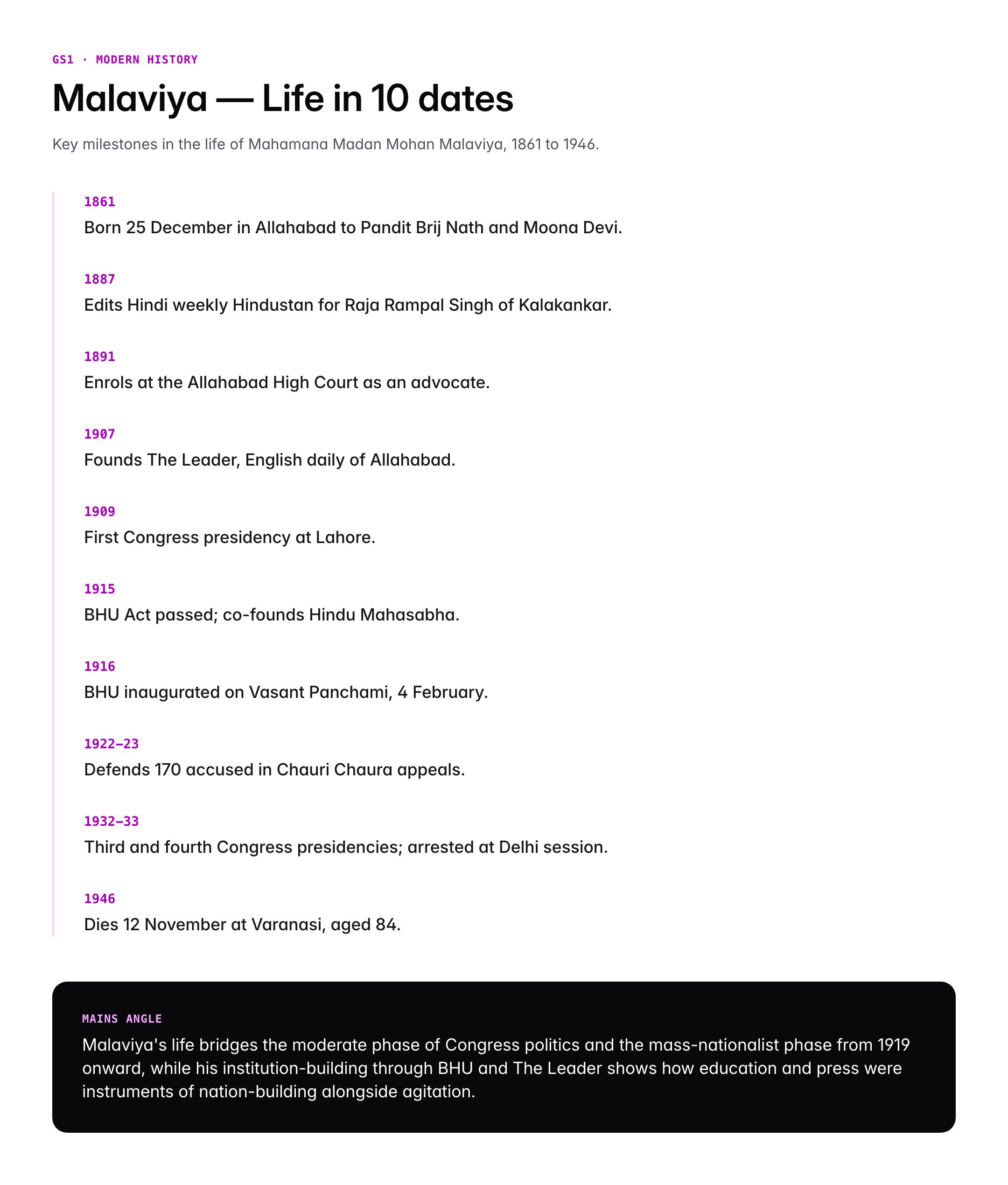
| Attribute | Detail |
|---|---|
| Born | 25 December 1861, Allahabad, North-Western Provinces |
| Died | 12 November 1946, Varanasi |
| Honorific | Mahamana |
| Education | Muir Central College, Allahabad; LL.B. |
| Profession | Lawyer, educationist, journalist, parliamentarian |
| Congress Presidency | 1909 (Lahore), 1918 (Delhi), 1932 (Delhi, arrested), 1933 (Calcutta) |
| Major Institution | Banaras Hindu University, founded 1916 |
| Key Newspapers | Hindustan, Indian Union, The Leader (Allahabad), Hindustan Times |
| Associated Phrase | Satyameva Jayate — popularised as national motto |
| Awards | Bharat Ratna (2014, posthumous) |
Background and Historical Context
Malaviya grew up in a Brahmin family steeped in Sanskrit learning and Vaishnav devotion. His early schooling was at Pandit Hardeva’s Dharma Gyanopadesh Pathshala and later at the Allahabad Zilla School. He graduated from Muir Central College in 1884 and began his career as a teacher at Government High School, Allahabad, before switching to law and eventually to full-time public life.
He belonged to the generation shaped by the founding of the Indian National Congress in 1885, the partition of Bengal in 1905, and the Swadeshi agitation that followed. Within the Congress he was classed as a moderate, close to leaders like Gopal Krishna Gokhale and Pherozeshah Mehta, though he maintained working relationships across factions including with Bal Gangadhar Tilak and later Mahatma Gandhi. He never endorsed extremist violence but was equally uncomfortable with uncritical loyalty to the Raj.
Three intellectual currents shaped his politics. The first was cultural revivalism drawn from the Arya Samaj milieu of northern India and from orthodox Sanatani thought. The second was the liberal-constitutional reformism of the moderates who believed in petition, press and legislative work. The third was the education-as-nation-building idea that animated many colonial-era reformers, from Syed Ahmad Khan with Aligarh to Annie Besant with the Central Hindu College. It was from the last of these that BHU eventually grew.
By the time he took charge as Congress president at Lahore in 1909, Malaviya had already demonstrated his range: as editor of Hindi weekly Hindustan from 1887, as member of the provincial legislative council of the North-Western Provinces and Oudh from 1903, and as lawyer of growing reputation at the Allahabad High Court.
Biography and Life Milestones
Early Life and Family
Born on 25 December 1861 in Allahabad, Malaviya was the fifth of seven children of Pandit Brij Nath and Moona Devi. The family traced its ancestry to Malwa, from which the surname Malaviya derives. He was married to Kundan Devi of Mirzapur in 1878. Sanskrit learning was imbibed at home before formal schooling.
Education and Early Career
After matriculation from Muir Central College, he taught briefly at Government High School, Allahabad, from 1884 to 1887. He then moved to journalism, editing the Hindi weekly Hindustan started by Raja Rampal Singh of Kalakankar. He also helped edit Indian Opinion and in 1907 founded The Leader, an English-language daily of Allahabad that became a leading nationalist paper in the United Provinces. He served as chairman of Hindustan Times from 1924, securing its Hindi edition and nationalist orientation.
Legal Practice
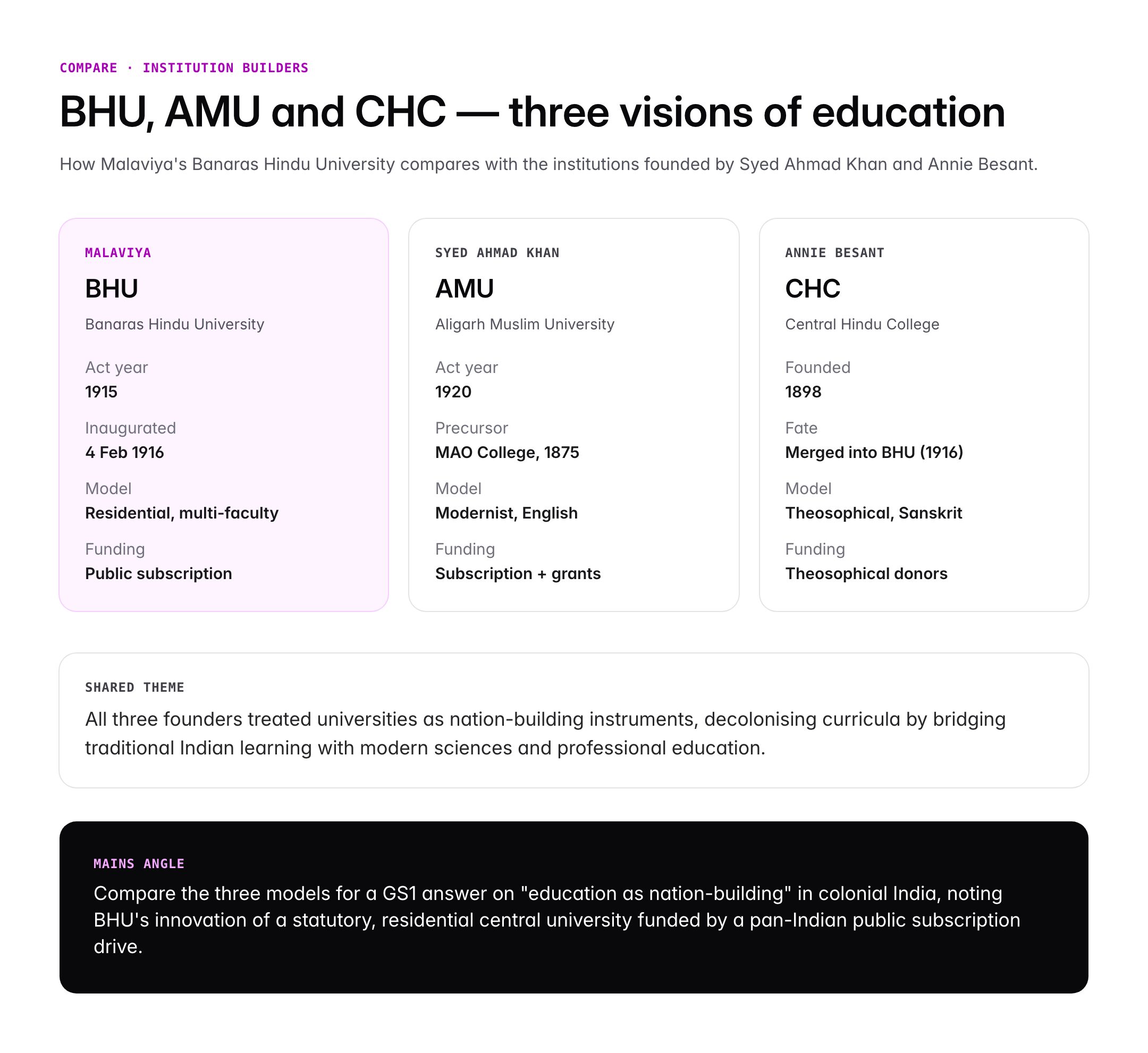
Malaviya enrolled at the Allahabad High Court in 1891. His most celebrated brief was the defence of the accused in the Chauri Chaura case (1922–23), where he and colleagues secured the reduction of death sentences for 151 of 170 convicted peasants, though the underlying riot remained a trauma that had pushed Gandhi to suspend Non-Cooperation.
Institution Building
His signal achievement was the Banaras Hindu University Act, 1915, under which BHU was founded on Vasant Panchami, 4 February 1916, with the support of Annie Besant, Sir Sundar Lal, and Maharaja Prabhu Narayan Singh of Kashi, among others. Malaviya served as BHU’s first vice-chancellor (1919–1938). BHU was conceived as a residential, multi-faculty university integrating traditional Indian learning with modern science and technology.
Political Career
He served as Congress president four times: Lahore 1909, Delhi 1918, Delhi 1932 (where he was arrested at the session venue), and Calcutta 1933. In 1934 he co-founded the Congress Nationalist Party with M. S. Aney after disagreements over the Communal Award’s acceptance. He was a member of the Imperial Legislative Council from 1912 and of the Central Legislative Assembly from 1924.
Later Years
He stepped back from active politics by the early 1940s due to failing health, while continuing to steer BHU’s affairs. He died at Varanasi on 12 November 1946, months before independence.
Significance for UPSC and General Knowledge
- He represents the moderate tradition in the Congress while bridging to Hindu revivalist politics, making him a useful case study in Modern Indian History (GS1).
- BHU’s founding is a textbook example of education as nation-building and appears in questions on institutional history.
- The phrase Satyameva Jayate, taken from the Mundaka Upanishad, was popularised by him as a nationalist slogan and later adopted as India’s national motto.
- His defence in the Chauri Chaura trials is a reference point for debates on non-violence, due process and colonial justice.
- His journalism, spanning Hindi and English, illustrates the role of vernacular and English press in shaping public opinion.
- He received the Bharat Ratna in 2014, a recurrent Prelims fact.
Political Contributions and Nationalist Work
Malaviya’s politics are best understood in four registers: constitutionalism, education, communal concord-and-conflict, and social reform.
As a constitutionalist, he worked the legislative councils under the Morley-Minto and Montagu-Chelmsford frameworks, raising questions on indentured labour, repressive laws like the Rowlatt Act, police excesses, and education budgets. He supported the Lucknow Pact of 1916 between the Congress and the Muslim League, which offered separate electorates to Muslims in exchange for weightage arrangements. He later opposed the Communal Award of 1932 and its extension through the Poona Pact formula when he felt it entrenched separate electorates, a position that led to his 1934 break with the Congress on this narrow issue while remaining within its broader fold.
In education, beyond BHU, he pushed for compulsory primary education, the status of Hindi and Devanagari, and the decolonisation of curricula. As early as 1898, he had argued before the Hunter Commission for making Hindi an official court language in the United Provinces, which succeeded in 1900.
On communal politics, he was a founding figure of the Hindu Mahasabha in 1915 and presided over sessions in Hardwar (1915) and Kashi (1923). Yet he remained within the Congress, participated in Non-Cooperation-era mobilisation, and worked with Muslim leaders in BHU’s early years. Historians treat him as representing an integrative rather than exclusionary Hindu nationalism, though this is contested.
On social reform, he was among the early upper-caste leaders to press for temple entry for Dalits and opposed untouchability, campaigning with Gandhi on the issue in 1930s UP. He supported the Hindu Code reforms partially and backed the removal of some customary disabilities for widows.
Comparative Perspective
Malaviya’s institution-building places him alongside Syed Ahmad Khan and Annie Besant as one of three university founders whose projects anchored modern Indian higher education. The table compares the three.
| Dimension | Malaviya (BHU, 1916) | Syed Ahmad Khan (MAO / AMU, 1875 / 1920) | Annie Besant (CHC, 1898; merged into BHU) |
|---|---|---|---|
| Primary constituency | Hindu middle classes, pan-Indian | Muslim community, pan-Indian | Theosophical and Hindu reformist |
| Ideological anchor | Integrative Hindu revivalism, nationalism | Muslim modernism, loyalist reformism | Theosophy, cultural nationalism |
| Relationship with Congress | Four-time president | Wary of Congress | Congress president 1917 |
| Curricular mix | Sanskrit, sciences, engineering, medicine | English, sciences, Islamic studies | Sanskrit, Hindu studies, sciences |
| Funding model | Public subscription, princely donations | Public subscription, government grants | Theosophical donations, merged into BHU |
| Lasting institution | BHU (central university, 1916 Act) | AMU (central university, 1920 Act) | Absorbed into BHU, 1916 |
The comparison shows that Malaviya’s innovation was scale and integration: a residential, multi-faculty central university funded by a nation-wide subscription drive and incorporated by a dedicated parliamentary Act.
Controversies and Debates
Three debates surround Malaviya’s legacy. First is his association with the Hindu Mahasabha while remaining in the Congress. Critics argue this enabled majoritarian tendencies within the national movement, while defenders point to his consistent opposition to violence and his defence of Muslim civil rights at BHU and in his legal work. Second is his position on separate electorates and the Communal Award, which he saw as divisive. He preferred joint electorates with reserved seats, a position that aligned with Gandhi’s Poona Pact formulation for Dalits but not for Muslims. Third is the BHU model itself. Secular critics argue the university’s explicitly Hindu naming and symbolism set a precedent that sat uneasily with constitutional secularism later. Supporters counter that BHU from the outset admitted students and employed staff across religions, with its charter guaranteeing non-discrimination.
A minor but recurring debate concerns his stance on the Rowlatt Satyagraha and Non-Cooperation. He supported agitation but often counselled against steps he thought would invite repression, which led some younger nationalists to view him as excessively cautious.
Prelims Pointers
- Born 25 December 1861, Allahabad; died 12 November 1946, Varanasi
- Honorific Mahamana conferred by Gandhi and widely used thereafter
- Congress president four times: 1909, 1918, 1932, 1933
- Founded Banaras Hindu University through the BHU Act 1915; inaugurated 4 February 1916 on Vasant Panchami
- First vice-chancellor of BHU from 1919 to 1938
- Popularised Satyameva Jayate from the Mundaka Upanishad; later adopted as India’s national motto in 1950
- Co-founded the Hindu Mahasabha in 1915
- Defended 170 accused in the Chauri Chaura case 1922-23
- Founded The Leader English daily of Allahabad in 1907
- Chairman of Hindustan Times from 1924
- Member of Imperial Legislative Council (1912) and Central Legislative Assembly (1924)
- Co-founded Congress Nationalist Party with M. S. Aney in 1934
- Awarded Bharat Ratna posthumously in 2014
Mains Practice Questions
- “Madan Mohan Malaviya combined moderate constitutionalism with cultural revivalism in a way that foreshadowed later tensions within Indian nationalism.” Critically examine. (250 words)
- Constitutionalist work: councils, press, Lucknow Pact 1916, opposition to Rowlatt and Communal Award
- Cultural revivalism: BHU, Hindu Mahasabha, Sanskrit and Hindi advocacy
- Tensions: majoritarian drift within nationalism, separate versus joint electorates, secularism debate
- Discuss the role of educational institutions founded by nationalist leaders in the freedom movement, with particular reference to BHU. (250 words)
- Education as nation-building: decolonising curricula, bridging tradition and modernity
- BHU specifics: 1915 Act, multi-faculty model, public subscription, pan-Indian recruitment
- Comparative note with AMU and other institutions, and continuing relevance as central universities
Conclusion
Madan Mohan Malaviya’s public life occupies a crucial middle ground in the story of modern India. He was neither a mass leader in Gandhi’s mould nor a revolutionary nor a narrow sectarian. He was an institution-builder whose instrument of change was the durable public institution: a university, a newspaper, a legal precedent, a legislative intervention. That approach may look less dramatic than satyagraha or armed struggle, but its effects outlast their headlines.
For the UPSC aspirant, Malaviya is a productive case study precisely because he resists easy labels. He illuminates the moderate tradition, the politics of education, the ambivalences of Hindu identity within the national movement, and the slow constitutional work that underwrote mass mobilisation. Questions on him can surface in Modern History, in Indian Society, or in Ethics through his advocacy of truth as a public virtue captured in the phrase he made famous: Satyameva Jayate.
Frequently Asked Questions
Who was Madan Mohan Malaviya?
Madan Mohan Malaviya (25 December 1861 to 12 November 1946) was an Indian educationist, lawyer, journalist and nationalist politician who presided over the Indian National Congress four times. He founded Banaras Hindu University in 1916, popularised the motto Satyameva Jayate and was posthumously awarded the Bharat Ratna in 2014.
Why is Madan Mohan Malaviya important for UPSC?
He spans three Prelims-friendly themes: Congress presidencies (1909, 1918, 1932, 1933), BHU’s founding under the 1915 Act, and the Chauri Chaura trial defence. For Mains GS1 he is a case study in moderate nationalism, education as nation-building, and the tensions between Hindu revivalism and secular constitutionalism.
How is Madan Mohan Malaviya related to Banaras Hindu University?
Malaviya conceived BHU, steered the Banaras Hindu University Act through the Imperial Legislative Council in 1915, and inaugurated the university on Vasant Panchami, 4 February 1916. He served as its first vice-chancellor from 1919 to 1938, shaping its multi-faculty residential model that combined Sanskrit learning with modern science and technology.
Did Madan Mohan Malaviya coin Satyameva Jayate?
No. The phrase is from the Mundaka Upanishad (3.1.6). Malaviya popularised it as a nationalist slogan in speeches and Congress platforms from the early twentieth century, and it was formally adopted as the national motto of the Republic of India in 1950, inscribed beneath the Sarnath Lion Capital on the State Emblem.
How many times was Malaviya president of the Congress?
He presided over four Congress sessions: Lahore 1909, Delhi 1918, Delhi 1932 where he was arrested at the session venue during the civil disobedience crackdown, and Calcutta 1933. This four-time presidency is a recurring Prelims factual question.
What was Malaviya’s role in the Chauri Chaura case?
After the 4 February 1922 violence at Chauri Chaura in which police and rioters died, 172 peasants were initially sentenced to death. Malaviya led the appeals at the Allahabad High Court in 1922-23, securing reductions of sentence for 151 accused, reducing death penalties to transportation for life in most cases.
Was Malaviya part of the Hindu Mahasabha?
Yes. He co-founded the Hindu Mahasabha in 1915 and presided over its Hardwar (1915) and Kashi (1923) sessions. He remained within the Congress throughout, representing an integrative Hindu nationalist position, though his dual membership is debated by historians as foreshadowing later tensions within the national movement.
What honours did Madan Mohan Malaviya receive?
He was conferred the title Mahamana, popularly attributed to Gandhi. In 2014 the Government of India posthumously awarded him the Bharat Ratna, the nation’s highest civilian honour, jointly announced with the award to former prime minister Atal Bihari Vajpayee. His image appears on Indian postage stamps and a commemorative 100-rupee coin released in 2016.
Tell Google you want more of this.
Add Anantam IAS as a preferred sourceOne tap, and this site shows up more often in your own Top Stories, AI Overviews and AI Mode. Remove it any time.





