
The Mahatari Vandana Yojana is a flagship direct benefit transfer (DBT) scheme launched by the Government of Chhattisgarh to provide monthly financial assistance to eligible married women. Rolled out in March 2024, the scheme transfers Rs. 1,000 per month (Rs. 12,000 annually) directly to beneficiaries' bank accounts. It aims to strengthen women's economic autonomy, improve nutrition, and enhance decision-making power within households. The initiative draws on a broader Indian policy trend of state-level cash transfer schemes targeted specifically at women, following similar models such as Madhya Pradesh's Ladli Behna Yojana and Maharashtra's Majhi Ladki Bahin Yojana.
What is the Mahatari Vandana Yojana
Mahatari means "mother" in Chhattisgarhi, and Vandana means "salutation" or "reverence". The scheme therefore translates as "Salutation to the Mother". It was a key poll promise of the Bharatiya Janata Party in the 2023 Chhattisgarh Assembly elections and was operationalised within the first 100 days of the new state government. The scheme is administered by the Women and Child Development Department of Chhattisgarh.
The scheme's core objectives are:
- Improving the socio-economic status of women
- Ensuring financial self-reliance within families
- Reinforcing women's decisive role in the family
- Improving the health and nutritional levels of women and dependants
- Recognising the unpaid care-giving work performed by women at home
Key Features and Benefits
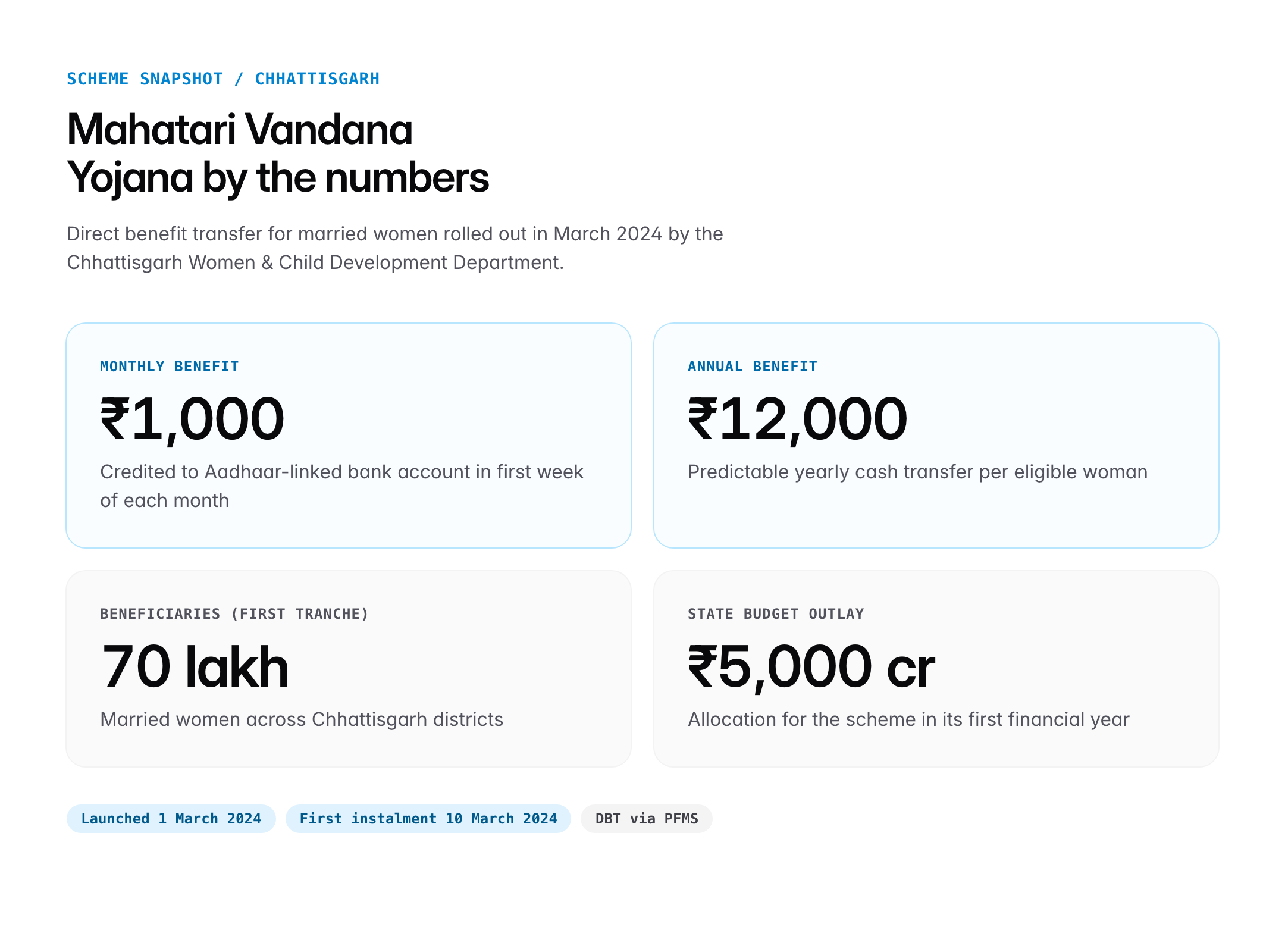
The scheme is designed to be broad-based yet targeted, with simple enrolment through the Anganwadi network and online portals.
| Feature | Detail |
|---|---|
| Monthly Benefit | Rs. 1,000 per eligible woman |
| Annual Benefit | Rs. 12,000 |
| Mode of Transfer | DBT (Aadhaar-linked bank account) |
| Launch Date | 1 March 2024 (first instalment 10 March 2024) |
| Implementing Dept. | Women and Child Development, Chhattisgarh |
| Coverage | All eligible married women across districts |
Additional design features include Aadhaar seeding, e-KYC for beneficiary validation, and a dedicated web portal plus mobile application for application tracking. Payments are released on the first week of every month.
Eligibility Criteria
The scheme sets clear inclusion and exclusion parameters to ensure benefits reach the intended demographic.
Who is eligible:
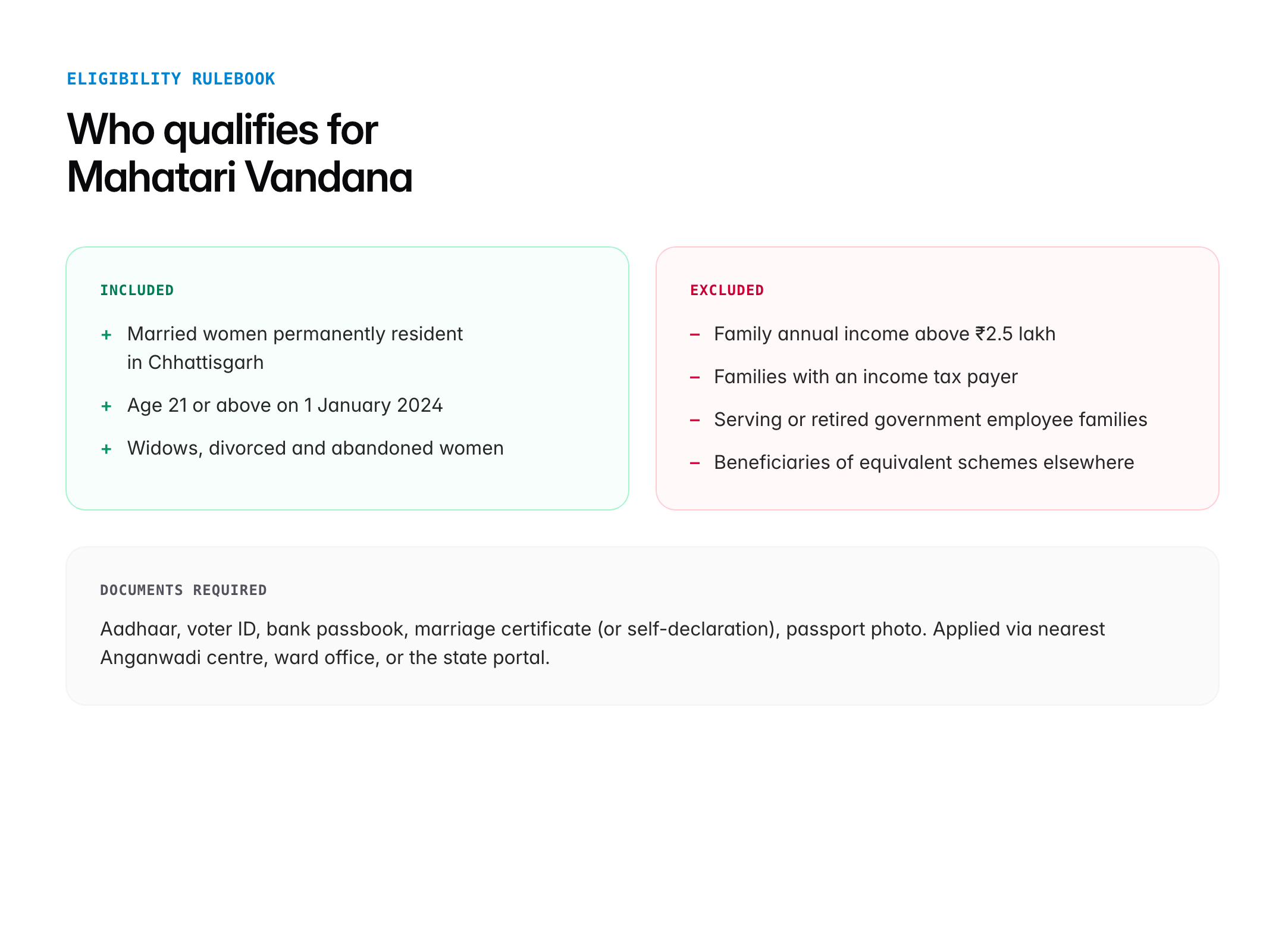
- Married women who are permanent residents of Chhattisgarh
- Age of 21 years or above on 1 January 2024
- Widows, divorced and abandoned women are also included
Who is excluded:
- Women whose family's annual income exceeds Rs. 2.5 lakh
- Members of families where any person pays income tax
- Women whose family members are serving or retired government employees (with some exceptions)
- Women availing equivalent or higher benefits under any other state or central scheme
The application process involves submitting documents such as Aadhaar, voter ID, bank passbook, marriage certificate or self-declaration, and a passport-size photograph through the nearest Anganwadi centre, ward office, or online portal.
Implementation and Progress
Chhattisgarh has a population of over 2.9 crore (2011 Census) with women comprising nearly half. The first tranche of the scheme covered around 70 lakh women beneficiaries, making it one of the largest women-centric DBT schemes in the state. The state budget allocated approximately Rs. 5,000 crore for the scheme in its first financial year.
Monthly disbursement is governed through the Public Financial Management System (PFMS), which ensures traceability and minimises leakage. The scheme also integrates with the Samagra Samajik Suraksha portal, helping the state build a unified beneficiary database.
Significance and Impact
The scheme addresses several dimensions of women's empowerment recognised in UPSC-relevant policy frameworks:
- Economic autonomy: A predictable monthly income in a woman's own bank account shifts intra-household bargaining power.
- Nutrition and health: Evidence from similar schemes (e.g., PM-Kisan, Odisha's Mission Shakti) shows modest increases in household expenditure on food and healthcare.
- Financial inclusion: The scheme forces bank account opening, Aadhaar seeding, and digital literacy among women who may otherwise remain outside the formal system.
- Reduction of distress migration: A supplementary cash flow cushions families against shocks, particularly in tribal and agrarian districts.
Critics argue that such cash transfers may create fiscal stress on the state exchequer, distort labour markets, or compete with investments in infrastructure and education. NITI Aayog and RBI have flagged the rising cost of unconditional transfers across states as a potential concern for sub-national fiscal health.
Comparison with Similar Schemes
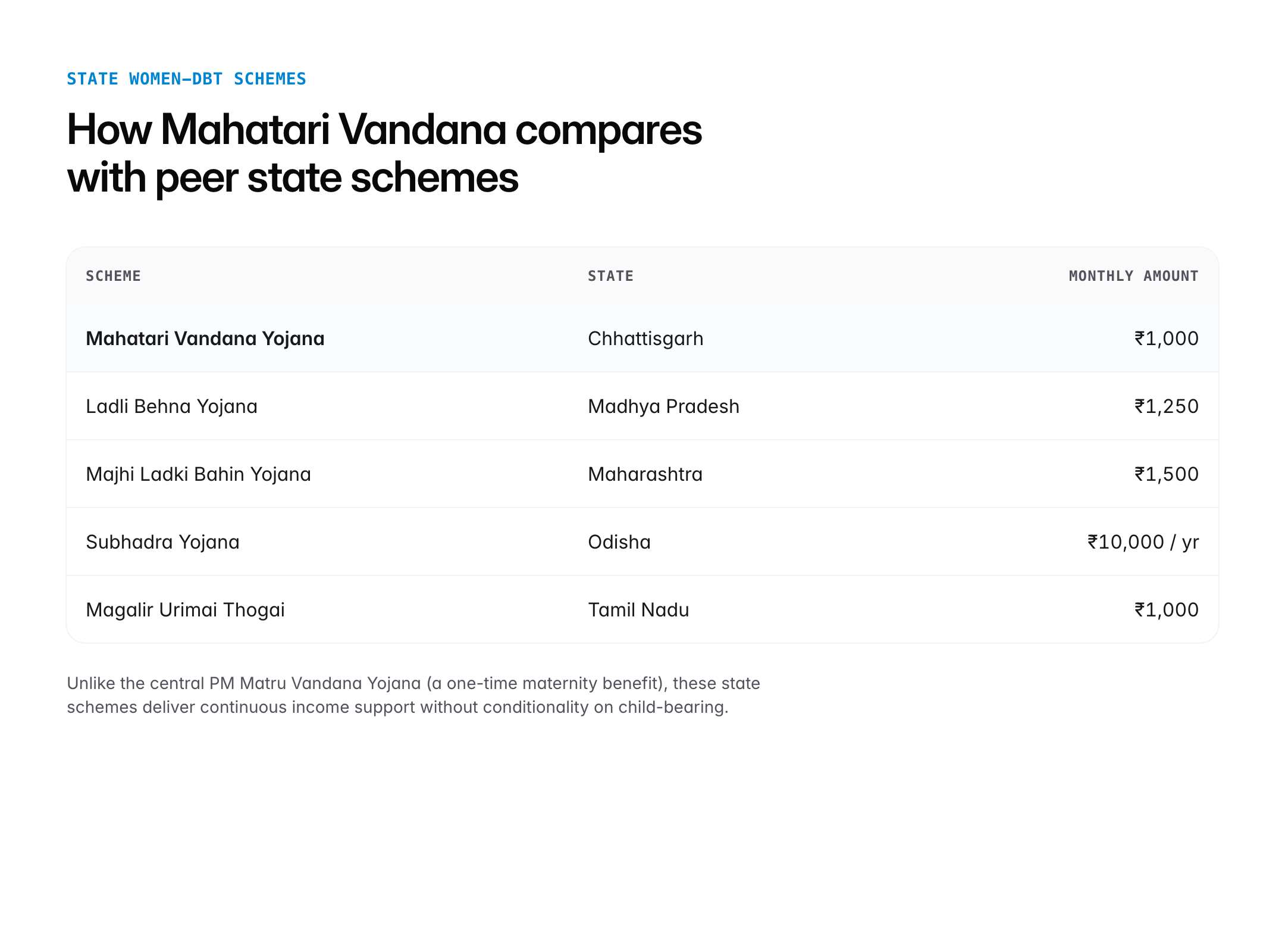
Several Indian states have launched analogous women-targeted cash transfer programmes.
| Scheme | State | Monthly Amount |
|---|---|---|
| Ladli Behna Yojana | Madhya Pradesh | Rs. 1,250 |
| Majhi Ladki Bahin Yojana | Maharashtra | Rs. 1,500 |
| Subhadra Yojana | Odisha | Rs. 10,000 annually |
| Magalir Urimai Thogai | Tamil Nadu | Rs. 1,000 |
| Mahatari Vandana Yojana | Chhattisgarh | Rs. 1,000 |
At the central level, PM Matru Vandana Yojana (PMMVY) provides one-time maternity benefit, while the Mahatari Vandana Yojana is a continuous income-support programme with no conditionality on child-bearing.
UPSC Relevance
Prelims focus
- Launch year, eligibility, monthly amount, implementing ministry/department
- Difference between PM Matru Vandana Yojana (central) and Mahatari Vandana Yojana (state)
- Direct Benefit Transfer (DBT), PFMS, Aadhaar-enabled payment systems
Mains GS-II angle
- Welfare schemes for vulnerable sections, especially women and children
- Issues relating to the development and management of social sector
- Role of state government in women empowerment
Mains GS-III angle
- Government budgeting: fiscal implications of large cash-transfer schemes on state finances
- Inclusive growth and employment
Sample PYQ-style question
"Direct Benefit Transfer schemes have emerged as a central instrument for delivering welfare in India. In the light of recent state-level women-focused DBT programmes, examine their effectiveness in advancing women's empowerment and discuss the associated fiscal challenges." (GS-II/III, 15 marks)
Tell Google you want more of this.
Add Anantam IAS as a preferred sourceOne tap, and this site shows up more often in your own Top Stories, AI Overviews and AI Mode. Remove it any time.