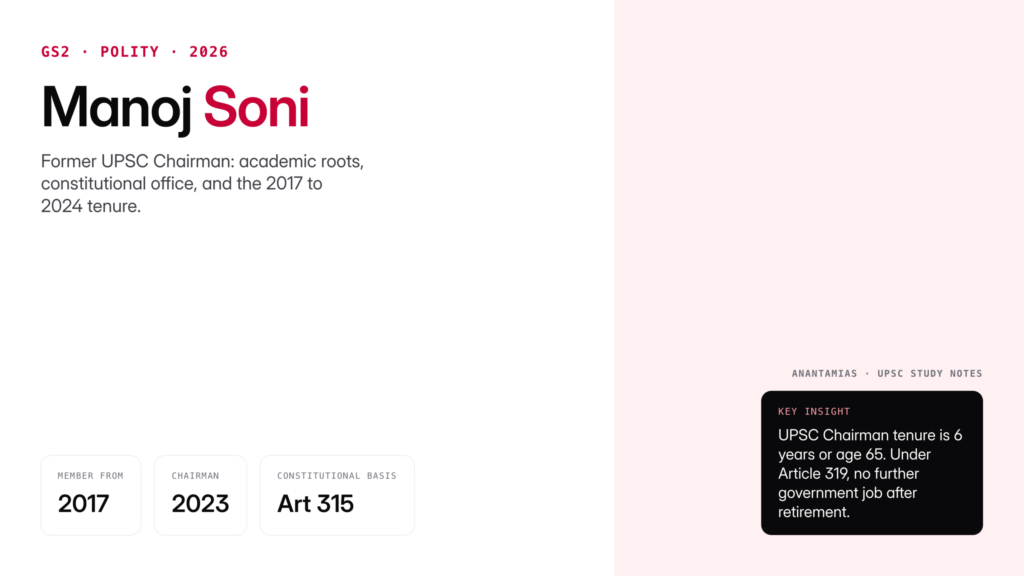
Manoj Soni is a former Chairman of the Union Public Service Commission (UPSC) — he served as Acting Chairman from April 2022, was confirmed as Chairman on 5 April 2023, and resigned in July 2024 before completing his term. A Gujarat-born academic with a PhD in International Relations, he was among India’s youngest university Vice-Chancellors before joining the UPSC as a Member in 2017, and as Chairman he was the constitutional appointee (under Article 316) whose office recommends the appointment of thousands of civil servants. The current UPSC Chairman is Dr. Ajay Kumar, a former Defence Secretary, who took charge in May 2025.
Introduction
Few names inside UPSC Bhavan at Dholpur House are as quietly familiar to aspirants as that of Manoj Soni, the former Chairman of the Union Public Service Commission. His signature sits on appointment letters of thousands of Civil Services officers, and his academic journey from a Gujarat classroom to the highest recruitment body of the Union holds several lessons for students writing the exam he once oversaw.
This profile consolidates what aspirants need to know about Manoj Soni: his academic background, his tenure as a UPSC member and then as Chairman, the constitutional design around Article 315 and 316, and why the office itself matters far more than any individual occupant. The article is framed as UPSC study material rather than as celebrity coverage.
Quick Facts at a Glance
| Field | Detail |
|---|---|
| Born | 1965, Dakor, Gujarat |
| Education | PhD in International Relations, Sardar Patel University |
| Academic high point | Youngest Vice-Chancellor, M S University of Baroda (2005) |
| Also served as VC | Dr Babasaheb Ambedkar Open University |
| Joined UPSC as Member | 28 June 2017 |
| Acting Chairman | April 2022 |
| Confirmed Chairman | 5 April 2023 |
| Term ended | Resigned in July 2024 |
| Constitutional basis | Articles 315 to 323 of the Constitution |
| Appointing authority | President of India |
| UPSC HQ | Dholpur House, New Delhi |
Background and Historical Context
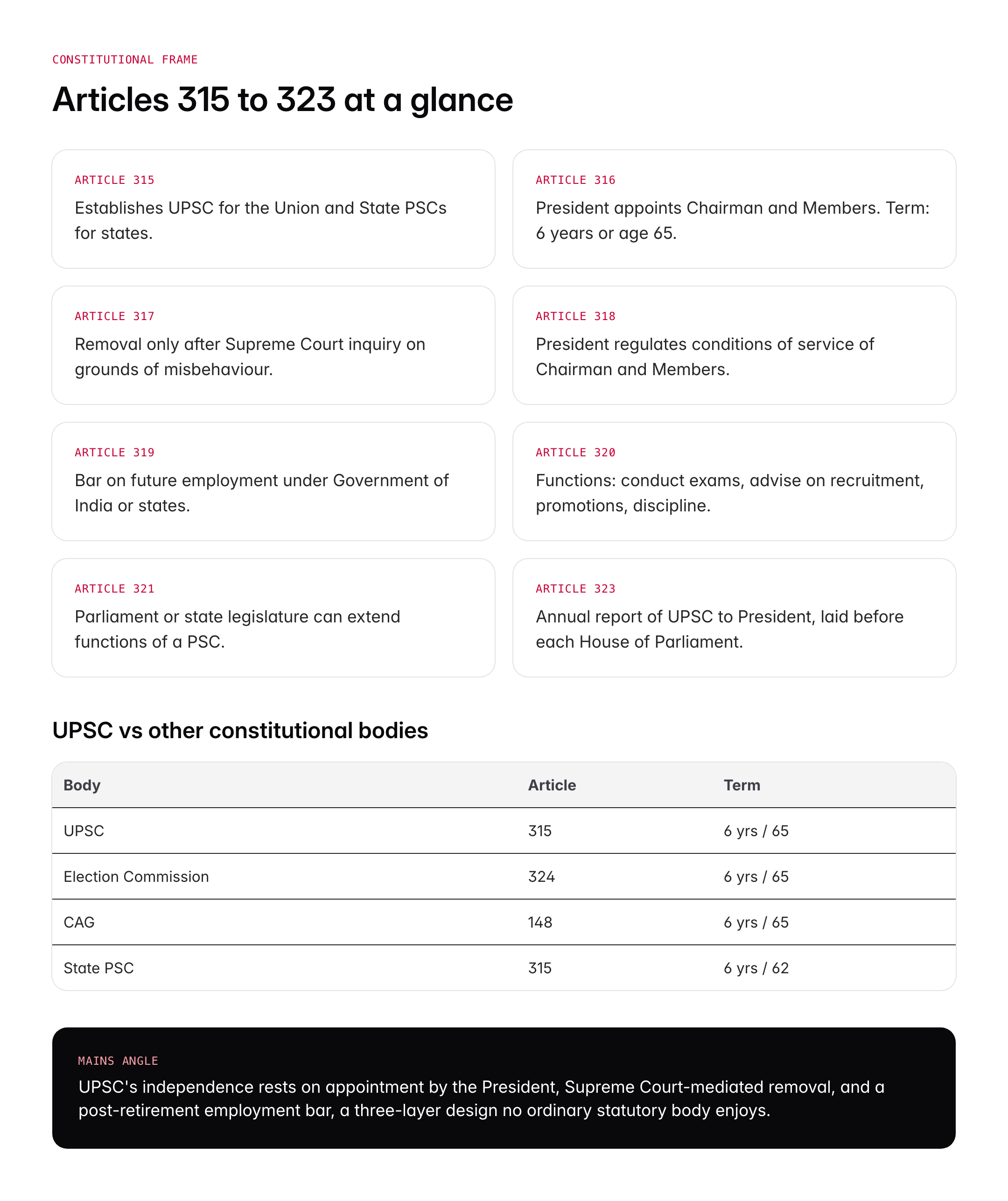
The Union Public Service Commission (UPSC) traces its lineage to the Public Service Commission set up on 1 October 1926 on the recommendation of the Lee Commission. It was reconstituted as the Federal Public Service Commission under the Government of India Act 1935 and became the Union Public Service Commission under the Constitution of India on 26 January 1950. Under Article 315 the UPSC is a constitutional body, and under Article 316 its Chairman and Members are appointed by the President of India for a term of six years or until age 65, whichever is earlier.
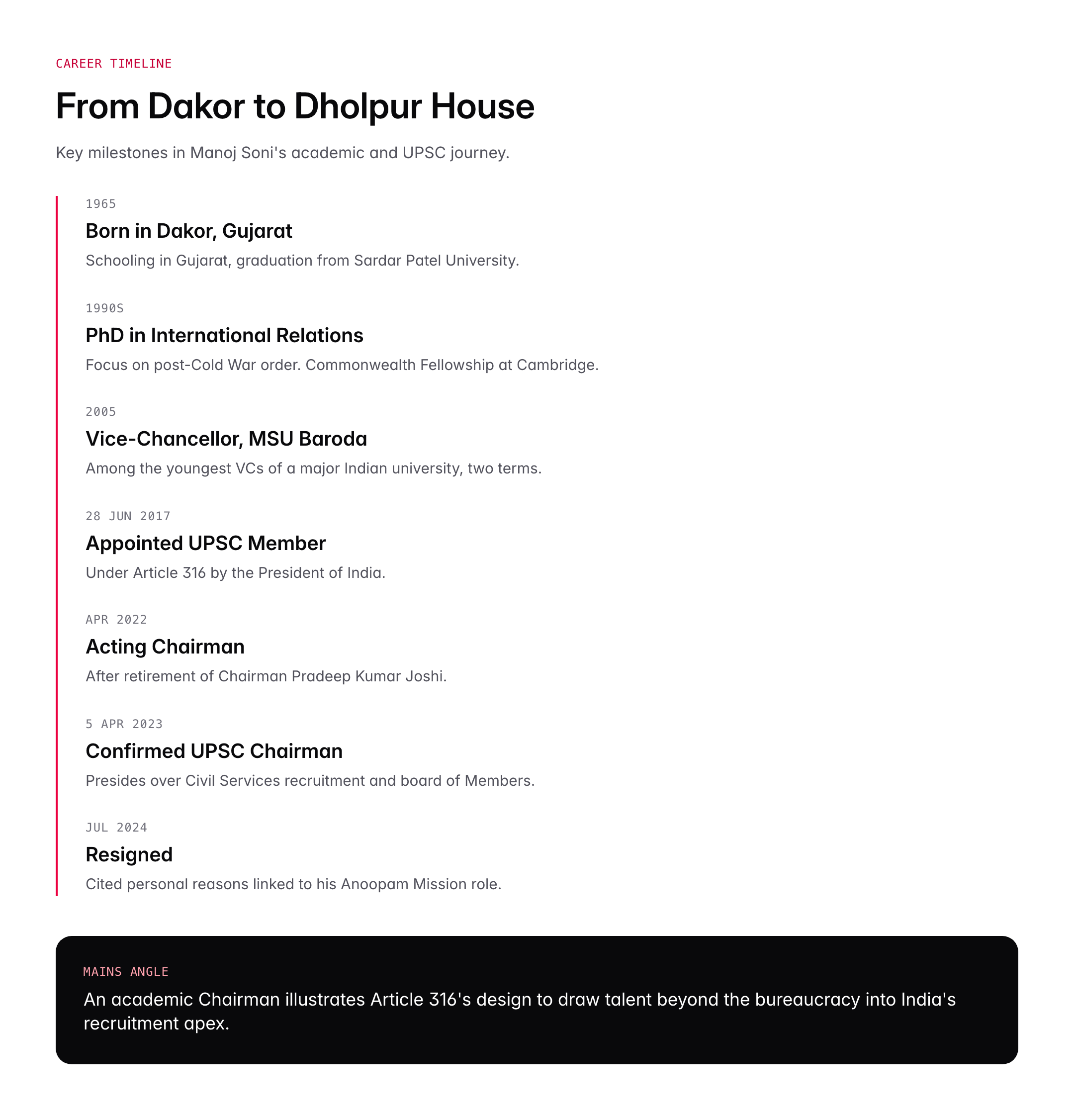
Into this institution arrived Manoj Soni in June 2017 as a Member. By that point he already carried a distinctive academic reputation. Born in Dakor, a temple town in Gujarat’s Kheda district, Soni completed his schooling locally, graduated from Sardar Patel University in Vallabh Vidyanagar, and earned his doctorate on post-Cold War international relations. His early faculty career was at Sardar Patel University. In 2005, at the age of 40, he became the Vice-Chancellor of the Maharaja Sayajirao University of Baroda, among the youngest VCs of any large Indian university, and later led Dr Babasaheb Ambedkar Open University. His academic niche was India-United States relations and the geopolitics of the post-Cold War order.
When Pradeep Kumar Joshi, the Chairman, demitted office in April 2022, Manoj Soni was designated Acting Chairman as the senior-most Member. He was formally appointed Chairman on 5 April 2023 and served until his resignation in July 2024. The confirmation came about a year after he began functioning in the top role, a gap common in constitutional appointments that depend on the warrant of the President.
Biography and Career
Early Life and Education
Manoj Soni was born in 1965 in Dakor, Gujarat, in a middle-class family. He completed his school education in Gujarat and graduated from Sardar Patel University. He earned his PhD in International Relations with a focus on the global order after the Cold War, and followed it with postdoctoral work and a Commonwealth Academic Staff Fellowship at the University of Cambridge.
Academic Career
Soni taught at Sardar Patel University as a faculty member in the Department of Political Science and International Relations. Over two decades he rose through the ranks, and in 2005 he was appointed Vice-Chancellor of the Maharaja Sayajirao University of Baroda, a 300-faculty institution with a long public history. He served two terms at MSU Baroda and later led Dr Babasaheb Ambedkar Open University in Gujarat. His academic writing focused on India-US strategic relations, multilateralism, and post-Cold War security architecture.
Member, Union Public Service Commission
Soni was appointed a Member of the UPSC on 28 June 2017 under Article 316. As Member he sat on interview boards for Civil Services, Indian Forest Service, Indian Economic Service, CAPF, and Combined Medical Services recruitments, and on cadre review meetings. Members of the Commission serve six years or until age 65.
Chairman, Union Public Service Commission
On the retirement of Chairman Pradeep Kumar Joshi in April 2022, Soni took over as Acting Chairman. He was confirmed as Chairman on 5 April 2023. As Chairman he presided over the Commission’s board of Members, signed off on annual reports laid before Parliament, supervised the Secretariat, and chaired major interview boards. In July 2024 he resigned before completing his term, citing personal reasons connected to his role in a spiritual organisation, a rare occurrence at the head of a constitutional body.
Life Beyond Office
Manoj Soni has long been associated with the Anoopam Mission, a Swaminarayan-sect spiritual organisation based in Mogri, Gujarat. He took the Nishkam Karmayogi diksha in 2020. His academic and administrative career has run alongside this spiritual engagement, and his post-UPSC life has returned to it.
Significance for UPSC and General Knowledge
- The Chairman and Members of UPSC are appointed by the President under Articles 315 and 316.
- Tenure is six years or until age 65, whichever is earlier, per Article 316(2).
- Soni’s appointment illustrates the recruitment of Members from academia, not only from the bureaucracy.
- Article 317 lays down the grounds and procedure for removal of UPSC Members.
- UPSC presents its annual report to the President, who places it before each House of Parliament.
- Understanding the office of the Chairman helps in GS Paper 2 questions on constitutional bodies.
Detailed Analysis: The Office of the UPSC Chairman
The UPSC Chairman sits at the top of India’s merit-based recruitment architecture. Under Article 320, the Commission is consulted on methods of recruitment, principles for appointments and promotions, disciplinary matters, and claims for pensions in respect of civil services under the Union. Although advisory, the Commission’s advice carries strong convention, and ignoring it requires the government to report the fact to Parliament.
Day-to-day the Chairman supervises roughly 26 recruitment examinations each year, the best known being the Civil Services Examination that produces officers for the IAS, IPS, IFS, and central services. Interview boards are typically chaired by a Member, with the Chairman presiding over boards at key stages. During Manoj Soni’s tenure the Commission also handled controversy around identity fraud cases, including that involving probationer Puja Khedkar that surfaced in July 2024, and the resulting focus on verification protocols during Civil Services recruitment.
The Chairman’s office requires political neutrality. Article 319 bars a former Chairman from any further employment under the Government of India or a state government, a safeguard designed to ensure that decisions taken while in office are not shaped by post-retirement expectations. Article 317 protects Members from arbitrary removal by restricting dismissal to grounds of misbehaviour referred to the Supreme Court, misconduct, infirmity of mind or body, or insolvency.
Soni’s trajectory also highlights the academic pathway into UPSC. Out of 10 or 11 Members at full strength, some are drawn from academia and the private sector alongside former civil servants and defence officers, reflecting the original constitutional intent that the Commission should command a broad view of public administration and not be a closed club. His career mirrors that of earlier academic Chairmen like P C Hota and D P Agrawal, who similarly bridged university and government service.
Beyond recruitment, the UPSC has since 2017 operated under digital transformation with One Time Registration, digital DAF submission, and biometric checks at examination centres. The Chairman steers these operational modernisation initiatives. Soni’s period saw continuity on these fronts along with increased attention to interview board training and diversity of board composition across gender, background, and region.
Comparative Perspective
| Body | Constitutional basis | Head term | Removal |
|---|---|---|---|
| UPSC | Article 315 | 6 years or 65 | Article 317, SC reference |
| State PSC | Article 315 | 6 years or 62 | Article 317 |
| Election Commission | Article 324 | 6 years or 65 | Same procedure as SC judge |
| CAG | Article 148 | 6 years or 65 | Same procedure as SC judge |
The UPSC Chairman’s tenure and removal process sit alongside those of the CEC and CAG as constitutional protections designed to insulate the office from political pressure. Unlike the CEC and CAG, however, the UPSC Chairman’s removal under Article 317 requires a reference to the Supreme Court for inquiry, a unique design. State Public Service Commissions mirror the UPSC but the Governor is the appointing authority and removal still rests with the President on the Supreme Court’s advice.
Controversies and Debates
No significant controversy attached personally to Manoj Soni during his tenure as Chairman. The most debated episode of 2024 was the Puja Khedkar matter concerning alleged fabrication of disability and identity documents by a 2023-batch probationer, which surfaced after Soni’s period in office but renewed scrutiny of UPSC verification procedures for OBC and PwBD certificates. The Commission ultimately recommended cancellation of her candidature and debarment from future examinations, underscoring the importance of verification reforms going forward.
Separately, scholars have periodically questioned whether UPSC Members should be drawn from a wider pool, including more representation of state services, women, and marginalised groups, to reduce any perceived bureaucratic insularity. These are institutional debates rather than personal ones, and they continue to shape appointment practice under every new Chairman.
Prelims Pointers
- UPSC was set up on 26 January 1950 under Article 315
- Chairman and Members are appointed by the President under Article 316
- Tenure is six years or age 65, whichever is earlier
- Maximum strength is up to 11, set by Presidential regulation under Article 318
- Article 317 deals with removal via Supreme Court reference
- Article 319 bars former UPSC Chairman from further government employment
- Article 320 lists the functions of the Commission
- Manoj Soni was appointed Member on 28 June 2017
- Soni became Acting Chairman in April 2022
- Soni was confirmed Chairman on 5 April 2023
- Soni resigned from the Chairmanship in July 2024
- UPSC headquarters is Dholpur House, New Delhi
- UPSC presents an annual report to the President, placed before Parliament
Mains Practice Questions
Q1. Examine the constitutional safeguards that ensure the independence of the Union Public Service Commission.
- Map Articles 315 to 323, focusing on appointment, tenure, and removal.
- Highlight Article 317 (Supreme Court reference) and Article 319 (post-retirement bar).
- Assess practical working through recent Chairmen including Manoj Soni and his predecessors.
Q2. Discuss the changing composition and role of the UPSC in the context of civil service reform.
- Diversity of Members: academics, bureaucrats, defence and private sector.
- Digital transformation of examinations and interview reforms.
- Continuing debates on verification processes after the 2024 Puja Khedkar case.
Conclusion
Manoj Soni’s journey from a student in Dakor to the Chair at Dholpur House captures something important about the UPSC itself: the institution actively drafts talent from outside the bureaucracy because civil service recruitment needs more than administrative insiders to judge fairly. His two-decade academic career and short Chairmanship together illustrate how academic credentials, international experience, and administrative stints can combine in service of a constitutional body.
For UPSC aspirants the more durable takeaway is the office, not the officeholder. Articles 315 to 323 of the Constitution construct a recruitment system that is independent by design, and every Chairman inherits and protects that design. Knowing the biography of Manoj Soni is useful for a Prelims or current affairs question; knowing the constitutional architecture he worked within is what will carry through Mains and the interview boards his signature once authorised.
Frequently Asked Questions
Who is Manoj Soni?
Manoj Soni is a former Chairman of the Union Public Service Commission (UPSC) and a veteran academic from Gujarat. Born in Dakor in 1965, he holds a PhD in International Relations, served as Vice-Chancellor of M S University of Baroda and Dr Babasaheb Ambedkar Open University, and joined UPSC as Member in 2017 before becoming Chairman in 2023.
Why is Manoj Soni important for UPSC aspirants?
Manoj Soni’s career illustrates the constitutional design that lets academics, not only civil servants, lead India’s top recruitment body under Articles 315 and 316. His tenure as Chairman frames current affairs questions on UPSC reforms, verification processes after the 2024 Puja Khedkar matter, and broader debates on the independence of constitutional bodies in GS Paper 2.
When did Manoj Soni become UPSC Chairman?
Manoj Soni was appointed as a Member of the UPSC on 28 June 2017. He took charge as Acting Chairman in April 2022 after the retirement of Chairman Pradeep Kumar Joshi, and was formally appointed Chairman by the President of India on 5 April 2023. He resigned from the Chairmanship in July 2024 before completing his term.
How is Manoj Soni related to Article 316 of the Constitution?
Article 316 of the Constitution empowers the President of India to appoint the Chairman and Members of the UPSC and fixes their term as six years or until age 65, whichever is earlier. Manoj Soni was appointed both as Member in 2017 and as Chairman in 2023 under this provision, making him a direct example of Article 316 in practice.
What is the educational background of Manoj Soni?
Manoj Soni graduated from Sardar Patel University in Vallabh Vidyanagar and earned his PhD in International Relations with a focus on the post-Cold War order. He also held a Commonwealth Academic Staff Fellowship at the University of Cambridge. His academic writing concentrated on India-United States relations, multilateralism, and post-Cold War security architecture.
Why did Manoj Soni resign as UPSC Chairman?
Manoj Soni resigned as UPSC Chairman in July 2024. Official communications cited personal reasons connected to his long-standing role with the Anoopam Mission, a Swaminarayan-sect spiritual organisation where he had taken the Nishkam Karmayogi diksha in 2020. The resignation came during a period of renewed public attention to UPSC verification processes.
What did Manoj Soni do before joining UPSC?
Before joining UPSC as Member in 2017, Manoj Soni had a two-decade academic career. He taught political science and international relations at Sardar Patel University, served two terms as Vice-Chancellor of the Maharaja Sayajirao University of Baroda from 2005, and later led Dr Babasaheb Ambedkar Open University, making him one of Gujarat’s best-known university administrators.
How is the UPSC Chairman appointed and removed?
The UPSC Chairman is appointed by the President under Article 316. Removal is governed by Article 317, which allows dismissal only on grounds of misbehaviour after reference to the Supreme Court for inquiry, or for misconduct, infirmity, or insolvency. Article 319 further bars a former Chairman from any further employment under the Government of India or any state government.
Tell Google you want more of this.
Add Anantam IAS as a preferred sourceOne tap, and this site shows up more often in your own Top Stories, AI Overviews and AI Mode. Remove it any time.