The greenhouse effect and ozone depletion are two of the most consequential atmospheric phenomena in modern Earth science, and they are easily confused. The greenhouse effect is a natural process that keeps the planet warm enough to support life, but it has been amplified by human activity into a driver of dangerous climate change. Ozone depletion is a separate problem in which a thin layer of stratospheric ozone, which shields life from harmful ultraviolet radiation, has been thinned by industrial chemicals. Although both phenomena involve atmospheric chemistry and require global cooperation to manage, they have distinct causes, mechanisms, and policy regimes.
For UPSC aspirants, the distinction between these two issues is fertile ground for prelims questions and a recurring theme in mains essays on environment and sustainability. The greenhouse effect connects to climate change, the UNFCCC, and Net Zero pathways. Ozone depletion connects to the Vienna Convention, the Montreal Protocol, and what is widely regarded as the most successful environmental treaty in history. The Kigali Amendment, adopted in 2016, sits at the intersection of both regimes by phasing down hydrofluorocarbons that protect the ozone layer but heat the climate.
This guide walks through the science of both phenomena, the chemistry of the gases involved, the international architecture that governs them, and the questions most likely to appear in UPSC prelims and mains.
Quick Facts at a Glance
The greenhouse effect was first described by Joseph Fourier in 1824 and quantified by John Tyndall and Svante Arrhenius in the late 19th century. Earth’s average surface temperature would be roughly minus 18 degrees Celsius without it; with it, the average is around plus 15 degrees Celsius. The principal anthropogenic greenhouse gas is carbon dioxide, with concentrations now exceeding 420 parts per million compared to roughly 280 ppm before the Industrial Revolution. Ozone depletion was first detected over Antarctica in 1985 by British Antarctic Survey scientists. The Vienna Convention was adopted in 1985 and the Montreal Protocol in 1987. The Kigali Amendment to the Montreal Protocol was adopted in 2016 to phase down HFCs. The Montreal Protocol is the only UN treaty ratified by all 198 UN member states.
What the Greenhouse Effect Is
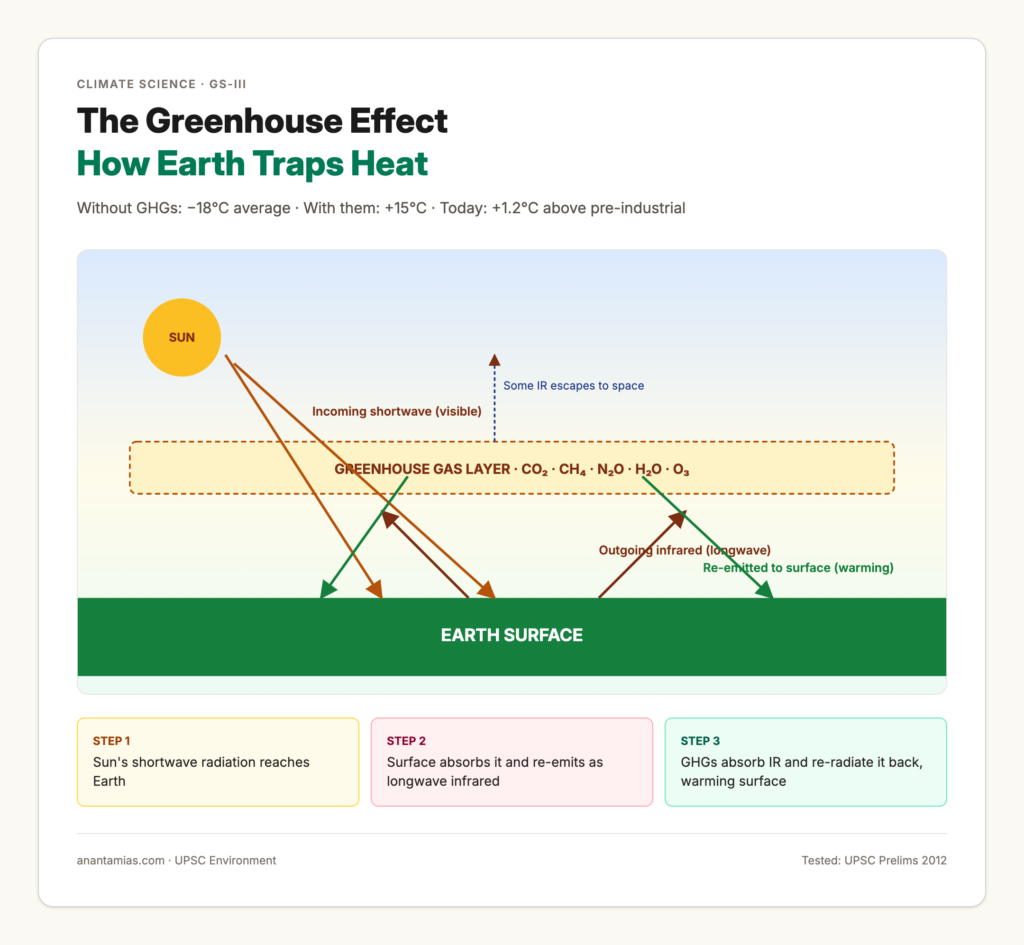
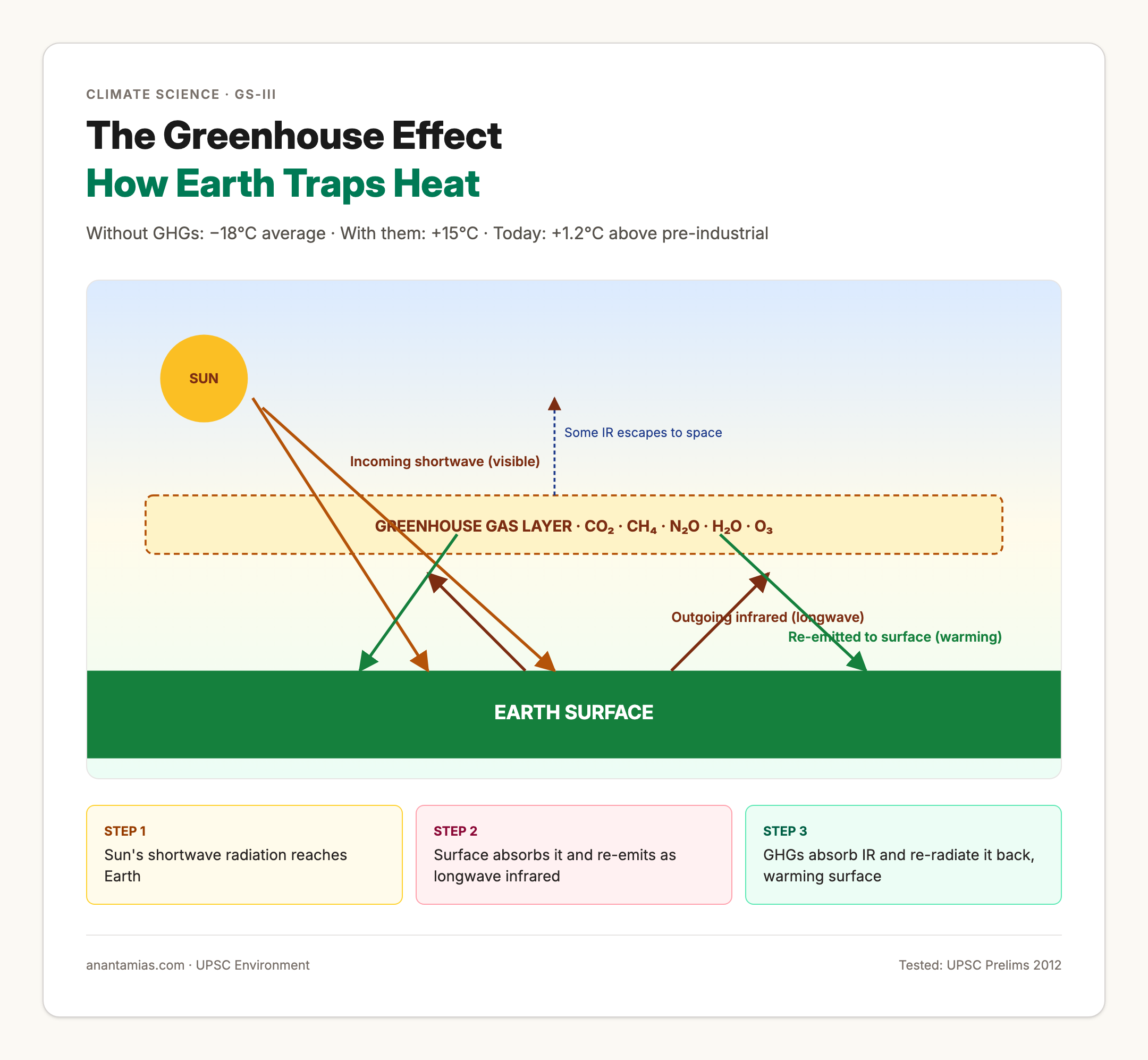
The greenhouse effect is the process by which certain atmospheric gases absorb outgoing infrared radiation from the Earth’s surface and re-emit a portion of it back downward, warming the lower atmosphere and the surface. Sunlight reaches Earth predominantly as shortwave visible radiation. The surface absorbs this energy and re-radiates it as longwave infrared radiation. Greenhouse gases are transparent to visible light but absorb infrared, which is why they trap heat without preventing sunlight from arriving.
The process is natural and life-supporting. Without it, the planet would freeze. The problem is the enhanced greenhouse effect: human activities have raised concentrations of greenhouse gases since the Industrial Revolution, intensifying the heat-trapping action and pushing global temperatures up by roughly 1.2 degrees Celsius compared to the pre-industrial baseline. This warming is driving glacial retreat, sea level rise, intensifying heatwaves, monsoon disruption, and ocean acidification.
Background and the Major Greenhouse Gases
Six greenhouse gases dominate climate policy, and each behaves differently in the atmosphere. Water vapour is the most abundant greenhouse gas but acts as a feedback rather than a forcing: warmer air holds more water vapour, which amplifies warming caused by other gases. Carbon dioxide is the principal anthropogenic forcing, released by fossil fuel combustion, deforestation, and cement production. It has a long atmospheric lifetime of around 100 years and remains the central focus of mitigation policy. Methane is produced by wetlands, paddy cultivation, livestock enteric fermentation, landfills, and oil and gas extraction; it has a short lifetime of about 12 years but a much higher heat-trapping power than CO2 over the short term. Nitrous oxide comes mainly from agricultural soils, fertiliser use, and certain industrial processes; it has a lifetime of around 120 years. Chlorofluorocarbons and their successors are synthetic gases used in refrigeration, aerosols, and foam blowing. Ozone, found in both the stratosphere and troposphere, is a greenhouse gas in the lower atmosphere where it also acts as a pollutant.
Global Warming Potential and Atmospheric Lifetime
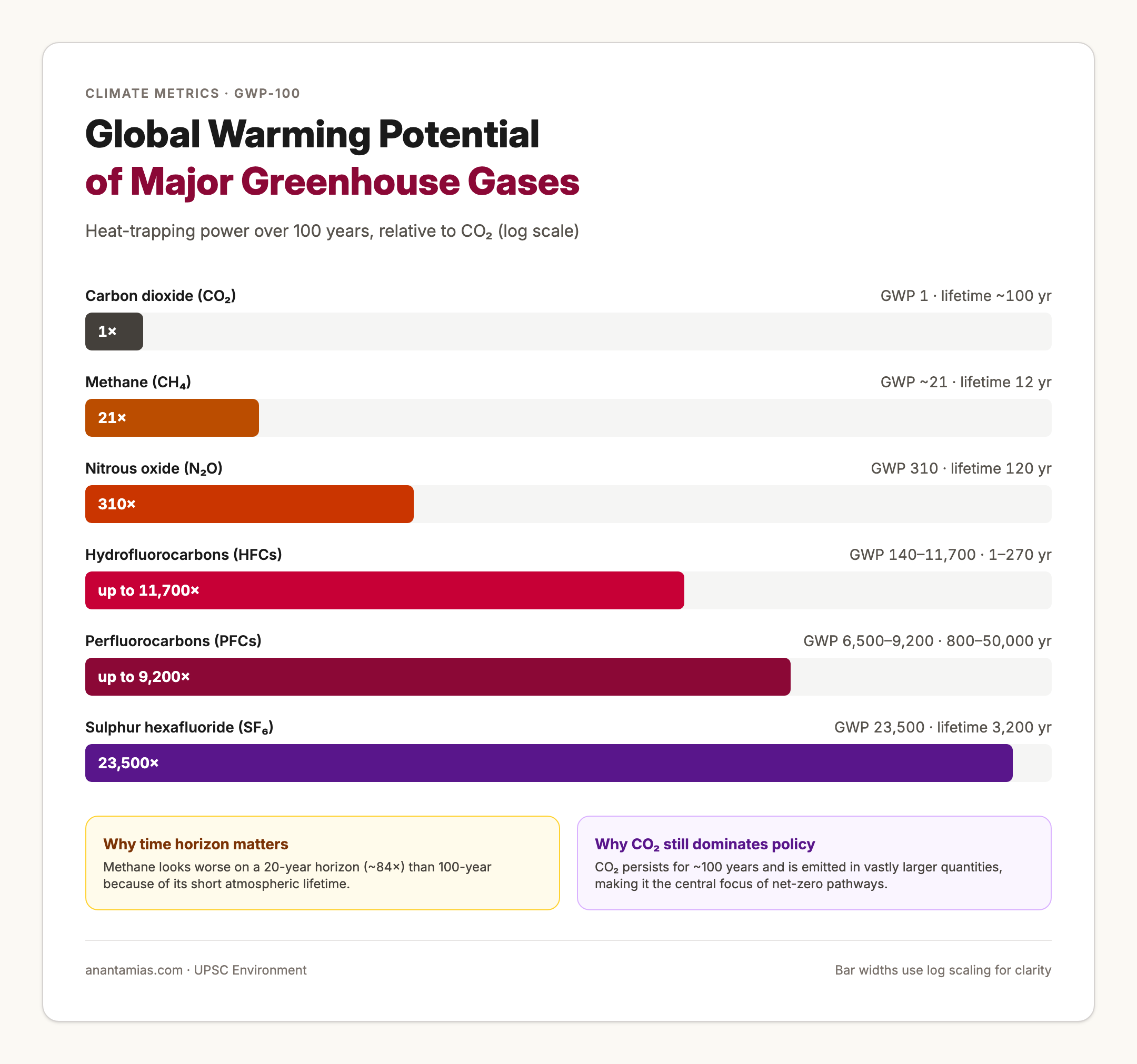
Global Warming Potential is a comparative metric that expresses the heat-trapping ability of a gas over a defined period, usually 100 years, relative to carbon dioxide. By definition, CO2 has a GWP of 1. Methane has a GWP-100 of around 21 in older accounting and 28 to 30 in updated IPCC values. Nitrous oxide has a GWP-100 of around 310. Hydrofluorocarbons have GWP values ranging from around 140 to 11,700 depending on the specific compound. Perfluorocarbons range from 6,500 to 9,200. Sulphur hexafluoride is the most potent greenhouse gas in widespread use, with an extremely high GWP and an atmospheric lifetime of around 3,200 years.
GWP is a useful but imperfect tool. It packages the radiative forcing and lifetime of a gas into a single number, but the choice of time horizon matters. Methane looks far worse on a 20-year horizon than on a 100-year horizon because of its short lifetime. Long-lived gases like CO2 and SF6 dominate the multi-century climate signature, which is why net zero discussions focus heavily on them.
Key Climate Concepts You Must Know
A handful of concepts recur in the climate literature and are tested often. Climate change refers to long-term alterations in average weather patterns due to natural and anthropogenic factors. Global warming is the rise in average surface temperature primarily driven by greenhouse gases. Radiative forcing is the change in Earth’s energy balance caused by an external factor, measured in watts per square metre. Carbon sequestration is the long-term storage of carbon in natural reservoirs like forests, soils, and oceans, or in engineered systems like underground saline aquifers and depleted oil reservoirs. Positive feedback amplifies an initial warming, as when melting Arctic ice exposes darker ocean that absorbs more sunlight. Negative feedback dampens warming, as when increased plant growth at higher CO2 levels takes some carbon out of the atmosphere. A tipping point is a threshold beyond which a change becomes self-sustaining and effectively irreversible on human timescales, such as the destabilisation of the West Antarctic Ice Sheet.
Net Zero refers to balancing residual greenhouse gas emissions with removals from the atmosphere, resulting in no net increase. The Total Carbon Budget is the maximum cumulative CO2 that can be emitted globally to keep warming below a specified threshold, typically 1.5 or 2 degrees Celsius. A carbon footprint measures the total greenhouse gas emissions associated with an individual, organisation, or product, expressed in CO2 equivalents.
For more on climate impacts and mitigation, see our coverage of India’s efforts for combating climate change and carbon farming.
What Ozone Depletion Is
Ozone depletion is the thinning of the stratospheric ozone layer, a region between roughly 15 and 35 kilometres altitude where ozone molecules absorb harmful ultraviolet-B radiation from the Sun. The ozone layer is what makes terrestrial life possible: without it, UV-B would damage DNA, increase skin cancer rates, harm marine phytoplankton, and disrupt food chains.
Ozone is created when UV radiation splits an oxygen molecule into atoms that combine with other oxygen molecules. It is destroyed naturally in a steady cycle, but the introduction of synthetic ozone-depleting substances has tipped this balance. The most famous manifestation of ozone depletion is the Antarctic ozone hole, an annual thinning over the South Pole that was first detected by British Antarctic Survey scientists in 1985 and shocked the global scientific community.
Causes of Ozone Depletion: The Chemistry
Ozone depleting substances, or ODS, are man-made chemicals that are stable in the lower atmosphere but break down in the stratosphere, releasing chlorine or bromine atoms that catalytically destroy ozone. A single chlorine atom can destroy thousands of ozone molecules before it is removed.
Chlorofluorocarbons, used in refrigeration, air conditioning, aerosol sprays, and foam blowing agents, are the primary culprits with high ozone depletion potential. Halons, used in fire extinguishers, are even more potent because of their bromine content. Carbon tetrachloride, an industrial solvent and dry cleaning agent, has moderate ODP. Methyl chloroform, used in adhesives and chemical processing, also has moderate ODP. Methyl bromide, a soil fumigant in agriculture, has high ODP. Hydrochlorofluorocarbons, introduced as transitional substitutes for CFCs, have lower but non-zero ODP.
Why the Hole Is Over Antarctica
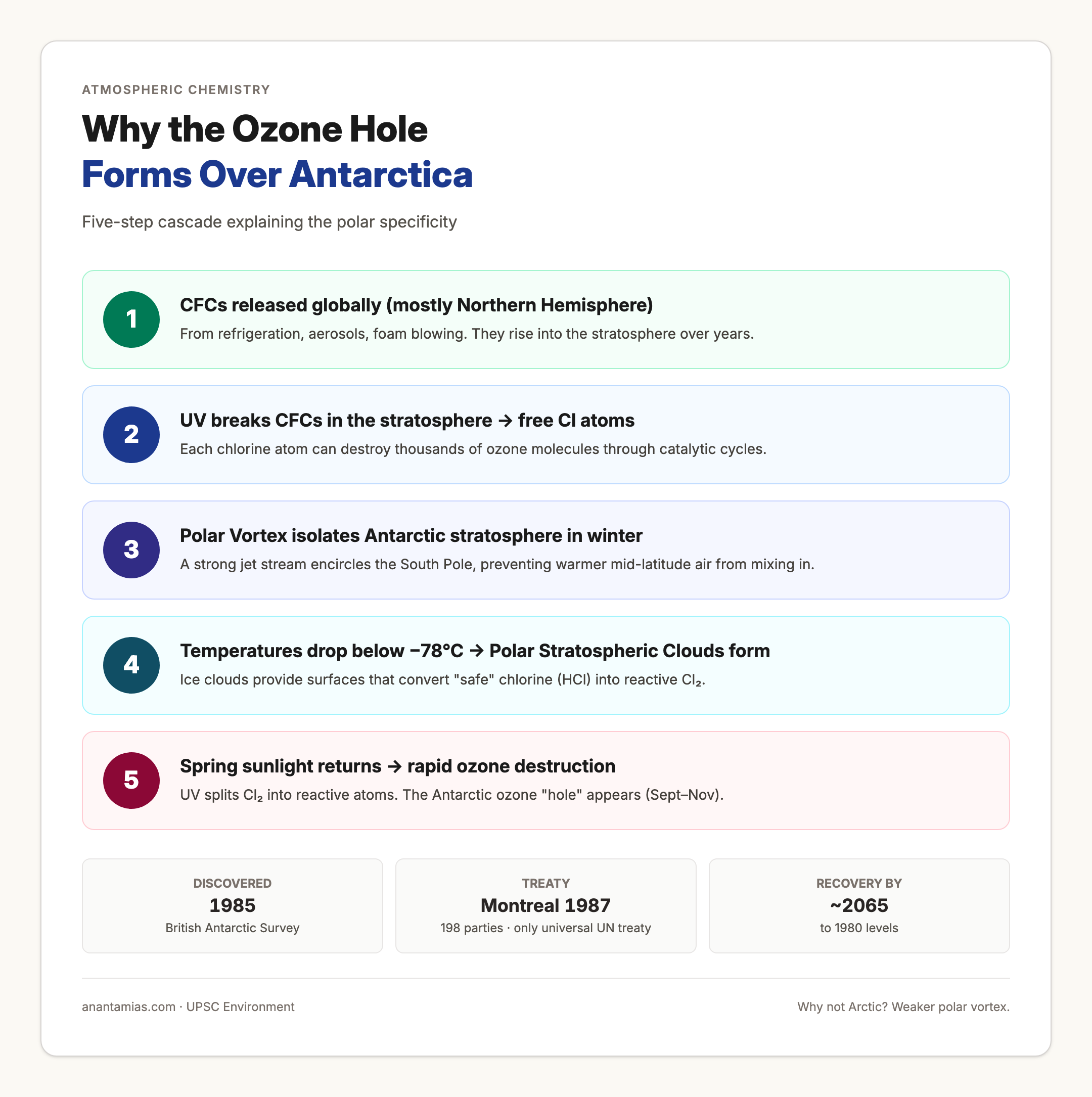
The Antarctic ozone hole is not because CFCs were released over the South Pole. They were released mostly in the Northern Hemisphere and circulated globally. The polar concentration is a product of unique meteorology. A polar vortex, a strong jet stream that encircles Antarctica in winter, isolates the air mass and prevents it from mixing with warmer mid-latitude air. Stratospheric temperatures in this isolated region drop below minus 78 degrees Celsius, cold enough to form polar stratospheric clouds, which are thin clouds of ice and nitric acid particles. These cloud surfaces catalyse reactions that convert dormant chlorine reservoirs like hydrogen chloride into reactive forms. When sunlight returns in the Antarctic spring, ultraviolet radiation rapidly splits these reactive chlorine compounds, unleashing a sudden cascade of ozone destruction. The Arctic experiences less severe depletion because its polar vortex is weaker and its stratospheric air mixes more freely.
International Conventions: Vienna and Montreal
The international response to ozone depletion is widely cited as the most successful environmental governance regime in history. It rests on two pillars adopted in quick succession.
The Vienna Convention for the Protection of the Ozone Layer was adopted in 1985 as a framework convention. Like the UNFCCC for climate, it sets broad goals and procedures without numerical targets. Its objective is to promote international cooperation, research, and information exchange. India became a party in 1991. The Vienna Convention established the Conference of the Parties, which meets every three years.
The Montreal Protocol on Substances that Deplete the Ozone Layer was adopted in 1987 and is the operational instrument under the Vienna Convention. Unlike the convention, it is legally binding and contains specific phase-out schedules. It applies the principle of Common but Differentiated Responsibilities. Article 5 countries, which include developing nations like India and China, were given a 10-year grace period and access to financial assistance through the Multilateral Fund to switch to ozone-friendly alternatives. Non-Article 5 countries, the developed nations, had to phase out chemicals on a faster timeline. The protocol’s success is unmatched: it is the only UN treaty ratified by all 198 UN member states. India became a party in 1992.
Atmospheric chlorine and bromine concentrations have been declining since the late 1990s, and scientists project that the ozone layer will recover to 1980 levels by mid-century. This recovery is one of the clearest examples of effective international environmental cooperation.
The Kigali Amendment 2016
The Kigali Amendment to the Montreal Protocol was adopted in October 2016 and entered into force in 2019. It addresses an unintended consequence of the Montreal Protocol: HFCs were introduced as substitutes for CFCs because they do not deplete the ozone layer. However, they turned out to be super greenhouse gases with GWP values thousands of times higher than CO2. The Kigali Amendment phases down HFC production and consumption, with a goal of reducing HFC consumption by over 80 percent by 2047 and avoiding up to 0.5 degrees Celsius of warming by 2100. Unlike the voluntary NDCs of the Paris Agreement, the Kigali Amendment sets legally binding targets with specific timelines for all member countries, with developing nations following a slower schedule. India ratified the Kigali Amendment in 2021.
For complementary reading, explore our analysis of methane emissions and the Lifestyle for Environment movement.
Comparing Greenhouse Effect and Ozone Depletion
Although both involve atmospheric chemistry, the two phenomena are distinct. The greenhouse effect operates in the troposphere; ozone depletion is a stratospheric problem. The greenhouse effect is driven by gases that absorb infrared radiation; ozone depletion is driven by chemicals that release reactive halogens that destroy ozone. The greenhouse effect is regulated by the UNFCCC, Kyoto Protocol, and Paris Agreement; ozone depletion by the Vienna Convention and Montreal Protocol. Climate change targets remain voluntary and contested; ozone targets are legally binding and have been broadly met. Some chemicals appear in both regimes: CFCs are both ozone depleters and powerful greenhouse gases, and HFCs are non-ozone-depleting but heat-trapping, which is why the Kigali Amendment bridges the two.
Challenges and Ongoing Concerns
Despite the success of the Montreal Protocol, threats to the ozone layer persist. Recent monitoring detected unexpected emissions of CFC-11 traced to illegal production in parts of East Asia, prompting tighter enforcement. Climate change itself can affect the ozone layer, as a cooler stratosphere may sustain polar stratospheric clouds for longer and slow recovery. On the climate side, despite three decades of negotiation, global emissions continue to rise, and the gap between current policies and the 1.5 degree goal remains wide.
UPSC Prelims Pointers
- Greenhouse effect: trapping of outgoing infrared radiation by GHGs in the troposphere.
- Major GHGs: H2O vapour, CO2, CH4, N2O, CFCs, HFCs, O3, SF6.
- GWP: CO2 = 1, CH4 around 21-28, N2O around 310, SF6 highest among common gases.
- Ozone layer: stratosphere, 15-35 km altitude; absorbs UV-B.
- Antarctic ozone hole discovered in 1985.
- Polar vortex plus polar stratospheric clouds plus returning sunlight cause Antarctic depletion.
- Vienna Convention 1985: framework, no binding targets.
- Montreal Protocol 1987: legally binding phase-out of CFCs, halons, etc.
- Multilateral Fund supports developing country phase-out under the Montreal Protocol.
- Montreal Protocol: only UN treaty ratified by all 198 UN member states.
- Kigali Amendment 2016: phases down HFCs, super-GHGs introduced as CFC replacements.
- India ratified Vienna 1991, Montreal 1992, Kigali 2021.
Mains Practice Questions
- The Montreal Protocol is widely described as the most successful environmental treaty in history. Examine the factors behind its success and discuss what climate change negotiators can learn from it. (GS-III, 250 words)
- Distinguish between the greenhouse effect and ozone depletion in terms of mechanism, gases involved, and international response. (GS-III, 200 words)
- The Kigali Amendment bridges ozone protection and climate mitigation. Discuss its significance and the challenges in implementing it in developing countries. (GS-III, 250 words)
- Global Warming Potential is widely used in climate policy but has methodological limitations. Critically evaluate its utility as a metric. (GS-III, 200 words)
Way Forward
Two priorities define the path ahead. First, the Montreal regime must remain vigilant against illegal CFC production and ensure smooth implementation of the Kigali Amendment, particularly in developing countries that need finance and technology to switch to climate-friendly refrigerants. Second, the lessons of Montreal, namely binding targets, differentiated responsibilities backed by finance, technology cooperation, and clear deadlines, must be carried into climate negotiations. The contrast between Montreal’s success and the slower pace of climate diplomacy underscores how design choices in international treaties shape outcomes. India can position itself as a bridge between developed and developing countries by accelerating its own transition to low-GWP refrigerants and demonstrating that ambitious phase-downs are compatible with development.
Frequently Asked Questions
What is the difference between the greenhouse effect and global warming?
The greenhouse effect is the natural process by which gases like CO2 and water vapour trap outgoing infrared radiation, keeping Earth warm enough to support life. Global warming is the recent, human-caused intensification of this effect, driven by elevated concentrations of greenhouse gases from fossil fuel use, deforestation, and agriculture, leading to a rise in average global temperatures.
Why does the ozone hole form over Antarctica and not over India?
The Antarctic polar vortex isolates stratospheric air over the South Pole during winter, allowing temperatures to drop below minus 78 degrees Celsius. These extreme conditions form polar stratospheric clouds whose surfaces catalyse the conversion of dormant chlorine into reactive forms. When sunlight returns in spring, the reactive chlorine destroys ozone rapidly. The Arctic experiences a weaker version of this because its polar vortex is less stable, and tropical regions like India never get cold enough in the stratosphere to form these clouds.
What is Global Warming Potential and why does the time horizon matter?
GWP is a comparative measure of how much heat a gas traps over a given period relative to CO2. The 100-year horizon is standard, but for short-lived gases like methane, a 20-year horizon shows a much higher impact. Choosing the time frame affects mitigation priorities: methane reductions look more urgent on shorter horizons, while CO2 dominates the multi-century outlook.
Are CFCs and HFCs the same thing?
No. CFCs are chlorofluorocarbons that deplete the ozone layer and are also potent greenhouse gases. HFCs are hydrofluorocarbons introduced as substitutes for CFCs because they do not contain chlorine and therefore do not destroy ozone. However, HFCs have very high GWP values, making them powerful climate forcers, which is why the Kigali Amendment phases them down.
Why is the Montreal Protocol considered a success but the Paris Agreement is criticised?
Montreal had a clear scientific consensus, a small set of substitute chemicals, a manageable industrial transition, legally binding targets with explicit timelines, and a Multilateral Fund to support developing countries. Paris addresses fossil fuels, which are embedded in every economy, relies on voluntary NDCs, and depends on transparency rather than legal compulsion. The structural difficulty of climate mitigation is far greater than that of replacing CFCs.
What is the Kigali Amendment and when does India have to phase down HFCs?
The Kigali Amendment, adopted in 2016, phases down HFCs under the Montreal Protocol. India has agreed to begin its phase-down in 2028, with a target of reducing HFC consumption by 85 percent by 2047 from its baseline. India ratified the amendment in 2021.
What is radiative forcing?
Radiative forcing is the difference between energy entering Earth’s atmosphere from the Sun and energy radiated back to space, measured in watts per square metre. A positive radiative forcing warms the planet; a negative one cools it. Greenhouse gases produce positive radiative forcing, while sulphate aerosols can produce negative forcing in the short term.
Is ozone good or bad?
Both, depending on location. Stratospheric ozone is essential because it shields life from harmful UV radiation. Tropospheric ozone, formed near the surface from reactions involving NOx, VOCs, and sunlight, is a pollutant that harms human health and damages crops, and it also acts as a greenhouse gas.
What is a tipping point in the climate system?
A tipping point is a threshold beyond which a change in the climate system becomes self-sustaining and effectively irreversible on human timescales. Examples include the disintegration of the West Antarctic Ice Sheet, the dieback of the Amazon rainforest, and the destabilisation of monsoon systems. Avoiding tipping points is a central reason for the 1.5 degree Celsius goal.
What does Net Zero mean and how is it different from carbon neutrality?
Net Zero refers to balancing all greenhouse gas emissions with equivalent removals, leaving no net addition to the atmosphere. Carbon neutrality typically refers only to CO2. The Paris Agreement uses Net Zero as a long-term goal, with countries setting their own target dates: 2050 for most developed countries, 2060 for China, and 2070 for India.
Tell Google you want more of this.
Add Anantam IAS as a preferred sourceOne tap, and this site shows up more often in your own Top Stories, AI Overviews and AI Mode. Remove it any time.