A series of high-profile volcanic eruptions in 2025 brought global attention back to the geophysical foundations of the planet. The Ethiopian volcano Hayli Gubbi erupted explosively after roughly 12,000 years of dormancy, sending an ash plume to about 14 kilometres altitude. Kilauea on the Big Island of Hawaii continued its almost continuous activity with lava fountains and effusive flows. Krasheninnikov on the Russian Kamchatka peninsula and Lewotobi Laki-Laki and Mount Marapi in Indonesia produced sustained explosive ash plumes through the year. Sabancaya in Peru and Telica in Nicaragua kept up smaller-scale strombolian activity. Each of these events fits into a tectonic story that UPSC aspirants are expected to read carefully because the same story explains where future eruptions are likely to occur and why.
For UPSC the topic sits in the geography section of GS Paper I, with significant overlap into environment and disaster management in GS Paper III. Prelims questions ask about the location of volcanoes, the type of eruption, and the type of volcano. Mains questions test the wider relationship between plate tectonics and volcanism, the climatic effects of large eruptions, and the disaster preparedness that governments need to maintain in volcanic regions.
This guide covers the basics of volcanism, the products and processes of an eruption, the 2025 eruptions in detail, the broader catalogue of world records that prelims often draws from, and the GS-style hooks that aspirants need for both stages of the exam.
Quick Facts at a Glance
Volcanism is the process by which molten rock, gases, and other materials from the Earth’s interior are brought to the surface or near the surface. The materials released include lava, ash and tephra, volcanic gases such as carbon dioxide, sulphur dioxide, and water vapour, pyroclastic flows which are the most deadly of all volcanic hazards, and lahars which are volcanic mudflows. Volcanoes are classified by shape into shield volcanoes (broad and gently sloping, formed by basaltic effusive eruptions, e.g. Mauna Loa and Kilauea), stratovolcanoes (steep and conical, formed by alternating layers of lava and ash from explosive eruptions, e.g. Mount Fuji and Mount Krakatoa), and caldera systems (large depressions formed by collapse after a major eruption, e.g. Yellowstone). Volcanism is mostly concentrated along plate margins, particularly the Pacific Ring of Fire, the Mid-Atlantic Ridge, and the East African Rift. Recent eruptions of 2025 cluster in three tectonic settings: the East African Rift (Hayli Gubbi), the Hawaiian hotspot (Kilauea), the Pacific Ring of Fire subduction zones (Krasheninnikov, Lewotobi, Marapi, Sabancaya, Telica). Tallest volcano above sea level is Ojos del Salado in Chile-Argentina at about 6,893 metres. Tallest from base to summit is Mauna Kea at about 10,200 metres from the ocean floor. Largest by volume is Mauna Loa in Hawaii. Most active volcano is Kilauea. Largest active caldera is Yellowstone. Oldest known active volcano is Mount Etna in Sicily. The deadliest eruption in recorded history is Mount Tambora in 1815, with a Volcanic Explosivity Index of 7 and an estimated 71,000 deaths, which produced the 1816 Year Without a Summer. Highest volcano in Asia is Damavand in Iran. The largest known volcano in the solar system is Olympus Mons on Mars, at about 22 kilometres high.
What Volcanism Is
Volcanism is the surface expression of internal heat. The Earth’s interior is hot enough to melt rock at certain depths, primarily where pressure is reduced or water is added to the mantle, and the resulting magma rises buoyantly through the crust. When magma reaches the surface it becomes lava, and the gases dissolved in it expand and escape, sometimes gently and sometimes catastrophically. The relationship between volcanism and plate tectonics is essentially the relationship between heat flow and the movement of crustal plates. The full sweep of volcanism, types of volcanic landforms is taught at the level of physical geography and is one of the standard prelims topics.
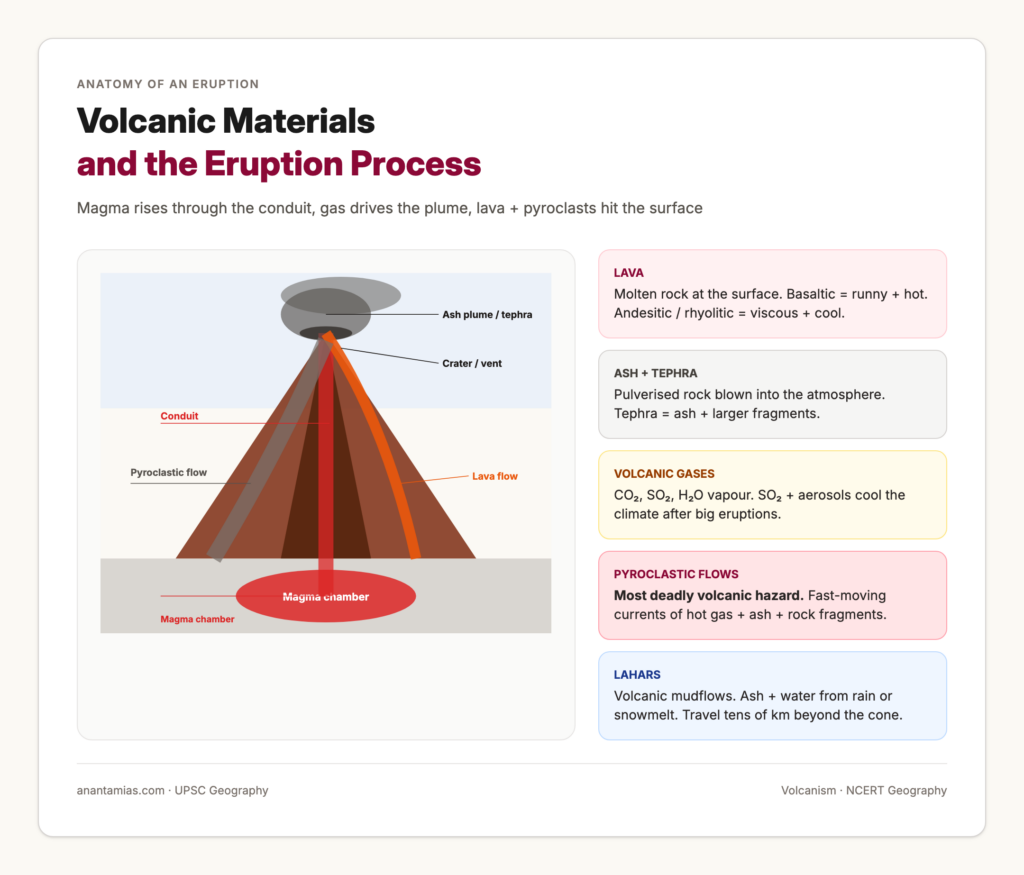
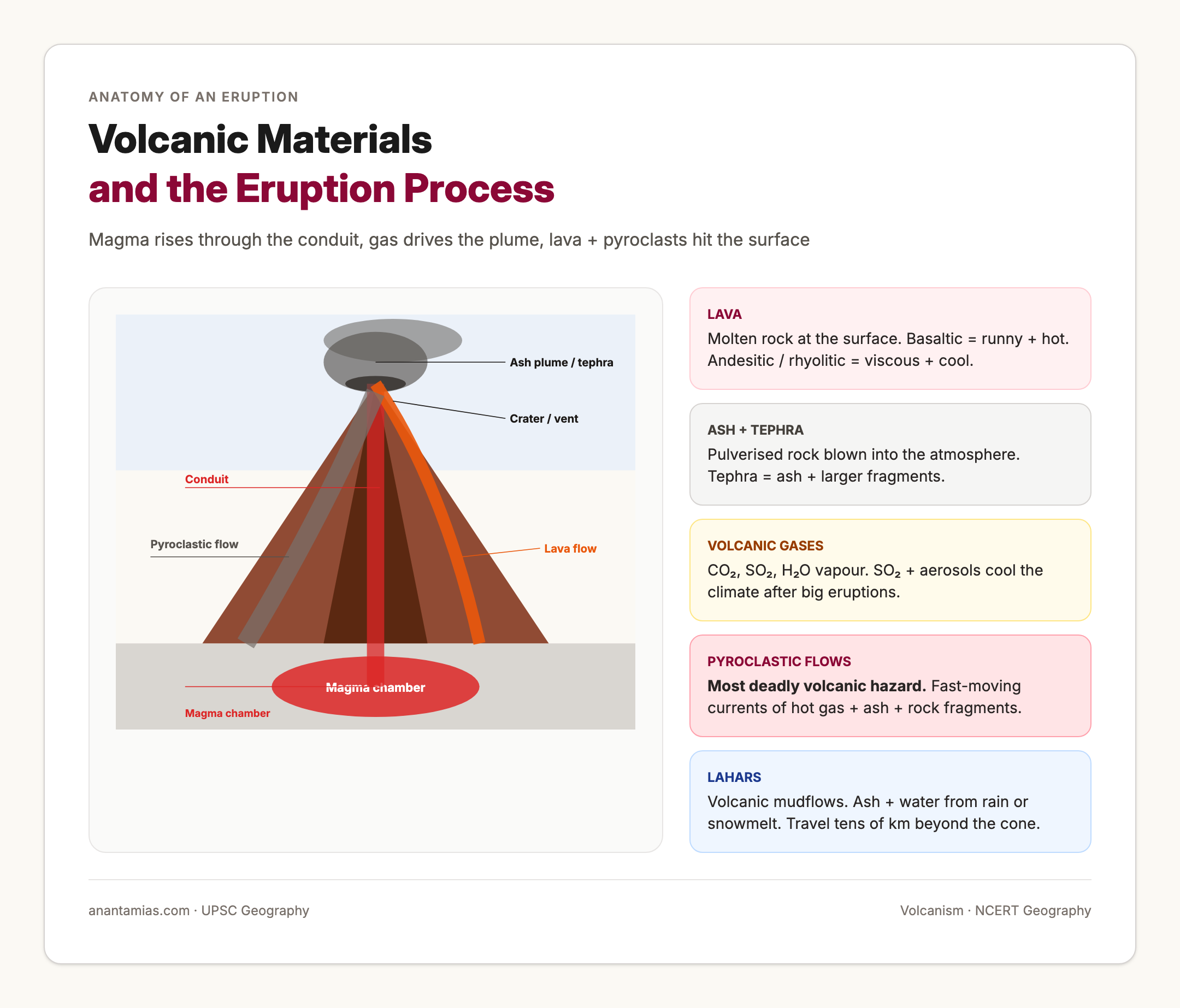
The materials released during an eruption fall into several categories. Lava is molten rock at the surface; basaltic lava is hotter and runnier, and andesitic and rhyolitic lavas are cooler and more viscous. Ash is the fine pulverised rock thrown into the atmosphere by explosive eruptions, while tephra is the broader category that includes ash plus larger fragments. Volcanic gases include carbon dioxide, sulphur dioxide, and water vapour, with the sulphur dioxide responsible for the climatic cooling that follows large eruptions. Pyroclastic flows are fast-moving currents of hot gas, ash, and rock fragments that travel down the flanks of a volcano at hundreds of kilometres an hour and are the primary cause of fatalities in modern explosive eruptions. Lahars are volcanic mudflows, formed when volcanic ash mixes with water from rain or melting snow and ice, and they can travel tens of kilometres beyond the volcano itself.
Background and Historical Context
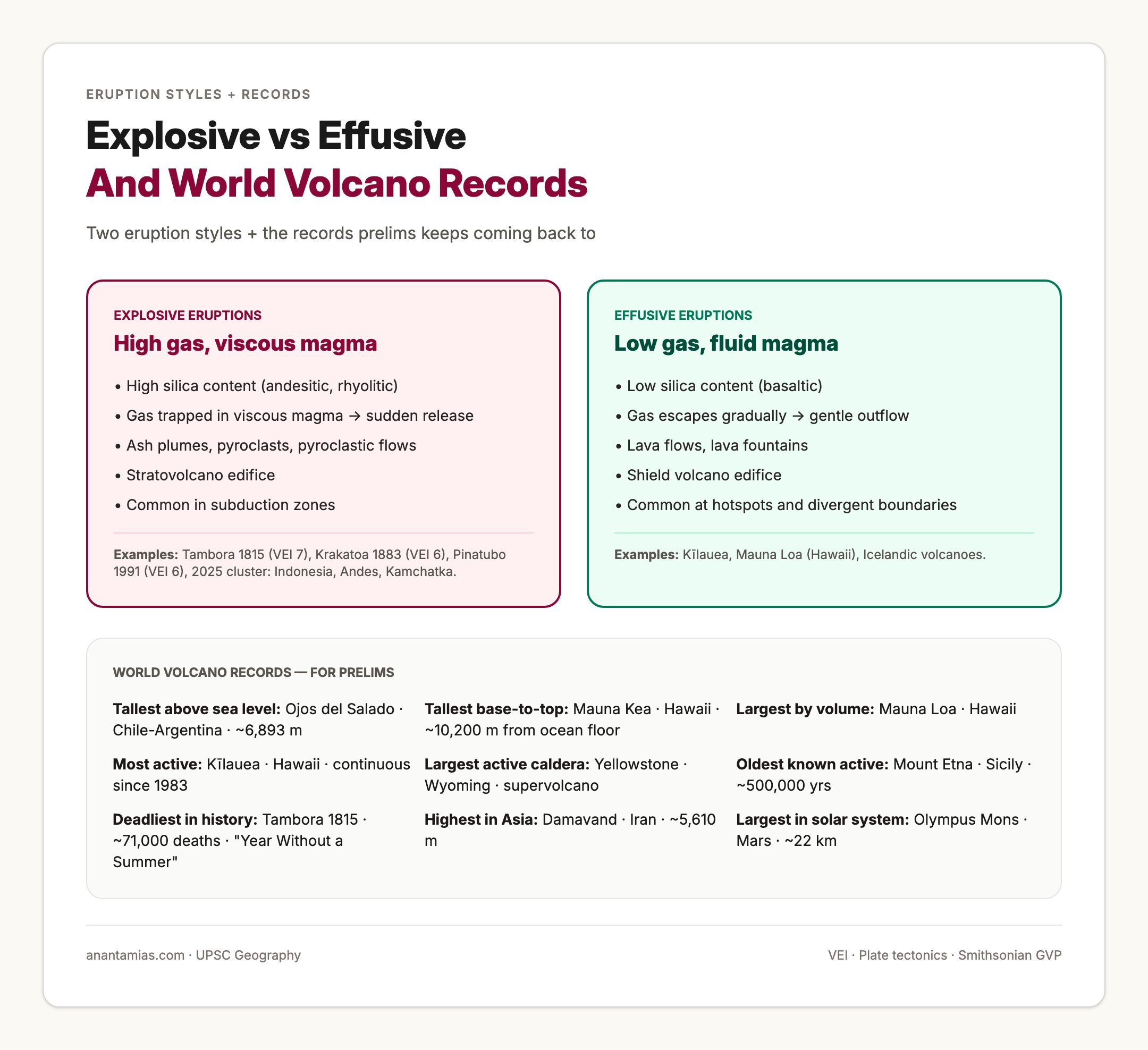
Eruptions are usually classified into two broad styles based on the magma’s gas content and viscosity. Explosive eruptions occur when high gas pressure builds up in viscous, silica-rich magma; the gas cannot escape gradually and instead blows out in a sudden release that produces ash plumes, pyroclasts, and pyroclastic flows. Subduction zones produce the classic explosive eruptions because the magma there is silica-rich and water-charged. Examples include the volcanoes of Indonesia along the Sunda subduction zone, the Andes in Peru and Chile, and Kamchatka in Russia. Effusive eruptions occur when the magma is fluid, low in silica, and low in dissolved gases. The lava flows out gently rather than exploding. Hawaii is the textbook example because the Hawaiian hotspot taps deep mantle material that emerges as runny basaltic lava.
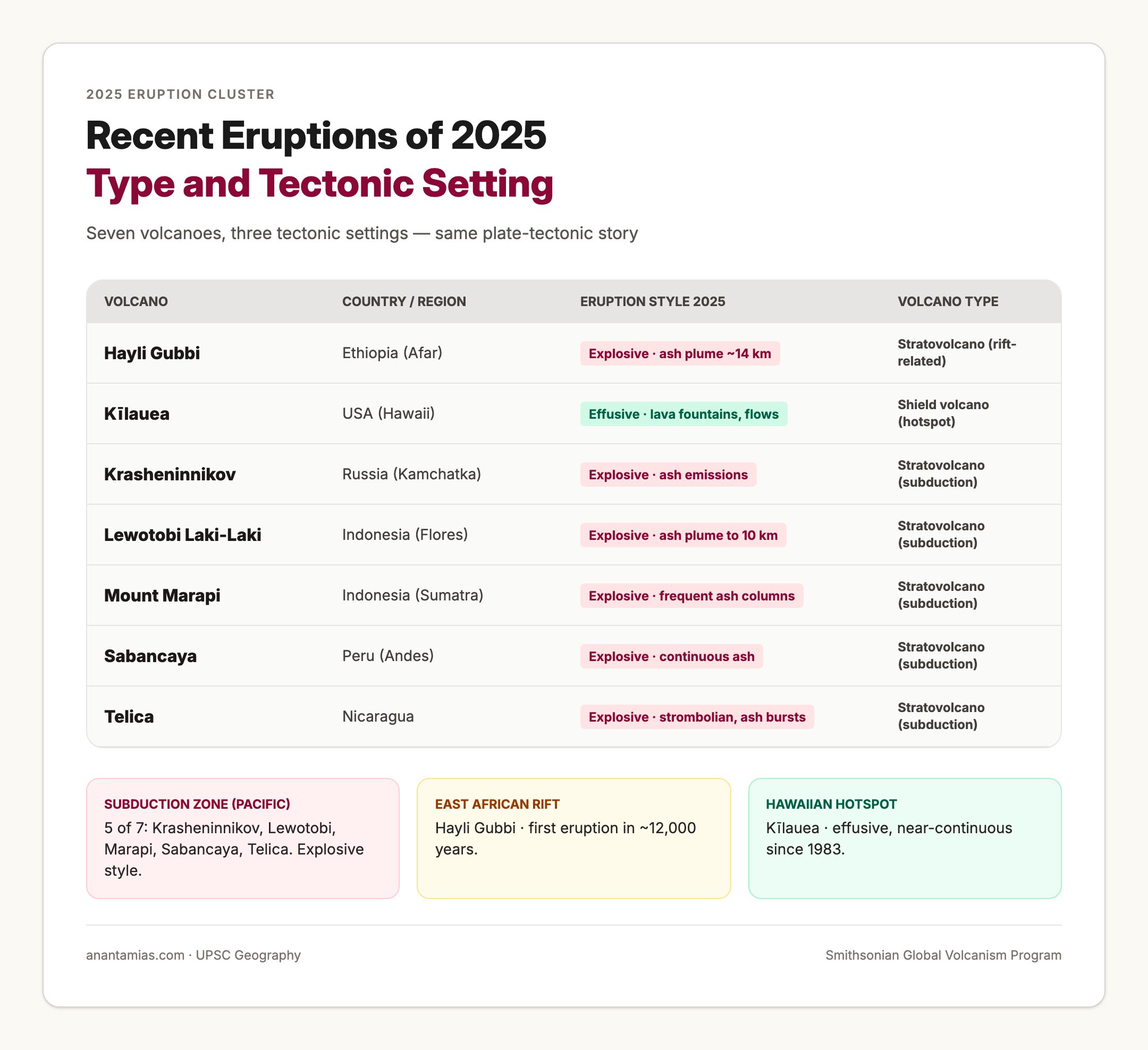
The 2025 cluster of eruptions illustrates both styles. Hayli Gubbi in Ethiopia is associated with the East African Rift, where the African continent is splitting along a divergent boundary. Krasheninnikov in Russia, Lewotobi Laki-Laki and Mount Marapi in Indonesia, Sabancaya in Peru, and Telica in Nicaragua are all stratovolcanoes along subduction zones, producing classic explosive eruptions with high-altitude ash plumes. Kilauea in Hawaii is a shield volcano on the Hawaiian hotspot, producing characteristic effusive lava fountains and flows.
Recent Volcanic Eruptions of 2025
Hayli Gubbi is a stratovolcano located in the Afar region of Ethiopia, along the East African Rift. The 2025 eruption was the first known eruption of the volcano in approximately 12,000 years and caught geologists by surprise. The eruption was explosive and produced an ash plume of around 14 kilometres in altitude. The Afar region is one of the geologically most active parts of Africa, sitting at the junction of three tectonic plates: the African, the Arabian, and the Somali. Because the eruption happened in a sparsely populated area, casualties were limited, but the ash plume disrupted aviation across parts of East Africa and the Arabian peninsula.
Kilauea on the island of Hawaii continued its near-continuous activity in 2025 with effusive lava fountains and flows. Kilauea is one of the most active volcanoes in the world and has been in nearly continuous eruption since 1983. It is a shield volcano, fed by the Hawaiian hotspot, and produces low-viscosity basaltic lava. The 2025 activity stayed within the broad pattern of effusive eruption that characterises Kilauea, with periodic episodes of fountaining at the Halemaumau crater of the Kilauea caldera.
Krasheninnikov in the Kamchatka peninsula of Russia is a stratovolcano. Its 2025 eruption produced explosive ash emissions and a sustained plume. Kamchatka is one of the most volcanically active regions on Earth, with multiple active volcanoes along the subduction zone of the Pacific Plate beneath the Okhotsk Plate.
Lewotobi Laki-Laki on the island of Flores in Indonesia is a stratovolcano. Its 2025 activity produced explosive eruptions with ash plumes reaching about 10 kilometres in altitude, with associated evacuations of nearby villages. Mount Marapi on Sumatra is another Indonesian stratovolcano that produced frequent ash columns through 2025.
Sabancaya in Peru is a stratovolcano in the Andes. It maintained continuous explosive ash eruptions through 2025, sustaining a pattern that has been ongoing for several years. Telica in Nicaragua is a small but persistent stratovolcano in Central America. It produced strombolian activity and ash bursts through the year.
Why Recent Eruptions Matter
Recent eruptions matter for three categories of reasons. The first is direct human and economic impact. Eruptions destroy property, displace populations, disrupt aviation, and trigger secondary hazards such as lahars and landslides. Indonesia’s volcanic belt sits in densely populated terrain, which means that even moderate eruptions can affect tens of thousands of people. Aviation disruption from ash plumes has economic ripple effects far beyond the immediate region; the Hayli Gubbi plume affected long-haul flight routes for several days.
The second is climatic. Large explosive eruptions inject sulphur dioxide and aerosols into the stratosphere, where they reflect incoming solar radiation and cool the surface temporarily. The Mount Tambora eruption of 1815 cooled global temperatures enough to produce the 1816 Year Without a Summer, with crop failures across Europe and North America. The Mount Pinatubo eruption of 1991 cooled global temperatures by about half a degree Celsius for nearly two years. None of the 2025 eruptions reached the scale required for such effects, but the climatic potential of larger eruptions is one of the standard topics in environment and disaster questions.
The third is scientific and tectonic. The 2025 cluster reinforces standard plate tectonic understanding. Most explosive eruptions occur along subduction zones, where one plate dives beneath another and the descending plate releases water that lowers the melting point of mantle rock. Effusive eruptions occur at hotspots and along divergent boundaries where deep mantle material can rise relatively cleanly. The Hayli Gubbi eruption in particular adds to the evidence base on the East African Rift’s volcanic activity at a time when the rift is recognised as one of the most geologically dynamic regions on the planet.
Comparative: Explosive vs Effusive Eruptions
Explosive eruptions are characterised by high gas pressure, high magma viscosity, and high silica content. The result is a sudden, violent release of energy, with ash plumes, pyroclastic flows, and tephra. Stratovolcanoes are the typical edifice. Explosive eruptions produce most of the catastrophic volcanic events in recorded history: Mount Vesuvius in 79 AD, Mount Tambora in 1815, Krakatoa in 1883, Mount Pelée in 1902, Mount Pinatubo in 1991. The Volcanic Explosivity Index (VEI) is the standard measure, scaling from VEI 0 (non-explosive) to VEI 8 (mega-colossal); Tambora was VEI 7, Pinatubo was VEI 6, and Krakatoa was VEI 6.
Effusive eruptions are characterised by low gas pressure, low magma viscosity, and low silica content. The result is gentle outflow of lava that builds broad shield volcanoes with gentle slopes. Hawaii is the global archetype, and the Icelandic volcanoes also tend toward effusive behaviour. Effusive eruptions can be hazardous through lava flows that destroy property but rarely produce immediate fatalities at the scale of explosive eruptions.
The tectonic setting predicts the eruption style. Subduction zones along the Pacific Ring of Fire host most of the explosive volcanoes. Hotspots and divergent boundaries host most of the effusive volcanoes. Continental rifts such as the East African Rift can produce both styles depending on local magma chemistry.
Notable World Volcanoes — Records to Memorise
Ojos del Salado straddles the border of Chile and Argentina in the Andes. At approximately 6,893 metres above sea level, it is the highest active volcano in the world.
Mauna Kea in Hawaii reaches about 4,205 metres above sea level but rises about 10,200 metres from the ocean floor, making it the tallest volcano on Earth measured from base to top, taller than Mount Everest by that metric. It is technically dormant rather than fully extinct.
Mauna Loa in Hawaii is the world’s largest volcano by volume. It is a shield volcano fed by the Hawaiian hotspot and is still active.
Kilauea in Hawaii is the most active volcano in the world. It has been in nearly continuous eruption since 1983.
Yellowstone Caldera in Wyoming, USA, is one of the largest active caldera systems on Earth. It is classified as a supervolcano because of the enormous size of past eruptions, although no eruption has occurred in the last several hundred thousand years.
Mount Etna in Sicily, Italy, is the oldest continuously active volcano in the world, with activity dating back about 500,000 years.
Mount Tambora in Indonesia produced the deadliest eruption in recorded history in 1815, a VEI 7 event that killed approximately 71,000 people directly and caused the 1816 Year Without a Summer through stratospheric cooling.
Damavand in Iran, at about 5,610 metres, is the highest volcano in Asia.
Olympus Mons on Mars, at about 22 kilometres high, is the largest volcano in the solar system. It is sometimes asked as a general knowledge factoid.
Challenges of Volcanic Hazard Management
Volcanic hazard management is challenging for three reasons. First, eruption prediction is imperfect. Modern monitoring through seismic networks, ground deformation sensors, gas sensors, and satellite thermal imagery has improved warning times, but the precise timing of an eruption is still hard to predict. Hayli Gubbi, dormant for 12,000 years, illustrates how a volcano can resume activity with relatively little advance warning. Second, evacuation logistics are demanding, particularly in densely populated volcanic regions such as Java in Indonesia and Naples around Mount Vesuvius. Third, secondary hazards extend the affected zone. Lahars can travel tens of kilometres downstream, ash plumes can disrupt aviation thousands of kilometres downwind, and tsunamis triggered by partial collapse of a volcanic edifice can affect distant coastlines, as the Krakatoa case in 1883 and the Anak Krakatoa flank collapse in 2018 demonstrated.
For India directly, the closest active volcano is Barren Island in the Andaman and Nicobar Islands, which is the only confirmed active volcano in South Asia. Narcondam Island, also in the Andamans, is dormant. Indian aspirants need to know both for prelims.
Prelims Pointers
Volcanism = process by which magma, gases, and other materials reach the Earth’s surface or near surface.
Materials released: lava, ash and tephra, gases (CO2, SO2, H2O vapour), pyroclastic flows (most deadly), lahars (mudflows).
Explosive eruptions: high gas pressure, viscous magma, ash plumes, pyroclasts, common in subduction zones (Indonesia, Andes, Kamchatka).
Effusive eruptions: low gas pressure, fluid basaltic lava, gentle outflow, common in Hawaii.
Hayli Gubbi (Ethiopia, Afar) erupted in 2025 after 12,000 years; stratovolcano along the East African Rift.
Krasheninnikov is in Kamchatka, Russia. Lewotobi Laki-Laki and Mount Marapi are in Indonesia. Sabancaya is in Peru. Telica is in Nicaragua. Kilauea is in Hawaii.
Ojos del Salado: tallest active volcano above sea level. Mauna Kea: tallest from base. Mauna Loa: largest by volume. Kilauea: most active. Yellowstone: largest active caldera. Etna: oldest known active volcano. Tambora: deadliest in recorded history. Damavand: highest in Asia. Olympus Mons: largest in the solar system.
India’s only active volcano: Barren Island in the Andaman and Nicobar Islands.
Mains Questions
Discuss the relationship between plate tectonics and the global distribution of active volcanoes, with reference to the recent eruptions in Ethiopia, Indonesia, and Kamchatka. (GS I, 250 words)
Examine the climatic implications of large explosive volcanic eruptions, with reference to the 1815 Mount Tambora eruption and the 1991 Mount Pinatubo eruption. (GS I and GS III, 250 words)
What are the major hazards associated with volcanic eruptions? Discuss the disaster management response required in densely populated volcanic regions. (GS III, 250 words)
Compare and contrast explosive and effusive volcanic eruptions in terms of magma composition, eruptive style, and hazards. (GS I, 150 words)
Way Forward
The way forward in volcanic hazard management has three priorities. The first is global monitoring. Programmes such as the Smithsonian Institution’s Global Volcanism Program, NASA’s volcanic emissions monitoring, and the European Space Agency’s Sentinel satellite missions need continued investment so that dormant volcanoes such as Hayli Gubbi can be tracked even in the absence of recent eruption history. The second is regional preparedness. Indonesia’s Center for Volcanology and Geological Hazard Mitigation, Japan’s volcanic warning systems, and the Philippine Institute of Volcanology and Seismology offer templates that other countries with active volcanic populations can adapt. The third is climate research. Stratospheric injection of sulphur compounds during large eruptions is one of the natural analogs for proposed solar geoengineering interventions, and rigorous study of recent moderate eruptions such as the 2022 Hunga Tonga event and the 2025 cluster will help refine the climate models that underpin both eruption forecasts and geoengineering risk assessment.
Frequently Asked Questions
What is volcanism?
Volcanism is the process by which molten rock, gases, and other materials from the Earth’s interior are brought to the surface or near the surface. The molten rock is called magma when it is below the surface and lava when it reaches the surface. Volcanism is the surface expression of the internal heat of the planet.
What materials are released during a volcanic eruption?
Volcanic eruptions release lava, ash and tephra, volcanic gases including carbon dioxide, sulphur dioxide, and water vapour, pyroclastic flows which are the most deadly volcanic hazard, and lahars which are volcanic mudflows formed when ash mixes with water.
What is the difference between explosive and effusive eruptions?
Explosive eruptions occur when magma is viscous and gas-rich. Pressure builds up until the gas blows out the magma in a sudden, violent release that produces ash plumes, pyroclasts, and pyroclastic flows. They are common in subduction zones such as Indonesia, the Andes, and Kamchatka. Effusive eruptions occur when the magma is fluid, low in silica, and low in dissolved gases. The lava flows out gently, building broad shield volcanoes. Hawaii is the textbook example.
Where is Hayli Gubbi volcano?
Hayli Gubbi is a stratovolcano located in the Afar region of Ethiopia, along the East African Rift. Its 2025 eruption was the first known eruption in approximately 12,000 years and produced an ash plume of around 14 kilometres altitude.
Which is the tallest volcano in the world?
Ojos del Salado, on the border of Chile and Argentina in the Andes, is the highest active volcano in the world above sea level at about 6,893 metres. Measured from the ocean floor to the summit, Mauna Kea in Hawaii reaches about 10,200 metres, making it the tallest volcano measured from base to top.
Which is the largest volcano in the world?
Mauna Loa in Hawaii is the world’s largest volcano by volume. It is a shield volcano fed by the Hawaiian hotspot and remains active.
Which is the most active volcano in the world?
Kilauea in Hawaii is the most active volcano in the world. It has been in near-continuous eruption since 1983.
Which volcanic eruption was the deadliest in recorded history?
The 1815 eruption of Mount Tambora in Indonesia is the deadliest in recorded history. It was a VEI 7 event that killed approximately 71,000 people directly and caused the 1816 Year Without a Summer through stratospheric cooling.
Where is the only active volcano in India?
The only active volcano in India is Barren Island in the Andaman and Nicobar Islands. Narcondam Island, also in the Andamans, is dormant.
What is the largest volcano in the solar system?
Olympus Mons on Mars is the largest known volcano in the solar system. It stands about 22 kilometres high, roughly two and a half times the height of Mount Everest above sea level.
Tell Google you want more of this.
Add Anantam IAS as a preferred sourceOne tap, and this site shows up more often in your own Top Stories, AI Overviews and AI Mode. Remove it any time.