Here’s the question that catches almost everyone. The Moon goes around the Earth once a month, and once every month it passes between us and the Sun. So why isn’t there a solar eclipse every month? If you’ve never had a good answer to that, you don’t yet have the mechanism, and without the mechanism the four types of eclipse are just four words to memorise.
The answer is a tilt of about five degrees, and it explains why eclipses are rare, why they arrive in seasons rather than randomly, and why they repeat on an eighteen-year rhythm the Babylonians worked out without knowing what a shadow was made of. Start with the geometry, and everything else, including the reason you must never look at the Sun, falls straight out of it.
What a solar eclipse actually is, and the two shadows that make it
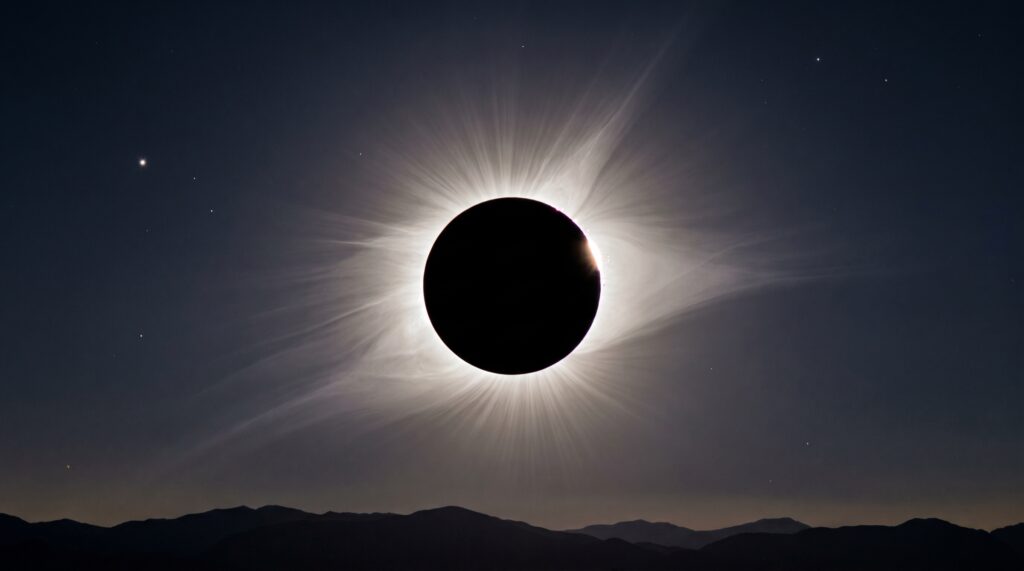
A solar eclipse happens when the Moon passes directly between the Sun and the Earth and drops its shadow on us. That’s it. Nothing is happening to the Sun; something small and close is temporarily standing in front of something huge and far. It can only occur at new moon, the phase when the Moon sits on the Sun’s side of the Earth with its lit face turned away from us.
The shadow has two parts, and the distinction does all the work. The umbra is the dark inner cone where the Moon blocks the Sun completely, and it’s small: by the time it reaches the ground it’s typically a patch 100 to 160 km wide, at most about 267 km. The penumbra is the vast fuzzy outer shadow where the Moon covers only part of the Sun, and it can span thousands of kilometres. Stand in the umbra and you get totality. Stand in the penumbra, which is nearly everyone, and you get a partial eclipse, the Sun with a bite taken out of it.
Hold your thumb up and cover a distant streetlight. Move your head a few centimetres and the light reappears. That’s the umbra: a narrow tube of full blockage that you have to be standing inside. It’s the reason a total eclipse is a local event and not a global one, and the reason people fly across continents to reach a strip of land 150 km wide.
That strip is called the path of totality, and it doesn’t sit still. The Moon’s shadow races eastward across the Earth’s surface at a minimum of about 1,700 km/h near the equator and faster at higher latitudes, which is why totality at any one spot lasts only a few minutes. The theoretical ceiling is 7 minutes 32 seconds. Most total eclipses give you two to three. And because the path is narrow and the Earth is mostly water, any given place on land sees totality roughly once every 375 years on average. That’s the real reason so few people have seen one.
The 400 coincidence that makes totality possible at all
Totality exists because of an accident of scale that has no physical reason to be true. The Sun’s diameter is about 1.39 million km and the Moon’s is about 3,475 km, so the Sun is roughly 400 times wider. The Sun also sits about 149.6 million km away while the Moon orbits at about 384,400 km, so the Sun is roughly 400 times farther. Those two 400s cancel.
Work the arithmetic yourself, because the coincidence is worth feeling rather than reading. Apparent size in the sky depends on real size divided by distance. Divide 1.39 million by 149.6 million and divide 3,475 by 384,400, and you get almost the same number. Both objects subtend about half a degree, roughly the width of your little fingernail at arm’s length. A body 400 times smaller, standing 400 times closer, covers the larger one almost exactly.
Sit with how strange that is. Nothing in physics required it. Had the Moon been a little smaller or farther, we’d get a permanent ring of sunlight and would never have seen the Sun’s outer atmosphere from the ground. A little bigger or closer, and it would swamp that atmosphere entirely.
It’s also temporary. The Moon is receding from the Earth at about 3.8 cm a year, measured by bouncing lasers off reflectors left on the surface. In roughly 600 million years it’ll be too far away to cover the Sun at all, and total eclipses will stop. We’re living inside a window.
The four types of solar eclipse, and what decides which one you get
There are four types, and one variable explains all of them: how big the Moon looks compared with the Sun at that moment, which depends on where the Moon sits in its orbit and where you’re standing.
The Moon’s orbit isn’t a circle. It’s an ellipse, so the Moon swings between perigee, about 356,500 km away, and apogee, about 406,700 km. That 14% swing in distance changes its apparent size by enough to matter. Near perigee the Moon looks slightly bigger than the Sun and can cover it completely. Near apogee it looks slightly smaller, and it can’t. When the Moon is too small to cover the Sun, the umbra’s tip doesn’t reach the ground. What reaches the ground instead is the antumbra, the region beyond the cone’s point, and from inside it you see the Sun’s edge sticking out all the way around: an annular eclipse, the ring of fire.
| Type | What causes it | What you see | Safe to look without a filter? |
|---|---|---|---|
| Total | Moon near perigee, and you are standing inside the umbra | The Sun completely covered; the corona appears; darkness for up to about 7 minutes | Only during totality itself |
| Partial | You are in the penumbra, outside the central path | A crescent Sun; daylight barely dims | Never |
| Annular | Moon near apogee, so it looks too small to cover the Sun; you stand in the antumbra | A bright ring of sunlight around a black disc | Never, at any stage |
| Hybrid | Earth’s curvature: the umbra tip reaches the ground mid-path but falls short at the ends | Annular near the ends of the path, total in the middle | Only during totality, in the total segment |
The hybrid deserves a second look because it exposes a fact people forget: the Earth is round, and so the ground isn’t at a fixed distance from the Moon. At the middle of the path you’re standing on the bulge, a few thousand kilometres closer to the Moon than someone near the path’s end. If the umbra tip lands right at that margin, the eclipse begins annular, turns total as the shadow crosses the bulge, and goes annular again. Hybrids are genuinely rare. Of the 224 solar eclipses in this century, NASA’s catalogue counts 77 partial, 72 annular, 68 total and just 7 hybrid, so hybrids are about 3% of the total.
Two more terms worth having, because they arrive in the last seconds before totality. Baily’s beads are the broken points of sunlight that shine through valleys on the Moon’s edge as the last sliver disappears. When one bead outlives the rest, you get the diamond ring. Both are your cue that totality is starting, and, as the safety section explains, they’re also the exact moment the rules change.
Why there isn’t an eclipse every new moon
Because the Moon’s orbit is tilted by about 5 degrees to the plane of the Earth’s orbit around the Sun, so at most new moons the Moon’s shadow passes above or below the Earth entirely and hits nothing.
Picture two hoops, not lying flat together but slightly crossed. The Earth’s orbital plane is the ecliptic; the Moon’s plane cuts through it at an angle. Two hoops crossed like that meet at exactly two points, and those points are the nodes. An eclipse needs the Sun, Moon and Earth in a line, so the new moon has to fall at or very near a node. Any other new moon and the shadow misses. Five degrees sounds small, but at the Moon’s distance it’s about 33,000 km of miss, more than twice the Earth’s diameter.
So eclipses come in eclipse seasons. Twice a year, as the Earth goes round the Sun, the line joining the nodes points at the Sun, opening a window of roughly 34 days when eclipses are possible. Since a new moon comes every 29.53 days, at least one solar eclipse must fall inside each window. That’s why there are never fewer than two solar eclipses a year, and never more than five.
Now the elegant part, and the reason this section matters more than the types do. The nodes don’t stay put: they drift slowly backwards along the ecliptic, which drags the eclipse seasons about 19 days earlier each year, so successive seasons come 173.3 days apart rather than every six months exactly.
Three cycles are running at once here: the phases (29.53 days), the return to a node (27.21 days), and the perigee-to-perigee cycle (27.55 days). They share no neat common multiple, but they nearly do. Every 6,585.3 days, which is 18 years, 11 days and 8 hours, all three come back into almost the same arrangement and a near-identical eclipse repeats. That’s the Saros cycle, and Babylonian astronomers had it in cuneiform centuries before anyone knew the Moon was a rock.
Now notice the extra 8 hours, because that’s the detail that makes Saros concrete. In eight hours the Earth turns a third of the way round, so the next eclipse in the same series lands about 120 degrees of longitude west of the last one. Wait three Saros cycles, about 54 years and a month, and the Earth has turned a full extra rotation, bringing the eclipse back to roughly your part of the world. The Greeks called that triple the exeligmos. So an eclipse isn’t random, and it isn’t quite periodic either. It’s three clocks that almost agree.
What totality reveals, and the experiment that made Einstein famous
Totality is worth all this geometry because it’s the only time the Sun’s atmosphere is visible from the ground. The corona, the pearly halo that appears the instant the disc vanishes, is about a million times fainter than the Sun’s surface, so ordinary daylight drowns it completely. Block the disc and it appears.
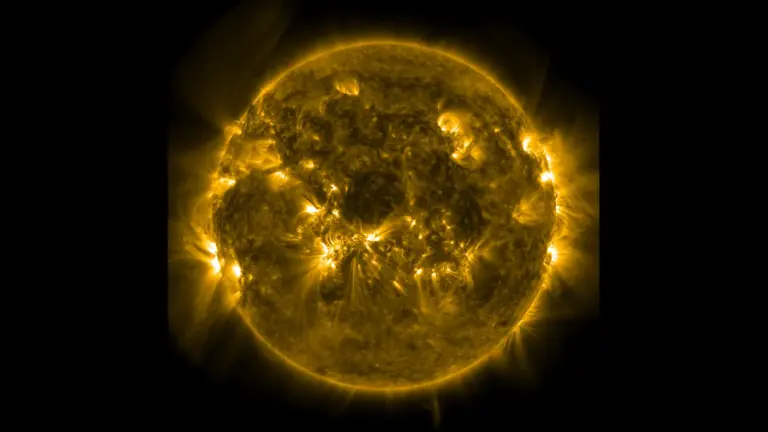
The corona is also the biggest unsolved thing about the Sun in plain sight. The visible surface, the photosphere, runs at about 5,500 °C. The corona above it reaches one to three million °C. Heat isn’t supposed to flow from the cooler thing to the hotter thing, so something other than simple heat transfer is dumping energy up there, most likely magnetic. That’s the coronal heating problem, still open, and it’s the same machinery that drives a solar storm and the eleven-year rhythm of the solar cycle. Eclipse science isn’t a curiosity; it’s how we learned to read the layer that produces space weather.
Eclipses have delivered two results that changed physics, and one of them was recorded from India. During the total eclipse of 18 August 1868, observed from Guntur in present-day Andhra Pradesh, the French astronomer Jules Janssen found a yellow spectral line in the solar prominences that matched no element known on Earth. Norman Lockyer and Edward Frankland named the new element helium, after Helios. An element was discovered in the Sun 27 years before it was found in the ground, and an eclipse over the Krishna delta is why.
The second is the famous one. Einstein’s general relativity predicted that mass bends spacetime, so starlight grazing the Sun should be deflected by 1.75 arcseconds, exactly twice what Newtonian physics allowed. You can’t see stars next to the Sun. Unless the Sun goes out. On 29 May 1919, British teams under Arthur Eddington at Príncipe off West Africa and at Sobral in Brazil photographed the star field around the eclipsed Sun and compared it with the same stars at night. The stars had shifted, by roughly the Einstein figure. The announcement on 6 November 1919 turned a Bern patent clerk into the most famous scientist alive, and it’s the ancestor of every later test of relativity, including the detection of gravitational waves.
We no longer have to wait for the Moon. A coronagraph makes an artificial eclipse with a small occulting disc inside a telescope, which is exactly what the VELC instrument on ISRO’s Aditya-L1 does from its halo orbit around the Sun-Earth L1 point, studying the corona continuously instead of for three minutes a year.
How to watch a solar eclipse without damaging your eyes
Never look directly at the Sun without a certified solar filter, at any stage of a partial or annular eclipse, and never through any optical device without a filter fitted over the front of it. This is the one section where getting it approximately right isn’t good enough, so here it is exactly.
The danger is solar retinopathy, and the reason it catches people is that it doesn’t hurt. Your retina has no pain receptors. Focused sunlight cooks the light-sensitive cells at the back of the eye photochemically, and you feel nothing while it happens. The symptoms, a blurred or blank patch in the centre of your vision, often show up hours later, once the damage is done. It can be permanent, and there’s no treatment that reliably reverses it. During an eclipse the risk goes up rather than down, because the sky dims enough that your pupils open wide and your blink reflex relaxes while a lethal sliver of photosphere is still shining.
What actually works:
- ISO 12312-2 certified eclipse glasses or handheld solar viewers. These transmit about 1 part in 100,000 of the sunlight. Through a real pair you should see nothing at all indoors except a very bright lamp filament. Check the filter for scratches, pinholes or separation from the frame before every use, and discard damaged ones.
- Welder’s glass of shade 14 or darker. Shade 12 is borderline and shade 10, the common one, is not safe.
- Pinhole projection, the cheapest and safest method there is. Punch a small hole in a card, hold it up with your back to the Sun, and let the light fall on a second card in the shade. You’ll see a crescent Sun projected. You look at the projection, never through the hole. A kitchen colander does it dozens of times over, and so does the gap between overlapping leaves, which is why the ground under a tree fills with crescents during a partial eclipse.
- A telescope, binoculars or camera with a purpose-made solar filter mounted over the front objective, never over the eyepiece.
What does not work, whatever anyone tells you: ordinary sunglasses, several pairs stacked, polarising filters, smoked glass, exposed photographic film, X-ray film, CDs and DVDs, mylar food packaging, or a bucket of water. None of them cut the infrared and ultraviolet reliably, and several of them dim the visible glare just enough to stop you flinching while the damage continues.
The most dangerous mistake is a combination. Never look through binoculars, a telescope or a camera viewfinder while wearing eclipse glasses. The optics gather sunlight from a wide aperture and concentrate it; that beam melts the filter in front of your eye in an instant and then keeps going. The filter belongs on the sky end of the instrument, always.
There’s exactly one exception, and it’s narrow. During the total phase, and only while the Sun’s disc is 100% covered, you may look with the naked eye. That’s the only way to see the corona, and it’s the whole point of standing there. Put the filter back on the instant the first Baily’s bead or the diamond ring appears, and don’t wait for it to look bright, because it will hurt before it looks dangerous. This exception applies to nothing else. An annular eclipse never has a safe moment, because a ring of photosphere is shining the entire time, and neither does any partial phase, however thin the crescent looks.
How a solar eclipse differs from a lunar eclipse
The two are not mirror images, and the differences all trace to which body is casting the shadow and which is catching it.
| Solar eclipse | Lunar eclipse | |
|---|---|---|
| What is shadowed | The Earth (the Moon’s shadow falls on us) | The Moon (the Earth’s shadow falls on it) |
| Moon phase | New moon | Full moon |
| Who can see it | A narrow path, typically 100 to 160 km wide | Everyone on the night side of the Earth |
| Duration of totality | Minutes; 7 min 32 s at the theoretical maximum | Up to about 1 hour 47 minutes |
| Appearance | The Sun is blotted out; the corona appears | The Moon turns coppery red |
| Eye safety | Filters mandatory except during totality | Completely safe with the naked eye |
The red moon is worth one line of explanation, because it’s the same physics as a sunset. Inside the Earth’s umbra the Moon isn’t fully dark, since our atmosphere refracts a little sunlight around the edge of the planet and onto it. That light has crossed a long slant of air, which scatters the blue out of it, so what arrives is red. You’re watching every sunrise and sunset on Earth at once, projected onto a rock 384,000 km away.
The lopsided visibility is why lunar eclipses feel common and solar ones feel rare, even though solar eclipses are slightly more frequent. Half the planet catches a lunar eclipse at once. A solar eclipse hands totality to a strip of ground the width of a district.
How to study this
Learn it as one chain, not six lists, because a chain reconstructs itself under pressure and a list doesn’t. The chain runs: the Moon’s 5-degree tilt means alignment needs a node, which creates eclipse seasons twice a year, which is why you get 2 to 5 solar eclipses a year rather than twelve; the 400-and-400 coincidence makes the discs nearly equal, and where the Moon sits between perigee and apogee then decides total versus annular, with hybrid as the curvature edge case and partial as what the penumbra gives everyone else. Every question sits on one of those links.
Three traps eat marks. First, an annular eclipse is caused by the Moon being too far away, not by imperfect alignment; the alignment is fine, the apparent size isn’t. Second, don’t say eclipses are rare because alignments are rare. Alignments happen monthly. What’s rare is an alignment at a node. Third, keep umbra, penumbra and antumbra straight: total, partial, annular in that order, and the antumbra is the one beyond the cone’s tip.
Two contrasts finish the job. Set the solar eclipse against the lunar for phase, safety and reach. Set the eclipse against the coronagraph on Aditya-L1, which does artificially and continuously what the Moon does naturally for three minutes, and you’ve connected classical geometry to India’s current space programme. And if you’re revising the Sun’s structure alongside this, the corona is the outermost layer of a perfectly ordinary main-sequence star, which is where the life cycle of a star picks the thread up.
Frequently Asked Questions
What is a solar eclipse?
It’s what happens when the Moon passes directly between the Sun and the Earth and casts its shadow on us, blocking the Sun partly or completely. It can only occur at new moon, and it lasts minutes because the Moon’s shadow sweeps across the Earth at over 1,700 km/h.
Why don’t we get a solar eclipse every new moon?
Because the Moon’s orbit is tilted about 5 degrees to the Earth’s orbital plane, so at most new moons its shadow passes above or below the Earth and misses entirely. An eclipse needs the new moon to fall near a node, one of the two points where the two orbital planes cross.
What is the difference between a total and an annular eclipse?
It comes down to the Moon’s distance. Near perigee the Moon looks slightly larger than the Sun and covers it completely, giving totality. Near apogee it looks slightly smaller, so a bright ring of the Sun remains visible all the way around, which is the annular or ring of fire eclipse.
What is a hybrid solar eclipse?
It’s an eclipse that shifts between annular and total along its own path, because the Earth’s curvature puts the middle of the path closer to the Moon than the ends. The umbra tip reaches the ground mid-path but falls short near the ends. Only about 7 of this century’s 224 solar eclipses are hybrid.
What is the Saros cycle?
It’s the 6,585.3-day period, 18 years, 11 days and 8 hours, after which the Sun, Moon and nodes return to nearly the same alignment and a very similar eclipse repeats. The extra 8 hours shift each repeat about 120 degrees of longitude west, so it takes three Saros cycles, about 54 years, to come back to the same region.
Why is the Sun about 400 times the Moon’s size but they look equal?
Because the Sun is also about 400 times farther away. The Sun is roughly 1.39 million km wide at 149.6 million km, and the Moon is about 3,475 km wide at 384,400 km, so both cover about half a degree of sky. That coincidence is the only reason totality exists.
Is it ever safe to look at a solar eclipse without eye protection?
Only during the total phase of a total eclipse, while the Sun’s disc is completely covered, and you must look away or refit the filter the instant the first bead of sunlight reappears. Partial phases and annular eclipses are never safe to view without an ISO 12312-2 filter, because a sliver or ring of the Sun’s surface is still shining.
Why does an eclipse damage your eyes when you feel nothing?
The retina has no pain receptors, so focused sunlight burns the light-sensitive cells without any sensation. This is solar retinopathy, and the blurred or blank central patch it causes often appears hours later and can be permanent. The dimmed sky during an eclipse makes it worse by widening your pupils and relaxing your blink reflex.
Practice Questions
1. A solar eclipse can occur only when the Moon is at:
a) Full moon
b) New moon
c) First quarter
d) Any phase, provided it is near perigee
Answer: b
2. An annular solar eclipse occurs because:
a) The alignment of the Sun, Moon and Earth is imperfect
b) The Moon is near apogee and appears too small to cover the Sun’s disc
c) The Earth is at perihelion
d) Clouds scatter the umbra
Answer: b
3. Solar eclipses do not occur every month because:
a) The Moon’s orbit is inclined about 5 degrees to the ecliptic, so alignment must occur near a node
b) The Moon rotates on its axis
c) The Earth’s axis is tilted 23.5 degrees
d) The Moon is moving away from the Earth
Answer: a
4. The Saros cycle is best described as:
a) The 11-year cycle of sunspot activity
b) A period of about 18 years 11 days after which a near-identical eclipse recurs
c) The time the Moon takes to complete one orbit of the Earth
d) The interval between two consecutive new moons
Answer: b
5. Which of the following is a safe way to observe a partial solar eclipse?
a) Two pairs of sunglasses worn together
b) Looking through binoculars while wearing eclipse glasses
c) Pinhole projection onto a screen
d) Viewing the reflection in exposed X-ray film
Answer: c
Mains-style questions
1. Explain the geometry of a solar eclipse, distinguishing between the umbra, penumbra and antumbra, and relate each to a type of eclipse. 2. “Eclipse seasons, not months, govern eclipses.” Discuss with reference to the inclination of the Moon’s orbit and the role of nodes. 3. Examine the scientific value of total solar eclipses, with reference to the study of the solar corona and the 1919 test of general relativity. 4. Compare solar and lunar eclipses in terms of geometry, visibility, duration and viewing safety. 5. Discuss how space-based coronagraphs such as the instrument aboard Aditya-L1 have altered the scientific dependence on natural eclipses.
The temptation with eclipses is to treat them as spectacle, learn the four types as a list, and move on. But the list is the least interesting thing here. What’s worth carrying is that a five-degree tilt is why we don’t see one every month, that a 400-to-400 accident of scale is the only reason the corona has ever been visible from the ground, and that the whole arrangement is a window closing at 3.8 cm a year. Two of the biggest results in physics, an element found in the Sun before it was found on Earth and the bending of starlight by gravity, came out of the few minutes when the Moon happens to fit. Understand why it fits, and the eclipse stops being a phenomenon and becomes an argument about geometry, one you can rebuild from first principles even if you forget every number in it.
Tell Google you want more of this.
Add Anantam IAS as a preferred sourceOne tap, and this site shows up more often in your own Top Stories, AI Overviews and AI Mode. Remove it any time.