

India generates roughly 62 million tonnes of solid waste every year, projected to rise to 165 MT by 2030 and beyond. Around 70% is collected, but only 12 MT is treated before disposal, with the rest dumped in legacy landfills — Ghazipur in Delhi alone holds over 14 million tonnes, taller than the Qutub Minar. For UPSC, solid waste management cuts across urban governance, environmental pollution, public health, and climate — and increasingly intersects with the circular economy and Extended Producer Responsibility (EPR) frameworks.
The scale of the problem
| Metric | Value |
|---|---|
| Annual waste generation | 62 MT (TERI) |
| Projected 2030 generation | 165 MT (CPCB) |
| Collection rate | ~70% |
| Treated before disposal | ~25% of what is collected |
| Untreated waste in dumpyards | ~31 MT/year |
| Plastic waste generation | ~3.5 MT/year |
| E-waste (2023) | ~1.75 MT |
India's per-capita waste (~450 g/day) is still lower than OECD averages but rising rapidly with urbanisation and consumption.
Why waste is growing
- Population and urbanisation — India's urban population is forecast to cross 600 million by 2030.
- Rising per-capita consumption — single-use packaging, fast fashion.
- Shorter product lifecycles — planned obsolescence in electronics.
- Seasonal surges — agricultural waste at harvest, yard waste in spring, tourism-linked waste at pilgrim sites.
- Poor enforcement of segregation norms.
Legal and institutional framework
| Rule / Act | Role |
|---|---|
| Environment (Protection) Act, 1986 | Umbrella law |
| Solid Waste Management Rules, 2016 | Core SWM framework (replaced MSW Rules 2000) |
| Plastic Waste Management Rules, 2016 (amended 2022, 2024) | EPR for plastics |
| E-Waste Management Rules, 2022 | EPR for electronics |
| Bio-Medical Waste Management Rules, 2016 | Healthcare waste |
| Construction & Demolition Waste Rules, 2016 | C&D waste |
| Hazardous Waste Rules, 2016 | Toxic waste |
| Battery Waste Management Rules, 2022 | End-of-life batteries |
Solid Waste Management Rules, 2016 — salient features
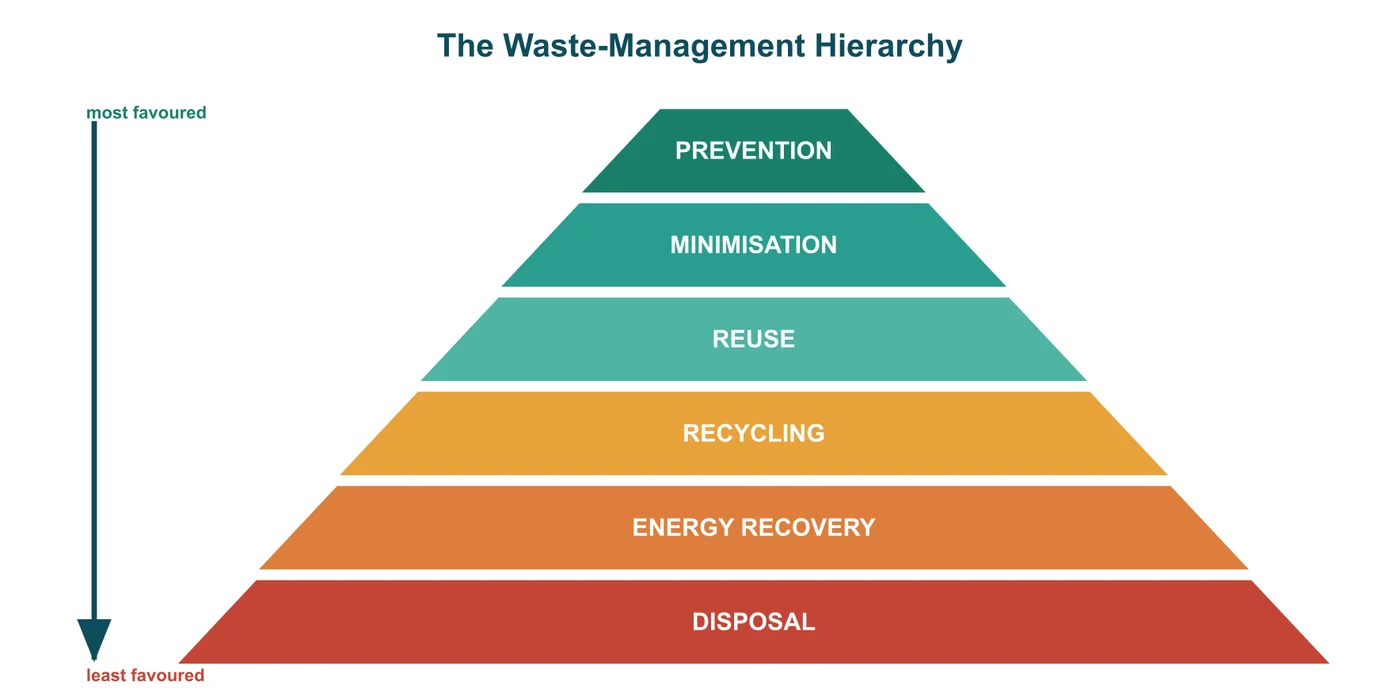
1. Expanded applicability
The Rules apply beyond municipal areas to urban agglomerations, census towns, notified industrial townships, areas under Indian Railways, airports, airbases, ports and harbours, defence establishments, SEZs, Central/State government establishments, and places of pilgrimage.
2. Mandatory source segregation
Waste generators must segregate into three streams:
- Wet (biodegradable) — kitchen, garden.
- Dry (recyclable) — plastic, paper, metal, wood.
- Domestic hazardous — diapers, sanitary napkins, empty pesticide containers.
3. Generator responsibility
- Pay a User Fee for collection.
- Spot Fine for littering and non-segregation.
- Handover segregated waste to authorised rag pickers, waste collectors, or ULBs.
4. Bulk and institutional generators
Hotels, restaurants, event organisers, market associations, and housing societies (>5,000 sq m or generating >100 kg/day) must:
- Segregate and sort their waste on site.
- Process biodegradable waste via composting / bio-methanation on-site as far as possible.
- Partner with ULBs for residual waste.
5. Integration of informal sector
- Rag pickers, Kabadiwalas, waste dealers to be integrated into the formal system.
- SHGs, cooperatives, or other groups constituted for this purpose.
6. Special provisions
- Hilly areas — no landfills on hill slopes; transfer stations set up with sanitary landfills within 25 km in plains.
- SEZs/industrial estates — must earmark 5% of plot area or minimum 5 plots for recovery/recycling facilities.
- Street vendors — required to carry suitable waste-storage containers.
Plastic Waste Management Rules, 2022 — EPR shift
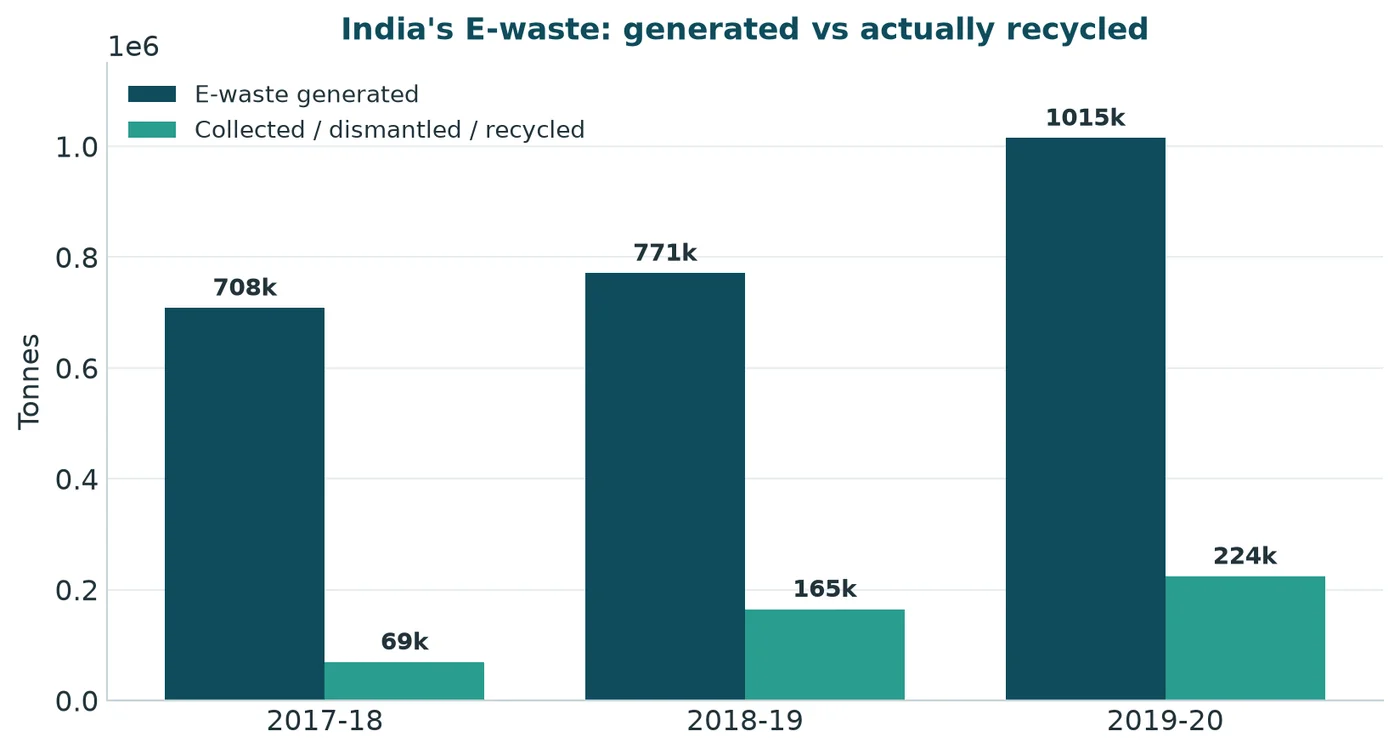
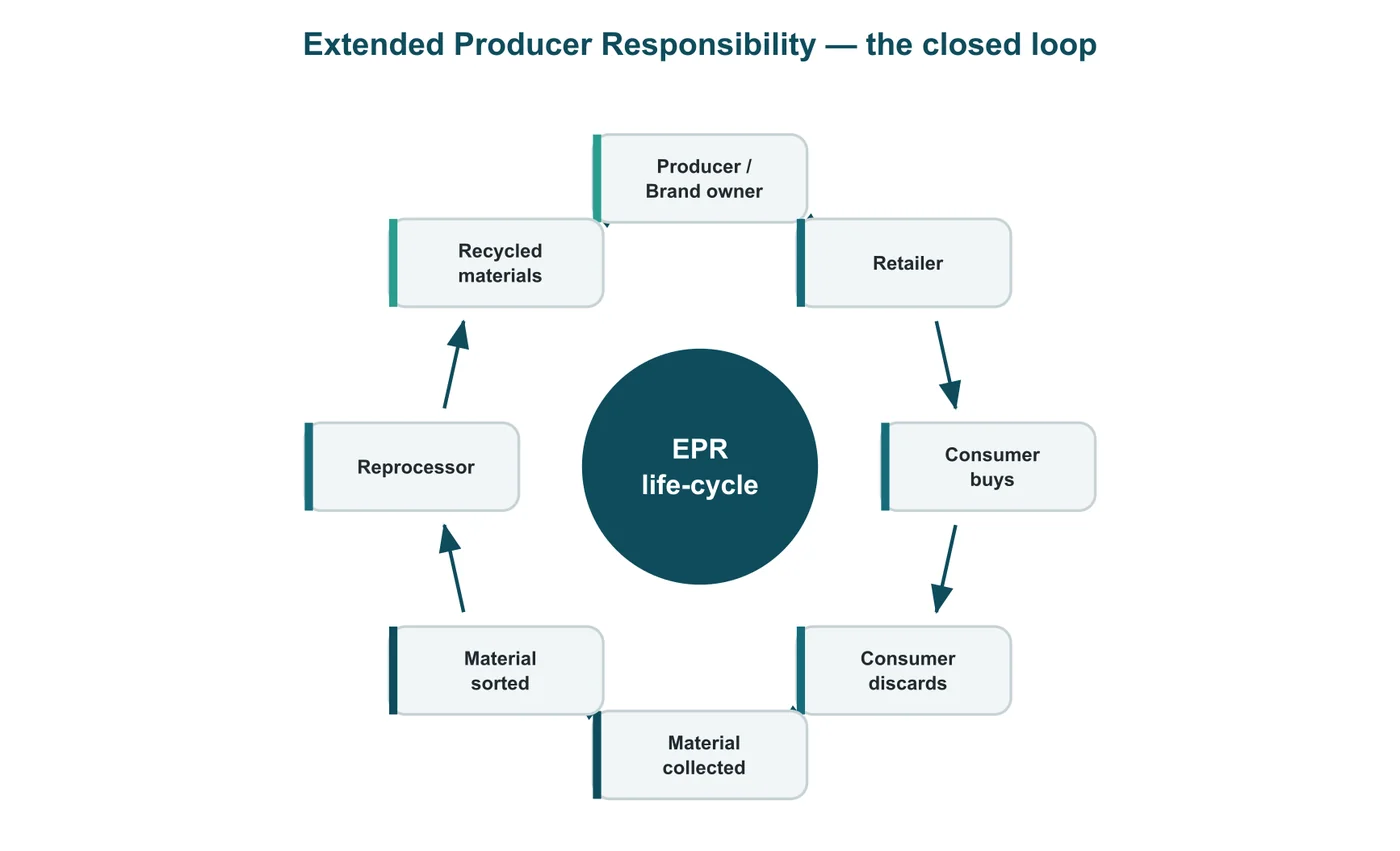
- Extended Producer Responsibility (EPR) codified — producers, importers, and brand-owners must ensure environmentally sound recycling of plastic they put on the market.
- Single-use plastic ban (July 2022) — 19 items banned (plates, cups, straws, cutlery, earbuds, etc.).
- EPR portal — centralised compliance.
- Plastic Credits — tradable certificates within categories (Cat I–IV).
E-Waste Management Rules, 2022
- EPR for 100+ categories of EEE.
- Refurbishment and recycling obligations on producers.
- CPCB as national authority.
Major challenges
- Low segregation at source — few cities have reached 80%+.
- Landfill crisis — legacy dumps at Ghazipur, Bhalswa, Okhla (Delhi); Deonar (Mumbai); Perungudi (Chennai).
- Weak municipal capacity — most ULBs under-staffed, under-funded.
- Informal sector vulnerability — 1.5-4 million waste pickers work without protection.
- Changing composition — e-waste, PV waste, battery waste growing.
- Waste-to-energy plants — environmental concerns and financial unviability.
- Methane emissions — from dumpyards contribute to India's GHG footprint.
Best practices and models
- Indore (Madhya Pradesh) — ranked cleanest city seven times in a row (Swachh Survekshan). 100% segregation at source, 100% door-to-door collection, decentralised composting.
- Alappuzha (Kerala) — decentralised processing, pipe composting.
- Surat (Gujarat) — modern integrated SWM with reliable ULB capacity.
- Ambikapur (Chhattisgarh) — SHG-led, zero-landfill model.
Latest developments (2024–26)
Updated context: check specific figures in Swachh Survekshan 2024 and CPCB annual reports.
- Swachh Bharat Mission 2.0 (SBM-U 2.0) — focus on legacy waste remediation, source segregation, and circular economy; extended to 2026.
- GOBARdhan — converting organic waste to bio-gas / CBG.
- National Mission for Circular Economy under NITI Aayog.
- Plastic Waste EPR Rules amendments 2024 — tightening credit trading; imported plastic limits.
- Battery Waste Rules 2022 — full implementation underway; EV battery circular economy push.
- COP29 methane commitments — landfill methane reduction targets.
- Extended producer liability for textile waste — under discussion.
UPSC relevance
GS-III mapping
- Conservation, environmental pollution and degradation.
- Urban issues (GS-II overlap).
Prelims bullets
- SWM Rules 2016 mandate three-stream segregation.
- Bulk generators: housing societies >5,000 sq m or producing >100 kg/day of waste.
- EPR — Extended Producer Responsibility.
- Swachh Survekshan — annual cleanliness ranking by MoHUA.
- Indore — cleanest city seven times.
- Single-use plastic ban — July 2022.
- CPCB — Central Pollution Control Board; under MoEFCC.
Mains angles
- "Evaluate the effectiveness of Solid Waste Management Rules 2016 in addressing India's urban waste crisis."
- "Discuss the role of Extended Producer Responsibility in creating a circular economy in India."
- "Legacy waste in Indian landfills is both an environmental and climate concern. Suggest a roadmap."
Essay hooks
- Circular economy as climate solution.
- Urbanisation and the crisis of commons.
- Swachh Bharat — beyond construction of toilets.
Quick revision
| Stream | Example | Fate |
|---|---|---|
| Wet | Kitchen waste | Compost / biomethanation |
| Dry | Plastic, paper | Recycle / EPR |
| Domestic hazardous | Diapers, sanitary waste | Segregated disposal |
| C&D | Concrete, bricks | C&D plants |
| E-waste | Electronics | EPR/formal recycling |
| Bio-medical | Hospital waste | Incineration/autoclaving |
Solid waste management is no longer a municipal-housekeeping issue; it is an environmental, climate, and public-health front. For UPSC, the clearest framing is: India's waste problem is a governance problem — segregation, EPR, and circular economy offer the architecture; implementation at the ULB level is the bottleneck.
Tell Google you want more of this.
Add Anantam IAS as a preferred sourceOne tap, and this site shows up more often in your own Top Stories, AI Overviews and AI Mode. Remove it any time.






