Ask most people how tall the Statue of Unity is and you will hear “very tall” or “taller than the Statue of Liberty.” Both are true and both miss the scale. At 182 metres, it is roughly twice the height of New York’s Statue of Liberty measured statue-to-statue, and it held the title of the world’s tallest statue on the day it opened. For an aspirant, though, the height is the least interesting thing about it. The statue is a compact case study that ties together modern history, engineering, tourism economics and the politics of memory, and examiners have noticed.
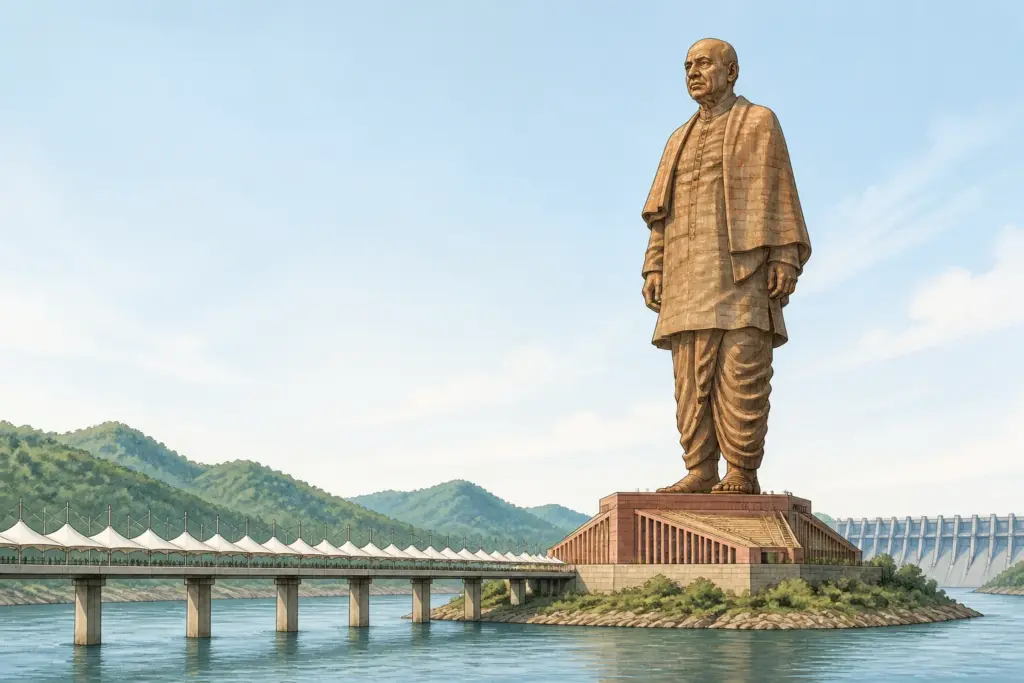
The Statue of Unity is a 182-metre statue of Sardar Vallabhbhai Patel, India’s first Deputy Prime Minister and Home Minister, standing on the Narmada river in Gujarat, facing the Sardar Sarovar Dam. It was inaugurated on 31 October 2018, Patel’s 143rd birth anniversary, and it remains the tallest statue on Earth. What follows is the full picture: who it honours, where it stands, how it was built, and what the surrounding Ekta Nagar has become.
Who the statue honours: Sardar Patel and national integration
The statue exists to memorialise one specific achievement: the integration of India. When the British left in 1947, they left behind not one country but a patchwork of British provinces and more than 560 princely states, each of which technically had the option to stay independent or join Pakistan. Had even a fraction chosen independence, the map of India would have been a chessboard of enclaves. As Home Minister and head of the States Department, working alongside civil servant V.P. Menon, Sardar Vallabhbhai Patel persuaded, pressured and occasionally forced these states to accede to the Indian Union, largely without war. That work of stitching a nation together is why he is remembered as the Iron Man of India, and why the monument is called the Statue of Unity rather than the Statue of Patel.
The theme of unity is not decoration; it is the organising idea. The statue was conceived as the centrepiece of what the government frames as a tribute to national integration, and its inauguration date doubles as Rashtriya Ekta Diwas (National Unity Day), observed every 31 October to mark Patel’s birth. If you understand the statue purely as a big sculpture, you have missed its purpose. It is an argument in bronze about how India was held together, and about who deserves credit for it. For the fuller life and legacy, our dedicated notes on Sardar Vallabhbhai Patel, the Iron Man of India, cover the Bardoli Satyagraha and the accession story, while the ethics-focused profile of Patel draws out the administrative integrity that GS IV papers keep returning to.
The scale of what Patel managed becomes clearer through the hard cases, and those are worth carrying as examples. Most princely states signed the Instrument of Accession quietly, but three refused and each was resolved differently. Junagadh, a Hindu-majority state whose ruler acceded to Pakistan, was brought into India after a plebiscite in 1948 confirmed the popular will. Hyderabad, the largest and richest princely state, held out under the Nizam until the Indian Army moved in through Operation Polo in September 1948 and integrated it in a matter of days. Kashmir acceded to India after a tribal invasion from Pakistan in October 1947, an accession whose consequences are still being worked out. Patel handled the first two directly; the point of the statue is that this messy, high-stakes process, carried out in barely a year, produced the single political entity we now take for granted.
The idea of welding many units into one nation-state is not unique to India, and the comparison is worth carrying into an answer. The nineteenth-century unification of Germany and Italy was achieved largely through war and diplomacy over decades; India’s integration of the princely states was achieved in a matter of months, mostly through negotiation. That contrast is a ready-made point whenever a question links Indian and world history.
Where it stands: Narmada, Sadhu Bet and the Sardar Sarovar Dam
The statue rises from a small river island called Sadhu Bet, on the Narmada in the Kevadia area of Narmada district, Gujarat, and it faces the Sardar Sarovar Dam a short distance downstream. The location is not accidental. Sardar Sarovar is one of the largest dams on the Narmada and the terminal dam of the vast Narmada Valley Development Project, and placing Patel’s statue directly before it links the man who unified India to a piece of nation-building infrastructure that irrigates and powers four states. The visual line from statue to dam is the whole point: political unity looking out over economic development.
Getting the geography right matters for Prelims. The Narmada is one of India’s major west-flowing rivers, rising at Amarkantak in Madhya Pradesh and draining into the Arabian Sea through the Gulf of Khambhat, and it flows through a rift valley between the Vindhya and Satpura ranges. The Sardar Sarovar Dam sits near the Gujarat-Maharashtra-Madhya Pradesh tri-junction and has long been at the centre of debates over displacement and rehabilitation, the very issues the Narmada Bachao Andolan raised for decades. Any serious treatment of the site has to hold both truths: the dam is an engineering achievement and it displaced large numbers of people, many of them Adivasi, which is why the wider question of tribal displacement and forest rights in India sits so close to this monument.
It helps to place Sardar Sarovar in the company it keeps. India’s large dams each carry a distinct profile, and knowing them as a set is how aspirants avoid mixing them up.
| Dam | River | State(s) | Note |
|---|---|---|---|
| Sardar Sarovar | Narmada | Gujarat | Faces the Statue of Unity; serves four states |
| Bhakra Nangal | Sutlej | Himachal Pradesh/Punjab | One of India’s highest gravity dams |
| Hirakud | Mahanadi | Odisha | Among the longest dams in the world |
| Tehri | Bhagirathi | Uttarakhand | India’s tallest dam |
How it was built: the engineering behind 182 metres
The Statue of Unity is a feat of engineering, not just sculpture, and the numbers make the point. It stands 182 metres tall, a height reportedly chosen to echo the 182 seats in the Gujarat legislative assembly. It was designed by the celebrated Indian sculptor Ram V. Sutar, whose studio shaped the likeness of Patel down to the folds of his dhoti, and it was constructed by the engineering major Larsen & Toubro (L&T) at a cost of roughly ₹2,989 crore. Construction ran over several years and the statue was completed and opened in October 2018.
Structurally, the statue is not solid metal. It has a core of reinforced cement concrete surrounded by structural steel framing, and over that skeleton hangs an outer skin of bronze cladding, assembled from panels cast to Sutar’s design. This layered approach, a concrete-and-steel core inside a bronze shell, is what lets a figure this tall stand against wind and earthquakes. The design was engineered to withstand high wind speeds and seismic activity, using a damping system to control sway, the same principle that keeps tall towers steady. A viewing gallery built into the chest at a height of around 153 metres lets visitors look out over the Narmada valley and the Sardar Sarovar Dam, and it can hold a couple of hundred people at a time.
One detail captures the symbolism the project leaned on. In the run-up to construction, the government ran a nationwide campaign inviting farmers to donate iron from used agricultural implements, the idea being that the tools of India’s farmers would be melted into the foundation of a statue to the man who championed the peasants of Bardoli. The collected iron was largely symbolic rather than the bulk building material, but the campaign folded the whole country into the monument’s story, which was always as much about narrative as about metal.
Building at this height threw up problems that a normal statue never faces. Wind loading rises sharply the taller a structure goes, so the engineers had to model how the figure would behave in gusts and design the internal framing to resist swaying without cracking the bronze skin. The bronze panels themselves were cast in sections, some in China where large-scale bronze casting capacity was available, then assembled on site over the steel-and-concrete core, a logistics exercise as much as an artistic one. Lifts were built inside the structure to carry visitors up to the chest-level gallery, turning the statue into an occupiable building rather than a sealed monument. These are the kinds of specifics that separate a candidate who has understood the project from one who has only memorised its height.
For scale, it helps to rank it against the statues it overtook. The Statue of Unity is more than twice the height of the Spring Temple Buddha in China, which was the previous record holder, and it dwarfs the Statue of Liberty, whose figure is about 46 metres tall, or roughly 93 metres including its pedestal. When you tell someone the Statue of Unity is 182 metres, you are describing something in a different league from the monuments most people picture.
Ekta Nagar: from Kevadia to a planned tourism town
The area around the statue, once known as Kevadia, was renamed Ekta Nagar in 2021, and it has been developed into a full tourism circuit rather than a single attraction. This is the part of the story that turns a monument into an economic and governance case study. Around the statue the government built a cluster of attractions designed to hold visitors for days rather than hours: a Valley of Flowers (Bharat Van) along the riverbank, a Jungle Safari wildlife park, a Cactus Garden and Butterfly Garden, a Children’s Nutrition Park, the Ekta Nursery, a riverfront, boating on the reservoir, and a tent city for accommodation. A dedicated railway station, Ekta Nagar, and improved road and air links were added to move tourists in.
The stated logic is straightforward: build an anchor attraction, surround it with reasons to stay, and let tourism generate jobs and income in a district that had few. The statue has drawn very large visitor numbers since opening, running into millions of tourists across its first years and on many days outpacing footfall at far older global landmarks, which the government has repeatedly cited as proof that heritage tourism can be an engine of local development. Connectivity was engineered to match the ambition. A dedicated Ekta Nagar railway station links the site to the national network, road access was upgraded from the nearest cities of Vadodara and Bharuch, and a nearby airstrip and helicopter service were developed so that visitors could reach a once-remote riverside within hours. The point of this infrastructure push is that an attraction is only as valuable as the ease of getting to it, and the state treated access as part of the product rather than an afterthought.
That is the optimistic reading, and it has real force. The more critical reading notes that the land and rehabilitation questions tied to the Sardar Sarovar project never fully went away, and that a planned tourism town raises hard questions about who benefits and who is displaced. A good answer holds both: Ekta Nagar is a genuine model of destination-led tourism development and a live example of the tensions such development carries.
There is a governance angle worth flagging too. Ekta Nagar has been promoted as a model of clean, planned, sustainable tourism infrastructure, with electric buses, tree cover and waste management built in from the start. Whether it lives up to that billing is a fair thing to probe, but the ambition itself, to build a new kind of tourist town around a memorial, is what makes it more than a photo stop.
The criticism the project attracted is part of its exam value, not a distraction from it. Two lines of objection recur. The first is about priorities: spending close to ₹3,000 crore on a statue in a country with pressing needs in health and education struck many as misplaced, and the counter-argument, that the tourism revenue and jobs pay the investment back over time, is exactly the kind of trade-off a Mains answer is meant to weigh rather than dodge. The second is about the people already living on the land. Villages in the Kevadia cluster raised concerns that development around the statue affected their rights and access, echoing the older grievances of those displaced by the Sardar Sarovar Dam itself. A balanced answer does not pick a side reflexively; it acknowledges that a project can be a genuine development success and still owe a debt to the communities in its shadow. Holding those two facts together is what marks maturity of thought to an examiner.
How to use this topic in the exam
Treat the Statue of Unity as a hub, not a fact. On its own, “world’s tallest statue, 182 metres, Sardar Patel, Gujarat” is a one-mark Prelims fact and nothing more. Its real value is as a link between topics you are already studying, and that is how you should file it in your notes.
For Prelims, lock down the hard facts and guard against the common traps: 182 metres, on the Narmada at Sadhu Bet near the Sardar Sarovar Dam, in Narmada district of Gujarat, inaugurated 31 October 2018, designed by Ram V. Sutar, built by L&T, and remembered through Rashtriya Ekta Diwas on 31 October. Do not confuse the Narmada with an east-flowing river; it flows west to the Arabian Sea. Do not place it on any river other than the Narmada.
For Mains and interviews, use it to bridge subjects. It connects to modern history through Patel and the integration of the princely states, to geography through the Narmada and the family of Indian dams, to the society and environment papers through displacement and Adivasi rehabilitation, and to the economy through tourism-led development. If a question asks about heritage tourism as a development strategy, about commemorating freedom fighters, or about the integration of India, the Statue of Unity is a ready, specific example that most candidates will mention only in passing and few will use with real depth. The candidate who can say where it stands, why the location matters, what it cost, and what tensions it carries is the one who stands out. That, and not the height, is the whole point of learning it properly.
Frequently Asked Questions
How tall is the Statue of Unity and is it still the world’s tallest statue?
It stands 182 metres tall, and it remains the tallest statue in the world. That is more than twice the height of the Spring Temple Buddha in China, the previous record holder, and far taller than the Statue of Liberty, whose figure is about 46 metres.
Whom does the Statue of Unity honour?
It honours Sardar Vallabhbhai Patel, India’s first Deputy Prime Minister and Home Minister, who integrated more than 560 princely states into the Indian Union after 1947. He is remembered as the Iron Man of India, and the statue’s name reflects his role in unifying the country.
Where exactly is the Statue of Unity located?
It stands on Sadhu Bet, a small island on the Narmada river, in the Kevadia area, now Ekta Nagar, of Narmada district in Gujarat. It faces the Sardar Sarovar Dam a short distance downstream.
When was the Statue of Unity inaugurated?
It was inaugurated on 31 October 2018, the 143rd birth anniversary of Sardar Patel. That date is observed every year as Rashtriya Ekta Diwas, or National Unity Day.
Who designed and built the Statue of Unity?
It was designed by the Indian sculptor Ram V. Sutar and constructed by the engineering firm Larsen & Toubro (L&T), at a cost of roughly ₹2,989 crore. The statue has a reinforced concrete and steel core clad in an outer skin of bronze.
What is Ekta Nagar?
Ekta Nagar is the renamed Kevadia area around the statue, developed into a tourism town with attractions such as the Valley of Flowers, a Jungle Safari, a Cactus Garden, a Children’s Nutrition Park, a riverfront and a tent city, along with its own railway station. It is promoted as a model of planned, sustainable tourism development.
Why is the statue built facing the Sardar Sarovar Dam?
The location links the man who unified India to a major piece of nation-building infrastructure. The Sardar Sarovar Dam is the terminal dam of the Narmada Valley Development Project and serves four states, so placing Patel’s statue before it visually connects political unity to economic development.
Practice Questions
1. The Statue of Unity is a memorial to which leader?
a) Jawaharlal Nehru
b) Sardar Vallabhbhai Patel
c) Mahatma Gandhi
d) B.R. Ambedkar
Answer: b
2. On which river does the Statue of Unity stand?
a) Tapti
b) Mahi
c) Narmada
d) Sabarmati
Answer: c
3. The Statue of Unity was inaugurated on 31 October, a date observed as:
a) National Integration Day
b) Rashtriya Ekta Diwas
c) Constitution Day
d) National Voters’ Day
Answer: b
- Consider the following statements about the Statue of Unity:
- At 182 metres it is the tallest statue in the world.
- It stands facing the Sardar Sarovar Dam on the Narmada.
Which is/are correct?
a) 1 only
b) 2 only
c) Both 1 and 2
d) Neither 1 nor 2
Answer: c
5. The area around the Statue of Unity, formerly Kevadia, was renamed:
a) Sardar Nagar
b) Narmada Nagar
c) Ekta Nagar
d) Unity City
Answer: c
Mains-style questions
- The Statue of Unity commemorates Sardar Patel’s integration of the princely states. Discuss the significance of that integration for the making of modern India.
- Evaluate the Statue of Unity and the Ekta Nagar development as a model of heritage and destination-led tourism, weighing its economic gains against the questions of displacement it raises.
- Compare the integration of India’s princely states after 1947 with the nineteenth-century unification of Germany and Italy, bringing out the differences in method and pace.
- Large infrastructure and memorial projects on the Narmada have long carried debates over displacement and rehabilitation. Examine these tensions with reference to the Sardar Sarovar project and its surroundings.
- “A monument is an argument about memory, not merely a work of engineering.” Critically discuss with reference to the Statue of Unity.
Tell Google you want more of this.
Add Anantam IAS as a preferred sourceOne tap, and this site shows up more often in your own Top Stories, AI Overviews and AI Mode. Remove it any time.