
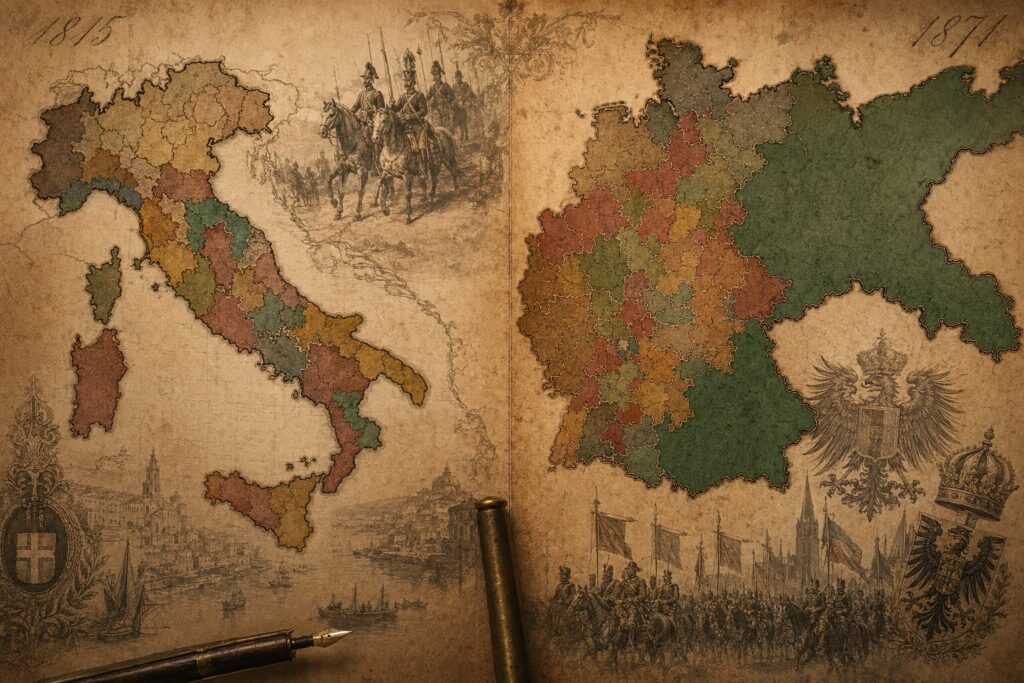
The unification of Germany and Italy in the 19th century is one of UPSC’s most-tested World History topics. Two ethnic and linguistic communities that had not existed as unified states in the modern era — fragmented for centuries into kingdoms, duchies, papal territories, and city-states — became the dominant powers of continental Europe within a single decade. Italy was unified between 1859 and 1870; Germany was unified between 1864 and 1871. By 1871 the European balance of power, fixed at the Congress of Vienna in 1815, had been turned upside down. The nation-state had become the defining political unit of the modern world, and the seeds of two World Wars had been quietly planted.
UPSC examiners return to this topic regularly because it pulls together nationalism, Realpolitik, diplomacy, military strategy, the role of leadership, and long-run consequences in a single narrative. This guide walks you through the unification of Germany and Italy with leader-by-leader profiles, three Bismarck wars, the Italian Risorgimento, a clean comparison table, the link to India’s freedom struggle, and a 250-word answer scaffold that has consistently scored well in our classroom evaluations.
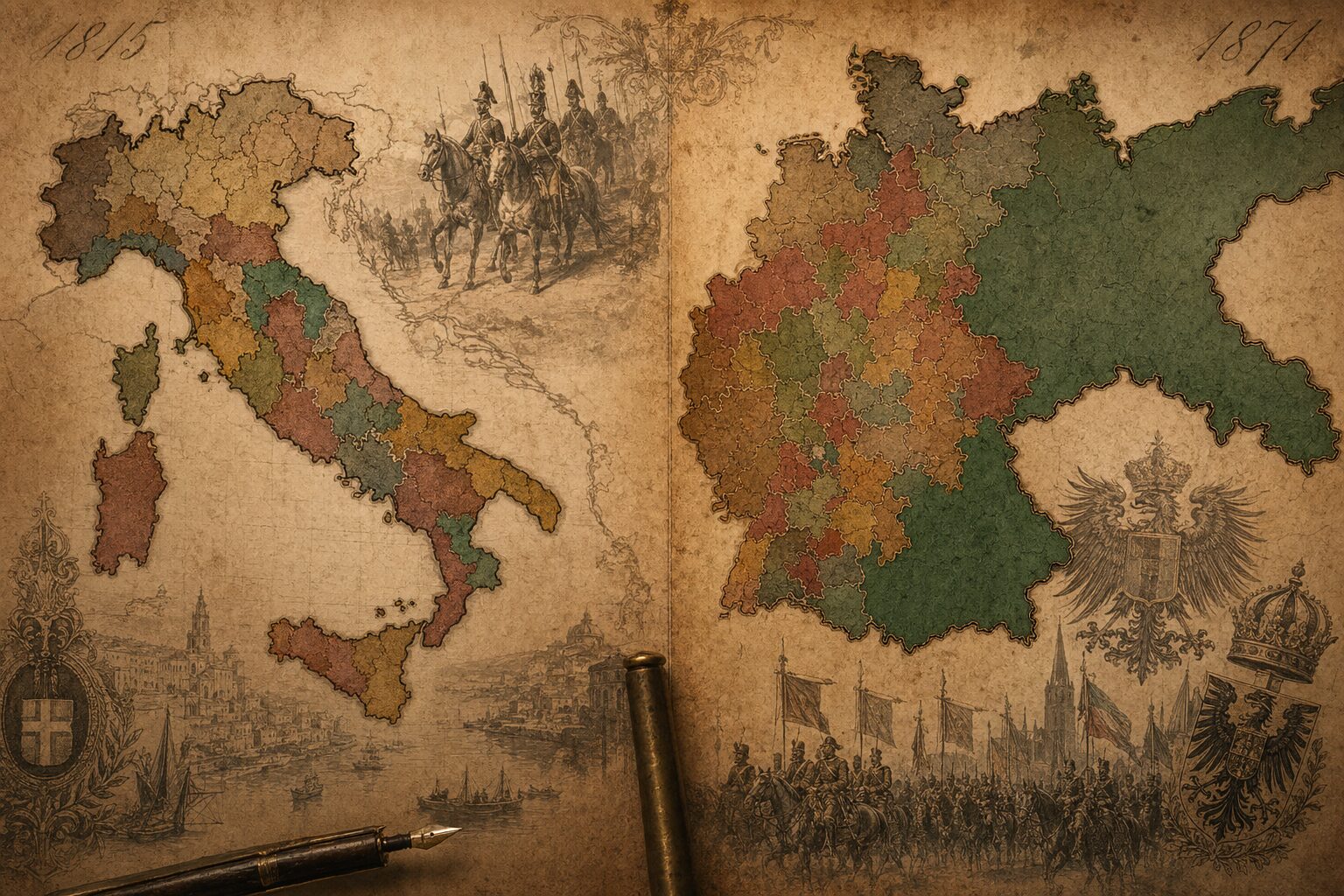
Quick facts: unification of Germany and Italy at a glance
| Parameter | Italy | Germany |
|---|---|---|
| Period | 1859–1870 | 1864–1871 |
| Pre-unification fragmentation | 7+ states under Austrian, Bourbon, and Papal control | 39 states in the German Confederation |
| Architects | Mazzini, Cavour, Garibaldi | Bismarck, Moltke, Wilhelm I |
| Method | Diplomacy + popular uprising + guerrilla campaigns | Realpolitik, three calculated wars |
| Leading state | Piedmont-Sardinia (Turin) | Prussia (Berlin) |
| Founding monarch | Victor Emmanuel II | Wilhelm I |
| Capital | Rome (from 1871) | Berlin |
| Final form | Constitutional monarchy | Federal empire under Prussian dominance |
The post-Napoleonic context: the Congress of Vienna, 1815
The unification story does not begin in 1859. It begins in 1815, in a Vienna ballroom, where the victors of the Napoleonic Wars met to redraw Europe. The Congress of Vienna, presided over by the Austrian Chancellor Klemens von Metternich, set out to restore the pre-revolutionary order on three principles.
- Legitimacy: the old dynasties displaced by Napoleon were restored to their thrones, even where their populations did not want them back.
- Balance of power: no single state should ever again dominate Europe as Napoleonic France had done.
- Compensation: territorial adjustments rewarded the victors and punished the losers.
For Italy, the Congress confirmed fragmentation: Lombardy and Venetia under Austria, the Papal States in the centre, the Bourbon Kingdom of the Two Sicilies in the south, and a clutch of duchies in the north. For Germany, it created the German Confederation, a loose grouping of 39 states under Austrian leadership, with no central government, no common army, and no shared parliament. Metternich’s system held the lid on for three decades, but the ideas the French Revolution and the Napoleonic era had unleashed — popular sovereignty, constitutional government, national self-determination — could not be wished away.
The Revolutions of 1848 tested the system from Sicily to Berlin and from Paris to Vienna. The revolutions failed, but they trained a generation of nationalists and exposed the fragility of restoration politics. The unification of Germany and Italy is, in a real sense, the long sequel to 1848.
Italian unification (the Risorgimento): three leaders, three methods
Italian unification is best understood through the partnership and tension between three very different men whose efforts converged at the right moment.
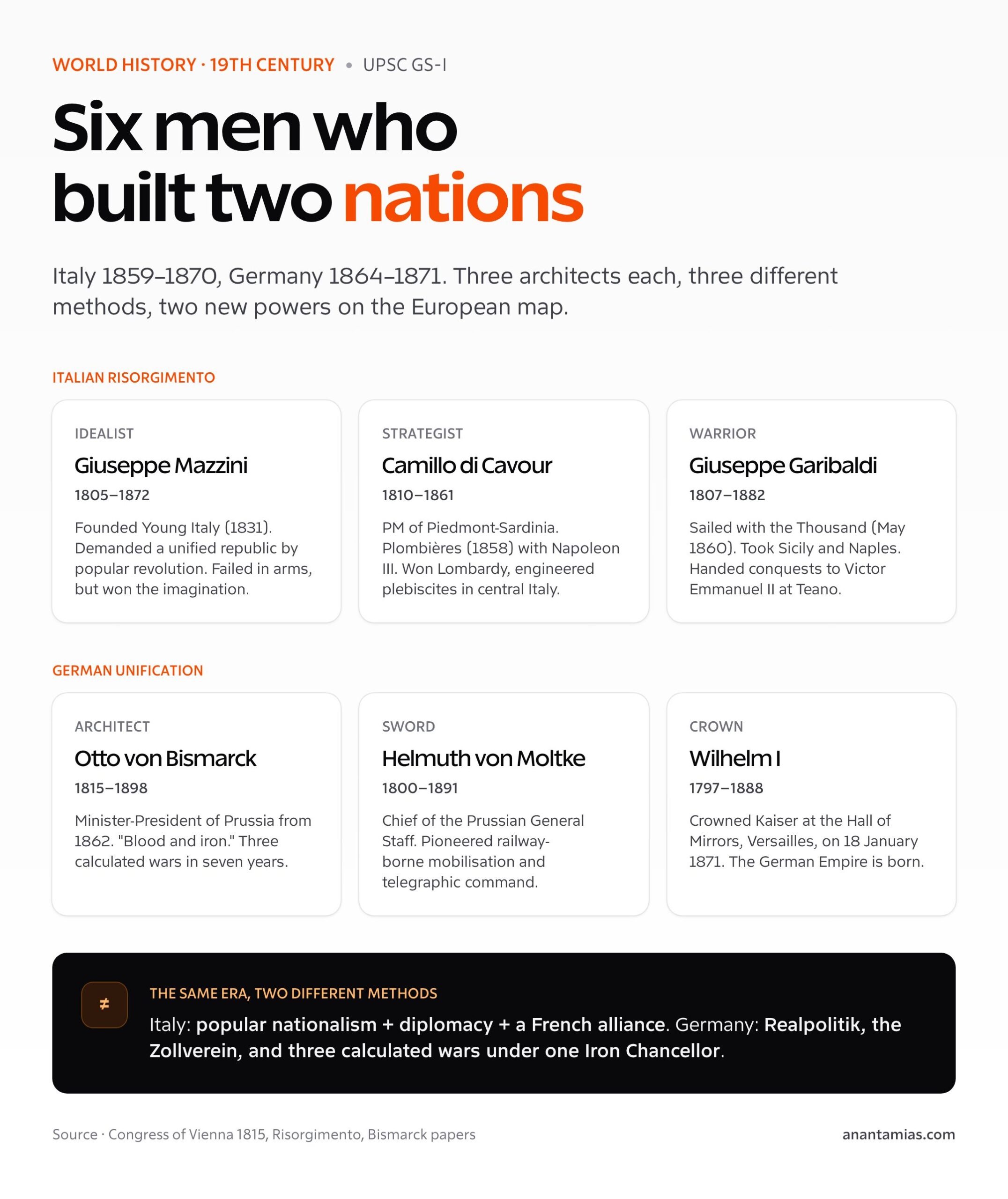
Giuseppe Mazzini: the idealist
Giuseppe Mazzini (1805–1872) was the prophet of Italian nationalism. Exiled at twenty-six, he founded Young Italy (Giovine Italia) in 1831 with a clear and uncompromising programme: a unified Italian republic achieved by popular insurrection, free of foreign rule, and inspired by a moral vision of national mission.
Mazzini’s contribution was ideological rather than territorial. His writings — addressed to “the working men of Italy” rather than to princes or armies — built the intellectual foundation of the Risorgimento. He failed in arms repeatedly: the 1834 Savoy expedition collapsed, the 1849 Roman Republic was crushed by French troops sent by Louis-Napoleon. But his ideas radicalised a generation. Without Mazzini, the diplomatic and military victories of Cavour and Garibaldi would have had no popular soil to land on.
Count Camillo di Cavour: the strategist
Count Camillo di Cavour (1810–1861), Prime Minister of Piedmont-Sardinia from 1852, was the actual architect of Italian unification. Cavour was no romantic. He was a master of Realpolitik — using diplomacy, alliances, economic reform, and calculated warfare to expand Piedmontese power and, almost incidentally, to unify Italy.
- Crimean War (1854–56): Cavour sent a small Piedmontese expeditionary force to fight alongside Britain and France against Russia. Piedmont won no territory, but it won a seat at the Paris peace conference and the goodwill of Napoleon III.
- Plombières Agreement (July 1858): in a secret meeting at the French spa town, Cavour and Napoleon III agreed that France would help Piedmont expel Austria from Lombardy and Venetia in exchange for Nice and Savoy.
- Franco-Austrian War (1859): a deliberately provoked Austrian declaration triggered the war. Piedmontese and French forces won at Magenta and Solferino. Cavour gained Lombardy. Napoleon III withdrew before Venetia could be taken — but Cavour quickly engineered plebiscites in Parma, Modena, Tuscany, and Romagna, which voted overwhelmingly to join Piedmont-Sardinia.
A common student error is to treat Cavour as a pan-Italian nationalist. He was not. His original aim was a strong North Italian kingdom under Piedmontese leadership, and a unified Italy “from the Alps to Sicily” only became plausible because of Garibaldi’s intervention in the south.
Giuseppe Garibaldi: the warrior
Giuseppe Garibaldi (1807–1882) was the romantic hero of the Risorgimento. A republican by conviction, a guerrilla fighter by training (he had fought in South America for Uruguayan and Brazilian republics), Garibaldi was the man who turned a North Italian project into a national one.
- May 1860: Garibaldi sailed from Genoa with his “Thousand” (I Mille) — a volunteer force in red shirts — and landed at Marsala in Sicily.
- July 1860: Sicily fell after the Battle of Calatafimi and the campaign of Palermo.
- September 1860: Garibaldi marched into Naples without a battle. The Bourbon Kingdom of the Two Sicilies collapsed.
- October 1860: Cavour, terrified that Garibaldi would either attack the Papal States and provoke French intervention or proclaim a southern republic, sent Piedmontese troops south. Garibaldi met King Victor Emmanuel II at Teano and quietly handed over his conquests.
Teano was not a defeat. It was a deliberate sacrifice. Garibaldi chose national unity over republican ideology, and accepted monarchy as the only available vehicle for unification. The pattern — idealist providing fuel, strategist providing direction, warrior providing reach — is one of the cleanest examples of leadership division in modern history.
Stages of Italian unification: a timeline
- 1815: Congress of Vienna confirms Italian fragmentation.
- 1820–21, 1830–31: Mazzini-influenced Carbonari uprisings; all fail.
- 1848: revolutions sweep Italy. Roman Republic and Venetian Republic proclaimed; both crushed by 1849.
- 1858: Plombières Agreement between Cavour and Napoleon III.
- 1859: Franco-Austrian War; Piedmont gains Lombardy. Plebiscites bring central Italy into Piedmont.
- 1860: Garibaldi’s Thousand take Sicily and Naples; Teano handover.
- 17 March 1861: Kingdom of Italy proclaimed, with Victor Emmanuel II as king. Cavour dies in June.
- 1866: Italy gains Venetia after siding with Prussia in the Austro-Prussian War.
- 1870: French troops withdraw from Rome during the Franco-Prussian War. Italian forces enter Rome on 20 September.
- 1871: Rome becomes the capital of the Kingdom of Italy.
German unification: blood, iron, and the Zollverein
If Italian unification was a convergence of idealism, diplomacy, and guerrilla warfare, German unification was an exercise in calculated state power directed by one man. Otto von Bismarck turned the German question into a Prussian project, and the Prussian project into a continental empire.
The Zollverein: economic foundation, 1834
Long before politics, economics had begun to unify Germany. The Zollverein (customs union) was established under Prussian leadership in 1834. By the 1860s, 25 of the 39 German states were members, with internal tariffs eliminated and a common external tariff. The Zollverein achieved three quietly decisive things.
- It built economic interdependence among German states, making political fragmentation increasingly costly.
- It centred the German economy on Prussia, while Austria — pointedly excluded — slipped to the periphery.
- It demonstrated to merchants, bankers, industrialists, and railway builders that unification would mean prosperity.
By the time Bismarck took office, the German bourgeoisie was already half-unified by the goods that crossed those abolished frontiers. The economic-first model of unification would later be studied carefully by post-colonial states.
Bismarck and Realpolitik
Otto von Bismarck became Minister-President of Prussia in 1862. His first speech to the Prussian Diet’s budget commission set the tone: “The great questions of the day will not be decided by speeches and majority votes — that was the great mistake of 1848 and 1849 — but by blood and iron.“
Bismarck was not an ideological nationalist. He was a Prussian conservative who saw German unification as the means to expand Prussian power, contain liberalism, and outflank Austria. His method was disciplined and almost mathematical: isolate each opponent diplomatically, then defeat them militarily, then convert the defeated into a useful future ally. This is the Realpolitik that UPSC examiners want you to define and apply.
Two men carried out the violence behind the strategy. Helmuth von Moltke, Chief of the Prussian General Staff, pioneered railway-borne mobilisation, telegraphic command, and breech-loading rifles. Albrecht von Roon, Minister of War, rebuilt the Prussian army into the most efficient fighting force in Europe. The combination was unprecedented.
War 1: the Danish War, 1864
The first war was a small one over the disputed duchies of Schleswig and Holstein, on the German-Danish border. Prussia and Austria allied against Denmark and won within months. The post-war settlement was Bismarck’s design: Prussia administered Schleswig, Austria administered Holstein. The arrangement looked even-handed; it was actually a trap, a guaranteed source of friction that Bismarck would exploit two years later.
War 2: the Austro-Prussian War, 1866
Also called the Seven Weeks’ War. Bismarck used the Schleswig-Holstein dispute to force a confrontation. Prussia, allied with Italy, defeated Austria in seven weeks. The decisive battle was Königgrätz (Sadowa) on 3 July 1866, where Moltke’s needle-gun-armed infantry shattered the Austrian army.
Bismarck’s restraint after Sadowa was the strategic masterstroke. Against the wishes of King Wilhelm and the General Staff, who wanted to march on Vienna, Bismarck refused to humiliate Austria. He took no Austrian territory, demanded no reparations, and required only the dissolution of the German Confederation. Austria was expelled from German affairs permanently, but it remained a possible future ally — a foresight that would matter when the Triple Alliance was built in 1882. The North German Confederation was created under Prussian leadership, and Italy received Venetia as the price of its loyalty.
War 3: the Franco-Prussian War, 1870–71
The final war was triggered by the most famous diplomatic edit in modern history. The Ems Dispatch was a telegram from King Wilhelm I to Bismarck describing a routine meeting with the French ambassador at the spa town of Ems. Bismarck shortened and sharpened the text, then released the edited version to the press, making it look as though both monarch and ambassador had insulted each other. France, prodded by national pride and miscalculation, declared war on 19 July 1870 — exactly as Bismarck had intended.
- Mobilisation: Moltke’s railway plans put 380,000 Prussian soldiers on the French border in eighteen days.
- Sedan, 2 September 1870: the French army, with Emperor Napoleon III himself in command, was surrounded and surrendered. The Second French Empire collapsed.
- Siege of Paris: the city fell on 28 January 1871 after a four-month siege.
- Hall of Mirrors, Versailles, 18 January 1871: the German Empire was proclaimed in the palace of the French kings — a deliberate, calculated humiliation. Wilhelm I was crowned Kaiser. Bismarck was made Chancellor.
- Treaty of Frankfurt, 10 May 1871: France ceded Alsace and most of Lorraine and paid an indemnity of 5 billion francs.
The southern German states — Bavaria, Württemberg, Baden — joined the new Empire, swept up in anti-French sentiment and Prussian victory. Germany was unified, but the manner of unification — through the humiliation of France and the seizure of Alsace-Lorraine — planted the French revanchism that would erupt in 1914.
Italy vs Germany: a clean comparison
| Aspect | Italian unification | German unification |
|---|---|---|
| Period | 1859–1870 | 1864–1871 |
| Key architects | Cavour (diplomacy), Garibaldi (military), Mazzini (ideology) | Bismarck (both diplomacy and military), Moltke (operations) |
| Method | Diplomacy + popular uprising + guerrilla warfare | Realpolitik + three calculated wars |
| Role of ideology | Strong (Mazzini’s republican nationalism) | Weak (Bismarck was anti-liberal) |
| External ally | France, then Prussia | None needed; Prussia was self-sufficient |
| Popular participation | High (Thousand, plebiscites, 1848 inheritance) | Limited (top-down, military-driven) |
| Main obstacles | Austria, Papal States, Bourbon Kingdom | Austria, France |
| Economic precursor | Weak | Zollverein, customs union since 1834 |
| Final territory gained | Rome (1870) | Alsace-Lorraine from France (1871) |
| Resulting government | Constitutional monarchy from Turin then Florence then Rome | Federal empire centred on Prussia and Berlin |
Causes, catalysts, and consequences
A useful examiner-friendly framework. Use it to organise long-form Mains answers.
Causes (long-run)
- French Revolution (1789): exported the ideas of popular sovereignty and national self-determination across Europe.
- Napoleonic reorganisation (1803–14): consolidated hundreds of German states into the Confederation of the Rhine and the Italian satellite kingdoms; standardised civil codes, weights, measures, and law.
- Industrial revolution: railways, telegraphs, and steam printing made larger administrative units cheaper to govern and easier to imagine.
- Romantic nationalism: writers like Herder, Fichte, and Mazzini gave intellectual shape to the idea that ethnic-linguistic communities should form their own states.
Catalysts (short-run)
- Failure of 1848: radicalised liberals into accepting state power as the vehicle for unification.
- Zollverein made Prussia indispensable to German economic life.
- Crimean War (1853–56): isolated Austria diplomatically, opened space for Piedmont and later Prussia.
- Bismarck’s appointment in 1862 and Cavour’s premiership from 1852 placed two unusually capable strategists in the right chairs at the right time.
Consequences (immediate and long-run)
- Continental balance of power: a unified Germany became the strongest land power in Europe almost overnight, ending the four-century rivalry between Austria and France.
- Alliance systems: the Bismarckian system (Triple Alliance 1882) and its French and Russian counterweights set the rails toward 1914.
- Nation-state model: Italy and Germany proved the viability of ethnic-linguistic state-building. The model spread to the Balkans, then to Asia and Africa.
- Roman Question: the loss of the Papal States poisoned Italian politics until the Lateran Treaty (1929) recognised Vatican City.
- Italian “transformismo” and German “Kulturkampf”: both new states struggled to integrate their regions and religious communities; the politics of nationhood proved harder than the wars of nationhood.
Impact on India’s national movement
The unification of Germany and Italy was studied carefully by Indian nationalists. The library of an early Congress leader almost certainly contained Mazzini and Garibaldi.
- Bal Gangadhar Tilak wrote on Garibaldi and Mazzini in the Marathi press, holding them up as models of fearless nationalism.
- Lala Lajpat Rai translated Mazzini’s writings into Urdu in 1896.
- Vinayak Damodar Savarkar wrote a biography of Mazzini in 1907, which the British Raj promptly proscribed.
- Subhas Chandra Bose drew on Garibaldi’s Thousand when conceiving the Indian National Army’s volunteer ethos, an angle covered in our piece on Subhas Chandra Bose, Netaji and the INA.
- Sri Aurobindo, before his retreat to spirituality, drew on continental nationalist thought; see our deep read on Sri Aurobindo’s revolutionary phase.
- Moderate leaders like Gopal Krishna Gokhale studied Cavour for his lessons on incremental nation-building through institutions.
The wider lesson — that an ethnically and linguistically diverse subcontinent could imagine itself as a single nation — found its constitutional expression decades later in the Preamble of the Indian Constitution.
Historiography: how historians read the unifications
For Mains essays, knowing how the historiography has shifted is a clean way to score above average.
- Heroic school (late 19th century): celebrated the leaders — Cavour as statesman, Garibaldi as warrior, Bismarck as Iron Chancellor — and read unification as the inevitable triumph of national ideas.
- Marxist school (Antonio Gramsci, mid-20th century): argued that Italian unification was a passive revolution, a top-down project that left the southern peasantry untouched and produced the “southern question” that haunts Italy to this day.
- Diplomatic-historical school (A. J. P. Taylor): emphasised contingency. Bismarck was a brilliant opportunist, not a long-term planner; the wars could easily have gone differently.
- Recent revisionist scholarship: stresses the role of railway networks, financial markets, and journalism in producing a “national public” before the nation-state existed legally.
Beyond Europe: the unification decade in global perspective
The 1860s were not just a European decade. They were a global decade of state-building and consolidation, and the unification of Germany and Italy belongs in that wider context. UPSC examiners increasingly reward answers that connect Europe with the rest of the world, so a brief comparative paragraph can lift a Mains answer from average to strong.
- United States, 1861–65: the American Civil War ended Confederate secession and built a single national market under Lincoln. The Thirteenth and Fourteenth Amendments enshrined a single citizenship.
- Japan, 1868: the Meiji Restoration abolished the Tokugawa shogunate, recentralised power around the Emperor in Tokyo, and launched a forced industrial-modernisation drive within months of the German victory at Sedan.
- Canada, 1867: the British North America Act federated Canadian provinces into the Dominion of Canada.
- Russia, 1861: Tsar Alexander II’s emancipation of the serfs began a top-down modernisation that paralleled, in different form, the German experience.
- India, 1858: the Crown took over the East India Company’s territories after the Revolt of 1857, replacing fragmented Company rule with a single colonial state — a reverse mirror of European unification.
Read together, these episodes show that the 19th century’s defining political innovation was the centralised national-market state, capable of taxing, conscripting, schooling, and administering large populations through railways and the telegraph. Italy and Germany are the most dramatic European examples; they are not the only ones. Place that frame around your Mains answer and the comparative judgement writes itself.
Common UPSC misconceptions on the unification of Germany and Italy
- Cavour did not aim for full Italian unification from the start. Garibaldi’s southern campaign forced his hand.
- Garibaldi was a republican who accepted monarchy. He did not “betray” his ideals at Teano; he subordinated them to unity.
- Bismarck was not a German nationalist in the popular sense. He was a Prussian conservative who used nationalism instrumentally.
- The Zollverein preceded political unification by nearly four decades. Economic integration was cause, not consequence.
- “Germany” in 1815 included Austria. Bismarck’s wars deliberately excluded Austria from the new German state — a process called kleindeutsch (small German) unification, as opposed to the abandoned grossdeutsch (large German) idea.
- Italian unification was not popular in the south. Brigandage in the Mezzogiorno persisted into the 1870s, and conscription into the new Italian army was deeply resented.
UPSC strategy: how to write the answer
| Paper | How the topic appears |
|---|---|
| Prelims GS | Congress of Vienna, Zollverein, Plombières, Sadowa, Sedan, Ems Dispatch, Hall of Mirrors |
| Mains GS-I | “Discuss the role of nationalism in 19th-century European state-formation”; “Compare the unification of Italy and Germany”; “Bismarck’s Realpolitik and its consequences” |
| Essay | “Nation-state and modernity”; “When ideas become institutions” |
| History Optional | Detailed coverage in our History Optional preparation strategy |
A 250-word Mains scaffold on the unification of Germany and Italy
- Frame: the Congress of Vienna (1815) tried to suppress nationalism but only delayed it. Italy and Germany unified within a single decade — Italy 1859–70, Germany 1864–71.
- Italy in three names: Mazzini for ideology, Cavour for diplomacy, Garibaldi for military reach. Plombières (1858), Lombardy (1859), Garibaldi’s Thousand (1860), Kingdom of Italy (1861), Venetia (1866), Rome (1870).
- Germany in three wars: Denmark (1864), Austria/Sadowa (1866), France/Sedan (1870). Bismarck’s “blood and iron” plus the Zollverein and Moltke’s railway-borne mobilisation.
- Compare: Italy is bottom-up plus diplomatic; Germany is top-down plus economic-and-military. Italy needed a French alliance; Prussia did not.
- Consequences: end of the Vienna order; rise of alliance systems; nation-state model spreading to the Balkans, Asia, and Africa; seeds of WWI through Alsace-Lorraine.
- Indian connection: Mazzini and Garibaldi inspired Tilak, Lajpat Rai, Savarkar, and Bose. The unifications shaped the imagination of an unborn Indian nation.
- Conclusion: 19th-century unifications proved that ideas, when matched with strategy and force, can redraw the map of the world.
Key takeaways
- The unification of Germany and Italy redrew the European balance of power between 1859 and 1871, ending the order set by the Congress of Vienna in 1815.
- Italy: Mazzini (ideology), Cavour (diplomacy), Garibaldi (military). Kingdom of Italy proclaimed 17 March 1861; Rome added in 1870.
- Germany: Bismarck’s three wars — Denmark 1864, Austria 1866, France 1870–71. German Empire proclaimed at Versailles on 18 January 1871.
- Method contrast: Italian unification was popular and diplomatic; German unification was top-down, military, and built on the Zollverein.
- Consequences: nation-state model exported to the Balkans, Asia, and Africa; alliance systems pre-1914; seeds of two World Wars.
- Indian link: Mazzini, Garibaldi, and Bismarck shaped the political imagination of Indian nationalists from Tilak to Bose.
Frequently asked questions
When was Italy unified?
Italy was unified between 1859 and 1870. The Kingdom of Italy was proclaimed on 17 March 1861, with Victor Emmanuel II as king. Venetia was added in 1866 after the Austro-Prussian War, and Rome was captured in 1870 to become the capital from 1871.
When was Germany unified?
Germany was unified between 1864 and 1871. The German Empire was proclaimed at the Hall of Mirrors at Versailles on 18 January 1871, after Prussia’s victories in three wars — against Denmark (1864), Austria (1866), and France (1870–71). Wilhelm I became Kaiser and Otto von Bismarck became Chancellor.
Who were the three main leaders of Italian unification?
Giuseppe Mazzini provided the ideology through Young Italy (1831). Count Camillo di Cavour, Prime Minister of Piedmont-Sardinia, provided diplomatic strategy and the alliance with Napoleon III at Plombières. Giuseppe Garibaldi led the military expedition with his Thousand (I Mille) that took Sicily and Naples in 1860.
Who unified Germany?
Otto von Bismarck, Minister-President of Prussia from 1862, was the architect of German unification. He used Realpolitik and a doctrine of ‘blood and iron’ to fight three calculated wars. Helmuth von Moltke commanded the Prussian army with railway-borne mobilisation, and King Wilhelm I of Prussia was crowned Kaiser of the new German Empire.
What was the Zollverein and why did it matter?
The Zollverein was a customs union among most German states established in 1834 under Prussian leadership. It eliminated internal tariffs, set a common external tariff, and tied German economic life to Prussia. Austria was excluded. By the 1860s the Zollverein had created a de facto German economic space that political unification simply formalised.
What were Bismarck’s three wars of unification?
The Danish War (1864) against Denmark over Schleswig and Holstein. The Austro-Prussian War or Seven Weeks’ War (1866), won decisively at the Battle of Königgrätz (Sadowa). The Franco-Prussian War (1870–71), triggered by the Ems Dispatch and ending with the capture of Napoleon III at Sedan and the proclamation of the German Empire at Versailles.
What was the Plombières Agreement?
The Plombières Agreement was a secret pact concluded in July 1858 between Cavour and Napoleon III at the French spa town of Plombières. France agreed to help Piedmont-Sardinia expel Austria from Lombardy and Venetia, in exchange for the territories of Nice and Savoy. It led directly to the Franco-Austrian War of 1859.
What was Realpolitik?
Realpolitik is the practice of politics based on power and pragmatism rather than on ideology or moral principle. Bismarck’s wars are the textbook examples: isolate each opponent diplomatically, defeat them militarily, and then convert the defeated into a useful future ally. Cavour practised a similar approach for Piedmont-Sardinia.
How did the unification of Germany and Italy influence India’s national movement?
Indian nationalists studied the Risorgimento closely. Tilak wrote on Garibaldi and Mazzini in the Marathi press. Lala Lajpat Rai translated Mazzini into Urdu. V. D. Savarkar wrote a Mazzini biography in 1907. Subhas Chandra Bose drew on Garibaldi’s volunteer ethos for the Indian National Army. The unifications gave Indian nationalism its language and its template.
How did the unification of Germany and Italy lead to World War I?
Three lines run from 1871 to 1914. First, French revanchism over the loss of Alsace-Lorraine and the 5-billion-franc indemnity. Second, the alliance system Bismarck built (Triple Alliance, 1882) and its French and Russian counterweights. Third, the nation-state model spreading to the Balkans, where Slavic nationalism collided with Austria-Hungary and lit the fuse in 1914.
Tell Google you want more of this.
Add Anantam IAS as a preferred sourceOne tap, and this site shows up more often in your own Top Stories, AI Overviews and AI Mode. Remove it any time.





