
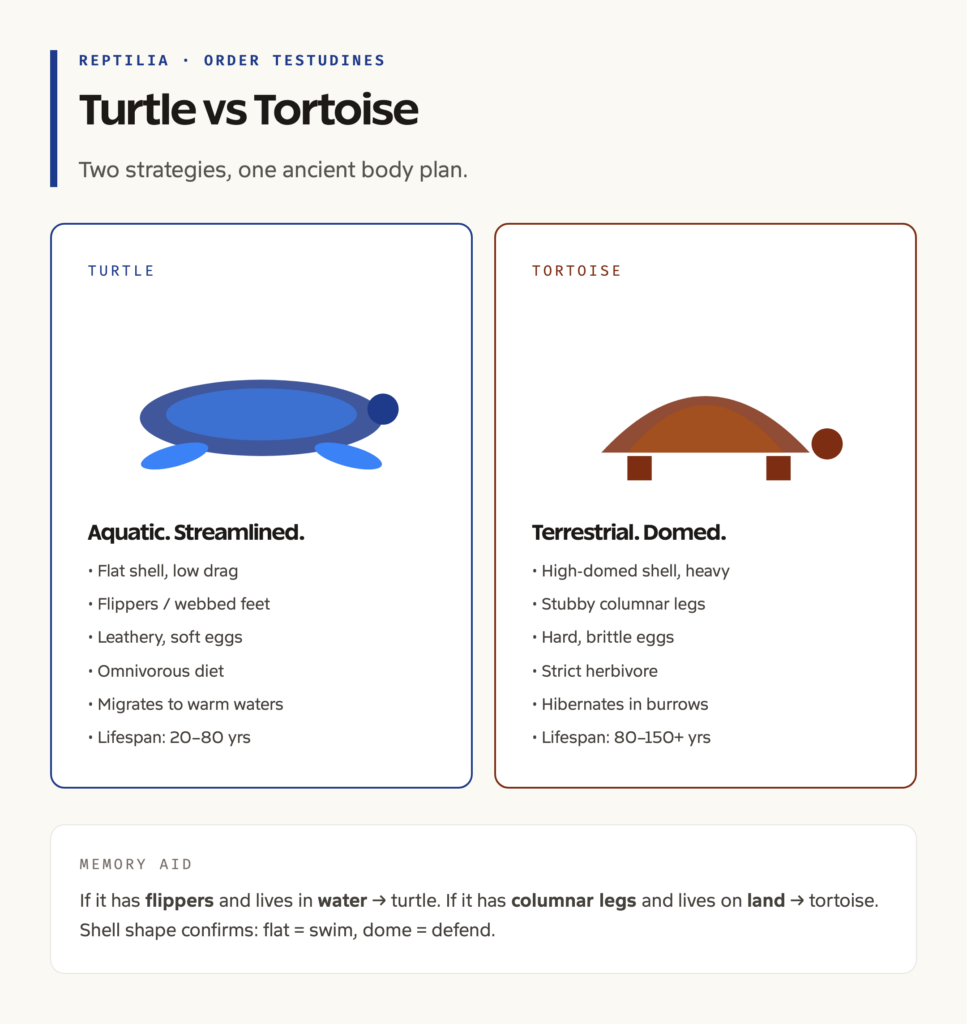
Turtles and tortoises are often used interchangeably in everyday language, but in zoology they describe two distinct ecological strategies. Both belong to the order Testudines, both carry a bony shell that is fused to the spine, and both lay eggs on land. Beyond that, almost every other feature — habitat, shell shape, diet, lifespan, and limb structure — separates them. Understanding the distinction is not just a textbook exercise; it shapes conservation strategy, captive breeding programs, and the legal framework that governs trade in these animals.
For a UPSC aspirant, the topic appears regularly in prelims through species-identification questions, and in mains through the wider conservation lens. Two species in particular — the Olive Ridley sea turtle on the Odisha coast and the Indian Star Tortoise of the Deccan grasslands — show up in current affairs almost every year, the first because of mass nesting events called Arribada and the second because of its persistent place on illegal pet trade lists.
Quick Facts on Turtles and Tortoises
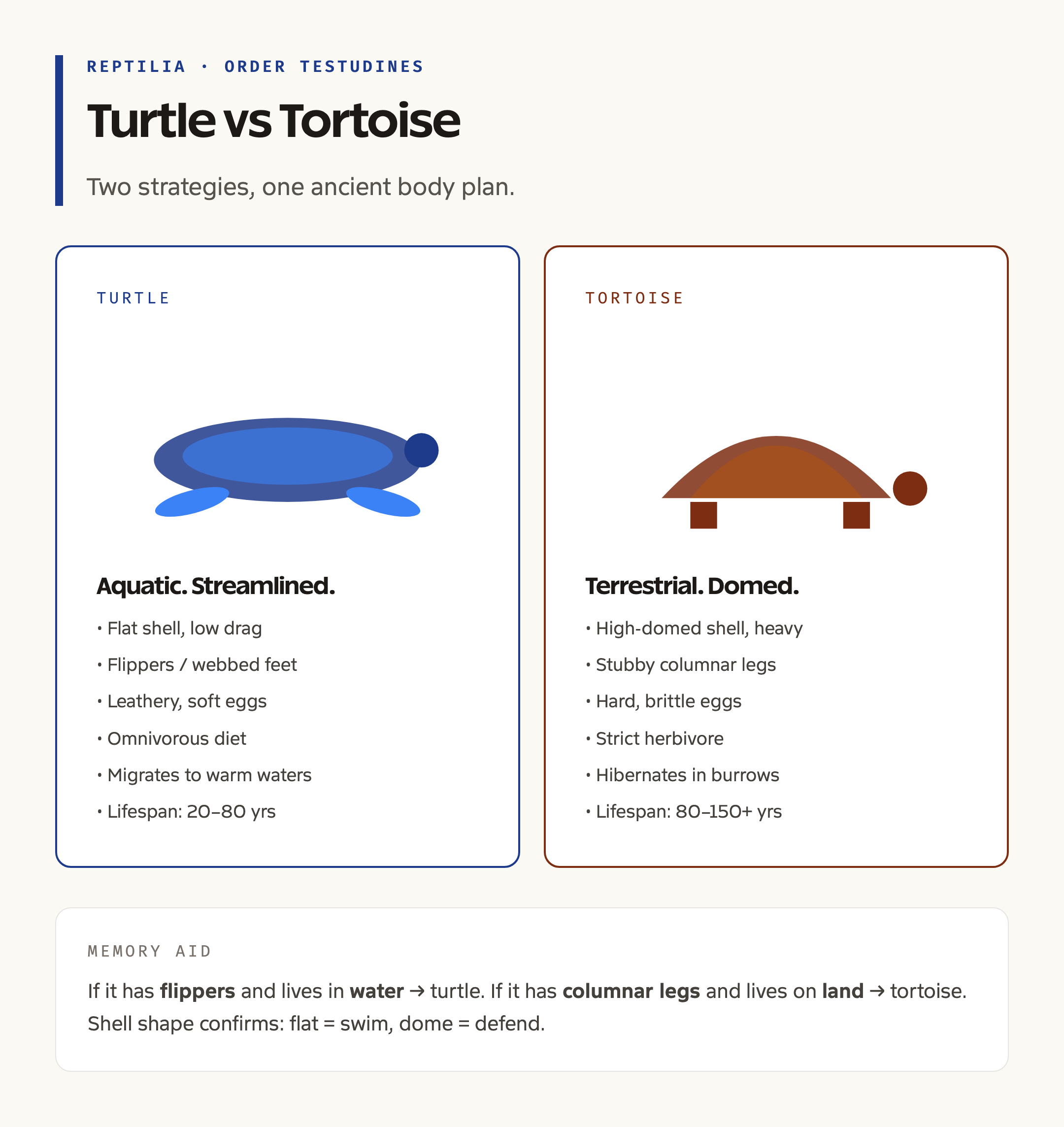
Turtles are aquatic. They live in oceans, rivers, lakes, and ponds, and most species spend almost their entire life in water. Tortoises are terrestrial. They live in deserts, scrub forests, and grasslands, and they avoid open water. Both groups together include roughly three hundred and sixty species worldwide, of which India hosts about thirty species across freshwater turtles, sea turtles, and tortoises.
All sea turtles found in Indian waters are listed in Schedule I of the Wild Life (Protection) Act, 1972, which is the highest level of legal protection in Indian wildlife law. The Indian Star Tortoise was uplisted from CITES Appendix II to Appendix I in 2019, banning all international commercial trade. Most Indian freshwater turtles also enjoy Schedule I protection, although enforcement varies sharply across states.
What Sets Turtles Apart from Tortoises
The first and most reliable difference is the shape of the shell. A turtle’s shell is flatter and streamlined, designed to cut through water with minimum drag. A tortoise’s shell is high-domed and heavy, designed to discourage predators that try to crush it on land. The flatter shell of the turtle has lower internal volume per unit of surface area, which helps it stay neutrally buoyant in water.
The second difference is the limbs. Turtles have flippers or webbed feet, depending on whether they are sea turtles or freshwater turtles, and the limbs are designed for propulsion. Tortoises have stubby, columnar legs with thick scales, designed for walking on rough terrain. The third difference is the egg shell. Turtle eggs are leathery and soft. Tortoise eggs are hard and brittle. The fourth is diet — turtles are typically omnivorous, while most tortoises are strict herbivores.
Background and Historical Context
Testudines are one of the oldest surviving reptile lineages. Fossil evidence places their divergence in the late Triassic period, more than two hundred million years ago, which makes them older than crocodiles and contemporary with the earliest dinosaurs. The bony shell, which is unique to this order, evolved from the fusion of ribs and vertebrae with bony plates of the skin. Once the body plan was established, it changed remarkably little — modern turtles and tortoises look broadly the same as their fossils from a hundred million years ago.
In India, both groups are deeply embedded in mythology and culture. The Kurma avatar of Vishnu, who supports Mount Mandara during the churning of the ocean, is a giant turtle. Several temple ponds in south India and eastern India host populations of softshell turtles that are protected by religious tradition. This cultural protection has often outlasted formal legal protection, and conservationists have repeatedly tried to harness it for modern conservation. Read this together with biodiversity in India and the Wildlife Protection Act, 1972 to anchor the legal framework.
Key Differences Between Turtles and Tortoises
A straightforward table captures the contrasts that aspirants are most often asked to recall.
| Feature | Turtle | Tortoise |
|---|---|---|
| Habitat | Aquatic — oceans, rivers, lakes | Terrestrial — deserts, forests, grasslands |
| Shell | Flat, streamlined, lighter | Domed, heavy, more protective |
| Limbs | Flippers or webbed feet | Stubby columnar legs |
| Egg shell | Leathery and soft | Hard and brittle |
| Diet | Mostly omnivorous | Mostly herbivorous |
| Thermoregulation | Long migrations to warmer waters | Hibernation in burrows |
| Lifespan | 20 to 80 years for most species | Often more than 100 years |
| Indian example | Olive Ridley sea turtle | Indian star tortoise |
The lifespan difference is striking. Tortoises are among the longest-living vertebrates on Earth. The Aldabra giant tortoise routinely crosses one hundred and fifty years, and the famous Galapagos giant tortoises have been recorded at similar ages. Sea turtles also live long, with leatherbacks crossing sixty to eighty years, but they rarely match the tortoise record.
Why the Distinction Matters for Conservation
Each group faces a different set of threats and therefore requires a different conservation toolkit. Sea turtles are threatened by trawler nets that drown them as bycatch, by plastic ingestion, by light pollution near nesting beaches that disorients hatchlings, and by climate change that skews the temperature-dependent sex ratio of hatchlings towards females. Conservation responses include Turtle Excluder Devices on fishing nets, dark-sky policies near nesting beaches, and the protection of mass nesting sites such as the Gahirmatha rookery in Odisha.
Tortoises face a different cocktail. Habitat loss to agriculture, road kills, and above all the pet trade are the dominant threats. The Indian Star Tortoise is one of the world’s most trafficked land tortoises, smuggled to South-East Asia through the Bangladesh and Sri Lanka corridors. Conservation here depends on customs enforcement, intelligence-led seizures, and the work of CITES.
Detailed Analysis of Indian Species
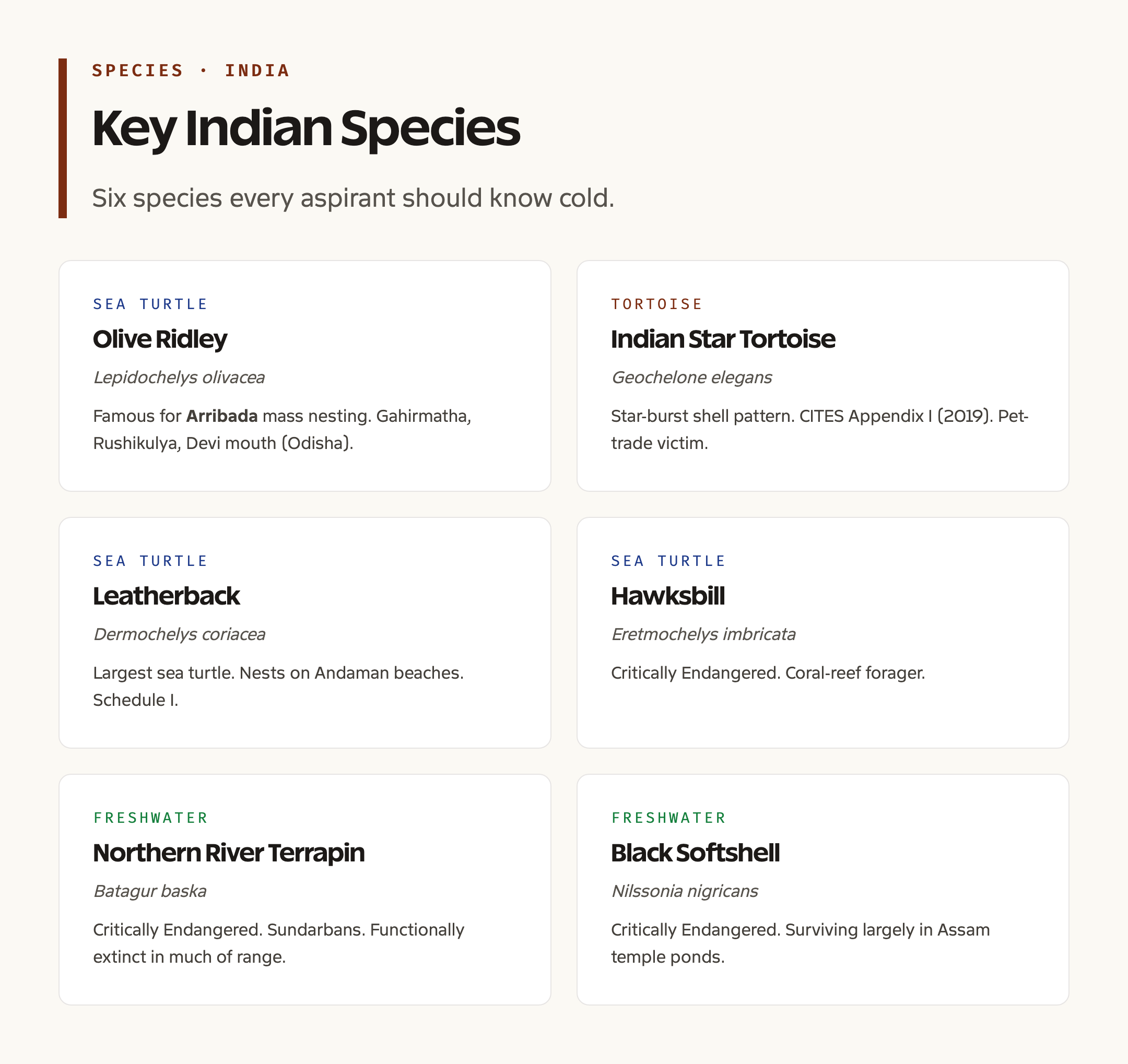
The Olive Ridley turtle is the smallest and most abundant of the world’s seven sea turtle species. The species is famous for the Arribada, a synchronized mass nesting event in which tens of thousands of females come ashore on the same beach over a few nights to lay eggs. India hosts three of the world’s largest known Arribada beaches — Gahirmatha, Rushikulya, and Devi river mouth, all on the Odisha coast. The beaches are protected by Section 144 type closures during the nesting season and patrolled by a combination of forest department staff, the Indian Coast Guard, and local volunteers.
The Indian Star Tortoise, named after the yellow star-burst pattern on its dome, lives in the dry deciduous forests and scrub of southern, central, and western India and parts of Sri Lanka. It is small enough to be smuggled inside hand luggage, attractive enough to be in demand as an exotic pet, and slow-breeding enough to be vulnerable to large-scale extraction.
Beyond these two, the species list of Indian Testudines includes the Green sea turtle, the Hawksbill, the Loggerhead, and the Leatherback among the marine forms; the Indian softshell turtle, the Black softshell, the Spotted pond turtle, and the Northern river terrapin among freshwater turtles; and the Indian flapshell turtle, which is widespread across the Gangetic plains. Several of these species have populations that have crashed by more than ninety percent in the last fifty years.
Comparative Look at Indian Conservation Status
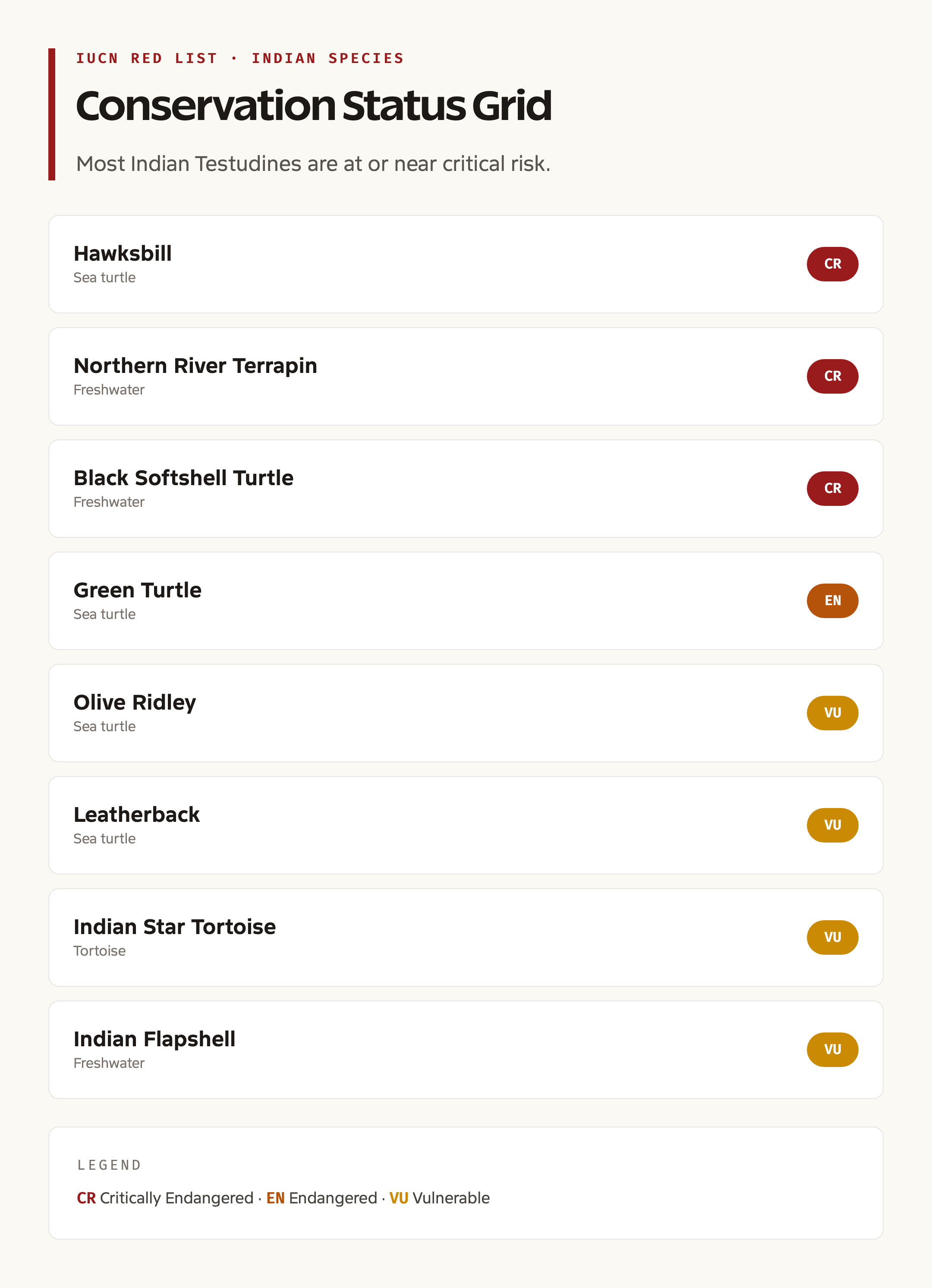
The IUCN Red List status of selected Indian species gives a sobering snapshot.
| Species | Type | IUCN Status |
|---|---|---|
| Olive Ridley | Sea turtle | Vulnerable |
| Hawksbill | Sea turtle | Critically Endangered |
| Leatherback | Sea turtle | Vulnerable |
| Green turtle | Sea turtle | Endangered |
| Indian Star Tortoise | Tortoise | Vulnerable |
| Northern river terrapin | Freshwater | Critically Endangered |
| Black softshell | Freshwater | Critically Endangered |
| Indian flapshell | Freshwater | Vulnerable |
The Northern river terrapin and the Black softshell turtle are functionally extinct in much of their historical Indian range, surviving only in temple ponds in Assam and a few protected stretches of the Sundarbans. Read this together with mangrove ecosystem India and wetlands of India to see how the fate of freshwater turtles tracks the fate of their habitats.
Challenges in Turtle and Tortoise Conservation
The first challenge is the international scale of the trade. A turtle hatched on the Odisha coast can end up on a beach in Sri Lanka or in a stew in Vietnam within a few years. National laws can protect breeding habitat, but they cannot stop a poacher from boarding a fishing boat in international waters. The second challenge is climate change, which is shifting nesting sex ratios and eroding nesting beaches at the same time. The third is plastic pollution, particularly in the Bay of Bengal where Olive Ridleys regularly mistake plastic bags for jellyfish.
A fourth, less visible challenge is the lack of population data. Reliable annual population estimates exist only for the Arribada beaches and a handful of intensively studied sites. Most freshwater turtle populations have never been systematically counted, and local extinctions can occur unnoticed.
Prelims Pointers
Turtles are aquatic, tortoises are terrestrial. Sea turtles are listed in Schedule I of the Wild Life (Protection) Act, 1972. The Olive Ridley is famous for the Arribada mass nesting, the most significant Indian rookery being Gahirmatha in Odisha. The Indian Star Tortoise was moved from CITES Appendix II to Appendix I in 2019.
Star tortoise, monitor lizard, and pygmy hog are naturally found in India. Spider monkey is not — it is a Central and South American species. Some species of turtles are herbivores, some species of fish are herbivores, and some species of snakes are viviparous. Marine mammals such as the dugong are predominantly herbivorous, feeding on sea-grass.
Mains Questions on Turtle and Tortoise Conservation
Discuss the threats faced by India’s turtle and tortoise populations and evaluate the effectiveness of the legal framework available for their protection. Examine the role of mass nesting beaches such as Gahirmatha in the conservation of the Olive Ridley turtle and analyze the trade-offs with coastal fisheries and port development.
A complete answer would walk through the dual track of marine and freshwater conservation, the role of CITES in tackling the international pet trade, the weakening of nesting beaches by light pollution and erosion, and the cultural and religious resources that have, in some cases, kept critically endangered freshwater species alive.
Way Forward
The path forward needs three reinforcements. The first is community-based monitoring at every Arribada beach and at every freshwater turtle hotspot, with citizen-science platforms feeding data into a national turtle database. The second is consistent enforcement of CITES on the ground, with intelligence-led seizures rather than chance discoveries at airports. The third is climate adaptation — assisted relocation of nesting beaches that have eroded, hatchery interventions to balance sex ratios, and the protection of inland freshwater systems from sand mining and damming.
A fourth element, easy to overlook, is education. Many freshwater turtles are still hunted for meat, particularly along the Brahmaputra and Mahanadi systems, and the demand persists in part because consumers do not know that what they are eating is a critically endangered species. Awareness campaigns, especially in fish markets, can complement legal enforcement.
Frequently Asked Questions
What is the simplest way to tell a turtle from a tortoise?
Look at the limbs and the habitat. A turtle has flippers or webbed feet and lives in or near water. A tortoise has stubby columnar legs and lives on land. The shell shape also helps — a turtle’s shell is flatter, a tortoise’s is high-domed.
What is the Arribada?
The Arribada is a synchronized mass nesting event in which tens of thousands of female Olive Ridley turtles come ashore on the same beach over a few nights to lay eggs. Three of the world’s largest Arribada beaches — Gahirmatha, Rushikulya, and the Devi river mouth — are on the Odisha coast.
Why is the Indian Star Tortoise endangered?
Habitat loss to agriculture and the international pet trade are the main threats. The species is small, attractive, and slow-breeding, which makes it both popular as a pet and vulnerable to extraction. CITES uplisted it to Appendix I in 2019 to ban international commercial trade.
Are sea turtles found along all of India’s coastline?
Sea turtles nest along the entire mainland coastline as well as the Andaman and Nicobar and Lakshadweep islands, with the densest nesting on the Odisha coast for Olive Ridleys and the Andaman beaches for Leatherbacks. Sporadic nesting is reported from the Gujarat, Kerala, Tamil Nadu, and Andhra Pradesh coasts.
What is a Turtle Excluder Device?
It is a metal grid fitted inside a fishing trawl net that allows turtles to escape through an exit panel while retaining the target shrimp catch. Its use is legally mandatory in many parts of India during the Olive Ridley nesting season but compliance varies across states.
Are turtles and tortoises kept as pets legally in India?
Most native Indian species are listed in Schedule I of the Wild Life (Protection) Act, 1972 and cannot be kept as pets. Some non-native species are kept legally if they are imported with valid CITES documents, but the trade is small and tightly regulated.
Do turtles and tortoises have temperature-dependent sex determination?
Yes. In most species the temperature of the nest during a critical incubation window decides the sex of the hatchlings. Warmer nests typically produce more females, which is why a warming climate threatens to skew the sex ratio of future generations.
What is the lifespan of a typical Indian tortoise?
The Indian Star Tortoise can live for thirty to fifty years in the wild and longer in captivity. Larger tortoises in captivity have been recorded at over one hundred years, although wild lifespans are usually shorter because of predation and habitat pressure.
Tell Google you want more of this.
Add Anantam IAS as a preferred sourceOne tap, and this site shows up more often in your own Top Stories, AI Overviews and AI Mode. Remove it any time.





