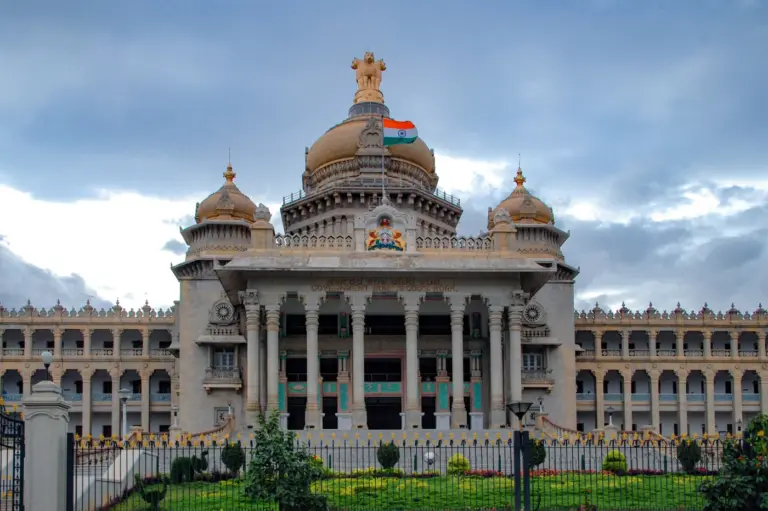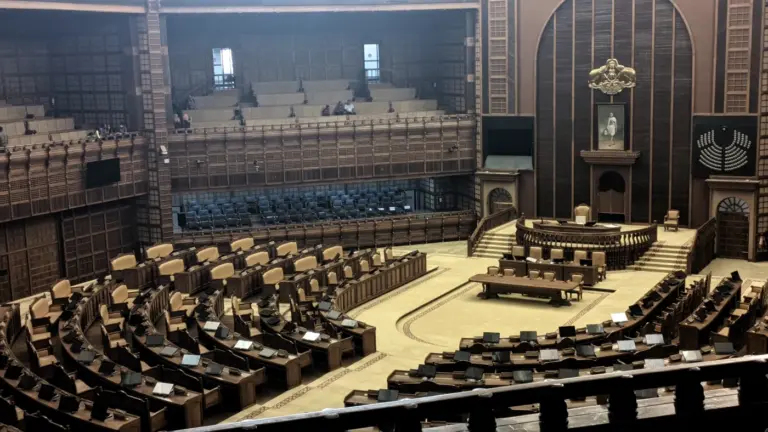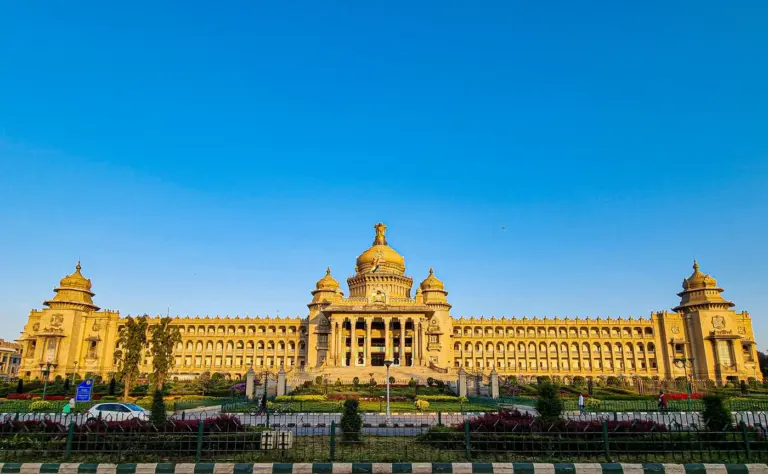
The Rajya Sabha, or Council of States, is the upper house of the Indian Parliament. Designed as the federal chamber, it represents the states and union territories. It also serves as a revising and deliberative body — “the sober second thought” of Indian democracy. But questions about its representative character, powers, and the coming delimitation exercise after 2026 raise profound constitutional and federal issues. For UPSC Polity, this is a GS-II cornerstone.
Historical Background
- 1919 — Montagu-Chelmsford Reforms introduced the Council of States in British India.
- 1954 — The Council of States was renamed Rajya Sabha.
- 4th Schedule of the Constitution allocates the number of seats to each state and UT.
- Maximum strength: 250 (238 elected + 12 nominated). Current effective strength is around 245.
Role of the Rajya Sabha
Federal Linking Institution
- The Rajya Sabha is designed as the voice of the states at the Centre.
- Members are elected by state legislative assemblies through proportional representation with single transferable vote.
Review and Re-Evaluation of Proposals
- Bills passed by the Lok Sabha come to the Rajya Sabha for consideration.
- The upper house can amend, reject, or delay bills (except Money Bills).
- It provides a checkpoint to hasty legislation.
Deliberation
- Longer tenure (6 years) and staggered elections (one-third retire every 2 years) enable deliberative continuity.
- Non-elected nominated members (12 from arts, literature, science, and social service) add expertise.
Vulnerable Representation
- Because of proportional representation, vulnerable groups and smaller parties can gain representation in Rajya Sabha that they might not in Lok Sabha.
Nomination of Expert Members
- Twelve members are nominated by the President from fields of literature, science, art, and social service.
- This brings expertise and non-political voices into legislative deliberation.
Article 249: Tax Subject Shift
- If the Rajya Sabha, supported by two-thirds of members present and voting, passes a resolution, Parliament can legislate on state-list subjects for up to one year.
- This is a unique federal mechanism.
Should All States Have Equal Representation?
The Case "For" — US-Style Equality
The argument: each state, regardless of size, should have equal representation in the upper house (as in the US Senate).
- The Lok Sabha is already linked to population — there is no need to replicate this in the upper house.
- Nine states have only 1 seat in the Rajya Sabha.
- Ten states take up 70% of the seats.
- Resolutions under Article 249 can be passed even if the bottom 14 states oppose.
- The Punchhi Commission recommended more equal representation.
The Case Against
- The Rajya Sabha should reflect not just states but also population and demographics.
- US-style equality would give disproportionate weight to small states.
- The framers consciously rejected full federal symmetry in favour of a mixed model.
Issues With the Rajya Sabha
No Equal Representation of States
As noted, nine states have just one seat while populous states dominate.
Lok Sabha Juggernaut
- The Lok Sabha has more than double the membership of the Rajya Sabha.
- In joint sessions, Lok Sabha numbers overwhelm.
- Rajya Sabha opposition can be overridden by the Lok Sabha after 6 months on ordinary bills.
Money Bill Bypass
- Money Bills can be passed by the Lok Sabha alone; Rajya Sabha can only recommend amendments (which need not be accepted).
- The Speaker's certification of bills as Money Bills (Article 110) has been controversial.
- Aadhaar Act (2016) was certified as a Money Bill — challenged in Rojer Mathew; pending before a larger bench.
Domicile Removed
- Pre-2003: A Rajya Sabha candidate had to be an ordinary resident of the state from which they were elected.
- 2003 amendment: The domicile requirement was removed.
- Critics argue this dilutes the federal character — now members can represent states they have little connection to.
Not Representative of State Socio-Economic Conditions
- Members are often chosen for political considerations rather than expertise in state affairs.
- Nominations are party-driven.
Not Always Aware of Ground Realities
- Members who spend most of their time in Delhi may lose touch with state-level developments.
Allegiance to Political Parties
- Party whips bind Rajya Sabha members just as in Lok Sabha.
- Anti-Defection Law applies.
- This reduces the scope for independent, state-centred action.
Delimitation: The Coming Flashpoint
Delimitation literally means the act or process of fixing the limits or boundaries of territorial constituencies in a country or a province having a legislative body.
Constitutional Framework
- Article 82: Parliament enacts a Delimitation Act after every Census, establishing a Delimitation Commission.
- Article 170: States are divided into territorial constituencies as per the Delimitation Act after every Census.
History of Delimitation in India
India has constituted Delimitation Commissions four times — in 1952, 1963, 1973, and 2002.
The 2002 Freeze
- In 2002, the 84th Constitutional Amendment was used to freeze the delimitation process for Lok Sabha and State Assemblies until at least 2026.
- The 91st Amendment (2001) also froze total Lok Sabha seats until after the first Census taken after 2026.
- As a result, the Delimitation Commission could not increase total seats in the Lok Sabha or state assemblies.
- Consequently, there are wide discrepancies in constituency sizes — the largest has over three million electors, the smallest less than 50,000.
Recent J&K and NE Delimitation
Central government has separately constituted Delimitation Commissions for:
- Union Territory of Jammu and Kashmir (post-Article 370 abrogation)
- Assam, Arunachal Pradesh, Manipur, and Nagaland
Issues Arising From Unequal Representation
Dilution of "One Citizen, One Vote"
- The present delimitation, based on the 2001 Census, has been undertaken after 30 years (since 1971).
- The population has increased by almost 87% and constituencies have become malapportioned.
- An MP from Rajasthan represents over 30 lakh people, while one in Tamil Nadu or Kerala represents less than 18 lakh.
Increasing Burden on Representatives
- An MP today represents more than four times the number of voters than in 1951-52.
Dynamics Not Captured
- In 1988, the voting age was lowered from 21 to 18 via the 61st Amendment — a substantial size increase.
- Migration to urban areas has made increases skewed in direction and intensity.
Regional Perception of Marginalisation
- The perception of one region controlling the others or ignoring cultural and social aspirations may invoke popular agitations.
- Creates a political divide between politically important vs unimportant states.
- Feeds demands for smaller states.
Implications if the Freeze Is Lifted After 2026
Family Planning Disincentives
- Southern states, which invested heavily in family planning, fear reduced representation if reallocation is based on current population.
- This creates a perverse incentive structure — states that controlled population growth may be penalised.
Control of Presiding Officers
- Already, presiding officers find it extremely difficult to conduct proceedings.
- Directions and rulings are not shown proper respect, and disruptions aggravate the problem.
- A sudden increase in numbers will further strain parliamentary management.
Strain on House Working
- The hourly windows for Zero Hour, Question Hour, and other business will become too small for increased members.
Options Under Debate
- Status quo freeze extended.
- Increase total seats proportionally without changing state shares.
- Full population-based reallocation.
- Hybrid formulas — e.g., weighted by population growth rate.
Latest Developments (2024-26)
- Women's Reservation Act, 2023 (106th Amendment) — 33% reservation to be operationalised after delimitation following first Census after 2026.
- Political debate on delimitation intensified in 2024 — southern states voiced concerns about potential seat reduction.
- One Nation One Election Committee (Kovind) has proposed synchronising Lok Sabha and Assembly elections.
- 2024-25 budget discussions raised North-South fiscal transfer debates — overlapping with delimitation anxieties.
UPSC Relevance
GS-II mapping: Parliament and State legislatures — structure, functioning; federalism; representation; constitutional amendments.
Prelims bullets:
- Rajya Sabha — 250 max (238 elected + 12 nominated).
- 4th Schedule — allocation of seats.
- Article 249 — Rajya Sabha resolution to legislate on state list.
- 84th Amendment (2002) — delimitation freeze until 2026.
- 91st Amendment (2001) — total Lok Sabha seats freeze.
- 61st Amendment (1988) — voting age reduced to 18.
- Domicile for Rajya Sabha candidates removed in 2003.
Mains angles:
- "The Rajya Sabha has drifted from its federal design." Discuss.
- Examine the constitutional and political challenges of lifting the delimitation freeze after 2026.
- Should all states have equal representation in the Rajya Sabha?
- How does the 2023 Women's Reservation Act interact with delimitation?
Tell Google you want more of this.
Add Anantam IAS as a preferred sourceOne tap, and this site shows up more often in your own Top Stories, AI Overviews and AI Mode. Remove it any time.