Most advice on cracking the UPSC Civil Services Examination is written for someone who has all day to study. The working professional doesn’t. You have a job that owns eight or nine hours, a commute, and a body that wants to sleep — and somewhere in the gaps you’re meant to digest one of the broadest syllabuses any exam in the country sets. The honest truth is that this is harder than full-time preparation, and pretending otherwise helps nobody.
But harder is not impossible, and a meaningful share of every year’s final list clears while employed. They don’t win by finding extra hours that don’t exist. They win by being ruthless about what they study, disciplined about when, and realistic about how long it will take. This guide lays out that strategy — the constraint, a template that fits a working week, what to cut, and the hardest decision of all: whether to keep the job at all.
The Real Constraint — and How to Beat It
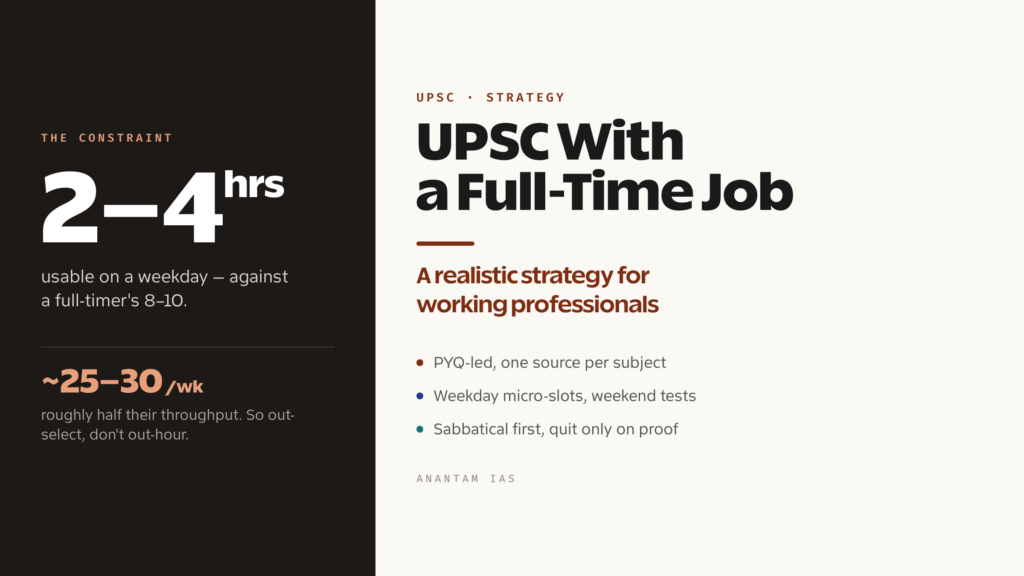
Start with the number that actually governs your prep: usable study hours per week. A full-time aspirant in Delhi or Prayagraj puts in eight to ten focused hours a day. You will get two to four hours on a good weekday, and most of that after a day that already drained you. Across a five-day week that’s perhaps fifteen hours, plus whatever the weekend yields — call it a realistic twenty-five to thirty hours a week against a full-timer’s sixty-plus. You are running at roughly half the throughput. Internalising that ratio is the whole game, because it tells you that you cannot out-study them. You have to out-select them.
The first thing the constraint kills is breadth-for-its-own-sake. A full-timer can afford to read three books on modern history and watch a lecture series on each; you cannot, and you shouldn’t try. Every hour you spend on a low-yield topic is an hour stolen from a high-yield one you’ll never get back. The second thing it kills is the rabbit hole — the seductive detour into some fascinating-but-unexamined corner of the syllabus. Full-timers can absorb a few wasted afternoons. For you, a wasted week is a meaningful fraction of a month’s total study time.
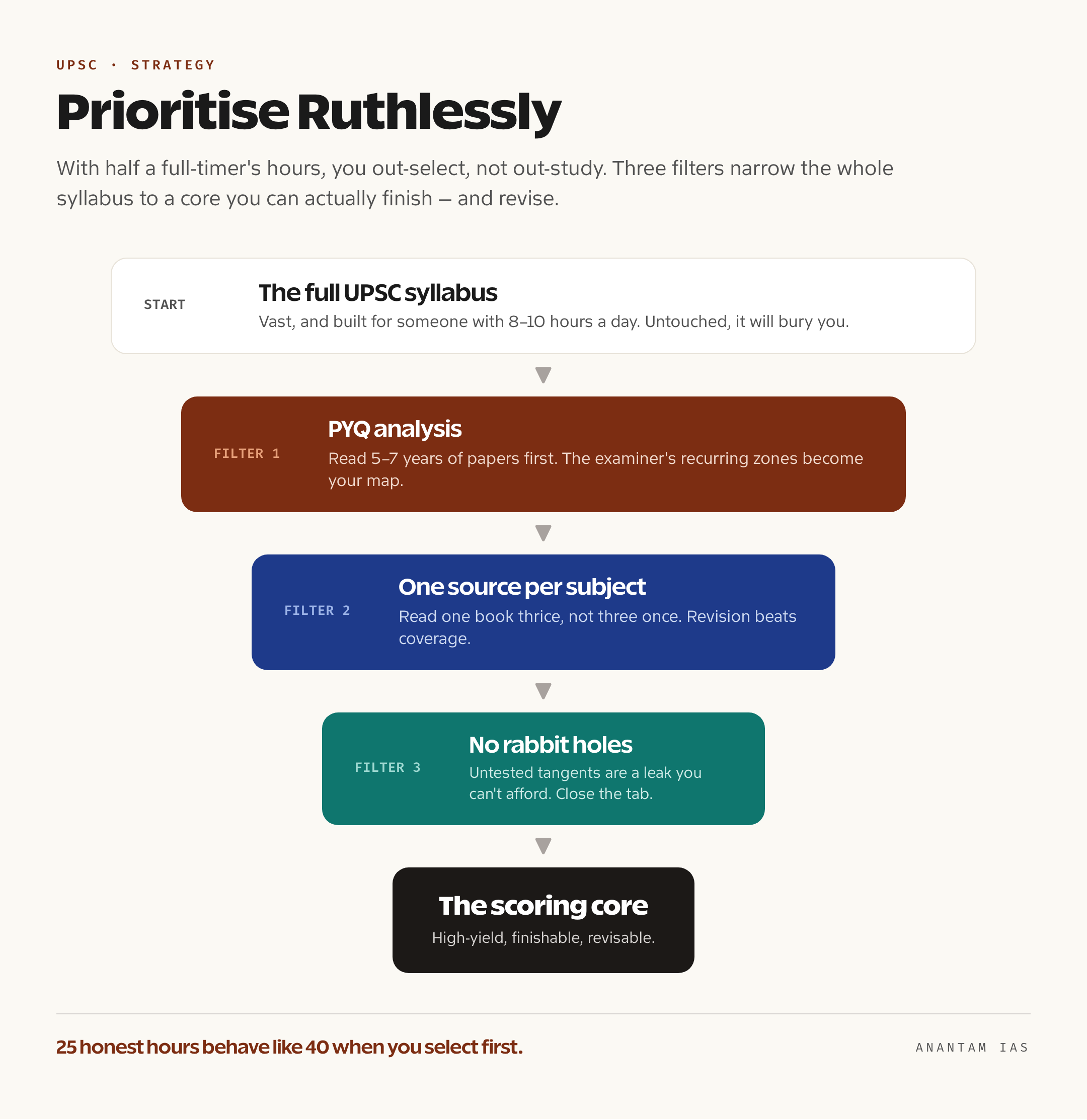
So the strategy that beats the constraint is built on three moves, and they all point the same way. First, prioritise ruthlessly using the previous years’ question papers as your map — let the examiner’s actual behaviour, not a coaching syllabus, decide what gets your scarce hours. Second, hold to one source per subject so you finish and revise instead of perpetually starting. Third, protect your few hours from interruption and from your own curiosity. Do these and twenty-five honest hours a week can carry you. Skip them and even forty won’t.
A Weekday-Weekend Study Template
A timetable for a working professional has to assume the day job wins every conflict, because it will. So you build around the job, not against it, and you treat the structure as the thing that protects you on the evenings when motivation is gone — which is most evenings.
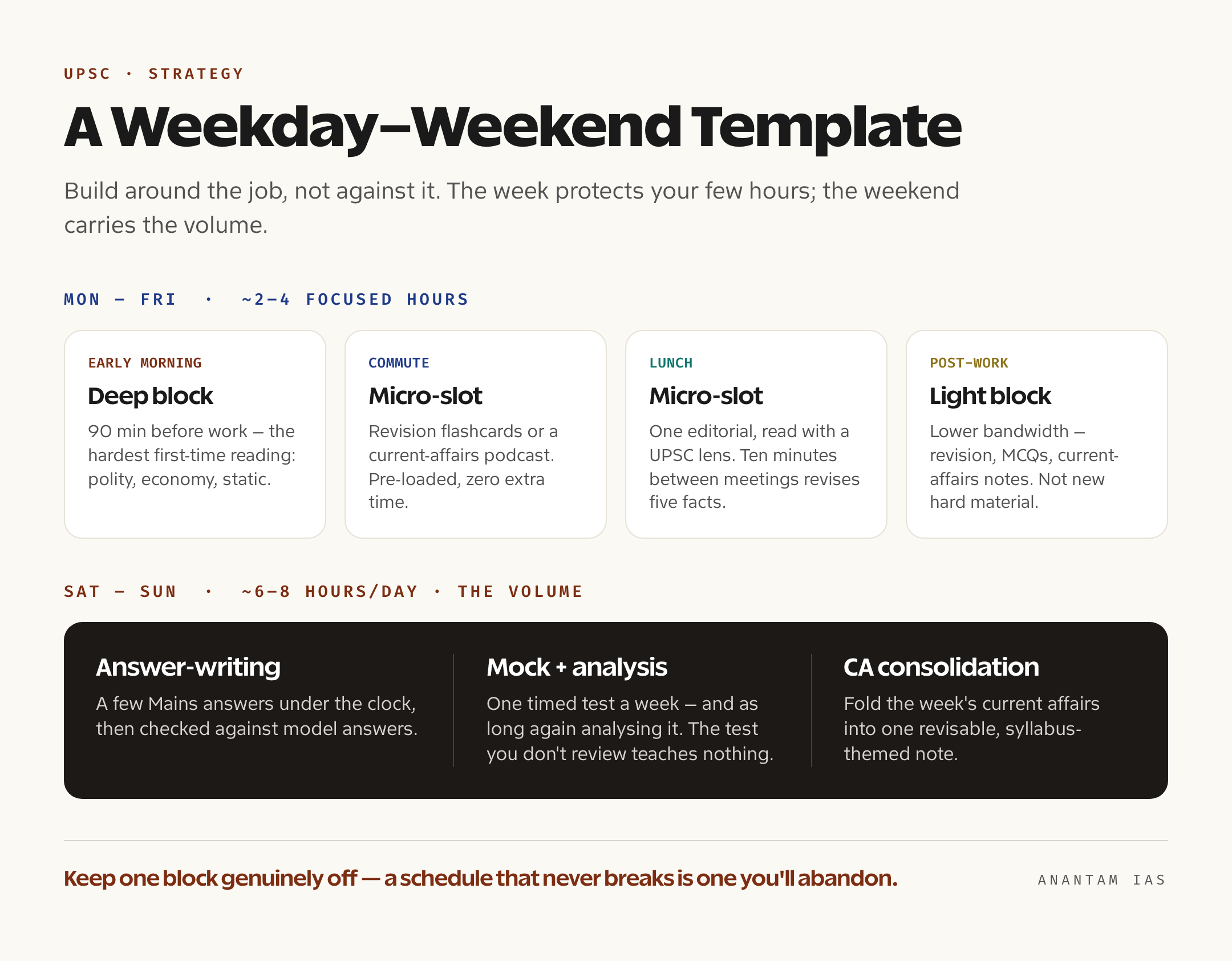
The single most reliable block is early morning. Waking ninety minutes earlier and studying before work gives you a clean, uninterrupted stretch when your mind is fresh and no one needs anything from you. This is where the hardest reading goes — a polity chapter, an economy concept, the static portion that demands concentration. A second, shorter deep block comes after work, but be honest about its quality: post-work study is lower-bandwidth, so use it for revision, MCQ practice, or current-affairs notes rather than first-time learning of difficult material.
Then mine the micro-slots that the working day hides. A commute by metro or bus is forty minutes of revision flashcards or a current-affairs podcast. A lunch break can hold a quick read of the day’s editorial. Ten minutes between meetings is enough to revise yesterday’s five facts. None of these slots is impressive on its own; together they can add an hour a day that costs you no extra time at all. The trick is to pre-load them — have the PDF, the flashcard deck, the podcast queued — so you’re never spending the slot deciding what to do in it.
The weekend is where the real volume lives, and it should look different from the week. Saturday and Sunday are for the things weekday fatigue makes impossible: answer-writing practice for Mains, full or sectional mock tests under timed conditions, and consolidating the week’s current affairs into one set of monthly notes. Protect at least one long weekend block for a test plus its analysis, because a mock you don’t review teaches you almost nothing. Keep one part of one day genuinely off — a prep schedule that never breaks is a schedule you’ll abandon by month three.
Prioritise Ruthlessly: PYQ-Led, One-Source Prep
The previous years’ question papers, published by the Union Public Service Commission, are the most undervalued resource a time-poor aspirant has. Before you read a single textbook, spend a weekend reading five to seven years of Prelims and Mains papers — not to answer them, but to see where the examiner keeps returning. Patterns jump out fast: certain areas of polity, environment, and economy recur every cycle, while others barely surface. That distribution is your prioritisation map. You study the recurring high-yield zones first and deepest, and you give the rare topics a single light pass or skip them outright. This is the move that lets twenty-five hours behave like forty.
One-source-per-subject is the companion discipline. The temptation, especially with limited time, is to hedge by buying every recommended book and following three online sources, which guarantees you finish none of them. Pick one standard text per subject — the NCERTs for the base, then one reliable standard reference each for polity, economy, geography, and so on — and commit to it. The aim is to read your one source three times rather than three sources once, because in this exam revision beats coverage. A topic you’ve revised twice is worth more than two topics you’ve seen once and forgotten. Our guide on UPSC preparation at home goes deeper on building this source list, and the UPSC syllabus breakdown helps you map your sources to what’s actually examined.
This is also where you make peace with the rabbit hole. When a topic pulls you toward an interesting tangent the papers never test, name it for what it is — a leak in a budget you cannot afford to overspend — and close the tab. Curiosity is a virtue for a scholar and a liability for a candidate on a clock. The same logic applies to the optional subject and to the choice between self-study and coaching: pick once, with a clear head, and stop re-litigating it. Our comparison of coaching versus self-study is worth reading once, deciding, and then not revisiting.
Current Affairs and Tests Without Burning Out
Current affairs is where working professionals most often drown, because it feels like it demands daily, open-ended reading you don’t have time for. It doesn’t. The efficient approach is to fix a hard time budget — thirty to forty-five minutes a day, no more — and spend it on one good source rather than five. One quality newspaper such as The Hindu or the Indian Express, read with a UPSC lens for issues rather than news, plus one monthly current-affairs compilation, covers most of what the exam wants. The daily slot fits a commute or a lunch break; the monthly compilation fits a weekend. The deeper habit-building is covered in our current affairs strategy guide, which works just as well on a compressed timetable.
The point of the monthly compilation is consolidation, not collection. Working aspirants accumulate scattered notes across apps and notebooks and never see them again. Once a month, fold the daily reading into a single revisable set organised by syllabus theme — polity, economy, environment, schemes, international relations. That set, revised a few times before Prelims, is worth more than a year of unrevised clippings.
Tests are non-negotiable, and they belong on the weekend. From a few months before Prelims, take a sectional or full-length mock every weekend and spend as long analysing it as taking it. The analysis is the real lesson — which silly errors you keep making, which topics you only thought you knew, how your time ran out. For Mains, weekend answer-writing is the equivalent: write a few answers under the clock, then compare them against model answers and the examiner’s expectations. You’ll write fewer answers than a full-timer, so each one has to teach you more. Burnout, meanwhile, is a structural risk for someone running a job and an exam at once, so guard your sleep, keep one genuine rest block a week, and accept that a sustainable medium pace beats a heroic sprint that ends in collapse two months out.
Sabbatical vs Quitting: The Honest Maths
At some point most serious working aspirants ask whether to leave the job, and this is where honesty matters most. The arithmetic is simple and unforgiving. The Civil Services Examination is a multi-year project for almost everyone, and especially for someone studying part-time — a realistic first-serious-attempt timeline is two to three years of preparation, not the single clean year the success stories imply. Plan for that horizon from the start, because a plan built on clearing in one rushed attempt usually produces neither the result nor a fallback.
A sabbatical or long leave is the lower-risk lever, and it’s the one to reach for first. Many employers grant unpaid or study leave; some aspirants negotiate three to six months off in the run-up to Prelims and Mains, when concentrated time genuinely changes outcomes. This buys you the full-timer’s hours at the exam’s most decisive moment without burning the bridge back to a salary. If your workplace allows it, a well-timed sabbatical around the Prelims-to-Mains window is often the single highest-return move available to a working aspirant.
Quitting outright is a different order of risk, and the maths deserves a cold look. Leaving a stable job removes your income, your financial cushion, and your fallback in an exam where most candidates do not clear in any given year. The honest framing is a bet: you are trading career and financial security for more study hours, against odds that remain long even for strong candidates. That bet can be rational — if you have savings to cover two or three years, no dependents relying on your income, a genuine shot demonstrated by mock performance, and a re-entry plan if it doesn’t work — and reckless if you have none of those. The financial stability a job gives you is itself a strength, not just a constraint; it lets you attempt the exam without desperation, and desperation is its own handicap. The strongest position is usually to prepare seriously while employed, leverage discipline the job has already built into you, take a sabbatical at the decisive moment, and reserve quitting for the point where you’ve proved to yourself — with marks, not hope — that the full-time leap is justified. For a structured way to sequence all of this from scratch, our UPSC beginner roadmap maps the stages.
Frequently Asked Questions
Can I really clear UPSC while working full-time?
Yes, and people do it every year, but go in clear-eyed: with two to four usable hours on weekdays you’re running at roughly half a full-timer’s study volume, so you have to out-prioritise rather than out-hour them. Expect a two-to-three-year horizon for a serious attempt, lean hard on previous-year-question analysis to cut the syllabus, and protect your weekends for tests and answer-writing.
How many hours a day do I actually need?
Aim for two to four focused hours on weekdays and six to eight on each weekend day, which lands around twenty-five to thirty quality hours a week. Quality matters more than the raw count here — an early-morning deep block plus mined commute and lunch micro-slots, all spent on high-yield topics, beats a larger number of distracted, low-bandwidth hours.
Should I quit my job to prepare?
Not as a first move. A sabbatical or study leave around the Prelims-to-Mains window gives you concentrated hours at the decisive moment without losing your income or fallback, so reach for that first. Quitting only makes sense if you have two-to-three years of savings, no dependents on your income, and mock performance that shows a genuine shot — otherwise the financial stability of the job is an advantage worth keeping.
How do I manage current affairs with so little time?
Cap it at thirty to forty-five minutes a day on one newspaper read with a UPSC lens, plus one monthly compilation, and fit the daily slot into your commute or lunch break. The discipline that saves you is consolidation — once a month, fold everything into a single revisable, syllabus-themed note, and treat anything that won’t fit into it as noise you were right to drop.
Tell Google you want more of this.
Add Anantam IAS as a preferred sourceOne tap, and this site shows up more often in your own Top Stories, AI Overviews and AI Mode. Remove it any time.