Yakshagana is the night-long dance-drama of coastal Karnataka and the neighboring Kasaragod district of Kerala, in which a lead singer called the Bhagavata sings a verse play while costumed actors dance it and then speak their own lines on the spot. Its stories come from the epics and the Puranas. The earliest poet the tradition can attach a date to is Parthi Subba of Kumbla, usually placed around 1600, and a Government of India release in 2026 credited the form with more than four centuries of history. It matters because it’s an old Indian stage form in which the actor still makes up the words.
Most short notes file Yakshagana under folk dance and stop there, and three mistakes ride along with that label. It isn’t mainly a dance, because the actors talk and the talk is improvised. It isn’t one style, because the southern Tenkutittu and the northern Badagutittu use different drums and cymbals. And it isn’t on any UNESCO list: the 2024 news was about one Yakshagana troupe being accredited as an adviser, not about the art being inscribed. This note settles all three and then sets Yakshagana beside Kathakali, the Kerala form it’s easiest to mistake it for.
What is Yakshagana?
Yakshagana is traditional theater from the Karnataka coast and Kasaragod, performed through the night in the open, with a singer-director and drummers at the back and costumed actors in front. The Government of India’s 2026 description names extempore dialogue among its ingredients, next to dance and music.
| Fact | Detail |
|---|---|
| What it is | Dance-drama with song, dance and improvised speech; Kerala Tourism counts it among the most important folk theater forms of Karnataka and Kasaragod |
| Where | Coastal Karnataka and Kasaragod district of Kerala; its seated form, Talamaddale, reaches the Malnad hill districts |
| The name | Yaksha plus gana (song); Sahapedia gives the literal meaning as divine music |
| Language | Kannada, with the dialogue made up within the frame of the songs |
| Earliest named poet | Parthi Subba of Kumbla, Kasaragod, usually placed around 1600; his dates are disputed |
| Who leads | The Bhagavata, the lead singer who sets the pace and directs the show |
| Music | Chande (drum played with sticks), maddale (drum played with the hands), cymbals and a harmonium drone |
| Styles | Tenkutittu (south) and Badagutittu (north); Sahapedia adds Badabadagutittu (far north) |
| UNESCO | Not inscribed on any list; a Keremane troupe was accredited as a UNESCO NGO in June 2024 |
Where Yakshagana comes from
Yakshagana is an open-air art whose written record turns firm only around 1600, with the plays of Parthi Subba. Anything earlier is tradition or inference.
The name joins yaksha, a class of demigods in Indian myth, and gana, song; Sahapedia’s account of the performance gives the literal meaning as divine music. A plainer name survives in the title of K. Shivarama Karanth’s study Yakshagana Bayalata. A bayalata is roughly an open-field play, and that’s where the form was done: Karnataka Tourism describes troupes performing in village paddy fields after the winter crop was harvested.
The first name the tradition can hang a date on is Parthi Subba, born at Kumbla (also spelled Kumble) in present-day Kasaragod district. Sahapedia places him around 1600 and calls him the father of Yakshagana, and Kannur University’s Kannada department used the same title for the national seminar it held on him on 13 and 14 February 2020. Most of his known plays turn the Ramayana into episode-sized pieces, among them:
- Pattabhisheka, Rama’s coronation
- Panchavati, the forest hermitage episode
- Valivadhe, the killing of Vali
- Sethubandhana, the building of the bridge to Lanka
- Lava Kusha, the story of Rama’s twin sons
That episode-sized unit has a name, the prasanga, and each night’s show is still built around one.
His dating is the soft spot. The Yakshagana scholar M. Prabhakara Joshy also puts him at about 1600, but adds that his dates and even his authorship have been the subject of much controversy. A second argument crosses the state border. The Malayalam literary historian Ulloor Parameswara Iyer held that Parthi Subba’s plays influenced Ramanattam, the Ramayana cycle by Kottarakkara Thampuran that sits at the root of Kathakali’s repertoire, and later scholars such as Siromani Krishnan Nair rejected that view.
So the safe line is this: Parthi Subba is the earliest well-known Yakshagana poet, usually dated around 1600, with his dates disputed. It isn’t safe to say he invented the form. Father of Yakshagana is a title of honor, not a birth certificate, and the sources don’t show the stage before him.
If you’ve read about the Bhakti movement, the shape will feel familiar: epic stories retold in a regional language for listeners who didn’t need Sanskrit. Treat it as a parallel for revision, not a proven origin.
How a Yakshagana performance works
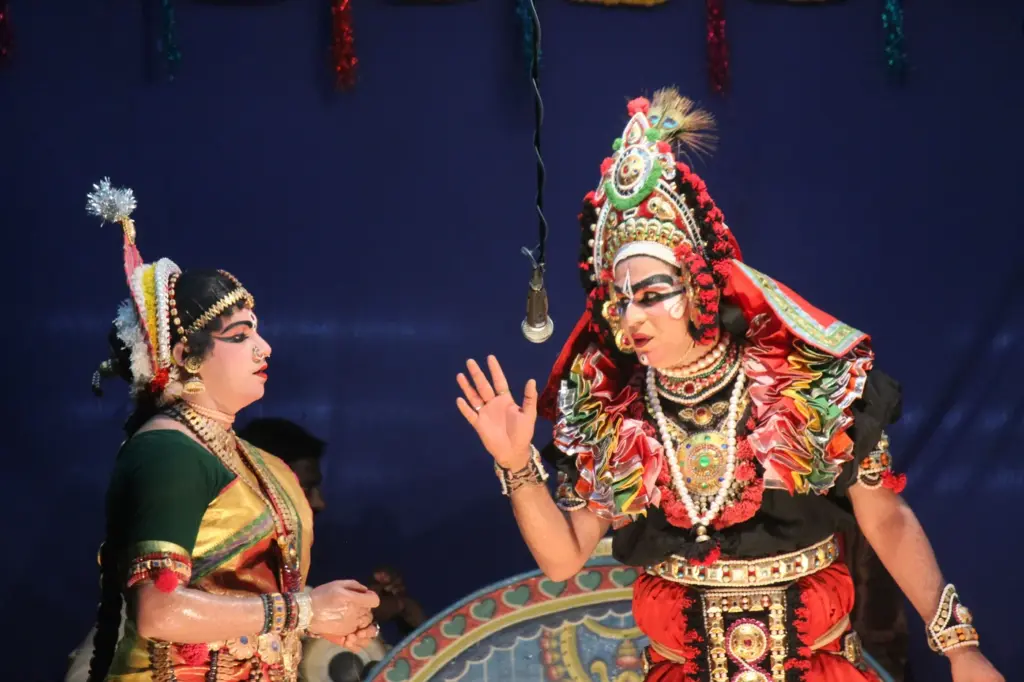
A Yakshagana performance runs on two teams and one written text. Musicians at the back sing the play; actors in front dance it and then argue it out in prose of their own.
The Bhagavata, the himmela and the mummela
The back row is the himmela, literally the rear troupe: the Bhagavata and the drummers. Sahapedia’s description of the traditional stage puts them on a raised bench at the back. The front row is the mummela, which Sahapedia defines as the team of actors who interpret and act out the songs.
The Bhagavata is the figure to remember. Sahapedia calls him the singer who controls the pace and artistic proceedings of the show, and Joshy calls him the director of the performance, the one who selects the verses and decides how long each segment runs. Karnataka Tourism sums up the arrangement as a troupe of 15 to 20 actors and a Bhagavata who is master of ceremonies and main storyteller.
Think of him as a conductor who also sings the libretto. The comparison holds for tempo and structure. It breaks over the words, because once he stops singing the actor owns the dialogue, and the Bhagavata can steer it only by choosing when the next verse comes in.
Chande, maddale and the rest of the himmela
Two drums carry the rhythm, and how each is played tells them apart:
- Chande: a high-strung drum played with two sticks, audible from a distance, as Sahapedia puts it.
- Maddale: a hollow cylindrical drum with leather on both faces, played with both hands; Kerala Tourism glosses it as a mridanga.
- Tala, jagate and chakratala: metal cymbals, from small finger bells to a large pair, that mark the beat.
- Harmonium: the drone, which Sahapedia says replaced an older drone pipe.
The hook is in the hands: sticks for the chande, palms for the maddale.
Vesha: costume and make-up
Costume is called vesha, and the same word names the role type an actor plays. Sahapedia lists the traditional categories, and three of them are enough to read most scenes:
- Raja vesha: kings and heroes.
- Bannada vesha: literally the colored role, used for demons.
- Stree vesha: female roles.
Karnataka Tourism picks out two details that stay with a first-time viewer: the large headgear and the musical beads, gejje, worn on the legs. Traditionally men played every part, female roles included; the same page notes that women are now part of Yakshagana troupes.
Prasanga and artha: the written play and the spoken one
The written text is the prasanga, and the Bhagavata sings its verses. Then comes the part Kathakali doesn’t have: the actor answers in artha, improvised prose. Kerala Tourism says the dialogue is presented extempore within the framework of the songs, in Kannada.
Picture how this works on a familiar episode, Vali’s death in the Ramayana. The Bhagavata sings the verse. The actor playing Vali then argues, in his own words, that Rama wronged him by shooting from hiding, and the actor playing Rama has to answer on the spot. The verse is fixed. The argument isn’t, so two troupes performing the same prasanga can give you two quite different Ramas.
The stage and the night
The traditional stage is small and open. Sahapedia gives it as a rectangle 12 feet wide and 15 feet deep, with spectators on three sides, and Kerala Tourism puts the traditional hours at 9 pm to 6 am in the open air. The chande opens the night with fixed beats called abbara or peetike. A prologue, the poorvaranga, follows with invocations and brisk dances by performers playing the boy Krishna and the boy Rama, and only then does the main story begin.
How Tenkutittu and Badagutittu differ
Tenkutittu is the southern style of Yakshagana and Badagutittu the northern one. In Kannada tenku means south and badagu means north. Tittu is a style, so the names are directions, not founders. The two differ most clearly in their percussion, with the south closer to Kerala.
A memory aid from Kerala: Malayalam’s thekku and vadakku, south and north, share these Dravidian roots, and Kerala Kalamandalam keeps separate Thekkan and Vadakkan kalaris, or training halls, for Kathakali vesham. Sahapedia draws the same parallel. It holds only for the names; Kathakali’s southern school and Tenkutittu are different things.
| Style | Where, as Sahapedia gives it | Percussion and look |
|---|---|---|
| Tenkutittu (southern) | From the Chandragiri river in Kasaragod to the Kalyanapuram river in Udupi; Kumbla is its main center | Jagate and chakratala cymbals, maddale and a chende like Kathakali’s chenda; Kerala Tourism says its costumes resemble Kathakali’s to a certain extent |
| Badagutittu (northern) | Udupi district and northward into Uttara Kannada | A Karnataka-style chende, maddale and gubbitaala, small thick finger bells |
| Badabadagutittu (far northern) | The extreme north of Uttara Kannada | Named in Sahapedia’s performance essay; many short accounts work with only two styles |
Which sources name three styles? Of those used here, only Sahapedia’s performance essay, by Manorama B. N., names Badabadagutittu; its history essay speaks of a southern and a northern style, and Kerala Tourism names only Thenkuthittu, the style of its own district. The two-way split is the safe core; write Badabadagutittu as a finer division within the north.
Melas, gurus and patrons
Yakshagana lives in troupes called melas, and the form’s modern institutions grew around them. Karnataka Tourism names four of the leading troupes:
- the Saligrama mela
- the Dharmasthala mela
- the Mandarthi mela
- the Perduru mela
One troupe now carries an international label. The Sri Idagunji Mahaganapati Yakshagana Mandali of Keremane, in Honnavar taluk of Uttara Kannada, is on UNESCO’s register of accredited NGOs. Its founding year depends on the record: 2024 news reports say 1934, while UNESCO’s entry gives 1988 as its year of creation, so it’s safer to quote the troupe’s name than its age.
A key modern figure wasn’t a performer at all. K. Shivarama Karanth, the Kannada novelist, wrote Yakshagana Bayalata, which won the Sahitya Akademi Award for Kannada in 1959 and is listed by the Akademi as a treatise on folk-drama. In 1971 the Yakshagana Kendra at Udupi was set up under the Guru Scheme of the Union Department of Culture, building on Karanth’s research, with Prof. K. S. Haridasa behind the project.
The form even has a string-puppet double. Sahapedia records that Yakshagana Bombeyata is believed to have begun in Parthi Subba’s own family, and that Kasaragod once had around 30 string-puppet groups; its account found only one left, led by K. V. Ramesh. The puppets and their cousins elsewhere in India are covered in the note on puppetry and traditional theatre forms of India.
Talamaddale: Yakshagana without costume or dance
Talamaddale is Yakshagana reduced to its voice. It keeps the Bhagavata’s song and the drums and hands the rest of the show to the actors’ spoken argument, with no costume or dance. The name comes from its two instruments, the tala cymbals and the maddale drum.
Joshy describes the layout plainly. The Bhagavata and the drummers sit at one end, and the arthadharis, the actor-narrators, sit in rows in front of them. Each arthadhari takes a character and develops the sung verses into dramatic prose, extempore, expanding the story as he goes. Joshy sums it up as Yakshagana with only the spoken word left, a form that also draws on temple discourse (puranapravachana) and harikatha.
Why would anyone strip a spectacle down to talk? One explanation Joshy reports is that Talamaddale developed as a costume-free rehearsal of Yakshagana, especially in the rainy season, when open-air shows couldn’t run. Keep that as a theory, because he offers it without documentary proof.
Its reach is wider than the stage form’s coastal heartland. Joshy finds it along the coast, Kasaragod included, and inland in parts of Malnad districts such as Shivamogga and Chikkamagaluru.
Where Yakshagana stands today
Yakshagana is a living form that Karnataka showcases, but it has no UNESCO inscription and no Sangeet Natak Akademi center of its own. Three layers of recognition are worth keeping separate.
UNESCO comes first. India’s entries on UNESCO’s intangible heritage lists include two theater forms listed in 2008, Kutiyattam and Ramlila, and the newest Indian entry is Deepavali, added in 2025. Yakshagana isn’t on any of these lists. At a session held at UNESCO headquarters on 11 and 12 June 2024, the Idagunji Mandali became one of 58 organizations newly accredited to advise under the 2003 Convention for the Safeguarding of the Intangible Cultural Heritage, and UNESCO’s register of accredited NGOs now carries its entry.
Inscription puts an element, the art itself, on a UNESCO list after a state nominates it. Accreditation recognizes an organization as fit to advise the Convention’s bodies. The troupe got the second. The art doesn’t have the first.
The Sangeet Natak Akademi is the next layer. The Ministry of Culture has made it the nodal center for India’s intangible heritage, so it coordinates nominations and keeps the National Inventory. That inventory, as published in September 2026, has no Yakshagana entry. Compare Kutiyattam: the Akademi ran a support project for it, UNESCO proclaimed it a Masterpiece of the Oral and Intangible Heritage of Humanity in May 2001, and it still has a Kutiyattam Kendra of its own. What Yakshagana can draw on is the Akademi’s general support, above all its annual awards, which the Akademi describes as the highest national recognition conferred on artists.
The state is the third layer. At Bharat Parv on 31 January 2026, Karnataka’s Department of Kannada and Culture staged Yakshagana, and the Union government’s release called it a night-long form that continues to be a cultural ambassador of Karnataka across the world.
Inside the form, three changes are on record:
- Shorter nights: Sahapedia contrasts the traditional dusk-to-dawn span with today’s three-to-four-hour performances.
- Women on stage: troupes that were once all-male now include women, as Karnataka Tourism notes.
- Memorized artha: Sahapedia notes that the improvised dialogue is increasingly learned by heart, so improvisation is a tradition under pressure.
Each change is a trade between keeping an audience and keeping the old form intact. That trade, more than any certificate, is the real state of Yakshagana today.
Yakshagana vs Kathakali
The shortest answer: in Yakshagana the actors speak, and in Kathakali they don’t. Most of the other differences are easier to remember once that one is fixed.
The two look alike for a reason, and the sources name three points of contact:
- Kerala Tourism notes that southern-style Yakshagana costumes resemble Kathakali’s to a certain extent.
- Sahapedia says the southern chende is like Kathakali’s chenda.
- Both forms split into southern and northern styles.
Here’s how they part ways, using Kerala Kalamandalam’s own description of Kathakali; the full picture is in the note on Kathakali.
| Point | Yakshagana | Kathakali |
|---|---|---|
| Home | Coastal Karnataka and Kasaragod | Kerala |
| Who carries the words | The Bhagavata sings the verse; actors then speak improvised prose (artha) | Two vocalists behind the actors sing the text; the actors don’t speak |
| Text | Kannada prasangas | Attakatha: slokams heavy with Sanskrit and padams in Malayalam |
| How meaning reaches the audience | Song, dance and spoken argument | A hand-gesture language built on 24 basic gestures from the Hastalakshanadeepika |
| Main drums | Chande and maddale | Chenda and maddalam |
| Character types | Raja vesha, bannada vesha, stree vesha and others | Pacha, kathi, thadi, minukku and pazhuppu |
| Early named author | Parthi Subba, around 1600, dates disputed | Kottarakkara Thampuran, whose Ramanattam cycle opens Kathakali’s repertoire |
One more difference sits off the stage. Kerala Kalamandalam calls Kathakali a classical art form, and it’s counted among the classical dance forms of India, while Karnataka Tourism and Kerala Tourism both describe Yakshagana as a folk form.
How to study Yakshagana for exams
Yakshagana belongs to the Indian culture portion of GS Paper I, which covers the salient aspects of art forms, and to the art and culture share of Prelims. This site’s Prelims bank puts 94 of the 1,403 questions from 2013 to 2026 under Art and Culture, and you can work through them in the Prelims previous year questions bank.
None of the Mains questions in this site’s bank names Yakshagana. The form earns its marks as an example inside broader questions. Mains 2017 GS Paper I asked “In the context of the diversity of India, can it be said that the regions form cultural units rather than the States? Give reasons with examples for your viewpoint.” A dance-drama shared by coastal Karnataka and Kerala’s Kasaragod district, with its southern style centered on a Kerala town, is the kind of example that question rewards.
Revise these seven facts until they come without effort:
- Region: coastal Karnataka and Kasaragod district of Kerala; Talamaddale reaches the Malnad.
- Bhagavata: the lead singer and director; the himmela sits at the back and the mummela acts in front.
- Drums: the chande is played with sticks, the maddale with the hands.
- Styles: Tenkutittu (south, centered on Kumbla) and Badagutittu (north); Sahapedia adds Badabadagutittu.
- Parthi Subba: the father of Yakshagana, from Kumbla, placed around 1600 with his dates disputed.
- Talamaddale: seated, no costume or dance; arthadharis argue in extempore prose.
- Status: not inscribed by UNESCO; a Keremane troupe became a UNESCO-accredited NGO in June 2024.
Four confusions cost marks, and each has a one-line fix:
- Yakshagana vs Yakshaganam. Telangana has its own Chindu Yakshaganam, a separate form; its artist Gaddam Sammaiah received the Padma Shri in 2024.
- South vs north. Tenku is south and badagu is north, so Tenkutittu is the Kasaragod-side style.
- Troupe vs form. The 2024 UNESCO accreditation went to one troupe as an NGO; Yakshagana itself isn’t inscribed.
- Talamaddale vs the stage show. Talamaddale is the seated, costume-free form; the full costumed open-air show is what Karanth’s book calls bayalata.
Set Yakshagana beside its siblings once and the map stays in your head:
| Form | Where | The detail to remember |
|---|---|---|
| Yakshagana | Coastal Karnataka and Kasaragod | The Bhagavata sings; the actors improvise speech |
| Talamaddale | Same region, inland to the Malnad | Seated; no costume or dance |
| Kathakali | Kerala | Actors silent; vocalists sing; 24 basic hand gestures |
| Kutiyattam | Kerala | Sanskrit theater; UNESCO Masterpiece in 2001 |
| Chindu Yakshaganam | Telangana | A separate form; Padma Shri to Gaddam Sammaiah in 2024 |
For the state-wise map that places Yakshagana beside the rest, use the list of classical and folk dances by state, and for how art and culture questions have run year by year, the art and culture Prelims question analysis.
Yakshagana is small enough to master in one sitting and useful well beyond its own question. An aspirant who can explain why a troupe’s UNESCO accreditation isn’t an inscription, or why a Kasaragod art ignores a state border, has a ready example for answers on regional culture and on safeguarding living heritage. That’s the return on learning it as a system rather than as one line in a state-wise list.
Frequently Asked Questions
What is Yakshagana?
Yakshagana is a traditional dance-drama of coastal Karnataka and Kerala’s Kasaragod district. A lead singer called the Bhagavata sings a verse play while costumed actors dance it and speak improvised dialogue in Kannada. Performances traditionally ran through the night in the open air.
Which state does Yakshagana belong to?
Yakshagana belongs mainly to Karnataka’s coastal districts, but it is also at home in Kasaragod district of Kerala. Parthi Subba, called the father of Yakshagana, was born at Kumbla in Kasaragod. Its seated form, Talamaddale, also reaches inland into the Malnad.
Is Yakshagana a classical dance?
No. Karnataka Tourism and Kerala Tourism both describe it as a folk form, and it is better understood as traditional theater than as dance, because its actors speak. Kathakali, the Kerala dance-drama it is often compared with, is the one that Kerala Kalamandalam calls a classical art form.
What is the difference between Tenkutittu and Badagutittu?
Tenkutittu is the southern style, centered on Kumbla and running from Kasaragod to near Udupi, and it uses a Kerala-like chende with large cymbals. Badagutittu is the northern style of Udupi and Uttara Kannada, with a Karnataka-style chende and small finger bells. Sahapedia also names a far-northern Badabadagutittu.
Who is the Bhagavata in Yakshagana?
The Bhagavata is the lead singer who also directs the performance. He sings the verses of the prasanga and decides how long each segment runs. The actors improvise their dialogue between his songs.
What is Talamaddale?
Talamaddale is Yakshagana without costume or dance. The Bhagavata and the drummers sit at one end while seated actor-narrators called arthadharis turn the songs into extempore prose. Its name comes from its two instruments, the tala and the maddale.
Is Yakshagana on the UNESCO intangible heritage list?
No. India’s elements on UNESCO’s lists include Kutiyattam and Ramlila but not Yakshagana. In June 2024 the Idagunji Mahaganapati Yakshagana Mandali of Keremane was accredited as an NGO under the 2003 Convention, which is a different thing from inscription.
Who is called the father of Yakshagana?
Parthi Subba, a poet born at Kumbla in Kasaragod district, is called the father of Yakshagana. He is usually placed around 1600, though his dates and some authorship claims remain disputed. His plays retell Ramayana episodes such as Panchavati and Valivadhe.
Practice Questions
Prelims
1. Consider the following statements about Yakshagana: 1. The Bhagavata is the lead singer who also directs the performance. 2. Its actors stay silent while vocalists sing the whole text. 3. Talamaddale is a seated form performed without costume or dance. Which of the statements given above is/are correct?
- (a) 1 and 2 only
- (b) 1 and 3 only
- (c) 2 and 3 only
- (d) 1, 2 and 3
Answer: (b) Statement 2 describes Kathakali; Yakshagana actors speak improvised dialogue called artha.
2. Consider the following pairs of Yakshagana terms and their meanings: 1. Chande : a drum played with two sticks 2. Maddale : a drum played with both hands 3. Mummela : the musicians seated at the back. How many of the pairs given above are correctly matched?
- (a) Only one
- (b) Only two
- (c) All three
- (d) None
Answer: (b) The mummela is the group of actors in front; the musicians at the back form the himmela.
3. With reference to the styles of Yakshagana, consider the following statements: 1. Tenkutittu is the southern style, with Kumbla in Kasaragod district as its main center. 2. Badagutittu is the northern style, found from Udupi district northward. Which of the statements given above is/are correct?
- (a) 1 only
- (b) 2 only
- (c) Both 1 and 2
- (d) Neither 1 nor 2
Answer: (c) Tenku means south and badagu means north, and Sahapedia places Tenkutittu’s main center at Kumbla.
4. In 2024, the Sri Idagunji Mahaganapati Yakshagana Mandali of Karnataka was in the news because it was
- (a) inscribed on UNESCO’s Representative List of the Intangible Cultural Heritage of Humanity
- (b) accredited as an NGO to advise under UNESCO’s 2003 Convention
- (c) made a constituent unit of the Sangeet Natak Akademi
- (d) given a Geographical Indication tag for its costumes
Answer: (b) Accreditation is for organizations; Yakshagana itself is not inscribed on any UNESCO list.
5. Who among the following is known as the father of Yakshagana?
- (a) K. Shivarama Karanth
- (b) Parthi Subba
- (c) Kottarakkara Thampuran
- (d) Ulloor Parameswara Iyer
Answer: (b) Parthi Subba of Kumbla is usually placed around 1600; Karanth studied the form and Kottarakkara Thampuran wrote Kathakali’s Ramanattam.
Mains
- Safeguarding the Indian art heritage is the need of the moment. Discuss. (10 marks, 150 words) Previous year: Mains 2018, GS Paper I.
- Yakshagana’s actors speak while Kathakali’s do not. Using this contrast, explain how the two dance-drama traditions of India’s south-west coast differ in text, music and technique. (10 marks, 150 words)
- “Talamaddale shows that Yakshagana is as much an art of argument as of spectacle.” Examine. (10 marks, 150 words)
- Shorter performances, memorized dialogue and changing audiences are reshaping traditional theater forms such as Yakshagana. Discuss the challenges and suggest measures to safeguard such living traditions. (15 marks, 250 words)
- Distinguish between the inscription of an element on UNESCO’s intangible heritage lists and the accreditation of an NGO under the 2003 Convention. Taking Yakshagana as a case, examine what India would need to do to seek its inscription. (15 marks, 250 words)
Tell Google you want more of this.
Add Anantam IAS as a preferred sourceOne tap, and this site shows up more often in your own Top Stories, AI Overviews and AI Mode. Remove it any time.