
The Insolvency and Bankruptcy Code, 2016 — universally called the IBC — is the single most consequential piece of economic legislation in post-liberalisation India, replacing a fragmented thicket of 12 different insolvency laws with one consolidated, time-bound, creditor-driven resolution framework. Enacted on 28 May 2016 on the recommendations of the Bankruptcy Law Reforms Committee (BLRC) chaired by T.K. Viswanathan, the Insolvency and Bankruptcy Code recognised that the older debt-recovery regime — SARFAESI plus DRT plus BIFR — had failed to deliver either recovery or credit discipline. Eight years on, the IBC has resolved corporate debtors holding more than ₹3.5 lakh crore of admitted claims, restored the primacy of contract, and reshaped how Indian banks and bondholders price credit risk. For UPSC GS-III, the Insolvency and Bankruptcy Code anchors topics on banking, financial markets, and the broader DFI architecture regulated by SEBI, IRDAI and NABARD.
Why the IBC Was Needed
Until 2016, an insolvent Indian company was at the mercy of overlapping regimes:
- The Sick Industrial Companies Act, 1985 (SICA) and the BIFR — which became a hideout for promoters using the “sick” tag to escape recovery.
- The Recovery of Debts Due to Banks and Financial Institutions Act, 1993 and the DRTs — slow and pre-occupied with individual cases.
- The SARFAESI Act, 2002 — secured-creditor enforcement, but ineffective against complex cases.
- The Companies Act winding-up provisions — protracted High Court proceedings stretching over decades.
The World Bank’s Doing Business surveys recorded India’s average resolution time at 4.3 years and recovery rate at 26 cents per dollar. The Bankruptcy Law Reforms Committee, set up by the Ministry of Finance in 2014, submitted its report in November 2015 proposing a single, modern code. The Insolvency and Bankruptcy Code, 2016 was passed by both Houses in May 2016 and received Presidential assent on 28 May 2016.
Architecture of the Code
The Insolvency and Bankruptcy Code creates a four-pillar institutional architecture, each pillar with a defined role.
Adjudicating Authorities
- National Company Law Tribunal (NCLT) — adjudicates corporate insolvency and liquidation.
- Debt Recovery Tribunal (DRT) — adjudicates individual and partnership insolvency.
- National Company Law Appellate Tribunal (NCLAT) — hears appeals from NCLT and IBBI.
- Supreme Court of India — appeals from NCLAT on questions of law.
The Regulator: IBBI
The Insolvency and Bankruptcy Board of India (IBBI) was established on 1 October 2016 as the apex regulator of the insolvency ecosystem. IBBI registers and regulates Insolvency Professionals (IPs), Insolvency Professional Agencies (IPAs), Insolvency Professional Entities (IPEs) and Information Utilities (IUs). It also frames detailed regulations covering CIRP, liquidation, voluntary liquidation, fast-track CIRP, individual insolvency and pre-pack resolution. The IBBI Board has a Chairperson and members nominated by the Centre, RBI and Ministries of Law and Corporate Affairs.
Insolvency Professionals
Licensed individuals — Chartered Accountants, Company Secretaries, Cost Accountants, lawyers and other qualified persons — who run the day-to-day process. The Resolution Professional (RP) takes control of the corporate debtor’s affairs during CIRP; the Liquidator runs liquidation. IPs are bound by a Code of Conduct enforced by IBBI.
Information Utilities
National information utilities — the National e-Governance Services Limited (NeSL) is the largest — store financial information about debt and default in an authenticated form. A creditor relying on an IU-authenticated default record finds it considerably easier to trigger CIRP.
Corporate Insolvency Resolution Process
The Corporate Insolvency Resolution Process (CIRP) is the engine of the Insolvency and Bankruptcy Code. The process begins with an application to the NCLT by:
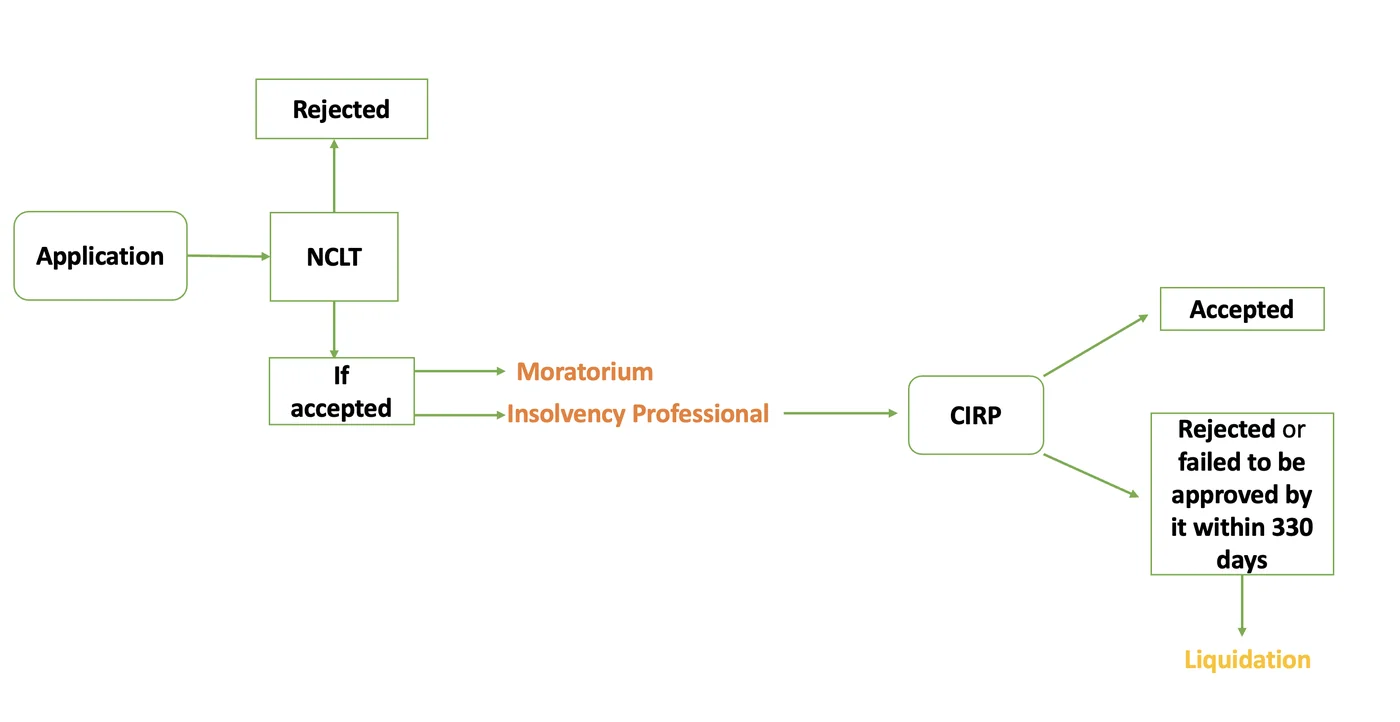
- A Financial Creditor (a bank, bondholder, ARC) under Section 7.
- An Operational Creditor (a trade supplier or employee) under Sections 8-9 after a 10-day demand notice.
- The Corporate Debtor itself under Section 10.
Once admitted by NCLT, a moratorium under Section 14 kicks in, freezing all suits, recoveries and enforcement actions against the corporate debtor. An Interim Resolution Professional is appointed, public announcement is made, and creditors file claims. The IRP constitutes the Committee of Creditors (CoC) of financial creditors, and the CoC then takes the central decisions — appointing the RP, approving the information memorandum, evaluating resolution plans and voting on the final plan with a 66 per cent voting threshold.
The 270+90-Day Timeline
The Insolvency and Bankruptcy Code prescribes a strict timeline:
- 180 days from admission to complete CIRP — extendable by 90 days with NCLT approval.
- A 2019 amendment imposed an outer limit of 330 days inclusive of litigation.
- A successful resolution plan, approved by 66 per cent of the CoC, is sent to NCLT for approval and becomes binding on all stakeholders.
If no resolution plan is approved within the time limits, the corporate debtor goes into liquidation under Sections 33-54.
The Distribution Waterfall
Section 53 lays down the order of priority in liquidation:
- CIRP and liquidation costs.
- Secured creditors and workmen’s dues (up to 24 months) — pari passu.
- Employee dues (up to 12 months).
- Unsecured financial creditors.
- Government dues and remaining secured creditors who relinquished security.
- Other dues.
- Preference shareholders.
- Equity shareholders.
Operational creditors typically rank lower than financial creditors, a structural feature the Supreme Court upheld in Swiss Ribbons (2019) as reflecting the legislative wisdom of the BLRC.
Landmark Cases under the IBC
A handful of marquee cases have defined how the Insolvency and Bankruptcy Code is interpreted in practice.
Essar Steel
Among the original “Dirty Dozen” referred by the RBI in 2017, Essar Steel was finally resolved in 2019 when ArcelorMittal‘s plan of ₹42,000 crore was approved by the NCLT, NCLAT and ultimately the Supreme Court. The case established the primacy of the CoC’s commercial wisdom over the discretion of NCLT/NCLAT in evaluating resolution plans, and clarified the treatment of operational creditors.
Bhushan Steel and Bhushan Power & Steel
Bhushan Steel was acquired by Tata Steel for ₹35,200 crore in 2018, in a CIRP that demonstrated the Insolvency and Bankruptcy Code’s ability to deliver value through a competitive bidding process. Bhushan Power & Steel went to JSW Steel at ₹19,700 crore, though its resolution was complicated by Section 32A questions on the immunity of the corporate debtor from past offences after a clean acquirer steps in.
Jaypee Infratech
The Jaypee Infratech case, involving thousands of home-buyers, triggered the 2018 amendment that classified homebuyers as financial creditors with voting rights in the CoC. Suraksha Group‘s resolution plan was eventually approved in March 2023 after years of litigation, becoming a landmark for real-estate insolvency.
Videocon Industries
The Videocon Industries case, with ₹64,838 crore of admitted claims, was resolved through the Vedanta-backed Twin Star Technologies plan in 2021, then sent back by NCLAT for reconsideration after public-interest concerns. Litigation continues, and the case remains a cautionary tale on the limits of CoC discretion under public scrutiny.
Recent Amendments
The Insolvency and Bankruptcy Code has been amended six times — 2017, 2018, 2019, 2020, 2021 and 2023 — each amendment addressing emerging gaps.
Personal Guarantors
From 1 December 2019, CIRP provisions of the Insolvency and Bankruptcy Code were extended to personal guarantors of corporate debtors, allowing creditors to proceed against guarantors alongside the corporate debtor. The Supreme Court upheld this regime in Lalit Kumar Jain v. Union of India (2021).
Pre-Packaged Insolvency Resolution
In April 2021 the Insolvency and Bankruptcy Code (Amendment) Ordinance introduced Pre-Packaged Insolvency Resolution Process (PIRP) for MSMEs — a hybrid procedure where the debtor remains in possession and proposes a base plan that is then opened to a “Swiss challenge”. Uptake has been slow but the framework is preserved as an emergency option.
Group Insolvency and Cross-Border Insolvency
A draft framework for group insolvency — to handle insolvent corporate groups as a coordinated whole — and a UNCITRAL Model Law-based cross-border insolvency framework are pending statutory implementation. The Insolvency Law Committee under K.P. Krishnan submitted its recommendations in 2021-22, and a Bill is expected in the 2026 budget session.
IBC and the Banking System
The Insolvency and Bankruptcy Code interacts continuously with banking regulation. The RBI’s June 2019 Prudential Framework for Resolution of Stressed Assets mandates referral to IBC if a resolution plan does not materialise within stipulated timeframes. Recovery percentages under IBC influence Provisioning Coverage Ratios; the framework runs alongside macro instruments like the repo rate and the cash reserve ratio in shaping bank credit decisions. Sovereign bond yields and the fiscal deficit move on news of large IBC resolutions, given the corporate-debt and PSB-recapitalisation linkage.
Performance and Challenges
As of FY25, IBC has admitted over 8,000 CIRPs, with approximately one in three ending in approved resolution plans, the rest going into liquidation or withdrawn. Average resolution time has crept up to 715 days against the 330-day limit, largely on account of NCLT vacancies and complex litigation. Recovery for financial creditors has averaged 32 per cent, far better than pre-IBC norms but still well below claim values. Persistent challenges include NCLT capacity, the haircuts taken by financial creditors, the treatment of operational creditors, and the slow pace of personal-guarantor and individual-insolvency rollout.
Frequently Asked Questions
When was the Insolvency and Bankruptcy Code enacted?
The Insolvency and Bankruptcy Code, 2016 received Presidential assent on 28 May 2016, following the recommendations of the Bankruptcy Law Reforms Committee chaired by T.K. Viswanathan.
Who is the regulator under the IBC?
The Insolvency and Bankruptcy Board of India (IBBI), established on 1 October 2016. It regulates insolvency professionals, professional agencies, professional entities and information utilities.
Which forum adjudicates corporate insolvency?
The National Company Law Tribunal (NCLT) is the adjudicating authority for corporate debtors. Appeals lie to the National Company Law Appellate Tribunal (NCLAT) and on questions of law to the Supreme Court.
What is the CIRP timeline under the Insolvency and Bankruptcy Code?
180 days, extendable by 90 days with NCLT approval — an outer limit of 330 days inclusive of litigation, after the 2019 amendment.
What is the voting threshold of the Committee of Creditors?
A resolution plan must be approved by financial creditors holding at least 66 per cent of the voting share in the Committee of Creditors before it can be submitted to NCLT for approval.
What was the Essar Steel case?
The Essar Steel resolution, completed in 2019 with ArcelorMittal’s ₹42,000-crore plan, established the primacy of the Committee of Creditors’ commercial wisdom and clarified the treatment of operational creditors, in a Supreme Court judgment that anchors much of subsequent IBC jurisprudence.
What is a pre-packaged insolvency under the IBC?
Pre-Packaged Insolvency Resolution Process (PIRP) — introduced in 2021 for MSMEs — is a debtor-in-possession process where the debtor proposes a base resolution plan, subjected to a Swiss-challenge mechanism for higher offers.
Are homebuyers financial creditors under the Insolvency and Bankruptcy Code?
Yes, since the 2018 amendment, homebuyers are treated as financial creditors and have representation and voting rights in the Committee of Creditors of real-estate corporate debtors.
Tell Google you want more of this.
Add Anantam IAS as a preferred sourceOne tap, and this site shows up more often in your own Top Stories, AI Overviews and AI Mode. Remove it any time.