Bio-digesters convert organic waste, human excreta, crop residue and animal dung into biogas and treated water through anaerobic digestion. They bridge three major policy goals simultaneously: rural sanitation, clean cooking fuel and reduced greenhouse gas emissions. In India, bio-digesters range from household biogas plants to large industrial-scale anaerobic digesters that feed compressed biogas into city gas networks. This topic is a high-frequency UPSC theme under GS Paper III (energy, environment, agriculture) and GS Paper II (sanitation, health).
What is a bio-digester
A bio-digester is a sealed chamber where bacteria break down biodegradable organic matter in the absence of oxygen (anaerobic digestion), releasing biogas and leaving nutrient-rich slurry. The biogas can be used for cooking, lighting, vehicle fuel or electricity. The slurry is used as organic fertiliser. Bio-digesters have been adapted for:
- Human waste disposal in remote areas, railways, defence establishments and rural households.
- Agricultural residue management, including the Pusa Decomposer approach for paddy stubble.
- Animal husbandry, processing cattle dung into biogas for farm use.
- Industrial-scale biogas for compressed biogas (CBG) under the SATAT scheme.
Why bio-digesters matter in India
Less than 30 percent of Indians historically had access to toilets; though the Swachh Bharat Mission has dramatically improved this, faecal sludge management remains a challenge. Untreated human waste is responsible for diseases such as dysentery, diarrhoea, amoebiasis, viral hepatitis, cholera and typhoid. Bio-digesters convert this health hazard into usable water and energy in an environmentally friendly way.
Bacteria inside the anaerobic tank feed on faecal matter, degrading it and releasing methane gas that can be used for cooking or heating, along with treated water suitable for irrigation.
DRDO bio-digesters and Indian Railways
The Defence Research and Development Organisation (DRDO) developed a bio-digester based on extremophile anaerobic bacteria sourced from Antarctica and acclimatised to Indian conditions. Salient features:
- No bad smell in toilets.
- Faecal matter in the tank is not visible.
- No infestation of cockroaches or flies.
- No clogging of the digester.
- Effluent is free of odour and solid waste.
- 99 percent reduction in pathogens.
- 90 percent reduction in organic matter.
- No maintenance required; no need to add bacteria or enzymes.
- No solid waste removal.
- Use of phenyl permitted up to 84 ppm.
Indian Railways has deployed DRDO bio-digesters across the passenger coach fleet, replacing open-discharge toilets and eliminating tonnes of daily faecal load on rail tracks.
Pusa Decomposer and crop residue
The Indian Council of Agricultural Research (ICAR) through its Pusa Institute developed a microbial bio-decomposer, branded Pusa Decomposer, that converts paddy stubble into compost within 20 to 25 days. In the 2022 sprays, Punjab, Haryana, Uttar Pradesh and NCT of Delhi applied Pusa Decomposer on 978,713 acres (391,485 hectares), equivalent to about 2.4 million tonnes of straw management. It reduces the pressure to burn crop residue, a major driver of North India's winter air pollution.
Biomass as energy
Biomass has been a foundational energy source for India because it is renewable, widely available, carbon-neutral when sustainably harvested, and can provide firm energy (unlike variable solar and wind). About 32 percent of India's total primary energy use still comes from biomass, and more than 70 percent of the population depends on biomass for cooking, heating and small-scale energy needs.
The Ministry of New and Renewable Energy (MNRE) promotes efficient biomass technologies through the biomass power and cogeneration programme.
Potential
As per an MNRE-sponsored study:
- Current biomass availability in India is estimated at about 750 million metric tonnes per year.
- Surplus availability is about 230 million metric tonnes per year covering agricultural residues, corresponding to a potential of about 28 GW of power.
- An additional 14 GW could be generated through bagasse-based cogeneration in India's 550 sugar mills if they adopted optimal cogeneration technology.
Technology of biomass energy
Combustion
The most common route. Biomass is burned in high-pressure boilers to generate steam, which drives a turbine. The Rankine cycle is similar to thermal power plants except the boiler is designed for biomass. Exhaust can be fully condensed for power or used in cogeneration for combined heat and power.
Gasification
Biomass is partially oxidised to produce a combustible gas mix (syngas) that can drive engines or turbines. More efficient than combustion for small-scale applications.
Pyrolysis
Biomass is heated in the absence of oxygen to produce bio-oil, biochar and syngas. Useful for creating liquid biofuels and soil amendments.
Cogeneration in sugar mills
Sugar mills have traditionally practised cogeneration by using bagasse as fuel. With improved technology (steam at 485 C and 66 bar instead of 400 C and 33 bar), more than 80 kWh of additional electricity per tonne of cane crushed becomes available. Maharashtra, Karnataka and Uttar Pradesh lead bagasse cogeneration in India.
Deployment
More than 800 biomass power and bagasse/non-bagasse cogeneration projects totalling 10,170 MW capacity have been installed in the country as of 2024, feeding power to the grid.
Biogas
Biogas is produced when biodegradable organic materials such as cattle dung, farm biomass, kitchen waste, industry waste, poultry droppings, night soil and municipal waste undergo anaerobic digestion. Biogas plant designs depend on the feedstock.
Composition
Biogas contains 55 to 65 percent methane, 35 to 44 percent carbon dioxide and traces of hydrogen sulphide, nitrogen, ammonia and moisture. Calorific value is about 5,000 kcal per cubic metre.
Uses
- Raw biogas: Clean cooking fuel (replacing LPG), lighting, motive power, electricity generation.
- Biogas in diesel engines: Up to 80 percent substitution; 100 percent biogas engines are also commercially available.
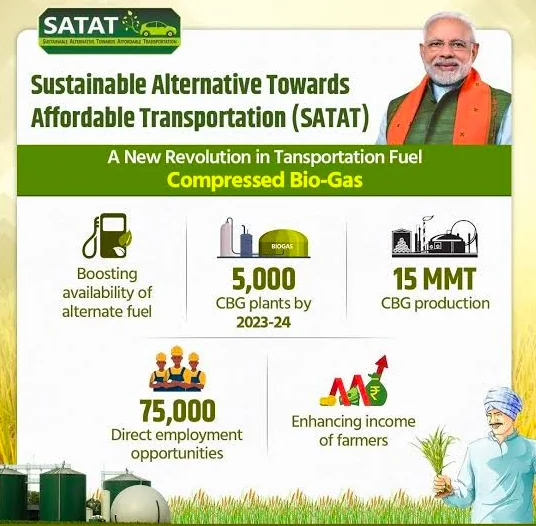
- Compressed Biogas (CBG): Biogas purified to 98 percent methane, filled in cylinders at 250 bar, used as transport fuel under the SATAT (Sustainable Alternative Towards Affordable Transportation) initiative.
Plant sizes
Designs range from 0.5 cubic metre household plants to 15,000-20,000 cubic metre industrial plants. India has over 5 million small household biogas plants installed under the National Biogas and Manure Management Programme (now subsumed under the New National Biogas and Organic Manure Programme).
Potential
With a livestock population of 512 million (including 300 million bovines) and over 230 million tonnes of surplus agricultural residue, India has a massive untapped biogas potential.
Digestate
The slurry output from biogas plants is nutrient-rich organic manure. It improves crop yield and soil health, and is particularly valuable for natural farming practices.
Latest developments (2024-26)
- SATAT Scheme: Over 5,000 CBG plants targeted, with production allocations crossing 15 million tonnes by 2024.
- GOBARdhan Scheme (Galvanizing Organic Bio-Agro Resources Dhan): Integrated approach to rural organic waste management; the 2024-25 budget strengthened it with 300 new community biogas plants.
- Compressed Biogas Blending Obligation (CBO) announced in 2023 requires gas distribution companies to blend CBG into natural gas; starts at 1 percent in 2025-26 and rises progressively.
- Indian Railways completed deployment of bio-toilets across its entire passenger coach fleet by 2023.
- Pusa Decomposer expanded in 2024 crop residue season with state subsidies; coverage exceeded 30 lakh acres.
- COP29 Baku (2024): Biogas and CBG featured prominently in India's adaptation-mitigation narrative, alongside Green Hydrogen.
- Global Methane Pledge: Though India has not joined, it has taken domestic action on methane from rice, livestock and waste sectors where biogas plants directly contribute.
- Carbon farming integration: Biogas adoption earns carbon credits under voluntary markets and the Indian Carbon Market being designed under the Energy Conservation Amendment Act 2022.
UPSC Relevance
Prelims focus
- DRDO bio-toilet and its microbiology (Antarctic anaerobic bacteria).
- Pusa Decomposer: ICAR, paddy stubble.
- SATAT scheme: Ministry of Petroleum and Natural Gas.
- GOBARdhan scheme: Ministry of Jal Shakti.
- CBG composition and Compressed Biogas Blending Obligation.
- MNRE biomass power and cogeneration programme.
Mains focus (GS III)
Typical question framings connect biogas to rural sanitation, clean energy transition, crop residue burning, and agri-waste management. Strong answers integrate Swachh Bharat Mission, Ujjwala (LPG) alternatives, SATAT, GOBARdhan, and the carbon credit potential of methane capture.
Linkages
Bio-digesters connect to SDG 6 (sanitation), SDG 7 (affordable clean energy), SDG 13 (climate action), India's updated NDCs after COP29, the Global Methane Pledge context, the Energy Conservation Amendment Act 2022, the Indian Carbon Market framework, and the Natural Farming Mission (Bhartiya Prakritik Krishi Paddhati).
Tell Google you want more of this.
Add Anantam IAS as a preferred sourceOne tap, and this site shows up more often in your own Top Stories, AI Overviews and AI Mode. Remove it any time.