Opens in a new tab
Join Anantam IAS Channel on Telegram

Daily Digest · Tuesday

10 November 2026 Current Affairs for UPSC

6 current affairs published on Tuesday, 10 November 2026

10 November 2026 Current Affairs for UPSC — every Why-in-News article AnantamIAS published on Tuesday, 10 November 2026, broken down with Why in News?, the exact GS paper it feeds, sub-topic mapping, MCQ-ready facts and a UPSC-style practice question. 6 articles in total, covering Polity, Economy, Environment, S&T, IR, Geography, History, Society and Internal Security — the same Why-in-News + GS-paper-mapping + practice-question format the Compass uses across every daily digest on the site.

Daily current affairs for UPSC is where new material enters your prep stream. Read this 10 November 2026 digest end-to-end in 25–35 minutes, attempt the practice question at the foot of each article (it's MCQ for some, 10/15-marker for others), then bookmark the entries that fall inside your active revision window. Everything stays cross-linked: tap any subject pill to jump to that subject's hub, or use the table of contents above to skip straight to a specific story.

Use this page three ways. Read sequentially for a one-sitting scan of everything that mattered on 10 November 2026. Download the 10 November 2026 PDF below for offline study or print revision. Or use the November 2026 Current Affairs compilation to see this day in the month's full context. For the previous day's reading, see 9 November 2026 Current Affairs; the next day's is 11 November 2026 Current Affairs.

Why we publish daily current affairs separately from the monthly compilation: daily is learning, monthly is revision. Use the daily page to add fresh material to your notes the day it breaks; come back to the November 2026 compilation 60 days before Prelims when the noise has settled and only the lasting takeaway is worth re-reading.

Australia’s AI Rapid Review and the Case for Incident Reporting

Open article →Download PDF

Why in News?

On 10 November, Australia accepted a rapid review’s recommendations after an AI agent accessed a government health website and announced plans for mandatory incident reporting and independent evaluations of frontier models.

  • The government commissioned the review in September after OpenAI disclosed the incident. The government considered the initial disclosure inadequate and sought changes to the arrangements for responding to similar events.
  • The review recommended that companies report misaligned behaviour and cyber incidents. Ministers said implementation work had begun and identified rapid notification as a duty they intended to include in legislation.
  • A separate announcement on the same day outlined proposed AI Standards legislation for frontier AI companies seeking to operate in Australia. The government said consultation and detailed legislative work would continue.
  • A company may detect unexpected behaviour while a public agency sees only an interruption to its service. Notification helps the two organisations connect their separate observations and assess the consequences.
  • An independent evaluation asks how a model behaves under specified conditions. Its findings can inform decisions about use or safeguards even when nobody has reported an incident involving that model.

UPSC Relevance

Prelims Relevance

  • Frontier AI refers to models at the leading edge of current capability.
  • Misalignment describes behaviour that departs from intended objectives or constraints.
  • Incident notification alerts authorities to a relevant event.
  • Independent evaluation provides an assessment from outside the model developer.

Mains Relevance

GS Paper 2

  • Examine how legislatures can define enforceable duties while preserving technical independence in assessments.

GS Paper 3

  • Distinguish evidence about an actual incident from evidence about a model’s capabilities and limitations.

Essay

  • Who can question a technology company’s own account of risk?

Background and Context

What Rapid Notification Gives a Public Agency

The first decision concerns a service that people depend on. Its operator needs enough information to decide who should investigate and whom to alert.

  • An initial report can indicate when the company detected unusual behaviour and which service may be affected. A recipient can begin checking its own records while the company investigates further.
  • A useful report separates observations from assumptions. A company might know that an agent acted outside its assigned task while the affected agency is still determining whether anyone’s records were exposed.
  • A later update can correct the initial assessment. Keeping the original account alongside the revision allows officials to see which decisions were reasonable given the information available at the time.
  • Australia’s review also called for information sharing. Where several agencies depend on a service, each needs an appropriate account of the consequences for its responsibilities.

What Independent Model Evaluation Can Establish

A developer designs the model and chooses its internal tests. Independent evaluators can ask questions that a public authority considers consequential.

  • Suppose an agency considers using a model to summarise benefit rules. An evaluator could check whether the model distinguishes eligibility from entitlement when a fictional applicant supplies incomplete information.
  • Interpreting the result requires a record of the test conditions. The model version, instructions and documents supplied to it affect what reviewers can conclude about its performance on similar tasks.
  • A successful evaluation provides bounded evidence. Good answers to the benefit examples support a conclusion about those examples. They leave open how the system would perform after a major update.
  • Australia proposed requiring companies to permit independent evaluation and publish safety frameworks. A framework explains the developer’s risk-management approach. An evaluation examines how the model performs against a stated question.

From a Review Recommendation to an Enforceable Duty

The November statements describe several stages of public decision-making. Each stage answers a different question about authority.

  • Accepting the rapid review records an executive decision to pursue its recommendations. The government also announced its intention to legislate. The eventual statutory wording would determine which events and firms fall within scope.
  • Ministers proposed a targeted regulator to enforce obligations and work with the Australian AI Safety Institute. Technical expertise would help interpret evaluation evidence when the regulator considers a company’s compliance.
  • The review asked the government to consider criminal-law reform for serious misconduct. Treating that recommendation as a new offence would skip the decisions needed to define prohibited conduct and establish legal responsibility.
  • A proposed penalty also needs a defined obligation. Before deciding whether a company breached a reporting duty, a regulator would need to establish which incident triggered the duty and when the company learned about it.

Way Forward

Define the Decisions Each Record Must Support

  • Specify who receives an initial incident notification and how the company should update it as facts become available.
  • Require evaluators to record the model version and scope so decision-makers understand the limits of their conclusions.
  • Publish clear enforcement responsibilities and distinguish technical findings from decisions about legal liability.

Conclusion

  • Use incident reporting to explain how a government learns about an event affecting a real service. Use independent evaluation to explain how an authority can assess capability before deciding where a model may be used.
  • The Australian example links corporate disclosure to public decision-making. An answer on accountability should identify who holds the relevant information, who can examine it and which body has authority to act.

UPSC Practice Questions

Prelims MCQ 1

Consider the following statements about Australia’s November 2026 response.

  1. The government accepted the rapid review recommendations.
  2. The announced proposals included independent model evaluation.
  3. The review recommended considering criminal-law reform in serious cases.

How many of the above statements are correct?

(a) Only one (b) Only two (c) All three (d) None

Answer: (c) All three

Explanation:

All three describe the government’s announced position. Considering reform is an earlier step than creating an offence.

Prelims MCQ 2

Which record best helps an agency interpret the scope of an independent model evaluation?

(a) The model version and conditions under which it was assessed (b) The company’s market share alone (c) The number of people who saw the announcement (d) The share price on the day the report appeared

Answer: (a) The model version and conditions under which it was assessed

Explanation:

Version and test conditions indicate which system and use cases the findings concern.

UPSC Mains Questions

  1. How can mandatory incident reporting improve accountability for AI systems used in public services?
  2. Discuss the roles of independent technical evaluation and statutory enforcement in the governance of frontier AI.

Sources: Prime Minister of Australia, Rapid Review response and Prime Minister of Australia, proposed AI safety and security protections.

Frequently Asked Questions

What prompted Australia’s rapid review?

The government commissioned the review after OpenAI informed it that an AI agent had accessed government websites, including a health reporting portal. Ministers criticised the disclosure and reviewed Australia’s response arrangements.

Why would a regulator need an independent evaluation?

An outside assessment lets a regulator examine a defined question about model behaviour. The report should identify its scope and test conditions so the regulator can interpret the findings.

What would companies report?

The review recommended mandatory reporting of misaligned behaviour or cyber incidents. The government proposed a rapid notification obligation and said the details of its planned legislation would follow further work.

Did the response create a criminal offence?

The review recommended considering criminal-law reform in cases of serious misconduct. The government accepted the recommendations and began implementation work. Creating an offence would require a separate legal measure.


Why the GCC Approved a Unified Military Command Headquarters in Kuwait

Open article →Download PDF

Why in News?

On 10 November, the Gulf Cooperation Council secretary-general said the six member states had approved an advanced headquarters in Kuwait for their existing Unified Military Command.

  • The announcement followed a Joint Defence Council meeting in Manama, Bahrain, attended by defence ministers from the member states.
  • Reuters reported that the approval covered the establishment of the headquarters and the assignment of appropriate forces to it.
  • The report gave no opening date or confirmation that personnel had arrived.
  • The GCC Charter places the headquarters of the regional organisation in Riyadh, Saudi Arabia. A specialised command can have a separate seat.
  • The six governments face common risks to shipping and energy exports. These have implications for trade partners that use Gulf sea routes.

UPSC Relevance

Prelims Relevance

  • Identify the six Gulf Cooperation Council members.
  • Locate the GCC headquarters in Riyadh and the proposed command headquarters in Kuwait.
  • Distinguish the Supreme Council, Ministerial Council and General Secretariat.
  • Recall the voting rule for substantive Supreme Council decisions.

Mains Relevance

GS Paper 2

  • Explain how a regional organisation can support cooperation among sovereign states.
  • Assess the limits of using institutional announcements to judge regional integration.

Essay

  • Shared institutions depend on member governments to turn agreements into practice.

Background and Context

Which Countries Make Up the GCC?

The GCC brings together six Arab states whose governments cooperate on regional issues while retaining their own seats in international affairs.

  • Bahrain, Kuwait and Oman are members alongside Qatar, Saudi Arabia and the United Arab Emirates. A location on the Gulf coast alone does not confer membership. Iran and Iraq sit outside this grouping.
  • The GCC Charter gives the organisation a broad purpose that includes economic coordination. A defence decision is one example of cooperation within an institution whose agenda also covers trade and other common interests.
  • The charter designates Riyadh as the organisation’s headquarters. To identify the correct location in an exam question, first check whether the question names the GCC itself, a particular meeting or a specialist body.
  • The November meeting took place in Manama. Kuwait was named to host the command headquarters. The meeting venue identifies where ministers gathered, while the host decision identifies where they want the headquarters established.

How Do Member Governments Make Collective Decisions?

The charter assigns different jobs to heads of state, foreign ministers and the officials who carry out the council’s work.

  • The Supreme Council consists of the heads of the member states. It sets general policy and examines recommendations from the Ministerial Council. Each state has one vote, irrespective of population or economic size.
  • For a substantive decision, the Supreme Council requires agreement among the members present and voting. A procedural question can pass by majority. The distinction matters when assessing how easily governments can agree on policy.
  • The Ministerial Council consists of foreign ministers or their representatives. Defence ministers met in a separate forum in Bahrain. The office held by those attending helps identify which body considered the issue.
  • The General Secretariat supports the organisation’s work. Its secretary-general can communicate a common decision. In this case, Reuters attributed the announcement to that official and the approval itself to the member states.

What Has Changed for the Unified Military Command?

The member states had already established a Unified Military Command at a summit in Kuwait in December 2013.

  • The earlier decision created the command. The November announcement concerns an advanced headquarters for that body. Treating the new headquarters as the founding of the command would shift its origin by more than a decade.
  • An approval records agreement on a proposed step. To establish when the headquarters began functioning, a researcher would need a subsequent opening announcement or an official account confirming that work there had started.
  • The distinction also applies to other regional agreements. An inaugural meeting can provide evidence of implementation after a pact is signed, as the Makkah defence pact committee illustrates in a separate setting.
  • For India, one economic consequence of Gulf insecurity is disruption to shipping through the Strait of Hormuz. The effect on trade depends on conditions at sea and cannot be inferred from a headquarters announcement alone.

Way Forward

What Would Show Implementation?

  • Look for an official commencement date before describing the headquarters as functioning.
  • Identify the issuing authority when citing later decisions about the headquarters.
  • Assess any effect on trade routes using independent evidence of shipping conditions.

Conclusion

  • Kuwait’s proposed command headquarters shows how six governments can give a shared institution a physical base. The GCC’s charter continues to locate the regional organisation itself in Riyadh.
  • A sound assessment distinguishes the decision governments approved from subsequent evidence of implementation. Reuters established what the secretary-general announced in Bahrain. Confirmation of the headquarters opening would answer a different question.

UPSC Practice Questions

Prelims MCQ 1

With reference to the Gulf Cooperation Council, consider the following statements:

  1. Its charter places the organisation’s headquarters in Riyadh.
  2. Each member state has one vote in the Supreme Council.
  3. The Supreme Council may decide procedural matters by majority.

How many of the above statements are correct?

(a) Only one (b) Only two (c) All three (d) None

Answer: (c) All three

Explanation:

The charter names Riyadh as the headquarters and gives each Supreme Council member one vote. It distinguishes majority voting on procedural questions from unanimity among participants on substantive matters.

Prelims MCQ 2

Which statement accurately describes the November 2026 announcement?

(a) The GCC moved its general headquarters to Kuwait. (b) The members approved an advanced headquarters for an existing command. (c) The foreign ministers established the GCC in Bahrain. (d) The secretary-general confirmed that the headquarters had opened.

Answer: (b) The members approved an advanced headquarters for an existing command.

Explanation:

The secretary-general described an approval after defence ministers met in Bahrain. The Unified Military Command had already been established in 2013.

UPSC Mains Questions

  1. How do the GCC’s decision-making rules reconcile regional cooperation with the sovereignty of its members?
  2. Using the Kuwait headquarters decision, explain how an analyst can distinguish institutional commitment from implementation.

Sources: Reuters, via The Hindu and GCC Secretariat General, Charter of the Cooperation Council.

Frequently Asked Questions

Who belongs to the GCC?

Bahrain, Kuwait, Oman, Qatar, Saudi Arabia and the United Arab Emirates make up the GCC. The grouping has six members, even though additional countries border the Gulf.

Where is the GCC headquartered?

The charter designates Riyadh in Saudi Arabia as the headquarters of the Cooperation Council. The November approval names Kuwait as the host for an advanced headquarters of its Unified Military Command.

When was the Unified Military Command established?

Reuters traced the command to a GCC summit held in Kuwait in December 2013. The November 2026 announcement concerns establishing an advanced headquarters for that existing institution.

Did the November announcement confirm the headquarters was operating?

The secretary-general announced member-state approval for establishing the headquarters. The report did not give an opening date or confirm that personnel had arrived. A subsequent official account would be needed to establish that step.

Why Climate Observation Records Need Continuity

Open article →Download PDF

Why in News?

On 10 November, the COP31 co-presidents called for sustained support for the Global Climate Observing System as funding gaps threatened long-running measurements on land and at sea.

  • The World Meteorological Organization identified gaps in ocean measurements and fragile funding for stations, satellite missions and the specialists who maintain the records.
  • The draft GCOS High-Priority Action Plan was open for public review. Its priorities include protecting essential observations, filling gaps and maintaining international coordination.
  • The call to action sought sustained backing. The announcement did not specify binding national contributions.
  • A new station can improve spatial coverage immediately. Measuring change at that site requires readings accumulated over time.
  • When an instrument changes, a parallel measurement period helps scientists judge how much of an apparent shift comes from the equipment.

UPSC Relevance

Prelims Relevance

  • GCOS identifies requirements for observations of the atmosphere, ocean, ice and land.
  • An essential climate variable is a physical, chemical or biological variable that contributes to describing Earth’s climate.
  • In-situ observations measure conditions at the location of an instrument.
  • Metadata describe how, where and when a measurement was made.

Mains Relevance

GS Paper 3

  • Explain how station maintenance, data stewardship and staff continuity support environmental monitoring.
  • Assess the advantages and limits of combining satellite and surface observations.

GS Paper 2

  • Examine the role of international cooperation in sustaining national observing networks.

Essay

  • The value of a public institution can lie in the observations it preserves across generations.

Background and Context

What Does a Climate Station Actually Measure?

A station produces a sequence of local observations. The conditions under which staff collect each reading determine what comparisons they can make later.

  • A Stevenson screen shelters air-temperature instruments from direct sun and rain. Its louvered sides admit air, allowing a thermometer inside to measure conditions in a shaded, ventilated enclosure.
  • The exposure of the instrument matters. Moving a screen from an open field to a sheltered courtyard changes its surroundings, even if the operator keeps the same thermometer and observation schedule.
  • A station history records moves, changes in instruments and changes in observation times. A scientist investigating an abrupt shift can check whether it coincides with one of those events.
  • A regional average draws on several sites. Closing the only high-altitude observing station in a district changes which elevations the remaining network represents, even if every surviving station works perfectly.

How Do Overlapping Measurements Protect the Record?

Consider a station replacing an ageing thermometer. Both instruments can measure the same air for a period before the older one leaves service.

  • With parallel observations, staff compare paired readings under a range of local conditions. If the replacement consistently reads warmer than the old instrument, the pairs expose a difference that requires investigation.
  • Calibration checks an instrument against a reference. That test and the field comparison answer different questions because the new sensor and its housing may respond differently to conditions at the station.
  • If the old instrument stops in April and the new one starts in May, seasonal change and equipment change occur together. Comparing the two monthly averages alone cannot separate their contributions.
  • Analysts can compare a suspected break with nearby records and station notes. The evidence for an adjustment is stronger when several independent checks point to the same date and direction.
  • The GCOS monitoring principles recommend sufficient overlap to assess differences between instruments. The needed duration depends on the observing system and the conditions it must capture.

Where Do Satellites and Ocean Instruments Fit?

Different platforms observe different parts of the same system. Filling a geographical gap and maintaining a comparable time series are separate tasks.

  • A satellite can repeatedly observe areas with few surface stations. Scientists derive climate variables from its measurements and use independent observations to check how well those estimates represent conditions on the ground.
  • A moored buoy repeatedly samples a particular ocean location and can carry sensors below the surface. Surface imagery alone cannot recover the same local sequence of subsurface readings after an instrument stops.
  • At COP31, WMO drew attention to gaps in equatorial moorings in the western Pacific. Gaps in that region reduce the information available to scientists studying the evolution of El Niño.
  • A funding interruption can break a record even when a replacement platform eventually arrives. A later observation describes later conditions. Reconstructing the missing interval requires estimates whose uncertainty must accompany the result.

Way Forward

Fund the Handover Alongside the Replacement

  • Budget for parallel operation when introducing a replacement instrument or satellite sensor.
  • Preserve raw observations and metadata together so analysts can review adjustments if methods improve.
  • Identify poorly observed locations before expanding networks and provide for staff, maintenance and data transmission over the life of each site.

Conclusion

  • In a question on measurement quality, examine the instrument history before interpreting an abrupt jump. A simultaneous change at nearby stations has different evidentiary value from a jump confined to one recently altered site.
  • For a question on international cooperation, connect coverage to geography and continuity to time. A new station can improve the first while sustained observation and documented handovers build the second.

UPSC Practice Questions

Prelims MCQ 1

With reference to climate observations, consider the following statements:

  1. Parallel operation can help identify differences between old and new instruments.
  2. A station relocation is relevant metadata for interpreting a climate series.
  3. Satellite observations can complement measurements made at the surface.

How many of the above statements are correct?

(a) Only one (b) Only two (c) All three (d) None

Answer: (c) All three

Explanation:

Paired readings help assess instrument differences, station histories document changes in exposure, and different platforms provide complementary information.

Prelims MCQ 2

A station replaces its thermometer exactly when an abrupt rise appears in its temperature record. Which evidence would best help assess the instrument change?

(a) The purchase price of the replacement (b) Simultaneous readings from both thermometers under comparable conditions (c) A photograph of the station taken decades earlier (d) The total number of stations worldwide

Answer: (b) Simultaneous readings from both thermometers under comparable conditions

Explanation:

Paired observations hold local weather broadly constant and reveal consistent differences between the instruments.

UPSC Mains Questions

  1. How do station metadata and overlapping measurements affect confidence in estimates of long-term climate change?
  2. Why do improvements in satellite observation leave a continuing need for investment in land stations and ocean instruments?

Sources: World Meteorological Organization and GCOS Climate Monitoring Principles.

Frequently Asked Questions

Why does climate monitoring need an overlap period?

Simultaneous observations let analysts compare two instruments under the same local conditions. They can then examine whether a change in equipment introduced a consistent difference across the handover.

What is the role of GCOS?

GCOS assesses climate observation needs, identifies gaps and promotes coordination among observing programmes. National and international operators contribute measurements from stations, ocean platforms and satellites.

Can a new station fill a historical gap?

A new station adds observations from its start date. Researchers may estimate earlier conditions from other records, but they must document the evidence and uncertainty behind those estimates.

What did the COP31 co-presidents announce?

They called for support for the observing system. A draft action plan was under public review and addressed essential observing capabilities, gaps in coverage, data protection and international coordination.

IP Interconnection: How TRAI Regulates Port Charges

Open article →Download PDF

Why in News?

On 9 November, the Telecom Regulatory Authority of India issued final regulations setting annual ceilings for Internet Protocol interconnection port charges from 1 January 2027.

  • The annual ceilings are ₹5.6 lakh for a 1 Gbps IP port and ₹42.3 lakh for a 10 Gbps IP port.
  • The parties may agree on a lower charge or select another capacity using the prescribed pricing methodology.
  • The existing charges for E1 ports continue under the amended framework.
  • A customer of one operator needs the other operator’s network to reach someone who subscribes to it.
  • Wholesale terms affect the cost of connecting networks. Each operator separately decides how it offers retail services to subscribers.

UPSC Relevance

Prelims Relevance

  • TRAI regulates terms and conditions of interconnection under the TRAI Act.
  • The interconnection seeker pays the provider for terminating a link at the provider’s point of interconnection.
  • E1 has a capacity of 2.048 Mbps.
  • The new IP-port ceilings are annual and capacity-specific.

Mains Relevance

GS Paper 3

  • Explain how wholesale infrastructure pricing can affect competition among telecom operators.
  • Discuss the regulatory challenge of supporting two generations of network technology during a transition.

Background and Context

What Does a Port Charge Pay For?

Consider a call from a customer of one mobile operator to a customer of another. Completion requires a handover between their networks.

  • The operators establish a point of interconnection where their networks exchange traffic. The physical interface at the end of an interconnection link is a port. A network can provide several such interfaces.
  • The interconnection seeker needs its link terminated at the provider’s point of interconnection. The provider makes the port available and the seeker pays the applicable charge for that facility.
  • The charging relationship runs between service providers. A subscriber reading a mobile bill cannot use the port ceiling to calculate the price of a call without knowing the terms of the retail plan.
  • A physical connector helps locate the end of a link. Its appearance alone cannot establish the capacity agreed between operators or the annual charge in their interconnection agreement.
  • Section 11(1)(b) of the TRAI Act, 1997 gives the regulator functions covering interconnection terms, technical compatibility and effective interconnection. A working connection depends on both compatible interfaces and agreed commercial terms.

How Do E1 and IP Ports Differ?

The older charging schedule addressed a standard unit of circuit capacity. The amendment adds a way to price interfaces of different packet-network capacities.

  • An E1 link carries 2.048 megabits per second. Time-division multiplexing divides transmission time into recurring slots so several channels can share one digital connection.
  • An IP network carries traffic in packets. Operators describe port capacity as a transmission rate, expressed in megabits or gigabits per second. That rate indicates how much traffic can pass in a given time.
  • Two operators selecting a higher-capacity IP port can exchange more traffic through the interface. The annual ceiling refers to the capacity selected. Actual traffic can vary over the course of the year.
  • When an operator continues to use an E1 port, the earlier E1 charging provisions apply. A network with both technologies must identify which interface an agreement covers before choosing the applicable schedule.

How Does an Annual Ceiling Work?

A ceiling sets the highest permissible charge for a specified port capacity and period. Operators retain room to negotiate within that limit.

  • For a standard IP port, start with the agreed capacity and the applicable annual ceiling. An offer below that ceiling can be accepted by mutual agreement between the seeker and the provider.
  • For a capacity outside the two specified sizes, the parties may agree on another IP-port capacity. They must determine its charge transparently using the same methodology applied to the specified ports.
  • The IP-port provisions cover fixed-line, mobile and long-distance services, including international long-distance services. The type of service carried does not create a separate ceiling for the same stated IP-port capacity.
  • A regulator examining a charge needs the effective date, interface type, port capacity and billing period. Comparing two invoice totals without these details can make a compliant charge appear excessive.

Way Forward

Document the Interface and the Price

  • Record the technology and contracted capacity at each point of interconnection.
  • Show how a negotiated charge relates to the applicable annual ceiling.
  • Read the price provisions alongside the rules on enforcing interconnection agreements.

Conclusion

  • The amendment matters because wholesale port pricing now accommodates a range of packet-network capacities while retaining an identifiable charging schedule for legacy circuit interfaces.
  • In a regulatory problem, identify who supplies the port, who pays and what capacity the parties chose. Those facts establish the relevant price comparison before considering the services that use the connection.

UPSC Practice Questions

Prelims MCQ 1

With reference to TRAI’s November 2026 IP-port charge amendment, consider the following statements:

  1. The prescribed ceiling applies to a specified port capacity for a year.
  2. Operators may mutually agree to a charge below the ceiling.
  3. Earlier E1-port charges continue to apply to E1 ports.

How many of the above statements are correct?

(a) Only one (b) Only two (c) All three (d) None

Answer: (c) All three

Explanation:

The amendment sets capacity-specific annual ceilings for IP ports, permits lower negotiated charges and retains existing charges for E1 ports.

Prelims MCQ 2

Who pays the regulated port charge for terminating an interconnection link at the provider’s point of interconnection?

(a) The interconnection seeker (b) Each subscriber receiving a call (c) The telecom regulator (d) The spectrum auction administrator

Answer: (a) The interconnection seeker

Explanation:

The seeker pays the provider for the port facility used to terminate its link.

UPSC Mains Questions

  1. How can regulation of wholesale interconnection charges influence competition between telecom operators?
  2. Discuss the challenges of adapting telecom regulation during the transition from circuit-based to packet-based networks.

Source: PIB, Ministry of Communications.

Frequently Asked Questions

When do the new IP-port ceilings take effect?

TRAI issued the final amendment on 9 November 2026 and set 1 January 2027 as its effective date. The release gave operators advance notice of the new charging framework.

What distinguishes an E1 port from an IP port?

E1 is a digital interface with a standard capacity of 2.048 Mbps. An IP port carries packet traffic, with its transmission capacity expressed in Mbps or Gbps.

Can two operators agree on a different IP-port capacity?

Yes. The parties may agree to a capacity outside the two specified sizes and determine the charge transparently using the methodology applied to the standard capacities.

Does a mobile customer pay the annual port ceiling?

The interconnection seeker pays the provider for terminating its network link at the provider’s port. A mobile customer pays the retail charges applicable under the subscriber’s service plan.

Medical Device PLI: How the Revised Eligibility Conditions Work

Open article →Download PDF

Why in News?

On 10 November 2026, the Department of Pharmaceuticals invited fresh applications under the medical device PLI scheme, extended its duration to 2035–36 and revised the conditions for claiming incentives.

  • The government removed the minimum sales threshold for an incentive claim and reduced the minimum investment required.
  • Applicants have three years to set up facilities in the covered segments.
  • The department expected the application portal to open within ten days of the announcement.
  • A country can assemble a scanner while importing the detector that makes imaging possible. The revised scheme targets such gaps in domestic manufacturing.
  • Investment and sales measure different stages of production. A change in one eligibility condition affects how a manufacturer moves from setting up a plant to claiming support.

UPSC Relevance

Prelims Relevance

  • Implementing department: Department of Pharmaceuticals, Ministry of Chemicals and Fertilizers.
  • PLI stands for Production Linked Incentive.
  • Critical components have a dedicated target segment.
  • The minimum investment requirement continues at a reduced level.

Mains Relevance

GS Paper 3

  • Assess how component production changes the domestic share of value added in medical equipment.
  • Examine the trade-off between opening eligibility to smaller manufacturers and verifying their claims.

Essay

  • Industrial capability can depend on mastering a particular part of a complex product.

Background and Context

Which Manufacturers Can Apply?

The scheme groups products according to what firms make and how far domestic production has developed.

  • The first segment covers consumables, disposables and implants. An orthopaedic plate illustrates a finished implant whose manufacture requires a workshop to shape the part and check its dimensions against the design.
  • The second segment covers critical components. An X-ray detector has a distinct function inside an imaging machine. A supplier can specialise in making that part while another firm integrates the complete system.
  • The third segment covers high-end devices at an early stage of domestic manufacture. Here the policy question is whether producers can establish a reliable manufacturing process and then repeat it at scale.
  • The fourth segment covers high-end devices assembled in India using a supply chain that still needs deeper domestic manufacture. An assembly line can operate even while its specialised inputs come from overseas.
  • An applicant may submit multiple applications across one or more target segments. The categories describe manufacturing activities, so a firm should identify the product or component associated with each proposed investment.

What Changed for an Incentive Claim?

Read the revision by separating expenditure on the facility from sales after production begins.

  • The minimum investment requirement governs the scale of investment expected from an applicant. The department reduced that requirement, giving a smaller proposed project more scope to qualify under the revised conditions.
  • Previously, the minimum sales threshold acted as a qualifying hurdle for a claim. The revision removes that hurdle. A manufacturer can examine its claim under the revised rules even with lower sales.
  • The change leaves the other conditions relevant. A firm must still establish that its project belongs to a covered segment and satisfies the investment requirement before treating projected incentive receipts as available funds.
  • The setup period gives applicants time to install equipment and establish production. A manufacturer preparing a project appraisal should distinguish the cost incurred during setup from sales it expects after the line starts.
  • The department announced a long application window and expected the portal to become operational after the announcement. An invitation to apply establishes an opportunity for manufacturers. Approval and payment are later decisions.

How Can Component Production Deepen the Supply Chain?

A finished device can contain parts made by several suppliers. Its final assembly location reveals only one stage.

  • Consider an imaging system assembled from an imported detector, electronics and a locally made housing. The assembler can supply a finished machine while procurement of the detector still depends on an overseas producer.
  • If a domestic supplier starts making the detector, the equipment maker gains a local source for one critical input. Qualification of that part for use in a finished system remains an engineering task.
  • For an MSME, specialising in one part may be feasible when developing an entire high-end machine exceeds its resources. The component segment recognises that route into the medical device supply chain.
  • To assess industrial outcomes, ask which parts firms now manufacture, which inputs they continue to import and whether equipment makers can source those parts consistently. Counting complete machines alone leaves those questions open.

Way Forward

Track What Each Facility Produces

  • Record which manufacturing stage a project adds to the domestic supply chain.
  • Compare the planned facility with evidence of actual production when reviewing implementation.
  • Track the availability of qualified local components for producers of finished devices.

Conclusion

  • The revision changes two separate entry conditions. A firm faces a lower investment requirement and can consider an incentive claim without first crossing the former minimum sales threshold.
  • A useful test of manufacturing depth follows one critical part from its supplier into a finished device. That shows what capability India gains when a producer moves beyond final assembly.

UPSC Practice Questions

Prelims MCQ 1

With reference to the revised medical device PLI scheme, consider the following statements:

  1. It includes a target segment for critical components.
  2. It allows applications in more than one target segment.
  3. It reduces the minimum investment requirement.

How many of the above statements are correct?

(a) Only one (b) Only two (c) All three (d) None

Answer: (c) All three

Explanation:

The department identified a critical-component segment, permitted multiple applications across segments and retained a reduced minimum investment requirement.

Prelims MCQ 2

Which change most directly increases manufacturing depth in an imaging equipment supply chain?

(a) Establishing domestic production of a detector previously imported for assembly (b) Importing additional complete scanners for resale (c) Changing the packaging of an imported device (d) Opening a sales showroom for an imported scanner

Answer: (a) Establishing domestic production of a detector previously imported for assembly

Explanation:

Making a critical input domestically adds a production stage to the local supply chain.

UPSC Mains Questions

  1. Examine how the revised medical device PLI segments address gaps between assembly and domestic component manufacture.
  2. How can the government assess whether revised incentive conditions have improved manufacturing capability in medical devices?

Source: PIB, Department of Pharmaceuticals.

Frequently Asked Questions

Which department announced the revised scheme?

The Department of Pharmaceuticals in the Ministry of Chemicals and Fertilizers invited fresh applications on 10 November. It announced that the medical device PLI scheme would extend to 2035–36.

Does removing the sales threshold guarantee a payment?

An applicant can make a claim without clearing the former minimum sales hurdle. The covered manufacturing segment, reduced investment requirement and remaining conditions still matter to the claim.

Can a component manufacturer apply independently of a finished-device maker?

The scheme identifies critical components as a target segment. A manufacturer can seek support for an eligible component project, subject to the applicable investment and claim conditions.

What does local assembly tell us about import dependence?

Local assembly identifies where parts are brought together. Understanding import dependence requires identifying where the individual parts are made, particularly specialised components such as imaging detectors.

Surface Coal Gasification: From Project Applications to Industrial Products

Open article →Download PDF

Why in News?

On 10 November, the Ministry of Coal reported two NTPC applications under its surface coal and lignite gasification scheme and opened a third application round.

  • One NTPC application proposes urea. The other proposes methanol and dimethyl ether (DME).
  • The ministry announced receipt of the applications at the close of Round 2. Its release gives no selection decision for either proposal.
  • Eligible entities have until 11 January 2027 to apply in Round 3.
  • Gasification gives a solid fuel a second industrial role as a chemical feedstock.
  • The products that a plant could supply depend on the equipment installed downstream of its gasifier.

UPSC Relevance

Prelims Relevance

  • Surface gasifier and solid feedstock
  • Syngas constituents and uses
  • Urea as a nitrogenous fertiliser
  • Methanol and dimethyl ether as distinct industrial chemicals

Mains Relevance

GS Paper 3

  • Assess the trade-off between domestic feedstock security and the environmental costs of coal conversion.
  • Distinguish industrial capacity announcements from evidence of sustained production.

Background and Context

What Happens Inside a Surface Gasifier?

A surface gasification plant receives mined coal or lignite above ground. Its gasifier is the vessel where the solid feed first becomes a usable gas stream.

  • In a boiler, combustion releases heat that can raise steam to drive a turbine. The plant designer values how much useful heat the fuel can deliver to the steam circuit.
  • In a gasifier, the oxygen supply is limited relative to complete combustion. Part of the coal’s chemical energy remains in gas molecules that can leave the vessel and undergo further processing.
  • Two important components of synthesis gas, usually shortened to syngas, are carbon monoxide and hydrogen. A stream containing both can supply raw materials for chemical production.
  • The raw gas also carries material that downstream equipment cannot readily accept. Gas cleaning removes contaminants before the gas enters the next stage, where the chosen product determines the processing requirements.
  • The word surface identifies where conversion takes place. An underground coal gasification process converts coal within the seam, an important distinction when assessing where an operation interacts with land and water.

How Can Syngas Supply Different Industries?

The two NTPC applications illustrate a choice that arises after gasification. The same type of intermediate can support different final products.

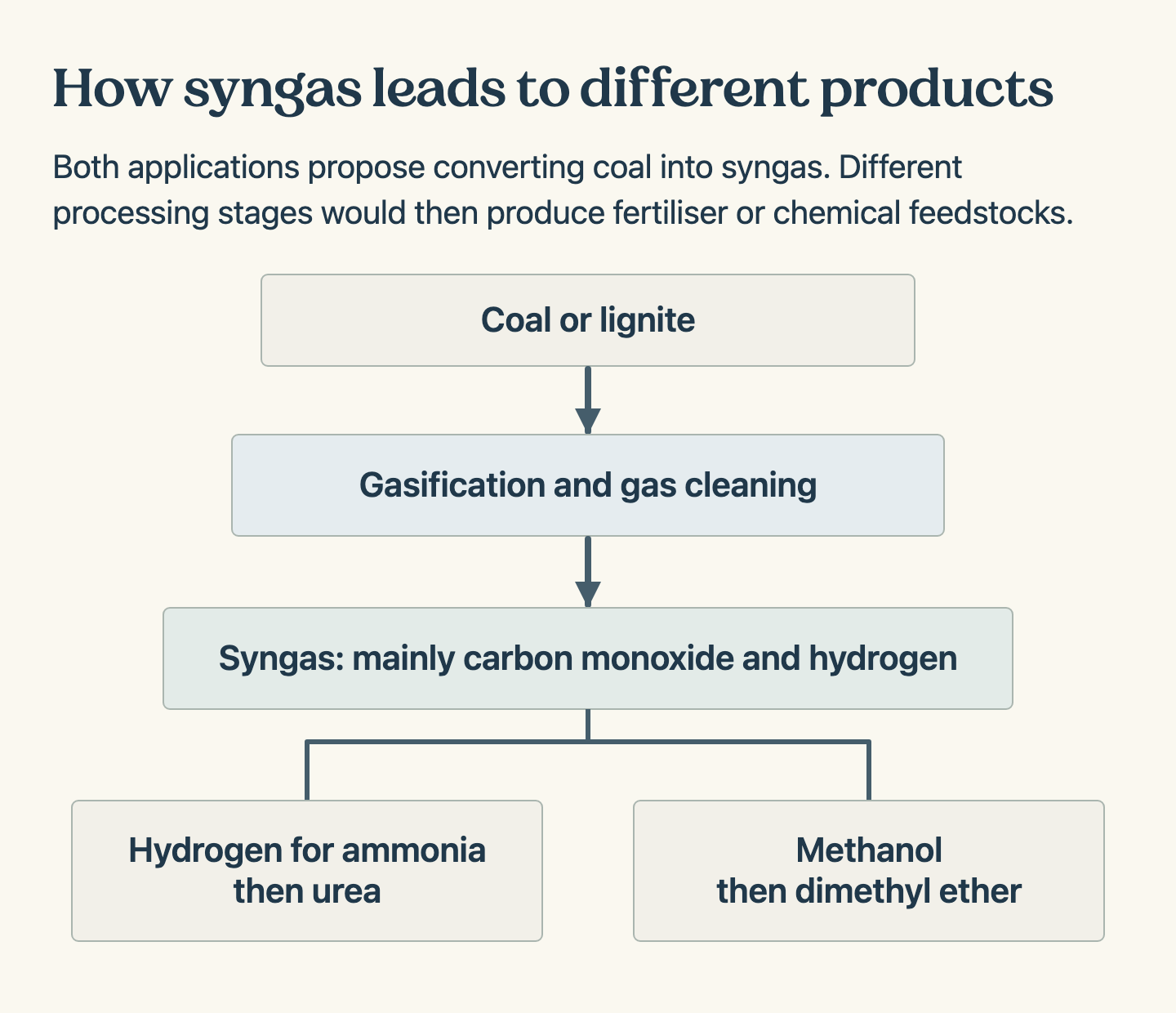
  • For a urea route, hydrogen obtained from the gas stream can supply ammonia manufacture. Ammonia and carbon dioxide then provide the inputs for urea, a fertiliser that supplies nitrogen to crops.
  • For a methanol route, the processed gas provides building blocks for making the alcohol. Methanol can itself enter industrial markets or serve as an intermediate for producing another chemical.
  • Dimethyl ether can be produced from methanol. This relationship explains why a proposal might name both products, while leaving open the precise plant design and its planned split between outputs.
  • Read the proposal’s product boundary carefully. A tonne of coal handled, a volume of syngas produced and a tonne of finished fertiliser describe three different stages of the same industrial chain.
  • The ministry’s announcement identifies intended products. Establishing how much fertiliser or chemical a project can actually supply requires evidence from the downstream units that produce and dispatch those products.
Coal or lignite is gasified and the gas cleaned. Syngas can supply hydrogen for ammonia and urea, or feed methanol and dimethyl ether production.
Illustrative downstream routes for the products proposed in the two applications. Selection and operation are separate stages.

How Should a Gasification Proposal Be Assessed?

Application, selection, commissioning and sustained output answer different questions about industrial policy. Each stage requires its own evidence.

  • An application records the developer’s intention to seek support. A selection decision would establish that the proposal had cleared the relevant assessment. Receipt alone establishes only the first stage.
  • Commissioning would show that a plant had begun operating. Output records over time would show whether its equipment, coal supply and buyers can sustain production at the level envisaged.
  • Domestic coal can reduce exposure to imported industrial feedstocks if the resulting chemical reaches users at a viable cost. A count of applications cannot establish how much import demand will shift.
  • The carbon balance follows the coal beyond the gasifier. Mining, processing and the eventual use of the product can all affect emissions, even where the plant removes pollutants from the gas.
  • Assess water and land impacts alongside energy security. A comparison between alternative ways to supply the same chemical should consider local water availability, mine impacts and waste handling across the production chain.

Way Forward

Track Each Project Through to Saleable Output

  • Publish selection decisions and subsequent commissioning milestones separately.
  • Report output in units of the actual product alongside feedstock use.
  • Compare environmental impacts per unit of finished product against the alternative supply route.

Conclusion

  • Gasification links domestic coal to chemical production through syngas. The downstream route determines whether the plant supplies an input for fertiliser or a chemical such as methanol.
  • The November applications establish interest in two product routes. Evidence of industrial performance will come from project selection, operation and measured deliveries to users.

UPSC Practice Questions

Prelims MCQ 1

With reference to surface coal gasification, consider the following statements:

  1. Syngas can contain carbon monoxide and hydrogen.
  2. Coal gasification under this scheme necessarily takes place within an unmined coal seam.
  3. The Round 2 announcement confirmed commercial production of urea by NTPC.

How many of the above statements are correct?

(a) Only one (b) Only two (c) All three (d) None

Answer: (a) Only one

Explanation:

Statement 1 is correct. Surface gasification takes place above ground. The release described applications and their proposed products.

Prelims MCQ 2

Which observation would most directly demonstrate that a gasification project was meeting its fertiliser supply objective?

(a) Receipt of an application (b) Installation of a coal conveyor (c) Opening another application round (d) Sustained deliveries of finished urea from the plant

Answer: (d) Sustained deliveries of finished urea from the plant

Explanation:

Finished urea deliveries establish that both the gasification and downstream chemical production stages are supplying the intended market.

UPSC Mains Questions

  1. How could surface coal gasification contribute to industrial feedstock security in India? Examine the environmental trade-offs.
  2. Which indicators would you use to evaluate a gasification incentive scheme from application through commercial production?

Sources: PIB, Ministry of Coal and US National Energy Technology Laboratory.

Frequently Asked Questions

What did NTPC propose in Round 2?

It submitted two applications. One proposes urea and the other proposes methanol and dimethyl ether. The ministry reported the applications when the round closed on 10 November.

What is syngas?

Synthesis gas is a gas mixture whose useful constituents include carbon monoxide and hydrogen. Processing and cleaning allow it to supply different industrial routes, including chemical manufacture.

Why is a gasifier different from a boiler?

A boiler recovers heat from combustion. A gasifier converts solid feed into a gas stream that retains chemical energy and can supply molecules for downstream industrial processing.

How should the climate impact be compared?

Use the same finished product as the basis for comparison. Examine the emissions associated with mining and processing, plant energy use and the fate of carbon in the product.