Opens in a new tab
Join Anantam IAS Channel on Telegram

Daily Digest · Monday

9 November 2026 Current Affairs for UPSC

7 current affairs published on Monday, 9 November 2026

9 November 2026 Current Affairs for UPSC — every Why-in-News article AnantamIAS published on Monday, 9 November 2026, broken down with Why in News?, the exact GS paper it feeds, sub-topic mapping, MCQ-ready facts and a UPSC-style practice question. 7 articles in total, covering Polity, Economy, Environment, S&T, IR, Geography, History, Society and Internal Security — the same Why-in-News + GS-paper-mapping + practice-question format the Compass uses across every daily digest on the site.

Daily current affairs for UPSC is where new material enters your prep stream. Read this 9 November 2026 digest end-to-end in 25–35 minutes, attempt the practice question at the foot of each article (it's MCQ for some, 10/15-marker for others), then bookmark the entries that fall inside your active revision window. Everything stays cross-linked: tap any subject pill to jump to that subject's hub, or use the table of contents above to skip straight to a specific story.

Use this page three ways. Read sequentially for a one-sitting scan of everything that mattered on 9 November 2026. Download the 9 November 2026 PDF below for offline study or print revision. Or use the November 2026 Current Affairs compilation to see this day in the month's full context. For the previous day's reading, see 8 November 2026 Current Affairs; the next day's is 10 November 2026 Current Affairs.

Why we publish daily current affairs separately from the monthly compilation: daily is learning, monthly is revision. Use the daily page to add fresh material to your notes the day it breaks; come back to the November 2026 compilation 60 days before Prelims when the noise has settled and only the lasting takeaway is worth re-reading.

RBI’s Foreign Liabilities and Assets Census: How to Read Investment Stocks

Open article →Download PDF

Why in News?

On 6 November, the Reserve Bank of India released provisional results of its 2025–26 census of the foreign liabilities and assets of Indian direct investment entities.

  • At end-March 2026, the rupee value of inward direct investment stood at 4.2 times that of overseas direct investment, down from 5.5 times a year earlier.
  • The published totals show that both positions grew in rupee terms. Outward investment grew faster relative to its starting value, narrowing the ratio even as inward investment remained larger.
  • The RBI values holdings at a reference date. The findings describe the positions that entities reported for the financial year ending in March, several months before the release.
  • A year-end position answers how much an investment was worth on one date. Its change over a year can reflect transactions, movements in asset prices and changes in exchange rates.
  • Reading a change in the ratio as evidence of an investor exit would require separate transaction data. The two totals alone cannot show whether existing investors sold their shares.

UPSC Relevance

Prelims Relevance

  • Inward FDI records a non-resident direct investor’s interest in a resident enterprise.
  • ODI refers to overseas direct investment by a resident entity.
  • A stock is measured at a point in time.
  • A flow is measured over an interval.

Mains Relevance

GS Paper 3

  • Explain how valuation affects the interpretation of external-sector statistics.
  • Assess investment trends using consistent time periods, units and coverage.

Background and Context

Whose Claim Does the Census Record?

Start with the residence of the enterprise whose accounts the RBI collects.

  • Suppose a foreign parent owns shares in an Indian manufacturer. The Indian enterprise records the parent’s interest as an inward equity liability. This ownership claim differs from a loan with a repayment schedule.
  • If the Indian manufacturer also owns a subsidiary abroad, its interest in that subsidiary is an external asset for the Indian enterprise. The same manufacturer can report positions in both directions.
  • The census covers reporting direct investment entities, including certain partnerships and funds alongside companies. Their returns also capture other cross-border claims, such as trade credit owed to an unrelated foreign supplier.
  • The set of respondents can change across rounds. Check reporting coverage before attributing a difference between two published totals entirely to investment decisions by the same group of enterprises.
  • The Indian enterprise supplies the viewpoint in both examples. Its foreign shareholder would describe the shares as an asset in its own accounts. The two descriptions refer to one ownership relationship.

What Can Change While the Investor Holds the Same Shares?

Imagine that the foreign parent keeps its entire stake in a listed Indian company throughout the year.

  • A higher closing share price at the second March-end raises the market value of the parent’s stake in rupees. The parent can record this gain without buying an additional share.
  • Expressing the holding in dollars requires another step. The RBI uses the year-end exchange rate. A weaker rupee can reduce the dollar value of a holding whose rupee price stays unchanged.
  • A purchase or sale during the year is a transaction. A price change on shares already held is a valuation adjustment. Both can affect the difference between opening and closing positions.
  • For a question about transactions in a quarter, consult the balance of payments. For a question about the outstanding holding in March, use the closing position.

Why Does the Valuation Basis Matter?

Read the table heading before comparing listed and unlisted equity.

  • A table at face value uses the nominal amount assigned to each share. A table measuring an investor’s stake at current value can give a different picture of its economic size.
  • For listed equity, the RBI uses closing share prices at the reference date. For unlisted equity, it estimates value from the company’s own funds using a book-value method.
  • The census found that unlisted companies held most inward FDI equity measured at face value. At market value, listed and unlisted companies accounted for roughly equal shares of the total.
  • Even the word share needs a denominator. The proportion of responding companies that are unlisted counts firms equally. Their proportion of total equity weights each holding by its reported value.

Way Forward

Match Each Claim to Its Measure

  • Use the same currency and reference date for both sides of an investment ratio.
  • Check the valuation method before comparing listed companies with unlisted firms.
  • Use transaction statistics to investigate claims about fresh investment or withdrawals.

Conclusion

  • The inward-to-outward ratio describes two outstanding investment positions. A decline can occur as both grow, when the smaller outward position increases faster.
  • In a Mains answer, identify the holder, reference date and valuation basis before interpreting a change. Those details determine whether the figures support a claim about ownership, valuation or new investment.

UPSC Practice Questions

Prelims MCQ 1

With reference to the RBI foreign liabilities and assets census, consider the following statements.

  1. A change in exchange rates can alter the dollar value of a rupee holding.
  2. Listed equity is valued using closing share prices at the reference date.
  3. An entity can report both inward and outward direct investment.

How many of the above statements are correct?

(a) Only one (b) Only two (c) All three (d) None

Answer: (c) All three

Explanation:

The currency conversion uses year-end rates, listed equity uses closing prices and an Indian entity can have direct investors abroad as well as overseas subsidiaries.

Prelims MCQ 2

A non-resident retains the same number of listed shares throughout the year. Their rupee market price rises. What does the price rise represent?

(a) A valuation gain on an existing position (b) An additional purchase of equity (c) A new external loan (d) A reduction in the share count

Answer: (a) A valuation gain on an existing position

Explanation:

The price change increases the value of the holding without a purchase or sale.

UPSC Mains Questions

  1. Explain why an increase in outstanding foreign liabilities can differ from net financial inflows during the same year.
  2. How do differences in equity valuation affect comparisons of foreign direct investment in listed and unlisted enterprises?

Source: Reserve Bank of India.

Frequently Asked Questions

What does the FLA census measure?

It records outstanding cross-border liabilities and assets reported by Indian entities with inward or outward direct investment. Respondents also report other positions, including loans and trade credit.

When did the RBI release the results?

The RBI released its provisional 2025–26 census results on 6 November 2026. The closing positions refer to the end of March 2026, the financial year-end.

Can the investment position rise without a purchase?

Yes. A higher share price raises the market value of the same number of shares. Currency movements can also change their value when expressed in another currency.

What does the lower inward-to-outward ratio show?

Overseas direct investment grew faster in rupee terms than the inward investment position. Both increased during the year, and the inward position remained the larger of the two.


How Swachh Survekshan Assesses Urban Sanitation

Open article →Download PDF

Why in News?

On November 9, the Ministry of Housing and Urban Affairs announced completion of Swachh Survekshan 2025–26, which expanded waterfront coverage and placed greater emphasis on citizen feedback.

  • The assessment covered urban local bodies under Swachh Bharat Mission–Urban. Its indicators examined the services residents receive, the condition of public places and the welfare of people who deliver sanitation services.
  • The wider waterfront assessment included urban riverfronts, coastlines and water bodies. The survey also examined cleanliness at tourist and heritage sites, where visitor numbers can place extra demands on municipal services.
  • Trained assessors made field visits supported by GPS monitoring. Municipal evidence moved through a digital submission and verification process, allowing assessors to connect a reported service with conditions at the location.
  • A municipality can clean the most visible stretch of a riverfront while waste still enters the water upstream. Assessing used water management alongside surface cleanliness helps distinguish these conditions.
  • A resident repeatedly reporting missed collections knows something a single site visit may miss. Citizen feedback brings that experience into the assessment.

UPSC Relevance

Prelims Relevance

  • Swachh Survekshan is the urban cleanliness assessment under Swachh Bharat Mission–Urban.
  • The Ministry of Housing and Urban Affairs oversees the assessment.
  • The survey includes mechanisation of desludging and the welfare of sanitation workers.
  • Trained assessors conduct field evaluations supported by GPS monitoring.

Mains Relevance

GS Paper 2

  • Examine how resident feedback can improve municipal accountability.
  • Distinguish a service record supplied by a city from independent observation.

GS Paper 3

  • Connect waterfront cleanliness to waste collection and used water management.

Essay

  • How a city measures public services influences which failures it sees.

Background and Context

What Counts as Urban Cleanliness?

Follow the waste from a household to its destination. Each point along that journey answers a different question about municipal performance.

  • Source segregation begins where the waste arises. A household may separate wet and dry materials, but mixing them in the same collection vehicle can undo that effort before the waste reaches a processing facility.
  • A swept riverfront tells an assessor about visible cleanliness at the time of the visit. The expanded coverage brings the edges of water bodies into view alongside streets, visitor areas and other public spaces.
  • Used water management requires another inquiry. A clean-looking bank offers little evidence about where drains discharge or what treatment the water receives before it enters the river.
  • The survey also covers sanitation worker welfare and mechanised desludging. An assessment of a functioning public toilet can extend beyond its appearance to how the city manages the waste it generates.

How Is a Municipal Claim Checked?

A city record, an assessor’s visit and a resident’s account offer three perspectives on the same service.

  • Digital submission allows a municipality to document its service. A collection schedule, for example, can identify when a vehicle should visit a neighbourhood and give an assessor a specific claim to check.
  • An assessor on the ground can record what is happening at a collection point. GPS monitoring helps locate that observation, while the visit supplies the evidence about the condition of the site.
  • Citizen feedback can reveal how often residents encounter an overflowing collection point. One visit may coincide with collection day, while residents experience the place throughout the week.
  • When accounts differ, grievance redressal adds a practical test. Checking whether a reported missed collection recurs after a complaint helps a city distinguish recording a request from restoring the service.

What Can a Better Score Establish?

Swachh Shehar Jodi pairs mentor and mentee cities so municipal teams can learn from each other’s practices.

  • The ministry reported improvements among mentee cities across several measures, including door-to-door collection. This describes a change in the measured service between assessments and identifies an area for closer study.
  • A before-and-after comparison leaves an attribution question open. New vehicles, more staff or changes in local budgets could also improve collection during the period in which cities received mentoring.
  • A city interested in transferring a practice should ask what the mentor changed, which wards adopted it and whether the service improved there. That links peer learning to a specific local decision.
  • A fairer comparison would track similar cities over the same period and examine whether both improved. Differences in starting conditions and changes to the assessment itself still matter when interpreting the results.

Way Forward

Use Differences Between Sources to Select Follow-Up Visits

  • Inspect sites where field observations and residents’ accounts repeatedly diverge. Record the day and time so supervisors can check what happened between collection rounds.
  • Ask the responsible municipal authority to assign a team and completion date to recurring complaints.
  • Pair waterfront inspections with checks on drain interception and treatment when the problem concerns discharge into a water body.

Conclusion

  • A waterfront visit can establish what the public space looks like. Assessing the wider sanitation service requires evidence about collection, treatment, working conditions and residents’ experience across time.
  • For a governance answer, follow one municipal claim through its records, a site visit and resident feedback. Explain how a discrepancy would guide the next inspection.

UPSC Practice Questions

Prelims MCQ 1

Consider these statements about Swachh Survekshan 2025–26.

  1. The assessment expanded its coverage of urban waterfronts and coastlines.
  2. Trained assessors conducted field evaluations.
  3. Sanitation worker welfare was an assessment area.

How many of the above statements are correct?

(a) Only one (b) Only two (c) All three (d) None

Answer: (c) All three

Explanation:

The ministry identified expanded waterfront coverage, GPS-supported field visits and worker welfare as features of the completed assessment.

Prelims MCQ 2

Which evidence best complements a field visit when assessing the regularity of household waste collection?

(a) The colour of the vehicle (b) A count of prizes received by the city (c) The location of the municipal headquarters (d) Residents’ accounts of missed collections over several weeks

Answer: (d) Residents’ accounts of missed collections over several weeks

Explanation:

Residents observe service frequency over time. Their experience can reveal interruptions that a visit on a single collection day would miss.

UPSC Mains Questions

  1. How can citizen feedback and field verification improve urban sanitation assessment? Illustrate with one municipal service.
  2. Assess the limits of using improved sanitation scores to evaluate the impact of peer learning between cities.

Source: PIB, Ministry of Housing and Urban Affairs.

Frequently Asked Questions

Which ministry conducts Swachh Survekshan?

The Ministry of Housing and Urban Affairs oversees the urban assessment under Swachh Bharat Mission–Urban. It evaluates municipal sanitation services, including waste collection, access to sanitation and worker welfare.

Why did waterfront coverage matter in this edition?

Urban riverfronts, coastlines and other water bodies received broader coverage. These sites allow assessors to examine visible public-space cleanliness alongside questions about waste collection and used water management.

How did assessors verify digital evidence?

Trained assessors conducted on-ground evaluations with GPS-enabled monitoring. A recorded location helps identify where a visit took place. Direct observation supplies evidence of conditions at that site.

What is Swachh Shehar Jodi?

It is a peer-learning initiative pairing mentor and mentee cities in urban waste management. The ministry reported improved indicators among mentees, while identifying the contribution of mentorship requires additional evidence.

Earth’s Energy Imbalance and the Heat Stored in the Ocean

Open article →Download PDF

Why in News?

The World Meteorological Organization reported on 9 November that Earth’s energy imbalance had reached its highest level since monitoring began, in an interim climate assessment released at Antalya.

  • The January–September 2026 global average surface temperature was about 1.47°C above the pre-industrial average.
  • The ocean absorbs about 90% of the excess heat that accumulates in the Earth system.
  • WMO expects El Niño to lift surface temperatures further. Its assessment of the full year’s ocean warmth remains provisional.
  • A surface thermometer samples a thin layer of the climate system. Ocean measurements reveal warming beneath that layer.
  • The same year can bring net planetary heating and a transfer of previously stored heat from the ocean to the atmosphere.

UPSC Relevance

Prelims Relevance

  • Absorbed solar radiation and outgoing infrared radiation
  • Positive energy imbalance at the top of the atmosphere
  • Ocean heat content and sea-surface temperature
  • El Niño and tropical Pacific ocean-atmosphere exchange

Mains Relevance

GS Paper 3

  • Explain how heat storage can delay the surface expression of warming.
  • Assess why ocean observations matter for coastal adaptation.

Background and Context

How Earth Gains Energy

Imagine measuring the energy crossing the top of the atmosphere over the whole planet for a year.

  • Some incoming sunlight returns to space after reflection from clouds, ice and other surfaces. Only the absorbed share supplies energy to the Earth system.
  • The warmed surface and atmosphere emit infrared radiation. The amount that escapes to space forms the outgoing side of the energy budget. Both sides must cover the same area and period.
  • When absorbed sunlight exceeds outgoing infrared radiation, the positive imbalance supplies energy to the system. A persistent small difference can add substantial heat when summed across the globe over decades.
  • At a given temperature, more greenhouse gases impede the escape of infrared energy. As the planet warms it radiates more energy outward, so the size of the imbalance can change over time.
  • The distinction is one of units. A scientist can express the imbalance in watts per square metre. Multiplying that rate by area and time gives a quantity of energy in joules.

Where the Excess Heat Goes

The ocean’s depth, circulation and capacity to store heat make it the largest reservoir for the energy accumulating on Earth.

  • Water needs considerable energy for a given rise in temperature. A small temperature change across a thick layer of seawater can represent a large addition to the planet’s heat inventory.
  • Ocean heat content accounts for the volume of water warmed. Two ocean regions with identical surface readings can hold different amounts of heat if warming penetrates to different depths.
  • Wind mixes the upper ocean, while currents carry water and its heat into other regions. To track storage, observers need measurements through the water column across many locations.
  • As seawater warms, thermal expansion raises sea level even if the mass of ocean water stays constant. Melting ice on land raises sea level through a separate addition of water.
  • Some retained energy also melts ice. During melting, energy changes the physical state of water, so a thermometer alone cannot account for the full change in stored energy.

How El Niño Changes the Surface Reading

El Niño shifts the distribution of warm water in the tropical Pacific and alters the exchange of heat with the atmosphere.

  • In a typical El Niño, weaker easterly trade winds allow warm surface water to spread farther east. Reduced upwelling can leave less cold subsurface water at the eastern Pacific surface.
  • A larger area of warm surface water can release more heat to the atmosphere. Global mean surface temperature can rise as the ocean gives up some energy it accumulated earlier.
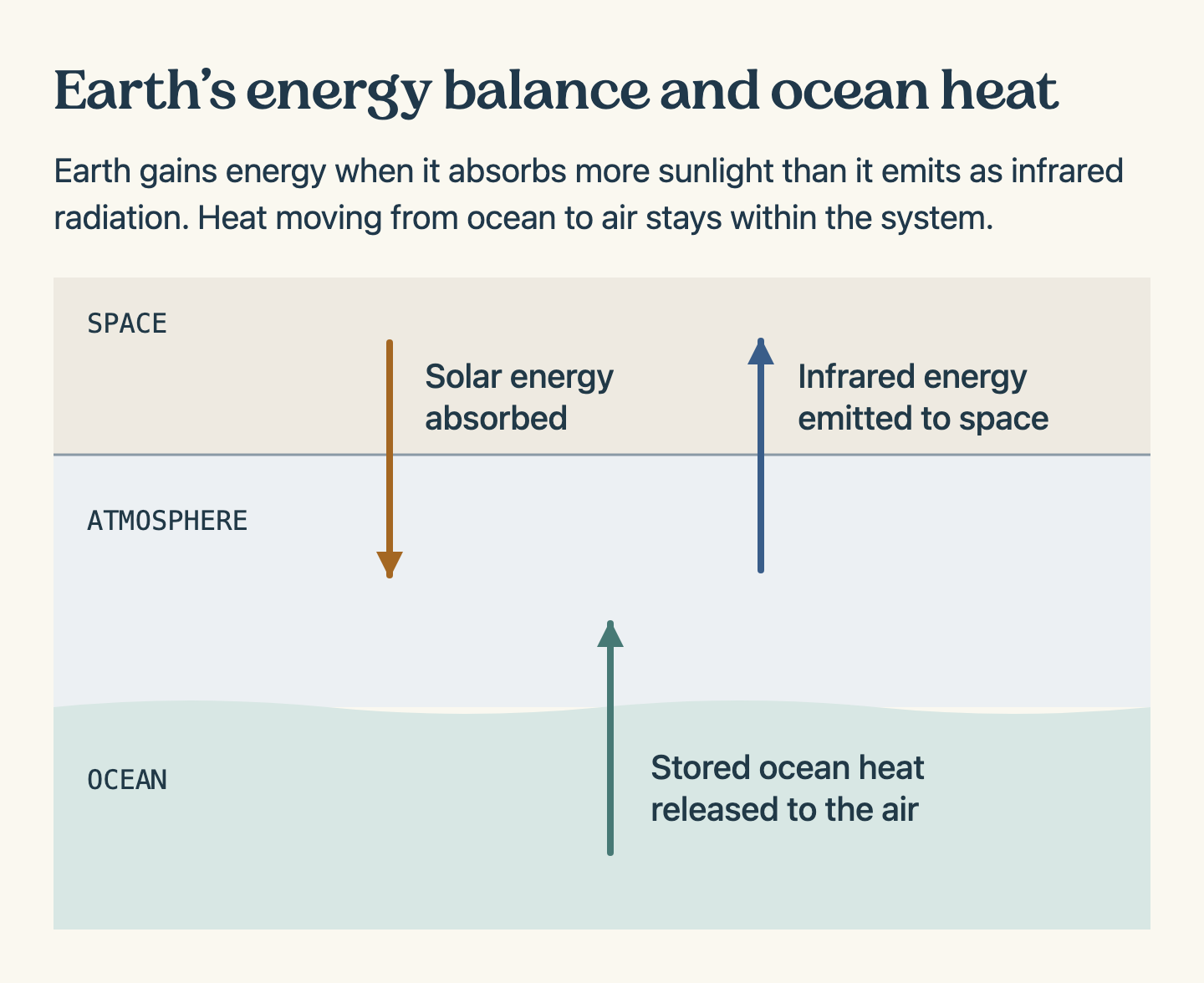
  • Follow the boundary in a budget question. Ocean-to-air transfer crosses a boundary inside the climate system. Earth gains energy overall when net radiation crosses its outer boundary inward.
  • The January–September average describes a particular interval. Completing the year adds more observations, and assessing long-term warming requires a much longer record than one El Niño-affected year.
  • WMO’s December outlook concerns the expected strength of the event. The update includes observations generally through September, so testing that forecast requires observations from the months that follow.
Sunlight enters and infrared radiation leaves across the top of the atmosphere. Ocean-to-air heat release crosses only the ocean surface.
Energy crossing the outer boundary changes the planetary balance. An ocean-to-air transfer redistributes energy already stored on Earth.

Way Forward

Reading Climate Indicators Together

  • Pair surface temperature with ocean heat content when tracking accumulated warming.
  • Identify the reference period and months covered before comparing temperature anomalies.
  • Use a regional forecast to assess local exposure. The global mean alone cannot specify rainfall at a particular location.

Conclusion

  • A planetary energy budget explains why heat accumulates. An inventory of the atmosphere, ocean, land and ice shows where the additional energy has gone.
  • Read a warm year alongside both ocean storage and Pacific circulation. The first tracks accumulated heat and the second helps explain when some of it appears in the surface temperature record.

UPSC Practice Questions

Prelims MCQ 1

With reference to Earth’s energy budget, consider the following statements:

  1. Reflected sunlight contributes to the energy absorbed by Earth.
  2. A positive energy imbalance can coincide with heat transfer from ocean to atmosphere.
  3. Warming a deep layer can increase ocean heat content even with little change at the surface.

How many of the above statements are correct?

(a) Only one (b) Only two (c) All three (d) None

Answer: (b) Only two

Explanation:

Statements 2 and 3 are correct. Reflected sunlight returns to space. Internal ocean-to-air heat exchange can occur while the planet gains energy overall.

Prelims MCQ 2

Which observation would best quantify the change in heat stored in an ocean basin?

(a) A series of air temperatures at one coastal station (b) A satellite image of sea-surface color (c) Repeated temperature profiles across the basin and through its depth (d) The date when the trade winds weakened

Answer: (c) Repeated temperature profiles across the basin and through its depth

Explanation:

Temperature changes over the volume of water, together with water density and heat capacity, allow an estimate of the change in stored energy.

UPSC Mains Questions

  1. Explain how ocean heat content complements global mean surface temperature as an indicator of planetary warming.
  2. Distinguish the role of greenhouse gases from the role of El Niño in a year of exceptional surface warmth.

Source: World Meteorological Organization.

Frequently Asked Questions

What does a positive Earth energy imbalance mean?

Over the period measured, Earth absorbs more energy from sunlight than it radiates back into space. The difference increases the energy held in the ocean, land, atmosphere and ice.

Why measure heat below the sea surface?

Heat can move downward through mixing and circulation. A depth profile helps estimate how much water has warmed, while a surface reading describes only the water near the top.

Can El Niño warm the atmosphere while Earth is already gaining energy?

Yes. The tropical Pacific can release stored heat to the air while the Earth system as a whole continues to gain energy through its radiative imbalance.

What does the 1.47°C figure cover?

It is the approximate global average surface temperature anomaly for January through September 2026 against a pre-industrial baseline. The full calendar year and the long-term warming level use different averaging periods.

Vehicular Emissions in NCR: What the Supreme Court Asked States to Report

Open article →Download PDF

Why in News?

In its 6 November order, uploaded on 8 November, the Supreme Court sought detailed accounts of how Delhi and neighbouring states enforce vehicle emission requirements across the National Capital Region (NCR).

  • The Court gave states two weeks to explain steps taken, respond to suggestions and submit their own proposals.
  • It asked Delhi authorities and three neighbouring states for vehicle-specific responses before the next hearing.
  • The Registry was directed to list the vehicular emissions case on 23 November.
  • An interstate journey can bring a vehicle registered elsewhere into Delhi several times. Registration figures for Delhi alone miss those movements.
  • Inspection returns help establish what agencies did. A claim about how much cleaner the air became requires different evidence.

UPSC Relevance

Prelims Relevance

  • Amici curiae assist the court in examining issues before it.
  • PUC stands for Pollution Under Control.
  • The authorities named include the Municipal Corporation of Delhi and Delhi Police’s Traffic Department.
  • The hearing on vehicular emissions was scheduled separately from the hearing on construction and industrial pollution.

Mains Relevance

GS Paper 2

  • Examine how judicial oversight can assign reporting duties across multiple jurisdictions.
  • Distinguish an agency’s proposal from a measure it has implemented.

GS Paper 3

  • Assess the limits of using vehicle inspection totals to judge citywide air quality.

Background and Context

What Prompted the Reporting Direction?

The bench heard two accounts of enforcement. One described government action, while the other raised questions about the record available to the Court.

  • The Additional Solicitor General, appearing for the Union and the Commission for Air Quality Management (CAQM), described restrictions on vehicle emissions and efforts to curb the burning of crop residue.
  • The amici curiae, lawyers assisting the bench, said compliance with earlier orders from January and February had yet to be properly reported. That observation concerned what officials had placed before the Court.
  • The amici presented GRAP compliance data for 21 October to 3 November. The bench noted fewer reported stubble-burning incidents alongside a rise in reported issues associated with vehicle emissions over that period.
  • Those observations involve different measures. Counting fires and recording enforcement problems cannot establish the fraction of particulate pollution that vehicles contributed on a particular day. That calculation requires evidence about pollutant sources.
  • The Court gave states two weeks to set out what they had done, answer the suggestions of the CAQM and the amici, and identify further steps they independently proposed.

What Must an Enforcement Return Show?

A vehicle approaching Delhi raises separate questions about entry, permission to operate and compliance with emission requirements. The bench asked the authorities to account for each.

  • For entry and operation, each authority must explain the rules already in force for commercial and private vehicles, including those arriving from neighbouring states, and how officials enforce those rules in practice.
  • For emission compliance, the Court sought details of how agencies identify and monitor vehicles that breach prescribed standards. It specifically asked how authorities enforce the requirement for a Pollution Under Control certificate.
  • For over-age and end-of-life vehicles, the question concerns measures taken to prevent entry or continued operation. An account confined to certificate inspections would leave this part of the direction unanswered.
  • For enforcement action, authorities must give counts for the relevant period, including vehicles inspected, challaned or denied entry. Inspection records show checks conducted, while a challan records an enforcement action for a violation.
  • A single vehicle may feature in more than one count. An officer might inspect it and then deny it entry. Adding those figures would count two actions involving the same vehicle.

Who Must Coordinate Across State Borders?

The bench identified traffic entering Delhi from neighbouring states as part of the region’s cumulative vehicle load. Its directions assign reporting duties on both sides.

  • On the Delhi side, the municipal corporation, Delhi government and traffic police must give their respective responses. The Court also named Haryana, Rajasthan and Uttar Pradesh in the same direction.
  • The bench asked about interstate coordination. A response should explain how agencies regulate movement across a boundary and ensure that a vehicle entering from another state meets the applicable emission requirements.
  • Authorities must distinguish current practice from planned changes. For proposed improvements, the Court sought both short-term and long-term measures and a timetable for strengthening enforcement, allowing later scrutiny of progress against those commitments.
  • An earlier judgment had divided the wider air-pollution proceedings into separate issues. The Registry was to list the lead matter alongside each, giving vehicle emissions a hearing separate from construction pollution.

Way Forward

Make Enforcement Returns Comparable

  • Identify the reporting period and vehicle category alongside each inspection total.
  • Show how many inspected vehicles faced each enforcement outcome and identify overlapping counts.
  • Assign a responsible agency and date to each proposed improvement so subsequent submissions can track implementation.

Conclusion

  • The 6 November order asks each authority to connect its existing rules to checks and recorded outcomes. It leaves the substantive examination of vehicular emissions for the scheduled hearing.
  • For an assessment of regional air governance, follow a vehicle across the border. Identify who checks it, what that check establishes and how the receiving authority records the outcome.

UPSC Practice Questions

Prelims MCQ 1

With reference to the Supreme Court’s November order on NCR air pollution, consider the following statements:

  1. The Court sought details of enforcement of Pollution Under Control certification.
  2. The directions covered only commercial vehicles.
  3. The Court asked for details of coordination across state boundaries.

How many of the above statements are correct?

(a) Only one (b) Only two (c) All three (d) None

Answer: (b) Only two

Explanation:

Statements 1 and 3 are correct. The Court expressly included commercial and non-commercial vehicles.

Prelims MCQ 2

Which observation would directly answer the Court’s question about action against violations?

(a) The number of people who commute into Delhi (b) The number of vehicle manufacturers in NCR (c) The number of vehicles denied entry during the reporting period (d) The share of land used for parking

Answer: (c) The number of vehicles denied entry during the reporting period

Explanation:

Denial of entry was one of the enforcement outcomes the bench specifically asked authorities to quantify.

UPSC Mains Questions

  1. How can a court assess implementation of regional emission controls when enforcement responsibilities cross administrative boundaries?
  2. What can vehicle inspection and challan records reveal about air-quality governance, and what further evidence would establish environmental outcomes?

Source: Supreme Court of India.

Frequently Asked Questions

When was the vehicular emissions hearing scheduled?

The order dated 6 November directed the Registry to list vehicular emissions and pollution on 23 November 2026. The lead air-quality matter was to be listed alongside it.

Did the order introduce a new driving ban?

The bench sought details of restrictions already in force, action against violations and measures the authorities proposed. Its operative directions required responses and a timetable for strengthening enforcement.

Why did the Court ask neighbouring states to respond?

Commercial and private vehicles enter Delhi from surrounding states. Their journeys span jurisdictions, so the Court sought accounts of how authorities coordinate checks and enforce emission requirements across state boundaries.

What does a challan count establish?

It records instances in which an authority issued a challan during the reporting period. To assess inspection coverage or changes in air quality, an analyst would need additional evidence.

Rahat Mitra: How India and Myanmar Rehearsed Cyclone Relief

Open article →Download PDF

Why in News?

On 9 November, the Ministry of Defence reported that India and Myanmar had completed their first bilateral tri-service humanitarian assistance and disaster relief exercise, Rahat Mitra, in Chennai.

  • The 5–6 November exercise brought a Myanmar Defence Forces delegation together with personnel from the Indian Army, Navy and Air Force.
  • A severe cyclone scenario gave participants a common problem for joint planning and discussion of disaster management procedures.
  • The second day featured capability demonstrations covering maritime search and rescue, casualty evacuation, field triage and relief camps.
  • A cyclone warning can guide decisions before landfall. Responders still need ways to reach isolated communities when roads, communications or landing sites become unusable.
  • A handover between a rescue crew and a medical team can determine whether an injured survivor receives timely care after reaching shore.

UPSC Relevance

Prelims Relevance

  • HADR stands for humanitarian assistance and disaster relief.
  • Chennai hosted the inaugural India–Myanmar bilateral tri-service exercise.
  • A tabletop exercise uses a scenario to discuss decisions and procedures.
  • Field triage sorts casualties by the urgency of medical attention.

Mains Relevance

GS Paper 3

  • Explain how blocked access and disrupted communications affect rescue and medical evacuation decisions.
  • Use a ship-to-shore handover to illustrate the coordination demands of disaster response.

GS Paper 2

  • Assess how bilateral exercises help neighbouring countries learn each other’s disaster response capabilities.

Background and Context

What Did the Cyclone Scenario Test?

Participants began with a planning problem that a coastal response team could face after a severe cyclone.

  • In the tabletop exercise, the two sides discussed how they might coordinate a response. A shared scenario lets participants compare their decisions when each starts with the same information about a hazard.
  • A planner who receives a warning needs to decide which routes might close and where relief teams could assemble. A cyclone decision support system helps interpret the hazards underlying those choices.
  • A blocked road can isolate a settlement even when food and medical supplies are available nearby. The Army demonstrated obstacle clearance and bridge laying, two ways to restore access under different ground conditions.
  • During a visit aboard INS Sukanya, the delegations examined shipborne relief capabilities. For a coastal planner, a vessel offers an additional way to approach an affected area when overland access becomes difficult.
  • The stated objective was interoperability. For example, a team requesting transport needs to describe the load, destination and urgency clearly enough for a partner using different procedures to act.

How Does a Rescue Reach Medical Care?

Locating someone in distress and getting an injured survivor to suitable care require different capabilities.

  • A Chetak helicopter and INS Bitra demonstrated coordinated maritime search and rescue manoeuvres. Air and surface crews need a consistent account of the search area so that each knows where the other is working.
  • The Navy’s Flood Relief Teams showed specialised equipment for flood operations. The equipment available to a responding team influences whether it can reach a stranded group and bring people back safely.
  • The Air Force demonstrated casualty evacuation using an Advanced Light Helicopter, with Myanmar delegates aboard. Moving an injured person by air also requires a destination that can receive the patient.
  • Field triage sets priorities when several casualties need attention at once. Military Hospital, Chennai, demonstrated triage and camp management, showing how shore teams can organise care for people who reach them.

What Can a Bilateral Drill Establish?

A relief operation depends on information passing between the teams responsible for successive decisions.

  • INS Adyar and the Communication Network Centre in Chennai presented shore arrangements and communications supporting command and control. A rescue crew needs somewhere to report its position and request further assistance.
  • Suppose a landing site becomes unusable while an aircraft is preparing to move a casualty. An updated handover message lets the aircrew and receiving medical team agree on another transfer point.
  • An exercise can expose a procedural mismatch before lives depend on resolving it. Comparing who requests support and who acknowledges the request gives the two sides a practical basis for revising procedures.
  • The Ministry’s account describes discussions and demonstrations. Assessing performance in a real cyclone would require different evidence, including whether teams reached affected settlements and whether receiving facilities could treat the casualties transferred.

Way Forward

Practise the Handover Under Disruption

  • Introduce a communications failure during a future drill and check whether both teams can agree on a fallback channel.
  • Ask the receiving team to confirm location, urgency and transport needs before dispatching an evacuation crew.
  • Review a simulated failed transfer with the search, transport and medical teams together to identify where information stopped moving.

Conclusion

  • Rahat Mitra connects disaster preparedness with bilateral cooperation through a specific task: getting responders from a shared assessment of the hazard to a workable plan for access, rescue and care.
  • A ship or helicopter provides one part of the response. Its contribution depends on shore coordination, including knowing where survivors can land and which medical team can receive them.

UPSC Practice Questions

Prelims MCQ 1

With reference to Exercise Rahat Mitra, consider the following statements:

  1. Its inaugural edition involved India and Myanmar.
  2. Its tabletop exercise used a severe cyclone scenario.
  3. It was conducted exclusively by the two countries’ navies.

How many of the above statements are correct?

(a) Only one (b) Only two (c) All three (d) None

Answer: (b) Only two

Explanation:

The bilateral exercise used a cyclone scenario and involved Indian Army, Navy and Air Force personnel alongside a Myanmar delegation.

Prelims MCQ 2

Which activity best describes field medical triage in disaster relief?

(a) Recording the predicted cyclone track (b) Assigning ships to search sectors (c) Prioritising casualties by urgency of care (d) Restoring a washed-out road

Answer: (c) Prioritising casualties by urgency of care

Explanation:

Triage helps medical teams decide who should receive attention first when several people need treatment.

UPSC Mains Questions

  1. How can poor coordination between maritime rescue and shore-based medical teams affect cyclone response? Illustrate with a practical example.
  2. Examine how bilateral disaster relief exercises can improve preparedness and explain the limits of using exercises to judge operational readiness.

Source: PIB, Ministry of Defence.

Frequently Asked Questions

When and where did Rahat Mitra take place?

India and Myanmar conducted their inaugural bilateral tri-service HADR exercise in Chennai on 5 and 6 November 2026. The Ministry of Defence published its completion report on 9 November.

What did the participants do in the tabletop exercise?

They discussed a coordinated response to a severe cyclone scenario and joint disaster management procedures. Working through the same situation gave them a way to compare approaches before observing the capability demonstrations.

Which assets demonstrated maritime search and rescue?

A Chetak helicopter and INS Bitra took part in coordinated maritime search and rescue manoeuvres. The earlier visit to INS Sukanya focused on familiarisation with shipborne disaster relief capabilities.

How did the exercise cover care after rescue?

Military Hospital, Chennai, demonstrated field triage and the management of relief camps. An Air Force helicopter separately demonstrated casualty evacuation, which helps move an injured person to a receiving facility.

Australia’s Digital Duty of Care Bill and the Risks of Private Messaging

Open article →Download PDF

Why in News?

At an Australian Senate hearing on November 9, Google warned that the proposed Digital Duty of Care could affect children’s access to ordinary email services.

  • The House of Representatives had passed the bill. Senators were examining the proposal when Reuters reported the testimony.
  • A Google witness raised the possibility of age checks extending to email, messaging and private file storage.
  • Other providers warned that uncertainty over harmful conduct could encourage excessive removal of lawful material.
  • A duty focused on service design asks providers to anticipate how their own features might expose users to harm.
  • Private correspondence poses a distinct privacy question because inspecting a message can disclose information about both sender and recipient.

UPSC Relevance

Prelims Relevance

  • Jurisdiction: Australia.
  • Status on November 9: the Senate was considering the proposed legislation.
  • eSafety Commissioner: Australia’s online safety regulator.
  • Risk mitigation: action to reduce the likelihood or severity of an identified harm.

Mains Relevance

GS Paper 2

  • Assess the role of parliamentary scrutiny in defining enforceable duties for intermediaries.
  • Examine how a regulator can assess safety while protecting private communications.

GS Paper 3

  • Explain how platform design influences users’ exposure to harmful material.

Essay

  • The same tool can protect a user in one setting and intrude on another user’s privacy elsewhere.

Background and Context

What Would a Digital Duty of Care Require?

The Australian proposal places responsibility on the provider for risks that arise through the design and operation of an online service.

  • A risk assessment asks who can encounter a harm, which feature creates the opportunity and what the provider can change. The answers depend on how people actually use the service.
  • Consider a public feed that repeatedly promotes a harmful post. A user can report that post, but the provider also controls the recommendation system that sends it to unfamiliar audiences.
  • The provider could change the conditions under which its system recommends similar material. Checking subsequent exposure would show whether that design change reached the people who faced the risk.
  • A complaints process supplies different evidence. Several complaints about one feature can reveal a recurring problem, while a single complaint may call for a response to one user’s experience.
  • The reasonable steps standard matters because a service can reduce exposure without eliminating every harmful interaction. A regulator would need evidence linking the provider’s response to the risk it identified.

Why Did Private Email Feature in the Hearing?

Moving from a public feed to a family inbox changes both the route of exposure and the information a safety measure might reveal.

  • In an email exchange, a sender chooses the recipient. A service that carries that message performs a different function from a platform that selects posts for distribution to a public audience.
  • The Google witness questioned how a provider should respond if a child might receive pornography through an ordinary communications service. She warned that age assurance could extend to services families use daily.
  • Checking a user’s age and examining the contents of a message are different interventions. Each requires its own justification because each involves different personal information and affects different people.
  • A family using shared file storage illustrates the problem. A restriction imposed at the account level could affect access to homework or family photographs even when the concern involves a particular item.
  • The forecast about Gmail access came from a company witness describing a possible compliance response. The hearing supplied evidence about industry’s interpretation while senators continued examining the bill.

How Can Oversight Account for Privacy?

An assessment of proportionality begins with the harm and the service feature that could expose a particular group of users to it.

  • Ask what a narrower intervention could accomplish. For example, a control over who may contact a child addresses unsolicited messages without requiring an assessment of every conversation with an existing contact.
  • Ask how the provider would measure effectiveness. A high count of deleted posts says little about how often children encountered harmful material or how many lawful discussions disappeared.
  • Include the cost of wrongful restriction. A user who loses access to correspondence needs a way to challenge the decision, particularly when access is necessary for education or work.
  • Australian ministers supported broad coverage to protect users across services. Providers warned of over-removal. Parliamentary scrutiny can test both claims by asking how a particular safeguard would operate in a specific service.

Way Forward

Test a Safeguard Against a Specific Harm

  • Specify the feature, affected users and exposure before choosing a control.
  • Compare the proposed measure with a less intrusive option that addresses the same risk.
  • Record how users can challenge an error and how the provider will check whether the measure works.

Conclusion

  • A digital duty of care makes prevention a question of service design. The same risk can require different responses in a public recommendation feed and a private inbox.
  • For a Mains answer, connect the foreseeable harm to a feasible safeguard, identify the privacy cost and explain what evidence would justify continuing or changing that safeguard.

UPSC Practice Questions

Prelims MCQ 1

Consider the following statements about Australia’s proposed Digital Duty of Care as discussed on November 9.

  1. The House of Representatives had passed the bill.
  2. A company witness raised concerns about its possible application to email.
  3. The Senate hearing examined potential consequences for private communications.

How many of the above statements are correct?

(a) Only one (b) Only two (c) All three (d) None

Answer: (c) All three

Explanation:

The bill had passed the House and was under Senate scrutiny. Testimony raised possible privacy and access consequences for everyday communications services.

Prelims MCQ 2

Which measure most directly addresses the design risk created when a public feed repeatedly promotes harmful material?

(a) Checking whether every email sender uses a real name (b) Counting the total number of users on the service (c) Requiring users to delete their private archives (d) Changing recommendation settings and measuring subsequent exposure

Answer: (d) Changing recommendation settings and measuring subsequent exposure

Explanation:

This measure changes the feature responsible for repeated exposure and tests its effect.

UPSC Mains Questions

  1. Discuss how a digital duty of care could change the accountability of online intermediaries.
  2. How should a regulator balance child safety and privacy when assessing measures applied to private messaging?

Sources: Reuters, reported by The Hindu and Australian Government, Department of Communications.

Frequently Asked Questions

What is a digital duty of care?

It is a proposed obligation requiring a provider to anticipate risks arising from its service and take reasonable steps to reduce foreseeable harm to its users.

Had Australia banned children from Gmail?

The November 9 hearing concerned a proposed bill. A Google witness predicted that its interpretation could affect email access for minors. The testimony did not establish a ban.

Why does a public feed differ from email?

A public feed can select and recommend material to new audiences. Email ordinarily carries a message to recipients chosen by its sender, which changes the associated privacy and safety questions.

How can a regulator evaluate a safeguard?

It can identify the source of exposure, examine evidence that the safeguard reduces it and check whether the same measure unnecessarily restricts lawful activity or collects excessive personal information.

Climate Risk After Forced Displacement in UNHCR’s No Escape III

Open article →Download PDF

Why in News?

On 6 November, UNHCR released No Escape III, reporting that climate hazards threaten people who have already fled conflict and can disrupt their recovery after they return home.

  • The report draws on displaced communities’ accounts of heat, flooding and pressure on water supplies.
  • More than two-thirds of refugees who returned home in the first half of 2026 returned to countries highly vulnerable to climate hazards.
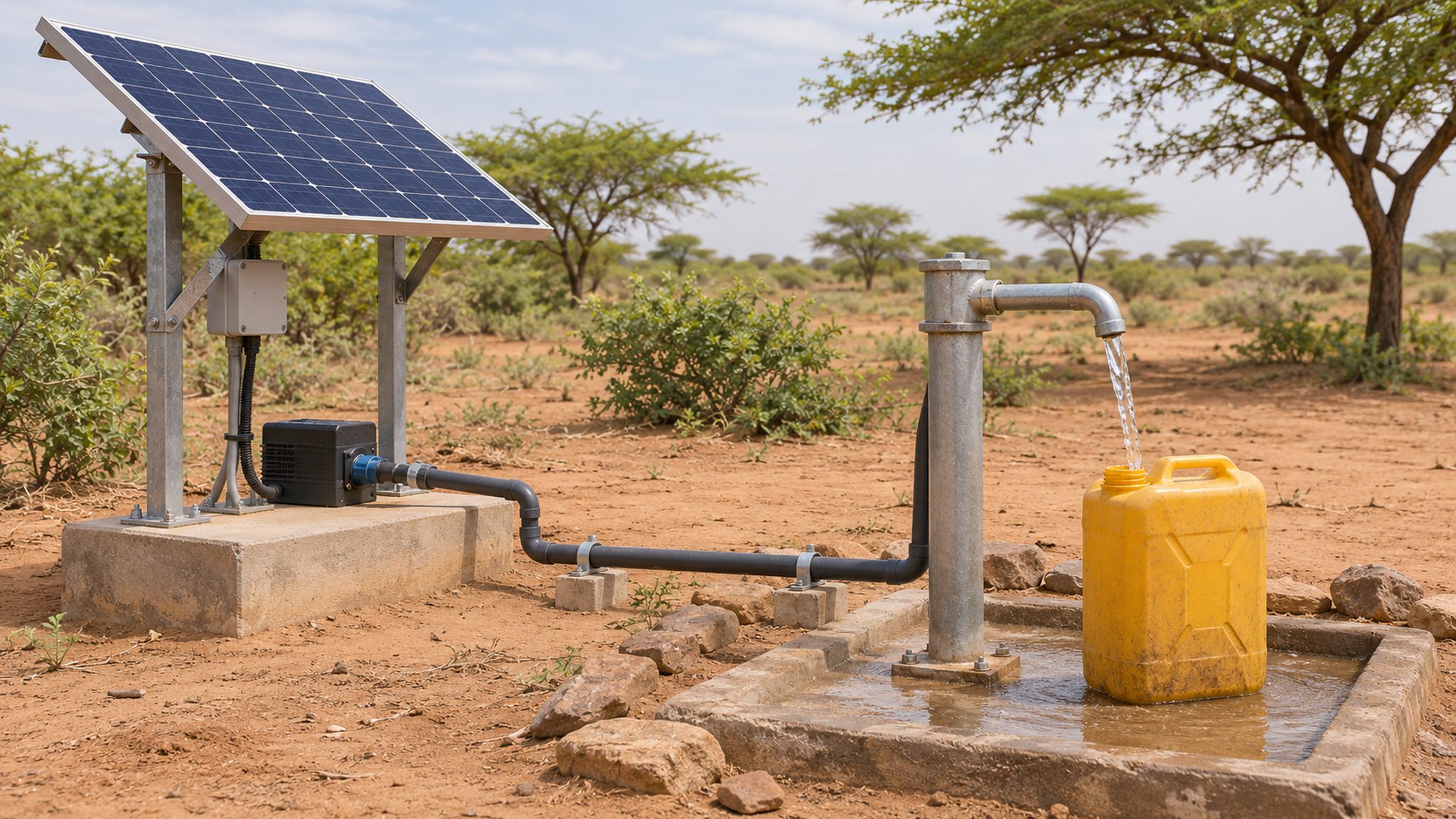
  • UNHCR highlighted adaptation by displaced people and host communities, including solar-powered water systems in the Sahel.
  • A family can escape fighting and encounter a separate climate hazard in the place where it finds shelter.
  • Shared water supplies connect the host community and new arrivals through the same local infrastructure.

UPSC Relevance

Prelims Relevance

  • UNHCR is the UN refugee agency.
  • Internal displacement takes place within a country’s borders.
  • Exposure concerns people or assets in places affected by a hazard.
  • Adaptation can reduce harm from climate hazards in a settlement or place of return.

Mains Relevance

GS Paper 2

  • Assess how international assistance can serve refugees and host communities together.

GS Paper 3

  • Use local exposure and service reliability to assess disaster risk after return.

Essay

  • What does rebuilding a home require after a family crosses its threshold again?

Background and Context

Why Exposure Can Persist After Flight

The reason a family leaves its home and the risks it encounters at its destination are separate questions.

  • A woman interviewed for the report fled fighting in Darfur and found refuge in eastern Chad. During the hotter dry season, collecting water took longer just as her household needed more of it.
  • Her account illustrates exposure after displacement. The armed conflict explains the initial flight. The dry-season water shortage helps explain why daily life in the settlement remained precarious.
  • A country assessed as highly exposed can contain neighbourhoods with different water sources, shade and shelter. Its rating alone cannot establish how much heat a particular family experienced.
  • Internal displacement describes forced movement within national borders. A person leaving a flood-damaged home for another town in the same country remains internally displaced even if the original house becomes permanently uninhabitable.
  • A disaster can interact with conflict or persecution. Deciding a refugee protection question requires the facts of the individual case and the applicable legal criteria. A national hazard rating cannot decide that question.

How Water Services Shape Risk in Host Communities

Two households experiencing the same dry season can face very different costs in obtaining safe water.

  • Consider a settlement served by one distant water point. A longer dry-season trip takes time away from school or work. A water supply nearby can reduce that burden for people living around it.
  • UNHCR cites solar-powered water systems in the Sahel as an example of local adaptation. Solar power can run a pump. The service still depends on a usable water source and equipment in working order.
  • Planning for shared services requires asking who can reach a water point and who maintains it. Both long-term residents and displaced households may depend on the same system during a drought.
  • Heat exposure also varies with living conditions. Shade at the water point and a shorter queue could reduce time spent in the sun even when the air temperature stays the same.

What Makes Return Durable?

A record of movement tells authorities that people came back. Establishing whether they can stay requires follow-up at their destination.

  • A return count records an event. A family can arrive at its former address while the house needs repairs, the nearby well runs dry or the road to work remains impassable.
  • UNHCR describes how flooding along the Euphrates damaged homes in Syria in May and displaced people again. Damage to a newly repaired dwelling can undo a household’s investment in returning.
  • For a durable return, examine safety, secure shelter, services and access to livelihoods over time. A national vulnerability classification can identify areas needing examination, but district evidence guides the choice of intervention.
  • Distinguish observations from projections when using report findings. Residents’ accounts document experienced conditions. A projection of future hazardous heat depends on assumptions and should retain its time horizon and conditional wording.

Way Forward

Measure Conditions Where People Settle

  • Map water access and heat exposure with residents of host settlements.
  • Fund maintenance alongside new water and shelter infrastructure.
  • Follow up with returning households through the next hazard season.

Conclusion

  • A useful assessment follows the household beyond the first move. It asks what hazard the household encounters, how it accesses essential services and whether it can rebuild a livelihood in safety.
  • Use the return statistic to frame a question about reintegration. Evidence from homes, water points and workplaces helps answer whether families can remain through the next flood or dry season.

UPSC Practice Questions

Prelims MCQ 1

With reference to forced displacement, consider the following statements:

  1. People fleeing a flood can be displaced within their own country.
  2. A national exposure classification establishes each resident’s personal exposure.
  3. A count of returns establishes that every returnee has regained a livelihood.

How many of the above statements are correct?

(a) Only one (b) Only two (c) All three (d) None

Answer: (a) Only one

Explanation:

Only statement 1 is correct. Country assessments cannot establish individual conditions, and return counts do not measure livelihoods.

Prelims MCQ 2

Which observation best helps assess whether return after displacement has been durable?

(a) The distance from the original place of refuge (b) The number of journeys on the first day of return (c) The name of the receiving district (d) Continued access to safe housing, water and livelihoods after a hazard season

Answer: (d) Continued access to safe housing, water and livelihoods after a hazard season

Explanation:

Follow-up establishes whether returnees could maintain essential living conditions over time.

UPSC Mains Questions

  1. How can a climate hazard increase vulnerability after a family has fled conflict? Illustrate with a host-community service.
  2. Discuss the evidence needed to assess durable reintegration after refugees return home.

Source: United Nations News.

Frequently Asked Questions

What is No Escape III?

UNHCR’s report examines climate hazards affecting people who have been forcibly displaced. It includes accounts from displaced communities and describes adaptation efforts involving people living alongside them.

Can the country rating predict household exposure?

The rating identifies a broad setting for further investigation. Local conditions, including the location of a dwelling, access to water and shelter from heat, affect household exposure.

What does internal displacement mean?

Internally displaced people have been forced to leave their homes while remaining within their own country. Conflict and disasters can both trigger this kind of movement.

Why follow up after a return?

A count of arrivals gives the timing and scale of movement. Follow-up shows whether families can obtain safe shelter and water, earn a living and remain through subsequent hazards.