Why in News?
The Hindu reported that the Supreme Court is set to hear a special leave petition challenging the Gujarat High Court’s approval of Waqf Tribunal orders that rejected proceedings after the claimants did not correct suit valuation and pay the required.
- The case before the Supreme Court is Ahmedabad Sunni Muslim Waqf Committee v. Gujarat State Waqf Tribunal, SLP(C) No. 18353 of 2026. It remains pending, so the Supreme Court’s questions or oral observations are not.
- On 1 June 2026, a Bench of Justices P. S. Narasimha and Aravind Kumar asked counsel to identify the legal source of the claimed exemption and granted time for additional material. The official cause list identified.
- The challenged line of Gujarat High Court authority began with the 17 December 2025 judgment in Sunni Muslim Idgah Masjid Trust v. Hardik Sitaram Patel, which dismissed a batch of civil revision applications arising from.
- The underlying proceedings concerned recovery of possession from tenants or alleged encroachers and related relief such as mesne profits. The Tribunal had directed correction of valuation and payment of deficit court fees before rejecting the plaints.
- The High Court held that calling the initiating document an application did not remove court-fee liability when the proceeding, in substance, involved adversarial adjudication of civil rights and relief comparable to a suit.
- Court fees serve a fiscal and regulatory role, but an unaffordable upfront demand can become a procedural barrier when a specialised tribunal is the forum designated by law.
- The controversy is not a general ruling on waqf ownership or the validity of the 2025 amendments. Its immediate focus is forum procedure, fee liability and rejection of proceedings.
- For UPSC answers, the issue connects tribunal design with Article 14, fair access under Article 21, the constitutional goal of equal justice in Article 39A, and the division of legislative fields under the Seventh.
UPSC Relevance
Prelims Relevance
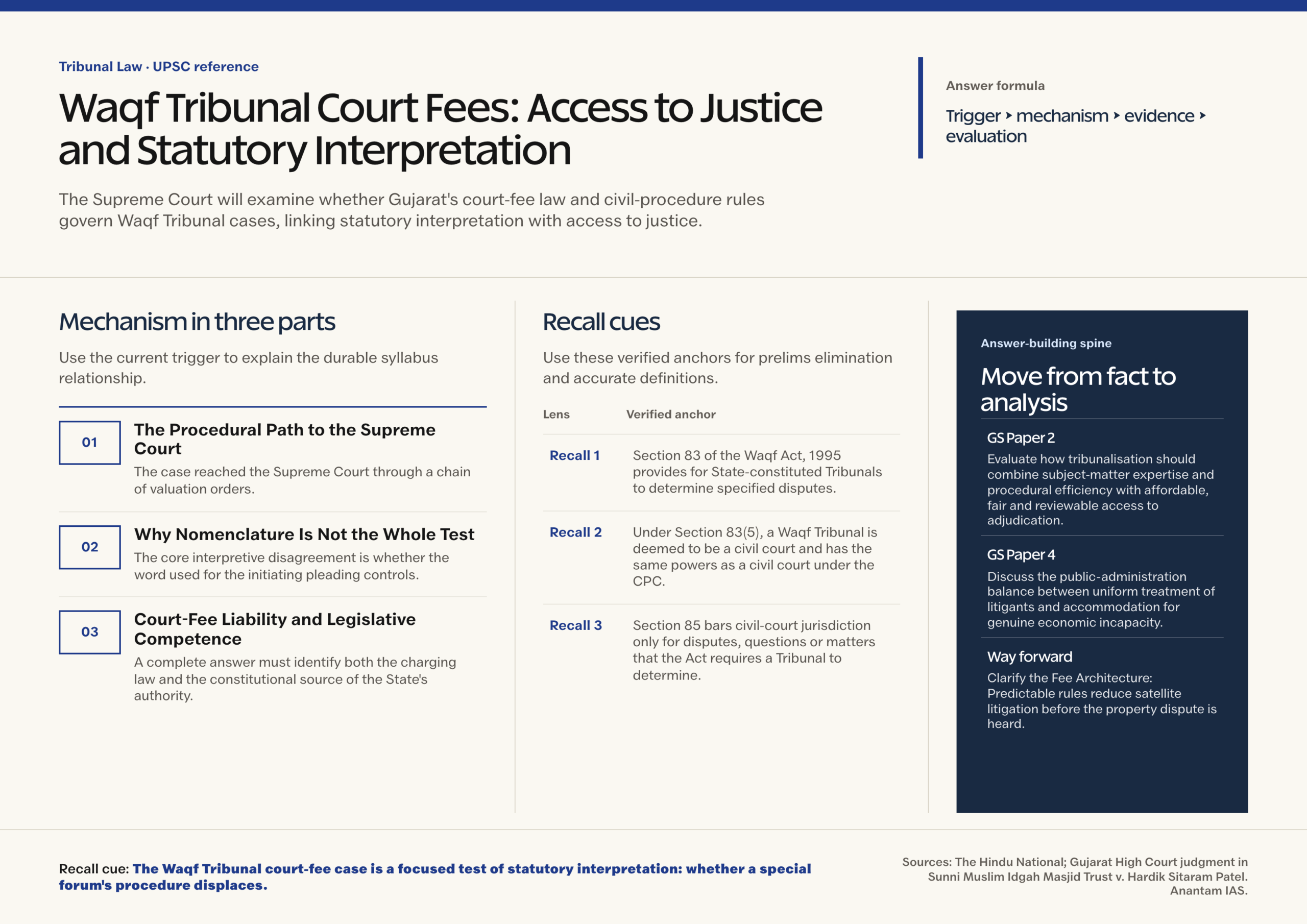
- Section 83 of the Waqf Act, 1995 provides for State-constituted Tribunals to determine specified disputes, questions and matters relating to waqf or waqf property, including listed tenancy matters.
- Under Section 83(5), a Waqf Tribunal is deemed to be a civil court and has the same powers as a civil court under the CPC while trying a suit or executing a decree or order.
- Section 85 bars civil-court jurisdiction only for disputes, questions or matters that the Act requires a Tribunal to determine; the bar is tied to the statutory subject matter.
- Order VII Rule 11(b) CPC concerns an undervalued relief when the plaintiff fails to correct the valuation within the time fixed by the court.
- Order VII Rule 11(c) CPC concerns a plaint on insufficiently stamped paper when the plaintiff fails to supply the required stamp paper within the time fixed.
- Section 149 CPC allows a court, in its discretion, to permit payment of the whole or part of a deficient court fee at any stage; once paid, the document ordinarily has the same force as if.
Mains Relevance
GS Paper 2
- Evaluate how tribunalisation should combine subject-matter expertise and procedural efficiency with affordable, fair and reviewable access to adjudication.
- Explain the interpretive tension between a special law creating an exclusive forum and a general State court-fee law that finances or regulates access to adjudicatory institutions.
GS Paper 4
- Discuss the public-administration balance between uniform treatment of litigants and accommodation for genuine economic incapacity.
- Examine why speaking orders, adequate notice and a real chance to cure defects support procedural fairness even when the State is entitled to collect a lawful fee.
Essay
- Access to justice is shaped not only by the existence of courts and tribunals but also by the cost and design of the path leading to them.
Background and Context
The Procedural Path to the Supreme Court
The case reached the Supreme Court through a chain of valuation orders, rejection orders and revision proceedings rather than through a final decision on the underlying property claims.
- Several waqf institutions filed proceedings before the Gujarat State Waqf Tribunal seeking possession of property from tenants or alleged encroachers and, in some matters, mesne profits or connected relief.
- The Tribunal found that the claims were not properly valued and that the corresponding court fee was deficient. It gave the claimants time to correct the valuation and make good the deficit.
- After non-compliance, the Tribunal rejected the proceedings by invoking Order VII Rule 11(b) and (c) CPC. Those clauses treat undervaluation and insufficient stamping as curable defects before rejection follows.
- Rejection of a plaint for a filing defect is distinct from deciding the underlying title, tenancy or possession claim on evidence. Yet it can have serious practical consequences because a fresh filing may face limitation, renewed.
- The institutions invoked the High Court’s revisional jurisdiction under the Waqf Act. On 17 December 2025, the High Court upheld the applicability of the Gujarat Court Fees Act and CPC principles to these proceedings and declined.
Why Nomenclature Is Not the Whole Test
The core interpretive disagreement is whether the word used for the initiating pleading controls, or whether the court should examine the proceeding’s legal substance.
- The petitioners argued before the High Court that Section 83 refers to an application, the Waqf Act contains no express court-fee levy for it, and the special statutory route should not be equated automatically with.
- The High Court focused on substance over form: parties assert competing civil rights, file pleadings, produce evidence, obtain adjudication, and may seek possession and monetary relief.
- Section 83(5) expressly deems the Tribunal a civil court and gives it civil-court powers under the CPC while trying a suit or executing a decree or order. The High Court treated this text as a strong.
- The presence of a statutory fiction does not answer every procedural question. Courts still ask why Parliament created the fiction, the setting in which it operates and whether importing a particular CPC consequence advances or.
- The harder question is the reach of that deeming provision. A statutory fiction must serve its enacted purpose, and it does not automatically import every incident of an ordinary civil court unless text, context and the.
Court-Fee Liability and Legislative Competence
A complete answer must identify both the charging law and the constitutional source of the State’s authority.
- The Gujarat High Court held that the Gujarat Court Fees Act, 2004 governs the relevant Tribunal filings because no applicable notification, circular or statutory clause granted waqf institutions a blanket waiver in the State.
- Court-fee liability is ordinarily created by legislation. An exemption also needs a sound legal basis; institutional purpose or charitable status alone does not necessarily create one.
- A court fee is different from costs awarded between parties, a security deposit or a penalty. Identifying the levy correctly matters because each has a different legal source, purpose and consequence for non-payment.
- Entry 3 of List II in the Seventh Schedule gives States legislative space concerning the administration of justice and fees taken in courts, apart from the Supreme Court. The Waqf Act, by contrast, is the.
- Fiscal charging provisions are read from their text rather than assumed on broad notions of fairness. At the same time, the authority must show that the document, forum and relief fall within the provision that imposes.
Access to Justice Without Inventing an Exemption
Constitutional concern about affordability can shape procedure and policy even when it does not itself erase a valid statutory charge.
- Article 39A directs the State to prevent economic or other disabilities from denying opportunities for justice. Articles 14 and 21 also inform demands for non-arbitrary and fair procedure.
- These principles do not mean that every court fee is invalid or that every religious or charitable body receives an automatic exemption. The legal status, financial position, nature of the claim and text of the fee.
- Formal equality supports applying the same charging rule to similarly placed litigants. Substantive equality asks whether objectively designed legal-aid or remission measures are needed so that inability to pay does not make the statutory forum illusory.
- Access can be protected through notice of deficiency, reasoned valuation, realistic time to cure, legal aid for eligible persons, instalment or remission schemes authorised by law, and restrained use of terminal dismissal.
- Because Section 85 can exclude the ordinary civil court for matters assigned to the Tribunal, the accessibility of the specialised forum carries added weight. An exclusive forum must be practically usable, though that concern does not.
Way Forward
Clarify the Fee Architecture
- States should publish a clear schedule identifying the fee, valuation method and available exemption or remission route for each major category of Waqf Tribunal relief.
- Tribunal forms and filing portals should show worked examples for possession, declaration, injunction and monetary relief, while making clear that the adjudicator retains authority over valuation.
- Any special fixed-fee regime should be created transparently by competent legislation or delegated rules, not through informal practice that varies between benches.
Conclusion
- The Waqf Tribunal court-fee case is a focused test of statutory interpretation : whether a special forum’s procedure displaces, incorporates or coexists with a State’s general court-fee regime.
- The access-to-justice concern remains real even if no blanket exemption exists.
UPSC Practice Questions
Prelims MCQ 1
With reference to Waqf Tribunals under the Waqf Act, 1995, consider the following statements:
- A State Government constitutes Tribunals for specified disputes and matters relating to waqf or waqf property.
- A Tribunal is deemed to be a civil court and has the same powers as a civil court under the Code of Civil Procedure while trying a suit or executing a decree or order.
- Section 85 bars civil-court jurisdiction for matters that the Act requires a Tribunal to determine.
How many of the above statements are correct?
(a) Only one (b) Only two (c) All three (d) None
Answer: (c) All three
Explanation:
All three statements reflect the statutory scheme of Sections 83 and 85. The jurisdictional bar is not a free-standing bar over every dispute touching a waqf; it applies to matters that the Act requires the Tribunal to determine.
Prelims MCQ 2
Which provision of the Code of Civil Procedure, 1908 expressly gives a court discretion to permit payment of a deficient court fee at any stage?
(a) Section 9 (b) Section 80 (c) Section 149 (d) Order II Rule 2
Answer: (c) Section 149
Explanation:
Section 149 CPC permits the court, in its discretion, to allow payment of the whole or part of a deficient fee. Once the deficiency is paid, the document ordinarily has the same force and effect as if the fee had been paid initially.
UPSC Mains Questions
- The effectiveness of a tribunal depends as much on affordable procedure as on specialised jurisdiction. Discuss with reference to the pending dispute over court fees before Waqf Tribunals. (250 words)
- How should courts reconcile a special central statute with a generally applicable State fiscal law when both appear to govern the same adjudicatory proceeding? Explain the relevant principles of statutory interpretation. (250 words)
Sources: The Hindu National and Gujarat High Court judgment in Sunni Muslim Idgah Masjid Trust v. Hardik Sitaram Patel.
Frequently Asked Questions
What is the issue before the Supreme Court?
The pending special leave petition challenges Gujarat High Court rulings that allowed Waqf Tribunal proceedings to be rejected after deficient court fees were not paid. The central questions concern the application of the Gujarat Court Fees Act, the procedural role.
Has the Supreme Court exempted waqf institutions from court fees?
No. The Supreme Court has not delivered a final merits judgment in this matter. At an earlier hearing, the Bench asked counsel to identify the legal basis for exemption and granted time for additional material. A judicial question during oral.
Why did the Gujarat High Court say court fees were payable?
The High Court found no statutory provision, notification or circular creating a blanket waiver in Gujarat. It also viewed Section 83 proceedings as adversarial civil adjudication in substance: parties seek possession or related relief, exchange pleadings, lead evidence and receive.
What does Order VII Rule 11 CPC do in a court-fee dispute?
Clauses (b) and (c) permit rejection when a plaintiff does not correct an undervalued relief or supply the required stamp paper within the time fixed by the court. The rule builds in an opportunity to cure first. The present appeal.
Does access to justice mean that no court fee can be charged?
No. Access to justice does not create an automatic exemption from every valid fee. It calls for non-arbitrary rules, affordable routes for eligible persons, clear notice and fair opportunities to cure defects. Article 39A supports equal justice and legal aid.