Opens in a new tab
Join Anantam IAS Channel on Telegram

Daily Digest · Thursday

21 May 2026 Current Affairs for UPSC

10 current affairs published on Thursday, 21 May 2026

21 May 2026 Current Affairs for UPSC — every Why-in-News article AnantamIAS published on Thursday, 21 May 2026, broken down with Why in News?, the exact GS paper it feeds, sub-topic mapping, MCQ-ready facts and a UPSC-style practice question. 10 articles in total, covering Polity, Economy, Environment, S&T, IR, Geography, History, Society and Internal Security — the same Why-in-News + GS-paper-mapping + practice-question format the Compass uses across every daily digest on the site.

Daily current affairs for UPSC is where new material enters your prep stream. Read this 21 May 2026 digest end-to-end in 25–35 minutes, attempt the practice question at the foot of each article (it's MCQ for some, 10/15-marker for others), then bookmark the entries that fall inside your active revision window. Everything stays cross-linked: tap any subject pill to jump to that subject's hub, or use the table of contents above to skip straight to a specific story.

Use this page three ways. Read sequentially for a one-sitting scan of everything that mattered on 21 May 2026. Download the 21 May 2026 PDF below for offline study or print revision. Or use the May 2026 Current Affairs compilation to see this day in the month's full context. For the previous day's reading, see 20 May 2026 Current Affairs; the next day's is 22 May 2026 Current Affairs.

Why we publish daily current affairs separately from the monthly compilation: daily is learning, monthly is revision. Use the daily page to add fresh material to your notes the day it breaks; come back to the May 2026 compilation 60 days before Prelims when the noise has settled and only the lasting takeaway is worth re-reading.

3rd India-Nordic Summit 2026

Open article →Download PDF

Why in News?

India and the leaders from the five Nordic nations officially elevated their relations to a Green Technology and Innovation Strategic Partnership during the 3rd India-Nordic Summit in Oslo.

UPSC Relevance: GS-2 International Relations: International Summits  

Mains: India-Nordic Summit, Significance of Nordic Nations to India. 

What is the India-Nordic Summit?

  • The India-Nordic Summit is a multilateral diplomatic forum that brings India together with five Nordic nations– Denmark, Finland, Iceland, Norway, and Sweden for high-level strategic dialogue. The format was established in 2018 and has progressively deepened in scope and ambition. 
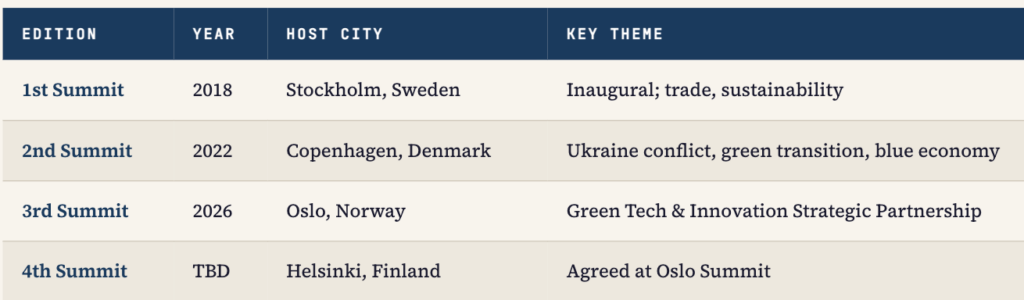
image 74

Trade Agreement Linkage with Nordic countries:

India is the only non-Western country that engages the five Nordic nations at a comprehensive collective summit level. The Nordic countries collectively have a GDP exceeding USD 1.9 trillion, making them a significant economic bloc. 

  • Denmark, Sweden, Finland (EU members) are covered under the India-EU FTA (concluded 2026). 
  • Norway and Iceland (EFTA members) are covered under the India-EFTA TEPA (entered in 2025, alongside Liechtenstein & Switzerland). 
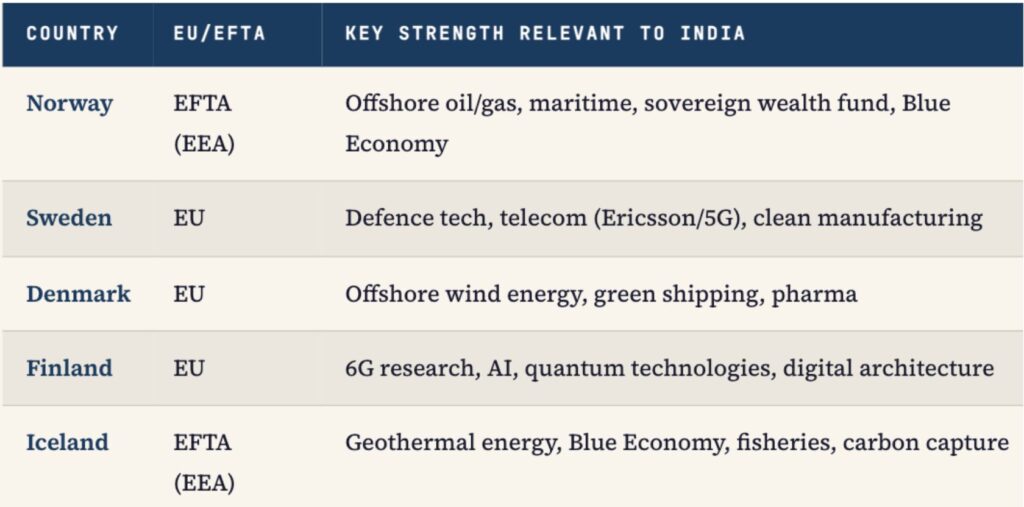
image 75

Key Outcomes of the 3rd India-Nordic Summit: 

  1. Green Technology & Innovation Strategic Partnership: Elevates India-Nordic ties to a strategic level. Covers blue economy, circular economy, digital infrastructure, climate action, energy security, water, and education.
  2. Leveraging India-EU FTA & India-EFTA TEPA: EFTA countries target USD 100 billion investment in India over 15 years, projected to create 1 million direct jobs. Boosts trade, tech transfer & supply chain resilience.
  3. India-Nordic Climate Action Initiatives: Translates Nordic clean-tech innovation into large-scale investible solutions in India. Supports Mission LiFE, LeadIT 3.0. Accelerates renewable energy & low-emission tech cooperation.
  4. India-Nordic Arctic Cooperation: Enhances polar research and joint Arctic research projects. India is an Arctic Council observer (since 2013) and operates the IndARC underwater observatory.
  5. STEM Research Initiative: Joint R&D in identified STEM areas, start-up & incubator linkaOutcome 01: ges. Promotes research in next-gen communications, including 6G technology.
  6. Blue Economy Cooperation: Promotes sustainable Blue Economy, green ship recycling, free & open Indo-Pacific. Jointly works through Indo-Pacific Oceans Initiative (IPOI) under India’s MAHASAGAR vision.
  7. Talent Mobility Promotion: Enhances movement of students, academics, researchers & professionals between India and Nordic nations.
  8. Defence Industrial Collaboration: Taps 100% FDI opportunities being offered to Nordic defence firms in India’s Defence Industrial Corridors (UP and Tamil Nadu corridors).

Geopolitical & Strategic Significance for India: 

India’s engagement with the Nordic bloc reflects a mature, multi-vector foreign policy that goes beyond traditional great-power diplomacy.

  • UNSC Reform: Nordic nations reiterated support for India’s permanent membership in a reformed & expanded UN Security Council. Also support India’s NSG membership bid, diplomatically significant despite China’s veto.
  • Arctic Access: India has been an observer at the Arctic Council since 2013. Norway is a key Arctic state. Growing polar cooperation gives India scientific access, climate data, and a presence in a geostrategically important region.
  • Supply Chain Resilience: India-EU FTA + India-EFTA TEPA opens Europe-quality supply chains. Nordic nations offer high-tech components in defence, telecom, and clean energy, thus reducing dependence on China-dominated supply chains.
  • Counter-Terrorism: Nordic nations condemned the Pahalgam terror attack and the Red Fort incident (2025); backed India’s fight against cross-border terrorism at the UNSC and FATF levels.
  • India as Global South Voice: India positioned itself as a bridge between developed (Nordic) and developing nations, calling for affordable climate finance, technology transfer, and just energy transitions for developing countries.
  • Defence Diversification: Nordic expertise in dual-use technologies, maritime systems & aerospace; 100% FDI offered in India’s Defence Industrial Corridors presents a strategic opportunity to reduce defence import dependency.

Associated Challenges: 

  • Trade Asymmetry: Bilateral trade at $19B is modest relative to India’s trade with the EU as a whole; significant untapped potential remains.
  • Technology Transfer Barriers: Nordic dual-use and defence technologies face export-control restrictions; bridging this gap requires policy-level commitments beyond summit declarations.
  • NSG Membership: Nordic support for India’s NSG bid is diplomatically significant but insufficient to overcome China’s consensus-based veto.
  • Climate Finance Gap: Nordic nations are advanced economies; ensuring commitments on affordable climate finance and technology transfer for developing nations requires institutional follow-through.
  • TEPA Implementation: The $100B investment target over 15 years requires consistent ease-of-doing-business reforms in India and dedicated investment facilitation mechanisms.
  • Arctic Governance: India’s observer status in the Arctic Council limits its formal decision-making role; deeper engagement requires managing geopolitical complexities involving Russia and China.

Way Forward: 

  • Establish a dedicated India-Nordic Green Technology Fund to operationalise climate-tech investment commitments.
  • Leverage GIFT City as a neutral financial hub to channel Nordic sovereign wealth into India’s green infrastructure projects.
  • Institutionalise the India-Nordic STEM Research Initiative through university MOUs, joint labs, and student exchange quotas.
  • Integrate Nordic defence FDI into both Defence Industrial Corridors under a streamlined single-window clearance mechanism.
  • Strengthen India’s scientific Arctic engagement, building on the IndARC observatory to contribute substantively to polar research — supporting a future bid for enhanced observer status.
  • Create a Joint Trade Facilitation Cell under the India-EFTA TEPA framework to track the $100B investment target with quarterly benchmarks.

Practice Question for Mains: 

Q. Examine the strategic significance of the 3rd India-Nordic Summit for India’s foreign policy goals in a multipolar world order. How does the Green Technology and Innovation Strategic Partnership align with India’s climate and development objectives?  

Who is Veera Pasi, the ‘forgotten hero’ of the 1857 Revolt?

Open article →Download PDF

Why in News?

The Leader of Opposition in the Lok Sabha unveiled a statue of Veera Pasi, described as a “forgotten hero” of the 1857 revolt, in Raebareli, Uttar Pradesh. 

The move is politically significant as it comes ahead of the Uttar Pradesh Assembly Election (2027). The Pasi community is the second-largest Scheduled Caste sub-group in UP.

UPSC Relevance: GS-1 Indian History: Modern India 

Prelims: Veera Pasi, Subaltern Resistance

Who is Veera Pasi?

  • Veera Pasi was born in 1835 in Lodhwari village, Raebareli district, Uttar Pradesh, into an impoverished family belonging to the Pasi caste, a Dalit (Scheduled Caste) community of North India. His original name was Shivdeen Pasi. 
  • Veera Pasi came to serve Rana Beni Madhav Baksh Singh, the ruler of the Shankarpur Estate in present-day Raebareli. According to oral tradition, he was recruited after demonstrating extraordinary physical strength, after which the Rana appointed him as his personal bodyguard and later as one of his most trusted commanders.
image 75 1

Role in the Revolt of 1857: 

  • When the Revolt of 1857 spread to Awadh, Rana Beni Madhav Singh joined the rebellion along with his father, Raja Ram Narayan Singh. 
  • The British forces eventually captured Rana Beni Madhav Singh and imprisoned him.
  • Veera Pasi, displaying remarkable courage, infiltrated the prison with a small band of supporters and successfully rescued Rana Beni Madhav Singh from British captivity.
  • This act of daring so alarmed the colonial administration that the British government announced a reward of ₹50,000 for information leading to Pasi’s capture. 
  • Local folklore records that he was ultimately killed while protecting the Rana from British forces, dying in the service of both his master and his nation.

Veera Pasi’s role, rescuing a rebel chieftain from British captivity and conducting prolonged guerrilla resistance in the Raebareli-Awadh region, exemplifies the Dalit fighter who served not as a passive follower but as a military strategist and commander in his own right.

Notable Dalit and Marginalised Fighters of 1857: The Subaltern Resistance

  • Matadin Bhangi, from the Valmiki caste, is credited by Subaltern historians with alerting Mangal Pandey to the fact that the greased cartridges violated Hindu religious sentiments, arguably sowing the first seed of the revolt.
  • Uda Devi Pasi was a Dalit woman warrior from Awadh who served in the guard of Begum Hazrat Mahal. She is credited with fighting in the Battle of Sikandar Bagh on 16 November 1857, where she is said to have climbed a banyan tree disguised as a man and killed approximately 32 British soldiers before being killed herself. Her story has become one of the most powerful symbols of Dalit resistance in Awadh.
  • Jhalkari Bai, from the Koli caste, served in Rani Lakshmibai’s women’s army and is said to have fought so valiantly that she impersonated the queen herself, allowing Lakshmibai to escape.
  • Banke Chamar and Chetram Jatav, both of whom took part in the rebellion in Uttar Pradesh.

Over the last few years, political parties have worked to invoke Dalit icons from the past and their contributions to the freedom struggle. 

Taiwan Travelogue wins International Booker Prize 2026 

Open article →Download PDF

Why in News?

The novel Taiwan Travelogue by Yang Shuang-zi, translated into English by Lin King, won the International Booker Prize 2026. It became the first Mandarin-language novel to win the award. 

UPSC Relevance: GS-1 Art and Culture: Literature, Awards and Honours 

Prelims: International Booker Prize 2026 

About the Winning Novel: Taiwan Travelogue

  • Author and Translator
    • Written by Yang Shuang-zi.
    • Translated into English by Lin King.
  • Theme of the Novel: The novel is set in 1938 Taiwan, during the period of Japanese colonial occupation (1895-1945). 
  • Plot Overview: Taiwan Travelogue explores colonialism, identity, cultural exchange, and emotional relationships through the journey of a Japanese writer and her Taiwanese translator. Using food, travel, and translation as literary devices, the novel examines tensions between imperial power and personal intimacy.  
image 75 2

International Booker Prize: 

  • The International Booker Prize (earlier known as the Man Booker International Prize) is a prestigious international literary award presented in the United Kingdom.
  • It is awarded annually to a single work of fiction or collection of short stories translated into English (originally written in a language other than English) and published in the United Kingdom or Ireland.
  • Prize Money: £50,000 is shared equally between the Author and the Translator. 
  • Objective: Promote high-quality international literature in English translation. Encourage cultural exchange through literature. 

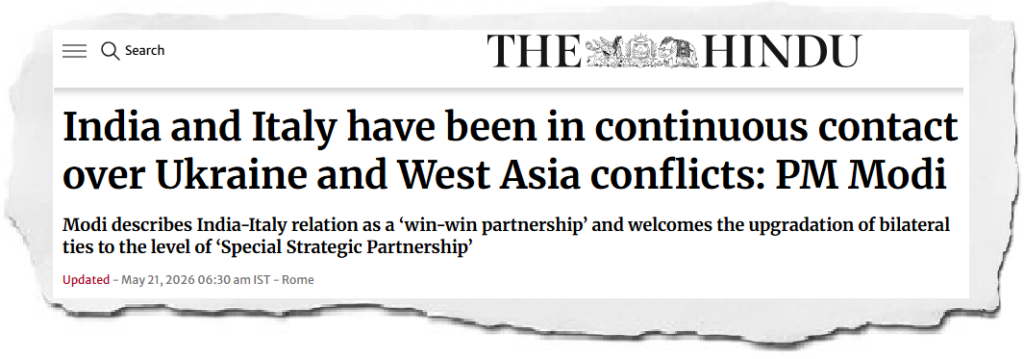
India and Italy have been in continuous contact over Ukraine and West Asia conflicts: PM Modi

Open article →Download PDF

image 75

Why in News?

Prime Minister Narendra Modi, during his visit to Italy, announced the elevation of India–Italy relations to a Special Strategic Partnership, while highlighting sustained engagement on the conflicts in Ukraine and West Asia. The two countries signed multiple agreements covering defence, critical minerals, agriculture, technology and cooperation in Africa.

UPSC Relevance

Prelims:
India–Italy relations, UNCLOS, FAO, India-EU FTA, Critical Minerals.

Mains:
GS II: Bilateral relations, International institutions;
GS III: Energy security, Critical minerals, Agriculture and technology cooperation.

Background

India and Italy have strengthened bilateral engagement in recent years through increasing trade, strategic cooperation and technology partnerships. The relationship has expanded from traditional economic interactions to broader cooperation in security, mobility, energy and global governance issues.

The recent elevation of ties reflects a growing convergence of interests amid changing geopolitical and economic realities.

Key Outcomes of the Visit

Upgradation to Special Strategic Partnership

India and Italy elevated bilateral relations to a Special Strategic Partnership, aimed at expanding cooperation across strategic sectors.

The partnership seeks to strengthen collaboration in trade, defence, technology, innovation, clean energy and mobility.

Defence cooperation

The two countries signed a Defence Industrial Road Map aimed at expanding cooperation in:

Defence manufacturing: Joint production and industrial partnerships.

Technology collaboration: Sharing technological capabilities and research cooperation.

Strategic security engagement: Enhanced institutional cooperation in defence-related sectors.

Cooperation in critical minerals

India and Italy signed an agreement on critical minerals cooperation.

Critical minerals are increasingly important because they serve as key inputs in renewable energy technologies, batteries, semiconductor industries and strategic sectors.

Agriculture and agricultural research

The two countries signed an agreement to strengthen cooperation between institutions and ministries dealing with:

Agricultural research: Collaborative research activities and knowledge exchange.

Technology transfer: Improving agricultural productivity through modern techniques.

Institutional linkages: Building stronger partnerships between research organisations.

Cooperation in Africa

The two sides agreed to undertake trilateral projects with African partners in sectors such as:

Digital Public Infrastructure (DPI): Promoting digital connectivity and governance systems.

Artificial Intelligence: Supporting technological capacity-building.

Healthcare and education: Expanding developmental cooperation.

Renewable energy and connectivity: Supporting sustainable development initiatives.

Geopolitical Dimensions

Position on Ukraine and West Asia conflicts

India reiterated its long-standing approach of resolving disputes through dialogue and diplomacy.

The emphasis reflects India’s broader foreign policy approach of maintaining strategic autonomy while engaging with multiple stakeholders.

Indo-Pacific cooperation

India and Italy expressed support for a free, open and inclusive Indo-Pacific region in accordance with international law and United Nations Convention on the Law of the Sea (UNCLOS).

Strait of Hormuz concerns

Both countries highlighted the importance of freedom of navigation and uninterrupted global trade flows through the Strait of Hormuz.

The Strait is strategically important because a large proportion of global oil and energy trade passes through it.

Significance for India

Strengthening economic ties: Italian companies operating in India can contribute to industrial growth, investments and technology transfer.

Supply chain diversification: Cooperation in critical minerals and manufacturing can help India reduce supply-chain vulnerabilities.

Energy and strategic security: Partnerships in clean energy and critical sectors strengthen India’s long-term energy security goals.

Enhanced global outreach: Joint projects in Africa expand India’s developmental engagement and Global South partnerships.

Challenges

Geopolitical uncertainties: Ongoing conflicts in Ukraine and West Asia continue to create instability in global markets and supply chains.

Trade barriers: Despite growing engagement, unresolved issues continue to affect progress in India–EU trade negotiations.

Implementation challenges: Converting strategic agreements into practical outcomes requires sustained institutional coordination.

Competition in strategic sectors: Competition among major powers in technology, defence and critical minerals may complicate cooperation frameworks.

Way Forward

Deepening technology partnerships: India and Italy should expand collaboration in emerging sectors such as semiconductors, AI and advanced manufacturing.

Strengthening defence industrial cooperation: Joint production and technology-sharing initiatives should be accelerated.

Expanding developmental partnerships: Trilateral cooperation in Africa can be broadened to additional sectors.

Fast-tracking economic agreements: Progress in India–EU trade negotiations can strengthen broader economic engagement.

Conclusion

The elevation of India–Italy relations to a Special Strategic Partnership reflects the growing strategic importance of bilateral ties in an evolving global environment. Stronger cooperation in technology, trade, security and development can strengthen India’s long-term economic and geopolitical interests.

Practice Questions

1. Consider the following statements regarding India–Italy relations:

  1. India and Italy recently elevated their ties to a Special Strategic Partnership.
  2. India and Italy signed agreements related to critical minerals cooperation.
  3. Italy is a member of the Quad grouping.

Which of the statements given above is/are correct?

(a) 1 and 2 only
(b) 2 and 3 only
(c) 1 and 3 only
(d) 1, 2 and 3

Correct Answer: (a)

Explanation: Italy is not a member of the Quad grouping.

2. With reference to UNCLOS, consider the following statements:

  1. UNCLOS deals with international maritime law.
  2. It regulates issues such as navigation rights and maritime zones.
  3. India is not a party to UNCLOS.

Which of the statements given above is/are correct?

(a) 1 only
(b) 1 and 2 only
(c) 2 and 3 only
(d) 1, 2 and 3

Correct Answer: (b)

Explanation: India is a signatory to UNCLOS.

Mains Questions

  1. Discuss how cooperation in critical minerals and technology can strengthen India’s strategic and economic interests.
  2. Examine the significance of India–Italy relations in the context of changing geopolitical and economic dynamics.

Brain-Eating Amoeba cases rise in Kerala

Open article →Download PDF

Why in News?

Kerala has reported a rise in cases of infection caused by the Brain-eating amoeba, also known as Naegleria fowleri. According to recent reports, the state recorded over 90 confirmed cases and several deaths between January and April 2026.

UPSC Relevance: GS-3 Science and Technology: Biology and Biotechnology, Health

Prelims: Naegleria fowleri, Primary Amoebic Meningoencephalitis, Amoeba

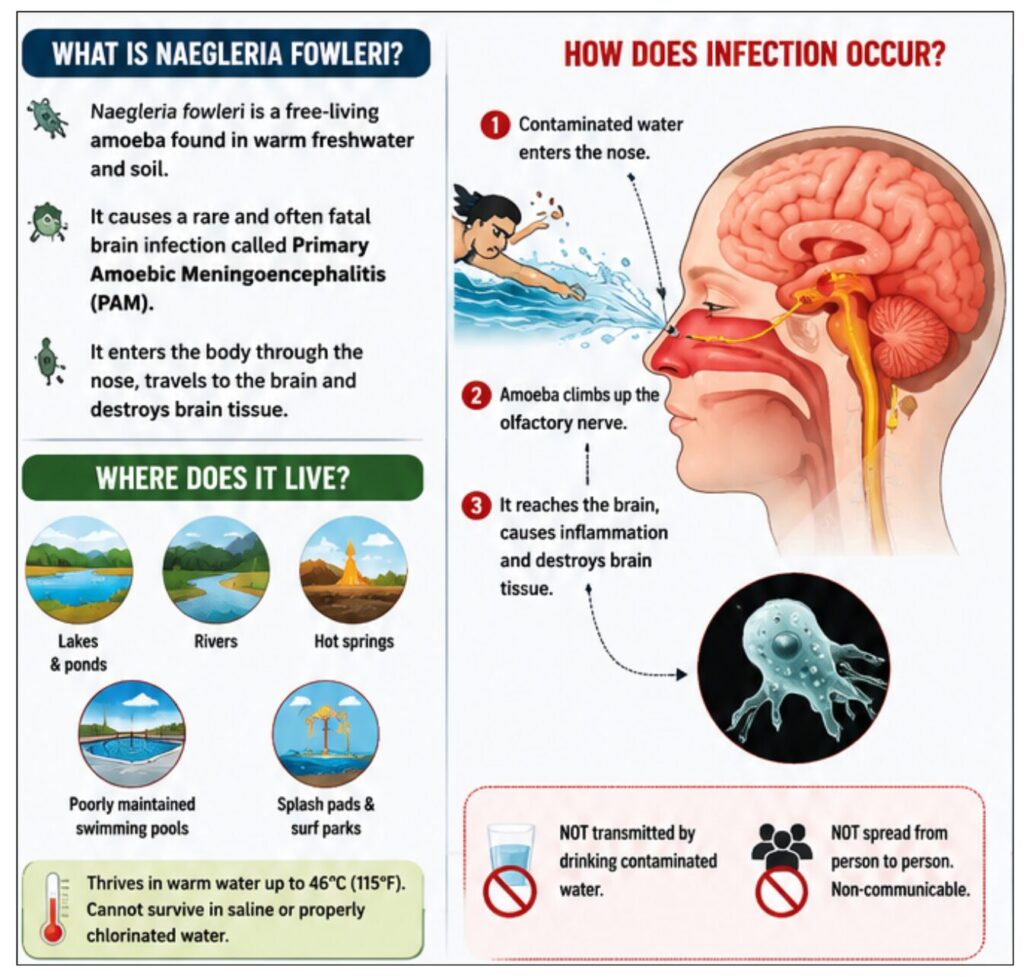
What is Naegleria fowleri?

  • Naegleria fowleri is a free-living, single-celled amoeba found mainly in warm freshwater bodies and moist soil.
  • It causes a rare but highly fatal brain infection known as Primary Amoebic Meningoencephalitis.
  • The amoeba is commonly found in:
    • Warm freshwater lakes and ponds
    • Rivers and hot springs
    • Poorly maintained swimming pools
    • Splash pads and surf parks with inadequate chlorination
    • Contaminated water storage systems
  • It thrives particularly in temperatures up to around 46°C. 

How does the infection occur? 

  • The infection occurs when contaminated water enters the nose during swimming or diving, bathing, water sports, or nasal cleansing using contaminated water. 
  • The amoeba then travels through the olfactory nerve to the brain, where it destroys brain tissue and causes severe inflammation. 
  • The infection does not occur from drinking contaminated water. PAM is non-communicable and does not spread from person to person. 
image 76 1

Primary Amoebic Meningoencephalitis (PAM):

  • Initial symptoms resemble meningitis and include severe headache, fever, nausea and vomiting. As the disease progresses, the patient may have a stiff neck and experience confusion, seizures, hallucinations and slip into a state of coma.
  • PAM has an extremely high fatality rate, often exceeding 95%. Death usually occurs within 1-18 days after symptoms begin.
  • No effective treatment for the disease has been identified yet. At present, it is treated with a combination of drugs.  
image 76

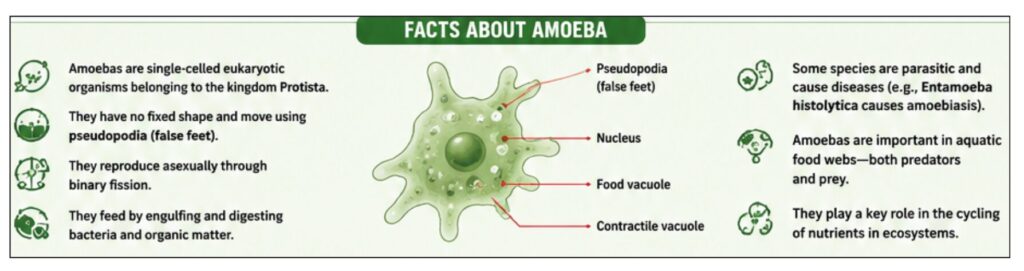
What is Amoeba?

  • Amoebas are single-celled eukaryotic organisms. They are found in a variety of aquatic and moist environments.
  • Characteristics: 
    • Possesses no fixed shape
    • Move using pseudopodia (false feet)
    • Reproduces mainly through binary fission
    • Feed by engulfing food particles (phagocytosis)
  • Ecological Importance: 
    • Important components of aquatic food chains
    • Help in nutrient recycling
    • Act as predators of bacteria and microorganisms
  • Disease-causing Amoebae: 
    • Entamoeba histolytica: Amoebiasis
    • Naegleria fowleri: PAM
    • Acanthamoeba: Keratitis and Encephalitis

Practice MCQ:

Q. With reference to Primary Amoebic Meningoencephalitis (PAM), consider the following statements:

1. PAM is caused by a free-living amoeba called Naegleria fowleri.

2. Humans can get infected by drinking water contaminated with the amoeba.

3. The amoeba generally enters the human body through the nose.

4. PAM can spread from person to person.

Which of the statements given above are correct?

(a) 1 and 2 only

(b) 1 and 3 only

(c) 2 and 4 only

(d) 1, 3 and 4 only

Answer: (b) 

UPSC PYQ 2017

Q. Consider the following statements:

1. In tropical regions, Zika virus disease is transmitted by the same mosquito that transmits dengue.

2. Sexual transmission of Zika virus disease is possible.

Which of the statements given above is/are correct?

(a) 1 only

(b) 2 only

(c) Both 1 and 2

(d) Neither 1 nor 2

Answer: (c)

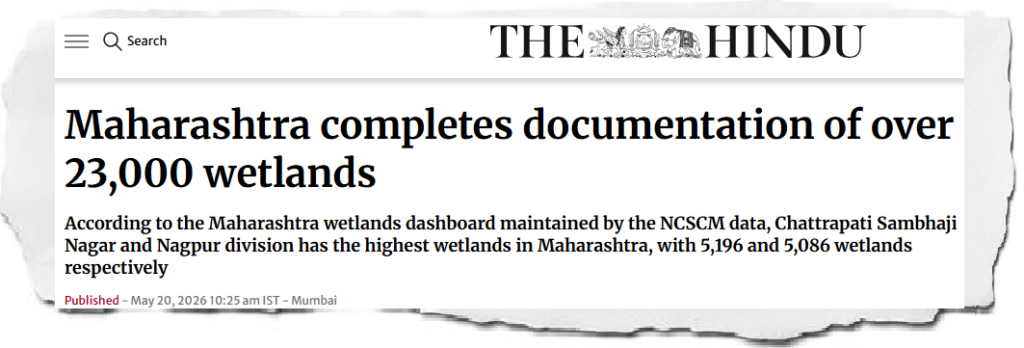
Maharashtra completes documentation of over 23,000 wetlands

Open article →Download PDF

image 76

Why in News?

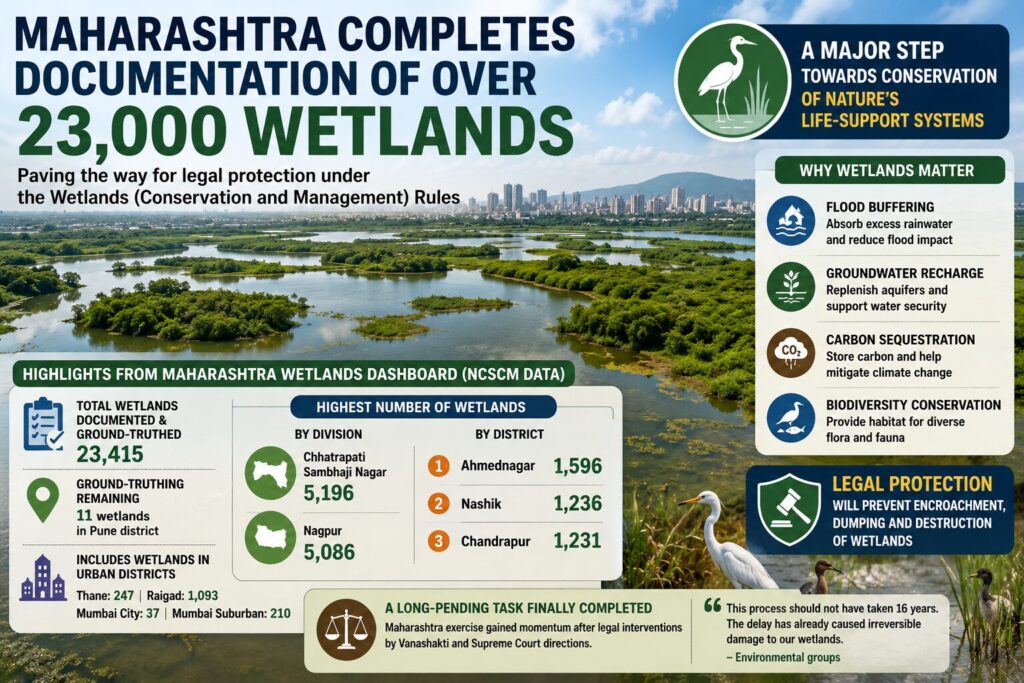
The National Centre for Sustainable Coastal Management (NCSCM) has completed documentation and ground-truthing of 23,415 wetlands in Maharashtra, with only 11 wetlands in Pune pending verification. The exercise paves the way for legal notification and protection of these wetlands under the Wetlands (Conservation and Management) Rules. The initiative gained momentum following judicial interventions and concerns over increasing wetland degradation and encroachments.

UPSC Relevance

Prelims:
Wetlands (Conservation and Management) Rules, Ramsar Convention, National Wetland Atlas, NCSCM, ecological importance of wetlands.

Mains:
GS I: Geography, Wetlands and environmental geography,
GS III Environment and Conservation, Climate Change, Disaster Management, Urbanisation and Sustainable Development

Background

Wetlands are ecosystems where water remains present either permanently or seasonally, creating unique ecological conditions that support diverse biological communities. They include marshes, lakes, rivers, floodplains, estuaries, mangroves, lagoons and peatlands.

India possesses extensive wetland ecosystems due to its diverse geography and climatic conditions. However, rapid urbanisation, infrastructure expansion and changes in land use have increasingly threatened these ecosystems.

Maharashtra’s wetland documentation exercise forms part of broader national efforts initiated through the National Wetlands Inventory and Assessment (NWIA) programme and the National Wetland Atlas. The completion of documentation and ground verification is expected to provide legal protection to these ecosystems and prevent their destruction.

The exercise has acquired significance because many wetlands remain un-notified and therefore vulnerable to reclamation, debris dumping, encroachment and infrastructure projects.

Understanding Ground-Truthing

Ground-truthing refers to the process of physically verifying satellite imagery and remote sensing data through field-based surveys.

The process includes:

Verification of boundaries: Determining the actual geographical extent of wetlands.

Assessment of ecological condition: Evaluating vegetation, biodiversity and hydrological characteristics.

Land-use assessment: Identifying human activities and encroachments affecting wetlands.

Validation of satellite observations: Ensuring that remote sensing data accurately reflects on-ground conditions.

Ground-truthing becomes an essential prerequisite before wetlands can receive legal notification and protection under environmental regulations.

Wetlands 2

Importance of Wetlands

Flood buffering

Wetlands act as natural sponges that absorb excess rainwater and release it slowly, thereby reducing flood intensity and protecting nearby settlements.

Recent urban flooding events demonstrate the consequences of wetland degradation and encroachment.

Groundwater recharge

Wetlands facilitate infiltration of water into underground aquifers and help maintain groundwater levels.

This function becomes particularly important in drought-prone and water-stressed regions.

Carbon sequestration

Wetlands capture and store significant quantities of carbon in vegetation and soils, thereby contributing to climate change mitigation.

Mangroves and peatlands are particularly effective carbon sinks.

Biodiversity conservation

Wetlands support a rich diversity of flora and fauna, including migratory birds, fish species, amphibians, reptiles and aquatic plants.

Several endangered species depend upon wetland ecosystems for their survival.

Livelihood support

Wetlands contribute to livelihoods through fisheries, agriculture, tourism and other ecosystem services.

Millions of people directly depend on wetland resources for economic sustenance.

Legal and Institutional Framework for Wetland Conservation

Constitutional provisions

Article 48A: Directs the State to protect and improve the environment and safeguard forests and wildlife.

Article 51A(g): Makes environmental protection a Fundamental Duty of citizens.

Wetlands (Conservation and Management) Rules, 2017

The Rules replaced the Wetlands Rules of 2010 and seek to regulate activities affecting wetland ecosystems.

Major provisions include:

  • Prohibition of reclamation and conversion of wetlands
  • Restriction on waste dumping and pollution
  • Creation of State Wetland Authorities
  • Preparation of wetland inventories and management plans

National Wetlands Inventory and Assessment (NWIA)

It was initiated to identify and map wetlands through satellite-based remote sensing technologies.

National Wetland Atlas

Prepared by the Space Applications Centre under ISRO, the Atlas provides information on the distribution and status of wetlands across India.

The decadal version launched in 2020 tracks changes in wetland ecosystems over time.

Ramsar Convention on Wetlands

India became a signatory to the Ramsar Convention in 1982.

Its objectives include: Conservation of wetlands, Sustainable or wise use of wetland resources, International cooperation on wetland protection

    India currently has one of the highest numbers of Ramsar sites globally.

    National Centre for Sustainable Coastal Management (NCSCM)

    NCSCM functions under the Ministry of Environment, Forest and Climate Change (MoEFCC).

    Its responsibilities include: Coastal and wetland research, Ecological mapping and monitoring, Conservation planning, Ground verification exercises

      Challenges

      Delayed identification and notification

      Several wetlands remain un-notified years after their identification, leaving them vulnerable to degradation and encroachments. Maharashtra’s exercise itself experienced considerable delays.

      Urbanisation and infrastructure expansion

      Wetlands are often treated as vacant land suitable for construction activities, resulting in reclamation and ecological destruction.

      Weak institutional coordination

      Multiple agencies exercise overlapping jurisdictions over wetlands, leading to fragmented governance and weak implementation.

      Encroachments and pollution

      Illegal dumping of debris, sewage discharge and industrial pollution continue to threaten wetland ecosystems.

      Inadequate public awareness

      Limited understanding of the ecological importance of wetlands reduces citizen participation in conservation efforts.

      Climate change pressures

      Changing rainfall patterns and extreme weather events can alter wetland hydrology and adversely affect ecological functioning.

      Way Forward

      Accelerate legal notification of wetlands

      States should complete the process of legal notification within fixed timelines to provide formal protection against encroachments.

      Strengthen monitoring through technology

      Advanced technologies such as GIS mapping, satellite monitoring and drones should complement field verification exercises.

      Integrate wetlands into urban planning

      Urban master plans and infrastructure projects should treat wetlands as ecological assets and critical urban infrastructure.

      Encourage community-based conservation

      Local communities should be actively involved in wetland management, monitoring and restoration activities.

      Improve institutional coordination

      State Wetland Authorities, local bodies and environmental agencies should function through integrated governance mechanisms.

      Promote restoration of degraded wetlands

      Restoration programmes should focus on removing encroachments, restoring natural hydrology and rehabilitating habitats.

      Conclusion

      Wetlands are ecological assets that provide essential environmental services and support sustainable development. Maharashtra’s completion of documentation and ground verification of over 23,000 wetlands marks a significant step toward strengthening wetland governance in India. However, mapping alone is insufficient. Effective conservation requires timely legal notification, institutional coordination and active public participation to ensure long-term ecological security.

      Practice Questions

      Prelims Question 1

      With reference to wetlands in India, consider the following statements:

      1. Wetlands help in groundwater recharge and flood mitigation.
      2. Wetlands are protected under the Wetlands (Conservation and Management) Rules, 2017.
      3. All wetlands identified under the National Wetland Atlas automatically receive legal protection.

      Which of the statements given above are correct?

      (a) 1 and 2 only
      (b) 2 and 3 only
      (c) 1 and 3 only
      (d) 1, 2 and 3

      Correct Answer: (a)

      Explanation: Statements 1 and 2 are correct. Wetlands perform important ecological functions and are regulated under the Wetland Rules, 2017. Mere identification in the National Wetland Atlas does not automatically grant legal protection.

      Prelims Question 2

      Consider the following:

      1. National Wetland Atlas
      2. Ramsar Convention
      3. National Centre for Sustainable Coastal Management (NCSCM)

      Which of the above are associated with wetland conservation?

      (a) 1 only
      (b) 2 and 3 only
      (c) 1 and 2 only
      (d) 1, 2 and 3

      Correct Answer: (d)

      Explanation: All three are associated with wetland identification, conservation and management.

      Mains Question

      1. Wetlands are increasingly being recognised as ecological infrastructure rather than wastelands. Examine their significance in climate resilience and sustainable development.
      2. Discuss the major challenges associated with wetland conservation in India. Suggest measures for improving wetland governance and management.

      Preparing India for a credible digital Census 

      Open article →Download PDF

      image 77

      Why in News?

      India has begun preparatory work for the 2027 Census, with the house-listing phase progressing in several States. The Census will be the first fully digital Census in India and is expected to include caste enumeration for the first time after Independence. The exercise assumes greater significance as its population figures will form the basis for future delimitation of Lok Sabha and State Assembly constituencies.

      UPSC Relevance

      Prelims:
      Census in India, 73rd and 74th Constitutional Amendments, Delimitation, demographic concepts;

      Mains:
      GS I: Population and related issues,
      GS II: Governance, electoral reforms, federalism,
      GS III: Digital governance and technology in administration.

      Background/Context

      The Census is one of the largest administrative and statistical exercises undertaken by the Government of India. Conducted under the provisions of the Census Act, 1948, it provides critical information on demographic, social and economic characteristics of the population.

      India has conducted a Census every ten years since 1881. The 2021 Census was postponed due to the COVID-19 pandemic, making the 2027 Census particularly significant.

      The upcoming Census is unique because:

      • It is expected to include caste data after Independence.
      • It will rely primarily on digital data collection through smartphones and electronic devices.
      • It may allow self-enumeration by citizens.
      • Census data will influence future political representation through delimitation.

      Census Methodology in India

      India traditionally follows an extended de facto approach to enumeration.

      Under this method:

      • Individuals present at their normal residence during enumeration are counted.
      • Persons temporarily absent but residing there during the enumeration period are included.
      • Visitors staying for the entire Census period may also be counted.
      • Household members are identified based on sharing a common kitchen.

      This differs from a de jure Census, where individuals are counted strictly at their place of usual residence.

      Significance of Census Methodology

      The method adopted has important implications:

      Political Representation

      Population figures determine parliamentary and legislative constituency boundaries through delimitation.

      Welfare Planning

      Government schemes rely on population data for resource allocation.

      Economic Planning

      Accurate demographic information influences infrastructure, education, health and employment policies.

      Social Inclusion

      Enumeration helps identify vulnerable and marginalised groups.

      Key Issues in Conducting the 2027 Digital Census

      Inclusion of Caste Enumeration

      The inclusion of caste data introduces several administrative and social challenges.

      Different communities may dispute their numerical representation and categorisation. Experiences from caste surveys conducted in Bihar and Karnataka suggest that caste enumeration can become contentious and politically sensitive.

      Differences in self-identification and variations in local terminology may also affect accuracy.

      Challenges of Digital Enumeration

      The entire Census exercise is expected to use electronic devices for data collection.

      Potential issues include:

      Digital literacy among enumerators

      Many enumerators may not possess adequate familiarity with smartphones or tablets.

      Technical difficulties

      Hardware failures, software glitches or connectivity issues may affect field operations.

      Data confidentiality concerns

      If data entry assistance is taken from family members or others, accountability and privacy may be compromised.

      Data-entry errors

      Incorrect entries during digital transfer can affect overall quality.

      Challenges of Self-Enumeration

      Self-enumeration may improve convenience but also creates new risks.

      Complex questions

      Questions regarding occupation, disability or work participation often require detailed interpretation.

      Misreporting

      Respondents may intentionally or unintentionally provide inaccurate information.

      Fraudulent entries

      There is a possibility of manipulation through false or duplicate submissions.

      Respondent Fatigue

      Long questionnaires increase the burden on respondents.

      Consequences include:

      • Incomplete responses
      • Incorrect responses
      • Deliberate skipping of questions
      • Reduced overall quality of information

      Risk of Omission Errors

      Past post-enumeration surveys indicated that certain categories are more likely to be missed:

      • Domestic workers
      • Distant relatives
      • Paying guests
      • Temporary migrants
      • Persons living in hostels

      Digital systems may increase such omissions if questions are not carefully structured.

      Challenges Related to Non-Resident Indians (NRIs)

      India has a large overseas population.

      According to estimates, about 1.58 crore Indians live abroad. States such as Kerala, Gujarat, Punjab, Telangana and Tamil Nadu have substantial migrant populations.

      Exclusion of overseas residents from population counts may influence: Population figures, Future delimitation, Political representation

        Constitutional and Governance Dimensions

        Article 82

        Provides for readjustment of parliamentary constituencies after each Census.

        Article 170

        Provides for readjustment of State Legislative Assembly constituencies.

        Census Act, 1948

        Provides the legal framework for Census operations in India.

        Delimitation Commission

        Uses Census data to redraw electoral constituencies.

        Importance of a Credible Digital Census

        Better Governance

        Reliable data enables evidence-based policy making and efficient implementation of welfare programmes.

        Strengthening Democracy

        Accurate population estimates are necessary for fair representation.

        Targeted Welfare Delivery

        Socio-economic data allows better targeting of subsidies and public services.

        Economic Planning

        Reliable demographic data helps assess labour force trends, urbanisation and migration.

        Improved Administrative Efficiency

        Digital systems can significantly reduce processing time and improve accessibility of data.

        Challenges in Broader Perspective

        Balancing Technology and Accuracy: Technological efficiency should not come at the cost of data reliability.

        Data Privacy and Security: Digital collection increases risks of data breaches and misuse.

        Political Sensitivities: Caste data and delimitation implications may generate political contestation.

        Administrative Capacity Constraints: Training more than three million enumerators poses a major challenge.

        Trust Deficit: Public confidence in data collection processes is critical for obtaining accurate information.

        Way Forward

        Simplify Questionnaire Design

        Questions should be framed in simple and clear language. Embedded explanations and user-friendly interfaces can reduce confusion.

        Strengthen Enumerator Training

        Comprehensive training on digital devices, concepts and field practices should be provided.

        Conduct Extensive Field Testing

        Pilot studies and pre-testing should be expanded to identify weaknesses before full implementation.

        Strengthen Data Security Framework

        Robust encryption and privacy safeguards should be introduced to protect personal information.

        Introduce Verification Mechanisms

        Cross-checking systems and post-enumeration surveys should be strengthened to detect omissions and inaccuracies.

        Consider Limited NRI Enumeration

        Appropriate mechanisms may be developed to capture information on overseas populations for better demographic assessment.

        Promote Public Awareness

        Mass awareness campaigns can improve participation and reduce misinformation.

        Conclusion

        The 2027 Census is not merely a statistical exercise but a foundational pillar of governance and democracy. Its significance extends beyond counting people to shaping political representation, resource allocation and development planning. A credible digital Census requires balancing technological innovation with accuracy, transparency and inclusiveness so that demographic data remains a reliable guide for India’s future development trajectory.

        Practice Questions

        Prelims Question 1

        With reference to Census methodology in India, consider the following statements:

        1. India follows a purely de jure method of Census enumeration.
        2. Individuals temporarily absent during the Census period may still be counted.
        3. Household members are generally identified on the basis of sharing a common kitchen.

        Which of the statements given above is/are correct?

        (a) 1 only
        (b) 2 and 3 only
        (c) 1 and 2 only
        (d) 1, 2 and 3

        Correct Answer: (b)

        Explanation: India follows an extended de facto method, not a purely de jure method. Persons temporarily absent and members sharing a common kitchen are counted.

        Prelims Question 2

        Consider the following Articles of the Constitution:

        1. Article 82
        2. Article 170
        3. Article 324

        Which of the above are directly related to delimitation based on Census data?

        (a) 1 and 2 only
        (b) 2 and 3 only
        (c) 1 and 3 only
        (d) 1, 2 and 3

        Correct Answer: (a)

        Explanation: Articles 82 and 170 deal with readjustment of parliamentary and assembly constituencies. Article 324 concerns powers of the Election Commission.

        Mains Question

        1. The transition to a digital Census presents both opportunities and challenges for India. Examine.
        2. Discuss the significance of Census data for democratic representation and governance in India. Examine the challenges associated with conducting a credible Census exercise.

        Oral Remarks and Institutional Limits

        Open article →Download PDF

        image 78

        Why in News?

        Recent oral remarks made by Chief Justice Surya Kant during proceedings related to the designation of senior advocates, and the subsequent clarification issued by the Supreme Court, have revived debate on the standards governing judicial conduct and courtroom speech. The issue raises questions regarding judicial restraint, ethical standards, institutional dignity, and the distinction between oral observations and formal judgments.

        UPSC Relevance:

        Prelims:
        Judicial ethics, constitutional bodies, Restatement of Values of Judicial Life, Article 50;

        Mains:
        GS II: Judiciary, Constitutional institutions, Judicial accountability and ethics

        Background/Context

        Judicial proceedings often involve active interactions between judges and lawyers. During hearings, judges frequently make observations, pose hypothetical questions, or express concerns to test legal arguments and understand the implications of different positions.

        However, oral observations differ fundamentally from written judgments. While judgments become part of binding legal reasoning, oral remarks are generally spontaneous and exploratory in nature.

        The recent controversy has renewed discussion regarding the limits of judicial speech and whether judges should exercise greater caution in public-facing courtrooms where every observation can instantly become part of the public discourse.

        The issue becomes more important in an era of real-time media reporting and social media amplification, where oral remarks can shape public perceptions even before the final judgment is delivered.

        Judicial Standards Governing Oral Remarks

        India has established certain conventions and principles to guide judicial conduct and preserve institutional credibility.

        Restatement of Values of Judicial Life (1997)

        The Full Court of the Supreme Court adopted the Restatement of Values of Judicial Life in 1997 as a code of ethics for judges.

        Key features include:

        • Judges should maintain independence, impartiality and dignity in judicial conduct.
        • Judges should avoid entering public controversies and political debates.
        • Language used in court should maintain decorum and institutional respect.
        • Judicial conduct should reinforce public confidence in the justice system.

        Chief Election Commissioner v. M.R. Vijayabhaskar (2021)

        The Supreme Court clarified the status of oral observations made during hearings.

        The judgment emphasised:

        • The official opinion of a court emerges only through written judgments and orders.
        • Oral observations are often exploratory and aimed at testing arguments.
        • Courts should avoid unnecessarily harsh or scathing language directed at individuals or institutions.
        • Judicial language must reflect institutional restraint.

        Benjamin Cardozo’s Principle of Judicial Conduct

        The principles underlying judicial restraint were articulated by legal scholar and judge Benjamin Cardozo.

        According to Cardozo, judicial discretion should be:

        • Informed by tradition.
        • Guided by established methods.
        • Disciplined by institutional principles.
        • Subordinated to the larger requirement of maintaining social order.

        This framework continues to influence judicial philosophy globally.

        Understanding the Two Dimensions of Oral Remarks

        Bench Questions That Test Arguments

        Judges often ask difficult or provocative questions during hearings to examine the strength of legal arguments.

        Such questioning serves several purposes:

        • Clarifies legal ambiguities.
        • Tests the implications of arguments.
        • Encourages comprehensive reasoning.
        • Assists judges in arriving at informed decisions.

        Examples demonstrate that courtroom questions frequently do not indicate the final outcome of a case.

        Thus, oral questioning serves as a method of judicial inquiry rather than a declaration of legal position.

        Intemperate Remarks

        The second category involves remarks that may appear demeaning, excessive, or emotionally charged.

        Problems arising from such remarks include:

        • Potential harm to institutional credibility.
        • Negative impact on public confidence in the judiciary.
        • Risk of perceived judicial bias.
        • Possibility of reputational injury to individuals or groups.

        Such remarks may acquire disproportionate influence because they are often widely circulated by media and social platforms.

        Challenges and Concerns

        Judicial Remarks Influencing Public Opinion

        Although oral observations have no binding legal force, they often shape media narratives and public perception before the delivery of judgments. This can create prejudgment in sensitive matters.

        Institutional Credibility and Judicial Restraint

        Harsh language or personal comments may undermine the judiciary’s image as a neutral institution and affect public trust.

        Distinction Between Oral and Written Observations

        The public often finds it difficult to distinguish between informal courtroom exchanges and final judicial conclusions, leading to misunderstanding.

        Expansion of Real-Time Media Reporting

        Instant reporting and social media dissemination have increased the visibility of judicial remarks beyond courtroom boundaries, magnifying their impact.

        Lack of Formal Accountability Mechanisms

        Judicial independence is essential, but excessive reliance on convention and self-regulation creates challenges in ensuring consistent adherence to ethical norms.

        Constitutional and Institutional Dimensions

        Article 50: Directs separation of judiciary from executive functions.

        Article 129: Declares the Supreme Court as a Court of Record.

        Article 142: Allows the Supreme Court to pass orders necessary for complete justice.

        Judicial Independence: Recognised as part of the basic structure doctrine.

        Judicial Accountability: Operates through conventions, ethical standards and constitutional mechanisms.

        Way Forward

        Strengthening Judicial Sensitisation

        Continuous orientation programmes and judicial education should emphasise communication ethics, courtroom language and institutional responsibility.

        Greater Awareness About Oral Observations

        Public institutions and media should clearly distinguish between oral remarks and final judicial decisions to reduce misunderstanding.

        Reinforcing Ethical Frameworks

        Existing standards such as the Restatement of Values of Judicial Life should be revisited and periodically updated according to changing technological and social realities.

        Responsible Media Reporting

        Media organisations should exercise caution in presenting oral remarks without proper context, avoiding sensationalism.

        Promoting Institutional Self-Correction

        Judicial institutions should encourage transparent acknowledgement and correction when remarks exceed accepted standards.

        Conclusion

        Judicial independence and judicial restraint are complementary rather than conflicting principles. Oral observations remain an essential part of judicial functioning, allowing rigorous testing of legal arguments. However, in an era of instant communication and expanded public scrutiny, the language used by courts acquires greater significance. Preserving institutional dignity requires that judicial speech remain measured, balanced and consistent with constitutional values.

        Practice Questions

        Prelims Question 1

        With reference to the Restatement of Values of Judicial Life (1997), consider the following statements:

        1. It serves as a judicial code of ethics for judges.
        2. It was enacted by Parliament as a statutory law.
        3. It discourages judges from entering public debates on political matters.

        Which of the statements given above is/are correct?

        (a) 1 only
        (b) 1 and 3 only
        (c) 2 and 3 only
        (d) 1, 2 and 3

        Correct Answer: (b)

        Explanation:
        The Restatement of Values of Judicial Life is an ethical framework adopted by the Supreme Court and is not a statutory enactment of Parliament. Statements 1 and 3 are correct.

        Prelims Question 2

        Consider the following:

        1. Oral observations of judges during hearings
        2. Written judgments of courts
        3. Interim administrative directions issued by courts

        Which among the above constitute the formal opinion of a judicial institution?

        (a) 1 only
        (b) 2 only
        (c) 2 and 3 only
        (d) 1, 2 and 3

        Correct Answer: (b)

        Explanation:
        As clarified by the Supreme Court in Chief Election Commissioner v. M.R. Vijayabhaskar (2021), the formal opinion of a court is reflected in its written judgments and orders, not oral observations.

        Mains Question

        1. “Judicial independence must be balanced with judicial restraint.” Discuss in the context of oral observations made by courts during proceedings.
        2. Examine the role of judicial ethics and institutional accountability in maintaining public confidence in constitutional courts in India.

        Strategic Spark in India-South Korea Defence Ties

        Open article →Download PDF

        Why in News?

        The Defence Minister of India visited Seoul from May 19-21, 2026, for extensive bilateral talks with the Republic of Korea’s Defence Minister. This high-level visit came just weeks after the South Korean President visited India in April 2026.

        Both sides signed multiple MoUs on defence cyber security, academic cooperation, and UN peacekeeping. This signals accelerating momentum in the India-South Korea Special Strategic Partnership.

        UPSC Relevance: GS-2 International Relations: Bilateral relations

        Prelims: Korea-India Defence Accelerator (KIND-X) 
        Mains: India-South Korea Defence Ties: Significance and Challenges. 

        Defence Minister’s Visit to South Korea: 

        • Extensive discussions were held to review the full spectrum of bilateral defence cooperation and deepen collaboration in the defence industry, joint production, maritime security, emerging technologies, and regional security. 
        • The two sides acknowledged the growing convergence between India’s Act East Policy and South Korea’s regional vision, reaffirming their shared commitment to a free, open, inclusive, and rules-based Indo-Pacific.

        MoUs & Agreements Signed: 

        • Defence Cyber Security Cooperation: Bilateral MoU between India’s Ministry of Defence and the RoK’s MOD to strengthen the cyber resilience of military infrastructure and share threat intelligence on cyber-attacks targeting defence systems.
        • Academic & Institutional Exchange: MoU between India’s National Defence College and South Korea’s Korea National Defence University to facilitate officer-level strategic education, doctrine exchange, and joint research programmes.
        • UN Peacekeeping Cooperation: Agreement to enhance interoperability in multinational UN peacekeeping missions through joint training, shared doctrine, and coordinated deployment frameworks.
        • L&T-Hanwha Defence Technology Agreements: Two agreements were signed between Larsen & Toubro and Hanwha covering industrial collaboration, technology cooperation, and capacity building in defence manufacturing.
        • KIND-X Roadmap Advancement: Both sides discussed and agreed to advance a roadmap for the Korea-India Defence Innovation Accelerator Ecosystem (KIND-X), aimed at integrating the innovation ecosystems of the two countries.

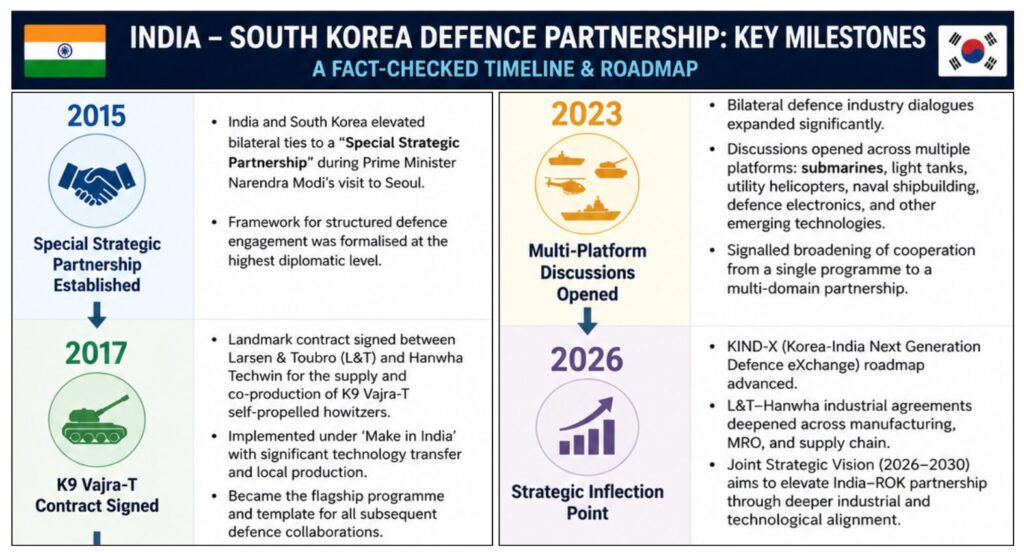
        India-South Korea Defence Ties: Evolution of the Partnership

        image 79

        Key Dimensions of Defence Cooperation: 

        Bilateral defence cooperation is expanding rapidly across several domains, with multiple projects under active consideration and negotiation.

        • Submarine & Underwater Systems: South Korea’s expertise in conventional submarines, lithium-ion battery systems, and air-independent propulsion (AIP) technologies aligns closely with India’s P75-India programme requirements. This represents one of the most strategically significant and technically demanding areas of potential collaboration.
        • Fighter Aircraft & Aerospace: South Korea’s advancing aerospace sector (including the KF-21 Boramae fighter programme and the FA-50 light combat aircraft) has opened new avenues for collaboration in fighter technologies, engines, avionics, missile integration, and maintenance systems. India’s need to diversify its aerospace supply chain makes this a natural fit.
        • Naval Shipbuilding & Maritime Power: South Korea can significantly contribute to India’s growing maritime ambitions in the Indo-Pacific through cooperation in destroyers, logistics vessels, submarine support systems, smart shipyards, and naval propulsion technologies.
        • Land Systems & Defence Electronics: Following the K9 Vajra-T success, discussions are progressing on light tanks, utility helicopters, future-ready combat vehicles, military lithium batteries, and defence electronics. Indian and Korean firms are actively pursuing joint ventures across multiple platform categories under the Make in India framework.
        • Defence Innovation: The proposed Korea-India Defence Accelerator (KIND-X) aims to link startups, incubators, and universities from both countries to foster co-development and co-design of advanced military systems. Reinvigorating the 2020 Roadmap for Defence Industry Cooperation and connecting South Korean innovation clusters with India’s Defence Industrial Corridors. 
        • Cyber, AI & Emerging Technologies: The newly signed cyber defence MoU marks the formal beginning of cooperation in military cyber security. Broader discussions cover AI-enabled platforms, autonomous systems, quantum technologies, semiconductors, and space-based capabilities.
        • Military Exchanges & Interoperability: At the operational level, bilateral military exchanges, naval exercises, coast guard cooperation, and structured defence dialogues are strengthening interoperability and mutual trust. 

        The Strategic Context of Indo-Pacific:

        The rapidly evolving Indo-Pacific geopolitical environment provides urgency for deepening India-South Korea defence ties beyond mere industrial collaboration. The geopolitical landscape around the Korean Peninsula is changing rapidly. 

        • China’s growing naval assertiveness around the Korean Peninsula, and its expanding presence in the South China Sea, through which a significant share of South Korea’s energy imports and maritime trade passes, has created new strategic anxieties in the country. This resonates with India’s own concerns about Chinese naval expansion in the Indian Ocean Region.
        • North Korea’s growing missile and nuclear capabilities continue to pose a direct threat to South Korea. 
        • Expanding Russia-North Korea military cooperation is reshaping Northeast Asia’s security architecture in ways that have implications for both South Korea and India.

        India’s broader Indo-Pacific interests depend on regional stability, open sea lanes, and the resilience of like-minded partners. A vulnerable South Korea undermines the very framework of a stable Indo-Pacific that India seeks to uphold. 

        Challenges & Constraints: 

        • Technology Transfer Limits: South Korean firms face constraints under MTCR, Wassenaar Arrangement, and domestic export control laws when transferring cutting-edge propulsion, fighter, and submarine technologies to third countries.
        • North Korea & Peninsula Instability: Growing North Korean nuclear and missile capabilities, combined with Russia-DPRK military cooperation, create a volatile security environment that can divert South Korean defence resources and attention.
        • India’s Strategic Autonomy: India’s tradition of strategic autonomy and its absence from formal US-led alliances (unlike South Korea’s US-ROK alliance) may limit operational defence convergence in sensitive regional scenarios.
        • South Korea’s Demographic Decline: A shrinking military recruitment pool weakens the long-term sustainability of South Korea’s conventional defence posture, creating structural vulnerabilities that affect its capacity for sustained bilateral cooperation.
        • Partnership Breadth vs. Depth: The risk of confining cooperation solely to defence-industrial domains without evolving a shared security framework for the Indo-Pacific would limit the partnership’s strategic potential.

        Way Forward: 

        • Institutionalised Defence Road Map: Both countries should formalise a bilateral defence framework to encompass emerging security threats across the wider Indo-Pacific. This includes addressing North Korean proliferation, Chinese naval expansion, and non-traditional security challenges in a coordinated manner.
        • Fast-Track KIND-X Operationalisation: The Korea-India Defence Accelerator must move from a proposed framework to a functioning ecosystem, with dedicated funding, a joint secretariat, and clear timelines for co-development milestones linking startups, universities, and defence investors.
        • Submarine & Aerospace Deals: Advance negotiations for P75-India collaboration with Hanwha Ocean and formalise engagement on fighter component production, leveraging KF-21 and FA-50 programme expertise for co-development and MRO cooperation.
        • Maritime Security Collaboration: Expand naval exercises, coast guard cooperation, and joint patrols in the Indian Ocean Region and beyond to strengthen interoperability and signal shared commitment to a stable maritime order.

        The partnership between the two nations must move beyond defence-industrial ties toward a broader partnership grounded in shared security interests and Indo-Pacific stability.

        Also Read: https://anantamias.com/current-affairs/advancing-india-south-korea-defence-innovation-ties/

        Practice Question for Mains: 

        Q. Discuss the geopolitical imperatives driving India-South Korea convergence in the context of the evolving Indo-Pacific security architecture.  

        No New Hydroelectric Projects in the Upper Ganga Basin: Govt to SC

        Open article →Download PDF

        Why in News?

        The Union Government has filed a joint affidavit before the Supreme Court of India stating that it will not permit any new hydroelectric projects (HEPs) in the upper reaches of the Ganga, specifically the Alaknanda-Bhagirathi basin in Uttarakhand. 

        UPSC Relevance: GS-1 Geography: Dams, GS-3 Environment and Biodiversity: Conservation

        Prelims: Upper Ganga Basin, Important hydropower plants. 

        Reasons for Rejecting New Projects: 

        • Geological and seismic fragility: The upper Ganga basin lies entirely within Seismic Zones IV and V. It is prone to landslides, glacial lake outburst floods (GLOFs), avalanches, tunnel collapses, and geodynamic instabilities. Disasters here are described as not episodic but persistent.
        • The 1916 Haridwar Agreement: An over-100-year-old agreement between the government, princely states, and civil society mandates a minimum constant and unfettered flow of 1,000 cusecs through the Ganga at Haridwar at all times. Construction of HEPs would jeopardise this commitment.
        • Irreplaceable biodiversity: The region hosts endangered and Schedule-I species, critical aquatic habitats, national parks, and a UNESCO World Heritage Site. The Wildlife Institute of India’s cumulative impact assessment identified critical conservation stretches where HEPs would cause irreversible harm.
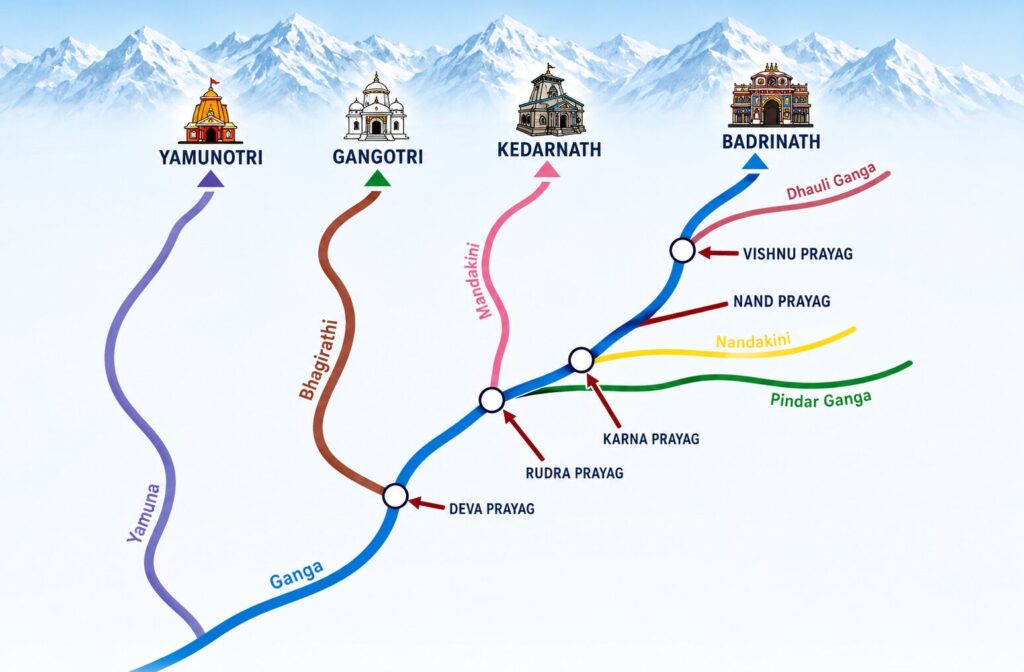
        • Cultural and spiritual significance: The five Prayags (Devprayag, Rudraprayag, Karnaprayag, Nandaprayag, Vishnuprayag) and the Char Dhams lie within this basin. The affidavit states that protection of this region is an obligation arising not only from environmental considerations, but also from the cultural and spiritual heritage of the nation.
        • Population dependence: The Ganga basin supports nearly half of India’s population. The Alaknanda-Bhagirathi system is the principal headstream and critical for supplying food, nutrients, and biodiversity inputs to the entire river system. 

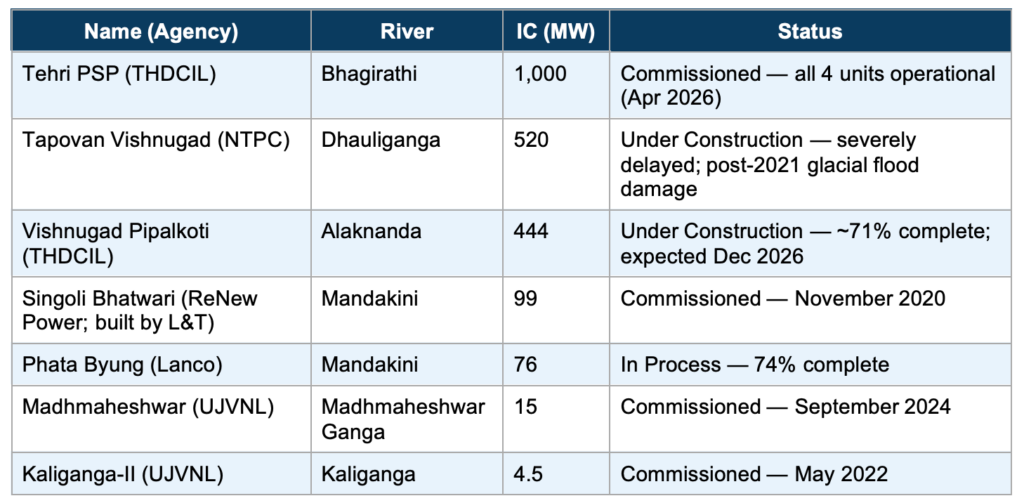
        The Seven Permitted Hydroelectric Projects: 

        Only the following 7 hydroelectric projects, of which four are already commissioned, and three have achieved substantial physical and financial progress. These alone will be permitted to proceed, subject to strict compliance with all applicable safeguards. 

        This decision comes in the context of an earlier 2015 decision approving 28 projects for the Alaknanda and Bhagirathi basins. 

        image 79

        The affidavit explicitly invokes the precautionary principle, a foundational norm of international environmental law enshrined in the Rio Declaration (1992). The principle holds that where scientific uncertainty exists about serious environmental harm, the burden of proof lies with those proposing the activity. 

        India’s National Environment Policy (2006) and the Environment Protection Act, 1986, recognise this principle. The government’s position that cumulative and cascading impacts were inadequately assessed by previous bodies reflects this principle in action.

        image 80

        Key Facts about the Upper Ganga Basin:

        Geography & Hydrology: 

        • Located entirely in Uttarakhand. Comprises the Alaknanda-Bhagirathi river system, the principal headstreams of the Ganga. The two rivers merge at Devprayag to form the Ganga River. 
        • Five Prayags (confluences) lie within the basin: Devprayag, Rudraprayag, Karnaprayag, Nandaprayag, Vishnuprayag
        • Four Char Dhams: Yamunotri, Gangotri, Kedarnath, and Badrinath are located here. 

        Geology & Seismicity: 

        • Persistent hazards include landslides, GLOFs, avalanches, tunnel collapses, and geodynamic instabilities. 
        • Falls within Seismic Zones IV and V, the two highest-risk categories in India. 
        • Crossed by the Main Central Thrust (MCT), a major tectonic boundary, making the region prone to earthquakes and mass wasting. Contains extensive paraglacial zones, recently deglaciated, geologically unstable terrain above the MCT.