Opens in a new tab
Join Anantam IAS Channel on Telegram

Daily Digest · Friday

7 August 2026 Current Affairs for UPSC

8 current affairs published on Friday, 7 August 2026

7 August 2026 Current Affairs for UPSC — every Why-in-News article AnantamIAS published on Friday, 7 August 2026, broken down with Why in News?, the exact GS paper it feeds, sub-topic mapping, MCQ-ready facts and a UPSC-style practice question. 8 articles in total, covering Polity, Economy, Environment, S&T, IR, Geography, History, Society and Internal Security — the same Why-in-News + GS-paper-mapping + practice-question format the Compass uses across every daily digest on the site.

Daily current affairs for UPSC is where new material enters your prep stream. Read this 7 August 2026 digest end-to-end in 25–35 minutes, attempt the practice question at the foot of each article (it's MCQ for some, 10/15-marker for others), then bookmark the entries that fall inside your active revision window. Everything stays cross-linked: tap any subject pill to jump to that subject's hub, or use the table of contents above to skip straight to a specific story.

Use this page three ways. Read sequentially for a one-sitting scan of everything that mattered on 7 August 2026. Download the 7 August 2026 PDF below for offline study or print revision. Or use the August 2026 Current Affairs compilation to see this day in the month's full context. For the previous day's reading, see 6 August 2026 Current Affairs; the next day's is 8 August 2026 Current Affairs.

Why we publish daily current affairs separately from the monthly compilation: daily is learning, monthly is revision. Use the daily page to add fresh material to your notes the day it breaks; come back to the August 2026 compilation 60 days before Prelims when the noise has settled and only the lasting takeaway is worth re-reading.

Animal-Free Research Methods and India’s Biomedical Testing Transition

Open article →Download PDF

Why in News?

In a written Rajya Sabha reply on August 6, 2026, the Union government detailed India’s efforts to promote human-relevant, non-animal methods for drug discovery, toxicity assessment and biomedical research.

  • The Indian Council of Medical Research has supported 109 projects on non-animal testing methods across 71 institutes and laboratories, including organ-on-chip, 3D tissue and computer-based approaches.
  • Eight Council of Scientific and Industrial Research laboratories reported capability or activity in one or more alternatives, though facilities vary across the laboratories.
  • BRIC-inStem in Bengaluru has dedicated platforms for cell culture, organoids, 2D and 3D cultures, microphysiological systems, bioreactors, high-throughput screening, automation and integrated data analysis.
  • BRIC-THSTI in Faridabad has developed an organoid platform that may support drug screening, disease modelling and therapeutic development for liver diseases.
  • BIRAC supports the Centre for Predictive Human Model Systems at CSIR-CCMB, Hyderabad, which develops human-relevant platforms and maintains a public database connecting Indian researchers in this field.
  • Animal models have contributed to biomedical research, but species differences can limit how reliably a result predicts human biology. Ethical concerns also require researchers to avoid unnecessary pain and animal use.
  • Non-animal methods are not one technology. They include in vitro, in chemico, organoid, organ-on-chip and in silico tools, each suited to particular questions and limits.
  • The central policy challenge is not simply invention. A method must be reproducible, relevant to a defined biological question, quality-controlled and accepted for a stated regulatory context of use.

UPSC Relevance

Prelims Relevance

  • In vitro methods study biological processes outside a living organism, commonly using cells, tissues or biochemical systems under controlled conditions.
  • In silico methods use computational models, simulations and data-based predictions to study biological activity, exposure or toxicity.
  • An organoid is a three-dimensional cell-derived structure that reproduces selected features of an organ; it is not a complete miniature human organ.
  • An organ-on-chip is a microengineered system designed to model selected tissue functions and physical conditions, such as fluid flow or interactions between cell types.
  • The ethical 3Rs are Replacement of animals where possible, Reduction in the number used and Refinement of procedures to minimise pain and distress.
  • India’s Committee for Control and Supervision of Experiments on Animals regulates animal experimentation and promotes the 3Rs through institutional oversight and guidance.

Mains Relevance

GS Paper 3

  • Explain how organoids, organ-on-chip platforms, cell-based assays and computational models can improve the human relevance and efficiency of preclinical research.
  • Assess India’s innovation ecosystem across ICMR, CSIR, DBT, BIRAC, BRIC-inStem, THSTI and CCMB, with attention to shared infrastructure and translation.

GS Paper 2

  • Examine coordination between research funders, CDSCO, CCSEA, standards bodies, ethics committees and industry in building a predictable approval pathway.
  • Relate human-relevant testing to public health governance: patient safety, faster evaluation, scientific transparency, affordability and domestic biomedical capability.

Essay

  • Scientific progress becomes humane when compassion is converted into rigorous methods, not when rigour is abandoned.
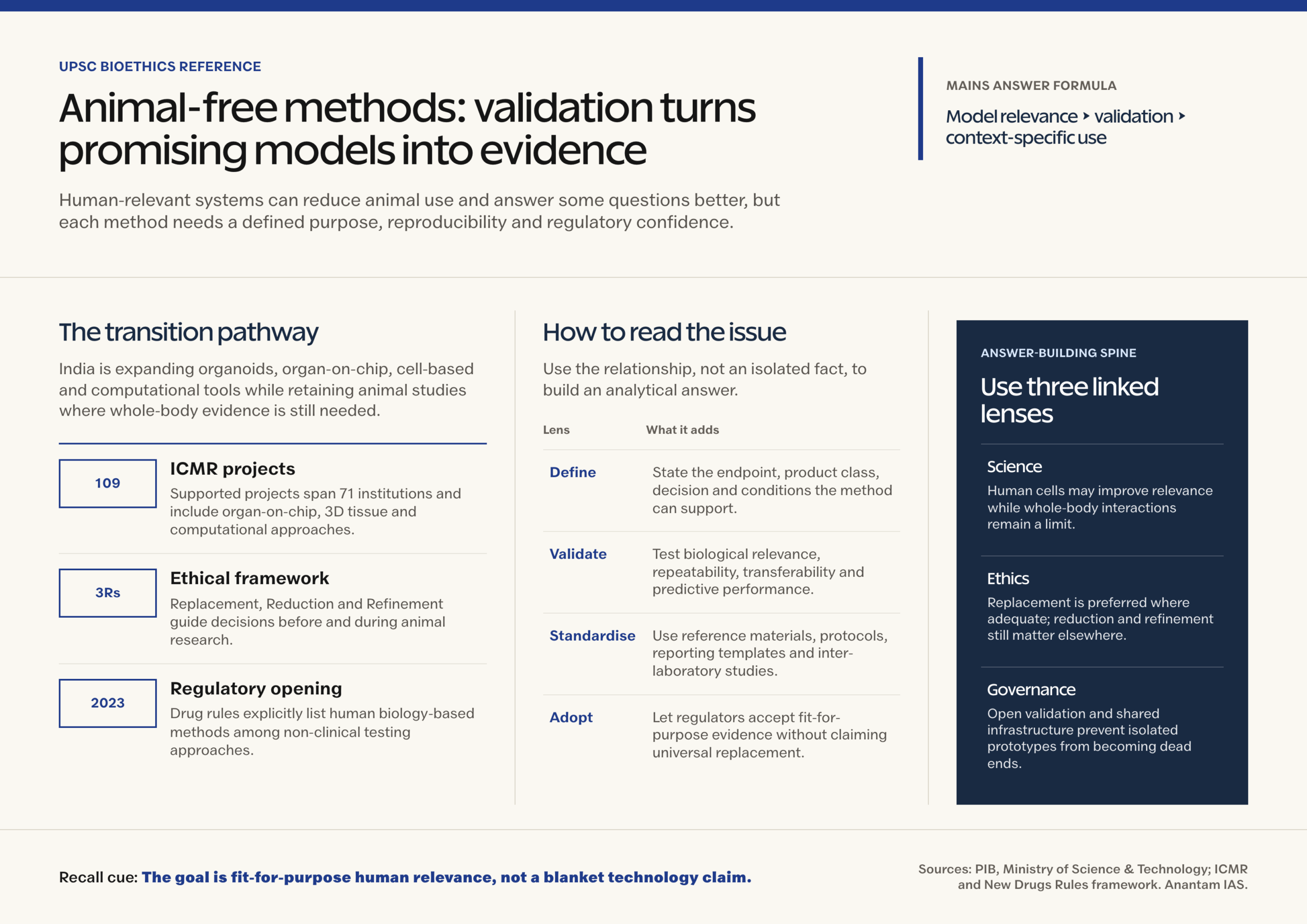
Mindmap explaining Animal-Free Research Methods and India's Biomedical Testing Transition for UPSC revision
Revision mindmap: Animal-Free Research Methods and India's Biomedical Testing Transition. Open the full-size image for details.

Background and Context

What New Approach Methodologies Include

New Approach Methodologies, or NAMs, is an umbrella term for tools and strategies that can generate safety or efficacy evidence without default reliance on conventional animal tests.

  • Cell-based assays can examine a defined biological response, such as receptor activity, cell damage or a molecular pathway, under controlled conditions.
  • 3D tissue models and organoids reproduce more spatial organisation and cell interaction than a simple two-dimensional culture, but their maturity and complexity differ by model.
  • Microphysiological systems, including organ-on-chip platforms, use engineered microenvironments to reproduce selected mechanical, chemical and cellular conditions of human tissues.
  • Computational approaches can predict molecular interactions or toxicity, integrate existing evidence and prioritise compounds for testing. Their reliability depends on the model, data and domain of applicability.
  • An integrated approach may combine multiple methods and prior knowledge because one NAM need not replace one animal test on a one-for-one basis.

Why Human Relevance Matters

The scientific case for NAMs is closely connected to the ethical case: a human-relevant method may reduce animal use while answering some questions more directly.

  • Animal species differ from humans in metabolism, immune response, genetics and disease pathways. A result in one species may not reproduce the same clinical effect.
  • Human cells and tissues can reveal mechanisms that are absent or altered in an animal model, while patient-derived systems may help study variation between individuals.
  • High-throughput systems can screen more candidates or concentrations than many conventional studies, helping researchers reject weak candidates earlier and focus resources on promising mechanisms.
  • These advantages are conditional. A model of one organ cannot capture every whole-body process, and cell sources, culture conditions and chip design can introduce new forms of uncertainty.

India's Research Capacity

The August 2026 update describes a distributed public ecosystem rather than a single national laboratory for animal-free testing.

  • ICMR’s 109 supported projects across 71 institutions indicate a substantial research base, but project counts do not by themselves show regulatory readiness or replacement achieved.
  • CSIR recognises organoids, advanced in vitro systems, organ-on-chip and in silico approaches; eight laboratories reported activity, with uneven facility availability across the network.
  • BRIC-inStem provides cell and organoid platforms, microphysiological systems, bioreactors, analytical tools, high-throughput screening and computational resources, along with training programmes in stem-cell and organoid research.
  • InStem is developing early embryonic models for developmental-toxicity testing, while THSTI’s liver organoid platform illustrates disease modelling and drug-screening applications.
  • BIRAC’s support to the CCMB-based Centre for Predictive Human Model Systems connects public science with translational development and a national researcher database.

The 2023 Regulatory Opening

India’s drug rules now explicitly recognise several human biology-based methods within the menu of non-clinical testing approaches.

  • G.S.R. 175(E), notified on March 9, 2023, amended the First Schedule to the New Drugs and Clinical Trials Rules, 2019.
  • The amendment lists cell-based assays, organ chips and microphysiological systems, sophisticated computer modelling and other human biology-based methods, along with animal studies, for assessing the safety and efficacy of a new or investigational new drug.
  • The wording creates regulatory space for evidence from alternatives, but it does not declare every non-animal method automatically valid for every product, endpoint or decision.
  • A sponsor still needs evidence appropriate to the product, risk, endpoint and regulatory question. The scientific standard cannot be reduced to whether a method uses animals.

Way Forward

Create a National Validation Pathway

  • Establish shared criteria for context of use, performance standards, reference materials, reproducibility and reporting, aligned where appropriate with OECD and other recognised frameworks.
  • Support multicentre studies through public laboratories so promising platforms are tested beyond the developer’s site and against human-relevant benchmarks.
  • Publish qualification decisions, limitations and accepted uses in a searchable registry that researchers, regulators, ethics committees and companies can consult.

Conclusion

  • India has moved beyond treating animal-free methods as a purely ethical aspiration.
  • The next step is harder: converting promising models into reproducible, independently assessed and regulator-ready evidence.

UPSC Practice Questions

Prelims MCQ 1

With reference to New Approach Methodologies in biomedical research, consider the following statements:

  1. Organoids are three-dimensional cell-derived systems that can reproduce selected features of an organ.
  2. In silico methods use computational models and simulations.
  3. India’s 2023 amendment to the New Drugs and Clinical Trials Rules excluded animal studies from all non-clinical testing.

How many of the above statements are correct?

(a) Only one (b) Only two (c) All three (d) None

Answer: (b) Only two

Explanation:

Statements 1 and 2 are correct. The 2023 amendment recognises several human biology-based methods but also retains animal studies in the list of non-clinical testing methods. It does not abolish all animal testing.

Prelims MCQ 2

Which one of the following correctly states the 3Rs of ethical animal experimentation?

(a) Registration, Review and Reporting (b) Relevance, Reproducibility and Regulation (c) Replacement, Reduction and Refinement (d) Research, Risk and Rehabilitation

Answer: (c) Replacement, Reduction and Refinement

Explanation:

Replacement seeks alternatives to animal use, Reduction minimises the number of animals consistent with valid evidence, and Refinement reduces pain and distress when animal use remains necessary.

UPSC Mains Questions

  1. Animal-free research is as much a problem of validation and regulatory design as one of technological invention. Discuss with reference to India’s emerging biomedical research ecosystem. (250 words)
  2. How can the 3Rs reconcile scientific uncertainty, animal welfare and the duty to protect human participants in drug development? Examine. (250 words)

Sources: PIB, Ministry of Science & Technology and CDSCO, New Drugs and Clinical Trials (Amendment) Rules, 2023.

Frequently Asked Questions

What are animal-free methods in biomedical research?

They are methods that generate biological, safety or efficacy evidence without conventional live-animal experiments. Examples include cell-based assays, 3D tissue models, organoids, organ-on-chip systems and computational models. Each method answers a defined set of questions and has limits.

What did the government announce in August 2026?

The government reported support for 109 ICMR projects across 71 institutions, activity in eight CSIR laboratories, specialised infrastructure at BRIC-inStem and platforms at THSTI and CCMB. It also said current methods complement rather than fully replace animal models in complex.

What is the difference between an organoid and an organ-on-chip?

An organoid is a self-organising 3D cell-derived structure that reproduces selected tissue features. An organ-on-chip is a microengineered platform that places cells in a controlled environment and may reproduce flow, mechanical forces or interactions between tissue compartments.

Did India abolish animal testing for new drugs in 2023?

No. The 2023 amendment expanded the recognised non-clinical methods to include cell assays, organ chips, computer modelling and other human biology-based tests, but it also retained animal studies. The suitable evidence depends on the product and regulatory question.

Why must a non-animal method be validated?

Validation shows whether a method is reliable and relevant for a defined purpose. It examines factors such as repeatability, transferability, biological relevance, controls and predictive performance. Without a clear context of use, a promising laboratory platform cannot safely support a.
Gujarat High Court Links Starvation, Dignity and Welfare Failure

Open article →Download PDF

Why in News?

The Gujarat High Court granted bail to an impoverished woman accused of murdering her daughter, with The Hindu reporting that the court considered the background of poverty and starvation.

  • The order arose at the bail stage. A bail court decides whether continued custody is justified while proceedings continue; it does not conduct the full criminal trial.
  • The woman remains an accused person. Grant of bail is neither acquittal nor a final finding that poverty legally excuses the alleged offence.
  • The reported observations ask a wider constitutional question: what responsibility do the State, community and welfare systems bear when a household cannot secure food, healthcare and minimum living conditions?
  • The case highlights the difference between individual criminal liability, which the trial must determine from evidence, and public responsibility for preventing hunger and destitution.
  • Any discussion of the child’s death must retain the seriousness of the allegation while avoiding a conclusion on facts that the trial court has not yet adjudicated.
  • Article 21 protects life and personal liberty, and Supreme Court jurisprudence has read life with dignity more broadly than mere animal existence.
  • Articles 39(a), 39A and 47 direct the State toward adequate livelihood, equal justice, nutrition, public health and improved living standards, although Directive Principles are not directly enforceable like Fundamental Rights.
  • The National Food Security Act, 2013 converts specified food and nutrition support into statutory entitlements and creates grievance-redress mechanisms.

UPSC Relevance

Prelims Relevance

  • Article 21 states that no person shall be deprived of life or personal liberty except according to procedure established by law.
  • Article 39(a) asks the State to direct policy toward securing an adequate means of livelihood for citizens, men and women equally.
  • Article 39A concerns equal justice and free legal aid so that economic or other disabilities do not deny access to justice.
  • Article 47 makes raising the level of nutrition, standard of living and public health a primary duty of the State.
  • Articles 39 and 47 are part of the Directive Principles of State Policy; Article 37 says these principles are not enforceable by courts but are fundamental in governance.
  • The National Food Security Act, 2013 provides subsidised foodgrain entitlements for eligible households and nutritional support for specified categories of women and children.

Mains Relevance

GS Paper 2

  • Examine the relationship between Article 21 dignity, Directive Principles and statutory food-security entitlements.
  • Assess why welfare delivery fails despite formal coverage, with attention to identification, portability, documentation, grievance redress and local accountability.

GS Paper 1

  • Analyse how poverty, gender, unpaid care work and insecure livelihoods can combine to deepen household vulnerability.
  • Distinguish structural explanation from the denial of individual agency or the erasure of a child’s rights.

Essay

  • A constitutional democracy is tested not only by the rights it declares but by whether a person in acute distress can actually reach food, care and justice.
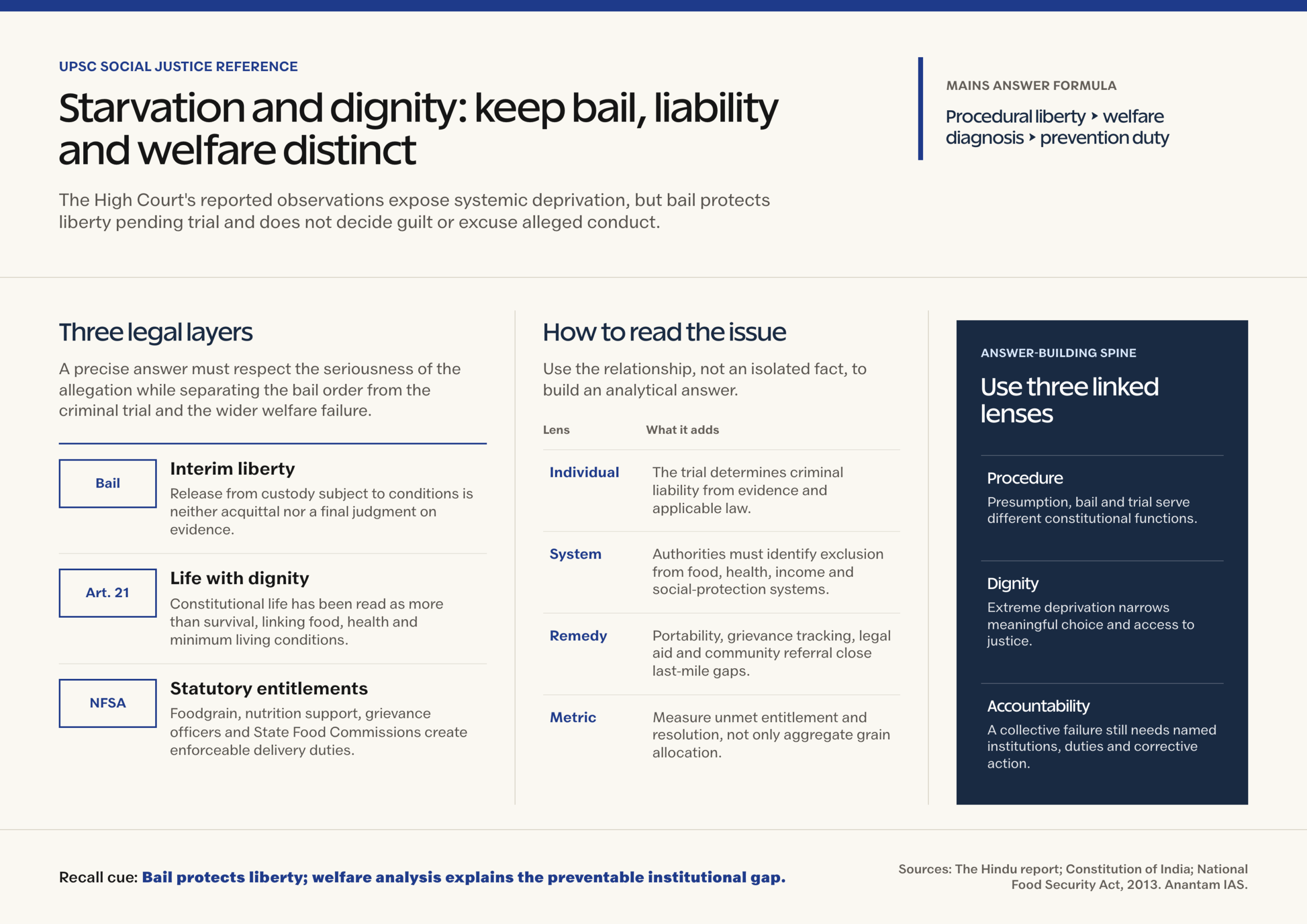
Mindmap explaining Gujarat High Court Links Starvation, Dignity and Welfare Failure for UPSC revision
Revision mindmap: Gujarat High Court Links Starvation, Dignity and Welfare Failure. Open the full-size image for details.

Background and Context

What the High Court order does and does not decide

Procedural posture is the first fact to get right in any answer on this case.

  • The High Court was considering bail, which concerns release from custody subject to conditions while the criminal process continues. The court was not delivering a final judgment after a complete trial.
  • At this stage, courts may consider the nature and gravity of the accusation, material available at a prima facie level, likelihood of absconding, risk of witness intimidation or evidence tampering, custody, health and other case-specific circumstances.
  • A grant of bail protects liberty pending adjudication. It does not erase the FIR, terminate the prosecution or declare that the alleged conduct did not occur.
  • The reported remarks about starvation and collective failure supply context for judicial discretion. Whether every allegation is proved, what mental element existed and what criminal provision applies remain questions for the competent trial court.
  • UPSC answers should use precise verbs: the court observed or noted at bail stage; it did not finally hold the State liable for the death or adjudicate the accused’s innocence.

Dignity under Article 21

Indian constitutional law treats life as more than physical survival.

  • Article 21’s guarantee of life and personal liberty has been judicially interpreted to protect a life of human dignity, subject to constitutionally valid procedure and reasonable State action.
  • Food, shelter, health and livelihood are interconnected because their absence can make other liberties nominal. A person cannot meaningfully exercise choice or access institutions while facing immediate hunger and untreated illness.
  • The right-to-life framework does not make every policy preference a directly enforceable Fundamental Right. Courts connect the text of Article 21 with statutory duties, Directive Principles and the facts before them.
  • Dignity belongs to both the deceased child and the accused mother. A rights-based approach must protect the child’s life and bodily integrity while ensuring the accused receives fair procedure, legal representation and freedom from prejudgment.
  • Constitutional compassion is not a defence created outside criminal law. It is a demand that State power, including detention and prosecution, operate with fairness, proportionality and attention to vulnerability.

Directive Principles create a governance mandate

The Constitution’s social-welfare commitments guide legislation and public administration even when they are not independently enforceable.

  • Article 39(a) calls for an adequate means of livelihood, Article 39(e) protects the health and strength of workers, and Article 39(f) seeks conditions in which children develop with freedom and dignity.
  • Article 47 makes improved nutrition, living standards and public health a primary duty of the State. Article 39A links economic vulnerability with equal justice and free legal aid.
  • Article 37 provides the constitutional balance: Directive Principles are not enforceable by any court, yet they are fundamental in governing the country and the State must apply them in making laws.
  • Parliament and State legislatures translate these directives into enforceable schemes and statutes. Once legislation creates a concrete entitlement, administrative failure can be tested against that law and ordinary public-law standards.
  • Calling deprivation a collective failure widens attention from a single office to the chain of responsibility: Union and State policy, district administration, local bodies, frontline workers, family networks and community institutions. It should not blur who.

National Food Security Act as an entitlement framework

The National Food Security Act moves food support from discretionary relief toward identified legal entitlements.

  • The Act provides foodgrain entitlements for eligible priority and Antyodaya households and nutritional support to pregnant women, lactating mothers and children through specified institutional channels.
  • Its design recognises that food security requires more than grain availability. Identification, regular delivery, maternal support, child nutrition and access to a functioning outlet or meal service all affect real outcomes.
  • Section 8 provides for a food security allowance when an entitled person does not receive foodgrain or meals. This turns a delivery failure into a question of remedy rather than charity alone.
  • The Act provides internal grievance mechanisms, a District Grievance Redressal Officer and State Food Commissions. These bodies matter only when beneficiaries know where to complain, officials respond quickly and orders are implemented.
  • Social audits, vigilance committees, disclosure and records can identify leakage or exclusion, but acute hunger needs an emergency response that does not wait for a long appellate process.

Way Forward

Create a no-wrong-door hunger response

  • Authorise district helplines, local bodies, hospitals, anganwadi centres and fair-price shops to arrange time-bound emergency food support and refer the household for a fuller assessment.
  • Do not make temporary relief conditional on completing every documentation correction first; verify eligibility in parallel where the law permits.
  • Assign one case coordinator for households facing multiple risks so that food, health, child protection, legal aid and livelihood services do not operate as isolated files.

Conclusion

  • The Gujarat High Court’s reported observations convert an individual bail matter into a difficult governance question: how can a constitutional welfare system fail to reach a household facing extreme deprivation?
  • The legal boundary remains equally important.

UPSC Practice Questions

Prelims MCQ 1

With reference to constitutional and statutory food security in India, consider the following statements:

  1. Article 47 identifies raising nutrition and the standard of living and improving public health as a primary duty of the State.
  2. The National Food Security Act provides for a food security allowance when entitled foodgrain or meals are not supplied, subject to its provisions.
  3. Directive Principles of State Policy are enforceable by courts in the same manner as Fundamental Rights.

How many of the above statements are correct?

(a) Only one (b) Only two (c) All three (d) None

Answer: (b) Only two

Explanation:

Statements 1 and 2 are correct. Article 47 sets the nutrition, living-standard and public-health duty, and Section 8 of the National Food Security Act provides a food security allowance for non-supply of entitlements. Article 37 says Directive Principles are not enforceable by courts, though they are fundamental in governance.

Prelims MCQ 2

Which one of the following most accurately describes the legal effect of granting bail to an accused person?

(a) It amounts to acquittal of the accused (b) It permanently terminates the criminal proceedings (c) It permits release from custody, usually subject to conditions, while proceedings continue (d) It shifts the burden to the victim to prove the FIR was true

Answer: (c) It permits release from custody, usually subject to conditions, while proceedings continue

Explanation:

Bail concerns liberty pending investigation or trial and may carry conditions. It is not an acquittal or termination of the case. Final guilt is determined through the criminal process on evidence and the applicable standard of proof.

UPSC Mains Questions

  1. The right to food in India lies at the intersection of Article 21, Directive Principles and statutory entitlements. Explain, and identify the reforms needed to prevent last-mile exclusion. (250 words)
  2. Social context can inform bail without deciding criminal guilt. Discuss with reference to poverty, dignity, legal aid and the presumption of innocence. (250 words)

Sources: India Code, National Food Security Act, 2013 and The Hindu.

Frequently Asked Questions

Did the Gujarat High Court acquit the woman?

No. The High Court granted bail, which permits release from custody subject to legal conditions while proceedings continue. The reported observations about poverty and starvation were made at that preliminary stage. The trial court must still assess the evidence.

Does poverty excuse a criminal offence?

Poverty is not an automatic legal excuse for causing harm. It may be relevant to social context and, depending on proven facts and applicable law, to bail or other judicial decisions. The prosecution must still prove the charged offence, while.

Is the right to food expressly written in Article 21?

Article 21 expressly protects life and personal liberty; it does not list food in those words. Courts have interpreted life to include human dignity, while the National Food Security Act and Directive Principles provide more specific food and nutrition.

What remedy exists when an NFSA entitlement is not supplied?

Section 8 of the National Food Security Act provides for a food security allowance when entitled foodgrain or meals are not supplied, subject to the Act’s framework. Complaints can also move through the internal mechanism, District Grievance Redressal Officer and.

Why is Article 39A relevant to this case?

Article 39A directs the State to secure equal justice and provide free legal aid so that economic disability does not deny access to justice. Poor accused persons may struggle to obtain counsel, documents or workable release conditions. Legal-services authorities help.

Indian Pharmacopoeia Commission Gains a Wider Regional Role

Open article →Download PDF

Why in News?

The Ministry of Health and Family Welfare announced that the WHO South-East Asia Region has recognised the Indian Pharmacopoeia Commission as a regional pharmacovigilance centre and a technical centre for medicine quality .

  • The recognition covers two related but distinct functions: post-market safety monitoring and technical support for medicine quality.
  • IPC is an autonomous institution under the Union Ministry of Health and Family Welfare and is based in Ghaziabad.
  • IPC publishes the Indian Pharmacopoeia, India’s official book of standards for medicines manufactured or marketed in the country.
  • IPC also houses the National Coordination Centre of PvPI, which receives and analyses reports of suspected adverse drug reactions and supports regulatory decisions.
  • Regional recognition does not mean that WHO has certified every medicine made in India or that all countries must adopt Indian Pharmacopoeia standards.
  • Safe medicines require both quality standards before and during manufacture and continuous monitoring after products reach diverse patient populations.
  • Many countries in the region face limited laboratory capacity, under-reporting of adverse events and uneven regulatory systems; shared technical resources can reduce these gaps.
  • For India, the role links public health with science diplomacy, pharmaceutical credibility and the responsibility that comes with being a major supplier of generic medicines and vaccines.

UPSC Relevance

Prelims Relevance

  • The Indian Pharmacopoeia Commission is an autonomous institution under the Ministry of Health and Family Welfare, not the Ministry of Chemicals and Fertilizers or the Ministry of Ayush.
  • The Indian Pharmacopoeia is the official book of standards for drugs manufactured or marketed in India.
  • A pharmacopoeial monograph can specify a medicine’s identity, purity, strength, tests, assay, storage and other quality requirements.
  • The Pharmacovigilance Programme of India is India’s national system for collecting, collating and analysing suspected adverse events related to medicines.
  • IPC functions as the National Coordination Centre for PvPI; regulatory action is taken through the competent drug-regulatory system, including CDSCO.
  • WHO defines pharmacovigilance as the science and activities relating to detection, assessment, understanding and prevention of adverse effects or any other drug-related problem.

Mains Relevance

GS Paper 2

  • Public-health governance through medicine-quality standards, patient-safety reporting and evidence-based regulatory action.
  • India’s role in regional capacity building and health diplomacy under the WHO South-East Asia architecture.

GS Paper 3

  • Scientific standard-setting through validated analytical methods, reference substances, laboratory quality systems and harmonised data.
  • The relationship between India’s pharmaceutical manufacturing strength, export credibility and regulatory science.

Essay

  • Affordable medicine is not truly accessible unless its quality and safety can be trusted.
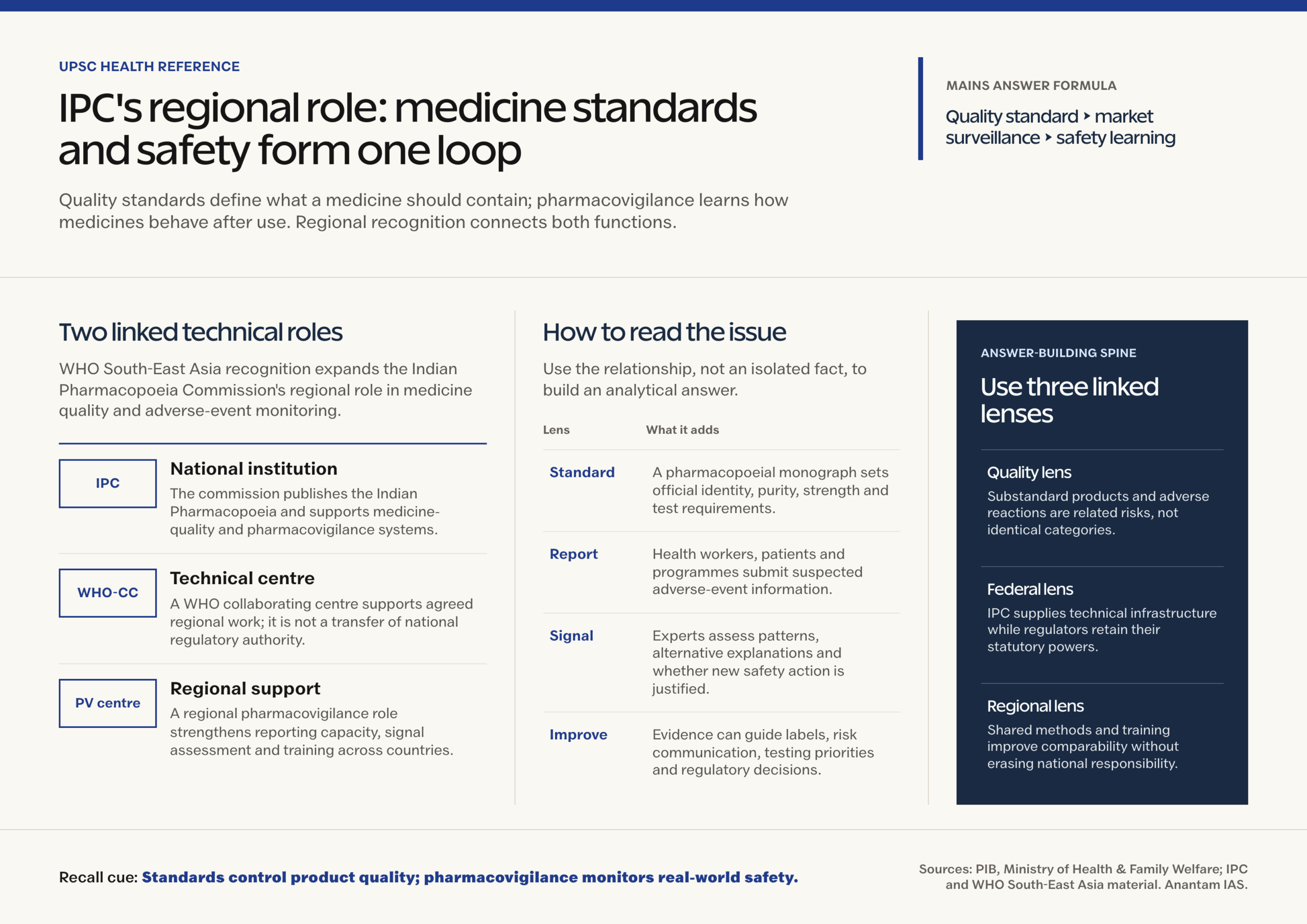
Mindmap explaining Indian Pharmacopoeia Commission Gains a Wider Regional Role for UPSC revision
Revision mindmap: Indian Pharmacopoeia Commission Gains a Wider Regional Role. Open the full-size image for details.

Background and Context

What the Indian Pharmacopoeia Commission does

IPC connects three parts of medicine governance: standards, rational use and post-market safety.

  • IPC develops and updates the Indian Pharmacopoeia, which provides official standards for medicines available in India.
  • It prepares drug monographs and associated analytical requirements with expert input, laboratory verification and revision as products and testing science evolve.
  • IPC supplies Indian Pharmacopoeia Reference Substances, which laboratories use as authoritative comparison materials when performing specified tests.
  • It publishes the National Formulary of India to support rational prescribing and use of medicines; a formulary guides use, while a pharmacopoeia sets quality standards.
  • IPC is also the National Coordination Centre for PvPI, creating a bridge between product standards and evidence that emerges after medicines are used in practice.

How a pharmacopoeia protects patients

A medicine name is not enough; every batch must meet measurable requirements for what the product is and how it performs.

  • An official monograph can describe tests for identity, ensuring that the stated active pharmaceutical ingredient is actually present.
  • Tests for strength or assay measure whether the amount of active ingredient falls within the accepted range rather than being sub-potent or excessive.
  • Purity and impurity limits help detect contaminants, degradation products and unwanted chemicals that may affect safety or stability.
  • Dosage-form tests such as dissolution can examine whether a tablet releases its ingredient as required; packaging and storage standards protect quality through shelf life.
  • Reference standards, validated methods and calibrated laboratories allow results from different locations to be compared more reliably.

Pharmacovigilance begins after approval

Clinical trials cannot reveal every rare, delayed or population-specific risk before a product enters wide use.

  • WHO defines pharmacovigilance as detection, assessment, understanding and prevention of adverse effects or other drug-related problems.
  • Patients and healthcare professionals can report a suspected adverse drug reaction even when they are not certain that the medicine caused it.
  • An Adverse Drug Reaction Monitoring Centre checks the report and sends an Individual Case Safety Report through the national system for review.
  • At IPC, reports are assessed for completeness, coding and clinical information before valid cases contribute to national analysis and the global WHO programme.
  • Multiple reports, patterns, biological plausibility, background rates and other evidence may generate a safety signal. A signal is a question requiring investigation, not a final verdict.

India in the WHO global drug-safety network

National reporting becomes more powerful when anonymised case patterns can be examined across countries.

  • The WHO Programme for International Drug Monitoring was created after the World Health Assembly called for systematic collection of serious adverse-reaction information.
  • Participating national centres submit Individual Case Safety Reports to VigiBase, the global database managed by the Uppsala Monitoring Centre.
  • A larger dataset can reveal rare patterns that may not be visible within one hospital or country, especially when a medicine is used by different age, genetic or disease groups.
  • International data still require careful interpretation because reporting practices, prescribing patterns and background disease rates vary among countries.
  • IPC-PvPI has already worked as a WHO Collaborating Centre for pharmacovigilance in public health programmes and regulatory services. The new regional roles broaden the platform for practical support.

Way Forward

Publish a regional work plan

  • IPC and WHO South-East Asia should state the services offered, eligibility, governance and measurable deliverables for both regional functions.
  • Baseline each participating country’s laboratory and pharmacovigilance capacity before setting training priorities.
  • Report outcomes such as improved report completeness, response time, laboratory proficiency and regulatory follow-through, not only workshop counts.

Conclusion

  • WHO South-East Asia’s recognition gives the Indian Pharmacopoeia Commission a stronger platform to connect medicine standards, laboratory quality and real-world safety monitoring across the region.
  • India should use the role to make reports more informative, laboratories more comparable and safety decisions faster and clearer.

UPSC Practice Questions

Prelims MCQ 1

With reference to the Indian Pharmacopoeia Commission, consider the following statements:

  1. It is an autonomous institution under the Ministry of Health and Family Welfare.
  2. It publishes the Indian Pharmacopoeia and functions as the National Coordination Centre for the Pharmacovigilance Programme of India.
  3. It grants marketing authorisation for every new drug in India.

How many of the above statements are correct?

(a) Only one (b) Only two (c) All three (d) None

Answer: (b) Only two

Explanation:

Statements 1 and 2 are correct. Statement 3 is incorrect: IPC develops standards and coordinates PvPI, while marketing authorisation and legal regulatory action fall within the competent drug-regulatory framework, including CDSCO.

Prelims MCQ 2

Which one of the following best describes VigiBase?

(a) India’s official book of medicine-quality standards (b) WHO’s global database of Individual Case Safety Reports, managed by the Uppsala Monitoring Centre (c) A WHO list of prequalified generic-drug manufacturers (d) India’s database of licensed retail pharmacies

Answer: (b) WHO's global database of Individual Case Safety Reports, managed by the Uppsala Monitoring Centre

Explanation:

VigiBase receives Individual Case Safety Reports from members of the WHO Programme for International Drug Monitoring. It supports signal detection but does not itself prove causality in an individual report.

UPSC Mains Questions

  1. WHO South-East Asia’s recognition of the Indian Pharmacopoeia Commission can strengthen both regional public health and India’s pharmaceutical credibility. Discuss the opportunities and institutional safeguards required. (250 words)
  2. Explain how pharmacopoeial standards and pharmacovigilance perform different but complementary roles in medicine safety. (150 words)

Sources: PIB, Ministry of Health and Family Welfare and Indian Pharmacopoeia Commission.

Frequently Asked Questions

What is the Indian Pharmacopoeia Commission?

IPC is an autonomous institution under the Union Health Ministry. It develops and publishes the Indian Pharmacopoeia, supplies reference standards, publishes the National Formulary of India and serves as the National Coordination Centre for the Pharmacovigilance Programme of India.

What is the Indian Pharmacopoeia?

The Indian Pharmacopoeia is India’s official book of standards for drugs manufactured or marketed in the country. Its monographs prescribe measurable requirements such as identity, strength, purity, analytical tests, storage and other quality attributes for medicines and pharmaceutical substances.

What is pharmacovigilance?

WHO defines pharmacovigilance as the science and activities relating to detecting, assessing, understanding and preventing adverse effects or other drug-related problems. It continues after approval because rare, delayed and population-specific risks may become visible only during wider real-world use.

Does an adverse drug reaction report prove that a medicine caused the event?

No. A suspected report provides information that may contribute to a safety signal, but temporal association is not proof of causation. Experts examine clinical details, alternative causes, repeated patterns, biological plausibility and other evidence before recommending regulatory action.

What does WHO regional recognition of IPC mean?

It gives IPC an expanded regional technical and capacity-building role in pharmacovigilance and medicine quality. It can support training, data systems, laboratory methods and regulatory capability across the WHO South-East Asia Region while national authorities retain their legal decision-making powers.

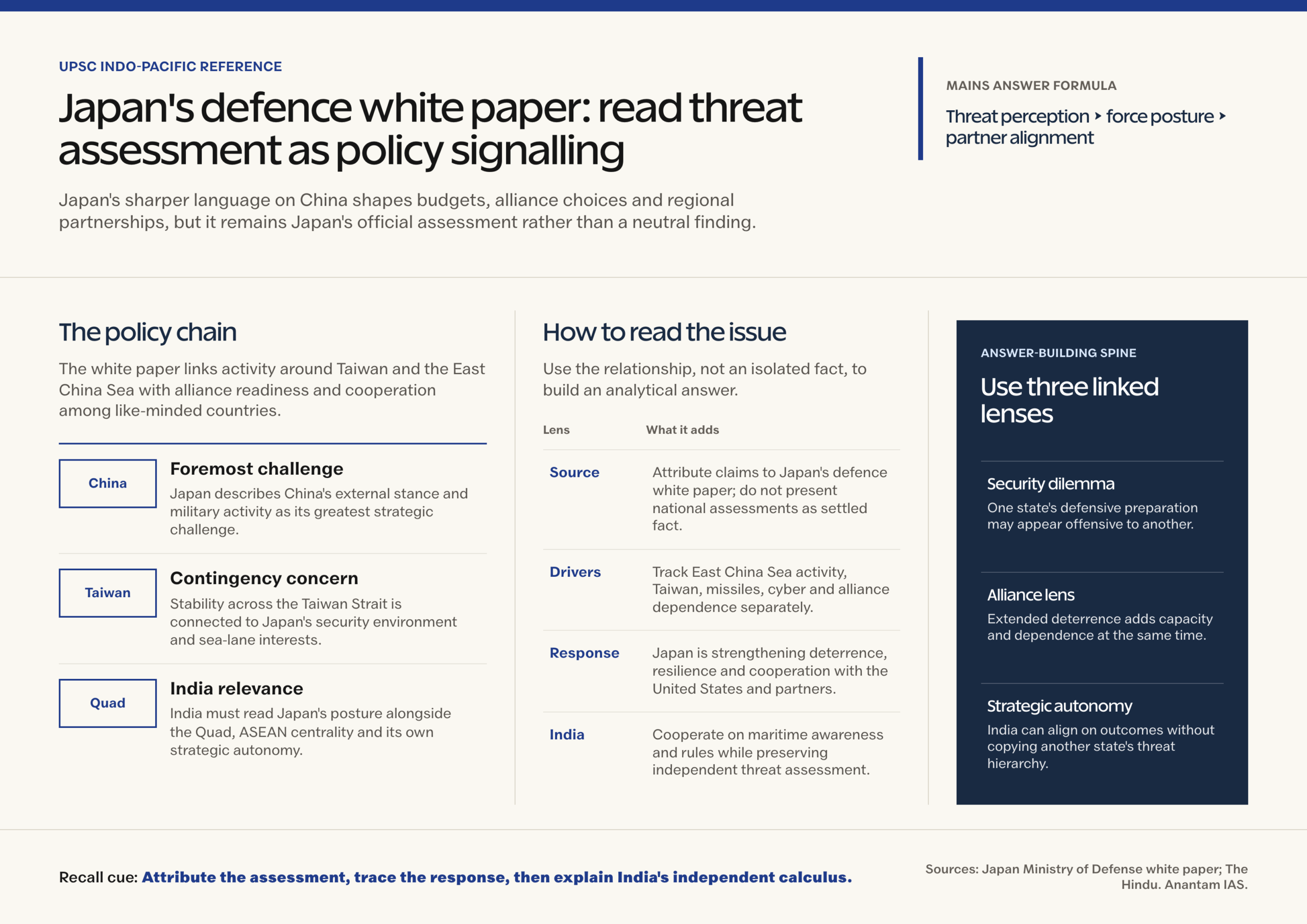
Japan Defence White Paper Calls China Its Greatest Strategic Challenge

Open article →Download PDF

Why in News?

Japan’s Ministry of Defense released the English digest of Defense of Japan 2026 , its annual white paper on the security environment and national defence policy.

  • The white paper says Japan should respond through comprehensive national power and cooperation with its ally, like-minded countries and other partners.
  • It records China’s broad military modernisation, including nuclear, missile, naval and air capabilities, and says defence-budget growth has continued at a high level for more than 30 years without adequate transparency.
  • Japan highlights intensified Chinese activity around the Senkaku Islands, which Japan administers and China claims as the Diaoyu Islands, as well as activity in the Sea of Japan and western Pacific.
  • The document also points to repeated exercises around Taiwan, while carefully presenting possible blockade scenarios as an assessment rather than a confirmed future course of action.
  • The Hindu reported the sharper language amid renewed China-Japan tensions. The wording remains Japan’s official threat perception, which must be distinguished from a neutral finding or legal adjudication.
  • The white paper matters because Japan sits close to the Taiwan Strait and the East China Sea, while its economy depends heavily on secure maritime routes through the wider Indo-Pacific.
  • Japan’s assessment can shape the revision of its Three Strategic Documents: the National Security Strategy, National Defense Strategy and Defense Buildup Program.
  • For India, the development affects the strategic setting of the Quad, maritime-domain awareness, defence technology cooperation and the wider balance between deterrence and escalation management.

UPSC Relevance

Prelims Relevance

  • Defense of Japan is an annual white paper issued by Japan’s Ministry of Defense; it explains Japan’s security environment and defence initiatives.
  • Japan’s Three Strategic Documents are the National Security Strategy, National Defense Strategy and Defense Buildup Program.
  • Japan’s official policy retains an Exclusively Defense-Oriented Policy, civilian control and the Three Non-Nuclear Principles as policy guidelines.
  • The Senkaku Islands are administered by Japan in the East China Sea and claimed by China as the Diaoyu Islands; this is a sovereignty dispute, not a settled description accepted by both sides.
  • The Taiwan Strait connects the East China Sea and South China Sea and is strategically relevant to regional sea and air routes.
  • The Quad comprises India, Japan, Australia and the United States; it is a diplomatic partnership, not a collective-defence treaty organisation.

Mains Relevance

GS Paper 2

  • Assess how changing threat perceptions in Japan influence India-Japan strategic cooperation, the Quad and the idea of a free and open Indo-Pacific.
  • Examine the role and limits of minilateral institutions in maritime security when they lack mutual-defence obligations.

GS Paper 3

  • Connect East Asian tensions with sea-lane security, critical supply chains, maritime-domain awareness and India’s economic security.
  • Analyse the security implications of unmanned systems, cyber operations, space assets, information warfare and rapid military-technological change.

Essay

  • Security dilemmas can make defensive measures appear offensive to a rival, creating an action-reaction cycle even when neither side publicly seeks war.
Mindmap explaining Japan Defence White Paper Calls China Its Greatest Strategic Challenge for UPSC revision
Revision mindmap: Japan Defence White Paper Calls China Its Greatest Strategic Challenge. Open the full-size image for details.

Background and Context

What Japan's white paper actually says

The document is an official Japanese assessment, so its claims should be read precisely and attributed clearly.

  • It describes China’s external posture and military activities as a matter of serious concern for Japan and the international community, and as Japan’s unprecedented and greatest strategic challenge.
  • The assessment combines several strands: sustained military modernisation, maritime and air activity around Japan, operations farther into the western Pacific, pressure around Taiwan and growing China-Russia military cooperation.
  • The white paper does not say that armed conflict is inevitable. It says a serious situation in East Asia cannot be ruled out, which is risk language rather than a forecast.
  • UPSC answers should separate three layers: verified activity, Japan’s interpretation of that activity, and broader analytical judgments about regional consequences.

East China Sea, Taiwan and the maritime geography

Geography makes developments around Taiwan and the East China Sea directly relevant to Japan’s security planning.

  • Japan’s southwestern islands extend toward Taiwan, while the disputed Senkaku/Diaoyu Islands lie in the East China Sea. Regular coast-guard and military activity raises the risk of miscalculation even without an intended attack.
  • The white paper says Chinese activity has extended beyond the so-called first island chain toward the second island chain. These are strategic-geography concepts, not treaty boundaries or legal maritime zones.
  • It notes intensified Chinese military exercises around Taiwan and argues that repeated operations can normalise a larger operational presence. This is Japan’s assessment of the pattern and purpose.
  • A Taiwan crisis could affect commercial shipping, aviation, semiconductor supply chains and alliance calculations. Such consequences explain the global interest, but they do not determine the legal status of Taiwan or prejudge a specific scenario.

Japan's post-war defence framework is changing in scale

Japan is strengthening military capability while presenting the shift within its constitutional and policy constraints.

  • The 2026 digest restates the Exclusively Defense-Oriented Policy, civilian control and the Three Non-Nuclear Principles as policy guidelines.
  • It also supports stronger defence capabilities, including counterstrike capabilities, backed by diplomacy and the Japan-US Alliance. This creates continuing domestic debate about the scope of Japan’s post-war security posture.
  • Japan formulated its current National Security Strategy, National Defense Strategy and Defense Buildup Program in 2022. The government plans to revise these documents within 2026 because it judges the environment to have changed faster than.
  • The digest says the government achieved the defence-budget level of 2% of GDP, counting initial and supplementary budgets, ahead of its original schedule. It also says FY2026 defence-related expenditure, including specified US-force realignment costs, exceeded.
  • Budget growth improves capacity only when matched by personnel, maintenance, stockpiles, resilient bases, command systems and democratic oversight. Expenditure alone is not a measure of readiness or regional stability.

Alliances, minilateralism and regional deterrence

Japan’s answer is not military self-reliance alone; it is a layered network centred on the United States and connected to regional partners.

  • The white paper calls the Japan-US Alliance a key pillar and advocates closer training, operations, equipment cooperation and industrial links with like-minded countries.
  • Japan also works through small-group formats and partnerships. Minilateralism can be faster and more task-specific than a large multilateral organisation, but it may create exclusion concerns or unclear crisis expectations.
  • The Quad focuses on practical public-good cooperation such as maritime-domain awareness, resilient supply chains, critical technologies and humanitarian assistance. It does not impose a NATO-style collective-defence obligation.
  • Deterrence aims to persuade an opponent that coercion will fail or become too costly. Yet additional deployments and exercises can intensify a security dilemma if each side interprets the other’s defensive steps as preparation for attack.
  • Risk-reduction measures such as hotlines, prior notification, professional air and maritime encounters and crisis communication are complements to deterrence, not signs of strategic weakness.

Way Forward

Pair deterrence with crisis-management guardrails

  • Japan and China should keep defence hotlines operational and adopt clear procedures for unexpected air and maritime encounters.
  • All sides should avoid unsafe approaches, radar illumination and other conduct that can be misread during close operations.
  • Exercise notification, professional communication and incident-investigation channels can create escalation control without resolving sovereignty disputes.

Conclusion

  • Japan’s 2026 defence white paper marks a sharper official assessment of China, but its lasting importance lies in the policy chain it may produce: revised strategy, larger capabilities, stronger alliances and deeper defence-industrial cooperation.
  • For India, the useful response is neither indifference nor automatic alignment.

UPSC Practice Questions

Prelims MCQ 1

With reference to Japan’s security architecture, consider the following statements:

  1. Japan’s Three Strategic Documents include the National Security Strategy, National Defense Strategy and Defense Buildup Program.
  2. The Quad creates a legally binding collective-defence obligation among India, Japan, Australia and the United States.
  3. Japan’s Official Security Assistance is distinct from its Official Development Assistance.

How many of the above statements are correct?

(a) Only one (b) Only two (c) All three (d) None

Answer: (b) Only two

Explanation:

Statements 1 and 3 are correct. Japan’s Three Strategic Documents are the NSS, NDS and DBP. Official Security Assistance supports security capabilities and is distinct from development-focused ODA. The Quad is a diplomatic partnership and has no collective-defence treaty clause.

Prelims MCQ 2

Which one of the following best describes the first and second island chains in Indo-Pacific strategic discussions?

(a) Maritime boundaries fixed by the UN Convention on the Law of the Sea (b) Treaty-defined collective-defence zones of the Quad (c) Strategic-geography concepts describing arcs of islands in the western Pacific (d) Exclusive economic zones jointly administered by Japan and the United States

Answer: (c) Strategic-geography concepts describing arcs of islands in the western Pacific

Explanation:

The island chains are strategic-geography concepts used to discuss the western Pacific. They are not legal maritime boundaries, Quad treaty zones or jointly administered exclusive economic zones.

UPSC Mains Questions

  1. Japan’s 2026 defence white paper reflects both a changing East Asian security environment and a classic security dilemma. Discuss. (250 words)
  2. How should India deepen security cooperation with Japan while preserving strategic autonomy and regional stability? Examine with reference to maritime and technology cooperation. (250 words)

Sources: Japan Ministry of Defense and The Hindu.

Frequently Asked Questions

What is Japan’s Defense of Japan white paper?

Defense of Japan is the Ministry of Defense’s annual public assessment of the security environment and Japan’s defence policies and activities. It is a primary source for understanding official Japanese perceptions and priorities, but its analytical judgments remain the position.

Why does the 2026 white paper call China Japan’s greatest strategic challenge?

The paper cites China’s long-term military modernisation, intensified maritime and air activity around Japan, operations in the western Pacific, exercises around Taiwan, South China Sea activity and closer military cooperation with Russia. The phrase expresses Japan’s official assessment; it.

What are Japan’s Three Strategic Documents?

They are the National Security Strategy, which gives broad national-security direction; the National Defense Strategy, which states defence objectives and approaches; and the Defense Buildup Program, which specifies the capability-building programme. The current set dates from 2022, and Japan.

How is the Japan-China security debate relevant to India?

It affects the Indo-Pacific environment in which India protects maritime trade, critical supply chains and strategic partnerships. India works with Japan bilaterally and through the Quad on maritime awareness, technology and resilience, but it has no treaty obligation to adopt.

Is the Quad an Asian NATO?

No. The Quad is a partnership of India, Japan, Australia and the United States focused on practical cooperation in areas such as maritime security, critical technologies, supply chains and disaster response. It has no collective-defence clause, permanent military command.

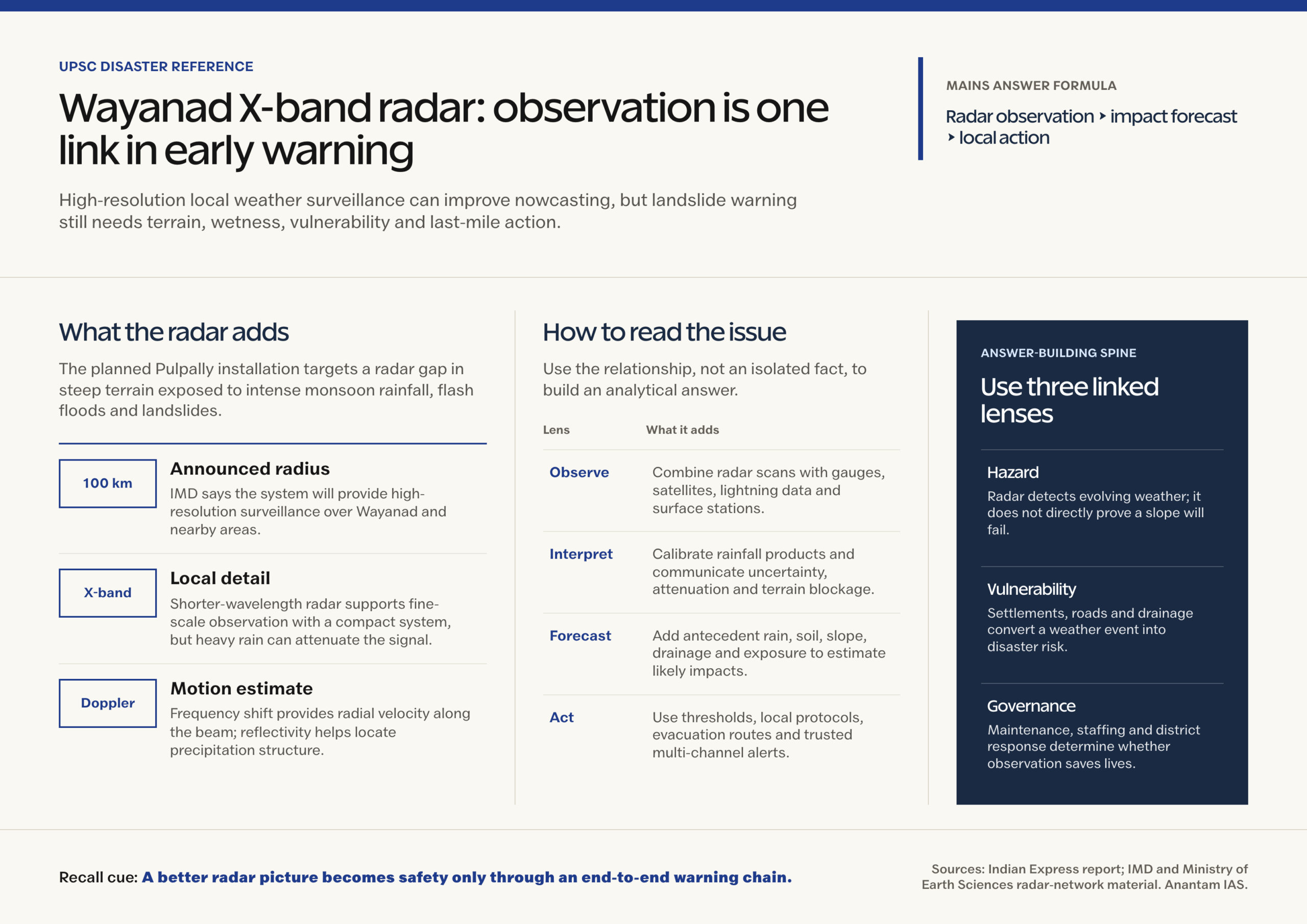
Wayanad X-Band Doppler Weather Radar and Local Early Warning

Open article →Download PDF

Why in News?

The India Meteorological Department said on August 6, 2026 that an X-band Doppler Weather Radar would be commissioned at Pulpally in Kerala’s Wayanad district by December 2026.

  • Pazhassi Raja College at Pulpally has provided land for the radar, which will be manned and operated by IMD’s technical and meteorological personnel.
  • IMD told The Indian Express that the system would provide high-resolution weather surveillance over a radius of 100 km, benefiting Wayanad and nearby areas.
  • The planned radar is meant to improve the timeliness and accuracy of forecasts and warnings supplied to the district administration, disaster-management authority and public.
  • A March 2025 parliamentary reply had already listed Wayanad among the tentative locations for new X-band DWRs, placing the project within a wider expansion of India’s radar network.
  • The announcement follows repeated disasters in the district, including the July 2024 landslides near Meppadi. That context explains the urgency, but a weather radar should not be described as a stand-alone landslide-prediction machine.
  • Wayanad lies in the Western Ghats, where steep slopes, complex terrain and strong orographic influence can produce sharp local variations in rainfall that are difficult to represent through sparse observations alone.
  • A radar provides frequent, spatially continuous observations of precipitation systems between surface stations. This is valuable for nowcasting, the very short-range forecasting of weather already developing or likely to develop soon.
  • Early warning becomes useful only when observations flow into forecasts, impact thresholds, clear institutional decisions and last-mile communication. Better detection does not automatically produce timely evacuation.

UPSC Relevance

Prelims Relevance

  • A Doppler Weather Radar sends microwave pulses and analyses returned signals to locate precipitation and estimate characteristics such as reflectivity and radial motion.
  • The Doppler effect is the change in observed frequency caused by relative motion between the source and the observer; weather radar uses it to estimate motion toward or away from the radar along the beam.
  • Radar reflectivity is related to the strength of the returned signal and helps forecasters identify the location and intensity structure of precipitation.
  • Radial velocity represents motion along the radar beam. A single radar does not directly provide the complete three-dimensional wind vector at every point.
  • X-band systems use a shorter wavelength than C-band and S-band weather radars and are suited to detailed surveillance over a comparatively local area.
  • IMD stated that the Pulpally radar would cover a 100 km radius; this is the announced operational coverage for this project, not a universal range for every X-band system.

Mains Relevance

GS Paper 3

  • Explain how dense radar coverage can strengthen early warning systems for cloudbursts, flash floods, thunderstorms and rainfall-triggered slope hazards in complex terrain.
  • Evaluate the full warning chain from observation to forecast, impact assessment, communication and protective action, rather than treating equipment procurement as the final outcome.

GS Paper 1

  • Relate the Western Ghats’ orographic rainfall, steep relief, drainage response and slope instability to Wayanad’s exposure to high-impact weather.
  • Distinguish between a meteorological hazard, a geomorphological process and a disaster shaped by exposure and vulnerability.

Essay

  • Technology reduces disaster risk only when institutions can translate better knowledge into trusted and timely action.
Mindmap explaining Wayanad X-Band Doppler Weather Radar and Local Early Warning for UPSC revision
Revision mindmap: Wayanad X-Band Doppler Weather Radar and Local Early Warning. Open the full-size image for details.

Background and Context

What a Doppler Weather Radar Measures

A DWR is an active remote-sensing instrument: it transmits microwave energy and processes the signal scattered back by hydrometeors such as raindrops, snow particles or hail.

  • The strength of the return is expressed through reflectivity products, which help reveal precipitation location, structure and relative intensity.
  • The frequency shift in the return provides radial velocity, allowing forecasters to examine motion along the radar beam and detect organised circulation or convergence signatures.
  • Repeated scans at different elevation angles build a volume view of the atmosphere. Derived products can support rainfall estimation, storm tracking and short-range warning decisions.
  • Radar is an indirect measurement. Beam geometry, terrain blockage, distance, calibration, anomalous propagation and signal attenuation can affect what is observed, so products require expert interpretation and comparison with other instruments.

Why X-Band Fits a Local High-Resolution Role

Weather-radar bands involve a practical trade-off among wavelength, spatial detail, antenna size, useful range and susceptibility to signal loss in heavy precipitation.

  • An X-band radar operates at a shorter wavelength than commonly used C-band and S-band systems. It can support fine-scale observations with a relatively compact installation.
  • Its strength is local surveillance of rapidly evolving weather, which matches the need to observe small, intense rain systems over Wayanad and adjoining areas.
  • Shorter-wavelength signals are more affected by attenuation as they pass through heavy precipitation. That limitation must be managed through calibration, processing, network design and interpretation.
  • The 100 km figure reported for Pulpally is a project-specific coverage radius. A candidate should avoid memorising simplistic universal ranges for radar bands because specifications and operational products vary.

Why Wayanad Needs Denser Observation

Wayanad’s risk is produced by the interaction of intense monsoon weather with mountainous terrain and vulnerable settlements and infrastructure.

  • Moist air forced to rise across the Western Ghats can enhance rainfall through orographic uplift, while the distribution of rainfall may change sharply across ridges, valleys and short distances.
  • Steep catchments can convert heavy rain into fast runoff, raising flash-flood risk. Saturated or weakened slopes may fail when rainfall adds pore-water pressure or removes support.
  • A surface rain gauge measures conditions at one location. Radar adds the spatial pattern and movement of precipitation, helping identify where intense cells are forming and how they evolve.
  • The new radar should complement the existing S-band DWR at Kochi and C-band DWR at Thiruvananthapuram, along with satellites, gauges, automatic weather stations, lightning data and numerical models.

From Weather Detection to Landslide Warning

A stronger weather picture is one input into a multi-hazard early-warning system, not proof that a particular slope will fail.

  • A hazard forecast estimates a physical event such as intense rainfall. An impact-based warning asks what that rainfall could do to people, roads, rivers, slopes and essential services in a particular place.
  • Operational landslide warning needs rainfall intensity and duration, antecedent wetness, soil and geological information, slope inventories, drainage conditions and records of past failures.
  • Thresholds should be calibrated for local terrain and then tested against events. A district-wide rainfall threshold can miss micro-scale risk or trigger too many false alarms.
  • Warnings must specify the threatened area, expected impact, confidence, time window and recommended action. A technically correct alert that arrives late or uses vague language has limited protective value.

Way Forward

Build a Multi-Sensor Wayanad Warning System

  • Fuse radar products with rain gauges, automatic weather stations, satellite estimates, lightning observations, river levels and soil-moisture information on one operational dashboard.
  • Map radar visibility and terrain blockage, retain redundant sensors in weak-coverage zones and conduct routine comparisons between radar estimates and ground observations.
  • Feed quality-controlled observations into nowcasting and numerical prediction systems while ensuring that forecasters can explain uncertainty and override automated outputs when evidence demands it.

Conclusion

  • The Pulpally X-band radar can close an important observational gap by showing the structure and movement of local rain systems with greater detail.
  • Its real test will come after commissioning: whether reliable radar data are combined with ground evidence, local thresholds, trusted communication and rehearsed action.

UPSC Practice Questions

Prelims MCQ 1

With reference to Doppler Weather Radar, consider the following statements:

  1. Radar reflectivity can help identify the location and intensity structure of precipitation.
  2. Doppler radial velocity directly provides the complete three-dimensional wind vector at every observed point.
  3. X-band radar generally uses a shorter wavelength than C-band and S-band weather radar.

How many of the above statements are correct?

(a) Only one (b) Only two (c) All three (d) None

Answer: (b) Only two

Explanation:

Statements 1 and 3 are correct. Reflectivity describes returned signal strength associated with precipitation structure, and X-band has the shorter wavelength. Radial velocity measures motion along the radar beam, not the full three-dimensional wind vector by itself.

Prelims MCQ 2

Which one of the following best describes the role of the planned X-band radar at Pulpally?

(a) It will directly predict the failure of every landslide-prone slope (b) It will replace rain gauges and satellite observations across Kerala (c) It will provide high-resolution local weather surveillance to strengthen forecasting and early warning (d) It will measure earthquake waves beneath the Western Ghats

Answer: (c) It will provide high-resolution local weather surveillance to strengthen forecasting and early warning

Explanation:

IMD has described the project as a 100 km-radius high-resolution weather-surveillance system. It can strengthen rainfall monitoring and nowcasting, but landslide warning still needs terrain, soil, hydrological and exposure information.

UPSC Mains Questions

  1. A weather radar is an observing instrument, while an early-warning system is an institutional chain. Examine this distinction with reference to the planned X-band Doppler Weather Radar in Wayanad. (250 words)
  2. Discuss how high-resolution weather surveillance can reduce disaster risk in the Western Ghats. What technological and governance limitations must be addressed? (250 words)

Sources: The Indian Express and Ministry of Earth Sciences, Parliament Question on Locations for New Radars.

Frequently Asked Questions

What is the Wayanad X-band Doppler Weather Radar project?

IMD plans to commission an X-band DWR at Pulpally in Wayanad by December 2026. It is expected to provide high-resolution weather surveillance over a 100 km radius and strengthen forecasts and early warnings for Wayanad and neighbouring areas.

Why is an X-band radar useful in Wayanad?

X-band radar is suited to detailed monitoring over a local area. In Wayanad’s complex Western Ghats terrain, it can help forecasters see the structure and movement of intense rain systems that may trigger flash floods or contribute to slope instability.

Can the radar predict landslides by itself?

No. It can improve rainfall observation and very short-range weather forecasts. A landslide warning also requires antecedent rainfall, soil moisture, geology, slope condition, drainage, land-use and exposure data, plus locally tested thresholds and field reporting.

What does Doppler mean in weather radar?

Doppler refers to the frequency shift in a returned radar signal caused by motion. It allows forecasters to estimate radial motion toward or away from the radar, while reflectivity products help describe precipitation location and structure.

What is nowcasting?

Nowcasting is the immediate to very short-range forecasting of weather, based heavily on frequently updated observations. Radar, satellite, lightning and surface data help forecasters track rapidly developing storms and issue location-specific warnings with useful lead time.

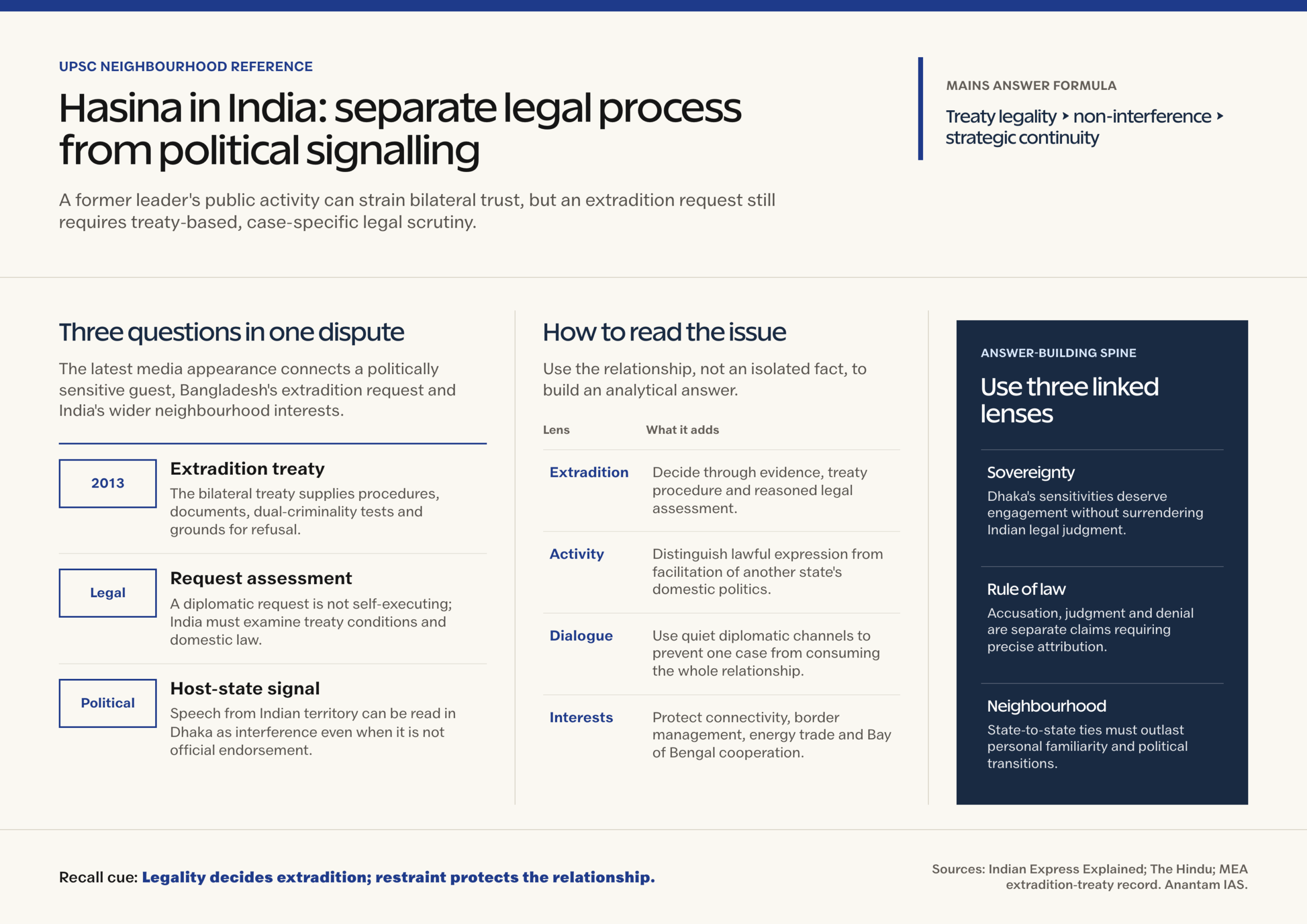
Sheikh Hasina in India: A New Strain in India-Bangladesh Ties

Open article →Download PDF

Why in News?

Former Bangladesh Prime Minister Sheikh Hasina , who has been living in India since leaving Bangladesh on 5 August 2024, participated in a question-taking media interaction from New Delhi on 5 August 2026.

  • The interaction coincided with the second anniversary of the uprising that ended Hasina’s government in August 2024.
  • The Associated Press reported that Hasina announced a plan to return voluntarily in December 2026; her statement is an intention, not confirmation that travel or surrender arrangements have been agreed.
  • Dhaka said its repeated requests for Hasina’s return under the 2013 India-Bangladesh Extradition Treaty had not produced the outcome it sought.
  • India has treated the extradition question as a legal issue. No public statement establishes that New Delhi has accepted, rejected or fixed a timetable for the request.
  • The episode matters beyond one individual because public activity by an exiled former leader can affect sovereignty sensitivities, domestic legitimacy and trust between neighbouring governments.
  • India must distinguish its legal handling of an individual from its wider relationship with the Bangladeshi state and people.
  • Bangladesh must pursue accountability through treaty procedures and credible due process, rather than assuming that a diplomatic demand produces automatic extradition.
  • Both sides have practical interests in border management, connectivity, power trade, water cooperation and regional security that should not become hostage to a single political dispute.

UPSC Relevance

Prelims Relevance

  • India and Bangladesh signed a bilateral Extradition Treaty in 2013; it entered into force on 23 October 2013.
  • An extradition request under the treaty is made through the diplomatic channel between the designated central authorities.
  • Extradition is a formal process for surrendering a person to another state for prosecution or enforcement of a sentence; it is distinct from deportation.
  • The treaty uses the principle of dual criminality: the alleged conduct must constitute an extraditable offence under the laws of both states, subject to the treaty’s terms.
  • The requested state examines the treaty conditions, supporting documents and applicable grounds for refusal; a request is not self-executing.
  • The treaty provides for consultation when the requested state considers the material supplied insufficient to decide the request.

Mains Relevance

GS Paper 2

  • India and its neighbourhood: managing a partner’s political transition without appearing aligned permanently with one party or leader.
  • Bilateral treaties and legal diplomacy: separating the existence of an extradition framework from the merits and procedure of an individual request.

GS Paper 3

  • Security effects of bilateral mistrust on border management, transnational crime and cooperation in India’s eastern neighbourhood.
  • The strategic importance of Bangladesh for Northeast connectivity, Bay of Bengal access, energy links and resilient regional supply chains.

Essay

  • Geography makes neighbours permanent; political alignments are temporary.
Mindmap explaining Sheikh Hasina in India: A New Strain in India-Bangladesh Ties for UPSC revision
Revision mindmap: Sheikh Hasina in India: A New Strain in India-Bangladesh Ties. Open the full-size image for details.

Background and Context

From Hasina's departure to the present dispute

The August 2026 row is the latest stage of a problem that began with Bangladesh’s abrupt political transition two years earlier.

  • Hasina left Bangladesh and arrived in India on 5 August 2024 after a student-led movement and wider unrest ended her government.
  • Her continued presence in India acquired diplomatic weight as Bangladeshi authorities initiated legal proceedings and sought her return. Any account of those proceedings must distinguish court findings, government claims and Hasina’s denials.
  • Hasina has issued political messages from India before, but the question-taking interaction gave the episode a sharper public profile and prompted Dhaka to ask why such activity was occurring on Indian soil.
  • The dispute is not proof that India organised or endorsed her remarks. The diplomatic question is whether New Delhi can prevent a private individual’s political activity from being interpreted as state alignment.
  • The event also shows how an unresolved individual case can become a recurring symbol through which broader suspicions about the bilateral relationship are expressed.

What the extradition treaty does and does not decide

The treaty creates a legal route for a request, but the treaty’s existence does not answer the case by itself.

  • The official MEA list of extradition treaties records the India-Bangladesh treaty as a 2013 instrument. It supplies procedures, evidentiary requirements and legal tests for surrender.
  • A request travels through the diplomatic channel and must be accompanied by the material required for an accused or a convicted person under the treaty.
  • The requested state evaluates whether the conduct is extraditable, whether the papers are sufficient and whether any treaty-based refusal ground applies. That evaluation is case-specific.
  • The treaty also allows the requested state to seek additional information. Diplomatic silence or delay cannot safely be read, without an official decision, as legal acceptance or rejection.
  • Students should not infer the outcome from labels such as political offence, conviction in absentia or severity of punishment. Their legal effect depends on the treaty text, domestic law, record supplied and competent authorities’ assessment.

Why speech from the host state's territory becomes diplomatic

A media appearance by a private or protected individual is not automatically an official act, yet its location can carry political meaning.

  • Dhaka views hostile political messaging from India as an issue of sovereignty and non-interference, especially when the speaker is a former prime minister seeking to influence Bangladesh’s politics.
  • New Delhi must also protect its own legal process and avoid treating another government’s accusation as a substitute for an independent decision.
  • The central diplomatic distinction is between permission, facilitation and endorsement. These are different factual categories and should not be collapsed without evidence.
  • Host states commonly manage such situations through conditions on public activity, discreet communication and clarification of their official position. The appropriate measure depends on the person’s legal status and domestic law, which India has not fully.
  • Escalatory public language may satisfy domestic audiences but narrows the room for confidential legal and diplomatic problem-solving.

India's strategic stakes in Bangladesh

Bangladesh is not a single-issue relationship for India; it is central to the security and economic geography of eastern South Asia.

  • Cooperation with Dhaka supports connectivity to India’s Northeast through road, rail, inland waterways and access to Bangladeshi ports.
  • The relationship includes border coordination, action against transnational crime, power and energy trade, development partnerships and management of shared rivers.
  • Bangladesh’s location connects the Ganga-Brahmaputra-Meghna region with the Bay of Bengal, giving the bilateral relationship wider relevance to BIMSTEC and India’s Indo-Pacific outlook.
  • The long period of close cooperation under Hasina produced security and connectivity gains, but it also contributed to a perception among some Bangladeshis that India was unusually invested in one political formation.
  • India’s durable interest is a stable, sovereign and cooperative Bangladesh, not the permanent dominance of any one party. The India-Bangladesh relations overview provides the wider bilateral foundation.

Way Forward

Clarify India's official position

  • India should state that remarks by a person on its territory do not represent the Government of India’s position.
  • Without disclosing protected legal material, New Delhi can explain the procedural stage at which the extradition request stands.
  • Future public activity should be managed consistently with Indian law and India’s interest in avoiding use of its territory for destabilising political campaigns.

Conclusion

  • Sheikh Hasina’s presence in India has become a test of whether New Delhi can combine legal consistency with political sensitivity.
  • India and Bangladesh should process the individual case on its legal record and protect the wider relationship through candid communication, restraint and continued cooperation.

UPSC Practice Questions

Prelims MCQ 1

With reference to extradition between India and Bangladesh, consider the following statements:

  1. India and Bangladesh have a bilateral extradition treaty signed in 2013.
  2. A request under the treaty is made through the diplomatic channel.
  3. The existence of the treaty makes every extradition request automatically enforceable.

How many of the above statements are correct?

(a) Only one (b) Only two (c) All three (d) None

Answer: (b) Only two

Explanation:

Statements 1 and 2 are correct. Statement 3 is incorrect because the requested state must examine the treaty conditions, supporting material and any applicable grounds for refusal; a request is not automatically enforceable.

Prelims MCQ 2

Which one of the following best distinguishes extradition from deportation?

(a) Extradition is a treaty or law-based surrender for prosecution or sentence, while deportation is removal under immigration law. (b) Extradition can occur only within a regional organisation, while deportation is always bilateral. (c) Extradition applies only to citizens, while deportation applies only to stateless persons. (d) Extradition is ordered by the United Nations, while deportation is ordered by an embassy.

Answer: (a) Extradition is a treaty or law-based surrender for prosecution or sentence, while deportation is removal under immigration law.

Explanation:

Extradition responds to another state’s criminal-justice request under the applicable legal framework. Deportation or removal arises from immigration law and has a different purpose and procedure.

UPSC Mains Questions

  1. Sheikh Hasina’s continued presence in India tests both treaty-based legal cooperation and India’s neighbourhood diplomacy. Discuss how India should balance due process, non-interference and its long-term interests in Bangladesh. (250 words)
  2. Political transitions in neighbouring countries reveal the limits of leader-centric foreign policy. Examine with reference to recent strains in India-Bangladesh relations. (250 words)

Sources: The Indian Express Explained and The Hindu.

Frequently Asked Questions

Why did Sheikh Hasina’s August 2026 media appearance upset Bangladesh?

The interaction occurred from New Delhi on the second anniversary of the 2024 uprising and allowed Hasina to make political claims about Bangladesh. Dhaka treated political messaging from Indian territory as an affront to its sovereignty and linked the episode.

Does the India-Bangladesh Extradition Treaty require India to hand over Sheikh Hasina automatically?

No. The 2013 treaty creates procedures and legal obligations, but each request must be assessed against its conditions, required documents and applicable refusal grounds. Without the complete request and an official Indian decision, the outcome in Hasina’s individual case should.

What is dual criminality in extradition law?

Dual criminality means the conduct underlying the request must amount to a qualifying offence under the laws of both the requesting and requested states. The comparison focuses on the substance of the conduct, while the precise treaty text and domestic.

Why is Bangladesh strategically important for India?

Bangladesh is vital for border security, Northeast connectivity, trade routes, inland waterways, energy exchange and management of shared rivers. Its Bay of Bengal location also supports India’s BIMSTEC and Indo-Pacific interests. These durable stakes make it important to prevent one.

How is extradition different from deportation?

Extradition is the formal surrender of a person to another state for prosecution or enforcement of a sentence under a treaty or domestic law. Deportation is removal under immigration law. They have different purposes, authorities and safeguards, even if both.

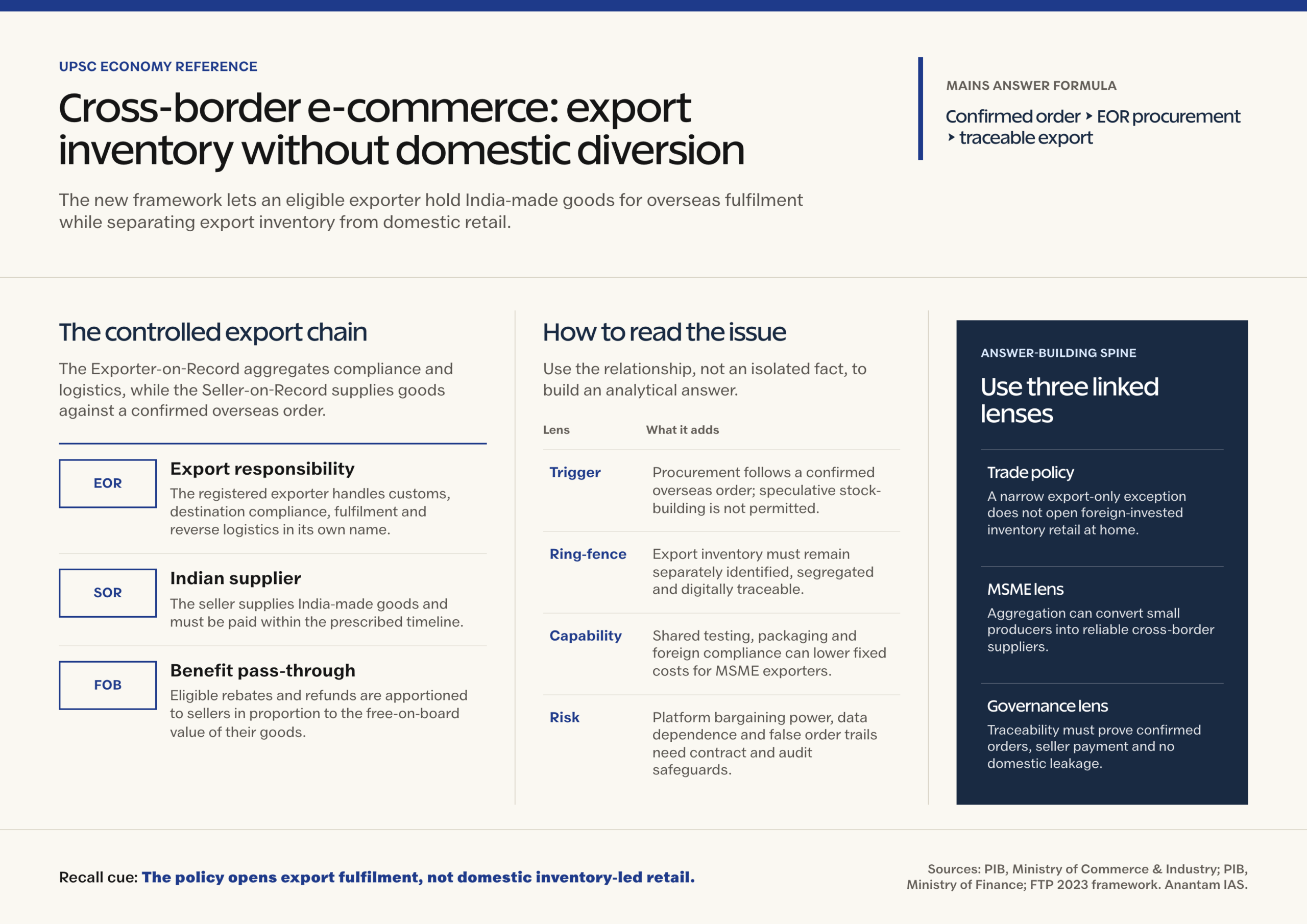
India’s Inventory-Based Framework for Cross-Border E-Commerce Exports

Open article →Download PDF

Why in News?

On August 5, 2026, the Union government operationalised an inventory-based cross-border e-commerce export framework under the Foreign Trade Policy 2023 through Notification No.

  • The measure follows Press Note No. 3 (2026 Series), which amended the FDI policy to permit inventory-based e-commerce operations exclusively for exports.
  • A registered Exporter-on-Record (EOR) may procure India-made goods from a Seller-on-Record only after an overseas order is confirmed and then export those goods in its own name.
  • The EOR assumes responsibility for export documentation, customs formalities, destination-country compliance, testing, certification, packaging, labelling, fulfilment, logistics and reverse logistics.
  • Export inventory must be separately identified, segregated and digitally traceable; it cannot be diverted for sale in India’s domestic market.
  • The seller must receive payment within the prescribed timeline even if the overseas buyer has not yet paid the EOR, while eligible rebates and refunds must be passed through in proportion to the goods’ FOB value.
  • The reform addresses a structural constraint faced by MSMEs and artisans: they may produce exportable goods but lack overseas fulfilment capacity, destination-country compliance expertise and economical reverse logistics.
  • It changes the allocation of export functions. The Indian producer can concentrate on production, while a registered EOR becomes the accountable exporter and service integrator.
  • The policy must be read with the 2026 courier reforms, including removal of the earlier ₹10 lakh per-consignment value cap and simplified treatment of returned or rejected e-commerce parcels.

UPSC Relevance

Prelims Relevance

  • The framework operates under the Foreign Trade Policy 2023, administered by the Directorate General of Foreign Trade under the Department of Commerce.
  • An inventory-based e-commerce model involves ownership or control of inventory by the e-commerce entity; it differs from a marketplace model that primarily facilitates transactions between buyers and sellers.
  • The 2026 policy opening is limited to export-only operations involving goods manufactured or produced in India; it is not a general permission for foreign-invested inventory-led retail in the domestic market.
  • The EOR exports in its own name and carries responsibility for export operations and destination-country requirements.
  • The SOR is the registered Indian seller from whom goods are procured against a confirmed overseas order.
  • Speculative procurement or build-up of export inventory is not permitted; procurement must be linked to confirmed export orders.

Mains Relevance

GS Paper 3

  • Assess how organised fulfilment, pooled compliance capacity and reverse logistics can lower fixed export costs for MSMEs, artisans and manufacturing clusters.
  • Examine whether an export-only inventory model can improve India’s participation in digital trade without weakening domestic retail safeguards.

GS Paper 2

  • Evaluate the governance design of separating the commercial seller, accountable exporter, platform and regulator while maintaining a clear audit trail.
  • Analyse safeguards needed to prevent domestic diversion, delayed seller payments, opaque transfer pricing and excessive platform power.

Essay

  • Digital platforms can widen market access only when convenience is matched by accountability, traceability and fair sharing of value.
Mindmap explaining India's Inventory-Based Framework for Cross-Border E-Commerce Exports for UPSC revision
Revision mindmap: India's Inventory-Based Framework for Cross-Border E-Commerce Exports. Open the full-size image for details.

Background and Context

What the new framework changes

The framework creates a regulated route through which an eligible e-commerce entity can hold inventory for exports without opening the same model to domestic retail.

  • Under the earlier FDI architecture, foreign investment was permitted in the marketplace model of e-commerce, subject to conditions, while the inventory-based B2C model remained restricted.
  • Press Note No. 3 of 2026 created a narrow exception for inventory-based operations conducted exclusively for exports. The August FTP notification supplies the operational policy and procedures for that exception.
  • The permitted goods must be manufactured or produced in India. This links the opening to export promotion and domestic production rather than to import-led online retail.
  • The design gives platforms or export entities more control over fulfilment, but attaches that control to a registered exporter, confirmed orders and a traceable inventory trail.

How the EOR-SOR chain works

The EOR-SOR arrangement assigns commercial and regulatory duties to named actors instead of leaving a small seller to manage every cross-border step.

  • An overseas buyer first places a confirmed order. Only then may the registered EOR procure the relevant goods from the Indian SOR.
  • The EOR exports the goods in its own name and becomes responsible for documentation, customs clearance and compliance in the destination market.
  • The EOR may integrate testing, certification, packaging, labelling, warehousing, fulfilment, international logistics and reverse logistics. This can spread fixed compliance costs across many small consignments and sellers.
  • The SOR retains an economic claim over timely payment, visibility into the final overseas sale price, order status and shipment tracking, and a proportionate share of export rebates and refunds.
  • This separation is important for accountability: the producer remains identifiable, while customs and foreign regulators have a clearly designated exporter responsible for the consignment.

Seller-protection and anti-diversion safeguards

The framework tries to ensure that export facilitation does not become a route for speculative stocking, domestic-market leakage or transfer of excessive risk to small sellers.

  • Inventory can be procured only against confirmed overseas orders. The EOR cannot build speculative export stock merely in anticipation of future demand.
  • Goods acquired for the framework must be distinctly identified and physically or operationally segregated from other inventory.
  • A digital repository must preserve traceability from the Indian seller through procurement, export, overseas sale and any return or disposal event.
  • Goods designated as export inventory cannot be diverted into India’s domestic market. This is the principal ring-fence separating the export exception from domestic inventory-led e-commerce.
  • Payment to the Indian seller is due within the prescribed timeline irrespective of whether the EOR has received payment from the foreign buyer. This places the overseas receivables risk on the EOR rather than passing it.

Why the reform matters for MSMEs and export clusters

Small producers often face a gap between making a globally saleable product and operating a reliable international retail chain.

  • Cross-border e-commerce can aggregate dispersed demand for handicrafts, apparel, home products, books, jewellery and other differentiated goods made by smaller firms.
  • A shared EOR can reduce the need for every seller to master foreign labelling rules, product certification, customs documentation and destination-country consumer requirements independently.
  • Organised fulfilment and consolidated logistics may improve delivery predictability and make reverse logistics less costly, two major constraints in direct-to-consumer exports.
  • Visibility into final sale prices can help sellers understand overseas demand and reduces the information asymmetry that arises when a platform controls the customer relationship.
  • The requirement to pass through rebates and refunds prevents the export intermediary from automatically retaining benefits attributable to the producer’s goods.

Way Forward

Build interoperable digital traceability

  • Link EOR and SOR records with customs declarations, shipping events, payment reconciliation and export-benefit claims through secure identifiers and auditable logs.
  • Give sellers a usable dashboard for order confirmation, procurement value, FOB attribution, overseas sale price, shipment status, returns and benefit pass-through.
  • Adopt risk-based inspections that focus on anomalous orders, repeated returns, domestic diversion indicators and mismatches between physical goods and digital records.

Conclusion

  • India’s inventory-based cross-border e-commerce framework is a targeted institutional reform: it opens an export-only business model while retaining a firm boundary against domestic inventory-led retail.
  • The framework can widen global market access for MSMEs only if enforcement keeps inventory ring-fenced, platforms disclose value fairly and producers retain bargaining power.

UPSC Practice Questions

Prelims MCQ 1

With reference to India’s Inventory-based Cross-border E-Commerce Export Framework, consider the following statements:

  1. The Exporter-on-Record exports goods in its own name and assumes responsibility for destination-country compliance.
  2. Export inventory may be procured speculatively before an overseas order is received.
  3. Goods procured under the framework may be diverted to India’s domestic market if the foreign buyer cancels the order.

How many of the above statements are correct?

(a) Only one (b) Only two (c) All three (d) None

Answer: (a) Only one

Explanation:

Statement 1 is correct. Procurement must follow a confirmed overseas order, speculative inventory build-up is barred, and export-designated inventory cannot be diverted to the domestic market. Returned or rejected goods must follow the prescribed re-export, return or disposal route.

Prelims MCQ 2

Which one of the following best describes the Seller-on-Record protection built into the framework?

(a) Payment depends entirely on prior receipt from the overseas buyer (b) The EOR may retain all export rebates because it files the export documents (c) The seller receives prescribed-timeline payment and a proportionate pass-through of export benefits (d) The seller becomes solely responsible for destination-country certification

Answer: (c) The seller receives prescribed-timeline payment and a proportionate pass-through of export benefits

Explanation:

The framework protects timely payment irrespective of receipt from the overseas buyer and requires rebates and refunds to be apportioned to SORs according to the FOB value attributable to their goods. The EOR handles export and destination-country compliance.

UPSC Mains Questions

  1. India’s inventory-based cross-border e-commerce export framework seeks to combine market access with regulatory ring-fencing. Explain its institutional design and assess its likely impact on MSME export competitiveness. (250 words)
  2. Digital traceability can reduce trade friction while strengthening regulatory oversight. Discuss with reference to the Exporter-on-Record and Seller-on-Record framework for e-commerce exports. (150 words)

Sources: PIB, Ministry of Commerce & Industry and PIB, Ministry of Finance.

Frequently Asked Questions

What is India’s inventory-based cross-border e-commerce export framework?

It is an export-only mechanism under Foreign Trade Policy 2023 that lets eligible e-commerce entities conduct inventory operations through a registered Exporter-on-Record. It applies to goods made or produced in India and combines organised fulfilment with confirmed-order procurement, digital traceability.

How is an Exporter-on-Record different from a Seller-on-Record?

The EOR procures goods against a confirmed overseas order, exports in its own name and bears responsibility for export processes and destination-country compliance. The SOR is the registered Indian seller supplying those goods. The SOR receives payment, price and shipment.

Does the policy allow inventory-based e-commerce for domestic sales?

No. The relaxation is expressly limited to export-only operations. Inventory procured under the framework must be distinctly identified, segregated and digitally traceable, and it cannot be diverted for sale in the Indian domestic market. This ring-fence separates export facilitation from.

Can an EOR build inventory before receiving foreign orders?

No. The official framework says export inventory may be procured only against confirmed export orders and prohibits speculative inventory build-up for export purposes. This condition limits warehousing risk, supports item-level traceability and reduces the possibility that export-designated goods will leak.

How does the framework protect Indian MSME sellers?

It assigns complex export functions to the EOR, requires seller payment within the prescribed timeline regardless of overseas-buyer payment, provides visibility into final sale price and shipment status, and mandates proportionate pass-through of export rebates and refunds. Digital records and.

RDI Deep-Tech Fund: Public Finance, Selection Design and Conflict Safeguards

Open article →Download PDF

Why in News?

India’s Research, Development and Innovation Fund has moved from policy design to actual allocation.

  • The Union Cabinet approved the scheme on July 1, 2025, and it was formally launched on November 3, 2025 for a six-year period.
  • The government sanctioned ₹1,000 crore each to the Technology Development Board and the Biotechnology Industry Research Assistance Council as initial Second-Level Fund Managers.
  • The official July update recorded ₹500 crore disbursed to TDB in March 2026. TDB had approved 22 projects with a combined project cost of ₹4,744 crore and proposed RDIF support of ₹2,192 crore.
  • BIRAC had shortlisted eight biotechnology projects involving ₹390.35 crore of support, showing that deployment has begun across more than one institutional channel.
  • The scheme’s published guidelines recognise that domain experts on an investment committee may themselves be investors in ideas or companies. That makes conflict management part of the fund’s core design, not a peripheral ethics issue.
  • Deep-tech ventures usually face long development cycles, uncertain technical outcomes, expensive testing and a difficult lab-to-market gap. Conventional lenders often cannot value this risk, while short-horizon equity may demand returns before the technology matures.
  • Public capital can absorb part of this risk and crowd in private investment, but weak selection can socialise losses, favour connected applicants or lock money into technologies with little additional public value.
  • The governance problem is a balance: an excessively bureaucratic process may reject frontier ideas, while unchecked discretion may weaken fairness, additionality and accountability.

UPSC Relevance

Prelims Relevance

  • The Department of Science and Technology is the nodal department for implementing the RDI Scheme.
  • A Special Purpose Fund under ANRF operates as the first-level custodian; it does not directly choose every beneficiary enterprise.
  • Second-Level Fund Managers may include AIFs, DFIs, NBFCs and Focused Research Organisations, subject to the applicable selection route and guidelines.
  • TDB and BIRAC were initially approved as public Focused Research Organisation fund managers; additional commercial managers are selected through a competitive process.
  • Permitted forms include long-term loans at low or nil interest, equity in select startup cases, and contributions to deep-tech or RDI-focused funds of funds.
  • The scheme does not provide grants or short-term loans under its published design.

Mains Relevance

GS Paper 3

  • Examine how patient public finance can address market failure in strategic and sunrise technologies without replacing private risk assessment.
  • Assess the fund’s role in bridging the valley between a validated prototype and commercial scale, especially for technologies at TRL 4 and above.

GS Paper 2

  • Analyse delegated decision-making, conflict-of-interest safeguards and auditability when public money is deployed through private or arm’s-length financial intermediaries.
  • Discuss how disclosure, reasoned decisions, recusal and independent oversight can reconcile expertise with impartiality.

Essay

  • Innovation policy succeeds when the state is willing to take intelligent risks and equally willing to make the process of taking those risks open to scrutiny.
Mindmap explaining RDI Deep-Tech Fund: Public Finance, Selection Design and Conflict Safeguards for UPSC revision
Revision mindmap: RDI Deep-Tech Fund: Public Finance, Selection Design and Conflict Safeguards. Open the full-size image for details.

Background and Context

Why deep-tech needs patient capital

Deep-tech finance differs from ordinary startup finance because technical risk, capital intensity and time to market are unusually high.

  • A laboratory result must pass engineering validation, safety or regulatory review, pilot production and customer adoption before it becomes a scalable product. Each stage can reveal a new failure mode.
  • Banks prefer predictable cash flows and collateral. Many deep-tech firms have neither because their main asset is unproven intellectual property and their early revenue is limited.
  • Venture investors can finance uncertainty, but fund life, exit expectations and portfolio strategy may not match a project that needs many years of testing before commercial returns.
  • The state has a case for intervention when innovation produces wider benefits such as strategic resilience, skilled employment, knowledge spillovers or lower dependence on imported critical technology.
  • Public support should remain additional: it should unlock a socially valuable project that the market underfunds, not merely subsidise activity that a firm would have financed on normal commercial terms.

How the two-tier RDI Fund works

The architecture separates custody and policy direction from project-level investment judgment.

  • At the first level, a Special Purpose Fund within ANRF holds and channels the corpus. DST acts as the nodal department and has framed implementation guidelines and special financial rules.
  • At the second level, approved fund managers evaluate enterprises and projects. Their categories can include Alternative Investment Funds, Development Finance Institutions, Non-Banking Financial Companies and specialised public research-finance organisations.
  • This separation is intended to keep individual project selection closer to people with technical, financial and market knowledge while retaining a public policy framework at the top.
  • Commercial fund managers are evaluated through Quality and Cost Based Selection. The Executive Council recommends names to the EGoS, which makes the final approval decision.
  • Project support may use patient debt, select equity or fund-of-funds contributions. Because the scheme excludes grants, capital recovery and recycling remain part of its financing logic.

What the first allocations show

Early deployment provides a baseline for judging whether a large announced corpus becomes a diverse, disciplined innovation portfolio.

  • The official July 2026 update said TDB had approved 22 projects with ₹2,192 crore in RDIF support against a total project cost of ₹4,744 crore.
  • The same update said BIRAC had shortlisted eight projects involving ₹390.35 crore, placing biotechnology alongside TDB’s wider cross-sector mandate.
  • These figures describe approvals or shortlisting, not completed outcomes. They should not be treated as proof that technologies have reached market, generated returns or achieved strategic self-reliance.
  • A credible evaluation should distinguish amounts sanctioned, amounts disbursed, milestones completed, private capital mobilised, intellectual property created, regulatory clearances obtained and products commercially adopted.
  • Portfolio concentration also matters. A few sectors may legitimately dominate when proposal quality is stronger, but the public record should explain why selection reflects merit rather than institutional familiarity or investment fashion.

Where conflicts of interest can arise

Deep-tech expertise is concentrated, so the most knowledgeable evaluators may have prior, current or prospective relationships with applicants.

  • An investment-committee member may be a limited partner in a fund, a general partner, an adviser, a board member, a shareholder, a research collaborator or an investor in a competing company.
  • A fund manager may prefer an enterprise already in its network, allocate a valuable opportunity between public and private portfolios, or set terms that increase its own fee income without maximising public value.
  • Technical experts can also carry non-financial conflicts, such as institutional rivalry, intellectual-property disputes, close academic collaboration or commitment to a particular technological pathway.
  • The published guidelines acknowledge that fund-manager team members may sit on the investment committee and that domain experts may also be investors in ideas or companies. Recognition is useful, but an operational safeguard needs defined disclosure.
  • The risk is not cured by excluding all industry experts. That would weaken technical judgment. The sound response is to identify interests early, grade their materiality and remove conflicted members from access, discussion or voting where.

Way Forward

Create a uniform conflict protocol

  • Require annual and meeting-specific declarations covering financial interests, advisory roles, board positions, close institutional relationships and interests in competing entities.
  • Classify conflicts as manageable, recusal-required or disqualifying, with a written rationale and a cooling-off rule for recent relationships.
  • Ensure that a conflicted member neither receives sensitive applicant material beyond what is necessary nor participates in discussion, scoring, voting or post-investment monitoring.

Conclusion

  • The RDI Fund addresses a real market failure: India cannot build strategic technologies if promising firms lack capital between proof of concept and commercial scale.
  • That strength also creates its main governance risk.

UPSC Practice Questions

Prelims MCQ 1

With reference to India’s Research, Development and Innovation Scheme, consider the following statements:

  1. The Special Purpose Fund under ANRF serves as the first-level custodian of funds.
  2. The scheme supports transformative RDI only through grants and short-term loans.
  3. Second-Level Fund Managers may include AIFs, DFIs, NBFCs and Focused Research Organisations.

How many of the above statements are correct?

(a) Only one (b) Only two (c) All three (d) None

Answer: (b) Only two

Explanation:

Statements 1 and 3 are correct. The Special Purpose Fund under ANRF is the first-level custodian, while eligible intermediaries act as Second-Level Fund Managers. Statement 2 is incorrect because the scheme excludes grants and short-term loans; it uses patient debt, select equity and fund-of-funds contributions.

Prelims MCQ 2

Which body gives final approval to additional Second-Level Fund Managers under the published RDI Scheme selection structure?

(a) Governing Board of ANRF (b) Technology Development Board (c) Empowered Group of Secretaries (d) Securities and Exchange Board of India

Answer: (c) Empowered Group of Secretaries

Explanation:

Applications are assessed under the prescribed selection framework. The ANRF Executive Council recommends suitable Second-Level Fund Managers, and the Empowered Group of Secretaries gives final approval.

UPSC Mains Questions

  1. India’s RDI Fund must combine the risk appetite of venture finance with the accountability expected of public expenditure. Discuss the institutional design needed to achieve this balance. (250 words)
  2. Why are conflict-of-interest safeguards central to a fund-of-funds model for deep technology? Suggest mechanisms that preserve expert judgment without allowing regulatory or network capture. (250 words)

Sources: PIB, Ministry of Science & Technology and The Indian Express Explained.

Frequently Asked Questions

What is the RDI Fund?

The Research, Development and Innovation Fund is a ₹1 lakh crore, six-year public financing initiative designed to catalyse private investment in high-risk, high-impact R&D. It targets strategic and sunrise sectors and routes support through approved intermediaries rather than relying on.

Why does the RDI Fund use a two-tier structure?

A Special Purpose Fund under ANRF holds and channels the corpus at the first level. Second-Level Fund Managers evaluate and finance projects at the second level. This separates policy custody from specialist project selection, while allowing the public framework to.

Which institutions are Second-Level Fund Managers?

The categories can include Alternative Investment Funds, Development Finance Institutions, Non-Banking Financial Companies and Focused Research Organisations. TDB and BIRAC were the first approved public fund managers. Additional commercial managers are considered through the notified competitive selection process.

Why can conflicts of interest arise in deep-tech selection?

India’s deep-tech networks are specialised and relatively concentrated. A technically qualified reviewer may also be an investor, adviser, board member, research collaborator or competitor of an applicant. The issue is managed through prior disclosure, materiality assessment, recusal, independent review and.

Does the RDI Fund provide grants to startups?

No. The published scheme design excludes grants and short-term loans. Its financing modes include long-term loans at low or nil interest, equity in select startup cases, and contributions to deep-tech or RDI-focused funds of funds, routed through approved managers.