Why in News?
On 1 September 2026, the Union government announced a lower sugar stock ceiling for dealers, operative from 15 September through 30 November 2026.
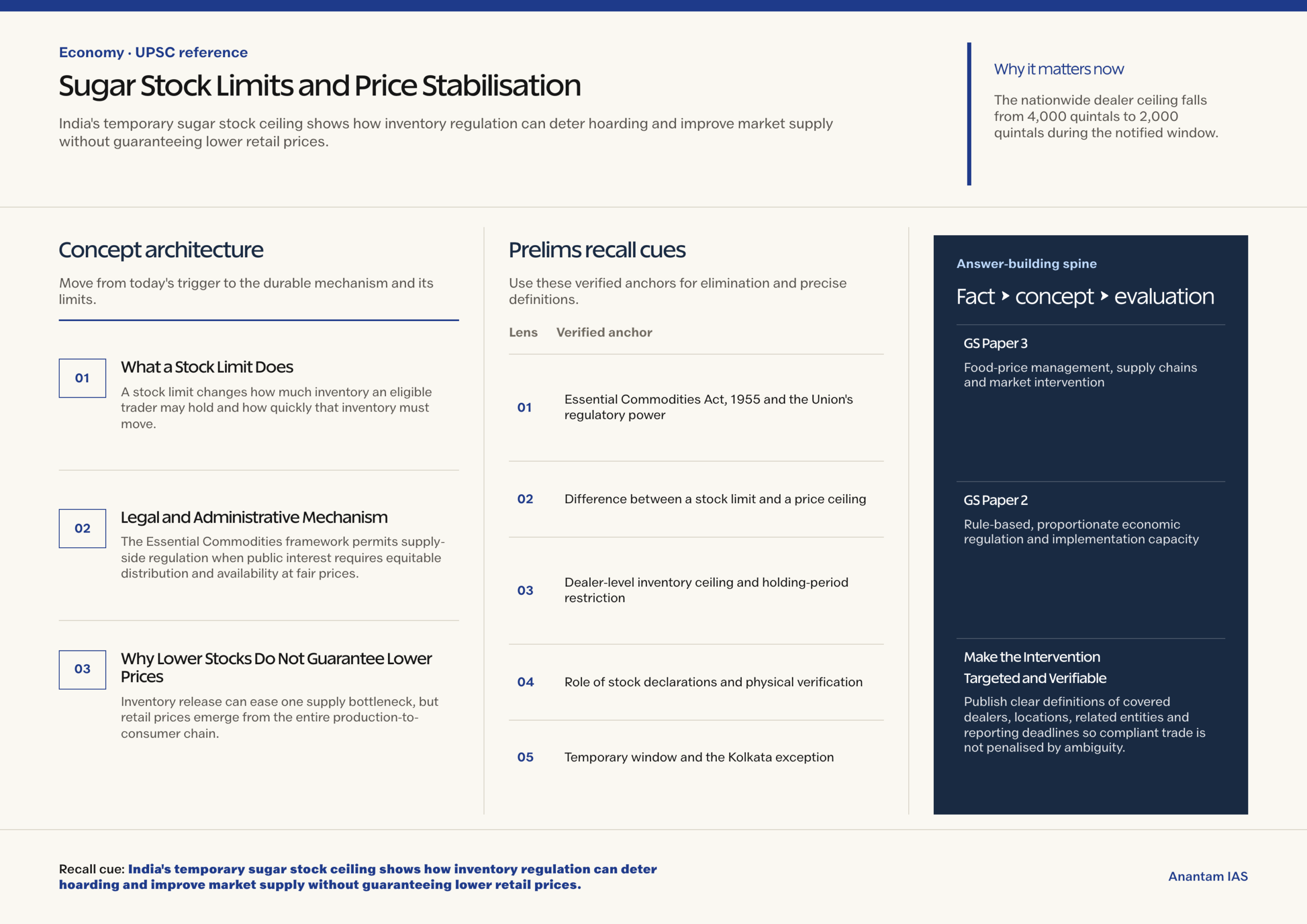
- The nationwide dealer ceiling falls from 4,000 quintals to 2,000 quintals during the notified window.
- A dealer may not retain received sugar for more than 30 days or exceed the applicable ceiling at any place.
- Kolkata and its extended metropolitan areas retain the 4,000-quintal ceiling because they serve eastern and North-Eastern distribution routes.
- The government linked the measure to anti-hoarding, orderly movement, domestic availability and price stability.
- A stock ceiling targets inventory concentration; it does not directly fix the retail price charged to consumers.
- Its effect depends on production, mill releases, transport, trade margins, demand and credible enforcement across the supply chain.
UPSC Relevance
Prelims Relevance
- Essential Commodities Act, 1955 and the Union’s regulatory power
- Difference between a stock limit and a price ceiling
- Dealer-level inventory ceiling and holding-period restriction
- Role of stock declarations and physical verification
- Temporary window and the Kolkata exception
Mains Relevance
GS Paper 3
- Food-price management, supply chains and market intervention
- Trade-offs between anti-hoarding enforcement and efficient wholesale distribution
GS Paper 2
- Rule-based, proportionate economic regulation and implementation capacity
Essay
- Markets need both freedom of exchange and credible safeguards against artificial scarcity.
Background and Context
What a Stock Limit Does
A stock limit changes how much inventory an eligible trader may hold and how quickly that inventory must move.
- By restricting large accumulation, the ceiling seeks to reduce market withholding that can create artificial scarcity during supply stress even when aggregate availability remains adequate.
- The accompanying 30-day holding rule targets duration as well as quantity, encouraging dealers to rotate stocks across warehouses instead of waiting for a more favourable price.
- Faster release can improve wholesale availability, narrow temporary supply gaps and weaken the bargaining power created by concentrated inventories where relatively few traders dominate local supply.
- The rule operates on stocks held by dealers; it should not be confused with separately notified mill-wise release controls governing how producers sell sugar into the domestic market.
- A temporary ceiling allows the government to respond to a perceived disruption while limiting interference with ordinary storage and distribution decisions once market conditions normalise.
Legal and Administrative Mechanism
The Essential Commodities framework permits supply-side regulation when public interest requires equitable distribution and availability at fair prices.
- Section 3 of the Essential Commodities Act, 1955 empowers the Union to regulate production, supply, distribution and trade to maintain supplies and secure equitable availability at fair prices.
- Its regulatory tools include controls over storage, transport, distribution and disposal, making inventory ceilings a time-bound supply-management instrument rather than a conventional tax or consumer subsidy.
- Compliance depends on regular stock declarations, inspection of premises and reconciliation of reported receipts, holdings and sales across mills, dealers and traders to detect unexplained inventory gaps.
- Physical verification addresses non-disclosure, excess holding and irregular stock movement; without credible checks, inventories can be fragmented, concealed or shifted to evade the ceiling.
- The Kolkata exception illustrates calibrated regulation: a uniform national ceiling may obstruct a hub that aggregates distant supplies and supports longer distribution routes across several downstream regions.
Why Lower Stocks Do Not Guarantee Lower Prices
Inventory release can ease one supply bottleneck, but retail prices emerge from the entire production-to-consumer chain.
- Retail sugar prices also reflect cane and sugar output expectations, mill release volumes, transport costs, regional demand, taxes and margins charged by wholesalers and retailers.
- A ceiling may increase near-term market arrivals, yet its effect can fade if underlying supply is tight or released stocks do not reach deficit locations efficiently.
- Dealers may respond by reducing procurement, splitting inventories or raising transaction frequency, creating compliance costs and coordination failures that partly offset gains from faster circulation.
- Price stability is an intended outcome, not an assured result; authorities must compare stock, arrival and retail-price data against prior trends before attributing any movement to the order.
- The best test throughout the notified period is whether availability improves without disrupting genuine distribution, especially in regions dependent on distant mills and a small number of logistical hubs.
Way Forward
Make the Intervention Targeted and Verifiable
- Publish clear definitions of covered dealers, locations, related entities and reporting deadlines so compliant trade is not penalised by ambiguity.
- Use risk-based inspections and digital stock reconciliation to detect concentration and non-disclosure without imposing equal compliance burdens on every trader.
- Track wholesale arrivals, regional availability and retail margins separately; revise or withdraw the ceiling if evidence shows disruption without consumer benefit.
- Coordinate mill releases and transport logistics so additional sugar moves toward deficit markets instead of merely changing ownership within surplus centres.
Conclusion
- A stock limit is a temporary anti-hoarding and supply-circulation tool; its success must be judged by verified availability and orderly trade, not by the notification alone.
- In a Mains answer, separate the mechanism from the outcome: reduced inventory concentration may support price stability, but cannot guarantee cheaper retail sugar.
UPSC Practice Questions
Prelims MCQ 1
With reference to the sugar stock-limit measure announced in September 2026, consider the following statements:
- The 2,000-quintal dealer ceiling is operative from 15 September through 30 November 2026.
- A dealer may hold a received stock for any duration if the quantity remains below the ceiling.
- Kolkata and its extended metropolitan areas retain a 4,000-quintal ceiling.
How many of the above statements are correct?
(a) Only one (b) Only two (c) All three (d) None
Answer: (b) Only two
Explanation:
Statements 1 and 3 are correct. Statement 2 is incorrect because the amended provisions also bar holding received stock for more than 30 days.
Prelims MCQ 2
Which one of the following best describes a commodity stock limit?
(a) A guaranteed maximum retail price (b) A compulsory subsidy paid to consumers (c) A ceiling on inventory held by a covered market participant (d) A minimum procurement price for producers
Answer: (c) A ceiling on inventory held by a covered market participant
Explanation:
A stock limit regulates inventory quantity or duration. It may influence availability, but it neither fixes a retail price nor guarantees that prices will fall.
UPSC Mains Questions
- Explain how commodity stock limits seek to curb hoarding. Why does a lower inventory ceiling not automatically guarantee lower retail prices?
- Temporary market interventions should be proportionate, evidence-based and sensitive to supply-chain geography. Discuss with reference to sugar stock regulation.
Sources: PIB, Department of Food and Public Distribution and India Code, Essential Commodities Act, 1955.
Frequently Asked Questions
What is the new sugar stock limit for dealers?
The ceiling is 2,000 quintals across most of India from 15 September through 30 November 2026, alongside a 30-day maximum holding period for received stock.
Why does Kolkata have a different ceiling?
Kolkata and its extended metropolitan areas retain 4,000 quintals because the hub receives sugar from distant producing states and supplies eastern and North-Eastern markets.
Does the order guarantee cheaper retail sugar?
No. It may improve circulation and availability, but retail prices also depend on output, mill releases, logistics, regional demand, taxes, trade margins and enforcement.
How are stock limits enforced?
Authorities use dealer declarations, stock updates, physical verification and checks of receipts, holdings and sales to identify excess stocks, non-disclosure and irregular movement.
What is the UPSC takeaway from this measure?
Treat stock limits as temporary supply-management tools under the Essential Commodities framework, and distinguish their anti-hoarding mechanism from the uncertain final effect on consumer prices.