Opens in a new tab
Join Anantam IAS Channel on Telegram

Daily Digest · Thursday

22 October 2026 Current Affairs for UPSC

15 current affairs published on Thursday, 22 October 2026

22 October 2026 Current Affairs for UPSC — every Why-in-News article AnantamIAS published on Thursday, 22 October 2026, broken down with Why in News?, the exact GS paper it feeds, sub-topic mapping, MCQ-ready facts and a UPSC-style practice question. 15 articles in total, covering Polity, Economy, Environment, S&T, IR, Geography, History, Society and Internal Security — the same Why-in-News + GS-paper-mapping + practice-question format the Compass uses across every daily digest on the site.

Daily current affairs for UPSC is where new material enters your prep stream. Read this 22 October 2026 digest end-to-end in 25–35 minutes, attempt the practice question at the foot of each article (it's MCQ for some, 10/15-marker for others), then bookmark the entries that fall inside your active revision window. Everything stays cross-linked: tap any subject pill to jump to that subject's hub, or use the table of contents above to skip straight to a specific story.

Use this page three ways. Read sequentially for a one-sitting scan of everything that mattered on 22 October 2026. Download the 22 October 2026 PDF below for offline study or print revision. Or use the October 2026 Current Affairs compilation to see this day in the month's full context. For the previous day's reading, see 21 October 2026 Current Affairs; the next day's is 23 October 2026 Current Affairs.

Why we publish daily current affairs separately from the monthly compilation: daily is learning, monthly is revision. Use the daily page to add fresh material to your notes the day it breaks; come back to the October 2026 compilation 60 days before Prelims when the noise has settled and only the lasting takeaway is worth re-reading.

Agrivoltaics: Sharing Sunlight Without Displacing Farming

Open article →Download PDF

Why in News?

India opened the AgriVoltaics World Conference in New Delhi on 21 October 2026, launching decision resources and announcing plans for an agrivoltaics programme under the next phase of PM-KUSUM.

  • MNRE launched an AgriPV Policy Handbook; the India Agrivoltaics Alliance launched a decision-making tool.
  • The Agriculture Ministry emphasised continued cultivation, machinery access, crop choice and safe rainwater drainage beneath solar installations.
  • The proposed next-phase programme remains an announcement; these releases do not establish notified subsidy rates, eligibility conditions or an implementation schedule.
  • Agrivoltaics addresses competition between food production and renewable-energy land use, but its success depends on maintaining a workable farm.
  • Small farmers need evidence about crop performance and net returns, alongside enforceable responsibilities for equipment, payments and eventual removal.

UPSC Relevance

Prelims Relevance

  • Agrivoltaics: simultaneous agricultural production and solar-electricity generation on the same land.
  • Photovoltaic panels convert sunlight into electricity; crops require light for photosynthesis.
  • Panel height and spacing affect both cultivation access and the distribution of shade.
  • Grid connection, electricity purchase and payment arrangements are distinct from installing panels.

Mains Relevance

GS Paper 3

  • Reconciling renewable-energy expansion with agricultural productivity and smallholder livelihoods.
  • Evaluating land-use efficiency alongside crop risk, electricity revenues and project lifecycle costs.

GS Paper 2

  • Coordinating agriculture and energy policy with farmer protections in contracts.

Essay

  • A technological transition succeeds when its design preserves the livelihoods it promises to improve.

Background and Context

What Makes a Solar Farm Agrivoltaic?

The defining test is whether meaningful agricultural production continues alongside electricity generation on the same land.

  • Agrivoltaics combines crops and photovoltaic generation within one working farm. Installing panels on agricultural land while effectively excluding cultivation does not deliver the dual-use benefit that the conference sought to advance for farmers.
  • Sunlight is a shared resource: panels intercept solar radiation to generate electricity, while crops need light for photosynthesis. A design that maximises panel coverage can compromise the agricultural activity it is supposed to retain.
  • Partial shade changes the crop microclimate and may help under some growing conditions, but reduced light can also constrain growth. The relevant question is how a particular crop performs through its local growing season.
  • Yield gains are not universal. Claims of better performance should be tested against comparable cultivation without panels, accounting for crop choice and weather; a promising result at one site cannot establish benefits for every farm.
  • Dual output should be judged through both harvests and electricity earnings. A farmer needs to know whether additional power income compensates for changed cultivation costs and crop risks, rather than treating generation alone as success.
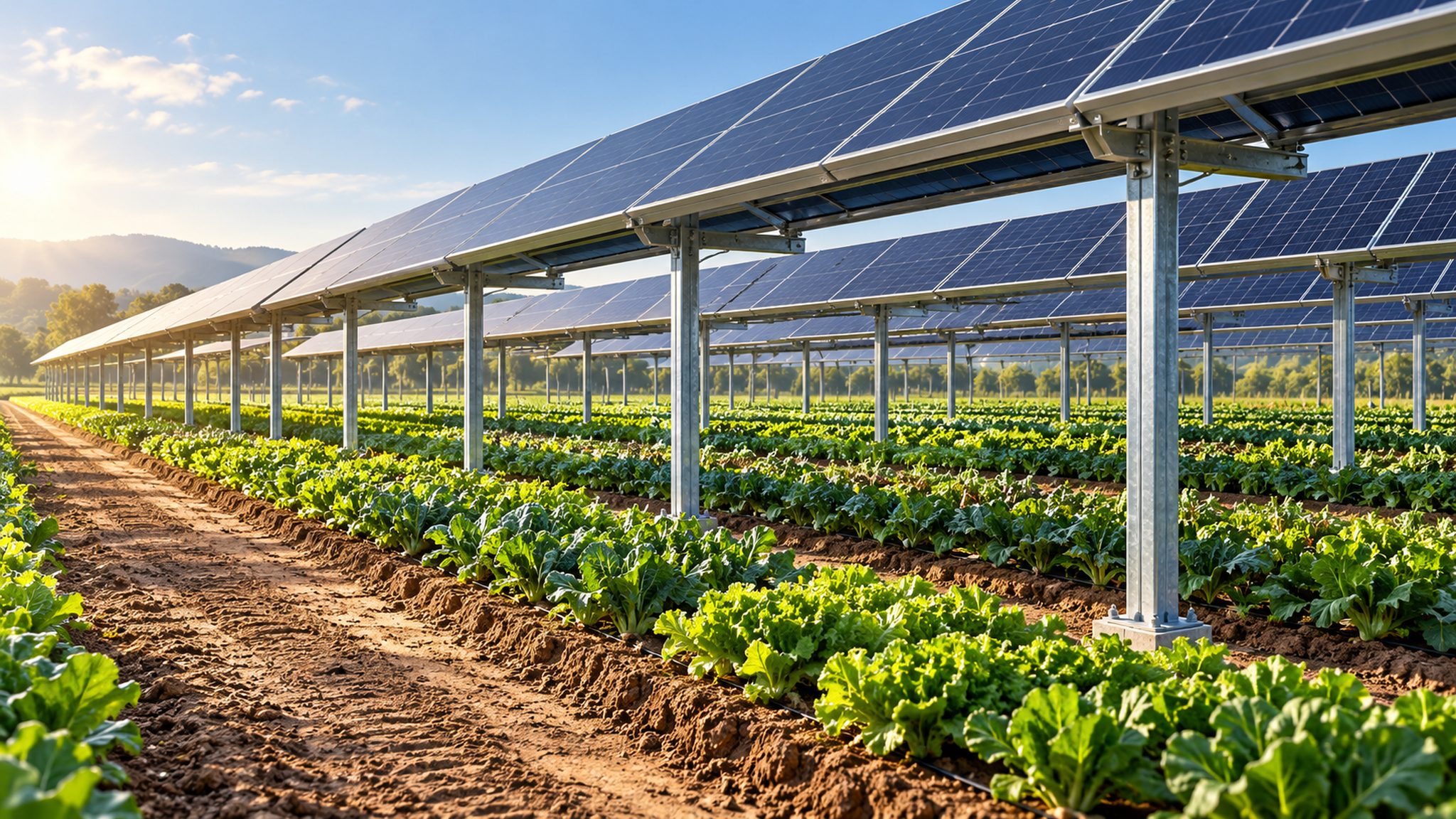
Design the Shared Field Around Cultivation

Panel geometry affects the space, light and water available to the farmer below.

  • Panel height and support spacing must allow ploughing and other field operations. Clearance should suit the actual equipment and crop, because nominally cultivable land is of little use if machinery cannot enter or turn safely.
  • Row spacing and orientation shape where shade falls across the field. Layout decisions should consider crop-light requirements over the growing season, rather than assuming that every point beneath an installation receives the same sunlight.
  • Crop rotation and farmer choice need room in the design. A structure suited to one short crop should not lock the farmer into that crop indefinitely or obstruct future cultivation choices as market conditions change.
  • Panel runoff concentrates rainfall at particular edges instead of distributing it evenly across the ground. Drainage and collection arrangements should prevent erosion while keeping water available for productive use, as the Agriculture Ministry stressed.
  • Access routes and working space must remain usable for cultivation and equipment maintenance. Planning these together reduces conflict between farm operations and electricity infrastructure; merely planting crops under panels cannot demonstrate that the layout works.
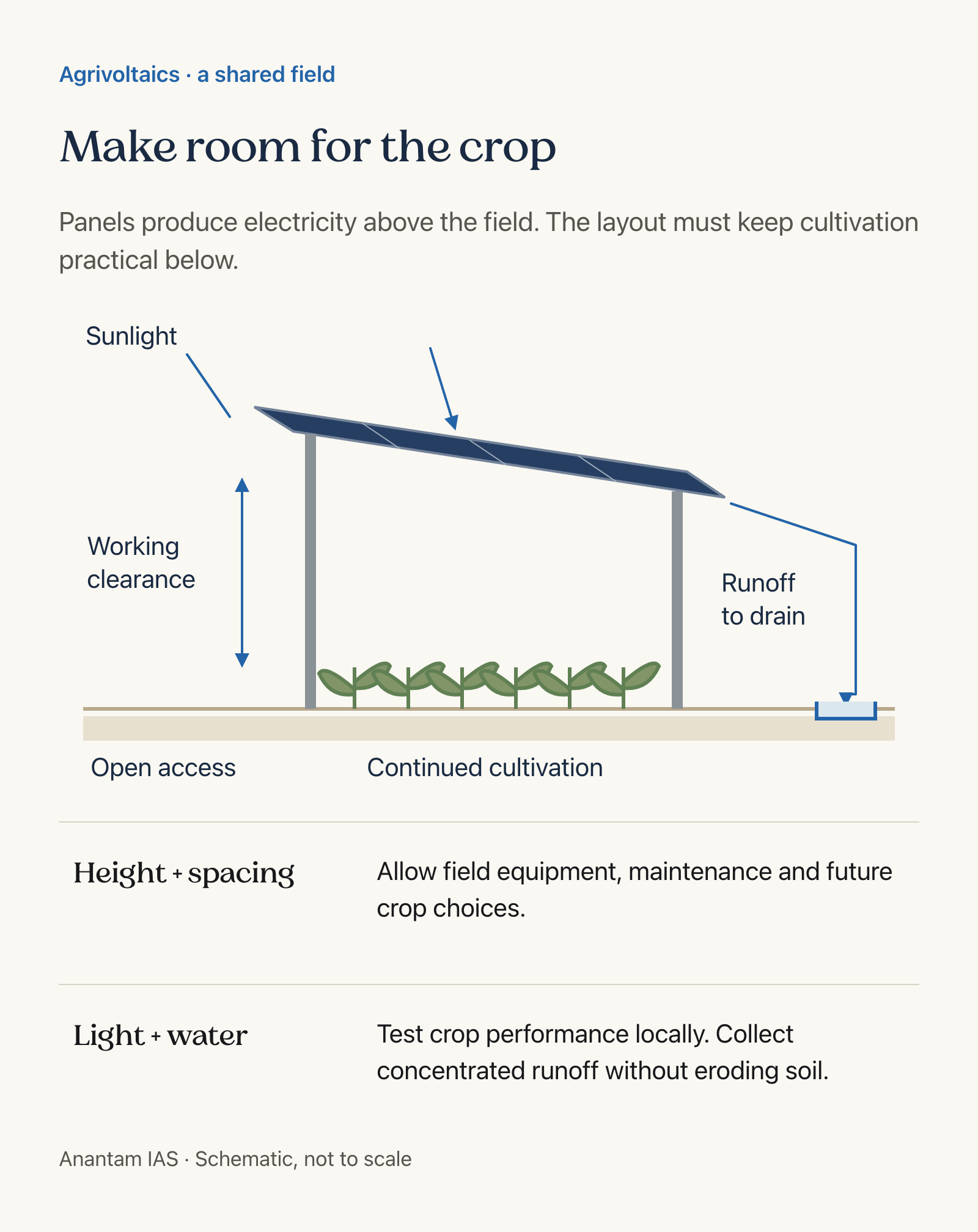
Spatial relationship of elevated panels, cultivation, working access and safe runoff collection.
Schematic agrivoltaic field: continued cultivation needs working clearance and controlled runoff.

Protect the Farmer Across the Project Lifecycle

A technically workable installation still needs dependable commercial arrangements and clear responsibility when the project ends.

  • Grid connectivity and power purchase require explicit arrangements before investment. Producing electricity does not by itself guarantee a buyer, timely connection or predictable revenue, so each link should be assessed separately in the farm business model.
  • Payment terms should identify who pays, how generation is measured and when payments fall due. Transparent records matter because a farmer facing delayed electricity income still has seasonal cultivation expenses and continuing household needs.
  • Farmer Producer Organisations were suggested as participants in the initiative. Collective involvement could support negotiation and technical services, but contracts must still specify individual farmers’ rights and responsibilities rather than assuming membership removes commercial risk.
  • Operation and maintenance create recurring responsibilities, including access for repairs. The ministry proposed training rural youth and women; such employment possibilities should be assessed as practical service needs rather than promised automatically with every installation.
  • Exit and removal obligations should be agreed at the outset. The Agriculture Ministry specifically warned against leaving farmers with financial or physical burdens if a company abandons a project or panels require removal after contract expiry.

Way Forward

Approve Farm Performance Alongside Power Performance

  • Require local crop trials and transparent comparisons before presenting a layout as suitable for widespread farmer adoption.
  • Make cultivation access, drainage and crop flexibility explicit design requirements, assessed with farmers before construction.
  • Set enforceable payment, repair and removal obligations, with responsibility for company exit defined before farmers commit land.
  • Distinguish the announced programme from future notified rules; assess eligibility and support only when official implementation details become available.

Conclusion

  • Agrivoltaics is a joint land-use design problem: electricity generation, crop performance and daily farm operations must work together. Retaining cultivation in name alone cannot resolve competition between food production and renewable-energy infrastructure.
  • For a balanced answer, connect physical design with farmer safeguards: light, access and drainage determine whether cultivation remains practical, while purchasing, payments and removal obligations determine who gains income and who carries long-term risk.

UPSC Practice Questions

Prelims MCQ 1

With reference to agrivoltaics, consider the following statements:

  1. It combines agricultural production and solar-electricity generation on the same land.
  2. Panel height and spacing can affect agricultural machinery access.
  3. Shade from panels necessarily raises yields for every crop.

How many of the above statements are correct?

(a) Only one (b) Only two (c) All three (d) None

Answer: (b) Only two

Explanation:

Statements 1 and 2 are correct. Crop responses depend on conditions and light requirements; universal yield gains cannot be assumed.

Prelims MCQ 2

Which arrangement most directly protects an agrivoltaic farmer against an abandoned installation at the end of a project?

(a) Maximising panel coverage irrespective of crop needs (b) Treating projected electricity generation as guaranteed income (c) Defining enforceable equipment-removal and site-restoration responsibilities in advance (d) Restricting farmers permanently to one crop

Answer: (c) Defining enforceable equipment-removal and site-restoration responsibilities in advance

Explanation:

Clear exit and removal obligations address the risk of leaving farmers responsible for unusable equipment and its removal. Panel coverage or generation projections do not allocate those obligations.

UPSC Mains Questions

  1. Agrivoltaics can reconcile renewable-energy expansion with agricultural land use only when farming remains viable. Discuss the design choices and safeguards required.
  2. Explain why grid connectivity, payment security and project-exit responsibilities matter as much as panel installation for small farmers adopting agrivoltaics.

Sources: PIB, Ministry of Agriculture and Farmers Welfare and PIB, Ministry of New and Renewable Energy.

Frequently Asked Questions

What is agrivoltaics?

Agrivoltaics combines agricultural production with solar-electricity generation on the same land. Its defining benefit requires cultivation to remain practical, with panel arrangements that accommodate crop needs and normal farm operations.

Does shade from solar panels always increase crop yields?

No. Crop performance depends on light requirements, local growing conditions and the installation layout. Any claimed benefit needs a suitable comparison with cultivation without panels, rather than assuming one result applies everywhere.

Has a new agrivoltaics subsidy been notified?

The cited October 2026 releases describe an announcement of a future programme under the next PM-KUSUM phase. They do not establish notified subsidy rates, eligibility rules or an implementation schedule.

Why do agrivoltaic contracts need removal clauses?

Contracts should allocate responsibilities if a company abandons the project or equipment must be removed after expiry. Clear obligations help prevent farmers from inheriting removal costs or installations that obstruct cultivation.

Centaurus X-3: Reading an Accretion Stream Through Pulsing X-Rays

Open article →Download PDF

Why in News?

On 21 October 2026, the Department of Science and Technology reported an RRI study using four secondary emission lines to infer a co-rotating accretion stream in Centaurus X-3.

  • The study concerns a high-mass X-ray binary: a neutron star drawing material from a massive companion.
  • The varying secondary lines point to material moving with the pulsar’s rotation, supporting an accretion-stream interpretation.
  • This interpretation supports disk-fed accretion, while direct stellar-wind capture is the usual comparison for high-mass X-ray binaries.
  • Distant X-ray binaries appear as point sources; changes in their radiation help reconstruct structures that telescopes cannot directly separate.
  • The finding links spectroscopy, rotation and magnetic fields, making it useful for understanding how astronomical models are tested.

UPSC Relevance

Prelims Relevance

  • Pulsar: a rotating, highly magnetised neutron star whose radiation can appear pulsed.
  • High-mass X-ray binary: a compact object accreting material from a massive stellar companion.
  • Accretion disk and magnetic accretion stream are different structures.
  • Primary radiation and reprocessed secondary emission are distinct signals.
  • Spectral variability can reveal spatial structure without a resolved image.

Mains Relevance

GS Paper 3

  • Explain how Indian fundamental research improves models of stellar systems.
  • Distinguish an observed radiation pattern from the physical mechanism inferred to explain it.

Essay

  • Scientific progress through indirect evidence and testable explanations.

Background and Context

What Kind of System Is Centaurus X-3?

The subject is a neutron star receiving matter from a massive companion, with radiation revealing how that matter reaches it.

  • An X-ray binary contains two gravitationally bound objects, including a compact star that accretes material from its companion. In Centaurus X-3, the compact object is a neutron star, not a black hole.
  • A neutron star compresses stellar mass into a very small volume. Its strong gravity makes accretion energetically important: material falling towards the compact star can produce radiation detectable as X-rays by orbiting instruments.
  • A pulsar is a rotating, highly magnetised neutron star. Radiation emerging near its magnetic poles sweeps through space as it spins; an observer can detect repeated pulses when the beam crosses the line of sight.
  • The companion is a massive star, making Centaurus X-3 a high-mass X-ray binary. Its supply of matter provides the context for comparing direct stellar-wind capture with disk-fed accretion around the compact object.
  • An accretion disk is material orbiting around the compact object, while an accretion stream carries material inward from that disk. Near the neutron star, magnetic fields guide this material towards the magnetic poles.

How Do Secondary Emission Lines Reveal the Stream?

The researchers used the relationship between direct and reprocessed radiation across the pulsar’s rotation to infer an otherwise unresolved structure.

  • Primary emission comes from the pulsar’s magnetic-pole regions. Some radiation reaches the observer directly; some illuminates surrounding matter, which absorbs and re-emits it, producing secondary radiation that carries information about the illuminated material.
  • The RRI team examined four secondary emission lines and their changing intensity with pulsar rotation. Their analysis indicates that the structure producing the varying lines rotates with the pulsar, constraining its location and behaviour.
  • In the proposed interpretation, a co-rotating accretion stream periodically obscures the observer’s view of the pulsar. Direct primary emission then decreases, while secondary emission associated with the stream increases during that part of the rotation.
  • This linked behaviour matters because timing and spectral changes connect the radiation to a moving structure. The inference uses how signals vary together, rather than simply treating the presence of X-rays as proof of a disk.
  • The DST account identifies the stream as the structure channelling material from an accretion disk. Under this interpretation, the stream provides evidence for disk-fed accretion without a directly resolved image of that disk.

Why Does the Accretion Mechanism Matter?

The useful comparison is disk-fed accretion versus direct wind capture, with the finding kept separate from a photograph or discovery of the system.

  • In many high-mass X-ray binaries, the compact object captures matter from the companion’s stellar wind. The reported result supports a disk and magnetically guided stream in Centaurus X-3, making that usual comparison scientifically significant.
  • A model based on direct wind capture alone can miss radiation arising from disk-associated structures. The researchers argue that future emission models for this system should account for the disk and the relevant reprocessing material.
  • The system appears as a point source because of its distance. Researchers reconstruct its internal arrangement from changing signals; an artist’s illustration may explain the proposed geometry, but cannot serve as observational evidence for it.
  • The observation is the variation in emission lines; the explanation is a co-rotating stream linked to a disk. Keeping these separate allows alternative models to be evaluated against the same measurements as scientific understanding develops.
  • This finding concerns stellar accretion and magnetic channelling, not gravitational-wave detection or a binary black-hole system. The exam-relevant lesson is that spectra and periodic brightness changes can reveal otherwise hidden structures around compact stars.

Way Forward

Test the Proposed Geometry

  • Compare disk-and-stream models with measured line variability across the pulsar’s rotation, rather than relying on a single brightness measurement.
  • Account for reprocessed emission when modelling the system, and state which physical structures each model requires.
  • Use further observations to assess whether the inferred geometry consistently explains both primary and secondary radiation.

Conclusion

  • Centaurus X-3 shows how secondary emission lines can connect observable radiation to an inferred accretion structure. The study supports a disk-fed stream without turning an unresolved source into a directly photographed system.
  • For UPSC, connect neutron stars, magnetic fields and spectroscopy through the mechanism of matter transfer. Preserve the distinction between measured line variability and the physical interpretation used to explain that variability.

UPSC Practice Questions

Prelims MCQ 1

With reference to Centaurus X-3, consider the following statements:

  1. Its compact object is a neutron star.
  2. Secondary radiation can arise when surrounding material absorbs and re-emits primary radiation.
  3. The reported accretion stream was identified through a directly resolved photograph of its structure.

How many of the above statements are correct?

(a) Only one (b) Only two (c) All three (d) None

Answer: (b) Only two

Explanation:

Statements 1 and 2 are correct. Statement 3 is incorrect: the system appears as a point source, and the stream is inferred from secondary-line variability.

Prelims MCQ 2

Which observation best supports the co-rotating accretion-stream interpretation discussed in the RRI study?

(a) Direct primary emission weakens while stream-associated secondary emission strengthens during part of the rotation. (b) The companion star disappears permanently. (c) Gravitational waves directly map the accretion disk. (d) A resolved photograph shows material entering a black hole.

Answer: (a) Direct primary emission weakens while stream-associated secondary emission strengthens during part of the rotation.

Explanation:

A rotating stream can obscure the direct beam while reprocessing radiation. This provides an explanation for the associated changes in primary and secondary emission.

UPSC Mains Questions

  1. Explain how the study of secondary emission lines can reveal structures around an unresolved X-ray pulsar. Use Centaurus X-3 as an example.
  2. Distinguish direct stellar-wind capture from disk-fed accretion in high-mass X-ray binaries. Why does this distinction matter for emission models?

Source: PIB, Department of Science and Technology.

Frequently Asked Questions

What is Centaurus X-3?

Centaurus X-3 is a high-mass X-ray binary containing a rotating, magnetised neutron star and a massive companion. Material transferred towards the neutron star powers its strong X-ray emission.

What did the RRI study infer?

The study examined four secondary emission lines and inferred a structure co-rotating with the pulsar. The researchers identify it as an accretion stream, supporting an interpretation in which a disk feeds the neutron star.

Was the accretion disk directly photographed?

No. The system appears as a point source. The researchers inferred its structure from changes in radiation; illustrations of the disk and stream explain that interpretation rather than presenting a directly resolved observation.

How are primary and secondary radiation different?

Primary radiation originates near the pulsar’s magnetic poles. Secondary radiation results when surrounding material absorbs and re-emits that radiation, allowing its changing properties to reveal information about the intervening or illuminated structures.

Certificate Trust: Why Revoking a Weak Key Must Reach Every Client

Open article →Download PDF

Why in News?

On 21 October 2026, eMudhra confirmed weak keys affecting eight global TLS intermediate certification authorities, following Google’s disclosure of protective measures for Chrome and Android users.

  • Google attributed the compromised intermediate keys to insufficient randomness, allowing forged HTTPS certificates against clients still trusting those keys.
  • Chrome distributed a key-based blocklist; Android received equivalent protection through Google Play Services.
  • Google expected broad release of the affected root’s removal on 27 October; that deadline was still ahead on 22 October.
  • eMudhra said its separate Indian DSC and eSign services were unaffected and reported no infrastructure compromise or data breach.
  • A certificate can look valid cryptographically while relying on an issuing key that should no longer be trusted.
  • Institutional trust depends on how quickly a withdrawal decision reaches the software making an authentication decision.

UPSC Relevance

Prelims Relevance

  • Public key infrastructure and certification authorities
  • Root, intermediate and server certificates
  • Cryptographic entropy
  • Certificate Transparency
  • Revocation and client trust stores

Mains Relevance

GS Paper 3

  • Trust management across browsers, operating systems and embedded clients.
  • Distinguishing a cryptographic vulnerability from confirmed malicious exploitation.

GS Paper 2

  • Accountability and coordinated remediation in privately operated digital trust infrastructure.

Essay

  • Trust requires a credible mechanism for withdrawing authority.

Background and Context

How a Certificate Chain Delegates Trust

HTTPS identity checks depend on a chain of signatures and a trusted starting point inside the client.

  • A root certificate acts as a trust anchor recognised by client software. Its authority can extend through an intermediate certificate to a website certificate, letting the client assess the website’s claimed identity.
  • An intermediate certification authority receives delegated signing authority within that hierarchy. Compromising its private key can let an attacker forge certificates that appear to come from an accepted issuer, even without stealing the root’s key.
  • Cryptographic entropy means unpredictability in key generation. Insufficient randomness can make a supposedly secret key recoverable; increasing the apparent complexity of a certificate’s contents does not repair the underlying weakness in its signing key.
  • Google identified weak private keys associated with eight subordinate CA certificates. This establishes a failure in delegated trust; it does not establish that the root private key itself was stolen or mathematically recovered.
  • eMudhra linked the problem to a key-generation ceremony and said the root cause remained under investigation. Its account of a flawed handling step should remain attributed, rather than treated as an independently completed forensic conclusion.

Why Trust Withdrawal Must Reach the Client

Revocation works only when the software accepting a certificate applies the withdrawal decision.

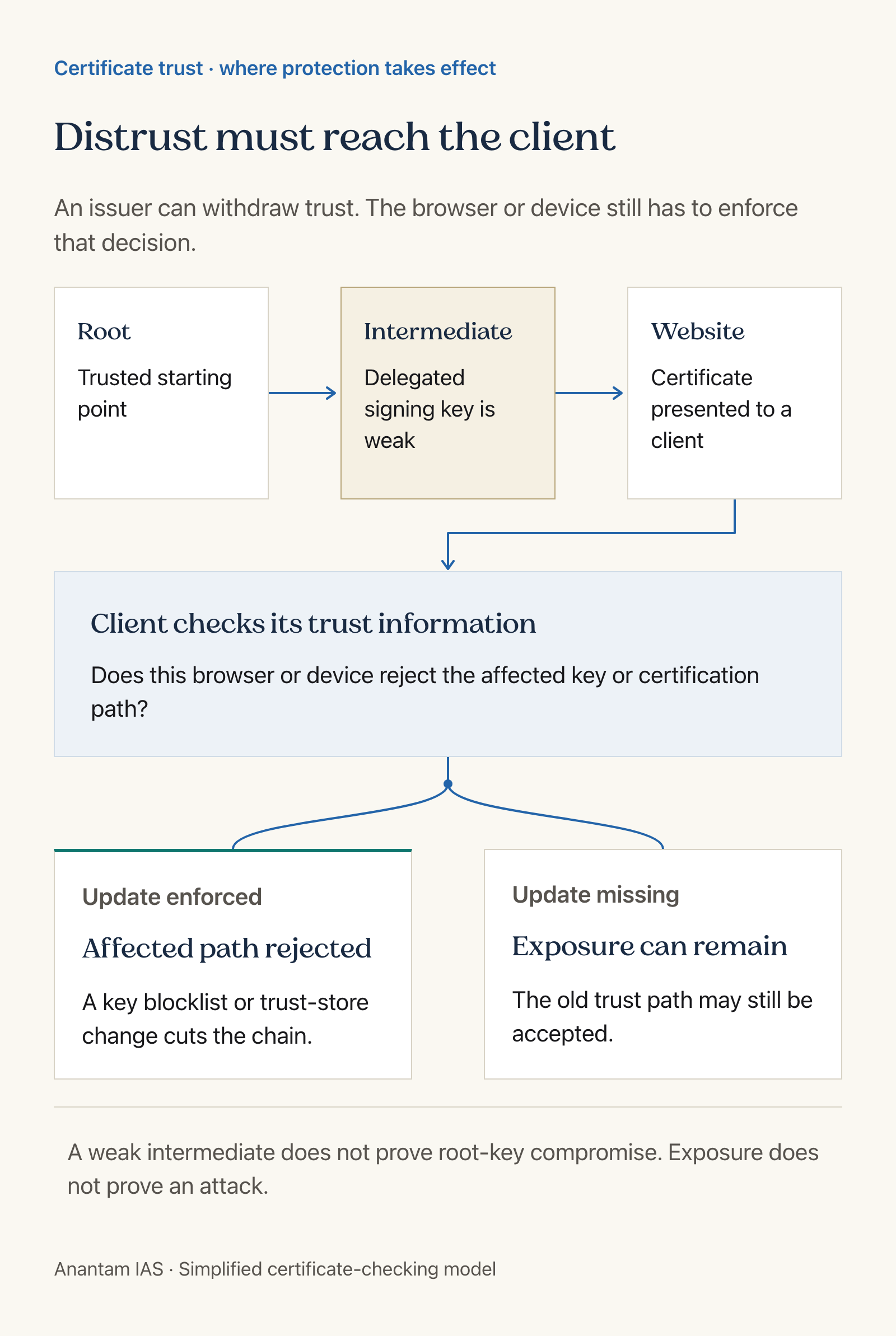
  • An issuer’s revocation decision and a client’s rejection are separate events. A browser, application or device must obtain and enforce suitable status information or distrust instructions before it stops accepting the affected certification path.
  • Chrome used its CRLSet mechanism to block hashes identifying the affected public keys. Google said this protected Chrome users against certificates sharing those keys without requiring a browser update or restart to take effect.
  • Key-based blocking targets the compromised signing identity rather than merely one certificate’s label. The relevant protection is that a client rejects certificates using the blocked keys, including certificates an attacker could otherwise present as trusted.
  • Google also removed the signing root from its root store for consumers that do not receive CRLSet updates. Broad release was expected on 27 October, so the announcement and completed delivery must be distinguished.
  • Root removal can also invalidate legitimate certificate chains. Google instructed affected website operators to obtain certificates from another trusted hierarchy; continuity planning must accompany trust withdrawal so authentic services remain reachable after clients enforce distrust.
Delegated certificate chain leading to a client check, with updated and stale trust paths.
A distrust decision protects a browser or device only when its certificate checks enforce it.

What Transparency and Service Separation Establish

Evidence about one protection or service cannot be extended to every device, certificate or business.

  • Certificate Transparency records publicly trusted certificates in auditable logs. Google found no TLS certificates chaining to six affected intermediates logged before its blocking action, supporting its protection assessment for clients that enforce CT requirements.
  • CT enforcement matters: Google’s conclusion covered Chrome and qualifying Android applications. It should not become a blanket assurance about every embedded device or application, because clients can apply different certificate acceptance and update policies.
  • A forgery capability is not proof of a completed attack. Google described the exposure and defensive response; the available evidence does not establish that attackers actually impersonated government websites or intercepted particular users’ communications.
  • eMudhra said Indian DSC and eSign operations use infrastructure separate from global TLS. Report that as the company’s service-specific assurance; the incident does not justify assuming that all Indian digital signatures have become invalid.
  • Independent audits and hardware safeguards did not prevent the reported weakness from reaching trusted intermediates. The governance lesson concerns validating the keys actually accepted by clients, alongside checking the processes and equipment used to create them.

Way Forward

Make Distrust Operational

  • Inventory certificate chains across websites, applications and embedded systems; identify which clients receive root-store and revocation updates.
  • Replace affected legitimate TLS certificates before the announced root-removal rollout, using a different accepted certification hierarchy.
  • Publish clear incident scope and independently supported findings; separate key weakness, confirmed exploitation and consequences for different services.

Conclusion

  • Digital trust is revocable authority: secure key generation creates it, while reliable client enforcement withdraws it. A central warning alone cannot protect a device that continues accepting a compromised issuing key.
  • In an answer on cyber governance, connect delegation, detection and distrust delivery. Keep the distinction between a vulnerable trust chain and a proven breach, and examine service continuity when legitimate certificates must be replaced.

UPSC Practice Questions

Prelims MCQ 1

With reference to digital certificate trust, consider the following statements:

  1. An intermediate certification authority can hold delegated signing authority under a trusted root.
  2. Compromise of an intermediate private key necessarily establishes compromise of the root private key.
  3. Client enforcement is necessary for a distrust decision to prevent acceptance of affected certificates.

How many of the above statements are correct?

(a) Only one (b) Only two (c) All three (d) None

Answer: (b) Only two

Explanation:

Statements 1 and 3 are correct. An intermediate can issue certificates under delegated authority, but its key compromise does not prove that the root private key was compromised.

Prelims MCQ 2

Which best describes the role of Certificate Transparency in the reported eMudhra incident?

(a) It replaced all compromised private keys automatically. (b) It guaranteed protection for every device using HTTPS. (c) It supported protection for clients enforcing certificate logging requirements. (d) It proved that the root private key had been stolen.

Answer: (c) It supported protection for clients enforcing certificate logging requirements.

Explanation:

Google tied its assessment to the absence of certificates from six affected TLS intermediates in CT before blocking and to clients enforcing CT. Logging does not replace keys or establish root-key compromise.

UPSC Mains Questions

  1. Explain why a certification authority’s revocation decision must be accompanied by client-side enforcement. Discuss the implications for digital trust governance.
  2. Distinguish cryptographic vulnerability, confirmed exploitation and service disruption in a certificate-trust incident. How should public communication reflect these distinctions?

Sources: Google Chrome Security and eMudhra.

Frequently Asked Questions

What went wrong with the eMudhra intermediate certificates?

Google reported insufficient randomness in private-key generation for eight subordinate CA certificates. Weak keys could enable forged HTTPS certificates against clients that continued trusting the affected keys.

Was the root private key compromised?

The disclosed incident concerned intermediate private keys. Removal of the signing root was a defensive trust decision; it does not by itself establish that the root private key was compromised.

Why is revocation different from client protection?

Revocation records a withdrawal of trust. Protection depends on a browser, application or device receiving and enforcing that decision through mechanisms such as status checking, key blocklists or trust-store updates.

Were Indian DSC and eSign services affected?

eMudhra said its Indian DSC and eSign businesses operate on separate infrastructure and were unaffected. This is the company’s service-specific statement, not a claim that every certificate ecosystem was free of risk.

GRAP Stage I: Turning Air-Quality Warnings Into Regional Action

Open article →Download PDF

Why in News?

On 21 October 2026, CAQM invoked GRAP Stage I across the National Capital Region after Delhi’s daily average Air Quality Index reached the Poor category.

  • Delhi’s daily average AQI reached 245 at 4 PM, within the Poor category of 201–300.
  • The CAQM Sub-Committee activated all Stage I actions with immediate effect across the entire NCR.
  • Its decision considered current air quality alongside IMD/IITM forecasts; further review will depend on observed conditions and forecasts.
  • A common regional trigger helps neighbouring jurisdictions act together when pollution affects the shared urban region.
  • The current decision strengthens early intervention; it should not be described as automatic activation of every higher-stage restriction.

UPSC Relevance

Prelims Relevance

  • GRAP: Graded Response Action Plan.
  • CAQM: Commission for Air Quality Management.
  • Stage I corresponds to Delhi AQI in the Poor category, 201–300.
  • CPCB supplies the AQI bulletin cited in the decision.
  • IMD/IITM forecasts inform the Sub-Committee’s assessment.

Mains Relevance

GS Paper 3

  • Ambient pollution indicators versus control of individual emission sources.
  • Emergency response alongside sustained urban emission reduction.

GS Paper 2

  • Regional coordination and accountability across implementing agencies.

Essay

  • Environmental governance requires both timely warnings and institutions capable of acting on them.

Background and Context

How an AQI Warning Becomes a Regional Decision

GRAP connects a monitored environmental condition to a coordinated administrative response rather than leaving each agency to act separately.

  • AQI is an ambient indicator: it describes the condition of the surrounding air. It does not identify which particular factory, vehicle or construction project caused the deterioration, or establish that source’s legal compliance.
  • Stage I uses Delhi’s Poor AQI category as its trigger, while the response extends across NCR. The distinction matters: the reference indicator and the geographical area of implementation are not identical in scope.
  • The CAQM Sub-Committee reviewed observed air quality together with weather and air-quality forecasts before invoking the measures. Forecast review helps authorities judge the risk of further deterioration instead of treating one reading in isolation.
  • Implementing agencies must carry out, monitor and review the notified actions within their responsibilities. A common regional decision still depends on local inspections, municipal operations and transport management to produce practical changes on the ground.
  • The official announcement provides for continued review using Delhi’s air quality and IMD/IITM forecasts. Activation is a decision to intensify response, not evidence that pollution has already fallen or that implementation is complete.

What Stage I Agencies Must Actually Do

The immediate response combines enforcement against polluting activities with practical services that make cleaner behaviour possible.

  • Dust control requires covered storage and transport of construction materials, proper waste handling, road sweeping and sprinkling. These measures target dispersed sources that require routine field operations, rather than a single centralised intervention alone.
  • Waste management links regular collection with enforcement against open burning and vigilance at landfill sites. Prohibiting burning without ensuring timely waste removal leaves a practical gap between the instruction and the conditions encouraging the activity.
  • Transport action combines enforcement of vehicle pollution norms with traffic management at congested corridors. The objective is to address polluting vehicles and avoidable congestion through operational measures instead of relying entirely on citizen appeals.
  • Public transport augmentation includes additional services and greater frequency for CNG or electric buses, metro and RRTS. This provides a usable alternative to private travel, supporting the request for commuters to change their behaviour.
  • Industrial enforcement checks emission standards and approved fuels, including through inspections of non-compliant units. These source-level obligations remain distinct from the ambient AQI trigger: regional air quality cannot substitute for checking individual facilities’ compliance directly.

What the Activation Does Not Establish

The key comparison is between a graded response to deteriorating air and the sustained work needed to reduce emissions.

  • Stage I is not every GRAP stage at once. Do not infer blanket construction shutdowns or school closures from this announcement. Read the particular measures invoked rather than transferring restrictions associated with more severe conditions.
  • Construction enforcement is conditional: the announcement includes action against specified non-compliant projects alongside dust mitigation. Treating this as an indiscriminate halt to all construction erases the difference between enforcing existing requirements and imposing wider restrictions.
  • Regional coordination matters because neighbouring jurisdictions share pollution exposure and connected transport networks. If one agency intensifies enforcement while another neglects comparable sources, the common response becomes uneven despite a shared decision at the top.
  • Weather affects the observed outcome, which is why forecasts enter the review. A subsequent improvement in AQI alone cannot demonstrate which measure worked; assessment also needs evidence that agencies actually implemented their assigned actions.
  • Emergency measures cannot replace year-round controls on waste, transport, construction and industrial emissions. A durable answer should connect the immediate response to reliable public services and compliance, rather than presenting seasonal activation as a complete solution.

Way Forward

Make Implementation Visible

  • Publish agency-level completion reports for dust control, waste removal and transport augmentation, distinguishing instructions issued from work completed.
  • Link citizen complaints to inspection outcomes so reporting a polluting activity produces an accountable response.
  • Review AQI trends alongside implementation records and forecasts; avoid attributing every change in air quality to a single intervention.

Conclusion

  • GRAP Stage I translates an ambient warning into regional action. Its usefulness depends on agencies delivering specific enforcement and service changes, with continuing review of observed air quality and forecasts.
  • For a governance answer, distinguish the trigger, implementing responsibilities and outcomes. Then explain why a graded response must sit alongside sustained emission reduction rather than become the main pollution-control strategy.

UPSC Practice Questions

Prelims MCQ 1

With reference to the GRAP Stage I activation on 21 October 2026, consider the following statements:

  1. The Poor category covers Delhi AQI from 201 to 300.
  2. The activated measures apply across the entire National Capital Region.
  3. The activation automatically establishes that all construction activity must stop.

How many of the above statements are correct?

(a) Only one (b) Only two (c) All three (d) None

Answer: (b) Only two

Explanation:

Statements 1 and 2 are correct. The announcement invokes Stage I across NCR. It specifies dust-control obligations and action against certain non-compliant projects, not a blanket halt to all construction.

Prelims MCQ 2

Which best describes the distinction between ambient AQI and emission-source compliance?

(a) AQI directly certifies that every industrial unit complies with its emission limits. (b) Source compliance becomes unnecessary once regional AQI improves. (c) AQI indicates surrounding air conditions, while source compliance requires checks of applicable obligations. (d) AQI identifies the legal liability of each construction project.

Answer: (c) AQI indicates surrounding air conditions, while source compliance requires checks of applicable obligations.

Explanation:

An ambient indicator describes the air being monitored. Compliance with fuel, emission or dust-control requirements must be assessed at the relevant source; the regional indicator does not replace that assessment.

UPSC Mains Questions

  1. Explain how GRAP links an air-quality indicator to coordinated regional governance. What implementation gaps can weaken this approach? (150 words)
  2. Emergency air-pollution measures must complement sustained emission reduction. Discuss with reference to the enforcement and public-service components of GRAP Stage I. (250 words)

Source: PIB, Ministry of Environment, Forest and Climate Change.

Frequently Asked Questions

Why was GRAP Stage I invoked on 21 October 2026?

Delhi’s daily average AQI reached 245 at 4 PM, within the Poor category. CAQM reviewed air quality and forecasts before activating Stage I measures across the entire NCR.

Does Stage I apply only inside Delhi?

No. Delhi’s AQI is the reference indicator cited for the Stage I decision, but the announcement directs implementation across the entire National Capital Region by the agencies concerned.

Does Stage I automatically close schools and all construction?

No. This announcement invokes Stage I measures, including dust control and action against specified non-compliant construction projects. It does not justify attributing blanket construction shutdowns or school closures to this activation.

Why are forecasts considered alongside current AQI?

Forecasts help the Sub-Committee assess how weather and air quality may develop. The announcement provides for continuing review using Delhi’s air quality and IMD/IITM forecasts when considering further appropriate decisions.

Low-Level Radar: Detection and Tracking Before Interception

Open article →Download PDF

Why in News?

On 21 October 2026, the Ministry of Defence signed a contract with Bharat Electronics Limited to procure Improved Low Level Light Weight Radars for the Indian Army.

  • The procurement contract concerns an improved low-level, lightweight radar system for Army air defence.
  • According to the Ministry of Defence, the system can detect and track fighter-sized targets and mini or micro drones.
  • The release also identifies aerial-target prioritisation as a capability, supporting decisions about which detected objects need attention first.
  • A signed contract establishes a procurement commitment; the release does not establish completed delivery or operational deployment.
  • Small, low-flying aerial targets create a surveillance challenge because useful echoes must be distinguished from surrounding returns.
  • Air defence connects sensors, decision-making and response systems; improving one component does not independently prove the effectiveness of the entire chain.

UPSC Relevance

Prelims Relevance

  • Radar uses radio-wave echoes to obtain information about objects.
  • Detection, tracking and target prioritisation perform different functions.
  • Mini and micro drones are among the target categories mentioned in the official announcement.
  • Terrain masking and ground clutter affect the detection environment.
  • A radar sensor is distinct from an interceptor or other response system.

Mains Relevance

GS Paper 3

  • Link indigenous defence procurement to reliable surveillance, integration and maintenance.
  • Explain how low-altitude surveillance strengthens, but cannot independently complete, counter-drone defence.

Essay

  • Technological capability depends on the institutions and systems that turn information into action.

Background and Context

What the Radar Contract Establishes

The announcement describes a sensor acquisition and its stated functions; it does not report a completed operational deployment.

  • The official announcement identifies Bharat Electronics Limited as the supplier and the Indian Army as the intended user. This makes the development a procurement decision, rather than evidence of a newly demonstrated battlefield result.
  • The stated target categories include fighter-sized aircraft and mini or micro drones. These categories describe the intended surveillance task; they do not provide a measured detection probability against every possible aircraft or drone under all conditions.
  • The release lists detection and tracking alongside prioritisation. Read these as related information functions: locating a potential target, following its movement and helping organise attention, rather than treating each as a separate weapon or interception capability.
  • The procurement is presented as supporting indigenisation of air-defence platforms. The policy question is whether domestic production can support reliable equipment, maintenance and integration over time, rather than whether signing a contract itself completes technological self-reliance.
  • The announcement does not disclose detection range, operating bands or quantities. Retain that uncertainty instead of importing specifications from similarly named radars, earlier variants or unrelated systems with different roles.

From a Radio Echo to a Useful Track

The following sequence explains general radar principles, rather than undisclosed technical specifications of the newly contracted system.

  • A radar transmits radio waves and receives energy reflected by objects. Echo timing helps estimate distance, while the direction in which the antenna observes the return helps locate the object relative to the radar itself.
  • Detection means recognising a return as a possible target amid other signals. A single observation does not automatically establish what the object is, whether it is hostile or whether a reliable continuing track can be maintained.
  • Tracking associates successive observations with the same moving object. This produces information about movement over time, making the target more useful to decision-makers than an isolated echo that supplies no dependable history of its changing position.
  • Prioritisation organises attention among aerial targets when several require assessment. It is distinct from detection: finding an object and deciding its relative importance answer different questions, and the release does not specify the system’s prioritisation rules.
  • A useful track can cue a response through the wider air-defence system. The radar supplies information; interception requires a separate response capability and decision process, so detection alone should never be described as a successful shootdown.

Why Low-Flying Targets Remain Difficult

The surveillance problem depends on geometry, reflected signals and the surrounding environment, not simply the presence of a radar.

  • Line of sight limits ground-based radar observations. Earth’s curvature and intervening terrain can hide low-flying objects, so a ground radar does not guarantee an unobstructed view in every direction or at every distance.
  • Ground clutter consists of unwanted returns from surrounding surfaces and objects. Detecting a low-altitude target requires separating useful information from this background; a bright or numerous set of returns is not automatically evidence of multiple threats.
  • A target’s radar return depends on shape, materials, orientation and radar characteristics. Small drones can be challenging, but physical size alone cannot establish how easily an object will be detected in every situation.
  • Sensor integration connects information to units assessing threats. A useful detection can lose operational value if communication, identification or response arrangements fail to connect the observation to appropriate action.
  • Purpose distinguishes radar applications: air-defence radar follows aerial targets, while atmospheric research radar investigates environmental processes. A shared sensing principle does not make their equipment, measurements or operational claims interchangeable.

Way Forward

Assess the Complete Surveillance Chain

  • Evaluate delivery and acceptance separately from the contract announcement, using documented milestones before claiming operational induction.
  • Prioritise integration and maintenance so useful tracks reach decision-makers and equipment remains available under demanding conditions.
  • Assess performance against representative target and terrain conditions, while avoiding unsupported public claims of perfect detection or automatic interception.

Conclusion

  • Low-level radar strengthens the information side of air defence by detecting, tracking and helping prioritise aerial targets. Its contribution should be explained through this sequence, without confusing a sensor’s output with a weapon’s effect.
  • The contract is a procurement development, with delivery and deployment still requiring separate evidence. A sound answer connects domestic manufacturing with reliable sensing, system integration and an appropriate response, while recognising the limits of the published announcement.

UPSC Practice Questions

Prelims MCQ 1

With reference to radar-based air surveillance, consider the following statements:

  1. Tracking associates successive observations with a moving object.
  2. Target prioritisation is identical to physically intercepting a target.
  3. Ground clutter can complicate the detection of low-flying targets.

How many of the above statements are correct?

(a) Only one (b) Only two (c) All three (d) None

Answer: (b) Only two

Explanation:

Statements 1 and 3 are correct. Tracking follows movement across observations, and clutter can obscure useful returns. Prioritisation helps organise attention; it does not itself intercept a target.

Prelims MCQ 2

Which conclusion is supported by the Ministry of Defence’s 21 October 2026 low-level radar announcement?

(a) All contracted radars have completed operational deployment. (b) The radar independently destroys every detected drone. (c) A procurement contract covers radars with detection, tracking and target-prioritisation capabilities. (d) The release confirms a universal detection range for every target.

Answer: (c) A procurement contract covers radars with detection, tracking and target-prioritisation capabilities.

Explanation:

The announcement establishes the procurement and stated capabilities. It does not establish completed deployment, universal range or an independent shootdown function.

UPSC Mains Questions

  1. Explain the roles of detection, tracking and target prioritisation in counter-drone air defence. Why should these functions be distinguished from interception? (150 words)
  2. Discuss how indigenous radar procurement can strengthen defence capability. Identify the importance of integration, maintenance and evidence-based performance assessment. (250 words)

Source: PIB, Ministry of Defence.

Frequently Asked Questions

What is the new low-level radar development?

The Ministry of Defence signed a contract with Bharat Electronics Limited on 21 October 2026 for improved low-level lightweight radars for the Indian Army. The announcement concerns procurement, rather than completed deployment.

How is tracking different from detection?

Detection recognises a possible target in received signals. Tracking links successive observations to follow its movement over time. A detected object does not automatically have a reliable track or a confirmed hostile identity.

Can radar alone intercept a drone?

A radar supplies information about aerial targets. Interception requires a separate response capability and decision process within the wider defence system. Detecting or prioritising a drone does not itself mean destroying it.

Why are low-flying targets difficult to detect?

Terrain and Earth’s curvature can obstruct radar line of sight, while returns from surrounding objects create clutter. Target shape, material and orientation also affect the echo, so performance depends on operating conditions.

Municipal Nominations: Evidence-Based Remedies for Obstructed Candidates

Open article →Download PDF

Why in News?

The Hindu reported that Andhra Pradesh’s State Election Commission halted the election process for 100 urban local bodies following Supreme Court directions on complaints that law-and-order conditions prevented candidates from filing nominations.

  • The reported directions postponed publication of the final candidate list until October 25.
  • The SEC must examine representations and supporting evidence, including electronic material submitted by the petitioner party and other candidates.
  • Reconsidering the nomination deadline depends on the SEC finding that law-and-order conditions prevented filing in the relevant places.
  • The report said the SEC would obtain reports from district election and police authorities before issuing a further order.
  • An election needs both a reliable timetable and a real opportunity to contest; a nominal filing window may be insufficient if access is obstructed.
  • A temporary halt is a procedural safeguard, not proof that every allegation is true or a declaration cancelling every municipal election.

UPSC Relevance

Prelims Relevance

  • State Election Commission: constitutional authority responsible for municipal election supervision and conduct.
  • Article 243ZA: municipal elections; applies the provisions of Article 243K to the SEC.
  • Article 243U: municipal duration and timely completion of elections, subject to its constitutional qualifications.
  • Article 243ZG: constitutional framework restricting election challenges, including the election-petition route.
  • Nomination versus scrutiny: submission of candidature papers versus examination of their legal validity.

Mains Relevance

GS Paper 2

  • Institutional independence and effective access to municipal elections.
  • Evidence-based relief that reconciles fair competition with timely local representation.

Essay

  • Democratic fairness depends on access to institutions as well as formal rules.

Background and Context

What the Reported Directions Require

The immediate issue is access to candidature: whether people could actually submit nomination papers within the prescribed window.

  • The reported halt covers the notified election process, allowing the SEC to assess complaints before the candidate list becomes final. It should not be described as a final judicial cancellation of all municipal polls.
  • The SEC must consider representations from affected candidates and the petitioner party alongside supporting material. A representation sets out a grievance; it does not, by itself, establish that obstruction occurred or that relief follows automatically.
  • The reported direction expressly includes electronic evidence. Such material can help establish what happened at a filing location, but its relevance, timing and reliability still need examination alongside the account of the person complaining.
  • The deadline question is conditional and location-specific: the SEC must decide whether law-and-order conditions prevented filing in the relevant places. The report does not establish that every candidate everywhere faced the same obstruction or disadvantage.
  • District election and police reports provide an administrative account for this assessment. Their role is to inform the SEC’s decision; seeking those reports should not be mistaken for a completed finding on disputed allegations.

Why the State Election Commission Is Central

The constitutional framework places municipal elections under the SEC while also requiring elected local government to be renewed on time.

  • Article 243ZA entrusts municipal electoral-roll preparation and election conduct to the SEC’s supervision, direction and control. Its application of Article 243K connects municipal elections with the constitutional framework protecting the State Election Commission’s institutional independence.
  • Election administration involves more than announcing dates: nomination access, scrutiny and publication of candidates shape the contest. A formally available filing procedure offers little protection if an otherwise eligible person cannot physically access it safely.
  • Article 243U supplies the timetable principle for municipal democracy: elections should sustain timely elected representation within constitutional requirements. Correcting an obstructed nomination process must be considered alongside that obligation, rather than treating delay as costless.
  • The institutional distinction is between SEC decision-making and administrative assistance. District officials and police supply information and operational support, while the commission must evaluate the complaint and determine the response required under the applicable framework.
  • The useful comparison is targeted correction versus indiscriminate restarting. Addressing a demonstrated denial of nomination access can protect competition without assuming that unrelated stages or locations are defective; the actual remedy depends on verified circumstances.

Evidence, Remedies and Limits of the Inference

Read a procedural direction carefully: what the institution must examine is different from what it has already conclusively established.

  • A sound complaint should connect the candidate, place and attempted filing with the alleged obstruction. This makes the claim assessable and helps distinguish inability caused by insecurity from unrelated deficiencies in nomination papers or eligibility.
  • Electronic material needs context: when and where it was recorded, what it depicts and how it relates to the filing attempt. A dramatic clip may not establish whether the complainant was prevented from submitting papers.
  • Reasoned decisions should explain the connection between the evidence, the finding and the chosen relief. This protects complainants from unexplained rejection and other participants from an unnecessarily broad disruption of the election process already underway.
  • Article 243ZG structures restrictions on municipal election challenges and the election-petition route. It should not be compressed into an absolute claim that courts can never intervene; the proceeding, legal issue and relief sought all matter.
  • A direction to examine complaints creates a duty to assess evidence, rather than deciding every allegation in advance. The final relief must follow verified circumstances and a reasoned institutional decision.

Way Forward

Make Nomination Access Verifiable

  • Provide a documented complaint channel that records attempted filing, location, time and supporting material without forcing candidates to rely only on informal contacts.
  • Preserve relevant electronic records and administrative accounts promptly, and assess contradictory evidence before reaching a finding.
  • Issue a reasoned, clearly communicated remedy specifying affected locations and revised steps where necessary, while safeguarding timely completion of elections.

Conclusion

  • Fair nomination access is a practical condition of electoral competition. The reported directions require examination of evidence before deciding whether affected candidates need a renewed opportunity to file; they do not establish universal coercion.
  • For a Mains answer, connect institutional independence, reliable evidence and proportionate relief. The challenge is to repair a demonstrated exclusion while retaining a workable election timetable and avoiding conclusions that go beyond the available record.

UPSC Practice Questions

Prelims MCQ 1

With reference to municipal elections in India, consider the following statements:

  1. Article 243ZA places municipal election conduct under the State Election Commission’s supervision, direction and control.
  2. Article 243U concerns the duration of municipalities and completion of municipal elections.
  3. A candidate’s representation alleging obstruction automatically proves the allegation and requires cancellation of every municipal poll in the State.

How many of the above statements are correct?

(a) Only one (b) Only two (c) All three (d) None

Answer: (b) Only two

Explanation:

Statements 1 and 2 reflect the constitutional framework. Statement 3 is incorrect: a complaint requires assessment, and the reported nomination remedy depends on findings about obstruction in the relevant places.

Prelims MCQ 2

Which interpretation best reflects the reported direction concerning obstructed municipal nominations?

(a) Every allegation must be accepted without examining evidence. (b) Police reports alone conclusively determine the validity of every nomination. (c) The SEC must assess representations and evidence before deciding on nomination deadlines where law-and-order conditions prevented filing. (d) All municipal elections have been permanently cancelled.

Answer: (c) The SEC must assess representations and evidence before deciding on nomination deadlines where law-and-order conditions prevented filing.

Explanation:

The reported direction is conditional: the SEC must examine evidence and decide whether the nomination deadline needs reconsideration wherever it finds that law-and-order conditions prevented filing.

UPSC Mains Questions

  1. Explain how State Election Commissions can reconcile timely municipal elections with an effective remedy for candidates prevented from filing nominations.
  2. Discuss the importance of electronic evidence and reasoned decisions when election authorities address allegations of obstruction during the nomination process.

Source: The Hindu.

Frequently Asked Questions

Were all municipal elections finally cancelled?

No. The Hindu reported a halt in the notified process pending further SEC action. A temporary procedural halt must not be presented as permanent cancellation or a final finding that every allegation was proved.

Does every complaint require reopening nominations?

No. The reported direction requires assessment of representations and evidence. Reconsideration of the deadline depends on the SEC finding that candidates were unable to file because of law-and-order conditions in the relevant places.

Why does electronic evidence matter?

Electronic records may help establish the location, timing and circumstances of an alleged obstruction. Their reliability and connection to an attempted filing still require examination; their mere submission does not establish the complaint.

Which institution conducts municipal elections?

The State Election Commission supervises and controls municipal election conduct under Article 243ZA. District election and police authorities provide administrative assistance, but their reports do not replace the commission’s responsibility to assess complaints.

PHP Security Flaws: Why Shared Software Needs Coordinated Patching

Open article →Download PDF

Why in News?

The PHP Project released security updates on 21 October 2026 for two critical vulnerabilities permitting unauthenticated remote code execution, followed by reports of precautionary website shutdowns.

  • The PHP advisory covers installations serving web requests across several server configurations; exposure is not limited to one website platform.
  • The developer warns that updating is the complete remedy; temporary measures reduce particular attack paths without making an installation safe.
  • The Hindu reported precautionary outages during emergency patching; taking a website offline does not itself establish that attackers compromised it.
  • A flaw in a shared runtime can place unrelated organisations under simultaneous pressure to patch the same underlying software.
  • Public services need clear hosting responsibility: the application team may not control the runtime that the infrastructure provider must update.

UPSC Relevance

Prelims Relevance

  • PHP as a server-side language and runtime
  • Remote code execution and unauthenticated access
  • Software dependency and security patch
  • Vendor backport and supported release
  • Vulnerability versus confirmed compromise

Mains Relevance

GS Paper 3

  • Shared software dependencies and concentrated cybersecurity exposure.
  • Balancing urgent patching with continuity of digital services.

GS Paper 2

  • Contractual accountability for security maintenance in outsourced public services.

Essay

  • Digital interdependence makes maintenance a shared institutional responsibility.

Background and Context

Why a Runtime Flaw Spreads Across Websites

The vulnerable component sits beneath the application that citizens see, making responsibility harder to trace from the public website alone.

  • PHP executes server-side application instructions and helps generate web responses. A website may use it indirectly through its software platform, so administrators must inspect the hosting environment rather than identify exposure from appearance alone.
  • Runtime dependencies are shared building blocks used by many separately managed applications. A defect in one such component can create simultaneous exposure across organisations, even when their websites serve different purposes and share no data.
  • Hosting servers run applications and their supporting runtime on physical or virtual infrastructure. Outsourcing changes who performs maintenance; it does not remove the need to establish whether deployed software is affected.
  • Application updates and runtime updates address different layers. Installing a new website theme or content-management release does not necessarily replace PHP, so an apparently current application can still depend on vulnerable software beneath it.
  • Asset inventories should connect each public service with its deployed runtime, hosting provider and maintenance owner. Without this relationship, teams can patch the most visible website while overlooking another exposed service using the same component.

What Remote Code Execution Means

The advisory concerns server execution, not merely a misleading page or the accidental publication of an isolated record.

  • Remote code execution means an attacker may cause a remote system to execute unintended instructions. The advisory describes unauthenticated attacks, so a valid account or stolen user password is not required for the vulnerable pathway.
  • Memory handling is central to the disclosed defects. At a high level, invalid or stale internal state may be treated as usable data, breaking assumptions on which safe processing of web requests depends during execution.
  • Early request processing matters because the advisory describes a demonstrated attack in one server configuration before application code runs. Protections implemented only within the website application cannot be assumed to intercept every underlying runtime failure.
  • Vulnerability is not compromise: a weakness establishes an opportunity for attack, while compromise requires evidence that it was exploited. A precautionary shutdown can prevent exposure and must not automatically be described as a successful intrusion.
  • AI-assisted discovery featured in The Hindu reporting, but discovery and causation are different claims. The immediate operational issue is repairing the disclosed runtime weaknesses, not assuming that artificial intelligence created them or hacked every affected website.

How Coordinated Patching Reduces Exposure

A released fix protects services only after it reaches the software actually handling their requests.

  • Vendor packages can deliver the repair through operating-system or hosting channels. Some vendors backport security fixes into maintained packages, so administrators should verify vendor confirmation instead of treating an unfamiliar version label as conclusive evidence.
  • Unsupported installations need special attention because routine upstream maintenance may have ended. The advisory directs users towards supported versions or relevant vendor fixes; the existence of a historical installation is no guarantee of continuing security support.
  • Temporary restrictions can reduce particular attack paths while an update is arranged. The PHP Project warns that these measures are incomplete; recording a mitigation must not close the task of deploying the security fix.
  • Deployment verification should establish that the running service uses repaired software, rather than merely confirming a package download. Hosting providers and application owners need a shared completion record that covers every relevant instance and service.
  • Service continuity requires an explicit tradeoff between an exposed public endpoint and a controlled interruption. Teams should prepare maintenance communication and recovery arrangements, then restore availability after confirming the repair rather than relying on elapsed downtime.

Way Forward

Make Patch Ownership Explicit

  • Assign a named runtime maintenance owner to every public-facing service and require hosting providers to confirm affected installations and patch status.
  • Prioritise exposed services, preserve a recovery plan, and check application compatibility while deploying the vendor-supported security repair.
  • Keep temporary mitigations on an open risk register until the update is confirmed; communicate any interruption through alternative service channels.

Conclusion

  • The PHP disclosure shows how shared runtime dependence can turn one technical defect into a coordination problem across many services, including those operated by different public bodies and private providers.
  • A credible response connects inventory, ownership, patch deployment and verification. Public trust depends on restoring a repaired service with clear accountability, rather than interpreting an update announcement as proof that every installation is already safe.

UPSC Practice Questions

Prelims MCQ 1

With reference to software runtime vulnerabilities, consider the following statements:

  1. Unauthenticated remote code execution can occur without the attacker holding a valid application account.
  2. Updating a website application necessarily updates its underlying runtime.
  3. A precautionary website shutdown alone proves successful exploitation.

How many of the above statements are correct?

(a) Only one (b) Only two (c) All three (d) None

Answer: (a) Only one

Explanation:

Only statement 1 is correct. Application and runtime updates are separate, and precautionary downtime is not evidence of successful exploitation.

Prelims MCQ 2

Which action best establishes that a shared-runtime security repair has reached a hosted public service?

(a) Changing the public homepage design (b) Confirming that the running service uses the vendor-supported repaired software (c) Waiting until news coverage declines (d) Assuming all application updates replace the runtime

Answer: (b) Confirming that the running service uses the vendor-supported repaired software

Explanation:

Deployment verification must cover the actual runtime serving requests. Neither a cosmetic change nor an assumption about application updates confirms the repair.

UPSC Mains Questions

  1. Explain how shared software dependencies create cybersecurity risks across independently managed public services. Suggest measures for coordinated patching.
  2. How should public agencies balance service continuity with urgent remediation of critical server vulnerabilities? Discuss the responsibilities of hosting providers and application owners.

Sources: PHP Project and The Hindu.

Frequently Asked Questions

What is PHP in a website?

PHP is a server-side programming language and runtime used to execute application instructions and generate web responses. A website can depend on it through a platform even when users never see that dependency.

Does an affected PHP installation prove that a website was hacked?

No. An affected installation has a vulnerability that may be exploited. Confirmed compromise requires evidence of exploitation; a precautionary shutdown or emergency maintenance notice alone does not establish an intrusion.

Will updating the website application always fix PHP?

No. Application software and the underlying PHP runtime are separate maintenance layers. The organisation or hosting provider must confirm that the runtime actually serving requests has received the appropriate security repair.

Are temporary mitigations enough for these flaws?

The PHP Project says temporary measures reduce particular attack paths but do not make an installation safe. They can support interim risk reduction, while deployment of the security update remains the complete remedy.

When police officers wield powers of Special Executive Magistrate

Open article →Download PDF

Why in news?

A police officer, as Special Executive Magistrate, sent two protest leaders to custody, raising concerns over preventive powers. Lawyers have questioned whether police officers holding magisterial powers can fairly judge cases arising from police action, and whether these preventive powers are being used to curb lawful dissent.

UPSC Relevance

Prelims: Classes of criminal courts under BNSS; Executive vs Judicial Magistrates; Section 163 BNSS (old Section 144 CrPC); Article 50; Articles 19 and 22.

Mains GS2: Separation of powers between organs; structure and functioning of the judiciary; fundamental rights – freedom of speech and assembly.

Constitutional framework

  • Article 50: Principle of separation of power – Directs the State to separate the judiciary from the executive in public services. The CrPC of 1973 largely did this by taking trial powers away from Executive Magistrates.
  • Article 19(1)(a) and (b): Freedom of speech and the right to assemble peacefully without arms, subject to reasonable restrictions for public order under Articles 19(2) and 19(3).
  • Articles 21 and 22: No deprivation of liberty except by fair, just and reasonable procedure; safeguards on arrest and detention.

Who are Executive Magistrates?

  • Meaning: Officers of the executive (usually from the revenue administration) who are given limited magisterial powers to maintain public order and peace. They do not try criminal cases.
  • Section 14, BNSS: The State government appoints Executive Magistrates in every district – one as the District Magistrate (DM), and others as Additional DM and Sub-Divisional Magistrates (SDMs).
  • Section 15, BNSS – Special Executive Magistrates: The State can appoint SEMs for particular areas or functions for a fixed period. BNSS specifically allows a police officer of at least Superintendent of Police rank, or equivalent, to be appointed as SEM.
  • Police Commissionerate link: In cities with a commissionerate system (like Delhi, Mumbai), the Commissioner and senior police officers are given executive magistrate powers, so the police both maintain order and exercise preventive magisterial powers.

Classes of criminal courts under BNSS (Section 6)

Court of Session (Highest in huerarchy at District) → Judicial Magistrate of First Class → Judicial Magistrate of Second Class (lowest in hierarchy) → Executive Magistrates. BNSS has removed the separate category of Metropolitan Magistrates found in the CrPC.

Executive Magistrate vs Judicial Magistrate

BasisExecutive Magistrate (EM)Judicial Magistrate (JM)
Nature of workPreventive and administrative – maintain peace and public orderJudicial – deals with criminal cases and trials
Controlled byDistrict Magistrate and State governmentChief Judicial Magistrate, Sessions Judge and High Court
Trial and convictionCannot conduct trials or convict anyoneConducts trials and can impose sentences within legal limits
Who they areCivil servants (and, as SEMs, even police officers)Members of the judicial service, trained in law
Typical powersProhibitory orders, binding over for peace, dispersing assembliesTaking cognizance, bail, remand, trial and sentencing

The debate – police officers as SEMs

Arguments in favour

  • Quick response: In big cities, law and order situations need fast decisions; police officers are on the spot.
  • Single accountability: Under the commissionerate system, one authority is responsible for order, avoiding delays between the DM and the police.
  • Reduces burden: Revenue officers in metros are already overloaded.

Arguments against

  • Judge in own cause: The same police force arrests a person and then, through its own officer, decides on custody. This goes against the principle of natural justice – no one should be a judge in their own cause.
  • Weakens Article 50: Giving quasi-judicial powers to the police undoes the separation of judiciary and executive that the CrPC 1973 achieved.
  • Lack of legal training: Police officers are not trained to weigh evidence or apply the law on liberty the way judicial officers are.
  • Chilling effect on dissent: Lawyers argue that a “basket” of provisions – BNSS Sections 126, 135, 140, 141, 163, 170 and 172, along with State police laws and standing orders – lets police prevent protests routinely, making Article 19(1) a mockery.
  • Weak safeguards: Preventive orders are often passed without recorded reasons, proper hearing or timely review, and harsh bond conditions keep people in custody.

Way forward

  • Separate roles: Custody and remand decisions should rest with Judicial Magistrates; police SEMs, if needed, should be limited to purely preventive orders.
  • Reasoned orders: Every preventive order must record specific reasons, as required by Anuradha Bhasin, and be published.
  • Time-bound review: Quick judicial review of preventive detention and bond orders by a Judicial Magistrate or Sessions Court.
  • Clear guidelines on protests: Designated, accessible protest sites with transparent permission rules, as directed in Mazdoor Kisan Shakti Sangathan.
  • Police reforms: Implement Prakash Singh (2006) directions, including separation of investigation from law and order duties and Police Complaints Authorities.
  • Training and data: Train EMs on constitutional rights, and publish data on the use of preventive sections to track misuse.

Preventive powers exist to stop violence before it happens, not to stop speech before it is spoken. The line between keeping peace and silencing dissent must be drawn by an independent judge, not by the same hand that makes the arrest.

Practice MCQ

Q1. Consider the following statements regarding Executive Magistrates under the Bharatiya Nagarik Suraksha Sanhita (BNSS), 2023:

1. A police officer of the rank of Superintendent of Police or equivalent can be appointed as a Special Executive Magistrate.

2. Executive Magistrates can conduct criminal trials and convict accused persons.

3. A prohibitory order under Section 163 can be extended by the State government up to a maximum of six months.

How many of the statements given above are correct?

(a) Only one

(b) Only two

(c) All three

(d) None

Answer: (b). Statement 2 is incorrect – Executive Magistrates have only preventive and administrative powers; trials are conducted by Judicial Magistrates and Sessions Courts.

Q2. Consider the following statements:

Statement I: The Code of Criminal Procedure, 1973 took away the power of Executive Magistrates to try criminal cases.

Statement II: Article 50 of the Constitution directs the State to separate the judiciary from the executive in the public services of the State.

Which one of the following is correct in respect of the above statements?

(a) Both Statement I and Statement II are correct and Statement II explains Statement I

(b) Both Statement I and Statement II are correct but Statement II does not explain Statement I

(c) Statement I is correct but Statement II is incorrect

(d) Statement I is incorrect but Statement II is correct

Answer: (a). The CrPC, 1973 gave effect to the Directive Principle in Article 50 by separating judicial functions from executive magistrates.

Mains Practice Question

Examine the concept, appointment, and statutory powers of Special Executive Magistrates under the Bharatiya Nagarik Suraksha Sanhita (BNSS), 2023. How does the inclusion of senior police officers within its ambit mark a significant shift from the previous criminal procedure regime? (15 Marks / 250 Words)

The whales never stopped coming to Gujarat’s beaches, the watchers did

Open article →Download PDF

Why in news?

Global stranding data shows blue and Bryde’s whales regularly wash up in Gujarat, but systematic recording has stopped.

UPSC Relevance – Prelims: Species in news – blue whale, Bryde’s whale, Arabian Sea humpback.

Cetaceans – Basics

Meaning: Cetaceans are fully aquatic mammals – whales, dolphins and porpoises. They breathe air through blowholes, are warm-blooded and give birth to live young.

Two groups of whales

BasisBaleen whales (Mysticeti)Toothed whales (Odontoceti)
FeedingBaleen plates filter krill, small fish and planktonTeeth to catch fish, squid
BlowholesTwoOne
EcholocationAbsent; use low-frequency songsPresent
Examples in IndiaBlue, Bryde’s, humpback, fin, sei, minke, Omura’s whaleSperm whale, killer whale, pilot whales, false killer whale, all dolphins and porpoises

Marine Stranding

  • A stranding, also called beaching happens when a marine animal—such as a whale, dolphin, porpoise, seal, or sea turtle—gets stuck on land or in water too shallow to return to the sea.
    • Natural causes: Disease, old age, injury, getting lost in shallow, gently sloping coasts like the Gulf of Khambhat.
    • Human causes: Ship strikes, entanglement in fishing nets, naval sonar and seismic surveys, plastic ingestion and chemical pollution.
  • Of about 470 blue whale strandings recorded worldwide, India accounts for about one in seven; nearly three-quarters of these are on the west coast.
  • Gujarat has 15 blue whale strandings on record, 14 of them in the 20th century, mostly in the Gulf of Khambhat and near Surat. After 2000, only one has been recorded. Whales kept coming; recording stopped.
  • Fishers of Mandvi and Porbandar see whales from October to April and call baleen whales ‘Maccha Raja’ (king of all fish).

Blue Whale – Key Facts

  • Scientific name: Balaenoptera musculus. The Northern Indian Ocean population is often treated as a separate subspecies (B. m. indica).
  • Size: Largest animal ever known to have lived – up to about 30 metres long and over 150 tonnes. Its heart is roughly the size of a small car.
  • Diet: Baleen whale; feeds mainly on krill, eating up to about 4 tonnes a day.
  • Voice: Among the loudest animals on Earth; low-frequency calls can travel hundreds of kilometres under water.
  • In India: Seen and stranded along the west coast (Gujarat, Maharashtra, Goa, Kerala), and around Sri Lanka and the Lakshadweep sea. Upwelling in the Arabian Sea during monsoon supports its food.
  • Threats: History of commercial whaling, ship strikes, ocean noise, entanglement in fishing nets and climate change affecting krill.
  • Status: IUCN – Endangered; CITES – Appendix I; WPA 1972 – Schedule I; CMS – Appendix I.

Other Whales Found in India

  • Bryde’s whale (Balaenoptera edeni): Most commonly stranded baleen whale on Gujarat coast recently. Lives in warm tropical waters, does not make long migrations. Called ‘Machchh’ locally.
  • Arabian Sea humpback whale (Megaptera novaeangliae): Most remarkable: unlike other humpbacks, which make the longest migration of any mammal, this group stays in the Arabian Sea all year. Genetically isolated for about 70,000 years. Only around 100 remain. Songs recorded off Goa, Karnataka and Maharashtra. Globally the humpback is Least Concern, but this subpopulation is Endangered.
  • Sperm whale (Physeter macrocephalus): Largest toothed whale and predator; dives very deep to hunt squid. Produces ambergris, whose trade is banned in India.
  • Short-finned pilot whale: Known for mass strandings. Over 100 stranded at Manapad beach, Thoothukudi (Tamil Nadu) in January 2016.
  • False killer whale: In 2021, Karnataka recorded its first stranding of this species.

Practice MCQ

Q1. Consider the following pairs:

SpeciesIUCN Red List status
1. Blue whaleEndangered
2. Bryde’s whaleCritically Endangered
3. Sperm whaleVulnerable
4. Ganges river dolphinEndangered

How many of the pairs given above are correctly matched?

(a) Only one        (b) Only two        (c) Only three        (d) All four

Answer: (c). Pair 2 is incorrect: Bryde’s whale is listed as Least Concern.

Q2. Consider the following statements:

1. The humpback whales of the Arabian Sea undertake long annual migrations to polar feeding grounds.

2. The blue whale is a toothed whale that hunts using echolocation.

3. All cetaceans found in India are listed in Schedule I of the Wildlife (Protection) Act, 1972.

How many of the statements given above are correct?

(a) Only one        (b) Only two        (c) All three        (d) None

Answer: (a). Statement 1 is incorrect: Arabian Sea humpbacks are non-migratory and stay in the region all year. Statement 2 is incorrect: the blue whale is a baleen whale that filter-feeds on krill.

How exposed is India to foreign tech?

Open article →Download PDF

Why in news?

Reports of Elon Musk throttling Starshield services to Ukraine have revived concerns over India’s dependence on foreign-controlled critical technologies.

UPSC Relevance 

Prelims – NavIC, GNSS systems, satellite internet licences, MeghRaj, UPI, SWIFT and its alternatives, positive indigenisation lists, SIPRI arms data.

Mains GS3 – Science and Technology – indigenisation of technology. 

Strategic concerns with Technology today

  • Technological sovereignty – The ability of a country to develop, control or reliably access the technologies it needs, without being exposed to pressure from another state or company.
  • Strategic autonomy – India’s long-standing foreign policy idea of keeping freedom of choice. Today this autonomy also depends on who controls our satellites, servers, payment rails and weapon systems.
  • Weaponised interdependence – A term used by scholars Henry Farrell and Abraham Newman (2019) – countries that control global networks (finance, internet, supply chains) can use them as pressure points against others .

Read more on Weaponisation of Tech : Weaponisation of Technology 

Three ways India can be hit

  • A foreign operator directly cuts or restricts a running service – the worst case.
    • GPS Denial: During the 1999 Kargil War, the United States denied India’s request for vital GPS data.
  • A foreign-controlled platform disrupts access to an otherwise Indian system.
    • India’s massive digital ecosystem like UPI relies heavily on foreign operating platforms like Google’s Android and Apple’s iOS.
  • A foreign supplier slowly degrades India’s ability to sustain key capabilities, e.g. by delaying parts or engines.
    • Supply chain delays from US-based General Electric (GE) in delivering the F404 jet engines, which directly pushed back the production timeline for India’s indigenous Tejas Mark-1A fighter jets.

The debate – self-reliance vs global integration

  • For indigenisation – Critical sectors cannot be left to the goodwill of foreign governments or companies; dependence becomes leverage in a crisis.
  • Against full autarky – Building everything at home is costly and may give inferior products. Even the US and EU rely on global supply chains.
  • Middle path – Domestic control over the ‘core’ (rails, data, key weapons), diversified trusted partners for the rest, and strong legal safeguards in contracts.

Sector-wise exposure

1. Satellite communications

  • Licensed players – Three firms are licensed for satellite broadband – Starlink, Eutelsat OneWeb’s Indian arm and Jio-SES. As of October 16, none had received the security clearance needed to start commercial services.
  • Who controls them – Starlink is controlled by SpaceX. In Eutelsat, the French government holds 29.65%, the British government 10.89% and Bharti Space 17.88%. In Jio-SES, Jio holds 51% but the satellites remain with Luxembourg-based SES – majority Indian ownership does not mean control of the network.
  • Limited risk for now – Most telephone and internet traffic runs on terrestrial networks. ISRO has launched about 40 communication satellites since 1981, and India has dedicated military satellites.

2. Satellite navigation (NavIC)

  • What is NavIC – Navigation with Indian Constellation (earlier IRNSS) – India’s regional system of seven satellites giving Position, Navigation and Timing (PNT) over India and about 1,500 km around it.
  • The problem – In July 2026, the government told Parliament that only three NavIC satellites can provide PNT signals. At least four are needed for standalone positioning, so NavIC cannot work on its own.
  • Reasons – Atomic clock failures on earlier satellites, the failed orbit raising of NVS-02 (2025), and ISRO’s low launch rate.
  • Why GPS dependence is risky – The US ended ‘Selective Availability’ (deliberate degradation of civilian GPS) in 2000, but it can still deny GPS in specific areas for military reasons. India’s Kargil experience (1999) is often cited as the trigger for NavIC.

3. Cloud computing and IT

  • Market – AWS, Microsoft Azure and Google Cloud dominate cloud services in India. Gartner expects Indian spending on public cloud to reach $17.5 billion in 2026.
  • MeghRaj – Government’s own cloud (GI Cloud) run by the National Informatics Centre. In December 2025, 2,170 ministries and departments were hosting applications on it, but it also uses empanelled private providers, some based abroad.
  • MeghRaj 2.0 and AWS Outposts – Announced with Yotta in February 2026 – data stays physically in NIC data centres, but the setup needs a link to an AWS regional control system for monitoring and software updates. Physical localisation is not the same as control.
  • Legal reach – Laws like the US CLOUD Act (2018) allow US authorities to seek data held by US companies, even if stored abroad.
  • Non-malicious risk – The faulty CrowdStrike update (July 2024) crashed Windows systems worldwide, hitting Indian airlines, airports and securities firms. Disruption need not be deliberate.
  • Open source as a hedge – The 2015 Policy on Adoption of Open Source Software made it the preferred option for e-governance. C-DAC’s BOSS (Bharat Operating System Solutions) is a Linux-based Indian OS.

4. Digital payments

  • UPI and RuPay – NPCI’s UPI gives India strong independence from Visa and Mastercard. If Google Pay shuts down, users can shift to another app, since the core rails are Indian.
  • Concentration – The consumer-facing layer is dominated by PhonePe (majority owned by US-based Walmart) and Google Pay.
  • Cross-border exposure – Banks use correspondent banking and SWIFT. In 2022, the EU cut select Russian banks off SWIFT, crippling their foreign payments. Sanctions on Indian institutions could cause similar disruption even if they broke no Indian law.
  • Alternatives – India’s SFMS (domestic messaging), Russia’s SPFS and China’s CIPS; RBI’s 2022 framework for trade settlement in rupees (Special Rupee Vostro Accounts).

5. Military equipment

  • Past lesson – After the 1998 nuclear tests, US sanctions blocked delivery of LHTEC T800 engines ordered by HAL for helicopters; HAL had to switch to a French supplier (noted by the CAG).
  • Import dependence – SIPRI (March 2026) ranked India the world’s second-largest arms importer in 2021-25. Russia supplied about 40%, with rising buys from France, Israel and the US.
  • Even indigenous platforms depend – The Tejas fighter uses US-made GE engines; delivery delays have hit production schedules. The Kaveri engine has not yet met requirements.
  • Other risks – Spare parts for Russian equipment affected by the Ukraine war; possible US sanctions under CAATSA for Russian purchases.

Why does the dependence continue?

  • Low R&D spending – India spends around 0.65% of GDP on R&D, far below China (about 2.4%) and the US (above 3%).
  • Long gestation and high costs – Engines, chips and satellite constellations take decades and huge investment, while imports are quicker and often cheaper.
  • Capacity limits – ISRO’s limited launch rate, slow defence procurement and weak component manufacturing base.
  • Network effects – Global platforms are already widely used, which makes Indian alternatives harder to scale.
  • Talent and private sector – Brain drain and limited private investment in deep-tech research.

Steps taken by India

  • Space – Indian Space Policy 2023 and IN-SPACe open space activities to private firms; replacement NVS series satellites for NavIC; push for NavIC chips in phones.
  • Telecom and cyber security – Telecommunications Act 2023; ‘trusted source’ rules for telecom equipment (2021); NCIIPC protects Critical Information Infrastructure under Section 70 of the IT Act.
  • Data – Digital Personal Data Protection Act 2023 and its Rules (2025); RBI’s 2018 rule that payment data must be stored in India.
  • Defence – Positive indigenisation lists of items that cannot be imported; ‘Buy (Indian-IDDM)’ as top priority under DAP 2020; iDEX for start-ups; defence production crossed Rs 1.5 lakh crore in 2024-25.
  • Electronics – India Semiconductor Mission (2021), PLI schemes for electronics and IT hardware.

Way forward

  • Fix NavIC fast – Raise launch frequency, involve private launchers and make NavIC support mandatory in strategic and critical devices.
  • Security clauses for satcom – Licences should require Indian gateways, lawful-interception and no-disruption clauses, with local control over network management.
  • Sovereign cloud – Control planes and key management for government cloud should be within India; more support to Indian cloud providers.
  • Map critical dependencies – Regular audits of single points of failure in power, finance, telecom and defence supply chains.
  • Payments resilience – Expand UPI and RuPay links abroad, rupee trade settlement and bilateral messaging links.
  • Defence co-development – Insist on technology transfer and co-production (e.g. GE F414 engines with HAL) instead of off-the-shelf buys; support the Kaveri and AMCA engine programmes.
  • Raise R&D – Increase public and private R&D spending; use the Anusandhan National Research Foundation to fund deep-tech research.

Complete self-sufficiency is neither possible nor needed. But in sectors where a switch-off can paralyse the country, India needs either its own capability or a reliable fallback.

Practice MCQ

Q1. With reference to satellite navigation, consider the following statements:

1. NavIC provides positioning services over India and the region extending up to about 1,500 km beyond its boundary.

2. A minimum of four working satellites is required for NavIC to provide standalone positioning.

3. The United States presently uses ‘Selective Availability’ to degrade the accuracy of civilian GPS worldwide.

How many of the above statements are correct?

(a) Only one        (b) Only two        (c) All three        (d) None

Answer: (b). Statement 3 is incorrect – the US discontinued Selective Availability in 2000, though it retains the ability to deny GPS in specific areas for military purposes.

Q2. Consider the following pairs:

SystemCountry / Bloc
1. CIPS (payment messaging)China
2. SPFS (financial messaging)Russia
3. SFMS (financial messaging)India
4. Galileo (satellite navigation)Japan

How many of the pairs given above are correctly matched?

(a) Only one        (b) Only two        (c) Only three        (d) All four  

Answer: (c). Pair 4 is incorrect – Galileo belongs to the European Union. Japan’s regional system is QZSS.

Mains Practice Question

 “Dependence on foreign-controlled technology has become a new national security vulnerability.” In light of India’s reliance on foreign systems in satellite services, cloud computing, payments and defence, examine the risks involved and suggest measures to build strategic technological autonomy. (15 marks, 250 words)

Unlocking agri-potential of FRA lands

Open article →Download PDF

Why in news?

Experts suggest promoting pulses and oilseeds on Forest Rights Act lands to improve tribal livelihoods and cut import dependence.

UPSC Relevance

Prelims: Forest Rights Act, 2006 – eligibility, types of rights, Gram Sabha’s role. 

Mains GS2: Welfare schemes for vulnerable sections; mechanisms, laws and institutions for the protection of Scheduled Tribes.

Mains GS3: Cropping patterns, irrigation, agricultural marketing. 

Forest Rights Act – From Land Titles to Livelihood Security

Why was FRA needed? 

For generations, tribal and forest-dwelling communities lived in and depended on forests. But colonial laws like the Indian Forest Act (1878, later 1927) turned these forests into state property, and the people living there became “encroachers” on their own land. This continued even after Independence, especially with the creation of reserved forests and protected areas. The Forest Rights Act, 2006 openly admits this in its Preamble – it calls it a “historical injustice” and seeks to correct it. 

Key provisions of the FRA, 2006 

  • Full name: The Scheduled Tribes and Other Traditional Forest Dwellers (Recognition of Forest Rights) Act, 2006. Rules framed in 2008, amended in 2012. Nodal ministry – Ministry of Tribal Affairs.
  • Who is eligible: Forest-dwelling Scheduled Tribes living in forest land before 13 December 2005; Other Traditional Forest Dwellers (OTFDs) who have lived there for at least three generations (75 years) before that date.
  • Land ceiling: Individual land rights only for land actually under occupation, up to a maximum of 4 hectares.
  • Nature of rights: Heritable but not alienable or transferable; titles to be registered jointly in the names of both spouses.
  • Protection from eviction: No eviction till the recognition and verification process is complete (Section 4(5)).
  • Development needs: Section 3(2) allows diversion of up to 1 hectare of forest land for facilities like schools, dispensaries, anganwadis and drinking water.
Type of rightWhat it covers
Individual Forest Rights (IFR)Right to hold and cultivate forest land for habitation or self-cultivation
Community Rights (CR)Grazing, fishing, water bodies, and ownership of minor forest produce like tendu leaves, bamboo, honey
Community Forest Resource (CFR) rightsRight of the community to protect, regenerate, conserve and manage its customary forest
Habitat rightsFor Particularly Vulnerable Tribal Groups (PVTGs) and pre-agricultural communities over their traditional habitat
Conversion rightsConversion of forest villages and unrecorded settlements into revenue villages

Process of recognition of land rights

  • Gram Sabha (initiates the process, receives and verifies claims, forms the Forest Rights Committee) → Sub-Divisional Level Committee (examines and prepares record) → District Level Committee (final decision on the claim). 
  • A State Level Monitoring Committee oversees implementation. 
  • Any aggrieved person can file a petition at each level.

The next challenge –  productivity of FRA Land 

  • Eroded and marginal: Most FRA land lies in hilly, undulating forest fringes with shallow, eroded and often acidic or lateritic soils, low in organic matter.
  • Rainfed and soil moisture stress: Crops depend entirely on the monsoon. Long dry spells during the growing season damage yields. Tribal regions have far lower irrigation coverage than the national average, and water harvesting structures are few.
  • Small and scattered plots: Titles are limited to land actually cultivated, so plots are often small, sloping and scattered, making mechanisation and irrigation difficult.
  • Poor quality seeds: Farmers mostly use saved seed of old varieties; certified and improved seeds rarely reach remote tribal villages on time.
  • Wrong crops for the land: Water-intensive crops like paddy are often grown on uplands where they perform poorly, instead of crops suited to local soil and rainfall.
  • Weak agri-extension: Extension workers and Krishi Vigyan Kendras have limited reach; advice is rarely given in local languages or suited to local crops.
  • No credit against land: Since FRA land cannot be sold or mortgaged, banks are reluctant to lend. Most farmers turn to moneylenders.
  • Missing from land records: Many titles are not entered in revenue records, so holders miss out on Kisan Credit Cards, crop insurance and other farmer schemes.
  • Restrictions on land development: Building wells, bunds or farm ponds on forest land often needs forest department permission.
  • Lack of convergence: Agriculture, irrigation and tribal welfare departments work separately; FRA land is often left out of their plans.
  • No post-harvest infrastructure: Lack of drying yards, storage, grading and processing leads to losses and distress sales right after harvest.
  • Weak procurement: MSP procurement of pulses and oilseeds rarely reaches tribal belts. Poor roads and distance from mandis force farmers to sell to middlemen at low prices.

Solutions 

Authors’ suggestion
Shift towards pulses and oilseeds which need less water and is thus suited to rain-fed, marginal land; region-specific production clusters in high-potential tribal districts
Timely and adequate access to certified seeds and improved varieties
Improved irrigation, watershed management and better soil moisture regime
Stronger agri-extension and scientific crop management
Local drying, storage, grading and primary processing infrastructure
Stronger FPOs, cooperatives, SHGs and community institutions for aggregation, value addition and market access
Convergence with schemes like PMKSY, National Food Security and Nutrition Mission, National Mission on Edible Oils, PM-AASHA and Van Dhan Yojana
GIS-based crop planning aligned to local agro-ecological conditions
Better institutional credit, crop insurance and assured procurement

The journey from forest rights to livelihood security does not end with a land title – it starts there. A title becomes meaningful only when the land can feed the family that holds it.

Practice MCQ

Q1. Consider the following statements regarding the Forest Rights Act, 2006:

1. The Gram Sabha is the authority to initiate the process of determining individual and community forest rights.

2. Forest rights recognised under the Act can be sold or transferred by the right holder.

3. Other Traditional Forest Dwellers must have resided in forest land for at least three generations before 13 December 2005.

How many of the statements given above are correct?

(a) Only one

(b) Only two

(c) All three

(d) None

Answer: (b). Statement 2 is incorrect – rights under FRA are heritable but not alienable or transferable.

Q2. Consider the following pairs:

SchemeMain focus
1.Van Dhan YojanaValue addition to minor forest produce
2.PM-AASHAPrice support and procurement for farmers
3.National Mission on Edible Oils – OilseedsOnly oil palm cultivation in north-eastern States

How many of the pairs given above are correctly matched?

(a) Only one

(b) Only two

(c) All three

(d) None

Answer: (b). NMEO–Oilseeds covers primary oilseeds like mustard, groundnut, soybean and sunflower across the country; oil palm is covered under a separate component (NMEO–Oil Palm).

Mains Practice Question

Q. “Recognition of rights under the Forest Rights Act is the beginning, not the end, of livelihood security for forest dwellers.” Discuss the challenges in the implementation of the Act and suggest measures to make FRA lands productive and sustainable. (15 marks, 250 words)

Core industries grow 7.9% in historic high

Open article →Download PDF

Why in news?

The Index of Core Industries grew 7.9% in September 2026, the highest since the new series data began in April 2024.

UPSC Relevance 

Prelims: Index of Core Industries (ICI), weights of core industries, new base year 2022-23, ICI vs IIP, releasing agencies.

What is the Index of Core Industries (ICI)?

  • Meaning: A monthly production volume index that measures the combined and individual performance of key infrastructure-based industries.
  • Released by: Office of the Economic Adviser (OEA), Department for Promotion of Industry and Internal Trade (DPIIT), Ministry of Commerce and Industry.
  • Lead indicator: It comes out before the Index of Industrial Production (IIP) and gives an early signal of overall industrial performance, since these industries supply inputs to almost all other sectors.
  • Base year: Revised from 2011-12 to 2022-23 in July 2026. The new series was released on 20 July 2026 with a back series from April 2023.
  • Share in IIP: The core industries now make up 32.88% of the weight of items in the IIP, down from 40.27% in the old series.
  • Iron ore added: Included because of its heavy use in industrial production, especially steel. The basket grew from eight to nine industries.

Note: It is no longer the ‘Index of Eight Core Industries’. With iron ore added, there are now nine core industries.

The Nine Core Industries and Their Weights

IndustryWeight (%) Base 2022-23Change
Electricity30.932Big rise; now the highest
Refinery Products22.572Fall; was highest earlier
Steel17.584Almost the same
Crude Oil7.430Fall
Coal5.596Sharp fall
Iron Ore4.905Newly added
Cement4.410Fall
Natural Gas3.841Fall
Fertilizers2.731Slight rise; still the lowest
Total100

Easy way to remember (descending order of weight): Electricity > Refinery Products > Steel > Crude Oil > Coal > Iron Ore > Cement > Natural Gas > Fertilizers.

Source: OEA, DPIIT – FAQs on the new series of ICI (Base Year 2022-23).

ICI vs IIP

BasisIndex of Core IndustriesIndex of Industrial Production
Released byOEA, DPIIT (Ministry of Commerce and Industry)National Statistics Office (NSO), MoSPI
CoverageNine core industries onlyBroad industry – mining, manufacturing and electricity
Base year2022-232022-23
RoleLead indicator; released earlierComprehensive measure of industrial output
LinkCore industries carry 32.88% of IIP weightICI weights are derived from IIP weights

UPSC PYQ (Prelims 2015)

Q. In the ‘Index of Eight Core Industries’, which one of the following is given the highest weight?

(a) Coal production

(b) Electricity generation

(c) Fertilizer production

(d) Steel production

Answer: (b)

Note: In the 2011-12 series, refinery products had the highest weight. In the new 2022-23 series, electricity is once again the highest.

Practice MCQ 

Q1. With reference to the revised Index of Core Industries (Base Year 2022-23), consider the following statements:

1. Iron ore has been added, raising the number of core industries from eight to nine.

2. Refinery products carry the highest weight in the revised index.

3. The weights of the index are derived from the Index of Industrial Production (2022-23) series.

How many of the statements given above are correct?

(a) Only one

(b) Only two

(c) All three

(d) None

Answer: (b)

Explanation: Statement 2 is incorrect. Electricity has the highest weight (30.932%), followed by refinery products (22.572%).

Q2. Arrange the following core industries in descending order of their weights in the Index of Core Industries (Base Year 2022-23):

1. Coal

2. Steel

3. Cement

4. Electricity

Select the correct answer using the code given below:

(a) 4-2-1-3

(b) 2-4-1-3

(c) 4-1-2-3

(d) 4-2-3-1

Answer: (a)

Explanation: Electricity (30.932) > Steel (17.584) > Coal (5.596) > Cement (4.410).

Agrivoltaics on 10% land can meet 2050 power need: Joshi 

Open article →Download PDF

Why in news?

The 7th AgriVoltaics World Conference (AWC) 2026, commenced on October 21, 2026, at Bharat Mandapam, New Delhi. This marks a monumental occasion as it is the very first time the premier global summit is being hosted in the Global South.  

UPSC RelevanceGS II: Governance and International bodies;GS III: Environment, Agriculture and related government initiatives.

What is Agrovoltaics?

Agrivoltaics (AgriPV) refers to the simultaneous and dual use of a single parcel of land for both solar photovoltaic (PV) power generation and agricultural crop cultivation. Rather than clearing green fields or displacing farms to install conventional ground-mounted solar arrays, agrivoltaics integrate solar panels into the farming ecosystem by mounting them on elevated, spaced structures (typically 2 to 3 meters high) to allow crops to thrive and machinery to operate underneath. 

AD 4nXdy9Hb2KSMjuGLwzmup4UOTEeXZRE5TfmwdJ90talyKZLWzV9QK1zqjSTPVU91dAzHJi JRgBSjdYkGiFXdtaN91TgxmYxl7D4HAMBi DCJCW 9fIteDzTTEbPym3UMvLdUsdFcxs=s2048?key=oEvhNCDZ9grSWmCj cbBFg

What is the potential of Agrovoltaics in India?

As per a report of TERI,

  • 47.5 million hectares, roughly 30% of India’s 160 million hectares of arable land, is technically suitable for agrivoltaics. 
  • Converting just 10% of this suitable land (around 4.75 million hectares) into operational agrivoltaic systems can generate enough clean energy to fulfill India’s entire projected power demand for 2050. 

Benefits of Agrovoltaics

  • Income Diversification and Stability: Agriculture employs roughly 43% of the Indian workforce but remains vulnerable to seasonal changes. AgriPV creates a reliable, regular financial cushion by allowing farmers to sell surplus power back to regional distribution companies (DISCOMs) or earn steady leasing revenues. 
  • Microclimate Optimization & Yield Enhancements: The partial shade cast by elevated panels limits intense direct sunlight and shields crops from extreme weather anomalies like hailstorms and heatwaves.
    • According to pilot data, high-value shade-loving plants, leafy vegetables, fruits, and medicinal herbs record 10% to 20% increases in crop yields.
  • Substantial Water Conservation: Shading directly curtails soil moisture evaporation and crop evapotranspiration, yielding an average of 30% water savings. 
  • Mutually Improved Efficiencies: Solar PV panels typically experience a drop in energy generation efficiency as ambient temperatures rise. The transpiration of the crops growing underneath releases ambient moisture, cooling the panels from below and boosting solar cell conversion efficiency.

Challenges 

DimensionKey Structural Bottleneck / Challenge
Capital Expenditures (CapEx)Elevated panel designs require reinforced stilt structures to withstand wind loads and permit farm machinery below. This structural modification makes installation 25% to 30% more expensive than standard ground-mounted systems.
Tariff DisparitiesEnergy generated via AgriPV costs roughly ₹3.20 to ₹3.30 per unit, compared to ₹2.50 to ₹2.60 per unit for standard ground installations, requiring economic bridging mechanisms to become market-viable.
Financial InclusivitySmall and marginal farmers make up over 86% of India’s agricultural landholdings. These segments encounter severe constraints in securing low-cost, long-term credit to clear high upfront setup costs.
Regulatory AmbiguitiesCurrent frameworks lack clear, uniform criteria on dual-use land reclassification, grid-interconnection standards for distributed farms, and ironclad long-term lease protections to protect farmers from corporate land exploitation.
Agronomic ConstraintsAgricultural data on AgriPV remains confined to roughly 50 small-scale regional pilots. Mainstream dietary staples like paddy and wheat which dominate India’s minimum support price (MSP) chains are largely untried and may suffer under prolonged panel shading.

Way Forward 

  1. Formulating Standardized Technical Codes: India needs specific regulatory guidelines like Germany to ensure that any agrivoltaic installation strictly prioritizes agricultural yield.
  2. Aggregated Implementation via FPOs: Financial risks can be diluted by routing agrivoltaic projects through Farmer Producer Organizations (FPOs) and agricultural cooperatives.
  3. Targeted Agronomic R&D: The Indian Council of Agricultural Research (ICAR) must collaborate with state agricultural universities to map region-specific crop matrices. Transitioning focus toward high-value shade-resilient crops (e.g., onions, chilies, leafy greens, and medicinal plants) will help maximize land-use efficiency and boost total farm revenues.

Prelims Practice Question

Q1. With reference to Agrivoltaics (AgriPV), consider the following statements:

  1. It involves the dual use of land where solar power generation and crop cultivation occur simultaneously on the same parcel of land.
  2. The transpiration from under-canopy crops lowers the ambient temperature of solar panels, thereby increasing their energy conversion efficiency.
  3. Shading from the elevated solar arrays reduces crop evapotranspiration, leading to a net saving in irrigation water.
  4. Implementing Agrivoltaics requires a mandatory legal reclassification of agricultural land to commercial land across all Indian states.

Which of the statements given above are correct?

(a) 1, 2 and 3 only

(b) 2 and 4 only

(c) 1 and 3 only

(d) 1, 2, 3 and 4

Correct Answer: (a) 1, 2 and 3 only

Explanation:

  • Statements 1, 2, and 3 are correct: AgriPV is a symbiotic dual-use system. Crop transpiration creates a cooling microclimate that improves solar panel efficiency, while panel shade protects soil moisture, reducing water consumption by roughly 30%.
  • Statement 4 is incorrect: Regulatory ambiguity and lack of uniform guidelines for land reclassification are major bottlenecks. There is currently no mandatory nationwide framework; in fact, the goal of AgriPV policy is to avoid permanent commercial land conversion so that farmers can retain agricultural benefits and land rights.

Mains Practice Question

Q. “Agrivoltaics (AgriPV) sits at the critical intersection of India’s water, energy, and food security. However, transitioning from isolated pilot projects to a macro-scale climate strategy requires overcoming steep structural and socioeconomic bottlenecks.” Critically analyze. (15 Marks, 250 Words) 

Sustainable Aviation Fuel (SAF) and CORSIA

Open article →Download PDF

Why in News?

India is expected to mandate SAF blending in jet fuel for international flights: 1% from 2027, 2% from 2028, 5% from 2030 (industry sources; official announcement awaited), as the mandatory phase of CORSIA begins in January 2027. Industry is worried that a comprehensive national SAF policy and a carbon-credit framework are not yet in place.

UPSC Relevance

GS III — Environment: climate mitigation, net-zero, aviation emissions, carbon markets; Economy: energy transition, biofuels, infrastructure (aviation).
GS II — International institutions: ICAO and global climate governance.

What is SAF

A “drop-in” aviation fuel made from non-petroleum feedstocks (used cooking oil, agricultural residues, waste, ethanol-based routes), blended with conventional jet fuel (certified blends are up to 50%). It can cut lifecycle CO2 sharply (often cited up to about 80%).

AD 4nXeWx6bNIdu7lTryo9zrRzY25GHNxMFNRpPRGiI69Zvf w gfOrogw9zCCzfWtqCumExmemgGIrlodyH5dz2bqJGVJxB ZVxCX Y4SYGBmOCuBaXYCHVRth7p2t hs4sGcRKGqBWaSE=s2048?key=oEvhNCDZ9grSWmCj cbBFg

Why aviation needs it: Aviation emits about 2% of global CO2 and is hard to abate: long-haul flights cannot be electrified easily, so cleaner liquid fuel is the main near-term lever.

What is CORSIA

  • The ICAO (International Civil Aviation Organization, a UN agency) global market-based measure, adopted in 2016, to keep net international aviation emissions at or below 85% of 2019 levels.
  • Airlines cover the gap through SAF or eligible carbon credits.
  • Phases: voluntary (2021 to 2026), mandatory 2027 to 2035 for flights between participating States.
  • It complements ICAO’s long-term goal of net-zero aviation by 2050.

India’s position

  • Expected blending ramp: 1% (2027), 2% (2028), 5% (2030) for international flights.
  • Offsetting liability of Indian airlines: about 5 million tonnes of CO2 a year; credits at $10-15 imply a $50-75 million annual bill.
  • Capacity: ICAO study puts potential at 14 to 33 million tonnes; today, Indian Oil’s Panipat refinery is readying 30,000 tonnes (co-processing used cooking oil, with an alcohol-to-jet unit planned).
  • Foreign mandates already bite Indian carriers: EU 2% (2025) rising to 6% (2030); UK 2% (2025) rising to 10% (2030).

Positives

  • Cuts aviation emissions; supports net-zero 2070.
  • Opens an export and investment opportunity (used cooking oil, residues, ethanol).
  • Lowers import dependence; adds rural and waste-value income.
  • Helps airlines avoid higher offset costs.

Negatives/Issues

  • No national SAF policy yet: blending, pricing, domestic production and export rules are pending.
  • SAF costs 2 to 5 times aviation turbine fuel (ATF); airlines seek price parity.
  • Feedstock competition (Europe also needs used cooking oil); small domestic capacity.
  • Unclear carbon-credit eligibility, international authorisation of projects and airline emissions reporting.
  • Cost burden on airlines; risk of food-versus-fuel pressures if crop-based feedstocks expand.

Way forward

  • Finalise a national SAF policy covering blending, pricing, domestic production and exports.
  • Viability gap support and offtake guarantees; aim for price parity.
  • Build feedstock collection (used cooking oil, residues) and alcohol-to-jet capacity.
  • Set up carbon-credit eligibility, authorisation and monitoring-reporting-verification systems.
  • Allow regulated exports while prioritising domestic needs.

Prelims MCQ

Q. With reference to the Carbon Offsetting and Reduction Scheme for International Aviation (CORSIA) and Sustainable Aviation Fuel (SAF), consider the following statements:

  1. CORSIA was adopted by the International Civil Aviation Organization (ICAO) in 2016.
  2. Under CORSIA, airlines must offset international-flight emissions above an agreed baseline (85% of 2019 levels) using SAF or eligible carbon credits.
  3. SAF is an alternative fuel made from non-petroleum feedstocks such as used cooking oil.

Which of the statements given above is/are correct?

(a) 1 and 2 only
(b) 2 and 3 only
(c) 1 and 3 only
(d) 1, 2 and 3

Answer: (d) 1, 2 and 3 — All three statements are correct: CORSIA was adopted by ICAO in 2016, requires airlines to offset emissions above the 85%-of-2019 baseline using SAF or eligible credits, and SAF is made from non-petroleum feedstocks.

Digital Certificates, PKI and the “Chain of Trust”

Open article →Download PDF

Why in News?

Eight private keys of “intermediate” certificate authority certificates issued by Bengaluru-based eMudhra Ltd were leaked, because they were weak (a number between 1 and 256 instead of a 384-bit key). Browsers and operating-system makers rushed to patch systems to stop trusting the affected certificates. eMudhra is the only Indian root certificate authority trusted globally, and several government sites (e.g., UIDAI, the Income Tax filing portal) use its certificates or technology. MeitY set up a special team, saying Digital Signature Certificates (DSCs) and eSign regulated by the CCA are unaffected.

UPSC Relevance

GS III — Science & Technology/Internal Security: cybersecurity, cryptography, digital public infrastructure, critical information infrastructure.
GS II — Governance: IT Act, 2000 regulators (CCA, CERT-In), e-governance trust.

Cryptography and Public Key Infrastructure (PKI) 

Cryptography is the technique of securing information using mathematical algorithms to ensure confidentiality, integrity, authentication and non-repudiation.

Types of Cryptography

TypeWorking
Symmetric-key cryptographySame secret key is used for encryption and decryption
Asymmetric/public-key cryptographyUses a mathematically related public–private key pair
HashingConverts data into a fixed-length digest; not reversible encryption

Public-Key Cryptography

  • Private key: Kept secret; used to create digital signatures.
  • Public key: Shared openly; used to verify digital signatures.
  • Digital signature: Helps establish authenticity and integrity of digitally signed data.

For example, a website uses a digital certificate to associate its identity with a public key, helping browsers authenticate it during a secure HTTPS connection.

What is PKI?

Public Key Infrastructure (PKI) is the framework of technologies, institutions and procedures used to issue, validate and manage digital certificates.

Its main components are:

  • Root Certificate Authority (CA): The trust anchor at the top of the certificate chain.
  • Intermediate CA: Issues certificates under the authority of a root or another authorised CA.
  • Digital certificate: Binds an identity, such as a domain name, to a public key.
  • Certificate revocation: Withdraws trust in a certificate before its expiry when it is compromised or otherwise invalid.

Connection with the eMudhra Incident

The incident involved weakly generated intermediate CA private keys.

  • Secure public-key cryptography depends on private keys being unpredictable and secret.
  • If a private key is generated from a tiny set of possible values, an attacker can discover it through brute force.
  • A compromised intermediate CA key may allow fraudulent website certificates to be created.
  • Revocation and browser distrust help contain the damage.

Key lesson: Even a strong cryptographic algorithm becomes insecure if key generation or implementation is defective.

What is a digital certificate: A signed electronic credential that proves a website or person is genuine. Web security (SSL/TLS) certificates enable HTTPS, the padlock in your browser. They rest on Public Key Infrastructure (PKI): a pair of keys, a public key (shared) and a private key (kept secret).

Chain of trust

  • Root CA (certificate authority) is trusted because browsers and operating systems (Chrome, Mozilla, Microsoft, Apple) pre-install it in their root stores.
  • Root signs intermediate CAs; intermediates sign end-entity (website) certificates.
  • If an intermediate’s private key leaks, anyone can forge certificates that browsers would accept, enabling impersonation and interception.

What went wrong

  • A flaw in the key generation ceremony (the controlled process used to create CA keys) produced a second set of weak keys; the weak keys were the ones published to root stores.
  • A 384-bit key has an astronomically large number of possibilities; a number from 1 to 256 can be guessed instantly. One key was reported as the number 4 preceded by 383 zeros.
  • eMudhra says none of the affected intermediates issued end-entity certificates and only one was ever deployed in production; its root certificates show no sign of compromise. Six affected certificates were for TLS trusted across major root programmes.

Who regulates what

  • Controller of Certifying Authorities (CCA) (under MeitY, IT Act, 2000): licenses CAs for Digital Signature Certificates and eSign in India; the Root CA of India sits here.
  • Web (TLS) certificates operate under a global trust framework set by browser root programmes and industry baseline rules, so trust is granted internationally, not by the CCA.

Why it matters for India

  • India’s sole globally trusted root CA is involved; trust built slowly can be lost quickly.
  • History: after “rogue” certificates were issued in July 2014 via the National Informatics Centre’s authority, global browsers became reluctant to trust Indian roots.
  • Clean-up risk extends to IoT devices and software that are rarely patched.

Way forward

  • Strict, independently witnessed key ceremonies using hardware security modules, with audits.
  • Certificate transparency monitoring and automated, “crypto-agile” certificate management to replace keys quickly.
  • Clear incident-disclosure rules and coordination between MeitY, CCA and CERT-In (Indian Computer Emergency Response Team).
  • Diversify trust anchors; build patching pipelines for IoT and public-sector systems.

Prelims MCQ

Q. With reference to digital certificates and Public Key Infrastructure (PKI), consider the following statements:

  1. The security of a certificate authority depends on its private key remaining unknown to outsiders.
  2. In the chain of trust, the root certificate sits below the intermediate certificate.
  3. Under the Information Technology Act, 2000, the Controller of Certifying Authorities (CCA) licenses and regulates Certifying Authorities that issue Digital Signature Certificates.

Which of the statements given above is/are correct?

(a) 1 and 2 only
(b) 2 and 3 only
(c) 1 and 3 only
(d) 1, 2 and 3

Answer: (c) 1 and 3 only : 

Statement 1 is correct: A Certifying Authority (CA) uses its private key to digitally sign certificates. If an unauthorised person obtains this key, they can forge fraudulent certificates, undermining trust in the CA.

Statement 2 is incorrect: The root certificate is at the top of the chain of trust, not below the intermediate certificate. The root CA certifies intermediate CAs, which may issue certificates to end users.

Statement 3 is correct: Under the Information Technology Act, 2000, the Controller of Certifying Authorities (CCA) licenses and regulates Certifying Authorities that issue Digital Signature Certificates (DSCs).