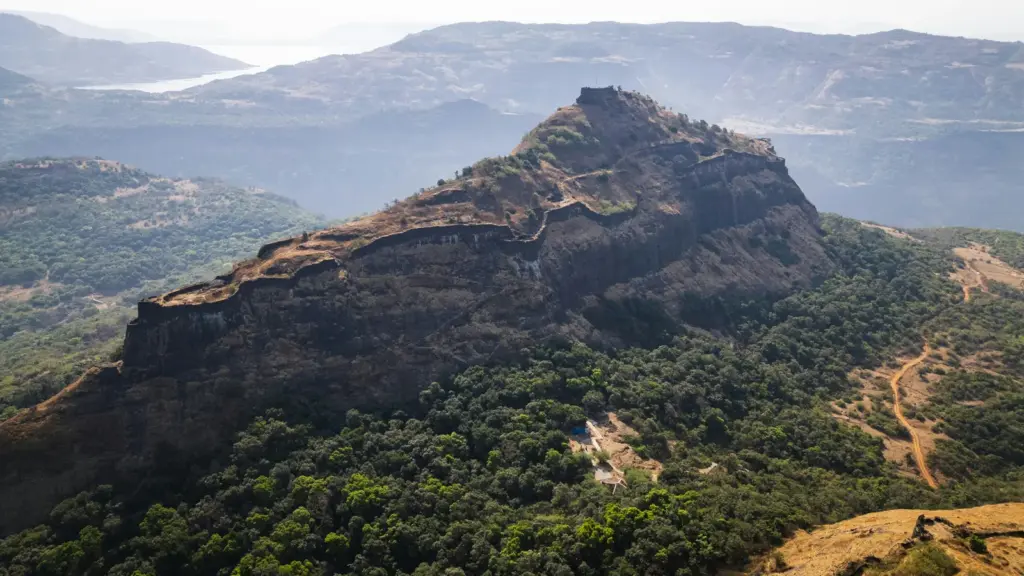
Almost everyone who studies medieval India knows the one-line verdict on Muhammad bin Tughlaq: he moved his capital from Delhi to Daulatabad and it failed. Far fewer can say what Daulatabad actually was, why a sultan in Delhi would want it, or why the fort itself is one of the most brilliantly defended hill forts ever built in India. That gap is a problem, because the “failed capital” is only half the story. Daulatabad was a formidable Yadava stronghold called Devagiri long before Tughlaq touched it, and its defences, a water moat, a smooth-cut cliff, and a pitch-dark spiral tunnel, are a masterclass in military engineering. Learn the fort as a place, not just as a punchline, and the whole episode of the capital transfer finally makes sense.
Where Daulatabad is and what makes the hill special
The short answer: Daulatabad Fort sits about 16 kilometres northwest of Aurangabad, now renamed Chhatrapati Sambhajinagar, in Maharashtra, on a conical granite hill roughly 200 metres high that rises abruptly out of the surrounding plain. That isolated cone is the whole secret of the fort. Most hill forts sit on a ridge that attackers can approach along a slope; Devagiri sits on a near-freestanding pillar of rock, so a defender only has to seal one way up.
The builders then made that natural advantage almost total. The lower flanks of the hill were deliberately scarped, meaning the rock was cut away to leave a smooth, near-vertical face about 50 metres high all around the upper citadel. You cannot climb a polished vertical cliff, and you cannot easily tunnel or ramp it under fire. So before you reach any wall or gate, the mountain itself has already been turned into an unclimbable barrier. This is the first thing to understand about Daulatabad: much of its strength is subtraction, rock removed rather than walls added.
The fort commands the northern edge of the Deccan plateau, the gateway between the Gangetic north and the peninsular south. Whoever held Devagiri controlled the roads into the Deccan, which is precisely why every major power of the medieval period wanted it.
Devagiri: the Yadava capital before the Sultans came
Long before it was Daulatabad, the fort was Devagiri, “the hill of the gods,” and it was the capital of the Yadava (Seuna) dynasty of the Deccan. The stronghold was established around 1187 CE by the Yadava ruler Bhillama V, who made it the seat of a kingdom that would dominate the western Deccan for over a century. Under the Yadavas, Devagiri became a wealthy and cultured centre, and the hill still carries remains of Hindu and Jain temples from that era.
This pre-Islamic phase matters for two reasons. First, it corrects the lazy assumption that the fort was a Sultanate creation; the core stronghold and its cut-cliff defences are Yadava work, later extended by every dynasty that followed. Second, it explains why Delhi came knocking. A rich, well-defended Hindu kingdom sitting on the doorway to the south was an irresistible target once the Delhi Sultanate turned its attention to the peninsula.
The Yadava court was more than a garrison on a rock. Under kings like Ramachandra, Devagiri patronised a flowering of Marathi and Sanskrit learning: the minister and polymath Hemadri (Hemadpant) compiled his vast ritual encyclopaedia here and lent his name to the distinctive “Hemadpanti” style of Deccan temple building, and the saint-poet Jnaneshwar, whose *Jnaneshwari* is a cornerstone of Marathi literature, belongs to this same late-Yadava world. Devagiri, in other words, was a cultural capital before it was a contested fort, and that prosperity is part of why Delhi coveted it.
The Yadava end came in stages. In 1296 CE, Alauddin Khalji, then still a young commander and not yet sultan, led a daring raid deep into the Deccan and forced the Yadava king Ramachandra to pay a huge tribute. That single strike, part of the story of the Khilji dynasty, announced that the Deccan was now within Delhi’s reach. A second campaign in 1308 reduced the Yadavas to vassals, and by around 1317 the dynasty was extinguished, its last ruler put to death by the Sultanate. Devagiri passed fully into Delhi’s hands, and the stage was set for its most famous chapter.
Muhammad bin Tughlaq and the capital transfer of 1327
Here is the episode every aspirant has heard of and few can explain properly. In 1327 CE, the sultan Muhammad bin Tughlaq renamed Devagiri as Daulatabad, “the abode of prosperity,” and shifted his capital there from Delhi, a distance of well over 1,100 kilometres. The move was not the whim of a madman, whatever the popular verdict says, and getting the reasoning right is the whole point of studying it.
The logic was genuinely strategic. Delhi sat in the far north, dangerously exposed to Mongol raids from the northwest, while the Sultanate’s ambitions were increasingly in the south, where its new Deccan conquests needed close administration. Daulatabad sat almost at the geographical centre of the enlarged empire, safe from Mongols and well placed to control the peninsula. On paper, a central, defensible capital was a sound idea, and this is the part a good answer must concede before it criticises.
The execution is where it collapsed. The sultan did not merely move his court; the chronicles, notably the contemporary historian Ziauddin Barani and the traveller Ibn Battuta, record that he ordered a large part of Delhi’s population, the officials, nobles, scholars, and craftsmen who made a city a capital, to migrate south with him. The march across the length of the country, in heat and over poor roads, was brutal, and many are said to have died on the way. Delhi, meanwhile, was drained of its people and its life. Within a few years the flaws were undeniable: Daulatabad was too far from the northern frontier to defend it, the north grew restless, and water and supply problems dogged the new capital. By about 1334 CE, Muhammad bin Tughlaq reversed the whole scheme and ordered the return to Delhi, inflicting a second exhausting migration on a population that had barely settled.
The result was the worst of both worlds. Delhi was weakened, Daulatabad never truly took, and the sultan’s reputation never recovered. This is why the transfer is the textbook example of the Tughlaq dynasty’s pattern of visionary schemes ruined by ruthless, impractical execution, the same pattern that marks his token currency experiment. The failure was not in the idea of a central capital but in forcing an unwilling city to move twice.
There is a deeper irony worth carrying into an answer. The transfer was meant to bind the Deccan more tightly to Delhi, yet its long-term effect was the opposite. By pouring northern administrators, soldiers, and Sufi scholars into Daulatabad and then abandoning them there when the court withdrew, Tughlaq seeded the Deccan with an Indo-Muslim elite that had no reason to stay loyal once central authority weakened. Within a generation those very settlers helped found the independent Bahmani Sultanate in 1347, the first breakaway Muslim kingdom of the south. In trying to control the Deccan, Muhammad bin Tughlaq accidentally created the class of people who would prise it loose from Delhi forever. The lasting mark of the failed capital, then, was not administrative but demographic: it changed who lived in the Deccan.
The defences: how the fort was made unconquerable
Now to the part that makes Daulatabad worth a visit rather than a footnote. Successive rulers turned the hill into one of the most ingeniously layered fortresses in India, and the design is best understood as a sequence of traps an attacker had to survive in order, any one of which could stop an army cold.
Start at the outside. The fort was ringed by concentric fortification walls, not one but a series of encircling ramparts, so breaching the outer wall only delivered you into a killing ground between it and the next. Set into and before these walls was a deep moat, in places a rock-cut ditch that could be filled with water, guarding the approach to the inner citadel. Local tradition holds that the moat was stocked with crocodiles, and while that detail is folklore, the moat itself is very real and was crossed by a retractable or removable bridge that defenders could pull away.
Then comes the feature that gives Daulatabad its fearsome reputation: the andheri, a dark, tortuous tunnel cut through the solid rock that formed the only route up to the upper citadel. This passage was designed as a death trap. It twisted and turned in pitch blackness so that attackers lost their bearings, it was narrow enough to force them into single file, and it had an iron cover or grating at the top that defenders could heat, and openings through which they could pour hot coals or choking smoke down onto anyone inside. A handful of defenders in the andheri could hold off a whole army fumbling upward in the dark. If you remember only one thing about the fort’s engineering, remember this tunnel, because it is the single most examinable and most vivid of its defences.
The gateways add the final layer. The main entrances were fitted with massive wooden doors studded with sharp iron spikes, set at the height of an elephant’s forehead, to defeat the standard medieval battering tactic of driving war elephants into the gate. The gates were also arranged in bent, staggered passages rather than straight lines, so an elephant or a charging column could not build up momentum before hitting the next obstacle at an angle. Add heavy cannon mounted on the ramparts in the later period, and you have a fort that had to be taken by trickery, treachery, or starvation, almost never by direct assault.
| Defensive feature | How it worked |
|---|---|
| Scarped cliff | Lower hill cut to a smooth vertical rock face ~50 m high, impossible to climb |
| Concentric walls | Several encircling ramparts; breaching one only trapped attackers in a killing ground |
| Water moat | Deep ditch around the citadel, crossed by a removable bridge |
| Andheri (spiral tunnel) | Dark, winding rock-cut passage; smoke, hot coals and a heatable iron cover made it a death trap |
| Spiked, bent gateways | Iron elephant-spikes and staggered entrances to defeat elephant charges |
The proof of the design is in how the fort actually changed hands, which was almost never by storming the walls. Daulatabad fell to blockade, bribery, and thirst instead. When the Mughals besieged it in 1633, they did not batter their way up the andheri; they surrounded the hill, cut off supplies, and starved the defenders of the Nizam Shahi garrison into surrender. That is the real testimony to the engineering. A fort that has to be reduced by patient siege rather than direct assault has done its job, and Daulatabad forced every serious attacker onto that slow, expensive path. When you argue in an answer that the fort was “impregnable,” this is the evidence to cite: not that it never fell, but that it never fell to a frontal attack.
The architecture inside: Chand Minar and the palaces
Daulatabad is not only military stone; it holds some of the finest Indo-Islamic architecture of the Deccan, added by the sultanates that held the fort after the Tughlaqs. The signature monument is the Chand Minar, a soaring victory tower about 63 metres high, raised in 1445 CE by the Bahmani sultan Alauddin Ahmad Shah to celebrate a Bahmani triumph. Slender, tiered, and once faced in glowing Persian-blue tiles, it is often compared to the Qutb Minar of Delhi and ranks among the great towers of southern India. A small mosque sits at its base.
Nearby stand the Chini Mahal, the “China Palace” named for the porcelain-like glazed tiles that once decorated it, later used as a state prison, and the Rang Mahal, along with a colossal iron cannon, the Mendha Toph (the “ram-headed cannon”), mounted to command the approaches. These structures date the fort’s Islamic phase and belong to the story of the Bahmani kingdom, the Deccan’s first independent Muslim sultanate, which held Daulatabad after the Tughlaqs lost their grip on the south. The Chand Minar’s very reason for existing, a Bahmani victory over the Vijayanagara Empire, captures the fort’s role as a prize fought over by the peninsula’s great powers.
Who held Daulatabad after Tughlaq
The chain of ownership after 1334 is a compact tour of Deccan history, and it is worth knowing because the fort keeps reappearing in different chapters. When the Delhi Sultanate’s hold on the south crumbled, the fort passed to the Bahmani Sultanate in the mid-fourteenth century, then to the Ahmadnagar (Nizam Shahi) Sultanate when the Bahmani state splintered into the five Deccan sultanates. Its most dramatic later custodian was Malik Ambar, the remarkable Ethiopian-origin regent of Ahmadnagar, who used Daulatabad as a base for his long guerrilla resistance against Mughal expansion.
The Mughals finally took the fort in 1633, under the emperor Shah Jahan, folding it into the empire that would later be governed from the Deccan by Aurangzeb, who spent his last decades campaigning in this very region. In the eighteenth century, as Mughal authority faded, Daulatabad passed to the Nizam of Hyderabad and was contested by the rising Maratha Empire. By the time its military days ended, the fort had served, in turn, the Yadavas, the Delhi Sultanate, the Bahmanis, the Nizam Shahis, the Mughals, and the Marathas, which is a fair summary of the whole medieval history of the Deccan told through one hill.
How to study Daulatabad Fort for exams
Do not learn Daulatabad as a single fact (“Tughlaq’s failed capital”), because that flattens a rich topic into one dismissive line. Learn it as three layers stacked on one hill, and you can answer almost anything.
First, the place and its Yadava origin. It is Devagiri, capital of the Yadava dynasty, founded around 1187 by Bhillama V, on a 200-metre conical hill near Aurangabad in Maharashtra. The Khalji raid of 1296 and the fall of the Yadavas by 1317 bring it into Delhi’s orbit.
Second, the capital transfer, told fairly. Muhammad bin Tughlaq renamed it Daulatabad and shifted the capital in 1327 for sound strategic reasons, safety from Mongols and central control of an enlarged empire, but ruined it by forcing Delhi’s population to migrate over 1,100 kilometres and then reversing the whole thing by about 1334. The lesson is execution, not vision: concede the logic before you condemn the method, and your answer immediately reads as analysis rather than repetition.
Third, the defences, which are the highest-value and most-forgotten content. Fix the sequence: scarped cliff, concentric walls, water moat, the pitch-dark andheri tunnel with its smoke and heat traps, and the spiked, bent gateways against elephants. Add the Chand Minar of 1445 as the architectural set-piece. If you can describe why an attacker would fail at each stage, you understand the fort better than a memorised list ever allows.
The topic is smaller than it looks once you see the hill as three stories in one: a Yadava capital, a Sultan’s blunder, and an engineering marvel. Devagiri, Daulatabad, and the andheri: hold those three and the fort is yours.
Frequently Asked Questions
What is Daulatabad Fort and where is it located?
Daulatabad Fort is a hill fortress about 16 kilometres northwest of Aurangabad (Chhatrapati Sambhajinagar) in Maharashtra, built on a conical granite hill roughly 200 metres high. It was originally the Yadava capital Devagiri and later became famous as Muhammad bin Tughlaq’s short-lived capital.
Why did Muhammad bin Tughlaq shift his capital to Daulatabad?
He moved the capital in 1327 for strategic reasons: Daulatabad lay near the centre of his enlarged empire, was safer from Mongol raids than Delhi, and was better placed to control the newly conquered Deccan. The idea was sound, but the forced migration of Delhi’s population and poor execution made it fail.
Why did the Daulatabad capital experiment fail?
The plan collapsed because the sultan compelled a large part of Delhi’s people to march over 1,100 kilometres south, causing great hardship and many deaths, while the far-south capital proved too distant to defend the northern frontier. By about 1334 he reversed the decision and moved the capital back to Delhi, weakening both cities.
What was the original name of Daulatabad Fort?
Its original name was Devagiri, meaning “hill of the gods.” It was the capital of the Yadava (Seuna) dynasty, established around 1187 CE by Bhillama V, long before Muhammad bin Tughlaq renamed it Daulatabad in 1327.
What are the famous defensive features of Daulatabad Fort?
The fort is defended by a smooth, near-vertical scarped cliff, concentric fortification walls, a water moat, spiked and bent gateways to stop elephant charges, and above all the andheri, a dark, winding rock-cut tunnel that acted as a death trap where defenders could use smoke and heat against attackers.
What is the Chand Minar at Daulatabad?
The Chand Minar is a victory tower about 63 metres tall, built in 1445 CE by the Bahmani sultan Alauddin Ahmad Shah, once decorated with Persian-blue tiles. It is one of the finest examples of Indo-Islamic architecture in the Deccan and is often compared to the Qutb Minar.
Which dynasties ruled Daulatabad Fort over time?
In sequence, the fort was held by the Yadavas of Devagiri, the Delhi Sultanate (Khaljis and Tughlaqs), the Bahmani Sultanate, the Ahmadnagar (Nizam Shahi) Sultanate under regents like Malik Ambar, the Mughals from 1633, and later the Nizam of Hyderabad and the Marathas.
Practice Questions
1. Daulatabad Fort was originally known by which name, and it was the capital of which dynasty?
a) Devagiri; the Yadava dynasty
b) Devagiri; the Kakatiya dynasty
c) Deogarh; the Chalukya dynasty
d) Devakota; the Hoysala dynasty
Answer: a) Devagiri; the Yadava dynasty
2. In which year did Muhammad bin Tughlaq transfer his capital from Delhi to Daulatabad?
a) 1296
b) 1317
c) 1327
d) 1347
Answer: c) 1327
3. Which ruler first raided Devagiri in 1296 and forced the Yadava king Ramachandra to pay tribute?
a) Muhammad bin Tughlaq
b) Alauddin Khalji
c) Balban
d) Firoz Shah Tughlaq
Answer: b) Alauddin Khalji
4. The andheri at Daulatabad Fort was:
a) A royal audience hall
b) A large stepwell for the garrison
c) A dark, winding rock-cut tunnel designed as a defensive death trap
d) A granary for storing grain during sieges
Answer: c) A dark, winding rock-cut tunnel designed as a defensive death trap
5. The Chand Minar at Daulatabad was built in 1445 CE by a ruler of which kingdom?
a) The Mughal Empire
b) The Bahmani Sultanate
c) The Vijayanagara Empire
d) The Maratha Empire
Answer: b) The Bahmani Sultanate
Mains-style questions
- “Muhammad bin Tughlaq’s transfer of the capital to Daulatabad failed not because the idea was flawed but because the execution was ruthless and impractical.” Critically examine.
- Discuss the defensive design of Daulatabad Fort and explain how its combination of natural and engineered features made it one of the most formidable strongholds in medieval India.
- Trace the history of Devagiri-Daulatabad from the Yadava dynasty to the Marathas, and explain what its changing ownership reveals about the political history of the Deccan.
- “Whoever controlled Devagiri controlled the gateway to the Deccan.” Analyse the strategic importance of the fort in the expansion of the Delhi Sultanate into southern India.
- Assess Daulatabad as a site of Indo-Islamic architecture, with particular reference to the Chand Minar and the monuments added under the Deccan sultanates.
Daulatabad deserves far more than its reputation as the setting for a sultan’s blunder. It is a Yadava capital older than the Sultanate itself, a fortress whose scarped cliff and pitch-dark andheri tunnel still humble modern visitors, and a prize that passed through six great powers of the Deccan. Learn the hill as three stories in one, keep the capital transfer’s logic and its failure clearly separated, and one of medieval India’s richest sites turns from a punchline into one of your most reliable answers.
Tell Google you want more of this.
Add Anantam IAS as a preferred sourceOne tap, and this site shows up more often in your own Top Stories, AI Overviews and AI Mode. Remove it any time.