Geothermal and wind are two renewable sources that tap into Earth's natural systems: heat from its interior and kinetic energy from moving air masses. India has identified geothermal hotspots in Ladakh, Himachal Pradesh, Jharkhand and Chhattisgarh, and is the world's fourth-largest wind energy market with about 47 GW of installed capacity. The offshore wind frontier and geothermal pilot projects in Puga and Chumathang are active frontiers. For UPSC aspirants, geothermal and wind energy are part of the broader GS Paper III discussion on clean energy transition and the 500 GW non-fossil target.
Geothermal energy
What is geothermal energy
Geothermal energy is heat stored inside the Earth's crust. Temperatures increase by about 25 to 30 C per kilometre of depth on average; in volcanic or tectonic zones, the gradient is steeper. Water or steam carries this heat to the surface, either naturally (through hot springs and geysers) or through drilled wells. The extracted heat drives turbines or provides direct heating.
Types of geothermal systems
- Dry steam plants: Use natural steam directly from underground reservoirs (Larderello in Italy, The Geysers in California).
- Flash steam plants: Convert high-pressure hot water into steam as it rises.
- Binary cycle plants: Transfer heat from geothermal water to a separate working fluid with a lower boiling point, useful for lower-temperature resources.
- Ground-source heat pumps: Use near-surface temperatures for building heating and cooling.
Advantages
- Renewable and sustainable.
- Not dependent on weather conditions, unlike solar and wind.
- Stable base-load energy supply.
- Low unit price for energy once plant is built.
- Large future expansion prospects, particularly in volcanic and tectonically active regions.
- Creation of local jobs in operations and maintenance.
- Energy independence from imports.
- Not affected by fossil fuel price fluctuations.
Challenges
- High upfront costs for drilling and construction.
- Connection costs to the local electricity grid may be high in remote areas.
- Cannot be installed where the geothermal gradient is low.
- Some sites have produced hydrogen sulphide emissions and minor induced seismicity.
Geothermal in India
India has six geothermal provinces: Himalayan, Sohana, Cambay, Son-Narmada-Tapi lineament, West Coast, and Godavari. Major geothermal fields identified:
- Puga Valley (Ladakh): Surface temperatures up to 135 C.
- Chumathang (Ladakh): Geothermal hot springs.
- Tapoban (Uttarakhand): Hot springs.
- Manikaran (Himachal Pradesh): Popular hot spring but lower potential.
- Tattapani (Chhattisgarh): Medium-enthalpy field.
ONGC Energy Centre Trust, IIT Bombay and NGRI Hyderabad have been exploring geothermal potential. A pilot 1 MW geothermal plant was announced for Puga and was under development in 2024-25.
Wind energy
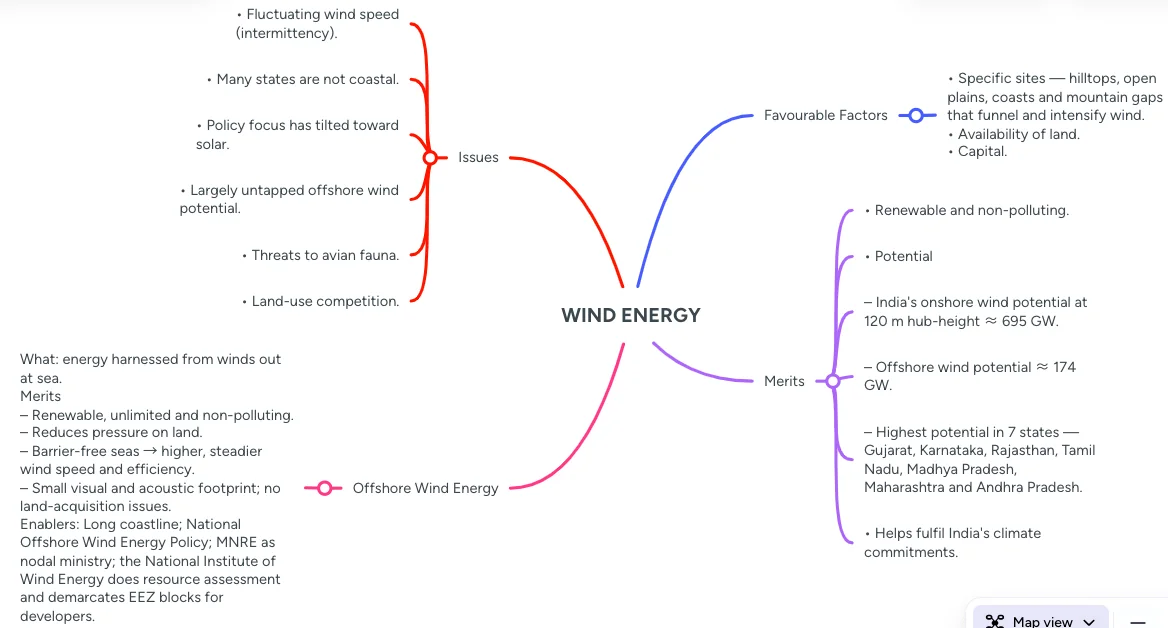
Wind power potential
- Globally, viable wind power potential is about 72 TW, four times more than current world total energy demand.
- India's wind power potential at 120 metres hub height is estimated at 695 GW by the National Institute of Wind Energy (NIWE).
- At 150 metres, potential rises even higher, though commercial feasibility depends on turbine design.
India's wind energy status
- Installed wind power: About 47 GW (early 2025), fourth-largest in the world behind China, USA and Germany.
- Wind share of renewables: Roughly 25 percent of total renewable installed capacity.
- Leading states: Tamil Nadu, Gujarat, Karnataka, Maharashtra, Rajasthan, Andhra Pradesh.
- Policy framework: Ministry of New and Renewable Energy (MNRE), National Offshore Wind Energy Policy 2015, Wind-Solar Hybrid Policy 2018, repowering policy 2023.
Strengths of wind energy
- Significant share of India's renewable energy capacity.
- Mature industry: India manufactures all wind turbines domestically, with over 80 percent of components made indigenously.
- Water-smart electricity: Wind is the least water-consuming source of electricity. Water requirement is negligible after commissioning.
- Technological advancement: Larger rotor diameters and higher hub heights (120 to 150 metres) significantly increase capacity utilisation factors.
Shortcomings
- Land-focused policy: India's wind capacity is entirely land-based. Offshore wind remains unexploited.
- Suboptimal harnessing of best sites: Earliest wind projects occupied the windiest sites with smaller turbines. Modern, larger turbines could deliver far more at these locations.
- Repowering delays: Most existing wind farms are 10-20 years old and need replacement with modern turbines (repowering), but regulatory and PPA issues have slowed progress.
Advantages
- New and renewable resource.
- No greenhouse gas emissions during operation.
- Among the cheapest renewable resources today.
- Minimal water consumption.
Disadvantages
- Fluctuating wind speeds alter production projections.
- Threats to avian fauna, especially migratory birds; siting is critical.
- Noise pollution near communities.
- Land use competition (agriculture, housing).
- Often built in remote locations with transmission challenges.
Way forward for wind
- Deploy wind turbines with higher hub heights (150 m) and larger capacity.
- Harness offshore wind potential, particularly off Tamil Nadu and Gujarat coasts.
- Support domestic manufacturing of state-of-the-art turbines and components.
- Repower older wind sites with modern turbines.
- Integrate wind with storage and complementary solar for firm renewable energy.
Offshore wind frontier
India launched the National Offshore Wind Energy Policy in 2015. Two offshore zones have been identified: Gulf of Khambhat (Gujarat) and off Tamil Nadu (Thoothukudi-Kanyakumari coast). The first offshore wind auction (1 GW) was launched in 2024. The Ministry of Power notified offshore wind Viability Gap Funding (VGF) in 2024 to kick-start the sector. Target: 37 GW of offshore wind by 2030.
Latest developments (2024-26)
- Offshore wind VGF scheme: Rs 7,453 crore approved in 2024 for 1 GW of offshore wind in Gujarat and Tamil Nadu.
- Repowering framework 2023: Simplified procedures for replacing older turbines with modern higher-capacity machines.
- Wind-solar hybrid auctions crossed 5 GW by 2024.
- Puga geothermal pilot: 1 MW demonstration project under development by ONGC Energy Centre.
- Geothermal heating: Pilot in Ladakh and Uttarakhand for district heating using geothermal resources.
- COP29 Baku (2024): India's updated NDCs emphasised offshore wind and geothermal as long-term renewable options.
- Green Energy Open Access Rules 2022: Allowed wind producers to sell directly to bulk consumers.
- Critical Minerals Mission (2024): Rare earths for wind turbine magnets identified as priority.
UPSC Relevance
Prelims focus
- Wind power potential at 120 m: 695 GW; India's installed wind capacity about 47 GW.
- Offshore Wind Energy Policy 2015, VGF 2024.
- Wind-Solar Hybrid Policy 2018.
- Geothermal provinces: Himalayan, Sohana, Cambay, SONATA, West Coast, Godavari.
- Puga Valley and Tattapani geothermal fields.
- ONGC Energy Centre Trust, NIWE, NGRI Hyderabad.
Mains focus (GS III)
Typical question framings evaluate the role of wind and geothermal in India's renewable transition, the offshore wind frontier, the potential of Himalayan geothermal, and the trade-offs of large-scale wind deployment. Strong answers cite installed capacity, policy framework, COP29 commitments and international comparisons.
Linkages
Geothermal and wind connect to SDG 7, SDG 13, India's updated NDCs after COP29, the International Solar Alliance, the Green Hydrogen Mission, the Critical Minerals Mission, the Energy Conservation Amendment Act 2022, and the Paris Agreement.
Tell Google you want more of this.
Add Anantam IAS as a preferred sourceOne tap, and this site shows up more often in your own Top Stories, AI Overviews and AI Mode. Remove it any time.