Disclosure: this guide contains Amazon affiliate links. As an Amazon Associate, Anantam IAS earns from qualifying purchases — at no extra cost to you.
GK Questions for UPSC: Practice MCQs with Answers
The fastest way to test your UPSC preparation is through MCQs. Not random trivia — targeted questions that test the exact knowledge pattern UPSC uses.
These questions are organized subject-wise with explanations. The explanation is as important as the answer. Don’t just mark right or wrong; understand why.
Disaster Management: UPSC Complete Notes for GS III
How to Use These Questions
UPSC Prelims has two papers: GS Paper I (100 questions, 200 marks) and CSAT (80 questions, 200 marks — qualifying at 33%). These questions are for GS Paper I.
Difficulty marking:
- ⭐ Basic (direct fact)
- ⭐⭐ Moderate (application + fact)
- ⭐⭐⭐ Advanced (tricky, UPSC-style)
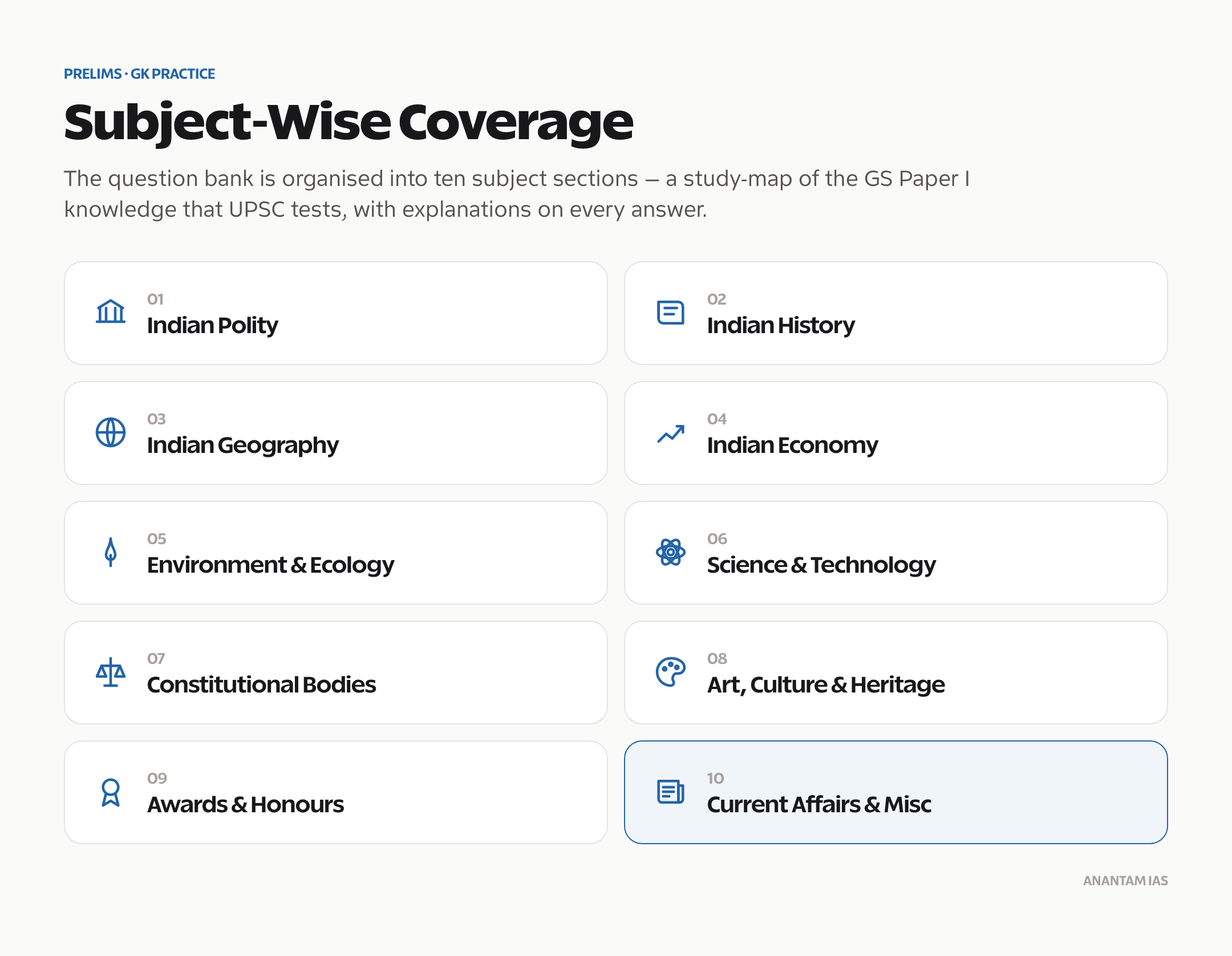
Section 1: Indian Polity MCQs
Q1. ⭐ Which Article of the Indian Constitution deals with the Right to Equality?
(a) Article 12 (b) Article 14 (c) Article 19 (d) Article 21
Answer: (b) Article 14
Explanation: Article 14 states “The State shall not deny to any person equality before the law or the equal protection of the laws within the territory of India.” Articles 14–18 cover the Right to Equality as a Fundamental Right. Article 12 defines “State.” Article 19 covers freedoms. Article 21 is Right to Life.
Q2. ⭐⭐ The ‘basic structure doctrine’ of the Indian Constitution was established in which case?
(a) Golaknath v. State of Punjab (1967) (b) Kesavananda Bharati v. State of Kerala (1973) (c) Minerva Mills v. Union of India (1980) (d) Indra Sawhney v. Union of India (1992)
Answer: (b) Kesavananda Bharati v. State of Kerala (1973)
Explanation: In Kesavananda Bharati (1973), a 13-judge bench held by a 7-6 majority that Parliament can amend any part of the Constitution but cannot destroy its “basic structure.” The basic structure includes supremacy of the Constitution, republic and democratic forms, secular character, separation of powers, federal character, and judicial review.
Q3. ⭐ The President of India is elected by:
(a) Direct election by citizens (b) Members of both Houses of Parliament only (c) Elected members of both Houses of Parliament + elected members of all State Legislative Assemblies and UTs with legislatures (d) Members of the Rajya Sabha only
Answer: (c) Elected members of both Houses of Parliament + elected members of all State Legislative Assemblies and UTs with legislatures
Explanation: Article 54 of the Constitution provides for the Presidential election by an electoral college consisting of elected members of both Houses of Parliament and elected members of the Legislative Assemblies of states and UTs with legislatures (Delhi, J&K, Puducherry). Nominated members don’t vote. Rajya Sabha members vote but alone they’re insufficient.
Q4. ⭐⭐ Which of the following is NOT a feature of the Indian Federal system?
(a) Dual polity (b) Written Constitution (c) Single citizenship (d) Dual judiciary
Answer: (d) Dual judiciary
Explanation: India has a unified single integrated judiciary — Supreme Court at the apex with High Courts and subordinate courts below. The US has a dual judiciary (federal courts + state courts). India has: dual polity (Union + states), written Constitution, single citizenship (unlike US dual citizenship), and single election commission. These are features of Indian federalism with unitary features.
Q5. ⭐⭐⭐ Consider the following statements about Directive Principles of State Policy:
- They are justiciable — courts can enforce them
- They are contained in Part IV of the Constitution
- They aim to establish a welfare state
- Article 44 directs the state to secure a Uniform Civil Code
Which statements are correct?
(a) 1 and 3 only (b) 2, 3, and 4 only (c) 1, 2, 3, and 4 (d) 3 and 4 only
Answer: (b) 2, 3, and 4 only
Explanation: Statement 1 is wrong — DPSPs are NON-justiciable, meaning courts cannot enforce them (Article 37). Statement 2 is correct — Part IV (Articles 36–51). Statement 3 is correct — DPSPs guide state policy towards welfare objectives. Statement 4 is correct — Article 44 directs a Uniform Civil Code.
Q6. ⭐ The Speaker of the Lok Sabha is elected by:
(a) Members of Lok Sabha only (b) Members of both Houses of Parliament (c) President of India (d) Prime Minister
Answer: (a) Members of Lok Sabha only
Explanation: The Speaker of the Lok Sabha is elected by a simple majority of the members of the Lok Sabha. The convention is that the Speaker is from the ruling party/coalition and the Deputy Speaker from the opposition, though this isn’t constitutionally mandated. The Speaker chairs Lok Sabha sessions and has the casting vote in ties.
Q7. ⭐⭐ Which Schedule of the Constitution deals with the allocation of seats in the Rajya Sabha?
(a) Second Schedule (b) Third Schedule (c) Fourth Schedule (d) Fifth Schedule
Answer: (c) Fourth Schedule
Explanation: The Fourth Schedule allocates seats to states and UTs in the Rajya Sabha (Council of States). Uttar Pradesh has the most seats (31). The Second Schedule deals with salaries of President, MPs, judges etc. Third Schedule has forms of oaths. Fifth Schedule deals with tribal areas.
Q8. ⭐ Article 370 of the Indian Constitution was related to:
(a) Scheduled Tribes’ protection (b) Special status of Jammu & Kashmir (c) Emergency provisions (d) Protection of minorities
Answer: (b) Special status of Jammu & Kashmir
Explanation: Article 370 granted special autonomous status to J&K, limiting Parliament’s power to legislate for J&K except in specified matters. In August 2019, the government effectively abrogated Article 370 through a Presidential Order, converting J&K into two Union Territories.
Section 2: Indian History MCQs
Q9. ⭐ Who was the founder of the Maurya Empire?
(a) Bindusara (b) Ashoka (c) Chandragupta Maurya (d) Bimbisara
Answer: (c) Chandragupta Maurya
Explanation: Chandragupta Maurya founded the Maurya Empire around 322 BCE with the help of Chanakya (Kautilya). He defeated the Nanda dynasty and later pushed back Seleucus Nicator (Alexander’s general). Bindusara was his son; Ashoka was his grandson.
Q10. ⭐⭐ The Partition of Bengal in 1905 was carried out under which Viceroy?
(a) Lord Curzon (b) Lord Minto (c) Lord Dufferin (d) Lord Hardinge
Answer: (a) Lord Curzon
Explanation: Lord Curzon partitioned Bengal in 1905 on the ostensible grounds of administrative efficiency but actually to divide the nationalist movement along Hindu-Muslim lines. It created East Bengal (Muslim majority) and West Bengal. The partition sparked the Swadeshi Movement. It was annulled in 1911 under Lord Hardinge.
Q11. ⭐⭐ The Quit India Movement was launched in:
(a) 1940 (b) 1942 (c) 1944 (d) 1946
Answer: (b) 1942
Explanation: The Quit India Movement (August Kranti) was launched on August 8, 1942, by Mahatma Gandhi at the All India Congress Committee session in Bombay. The slogan “Do or Die” was given. Gandhi gave the movement the directive “Do or Die.” The British immediately arrested Gandhi and all Congress leaders.
Q12. ⭐ Dandi March (Salt Satyagraha) was undertaken in:
(a) 1928 (b) 1930 (c) 1932 (d) 1934
Answer: (b) 1930
Explanation: Gandhi started the Dandi March on March 12, 1930, from Sabarmati Ashram, Ahmedabad. He reached Dandi (Navsari, Gujarat) on April 6, 1930, to break the salt law. The march was 241 miles (388 km) and took 24 days. It launched Civil Disobedience Movement II.
Q13. ⭐⭐⭐ Which of the following is correctly matched — Governor-General and their significant action?
(a) Lord Cornwallis — Permanent Settlement (b) Lord Wellesley — Doctrine of Lapse (c) Lord Dalhousie — Subsidiary Alliance (d) Lord Canning — Partition of Bengal
Answer: (a) Lord Cornwallis — Permanent Settlement
Explanation: Lord Cornwallis introduced the Permanent Settlement in 1793 (Bengal, Bihar, Odisha), fixing land revenue permanently. Lord Wellesley introduced Subsidiary Alliance. Lord Dalhousie introduced the Doctrine of Lapse (annexation of states without natural heirs). Lord Curzon (not Canning) partitioned Bengal in 1905.
Q14. ⭐ The Indian National Congress was founded in:
(a) 1883 (b) 1885 (c) 1887 (d) 1890
Answer: (b) 1885
Explanation: The Indian National Congress was founded on December 28, 1885, in Bombay (Mumbai) by A.O. Hume (a retired British ICS officer), Dadabhai Naoroji, and Dinshaw Wacha. The first session was presided over by W.C. Bonnerjee. Hume is regarded as the “father of the Congress.”
Section 3: Indian Geography MCQs
Q15. ⭐ The Tropic of Cancer passes through which of the following Indian states?
(a) Rajasthan, UP, Bihar, West Bengal (b) Gujarat, Rajasthan, MP, Chhattisgarh, Jharkhand, WB, Tripura, Mizoram (c) Gujarat, Maharashtra, AP, Tamil Nadu (d) Punjab, Haryana, UP, Bihar
Answer: (b) Gujarat, Rajasthan, MP, Chhattisgarh, Jharkhand, WB, Tripura, Mizoram
Explanation: The Tropic of Cancer (23.5°N) passes through 8 Indian states: Gujarat, Rajasthan, Madhya Pradesh, Chhattisgarh, Jharkhand, West Bengal, Tripura, and Mizoram. It does NOT pass through Punjab, Haryana, Maharashtra, or South Indian states.
Q16. ⭐⭐ Which river is known as the ‘Sorrow of Bihar’?
(a) Gandak (b) Kosi (c) Son (d) Ghaghra
Answer: (b) Kosi
Explanation: The Kosi River is called the “Sorrow of Bihar” because it frequently changes course and causes devastating floods in North Bihar. It’s a major tributary of the Ganga. Damodar River is called the “Sorrow of Bengal/West Bengal.” The Mahanadi is sometimes called the “Sorrow of Odisha.”
Q17. ⭐ The Brahmaputra River enters India from:
(a) China through Arunachal Pradesh (b) Nepal (c) Bhutan (d) Myanmar
Answer: (a) China through Arunachal Pradesh
Explanation: The Brahmaputra originates in the Manasarovar Lake region in Tibet (China) and flows east through Tibet as the Tsangpo. It makes a dramatic U-turn around the Namcha Barwa peak and enters India through Arunachal Pradesh, where it’s called the Dihang. It enters Assam as the Brahmaputra.
Q18. ⭐⭐ Which of the following is the correct sequence of rivers from north to south on the western coast of India?
(a) Narmada, Tapti, Mahi, Sabarmati (b) Sabarmati, Mahi, Narmada, Tapti (c) Mahi, Sabarmati, Narmada, Tapti (d) Tapti, Narmada, Mahi, Sabarmati
Answer: (b) Sabarmati, Mahi, Narmada, Tapti
Explanation: Moving from north to south along India’s west coast: Sabarmati (originates Aravalli), Mahi, Narmada (largest west-flowing river), Tapti/Tapi. All four are west-flowing rivers that drain into the Arabian Sea. Narmada flows through the rift valley between Vindhya and Satpura ranges.
Q19. ⭐⭐⭐ Consider these statements about Indian monsoon:
- The southwest monsoon enters India from two branches — Arabian Sea and Bay of Bengal
- The Bay of Bengal branch is the first to arrive over mainland India
- Western disturbances bring winter rainfall to North India
- The retreating monsoon (northeast monsoon) brings maximum rainfall to Tamil Nadu
Which statements are correct?
(a) 1 and 3 only (b) 1, 3, and 4 only (c) All four (d) 2, 3, and 4 only
Answer: (c) All four
Explanation: All four statements are correct. Southwest monsoon has two branches (Arabian Sea and Bay of Bengal). The Bay of Bengal branch actually arrives earlier — it reaches Andaman & Nicobar in late May and hits the northeast before the Arabian Sea branch reaches the northwest. Western disturbances are cyclonic systems from the Mediterranean that bring winter rainfall to Punjab, Haryana, and UP. The northeast monsoon (Oct-Dec) brings critical rainfall to Tamil Nadu and parts of Andhra Pradesh.
Q20. ⭐ India’s largest freshwater lake is:
(a) Dal Lake (b) Wular Lake (c) Chilika Lake (d) Vembanad Lake
Answer: (b) Wular Lake
Explanation: Wular Lake in J&K is India’s largest freshwater lake. Chilika Lake in Odisha is India’s largest coastal lagoon (saltwater/brackish) and the largest lagoon in Asia. Dal Lake is a famous lake in Srinagar. Vembanad (Kerala) is a backwater lake. For freshwater: Wular. For lagoon/coastal: Chilika.
Section 4: Indian Economy MCQs
Q21. ⭐ India’s GDP is measured at:
(a) Market prices only (b) Factor cost only (c) Both market prices and basic prices (d) Purchasing power parity only
Answer: (c) Both market prices and basic prices
Explanation: Since 2015, India shifted from measuring GDP at “factor cost” to “basic prices” as recommended by the UN System of National Accounts (SNA) 2008. GDP at market prices = GDP at basic prices + taxes on products – subsidies on products. The Central Statistics Office (now MoSPI) compiles National Income data.
Q22. ⭐⭐ The FRBM Act (Fiscal Responsibility and Budget Management Act) was enacted in:
(a) 2000 (b) 2003 (c) 2005 (d) 2007
Answer: (b) 2003
Explanation: The FRBM Act 2003 mandated fiscal discipline — the central government was required to eliminate revenue deficit and bring fiscal deficit to 3% of GDP by specific deadlines. It aimed to institutionalize fiscal prudence. The N.K. Singh Committee (2017) reviewed it and recommended a Debt-to-GDP target (60%) instead of just deficit targets.
Q23. ⭐ The Green Revolution in India was associated with:
(a) M.S. Swaminathan (b) Norman Borlaug (c) Both (d) C. Subramaniam
Answer: (c) Both
Explanation: Norman Borlaug (American scientist, Nobel Prize 1970) developed the high-yielding variety (HYV) dwarf wheat. M.S. Swaminathan (Indian geneticist, “Father of India’s Green Revolution”) introduced these varieties in India in the 1960s with the support of C. Subramaniam (Agriculture Minister). The Green Revolution transformed Punjab, Haryana, and western UP into India’s breadbasket.
Q24. ⭐⭐ India’s balance of payments deficit is financed by:
(a) Foreign Direct Investment (b) Foreign Portfolio Investment (c) External Commercial Borrowings (d) All of the above
Answer: (d) All of the above
Explanation: The Current Account deficit (trade deficit + invisibles) is financed by the Capital Account. Capital Account inflows include FDI (long-term, productive), FPI (short-term, volatile), External Commercial Borrowings (ECBs), NRI deposits, and official borrowings. India’s current account deficit widened after 2022 due to global commodity price rises.
Q25. ⭐⭐⭐ Which of the following is correctly matched regarding Indian banking?
(a) NABARD — National Bank for Agriculture and Rural Development — 1982 (b) SIDBI — Small Industries Development Bank of India — 1995 (c) EXIM Bank — Export-Import Bank of India — 1990 (d) NHB — National Housing Bank — 2000
Answer: (a) NABARD — National Bank for Agriculture and Rural Development — 1982
Explanation: NABARD was established in 1982 on the recommendations of the B. Sivaraman Committee. SIDBI was established in 1990 (not 1995). EXIM Bank was established in 1982 (same year as NABARD, not 1990). NHB was established in 1988 (not 2000).
Q26. ⭐ The Goods and Services Tax (GST) was implemented in India on:
(a) April 1, 2017 (b) July 1, 2017 (c) October 1, 2017 (d) January 1, 2018
Answer: (b) July 1, 2017
Explanation: GST was launched on midnight of June 30-July 1, 2017, in a special Parliament session. It replaced a cascade of indirect taxes (excise duty, service tax, VAT, CST, etc.). India adopted a four-rate structure: 5%, 12%, 18%, 28%. The GST Council, chaired by Union Finance Minister with state ministers, decides rates.
Section 5: Indian Environment & Ecology MCQs
Q27. ⭐ The Paris Agreement on Climate Change aims to limit global temperature rise to:
(a) 1°C above pre-industrial levels (b) 1.5–2°C above pre-industrial levels (c) 2.5°C above pre-industrial levels (d) 3°C above pre-industrial levels
Answer: (b) 1.5–2°C above pre-industrial levels
Explanation: The Paris Agreement (2015, COP21) aims to limit global average temperature increase to “well below 2°C above pre-industrial levels” and pursue efforts to limit it to 1.5°C. India ratified it in October 2016. Under its NDC (Nationally Determined Contribution), India committed to achieving 45% reduction in emission intensity of GDP by 2030 (updated).
Q28. ⭐⭐ India’s first Biosphere Reserve was:
(a) Sundarbans (b) Nilgiri (c) Gulf of Mannar (d) Nanda Devi
Answer: (b) Nilgiri
Explanation: Nilgiri Biosphere Reserve was declared India’s first biosphere reserve in 1986. It covers parts of Tamil Nadu, Karnataka, and Kerala and includes Mudumalai, Nagarhole, Bandipur, and Wayanad national parks/wildlife sanctuaries. It was also the first Indian biosphere reserve to be included in UNESCO’s World Network of Biosphere Reserves (2000).
Q29. ⭐ The Chipko Movement was related to:
(a) Save rivers (b) Protect forests (c) Anti-dam movement (d) Clean air campaign
Answer: (b) Protect forests
Explanation: The Chipko Movement began in 1973 in the Chamoli district of Uttarakhand (then UP). Women of Reni village, led by Gaura Devi, hugged (chipko = to cling) trees to prevent them from being felled. Sunderlal Bahuguna became the face of the movement nationally. It was a non-violent resistance to commercial logging of Himalayan forests.
Q30. ⭐⭐ The term ‘carbon credits’ is associated with:
(a) UNFCCC Paris Agreement (b) Kyoto Protocol’s market mechanisms (c) Montreal Protocol (d) Stockholm Convention
Answer: (b) Kyoto Protocol’s market mechanisms
Explanation: Carbon credits originated from the Kyoto Protocol’s (1997) market-based mechanisms: Clean Development Mechanism (CDM), Joint Implementation (JI), and International Emissions Trading (IET). Each credit equals 1 tonne of CO2 equivalent. Countries/companies can earn credits by reducing emissions or buy them to offset. Paris Agreement has its own Article 6 market mechanisms.
Q31. ⭐⭐⭐ Consider these statements about National Parks in India:
- No human activity is permitted inside a national park
- Buffer zones around national parks allow limited human activity
- Tribal communities inside national parks can be relocated only with their consent
- India has more than 100 national parks
Which are correct?
(a) 1 and 4 only (b) 3 and 4 only (c) 1, 3, and 4 only (d) All four
Answer: (d) All four
Explanation: Statement 1: In national parks, no human activity (hunting, grazing, collection of forest produce) is permitted — unlike wildlife sanctuaries. Statement 2: Buffer zones allow regulated human activity. Statement 3: Forest Rights Act 2006 and Supreme Court directions require consent for tribal relocation. Statement 4: India has 106 national parks (as of 2026). All four are correct.
Section 6: Science & Technology MCQs
Q32. ⭐ ISRO’s Chandrayaan-3 successfully landed on the Moon’s south pole on:
(a) July 14, 2023 (b) August 23, 2023 (c) September 5, 2023 (d) October 1, 2023
Answer: (b) August 23, 2023
Explanation: Chandrayaan-3’s Vikram lander successfully soft-landed on the Moon’s south polar region on August 23, 2023 (18:04 IST). India became the FIRST country to land near the lunar south pole and the FOURTH country to achieve a soft lunar landing (after USA, USSR/Russia, China). The mission included Vikram lander and Pragyan rover. August 23 is now celebrated as National Space Day.
Q33. ⭐ The Aditya-L1 mission was launched to study:
(a) Mars (b) The Sun (c) Jupiter (d) Moon
Answer: (b) The Sun
Explanation: ISRO’s Aditya-L1 was launched on September 2, 2023. It’s India’s first dedicated solar mission. “Aditya” means Sun in Sanskrit. “L1” refers to Lagrange Point 1 — a gravitationally stable point between Earth and Sun approximately 1.5 million km from Earth. The spacecraft carries 7 payloads to study solar corona, solar wind, and space weather.
Q34. ⭐⭐ UPI (Unified Payments Interface) is managed by:
(a) Reserve Bank of India (b) National Payments Corporation of India (NPCI) (c) Ministry of Finance (d) State Bank of India
Answer: (b) National Payments Corporation of India (NPCI)
Explanation: UPI is operated and governed by NPCI (National Payments Corporation of India), which was set up by RBI and Indian Banks’ Association. NPCI also manages IMPS, RuPay card network, NACH, and Aadhaar-enabled Payment System (AePS). India processes more digital payments through UPI than any other country.
Q35. ⭐⭐ India’s first indigenously developed COVID-19 vaccine was:
(a) Covaxin (b) Covishield (c) Sputnik V (d) ZyCoV-D
Answer: (a) Covaxin
Explanation: Covaxin was developed by Bharat Biotech in collaboration with ICMR (Indian Council of Medical Research) and National Institute of Virology — making it India’s first indigenously developed COVID-19 vaccine. Covishield was developed by Oxford-AstraZeneca and manufactured by Serum Institute of India (licensed manufacturing, not indigenous development). Covaxin used an inactivated whole-virus platform.
Section 7: Indian Polity — Constitutional Bodies
Q36. ⭐ The Finance Commission of India is constituted under:
(a) Article 280 (b) Article 148 (c) Article 324 (d) Article 263
Answer: (a) Article 280
Explanation: Article 280 provides for the Finance Commission. It’s constituted by the President every 5 years. The 15th Finance Commission (NK Singh) covered 2021-26. The Finance Commission recommends the distribution of taxes between Centre and states and grants-in-aid to states. Article 148 is CAG, Article 324 is Election Commission, Article 263 is Inter-State Council.
Q37. ⭐⭐ The Election Commission of India was established on:
(a) January 25, 1950 (b) January 26, 1950 (c) August 15, 1950 (d) November 26, 1949
Answer: (a) January 25, 1950
Explanation: The Election Commission of India was established on January 25, 1950 — one day before the Constitution came into force. That’s why January 25 is celebrated as National Voters’ Day. The Constitution came into force on January 26, 1950 (Republic Day). Article 324 provides for the Election Commission.
Q38. ⭐⭐ CAG of India submits its report to:
(a) Prime Minister (b) Parliament directly (c) President, who then places it before Parliament (d) Ministry of Finance
Answer: (c) President, who then places it before Parliament
Explanation: The CAG (Comptroller and Auditor General) submits audit reports to the President (for central government accounts) and to Governors for state accounts. The President/Governor then causes the reports to be laid before Parliament/State Legislature. The CAG doesn’t present directly to Parliament. The Public Accounts Committee (PAC) examines CAG reports.
Section 8: Art, Culture & Heritage MCQs
Q39. ⭐ The Ajanta Caves are located in:
(a) Rajasthan (b) Madhya Pradesh (c) Maharashtra (d) Karnataka
Answer: (c) Maharashtra
Explanation: Ajanta Caves are located in Aurangabad district, Maharashtra. They are rock-cut cave monuments (29 caves) dating from the 2nd century BCE to 6th century CE. They contain Buddhist murals and sculptures. UNESCO World Heritage Site since 1983. Ajanta paintings depict Jataka tales.
Q40. ⭐⭐ The classical dance form Bharatanatyam originated from:
(a) Kerala (b) Tamil Nadu (c) Andhra Pradesh (d) Karnataka
Answer: (b) Tamil Nadu
Explanation: Bharatanatyam is one of India’s eight classical dance forms (recognized by Sangeet Natak Akademi). It originated in the temples of Tamil Nadu, performed by devadasis. Key modern exponents include Rukmini Devi Arundale who revived it. Other classical dances: Kathak (North India), Odissi (Odisha), Manipuri (Manipur), Kuchipudi (Andhra Pradesh), Mohiniyattam (Kerala), Kathakali (Kerala), Sattriya (Assam).
Q41. ⭐ ‘Sangam Literature’ was written in:
(a) Sanskrit (b) Pali (c) Tamil (d) Prakrit
Answer: (c) Tamil
Explanation: Sangam literature is the body of classical Tamil literature (300 BCE – 300 CE). Three Sangams (academies of poets) were patronized by Pandyan kings at Madurai. The literature includes Tolkappiyam (grammar), Purananuru (war poems), Akananuru (love poems), Tirukkural (by Thiruvalluvar). It provides rich evidence of early Dravidian civilization.
Section 9: Awards & Honours MCQs
Q42. ⭐ The Bharat Ratna is India’s:
(a) Highest military award (b) Highest civilian award (c) Highest sports award (d) National Academy award
Answer: (b) Highest civilian award
Explanation: Bharat Ratna is India’s highest civilian honour, instituted in 1954. It’s awarded for exceptional service towards advancement of art, literature, science, or public service. It can be awarded posthumously (since 1966). There’s no provision for foreigners by default, but Nelson Mandela (1990) and Khan Abdul Ghaffar Khan (1987) have received it.
Q43. ⭐⭐ The Turing Award is given in the field of:
(a) Economics (b) Mathematics (c) Computing (d) Physics
Answer: (c) Computing
Explanation: The A.M. Turing Award, given by the Association for Computing Machinery (ACM), is considered the “Nobel Prize of Computing.” It’s given annually to individuals who have made lasting and major technical contributions to the computing community. Named after Alan Turing, the British mathematician and computer scientist.
Section 10: Current Affairs & Miscellaneous
Q44. ⭐ India’s G20 Presidency was held in:
(a) 2022 (b) 2023 (c) 2024 (d) 2025
Answer: (b) 2023
Explanation: India held the G20 Presidency from December 1, 2022 to November 30, 2023. The G20 Summit was held in New Delhi on September 9-10, 2023 at Bharat Mandapam. India’s G20 theme was “Vasudhaiva Kutumbakam — One Earth, One Family, One Future.” The African Union was admitted as a permanent G20 member during India’s presidency.
Q45. ⭐⭐ The QUAD grouping consists of:
(a) USA, UK, Australia, New Zealand (b) USA, India, Japan, Australia (c) USA, India, Japan, South Korea (d) USA, India, Australia, Singapore
Answer: (b) USA, India, Japan, Australia
Explanation: The Quadrilateral Security Dialogue (QUAD) consists of the United States, India, Japan, and Australia. It was informally revived in 2017 and elevated to a leaders’ summit format in 2021. The QUAD focuses on a free and open Indo-Pacific, supply chain resilience, clean energy, and vaccine diplomacy. It’s not a formal military alliance.
Q46. ⭐ Which country joined BRICS in 2024?
(a) Indonesia (b) Turkey (c) Saudi Arabia, UAE, Egypt, Ethiopia, and Iran (d) Argentina and Algeria
Answer: (c) Saudi Arabia, UAE, Egypt, Ethiopia, and Iran
Explanation: At the 2023 BRICS Summit in Johannesburg, South Africa, BRICS invited six new members: Saudi Arabia, UAE, Egypt, Ethiopia, Iran, and Argentina. All except Argentina joined from January 1, 2024. Argentina under new president Javier Milei declined the invitation. Indonesia, Turkey, and Algeria applied but weren’t initially included.
Q47. ⭐⭐ Operation Sindoor (2025) was India’s military action against:
(a) Terror camps in Bangladesh (b) Terror infrastructure in Pakistan and Pakistan-occupied Kashmir (c) Naxal camps in Chhattisgarh (d) Drug cartels in Myanmar
Answer: (b) Terror infrastructure in Pakistan and Pakistan-occupied Kashmir
Explanation: Operation Sindoor was launched on May 7, 2025, following the Pahalgam terror attack (April 22, 2025) in J&K’s Baisaran Valley that killed 26 tourists. India struck 9 terror sites across Pakistan and Pakistan-occupied Kashmir using precision weapons, targeting infrastructure linked to groups like Lashkar-e-Taiba and Jaish-e-Mohammad. It was India’s most significant cross-border military action since the 1971 war.
Q48. ⭐ World Environment Day is observed on:
(a) April 22 (b) June 5 (c) October 16 (d) March 21
Answer: (b) June 5
Explanation: World Environment Day is observed on June 5 every year. It was established by the UN General Assembly in 1972 following the Stockholm Conference on the Human Environment. April 22 is Earth Day. October 16 is World Food Day. March 21 is International Day of Forests.
Q49. ⭐⭐ The Nobel Peace Prize 2023 was awarded to:
(a) Narges Mohammadi (b) Ales Bialiatski (c) Memorial (Russia) and Center for Civil Liberties (Ukraine) (d) Malala Yousafzai
Answer: (a) Narges Mohammadi
Explanation: Narges Mohammadi, Iranian human rights activist and champion of women’s rights in Iran, won the Nobel Peace Prize 2023. She has been imprisoned multiple times by Iranian authorities for her activism. She received the prize while in prison. The 2022 Peace Prize went to Ales Bialiatski, Memorial (Russia), and the Center for Civil Liberties (Ukraine).
Q50. ⭐⭐⭐ Consider the following about India’s demographic dividend:
- Demographic dividend refers to the economic growth potential from a large working-age population
- India is expected to have its peak demographic dividend around 2040-2045
- India’s fertility rate has already fallen below replacement level in some southern states
- Demographic dividend automatically converts into economic growth
Which statements are correct?
(a) 1 and 3 only (b) 1, 2, and 3 only (c) 1, 3, and 4 only (d) All four
Answer: (b) 1, 2, and 3 only
Explanation: Statement 1: Correct — demographic dividend = large working-age population relative to dependents. Statement 2: Correct — India’s peak working-age share is projected around 2040-45. Statement 3: Correct — Tamil Nadu, Kerala, Karnataka, Andhra Pradesh, and Telangana have TFRs below 2.1 (replacement level). Statement 4: WRONG — demographic dividend is a potential, not automatic. It requires investment in education, healthcare, and job creation to convert into growth.
Practice Tips for GK in UPSC
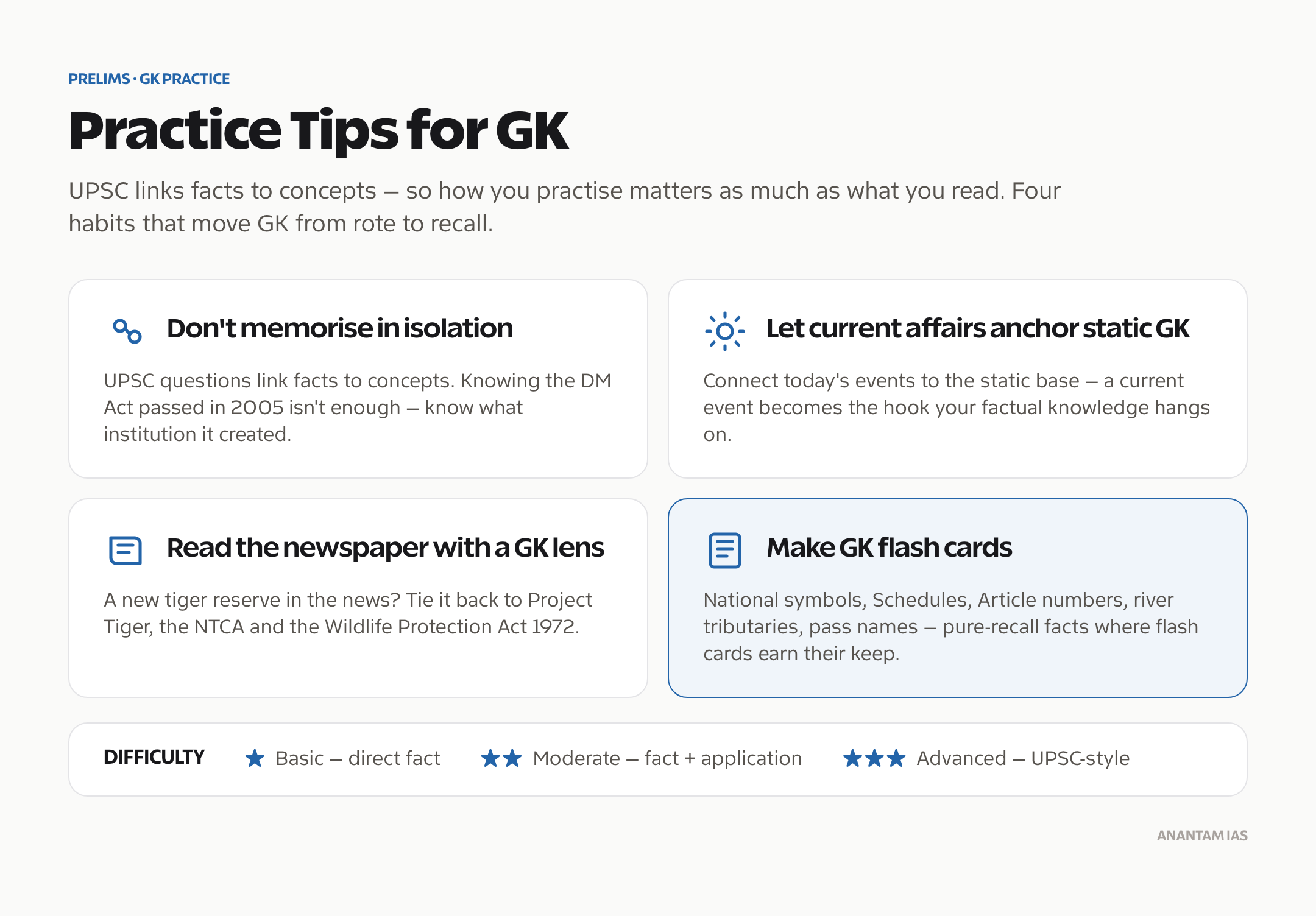
Don’t memorize in isolation. UPSC questions link facts to concepts. “Which year was the Disaster Management Act passed?” requires knowing 2005 — but UPSC will ask “What institution was created by the DM Act 2005?” which requires understanding the Act.

Lucent's General Knowledge 2026 — English (15th revised edition)
- 460 pages, Lucent Publications
- Static GK in the compressed, list-heavy format these MCQs are built from
- Overrated for UPSC Prelims, useful for the factual questions on this page and for state PSCs
Current affairs anchor static knowledge. Connect current events to static GK. Operation Sindoor (2025) connects to India-Pakistan relations, Article 51 of the Constitution (international peace), and India’s nuclear doctrine.
Read the newspaper with a GK lens. When you read about a new tiger reserve, connect it to Project Tiger, NTCA, and the WPA 1972.
Make GK flash cards. National symbols, Schedules of Constitution, Article numbers, river tributaries, pass names — these need memorization. Flash cards work.
Important Days & Dates 2026: Month-wise List
If the factual questions here are the ones you keep missing, the Lucent GK reading guide says which sections of that book to read and which to leave alone.
Frequently Asked Questions
Q: How many GK questions come in UPSC Prelims?
UPSC GS Paper I has 100 questions for 200 marks. Each correct answer gives 2 marks. Each wrong answer deducts 0.66 marks (1/3 negative marking). GK spans all topics — Polity, History, Geography, Economy, Environment, Science & Technology, and Current Affairs.
Q: Which subjects have the most questions in UPSC Prelims?
Based on past trends: History (15-20 questions), Polity and Governance (12-15), Environment (10-15), Economy (10-12), Geography (10-12), Science & Technology (8-10), Current Affairs (15-20). Percentages vary each year.
Q: What is the best way to prepare GK for UPSC?
Build a strong foundation with NCERT textbooks (Class 6-12 for History, Geography, Political Science, Economics). Follow The Hindu or Indian Express daily. Use standard references like Laxmikanth for Polity, Spectrum for History. Practice MCQs to identify gaps.
Q: Are current affairs questions more important than static GK?
Both matter. UPSC has been increasing current affairs questions linked to static knowledge. Pure current affairs MCQs are rare — usually a current event is used as a trigger for a question about underlying static knowledge (e.g., an RBI policy announcement triggers a question about monetary policy tools).
Tell Google you want more of this.
Add Anantam IAS as a preferred sourceOne tap, and this site shows up more often in your own Top Stories, AI Overviews and AI Mode. Remove it any time.