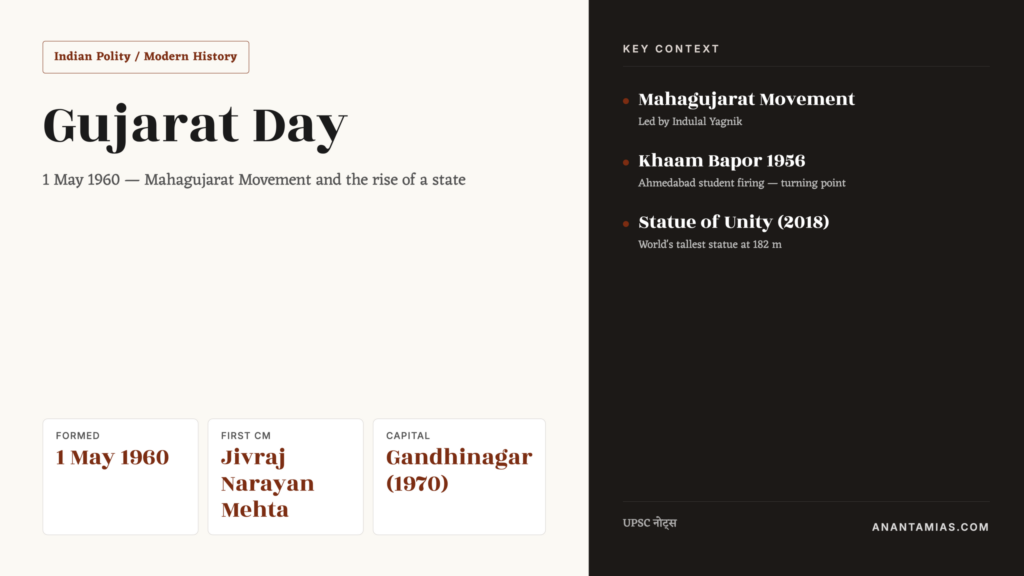
Gujarat Day, also called Gujarat Sthapna Divas or Gujarat Foundation Day, is observed every year on 1 May to mark the formation of the modern state of Gujarat. On 1 May 1960, the bilingual Bombay State was bifurcated into two linguistic states — Maharashtra and Gujarat — under the Bombay Reorganisation Act, 1960. In 2026, Gujarat completes 66 years of statehood. The day commemorates the Mahagujarat Movement led by Indulal Yagnik, the sacrifices of student protesters in the 1956 Ahmedabad firing, and the institutional journey from a state capital at Ahmedabad to the planned city of Gandhinagar.
Introduction
For UPSC aspirants, Gujarat Day is more than a state holiday. It sits at the intersection of three syllabus themes — linguistic reorganisation of Indian states, Article 3 of the Constitution that empowers Parliament to alter state boundaries, and the post-1956 evolution of the Indian federation. The day also opens up modern-issue hooks: GIFT City as India's first IFSC, the Statue of Unity as the world's tallest statue, and Ahmedabad's status as India's first UNESCO World Heritage City.
Gujarat today is among India's most industrialised and export-oriented states, contributing roughly 8 per cent of national GDP and over 30 per cent of national exports by value in recent years. The 2026 commemoration falls under Chief Minister Bhupendra Patel, who has held office since September 2021 and was re-elected after the December 2022 assembly verdict.
Quick Facts at a Glance
- Date of observation: 1 May (every year since 1960)
- Statutory basis: Bombay Reorganisation Act, 1960 (Act No. 11 of 1960)
- Effective date of bifurcation: 1 May 1960
- Movement: Mahagujarat Movement (1956–60), led by Indulal Yagnik
- Trigger event: "Khaam Bapor" firing, Ahmedabad, 8 August 1956
- First Chief Minister: Jivraj Narayan Mehta
- Original capital: Ahmedabad (1960–70)
- Present capital: Gandhinagar (since 1970)
- Districts: 33
- Official language: Gujarati
- State bird: Greater Flamingo
- State animal: Asiatic Lion
- Current CM (2026): Bhupendra Patel (BJP)
Historical Background
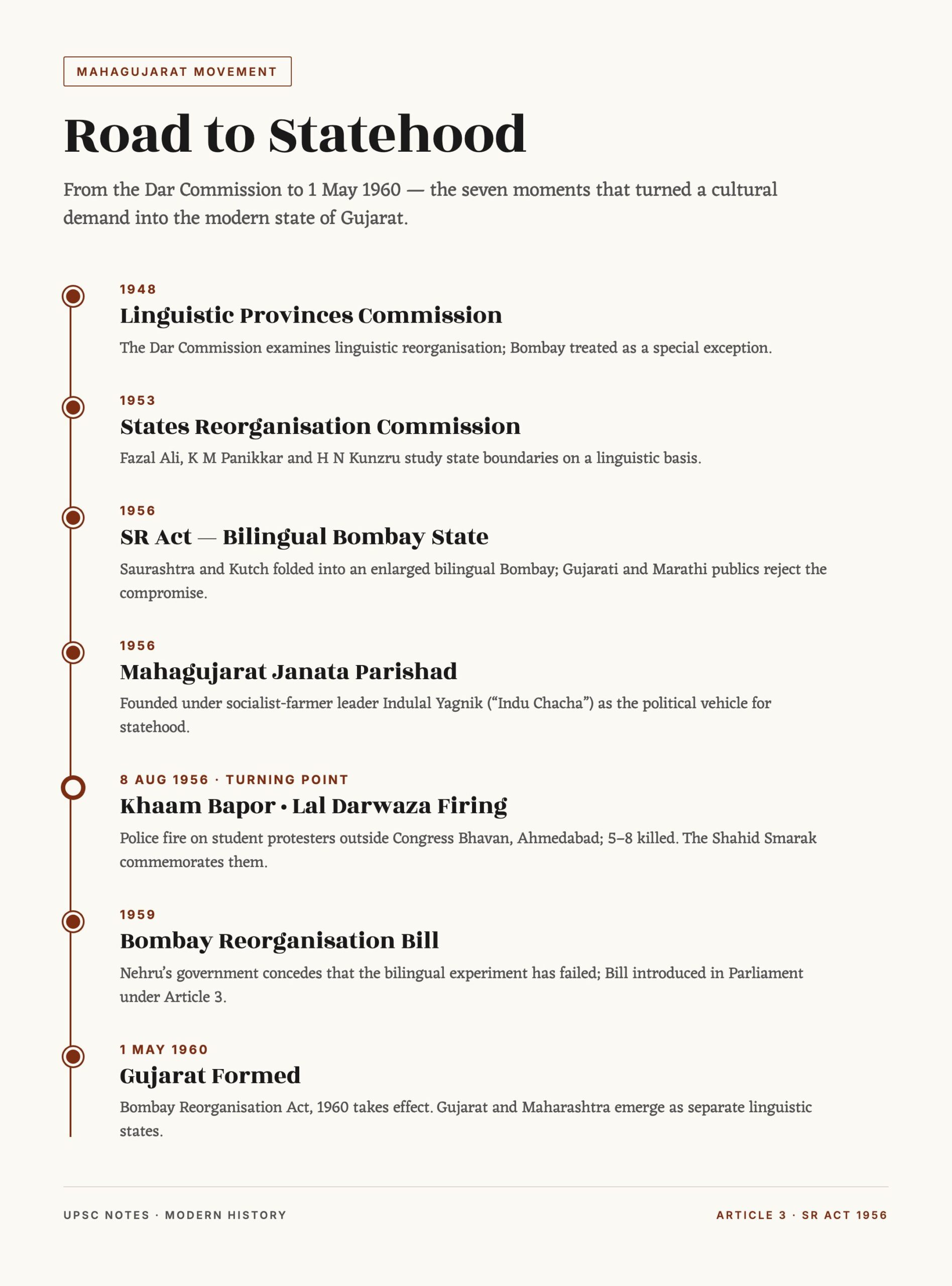
The story of Gujarat as a separate state begins in 1947 with the merger of more than 200 princely states of the Saurashtra and Kutch regions into the Indian Union — a feat largely engineered by Sardar Vallabhbhai Patel and V P Menon. After the States Reorganisation Act, 1956, these regions were folded into a vastly enlarged bilingual Bombay State that contained Gujarati, Marathi, Konkani and Kutchi speakers.
The States Reorganisation Commission (Fazal Ali, K M Panikkar and H N Kunzru, 1953) had recommended linguistic states as a general principle but treated bilingual Bombay as an exception. Gujarati-speaking and Marathi-speaking publics both rejected this compromise. The demand for a separate Gujarat — a Mahagujarat that would unite all Gujarati-speaking areas, including Saurashtra and Kutch — gained mass political momentum almost immediately.
Vithalbhai Patel, decades earlier, had spoken of a unified Gujarati cultural homeland; Mahatma Gandhi and Sardar Patel themselves were Gujarati nationalists in a cultural sense. By 1956, this cultural demand had become an electoral and street demand.
The Mahagujarat Movement
The Mahagujarat Movement (Mahagujarat Andolan) was the political vehicle that delivered statehood. The Mahagujarat Janata Parishad was formed in 1956, with the veteran socialist and farmer-leader Indulal Yagnik (1892–1972) — popularly addressed as "Indu Chacha" — as its public face. Yagnik combined Gandhian idiom, peasant politics and parliamentary opposition to build a movement that the ruling Indian National Congress could not contain.
The movement's defining moment came on 8 August 1956, when students gathered outside the Congress Bhavan in Lal Darwaza, Ahmedabad, to demand a separate Gujarat. Police fired on the unarmed crowd in an incident that has come to be remembered as the "Khaam Bapor" ("midday firing"). Estimates of the dead range from five to eight, with many more injured. The Shahid Smarak (Martyrs' Memorial) at Lal Darwaza commemorates them.
The shock of Khaam Bapor pushed the demand into the national press and the central political conversation. By 1959–60, Prime Minister Jawaharlal Nehru's government had accepted that the bilingual experiment had failed.
The Bombay Reorganisation Act, 1960
Parliament enacted the Bombay Reorganisation Act, 1960, which received presidential assent on 25 April 1960 and came into force on 1 May 1960. The Act did three things:
- Bifurcated the state of Bombay into the new state of Maharashtra and the new state of Gujarat
- Allocated assets, liabilities, services and pending litigation between the two successor states
- Made consequential amendments to the First and Fourth Schedules of the Constitution
The constitutional anchor for this exercise is Article 3 of the Constitution, which empowers Parliament — by simple majority and after a presidential reference to the affected state legislature — to form new states, alter areas, or change names and boundaries.
First Government and First Capital
Jivraj Narayan Mehta, a physician-politician and former Diwan of Baroda State, was sworn in as the first Chief Minister of Gujarat on 1 May 1960. The new state had its capital at Ahmedabad, the cultural and commercial heart of the region, and used the Civil Hospital and Sabarmati Ashram precincts as the early seat of government.
In 1970, the capital shifted to a purpose-built planned city — Gandhinagar — about 25 kilometres north of Ahmedabad. Gandhinagar was conceived in the post-Chandigarh tradition of modernist Indian planning. While Le Corbusier and Constantinos Doxiadis influenced the broader school, Gandhinagar's actual master planner was the Indian architect H K Mewada, working with Prakash M Apte. The city is laid out on a 30-sector grid bordered by the Sabarmati river.
State Symbols of Gujarat
Gujarat's official state symbols, codified through executive orders, anchor exam questions and answer-writing introductions:
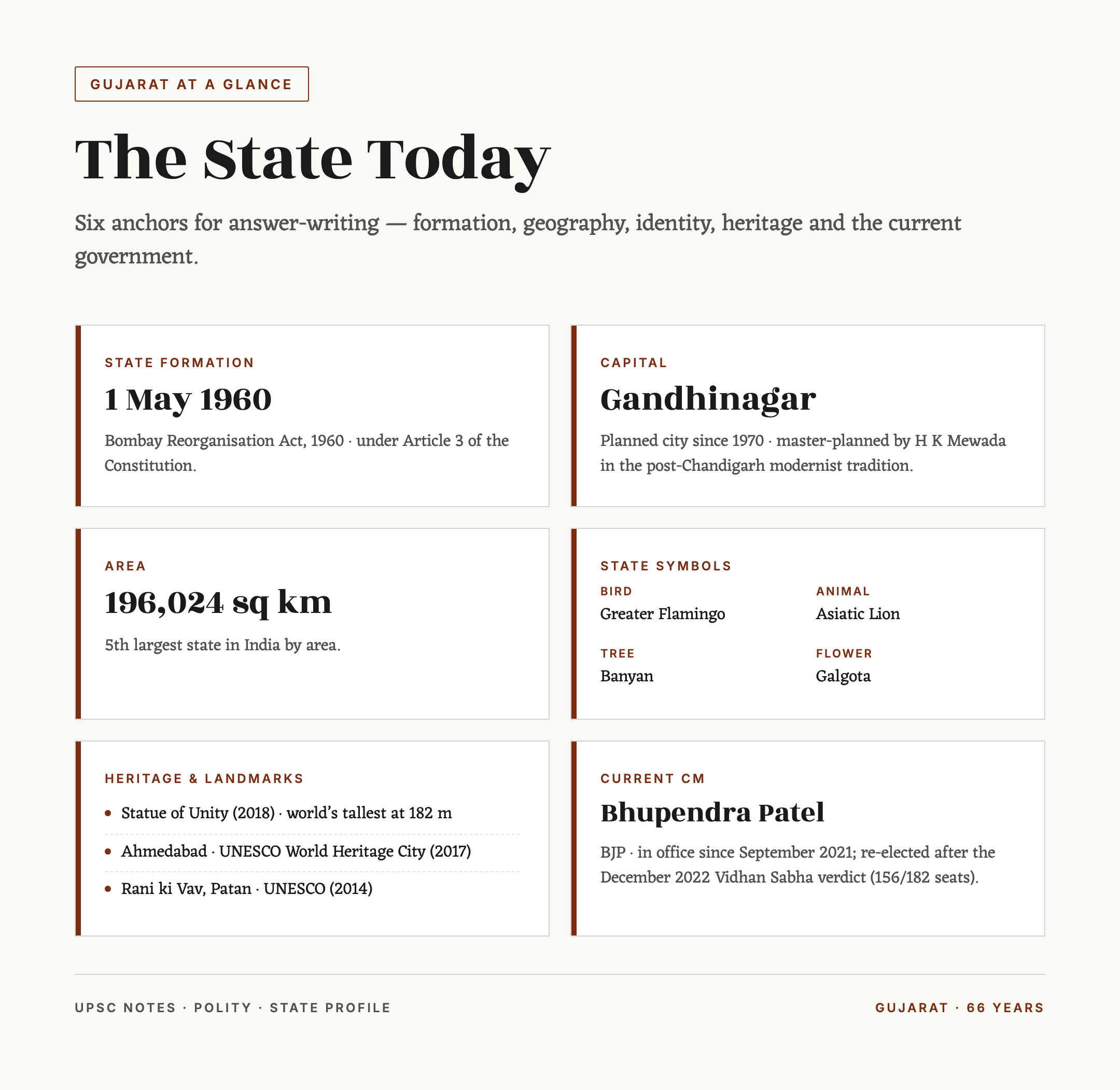
- State bird: Greater Flamingo (Phoenicopterus roseus) — the Rann of Kutch hosts one of Asia's largest breeding colonies
- State animal: Asiatic Lion (Panthera leo persica) — Gujarat's Gir National Park is the only natural habitat in the world
- State tree: Banyan (Ficus benghalensis)
- State flower: Galgota (Cassia auriculata, also known as Avartaki)
Iconic Landmarks and Heritage
Gujarat's tourism and heritage portfolio is unusually rich for state-formation answer-writing.
- Statue of Unity (2018): A 182-metre statue of Sardar Patel at Kevadia (Ekta Nagar) in Narmada district. It is the world's tallest statue, inaugurated by Prime Minister Narendra Modi on 31 October 2018.
- Sabarmati Riverfront, Ahmedabad: An 11.5-kilometre redeveloped riverfront completed in phases since 2012; cited as a model of urban-river restoration.
- Ahmedabad — UNESCO World Heritage City (2017): India's first city to receive the inscription, recognising the walled-city pols, Indo-Islamic architecture, and Sabarmati Ashram precinct.
- Rann Utsav, Kutch: A four-month tent-city festival on the white salt desert — a flagship of state tourism branding.
- Somnath, Dwarka, Modhera Sun Temple, Champaner-Pavagadh, Rani ki Vav (Patan, UNESCO 2014): A heritage spine that few states match.
Economic Profile and Recent Milestones
Gujarat's economic story has shaped its political identity. The state hosts:
- GIFT City (Gujarat International Finance Tec-City) at Gandhinagar — India's first International Financial Services Centre (IFSC), regulated by the IFSCA established in 2020.
- Tata-Airbus C-295 facility, Vadodara — the first private-sector military aircraft assembly line in India, inaugurated in October 2024.
- Vibrant Gujarat Global Summit — biennial investor summit; the 10th edition was held in January 2024.
- GIDC (Gujarat Industrial Development Corporation) industrial estates and the Dholera Special Investment Region.
Gujarat's GSDP has grown well above the national average through most of the post-2000 period, anchored by petrochemicals, pharmaceuticals, textiles, ceramics, dairy (Amul / GCMMF), and diamonds (Surat).
Political Continuity and Current Leadership
Gujarat has had only sixteen Chief Ministers since 1960. The Indian National Congress dominated the early decades; the Bharatiya Janata Party (BJP) has been in continuous power since 1998. Notable Chief Ministers include Madhavsinh Solanki, Chimanbhai Patel, Keshubhai Patel, Narendra Modi (2001–14), Anandiben Patel, and Vijay Rupani.
The current Chief Minister is Bhupendra Patel, who took office in September 2021 and was re-elected after the BJP's landslide in the December 2022 Vidhan Sabha election (156 of 182 seats — the highest tally ever for any party in Gujarat).
Significance for UPSC
- Prelims hooks: Bombay Reorganisation Act, 1960 (effective date 1 May 1960); Article 3; first CM J N Mehta; capital shift Ahmedabad → Gandhinagar (1970); Statue of Unity (182 m); Ahmedabad UNESCO World Heritage City (2017); Rani ki Vav UNESCO (2014); GIFT City and IFSCA.
- Mains GS-I: Linguistic reorganisation of states — Mahagujarat and Samyukta Maharashtra movements as twin case studies.
- Mains GS-II: Article 3 — Parliament's power to alter state areas; cooperative federalism; centre-state relations during reorganisation.
- Mains GS-III: Industrial policy, IFSC and GIFT City, defence indigenisation (Tata-Airbus), heritage-led tourism economy.
- Essay: "Linguistic states have strengthened, not weakened, Indian federalism."
Related Reading on anantamias.com
- States Reorganisation Act 1956 and the linguistic principle
- Article 3 of the Constitution — formation and alteration of states
- Sardar Vallabhbhai Patel — life, integration of princely states
- GIFT City and India's IFSC framework
Conclusion
Gujarat Day is a compact case study in how a constitutional democracy negotiates linguistic and cultural identity. The journey from a bilingual Bombay State to a separate Gujarat in 1960 was won not in the legislature alone but on the streets of Ahmedabad, in the speeches of Indulal Yagnik, and in the silent register of the Khaam Bapor martyrs. Sixty-six years later, the state's transformation — Gandhinagar's planned grid, Kevadia's Statue of Unity, GIFT City's IFSC, Vadodara's C-295 line, and Ahmedabad's UNESCO inscription — gives the day a contemporary edge. For an aspirant, 1 May is not just a date to memorise but a gateway into Article 3, the SRC, the linguistic-states debate, and a model of state-led economic development.
Frequently Asked Questions
When is Gujarat Day celebrated and why?
Gujarat Day is celebrated on 1 May every year. On this date in 1960, the state of Gujarat came into existence after the bifurcation of the bilingual Bombay State under the Bombay Reorganisation Act, 1960.
Who was the first Chief Minister of Gujarat?
Dr Jivraj Narayan Mehta, a physician and senior Congress leader, became the first Chief Minister of Gujarat on 1 May 1960 and held office until 1963.
What is the Mahagujarat Movement?
The Mahagujarat Movement (1956–60) was the agitation for a separate Gujarati-speaking state, organised principally by the Mahagujarat Janata Parishad under the leadership of Indulal Yagnik. The 8 August 1956 Ahmedabad firing on student protesters — the "Khaam Bapor" incident — was its turning point.
Why was the capital of Gujarat shifted to Gandhinagar?
Ahmedabad served as the temporary capital from 1960 to 1970. Gandhinagar was built as a purpose-designed planned capital, master-planned by H K Mewada and Prakash M Apte in the modernist post-Chandigarh tradition, and became the official capital in 1970.
Which constitutional article allowed the creation of Gujarat?
Article 3 of the Constitution empowers Parliament to form new states, alter the areas, boundaries or names of existing states. The Bombay Reorganisation Act, 1960 was passed under this Article.
What is the difference between Gujarat Day and Maharashtra Day?
Both are observed on 1 May, because both states were created by the same statute — the Bombay Reorganisation Act, 1960 — that bifurcated the erstwhile bilingual Bombay State on that date.
Who is the current Chief Minister of Gujarat in 2026?
Bhupendra Patel of the Bharatiya Janata Party has been the Chief Minister of Gujarat since September 2021 and was re-elected after the December 2022 assembly election.
What are the official symbols of Gujarat?
Gujarat's state bird is the Greater Flamingo, state animal the Asiatic Lion, state tree the Banyan, and state flower Galgota.
Tell Google you want more of this.
Add Anantam IAS as a preferred sourceOne tap, and this site shows up more often in your own Top Stories, AI Overviews and AI Mode. Remove it any time.