Disclosure: this guide contains Amazon affiliate links. As an Amazon Associate, Anantam IAS earns from qualifying purchases — at no extra cost to you.
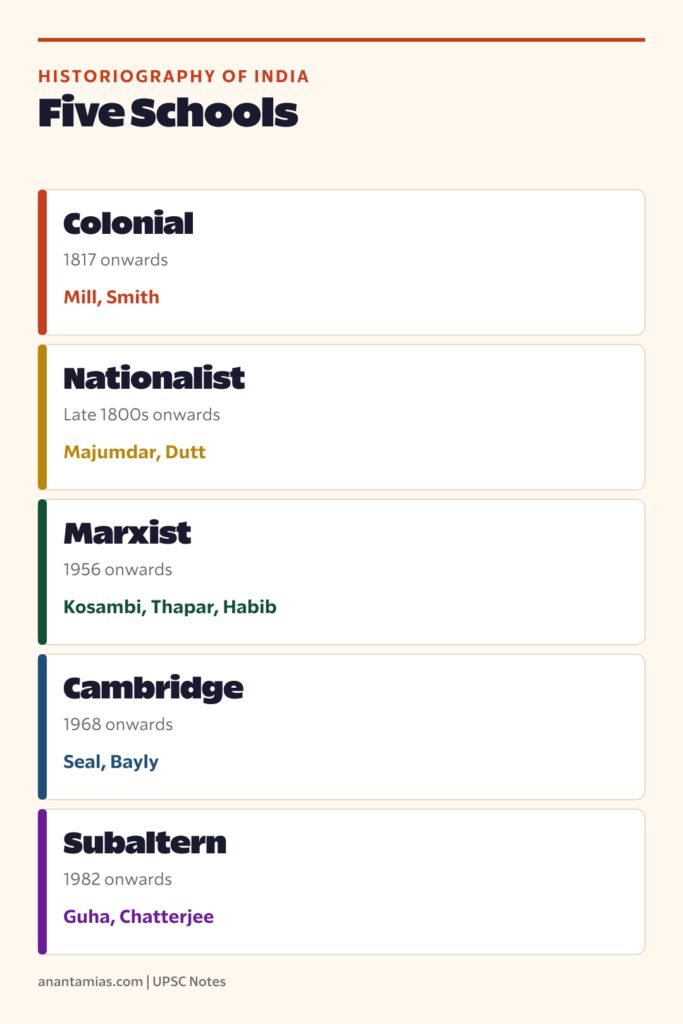
Historiography of India is the study of how Indian history has been written, by whom, with what assumptions, and to what political effect. It is not the same as Indian history itself. Historiography asks why a colonial administrator and a Marxist economic historian, looking at the same eighteenth century, produced different accounts of the East India Company. It asks why James Mill wrote a three-volume History of British India without setting foot in India, and why Romila Thapar wrote her early chronologies of the Mauryan period the way she did. The discipline of Indian historiography emerged in the late nineteenth century and now operates across five recognisable schools: Colonial, Nationalist, Marxist, Subaltern, and Cambridge.
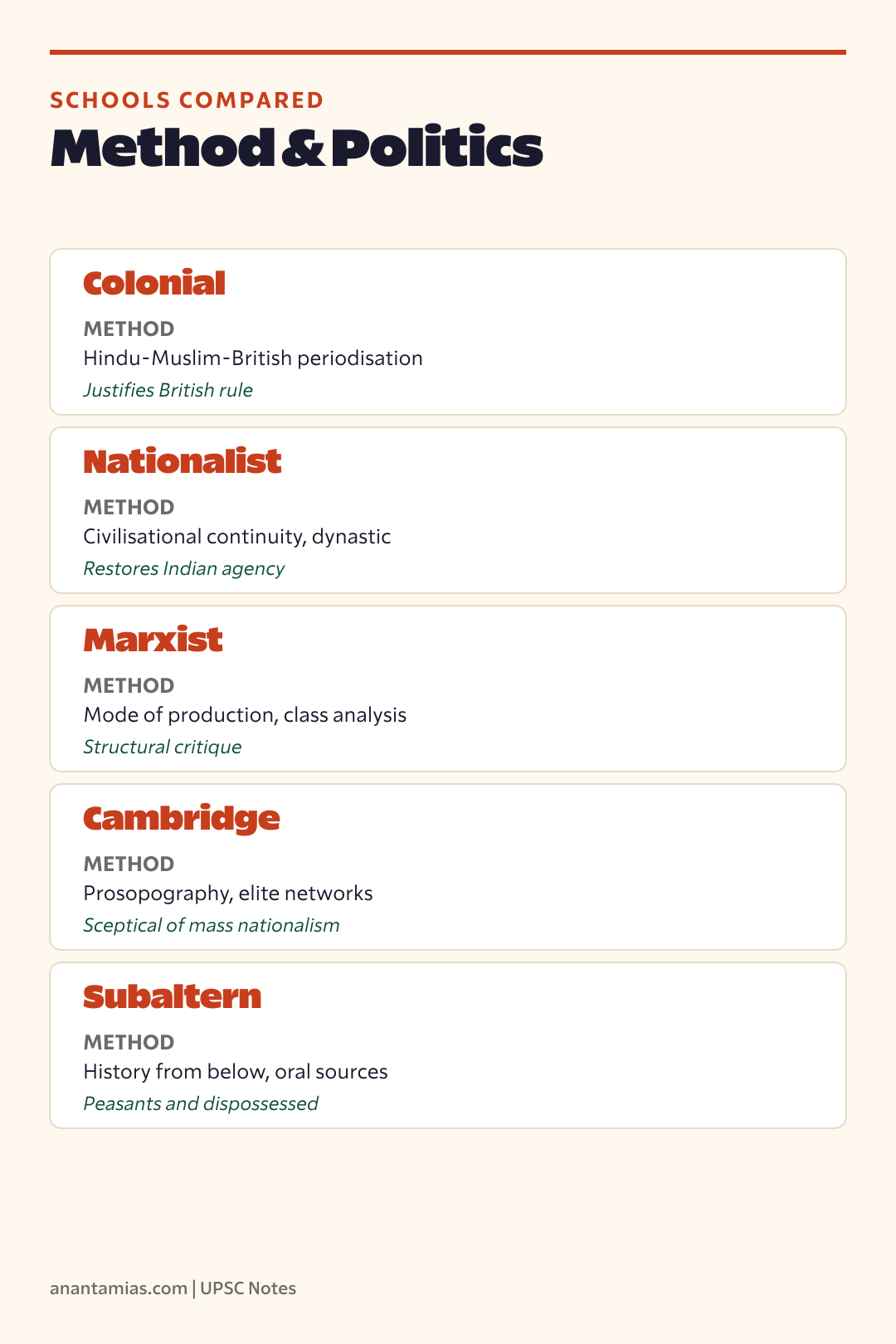
Each school has a method, a politics, and a canonical historian. The Colonial school used Indian history to justify British rule. The Nationalist school wrote against it. The Marxist school read Indian history through class and mode of production. The Subaltern school turned the lens away from elites toward peasants, tribals, women, and the dispossessed. The Cambridge school, working in the 1970s and after, treated Indian nationalism as a contest among Indian elites for British-distributed power rather than as a popular awakening. The argument between these schools is the substance of historiography of India.
This explainer walks through the five schools, the historians who defined them, the texts that anchor each tradition, and the critiques each school has drawn from the others. It also maps the UPSC angles, including the questions that have appeared in mains since 2013.
What historiography is
Historiography is the history of history-writing. It asks four questions about any historical text. What sources did the historian use? What method did the historian apply to those sources? What politics, conscious or unconscious, framed the questions the historian chose to ask? And what later historians said about the work.
A historiographical reading of, say, the 1857 uprising does not retell the events. It compares how Charles Ball, Vinayak Damodar Savarkar, R C Majumdar, Eric Stokes, and Rudrangshu Mukherjee told the same events differently, and asks why. The differences come from the school, the period, and the politics of each writer.
The phrase historiography of India is therefore an umbrella that covers the colonial, nationalist, Marxist, subaltern, and Cambridge readings of every period of Indian history, from the Vedic to the contemporary.
The Colonial school
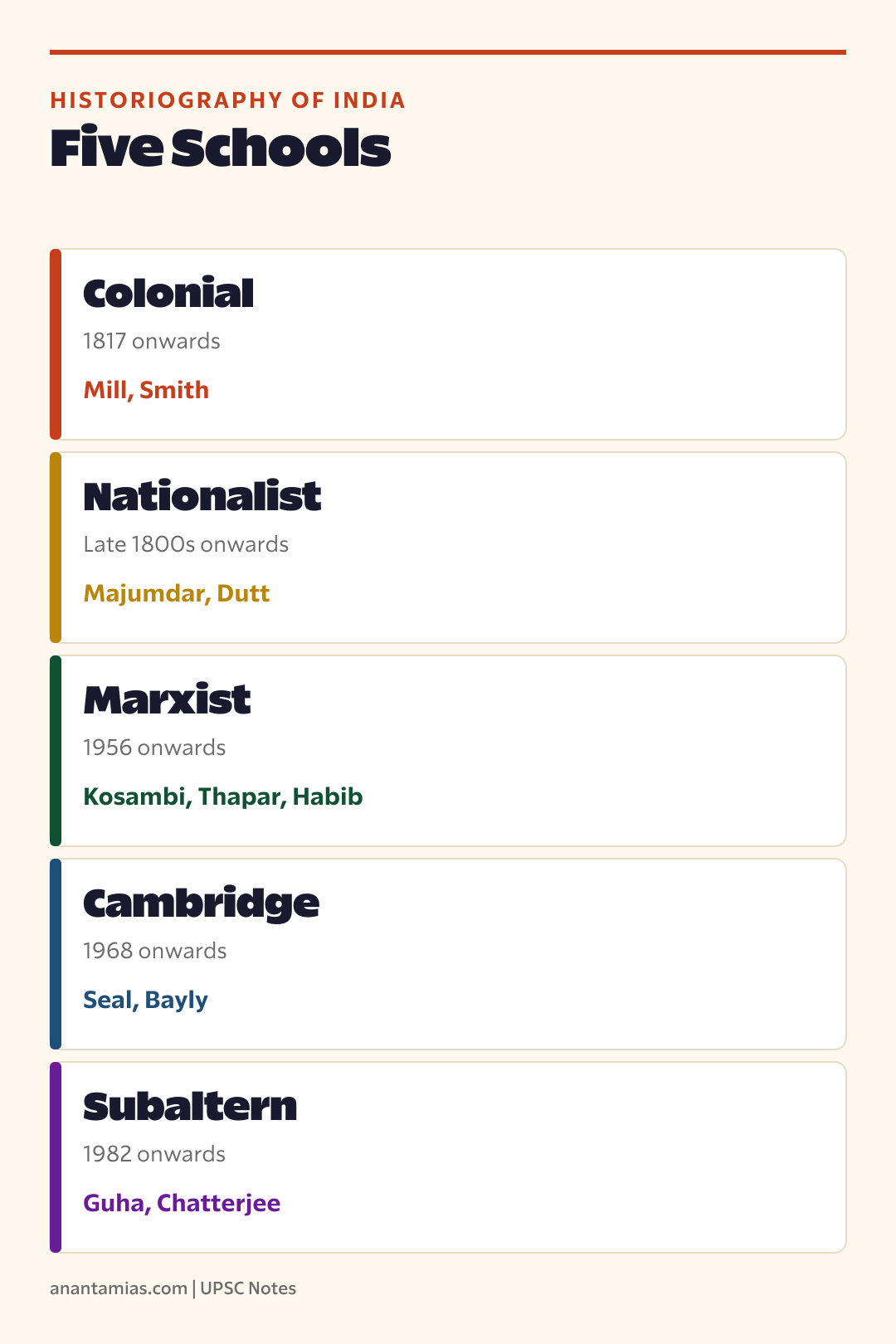
The Colonial school began with James Mill’s three-volume History of British India, published in 1817. Mill divided Indian history into Hindu, Muslim, and British periods, a periodisation that still appears in school textbooks. Mill never visited India and read no Indian language. The work was admired by the East India Company and became a setter text for officers in training.
The Colonial school had three features. It treated Indian history as a sequence of religious dynasties, with British rule as the rational endpoint. It used Indian sources selectively to confirm a story of decline. And it imported European categories, including feudalism and oriental despotism, without testing them against Indian evidence.
James Mill, Vincent Smith, and the canonical texts
James Mill’s History of British India was the founding text. Vincent Smith’s Oxford History of India, first published in 1919, carried the Colonial school into the twentieth century. Smith’s narrative of Mauryan and Mughal decline became the standard version taught across British India. The Cambridge History of India series, edited from 1922 to 1937, sits in the same lineage and was the orthodoxy until the 1960s.
The Colonial school’s critique came first from Indian nationalists, then from Marxists, and finally from postcolonial historians who showed how its categories were tools of governance rather than analysis.
The Nationalist school
The Nationalist school emerged in the late nineteenth century as a direct response to the Colonial reading. Its founders included R C Dutt, whose Economic History of India under Early British Rule, published in 1902, made the drain of wealth argument the centrepiece of nationalist economics. Dadabhai Naoroji‘s Poverty and Un-British Rule in India, published in 1901, was the companion text. The school flowered between 1900 and 1947 and dominated history teaching in independent India for the first three decades after 1947.

India's Struggle for Independence — Bipan Chandra & others (Penguin)
- 600 pages, Penguin, the standard modern-India narrative
- The nationalist-school reading of 1857 to 1947, chapter by movement
- The book most Prelims explanations end up citing
The Nationalist school had three commitments. It refused the Colonial periodisation of Hindu-Muslim-British and replaced it with a periodisation built around dynasties and unifications. It treated the freedom struggle as a popular and continuous movement from 1857 onwards. And it read ancient India as a period of high civilisational achievement, rather than as a backdrop for later decline.
R C Majumdar and the Bharatiya Vidya Bhavan series
R C Majumdar was the most influential Nationalist historian. His multi-volume History and Culture of the Indian People, published by the Bharatiya Vidya Bhavan from 1951 onwards, anchored the school. Majumdar emphasised the long civilisational continuity of India, the centrality of Sanskrit literary culture, and the role of indigenous resistance to foreign rule across centuries. Other Nationalist historians included R C Dutt, Jadunath Sarkar in his Mughal volumes, K M Munshi, and K P Jayaswal.
The Nationalist critique was that the Colonial school had written Indians out of their own history. The Nationalist counter-reading restored agency to Indian rulers, scholars, and rebels.
The Marxist school
The Marxist school began with D D Kosambi’s Introduction to the Study of Indian History, published in 1956, and An Introduction to Indian History, published in 1965. Kosambi read Indian history through modes of production, class relations, and the material base of religious and cultural forms. He rejected the Nationalist emphasis on civilisational unity and the Colonial emphasis on dynastic continuity.

India's Ancient Past — R.S. Sharma (Oxford)
- 387 pages, Oxford University Press India
- Ancient India from the Harappans to the early medieval, Marxist-school framing
- The ancient-history text most Prelims explanations cite
The Marxist school then developed through Romila Thapar, Bipan Chandra, Irfan Habib, R S Sharma, Satish Chandra, and others. The school dominated Delhi-centred history departments and the NCERT textbook tradition from the 1960s through the 1990s.
Romila Thapar
Romila Thapar’s Asoka and the Decline of the Mauryas, published in 1961, set a method for reading early Indian history that combined epigraphical evidence with economic and social analysis. Her later work on the early Indian past, including Early India: From the Origins to AD 1300, and her interventions on the writing of ancient Indian history have defined the field. Thapar argued against the use of religious categories to periodise history and against the imposition of European feudalism on the Indian medieval.
Bipan Chandra
Bipan Chandra wrote the canonical Marxist account of the freedom struggle. His India’s Struggle for Independence, published in 1988 and co-authored with Mridula Mukherjee, Aditya Mukherjee, Sucheta Mahajan, and K N Panikkar, became the standard text for the Indian National Movement in NCERT and UPSC preparation. Chandra rejected the Cambridge school’s reduction of nationalism to elite manoeuvring and argued that the movement was a mass, multi-class struggle led by the Congress in alliance with peasants, workers, and small businessmen.
R S Sharma and Irfan Habib
R S Sharma’s Indian Feudalism, published in 1965, applied a modified feudalism thesis to post-Gupta India. Irfan Habib’s Agrarian System of Mughal India, published in 1963, set the standard for Mughal economic history. Both texts remain foundational reading.
The Marxist school drew critiques from the Nationalist tradition for ignoring civilisational depth, from the Subaltern school for privileging the structural over the everyday, and from the Cambridge school for political alignment with Congress nationalism.
The Subaltern school
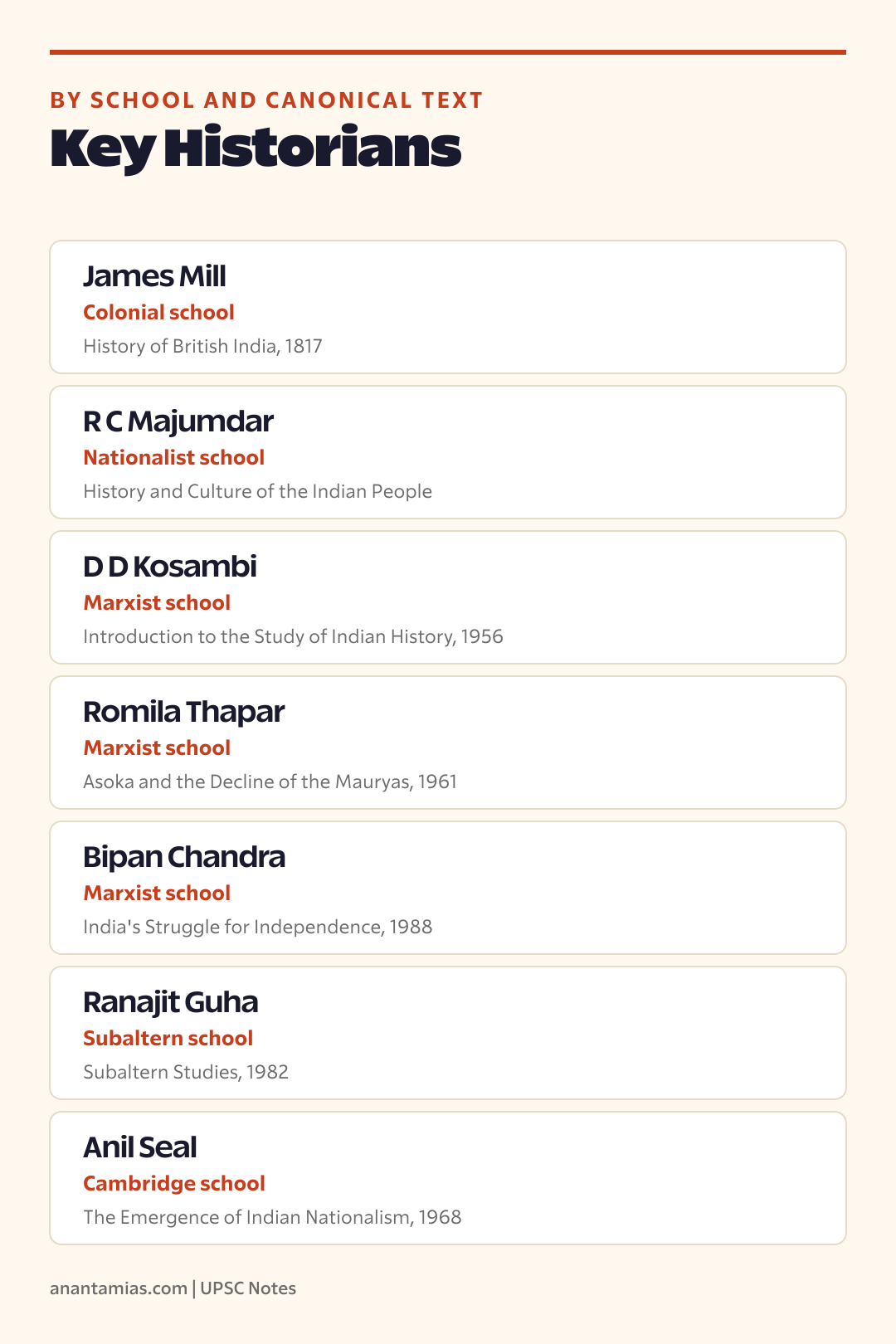
Subaltern Studies began in 1982 with the first volume of essays edited by Ranajit Guha, published by Oxford University Press. The school took its name from Antonio Gramsci’s concept of the subaltern, meaning the dispossessed and the politically excluded. The founding manifesto was Guha’s essay On Some Aspects of the Historiography of Colonial India, which argued that both Colonial and Nationalist historiographies had treated the Indian people as objects rather than agents.
The Subaltern school had three commitments. It read history from below rather than from above. It treated peasant rebellions, tribal movements, women’s politics, and Dalit assertion as politics in their own right, not as adjuncts to elite nationalism. And it used unconventional sources, including oral testimony, folk memory, and police records read against the grain.
Ranajit Guha and the founding texts
Ranajit Guha’s Elementary Aspects of Peasant Insurgency in Colonial India, published in 1983, was the school’s manifesto in book form. The successive volumes of Subaltern Studies brought together work by Partha Chatterjee, Gyanendra Pandey, Shahid Amin, David Arnold, Dipesh Chakrabarty, Sumit Sarkar, and others. The school later split, with Chakrabarty moving toward postcolonial cultural history in Provincializing Europe, published in 2000, and Sumit Sarkar publicly distancing himself from what he saw as the school’s drift away from social history.
The Subaltern school drew critiques from the Marxist tradition for romanticising peasant consciousness and from later cultural historians for losing the structural lens.
The Cambridge school
The Cambridge school took shape in the 1960s and 1970s through the work of Anil Seal, John Gallagher, Christopher Bayly, and others at the University of Cambridge. Anil Seal’s The Emergence of Indian Nationalism, published in 1968, was the founding text. The school argued that Indian nationalism was not a popular awakening but a contest among Indian elites for the political resources that the British were progressively devolving from the 1890s onwards.
The Cambridge school had three features. It treated the late colonial state as the central actor and Indian politics as a response to its devolution moves. It used prosopography, the close study of who held office and who married whom, to map political networks. And it was sceptical of the Nationalist and Marxist claim that the Congress led a unified mass movement.
C A Bayly’s Rulers, Townsmen and Bazaars, published in 1983, extended the Cambridge approach into north Indian commercial and political history of the eighteenth and nineteenth centuries. Judith Brown’s biographies of Gandhi sit in the same tradition, treating Gandhi as a political tactician rather than a moral force.
The Cambridge school drew sharp critiques from Bipan Chandra and the Marxist school, who saw it as a renovated colonial historiography that recycled the British dismissal of Indian nationalism as elite jockeying.
How the schools overlap
The five schools are not sealed boxes. Romila Thapar’s early work used Nationalist scaffolding; her later work is firmly Marxist. C A Bayly’s later work on intellectual history reads more like a hybrid of Cambridge and Subaltern methods. Irfan Habib has engaged with Subaltern critiques and partly absorbed them. The boundaries are useful for teaching but porous in practice.
For UPSC, the Indian classical languages and the eighth schedule languages posts cover the cultural and linguistic context that historiographical schools work with. The constitution constitutionalism constitution morality post covers the constitutional historiography that runs alongside.
UPSC angles to track
For prelims, the testable facts are which historian belongs to which school and which book anchored which tradition. The most common confusion is placing Bipan Chandra in the Nationalist school. He is Marxist, not Nationalist.

The Penguin History of Early India — Romila Thapar
- 555 pages, Penguin India
- Origins to AD 1300, with the historiographical debates left visible
- The reference for the Mauryan and post-Mauryan questions
For mains, the GS-I paper has carried historiography questions since 2013. The 2016 paper asked about the contribution of D D Kosambi to Indian history. The 2019 paper asked about the writing of women’s history. The 2023 paper carried a question on the legacy of colonial historiography. The essay paper has used the question of how nations remember their past as a theme.
The ground to prepare is the school, the canonical text, the key argument, and the critique. That is the substance of historiography of India for the civil services examination.
Frequently Asked Questions
What is historiography of India?
Historiography of India is the study of how Indian history has been written, by whom, and with what assumptions. It is the history of history-writing in India. The discipline operates across five recognisable schools: Colonial, Nationalist, Marxist, Subaltern, and Cambridge.
Who founded the Colonial school of Indian historiography?
James Mill founded the Colonial school with his three-volume History of British India, published in 1817. Mill divided Indian history into Hindu, Muslim, and British periods, a periodisation still used in some school textbooks. Vincent Smith and the Cambridge History of India series carried the school into the twentieth century.
Who was R C Majumdar?
R C Majumdar was the most influential Nationalist historian of India. He edited the Bharatiya Vidya Bhavan’s multi-volume History and Culture of the Indian People, published from 1951 onwards. Majumdar emphasised civilisational continuity, Sanskrit literary culture, and indigenous resistance to foreign rule.
What did Romila Thapar contribute to Indian historiography?
Romila Thapar set a method for reading early Indian history that combined epigraphical evidence with economic and social analysis. Her Asoka and the Decline of the Mauryas, published in 1961, and her Early India synthesis defined the field. She argued against using religious categories to periodise Indian history.
What is the Subaltern school?
The Subaltern school began in 1982 with the first volume of Subaltern Studies, edited by Ranajit Guha. It reads history from below, treating peasants, tribals, women, and Dalits as political agents rather than objects of elite politics. The school used Antonio Gramsci’s concept of the subaltern as its frame.
What is the Cambridge school of Indian history?
The Cambridge school argued that Indian nationalism was a contest among Indian elites for political resources devolved by the British from the 1890s onwards. Anil Seal’s The Emergence of Indian Nationalism, published in 1968, was the founding text. C A Bayly extended the approach to commercial and political history.
Is Bipan Chandra a Nationalist or Marxist historian?
Bipan Chandra is a Marxist historian, not a Nationalist one. His India’s Struggle for Independence, published in 1988, is a Marxist account of the freedom movement. The confusion arises because Chandra defended Congress nationalism against the Cambridge school’s reductive readings.
Which historiography school dominates NCERT textbooks?
The Marxist school has dominated the NCERT history textbooks since the 1960s, with Romila Thapar, Bipan Chandra, R S Sharma, and Satish Chandra as the principal authors of the canonical school texts. The 2014 to 2024 period has seen pressure to revise this orthodoxy.
What is the critique of colonial historiography?
The critique is that colonial historiography used Indian history to justify British rule. It treated Indians as objects rather than agents, imposed European categories like feudalism and oriental despotism without testing them, and selected sources to confirm a story of decline that British rule could then claim to reverse.
How is historiography tested in UPSC?
Historiography is tested in GS-I mains through questions on specific historians, schools, or themes. Questions have appeared on D D Kosambi in 2016, on women’s history in 2019, and on colonial historiography in 2023. The essay paper has used the question of how nations remember their past as a theme.
Tell Google you want more of this.
Add Anantam IAS as a preferred sourceOne tap, and this site shows up more often in your own Top Stories, AI Overviews and AI Mode. Remove it any time.