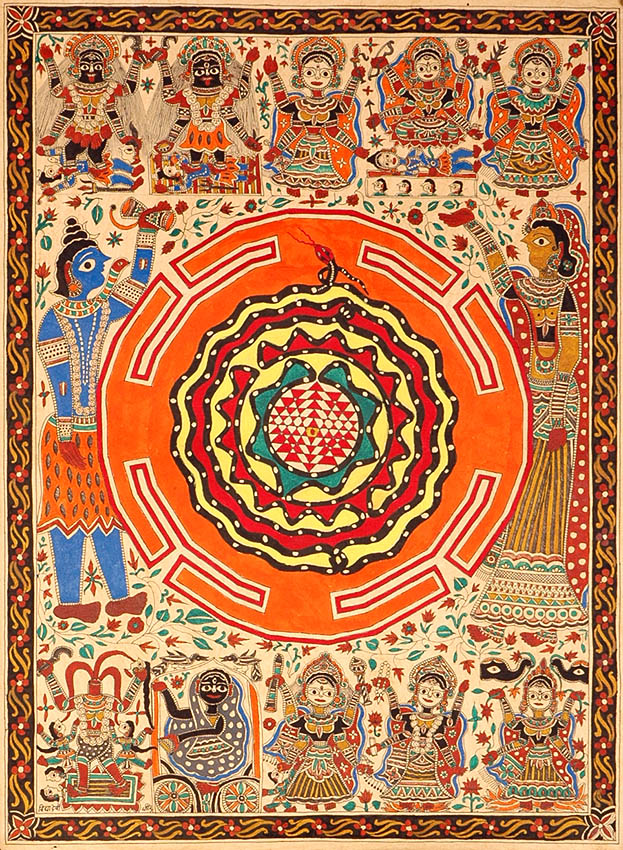
Madhubani painting — also called Mithila painting — is a folk art tradition of the Mithila region in north Bihar, sustained for centuries by women of the household who painted ritual diagrams on the freshly plastered mud walls and floors of their homes. The art was domestic, ephemeral, and almost entirely female until the drought of 1934 brought it to outside attention and the famines of the 1960s pushed it onto paper as a livelihood. Today Madhubani painting is a Geographical Indication-protected art form (GI tag, 2007), the source of three Padma awards, and Bihar’s most recognisable visual identity.
This article covers the origin of Madhubani painting, the five recognised styles — Bharni, Kachni, Tantrik, Godna, and Kohbar — the themes drawn from deities, nature, and wedding ritual, the use of natural pigments and bamboo-stick brushes, the All India Handicrafts Board intervention of 1966, the GI tag of 2007, and the Padma exponents Sita Devi, Ganga Devi, Jagdamba Devi, and Bharti Dayal.
Origin and Mythic Lineage
Mithila painting is traditionally traced to King Janaka of Mithila, who is said to have commissioned wall paintings for the wedding of his daughter Sita to Rama. The mythic provenance places the tradition in the Ramayana period and ties it directly to the Kohbar — the painted nuptial chamber that remains the form’s most sacred sub-genre.
The historical record is thinner. References to wall painting in Maithili poetry, ritual manuals (paddhati), and travellers’ accounts go back several centuries. The art was passed mother-to-daughter, never institutionalised, and produced for ritual occasions — weddings, the Chhath festival, Saraswati Puja, Durga Puja, and life-cycle ceremonies — after which the walls were eventually replastered and the painting lost.
The 1934 earthquake and the 1966 famine — twin discoveries
The British colonial officer W. G. Archer, posted in Madhubani during relief work after the 1934 Bihar earthquake, walked into damaged Mithila homes and saw the wall paintings exposed by collapsed plaster. He photographed extensively and his wife Mildred Archer later published the findings, bringing Madhubani painting to outside academic attention.
In 1966, drought devastated Bihar. The All India Handicrafts Board under Pupul Jayakar sent artist Bhaskar Kulkarni to Madhubani to encourage women to transfer their wall paintings onto handmade paper — converting a ritual practice into a saleable craft and providing famine relief income. This intervention created the modern art market for Madhubani painting and turned previously anonymous household painters into named artists.
Materials and Technique
Surface
The original surface is mud-plastered wall — the inner courtyard, the worship room, the kohbar ghar nuptial chamber. After 1966, handmade paper, cloth, canvas, and increasingly wood and ceramic became standard supports for commercial work.
Pigments
Pigments are made from natural sources:
- Black — soot from kajal lamps mixed with cow dung.
- Yellow — turmeric, pollen, or limestone with milk of banyan leaves.
- Red — kusum flower juice, red sandalwood, or kumkum.
- Green — bilwa leaf juice or other green leaves crushed in oil.
- Blue — indigo.
- Orange — palash flower.
- White — rice paste.
These pigments are mixed with gum from local trees as a binder.
Brushes
Traditional brushes are bamboo sticks with the end frayed and tipped with cotton or cloth. Fine outlines use a kalam — a sharpened bamboo nib. Many painters use their fingers and matchsticks alongside brushes. Synthetic brushes are now common in commercial work.
Composition rules
Madhubani painting fills the entire surface — empty space is forbidden. Borders are dense and geometric. Figures are drawn frontally with prominent eyes; profile views are rare. The double line is universal — every form is outlined twice, with the inner space filled with hatching, dots, or solid colour.
The Five Styles of Madhubani Painting
Bharni — the upper-caste filled style
Bharni (“to fill”) is the most familiar style internationally — bright colours fill the bold double-outlined forms. Bharni was historically practised by upper-caste Brahmin and Kayastha women. Themes are religious — Krishna, Rama-Sita, the Mahavidyas, Durga. The Mahavidya panels — the ten goddess wisdom forms — are a Bharni speciality.
Kachni — the line style
Kachni (“line”) uses delicate parallel lines and hatching with little or no colour fill. Outlines are doubled and the space between is filled with fine line patterns. Kachni was also an upper-caste style, and produces a quieter, more monochromatic aesthetic.
Tantrik — the esoteric style
The Tantrik style draws on Tantric iconography — Mahavidyas, yantras, esoteric goddess forms — and uses symbolic geometry alongside figural work. Sita Devi was particularly known for Tantrik subject matter.
Godna — the tattoo style
Godna (“tattoo”) emerged from the Dalit communities of Mithila, especially the Dusadh caste. The motifs derive from body tattoo patterns and use dense black outlines, monochrome or restricted palette, and themes of Raja Salhes (a Dusadh folk hero) and animal-human composites. Chano Devi is credited with bringing Godna onto paper in the 1970s.
Kohbar — the nuptial style
The Kohbar is the painted nuptial chamber where the newly married couple spends the first night together. The central image is a lotus pond with stylised lotuses, bamboo, fish, parrots, turtles, the sun, and the moon — all fertility symbols. The Kohbar is not a style by technique but by theme and ritual function.
Themes and Iconography
Deities
Krishna and Radha, Rama and Sita, Shiva and Parvati, Durga, the Mahavidyas, Saraswati, Lakshmi, Hanuman, and Ganesha are recurring subjects. Local deities like Raja Salhes (Dusadh hero), Sama-Chakeva (sibling-bond folk festival), and Naina-Jogin also appear.
Nature
The sun and moon are always present, often together in the same frame. Fish are fertility symbols; peacocks, parrots, turtles, elephants, and snakes recur. The tree of life — usually a stylised bamboo or banyan — anchors many compositions.
Wedding rituals
The Kohbar lotus pond, the purain lotus leaf, the naina-jogin female protector figures, and the bamboo-and-lotus marriage symbolism dominate wedding-related work. Geometric aripana floor diagrams are a related folk art that overlaps with Madhubani painting.
Contemporary themes
From the 1990s onward, Madhubani painters have turned to social subjects — dowry, female foeticide, environmental destruction, COVID-19, Vande Bharat trains, and the Beti Bachao campaign. The form has proven elastic enough to absorb contemporary content without losing its grammar.
The Geographical Indication Tag — 2007
Madhubani painting received its Geographical Indication (GI) tag in 2007 under the Geographical Indications of Goods (Registration and Protection) Act, 1999. The GI is held by the Mithila Painting Institute of Mithila and several producer cooperatives. The tag protects the name “Madhubani painting” from misuse by non-Mithila producers and supports the livelihoods of an estimated 25,000 to 30,000 artists in the Madhubani, Darbhanga, and surrounding districts.
The GI sits alongside Bihar’s other GI-tagged crafts including Bhagalpuri silk, Sujini embroidery, Sikki grass craft, and the Katarni and Magahi paan products.
Padma Exponents
Sita Devi (1914–2005)
Sita Devi, from Jitwarpur village, was the first internationally recognised Madhubani painter. Bhaskar Kulkarni discovered her during the 1966 intervention. She received the National Award in 1969, the Padma Shri in 1981, and the Bihar Ratna in 1984. Sita Devi specialised in Bharni style and the Mahavidyas.
Ganga Devi (1928–1991)
Ganga Devi, also from the Jitwarpur cluster, painted in the Kachni line style. She received the National Award in 1984 and the Padma Shri in 1984. Her later “Cycle of Life” series — based on her personal experience of cancer treatment in the United States — is considered a milestone in folk-art autobiography.
Jagdamba Devi (1900–1990)
Jagdamba Devi of Jitwarpur was awarded the Padma Shri in 1975, the first Madhubani painter to receive it. She worked in the Bharni style.
Mahasundari Devi (1922–2013)
Mahasundari Devi received the Padma Shri in 2011. She was instrumental in spreading Madhubani painting to other media — paper, cloth, ceramic.
Bharti Dayal, Dulari Devi, Baua Devi, Godavari Dutta
Baua Devi received the Padma Shri in 2017, Dulari Devi in 2021, and Godavari Dutta in 2021. Bharti Dayal has popularised Madhubani in urban India through workshops and commercial commissions. The Mithila Museum at Tokamachi (Japan), founded by Tokio Hasegawa in 1982, holds the largest international collection.
Madhubani Painting Today
Madhubani painting now appears on saris, dupattas, train interiors (Bihar Sampark Kranti Express coaches were painted by Madhubani artists in 2018), aircraft livery, postage stamps, and corporate art collections. The Bihar government’s Mithila Painting initiative under the State Handloom Corporation and the Mithila Lok Chitrakala Sansthan at Madhubani provide training and market access.
The form sits within India’s wider folk-painting ecosystem alongside Warli (Maharashtra), Pattachitra (Odisha-Bengal), Kalamkari (Andhra), Phad (Rajasthan), and Gond (Madhya Pradesh). Its proximity to the courtly miniature traditions — particularly the Mughal painting atelier system — is one of contrast; where Mughal was workshop-organised, male, and individuated, Madhubani was domestic, female, and communal. Performing-art parallels include the ritual base of Bharatanatyam in temple practice and the cycle-of-stories tradition that also drives Kathakali in Kerala. Bihar’s regional cultural lineage also includes courts that interacted with later Mughal successor states and figures like Akbar’s navratna, while temple-craft ecosystems extend south to the Chola heritage at Brihadeeswara temple.
Frequently Asked Questions
What is Madhubani painting?
Madhubani painting is a folk art tradition of the Mithila region of north Bihar, originally painted by women on freshly plastered mud walls during weddings, religious festivals, and life-cycle rituals. It is characterised by bold double-outlined figures, dense filling, frontal composition, and natural pigments.
Where is Madhubani painting from?
Madhubani painting comes from the Mithila region — present-day Madhubani, Darbhanga, Sitamarhi, and adjoining districts of Bihar, and parts of southern Nepal. The town of Madhubani gives the painting its commercial name; u0022Mithila paintingu0022 is the older cultural name.
What are the five styles of Madhubani painting?
The five recognised styles are Bharni (filled colour, religious themes, upper-caste origin), Kachni (delicate line work, restrained colour), Tantrik (esoteric Mahavidya and yantra subjects), Godna (Dusadh-Dalit tattoo-derived style with Raja Salhes themes), and Kohbar (nuptial-chamber lotus-pond fertility imagery).
What pigments are used in Madhubani painting?
Pigments are natural — soot for black, turmeric for yellow, kusum flower or red sandalwood for red, bilwa or other leaf juice for green, indigo for blue, palash for orange, and rice paste for white. Tree gum is the binder. Synthetic acrylics are also used in modern commercial work.
When did Madhubani painting get a GI tag?
Madhubani painting received its Geographical Indication tag in 2007 under the Geographical Indications of Goods Act, 1999. The GI is held by Mithila producer cooperatives and protects the name from misuse by non-Mithila producers.
Who are the Padma awardees in Madhubani painting?
Padma awardees include Jagdamba Devi (Padma Shri 1975), Sita Devi (Padma Shri 1981), Ganga Devi (Padma Shri 1984), Mahasundari Devi (Padma Shri 2011), Baua Devi (Padma Shri 2017), Dulari Devi (Padma Shri 2021), and Godavari Dutta (Padma Shri 2021).
What is the Kohbar in Madhubani painting?
The Kohbar is the painted nuptial chamber where a newly married couple spends the first night. The central image is a lotus pond with stylised lotuses, bamboo, fish, parrots, turtles, sun, and moon — all fertility symbols. The Kohbar is the ritual heart of the tradition.
How did Madhubani painting move from walls to paper?
The 1966 Bihar drought prompted the All India Handicrafts Board, under Pupul Jayakar, to send artist Bhaskar Kulkarni to Madhubani. He encouraged women painters to transfer their wall paintings onto handmade paper as a famine-relief livelihood, creating the commercial art form.
Tell Google you want more of this.
Add Anantam IAS as a preferred sourceOne tap, and this site shows up more often in your own Top Stories, AI Overviews and AI Mode. Remove it any time.