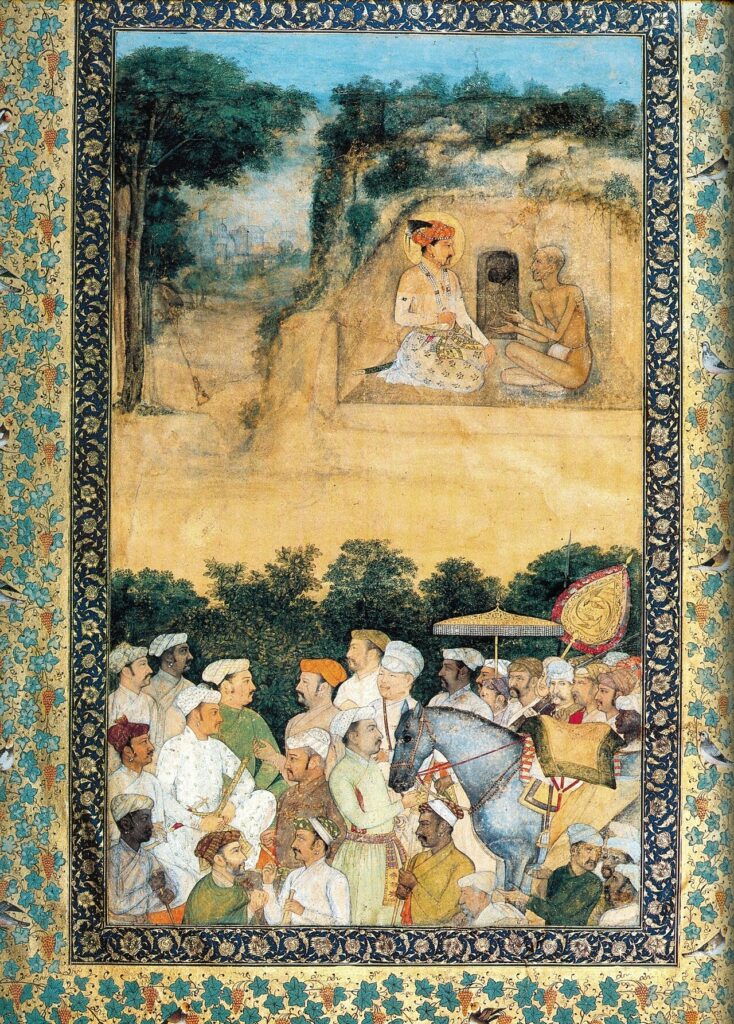
Mughal painting is the courtly miniature tradition that emerged in the Mughal karkhana (royal atelier) between 1555 and 1700, fusing the Persian Safavid manuscript style with indigenous Indian painting idioms — particularly the Hindu Rajput and Jain illuminated-manuscript traditions of northern and western India. The school began under Humayun, who returned from Persian exile with master painters Mir Sayyid Ali and Abd al-Samad; it reached its peak under Akbar (1556–1605) in great illustrated manuscripts like the Tutinama and Hamzanama; passed through the portraiture and naturalism of Jahangir (1605–1627); softened into the formal elegance of Shah Jahan (1628–1658); and declined as a court patronage form under the religiously austere Aurangzeb (1658–1707). The displaced atelier artists then seeded the regional Mughal and Rajput miniature schools that carried the tradition into the eighteenth and nineteenth centuries.
This article covers the Persian roots of Mughal painting, the Humayun-era foundation, the Akbar-era manuscript projects, the Jahangir era of portraiture and natural-history studies, the Shah Jahan period, the Aurangzeb decline, the regional successor schools, and the major painters and works that define the tradition.
Persian Roots and the Humayun Foundation
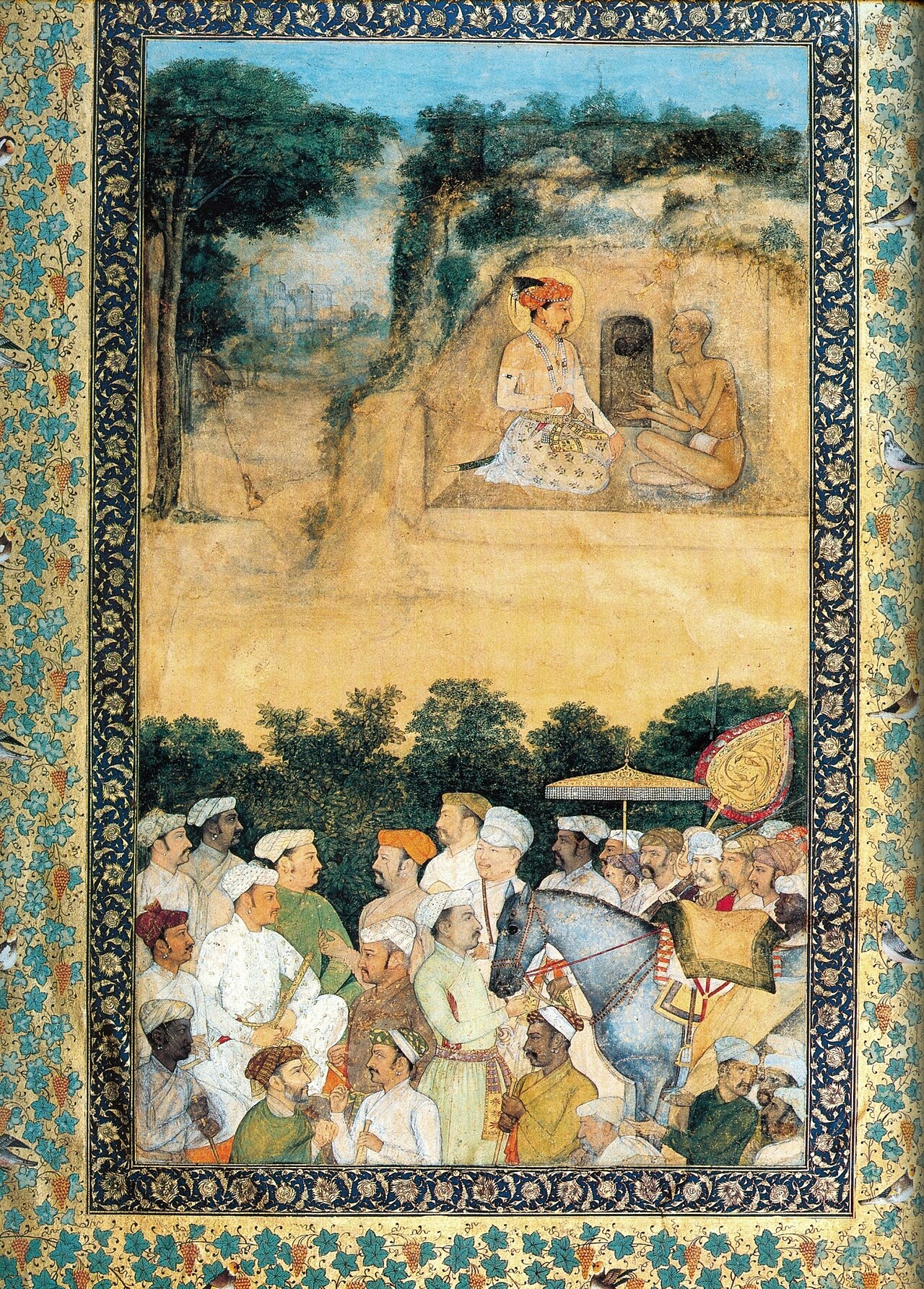
Mughal painting begins with Humayun, the second Mughal emperor. After his defeat by Sher Shah Suri at Chausa (1539) and Kannauj (1540), Humayun fled to the Safavid court of Shah Tahmasp in Persia. There he encountered the mature Tabriz school of Persian miniature painting — heir to the Herat tradition of Bihzad — and on his return to India in 1555 he brought with him two master painters who would seed the Mughal atelier:
- Mir Sayyid Ali — son of the Tabriz master Mir Musavvir, trained in the Bihzad tradition.
- Abd al-Samad — a Shirazi painter who would later supervise the imperial atelier under Akbar.
Humayun also brought Khwaja Abdus Samad, Mir Musavvir, and a small group of Persian craftsmen. These artists established the tasvir-khana (picture house) in Delhi. Humayun died in 1556 before any major manuscript project was completed, but the institutional structure he established passed intact to his son Akbar, who was thirteen at his accession.
What the Persian inheritance brought
The Safavid Tabriz style gave Mughal painting:
- High horizon line with vertical recession.
- Fine brushwork with sable hair brushes.
- Mineral and vegetable pigments (lapis lazuli for blue, vermilion, malachite, gold leaf).
- Manuscript-illustration tradition with text and image integrated.
- Bird’s-eye-view court and garden scenes.
- A repertoire drawn from Persian classics — Nizami’s Khamsa, Firdausi’s Shahnama.
What India added
Indigenous Indian painting traditions — Gujarati Jain manuscripts, the Chaurapanchasika style, and the Sultanate-era Pala-influenced manuscripts — added:
- Brighter, hotter colour palette than the cooler Persian tones.
- More volumetric figures with greater bodily presence.
- Use of Indian dress, architecture, fauna, and flora.
- A naturalistic observation of Indian landscape.
The Mughal style is the synthesis of these two streams.
The Akbar Era (1556–1605) — Peak of the Manuscript Tradition
Akbar inherited the Persian atelier and expanded it dramatically. By the 1590s, the imperial karkhana employed roughly 100 painters under the joint supervision of Abd al-Samad and Mir Sayyid Ali, with Daswanth and Basawan as the leading Indian-born masters. Many painters were drawn from Hindu Rajput backgrounds — Akbar’s policy of inclusion ran through the atelier. The Ain-i-Akbari of Abu’l Fazl names 17 leading painters of the age including Daswanth, Basawan, Kesu Lal, Lal, Mukund, Madhu, Jagan, Mahesh, Khem Karan, Tara, Sanwala, Haribans, and Ram.
The Tutinama
The Tutinama (“Tales of a Parrot”) is the earliest major surviving Mughal manuscript, completed in the late 1560s. Now held primarily at the Cleveland Museum of Art, it contains roughly 250 miniatures across 52 tales. The Tutinama shows the transitional moment when Persian masters and Indian apprentices were beginning to find a common style — Indian figural fullness inside a Persian compositional frame.
The Hamzanama
The Hamzanama (“Adventures of Amir Hamza”) was Akbar’s most ambitious manuscript project. Commissioned around 1562 and completed over fifteen years (c. 1577), it contained 1,400 large folios measuring roughly 67 × 50 cm — unusually large for miniature work. Painted on cotton cloth with text on the reverse, each folio was the work of multiple artists — a designer, a colourist, and a portraitist. Only about 200 folios survive, dispersed across the Vienna MAK museum, the British Museum, the Victoria and Albert, and the Brooklyn Museum.
The Akbarnama and Razmnama
The Akbarnama of Abu’l Fazl was illustrated in the 1590s with miniatures by Basawan, Lal, Manohar, and others. The Razmnama — the Persian translation of the Mahabharata commissioned by Akbar in 1582 — illustrates the emperor’s interest in Hindu epics; its illustrated copy at the Jaipur Palace contains 169 miniatures by leading court artists.
The Akbar synthesis
Akbar’s painters introduced:
- Group portraits with individualised facial features.
- Battle scenes with chaotic crowd composition.
- Naturalistic landscape behind narrative action.
- The use of European prints brought by Jesuit missions to the court at Fatehpur Sikri (1580 onward) — leading to early Mughal experiments with perspective, chiaroscuro, and Christian iconography.
The Jahangir Era (1605–1627) — Portraiture and Natural History
Jahangir is the connoisseur emperor. His Tuzuk-i-Jahangiri memoirs claim he could identify the hand of any painter in a composite work — “if there be a picture containing many portraits, and each face be the work of a different master, I can discover which face is the work of each of them.” Under Jahangir, the atelier shrank from the assembly-line scale of the Hamzanama to a smaller, more elite workshop producing single-leaf paintings of supreme refinement.
Court portraiture
Jahangir’s painters — Abu’l Hasan (titled Nadir al-Zaman), Bishan Das, Manohar, Govardhan, Daulat, and Bichitr — produced individual portraits of courtiers, foreign visitors, and the emperor himself. The bust-and-full-length portrait, often against a plain background with a flower or attribute, became a Mughal speciality. Bichitr’s allegorical Jahangir Preferring a Sufi Shaikh to Kings — showing Jahangir seated on an hourglass throne above James I of England — is the iconic example.
Natural history studies
Jahangir commissioned Mansur (“Nadir al-Asr”) to paint birds, flowers, and animals from observation. Mansur’s Turkey-cock (a bird gifted by a Portuguese embassy), his Himalayan flower studies, and his zebras and exotic species rank among the finest natural-history images of the seventeenth century. Mansur is to Mughal art what John James Audubon would be to nineteenth-century America — an ornithological observer of exceptional acuity.
Aesthetic refinement
Jahangir-era painting features:
- Cool, muted palette.
- Empty or minimally decorated backgrounds.
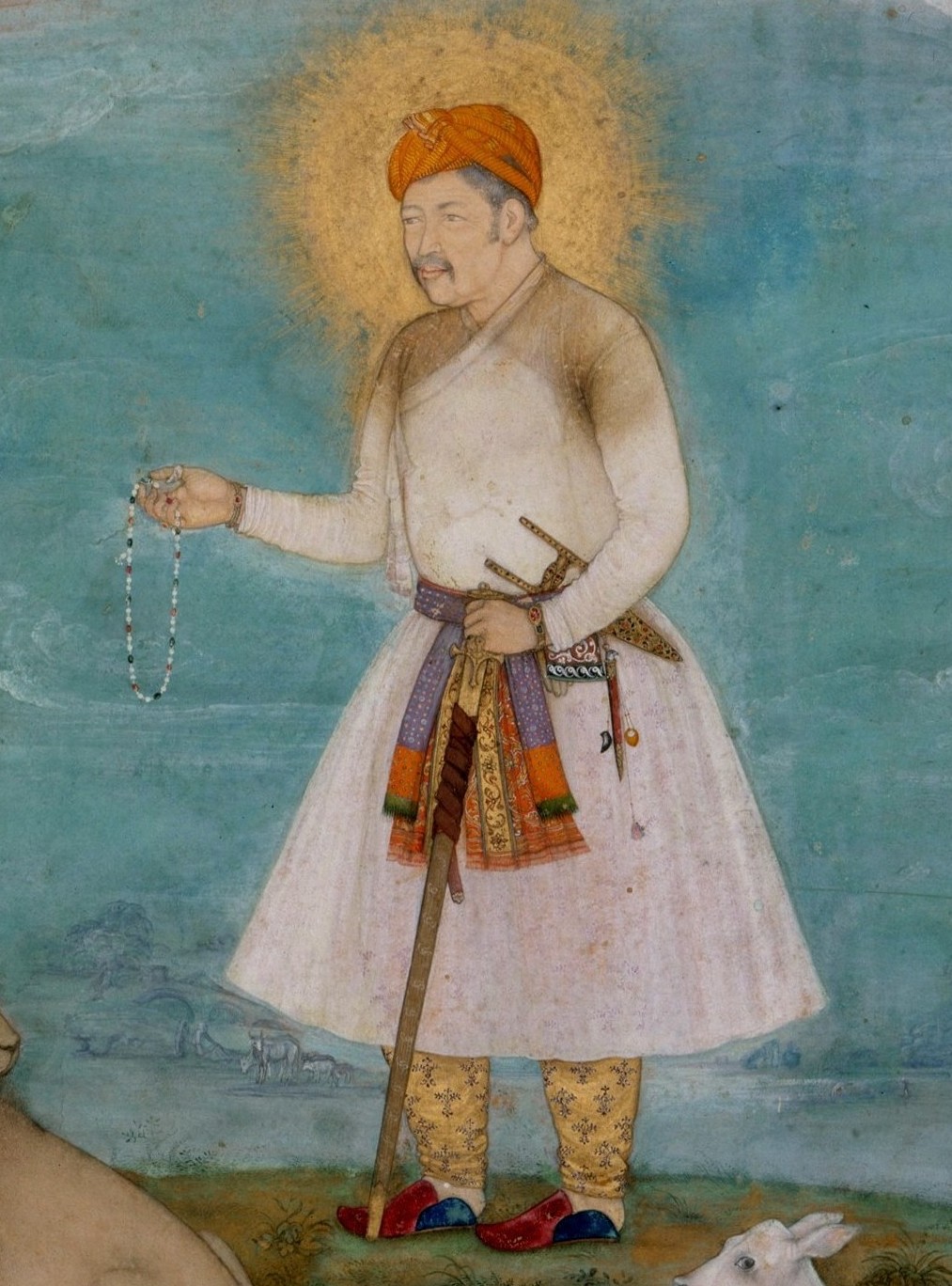
- Halos around imperial figures (a European borrowing).
- Heightened individualism in portraiture.
- Single-leaf album paintings (muraqqa) over book illustration.
The Shah Jahan Era (1628–1658) — Formal Elegance
Under Shah Jahan, the painter is asked to flatter. Court scenes become hieratic and frozen — the emperor on the Peacock Throne surrounded by perfectly arranged nobles, each in profile, each subordinated to the centre. Major painters include Bichitr, Govardhan, Payag, and Hashim.
Characteristics
- Cooler, more silver-grey palette.
- High finish; visible brushwork eliminated.
- Increased use of gold for jewellery, halos, and architectural detail.
- Architectural detail — the white-marble inlay of the Taj Mahal era — reflected in painting backgrounds.
- Reduction of natural-history work; concentration on dynastic portraiture.
The Shah Jahan painting style is parallel in feeling to his architecture — symmetrical, geometric, ornate, slightly cold.
The Aurangzeb Decline (1658–1707)
Aurangzeb’s religious orthodoxy disapproved of figural painting, and his austerity reduced atelier patronage sharply. Painters left the imperial workshop and sought employment in the Deccan sultanate courts of Bijapur, Golconda, and Hyderabad, and in the Rajput courts of Mewar, Marwar, Bundi, and Kishangarh. The displaced craftsmen seeded the major Pahari schools — Basohli, Kangra, Guler — and the Rajput schools of the eighteenth century.
Aurangzeb did continue some portrait work for political purposes — court ceremonials, hunt scenes — but the institutional infrastructure of the Mughal atelier was effectively dismantled by the 1690s. Bahadur Shah I and his successors maintained a residual practice, but the great age was over.
Late and provincial Mughal
The late Mughal style of Muhammad Shah (1719–1748) shows a partial revival under a less religiously rigid emperor. Provincial Mughal schools developed at Lucknow under the Nawabs of Awadh, Murshidabad under the Nawabs of Bengal, and Hyderabad under the Asaf Jahis. These provincial styles often combined Mughal technique with regional themes and patrons including European East India Company officials — the Company style of the early nineteenth century.
Materials and Workshop Method
Mughal painters worked on wasli — multiple layers of handmade paper burnished smooth with an agate stone. Outline was drawn in red or black with a fine sable or squirrel-hair brush. Pigments included lapis lazuli (ultramarine), malachite (green), vermilion (red), orpiment (yellow), lead white, lamp black, and pure gold leaf. The image was burnished after each layer to compact the pigment into the paper surface — producing the characteristic Mughal enamel-like finish.
Workshop production was collaborative — a tarrah (designer) drew the composition, a rang-amez (colourist) applied the pigments, and a chihra-nami (portraitist) painted the faces. A complex folio could pass through three or four hands.
Persian-Indian Fusion — Distinguishing Features
The mature Mughal style is identifiable by:
- Naturalistic figures with individualised faces.
- Detailed costume and jewellery rendered with optical precision.
- Indian flora, fauna, and architecture.
- Borrowed European elements — perspective, chiaroscuro, putti, halos.
- Persian compositional frame — high horizon, vertical recession.
- Calligraphic borders integrating Persian or Arabic text.
- Workshop signature traditions — artists named in inscriptions, particularly under Akbar and Jahangir.
Mughal Painting Today
Major Mughal painting collections sit at the Chester Beatty Library (Dublin), the Victoria and Albert Museum (London), the British Museum, the Metropolitan Museum of Art (New York), the Smithsonian Freer-Sackler (Washington), the Bibliothèque Nationale (Paris), the Reza Library (Rampur), the National Museum (Delhi), the Salar Jung Museum (Hyderabad), and the Bharat Kala Bhavan (Banaras). The dispersed inheritance — much of it carried out by colonial collectors — is now the subject of growing repatriation and scholarship.
The tradition forms part of the broader Indian visual canon that also includes the folk parallel of Madhubani painting in Mithila and the temple-and-court performance traditions of Bharatanatyam in Tamil Nadu and Kathakali in Kerala. The Mughal atelier’s organisational culture — workshop division of labour, named master painters, patron-commissioned manuscripts — has parallels in the courtly intellectual culture of Akbar’s navratna, and the broader medieval craft economy of which the Chola-period Brihadeeswara temple bronze-casting workshops are a separate but comparable instance.
Frequently Asked Questions
What is Mughal painting?
Mughal painting is the courtly miniature tradition of the Mughal Empire (c. 1555–1700) that fused Persian Safavid manuscript style with indigenous Indian painting idioms. It centred on the imperial karkhana atelier and produced illustrated manuscripts, portrait albums, and natural-history studies.
Who founded Mughal painting?
The Mughal painting school was founded under Emperor Humayun, who brought Persian masters Mir Sayyid Ali and Abd al-Samad from the Safavid court of Shah Tahmasp on his return to India in 1555. The institution was inherited and expanded by his son Akbar.
What were the major Mughal manuscripts?
The major manuscripts include the Tutinama (Tales of a Parrot, c. 1560s), the Hamzanama (Adventures of Amir Hamza, 1562–1577, 1,400 large folios), the Akbarnama (1590s, by Abu’l Fazl), and the Razmnama (Persian translation of the Mahabharata, 1582). Most are held outside India today.
What changed in Mughal painting under Jahangir?
Under Jahangir the workshop shrank and refined. Production shifted from large manuscripts to single-leaf album paintings (muraqqa), portraiture became the dominant genre, and Mansur produced natural-history studies of birds and flowers. The palette cooled, backgrounds emptied, and halos around imperial figures appeared.
How did Aurangzeb affect Mughal painting?
Aurangzeb’s religious orthodoxy and austerity sharply reduced atelier patronage. Painters left the imperial workshop and joined the Deccan, Rajput, and Pahari courts, seeding the eighteenth-century regional schools of Basohli, Kangra, Guler, Mewar, Bundi, and Kishangarh. The great age of Mughal painting effectively ended by the 1690s.
Who were the leading Mughal painters?
Leading painters include Mir Sayyid Ali and Abd al-Samad (Humayun-Akbar transition), Daswanth, Basawan, Kesu Lal, and Manohar (Akbar era), Abu’l Hasan, Bishan Das, Mansur, Govardhan, Daulat, and Bichitr (Jahangir era), and Payag, Hashim, and Bichitr (Shah Jahan era).
What materials did Mughal painters use?
Mughal painters worked on wasli — multilayered handmade paper burnished smooth. Pigments were mineral and vegetable — lapis lazuli for blue, malachite for green, vermilion for red, orpiment for yellow, lead white, lamp black, and pure gold leaf. Brushes were fine sable or squirrel hair.
How does Mughal painting fuse Persian and Indian styles?
Mughal painting takes the Persian Safavid manuscript frame — high horizon, vertical recession, fine brushwork, manuscript illustration — and combines it with Indian additions including a hotter palette, more volumetric figures, Indian dress, architecture, and landscape, and a naturalism stronger than the Persian original. European prints later added perspective and chiaroscuro.
Tell Google you want more of this.
Add Anantam IAS as a preferred sourceOne tap, and this site shows up more often in your own Top Stories, AI Overviews and AI Mode. Remove it any time.