

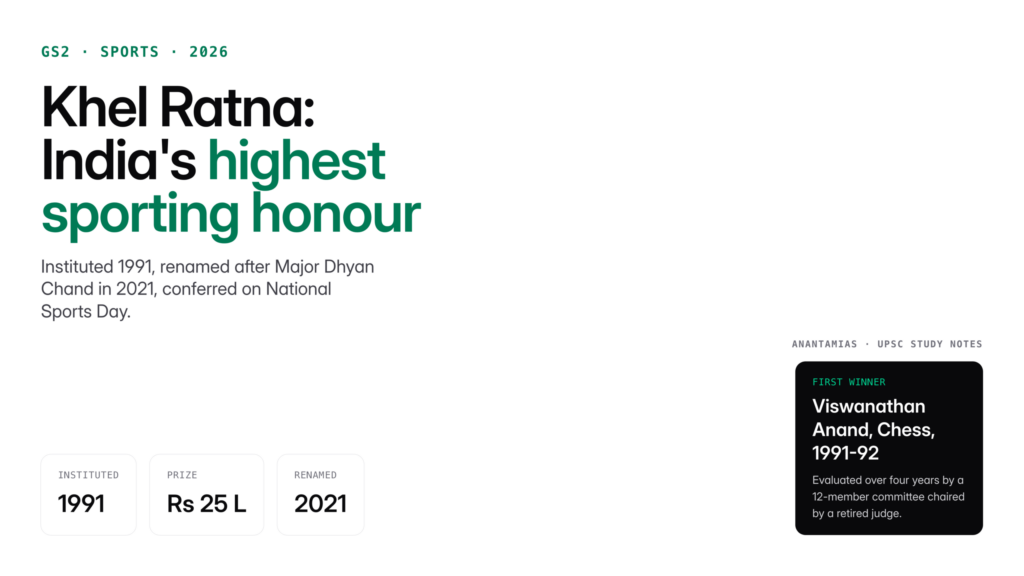
The most recent Major Dhyan Chand Khel Ratna Award — India’s highest sporting honour — was conferred on 17 January 2025 at Rashtrapati Bhavan to four athletes: Manu Bhaker (shooting), D. Gukesh (chess), Harmanpreet Singh (hockey) and Praveen Kumar (para-athletics). The award carries a cash prize of Rs 25 lakh and, as of 2025, has been conferred on 62 sportspersons since it was instituted in 1991-92. It was originally the Rajiv Gandhi Khel Ratna Award and was renamed after hockey legend Major Dhyan Chand on 6 August 2021.
Introduction
The Major Dhyan Chand Khel Ratna Award is the highest sporting honour conferred by the Government of India. Instituted in 1991 as the Rajiv Gandhi Khel Ratna Award and renamed in August 2021 in memory of the hockey wizard Major Dhyan Chand, the award recognises the most spectacular and outstanding performance by a sportsperson over a four-year period. For UPSC aspirants, this award is an annual feature in Prelims current-affairs sections and a useful hook for Mains discussions on sports governance, the role of government in promoting excellence, and India’s gradual rise as a multi-sport nation.
Every year in late August or September, when the list is announced by the Ministry of Youth Affairs and Sports, a predictable cycle follows. Who won it this time? Why was the committee delayed? Was there a controversy over non-selection? For an aspirant, understanding the scaffolding of the award, its eligibility rules, the selection committee, the prize money and the list of past winners builds both factual recall and a deeper sense of how India rewards sporting excellence.
Quick Facts at a Glance
| Attribute | Detail |
|---|---|
| Original name | Rajiv Gandhi Khel Ratna Award |
| Renamed to | Major Dhyan Chand Khel Ratna Award (6 August 2021) |
| Instituted in | 1991-92 |
| Awarding body | Ministry of Youth Affairs and Sports, Government of India |
| First recipient | Viswanathan Anand (Chess, 1991-92) |
| Cash prize | Rs 25 lakh |
| Medallion | Gold-plated with national emblem and inscription |
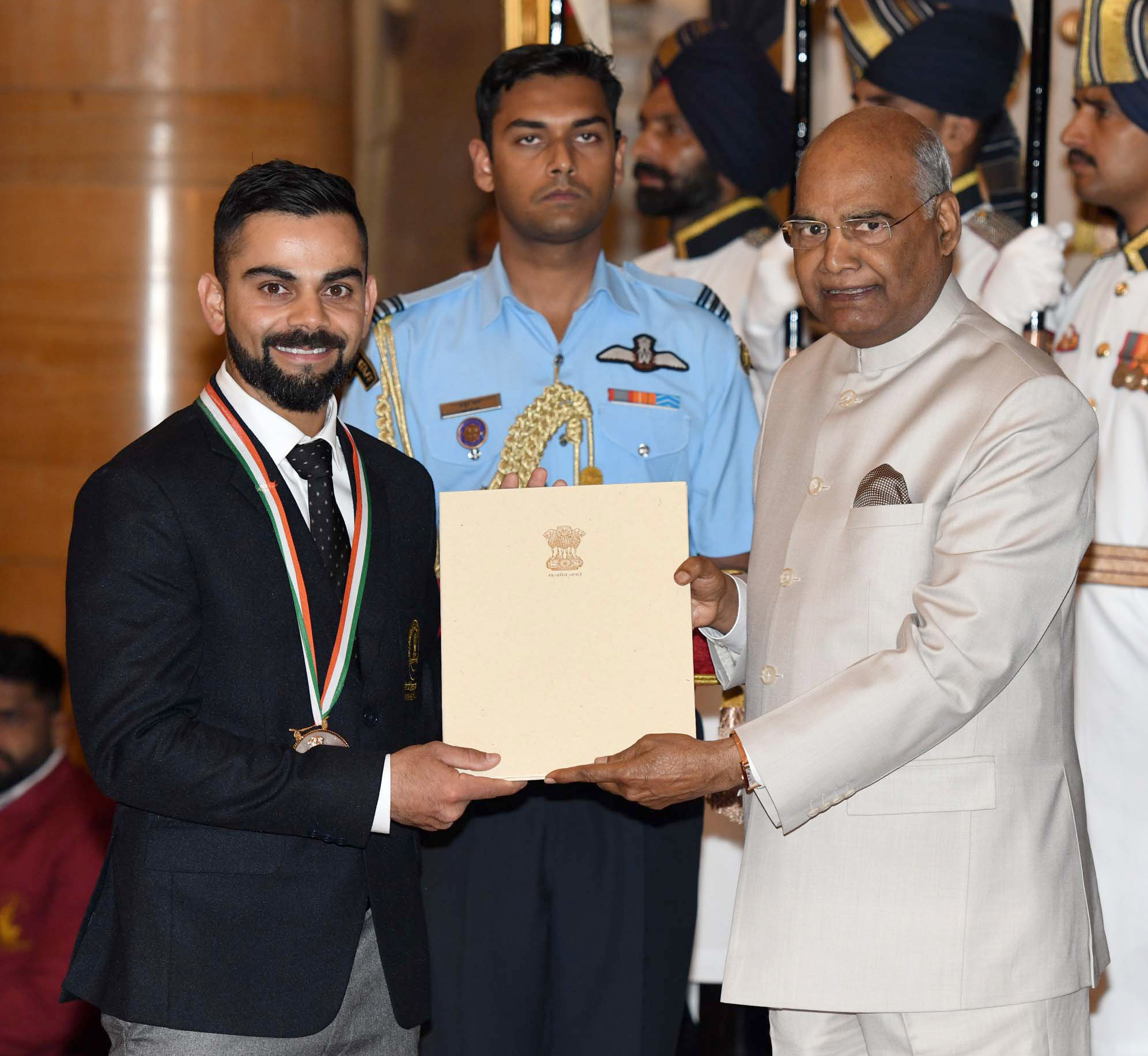
| Conferred by | President of India at Rashtrapati Bhavan |
| Evaluation period | Preceding four years |
| Number of awardees | Typically 1-3 per year, occasionally more |
Background and Historical Context
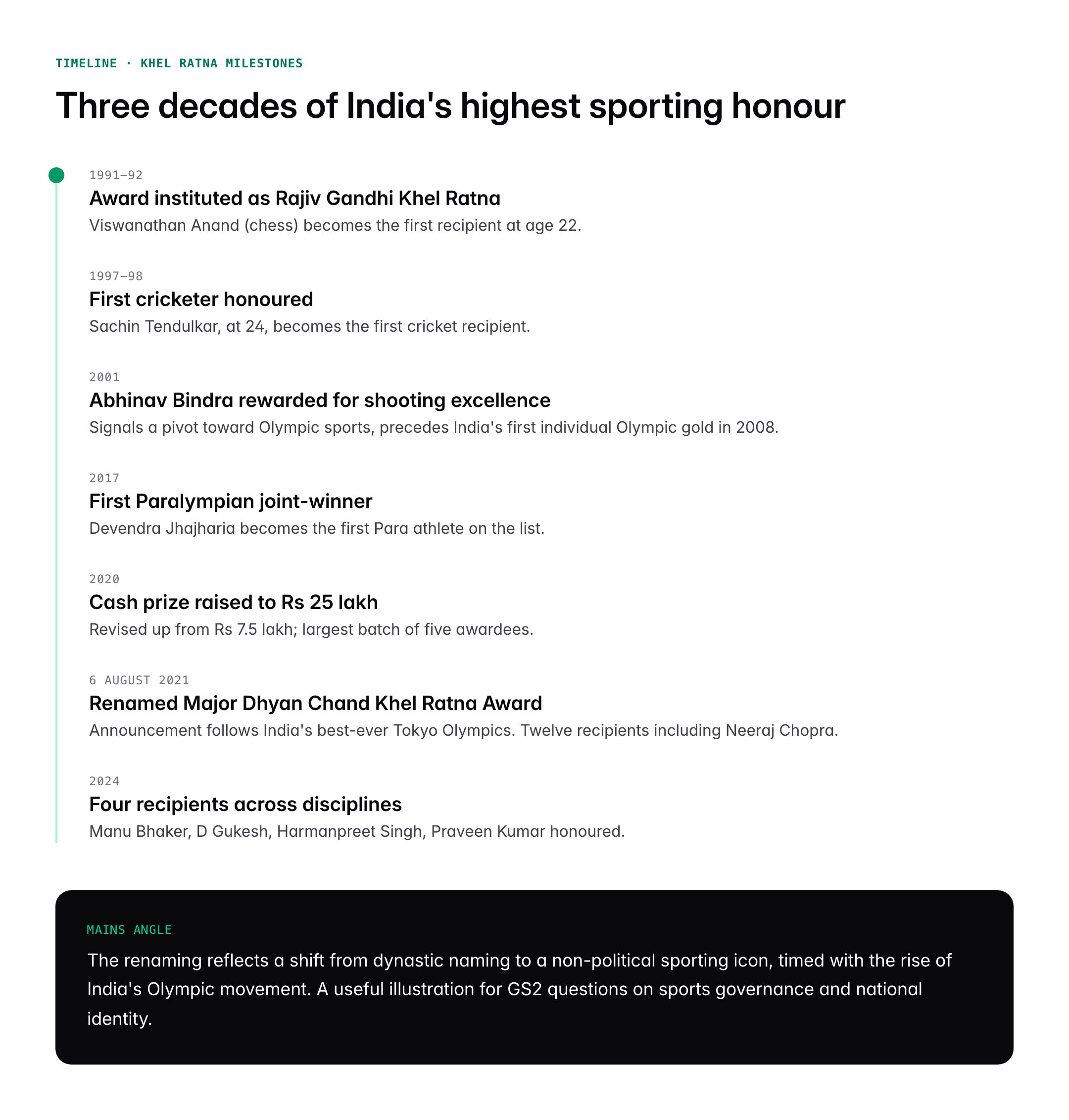
India’s post-Independence sports awards architecture began with the Arjuna Award in 1961, which recognised consistent performance. By the late 1980s, policy-makers felt the need for an apex award that rewarded a single year or cycle of extraordinary excellence, comparable to the Bharat Ratna in civilian life. The Rajiv Gandhi Khel Ratna Award was instituted in 1991-92 under the Ministry of Human Resource Development (then responsible for youth and sports) and later moved to the Ministry of Youth Affairs and Sports, which was carved out as a separate ministry in 2000.
The inaugural award in 1991-92 went to chess grandmaster Viswanathan Anand, then a rising 22-year-old who had already claimed the world junior title and was breaking into the global elite. The choice of a chess player for India’s first Khel Ratna underlined the award’s spirit: recognising world-class excellence across the full breadth of sport, not just cricket or hockey.
On 6 August 2021, after India’s best-ever Tokyo Olympics, Prime Minister Narendra Modi announced the renaming of the award to the Major Dhyan Chand Khel Ratna Award. The decision honoured Major Dhyan Chand (1905-1979), the hockey legend who led India to Olympic gold medals in 1928, 1932 and 1936 and scored over 400 goals in international matches. The renaming was announced on 6 August 2021, days after the Indian men’s hockey team won bronze at Tokyo after a 41-year wait. Dhyan Chand’s birthday, 29 August, is celebrated as National Sports Day.
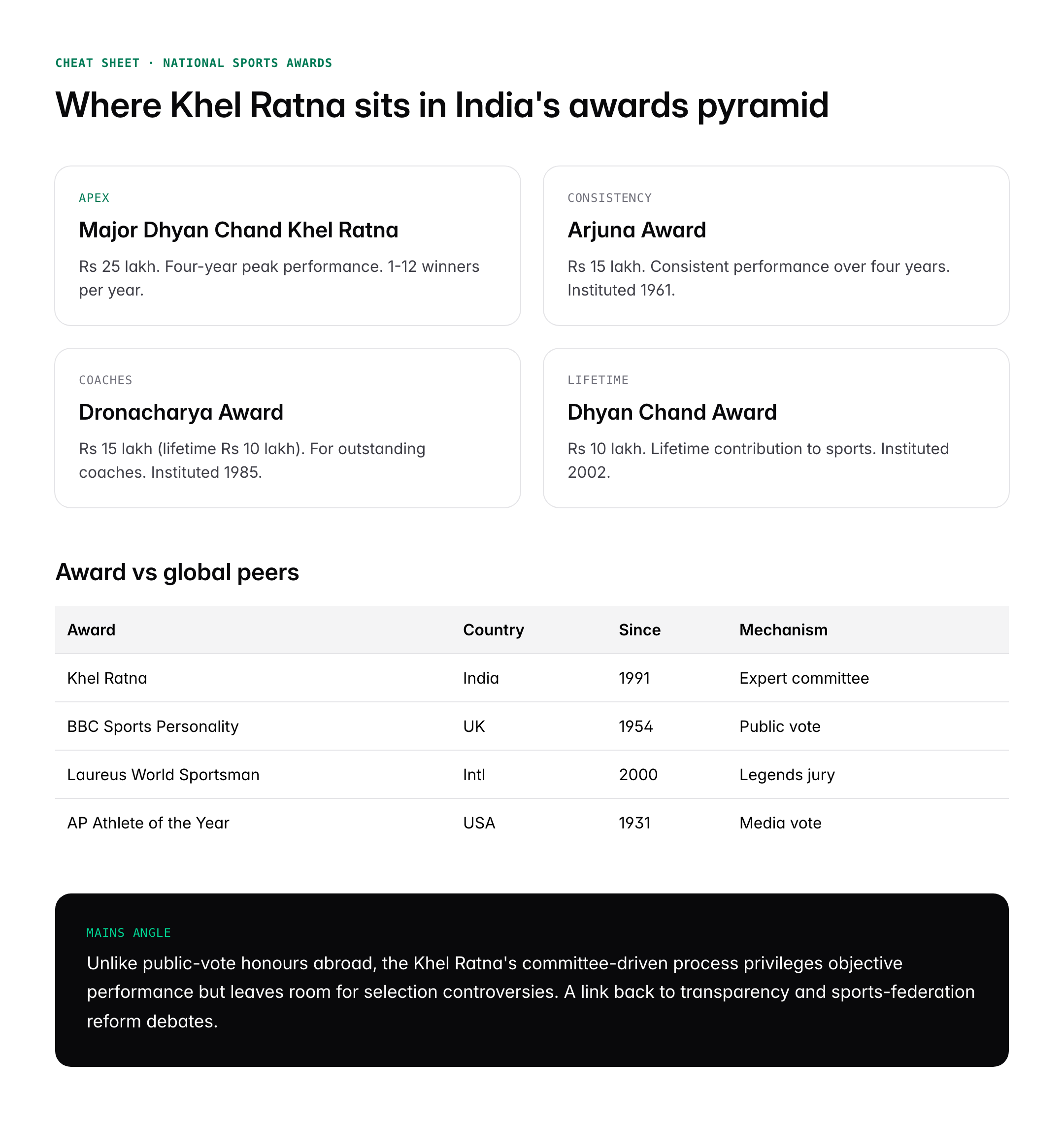
The Khel Ratna sits at the top of a pyramid of national sports awards that includes the Arjuna Award for consistent outstanding performance over four years, the Dronacharya Award for coaches, the Dhyan Chand Award for lifetime contribution, and the Rashtriya Khel Protsahan Puraskar for institutions. Together these awards trace the evolution of India from a one-sport Olympic nation to a broader sporting ecosystem.
Key Features and Provisions
Eligibility and Criteria
The Khel Ratna is open to sportspersons in disciplines included in the Olympic Games, Asian Games, Commonwealth Games, World Championship and Cricket, plus indigenous sports and para-sports. The evaluation period is the four calendar years immediately preceding the year of nomination, though the committee weighs the spectacular performances within that window. The award is strictly for individual performance, though team sport athletes who demonstrated extraordinary contribution are eligible.
Selection Committee
A twelve-member Selection Committee, reconstituted annually, evaluates nominations. The committee is chaired by a retired Supreme Court or High Court judge and includes two Olympians or medal-winners from Olympic/Asian/Commonwealth Games, two eminent sports journalists or experts, two members from the Sports Authority of India or the Ministry, and representatives of the Indian Olympic Association and national sports federations. Nominations are evaluated on a 100-point scale: 80 points for performance in the four-year cycle and 20 points for qualities such as leadership, sportsmanship and sense of discipline.
Prize and Presentation
The winner receives a medallion featuring the national emblem, a scroll of citation and a cash prize of Rs 25 lakh. Before the 2020 revision the prize was Rs 7.5 lakh. Awards are traditionally conferred by the President of India at an investiture ceremony at Rashtrapati Bhavan on or around National Sports Day (29 August).
Relationship with Arjuna Award
A sportsperson who has already received the Arjuna Award remains eligible for the Khel Ratna, but an individual who has won the Khel Ratna cannot later receive the Arjuna Award for the same sport. The Khel Ratna is conceptually superior: where Arjuna rewards consistency, Khel Ratna rewards peak.
Withdrawal Clause
The award can be withdrawn or forfeited if a recipient brings disrepute to the award, engages in doping, or acts against national interest. The Ministry retains discretion. Cases of such withdrawal have been rare but possible under the framework.
Significance for UPSC and General Knowledge
- Frequently tested in Prelims through “Who was the first recipient?” or “In which year was it renamed?” style questions, and the Anand-1991 fact is a recurring answer.
- Useful in Mains GS2 discussions on the role of government in promoting sports, as the award is a visible tool of state patronage of sporting excellence.
- Provides a lens on the Khelo India scheme, Target Olympic Podium Scheme (TOPS) and the Fit India Movement, which together form the policy ecosystem that the award crowns.
- The 2021 renaming is a case study in the politics of commemoration, the balance between dynastic and individual naming, and the use of sports icons as national symbols.
- Data on the gender ratio of winners, distribution across sports and geographical spread across states gives aspirants quantitative material for essay and interview responses.
- The withdrawal clause links the topic to the broader anti-doping conversation, the National Anti-Doping Agency (NADA) and India’s obligations under the WADA Code.
Detailed Analysis: List of Winners and Patterns
Since 1991-92, the award has been conferred more than forty-five times across three dozen years, with multiple recipients in several years. Early winners came overwhelmingly from individual sports: Viswanathan Anand (chess, 1991-92), Geet Sethi (billiards, 1992-93), Homi Motivala and P K Garg (yachting, 1994-95), Kunjarani Devi (weightlifting, 1995-96), Leander Paes (tennis, 1996-97) and Sachin Tendulkar (cricket, 1997-98). Tendulkar’s selection, coming at age 24, was the first time a cricketer received the honour.
The 2000s expanded the award to Olympic sports as India began converting talent into medals. Dhanraj Pillay (hockey, 1999-2000), Pullela Gopichand (badminton, 2000-01), Abhinav Bindra (shooting, 2001), Anjali Bhagwat (shooting, 2002-03), K M Beenamol and Anju Bobby George (athletics, 2002-03 and 2003-04), and Rajyavardhan Singh Rathore (shooting, 2004-05) marked the decade. Bindra went on to win India’s first individual Olympic gold at Beijing 2008.
The post-2010 period saw a surge in women winners and Paralympic athletes. Mary Kom (boxing, 2009), Saina Nehwal (badminton, 2009-10), Gagan Narang (shooting, 2010-11), Vijay Kumar and Yogeshwar Dutt (2012), Ronjan Sodhi (2013), Sania Mirza (2015), P V Sindhu and Dipa Karmakar (2016), Devendra Jhajharia, the first Paralympian joint-winner (2017), and Virat Kohli (2018) widened the circle. The 2020 list was the largest in history, with five recipients including Rohit Sharma, Mariyappan Thangavelu and Rani Rampal. In 2021, the freshly renamed award went to a record twelve recipients including Neeraj Chopra (athletics, javelin), P R Sreejesh (hockey), Ravi Kumar Dahiya (wrestling) and the entire Tokyo medal contingent. The 2022 winners were Sharath Kamal (table tennis), and 2023 recipients included Satwiksairaj Rankireddy and Chirag Shetty (badminton). The 2024 awards, conferred on 17 January 2025, went to Manu Bhaker (shooting), D. Gukesh (chess), Harmanpreet Singh (hockey) and Praveen Kumar (para-athletics) — the latest recipients to date.
Patterns worth noting: shooting, wrestling, boxing and badminton dominate the list since 2008, reflecting India’s Olympic medal footprint. Cricket has produced only four winners, partly because cricket is not an Olympic event. Para-athletes have received the award regularly since 2017, reflecting India’s expanding Paralympic movement.
Comparative Perspective
The Khel Ratna sits within a global landscape of national and international sports honours. A brief comparison helps contextualise it:
| Award | Country | Year Instituted | Cash Prize (approx) | Criteria |
|---|---|---|---|---|
| Major Dhyan Chand Khel Ratna | India | 1991 | Rs 25 lakh | Four-year peak performance |
| BBC Sports Personality of the Year | United Kingdom | 1954 | No cash | Public vote, calendar year |
| Laureus World Sportsman/Sportswoman | International | 2000 | Trophy | Calendar year, jury of legends |
| Associated Press Athlete of the Year | United States | 1931 | No cash | Media vote, calendar year |
| China Sports Outstanding Contribution | China | 1984 | Varies | Multi-year achievement |
Unlike the BBC or AP awards that depend on public or media voting, the Khel Ratna is government-conferred after expert committee evaluation, which makes it closer in nature to the Russian Order of Honour or China’s National Sports Outstanding Contribution awards. The relatively high cash component of the Khel Ratna, at Rs 25 lakh, reflects Indian policy choice of using monetary rewards as an incentive where private sponsorship for non-cricket athletes is still thin.
Controversies and Debates
The Khel Ratna has weathered periodic controversies. Non-selection of deserving athletes has frequently triggered public anger, with fans and former players alleging favouritism of more marketable names. Wrestler Sushil Kumar’s 2009 joint nomination sparked debate on whether Olympic bronze deserved parity with non-Olympic achievements. The 2021 renaming itself was politically contested: some opposition voices saw it as an erasure of the Rajiv Gandhi legacy; others welcomed the shift to a non-dynastic hockey icon. Dhyan Chand’s family and supporters had long argued that the wizard of hockey deserved Bharat Ratna, and the Khel Ratna renaming was seen as partial recognition.
A recurring criticism is the evaluation window: rewarding a four-year cycle disadvantages athletes whose peak falls between Olympic cycles, and privileges those who peak in Asian Games or Commonwealth years. The large 2020 and 2021 batches raised concerns about dilution of prestige, though the Ministry defended them as a fitting response to India’s expanded medal tally. Doping cases involving past awardees, including weightlifters and athletes, have also tested the withdrawal clause, with the Ministry generally preferring censure over public revocation.
Prelims Pointers
- The award was instituted in 1991-92, initially as the Rajiv Gandhi Khel Ratna Award.
- Viswanathan Anand was the first recipient, for chess.
- Renamed on 6 August 2021 to the Major Dhyan Chand Khel Ratna Award.
- Administered by the Ministry of Youth Affairs and Sports.
- Cash prize is Rs 25 lakh, revised upward in 2020.
- Conferred by the President of India at Rashtrapati Bhavan.
- National Sports Day on 29 August (Dhyan Chand’s birthday) is linked to the award ceremony.
- Major Dhyan Chand won Olympic gold in 1928, 1932 and 1936 and scored over 400 international goals.
- Sachin Tendulkar (1997-98) was the first cricketer to win the award.
- Devendra Jhajharia (2017) was the first Paralympian to win the award jointly.
- Evaluation period is the preceding four years.
- A Khel Ratna winner cannot later receive the Arjuna Award for the same discipline.
Mains Practice Questions
Q1. The renaming of the Rajiv Gandhi Khel Ratna Award to the Major Dhyan Chand Khel Ratna Award in 2021 reflects both a symbolic and a policy shift. Discuss.
- Symbolic: from dynastic to hockey-icon naming, tied to National Sports Day and Tokyo Olympics.
- Policy: signal to strengthen non-cricket sports, links to Khelo India, TOPS, and Fit India.
- Critique: political contestation, dilution concerns, and continued need for structural reforms in sports governance.
Q2. Evaluate the role of national sports awards in promoting sporting excellence in India. Are they adequate, or do they need reform?
- Role: recognition, financial incentive, role-model creation, and career security for non-cricket athletes.
- Gaps: selection controversies, sport-wise imbalance, doping-related withdrawal ambiguity, and disparity across states.
- Reform directions: transparent scoring, independent ombudsman, link with long-term support via TOPS and Khelo India.
Conclusion
The Major Dhyan Chand Khel Ratna Award is more than a medallion and a cheque. It is the state’s most visible signal of which sports and which athletes India chooses to honour as its finest. From Viswanathan Anand’s chessboard in 1991 to Neeraj Chopra’s javelin throw in 2021 and the broadening field of para-athletes in recent years, the award’s list of winners traces the arc of a sporting nation that is slowly moving beyond cricket.
For UPSC aspirants, the award is a compact topic that connects Prelims facts to Mains debates on sports governance, social inclusion and national identity. Remembering the year, the first winner, the renaming date and the prize amount covers the objective questions, while understanding the controversies, the comparative landscape and the link to schemes like Khelo India equips aspirants to answer analytical prompts in the General Studies papers and interview.
Frequently Asked Questions
What is the Major Dhyan Chand Khel Ratna Award?
The Major Dhyan Chand Khel Ratna Award is India’s highest sporting honour, instituted in 1991-92 as the Rajiv Gandhi Khel Ratna Award and renamed in August 2021. Conferred by the President of India on National Sports Day, it recognises the most spectacular performance by a sportsperson over the preceding four years and carries a cash prize of Rs 25 lakh.
Why is the Khel Ratna important for UPSC?
It appears in Prelims through factual questions on year of institution, first winner and renaming, and in Mains as a case study in sports governance under GS2. The award links to schemes like Khelo India, TOPS and Fit India, and to debates on doping, sports federation reform and India’s Olympic performance, making it a compact topic with wide analytical reach.
How is the Khel Ratna related to the Arjuna Award?
Both are national sports awards, but the Arjuna recognises consistent performance over four years while the Khel Ratna rewards peak excellence. An Arjuna awardee can later win the Khel Ratna, but a Khel Ratna winner cannot later receive the Arjuna Award in the same discipline. The Khel Ratna is the apex award and sits above Arjuna in the pyramid.
Who was the first recipient of the Khel Ratna?
Chess grandmaster Viswanathan Anand received the inaugural Rajiv Gandhi Khel Ratna Award in 1991-92, at age 22. His selection signalled that the award would recognise world-class excellence across all sports, not just cricket or hockey. Anand went on to win five World Chess Championships and remains the only Indian chess world champion.
Why was the award renamed in 2021?
Prime Minister Narendra Modi announced the renaming on 6 August 2021, days after the Tokyo Olympics, to honour hockey legend Major Dhyan Chand. Dhyan Chand led India to Olympic golds in 1928, 1932 and 1936 and scored over 400 international goals. The decision followed longstanding demand to memorialise him and was timed with India’s best-ever Olympic medal tally.
How are winners selected and what is the prize?
A twelve-member Selection Committee chaired by a retired judge evaluates nominations on a 100-point scale: 80 points for performance over four years and 20 points for qualities such as leadership and discipline. The Ministry of Youth Affairs and Sports finalises the list. Winners receive a medallion, citation scroll and Rs 25 lakh cash, revised up from Rs 7.5 lakh in 2020.
Can the Khel Ratna be withdrawn?
Yes. The award can be withdrawn if a recipient brings disrepute to the honour, is found guilty of doping, or acts against national interest. The Ministry retains discretion. Public revocations have been rare, but the clause links the award to India’s obligations under the WADA Code and the oversight of the National Anti-Doping Agency.
Who are some recent Khel Ratna winners?
Recent winners include Neeraj Chopra, P R Sreejesh and Ravi Kumar Dahiya (2021), Sharath Kamal (2022), Satwiksairaj Rankireddy and Chirag Shetty (2023), and Manu Bhaker, D Gukesh, Harmanpreet Singh and Praveen Kumar (2024). The list reflects India’s broadening Olympic, Paralympic and world-championship footprint across athletics, badminton, chess, hockey, shooting and wrestling.
Tell Google you want more of this.
Add Anantam IAS as a preferred sourceOne tap, and this site shows up more often in your own Top Stories, AI Overviews and AI Mode. Remove it any time.






