Clean drinking water sounds like a simple problem. It is not. Roughly two hundred million Indians live in districts where the groundwater carries fluoride above safe limits. Tens of millions more live in arsenic-affected belts in West Bengal, Bihar, Assam, and the eastern Gangetic plain. Conventional sand filters and chlorination cannot touch these contaminants. Reverse osmosis can, but it wastes water and strips out useful minerals along with the toxins. What sits between these two extremes is a quieter technology that most people have never heard of: nanofiltration.
Nanofiltration is membrane filtration that uses pores roughly one to ten nanometres across. That is small enough to reject divalent ions like calcium, magnesium, and many heavy metals, while letting most monovalent salts and water molecules pass through. The trade-off is precise. You get safe water without the energy cost and brine waste of full reverse osmosis, and without the inability of microfiltration to remove dissolved toxins.
For UPSC purposes, the topic sits at the intersection of nanotechnology, public health, environmental engineering, and India’s drinking water policy. It also connects to the broader nanomaterials revolution that has turned graphene oxide and silver nanoparticles from laboratory curiosities into practical tools. This article walks through what nanofiltration actually does, how it differs from neighbouring technologies, where it fits in India’s water security plans, and what limits it.
Quick Facts on Nanofiltration
Nanofiltration is a pressure-driven membrane separation process. Water is forced through a thin polymer or composite membrane whose pores are between one and ten nanometres in diameter. Particles, ions, and molecules larger than the pore are rejected. Smaller ones pass through with the water.
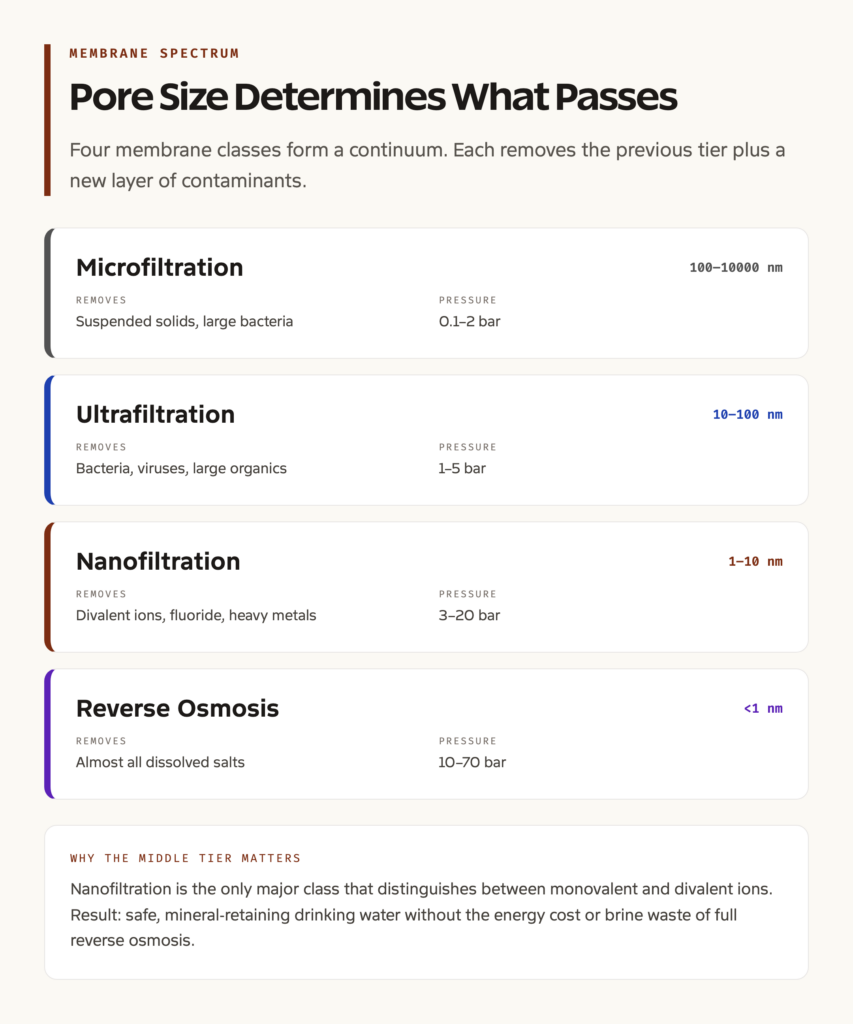
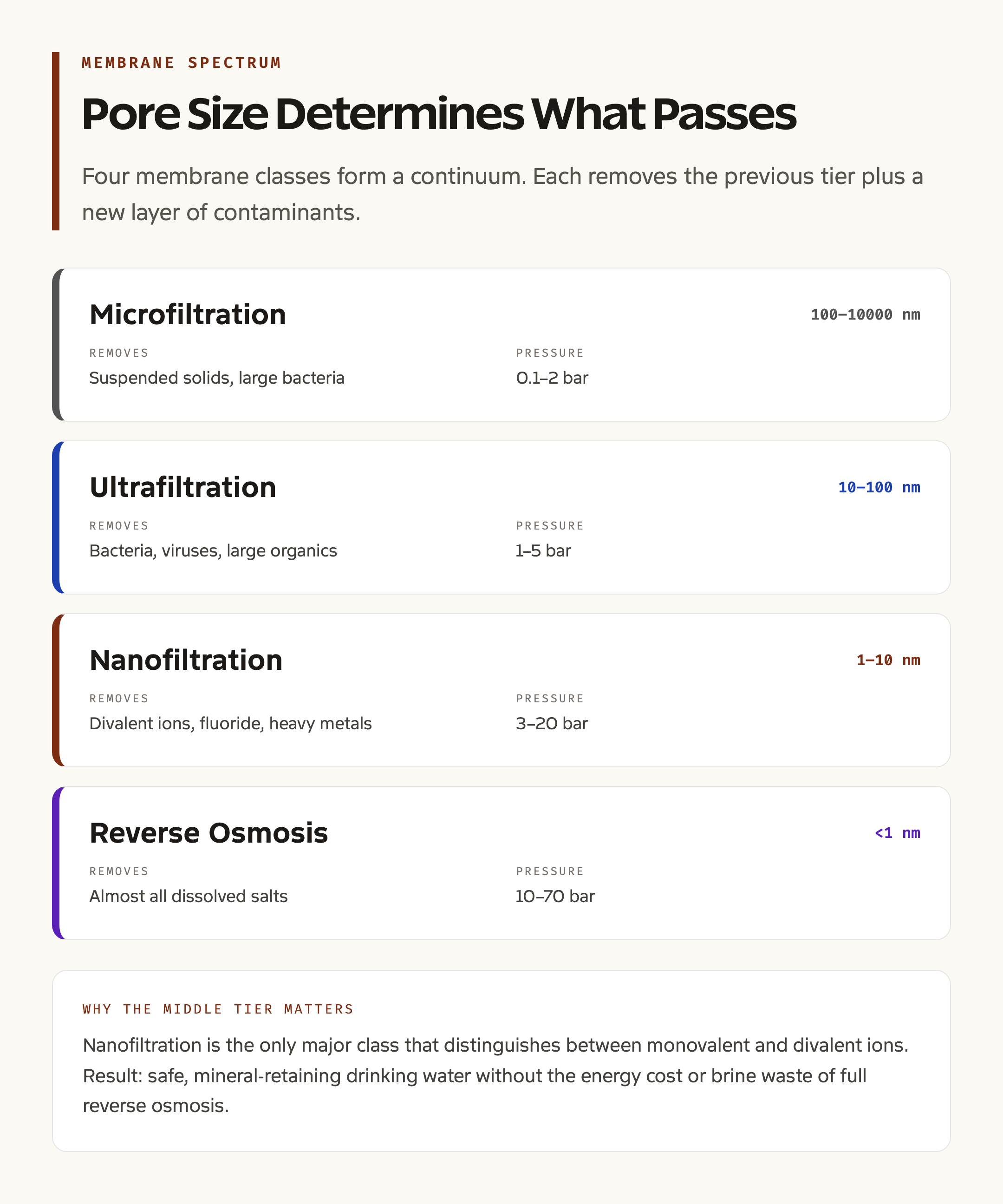
The technology sits between ultrafiltration and reverse osmosis on the membrane spectrum. Ultrafiltration uses pores around ten to one hundred nanometres and removes bacteria, viruses, and large organic molecules but lets dissolved salts through. Reverse osmosis uses dense membranes with effective openings well below one nanometre and removes almost everything, including the salts and minerals that nanofiltration retains.
In Indian drinking water, the targets that matter most are fluoride, arsenic, iron, nitrate, and bacterial contamination. Fluoride above 1.5 milligrams per litre causes dental and skeletal fluorosis. Arsenic above ten micrograms per litre causes skin lesions, cardiovascular damage, and cancer. Both are removable by nanofiltration, often without the high energy cost or rejected brine that reverse osmosis produces.
How Nanofiltration Actually Works
The simplest mental model is a sieve, but the physics is more interesting than that. A nanofiltration membrane separates by two parallel mechanisms. The first is size exclusion. Anything physically larger than the pore is blocked. The second is surface charge. Most modern nanofiltration membranes carry a fixed negative charge on their surface. Negatively charged ions like sulphate and fluoride are repelled. Positively charged ions like sodium and calcium are attracted, but the divalent ones are too tightly held by the membrane chemistry to pass through.
The result is a selectivity that single-mechanism filters cannot achieve. Sodium chloride passes mostly through. Calcium sulphate is heavily rejected. Trace organics with molecular weight above two hundred Daltons are rejected. Fluoride, despite being a small ion, is rejected because of charge effects.
Operating pressure for nanofiltration is typically three to twenty bar, lower than the forty to seventy bar that seawater reverse osmosis demands. That translates to lower energy cost. Water recovery is generally seventy to ninety percent, better than the sixty to seventy percent of household reverse osmosis. The brine stream is smaller and less concentrated, which matters in inland deployments where there is no ocean to dump waste into.
Background and Historical Context
Nanofiltration as a category emerged in the late 1980s, when membrane chemists realised that thin-film composite membranes could be engineered with precise sub-nanometre pores. The first commercial applications were in water softening for industrial boiler feed and in the dairy industry, where nanofiltration concentrated whey while letting lactose-relevant minerals through.
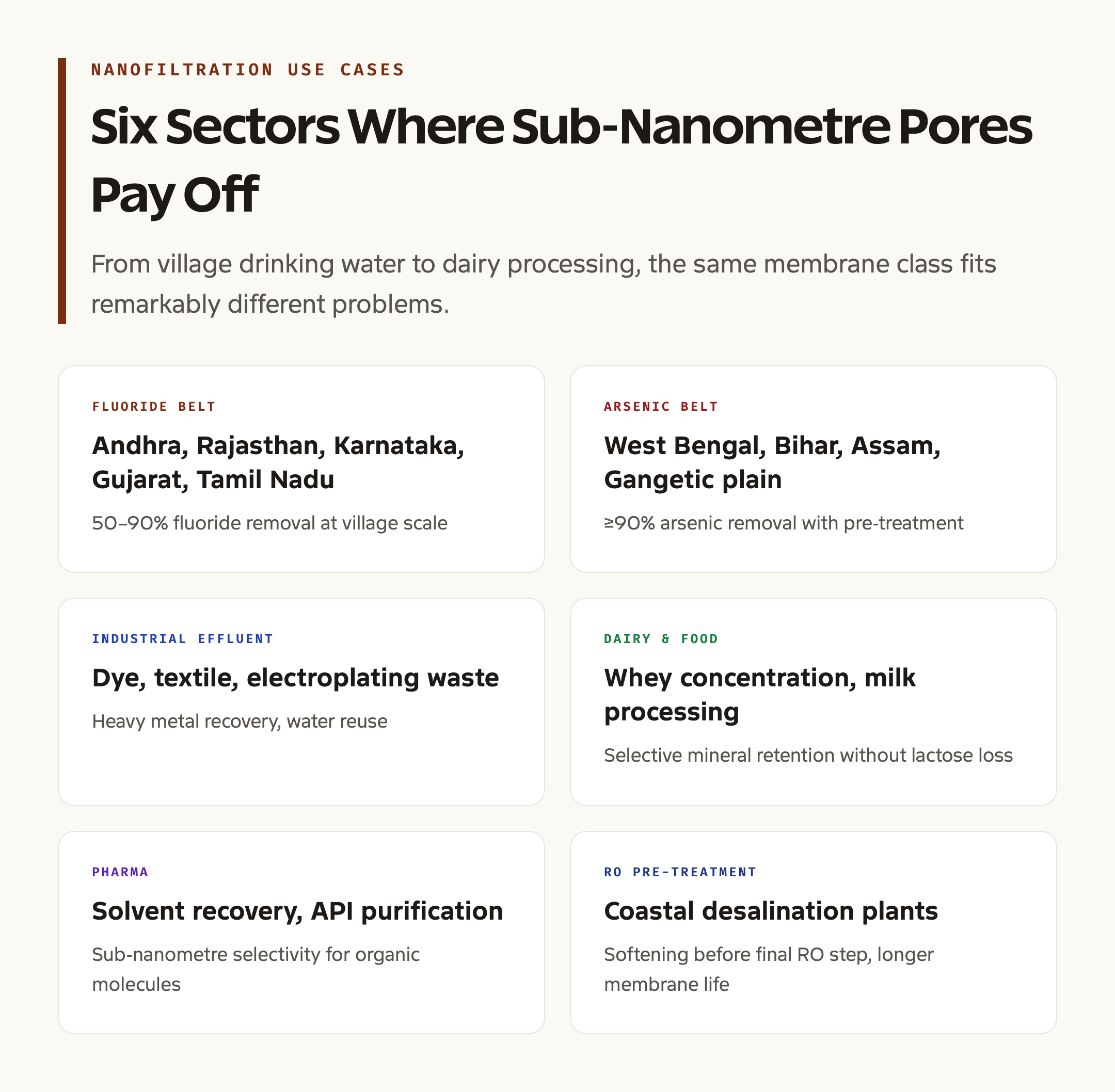
The shift towards drinking water came in two waves. Europe and the United States adopted nanofiltration in the 1990s for removing natural organic matter and disinfection-byproduct precursors from surface water supplies. India’s interest came later and centred on a different problem: groundwater toxicity. The fluoride belt across Andhra Pradesh, Rajasthan, Karnataka, Gujarat, and Tamil Nadu, and the arsenic belt across the lower Gangetic plain, drove the search for a treatment that was specific, affordable, and operable at village scale.
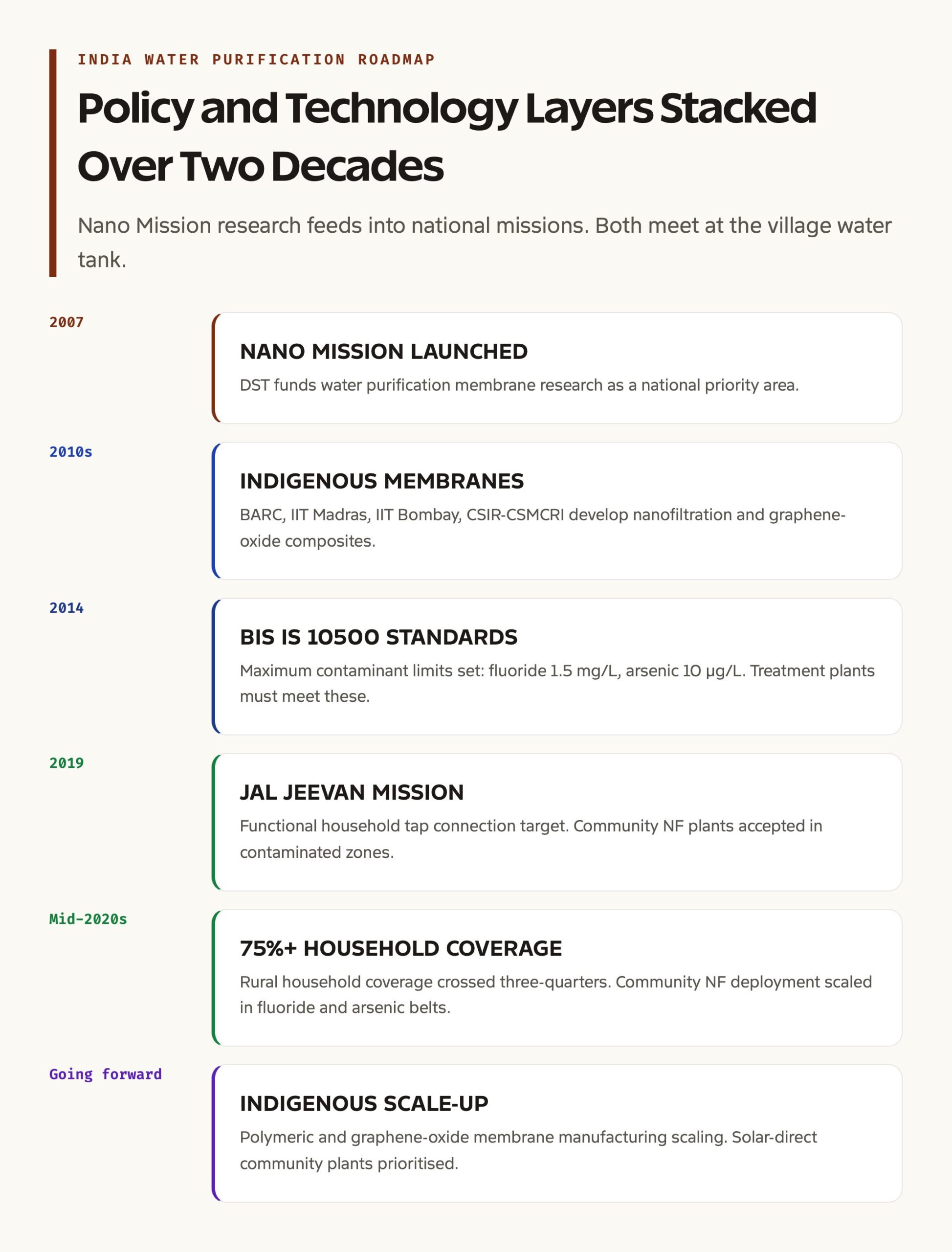
The Bhabha Atomic Research Centre, IIT Madras, IIT Bombay, and CSIR-CSMCRI Bhavnagar developed nanofiltration and related membrane technologies through the 2000s and 2010s. The Department of Science and Technology’s Nano Mission, launched in 2007 and renewed since, funded much of this. The result is a pipeline of indigenous membranes and complete community water systems that are now being deployed under Jal Jeevan Mission and various state-level safe water programmes.
Key Features of Nanofiltration
Five technical features matter. The first is pore size in the one to ten nanometre range, which sets what passes and what is rejected.
The second is surface charge. The membrane is engineered to repel specific ions. Negative charge on the membrane rejects fluoride and sulphate. Some specialty membranes carry positive charges to selectively reject heavy metal cations.
The third is selective rejection. Nanofiltration is the only major membrane class that distinguishes between monovalent and divalent ions in any meaningful way. This is what lets it produce mineral-retaining drinking water rather than the demineralised output of reverse osmosis.
The fourth is operating pressure. Three to twenty bar is achievable with small pumps that run on solar panels. Several Indian community systems run on direct solar without battery storage, generating water during daylight and storing it in tanks.
The fifth is fouling resistance. Nanofiltration membranes can be made resistant to organic fouling, biological growth, and chemical attack. Indian groundwater is often hard, iron-rich, and bacterially active, so fouling resistance translates directly to membrane life and operating cost.
Why Nanofiltration Matters
Nanofiltration matters because the alternatives have specific failure modes. Boiling water kills pathogens but does nothing to fluoride, arsenic, or nitrate. Chlorination handles bacteria and viruses but is useless against dissolved metals and may produce harmful disinfection byproducts. Activated carbon removes organic contaminants but lets ionic toxins through. Reverse osmosis removes everything, but the energy cost is too high for many rural deployments and the demineralised output is itself a long-term health concern.
Nanofiltration handles the mid-range problem. Fluoride at fifty to ninety percent removal. Arsenic at ninety percent and above when paired with the right pre-treatment. Heavy metals like cadmium, lead, and chromium at high rejection rates. Hardness reduced to comfortable levels without removing all the calcium and magnesium that human bodies need. Bacteria and viruses physically blocked by the membrane.
In economic terms, a community-scale nanofiltration plant serving a thousand people typically costs between twelve and twenty-five lakh rupees in capital and twenty to fifty paise per litre in operating cost. That fits within the budget envelopes of state water authorities and within the willingness-to-pay of rural users for safe drinking water.
For the health system, nanofiltration matters because it heads off chronic disease before it starts. Fluorosis, arsenicosis, and waterborne illness together account for a large share of preventable rural disease burden. Treating the water is cheaper than treating the patients.
Detailed Comparison: Microfiltration, Ultrafiltration, Nanofiltration, Reverse Osmosis
The four membrane classes form a continuum. Each removes the contaminants of the looser class plus a new tier.
| Class | Pore Size | Removes | Operating Pressure | Typical Use |
|---|---|---|---|---|
| Microfiltration | 100 to 10000 nm | Suspended solids, large bacteria | 0.1 to 2 bar | Pre-treatment, industrial |
| Ultrafiltration | 10 to 100 nm | All bacteria, viruses, large organics | 1 to 5 bar | Drinking water disinfection |
| Nanofiltration | 1 to 10 nm | Divalent ions, heavy metals, fluoride | 3 to 20 bar | Selective drinking water treatment |
| Reverse Osmosis | Below 1 nm | Almost everything including all salts | 10 to 70 bar | Desalination, ultrapure water |
The choice between them depends on the source water and the end use. Surface water for a city usually goes through ultrafiltration plus disinfection. Groundwater contaminated with fluoride goes through nanofiltration. Seawater needs reverse osmosis. A pharmaceutical plant making injectable products needs reverse osmosis followed by polishing.
The Nanomaterials Layer: Graphene Oxide and Silver Nanoparticles
Membrane technology is moving beyond conventional polymers. Three nanomaterials matter for the next generation of water purification.
Graphene oxide membranes consist of stacked graphene oxide sheets with channels between them. The channels can be tuned to specific widths by chemical treatment, producing membranes with extraordinarily precise selectivity. Indian groups at IIT Madras and JNCASR Bangalore have demonstrated graphene oxide nanofiltration that removes both heavy metals and organic dyes. Commercial deployment is still small-scale but growing.
Silver nanoparticles are added to membrane surfaces and to point-of-use filters as antimicrobial agents. Silver releases ions that disrupt bacterial cell membranes. Indian companies like Eureka Forbes and Tata Swach have used silver-doped media in household filters for over a decade. The flip side is that silver nanoparticles are themselves toxic to aquatic life if released uncontrolled, which limits how much can be used and how the spent media must be disposed of.
Iron oxide nano-adsorbents, including nano-magnetite and nano-goethite, are used as standalone or combined treatments for arsenic removal. The adsorbent binds arsenic species tightly. The spent material can be regenerated or safely disposed of. Several Indian plants in West Bengal use nano-iron-oxide cartridges as the polishing step after nanofiltration.
The connection to broader nanotechnology policy is direct. The Nano Mission has explicitly funded water purification membrane research as a national priority area, and several outputs have entered field deployment.
India’s Drinking Water Mission Architecture
Three pieces of policy define the deployment context.
Jal Jeevan Mission, launched in 2019, aims to provide functional household tap connections to every rural household by 2024. As of late 2024, over seventy-five percent of rural households had connections. The mission accepts community-scale treatment systems, including nanofiltration plants, where source water is contaminated.
The Swajal scheme, run earlier by the Ministry of Drinking Water and Sanitation, funded community-managed solar-powered water purification systems. Many of these used nanofiltration or reverse osmosis. The model was that village water user committees owned and operated the plants, with state funding for capital cost.
Bureau of Indian Standards drinking water specifications, IS 10500, set the maximum contaminant levels that any treatment system must achieve. Fluoride at 1.0 milligram per litre acceptable, 1.5 maximum. Arsenic at ten micrograms per litre maximum. Iron, nitrate, hardness, and total dissolved solids each have specified limits. Nanofiltration plants are designed to meet these standards reliably across the seasonal variation of source water.
State-level programmes have added their own layers. Andhra Pradesh, Rajasthan, and West Bengal have each rolled out community nanofiltration or related advanced treatment systems in the worst-affected districts.
Challenges in the Nanofiltration Ecosystem
Membrane fouling is the first persistent challenge. Iron, hardness, biological growth, and organic loading all reduce membrane permeability over time. Pre-treatment with sand filters, anti-scalants, and periodic chemical cleaning extend membrane life from a few months to several years. The cost and complexity of pre-treatment is a meaningful share of total operating cost.
Energy and brine disposal is the second. Even at three to twenty bar, the energy cost is non-trivial in remote villages without grid power. Solar power solves part of the problem but adds capital cost. The brine stream, ten to thirty percent of the input water, is concentrated in the contaminants that have been removed. Disposal in inland locations is regulated and sometimes difficult.
Operations and maintenance is the third and probably the largest issue in Indian rural deployments. A nanofiltration plant is more complex than a hand pump. Membrane replacement, chemical dosing, energy management, and water quality testing all require trained staff. Many community plants installed in the 2010s fell out of use because the operations model was not sustained. The lesson, slowly learned, is that institutional design matters as much as the membrane chemistry.
Cost and indigenous manufacturing is the fourth. Membrane elements are still substantially imported. Indian membrane manufacturers exist but production capacity is below domestic demand. Scaling indigenous manufacturing to drive cost down is a stated objective of the Nano Mission and the Department of Science and Technology.
Way Forward
Four directions look most promising. First, indigenous membrane manufacturing scale-up, both polymeric thin-film and graphene-oxide composite, with explicit linkage to drinking water deployment under Jal Jeevan Mission. Second, solar-direct community plants designed for low-maintenance operation, with simpler chemistry and longer membrane life. Third, decentralised arsenic removal cartridges using nano-adsorbents in the worst-affected blocks, paired with conventional safe water supply elsewhere. Fourth, a stronger institutional layer at the village level, treating each plant as a permanent piece of public infrastructure with funded operations rather than a one-off capital project.
For UPSC, the topic illustrates how a frontier technology becomes a public-health tool only when policy, manufacturing, and institutional design line up. Nanofiltration is not just a membrane question. It is also a question of how India organises the delivery of safe drinking water at the last mile.
Frequently Asked Questions
What is nanofiltration in simple terms?
Nanofiltration is membrane filtration that uses pores roughly one to ten nanometres in diameter. It removes divalent ions like calcium and many heavy metals, plus fluoride, arsenic, and bacteria, while letting monovalent salts pass through. It sits between ultrafiltration and reverse osmosis on the membrane spectrum.
How is nanofiltration different from reverse osmosis?
Nanofiltration uses larger pores than reverse osmosis and operates at lower pressure, three to twenty bar against ten to seventy bar for reverse osmosis. It selectively retains divalent ions but lets monovalent salts through, producing mineral-retaining water. Reverse osmosis removes nearly everything and is needed for seawater desalination.
Can nanofiltration remove fluoride and arsenic?
Yes. Nanofiltration typically removes fifty to ninety percent of fluoride and ninety percent or more of arsenic when paired with appropriate pre-treatment. This makes it directly useful for the fluoride and arsenic belts across India.
What role does graphene oxide play in nanofiltration?
Graphene oxide membranes use stacked graphene oxide sheets with tunable channels. They offer high selectivity and water flux and are an active area of Indian research, particularly at IIT Madras and JNCASR Bangalore. Commercial deployment is still small but growing.
How does nanofiltration fit into Jal Jeevan Mission?
Jal Jeevan Mission accepts community-scale treatment systems, including nanofiltration plants, in areas where source water exceeds drinking water standards for contaminants like fluoride or arsenic. The mission funds the capital cost and the state water authority operates the plants, often with village water user committees.
Tell Google you want more of this.
Add Anantam IAS as a preferred sourceOne tap, and this site shows up more often in your own Top Stories, AI Overviews and AI Mode. Remove it any time.