The gold got the headlines. Five sealed chambers opened in 2011, and out came a number so large that most reports simply gave up and called the Sree Padmanabhaswamy Temple the richest place of worship in the world. That story is real, and it’s also the least interesting thing about this temple.
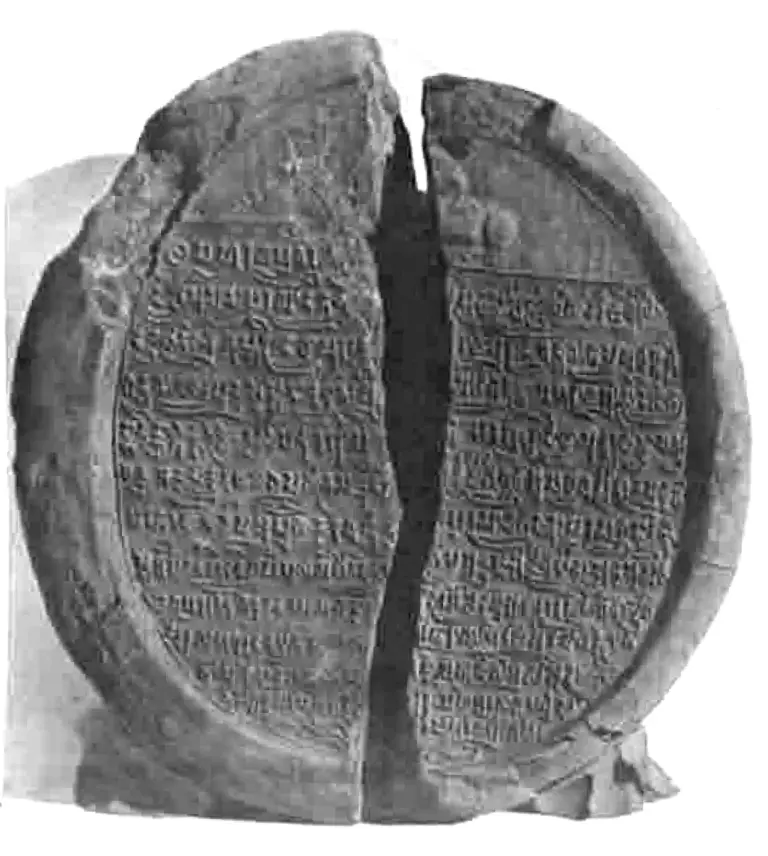
Here’s the fact the treasure coverage buries. In 1750, the ruler of Travancore signed his entire kingdom over to the deity inside this sanctum, and then governed it as the god’s servant rather than as its owner. Not as a metaphor. As a legal and constitutional arrangement that survived the kingdom, survived independence, and was still being argued in the Supreme Court of India in 2020. The vaults are a consequence of that deed, not a curiosity beside it. Get the deed and the rest of the temple falls into order.
What the Sree Padmanabhaswamy Temple is
The Sree Padmanabhaswamy Temple stands in Thiruvananthapuram, the capital of Kerala, and it’s dedicated to Vishnu in the form of Anantha Padmanabha, shown reclining in yogic sleep on the coils of the serpent Anantha. It’s one of the 108 Divya Desams of the Sri Vaishnava tradition, it blends Kerala and Dravidian architecture in a way almost no other Kerala temple does, and it’s tied by a deed of gift to the erstwhile Travancore royal family.
Take the deity’s name apart first, because it explains the building, the city, and the litigation in one go. *Padmanabha* means “lotus-navel.” In the image, a lotus rises out of Vishnu’s navel and Brahma sits on it, so creation is shown emerging from the sleeping god’s body. *Anantha* means “the endless one,” the thousand-hooded serpent he lies on. And Thiruvananthapuram is simply *Thiru-Anantha-Puram*, “the sacred city of Anantha.” Kerala’s capital is named after the snake in this sanctum. That’s not a coincidence anyone had to arrange; the temple came first and the city grew around it.
| Attribute | Detail |
|---|---|
| Location | Thiruvananthapuram, Kerala |
| Deity | Vishnu as Anantha Padmanabhaswamy, reclining on the serpent Anantha |
| Posture | Anantha shayanam, yogic sleep on the serpent, facing east |
| Idol | About 18 feet long, viewed through three separate doors |
| Idol material | Katusarkara yogam, an ayurvedic amalgam, holding 12,008 saligrams |
| Gopuram | 7 tiers, about 100 feet, Pandyan style; foundation laid 1566 |
| Architecture | Kerala style blended with Dravidian (Tamil) elements |
| Temple tank | Padma Theertham, the “lotus spring” |
| Corridor | 365 and one-quarter carved granite pillars |
| Tradition | One of the 108 Divya Desams, praised in the Alvars’ hymns |
| Royal link | Trippadidanam of 1750; Travancore rulers styled Sree Padmanabhadasa |
| Administration | Committee under the 2020 Supreme Court ruling, chaired by the District Judge |
The god who sleeps, and why you see him through three doors
The image in the sanctum is about 18 feet long, and the sanctum is small, so you cannot see the whole god at once. You see him through three separate doors: the first frames the head and the hands, the second the torso and the navel with Brahma on his lotus, and the third the feet. Three windows, one body, and no vantage point anywhere in the temple from which the deity is visible in full.
Sit with how strange that is. Most temple design works to deliver you a single, complete darshan at the end of a long approach. Here the architecture refuses. You assemble the god in your head from three glimpses, in sequence, and the assembly is the experience. Whether or not that was the intent, it’s the most honest piece of theology in the building: this is Vishnu as *anantha shayanam*, resting on the endless one between cycles of creation, and a god the size of the cosmos was never going to fit in one doorway.
The image itself is unusual material. It isn’t carved from a single stone or cast in metal. It’s built from katusarkara yogam, a hardened ayurvedic amalgam, packed around 12,008 saligrams, the sacred fossil stones brought from the Gandaki river in Nepal. Because of that composition the deity isn’t given the usual abhishekam with water and oils, which would damage it. This trips up almost everyone who assumes every temple idol is stone or bronze; here the god is, in a real sense, a compound.
If the reclining posture sounds familiar, it should. Ranganatha at Srirangam reclines too, and the two are the great reclining-Vishnu temples of the south. The useful distinction to hold: Ranganatha faces south, Padmanabha faces east, and Srirangam wraps its god in seven walls while Thiruvananthapuram wraps its god in three doors.
Kerala architecture with a Tamil tower
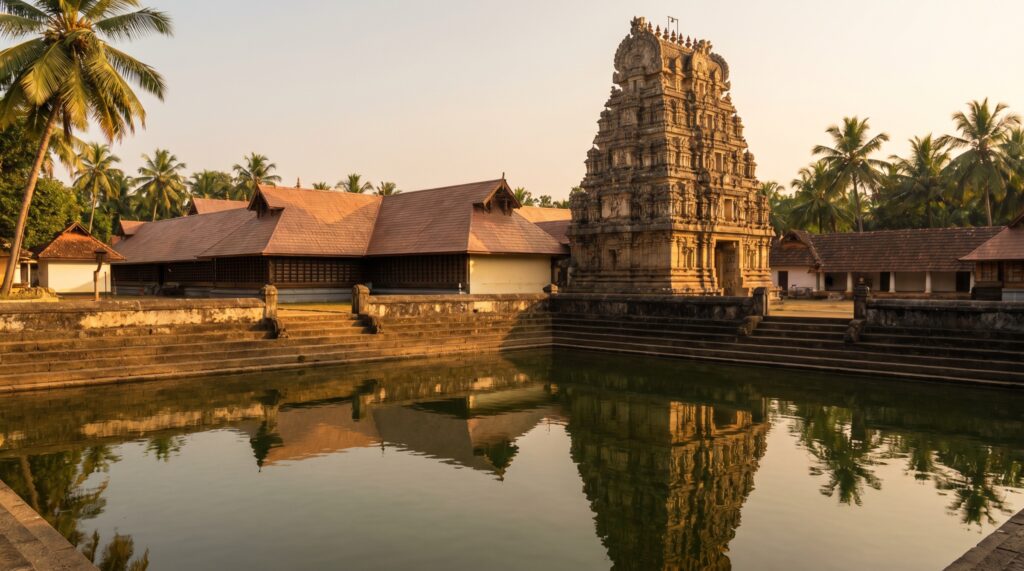
Look at the temple from the tank and the anomaly announces itself: a seven-tier gopuram about 100 feet tall, built in Pandyan style, whose foundation was laid in 1566. That tower has no business being in Kerala, and that’s exactly why it’s worth teaching.
Name the default first. A Kerala temple normally has no soaring gateway at all. It’s a low, walled compound built for monsoon country: a srikovil (the sanctum, often circular or square) under a steep sloping roof of copper or tile, timber framing, gabled ends, carved wooden brackets, and the whole thing dissolving into the rain and the trees. Height is not the point. Shedding water is the point. Now compare a Tamil Dravidian temple, where the tallest thing on site is a pyramidal stone-and-stucco gateway tower stacked in tiers over the outer wall, built to be seen from the next district.
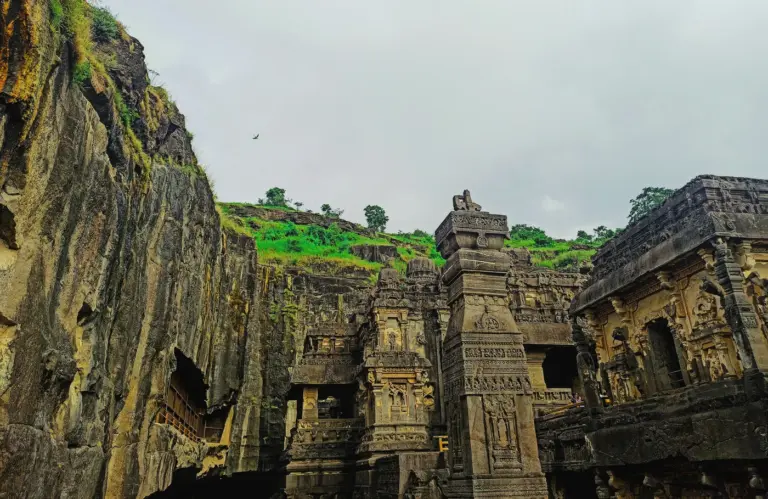
Padmanabhaswamy does both, and it does them without pretending they’re the same thing. The inner shrine and its roofs follow Kerala practice. The gopuram and the granite corridors follow Tamil practice. The join is the interesting part: Travancore sat on the cultural seam between Kerala and the Tamil country, its rulers looked east as much as west, and the building records that. Architecture is downstream of politics more often than the textbooks admit, and the temple architecture of India is easier to hold once you treat regional styles as arguments rather than boxes.
Three specifics make the complex stick. The Padma Theertham, the “lotus spring,” is the temple tank you pass on the way in. The corridor carries 365 and one-quarter carved granite pillars, a count that matches the days of a solar year, quarter and all. And the Ottakkal Mandapam is a platform cut from a single slab of stone roughly 20 square feet in area and 2.5 feet thick, hauled and installed in 1731 on Marthanda Varma’s orders. One stone. That’s not decoration, that’s a statement about what the kingdom could move.
The present temple is also younger than it looks. A major fire in 1686 destroyed much of the structure, reconstruction began in 1724, and the serious rebuilding came after Marthanda Varma became king in 1729. So the temple you photograph today is largely an eighteenth-century Travancore project raised on a site the Alvars were already singing about a thousand years earlier.
Trippadidanam: the kingdom that was signed over to a god
On 17 January 1750, Anizham Thirunal Marthanda Varma (1706 to 1758), the founder of modern Travancore, performed the Trippadidanam and surrendered his kingdom to Sree Padmanabhaswamy. From that day the deity was the sovereign of Travancore and the ruler governed as Sree Padmanabhadasa, “servant of Padmanabha,” holding the state in trust for the god. Every Travancore ruler after him carried that title.
Translate what actually changed, because “he gave the kingdom to a temple” undersells it. The deity became the legal owner of the state. The king kept power but lost proprietorship: he administered Travancore as the god’s steward, drew his authority from that role, and could not claim the kingdom as personal property. Land, revenue, and treasury sat under Padmanabha’s name, and the ruler’s own legitimacy now ran through the sanctum instead of through conquest.
Was this piety or politics? Both, and the honest answer is that the two weren’t separable. Marthanda Varma had spent two decades breaking the power of the Ettuveetil Pillamar, the “Lords of the Eight Houses,” and curbing the Ettara Yogam, the council of eight that had shared control of the temple with the king. He’d made himself the strongest ruler in the region by force. The Trippadidanam took that hard-won authority and moved it beyond challenge, because a nobleman can plot against a king but he can’t very well file a claim against a god. It was a masterstroke of legitimation that happened to also be sincere.
And it never really ended. Travancore acceded to India and merged into what became Kerala, and the integration of the princely states dissolved the kingdom as a political unit. But the shebaitship, the right and duty to manage the deity’s affairs, is a legal interest recognised by Indian courts, and it stayed with the family. That’s the thread that runs from a 1750 ceremony straight into a twenty-first-century courtroom.
The vaults, and what the inventory actually found
The temple has six known vaults, labelled A to F, sealed underground chambers holding the deity’s accumulated wealth, and an amicus curiae report in April 2014 identified two more, G and H. Vault A was opened in June 2011 under Supreme Court orders, and along with the other opened chambers it yielded gold ornaments, coins, precious stones, and ritual objects on a scale nobody outside the temple had reliably guessed at.
Be careful with the number, because almost every retelling isn’t. The figure you’ll see everywhere is over ₹1 lakh crore, and it’s worth knowing exactly what that is: a rough estimate based largely on the weight of gold, produced in media reporting after the inventory. It isn’t an official valuation, it doesn’t price antiquity or artistic value, and gold weight moves with the market. The honest statement is that the inventoried wealth runs into the tens of billions of dollars by weight alone, and that the true figure is unknown because a full valuation of that kind has never been published. A number this famous deserves the caveat more than most.
Vault B is the one that stayed shut. It hasn’t been opened since around the 1880s, the royal family opposed opening it, and the Supreme Court’s 2020 judgment said nothing about opening it. Popular accounts wrap it in a curse and a serpent-carved door. What’s actually on record is narrower and more interesting: a chamber sealed for well over a century, a family arguing that opening it would violate the deity’s sanctity, and a court that declined to force the question. Treat the folklore as folklore and the sealing as fact, and you’ll be more accurate than most of what’s written about it.
There’s a human detail worth keeping. The inventory happened because T.P. Sundara Rajan, a local advocate, filed a writ petition in 2009. He sat on the Supreme Court’s panel and watched five vaults open. He died in July 2011, before the question of Vault B was resolved. The man who forced open the richest temple treasury on earth never saw the chamber everyone argues about.
Who runs the temple: the litigation and the ruling
The governing question was never the gold. It was who controls the temple after the kingdom is gone, and the Supreme Court answered it on 13 July 2020: a bench of Justices U.U. Lalit and Indu Malhotra upheld the erstwhile Travancore royal family’s role as shebaits, setting aside a 2011 Kerala High Court decision that had directed the state government to take over the temple’s management and assets.
Follow the reasoning, because it’s cleaner than the headlines suggest. The Kerala High Court had held that the family’s rights ended with the death of Chithira Tirunal Balarama Varma, the last ruler of Travancore, who died in 1991, and that the state should step in. The Supreme Court disagreed on a narrow, technical point: shebaitship is not the same thing as rulership. It’s a heritable religious office attached to the deity, so the death of the last Maharaja didn’t extinguish it, and it passed to his successors in the family. The kingdom ended in 1949; the service to the god didn’t.
The court didn’t hand the temple back as private property either, and that nuance gets lost constantly. It set up an administrative committee chaired by the District Judge of Thiruvananthapuram, with representatives of the Kerala and Union governments, the chief Tantri, a nominee of the titular Maharaja, and an expert member. The family’s role is recognised; the day-to-day running is supervised. The judgment is on the Supreme Court of India’s website.
This is why the case is worth your attention beyond the temple. It sits at the junction of religious denominational rights, the state’s power to regulate secular administration of religious institutions, and the afterlife of princely-era arrangements inside a republic. Anyone working through freedom of religion under Articles 25 to 28 will find that Padmanabhaswamy is the sharpest recent illustration of where the line between religion and administration actually gets drawn.
A Divya Desam, and the Alvars’ claim on the temple
Long before Travancore existed, this was already a famous place. Padmanabhaswamy is one of the 108 Divya Desams, the holy abodes of Vishnu praised by the Alvars, the twelve Tamil poet-saints of the Bhakti movement, and it appears in Tamil hymns from the 7th and 8th centuries CE. A Kerala temple, sung in Tamil, canonised in a Tamil devotional corpus, centuries before the kingdom that made it rich.
That single fact does a lot of quiet work. It explains the Tamil-style gopuram on a Kerala shrine, it explains why Sri Vaishnavism claims a temple in Malayalam country, and it kills the tidy assumption that religious geography follows modern state lines. Devotion travelled along a coast and a language network, not along a 1956 map.
The living calendar reflects that layered inheritance. The Laksha Deepam, “a hundred thousand lamps,” is held once every six years at the close of a 56-day period of Vedic chanting called the Murajapam. The biannual festivals in Alpasi (around October and November) and Painkuni (around March and April) end with the Aarat, a procession that carries the deities to the sea at Shankumugham Beach. And the dress code holds: men in a plain white mundu, women in a sari. It’s a working temple with a strict tradition, not a museum with a ticket counter.
How to study Padmanabhaswamy without drowning in detail
Sort every fact about this temple into three buckets and it stops sliding around: the god, the building, and the deed. Almost nothing here falls outside those three, and the reason most notes on this temple turn to mush is that they start with the treasure, which is a consequence of the third bucket and belongs there.
For the god, lock one sentence: Vishnu as Anantha Padmanabha, reclining in yogic sleep on the serpent Anantha, an 18-foot image of katusarkara yogam holding 12,008 saligrams, seen through three doors, in one of the 108 Divya Desams. Add the name chain (Thiru-Anantha-Puram is the city of Anantha) and the contrast with the south-facing Ranganatha at Srirangam. That’s the whole religious layer.
For the building, hold the blend and one number each side: Kerala style (sloping roofs, walled compound, no tall gateway by default) plus Dravidian style (the 7-tier, 100-foot Pandyan gopuram, foundation laid 1566, and the granite corridor of 365 and a quarter pillars). Remember the fire of 1686 and the eighteenth-century rebuild, so you don’t mistake the present structure for the ancient one. Compare it with a pure Dravidian complex like Virupaksha at Hampi and the hybrid becomes obvious rather than confusing.
For the deed, learn the chain in order and everything else hangs off it: Trippadidanam, 17 January 1750, Marthanda Varma surrenders Travancore to Padmanabha; rulers become Padmanabhadasa; shebaitship survives the kingdom; vaults A to F hold the deity’s wealth; five opened in 2011 after T.P. Sundara Rajan’s petition; Vault B still sealed; Kerala High Court 2011 orders a state takeover; Supreme Court reverses it on 13 July 2020 and sets up a District Judge-led committee. That’s ten links in one chain, and it answers the treasure question, the architecture question, and the constitutional question at the same time. That’s the whole secret to this topic: it’s one story, not three.
Frequently Asked Questions
Which deity is worshipped at the Sree Padmanabhaswamy Temple?
Vishnu, in the form of Anantha Padmanabhaswamy, reclining in yogic sleep on the serpent Anantha. Padmanabha means “lotus-navel,” because a lotus bearing Brahma rises from the god’s navel.
Why is the idol viewed through three doors?
The image is about 18 feet long and the sanctum is small, so no single vantage point shows the whole deity. The first door frames the head and hands, the second the torso and navel with Brahma on his lotus, and the third the feet.
What is the Trippadidanam?
It’s the ceremony of 17 January 1750 in which Marthanda Varma surrendered the Kingdom of Travancore to Sree Padmanabhaswamy. The deity became the sovereign, and every Travancore ruler after him governed as Sree Padmanabhadasa, the servant of Padmanabha.
What was found in the Padmanabhaswamy Temple vaults?
Five of the six known vaults were opened in 2011 under Supreme Court orders and yielded gold ornaments, coins, precious stones, and ritual objects. The widely quoted figure of over ₹1 lakh crore is a rough estimate based mainly on the weight of gold, not an official valuation.
Why has Vault B never been opened?
Vault B hasn’t been opened since around the 1880s. The royal family opposed opening it on the grounds that it would violate the deity’s sanctity, and the Supreme Court’s 2020 judgment did not order it opened. The stories of a curse are folklore, not record.
What did the Supreme Court rule in 2020?
On 13 July 2020, Justices U.U. Lalit and Indu Malhotra upheld the erstwhile Travancore royal family’s shebait rights over the temple, setting aside a 2011 Kerala High Court order for a state takeover. The court held that shebaitship is a religious office that didn’t end with the death of the last ruler in 1991, and it set up an administrative committee chaired by the District Judge of Thiruvananthapuram.
What architectural style is the Padmanabhaswamy Temple?
A blend. The inner shrine and its sloping roofs follow Kerala practice, while the seven-tier, roughly 100-foot gopuram and the granite corridors follow Tamil Dravidian practice. The gopuram’s foundation was laid in 1566.
Is Padmanabhaswamy Temple a Divya Desam?
Yes. It’s one of the 108 Divya Desams of the Sri Vaishnava tradition, praised in Tamil hymns of the Alvars dating to the 7th and 8th centuries CE, centuries before the Travancore kingdom existed.
Practice Questions
1. The deity at the Sree Padmanabhaswamy Temple is a form of:
a) Shiva
b) Vishnu
c) Surya
d) Brahma
Answer: b
2. The Trippadidanam of 1750 refers to:
a) The consecration of the temple gopuram
b) The surrender of the Kingdom of Travancore to the deity by Marthanda Varma
c) The opening of the temple vaults
d) A treaty between Travancore and the British
Answer: b
3. The title assumed by the rulers of Travancore after the Trippadidanam was:
a) Ranganathadasa
b) Padmanabhadasa
c) Anantha Varma
d) Dharmaraja
Answer: b
4. In its judgment of 13 July 2020 on the Sree Padmanabhaswamy Temple, the Supreme Court:
a) Ordered the opening of Vault B
b) Handed the temple to the Kerala government
c) Upheld the shebait rights of the erstwhile Travancore royal family
d) Declared the temple treasure to be state property
Answer: c
5. The Sree Padmanabhaswamy Temple is counted among the:
a) 12 Jyotirlingas
b) 51 Shakti Peethas
c) 108 Divya Desams
d) 4 Char Dham shrines
Answer: c
Mains-style questions
1. “The Trippadidanam was an act of devotion that doubled as a masterstroke of political legitimation.” Critically examine this statement with reference to Marthanda Varma and the consolidation of Travancore. 2. The Sree Padmanabhaswamy Temple blends Kerala and Dravidian architectural traditions. Discuss the distinguishing features of each style and explain what the blend reveals about the region’s cultural geography. 3. Analyse the 2020 Supreme Court judgment on the Sree Padmanabhaswamy Temple. What does it settle about the distinction between shebaitship and rulership, and about the state’s power to regulate the secular administration of religious institutions? 4. Discuss the challenges of conserving, valuing, and securing temple wealth of the kind inventoried at Thiruvananthapuram, and the competing claims that such wealth attracts. 5. Trace the place of the Sree Padmanabhaswamy Temple in the Sri Vaishnava tradition, with reference to the Divya Desams and the Alvars.
The temple’s real subject isn’t the treasure, and the sooner you drop the gold the sooner the topic gets easy. What’s sitting in Thiruvananthapuram is a working answer to a question most countries never have to ask: what happens to a god who legally owns a kingdom when the kingdom stops existing? Travancore’s answer was to keep serving, and the Republic’s answer, delivered in 2020, was that the service outlives the sovereignty. Learn the three buckets, keep 1750 and 2020 at opposite ends of one thread, and remember that the eighteen-foot god you can only see in three pieces has been the largest landowner in the story the entire time.
Tell Google you want more of this.
Add Anantam IAS as a preferred sourceOne tap, and this site shows up more often in your own Top Stories, AI Overviews and AI Mode. Remove it any time.